Search
Search results
Tapestry
Tabletop Game
Tapestry is a two-hour civilization game for 1-5 players designed by Jamey Stegmaier. Create the...
Boardgames 2019Boardgames Civilizationgames
The Walking Dead: No Sanctuary
Tabletop Game
THE WALKING DEAD: NO SANCTUARY—designed by the award-winning team of Adam and Brady Sadler—is...

Purple Phoenix Games (2266 KP) rated Please Fix the Teleporter in Tabletop Games
Jan 25, 2021

Captain Gerf and Emperor Korlax are trapped inside the teleportation beam? Again? Who forgot to install the upgrade module? Uh oh, it was me… Well now I need to get to work fixing this infernal teleporter because my captain and his captured enemy keep coming aboard all different. They are all shouting at me, “PLEASE FIX THE TELEPORTER!”
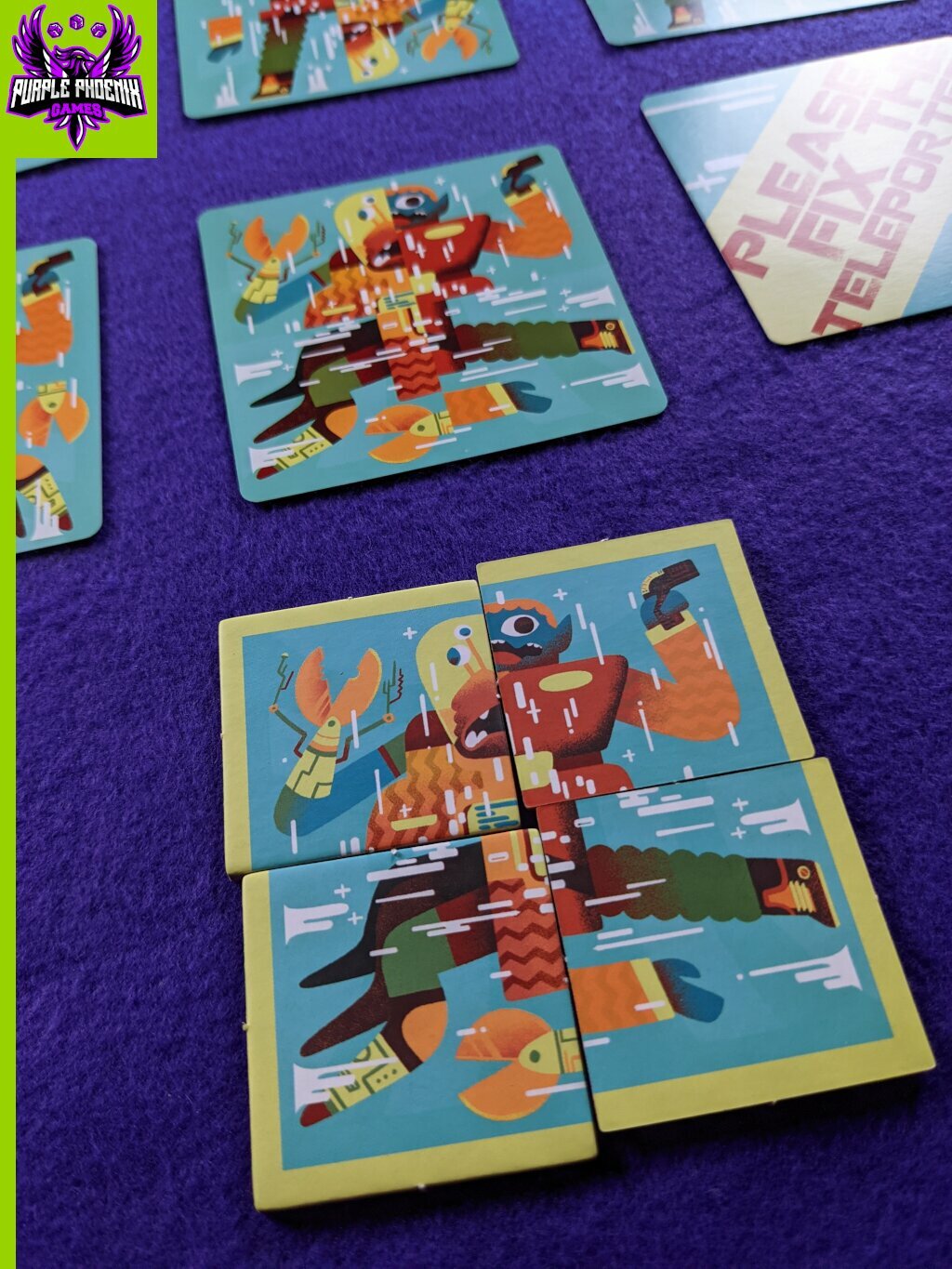
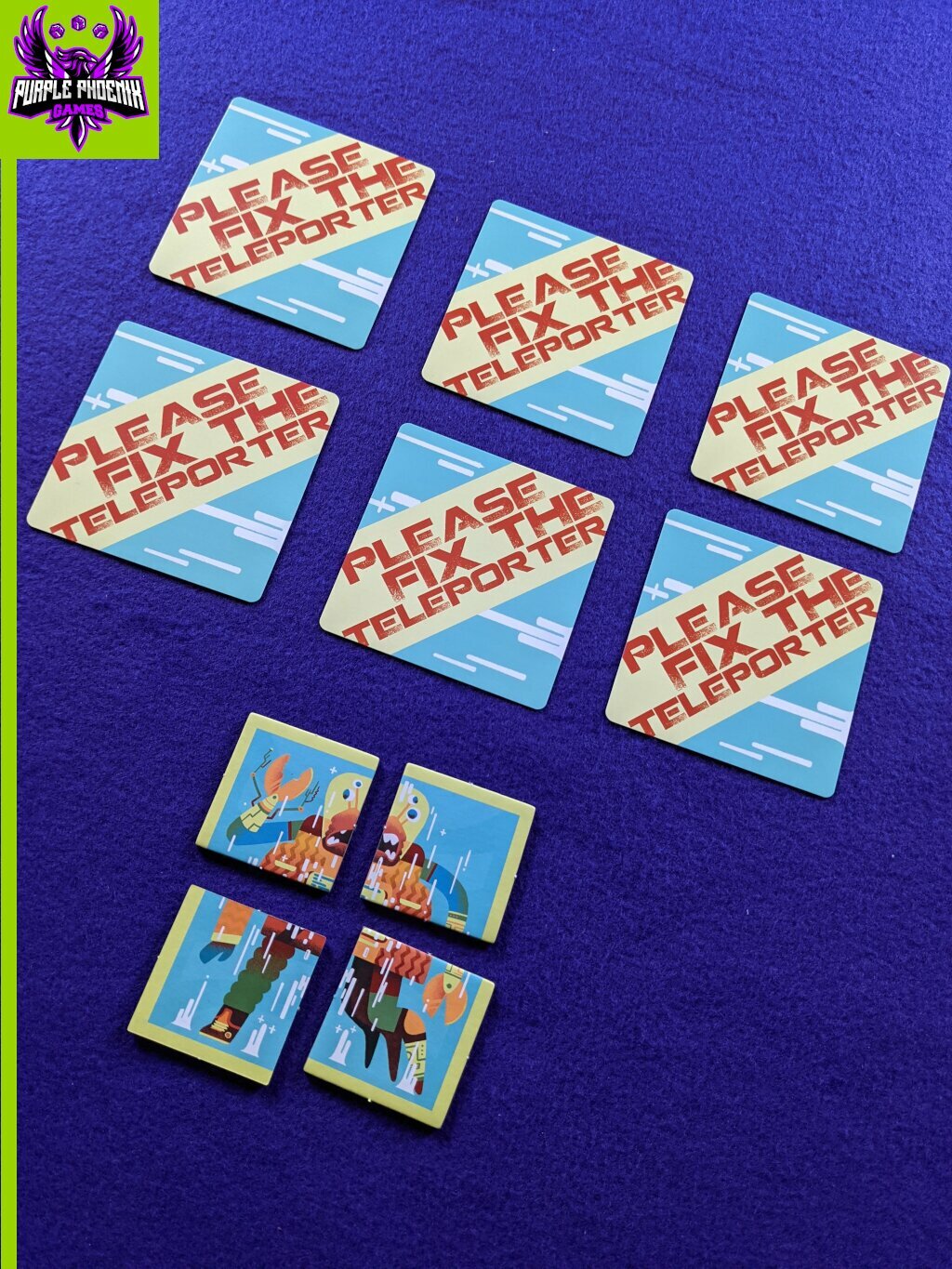
Please Fix the Teleporter is a quick real-time action/dexterity card game for 1-4 players, but in this preview I will be tackling it as a solo experience. In it players are teleportation specialists charged with repairing a malfunctioning teleportation beam that is displaying strange mix-and-match features of the two persons attempting to board the craft. By matching the images on the display six times the Captain and his quarry can board safely and in one piece.
DISCLAIMER: We were provided a prototype copy of this game for the purposes of this review. These are preview copy components, and I do not know for sure if the final components will be any different from these shown. You are invited to back the game through the Kickstarter campaign,or through any retailers stocking it after fulfillment. -T
To setup for a solo game choose one color of body part tiles and place them in front of the player. Shuffle the deck of scrambled cards and deal six face-down. Have a timer handy (Alexa, Siri, or Google also work well) and the game may begin!
Gameplay is simple: flip over one card, match the card with the body tiles to recreate the image and then flip over the next card. Repeat these steps until all six cards have been matched and then stop the timer. Based on the table on the back of the rulesheet the player may determine how well they fared. For example, the highest score that may be achieved is five stars, which is earned by completing the game in under 30 seconds.
Once the game is over, the player will most certainly wish to play again, so multiple games may be played in order to earn that glorious five star rating.
Multiplayer rules are almost exactly the same except instead of dealing six cards at the beginning, the first player to match and claim five cards will be the winner.
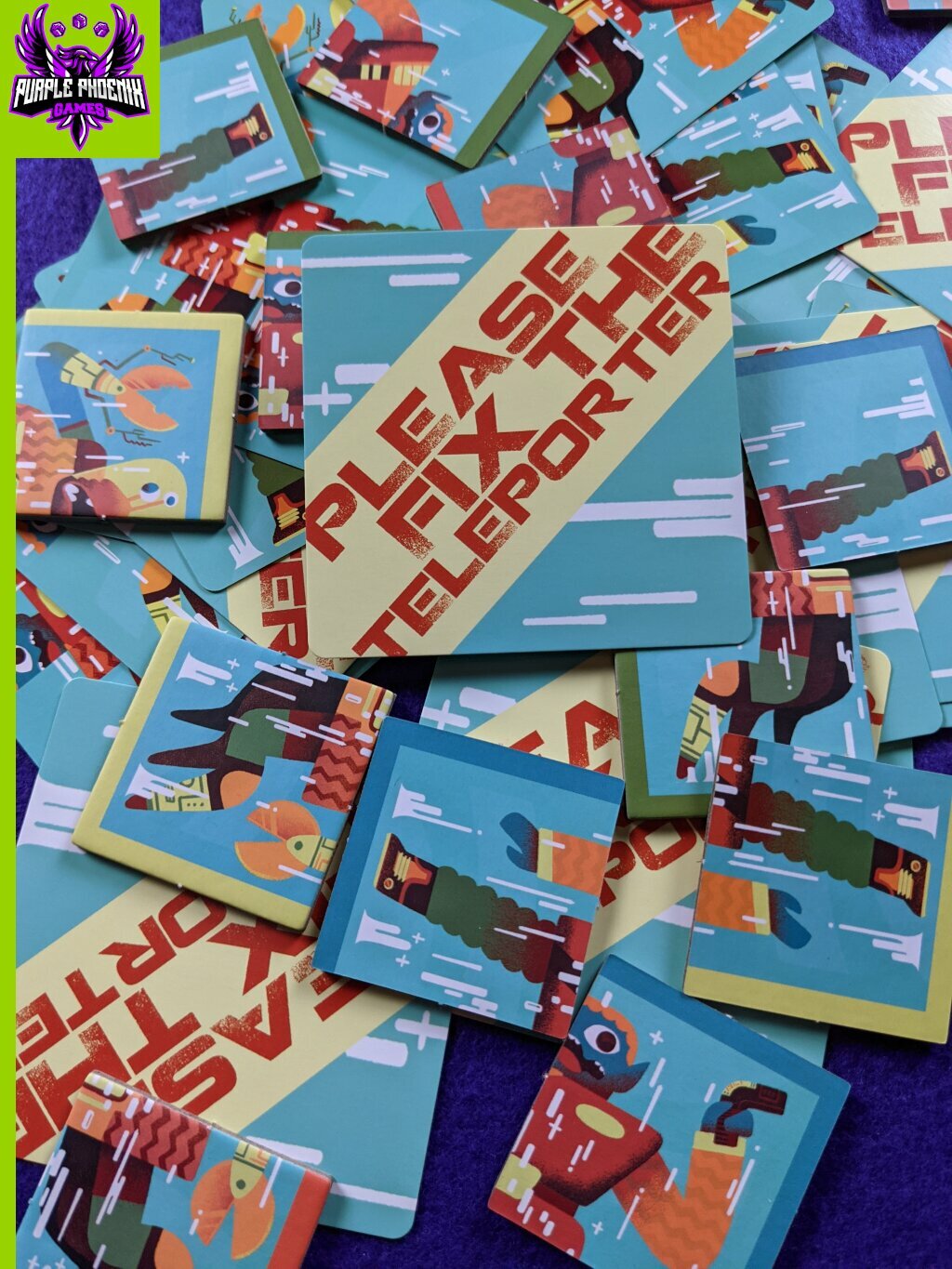
Components. This game is a bunch of cards and four tiles per player. The cards are nice squares and the tiles are chunky cardboard. What sets this game apart for me is the art style. The art here, as you have seen, is so crazy and wonky and I just love it! The colors used are some of my favorites and it just looks amazing on the table. I have zero complaints for components and art.
Gameplay is similarly loved. This one is so quick and easy that anyone can play and be great at it. It takes mere seconds to teach and each player will want to play more and more, even the solo player. I cannot really comment on strategy, as this game really doesn’t lend itself to any sort of strategic play. It is a free-for-all to match the cards and move on to the next. I like being frantic.
So if you are at all like me and love these little “refreshers,” as I like to call them, check this one out. It will fit perfectly between two heavy hitters to refresh the players for the next game. Or will perfectly balance your night of solo play. Are you into theme nights? I am. What a great addition to an outer space themed game night! Quick and easy with excellent art. This one is a winner, even if I never manage to actually fix the dang teleporter.

Please Fix the Teleporter is a quick real-time action/dexterity card game for 1-4 players, but in this preview I will be tackling it as a solo experience. In it players are teleportation specialists charged with repairing a malfunctioning teleportation beam that is displaying strange mix-and-match features of the two persons attempting to board the craft. By matching the images on the display six times the Captain and his quarry can board safely and in one piece.
DISCLAIMER: We were provided a prototype copy of this game for the purposes of this review. These are preview copy components, and I do not know for sure if the final components will be any different from these shown. You are invited to back the game through the Kickstarter campaign,or through any retailers stocking it after fulfillment. -T
To setup for a solo game choose one color of body part tiles and place them in front of the player. Shuffle the deck of scrambled cards and deal six face-down. Have a timer handy (Alexa, Siri, or Google also work well) and the game may begin!
Gameplay is simple: flip over one card, match the card with the body tiles to recreate the image and then flip over the next card. Repeat these steps until all six cards have been matched and then stop the timer. Based on the table on the back of the rulesheet the player may determine how well they fared. For example, the highest score that may be achieved is five stars, which is earned by completing the game in under 30 seconds.
Once the game is over, the player will most certainly wish to play again, so multiple games may be played in order to earn that glorious five star rating.
Multiplayer rules are almost exactly the same except instead of dealing six cards at the beginning, the first player to match and claim five cards will be the winner.
Components. This game is a bunch of cards and four tiles per player. The cards are nice squares and the tiles are chunky cardboard. What sets this game apart for me is the art style. The art here, as you have seen, is so crazy and wonky and I just love it! The colors used are some of my favorites and it just looks amazing on the table. I have zero complaints for components and art.
Gameplay is similarly loved. This one is so quick and easy that anyone can play and be great at it. It takes mere seconds to teach and each player will want to play more and more, even the solo player. I cannot really comment on strategy, as this game really doesn’t lend itself to any sort of strategic play. It is a free-for-all to match the cards and move on to the next. I like being frantic.
So if you are at all like me and love these little “refreshers,” as I like to call them, check this one out. It will fit perfectly between two heavy hitters to refresh the players for the next game. Or will perfectly balance your night of solo play. Are you into theme nights? I am. What a great addition to an outer space themed game night! Quick and easy with excellent art. This one is a winner, even if I never manage to actually fix the dang teleporter.
Purple Phoenix Games (2266 KP) rated Voltage in Tabletop Games
Jan 8, 2022
One thing that I truly love about the board gaming hobby is the ability to discover new games at nearly every turn. Just when I think I’ve seen it all, I come across a post on BGG or a social media game group that blows my mind. Either with unique gameplay, or sweet components, I’m always in awe at how many games are new to me every day. Enter Voltage. I came across this game at The Table when I visited Travis in Tennessee this summer. This game has apparently been around since 2006, but I never came across it until 2021. The box was unassuming on the shelf, but the gameplay seemed interesting. Added bonus: it’s a 2-player game that doesn’t take forever to play, which was perfect for a quick game night out. So I guess I am very late to the Voltage party, but as you can tell from my rating above, I think it’s a pretty stellar game. Keep reading to find out why!
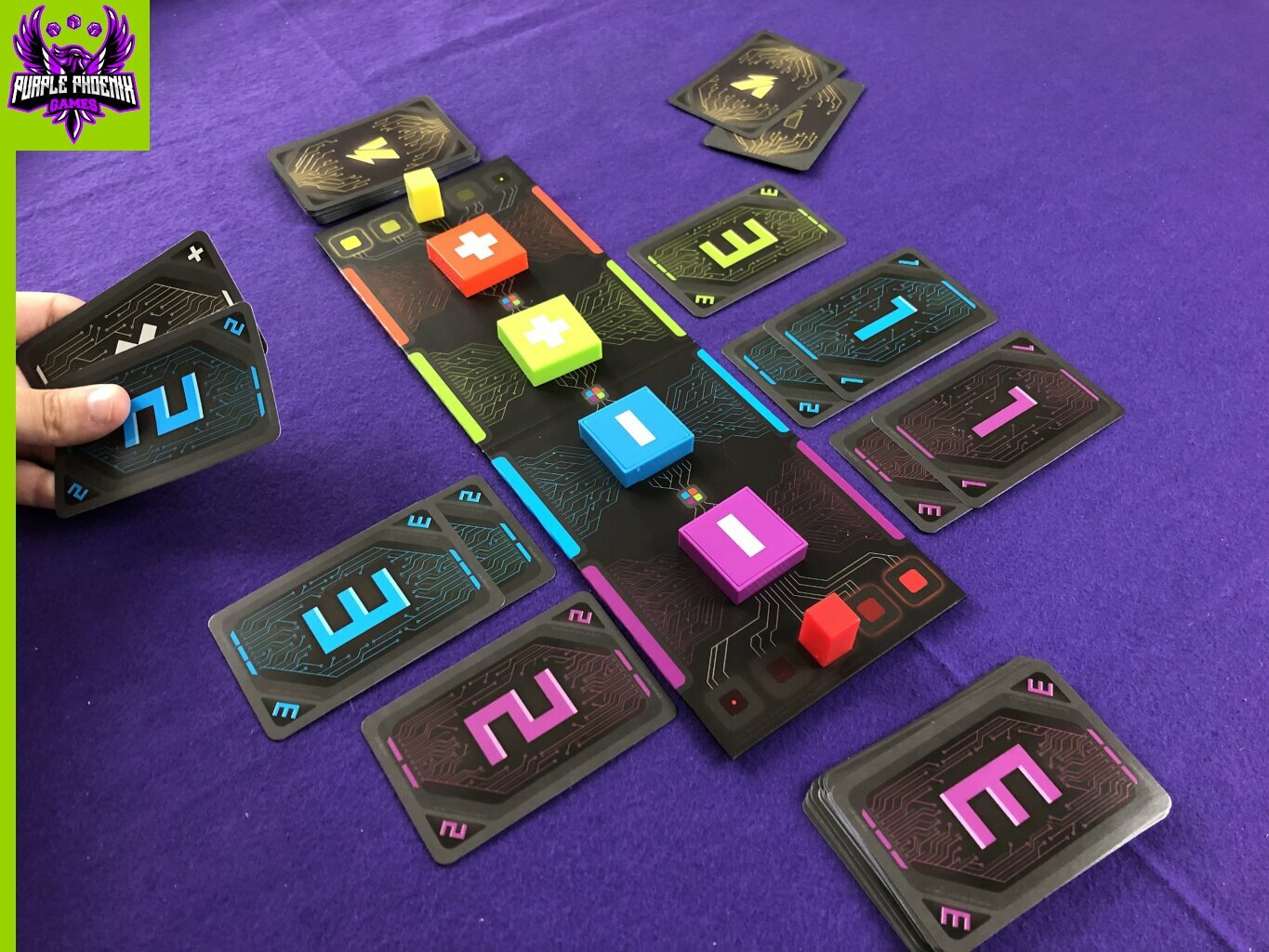
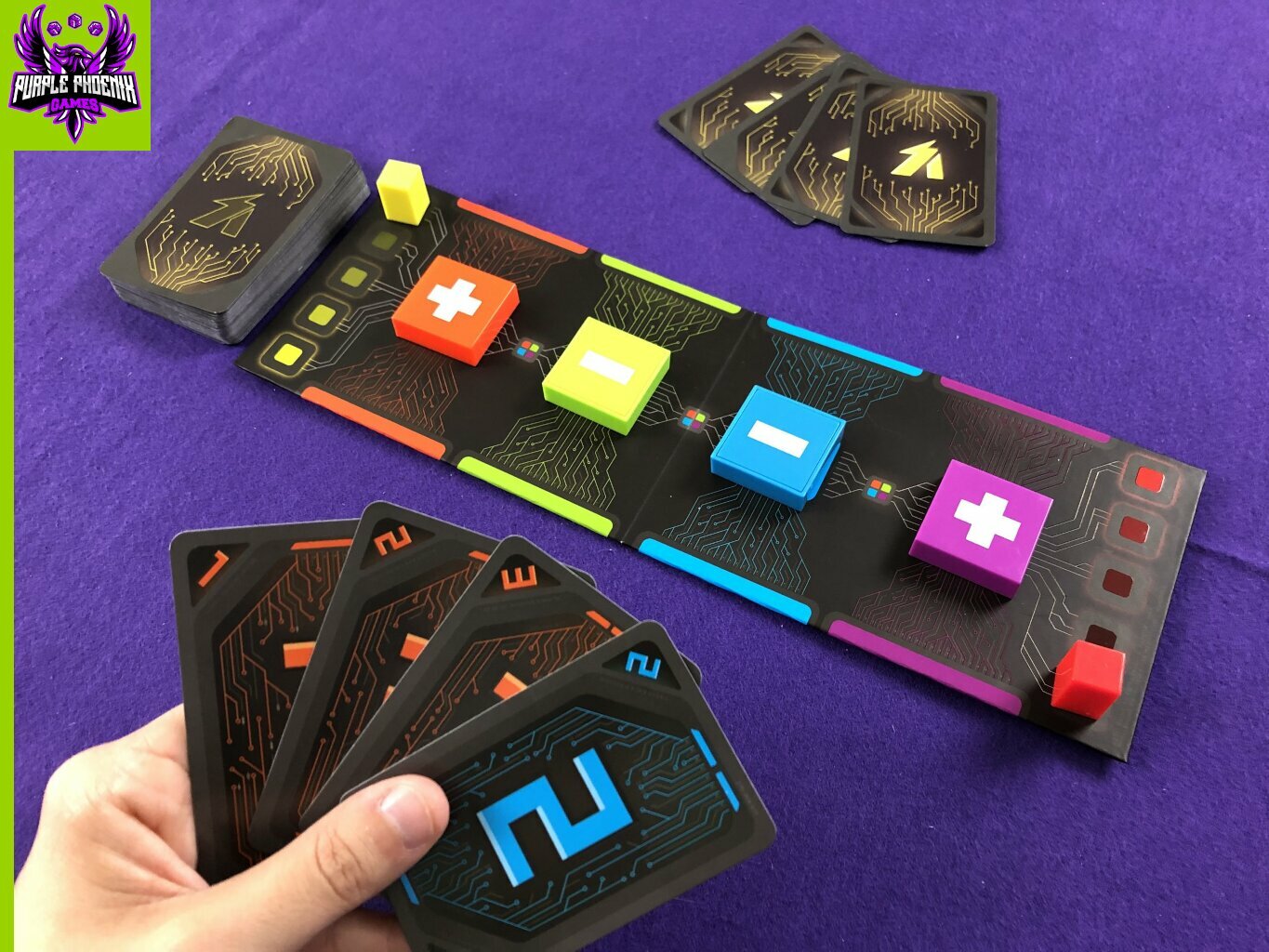
Voltage is a competitive game for 2 players in which players are trying to be the first to earn 4 total points. To setup for the game, place the board between the two players. Take the double-sized Terminal blocks and place them on their corresponding spaces of the board. The starting orientation for the Terminal blocks should read + – – + horizontally across the board. Shuffle the deck of cards and deal 4 to each player. Each player selects a Score Marker and places it on the first space of their score track. Choose a starting player, and the game is ready to begin! Pictured below is the starting setup for a game.
Over a series of turns, players will be playing cards to their corresponding colored Terminals in an attempt to win the set. If the Terminal is set to a + then the player with the highest value will win the set. Alternately, if the Terminal is set to a – then the player with the lowest value will win the set. Cards are played to Terminals until a Terminal has a set of 5 total cards. The Terminal is then scored, the cards used are discarded, and the winning player earns a point. The game continues in this fashion until one player has earned 4 total points.
On your turn, you must perform one of these three actions: Play a card & draw a card, Play 2 cards, or Draw 2 cards. Simple enough, but the strategy is what makes this game. When playing cards to the different Terminals, there are a few placement rules to keep in mind. Of course, you may only play cards to the Terminal of the matching color. You are allowed to play cards on your side of the Terminal, or on your opponent’s side. Now to get to the actions themselves. If you choose to play a card and draw a card, you must do so in that order. If you choose to play 2 cards, you must play both cards on different colors – you cannot play both to the same Terminal. The last action, draw 2 cards, is self-explanatory.
The cards of the game are numbered from 1-3, and are of the 4 Terminal colors. There are 3 types of special cards: Bypass, Blown Fuse, and Transformer. A Bypass card allows you to move a card from your opponent’s side to your side of the Terminal, and a Blown Fuse allows you to remove a card from your opponent’s side completely from play. Both of these types of cards count toward the 5-card maximum of the Terminals, so use them wisely. A Transformer is identified by the card back – if the V logo is colored Yellow. When you draw a Transformer, you must then flip one of the Terminal blocks to its opposite side. Since the draw deck is always visible, you can see when a Transformer card is next, so that could help inform your strategy for your turn. The game continues in this fashion of alternating player turns until one player has earned 4 total points. They are declared the winner!
I have to say that the gameplay of Voltage really surprised me. I went into my first play expecting a light little game, and what I got was so much more. There really is a pretty decent strategic element to this game that caught me a little off guard at first. The gameplay itself seems simple – draw cards, play cards, win sets to earn points. But how you accomplish that is more challenging that it seems. The ability to play cards to your side or your opponent’s allows you to try to tip the scales in your favor. You can’t simply focus on your side alone, you need to keep tabs across the entire board to inform your next move. And then if your opponent draws a Transformer, they could just as easily reverse the polarity of that Terminal and now you’re on the wrong end! When playing 2 cards, they must be played to different colored Terminals, so how can you place your cards so they are most beneficial to you? Do you risk placing the big numbers right away in hopes of winning a + Terminal, or do you play lower-numbered cards in case that Terminal gets flipped? All things to consider throughout the game. Along with the strategy, one thing that I love about Voltage is that there really is no runaway winner each time – the direction of a set can literally change with one card, and neither player can really feel secure during the game. You have to anticipate your opponent’s moves while trying to complete sets that are currently favorable to you. That all being said, I guess there is a bit of a ‘take that’ element in the gameplay that might seem a little aggressive to some players, but that’s kind of just the nature of this head-to-head gameplay.
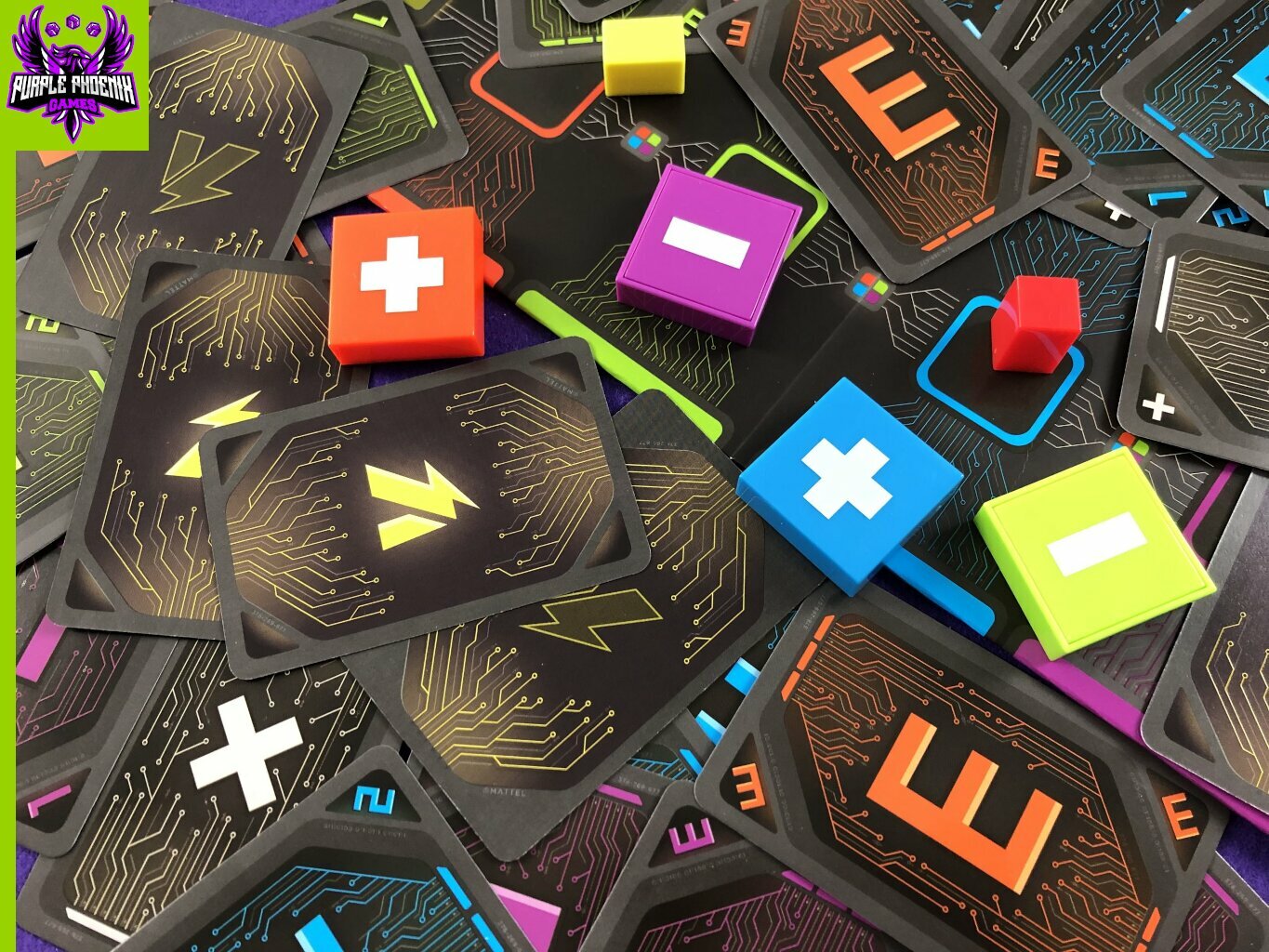
To touch on components, this game is pretty basic. The cards are nice quality, and the artwork is electrical and thematic. The board itself is nice and thick, and the spaces are all clearly marked. The Terminal blocks are probably my favorite components of this game. They are nice chunky plastic blocks, and the colors are bright neon colors – some of my favorites! For a game with such few components, the quality of them is appreciated.
After playing Voltage with Travis at The Table, I actually came home and found a copy for myself – that’s how much I liked it! I don’t think it’s my all-time favorite 2-player game yet, but it’s certainly working its way up the list…. If you’re in the market for a fast, yet strategic, 2-player game, I would highly recommend giving Voltage a try. The simplicity of the gameplay coupled with the vast strategic options makes for an engaging and entertaining game. Purple Phoenix Games gives this one an electrifying 9 / 12.

Voltage is a competitive game for 2 players in which players are trying to be the first to earn 4 total points. To setup for the game, place the board between the two players. Take the double-sized Terminal blocks and place them on their corresponding spaces of the board. The starting orientation for the Terminal blocks should read + – – + horizontally across the board. Shuffle the deck of cards and deal 4 to each player. Each player selects a Score Marker and places it on the first space of their score track. Choose a starting player, and the game is ready to begin! Pictured below is the starting setup for a game.
Over a series of turns, players will be playing cards to their corresponding colored Terminals in an attempt to win the set. If the Terminal is set to a + then the player with the highest value will win the set. Alternately, if the Terminal is set to a – then the player with the lowest value will win the set. Cards are played to Terminals until a Terminal has a set of 5 total cards. The Terminal is then scored, the cards used are discarded, and the winning player earns a point. The game continues in this fashion until one player has earned 4 total points.
On your turn, you must perform one of these three actions: Play a card & draw a card, Play 2 cards, or Draw 2 cards. Simple enough, but the strategy is what makes this game. When playing cards to the different Terminals, there are a few placement rules to keep in mind. Of course, you may only play cards to the Terminal of the matching color. You are allowed to play cards on your side of the Terminal, or on your opponent’s side. Now to get to the actions themselves. If you choose to play a card and draw a card, you must do so in that order. If you choose to play 2 cards, you must play both cards on different colors – you cannot play both to the same Terminal. The last action, draw 2 cards, is self-explanatory.
The cards of the game are numbered from 1-3, and are of the 4 Terminal colors. There are 3 types of special cards: Bypass, Blown Fuse, and Transformer. A Bypass card allows you to move a card from your opponent’s side to your side of the Terminal, and a Blown Fuse allows you to remove a card from your opponent’s side completely from play. Both of these types of cards count toward the 5-card maximum of the Terminals, so use them wisely. A Transformer is identified by the card back – if the V logo is colored Yellow. When you draw a Transformer, you must then flip one of the Terminal blocks to its opposite side. Since the draw deck is always visible, you can see when a Transformer card is next, so that could help inform your strategy for your turn. The game continues in this fashion of alternating player turns until one player has earned 4 total points. They are declared the winner!
I have to say that the gameplay of Voltage really surprised me. I went into my first play expecting a light little game, and what I got was so much more. There really is a pretty decent strategic element to this game that caught me a little off guard at first. The gameplay itself seems simple – draw cards, play cards, win sets to earn points. But how you accomplish that is more challenging that it seems. The ability to play cards to your side or your opponent’s allows you to try to tip the scales in your favor. You can’t simply focus on your side alone, you need to keep tabs across the entire board to inform your next move. And then if your opponent draws a Transformer, they could just as easily reverse the polarity of that Terminal and now you’re on the wrong end! When playing 2 cards, they must be played to different colored Terminals, so how can you place your cards so they are most beneficial to you? Do you risk placing the big numbers right away in hopes of winning a + Terminal, or do you play lower-numbered cards in case that Terminal gets flipped? All things to consider throughout the game. Along with the strategy, one thing that I love about Voltage is that there really is no runaway winner each time – the direction of a set can literally change with one card, and neither player can really feel secure during the game. You have to anticipate your opponent’s moves while trying to complete sets that are currently favorable to you. That all being said, I guess there is a bit of a ‘take that’ element in the gameplay that might seem a little aggressive to some players, but that’s kind of just the nature of this head-to-head gameplay.
To touch on components, this game is pretty basic. The cards are nice quality, and the artwork is electrical and thematic. The board itself is nice and thick, and the spaces are all clearly marked. The Terminal blocks are probably my favorite components of this game. They are nice chunky plastic blocks, and the colors are bright neon colors – some of my favorites! For a game with such few components, the quality of them is appreciated.
After playing Voltage with Travis at The Table, I actually came home and found a copy for myself – that’s how much I liked it! I don’t think it’s my all-time favorite 2-player game yet, but it’s certainly working its way up the list…. If you’re in the market for a fast, yet strategic, 2-player game, I would highly recommend giving Voltage a try. The simplicity of the gameplay coupled with the vast strategic options makes for an engaging and entertaining game. Purple Phoenix Games gives this one an electrifying 9 / 12.
No Ordinary Wedding Planner: Fighting Against the Odds to Help Others Make Their Dreams Come True
Book
This is the inspiring story of Naomi Thomas, a secondary breast cancer sufferer who has decided to...

Beyond the Map: Unruly Enclaves, Ghostly Places, Emerging Lands and Our Search for New Utopias
Book
Geography is getting stranger. Out there fleets of new islands are under construction and...