

Purple Phoenix Games (2266 KP) rated King of the Castle in Tabletop Games
Jul 2, 2020


Disclaimer: We were provided a prototype copy of this game for the purposes of this preview. The components pictured are not final. Also, I do not plan to detail the entire rulebook in this review, but rather discuss the main rules and overall flow of the game. Keep an eye out for the Kickstarter launching later this fall! -L
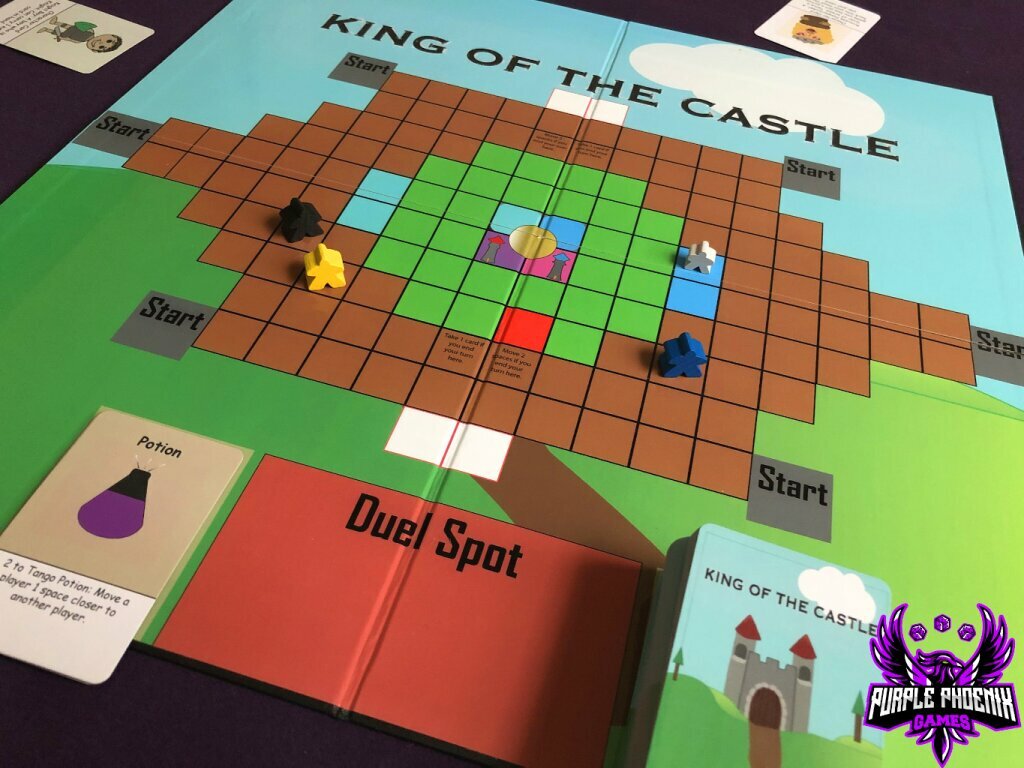
King of the Castle is a game of hand management, grid movement, and take that in which players are battling to be the first to capture and hold the throne. Played over a series of turns, players will move around the board, draw cards, and battle opponents to hinder their progress. To setup, each player is given a Character card at random, selects a Meeple in their chosen color, and places it on one of the various Start spaces on the game board. Shuffle all other cards and place them in a draw deck. Select a player to be the first player, and you are ready to begin!
On your turn, you will take a combination of 2 actions. Those combos are: Move 1 space and draw 1 card, Move 2 spaces, or Draw 2 cards. It is important to note that diagonal movement is not allowed! There are 2 types of cards that can be drawn: Potion cards (special powers/abilities) and Army cards (strength points for duels). Once you have performed your 2 actions, and played any Potion cards from your hand that you want, your turn ends. The game moves on to the next player. If you land on the same space as an opponent, you must duel each other. The dueling players will select as many Army cards from their hand as they wish to play, and will lay them down simultaneously. They may then play up to 3 Potion cards from their hand to influence the strength points of either player, as stated on the Potion cards. Whomever has the most strength points wins the duel, and gets to remain on that space. The loser must discard a card, and is knocked back to the nearest Exit space (depending on their current placement on the board).
In the center of the board are 2 Tower spaces. You must ‘capture’ a Tower in order to fulfill the win conditions. To capture a Tower, you must land on that space and occupy it for one full turn. Once you have captured a Tower, you may move to capture the Throne. The centermost space of the board is the Throne. To capture the Throne, you must first have captured a Tower, and you must enter the Throne space and occupy it for 3 complete and consecutive turns. When you are capturing a Tower or the Throne, you can still be attacked by opponents – so it is important to have a strong hand of cards to ward off enemies and continue your occupation of these valuable spaces. Once a player has occupied the Throne space for 3 consecutive turns, the game ends and that player is named King!
So with all of that said, how does King of the Castle play? Overall, I would say it’s a nice and simple little game. The concept itself is easy to comprehend – draw cards, duel opponents, capture a Tower, and ultimately, the Throne. There is a decent amount of strategy required for success. Not only are you racing to the center of the board, but you also need to amass a strong hand of cards with which you can hinder your opponents. Choosing when to use your Potion cards can affect not only your strategy, but those of your enemies as well. Is your strategy to skirt around your opponents and try to sneak by unnoticed? Or will you duel enemies at every opportunity, building up your Army and continually kicking the other players to the Exit spaces on the board? The idea of having to ‘capture’ certain spaces by occupying them for consecutive turns is an interesting one, and adds a unique twist to this game. You must be able to defend yourself in those spaces, or risk being kicked back to an Exit, requiring you to start that journey over again. It is a simple game to play, but not necessarily one that is easy to win, and I really like that.
Components. As I stated earlier, this is only a prototype version of the game, and I anticipate that there will be some changes for final production. That being said, the board in this prototype is nice and sturdy, the cards are easy to manipulate, and the Meeples are your standard wooden bits. So overall, these prototype components are off to a great start. The artwork and overall style of the game are a different story. The current artwork is pretty childish and unrefined. Again, this being only a prototype, I anticipate that the artwork will be overhauled and revised for final production. The artwork on the board is pretty basic as well, which is not necessarily a bad thing, it just doesn’t feel immersive or engaging for players. The spaces of the board are different colors to denote different areas of play, but nothing is labeled on the board, which can create some confusion at first as to the flow of movement around the board. The rules themselves need to be revised and edited for clarity. There is just a bit of ambiguity that leaves questions unanswered, but nothing that cannot be fixed.
All in all, the concept of King of the Castle is a solid one. It combines hand management, grid movement, and take that in a way that all 3 mechanics complement and work well with each other. The gameplay is lighthearted and relatively simple, which results in a fun and fast game. With some refining of the style and editing of the rules, I am sure that this game will truly shine. I look forward to following its progress, and am eager to see the Kickstarter campaign later this year. Keep your eyes on King of the Castle, because it’s shaping up to be a solid game.


Office Assistant by Elinasoft-PDF & Office Reader
Productivity and Utilities
App
Office Assistant is an All-Powerful productivity suite specially designed for you to deal with the...

Masha and the Bear see & play
Entertainment and Games
App
In one app you get the Masha and the Bear series, as well as its two popular spin-offs, “Masha’s...
Purple Phoenix Games (2266 KP) rated Divinus in Tabletop Games
Aug 10, 2021


Divinus is a competitive tile placement, campaign, drafting, dice game in which players assume the roles of upcoming demigods fighting over the one last spot at the table. By appeasing the gods of the warring ancient Roman and Norse cultures players will earn their place among them. This game uses some interesting hybrid app-driven story mechanics along with legacy-style component alterations to create this world that is constantly under refurbishment and ripe for the claiming of the future Divinus.
DISCLAIMER: We were provided a prototype copy of this game for the purposes of this review. These are preview copy components, and I do not know for sure if the final components will be any different from these shown. Also, it is not my intention to detail every rule in the game, as there are just too many. You are invited to download the rulebook, back the game through the Gamefound campaign, or through any retailers stocking it after fulfillment. -T
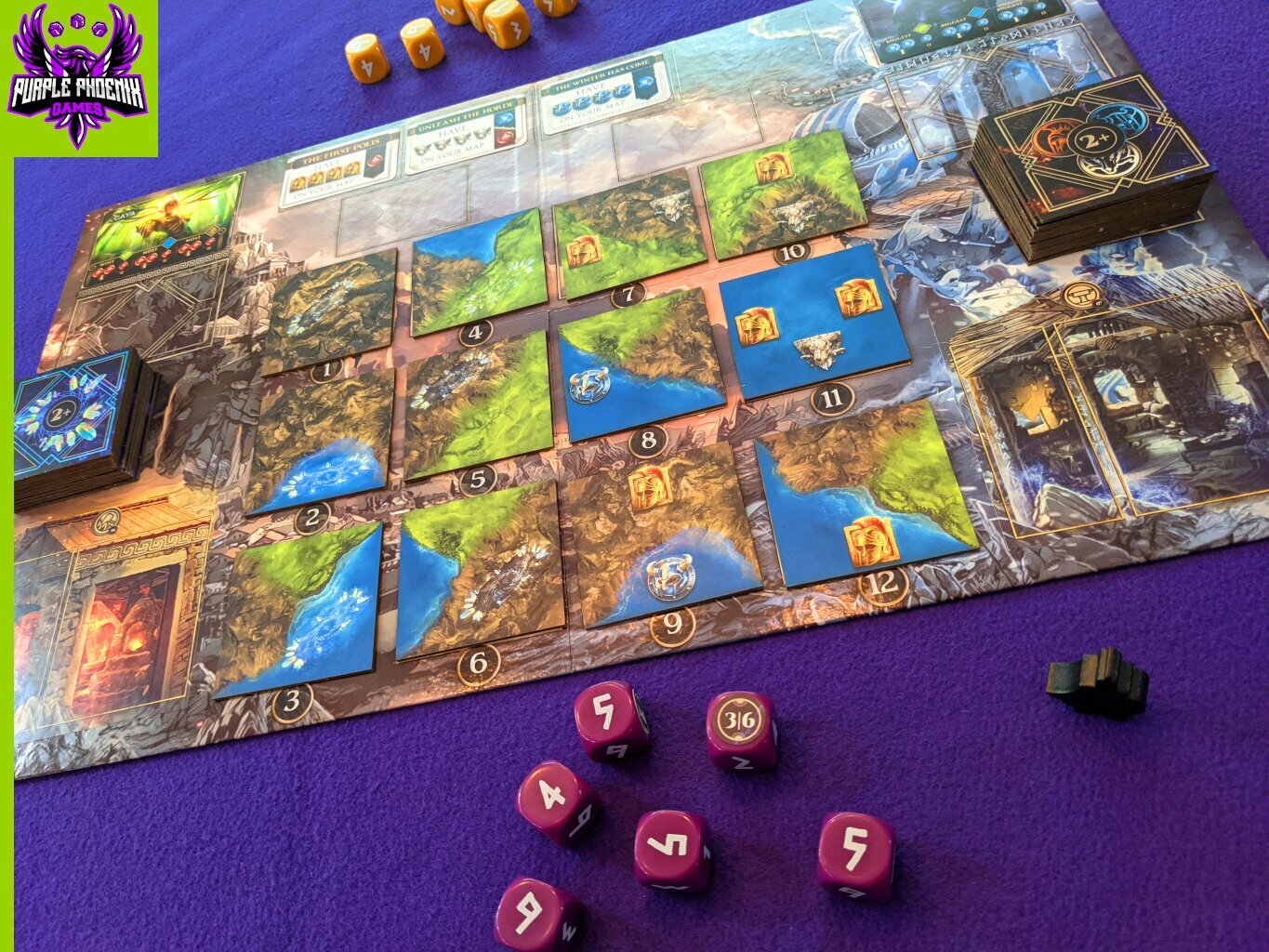
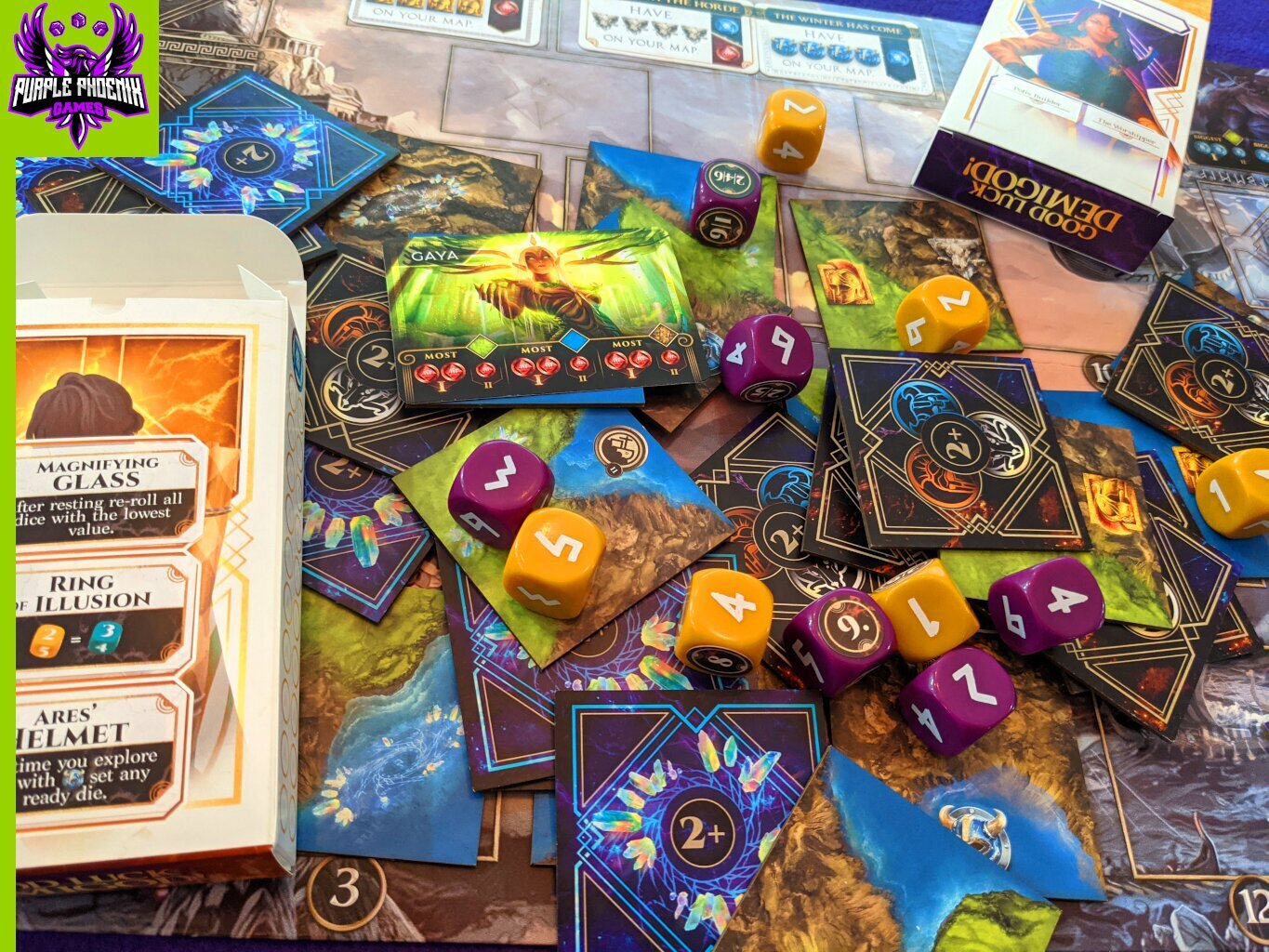
To setup, place the main board on the table, sort out the Map tiles by player count, and populate the board per the rulebook. Each player chooses their Demigod box and takes all components contained within. As Divinus is intended to be played either as a scenario session or its Eternal Mode, which is infinitely replayable using the board and components already altered by previously-played scenarios, open the chosen Scenario Box to be played and allow the app to instruct on how to setup with these components. All players roll their dice and place them in the “ready” pile to be used on their first turn. The first player takes the token (a black meeple in the prototype version) and the game is ready to be played!
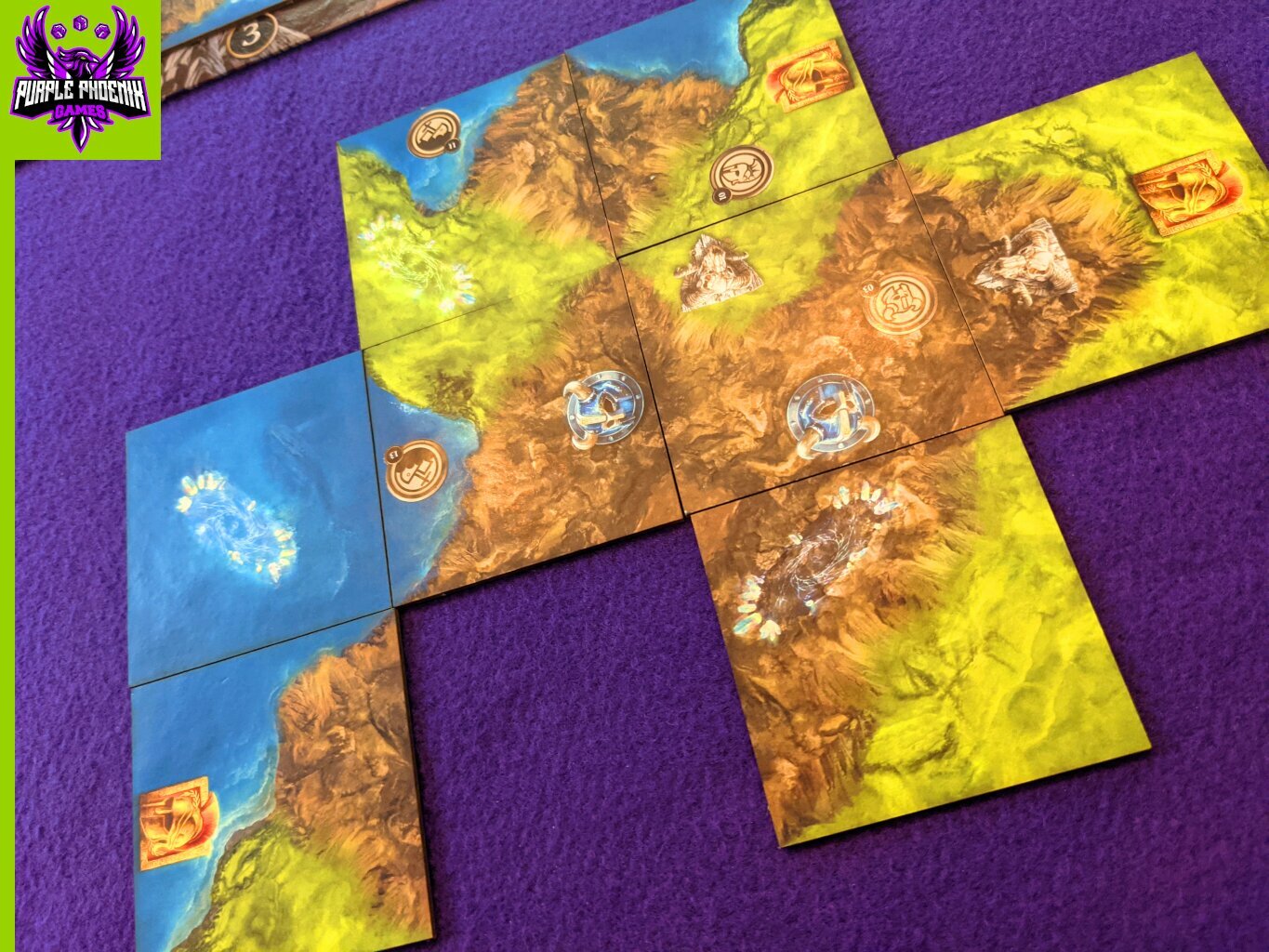
Divinus is played in turns starting with the first player and continuing around the table until one player places their final Map tile signaling the end of the game. On a turn, players will have a choice of using an Explore action or a Rest action. More actions may be available in future scenarios, but for the prototype scenarios, these are the two available choices. During an Explore action, the active player will choose any number of their rolled dice in order to create a mathematical equation that matches with one of the Map tiles on the main board. These spaces range from 1-12 in value, so an appropriate dice combination could be 5 + 4 – 1 = 8 in order to claim the Map tile on the 8 spot. Any number of dice can be used to claim tiles, and once a tile is claimed, it must be placed within the player’s personal play area map. In order to add these tiles, the edges will need to match up by terrain type with tiles already presently in play (see below), or may also be placed atop an existing tile. Map tiles may or may not contain symbols for factions, locations, and also Sacred Places. These will all be used in scenarios for different purposes.
Once a player decides they do not wish to (or cannot) take more Explore actions, they must Rest. To Rest, the active player reclaims all spent (and unspent ready) dice and rerolls them for the next turn, replacing empty spaces on the board with new Map tiles.
Play continues in this fashion of Exploring and Resting until one player places their 16th tile, thus completing their 4×4 personal map. Players will consult the app for scoring instructions and the winner will be announced. Should the players wish to play another scenario (or many, as we would have liked), they simply use the same Demigods and open a new Scenario Box. Inside these boxes are different gods to appease, new quests to fulfill (more on these later), and stickers to be applied to game components to improve their usefulness.
Components. Again, this is a prototype version of the game, and it includes two introductory scenarios, a bunch of sticker sheets, and a developmental app. That said, I really enjoyed my plays of the scenarios and they felt like great first steps to lure me into what I just know is going to be somewhat of a lifestyle game (assuming more and more expansions are in the plans). The sticker sheets are all fine, and as I understand it, the stickers that are placed on the Map tiles will have non-removable glue, but the stickers placed on the dice faces will have removable glue. As I am not a glue expert, I can’t really vouch for either. The app is somewhat similar to those that are used in the Chronicles of Crime series, but Divinus promises to deliver an app that can scan the components WITHOUT the use of QR codes. For those gamers who think the QRs are an eye-sore, then Divinus is taking a promising first step for you! I haven’t even touched on the artwork yet, and that’s usually my favorite aspect of a game’s components. The visual style and art on Divinus really make the game pop on the table, and just draw you into the lore and setting. I love it!
So while initially Divinus is a simple roll-and-draft game of building a 4×4 grid akin to Kingdomino, the addition and usage of the Quests and, later, the Charge Actions, morph this into something quite a bit meatier. Each Scenario Box (at least in this version) contains two god cards (that affect how the end of the scenario is scored) and some Quest cards (that are side-quests players can follow to earn some extra VP and other goodies). I imagine as the game progresses through Scenario Boxes that Quests will get more difficult and the god cards more interesting as well.
All in all Divinus has roped me in, and I am very much looking forward to all the other great things that Lucky Duck Games has planned for it. I can foresee soooooo many expansions being built on this excellent chassis, and I am very eager to finish the entire legacy aspect in order to play through the Eternal Mode a bunch of times. Can I divulge a little dirty secret of mine here? I have never before played any type of legacy board game, and if this is what they are like, then I will be breaking out my copy of Betrayal Legacy way sooner than I originally planned.
I believe that the theming here is great, the gameplay is relatively simple to grasp, and the hybrid app-driven story really adds to the entire experience. If you are someone who, like me, has yet to delve into legacy-style games where the components are constantly changing due to choices made at the table, and you have a penchant for dice games with a splash of ACTUAL math skills used, I urge you to take a look at backing Divinus on Gamefound ASAP. With just the initial two scenarios included, I am already addicted to the game and cannot wait to sink my teeth into more scenarios and more crucial decisions that will alter the landscape of my copy of the game. I know that as of the publish date of this preview, the campaign is already about 1000% funded and so many stretch goals have already been unlocked. It is a great time to hop on board and grab a big ol’ chunk of goodies for this one. You may have a preference for Roman or Norse mythology before playing, but be warned: your loyalties may change as a result of playing Divinus… or maybe you will learn to accept both at the harmonious center of activity in your own little section of the world.


Spider Solitaire by MobilityWare
Games
App
The classic Spider Solitaire card game you love is now available to play on your Apple device!...

24 Game – Math Card Puzzle
Games and Education
App
The OFFICIAL 24® Game app is back from the makers of the popular 24® Game! Now you can challenge...

Debbiereadsbook (1772 KP) rated Opposed Desires (Rehoboth Pact #2) in Books
Nov 18, 2021


This is book 2 in the Rehoboth Pact series, but it's not necessary to have rea book 1, Confined Desires, before this. Not necessary, but I would strongly RECOMMEND you do. Aubrey revokes the Pact in that book, and you need to know why.
Aubrey is a player. She goes out and gets one she wants, and there are no repeats. She is the polar opposite of Selina, who would rather go without than do what Aubrey does. In a moment of something totally out of character for BOTH these women, there is a fundamental shift in their relationship. But this is a vacation, and the real world encroaches.
I really enjoyed book 1, and I really enjoyed this one, for different reasons.
This is HEAVY on the emotional aspect from both these women. Aubs mum is ill, and she is worried that things are really bad again. Selina is lonely: she wants someone to love her, just as she is. And I cried a bit for both Aubs and Selina, I really did. They are both a little bit broken by their life experiences and actually talking to each other, rather than sniping at each other, starts them on a path neither is quite prepared for.
I love love LOVED that I had to wait for Selina to give in to Aubrey. But equally than AUBREY was the one who really wanted to wait. Aubrey usually had a different girl every night, but a whole vacation week, without a single one? Totally unheard of and I loved that her friends noticed. The smexy stuff is not especially explicit, but I'm finding I like that in these books. There is more to a relationship than sex and these women are finding that.
Skye and Mia (from book 1) are here, but also Kyle, who is the third in this little trio of friends. We didn't meet her before and she has a tale to tell, I can feel it. Her book is next, but not til bloody January! Kyle revokes the Pact here.
creeping up to 4.5 stars, (but rounding down to 4 for the blog, sorry!) can't quite stetch to five, but maybe Kyle can squeeze that extra bit outta me!
*same worded review will appear elsewhere

Rikki Hammond (33 KP) rated Room 25 in Tabletop Games
Jun 19, 2019
The game is played out over 25 room tiles, which are laid out face down apart from the starting room in the middle, and the basic goal is to make it to the elusive Room 25, somewhere out on the grid, but you have to do it quick, as there is a set number of turns to find it in.
Players will simultaneously choose to do 1 or 2 actions on their turn, and can choose to move into a room, thus revealing it's effect to everyone, push another player into a room, peek at a room, or slide a whole row of rooms in the direction of their choosing (nit including the starting room.)
Rooms are split into 3 colours: Green are safe, and can sometimes help you, yellow are normally traps or hinderances, and red rooms can kill you in one way or another (there's even a room that is instant death if you move into it.) Players have to navigate the rooms using their actions, and hope they don't meet their demise.
There are also varying game modes and difficulties to choose from. Competitive pits everyone against each other, co-operative means everyone is trying to work together, and team mode has two groups trying to outwit the other team. You can also adjust the difficulty by adding or removing more yellow and red rooms (the manual has set layouts for the tiles, but you can also customise as you see fit.)
Room 25 has a lot of replayability, but does suffer from a bit of luck. If there is bad decisions made, you can be eliminated very early on. The characters in the base game, although looking cool, have no differences to them either (which is resolved in the expansion.)
These are minor gripes though, and doesn't stop Room 25 being a fast paced, hectic, but enjoyable game.

Arena Calculator for Hearthstone
Reference and Utilities
App
++ The Grand Tournament Updated ++ Arena Calculator is a great tool to get passed 5~6 wins in...