

Purple Phoenix Games (2266 KP) rated TEN in Tabletop Games
Nov 28, 2021


Disclaimer: We were provided with a copy of TEN for the purposes of this review. This is a final production copy, so what you see pictured is what you would receive in a retail copy of the game. -L
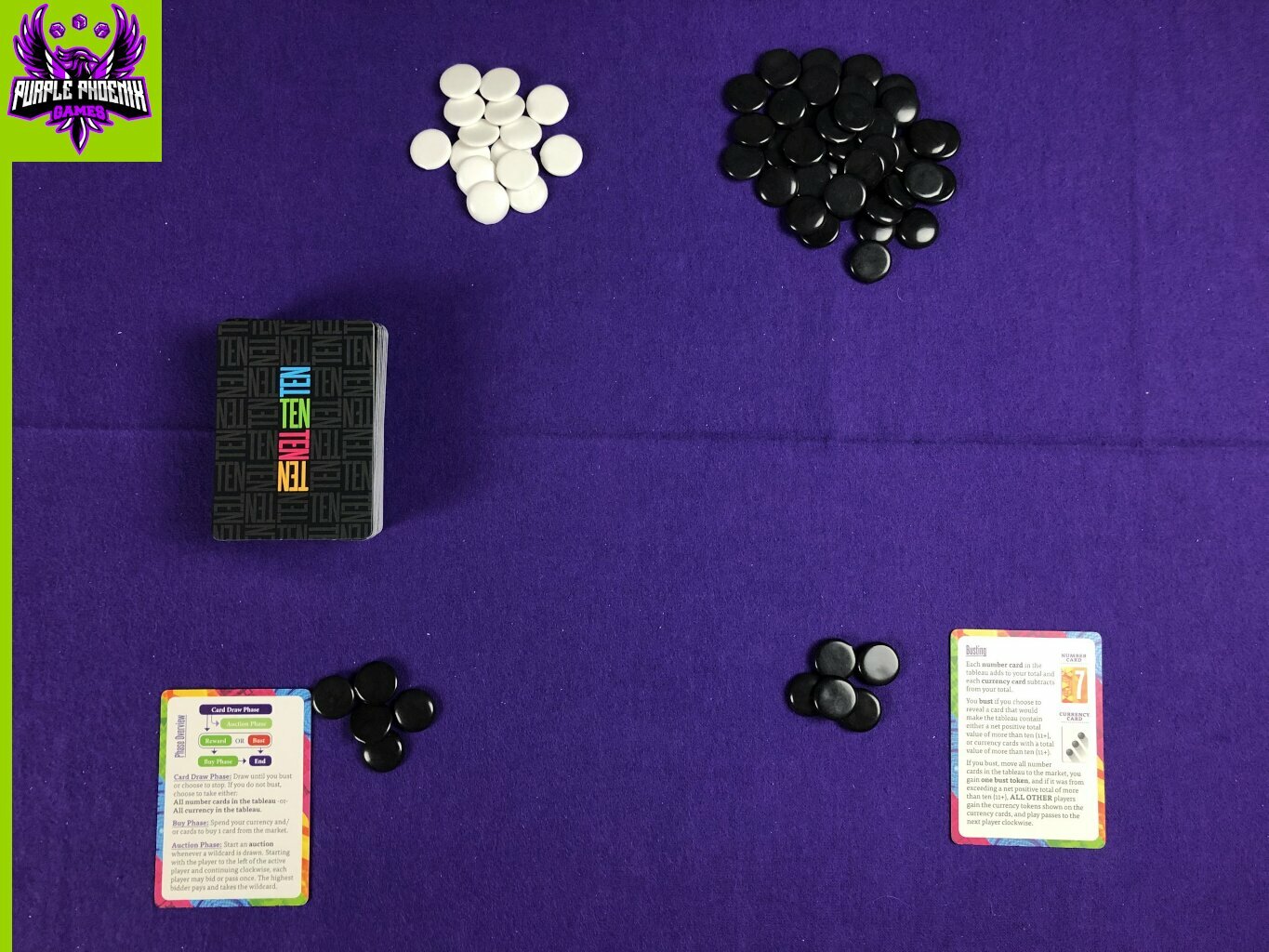
TEN is a push-your-luck game of set collection and auction/bidding in which players are trying to amass the most points by the end of the game. Points are earned by collecting sets of numeric sequences in the 4 colors of the game: Blue, Green, Pink, and Orange. Played over a series of turns, players will be drawing/collecting cards from the tableau, buying cards from the Market, or Busting if they push their luck a bit too far. To setup for a game, assemble the deck of cards as dictated by the player count and set it in the play area. Each player gets 5 Currency tokens with which to start the game, and are all dealt a random reference card. The player who was dealt the reference card with the Starting Player symbol will begin the game. Before getting into the actual gameplay, I want to mention the different card types, as to provide a better understanding when reading this review. In each of the 4 colors, there are card values numbered 1-9, with more copies of the lower numbers and fewer of the higher numbers. There are also Wildcards that can be used to represent any #/color, depending on the card. Some cards in the deck are Currency cards and show a value of 1-5 Currency. Should you choose to take these from the tableau, you collect that amount of Currency to be used for auctions or buying cards in later turns.
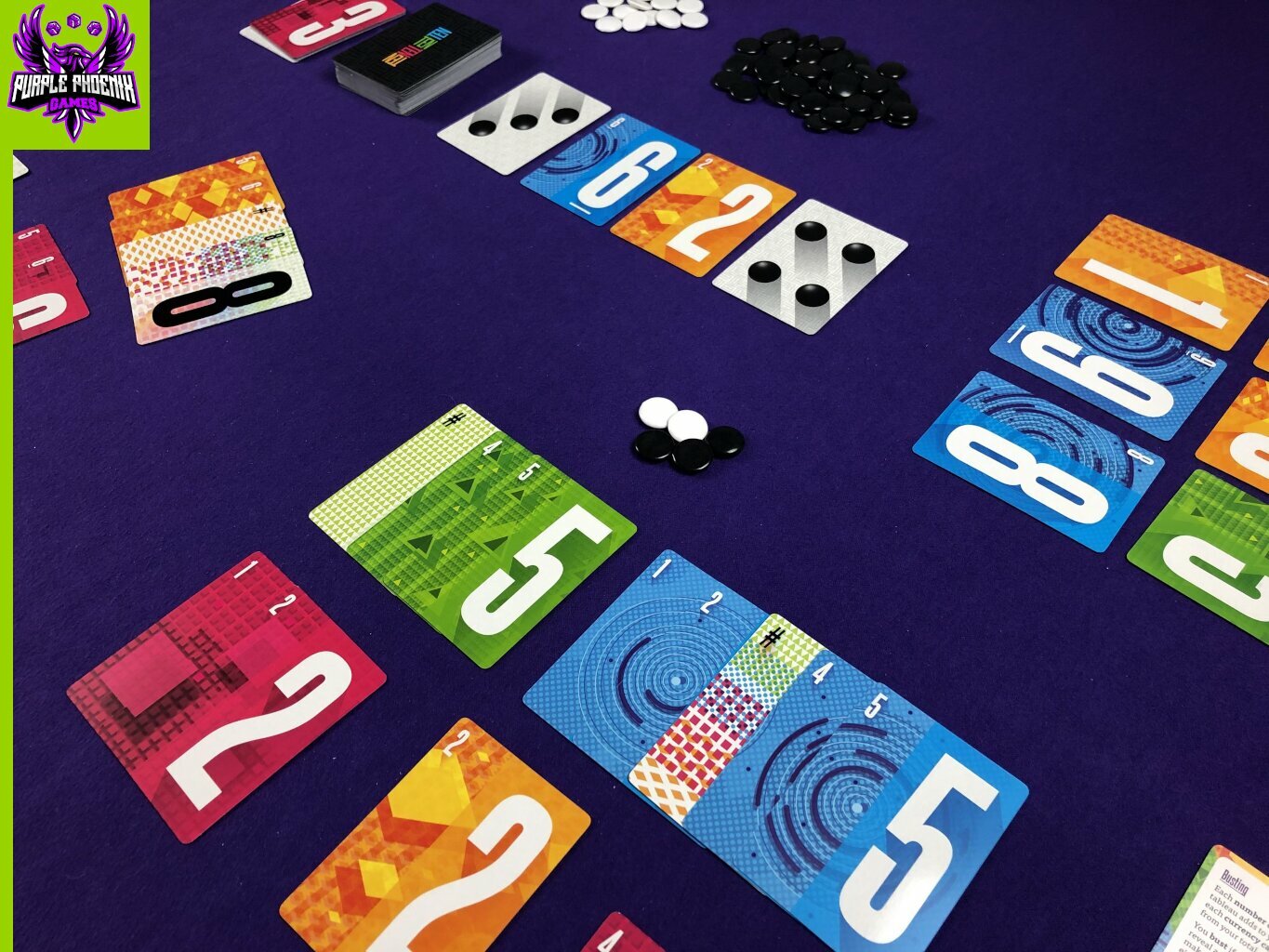
On your turn, you will perform a series of actions, the first of which is Draw a Card. You will draw a card from the top of the deck and place it in the tableau. If the card is a # card or a Currency card, you will then decide if you wish to continue drawing cards. If you do, draw the next card, and so on, until either you decide to stop or you Bust (more on this in a bit). As long as you do not Bust, you can decide when to stop drawing cards to the tableau. You may then take one of the following rewards: take all the # cards to your play area, or take Currency tokens (equal to the amount shown on the Currency cards in the tableau). When you take the # cards, they go into your play area and all other players will collect Currency tokens. You then have the opportunity to Buy a card from the Market (by paying the numeric value of the card) and add it to your play area. If you instead choose to collect Currency, you will take Currency equal to the total value of Currency in the tableau, and all other players receive nothing from your turn. All # cards are moved to the Market, and your turn ends. In the picture below, if I choose to take the # cards, I would take the Orange 2 and Blue 6 to my play area, and all other players would collect 7 Currency. Conversely, I could choose to take 7 Currency, and the # cards are added to the Market (on the right-hand side of the picture).
So how does Busting work? The tableau may never have a value of more than 10. Every # card you draw adds to your total value, and any Currency card drawn subtracts from the total. If you were to draw a # card that would give you a total value of more than 10, you Bust! OR if you ever have Currency cards that total more than 10, you Bust as well. So there’s a bit of math involved, with addition and subtraction, but you have to make sure you never get more than 10! For example, in the picture below, the net total value of the tableau is 1. (8 from # cards, -7 from Currency cards) If I were to draw a Currency card of 4-5, I would Bust, because that totals more than 10. In this pictured instance, any # card I draw would not make me Bust, as the highest total would only be a 10, given the current cards in play. If you ever push your luck too far and end up Busting, all # cards in the tableau are moved to the Market, and you gain a Bust token (worth 3 Currency). If you Busted with # cards, then all other players will collect Currency tokens, but if you Bust with Currency cards, nobody receives anything. After resolving a Bust, your turn ends and the game continues to the next player.
If, on your turn, you ever draw a Wildcard, your turn pauses and the Wildcard is auctioned. Each player will have one chance to either bid (increasing the bid from the previous) or pass. Whomever wins the auction must pay their bid, and they collect the Wildcard to their play area. Once the auction has been resolved, your turn continues as normal. It is possible to have multiple auctions on your turn – it all depends on the cards. The game continues in this fashion, players taking turns drawing cards, collecting cards/Currency, buying from the Market, bidding in auctions, etc., until the draw deck has been depleted. The active player finishes their turn as normal, but may not draw any more cards. Points are then tallied. All players will arrange their cards to create consecutive sequences of numbers in the 4 different colors. You receive 1 point per card in your longest sequence of each color. If you have a complete set of numbers 1-9 in a color, you get a bonus point. Players count up all their points, and the player with the highest value is the winner!
That kind of seems like a lot, but I promise it’s actually pretty intuitive when you get playing. Also, huge shoutout to AEG for providing such a well-done reference card – it includes a little flowchart to help you with how the turns flow. The gameplay itself is essentially pretty straightforward. You draw a card, and then react based on what it is. Bust? Collect a Bust token and your turn ends. No Bust? Decide if you want to keep drawing. Done pushing your luck? Collect either the # cards or Currency. Try to make sequential runs of numbers in the different colors – the more cards you get in sequence, the more points you’ll get at the end of the game. The thing that elevates TEN beyond a simple push-your-luck game to me is that it requires more strategy than just luck. You can see what cards are available in the Market – is there something you need to buy? You can see everyone else’s playing area – do they need any of the numbers you just revealed? You know how much Currency every player has – do you bid high on this Wildcard because your neighbor can’t outbid you? There is so much more than just luck in this game, and that is what takes it to the next level for me. I know that Travis has reviewed No, Thanks! in the past, and I would say that this gives me similar vibes, but way better in my opinion.
When it comes to playing games, I am generally not a huge risk-taker. I like making logical choices based on known information and end-game strategy. But something about this game just gets me. I think one element that makes me love this game is the different types of cards – # cards and Currency cards. When you’re pushing your luck and drawing cards, there’s an added element of excitement, because the two different types of cards affect the net total differently. It doesn’t all positively add to the net total, which makes me more likely to keep drawing in hopes that things will cancel out and I can maximize the turn. If everything all added together, and you just couldn’t get more than 10, I would probably only ever draw 2 cards per turn, max., just to make sure I didn’t Bust. But the fact that Currency cards subtract from the net total encourages players to keep pushing their luck, and either earning a big payoff or a big Bust. This game is exciting, engaging, and entertaining to play, and that makes it fun!
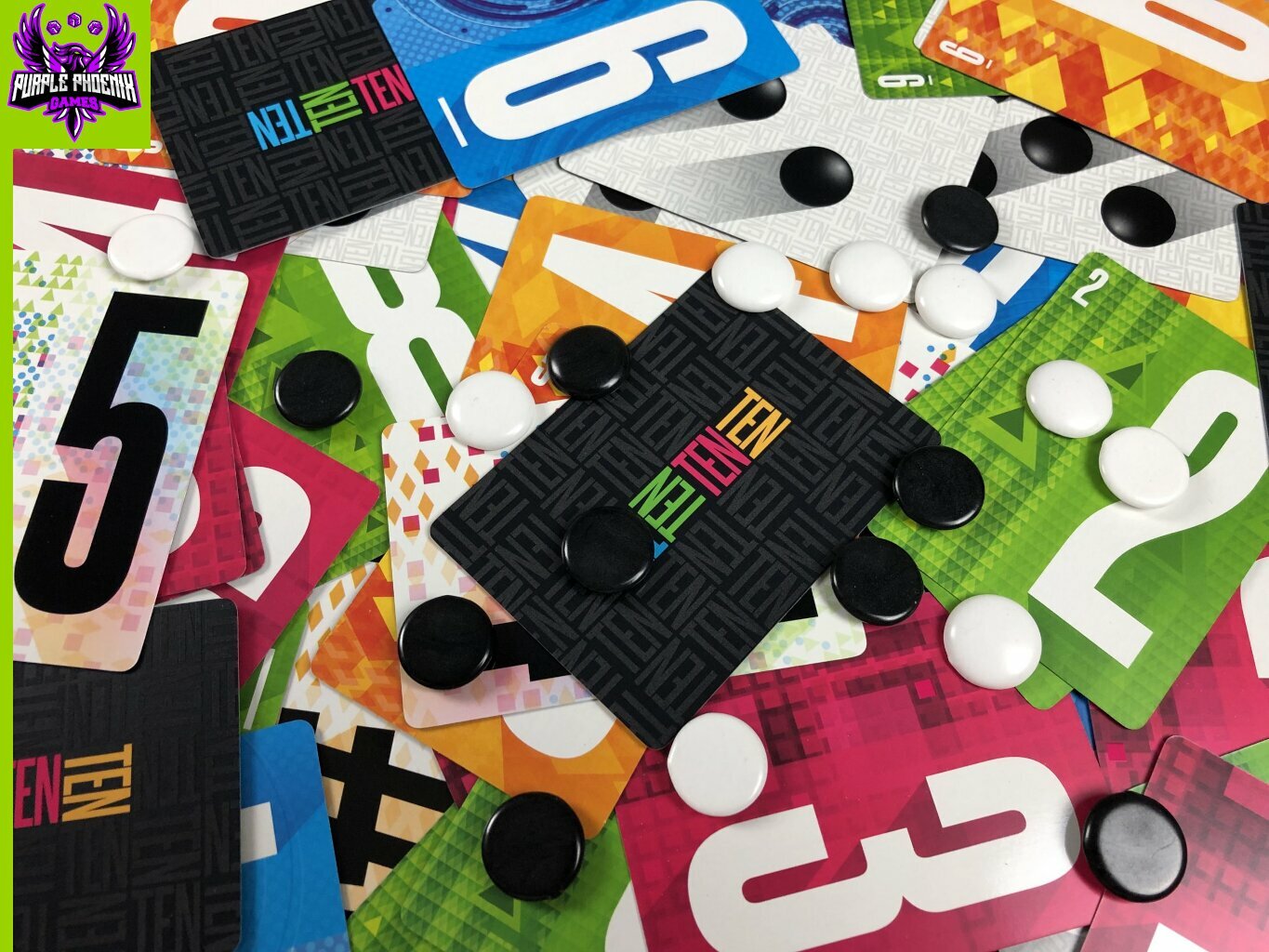
To touch on components, AEG always hits it out of the park – and TEN is no exception. The game is mostly just a bunch of cards, and some white/black Currency tokens. The tokens themselves are nice plastic, and are smooth and chunky in hand. The cards are thick and sturdy, and hold up to shuffling pretty well. The colors of the game are bright and vibrant, and they are very clear to differentiate between. It’s a nice pop of color on the table, and that adds to the overall enjoyment of the game. Each of the 4 colors, and the Wildcards for that matter, have a unique background design – which can help our colorblind friends who may not necessarily be able to differentiate between the colors. Just an added plus to help the gamers tell what cards belong to what colors! The game box is equally as colorful, and is eye-catching on the shelf. All in all, I’d say AEG gets a 10 for their production quality here. (Get it?)
I spoke earlier about judging a game by its mechanics, and how TEN really challenged me on that. I was expecting a game that I would like, but would be kind of just ok overall for me. What I got is a game that is highly strategic, yet also unpredictable at times. I am definitely a planner when it comes to strategy, but the unpredictability of this game is light, fun, and engaging for all players at all times. It just is fun to play. This is a game that I see staying in my collection for a long time, and hopefully getting to the table quite often when I need a quick filler that isn’t so light that it’s mindless, but not heavy enough that it’s a brain-burner. If you’re in the market for a fun little game that challenges all players, I would definitely recommend checking out TEN. Purple Phoenix Games rates our games on a scale of 1-6 (not 10 unfortunately in this case), and we give this one a solid 5 / 6.


Purple Phoenix Games (2266 KP) rated Bad Guy Nonsense in Tabletop Games
Jul 2, 2020


Disclaimer: We were provided a PnP copy of Bad Guy Nonsense for the purposes of this preview. Please excuse my lack of a color printer, but know that the final artwork and cards ARE eye-catching, colorful, and clear to read. I do not intend to rehash the entire rulebook in this preview, but rather provide an overview of the gameplay. Check out the publisher’s website to download the rulebook for yourself, and keep an eye out for the Kickstarter campaign coming soon! -L
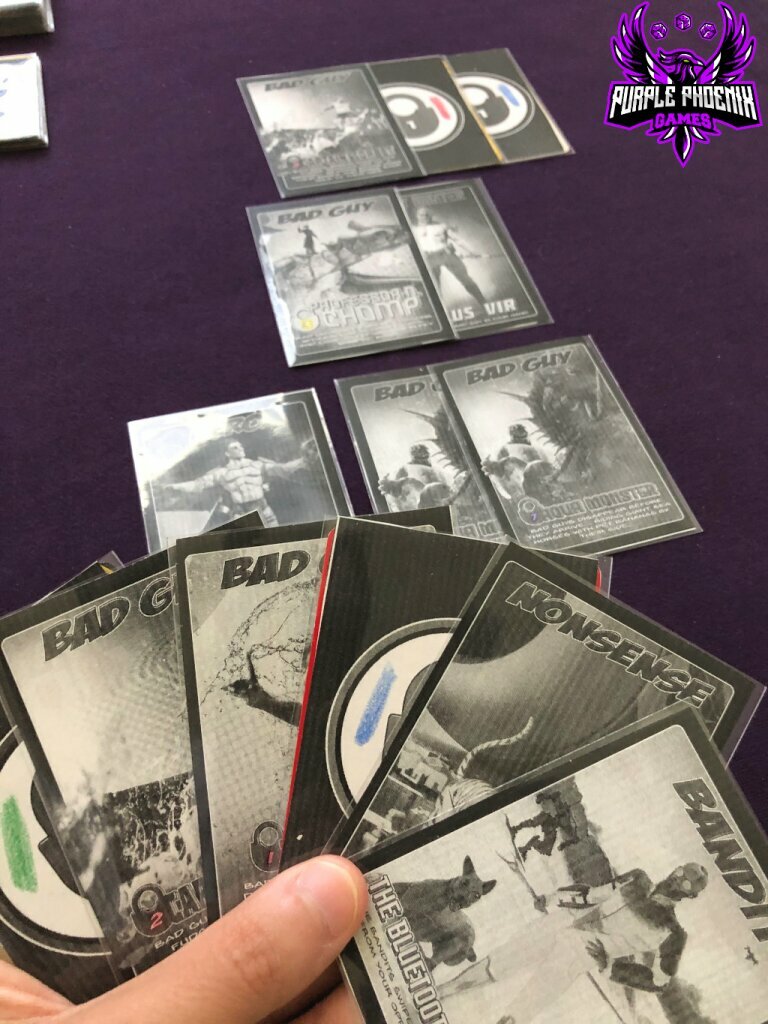
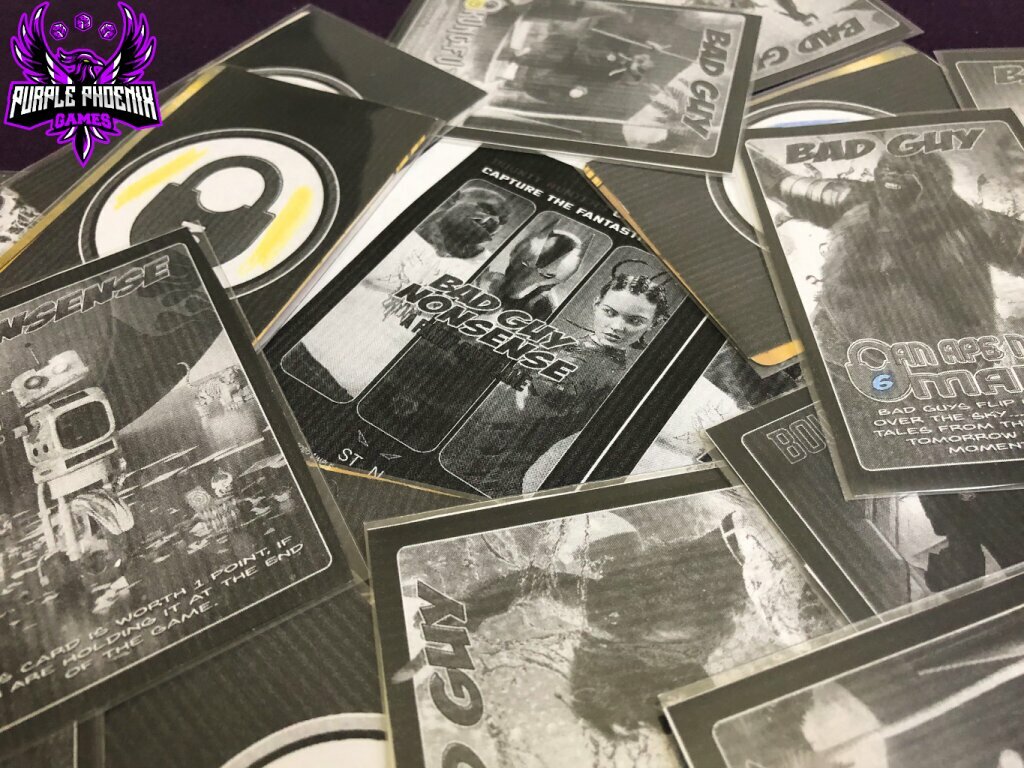
Bad Guy Nonsense is a card game of hand management and a bit of take that in which players are trying to score the most points by capturing Bad Guys. Here’s how it goes: shuffle the deck and deal 6 cards to each player. On your turn, you will perform one of 3 possible actions: Capture Bad Guy, Discard 1 Card, or Play 1 Special Card. To Capture a Bad Guy, use one of the 4 capture combinations and set the Bad Guy with corresponding cards in your play area. If you choose to Discard 1 Card, select a card from your hand to discard and then draw 1 new card from the draw deck. To play a Special Card, play it to the discard pile and perform its corresponding action. Whatever action you choose to perform, you will always draw back up to 6 cards at the end of your turn. Play continues until the draw deck runs out. Players may then place any remaining Bad Guy captures from their hand into their play area if they have any. Everyone counts up their points – positive points for Bad Guy captures, negative points for Bad Guys still in hand, and 1 point per Nonsense card in hand – and the player with the most points is the winner!
The basis and gameplay are pretty simple and straight-forward, and that’s what I love about Bad Guy Nonsense. It is so easy to teach, learn, and play that I can see this game played in so many situations. Whether I want to introduce some newer gamers to the hobby, or I need a fast and fun filler between longer games, or even if I want something to play with younger gamers, this game hits that sweet spot. Even though the gameplay is pretty simple, it still needs a bit of strategy for success. You need to decide which actions to take and when to ensure maximum benefit for yourself. Are you willing to risk discarding a card in hopes for getting a new one that may be more beneficial? Should you try to steal that high-value capture from an opponent? Or do you just try to fly under the radar, silently amassing your points and hoping your opponents don’t take notice? There are lots of options, and that keeps the gameplay refreshing and engaging. And the Special Card abilities add a fun strategic twist to the game too – from stealing opponent’s captures for yourself to searching the Discard deck for the card you want, you are always on your toes when playing this game.
Let’s talk components. Obviously, as I mentioned earlier, I do not have a color printer, so my PnP version leaves much to be desired. However, the final production copies of the game will feature tarot-sized cards that are bright, colorful, and sturdy in hand. I enjoyed this game so much that I will probably back it to get a copy of that higher quality for myself!
All in all, Bad Guy Nonsense is a fun little card game that can be played in many different situations. The gameplay is relatively light, the rules are simple to understand, and the time to play is the perfect length. Rarely do I play just one game of Bad Guy Nonsense, I will play 2 or 3 at least back-to-back! If you’re looking for a fun game that can be played with the entire family, consider backing Bad Guy Nonsense. It has a great balance of strategy and light-hearted fun that will keep you coming back for more.


Ohajiki Web Browser
Health & Fitness and Utilities
App
Ohajiki is a powerful web browser that packs complete browsing control into a unique circle gesture...

Paul Kellett (118 KP) rated Gloom of Kilforth: A Fantasy Quest Game in Tabletop Games
May 1, 2019


You start by choosing a character, class and a saga to tell. Your character and class give you your starting stats (combat, knowledge, sneak and influence) while the sagas are 4 chapters long and each chapter requires 2 (or 3 if only playing 1-2 players) keywords to complete. Completing a chapter levels up your character giving you more health and a new skill.
Keywords are found on the cards you encounter as you search the map and are colour coded to give you a hint to where they are most likely to be found.
The map is a 5x5 grid of cards with Sprawl City in the centre and a mix of Forests, Mountains, Plains and Badlands arranged randomly around it.
Every time you enter an empty location, you draw a card from the relevant terrain deck and interact with it.
Encounters are won by rolling a number of d6 dice equal to your skill in the stat list d on the encounter. Success is on a 5 or 6 so playing to your character's strengths is paramount.
Each player starts with 4 health and at the start of each round, you gain action points equal to your current health which makes strategy and stealth the key to early success.
It also means that the game starts slowly but starts to snowball as you complete the chapters of your saga and level up.
At the end of each round, you make camp and draw a night card which causes a location to fall into gloom and possibly trigger an event. A character ending the day on a gloom location will suffer 1 health point loss.
This is the game timer, so you have 25 days to complete your saga, gain more skills and equipment and confront the big bad.
Despite the random encounter draws and the size of each terrain deck (30+ cards each), every card has been carefully designed to fit into the game and let you narrate a unique story as you play.
If you want a unique narrative adventure game with a solid depth of strategy, look no further.
Purple Phoenix Games (2266 KP) rated Tiny Epic Pirates in Tabletop Games
Dec 28, 2021

Disclaimer: I do not intend to rehash the entire rulebook in this review, but rather provide a general overview of the rules and gameplay. -L
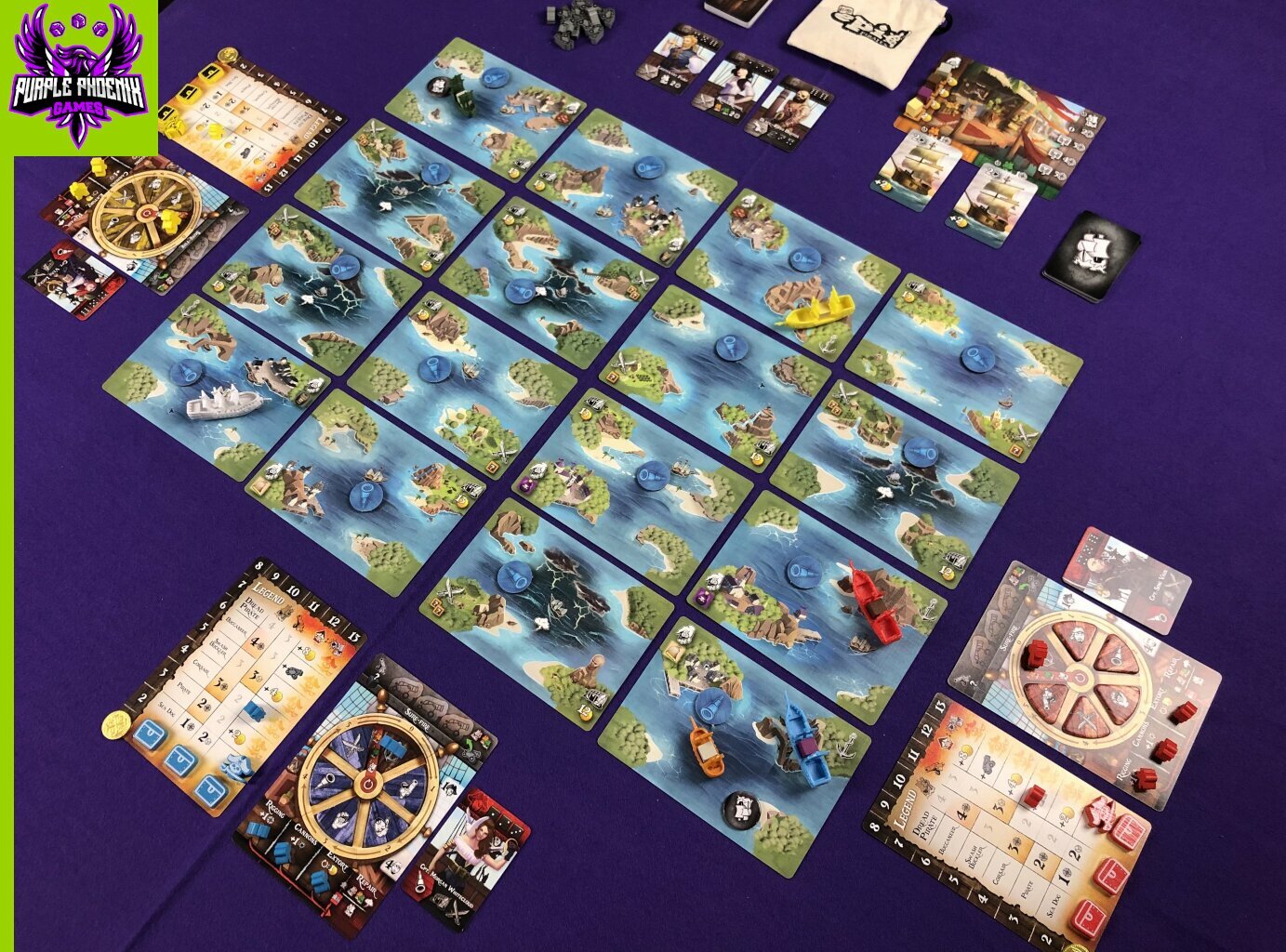
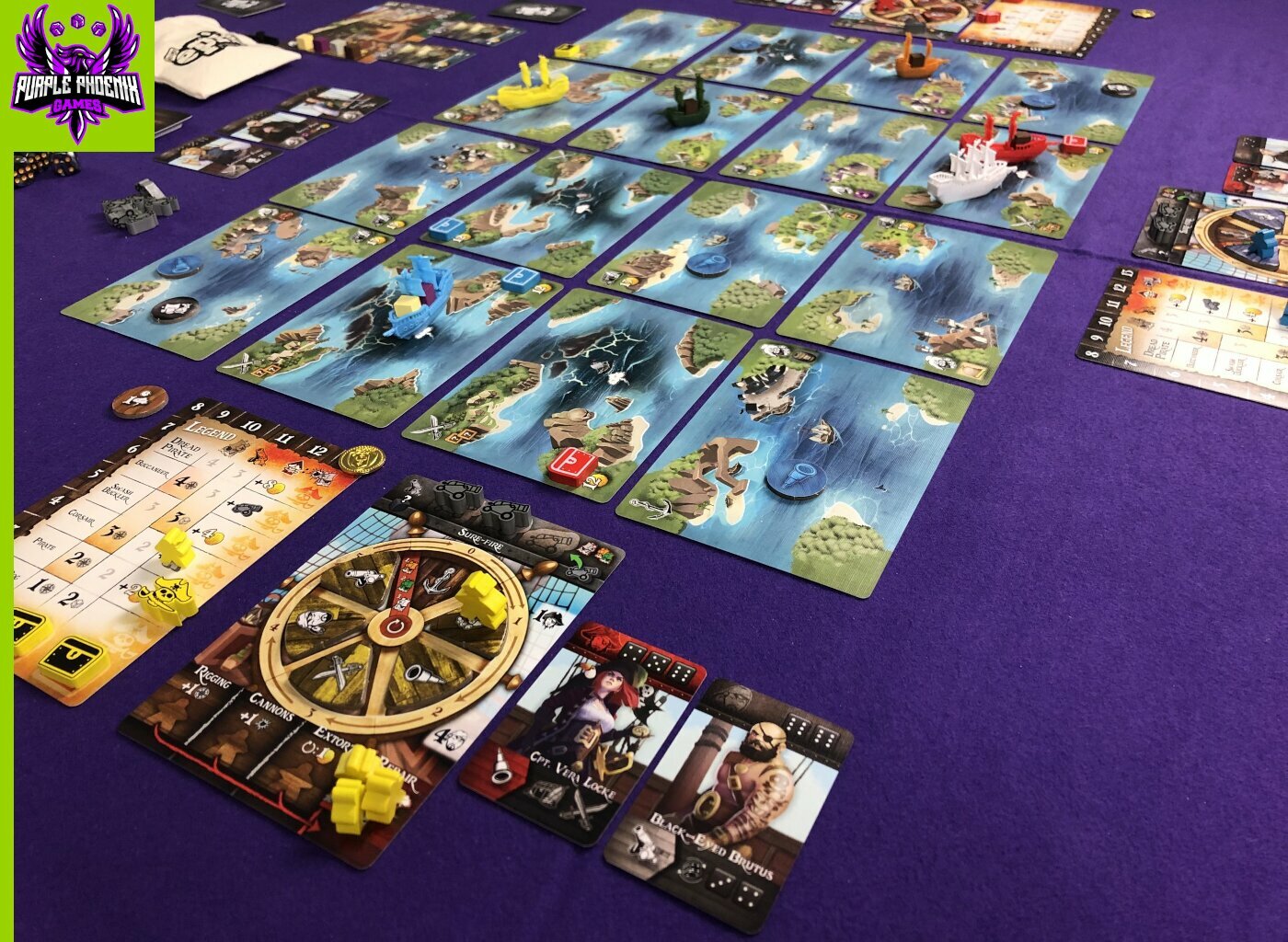
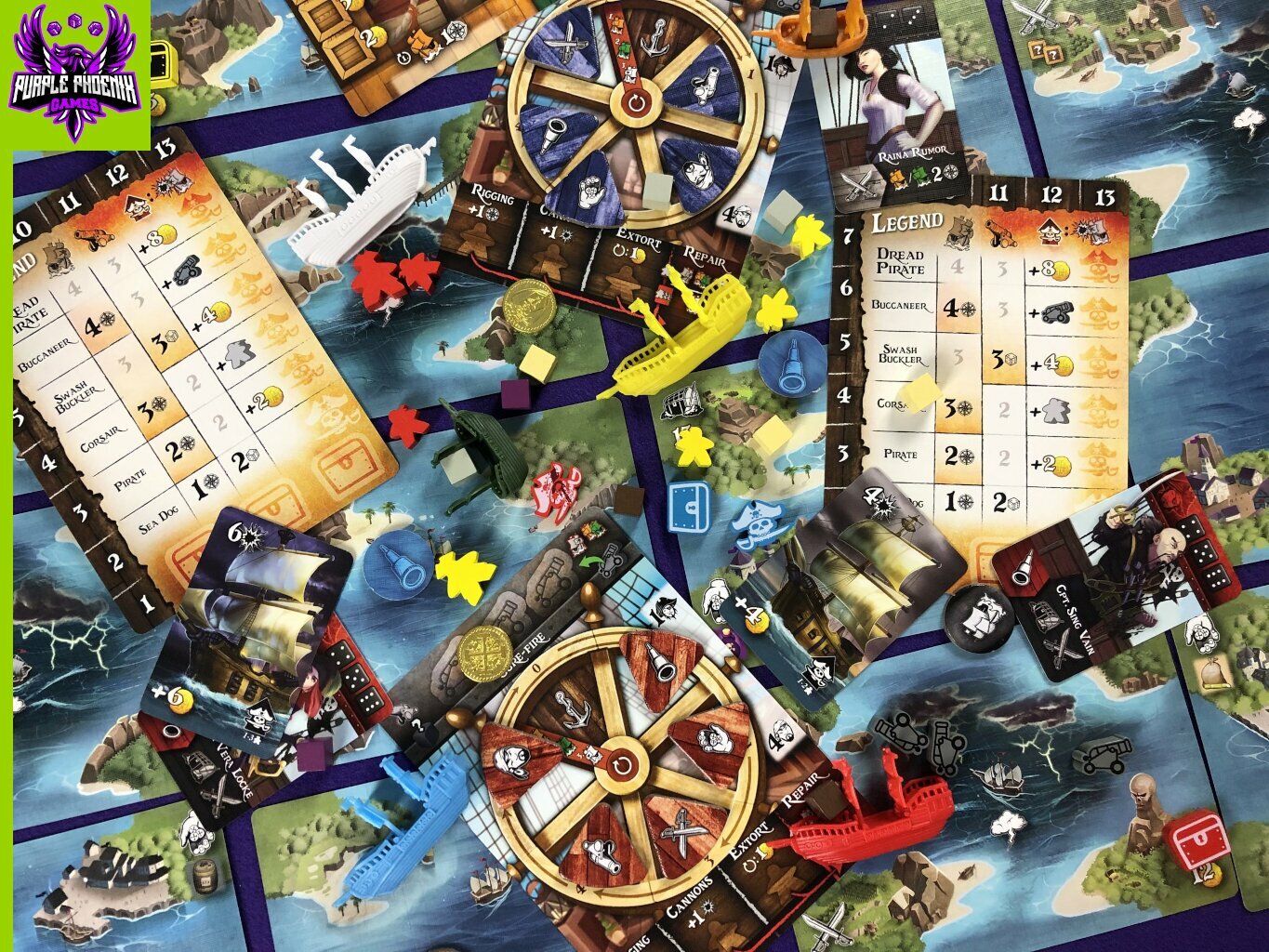
Tiny Epic Pirates is a competitive game in which players take on the roles of pirate captains sailing the seas, engaging in combat, trading at various ports, and trying to bury some treasure. Played over a series of rounds, the game ends once a player has buried their 3rd treasure chest. To setup, follow the instructions as detailed in the rulebook – there are simply too many to outline here concisely. Two unique aspects of setup are that the Map cards are shuffled and randomly placed in a 4×4 grid, ensuring a variable setup for each game. The other is that each player will also randomly assign Order tokens on their Wheel (rondel), which means that no two players will have the same setup for a game. Once the Sea has been created, players have prepared their appropriate mats, a market for Booty and Crew have been setup, and tokens/Ships are placed on the map, the game is ready to begin!
Each turn is broken down into 5 steps: Captain’s Order/Deckhands, Sail, Execute Captain’s Order, Trigger Bonus Actions, and Crossing the Ship Line. The first part of every turn is to move your Captain meeple clockwise on your Wheel to select your Captain’s Order for this turn. Moving to the next adjacent space is free, but to skip spaces you must place Deckhand meeples onto the skipped spaces. In future turns, you may have Deckhands coming off the wheel, and you will assign those to other tasks during this step. The next step is to Sail your ship. Every player begins the game with a base speed of 1 Map card, and this can be enhanced throughout gameplay. During this step, you may Sail your ship across Map tiles up to your total allowed distance. After having Sailed, it is time to Execute Captain’s Order. To do this, refer back to your Wheel to see which action your Captain is on, and perform it. Possible actions are to Plunder (steal Booty from settlements), Trade (trade Booty for $ at markets), Crew Up (add up to 4 Crew members to your Ship), Search (gain a one-time benefit from un-searched Map cards), Attack (attack opposing Pirates or Merchant ships at sea), or Hide Out (rest at a Cove and reassign all Deckhands). You may only perform the action that was selected in the Captain’s Order step, regardless of if your placement on a Map card has other actions available.
Once your selected action has been performed, the next step is to Trigger Bonus Actions. Looking at your Captain and Crew cards, if their leftmost icon matches your current Captain’s Order, you may trigger the listed bonus actions. Some bonus actions allow you to perform duplicate Captain’s Orders, but others will earn you money, let you reassign Deckhands, exchange Booty at a different rate, and bury treasure. You don’t need to perform every Bonus Action listed if you so choose, but they may only be performed when their card icon matches your Captain’s Order. The very last step of your turn is to see if you have Crossed the Ship Line. Check your Wheel and see if you have moved from space 5 across the Ship Line to start another circle around the Wheel. If you did not cross the line, then your turn ends and play moves to the next Pirate. If you did cross the Ship Line, then the Merchant and Navy ships will sail a set amount of distance. Merchant ships are simply trying to deliver goods to port, and will be traversing the sea throughout the game. The Navy ship is hunting down Pirates, and will move to attack the current player any time the Ship Line is crossed. When a player has buried their third and final treasure, the round finishes as normal and the game ends. The player who buried all 3 treasures is the winner! In the case of a tie, check the rulebook. 😉
As with most of the Tiny Epic games, I will first start by saying that the size of the box may be small, but the gameplay inside is enormous. There is so much strategy in this one, I think it’s the ‘heaviest’ one in the series so far. You have so many different choices when it comes to strategy, and the gameplay will feel different every time. You could choose to take the offensive and be the aggressor, attacking any and all Ships that you can. Winning combat against Merchant Ships earns you Booty and other resources, while winning combat against opposing Pirates earns you Legend Levels. Your current Legend Level dictates how many spaces you are allowed to Sail, as well as how many dice you can roll during combat. So increasing that level results in better benefits. Maybe you just want to be an honest Pirate and do all of your trading at legal markets, avoiding contact with others and trying to skirt around combat. Maybe you want to try a little of both? The point is, you have choices, and must be able to adapt them based on your opponents’ decisions as well.
A neat element I touched on earlier about this game is the variable setup for each individual player and their Wheel. This really factors into your strategy because you have to know when to use which actions. Do you use a Deckhand to skip a space, or do you burn a turn moving for free to keep that Deckhand right where you want him? And remember, Bonus Actions are only triggered when the matching Captain’s Order is selected, so maybe you have to sacrifice acting in a turn (not being able to perform the selected Captain’s Order) in order to trigger your desired Bonus Action. It’s all about strategy, and that keeps the gameplay engaging at all times.
Just a word of warning though, there is a bit of a learning curve, as there are so many steps and items to consider each turn. Thus the gameplay felt pretty daunting and slow-going my first few plays. But as I became more comfortable with the turn structure and the iconography, it became easier to know what comes next. Another thing to consider is player count. Playing Tiny Epic Pirates at 2 players didn’t really feel that immersive or engaging. With only 2 players on a 4×4 grid, it can be easy to completely avoid each other and skirt around, essentially playing by yourself in a way. With 3 and 4 players, there are more Ships on the map and more opportunities for player interactions and engagement. So it all comes down to what kind of gameplay you want, when selecting your player count.
Components. Again, so far all the Tiny Epic games have had awesome production quality and Tiny Epic Pirates is no exception. The artwork is bright and colorful, the cards and cardboard tokens are sturdy, the meeples are cute, and the actual ships are fun to play with. My only qualms are that two of the player colors – black and blue – are visually similar so in setup it can be tricky to tell them apart. Another qualm is that two of the Booty types (teehee) are a tan and gray color, and the iconography for both on the Map cards are similarly colored. The first few plays I found myself trading the wrong Booty at market because I didn’t check the icon closely enough. These are not game-breakers by any means, but just a heads up so you’re paying attention! As this was a Kickstarter, I did opt for the add-on Pirate Skull dice, and have to honestly say that I prefer the regular game dice better. The ‘knots’ on the corners of the skull dice stop them from continuing to roll, so I felt like I wasn’t really getting a real roll on them. Maybe that’s just my personal opinion, but the regular ol’ game dice are perfectly fine.
How does Tiny Epic Pirates fare in the lineup of the Tiny Epic games? Fairly well, I would say. It’s not one that I would pull out to play with just anybody, as it is a bit of a heavier game, but it is one that I know I would enjoy with my game group. There are a lot of neat elements and mechanics at play here that really work well together and make for an engaging and kind of brain-burning (in a way) game. Although Tiny Epic Pirates might not get as much playtime for me as others in the series, it’s a good one to have and it really embodies the tiny (small box, check) and epic (sweet and strategic gameplay) parts of the title. Purple Phoenix Games gives this one a seaworthy 4 / 6.


Erika (17789 KP) rated Deadpool 2 (2018) in Movies
May 20, 2018 (Updated May 20, 2018)


1) The jokes were tired, and already done in DP1. When everyone was cracking up in the first scenes, I looked at my best friend and asked, 'What is everyone laughing at? This sh** is not funny.' How many times does Ryan Reynolds need to make fun of Green Lantern? Seriously, get over it. 2) It was was too long. That's 2 hours and 10 minutes of my life I can never get back. At least it was free with moviepass. 3) Ryan Reynolds was too Ryan Reynolds, rather than the character. Unless, they're supposed to be one of the same? Don't get me wrong, I love Ryan Reynolds comedies (e.g., Waiting/Just Friends), but it was too much. 4) A lot of the scenes were about 5 minutes too long... The unfunny scene at the end where DP just wouldn't go away (no specifics because that'd be a spoiler). 5) You could tell some of the jokes were inserted after the fact because the quality of the sound on it. Yeah, of course they can get away with it sometimes, since RR is wearing the mask... But it was too obvious.
I am surprised that TJ Miller wasn't completely cut from the film (same with Ready Player One), since that seems to be the norm whenever scandals occur now.

Voice of DAISY
Book and Education
App
Supported OS: iOS 9.0 or later Device: iPhone 4S/5/5S/5C/6/6 Plus/6s/6s Plus/SE/7/7 Plus, iPod touch...

Calmer Chameleon
Book
Phil Pickett first tasted success in seventies band Sailor who scored with hits such as'Girls,...

Stickman Skater
Games and Entertainment
App
Ranked #2 paid apps USA, Ranked #1 Sports game in 15 countries. You are a little stickman skater...