Search
Search results

Debbiereadsbook (1801 KP) rated Around and Around We Go (Vermont Trailblazers #2) in Books
Apr 30, 2026


it was EPIC, when Sandro let Bennett in!
Independent reviewer for Archaeolibrarain, I was gifted my copy of this book.
This is book 2 in the Vermont Trailblazers series. While it can be read as a stand alone to book 1, The Best Parts of Him, I reckon you SHOULD read that book first. Why? Cos it was freaking awesome and so is this one!
Sandro is the oldest player in the team, and until his knees and/or back give out, he'll keep playing cos The Trailblazers are heading for a third consecutive championship this year. He just needs to hold out and put up with this documentary that is being made around them. Bennett is the director. He too, is facing the end of his career if this series tanked as much as the last one. That he is here, facing the love of his life after 15 years? Minor detail, and Bennett just needs to talk to Sandro, if Sandro will let him.
What I noticed while reading this book, (nay, I inhaled this book!) was although it's a hockey based book, there was very little actual on ice descriptions of play. And as a non-sporty person, I absolutely loved that! There are some, but only enough to give you a picture of what's going on, and it's not in great detail. It all made perfect sense to me, as sometimes, I get overwhelmed by the detail and I didn't here and I was able to fully concentrate on Sandro and Bennett.
And they were beautiful, they really were.
I fully understood why Sandro didn't really want to talk to Bennett, off camera, the man was still hurting, even after all this time, but when Sandro allowed Bennett in, finally?? Oh it was truly epic. Sandro made Bennett work for it, he really did.
I loved that Bennett found the theme for the series based on his own experience. Loved how the older Trailblazers were helping the new team members who really were struggling. And that Sandro found his future, along the same thread.
It takes time for the steam to build, and I loved being made to wait for it. This book is more about the emotions of these two men, and giving the other a second chance. Oh Bennett wanted Sandro, he really did, but Sandro wasn't sure about letting him in and I loved that they didn't jump straight back in. 15 years is a long time!
Absolutely cracking follow-up to book 1, and I can't wait to see what comes next. Well, I know who comes next, but I gotta wait so freaking long!
A stunning 5 star read!
*same worded review will appear elsewhere
This is book 2 in the Vermont Trailblazers series. While it can be read as a stand alone to book 1, The Best Parts of Him, I reckon you SHOULD read that book first. Why? Cos it was freaking awesome and so is this one!
Sandro is the oldest player in the team, and until his knees and/or back give out, he'll keep playing cos The Trailblazers are heading for a third consecutive championship this year. He just needs to hold out and put up with this documentary that is being made around them. Bennett is the director. He too, is facing the end of his career if this series tanked as much as the last one. That he is here, facing the love of his life after 15 years? Minor detail, and Bennett just needs to talk to Sandro, if Sandro will let him.
What I noticed while reading this book, (nay, I inhaled this book!) was although it's a hockey based book, there was very little actual on ice descriptions of play. And as a non-sporty person, I absolutely loved that! There are some, but only enough to give you a picture of what's going on, and it's not in great detail. It all made perfect sense to me, as sometimes, I get overwhelmed by the detail and I didn't here and I was able to fully concentrate on Sandro and Bennett.
And they were beautiful, they really were.
I fully understood why Sandro didn't really want to talk to Bennett, off camera, the man was still hurting, even after all this time, but when Sandro allowed Bennett in, finally?? Oh it was truly epic. Sandro made Bennett work for it, he really did.
I loved that Bennett found the theme for the series based on his own experience. Loved how the older Trailblazers were helping the new team members who really were struggling. And that Sandro found his future, along the same thread.
It takes time for the steam to build, and I loved being made to wait for it. This book is more about the emotions of these two men, and giving the other a second chance. Oh Bennett wanted Sandro, he really did, but Sandro wasn't sure about letting him in and I loved that they didn't jump straight back in. 15 years is a long time!
Absolutely cracking follow-up to book 1, and I can't wait to see what comes next. Well, I know who comes next, but I gotta wait so freaking long!
A stunning 5 star read!
*same worded review will appear elsewhere

Purple Phoenix Games (2266 KP) rated Deep Blue in Tabletop Games
Mar 17, 2022
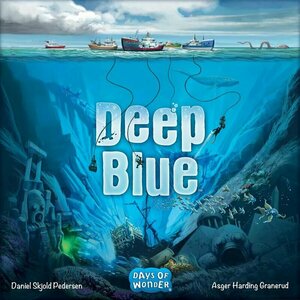

A couple of months ago, Travis was in town, so he and I went over to Josh’s place to get a day of gaming in. It was an awesome time to play together, and to get to experience some new games for each of us. While we were there, we got to talking about some of the games in Josh’s collection, and he pulled out Deep Blue. He’d had it for a while, but had since gotten another game that he felt did the same things but better. So he asked if either of us wanted to take it off his hands. I said sure, as I’d never played the game before. Now that it’s a part of my collection, is it going to stay there? Or will my feelings mirror Josh’s with regards to the gameplay?
Deep Blue is a nautical game for 2-5 players of deck building, hand management, and a bit of push your luck. In it, players take on the roles ship Captains who are racing to collect treasures from undersea wrecks. Players will be hiring Crew members, sailing across the sea, and sending divers down to wrecks to salvage any valuables. The race is on, though, because you are not the only Captain on this treasure hunt… Throughout the game, players will stumble across 4 Wrecks that make up a Sunken City. Once all 4 areas of the Sunken City have been discovered and searched, the game ends. The player who earns the most VP from their collected treasures by the end of the game is declared the winner!
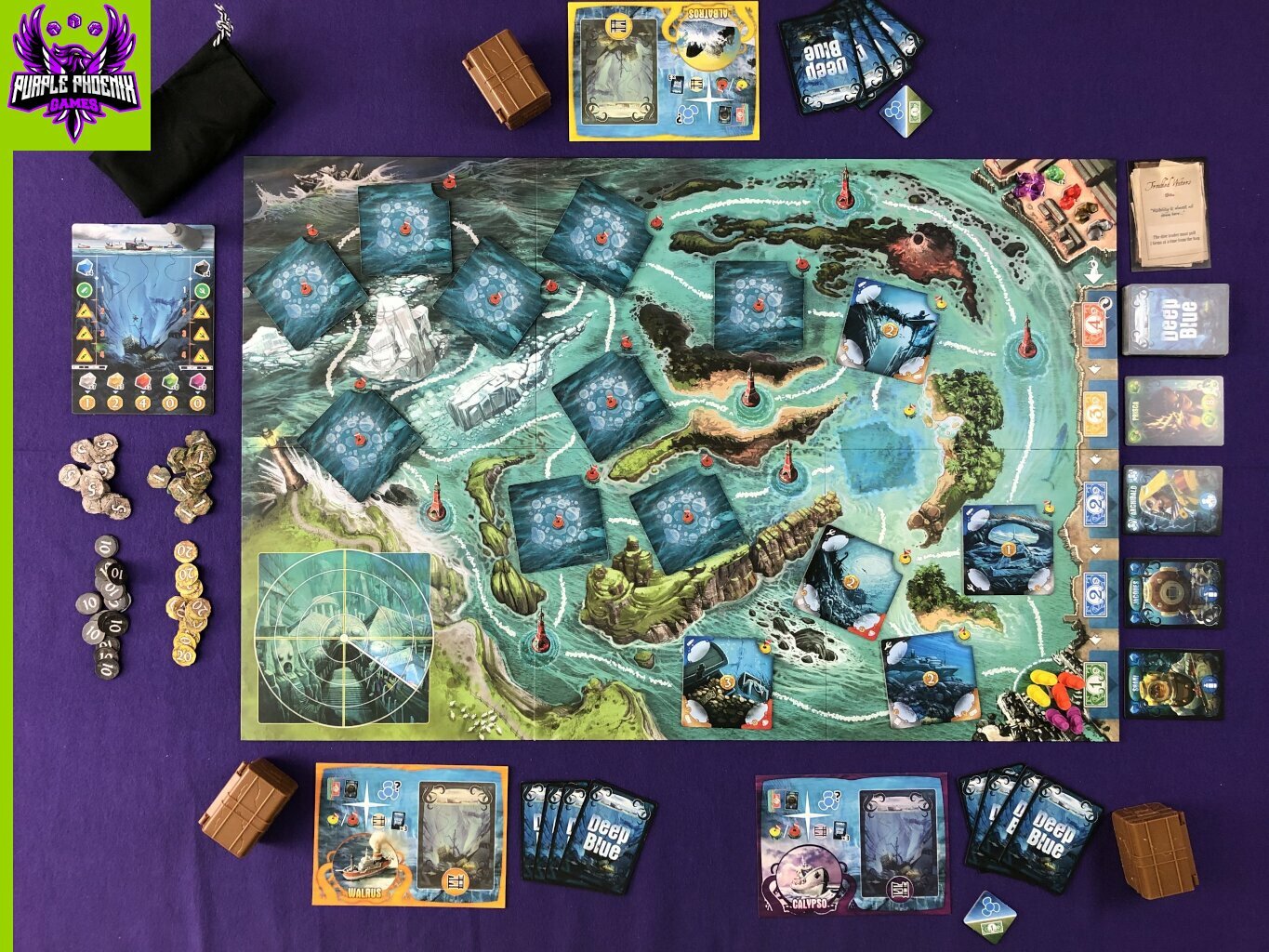
To setup for a game, follow the instructions in the rulebook – there are simply too many to detail here. The basic gist of setup is to create a market of Crew cards, shuffle and randomly distribute Wreck tiles across the board, and create a Gem pool. Each player will receive a player mat and starting cards in their chosen color, as well as 2 ships to be placed on the starting space of the board. Players will also get a treasure chest, in which they will keep their VP throughout the game. Set the Dive Site board, Gem bag, and VP tokens off to the side. Select a starting player, deal out starting tokens accordingly, and the game is ready to begin! Pictured below is the setup for a 3-player game.
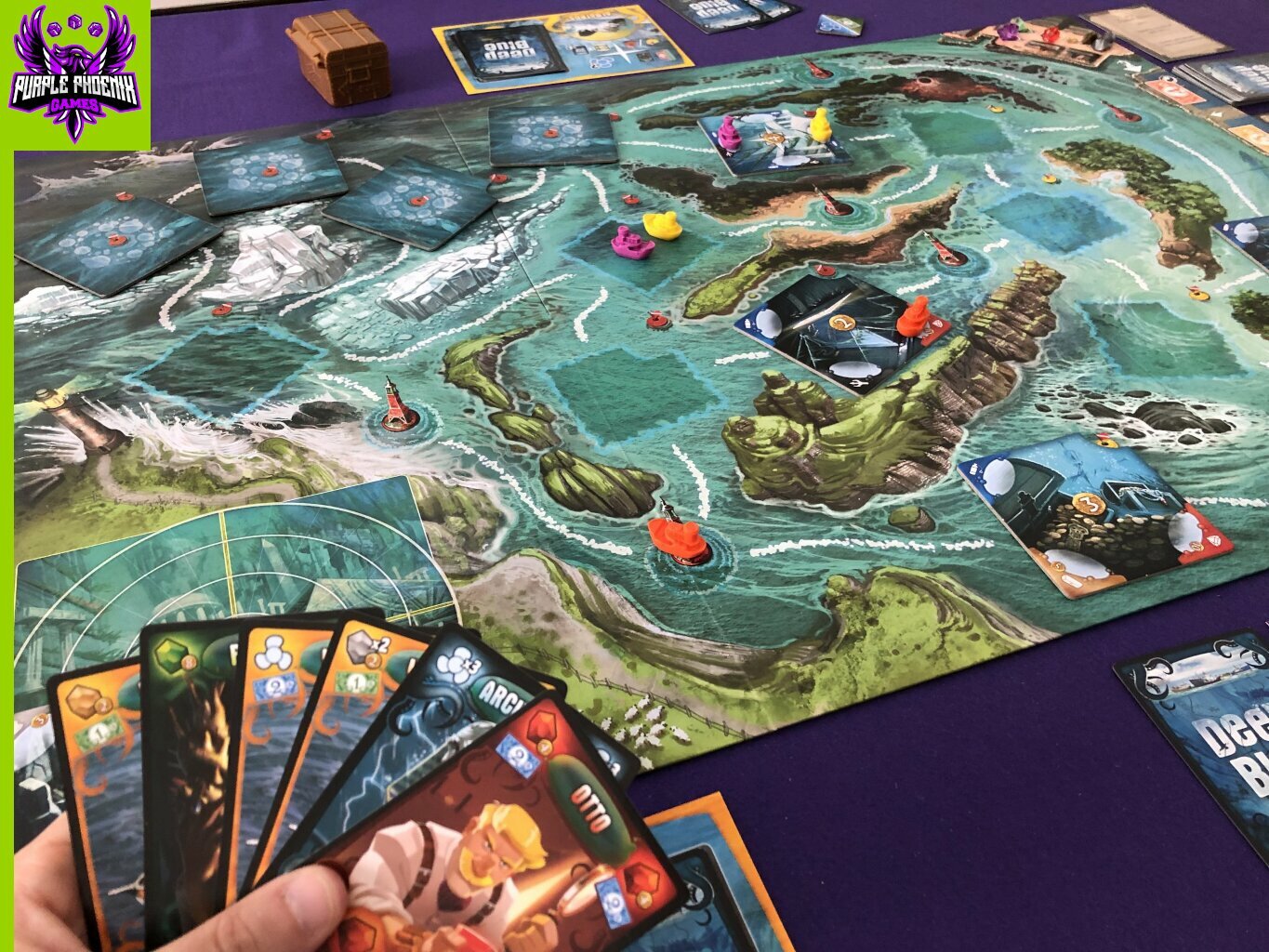
On your turn, you will take one of four possible actions: Recruit a Crew Member, Sail, Rest, or Dive. Throughout the game you will be building your personal deck by Recruiting Crew Members. These new Crew offer unique abilities and scoring powers to be used during Dives. In order to recruit a Crew Member, you must pay the corresponding cost listed by its location in the market. To do so, you will play cards from your hand with $ symbols that equal the required cost. Once you play a card from your hand, it goes facedown onto the Rest area of your player mat. Take the Crew Member you just hired directly into your hand, and move the Market cards down to fill in the empty space, drawing a new card for the final slot. If you choose to Sail, you will play a number of cards from your hand with the Propeller icon. The number of icons dictates how many spaces you may sail. You can use all of your movement on one of your ships, or you can break movement across both ships. If you end a move on a face-up Wreck tile, you will ‘anchor’ your boat to one of the open scouting spots. These scouting spots offer special scoring benefits during the Dive on this tile. If you end movement on a face-down Wreck tile, first you will flip it face-up, and then anchor your boat. When landing on a buoy or an empty dive site, nothing happens.
On any turn, you may instead choose to Rest. To perform this action, you will shuffle all cards that reside on the Rest area of your player mat, and then draw only the 3 topmost cards into your hand. This is the action that allows you to refresh your hand, as you play more cards and your hand starts to dwindle. The final action choice is to Dive. This action is the crux of the game. When you have a boat on a Wreck tile, you may choose to start a Dive. The first step is to declare your Dive – decide which Wreck to Dive if your boats are on different Wreck tiles. Before the Dive begins, any opponents who have boats on adjacent Wreck tiles may move their boats to your Wreck in hopes of also profiting from the Dive. When all eligible boats have been moved to the Wreck, you will then officially begin the Dive. Take the Gem bag and Dive Site board. You will then draw Gems out of the bag, one-by-one, resolving them as necessary. Red, Gold, Silver, Green, and Purple gems are treasures, and can earn you VP. Blue and Black gems are Hazards that must be defended against in order to continue the Dive.
After a Gem is drawn and placed on the Dive Site board, players may choose to play a Crew Member to increase their VP earned. For example, one card allows you to earn 8 VP for a Green gem, instead of 0. To defend against hazards, players may play Crew from their hands who have the ability to negate the hazard, or may use the special ability of their scouting spot on the Wreck tile. If you are unable to defend against a hazard, you are forced to resurface and leave the Dive. The Dive continues in this fashion, until either the active player decides to end the Dive, or when they no longer have the ability to defend against hazards. Any players who still have boats at the Dive Site will collect VP from Crew cards they played, as well as a base amount of VP for the different Gems that were drawn. Once a Dive has been performed at a Wreck, that tile is removed from the game, leaving an empty dive site behind. If players have performed a Dive at one of the 4 Sunken City tiles, it is removed from the board, but placed on its corresponding space in the corner of the board. After all 4 Sunken City tiles have been moved to the corner of the board, the game immediately ends. Players will count up all the VP collected throughout the game, and the player with the highest score is declared the winner!
So how do I feel about Deep Blue overall? I would have to say that it’s fine. Just fine. There are some elements that I really enjoy, but others that kind of frustrate me. What I enjoy – the bits of strategy involved, and the awesome components. What I don’t enjoy – the pacing of the game and the imbalance of actions. To touch on the pros first, this game does require some strategy. You have to decide where to Sail, which Crew to recruit, which Crew to play and when to play them, etc. VP are earned by participating in Dives, so you want to make sure you can be at as many Dives as possible. That means keeping ships close to opponents to profit from any dives they may choose to initiate. Another interesting strategic element is the Rest action. You shuffle your discard pile, but then only draw the 3 topmost cards into your hand. You might not always draw what you were wanting, but you are always allowed to take a Rest action, regardless of how many cards are in your discard. There is no hand limit in this game, so do you rest every other turn to ensure you have almost all cards in your hand? Or do you dwindle your hand down in order to perform other actions instead? It’s all about your strategy, and you never quite know what your opponents are trying to do.
Now for the cons. The pacing of the gameplay feels really slow to me. You are only allowed to perform 1 action per turn, so it seems like the game takes a while to really get going. At first, everyone is going to be wanting to Sail, as all players start in the same starting area of the board. You want to get your ships out there ASAP. But then you run out of cards, so you have to take a turn to Rest and get those cards back. You’re taking a bunch of little turns to accomplish any one bigger thing, and that bogs down the gameplay for me. If you were able to perform 2 actions per turn, that would probably alleviate some of this frustration, as it would allow you to progress more quickly than by taking only a single action. Another aspect I mentioned is the imbalance of actions. The Recruit, Sail, and Rest actions all feel to me like they are on the same level, but the Dive action is different. Which in and of itself isn’t necessarily a bad thing. But the process of the Dive action is vastly different than any of the other actions, to the point that it kind of feels like a different game to me. For half of the game, you’re playing this game of strategy, deck building, and optimizing placement across the board. But for the other half, it turns into a push-your-luck frenzy that seems disjointed from the rest of the game to me. No matter how strategic and careful you are with your actions, it ultimately comes down to the luck of the draw.
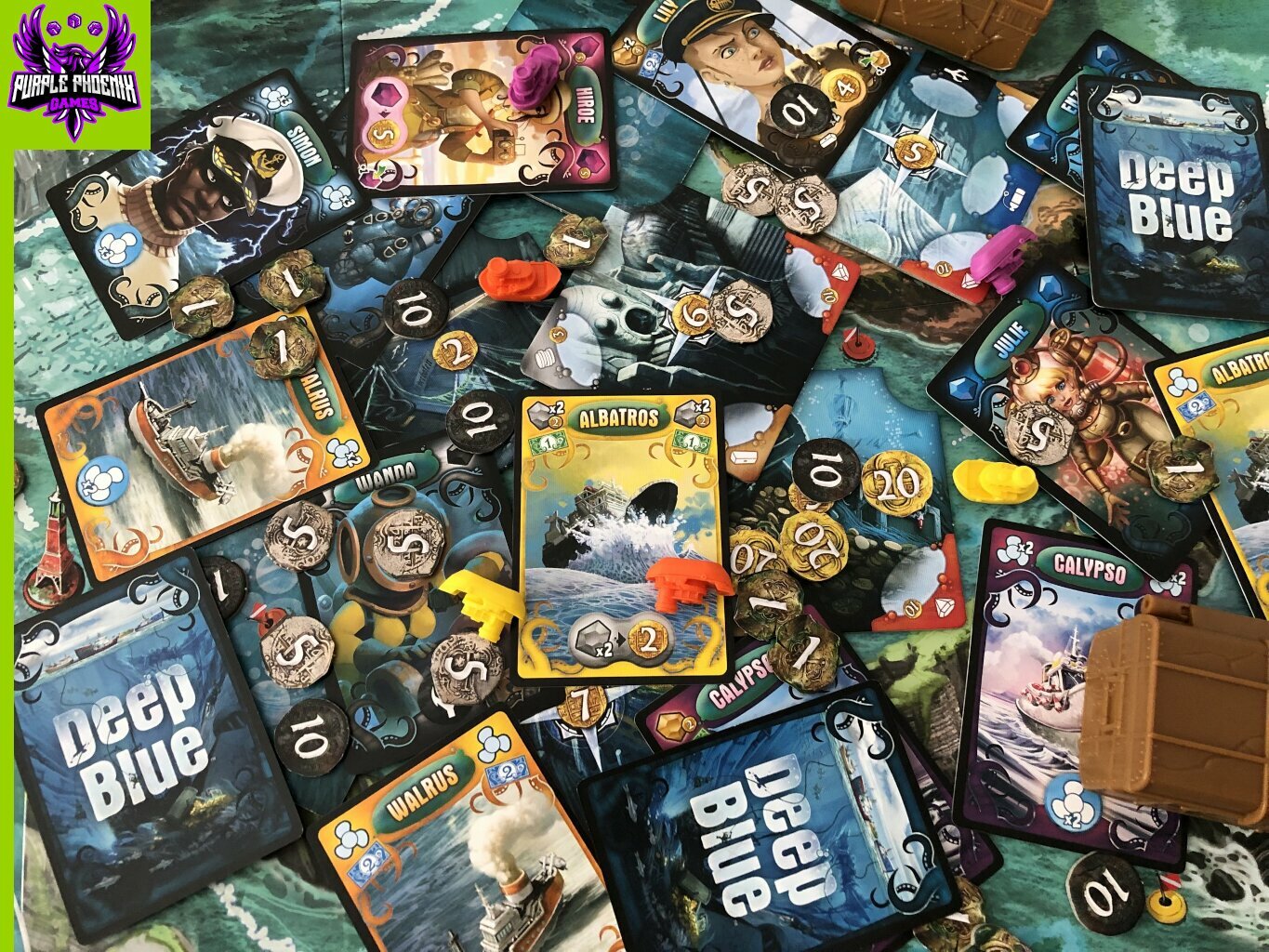
To touch on components for a minute – the production quality of this game is awesome. The board, Dive Site board, and VP tokens are nice chunky cardboard. The cards are colorful, have cool artwork, and are sturdy. And the treasure chests are awesome little plastic chests that definitely are holding up well. The Wreck tiles are big and thick, the Gems are cute, and the ships are fun to play with. So overall, this game is made very well.
You can probably tell by now that I have mixed feelings about Deep Blue. There are aspects that I like, but other aspects that negate some of those positive attributes. I was psyched for a cool nautical deck builder where I could really flex my strategy, but got more push-your-luck than I was anticipating. Deep Blue will probably stick around in my collection for the time being. But, like Josh, I will probably find something that gives me the same vibes but done better. It’s a game that I’ll pull out from time to time, but definitely not one that’s going to break into my Top 10. With that said, Purple Phoenix Games gives it a sunken 4 / 6.
Deep Blue is a nautical game for 2-5 players of deck building, hand management, and a bit of push your luck. In it, players take on the roles ship Captains who are racing to collect treasures from undersea wrecks. Players will be hiring Crew members, sailing across the sea, and sending divers down to wrecks to salvage any valuables. The race is on, though, because you are not the only Captain on this treasure hunt… Throughout the game, players will stumble across 4 Wrecks that make up a Sunken City. Once all 4 areas of the Sunken City have been discovered and searched, the game ends. The player who earns the most VP from their collected treasures by the end of the game is declared the winner!
To setup for a game, follow the instructions in the rulebook – there are simply too many to detail here. The basic gist of setup is to create a market of Crew cards, shuffle and randomly distribute Wreck tiles across the board, and create a Gem pool. Each player will receive a player mat and starting cards in their chosen color, as well as 2 ships to be placed on the starting space of the board. Players will also get a treasure chest, in which they will keep their VP throughout the game. Set the Dive Site board, Gem bag, and VP tokens off to the side. Select a starting player, deal out starting tokens accordingly, and the game is ready to begin! Pictured below is the setup for a 3-player game.
On your turn, you will take one of four possible actions: Recruit a Crew Member, Sail, Rest, or Dive. Throughout the game you will be building your personal deck by Recruiting Crew Members. These new Crew offer unique abilities and scoring powers to be used during Dives. In order to recruit a Crew Member, you must pay the corresponding cost listed by its location in the market. To do so, you will play cards from your hand with $ symbols that equal the required cost. Once you play a card from your hand, it goes facedown onto the Rest area of your player mat. Take the Crew Member you just hired directly into your hand, and move the Market cards down to fill in the empty space, drawing a new card for the final slot. If you choose to Sail, you will play a number of cards from your hand with the Propeller icon. The number of icons dictates how many spaces you may sail. You can use all of your movement on one of your ships, or you can break movement across both ships. If you end a move on a face-up Wreck tile, you will ‘anchor’ your boat to one of the open scouting spots. These scouting spots offer special scoring benefits during the Dive on this tile. If you end movement on a face-down Wreck tile, first you will flip it face-up, and then anchor your boat. When landing on a buoy or an empty dive site, nothing happens.
On any turn, you may instead choose to Rest. To perform this action, you will shuffle all cards that reside on the Rest area of your player mat, and then draw only the 3 topmost cards into your hand. This is the action that allows you to refresh your hand, as you play more cards and your hand starts to dwindle. The final action choice is to Dive. This action is the crux of the game. When you have a boat on a Wreck tile, you may choose to start a Dive. The first step is to declare your Dive – decide which Wreck to Dive if your boats are on different Wreck tiles. Before the Dive begins, any opponents who have boats on adjacent Wreck tiles may move their boats to your Wreck in hopes of also profiting from the Dive. When all eligible boats have been moved to the Wreck, you will then officially begin the Dive. Take the Gem bag and Dive Site board. You will then draw Gems out of the bag, one-by-one, resolving them as necessary. Red, Gold, Silver, Green, and Purple gems are treasures, and can earn you VP. Blue and Black gems are Hazards that must be defended against in order to continue the Dive.
After a Gem is drawn and placed on the Dive Site board, players may choose to play a Crew Member to increase their VP earned. For example, one card allows you to earn 8 VP for a Green gem, instead of 0. To defend against hazards, players may play Crew from their hands who have the ability to negate the hazard, or may use the special ability of their scouting spot on the Wreck tile. If you are unable to defend against a hazard, you are forced to resurface and leave the Dive. The Dive continues in this fashion, until either the active player decides to end the Dive, or when they no longer have the ability to defend against hazards. Any players who still have boats at the Dive Site will collect VP from Crew cards they played, as well as a base amount of VP for the different Gems that were drawn. Once a Dive has been performed at a Wreck, that tile is removed from the game, leaving an empty dive site behind. If players have performed a Dive at one of the 4 Sunken City tiles, it is removed from the board, but placed on its corresponding space in the corner of the board. After all 4 Sunken City tiles have been moved to the corner of the board, the game immediately ends. Players will count up all the VP collected throughout the game, and the player with the highest score is declared the winner!
So how do I feel about Deep Blue overall? I would have to say that it’s fine. Just fine. There are some elements that I really enjoy, but others that kind of frustrate me. What I enjoy – the bits of strategy involved, and the awesome components. What I don’t enjoy – the pacing of the game and the imbalance of actions. To touch on the pros first, this game does require some strategy. You have to decide where to Sail, which Crew to recruit, which Crew to play and when to play them, etc. VP are earned by participating in Dives, so you want to make sure you can be at as many Dives as possible. That means keeping ships close to opponents to profit from any dives they may choose to initiate. Another interesting strategic element is the Rest action. You shuffle your discard pile, but then only draw the 3 topmost cards into your hand. You might not always draw what you were wanting, but you are always allowed to take a Rest action, regardless of how many cards are in your discard. There is no hand limit in this game, so do you rest every other turn to ensure you have almost all cards in your hand? Or do you dwindle your hand down in order to perform other actions instead? It’s all about your strategy, and you never quite know what your opponents are trying to do.
Now for the cons. The pacing of the gameplay feels really slow to me. You are only allowed to perform 1 action per turn, so it seems like the game takes a while to really get going. At first, everyone is going to be wanting to Sail, as all players start in the same starting area of the board. You want to get your ships out there ASAP. But then you run out of cards, so you have to take a turn to Rest and get those cards back. You’re taking a bunch of little turns to accomplish any one bigger thing, and that bogs down the gameplay for me. If you were able to perform 2 actions per turn, that would probably alleviate some of this frustration, as it would allow you to progress more quickly than by taking only a single action. Another aspect I mentioned is the imbalance of actions. The Recruit, Sail, and Rest actions all feel to me like they are on the same level, but the Dive action is different. Which in and of itself isn’t necessarily a bad thing. But the process of the Dive action is vastly different than any of the other actions, to the point that it kind of feels like a different game to me. For half of the game, you’re playing this game of strategy, deck building, and optimizing placement across the board. But for the other half, it turns into a push-your-luck frenzy that seems disjointed from the rest of the game to me. No matter how strategic and careful you are with your actions, it ultimately comes down to the luck of the draw.
To touch on components for a minute – the production quality of this game is awesome. The board, Dive Site board, and VP tokens are nice chunky cardboard. The cards are colorful, have cool artwork, and are sturdy. And the treasure chests are awesome little plastic chests that definitely are holding up well. The Wreck tiles are big and thick, the Gems are cute, and the ships are fun to play with. So overall, this game is made very well.
You can probably tell by now that I have mixed feelings about Deep Blue. There are aspects that I like, but other aspects that negate some of those positive attributes. I was psyched for a cool nautical deck builder where I could really flex my strategy, but got more push-your-luck than I was anticipating. Deep Blue will probably stick around in my collection for the time being. But, like Josh, I will probably find something that gives me the same vibes but done better. It’s a game that I’ll pull out from time to time, but definitely not one that’s going to break into my Top 10. With that said, Purple Phoenix Games gives it a sunken 4 / 6.

Purple Phoenix Games (2266 KP) rated Jetpack Joyride in Tabletop Games
Jan 8, 2020 (Updated Jan 8, 2020)


It should come as no surprise that I love to play board games. Hence my involvement in this wonderful group! But besides board games, I also enjoy my fair share of video games too. These two worlds of gaming occasionally collide when a classic from one realm is transferred over to the other! Is the adaptation as fun as the original, or does it leave much to be desired?
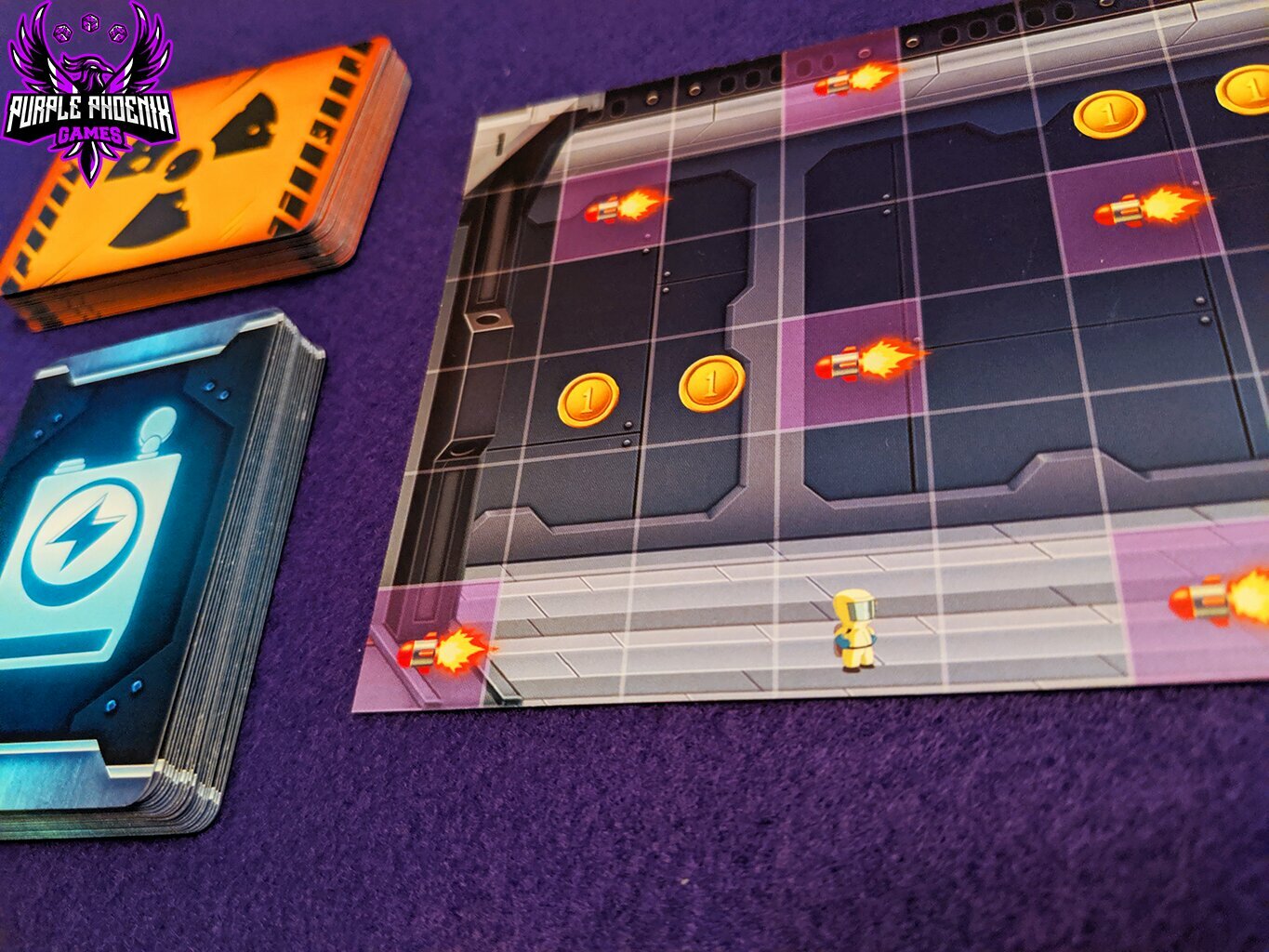
Originally a mobile game, Jetpack Joyride follows our main character, Barry, as he attempts to escape a top-secret lab with a stolen jetpack! He must avoid being hit by zappers, annihilated by lasers, and blown away by missiles in the process. If Barry succeeds, he escapes with not only the high-tech jetpack, but also with as many gold coins and other top-secret gadgets as he can get his hands on! So the risk is definitely worth the reward. But if Barry is unable to escape, he will face the consequences for his unauthorized joyride… In all honesty, I had never heard of Jetpack Joyride before I Kickstarted the board game version, so I downloaded it on my phone to see how it plays. Do you remember Flappy Bird? The mobile version of Jetpack Joyride is kiiiinda like that, but more exciting and way less infuriating. It’s free to download in the App Store and Google Play Store, so check it out if you’re interested! Anyway, back to the board game version. The premise is the same as the app – you have to create a path for Barry to use for his escape from the lab, utilizing the gadgets available to you and collecting gold coins on your way.
DISCLAIMER: We are using the Kickstarter Deluxe version of the game. We do have the expansions from the KS campaign, but will not be using those for this review. Also, we do not intend to cover every single rule included in the rule book, but will describe the overall game flow and major rule set so that our readers may get a sense of how the game plays. For more in depth rules, you may purchase a copy from the publisher directly or from your FLGS. -T
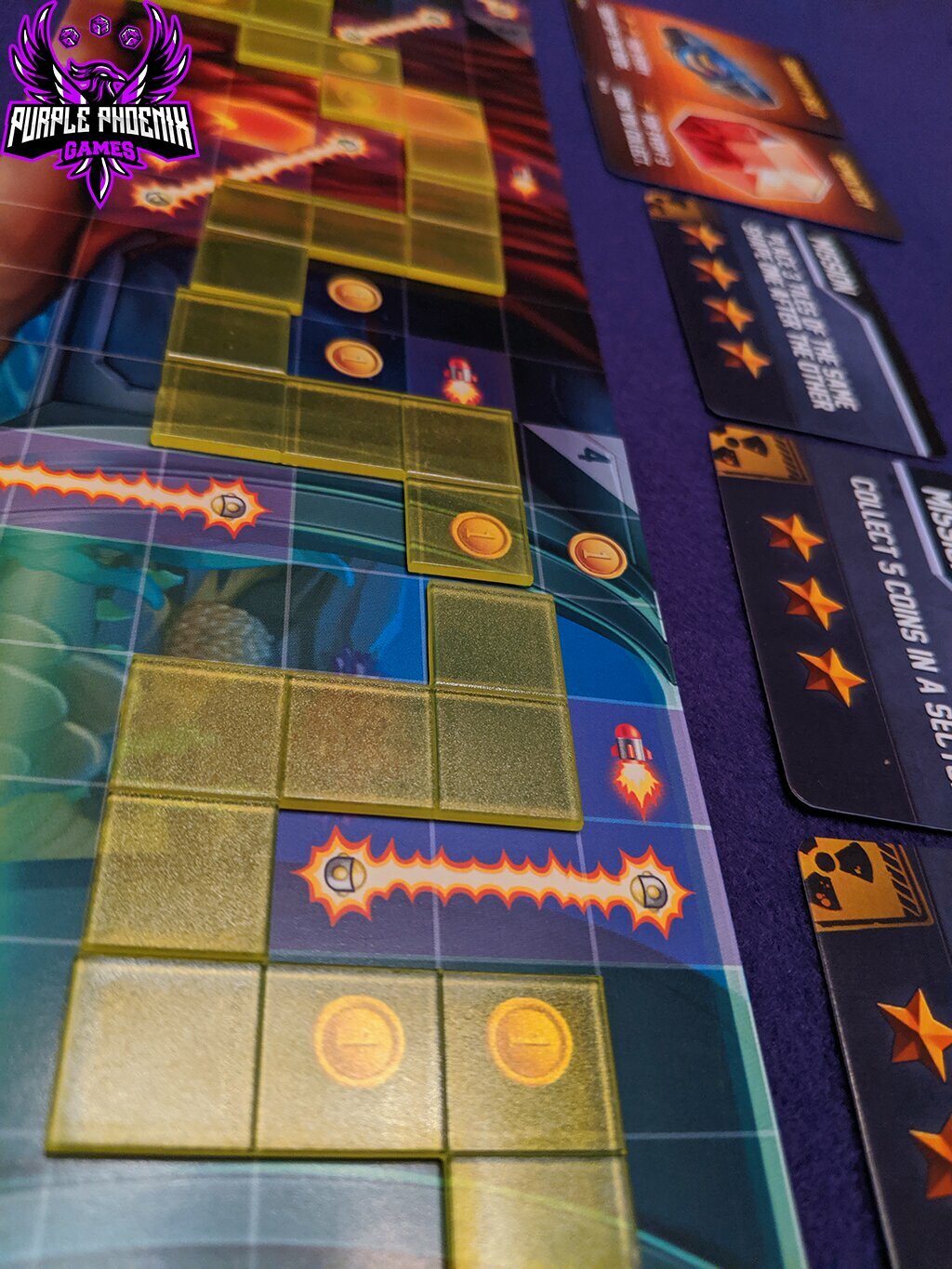
Jetpack Joyride is a real-time game of tile placement in which players are racing to see who can complete their run (path through the lab) the fastest. The game lasts for 3 runs, and points are earned throughout all runs. To setup, each player receives a set of 4 lab sector cards and sets them on the table in front of them in numerical order, 1-4. Three mission cards (cards that score points at the end of the run) are revealed and available for all players. Players may also have gadgets, available only to them, to help score extra points. When a run begins, all players grab translucent polyominoes (like matte versions of bits from Blokus) from the common pool and place them on their lab cards to create an unbroken path through the lab. There are specific placement restrictions that I will leave for you to discover in the rulebook. The game has no set time limit for each run, but it is a race to complete a path before your opponents. At the end of the run, points are tallied for completed missions and gadget cards. Easy, right? Here’s a small twist – before starting the next run, all players pick up their lab cards and pass them to the player on their left. So each run, players are looking at new cards and must find new paths through the lab! New mission cards and gadgets are revealed before subsequent runs as well. The player with the most points at the end of all 3 runs is the winner!
Jetpack Joyride is a fast-paced, exciting, and surprisingly strategic game that keeps all players engaged and entertained. And that’s what I love about it. First of all, real-time games are always high-energy, at least in my opinion. It’s nearly impossible to stay calm and collected when you’re literally racing against your opponents! Jetpack Joyride is definitely not a passive game, and there’s so much action and excitement that you sometimes forget you’re literally just laying tiles on cards. The next thing I love about this game is how deceptively strategic it is. Laying tiles to form a legal path across cards is not complicated, but doing so while also trying to earn extra points by completing missions (like placing 3 tiles of the same shape in a row, for example) adds a strategic element that you don’t expect. You’re not only trying to finish your run the fastest, but you’ve also got to fulfill the requirements for multiple mission and gadget cards too. One misplaced tile could decimate a run for you, so you’ve always got to be thinking several tiles in advance.
Going along with that, another neat thing about Jetpack Joyride is that all players are drawing tiles from a common pool. There is a finite number of tiles, and a specific number of the different shapes, so if the shape of tile you need is gone from the pool, you’re outta luck! You have to think and move quickly, otherwise you might get knocked out of a run, and that costs you valuable end-game points. For such a simple game, Jetpack Joyride also has a lot of variability. All lab cards are double-sided, and can be mixed and matched in any combination, as long as they are in a numerical set of 1-4. There are so many possibilities, chances are you won’t ever play with the same card combo twice….and if you do, chances are you won’t remember it 😛 All of these aspects elevate this game from a simple party game to a strategically fun game that can be played with any player count.
Overall, I think Jetpack Joyride is great. After my first play, I rated it a 4+, but after a few more I’ve changed my rating to a 5. As you can see from our scores above, Travis and our guest judge Luke enjoyed it as well. It’s a nice, light game that can be used as a filler between heavier games, or as a main-event game all on its own. Definitely a game I will use with newer gamers, and the strategic side will keep me coming back for more. I think Jetpack Joyride will get a lot of playtime from me, and it was worth my investment on Kickstarter. Purple Phoenix Games gives it a jet-powered 15 / 18.
Originally a mobile game, Jetpack Joyride follows our main character, Barry, as he attempts to escape a top-secret lab with a stolen jetpack! He must avoid being hit by zappers, annihilated by lasers, and blown away by missiles in the process. If Barry succeeds, he escapes with not only the high-tech jetpack, but also with as many gold coins and other top-secret gadgets as he can get his hands on! So the risk is definitely worth the reward. But if Barry is unable to escape, he will face the consequences for his unauthorized joyride… In all honesty, I had never heard of Jetpack Joyride before I Kickstarted the board game version, so I downloaded it on my phone to see how it plays. Do you remember Flappy Bird? The mobile version of Jetpack Joyride is kiiiinda like that, but more exciting and way less infuriating. It’s free to download in the App Store and Google Play Store, so check it out if you’re interested! Anyway, back to the board game version. The premise is the same as the app – you have to create a path for Barry to use for his escape from the lab, utilizing the gadgets available to you and collecting gold coins on your way.
DISCLAIMER: We are using the Kickstarter Deluxe version of the game. We do have the expansions from the KS campaign, but will not be using those for this review. Also, we do not intend to cover every single rule included in the rule book, but will describe the overall game flow and major rule set so that our readers may get a sense of how the game plays. For more in depth rules, you may purchase a copy from the publisher directly or from your FLGS. -T
Jetpack Joyride is a real-time game of tile placement in which players are racing to see who can complete their run (path through the lab) the fastest. The game lasts for 3 runs, and points are earned throughout all runs. To setup, each player receives a set of 4 lab sector cards and sets them on the table in front of them in numerical order, 1-4. Three mission cards (cards that score points at the end of the run) are revealed and available for all players. Players may also have gadgets, available only to them, to help score extra points. When a run begins, all players grab translucent polyominoes (like matte versions of bits from Blokus) from the common pool and place them on their lab cards to create an unbroken path through the lab. There are specific placement restrictions that I will leave for you to discover in the rulebook. The game has no set time limit for each run, but it is a race to complete a path before your opponents. At the end of the run, points are tallied for completed missions and gadget cards. Easy, right? Here’s a small twist – before starting the next run, all players pick up their lab cards and pass them to the player on their left. So each run, players are looking at new cards and must find new paths through the lab! New mission cards and gadgets are revealed before subsequent runs as well. The player with the most points at the end of all 3 runs is the winner!
Jetpack Joyride is a fast-paced, exciting, and surprisingly strategic game that keeps all players engaged and entertained. And that’s what I love about it. First of all, real-time games are always high-energy, at least in my opinion. It’s nearly impossible to stay calm and collected when you’re literally racing against your opponents! Jetpack Joyride is definitely not a passive game, and there’s so much action and excitement that you sometimes forget you’re literally just laying tiles on cards. The next thing I love about this game is how deceptively strategic it is. Laying tiles to form a legal path across cards is not complicated, but doing so while also trying to earn extra points by completing missions (like placing 3 tiles of the same shape in a row, for example) adds a strategic element that you don’t expect. You’re not only trying to finish your run the fastest, but you’ve also got to fulfill the requirements for multiple mission and gadget cards too. One misplaced tile could decimate a run for you, so you’ve always got to be thinking several tiles in advance.
Going along with that, another neat thing about Jetpack Joyride is that all players are drawing tiles from a common pool. There is a finite number of tiles, and a specific number of the different shapes, so if the shape of tile you need is gone from the pool, you’re outta luck! You have to think and move quickly, otherwise you might get knocked out of a run, and that costs you valuable end-game points. For such a simple game, Jetpack Joyride also has a lot of variability. All lab cards are double-sided, and can be mixed and matched in any combination, as long as they are in a numerical set of 1-4. There are so many possibilities, chances are you won’t ever play with the same card combo twice….and if you do, chances are you won’t remember it 😛 All of these aspects elevate this game from a simple party game to a strategically fun game that can be played with any player count.
Overall, I think Jetpack Joyride is great. After my first play, I rated it a 4+, but after a few more I’ve changed my rating to a 5. As you can see from our scores above, Travis and our guest judge Luke enjoyed it as well. It’s a nice, light game that can be used as a filler between heavier games, or as a main-event game all on its own. Definitely a game I will use with newer gamers, and the strategic side will keep me coming back for more. I think Jetpack Joyride will get a lot of playtime from me, and it was worth my investment on Kickstarter. Purple Phoenix Games gives it a jet-powered 15 / 18.


Purple Phoenix Games (2266 KP) rated Block Ness in Tabletop Games
May 10, 2021
The Loch Ness monster has been a thorn in the side of believers for so long now. We recently published a preview for a Sasquatch game, and a game featuring a werewolf. Today it’s Nessie’s turn. But this game isn’t necessarily about Nessie, but of giant water serpents vying for control over the too-small lake in which they find themselves. How did they get there? What do they eat? Will they truly come to get me if I don’t brush my teeth? I don’t know the answer to some of those questions, but here’s another: is a game about these creatures good?
Block Ness is a connections game with big chunky bits where players are taking on the mantles of ever-expanding water serpents attempting to stretch themselves out as long as possible. The winning serpent is they who either is able to stretch out furthest (by using all of their body pieces), or who is able to reach for the sun the furthest (by having the tallest head piece at game end).
DISCLAIMER: We were provided a copy of this game for the purposes of this review. This is a retail copy of the game, so what you see in these photos is exactly what would be received in your box. I do not intend to cover every single rule included in the rulebook, but will describe the overall game flow and major rule set so that our readers may get a sense of how the game plays. For more in depth rules, you may purchase a copy online or from your FLGS. -T
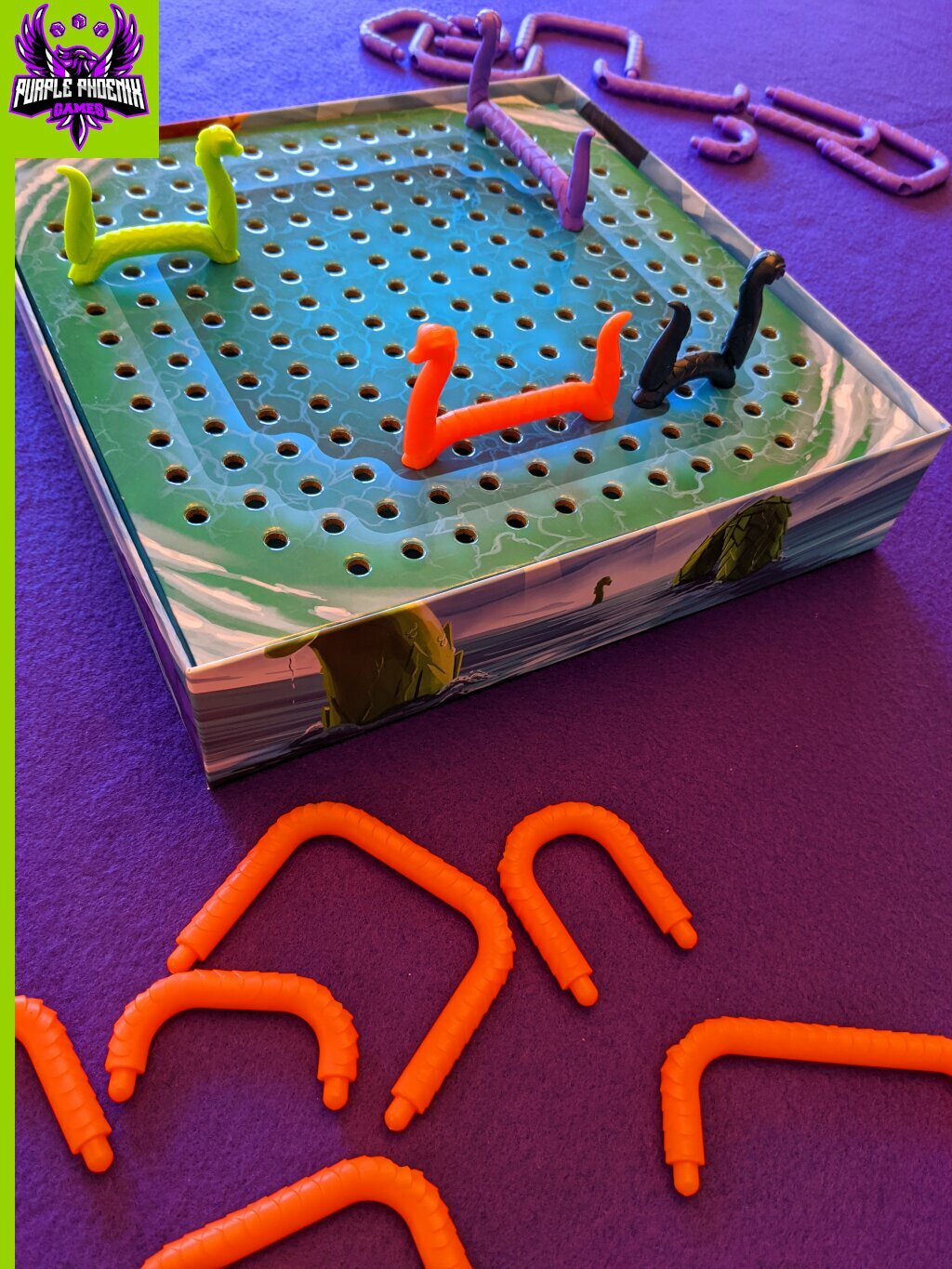
To setup, place the peg board on top of the insert in the box. This signifies the lake and where the game will take place. Each player chooses a color of serpent and takes all the corresponding pieces in front of them. Each serpent has a starting body piece that is shorter than all the other pieces, and must be placed first. The youngest player places their first piece on the board, within the darkest inner colors of the lake (UNlike the setup pictured below. Sometimes you just HAVE to let little ones place wherever they like to avoid ACTUAL monster spawns). The other players follow in turn order and attach the head and tail pieces to either end of the starting segments. The game is now setup and ready to begin!
On a turn, the active player will choose a body piece to add to their serpent at either the head or tail location. Players are limited to the three spaces adjacently surrounding the head and tail segments (akin to the compass markings of North, East, South, West). The new body segment then receives either the head or tail piece on its end to signify the new growth of the serpent. No body segments may be placed in a diagonal fashion, and there will come a time when serpents will need to get creative in order to place.
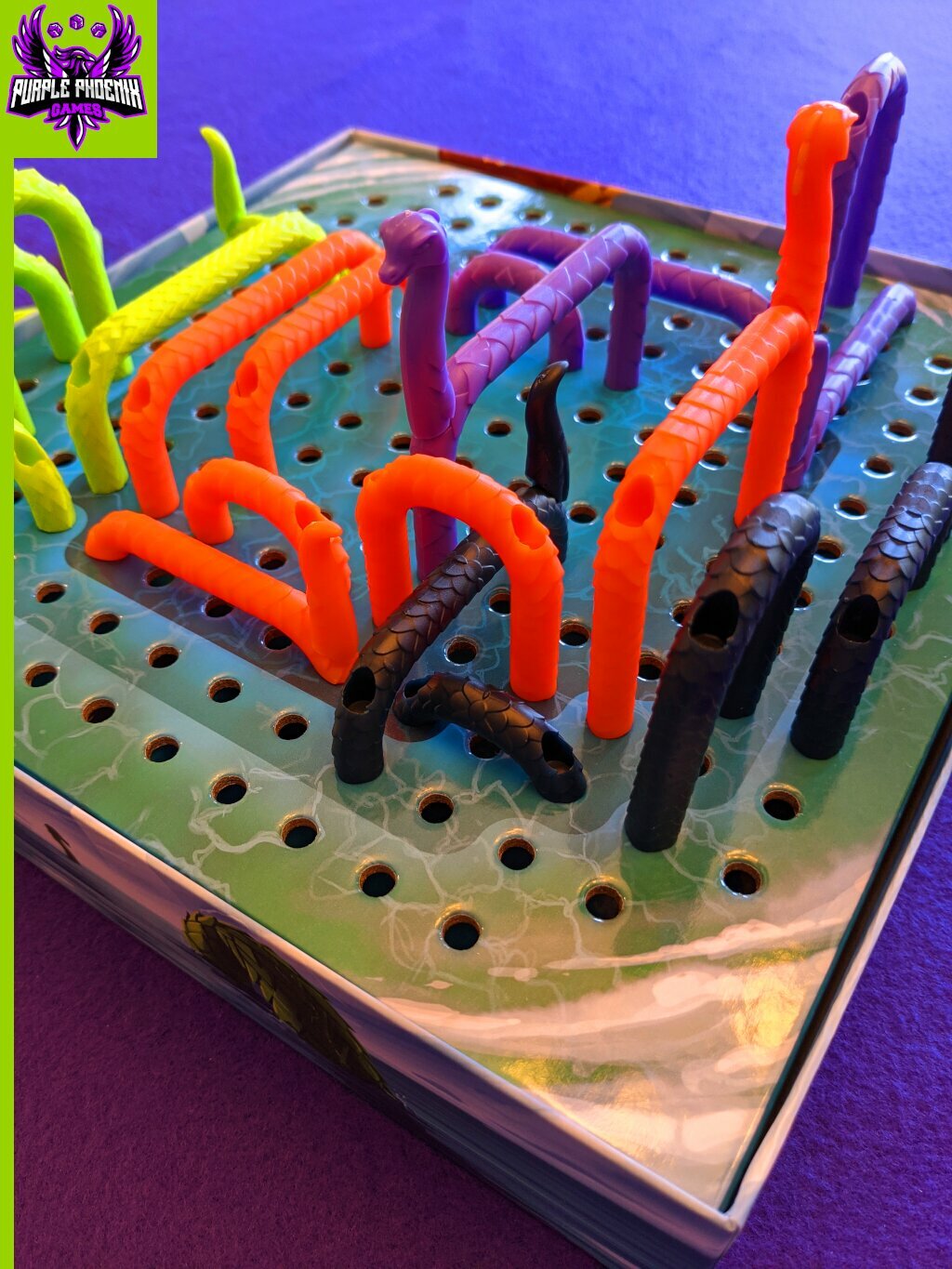
Should a serpent wish to expand through an existing player’s body segment, they may only do so if they are able to place said piece ABOVE the existing segment. For example, the photo below shows the orange serpent slithering above a portion of the black serpent (whose placement now looks somewhat illegal anyway). No matter where the segment is placed the head or tail piece will need to be moved to the newly-placed segment to allow for further expansion on future turns.
Play continues in this fashion until one player has the least leftover body segments without a legal placement, or controls the serpent with the tallest head among the tied players. The winner then must gloat and challenge the others to another game.
Components. This game has great 3D serpent pieces and a nice little peg board to play on. I truly love when games include the box as part of gameplay, and this uses it well. The art and colors used throughout are simply perfect (thank you for not using boring blue, red, yellow, green). The only tiny gripe I have is more of a hope than anything. I hope that upon many many plays the peg board stays nice and doesn’t deteriorate. I realize it’s a game and it’s made out of cardboard. I know many people love seeing their games age because it shows a well-loved item, but I’m not like that. I like my games to always look new. Perhaps if the peg board ever does warp or get damaged in any way I may look into having a plexi replacement made. But that aside, this is a beautiful game with excellent components, and exactly what I would expect from Blue Orange Games.
So do I like this one? Oh yes, quite a bit! Though it is not exactly the same, I believe this may kill off an old family favorite of mine – Blokus. Again, this is not a re-theme of Blokus at all, but it certainly gives me the same vibes, but in three dimensions and with much greater flair. In both games players are actively trying to block each others’ expansion progress, but Block Ness offers a smaller board and way less pieces with which to play. This creates a more tense game in a shorter time frame, and you play with serpent monsters!!
The serpents are all so much fun to handle, and while I initially though moving the head and tail pieces would get annoying after a while, I quite enjoy seeing my new serpent monster after their endpoints are reattached. Like I mentioned earlier, I very much appreciate being able to play orange, purple, black, and a yellowy-green very similar in color to our highlight color we use for our brand. Super happy about those color choices.
All in all, to say this slays Blokus is a huge thing for me. My wife and I absolutely adore Blokus, but I think I would much rather play Block Ness. I also can play this with my kids much easier and not have to worry about one of them losing the 1×1 pieces. I am certainly not alone in recommending this one. Purple Phoenix Games gives this a legendary 10 / 12. I would be surprised if this doesn’t intrigue most gamers of almost any skill and preference. There is much strategy to be employed, and an equal amount of frustration as the serpents block in other opponents. While I have no desire to try to see the actual Loch Ness monster, I will ALWAYS be up for a game of Block Ness.
Block Ness is a connections game with big chunky bits where players are taking on the mantles of ever-expanding water serpents attempting to stretch themselves out as long as possible. The winning serpent is they who either is able to stretch out furthest (by using all of their body pieces), or who is able to reach for the sun the furthest (by having the tallest head piece at game end).
DISCLAIMER: We were provided a copy of this game for the purposes of this review. This is a retail copy of the game, so what you see in these photos is exactly what would be received in your box. I do not intend to cover every single rule included in the rulebook, but will describe the overall game flow and major rule set so that our readers may get a sense of how the game plays. For more in depth rules, you may purchase a copy online or from your FLGS. -T
To setup, place the peg board on top of the insert in the box. This signifies the lake and where the game will take place. Each player chooses a color of serpent and takes all the corresponding pieces in front of them. Each serpent has a starting body piece that is shorter than all the other pieces, and must be placed first. The youngest player places their first piece on the board, within the darkest inner colors of the lake (UNlike the setup pictured below. Sometimes you just HAVE to let little ones place wherever they like to avoid ACTUAL monster spawns). The other players follow in turn order and attach the head and tail pieces to either end of the starting segments. The game is now setup and ready to begin!
On a turn, the active player will choose a body piece to add to their serpent at either the head or tail location. Players are limited to the three spaces adjacently surrounding the head and tail segments (akin to the compass markings of North, East, South, West). The new body segment then receives either the head or tail piece on its end to signify the new growth of the serpent. No body segments may be placed in a diagonal fashion, and there will come a time when serpents will need to get creative in order to place.
Should a serpent wish to expand through an existing player’s body segment, they may only do so if they are able to place said piece ABOVE the existing segment. For example, the photo below shows the orange serpent slithering above a portion of the black serpent (whose placement now looks somewhat illegal anyway). No matter where the segment is placed the head or tail piece will need to be moved to the newly-placed segment to allow for further expansion on future turns.
Play continues in this fashion until one player has the least leftover body segments without a legal placement, or controls the serpent with the tallest head among the tied players. The winner then must gloat and challenge the others to another game.
Components. This game has great 3D serpent pieces and a nice little peg board to play on. I truly love when games include the box as part of gameplay, and this uses it well. The art and colors used throughout are simply perfect (thank you for not using boring blue, red, yellow, green). The only tiny gripe I have is more of a hope than anything. I hope that upon many many plays the peg board stays nice and doesn’t deteriorate. I realize it’s a game and it’s made out of cardboard. I know many people love seeing their games age because it shows a well-loved item, but I’m not like that. I like my games to always look new. Perhaps if the peg board ever does warp or get damaged in any way I may look into having a plexi replacement made. But that aside, this is a beautiful game with excellent components, and exactly what I would expect from Blue Orange Games.
So do I like this one? Oh yes, quite a bit! Though it is not exactly the same, I believe this may kill off an old family favorite of mine – Blokus. Again, this is not a re-theme of Blokus at all, but it certainly gives me the same vibes, but in three dimensions and with much greater flair. In both games players are actively trying to block each others’ expansion progress, but Block Ness offers a smaller board and way less pieces with which to play. This creates a more tense game in a shorter time frame, and you play with serpent monsters!!
The serpents are all so much fun to handle, and while I initially though moving the head and tail pieces would get annoying after a while, I quite enjoy seeing my new serpent monster after their endpoints are reattached. Like I mentioned earlier, I very much appreciate being able to play orange, purple, black, and a yellowy-green very similar in color to our highlight color we use for our brand. Super happy about those color choices.
All in all, to say this slays Blokus is a huge thing for me. My wife and I absolutely adore Blokus, but I think I would much rather play Block Ness. I also can play this with my kids much easier and not have to worry about one of them losing the 1×1 pieces. I am certainly not alone in recommending this one. Purple Phoenix Games gives this a legendary 10 / 12. I would be surprised if this doesn’t intrigue most gamers of almost any skill and preference. There is much strategy to be employed, and an equal amount of frustration as the serpents block in other opponents. While I have no desire to try to see the actual Loch Ness monster, I will ALWAYS be up for a game of Block Ness.


Gareth von Kallenbach (980 KP) rated Glory Road (2006) in Movies
Aug 14, 2019

Sports films have long been a popular genre in Hollywood as classics such as Pride of the Yankees, The Natural, and Raging Bull are all examples of some of the finest examples of sports films which encapsulate the very essence of the sport they portray.
In the new film Glory Road Josh Lucas stars as Don Haskins, a girls Basketball coach who is given the chance to coach a Division 1 team at Texas Western in 1966.
The small school cannot offer the coach much in the way of amenities as Don and his family are required to live in the student’s dorm. Since his dreams of playing pro ball came to a halt after a knee injury, Haskins looks at his job as a chance for him to make a name for himself.
The task will be daunting as Texas Western is a very small school that puts the majority of its athletic budget into the football program leaving next to no money for the gym, new equipment, and recruiting of players.
After a frustrating attempt to recruit players at a local invitational, Haskins sets his sites on a young African American player who while big on attitude, is also big on potential.
With scholarships to offer, Haskins and his staff travel the nation and shock the conservative school by offering scholarships to 8 African American players. In a day and age when teams had at most 1-2 African American players; many of whom did not see much playing time; this is a risky move for the coach.
Undaunted, the coach begins the process of integrating his new players with his current players all of whom are Caucasian, which leads to some tension over starting rights, abilities, and styles.
Haskins is a no nonsense coach who is very strict in regards to grades, effort in practice, and above all avoiding late nights and carousing while the season is underway. Despite this, many players decide to test the will of the coach which raises issues of commitment to the team and discipline, all of which are standard staples of sports films.
When the season starts, a funny thing happens. Not only is the coach playing his African American players in a heavy rotation, but little Texas Western is winning their games and beating some of the more noted teams in the country in the process.
As their notoriety increases so does the amount of hostility directed towards the team from racially incensed fans who do not like the make up of the team and especially hate their success.
Despite this, the team finds itself in the National Championship game against powerful Kentucky coached by the legendary Adolph Rupp (Jon Voight), where Haskins makes history by starting and playing only his African American players which is a first in NCAA finals history.
While the marketing and trailers for the film certainly do not hesitate from telling you most of the above and underscoring that the team ends up in the finals and that the film is based on a true story, it is not about the final results, it is about the journey the team took getting there.
Producer Jerry Bruckheimer is a master at knowing what the fans want and director James Gartner gives viewers a by the number film that delivers the goods. Yes, the film heavily uses all the sporting clichés from the ailing player, the us against the world mentality, the team of misfits, and so on all of which combines to offer little cinematic tension as it is very clear early on and from the ads where this film will end up.
Despite tipping their hand early and throughout, the filmmakers have decided not to rock the boat and have stuck with a tried and true formula that results with a winning albeit very predictable film.
Lucas does a solid job in the roll and makes the best of the material he has to work with. The game sequences are well managed and rousing which had members of my preview audience cheering.
While it offers little originality, Glory Road is a lot of fun, and despite mining every cliché in the book, is an entertaining time at the movies.
In the new film Glory Road Josh Lucas stars as Don Haskins, a girls Basketball coach who is given the chance to coach a Division 1 team at Texas Western in 1966.
The small school cannot offer the coach much in the way of amenities as Don and his family are required to live in the student’s dorm. Since his dreams of playing pro ball came to a halt after a knee injury, Haskins looks at his job as a chance for him to make a name for himself.
The task will be daunting as Texas Western is a very small school that puts the majority of its athletic budget into the football program leaving next to no money for the gym, new equipment, and recruiting of players.
After a frustrating attempt to recruit players at a local invitational, Haskins sets his sites on a young African American player who while big on attitude, is also big on potential.
With scholarships to offer, Haskins and his staff travel the nation and shock the conservative school by offering scholarships to 8 African American players. In a day and age when teams had at most 1-2 African American players; many of whom did not see much playing time; this is a risky move for the coach.
Undaunted, the coach begins the process of integrating his new players with his current players all of whom are Caucasian, which leads to some tension over starting rights, abilities, and styles.
Haskins is a no nonsense coach who is very strict in regards to grades, effort in practice, and above all avoiding late nights and carousing while the season is underway. Despite this, many players decide to test the will of the coach which raises issues of commitment to the team and discipline, all of which are standard staples of sports films.
When the season starts, a funny thing happens. Not only is the coach playing his African American players in a heavy rotation, but little Texas Western is winning their games and beating some of the more noted teams in the country in the process.
As their notoriety increases so does the amount of hostility directed towards the team from racially incensed fans who do not like the make up of the team and especially hate their success.
Despite this, the team finds itself in the National Championship game against powerful Kentucky coached by the legendary Adolph Rupp (Jon Voight), where Haskins makes history by starting and playing only his African American players which is a first in NCAA finals history.
While the marketing and trailers for the film certainly do not hesitate from telling you most of the above and underscoring that the team ends up in the finals and that the film is based on a true story, it is not about the final results, it is about the journey the team took getting there.
Producer Jerry Bruckheimer is a master at knowing what the fans want and director James Gartner gives viewers a by the number film that delivers the goods. Yes, the film heavily uses all the sporting clichés from the ailing player, the us against the world mentality, the team of misfits, and so on all of which combines to offer little cinematic tension as it is very clear early on and from the ads where this film will end up.
Despite tipping their hand early and throughout, the filmmakers have decided not to rock the boat and have stuck with a tried and true formula that results with a winning albeit very predictable film.
Lucas does a solid job in the roll and makes the best of the material he has to work with. The game sequences are well managed and rousing which had members of my preview audience cheering.
While it offers little originality, Glory Road is a lot of fun, and despite mining every cliché in the book, is an entertaining time at the movies.
Purple Phoenix Games (2266 KP) rated Beatdown: Streets of Justice in Tabletop Games
Nov 12, 2019

Ever wanted to be a street level thug? Or the hero that fights said thugs? I haven’t really. But! I did used to love playing the Street Fighter games growing up. Now, you cannot Hadouken in real life (right?) and take out E. Honda, but you CAN fight thugs in the street… if you really wanted. You know what? I’m just gonna stick to fighting via card play. Wanna help?
Beatdown: Streets of Justice is a cooperative, push-your-luck, fighting card game that pits you and your team of heroes against waves of thugs and a boss fight. As it is cooperative, the players win by beating the boss (typically in the third wave of fights), or lose by being all knocked out. Silly heroes.
DISCLAIMER: We were provided a copy of this game for the purposes of this review. This is a retail copy of the game, so what you see in these photos is exactly what would be received in your box. I do not intend to cover every single rule included in the rulebook, but will describe the overall game flow and major rule set so that our readers may get a sense of how the game plays. For more in depth rules, you may purchase a copy online or from your FLGS. -T
To setup, each player takes a player mat, chooses a hero to play, and takes the dice of matching color to use during the game. Shuffle all the different decks of cards and place them on the table within easy reach of all players. The Attacks deck will include the base attack cards plus all cards that match the players in the game (like Invicta’s attack cards if she is in the game). Place tiny clear cubes on your starting health, as well as the starting health for the thugs you will be fighting in Wave 1, and you are ready to play!
Beatdown: Streets of Justice (or just Beatdown from now on) is played over three waves of fights where the heroes will play cards and do their fighting and then the bad guys will take their turns to fight. Generally, play will go like this: on a player’s turn they will play a card from their hand or one blindly from the top of the Attack deck. This is the opening to their “combo.” The Attack cards will typically have a damage amount and a combo rating number. In order to play more cards to the combo, the player will need to roll their d10 and roll a number equal to or higher than their accumulated combo rating (the little numbers showing in the green arrows of cards played + the green arrow number on the hero card). A combo can continue as long as the player can roll higher than their combo rating, but a failed roll doesn’t necessarily mean c-c-c-combo breaker, but rather that the hero has left themselves open for attack by the thugs. I won’t go into any more detail on fighting, as the rules are a little complex and I will let you discover those for yourselves.
After the heroes have taken all their turns, if thugs are still on the battlefield, they will now take their fighting turns. Flip over an Enemy Attack card from the deck for each enemy and resolve it against the heroes. Each baddie will make their attacks and if heroes are still conscious another round of the wave will begin. New thugs do not enter play, as they only populate at the beginning of a Wave. The thugs are no joke, and the bosses are even rougher. Can you be defeated? Yes. I was defeated in my first game. Can you be revived? Yes. Between Waves the players can participate in a Shopping Phase where they can use trophies (the cards of enemies they have defeated) to purchase health back, revive a fallen hero, or purchase a revealed Loot card to help in future fights. Play continues in this fashion for three Waves until the heroes complete the Boss Wave (by defeating all enemies) or all the heroes are knocked out.
Components. I have some good news and bad news here. Good news first. The dice are great. The tiny clear cubes are… tiny and clear. And they are just fine. The cards are good quality, as are the cardboard mats and tokens. The card layout is good too. The bad news: the rulebook is a little confusing for the first couple read-throughs and the art style does nothing for me. I appreciate the way the rules are very informal and make several chuckle-worthy jokes, but I feel like it could flow different and more efficiently. Similarly, in an industry where art can really make a good game great, this one is lacking. It’s really a shame, because everything else about the game is really good quality. The iconography is… fine, but the character art in-game is an issue I have with this.
Beatdown is actually a really decent game once you are playing. The rulebook needs work, and the art needs an update, but those grievances aside, Beatdown is an enjoyable experience at the table. I usually play pretty conservatively in push-your-luck games, but I went all out with this one and was more often than not rewarded handsomely for it. If your group enjoys cooperative, push-your-luck, fighting, card games give this one a look. Just don’t pay attention to the character art. This all said Purple Phoenix Games gives this one a 6 / 12. Improve the rulebook and art and that rating improves.
Beatdown: Streets of Justice is a cooperative, push-your-luck, fighting card game that pits you and your team of heroes against waves of thugs and a boss fight. As it is cooperative, the players win by beating the boss (typically in the third wave of fights), or lose by being all knocked out. Silly heroes.
DISCLAIMER: We were provided a copy of this game for the purposes of this review. This is a retail copy of the game, so what you see in these photos is exactly what would be received in your box. I do not intend to cover every single rule included in the rulebook, but will describe the overall game flow and major rule set so that our readers may get a sense of how the game plays. For more in depth rules, you may purchase a copy online or from your FLGS. -T
To setup, each player takes a player mat, chooses a hero to play, and takes the dice of matching color to use during the game. Shuffle all the different decks of cards and place them on the table within easy reach of all players. The Attacks deck will include the base attack cards plus all cards that match the players in the game (like Invicta’s attack cards if she is in the game). Place tiny clear cubes on your starting health, as well as the starting health for the thugs you will be fighting in Wave 1, and you are ready to play!
Beatdown: Streets of Justice (or just Beatdown from now on) is played over three waves of fights where the heroes will play cards and do their fighting and then the bad guys will take their turns to fight. Generally, play will go like this: on a player’s turn they will play a card from their hand or one blindly from the top of the Attack deck. This is the opening to their “combo.” The Attack cards will typically have a damage amount and a combo rating number. In order to play more cards to the combo, the player will need to roll their d10 and roll a number equal to or higher than their accumulated combo rating (the little numbers showing in the green arrows of cards played + the green arrow number on the hero card). A combo can continue as long as the player can roll higher than their combo rating, but a failed roll doesn’t necessarily mean c-c-c-combo breaker, but rather that the hero has left themselves open for attack by the thugs. I won’t go into any more detail on fighting, as the rules are a little complex and I will let you discover those for yourselves.
After the heroes have taken all their turns, if thugs are still on the battlefield, they will now take their fighting turns. Flip over an Enemy Attack card from the deck for each enemy and resolve it against the heroes. Each baddie will make their attacks and if heroes are still conscious another round of the wave will begin. New thugs do not enter play, as they only populate at the beginning of a Wave. The thugs are no joke, and the bosses are even rougher. Can you be defeated? Yes. I was defeated in my first game. Can you be revived? Yes. Between Waves the players can participate in a Shopping Phase where they can use trophies (the cards of enemies they have defeated) to purchase health back, revive a fallen hero, or purchase a revealed Loot card to help in future fights. Play continues in this fashion for three Waves until the heroes complete the Boss Wave (by defeating all enemies) or all the heroes are knocked out.
Components. I have some good news and bad news here. Good news first. The dice are great. The tiny clear cubes are… tiny and clear. And they are just fine. The cards are good quality, as are the cardboard mats and tokens. The card layout is good too. The bad news: the rulebook is a little confusing for the first couple read-throughs and the art style does nothing for me. I appreciate the way the rules are very informal and make several chuckle-worthy jokes, but I feel like it could flow different and more efficiently. Similarly, in an industry where art can really make a good game great, this one is lacking. It’s really a shame, because everything else about the game is really good quality. The iconography is… fine, but the character art in-game is an issue I have with this.
Beatdown is actually a really decent game once you are playing. The rulebook needs work, and the art needs an update, but those grievances aside, Beatdown is an enjoyable experience at the table. I usually play pretty conservatively in push-your-luck games, but I went all out with this one and was more often than not rewarded handsomely for it. If your group enjoys cooperative, push-your-luck, fighting, card games give this one a look. Just don’t pay attention to the character art. This all said Purple Phoenix Games gives this one a 6 / 12. Improve the rulebook and art and that rating improves.
Purple Phoenix Games (2266 KP) rated Of Knights & Ninjas in Tabletop Games
Jan 23, 2020

Little-known factoid about me: I am a Knight. Not from England, and not due to my daring heroics in war, but a Knight Templar of the Grand Commandery in the York Rite of Freemasonry. Politics and conspiracy theories aside, becoming a Knight was a highlight of my life, and something I will forever treasure. And speaking of treasure and Knights Templar (read your history, kids), we all know that one of the biggest foes of the Knights in olden times were the nefarious Ninjas. Or maybe it’s just fun to think about and play a game where these factions are represented.
Of Knights & Ninjas is a card game about claiming enough treasure to ascend to kinghood and rule all the lands. You can accomplish this by sending forces to your opponents’ realms and stealing their glorious gems. The first lord to amass 10 gems will have sufficient wealth to assume the kinghood and rule all realms!
DISCLAIMER: We were provided a prototype copy of this game for the purposes of this review. These are preview copy components, and the final components may be different from these shown. Also, it is not my intention to detail every rule in the game, but to give our readers an idea of how the game plays. If you would like to read the rulebook in full, you may visit the publisher’s website, purchase the game through the publisher, back the game through the Kickstarter campaign, or through any retailers stocking it after fulfillment. -T
To setup, each player will take five gems of their preferred color in front of them. Shuffle the large deck of cards, and deal each player four cards (this rule was updated after our play-throughs). You are now ready to play!
On your turn, you will draw two cards from the deck (unless it’s the first draw of the game – that player will draw just one). You must now play a card to the table or discard a card from your hand. Cards that you can play from your hand will each have different abilities, and thankfully the designer will be providing a reference sheet for these, as there are many cards with wildly different abilities. This is also why I will not be explaining the entire rulebook.
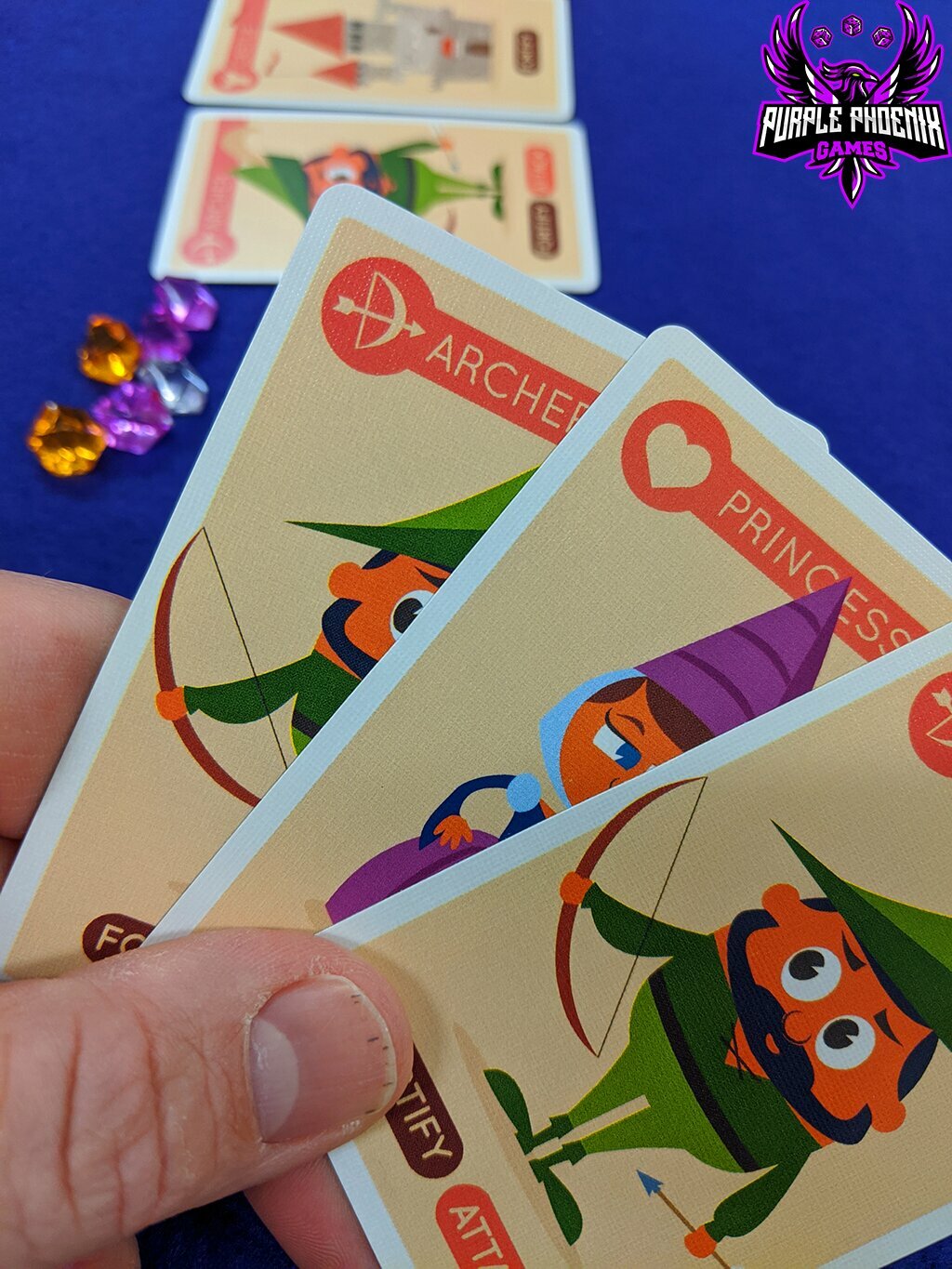
Typically you will be able to play Fortify cards (castles, archers), Attack cards (knights, ninjas, etc), Respond cards, and Special cards (minstrels, jesters, etc). Fortify cards protect your gems from certain Attack cards, like an Archer only being able to attack another Archer, or a Dragon being able to attack a Castle – but not if an Archer is stationed there (logic). Although, a Ninja can scale a Castle wall, and a Catapult can destroy a Castle altogether (but not that pesky Archer that happens to be sitting on top)…
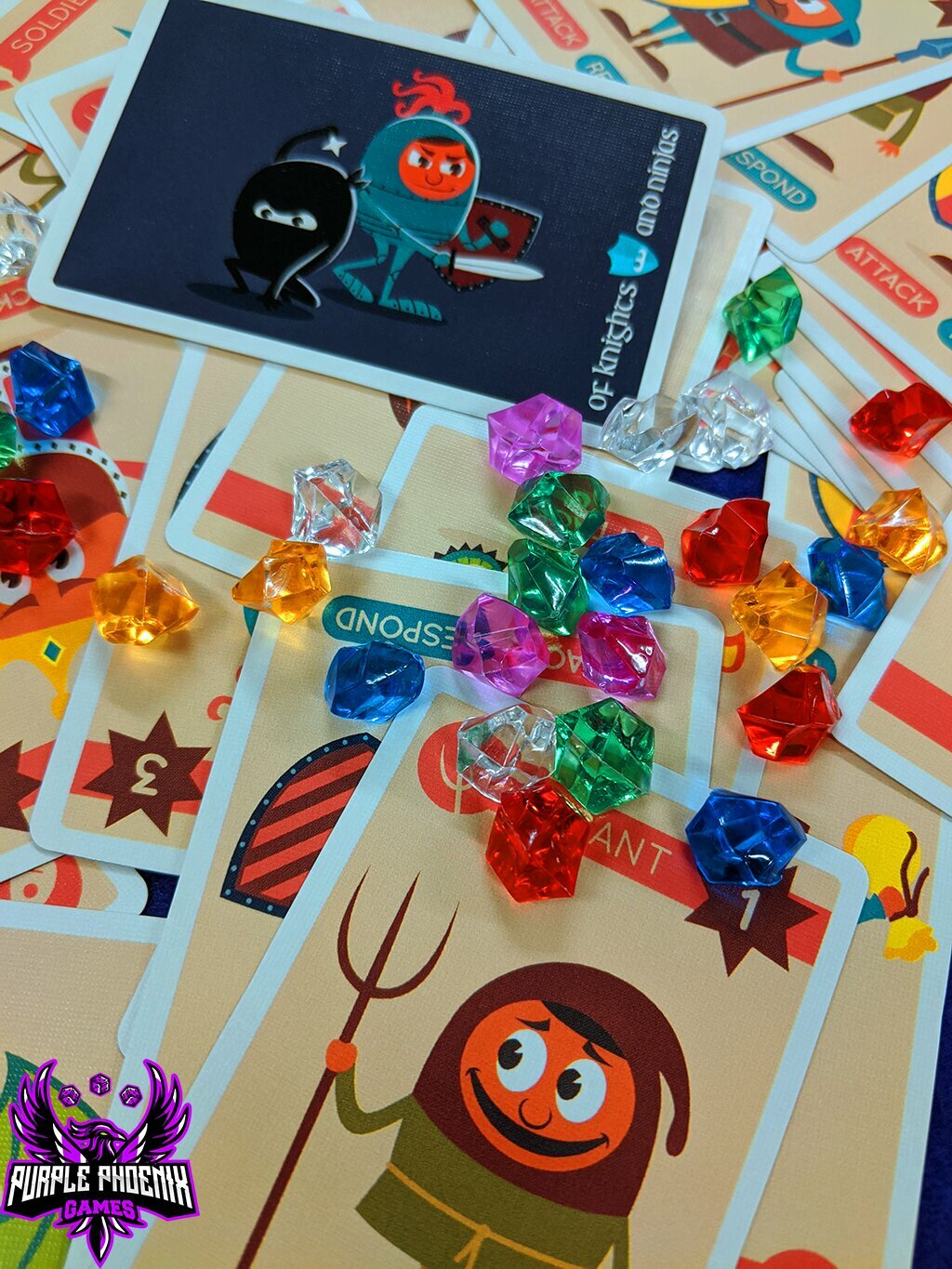
Attack cards are just that: they Attack. Each Attack card will show a number in a starburst icon in the upper right hand corner that signifies how many gems they are able to steal. Once an opponent is declared and an Attack card played, let’s say a 1-power Peasant, the defender may then play a card with the Respond keyword (which will also have a starburst number) to offset the number of stolen gems. If the attacker chooses, they may continue playing Attack cards against the same opponent in order to draw out all the Respond cards and come away with some sweet, sweet gems.
But maybe once all is said and done, and gems are about to change hands, another opponent plays a Special card – a Highwayman, for example. These characters will steal all the gems that are about to change hands (as if he was robbing the gem carriage en route to the new owner). But then again, perhaps yet ANOTHER opponent plays a Highwayman as well, and steals those gems a second time! You just never know when these Special cards will come out and how they may affect the best laid plans.
Play continues in this fashion until one player has amassed the 10 gems they require to win the game!
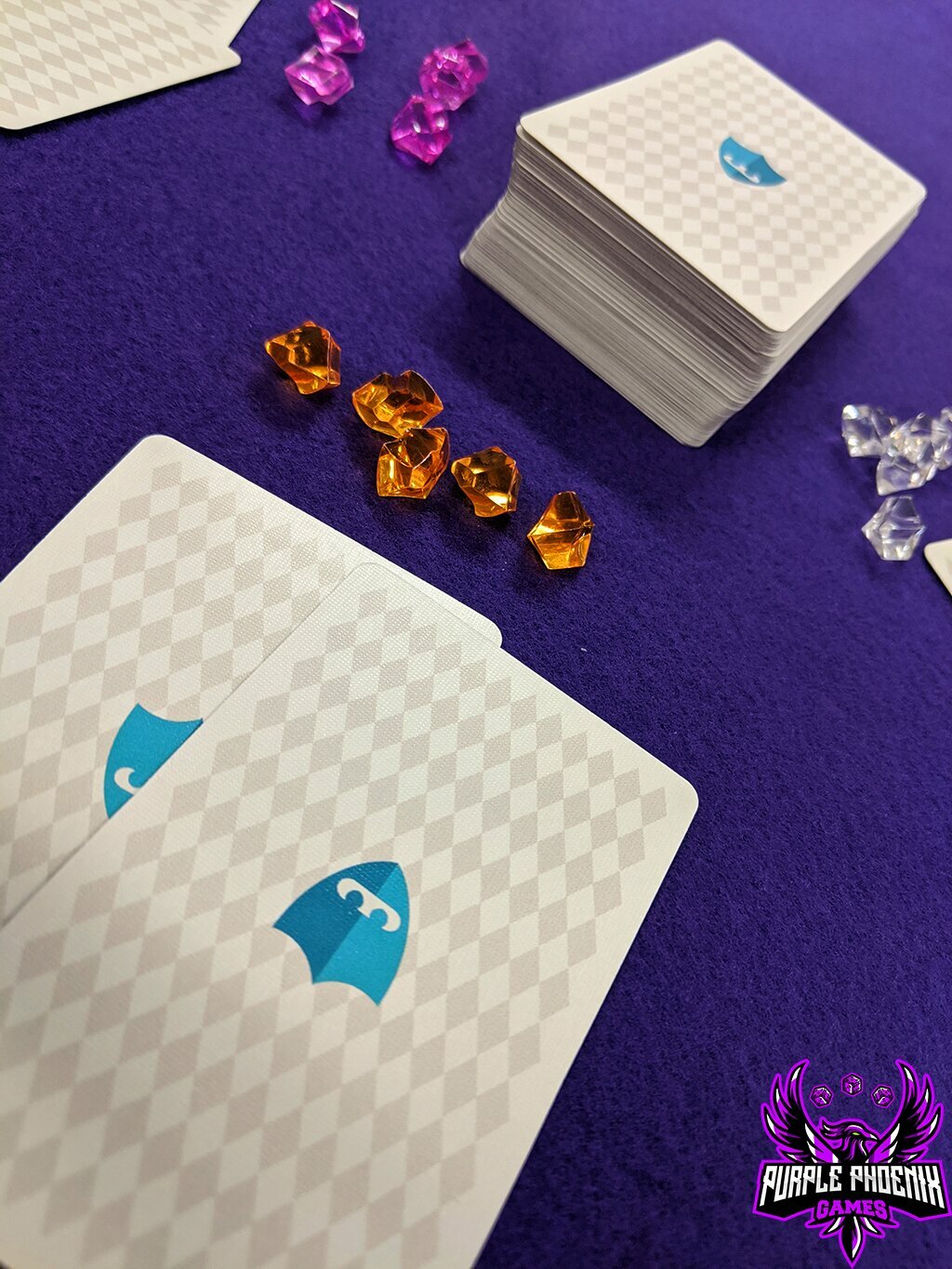
Components. Again, we were provided a prototype copy of this game, and we understand that components can change during the course of a successful Kickstarter campaign. That said, this game is a ton of cards and some plastic gem pieces. The art is stellar – cartoony, but whimsical and fun. The card layouts make sense and are very easy to read and understand. The gems are colorful and fun to play with. I only have one concern/suggestion/wish for the components here. I wish the individual card’s abilities were somehow printed on the cards themselves. That would alleviate the need for a reference sheet, but it would then detract from the cute art on the cards. So, maybe that wouldn’t be so great after all. I’m torn on that.
All in all, this game is super fun to play. It will be chaotic one moment, and strategically tense the next. Being able to whittle an opponent’s hand down to nothing and then slapping them with a King card to steal a huge chunk of gems is just so sneakily satisfying. Or sending your Ninja to infiltrate their unArchered (I know it’s not a word) Castle and slither away with the goods. Don’t get too attached to your gems, because you may find yourself without for several rounds. You can always rebuild, but make haste as your opponents will keep you down if you let them.
If you are a fan of games that are cute, fun, and relatively quick with a quirky, but light-hearted theme, then definitely check this one out.
Of Knights & Ninjas is a card game about claiming enough treasure to ascend to kinghood and rule all the lands. You can accomplish this by sending forces to your opponents’ realms and stealing their glorious gems. The first lord to amass 10 gems will have sufficient wealth to assume the kinghood and rule all realms!
DISCLAIMER: We were provided a prototype copy of this game for the purposes of this review. These are preview copy components, and the final components may be different from these shown. Also, it is not my intention to detail every rule in the game, but to give our readers an idea of how the game plays. If you would like to read the rulebook in full, you may visit the publisher’s website, purchase the game through the publisher, back the game through the Kickstarter campaign, or through any retailers stocking it after fulfillment. -T
To setup, each player will take five gems of their preferred color in front of them. Shuffle the large deck of cards, and deal each player four cards (this rule was updated after our play-throughs). You are now ready to play!
On your turn, you will draw two cards from the deck (unless it’s the first draw of the game – that player will draw just one). You must now play a card to the table or discard a card from your hand. Cards that you can play from your hand will each have different abilities, and thankfully the designer will be providing a reference sheet for these, as there are many cards with wildly different abilities. This is also why I will not be explaining the entire rulebook.
Typically you will be able to play Fortify cards (castles, archers), Attack cards (knights, ninjas, etc), Respond cards, and Special cards (minstrels, jesters, etc). Fortify cards protect your gems from certain Attack cards, like an Archer only being able to attack another Archer, or a Dragon being able to attack a Castle – but not if an Archer is stationed there (logic). Although, a Ninja can scale a Castle wall, and a Catapult can destroy a Castle altogether (but not that pesky Archer that happens to be sitting on top)…
Attack cards are just that: they Attack. Each Attack card will show a number in a starburst icon in the upper right hand corner that signifies how many gems they are able to steal. Once an opponent is declared and an Attack card played, let’s say a 1-power Peasant, the defender may then play a card with the Respond keyword (which will also have a starburst number) to offset the number of stolen gems. If the attacker chooses, they may continue playing Attack cards against the same opponent in order to draw out all the Respond cards and come away with some sweet, sweet gems.
But maybe once all is said and done, and gems are about to change hands, another opponent plays a Special card – a Highwayman, for example. These characters will steal all the gems that are about to change hands (as if he was robbing the gem carriage en route to the new owner). But then again, perhaps yet ANOTHER opponent plays a Highwayman as well, and steals those gems a second time! You just never know when these Special cards will come out and how they may affect the best laid plans.
Play continues in this fashion until one player has amassed the 10 gems they require to win the game!
Components. Again, we were provided a prototype copy of this game, and we understand that components can change during the course of a successful Kickstarter campaign. That said, this game is a ton of cards and some plastic gem pieces. The art is stellar – cartoony, but whimsical and fun. The card layouts make sense and are very easy to read and understand. The gems are colorful and fun to play with. I only have one concern/suggestion/wish for the components here. I wish the individual card’s abilities were somehow printed on the cards themselves. That would alleviate the need for a reference sheet, but it would then detract from the cute art on the cards. So, maybe that wouldn’t be so great after all. I’m torn on that.
All in all, this game is super fun to play. It will be chaotic one moment, and strategically tense the next. Being able to whittle an opponent’s hand down to nothing and then slapping them with a King card to steal a huge chunk of gems is just so sneakily satisfying. Or sending your Ninja to infiltrate their unArchered (I know it’s not a word) Castle and slither away with the goods. Don’t get too attached to your gems, because you may find yourself without for several rounds. You can always rebuild, but make haste as your opponents will keep you down if you let them.
If you are a fan of games that are cute, fun, and relatively quick with a quirky, but light-hearted theme, then definitely check this one out.

Purple Phoenix Games (2266 KP) rated Set a Watch in Tabletop Games
Sep 26, 2019
Purple Phoenix Games Solo Chronicles
I love a good fantasy-themed game. We’ve all, at some point in our lives, probably dreamed of being adventurers – traveling across the land, fighting monsters, and saving all of humanity. Sounds like it could maybe be fun to me. So whenever I see a game that emulates that theme, I am drawn to it. Such was definitely the case when I stumbled across Set a Watch as I was perusing Kickstarter one day, and the rest is history.
The kingdom is under attack. Hoards of creatures are amassing at locations around the realm in an attempt to resurrect ancient Unhallowed monsters. Their ultimate goal? To take control of the world. You and your fellow adventurers have been tasked with stopping this uprising. By traveling to these various locations, you will attempt to clear the area of evil-doers and maintain peace in the kingdom. Keep a vigilant watch, and your team will be successful. But if you wane for even a moment, all could be lost.
DISCLAIMER: This review uses the Deluxe version of Set a Watch that we backed on Kickstarter. Some components may differ from components found other versions. -T
Set A Watch is a cooperative game for 1-4 players in which players must secure nine locations around the realm to prevent the release of the deadly Unhallowed monsters. The party always consists of 4 adventurers, regardless of actual player count. In each round, one adventurer will stay back at camp, resting and taking strategic actions, while the other 3 adventurers take watch and fight off the creatures attempting to infiltrate the camp by using special abilities and powers to aid in battle. The game ends in victory if the adventurers have successfully secured all locations. If, at the end of a round, all adventurers on watch are exhausted, the camp is overrun and the game is lost.
So how does solo play differ from multiplayer games? It doesn’t! A solo game of Set A Watch plays identically to a multiplayer game – the solo player just controls all 4 adventurers at once instead of being split up among the players. Obviously, as a solo player, you have to make all of the decisions, which is sometimes nicer than playing with other people. You get to play whatever strategy YOU want to, without having to compromise with other players. On the flip side, that could be treacherous if your strategy is too bold/too meek or if you get in a tight spot and are at a loss for what to do next. Other than the aspect of solo decision-making, the gameplay remains unchanged. One adventurer still rests at camp while the other 3 stand watch and battle monsters.
Typically, I am not a fan of solo games in which you are forced to play multiple characters. That just feels like kind of a cop-out way to say ‘Yeah, we have a solo mode’ when in reality you’re still playing a multiplayer game, just by yourself. That being said, I actually don’t mind this aspect in Set A Watch. Why? Because there really are no ‘turns’ to track. One adventurer stays at camp and acts first, but the other 3 go to battle and act whenever/however they want. There is no real turn order. I make the characters act when and how I want them to, and that really opens the rounds up to a lot of freedom. I don’t have to sacrifice special powers/abilities because it wasn’t that character’s ‘turn’ – I can come up with some sweet combos, utilizing whichever characters I need to, to really do some damage. The lack of turns makes this a truly cooperative game, even when playing solo.
Overall, I love Set A Watch. It was, admittedly, a little intimidating at first, but once I got the hang of it, it plays great! The components are nice and sturdy, the box transforms into the game board, and the artwork is very nicely done. Set A Watch is a game I would definitely play either multiplayer or solo, and not as a last resort. The gameplay is engaging, the strategic options give you a different game every play, and the theme itself is just exciting to me. I am very happy with this Kickstarter purchase, and I look forward to any expansions/reimplementations that could be in the works!
The kingdom is under attack. Hoards of creatures are amassing at locations around the realm in an attempt to resurrect ancient Unhallowed monsters. Their ultimate goal? To take control of the world. You and your fellow adventurers have been tasked with stopping this uprising. By traveling to these various locations, you will attempt to clear the area of evil-doers and maintain peace in the kingdom. Keep a vigilant watch, and your team will be successful. But if you wane for even a moment, all could be lost.
DISCLAIMER: This review uses the Deluxe version of Set a Watch that we backed on Kickstarter. Some components may differ from components found other versions. -T
Set A Watch is a cooperative game for 1-4 players in which players must secure nine locations around the realm to prevent the release of the deadly Unhallowed monsters. The party always consists of 4 adventurers, regardless of actual player count. In each round, one adventurer will stay back at camp, resting and taking strategic actions, while the other 3 adventurers take watch and fight off the creatures attempting to infiltrate the camp by using special abilities and powers to aid in battle. The game ends in victory if the adventurers have successfully secured all locations. If, at the end of a round, all adventurers on watch are exhausted, the camp is overrun and the game is lost.
So how does solo play differ from multiplayer games? It doesn’t! A solo game of Set A Watch plays identically to a multiplayer game – the solo player just controls all 4 adventurers at once instead of being split up among the players. Obviously, as a solo player, you have to make all of the decisions, which is sometimes nicer than playing with other people. You get to play whatever strategy YOU want to, without having to compromise with other players. On the flip side, that could be treacherous if your strategy is too bold/too meek or if you get in a tight spot and are at a loss for what to do next. Other than the aspect of solo decision-making, the gameplay remains unchanged. One adventurer still rests at camp while the other 3 stand watch and battle monsters.
Typically, I am not a fan of solo games in which you are forced to play multiple characters. That just feels like kind of a cop-out way to say ‘Yeah, we have a solo mode’ when in reality you’re still playing a multiplayer game, just by yourself. That being said, I actually don’t mind this aspect in Set A Watch. Why? Because there really are no ‘turns’ to track. One adventurer stays at camp and acts first, but the other 3 go to battle and act whenever/however they want. There is no real turn order. I make the characters act when and how I want them to, and that really opens the rounds up to a lot of freedom. I don’t have to sacrifice special powers/abilities because it wasn’t that character’s ‘turn’ – I can come up with some sweet combos, utilizing whichever characters I need to, to really do some damage. The lack of turns makes this a truly cooperative game, even when playing solo.
Overall, I love Set A Watch. It was, admittedly, a little intimidating at first, but once I got the hang of it, it plays great! The components are nice and sturdy, the box transforms into the game board, and the artwork is very nicely done. Set A Watch is a game I would definitely play either multiplayer or solo, and not as a last resort. The gameplay is engaging, the strategic options give you a different game every play, and the theme itself is just exciting to me. I am very happy with this Kickstarter purchase, and I look forward to any expansions/reimplementations that could be in the works!
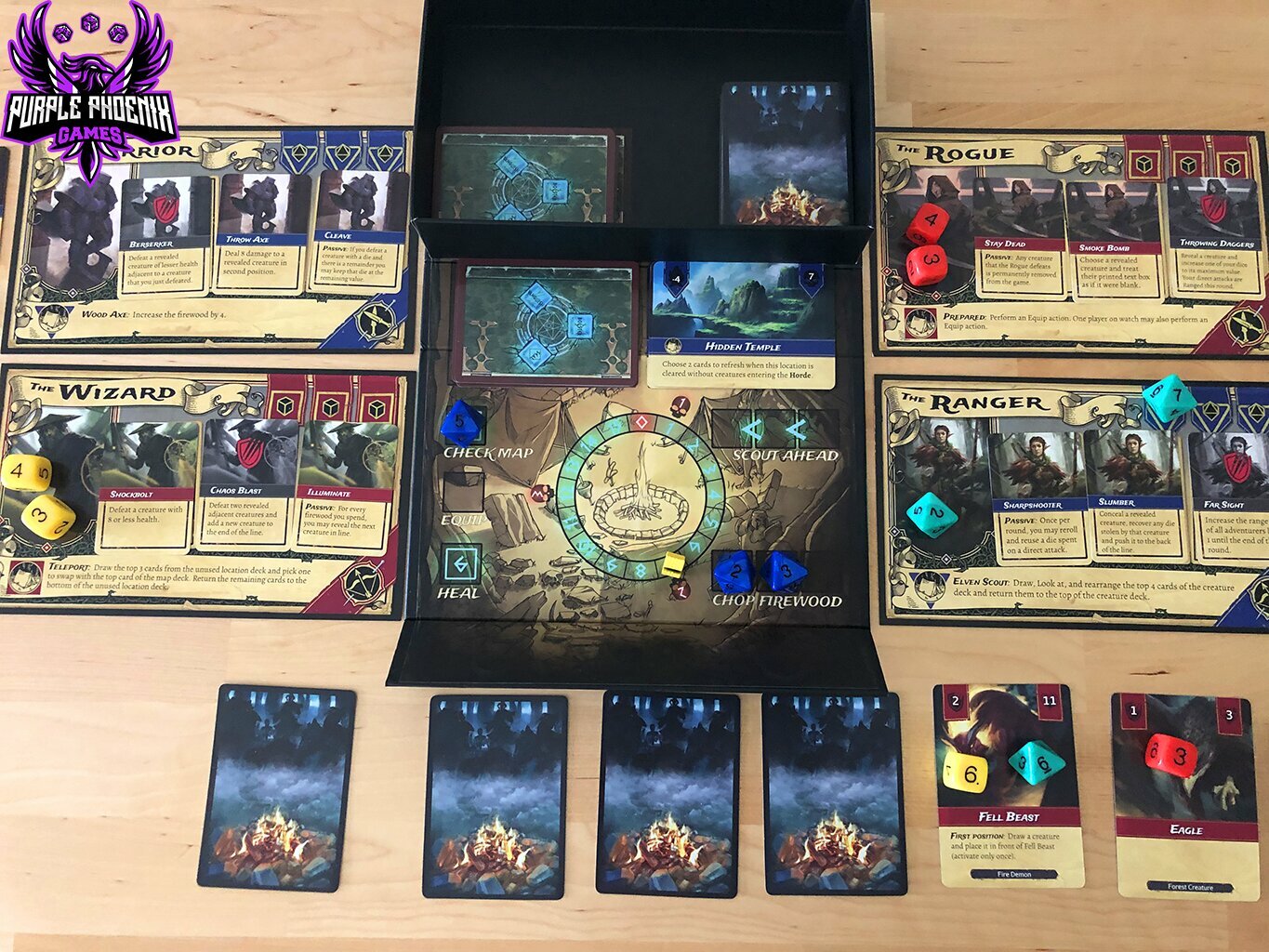

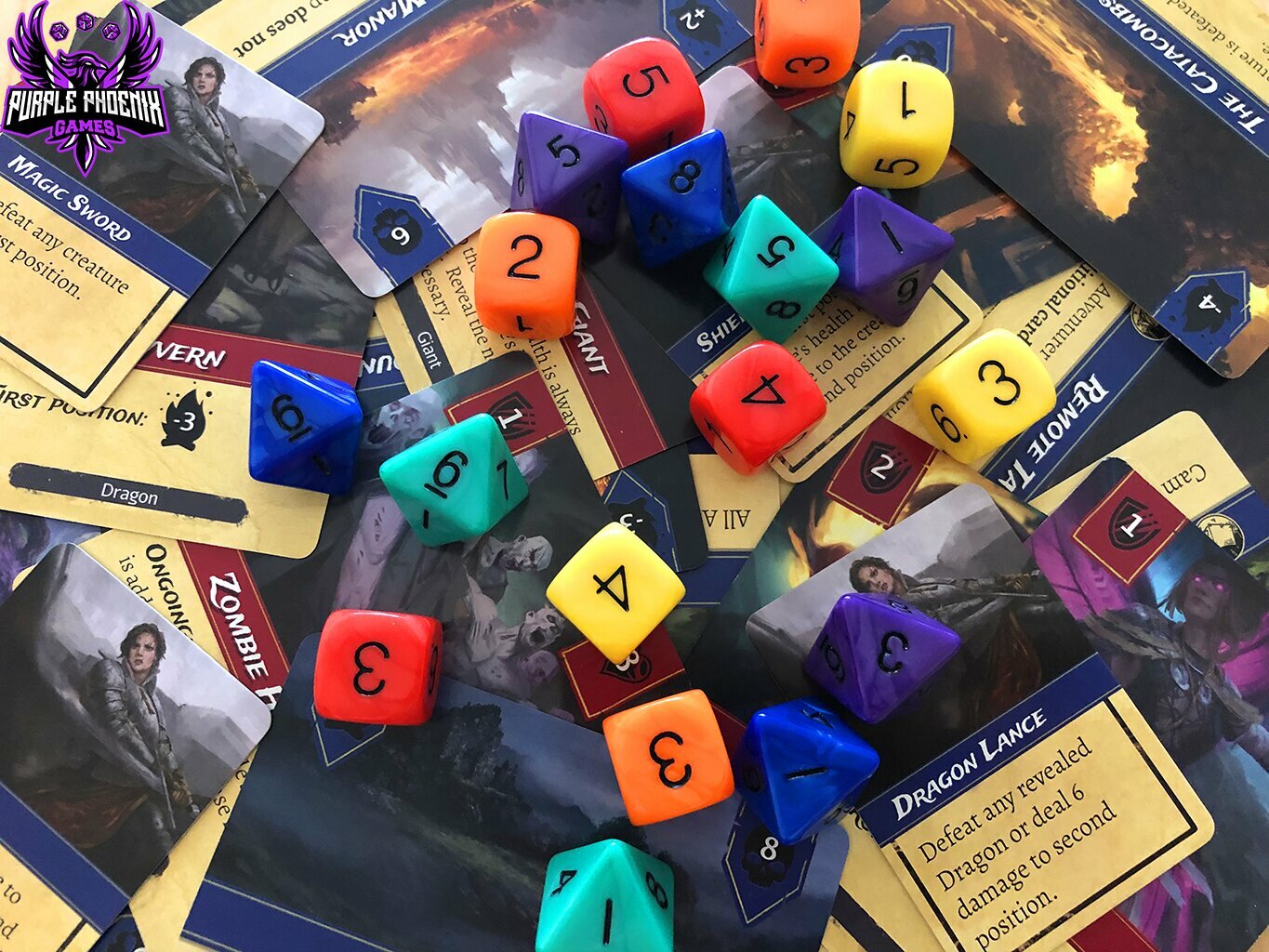
Purple Phoenix Games (2266 KP) rated Indigo in Tabletop Games
Jun 12, 2019

Mazes. So simple, yet for some reason, so entertaining. Well, for me at least. Who knew that winding your way through a maze to get from Point A to Point B could be such a hit? Combine traversing through a maze with building your own maze of sorts, and you’ve got Indigo! Does this game deliver on gameplay and enjoyment, or does it leave you running into dead-ends and loops as you try to find your way out?
Indigo is a strategy game of tile placement and route building in which players are attempting to get various gems from the center of the board through their “gateways” on the edges of the board to score points. Players are each building their own pathways, in a maze-like sort of way, to maneuver the gems around the board, through their own gateways, and away from those of their opponents. Each player receives one tile, and on their turn, plays it to the board. Tiles can be placed anywhere on the board, they don’t necessarily need to be placed adjacent to other tiles. If you play a tile to extend an existing route with a gem on it, move the gem as far along that route as possible. After playing a tile, you draw a new tile to be played on your next turn. The game continues until all gems have been claimed, and then points are added! Gems are worth points depending on their color, and the player with the highest score wins!
I think Indigo is such a neat game. It is so simple, yet strategic, and that makes it so much fun for me to play. The board itself becomes a visual maze as tiles are added, and you must be diligent about watching which pathways are open and available to you, while also trying to make sure you keep pathways blocked off towards your opponents. The possibilities are endless with this game in terms of tile placement and strategy, and that keeps me engaged the entire game. I also love the fact that all players only have 1 tile to play at any given time – you’ve got to make your tile work, you don’t have a hand of tiles from which to choose your best option. That ups the strategy factor even more because one misplaced tile could be the difference between gaining a gem or accidentally giving one away!
Another thing I like about Indigo is just that it’s a pretty game to look at! I think it is so cool to see the board fill up as the game progresses, and you get to watch the maze come to life with each turn. What starts as a mostly blank board soon becomes filled with ribbon-like paths that can lead to anywhere! It’s a neat visual effect for me, and that’s something that drew me into this game in the first place.
Is Indigo the best strategy game I’ve ever played? No. But it is a fun one that keeps me on my toes. With so many possibilities for routes, and the board changing with every tile placed, players are constantly engaged and active in the game. Purple Phoenix Games gives Indigo a swirly 13 / 18.
https://purplephoenixgames.wordpress.com/2019/04/09/indigo-review/
Indigo is a strategy game of tile placement and route building in which players are attempting to get various gems from the center of the board through their “gateways” on the edges of the board to score points. Players are each building their own pathways, in a maze-like sort of way, to maneuver the gems around the board, through their own gateways, and away from those of their opponents. Each player receives one tile, and on their turn, plays it to the board. Tiles can be placed anywhere on the board, they don’t necessarily need to be placed adjacent to other tiles. If you play a tile to extend an existing route with a gem on it, move the gem as far along that route as possible. After playing a tile, you draw a new tile to be played on your next turn. The game continues until all gems have been claimed, and then points are added! Gems are worth points depending on their color, and the player with the highest score wins!
I think Indigo is such a neat game. It is so simple, yet strategic, and that makes it so much fun for me to play. The board itself becomes a visual maze as tiles are added, and you must be diligent about watching which pathways are open and available to you, while also trying to make sure you keep pathways blocked off towards your opponents. The possibilities are endless with this game in terms of tile placement and strategy, and that keeps me engaged the entire game. I also love the fact that all players only have 1 tile to play at any given time – you’ve got to make your tile work, you don’t have a hand of tiles from which to choose your best option. That ups the strategy factor even more because one misplaced tile could be the difference between gaining a gem or accidentally giving one away!
Another thing I like about Indigo is just that it’s a pretty game to look at! I think it is so cool to see the board fill up as the game progresses, and you get to watch the maze come to life with each turn. What starts as a mostly blank board soon becomes filled with ribbon-like paths that can lead to anywhere! It’s a neat visual effect for me, and that’s something that drew me into this game in the first place.
Is Indigo the best strategy game I’ve ever played? No. But it is a fun one that keeps me on my toes. With so many possibilities for routes, and the board changing with every tile placed, players are constantly engaged and active in the game. Purple Phoenix Games gives Indigo a swirly 13 / 18.
https://purplephoenixgames.wordpress.com/2019/04/09/indigo-review/