Search
Search results

Purple Phoenix Games (2266 KP) rated Viceroy in Tabletop Games
Jun 12, 2019
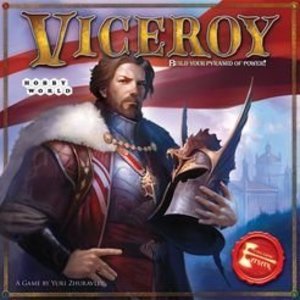


One of the best parts of the board gaming experience is finding a fun group of people with whom to play! Sometimes, though, coordinating a game night is easier said than done. We all must occasionally forego the group experience and face the world as the Lonely Only. But fear not! The world of solo-play is a vast and exciting realm! What follows is a chronicle of my journey into the solo-playing world – notes on gameplay, mechanics, rules, difficulty, and overall experience with solo variations of commonly multiplayer games! I hope this will provide some insight as you continue to grow your collection, or explore your already owned games!
Power. That’s what everyone wants, isn’t it? Well, at least it is in Viceroy! As an inhabitant of the world of Laar, you are fighting to become the ultimate ruler. Recruit allies who provide strategic advantages and enact laws that solidify your claim for power. Do you have what it takes to build and maintain a powerful kingdom, or will your attempts fall short?
DISCLAIMER: There is an expansion to this game, but we are not reviewing it at this time. Should we review it in the future we will either update this review or post a link to the new material here. -T
Viceroy, a game of card drafting and tile placement, is played over 12 turns in which players build a pyramid with their cards – paying to place each card and collecting rewards based upon which level of the pyramid a card is placed. Each turn is divided into two phases: Auction and Development. During the Auction Phase, players bid gemstones to buy a card from the auction line. Once every player has either collected 1 card from auction or passed, play moves to the Development Phase. During the Development Phase, players can either play a card into their pyramid, pass, or discard a card and take 2 gemstones from the reserve. To play a Law card into your pyramid, you place it for free. To play a Character card into your pyramid, you have to pay for it with gems. The cost is dependent upon which level of the pyramid the card is to be placed. You must pay for the level the card will sit on, as well as pay the cost for every level beneath it. For example, to add a card to the third level of the pyramid, you must pay the cost for the 3rd level, AND 2nd level, AND 1st level. The rewards gained from adding a card to the pyramid, however, are taken only for the level on which the card sits. In the earlier example, you would only get the reward for the third level alone, since that is the level on which the card sits. The Development Phase is played over 3 rounds, so a player could play up to 3 cards into their pyramid during 1 Development Phase. After the 3 rounds are up, the next turn begins again in the Auction Phase. When all cards are gone from the Auction Deck, the game ends. Players count up all of their Power Points, and the player with the highest Power value wins!
The only change in Viceroy between a group and solo game is during the Auction Phase. Obviously, if you are playing solo, there is nobody to bid against for cards. How that is alleviated is that you still bid your gemstone as normal, and you randomly draw an unused gemstone from the box as an AI bid. If the colors match, you lose your gem and go on to the next auction. If the colors do not match, you collect your choice card, and the card the AI would have collected gets discarded. If the AI color does not match an available card, you just discard one of the remaining cards. This mimics group play in the sense that you might not always get the card you want from auction! The Development Phase is played as normal. At the end of the game, count points as normal and try to beat your own high score.
Viceroy is a neat game. Every card has so many options that there is no one single strategy that is a sure-win every time. Maybe one game I’ll go for Magic tokens. And maybe the next I’ll try to go for raw Power Point tokens. The possibilities really are endless, and that keeps this game fresh for me. I don’t feel like I’m just going through the motions because every card will act differently depending on where it is played. Strategy really is everything here. On the flip-side of that, however, is that sometimes the options can be a little overwhelming. With so many possibilities for each card, it can get hard for me to decide on what strategy I really want to use. It should also be noted that a card can only be played onto a level if it can sit on exactly 2 cards on the level beneath it. So sometimes I buy a card to play on a certain level only to get to the Development Phase and realize I don’t have a legal place to which I can play it. So do I sacrifice other cards/gemstones to build a slot for this one card, or do I play it to a different level and change my strategy a bit? There’s a little bit of a learning curve, but the more I play, the better I get (or at least, the better I think I get).
Another grievance with Viceroy is that I find myself running out of cards in my hand a lot. The only opportunity to draw cards is if you play a card into your pyramid that allows you to do so. And since I’m usually focused on other strategic routes, I don’t use those cards for those purposes. So then I play all of the cards in my hand (leaving me empty-handed), get 1 card at the next auction, play it, and am again left with no cards in my hand. To fix this issue, I wish one of the actions you could take during the Development Phase was to draw 1 card. I’m not sure if other people have this issue, or if it’s just me, but it’s a problem I run into almost every game.
Overall, I think Viceroy is a good game. It’s unique in the sense that there are so many possibilities that you’ll probably never play the same game twice, even if you decide to play by the same strategy. The mechanics and gameplay are cool too – it’s fun to watch your pyramid literally grow in front of you as the game progresses. This game takes a little more focus and thought than you might think, so it’s not one I’d necessarily just pull out for some light fun. I think Viceroy is as exciting as a solo game as it is as a group game since there really aren’t any differences between the two settings. If you like Viceroy, give it a try solo! If you’ve never played Viceroy, try it either solo or in a group – it’s the same game after all!
https://purplephoenixgames.wordpress.com/2019/04/18/solo-chronicles-viceroy/
Power. That’s what everyone wants, isn’t it? Well, at least it is in Viceroy! As an inhabitant of the world of Laar, you are fighting to become the ultimate ruler. Recruit allies who provide strategic advantages and enact laws that solidify your claim for power. Do you have what it takes to build and maintain a powerful kingdom, or will your attempts fall short?
DISCLAIMER: There is an expansion to this game, but we are not reviewing it at this time. Should we review it in the future we will either update this review or post a link to the new material here. -T
Viceroy, a game of card drafting and tile placement, is played over 12 turns in which players build a pyramid with their cards – paying to place each card and collecting rewards based upon which level of the pyramid a card is placed. Each turn is divided into two phases: Auction and Development. During the Auction Phase, players bid gemstones to buy a card from the auction line. Once every player has either collected 1 card from auction or passed, play moves to the Development Phase. During the Development Phase, players can either play a card into their pyramid, pass, or discard a card and take 2 gemstones from the reserve. To play a Law card into your pyramid, you place it for free. To play a Character card into your pyramid, you have to pay for it with gems. The cost is dependent upon which level of the pyramid the card is to be placed. You must pay for the level the card will sit on, as well as pay the cost for every level beneath it. For example, to add a card to the third level of the pyramid, you must pay the cost for the 3rd level, AND 2nd level, AND 1st level. The rewards gained from adding a card to the pyramid, however, are taken only for the level on which the card sits. In the earlier example, you would only get the reward for the third level alone, since that is the level on which the card sits. The Development Phase is played over 3 rounds, so a player could play up to 3 cards into their pyramid during 1 Development Phase. After the 3 rounds are up, the next turn begins again in the Auction Phase. When all cards are gone from the Auction Deck, the game ends. Players count up all of their Power Points, and the player with the highest Power value wins!
The only change in Viceroy between a group and solo game is during the Auction Phase. Obviously, if you are playing solo, there is nobody to bid against for cards. How that is alleviated is that you still bid your gemstone as normal, and you randomly draw an unused gemstone from the box as an AI bid. If the colors match, you lose your gem and go on to the next auction. If the colors do not match, you collect your choice card, and the card the AI would have collected gets discarded. If the AI color does not match an available card, you just discard one of the remaining cards. This mimics group play in the sense that you might not always get the card you want from auction! The Development Phase is played as normal. At the end of the game, count points as normal and try to beat your own high score.
Viceroy is a neat game. Every card has so many options that there is no one single strategy that is a sure-win every time. Maybe one game I’ll go for Magic tokens. And maybe the next I’ll try to go for raw Power Point tokens. The possibilities really are endless, and that keeps this game fresh for me. I don’t feel like I’m just going through the motions because every card will act differently depending on where it is played. Strategy really is everything here. On the flip-side of that, however, is that sometimes the options can be a little overwhelming. With so many possibilities for each card, it can get hard for me to decide on what strategy I really want to use. It should also be noted that a card can only be played onto a level if it can sit on exactly 2 cards on the level beneath it. So sometimes I buy a card to play on a certain level only to get to the Development Phase and realize I don’t have a legal place to which I can play it. So do I sacrifice other cards/gemstones to build a slot for this one card, or do I play it to a different level and change my strategy a bit? There’s a little bit of a learning curve, but the more I play, the better I get (or at least, the better I think I get).
Another grievance with Viceroy is that I find myself running out of cards in my hand a lot. The only opportunity to draw cards is if you play a card into your pyramid that allows you to do so. And since I’m usually focused on other strategic routes, I don’t use those cards for those purposes. So then I play all of the cards in my hand (leaving me empty-handed), get 1 card at the next auction, play it, and am again left with no cards in my hand. To fix this issue, I wish one of the actions you could take during the Development Phase was to draw 1 card. I’m not sure if other people have this issue, or if it’s just me, but it’s a problem I run into almost every game.
Overall, I think Viceroy is a good game. It’s unique in the sense that there are so many possibilities that you’ll probably never play the same game twice, even if you decide to play by the same strategy. The mechanics and gameplay are cool too – it’s fun to watch your pyramid literally grow in front of you as the game progresses. This game takes a little more focus and thought than you might think, so it’s not one I’d necessarily just pull out for some light fun. I think Viceroy is as exciting as a solo game as it is as a group game since there really aren’t any differences between the two settings. If you like Viceroy, give it a try solo! If you’ve never played Viceroy, try it either solo or in a group – it’s the same game after all!
https://purplephoenixgames.wordpress.com/2019/04/18/solo-chronicles-viceroy/
Purple Phoenix Games (2266 KP) rated Proving Grounds in Tabletop Games
Aug 23, 2021
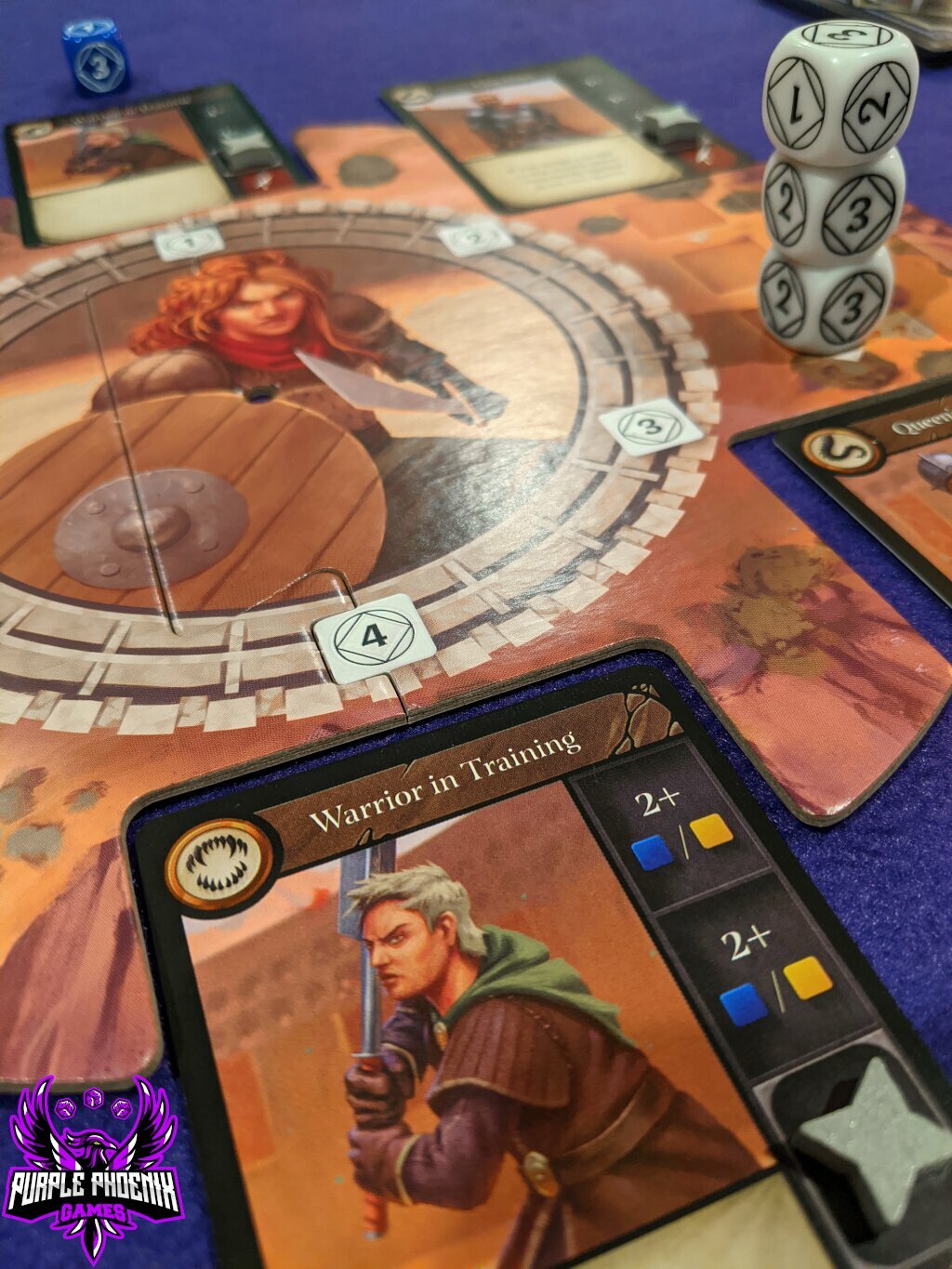
Maia Strongheart sees the eight opponents surrounding her and knows exactly how to handle each one. She makes a dash for #4, a simpleton Warrior in Training, and whoosh – misses. “Huh, that’s never happened to me before,” she thinks. Performing a daring backflip whilst targeting the Clan Elder in the #6 position with a well-placed finishing blow and whoosh – her armor seems to part like the Red Sea as the Clan Elder finds its weakness and delivers a wound to our heroine. “WHO IS PLAYING ME?” Maia wonders. It’s me. Travis. The worst player of Proving Grounds. Poor Maia.
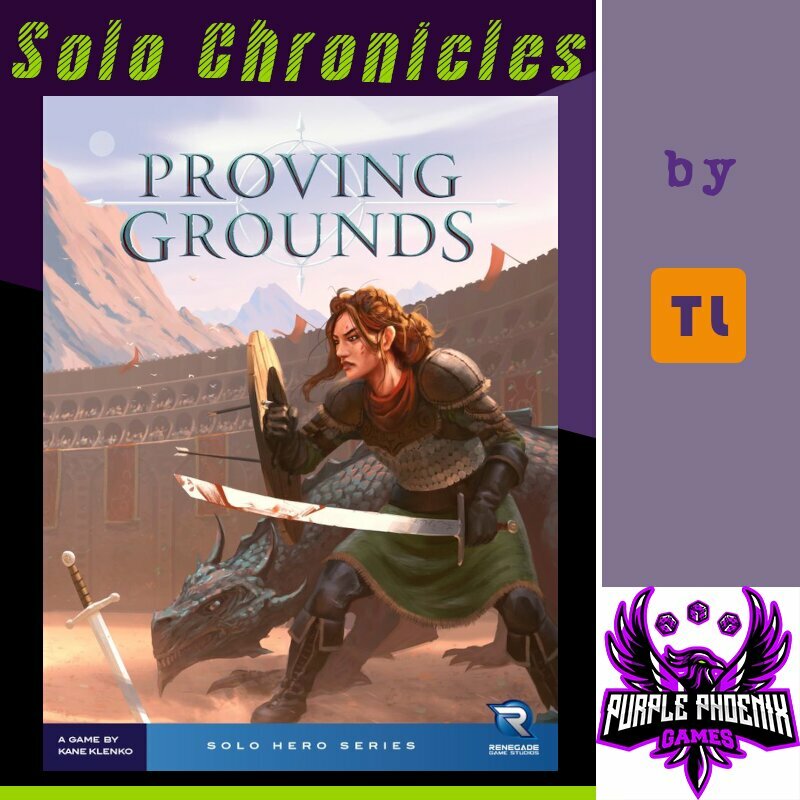
Proving Grounds is a solo fighting dice game with real-time phases. Players will win by defeating eight opponents in battle and will lose (often, in my case) if the heroine suffers too many wounds. The game is played over several rounds, and Renegade has provided an app to act as a timer during the rolling dice phase. Obviously I am terrible at the game, but how does it play and do I feel like continuing to suffer subsequent losses?
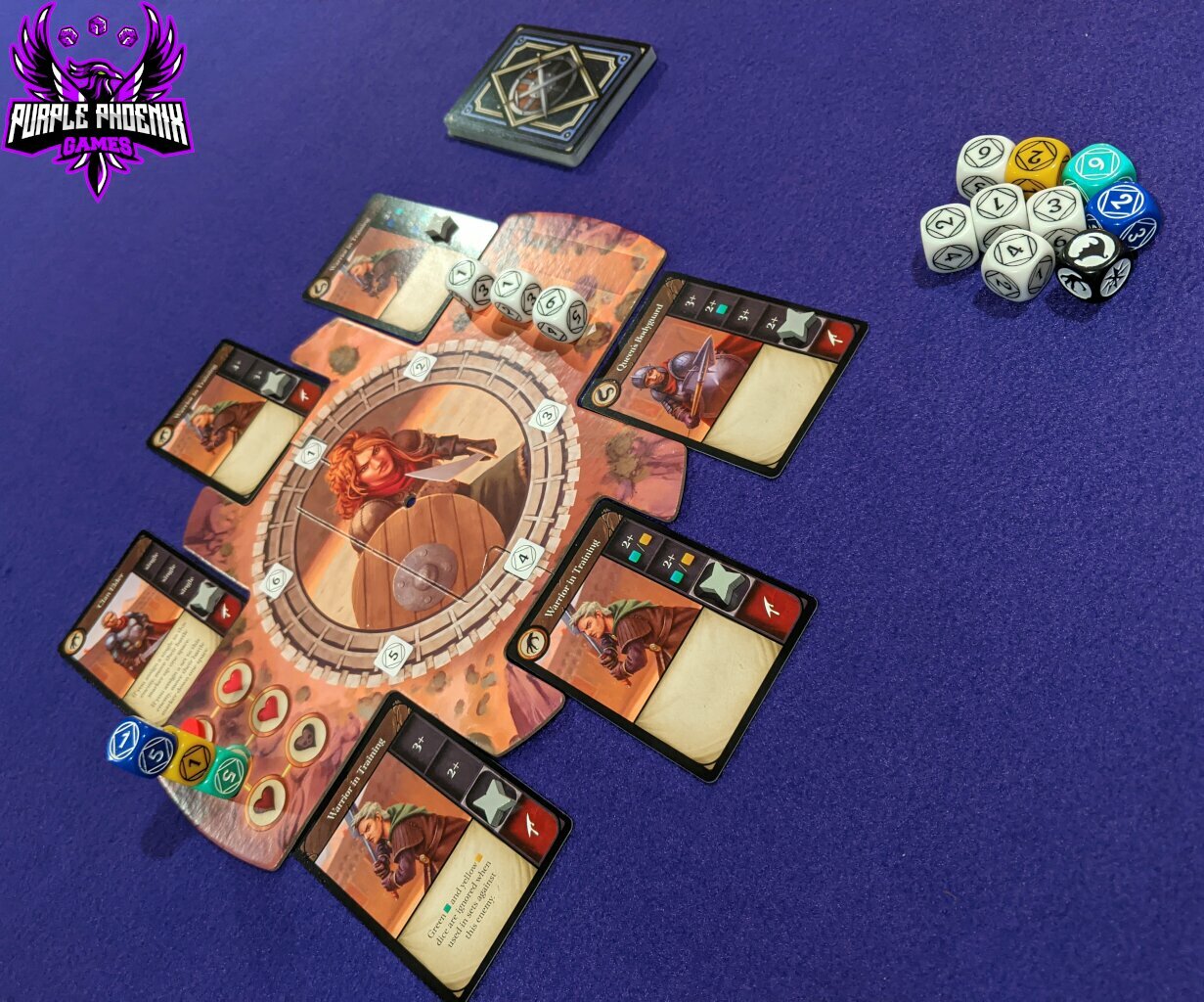
To setup a basic game, place the Encounter Board in the middle of the table. Shuffle the enemy cards (with swords & board backs) and deal one per slot around the Encounter Board. These are the first set of enemies Maia will be fighting. Place Battle Markers (silver ninja stars that track wounds inflicted to enemies) in the outlined spaces of the enemy cards. Place Maia’s health token (a heart) on the tracker and one each of the green, yellow, and blue dice on the health area in the space with a rainbow surround. Fill the exhaustion track with one white die per space (on the right side of the Encounter Board), and take the rest of the dice into hand to use as the dice pool. For this review I also used the Dragonling Die module.
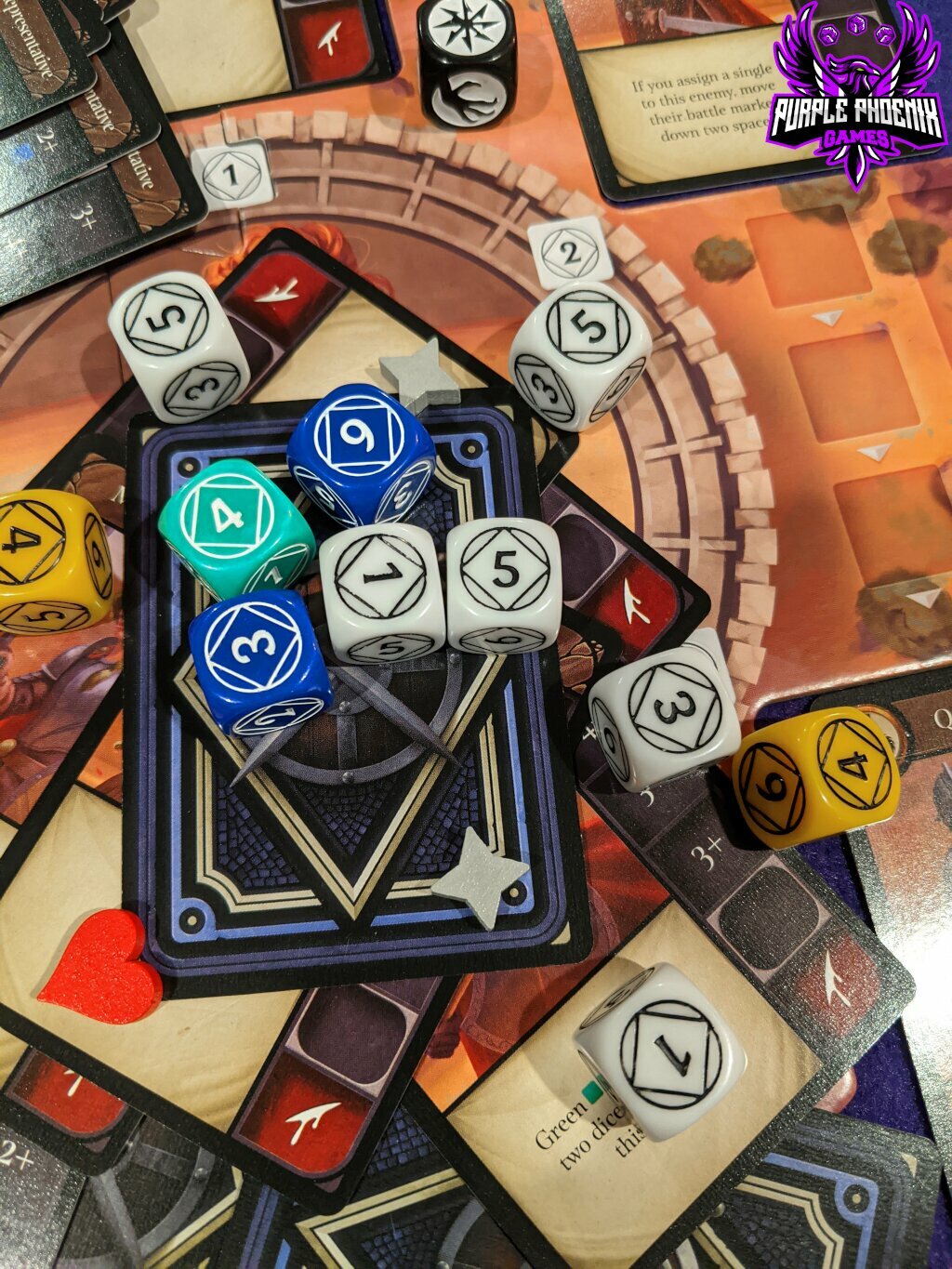
As mentioned, Proving Grounds is played solo over a series of rounds. Each round consists of three phases: Roll Dice, Resolve Attacks, and Recover. The first phase of the game, Roll Dice, is also the most chaotic. During this phase the app timer (or your phone or sand timer or sun dial) will allow 60 seconds to roll the dice and arrive at a final result. The interesting aspect of this mechanic at play here is that only sets of dice may be rerolled, not singles. So players may only roll that set of four 3s and not the solitary 1 sitting there all alone. This causes some brain freeze because many games utilize this in reverse, where only singles may be rerolled. Factor that into a 60 second frenzy to get the greatest results and brains will smoke.
Once the timer is up or players are satisfied with the rolled results, they move to the next phase: Resolve Attacks. Each number rolled on the dice correspond to the enemy’s position around the Encounter Board. So that solitary 1 that was rolled earlier is assigned to the enemy in position #1. Here’s the kick in the rear though: any single dice assigned to an enemy will result in a wound dealt to Maia, and would require the player to sacrifice one of the dice to the exhaustion track! Should an enemy require three or more dice but only two are assigned, or if zero dice are assigned, nothing happens to Maia nor the enemy. But those dang single dice will come back to haunt the player. A lot, if they play like I do. Some enemies will require at least one of the dice to be the blue/green/yellow die in order to be successful while others are just straight number of dice. Calculating everything that is needed during the Roll Dice phase is something that I have yet to master.
After attacks are resolved, players enter the Recover phase. During this phase players will gather all assigned dice from the round as well as any dice on the lowest spot of the exhaustion track to be used for the next round. Any enemies that were defeated have left an empty slot on the Encounter Board, so a new enemy will now fill that void. Play continues in this fashion of three phases per round until either eight enemies have been defeated or Maia suffers too many wounds to continue.
Components. I am fascinated by how few components are needed to put a game like this together. Yes, the Encounter Board is mostly unnecessary, but a great way to organize the game and keep everything spacially relevant for those of us that need that. The cards are fine quality and the game has great art. The dice are very cool, but I am unsure how the colors pop for our colorblind gamer friends. While the game doesn’t necessarily refer to the damage markers as “ninja stars” I cannot get over the fact that they are ninja stars. They are certainly out of place in a game like this where I encountered zero ninjas in my plays. Everything else, though, is great and it comes in a nice-sized box: a little smaller than my Century: Golem Edition box.
It was Kane Klenko’s birthday recently, so I wished him a happy birthday on social media and informed him that I was celebrating by playing Proving Grounds. His response was absolutely perfect: “Good luck!” Well, Kane, I never have good luck with this one! It is certainly a combination of poor dice rolling, poor decision making whilst rolling dice, and just dumb luck (emphasis on dumb). I love playing this game but it is infuriating that I have yet to beat it! Even with just the first Dragonling Die module! Gahhhhhh!!!
However, Proving Grounds is an excellent dice game that breaks out of the Yahtzee clone mold and into something fresh and exciting. The twist of only being able to reroll sets instead of singles makes for interesting decisions when you really need to defeat enemy #5 but just cannot roll ANY 5s to save your life (in the game). I just want to beat it once with the Dragonling Die so I can start adding in other modules (oh yes, there are several other modules to add). When games force me to WANT to play them more and more, even for the sheer hope of victory, I consider that a mark of distinction and a sign of a great game.
So if you are like me and enjoy the pain of defeat over and over again then I invite you to try Proving Grounds. It will not be easy. But if you happen to beat it, especially on your first try, please let me know. I need all the cheat codes I can get here. It will stay in my collection probably forever because I just need to overcome it, and then once I figure it out completely, I will just need to wallop it over and over to teach it a lesson. Enjoy Proving Grounds everyone!
Proving Grounds is a solo fighting dice game with real-time phases. Players will win by defeating eight opponents in battle and will lose (often, in my case) if the heroine suffers too many wounds. The game is played over several rounds, and Renegade has provided an app to act as a timer during the rolling dice phase. Obviously I am terrible at the game, but how does it play and do I feel like continuing to suffer subsequent losses?
To setup a basic game, place the Encounter Board in the middle of the table. Shuffle the enemy cards (with swords & board backs) and deal one per slot around the Encounter Board. These are the first set of enemies Maia will be fighting. Place Battle Markers (silver ninja stars that track wounds inflicted to enemies) in the outlined spaces of the enemy cards. Place Maia’s health token (a heart) on the tracker and one each of the green, yellow, and blue dice on the health area in the space with a rainbow surround. Fill the exhaustion track with one white die per space (on the right side of the Encounter Board), and take the rest of the dice into hand to use as the dice pool. For this review I also used the Dragonling Die module.
As mentioned, Proving Grounds is played solo over a series of rounds. Each round consists of three phases: Roll Dice, Resolve Attacks, and Recover. The first phase of the game, Roll Dice, is also the most chaotic. During this phase the app timer (or your phone or sand timer or sun dial) will allow 60 seconds to roll the dice and arrive at a final result. The interesting aspect of this mechanic at play here is that only sets of dice may be rerolled, not singles. So players may only roll that set of four 3s and not the solitary 1 sitting there all alone. This causes some brain freeze because many games utilize this in reverse, where only singles may be rerolled. Factor that into a 60 second frenzy to get the greatest results and brains will smoke.
Once the timer is up or players are satisfied with the rolled results, they move to the next phase: Resolve Attacks. Each number rolled on the dice correspond to the enemy’s position around the Encounter Board. So that solitary 1 that was rolled earlier is assigned to the enemy in position #1. Here’s the kick in the rear though: any single dice assigned to an enemy will result in a wound dealt to Maia, and would require the player to sacrifice one of the dice to the exhaustion track! Should an enemy require three or more dice but only two are assigned, or if zero dice are assigned, nothing happens to Maia nor the enemy. But those dang single dice will come back to haunt the player. A lot, if they play like I do. Some enemies will require at least one of the dice to be the blue/green/yellow die in order to be successful while others are just straight number of dice. Calculating everything that is needed during the Roll Dice phase is something that I have yet to master.
After attacks are resolved, players enter the Recover phase. During this phase players will gather all assigned dice from the round as well as any dice on the lowest spot of the exhaustion track to be used for the next round. Any enemies that were defeated have left an empty slot on the Encounter Board, so a new enemy will now fill that void. Play continues in this fashion of three phases per round until either eight enemies have been defeated or Maia suffers too many wounds to continue.
Components. I am fascinated by how few components are needed to put a game like this together. Yes, the Encounter Board is mostly unnecessary, but a great way to organize the game and keep everything spacially relevant for those of us that need that. The cards are fine quality and the game has great art. The dice are very cool, but I am unsure how the colors pop for our colorblind gamer friends. While the game doesn’t necessarily refer to the damage markers as “ninja stars” I cannot get over the fact that they are ninja stars. They are certainly out of place in a game like this where I encountered zero ninjas in my plays. Everything else, though, is great and it comes in a nice-sized box: a little smaller than my Century: Golem Edition box.
It was Kane Klenko’s birthday recently, so I wished him a happy birthday on social media and informed him that I was celebrating by playing Proving Grounds. His response was absolutely perfect: “Good luck!” Well, Kane, I never have good luck with this one! It is certainly a combination of poor dice rolling, poor decision making whilst rolling dice, and just dumb luck (emphasis on dumb). I love playing this game but it is infuriating that I have yet to beat it! Even with just the first Dragonling Die module! Gahhhhhh!!!
However, Proving Grounds is an excellent dice game that breaks out of the Yahtzee clone mold and into something fresh and exciting. The twist of only being able to reroll sets instead of singles makes for interesting decisions when you really need to defeat enemy #5 but just cannot roll ANY 5s to save your life (in the game). I just want to beat it once with the Dragonling Die so I can start adding in other modules (oh yes, there are several other modules to add). When games force me to WANT to play them more and more, even for the sheer hope of victory, I consider that a mark of distinction and a sign of a great game.
So if you are like me and enjoy the pain of defeat over and over again then I invite you to try Proving Grounds. It will not be easy. But if you happen to beat it, especially on your first try, please let me know. I need all the cheat codes I can get here. It will stay in my collection probably forever because I just need to overcome it, and then once I figure it out completely, I will just need to wallop it over and over to teach it a lesson. Enjoy Proving Grounds everyone!

Merissa (14146 KP) rated Ice on Fire (Treble and the Lost Boys #1) in Books
Apr 27, 2018

Ice on Fire (Treble and the Lost Boys #1) by G.R. Lyons
Ice on Fire is the first book in the new series, Treble and the Lost Boys. Set in the same world as the Shifting Isles series, it can nevertheless be read without any prior knowledge of that series.
Zac is leading a double life - he is the violinist in Treble, and the guitar player in Inferno. He can't tell his longtime friend in Inferno that he plays violing as they will see it as 'gay'. So he definitely can't tell them that he is, in fact, gay too. So he pretends, and hates every minute of it. His family life is a good one, but he is worried about telling them he is gay as well. So, all in all, Zac is firmly in the closet. The only bright spot, which he keeps to himself, is seeing the mysterious Mr Shadow when he plays with Treble. This unknown man is the root of all his fantasies.
Adrian is also leading a double life, but although it looks like he has it all, he is actually more trapped than Zac. Suffering with acute anxiety, he has to toe the line his strict father lays down, or he will be kicked out with no money to his name. He manages to go to the club every time Treble are playing though. There is no way he would miss out on seeing the vibrant and passionate violinist.
These two definitely have a bumpy road, and both of them annoyed me at times. It was heartbreaking to see their relationship splinter under the pressure of studies and exhaustion. With high expectations, and only manageable reality, we see them fall apart and can only hope for a HEA, or at least a HFN!
I thoroughly enjoyed this book, and can't wait to continue with this series. A brilliant start to the series, and I am waiting patiently for Rylie's story! Absolutely recommended.
* A copy of this book was provided to me with no requirements for a review. I voluntarily read this book, and the comments here are my honest opinion. *
Merissa
Archaeolibrarian - I Dig Good Books!
Zac is leading a double life - he is the violinist in Treble, and the guitar player in Inferno. He can't tell his longtime friend in Inferno that he plays violing as they will see it as 'gay'. So he definitely can't tell them that he is, in fact, gay too. So he pretends, and hates every minute of it. His family life is a good one, but he is worried about telling them he is gay as well. So, all in all, Zac is firmly in the closet. The only bright spot, which he keeps to himself, is seeing the mysterious Mr Shadow when he plays with Treble. This unknown man is the root of all his fantasies.
Adrian is also leading a double life, but although it looks like he has it all, he is actually more trapped than Zac. Suffering with acute anxiety, he has to toe the line his strict father lays down, or he will be kicked out with no money to his name. He manages to go to the club every time Treble are playing though. There is no way he would miss out on seeing the vibrant and passionate violinist.
These two definitely have a bumpy road, and both of them annoyed me at times. It was heartbreaking to see their relationship splinter under the pressure of studies and exhaustion. With high expectations, and only manageable reality, we see them fall apart and can only hope for a HEA, or at least a HFN!
I thoroughly enjoyed this book, and can't wait to continue with this series. A brilliant start to the series, and I am waiting patiently for Rylie's story! Absolutely recommended.
* A copy of this book was provided to me with no requirements for a review. I voluntarily read this book, and the comments here are my honest opinion. *
Merissa
Archaeolibrarian - I Dig Good Books!

Paul Kellett (118 KP) rated Dawn of the Zeds (Third edition) in Tabletop Games
May 20, 2019


Staged rules to ease you in slowly (1 more)
Strong solo game plus team and 1 Vs many rules
The Ultimate Zombie Tower Defense
I've been wanting DotZ for some time so jumped on the reprint and expansions when they hit Kickstarter last year.
As a solo player, having a town defense game designed as a solo game first was a big draw for me and the game certainly doesn't disappoint.
After hearing so much about it and the complexity, I was surprised to find it a lot smaller than I expected - the board is smaller than most modern board games and there aren't anywhere near as many chits and cards as other wargames. The game will play easily on a coffee table.
The first thing you see are the 5 rule books, but these are handily split into a "Start Here" basic game book which lets you quickly jump in and play a basic game, just your heroes fending off the Zeds from reaching the town, the advanced rules which lead you through the next level of difficulty, adding in extra rules, the set-up guide with all the instructions for each difficulty level plus epilogues to see how well you did. Next there is the Farmingdale Dossier - a reference book with all the various hero and zombie special skills and finally, the complete rules A-Z with rules for all difficulty levels and game modes.
The levels are all colour coded so it is easy to sort and set up the desired difficulty level and the rules are similarly split up and each rule numbered so you can quickly find what you need.
Gameplay is tight and atmospheric, you really feel like you are holding back the zombie hoardes. Careful planning and strategy is vital as actions are limited (and you never actually know how many actions you will get from turn to turn making you make some hard choices as to what is best to do each turn.
Overall a very satisfying game that will keep me busy for a long time and the ability to add more advanced rules when I feel comfortable is great.
As a solo player, having a town defense game designed as a solo game first was a big draw for me and the game certainly doesn't disappoint.
After hearing so much about it and the complexity, I was surprised to find it a lot smaller than I expected - the board is smaller than most modern board games and there aren't anywhere near as many chits and cards as other wargames. The game will play easily on a coffee table.
The first thing you see are the 5 rule books, but these are handily split into a "Start Here" basic game book which lets you quickly jump in and play a basic game, just your heroes fending off the Zeds from reaching the town, the advanced rules which lead you through the next level of difficulty, adding in extra rules, the set-up guide with all the instructions for each difficulty level plus epilogues to see how well you did. Next there is the Farmingdale Dossier - a reference book with all the various hero and zombie special skills and finally, the complete rules A-Z with rules for all difficulty levels and game modes.
The levels are all colour coded so it is easy to sort and set up the desired difficulty level and the rules are similarly split up and each rule numbered so you can quickly find what you need.
Gameplay is tight and atmospheric, you really feel like you are holding back the zombie hoardes. Careful planning and strategy is vital as actions are limited (and you never actually know how many actions you will get from turn to turn making you make some hard choices as to what is best to do each turn.
Overall a very satisfying game that will keep me busy for a long time and the ability to add more advanced rules when I feel comfortable is great.


Stickman Downhill - Motocross
Games
App
Stickman Downhill - Motocross, the sequel to the number #1 downhill game with more than 10 million...
Purple Phoenix Games (2266 KP) rated My First Stone Age: The Card Game in Tabletop Games
Apr 7, 2021
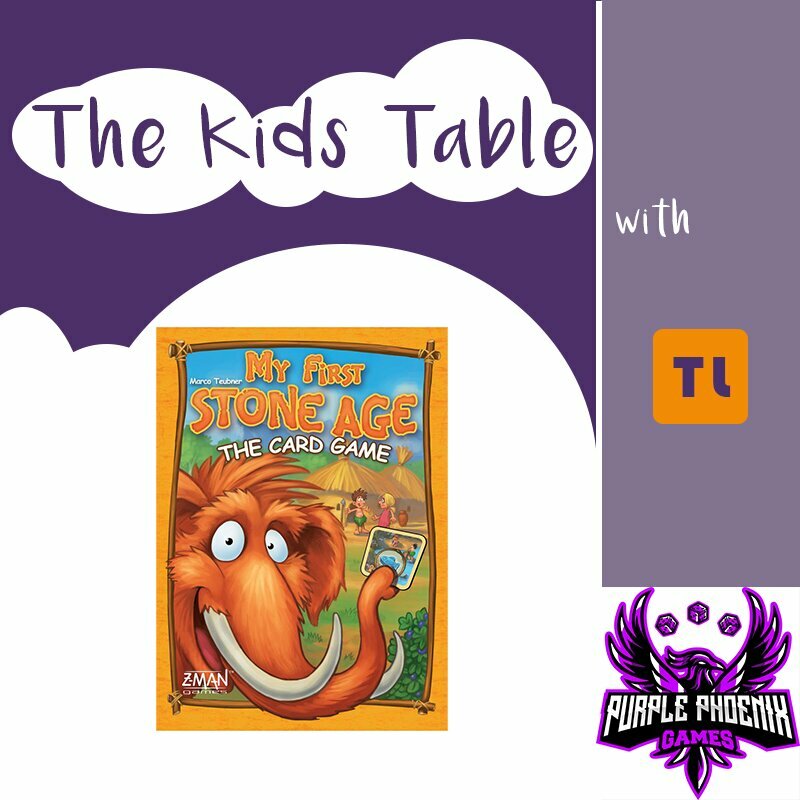
The Kids Table series from Purple Phoenix Games seeks to lightly explore games that are focused toward children and families. We will do our best to give some good insight, but not bog you down with a million rules…
My First Stone Age: The Card Game (that’s a mouthful) is a quick and easy card game that can be played by any child of any age assuming they have the attention span for it (mine didn’t the first couple times). It focuses on memory skills and set collection mechanics.
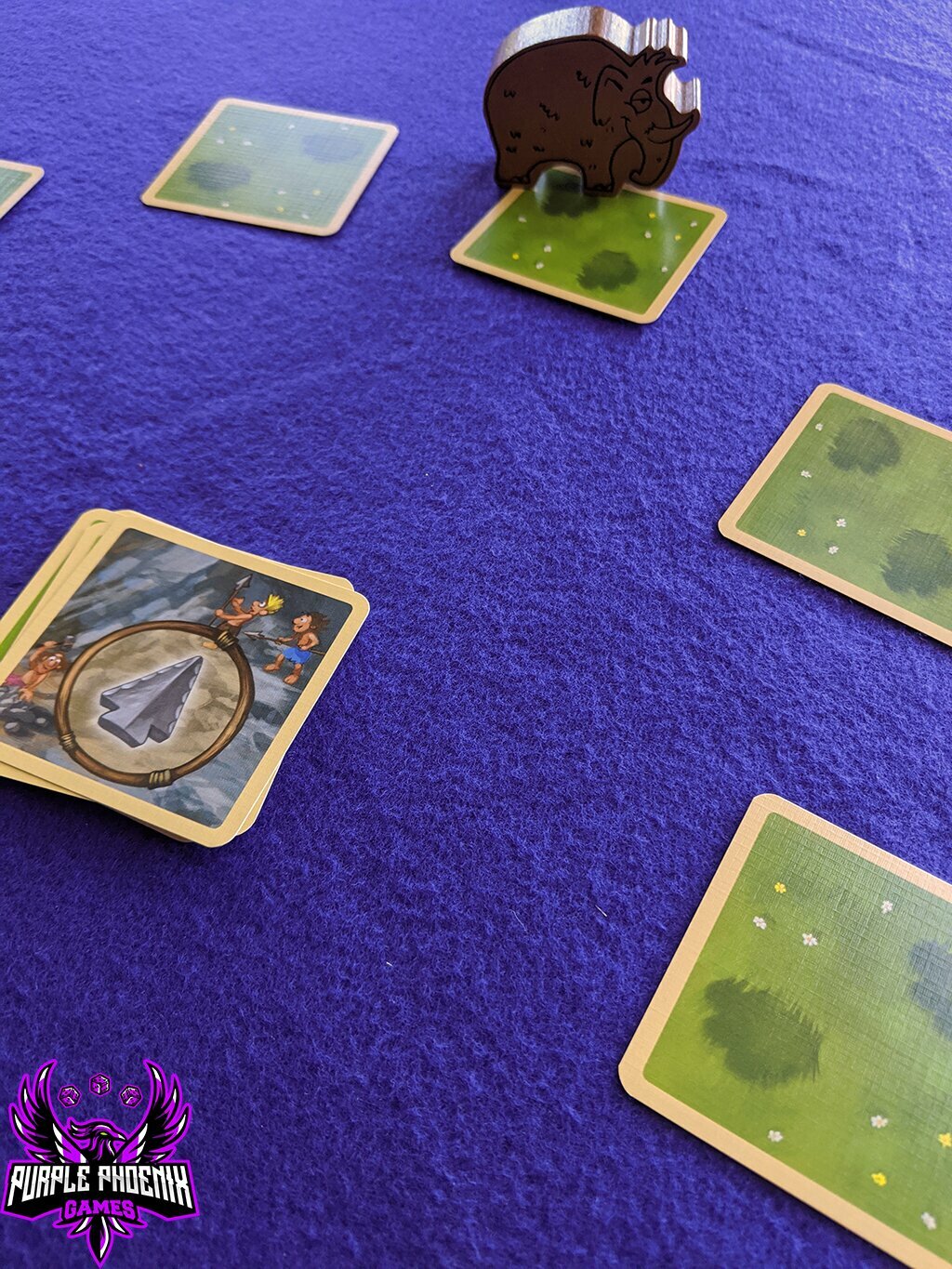
Setting up is easy. Shuffle the Hut Cards and give each player one. Shuffle the Goods Cards and deal nine face-down in a circle. Place the rest of the deck in the middle of the circle face-up. Plop Martin, the mammeeple (mammoth meeple) on or near one of the face-down cards and you’re ready to play!
The winner of the game is they who is able to build three huts first. Players can build huts by moving Martin around the circle clock-wise 1-4 spaces, collecting the card if it matches the players’ hut card, and then building the hut by discarding the goods used. Each turn players will be able to move Martin, flip a card to see if it matched their hut card, and build a hut. The game continues in this fashion until the winner has built their third hut!
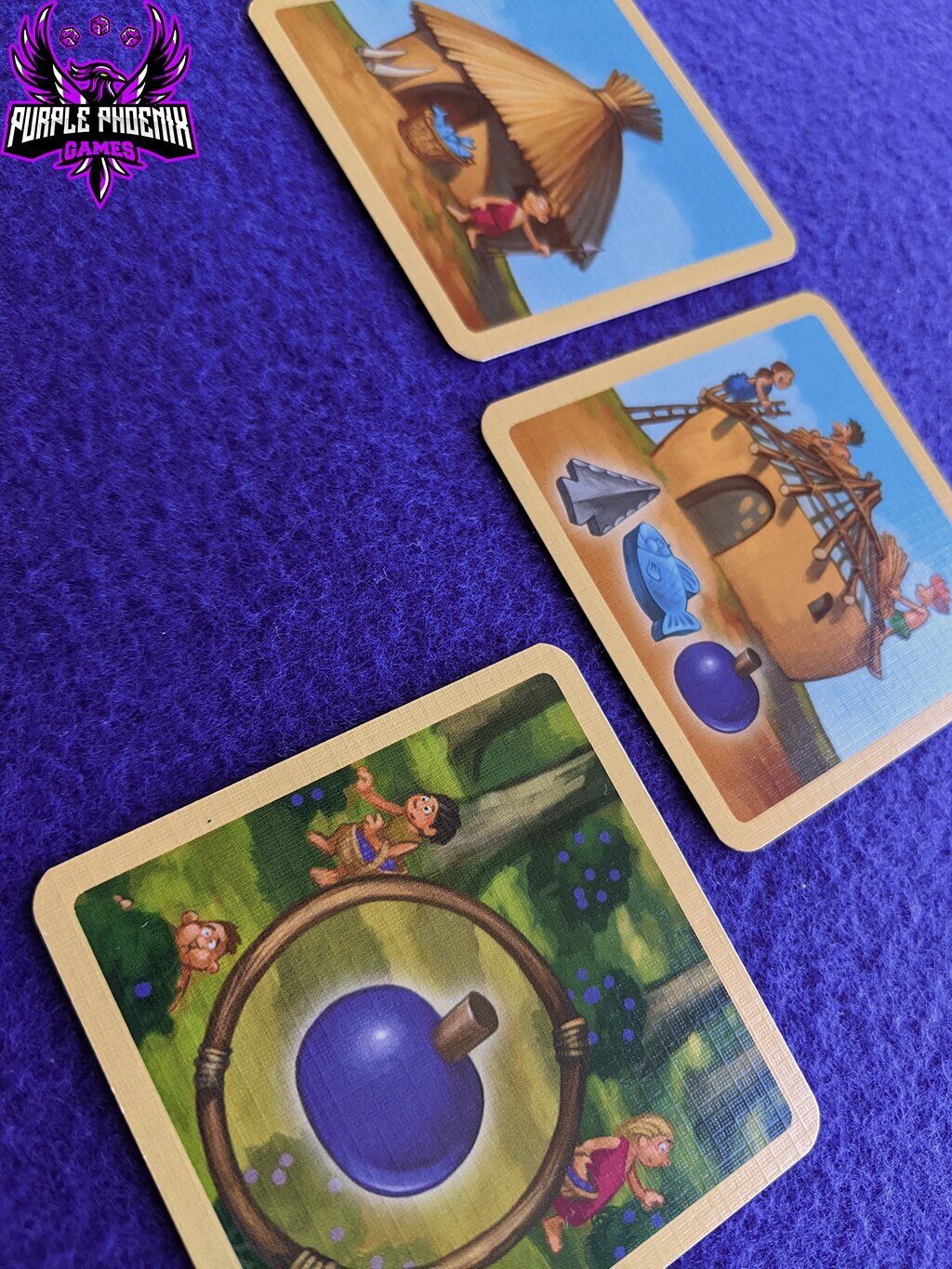
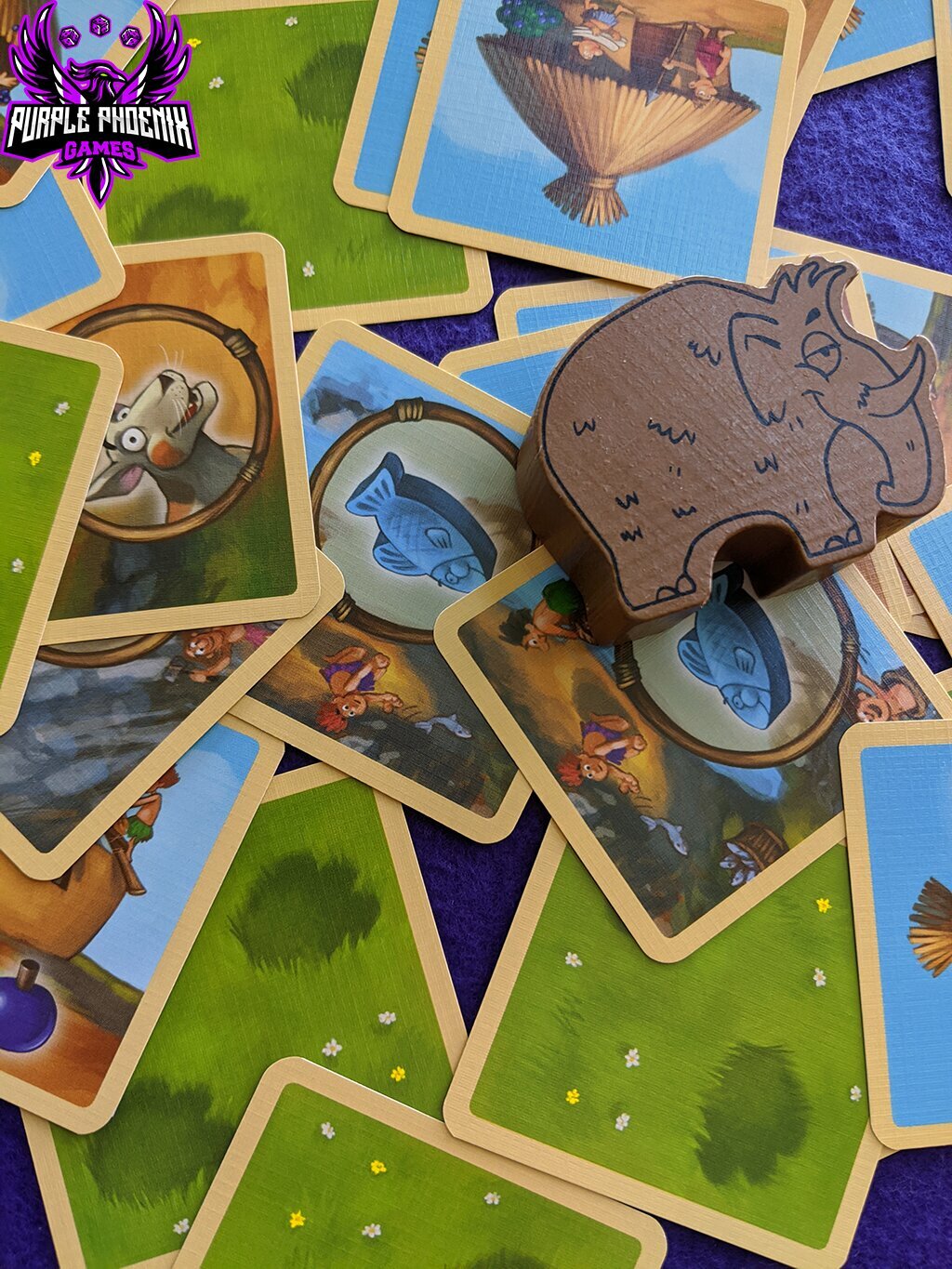
This is a very light game that has very simple rules, and not a ton for the players to have to keep track of or remember. Perfect for young ones and not-so-young ones alike. We love the artwork on the cards and being able to move a large mammeeple around the table searching for fish or arrowheads. While the game is competitive in that there is a winner and therefore also losers, we mitigate that by saying that, “if I win then you get to tickle me, but if you win I get to tickle you!” That usually quells any upset youngsters pretty quickly.
We love this game and it is a great first step into gateway games that target older audiences. It is simple and quick, and a minimal investment for a good few minutes!
My First Stone Age: The Card Game (that’s a mouthful) is a quick and easy card game that can be played by any child of any age assuming they have the attention span for it (mine didn’t the first couple times). It focuses on memory skills and set collection mechanics.
Setting up is easy. Shuffle the Hut Cards and give each player one. Shuffle the Goods Cards and deal nine face-down in a circle. Place the rest of the deck in the middle of the circle face-up. Plop Martin, the mammeeple (mammoth meeple) on or near one of the face-down cards and you’re ready to play!
The winner of the game is they who is able to build three huts first. Players can build huts by moving Martin around the circle clock-wise 1-4 spaces, collecting the card if it matches the players’ hut card, and then building the hut by discarding the goods used. Each turn players will be able to move Martin, flip a card to see if it matched their hut card, and build a hut. The game continues in this fashion until the winner has built their third hut!
This is a very light game that has very simple rules, and not a ton for the players to have to keep track of or remember. Perfect for young ones and not-so-young ones alike. We love the artwork on the cards and being able to move a large mammeeple around the table searching for fish or arrowheads. While the game is competitive in that there is a winner and therefore also losers, we mitigate that by saying that, “if I win then you get to tickle me, but if you win I get to tickle you!” That usually quells any upset youngsters pretty quickly.
We love this game and it is a great first step into gateway games that target older audiences. It is simple and quick, and a minimal investment for a good few minutes!




Police Scanner+
News and Utilities
App
50% Off Sale Today Only The most updated and #1 rated police scanner app now has the most stations...