
Search
Search results

Purple Phoenix Games (2266 KP) rated Viceroy in Tabletop Games
Jun 12, 2019
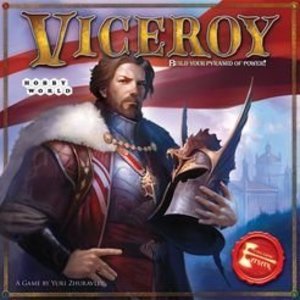


One of the best parts of the board gaming experience is finding a fun group of people with whom to play! Sometimes, though, coordinating a game night is easier said than done. We all must occasionally forego the group experience and face the world as the Lonely Only. But fear not! The world of solo-play is a vast and exciting realm! What follows is a chronicle of my journey into the solo-playing world – notes on gameplay, mechanics, rules, difficulty, and overall experience with solo variations of commonly multiplayer games! I hope this will provide some insight as you continue to grow your collection, or explore your already owned games!
Power. That’s what everyone wants, isn’t it? Well, at least it is in Viceroy! As an inhabitant of the world of Laar, you are fighting to become the ultimate ruler. Recruit allies who provide strategic advantages and enact laws that solidify your claim for power. Do you have what it takes to build and maintain a powerful kingdom, or will your attempts fall short?
DISCLAIMER: There is an expansion to this game, but we are not reviewing it at this time. Should we review it in the future we will either update this review or post a link to the new material here. -T
Viceroy, a game of card drafting and tile placement, is played over 12 turns in which players build a pyramid with their cards – paying to place each card and collecting rewards based upon which level of the pyramid a card is placed. Each turn is divided into two phases: Auction and Development. During the Auction Phase, players bid gemstones to buy a card from the auction line. Once every player has either collected 1 card from auction or passed, play moves to the Development Phase. During the Development Phase, players can either play a card into their pyramid, pass, or discard a card and take 2 gemstones from the reserve. To play a Law card into your pyramid, you place it for free. To play a Character card into your pyramid, you have to pay for it with gems. The cost is dependent upon which level of the pyramid the card is to be placed. You must pay for the level the card will sit on, as well as pay the cost for every level beneath it. For example, to add a card to the third level of the pyramid, you must pay the cost for the 3rd level, AND 2nd level, AND 1st level. The rewards gained from adding a card to the pyramid, however, are taken only for the level on which the card sits. In the earlier example, you would only get the reward for the third level alone, since that is the level on which the card sits. The Development Phase is played over 3 rounds, so a player could play up to 3 cards into their pyramid during 1 Development Phase. After the 3 rounds are up, the next turn begins again in the Auction Phase. When all cards are gone from the Auction Deck, the game ends. Players count up all of their Power Points, and the player with the highest Power value wins!
The only change in Viceroy between a group and solo game is during the Auction Phase. Obviously, if you are playing solo, there is nobody to bid against for cards. How that is alleviated is that you still bid your gemstone as normal, and you randomly draw an unused gemstone from the box as an AI bid. If the colors match, you lose your gem and go on to the next auction. If the colors do not match, you collect your choice card, and the card the AI would have collected gets discarded. If the AI color does not match an available card, you just discard one of the remaining cards. This mimics group play in the sense that you might not always get the card you want from auction! The Development Phase is played as normal. At the end of the game, count points as normal and try to beat your own high score.
Viceroy is a neat game. Every card has so many options that there is no one single strategy that is a sure-win every time. Maybe one game I’ll go for Magic tokens. And maybe the next I’ll try to go for raw Power Point tokens. The possibilities really are endless, and that keeps this game fresh for me. I don’t feel like I’m just going through the motions because every card will act differently depending on where it is played. Strategy really is everything here. On the flip-side of that, however, is that sometimes the options can be a little overwhelming. With so many possibilities for each card, it can get hard for me to decide on what strategy I really want to use. It should also be noted that a card can only be played onto a level if it can sit on exactly 2 cards on the level beneath it. So sometimes I buy a card to play on a certain level only to get to the Development Phase and realize I don’t have a legal place to which I can play it. So do I sacrifice other cards/gemstones to build a slot for this one card, or do I play it to a different level and change my strategy a bit? There’s a little bit of a learning curve, but the more I play, the better I get (or at least, the better I think I get).
Another grievance with Viceroy is that I find myself running out of cards in my hand a lot. The only opportunity to draw cards is if you play a card into your pyramid that allows you to do so. And since I’m usually focused on other strategic routes, I don’t use those cards for those purposes. So then I play all of the cards in my hand (leaving me empty-handed), get 1 card at the next auction, play it, and am again left with no cards in my hand. To fix this issue, I wish one of the actions you could take during the Development Phase was to draw 1 card. I’m not sure if other people have this issue, or if it’s just me, but it’s a problem I run into almost every game.
Overall, I think Viceroy is a good game. It’s unique in the sense that there are so many possibilities that you’ll probably never play the same game twice, even if you decide to play by the same strategy. The mechanics and gameplay are cool too – it’s fun to watch your pyramid literally grow in front of you as the game progresses. This game takes a little more focus and thought than you might think, so it’s not one I’d necessarily just pull out for some light fun. I think Viceroy is as exciting as a solo game as it is as a group game since there really aren’t any differences between the two settings. If you like Viceroy, give it a try solo! If you’ve never played Viceroy, try it either solo or in a group – it’s the same game after all!
https://purplephoenixgames.wordpress.com/2019/04/18/solo-chronicles-viceroy/
Power. That’s what everyone wants, isn’t it? Well, at least it is in Viceroy! As an inhabitant of the world of Laar, you are fighting to become the ultimate ruler. Recruit allies who provide strategic advantages and enact laws that solidify your claim for power. Do you have what it takes to build and maintain a powerful kingdom, or will your attempts fall short?
DISCLAIMER: There is an expansion to this game, but we are not reviewing it at this time. Should we review it in the future we will either update this review or post a link to the new material here. -T
Viceroy, a game of card drafting and tile placement, is played over 12 turns in which players build a pyramid with their cards – paying to place each card and collecting rewards based upon which level of the pyramid a card is placed. Each turn is divided into two phases: Auction and Development. During the Auction Phase, players bid gemstones to buy a card from the auction line. Once every player has either collected 1 card from auction or passed, play moves to the Development Phase. During the Development Phase, players can either play a card into their pyramid, pass, or discard a card and take 2 gemstones from the reserve. To play a Law card into your pyramid, you place it for free. To play a Character card into your pyramid, you have to pay for it with gems. The cost is dependent upon which level of the pyramid the card is to be placed. You must pay for the level the card will sit on, as well as pay the cost for every level beneath it. For example, to add a card to the third level of the pyramid, you must pay the cost for the 3rd level, AND 2nd level, AND 1st level. The rewards gained from adding a card to the pyramid, however, are taken only for the level on which the card sits. In the earlier example, you would only get the reward for the third level alone, since that is the level on which the card sits. The Development Phase is played over 3 rounds, so a player could play up to 3 cards into their pyramid during 1 Development Phase. After the 3 rounds are up, the next turn begins again in the Auction Phase. When all cards are gone from the Auction Deck, the game ends. Players count up all of their Power Points, and the player with the highest Power value wins!
The only change in Viceroy between a group and solo game is during the Auction Phase. Obviously, if you are playing solo, there is nobody to bid against for cards. How that is alleviated is that you still bid your gemstone as normal, and you randomly draw an unused gemstone from the box as an AI bid. If the colors match, you lose your gem and go on to the next auction. If the colors do not match, you collect your choice card, and the card the AI would have collected gets discarded. If the AI color does not match an available card, you just discard one of the remaining cards. This mimics group play in the sense that you might not always get the card you want from auction! The Development Phase is played as normal. At the end of the game, count points as normal and try to beat your own high score.
Viceroy is a neat game. Every card has so many options that there is no one single strategy that is a sure-win every time. Maybe one game I’ll go for Magic tokens. And maybe the next I’ll try to go for raw Power Point tokens. The possibilities really are endless, and that keeps this game fresh for me. I don’t feel like I’m just going through the motions because every card will act differently depending on where it is played. Strategy really is everything here. On the flip-side of that, however, is that sometimes the options can be a little overwhelming. With so many possibilities for each card, it can get hard for me to decide on what strategy I really want to use. It should also be noted that a card can only be played onto a level if it can sit on exactly 2 cards on the level beneath it. So sometimes I buy a card to play on a certain level only to get to the Development Phase and realize I don’t have a legal place to which I can play it. So do I sacrifice other cards/gemstones to build a slot for this one card, or do I play it to a different level and change my strategy a bit? There’s a little bit of a learning curve, but the more I play, the better I get (or at least, the better I think I get).
Another grievance with Viceroy is that I find myself running out of cards in my hand a lot. The only opportunity to draw cards is if you play a card into your pyramid that allows you to do so. And since I’m usually focused on other strategic routes, I don’t use those cards for those purposes. So then I play all of the cards in my hand (leaving me empty-handed), get 1 card at the next auction, play it, and am again left with no cards in my hand. To fix this issue, I wish one of the actions you could take during the Development Phase was to draw 1 card. I’m not sure if other people have this issue, or if it’s just me, but it’s a problem I run into almost every game.
Overall, I think Viceroy is a good game. It’s unique in the sense that there are so many possibilities that you’ll probably never play the same game twice, even if you decide to play by the same strategy. The mechanics and gameplay are cool too – it’s fun to watch your pyramid literally grow in front of you as the game progresses. This game takes a little more focus and thought than you might think, so it’s not one I’d necessarily just pull out for some light fun. I think Viceroy is as exciting as a solo game as it is as a group game since there really aren’t any differences between the two settings. If you like Viceroy, give it a try solo! If you’ve never played Viceroy, try it either solo or in a group – it’s the same game after all!
https://purplephoenixgames.wordpress.com/2019/04/18/solo-chronicles-viceroy/
Purple Phoenix Games (2266 KP) rated Xenohunters in Tabletop Games
Mar 22, 2021

What do you find absolutely terrifying? A great many things are on my list, and one of them happens to be the main theme for Xenohunters – heroes attempting to blow up a space station that has been overrun by hostile alien threats, but said aliens are adept at sneaking and can rise up just before you and deliver a deadly blow. I know I can’t be the only one shuddering at THAT thought. So when my friends over at Half-Monster Games contacted me about previewing their new game I knew I was in for one crazy ride.
In Xenohunters one player will act as the main alien force while the other players will divvy up the four hunter characters to oppose. The alien wins when the human threat is eliminated and the humans win once the alien threat is eliminated or once the space station has been blown up with a bomb and at least one human survivor leaving on the spaceship. Tensions run high and every being is on high alert. So let’s get into this! Pre-disclaimer: as this game has many delicate rules I will be giving a high-level overview of gameplay and more opinion on my plays at the end.
DISCLAIMER: We were provided a prototype copy of this game for the purposes of this review. These are preview copy components, and I do not know for sure if the final components will be any different from these shown. Also, it is not my intention to detail every rule in the game, as there are just too many. You are invited to download the rulebook, back the game through the Kickstarter campaign, or through any retailers stocking it after fulfillment. -T
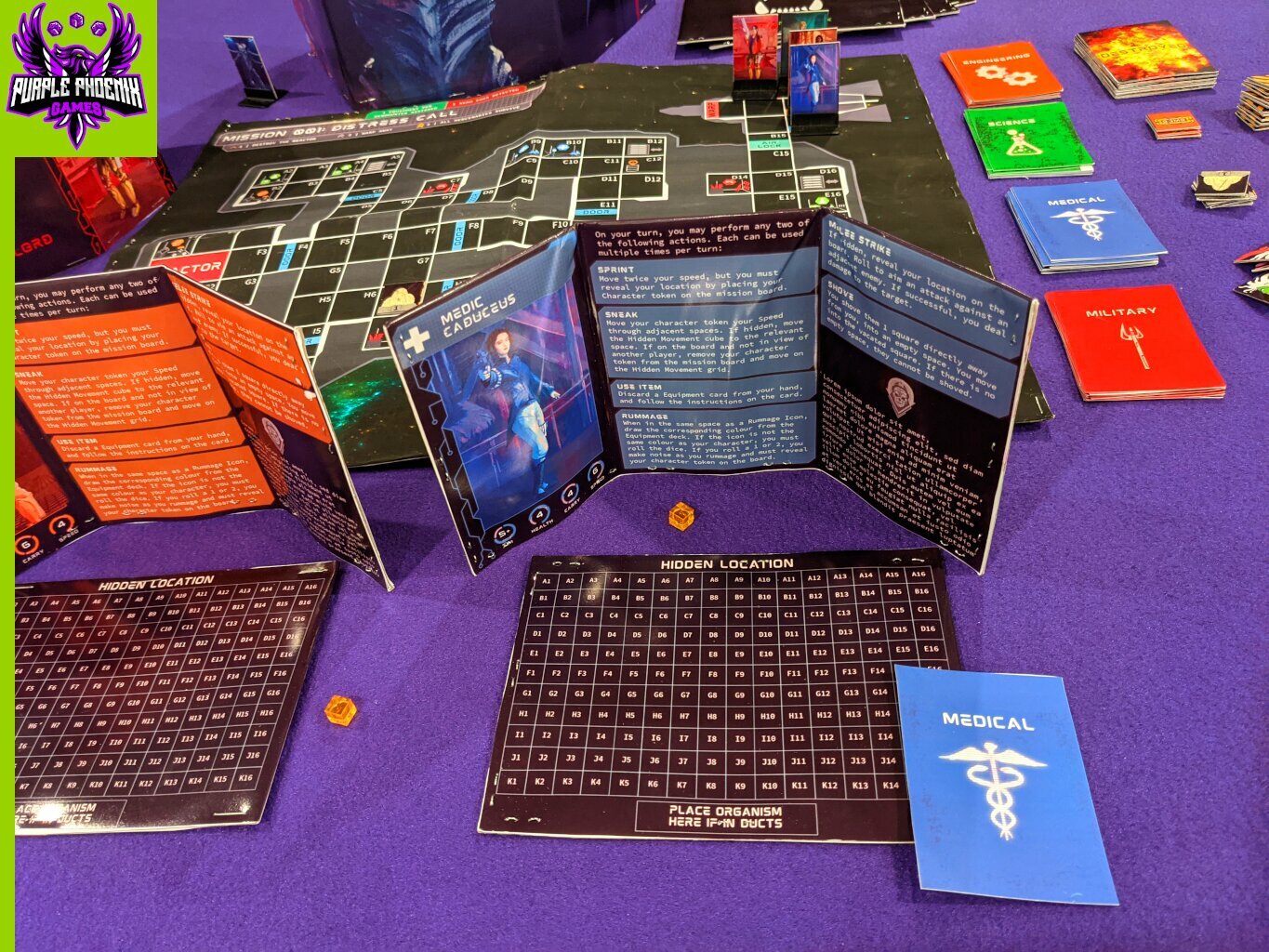
To setup consult the rules until the table looks similar to what is shown below. Beware: this game does take up quite a bit of table real estate to plan accordingly and use “the big table.”
Xenohunters is played in rounds until one side has achieved their win condition, as explained above. The aliens, or “Xenos,” will take their turns first, and then the human squad is able to take theirs. Xenohunters offers a loose turn structure in that each character is allowed two or three actions to take, but the actions and the characters on each side may take turns and actions however they wish in any order they wish. So the Xenos could move Alien 1 (not the name given in the game), then activate something with Alien 2, and then two more actions with Alien 1 before Alien 2 completes their turn. And same goes for the human squad.
Much of the game revolves around movement within the space station, either visible or hidden. Players are able to use abilities, gain special cards, hatch alien eggs, move through the vents, block doorways, and bomb individual rooms on the path to victory. Once a human player is attacked and killed, they immediately switch sides and can be respawned as a Hybrid Spawn that belongs to the Xeno team. The remaining human players are now at a disadvantage toward satisfying their victory condition and have another alien hunting them down.
Play continues in this loose turn fashion until one side can claim victory and the game ends.
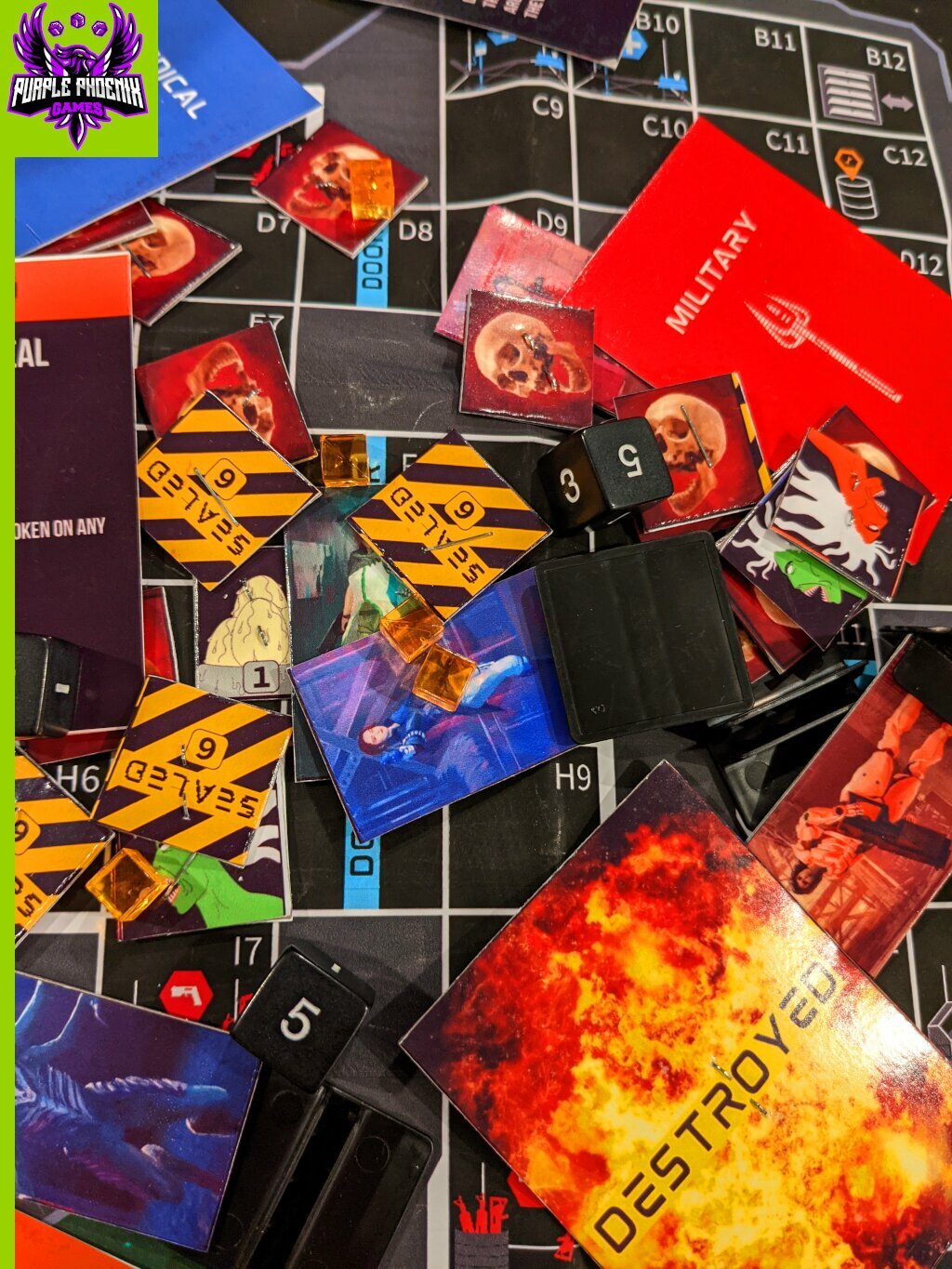
Components. Again, this is a rough prototype printed and assembled in house at Half-Monster Games, so it is possible that many of the components will look very different when finalized. That said, I truly enjoy the art style featured on many components, and though the game tone is very dark and brooding (not typically my style), the majority of component choices are well done and well suited for this style. I wish I could see a finalized version to truly comment on, but from what I was provided I believe the game will look amazing once complete.
Gameplay. This is where I wanted to spend most of my preview. This game reminds me of a cross between Escape from the Aliens in Outer Space, the wildly-popular (right? I don’t play it so I don’t really know) Among Us digital game, and most tabletop RPGs on the market. I make these comps because in the former, all movement is hidden until something bad happens. Here in Xenohunters movement is hybrid hidden and visible, but players should try to remain hidden as much as possible. The first game played did not value hidden movement as much and the Xenos won rather quickly by just barreling through the space station and unleashing hellish damage on the humans. In Among Us only the Impostor can travel through vents (right?) and here in Xenohunters only the aliens are able to use the vents initally; the humans will need a special item card in order to use the vents, and even then it is only one time.
Once a player meets on the same space as another player from the opposing team combat can begin. I comped RPGs as well, and combat in Xenohunters utilizes an Aim value that is like an AC of an opponent in that the die roll will need to meet or exceed the Aim value for the attacker or else no damage is dealt. Each Xeno and human has their own stats for Aim, Health, Carry, and Speed, which are all self-explanatory. Humans can use an action to Rummage at certain map locations in order to gain cards that are beneficial in combat, movement, additional actions, and even the coveted Bomb and Detonator cards. In this fashion I see influences from RPGs in Xenohunters.
So what do I think about the game? Well, I have never been great at hidden movement games, and while this one is not solely reliant on that one mechanic I am still bad at it. This does not at all diminish my enjoyment of the game, and I do quite like it. Xenohunters uses mechanics from other great games and employs them pretty well. Yes, the rules are always being improved, even from this point (I am using Rules v.0.9.6), but once this is complete I feel it will be an excellent game to have in one’s collection. I personally have zero games utilizing hidden movement mechanics, so this will certainly fill a niche in my collection that I have neglected.
I love the theme and premise of the game, and it seems ripe for expansions. I can see many new human characters that can be added, more maps and scenarios, and even more big bads being thrown in to increase the difficulty. I have no idea if these are planned at all, but Xenohunters is laying the groundwork for a bevvy of expansions that can be added. The artwork is great (though not final on all pieces), and I know Half-Monster Games is going to give it special treatment to make it really pop.
I am very much looking forward to monitoring the Kickstarter campaign for this one as I think it is an excellent concept and brings horror to the table without being overly graphic and gory. I will not be playing this with my son any time soon (he is four), but when he is old enough I will definitely be introducing him to Xenohunters. While I am not great at this game, I very much look forward to playing lots more and practicing my strategies so I can one day challenge Jack (the designer) at a convention… whenever those happen again.
In Xenohunters one player will act as the main alien force while the other players will divvy up the four hunter characters to oppose. The alien wins when the human threat is eliminated and the humans win once the alien threat is eliminated or once the space station has been blown up with a bomb and at least one human survivor leaving on the spaceship. Tensions run high and every being is on high alert. So let’s get into this! Pre-disclaimer: as this game has many delicate rules I will be giving a high-level overview of gameplay and more opinion on my plays at the end.
DISCLAIMER: We were provided a prototype copy of this game for the purposes of this review. These are preview copy components, and I do not know for sure if the final components will be any different from these shown. Also, it is not my intention to detail every rule in the game, as there are just too many. You are invited to download the rulebook, back the game through the Kickstarter campaign, or through any retailers stocking it after fulfillment. -T
To setup consult the rules until the table looks similar to what is shown below. Beware: this game does take up quite a bit of table real estate to plan accordingly and use “the big table.”
Xenohunters is played in rounds until one side has achieved their win condition, as explained above. The aliens, or “Xenos,” will take their turns first, and then the human squad is able to take theirs. Xenohunters offers a loose turn structure in that each character is allowed two or three actions to take, but the actions and the characters on each side may take turns and actions however they wish in any order they wish. So the Xenos could move Alien 1 (not the name given in the game), then activate something with Alien 2, and then two more actions with Alien 1 before Alien 2 completes their turn. And same goes for the human squad.
Much of the game revolves around movement within the space station, either visible or hidden. Players are able to use abilities, gain special cards, hatch alien eggs, move through the vents, block doorways, and bomb individual rooms on the path to victory. Once a human player is attacked and killed, they immediately switch sides and can be respawned as a Hybrid Spawn that belongs to the Xeno team. The remaining human players are now at a disadvantage toward satisfying their victory condition and have another alien hunting them down.
Play continues in this loose turn fashion until one side can claim victory and the game ends.
Components. Again, this is a rough prototype printed and assembled in house at Half-Monster Games, so it is possible that many of the components will look very different when finalized. That said, I truly enjoy the art style featured on many components, and though the game tone is very dark and brooding (not typically my style), the majority of component choices are well done and well suited for this style. I wish I could see a finalized version to truly comment on, but from what I was provided I believe the game will look amazing once complete.
Gameplay. This is where I wanted to spend most of my preview. This game reminds me of a cross between Escape from the Aliens in Outer Space, the wildly-popular (right? I don’t play it so I don’t really know) Among Us digital game, and most tabletop RPGs on the market. I make these comps because in the former, all movement is hidden until something bad happens. Here in Xenohunters movement is hybrid hidden and visible, but players should try to remain hidden as much as possible. The first game played did not value hidden movement as much and the Xenos won rather quickly by just barreling through the space station and unleashing hellish damage on the humans. In Among Us only the Impostor can travel through vents (right?) and here in Xenohunters only the aliens are able to use the vents initally; the humans will need a special item card in order to use the vents, and even then it is only one time.
Once a player meets on the same space as another player from the opposing team combat can begin. I comped RPGs as well, and combat in Xenohunters utilizes an Aim value that is like an AC of an opponent in that the die roll will need to meet or exceed the Aim value for the attacker or else no damage is dealt. Each Xeno and human has their own stats for Aim, Health, Carry, and Speed, which are all self-explanatory. Humans can use an action to Rummage at certain map locations in order to gain cards that are beneficial in combat, movement, additional actions, and even the coveted Bomb and Detonator cards. In this fashion I see influences from RPGs in Xenohunters.
So what do I think about the game? Well, I have never been great at hidden movement games, and while this one is not solely reliant on that one mechanic I am still bad at it. This does not at all diminish my enjoyment of the game, and I do quite like it. Xenohunters uses mechanics from other great games and employs them pretty well. Yes, the rules are always being improved, even from this point (I am using Rules v.0.9.6), but once this is complete I feel it will be an excellent game to have in one’s collection. I personally have zero games utilizing hidden movement mechanics, so this will certainly fill a niche in my collection that I have neglected.
I love the theme and premise of the game, and it seems ripe for expansions. I can see many new human characters that can be added, more maps and scenarios, and even more big bads being thrown in to increase the difficulty. I have no idea if these are planned at all, but Xenohunters is laying the groundwork for a bevvy of expansions that can be added. The artwork is great (though not final on all pieces), and I know Half-Monster Games is going to give it special treatment to make it really pop.
I am very much looking forward to monitoring the Kickstarter campaign for this one as I think it is an excellent concept and brings horror to the table without being overly graphic and gory. I will not be playing this with my son any time soon (he is four), but when he is old enough I will definitely be introducing him to Xenohunters. While I am not great at this game, I very much look forward to playing lots more and practicing my strategies so I can one day challenge Jack (the designer) at a convention… whenever those happen again.



BankofMarquis (1832 KP) rated The Irishman (2019) in Movies
Nov 30, 2019

Delivers What Is Expected
Like eating comfort food on a cold, wintery day, sitting down to catch the latest Scorsese/DeNiro mob movie filled me with a warmth that was satisfying for it's familiarity. It is a film landscape mined by professionals who know this genre of movie well.
There is a terrific film in this 3 1/2 hour epic - if only "Marty" would have trimmed the fat to find it.
Telling the real-life story (with some conjecture and fabrications), THE IRISHMAN tells the tale of...well...Irishman Frank Sheeran (Robert DeNiro) a working stiff who rises in the ranks of mobster Russell Buffalino (Joe Pesci) to be one of his chief enforcers and the personal bodyguard to Jimmy Hoffa (Al Paciino).
In the lead, DeNiro commands the screen like the DeNiro of old. His Frank Sheeran is menacing, razor-focused on his objectives. You never question Frank's loyalties and his ability to keep silent. DeNiro shows this by be being silent for a good part of this film, even though he is on screen for most of it. He is a commanding force that requires that we pay attention to him.
It was good to see Pesci back onscreen as Russell Buffalino. His mob boss is pragmatic, making decisions sternly and expecting his people to follow them, no questions asked. His presence on the screen is almost as commanding as DeNiro's and I wouldn't be surprised to see DeNiro (Best Actor) and Pesci (Best Supporting Actor) be in the mix come Oscar time.
In lesser, (almost cameo), roles - but faring very well - is a "who's who" of character actors, Harvey Keitel (who I would have LOVED to have seen much, much more in this film), Ray Romano, Bobby Canavale, Jesse Pleimens and Anna Paquin, I'm sure all jumped at the chance to appear - however briefly - in a Scorsese mob epic.
Faring less well in this film is Al Pacio as Jimmy Hoffa. He is back to his "yelling Al Pacino" ways of films like SCENT OF A WOMAN. His Hoffa is pretty one note and, consequently, his scenes with DeNiro are ineffective mostly because Pacino is chewing up the scenery (and yelling) while DeNiro is sitting silent and staring and listening to Pacino. This was a major disappointment for me, but (fortunately), Hoffa is in only about 1/3 of this long film, so while it hampered my enjoyment of the film, it didn't ruin it.
Credit (and blame) for all of this goes to master Director Martin Scorsese who has mined these waters more successfully in CASINO, THE DEPARTED and GOODFELLAS (his best film, IMO). This film is a loving pastiche to these types of films and a bygone era - and he chose to make it for NETFLIX for he wanted to make a sprawling epic and take his time in telling the story he wanted to tell. This is evidenced in the 3 1/2 hour length of this film, which if filled with long tracking shots set to a backdrop of Italian crooners singing old standards. It's a throwback to a different time and place, one that these players know well.
Scorsese has stated the he only decided to make this film because the "de-aging" software the he used to make DeNiro and Pesci look 30 years younger was "good enough" to use. And I would agree with that statement. The de-aging of these 2 (and others) is "good enough", in some scenes I forgot I was watching a de-aged DeNiro and Pesci, while in some other scenes, I could spot the trick. Again, it was "good enough" and not distracting (unless you were looking to make it distracting, then you probably found what you were looking for).
But for me - a fan of these types of films, I was not disappointed. It was about what I expected it to be. If you were looking for something different and new, look elsewhere, you will be disappointed.
Letter Grade: B+
8 stars (out of 10) and you can take that to the Bank(OfMarquis)
There is a terrific film in this 3 1/2 hour epic - if only "Marty" would have trimmed the fat to find it.
Telling the real-life story (with some conjecture and fabrications), THE IRISHMAN tells the tale of...well...Irishman Frank Sheeran (Robert DeNiro) a working stiff who rises in the ranks of mobster Russell Buffalino (Joe Pesci) to be one of his chief enforcers and the personal bodyguard to Jimmy Hoffa (Al Paciino).
In the lead, DeNiro commands the screen like the DeNiro of old. His Frank Sheeran is menacing, razor-focused on his objectives. You never question Frank's loyalties and his ability to keep silent. DeNiro shows this by be being silent for a good part of this film, even though he is on screen for most of it. He is a commanding force that requires that we pay attention to him.
It was good to see Pesci back onscreen as Russell Buffalino. His mob boss is pragmatic, making decisions sternly and expecting his people to follow them, no questions asked. His presence on the screen is almost as commanding as DeNiro's and I wouldn't be surprised to see DeNiro (Best Actor) and Pesci (Best Supporting Actor) be in the mix come Oscar time.
In lesser, (almost cameo), roles - but faring very well - is a "who's who" of character actors, Harvey Keitel (who I would have LOVED to have seen much, much more in this film), Ray Romano, Bobby Canavale, Jesse Pleimens and Anna Paquin, I'm sure all jumped at the chance to appear - however briefly - in a Scorsese mob epic.
Faring less well in this film is Al Pacio as Jimmy Hoffa. He is back to his "yelling Al Pacino" ways of films like SCENT OF A WOMAN. His Hoffa is pretty one note and, consequently, his scenes with DeNiro are ineffective mostly because Pacino is chewing up the scenery (and yelling) while DeNiro is sitting silent and staring and listening to Pacino. This was a major disappointment for me, but (fortunately), Hoffa is in only about 1/3 of this long film, so while it hampered my enjoyment of the film, it didn't ruin it.
Credit (and blame) for all of this goes to master Director Martin Scorsese who has mined these waters more successfully in CASINO, THE DEPARTED and GOODFELLAS (his best film, IMO). This film is a loving pastiche to these types of films and a bygone era - and he chose to make it for NETFLIX for he wanted to make a sprawling epic and take his time in telling the story he wanted to tell. This is evidenced in the 3 1/2 hour length of this film, which if filled with long tracking shots set to a backdrop of Italian crooners singing old standards. It's a throwback to a different time and place, one that these players know well.
Scorsese has stated the he only decided to make this film because the "de-aging" software the he used to make DeNiro and Pesci look 30 years younger was "good enough" to use. And I would agree with that statement. The de-aging of these 2 (and others) is "good enough", in some scenes I forgot I was watching a de-aged DeNiro and Pesci, while in some other scenes, I could spot the trick. Again, it was "good enough" and not distracting (unless you were looking to make it distracting, then you probably found what you were looking for).
But for me - a fan of these types of films, I was not disappointed. It was about what I expected it to be. If you were looking for something different and new, look elsewhere, you will be disappointed.
Letter Grade: B+
8 stars (out of 10) and you can take that to the Bank(OfMarquis)
Purple Phoenix Games (2266 KP) rated Terror in Meeple City in Tabletop Games
Aug 6, 2019 (Updated Sep 23, 2021)
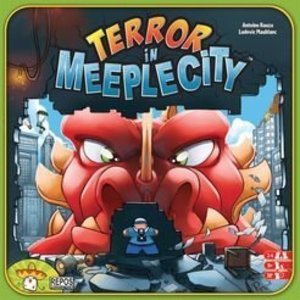

I don’t know about you, but one of my guilty pleasures is monster movies. Godzilla, King Kong, even the Jurassic Park franchise – if there are giant creatures terrorizing the world, chances are I’m going to love it. So when I heard of Terror in Meeple City (formerly known as Rampage, RIP), I knew I had to give it a try. Is the chance to embody one of these great monsters and wreak havoc on an innocent city as exciting as it seems? Or will your lack of dexterous ability result in a rampage? (See what I did there?)
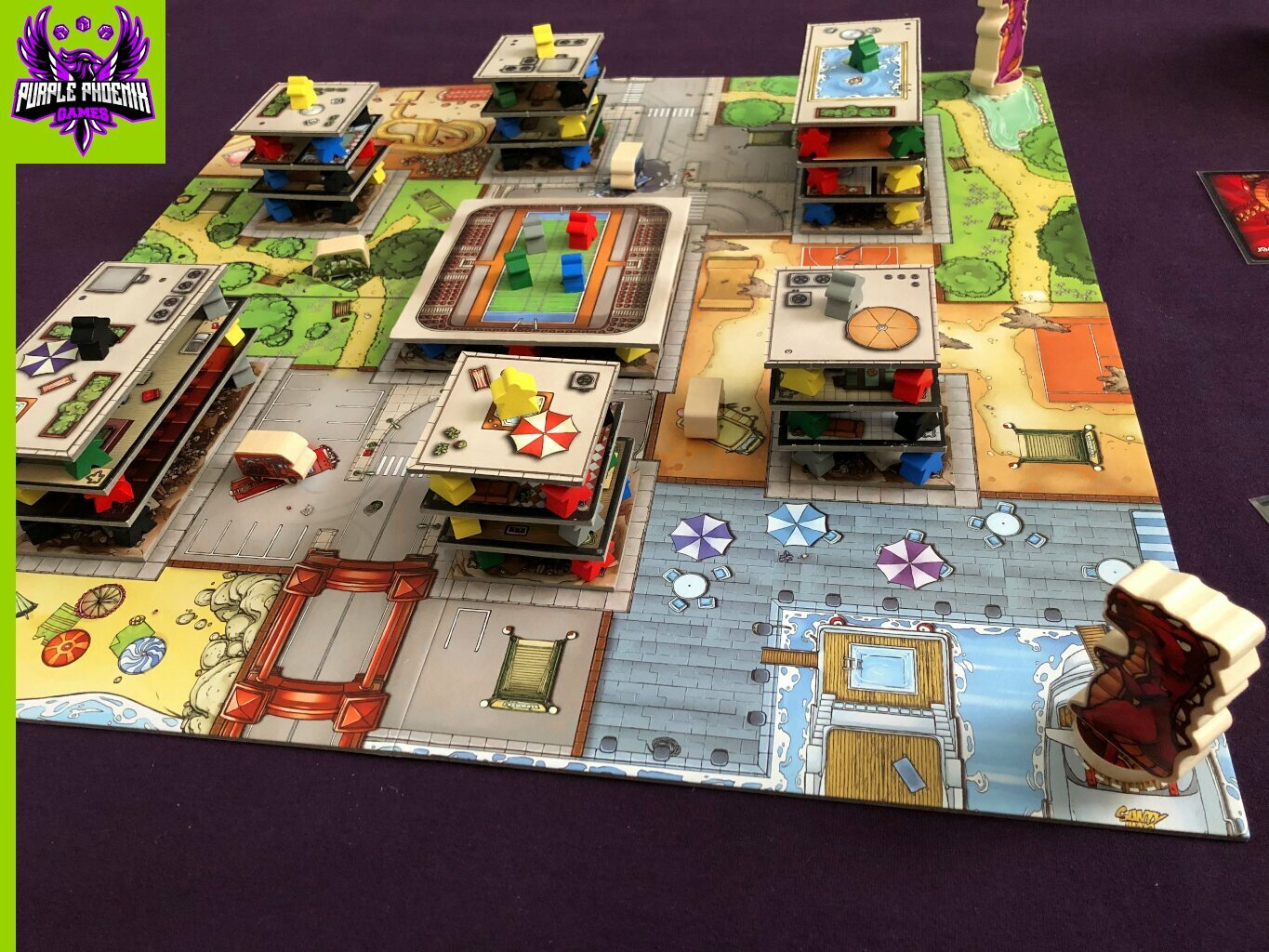
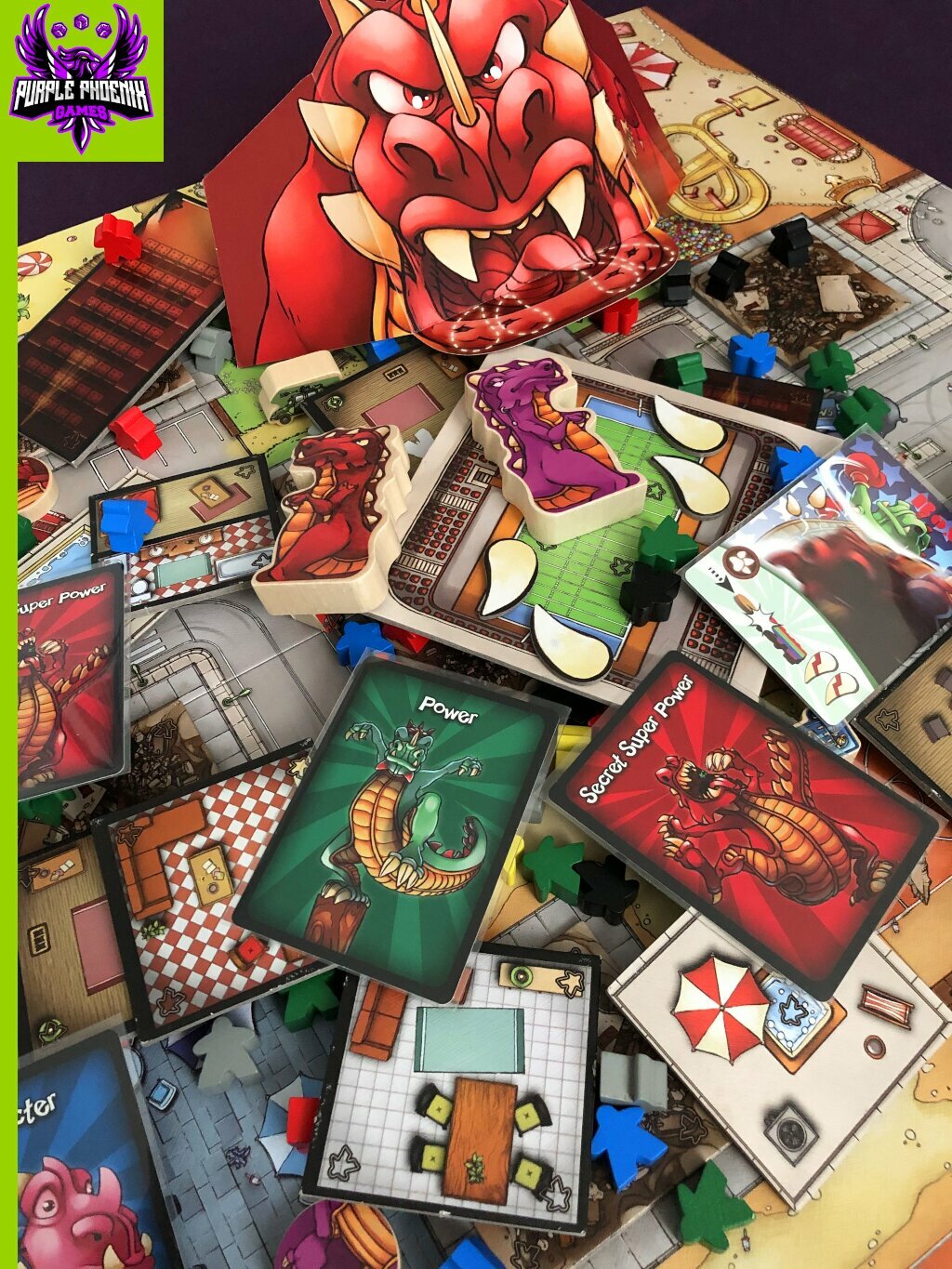
Terror in Meeple City is a dexterity game of area movement and set collection in which players are trying to amass the most end-game Victory Points by devouring meeples, collecting building tiles, teeth, and by successfully completing their Character cards. To begin, setup the board as described in the rulebook, constructing buildings and placing meeples and vehicles accordingly. Each player receives a screen, Body (monster), and Paws (disc) in their chosen color, placing the Paws on the starting area closest to them. Players receive 4 Teeth tokens and are dealt a Character card, Power card, and Secret Superpower card. The Character and Power cards are visible to all players, and are permanent throughout the game – providing special abilities or scoring conditions for the end of the game. The Secret Superpower card is secret (duh) and revealed only when you are ready to use it – it is a one-time use in the game, and then discarded. Select a starting player, and the game is ready to begin!
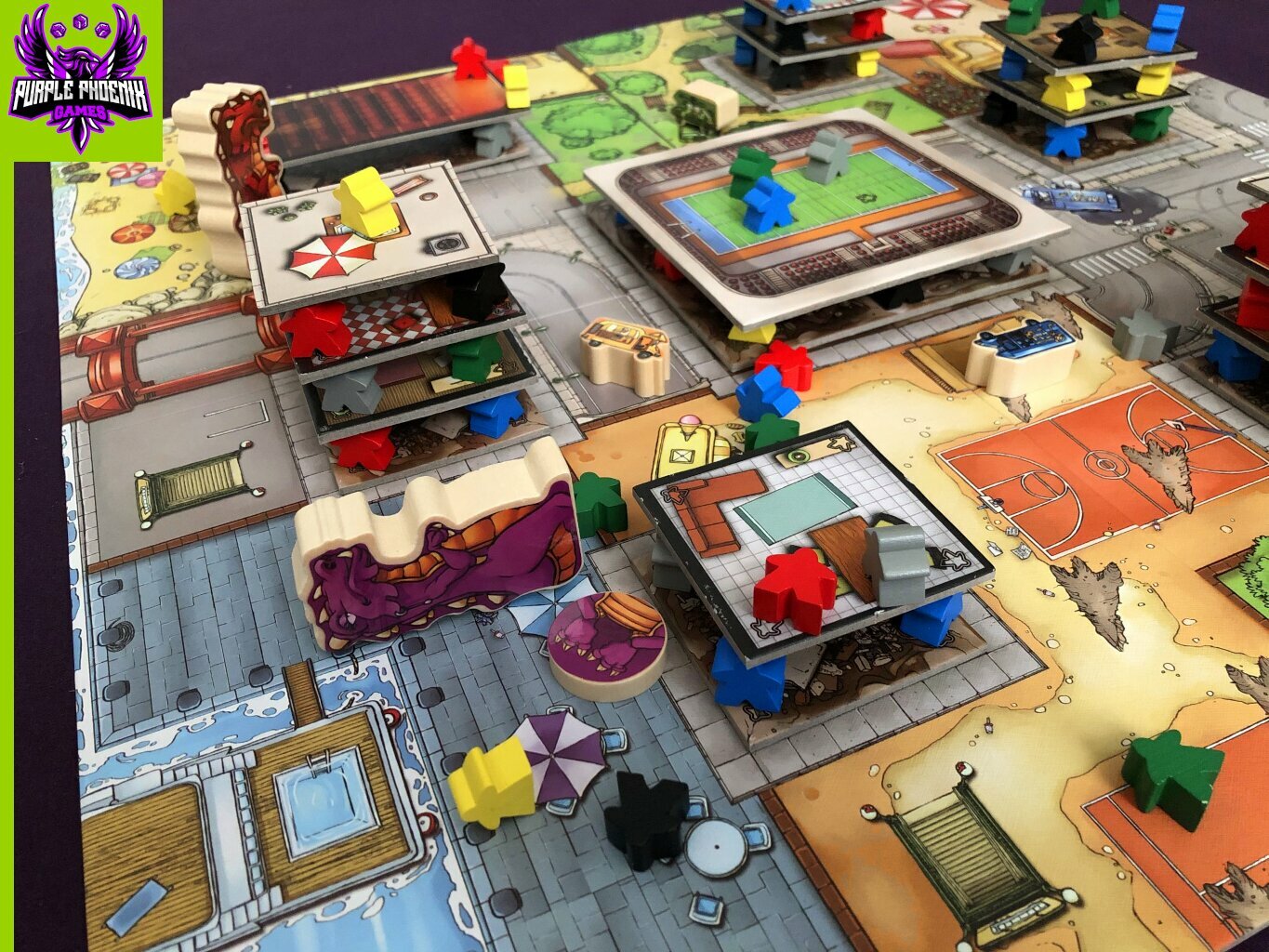
On your turn, you will perform 2 of the following actions: Move, Demolish, Toss a Vehicle, or Breathe. You can perform the same action twice on your turn if you want! To Move, you will first take the Body of your monster off of the Paws disc. Using your finger, you will flick the Paws disc on the board, hopefully to end up where you wanted it! After a successful flick, put your Body back on the Paws. To Demolish, your Paws must be touching the sidewalk surrounding one of the buildings in the city. If that is the case, you can try to demolish that building – by picking up your Body, holding it over the appropriate building, and dropping it! In order to Toss a Vehicle, your monster must be located in the same neighborhood (area of the board) as a vehicle. Pick up the chosen vehicle, place it on top of your monster, and flick it! And finally, you can Breathe – place your chin on top of your monster, inhale, and then blow as hard as you can. While performing these actions, there may be some collateral damage, that could be beneficial or detrimental to you! If you knock down another monster on your turn, collect one of their Teeth and put it behind your screen. If after your action, there is a building tile with nothing on it (meeples, monsters, etc.) then you collect that tile behind your screen as well.
Once you have taken your 2 actions, it is time to Chow Down – eat as many accessible meeples in your same neighborhood as you have Teeth tokens left. Devoured meeples go into your stomach (behind the player screen). If at any point during your turn, any meeples end up fleeing the city (knocked off the board), they will be added, in order, to the Runaway Meeple board. Once a line on this board is filled, the active player suffers the negative consequence – so be careful not to scare off too many yummy meeple morsels! The game continues in this fashion until it ends in one of two ways. Either the last building tile is collected, everyone takes one last turn, and then VP are tallied. Or the final line of the Runaway Meeple board is filled, causing the player who filled it to lose, while everyone else counts up their VP. VP are earned for any Teeth collected, building tiles consumed, sets of meeples devoured, and any points earned from your Character card. The player with the most VP is the winner and is the greatest monster of the game!
So I know that sounds kind of chaotic – and at times it can be. But it is a light-hearted and silly game that engages all involved. The simplicity of the mechanics (flicking/blowing) are countered by the strategy required for success. Yes, by all means, go on a crazy rampage – but the goal is end-game VP, so how can you use all these moving components to your advantage? The strategy is there, with enough luck/randomness from a dexterity stand-point that it keeps the gameplay interesting. And it is just plain fun to play! Getting up to move around the board for a better angle, knocking over opponents accidentally (or on purpose!), and sending components flying across the board makes for an entertaining and engaging game. That being said, unless you are incredibly dextrous and can perfectly execute your desired actions, be prepared for some frustration when you whiff big on a flick.
Let’s talk components for a minute. They are pretty good in this game! The board and cardboard building tiles are all pretty sturdy, which is really necessary in a game where the components can take quite a beating. The wooden meeples and monster parts are thick and high quality as well! I take great pride in keeping my games in good condition, and even this one has withstood the test of time and plays. So, good production quality all around, if you ask me!
Is Terror in Meeple City my favorite game? No. But it’s one that I’m glad to have in my collection. It works well in so many situations – a gateway game, a light-hearted filler game, a game to get everyone up and moving, and a game that can be played with younger gamers as well. Although it’s not really a brain-burner or a game of high-level strategy, it’s one that still makes for a good time. Purple Phoenix Games gives it a 7 / 12. Give it a try if you’re itching to smash some stuff!
Terror in Meeple City is a dexterity game of area movement and set collection in which players are trying to amass the most end-game Victory Points by devouring meeples, collecting building tiles, teeth, and by successfully completing their Character cards. To begin, setup the board as described in the rulebook, constructing buildings and placing meeples and vehicles accordingly. Each player receives a screen, Body (monster), and Paws (disc) in their chosen color, placing the Paws on the starting area closest to them. Players receive 4 Teeth tokens and are dealt a Character card, Power card, and Secret Superpower card. The Character and Power cards are visible to all players, and are permanent throughout the game – providing special abilities or scoring conditions for the end of the game. The Secret Superpower card is secret (duh) and revealed only when you are ready to use it – it is a one-time use in the game, and then discarded. Select a starting player, and the game is ready to begin!
On your turn, you will perform 2 of the following actions: Move, Demolish, Toss a Vehicle, or Breathe. You can perform the same action twice on your turn if you want! To Move, you will first take the Body of your monster off of the Paws disc. Using your finger, you will flick the Paws disc on the board, hopefully to end up where you wanted it! After a successful flick, put your Body back on the Paws. To Demolish, your Paws must be touching the sidewalk surrounding one of the buildings in the city. If that is the case, you can try to demolish that building – by picking up your Body, holding it over the appropriate building, and dropping it! In order to Toss a Vehicle, your monster must be located in the same neighborhood (area of the board) as a vehicle. Pick up the chosen vehicle, place it on top of your monster, and flick it! And finally, you can Breathe – place your chin on top of your monster, inhale, and then blow as hard as you can. While performing these actions, there may be some collateral damage, that could be beneficial or detrimental to you! If you knock down another monster on your turn, collect one of their Teeth and put it behind your screen. If after your action, there is a building tile with nothing on it (meeples, monsters, etc.) then you collect that tile behind your screen as well.
Once you have taken your 2 actions, it is time to Chow Down – eat as many accessible meeples in your same neighborhood as you have Teeth tokens left. Devoured meeples go into your stomach (behind the player screen). If at any point during your turn, any meeples end up fleeing the city (knocked off the board), they will be added, in order, to the Runaway Meeple board. Once a line on this board is filled, the active player suffers the negative consequence – so be careful not to scare off too many yummy meeple morsels! The game continues in this fashion until it ends in one of two ways. Either the last building tile is collected, everyone takes one last turn, and then VP are tallied. Or the final line of the Runaway Meeple board is filled, causing the player who filled it to lose, while everyone else counts up their VP. VP are earned for any Teeth collected, building tiles consumed, sets of meeples devoured, and any points earned from your Character card. The player with the most VP is the winner and is the greatest monster of the game!
So I know that sounds kind of chaotic – and at times it can be. But it is a light-hearted and silly game that engages all involved. The simplicity of the mechanics (flicking/blowing) are countered by the strategy required for success. Yes, by all means, go on a crazy rampage – but the goal is end-game VP, so how can you use all these moving components to your advantage? The strategy is there, with enough luck/randomness from a dexterity stand-point that it keeps the gameplay interesting. And it is just plain fun to play! Getting up to move around the board for a better angle, knocking over opponents accidentally (or on purpose!), and sending components flying across the board makes for an entertaining and engaging game. That being said, unless you are incredibly dextrous and can perfectly execute your desired actions, be prepared for some frustration when you whiff big on a flick.
Let’s talk components for a minute. They are pretty good in this game! The board and cardboard building tiles are all pretty sturdy, which is really necessary in a game where the components can take quite a beating. The wooden meeples and monster parts are thick and high quality as well! I take great pride in keeping my games in good condition, and even this one has withstood the test of time and plays. So, good production quality all around, if you ask me!
Is Terror in Meeple City my favorite game? No. But it’s one that I’m glad to have in my collection. It works well in so many situations – a gateway game, a light-hearted filler game, a game to get everyone up and moving, and a game that can be played with younger gamers as well. Although it’s not really a brain-burner or a game of high-level strategy, it’s one that still makes for a good time. Purple Phoenix Games gives it a 7 / 12. Give it a try if you’re itching to smash some stuff!


BadgerMuffin (48 KP) rated Dungeon in a Box! in Tabletop Games
Jun 2, 2019



Good Value (1 more)
Bonus Gifts
It Does What It Says On The Box.
Dungeon in a Box! Is a monthly subscription based service which works as an add-on to DnD. This service is fantastic and I cannot compliment it enough.
Firstly, each month you get a new game which follows an ongoing storyline. (However they can all be run as single games).
In the Box:
-A DM's manual
-2 X Reaper/Bones Mini's
-1 X Map (Double sided)
- Multiple Acrylic Mini's
-Dungeon tiles
So starting with the DM's Manual. Most boxes come with a 20-30 page book. This book is hugely detailed and contains the full story for the month in intense detail. Many tables (which I for one will be using in other games), Different encounter sheets, and full stats and descriptions of the Main NPC's.
The Reaper/Bones minis provided in the box do not correlate to the game in the box. However they are a nice touch, as it allows you to improve your Mini collection, and gives you Minis most players will not already own.
The map is printed on high quality ~120gsm paper. This map is highly detailed and the print quality is incredible. (In the first box you also receive a map of the world). The map is 24"x18" in size, so a decent battlefield. These have great reusability, the only downside is that you cannot use dry erase markers on them. (However this is a small issue in comparison).
You get a sheet of minis that can be flat packed very quickly. The print quality on them is great and as they can be dismantled, they require very little space for storage. My only downside of these is they are not the strongest, so when fitting the bases you need to push them down while using a table to avoid them snapping. (However if like me you did that and they still snap, they will send you replacement minis free of charge. GREAT CUSTOMER SERVICE!!)
Finally the dungeon tiles. These are again very highly printed and are printed on a ~800gsm cardboard. Sturdy and robust these tiles are all double sided and scaled to the inch so you can reuse them for many games.
TL;DR
-Good Quality
-Good Value
-Reusable Supplies
-Great Customer Service
Firstly, each month you get a new game which follows an ongoing storyline. (However they can all be run as single games).
In the Box:
-A DM's manual
-2 X Reaper/Bones Mini's
-1 X Map (Double sided)
- Multiple Acrylic Mini's
-Dungeon tiles
So starting with the DM's Manual. Most boxes come with a 20-30 page book. This book is hugely detailed and contains the full story for the month in intense detail. Many tables (which I for one will be using in other games), Different encounter sheets, and full stats and descriptions of the Main NPC's.
The Reaper/Bones minis provided in the box do not correlate to the game in the box. However they are a nice touch, as it allows you to improve your Mini collection, and gives you Minis most players will not already own.
The map is printed on high quality ~120gsm paper. This map is highly detailed and the print quality is incredible. (In the first box you also receive a map of the world). The map is 24"x18" in size, so a decent battlefield. These have great reusability, the only downside is that you cannot use dry erase markers on them. (However this is a small issue in comparison).
You get a sheet of minis that can be flat packed very quickly. The print quality on them is great and as they can be dismantled, they require very little space for storage. My only downside of these is they are not the strongest, so when fitting the bases you need to push them down while using a table to avoid them snapping. (However if like me you did that and they still snap, they will send you replacement minis free of charge. GREAT CUSTOMER SERVICE!!)
Finally the dungeon tiles. These are again very highly printed and are printed on a ~800gsm cardboard. Sturdy and robust these tiles are all double sided and scaled to the inch so you can reuse them for many games.
TL;DR
-Good Quality
-Good Value
-Reusable Supplies
-Great Customer Service
Purple Phoenix Games (2266 KP) rated Rumpelstiltskin in Tabletop Games
Jun 12, 2019

You know the story: the imp (gnome?) that tricked that one lady into promising him her firstborn child in return for spinning hair into gold? You remember? And then she can get her child back if she can guess his true name? Well this game has nothing to do with most of the story. But, it does center around the name guessing part, so there IS a tie back to the original fable. Guessing names is what it’s all about. But do we like it?
During a game of Rumpelstiltskin the players will be attempting to guess the true name of their opponent. The first one to guess correctly will receive a victory cube. The first player to win three of the five victory cubes is the winner! Each player begins the game with the exact same deck of cards to be shuffled. Place the deck face down in front of you, secretly peek at the card on the bottom of the deck and that is your true name to be guessed. On your turn you will play a card and hopefully be able to guess your opponent’s name. Some cards let you guess when played and some cards let you switch up the cards in your deck or your opponent’s. That’s the game.
Components. So it’s like 20 cards and 5 wooden cubes in a small box. The components are all great, as AEG usually has great components. Nothing super amazing (but that art is pretty pretty pretty good).
Ok so here’s the rub. It’s a game that’s just more of an activity than a game. I see what it’s trying to do, but it’s just not much fun. You can win the game with one card. Or it can drag on for like 3 or even 7 cards… It’s just not any fun for me. I only gave it a 2 rating because the art is great and I chuckle when I hear some people try to pronounce the names on the cards. Other than that I don’t think I will want to play this any more. Let me know if you want to take it off my hands.
Purple Phoenix Games gives this one a woeful 5 / 12.
https://purplephoenixgames.wordpress.com/2019/05/02/rumpelstiltskin-review/
During a game of Rumpelstiltskin the players will be attempting to guess the true name of their opponent. The first one to guess correctly will receive a victory cube. The first player to win three of the five victory cubes is the winner! Each player begins the game with the exact same deck of cards to be shuffled. Place the deck face down in front of you, secretly peek at the card on the bottom of the deck and that is your true name to be guessed. On your turn you will play a card and hopefully be able to guess your opponent’s name. Some cards let you guess when played and some cards let you switch up the cards in your deck or your opponent’s. That’s the game.
Components. So it’s like 20 cards and 5 wooden cubes in a small box. The components are all great, as AEG usually has great components. Nothing super amazing (but that art is pretty pretty pretty good).
Ok so here’s the rub. It’s a game that’s just more of an activity than a game. I see what it’s trying to do, but it’s just not much fun. You can win the game with one card. Or it can drag on for like 3 or even 7 cards… It’s just not any fun for me. I only gave it a 2 rating because the art is great and I chuckle when I hear some people try to pronounce the names on the cards. Other than that I don’t think I will want to play this any more. Let me know if you want to take it off my hands.
Purple Phoenix Games gives this one a woeful 5 / 12.
https://purplephoenixgames.wordpress.com/2019/05/02/rumpelstiltskin-review/

Combo Crew
Games and Entertainment
App
In a world where a fist to the face is a perfectly viable solution, Mr. Boss has it all. Now he...

Virtual Villagers 2: The Lost Children for iPad
Games and Entertainment
App
Villagers: The Lost Children is the second chapter in the award-winning Virtual Villagers series...

RGB Express - Mini Truck Puzzle
Games
App
RGB Express is a unique and beautiful puzzle game. Simple to play, yet super addictive! Fun and...