Search
Search results
Purple Phoenix Games (2266 KP) rated Colosseum in Tabletop Games
Aug 16, 2021
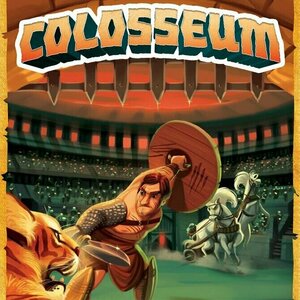
Ancient Romans, lend me your d20s! Okay, that was never a saying, but it could have been. For our review today we are checking out Colosseum (the newest TMG edition), and as I have zero experience as an arena manager, or a Gladiator, or even a professional Comedian, this is the closest I will get to any of those professions. Colosseum is regarded as one of Wolfgang Kramer’s (and Marcus Lubke) best games ever. But how did we fare with it?
In Colosseum players are Impresarios (basically an arena manager – I had to look it up) attempting to program the greatest shows of the age in their own arenas. The game will last for five rounds and the winner will be the player who put on the greatest show and attracted the highest amount of attendees.
To setup follow the directions in the rulebook. In fact, I have a disclaimer: I will certainly NOT be explaining all the rules here nor each component’s purpose. There are simply too many of each to cover. I will try to give the feeling of the game and how it flows.
The game lasts five rounds and each round consists of five different phases. The first phase is Investing. It is during this phase where players will be able to purchase Event Programs to be put on in a later phase, or expanding their personal arena, or purchasing upgrades that give different bonuses throughout the game.
The next phase is Acquiring Event Asset Tokens. These tokens are needed to successfully pull off an Event Program. They consist of cardboard chits representing lions, gladiators, gates, decorations, etc. Players will be bidding for an offering of three of these resources around the table until each player has had a chance to be the auctioneer.
After players have gathered their resource tokens they may Trade Event Asset Tokens. This is pretty self-explanatory, but trades may only happen between the current active player and other players, even though each player will have a chance to be the active player involved in trades.
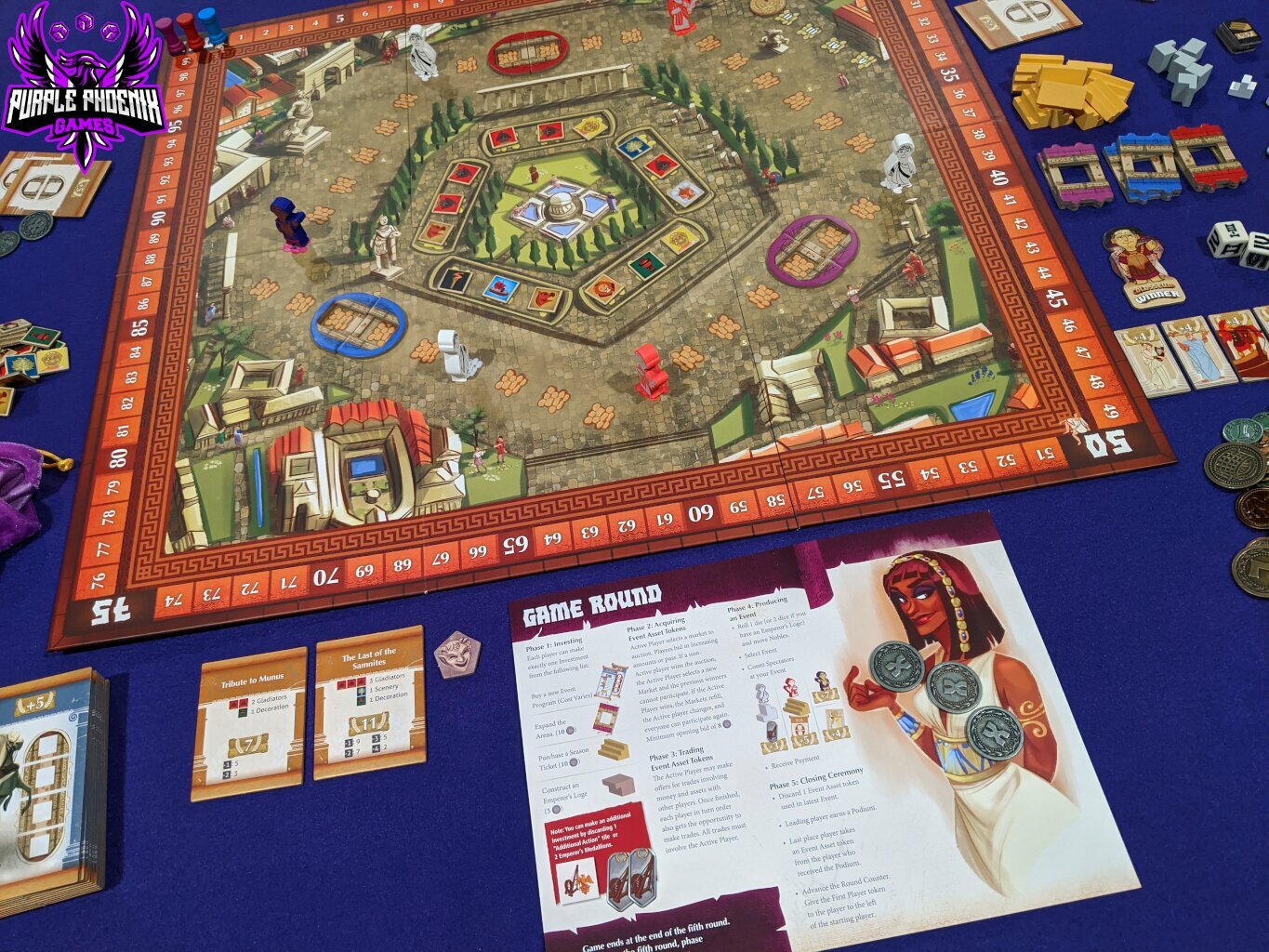
The fourth phase is Producing an Event and really is the crux of the game. This is when players will be rolling dice to move the nobleeples around the board to land them on the player’s arena and score bonus VP, and using their collected Event Asset Tokens from the previous phases, or even previous rounds, to assign to the program for maximum VP. However, programs may still be put on without the necessary tokens needed, but at a severe cut in VP scored. So there is a balance of using all tokens versus using only some of what is required.
Finally, players will participate in the Closing Ceremonies when players will be awarded podiums for placing in the lead position for attendees earned, and performing round cleanup duties. This phase is not played on the final round of the game.
Of course this is extremely pared down, but explains the overall flow of the game. Play continues over five rounds, but here’s the kicker – to determine the winner of the game players will not be totaling their scores after every round, but rather only increasing their placement on the score track according to their most-attended program. So if Randall scored 10, 17, 33, 45, and 44 over five rounds, his ending score would be 45 VP as his most-attended round was 45 spectators.
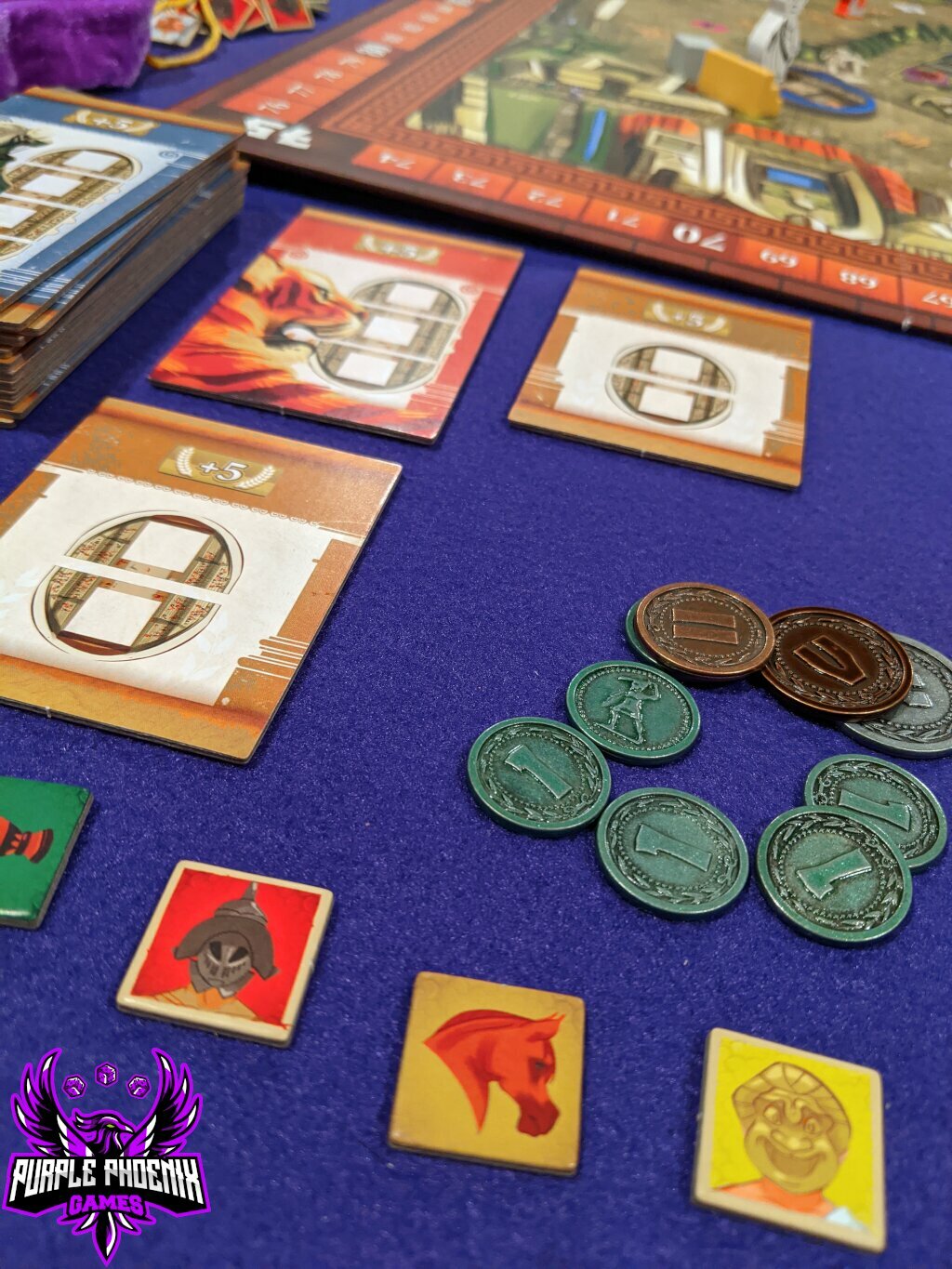
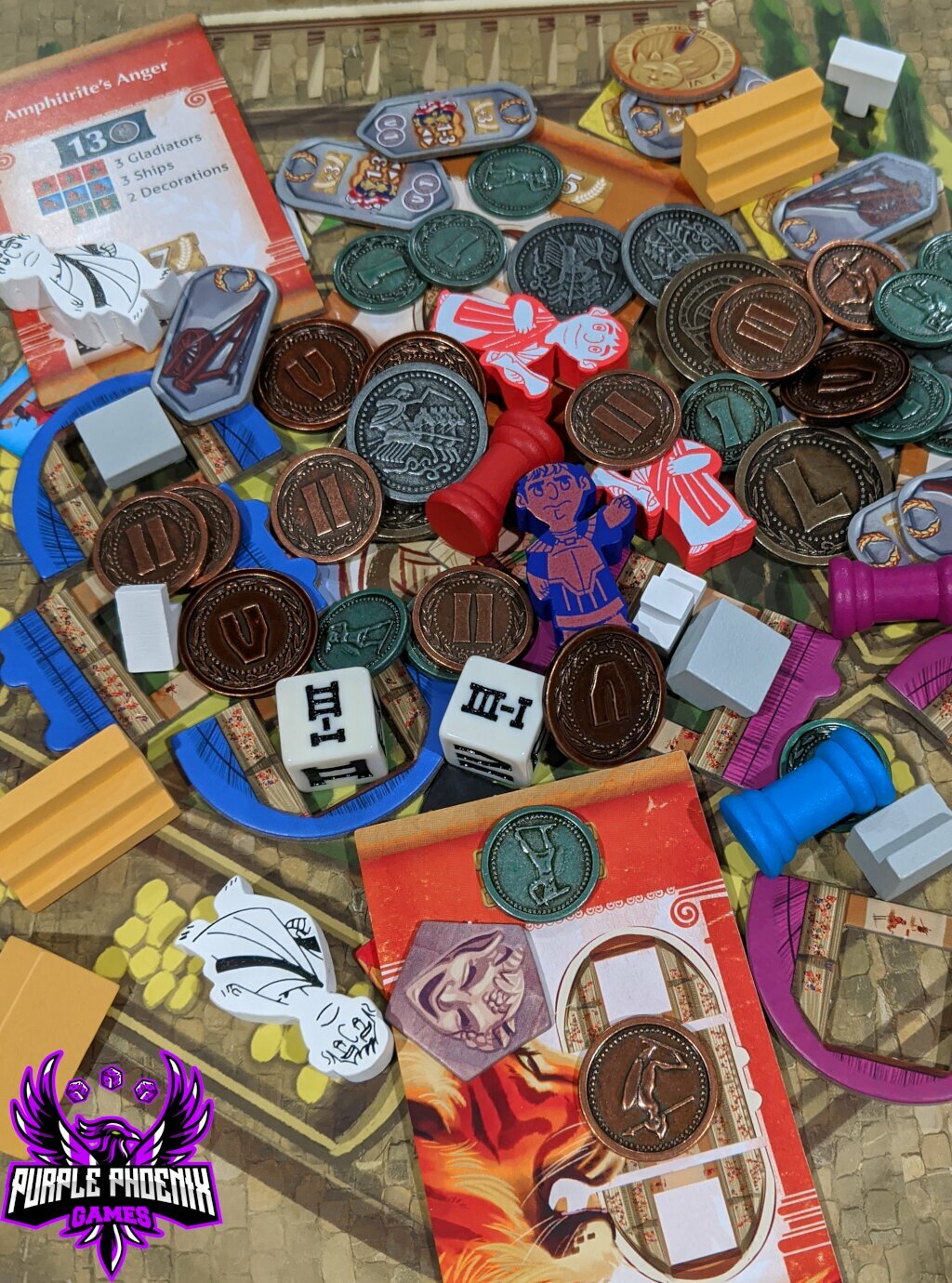
Components. Colosseum has amazing components. Tasty Minstrel Games really went all out on this remaster. The art is updated from the original version and is much better-looking. The components seem very deluxe – I mean the coins alone are very impressive, as they are heavy metal embossed coins. The wooden components are all great (except the Emperor’s Loge which looks like it could be a throne but in the rulebook they show it being an upside-down throne). Even the little nobleeples are nice looking and fun to move around the board. I am quite impressed by the components presented in this box. Fair warning – it is tough to get all those components back in the box without planning it out first.
A little backstory with this game and me. My first experience in a hobby game store had the owner approaching me and suggesting three games for my first purchase and induction into the board game collector’s club: Dominion (snooze), Colosseum (would have been WAY too much game for us at the time), and Munchkin (which I happily bought right away). That said, I do not think this is appropriate at all to be used as a gateway game ever. There’s a lot going on, a lot of rules that can be forgotten, or just straight up misunderstanding of rules minutia. So while I am glad I passed on it in 2012 when I started my journey, I am also glad I was able to grab a copy of the new version and give it a shot.
I enjoyed my plays of Colosseum quite a bit. I employed several different strategies going into each game and now have a good idea of how I would like to play going forward. Many things are left to chance in the game, and that may appeal to a certain crowd. For me, I do not at all mind a little chance or luck in my games so it is welcome to stay in my collection. I never actually played the original edition so I cannot compare very well, but I am impressed by this title and it will certainly be seeing more table time. It is also the only game I own by Kramer, and that makes me a little sad. I need to check out more from him for sure.
If you are looking for something a little heavier than what we typically review, enjoy an Ancient Roman theme, and you want to feel a little proud of your own wits when winning board games, check out Colosseum. Purple Phoenix Games gives it a lion-hearted 8 / 12. I hope my 4-year-old will want to play it in 10 years…
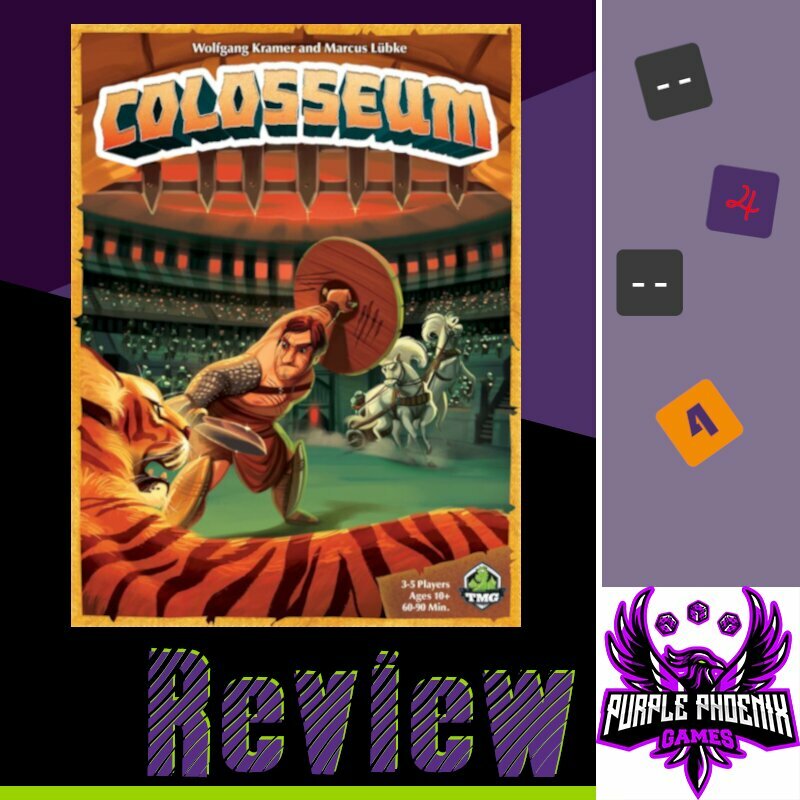
In Colosseum players are Impresarios (basically an arena manager – I had to look it up) attempting to program the greatest shows of the age in their own arenas. The game will last for five rounds and the winner will be the player who put on the greatest show and attracted the highest amount of attendees.
To setup follow the directions in the rulebook. In fact, I have a disclaimer: I will certainly NOT be explaining all the rules here nor each component’s purpose. There are simply too many of each to cover. I will try to give the feeling of the game and how it flows.
The game lasts five rounds and each round consists of five different phases. The first phase is Investing. It is during this phase where players will be able to purchase Event Programs to be put on in a later phase, or expanding their personal arena, or purchasing upgrades that give different bonuses throughout the game.
The next phase is Acquiring Event Asset Tokens. These tokens are needed to successfully pull off an Event Program. They consist of cardboard chits representing lions, gladiators, gates, decorations, etc. Players will be bidding for an offering of three of these resources around the table until each player has had a chance to be the auctioneer.
After players have gathered their resource tokens they may Trade Event Asset Tokens. This is pretty self-explanatory, but trades may only happen between the current active player and other players, even though each player will have a chance to be the active player involved in trades.
The fourth phase is Producing an Event and really is the crux of the game. This is when players will be rolling dice to move the nobleeples around the board to land them on the player’s arena and score bonus VP, and using their collected Event Asset Tokens from the previous phases, or even previous rounds, to assign to the program for maximum VP. However, programs may still be put on without the necessary tokens needed, but at a severe cut in VP scored. So there is a balance of using all tokens versus using only some of what is required.
Finally, players will participate in the Closing Ceremonies when players will be awarded podiums for placing in the lead position for attendees earned, and performing round cleanup duties. This phase is not played on the final round of the game.
Of course this is extremely pared down, but explains the overall flow of the game. Play continues over five rounds, but here’s the kicker – to determine the winner of the game players will not be totaling their scores after every round, but rather only increasing their placement on the score track according to their most-attended program. So if Randall scored 10, 17, 33, 45, and 44 over five rounds, his ending score would be 45 VP as his most-attended round was 45 spectators.
Components. Colosseum has amazing components. Tasty Minstrel Games really went all out on this remaster. The art is updated from the original version and is much better-looking. The components seem very deluxe – I mean the coins alone are very impressive, as they are heavy metal embossed coins. The wooden components are all great (except the Emperor’s Loge which looks like it could be a throne but in the rulebook they show it being an upside-down throne). Even the little nobleeples are nice looking and fun to move around the board. I am quite impressed by the components presented in this box. Fair warning – it is tough to get all those components back in the box without planning it out first.
A little backstory with this game and me. My first experience in a hobby game store had the owner approaching me and suggesting three games for my first purchase and induction into the board game collector’s club: Dominion (snooze), Colosseum (would have been WAY too much game for us at the time), and Munchkin (which I happily bought right away). That said, I do not think this is appropriate at all to be used as a gateway game ever. There’s a lot going on, a lot of rules that can be forgotten, or just straight up misunderstanding of rules minutia. So while I am glad I passed on it in 2012 when I started my journey, I am also glad I was able to grab a copy of the new version and give it a shot.
I enjoyed my plays of Colosseum quite a bit. I employed several different strategies going into each game and now have a good idea of how I would like to play going forward. Many things are left to chance in the game, and that may appeal to a certain crowd. For me, I do not at all mind a little chance or luck in my games so it is welcome to stay in my collection. I never actually played the original edition so I cannot compare very well, but I am impressed by this title and it will certainly be seeing more table time. It is also the only game I own by Kramer, and that makes me a little sad. I need to check out more from him for sure.
If you are looking for something a little heavier than what we typically review, enjoy an Ancient Roman theme, and you want to feel a little proud of your own wits when winning board games, check out Colosseum. Purple Phoenix Games gives it a lion-hearted 8 / 12. I hope my 4-year-old will want to play it in 10 years…
Purple Phoenix Games (2266 KP) rated Go Extinct!: Stardust Catches the Carnivores in Tabletop Games
Mar 26, 2020
“Yo, uhh, got any sevens?” “Naw, go fish.” “Dag, yo.” “Hmm, got any Queens?” “Nope, go fish.” “*&%#@!!” While this may be many of us during the social distancing or self-isolation using meager playing cards, there is now another option – Go Extinct!: Stardust Catches the Carnivores. The title is long, but the playtime isn’t, and the Go Fish is there, but it is masked by an educational skin. Does this one make a case for our collection?
In Go Extinct!: Stardust Catches the Carnivores (which I will shorten to Go Extinct from here on out) players are attempting to score the most points at the end of the game by collecting runs(?) of animals within the same biological family, called “clades.” More points are gained by collecting families with more members, and the game has a known end timeline – when the players’ cards run out.
DISCLAIMER: We were provided a prototype copy of this game for the purposes of this review. These are preview copy components, and I do not know for sure if the final components will be any different from these shown. Also, it is not my intention to detail every rule in the game, but to give a feel for how the game generally plays. You are invited to back the game through the Kickstarter campaign running until April 16, 2020, purchase from your FLGS upon release, or through any retailers stocking it after fulfillment. -T
To setup, place the large board on the table for all to see. Follow the setup rules per player count listed in the rule book (because it’s different for three players and for 4+). Shuffle the cards and deal each player six cards. The rest of the deck becomes the central draw deck. You are now ready to begin!
A game of Go Extinct is played over several rounds where players are trying to collect and play complete clades of animals. Only clades played to the players’ personal score piles can be scored at the end of the game, and once in the score pile, can no longer be stolen (asked for) by other players – just like in Go Fish.
Go Extinct becomes a bit more distinct when asking for cards. A player can ask a specific player for a specific animal (Wolverine, Polar Bear, etc) or can ask for cards within the same family (a cub of Delicate Dog or Ancestor of Ursidae). If a player is given a specific animal species, the asking player may take another turn to ask for more animals or clade members. If the ask is unsuccessful, the asked player announces, “Go Extinct” to indicate that the asking player must hunt for animals elsewhere, namely, the draw pile. Redraw at the end of a turn to a hand size of six and the game continues with the next player.
Again, the game ends once all the cards are played, but when the draw deck runs out, a new rule enters play. When asked for a clade, the asked player must give up to three of their cards, if they have that many of that clade. Once a player runs out of cards in their hand, they are finished, and the game ends when every player is out of cards. Tally up the points per clade size, and determine who is the best at collecting animal clades!
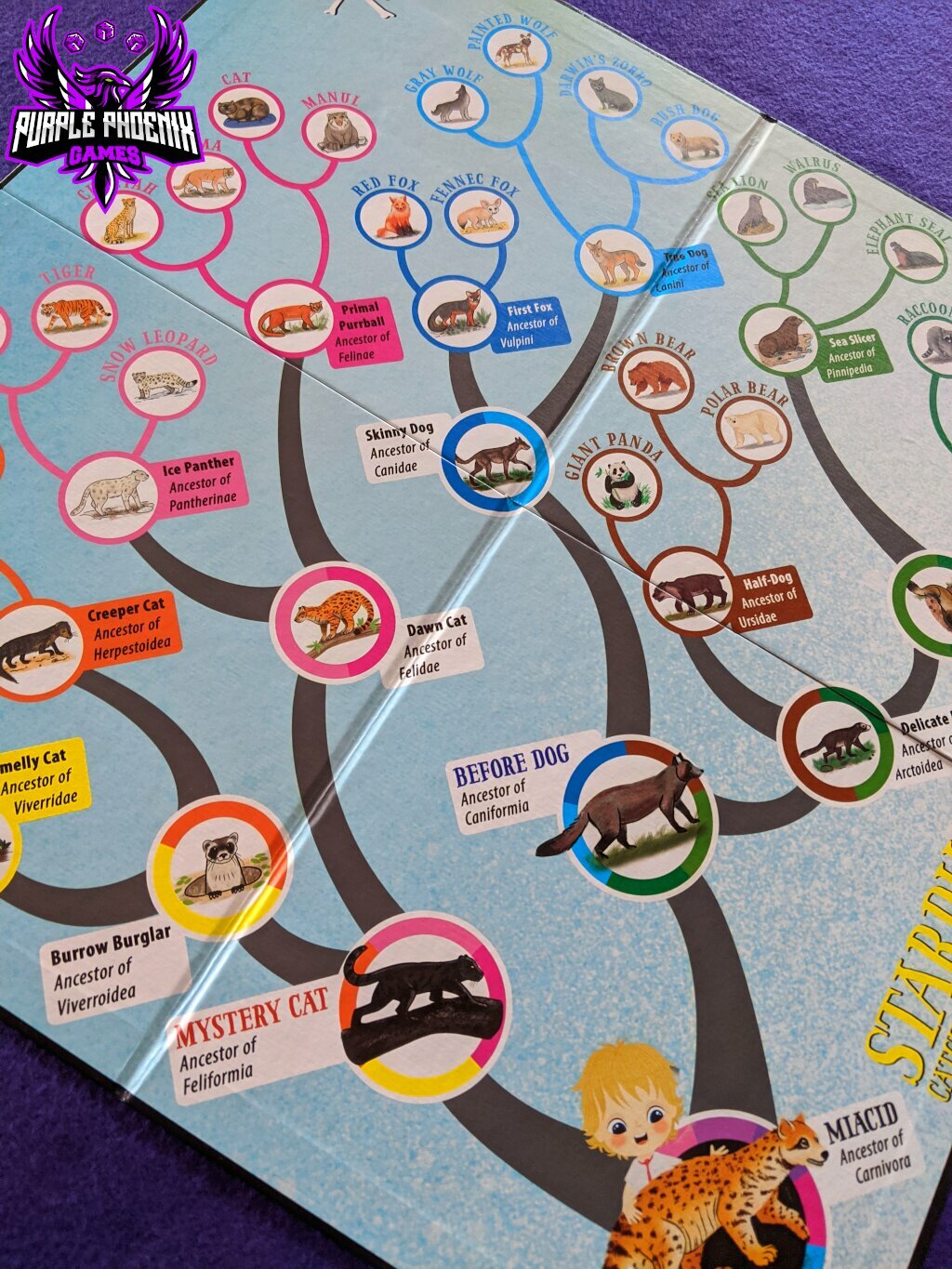
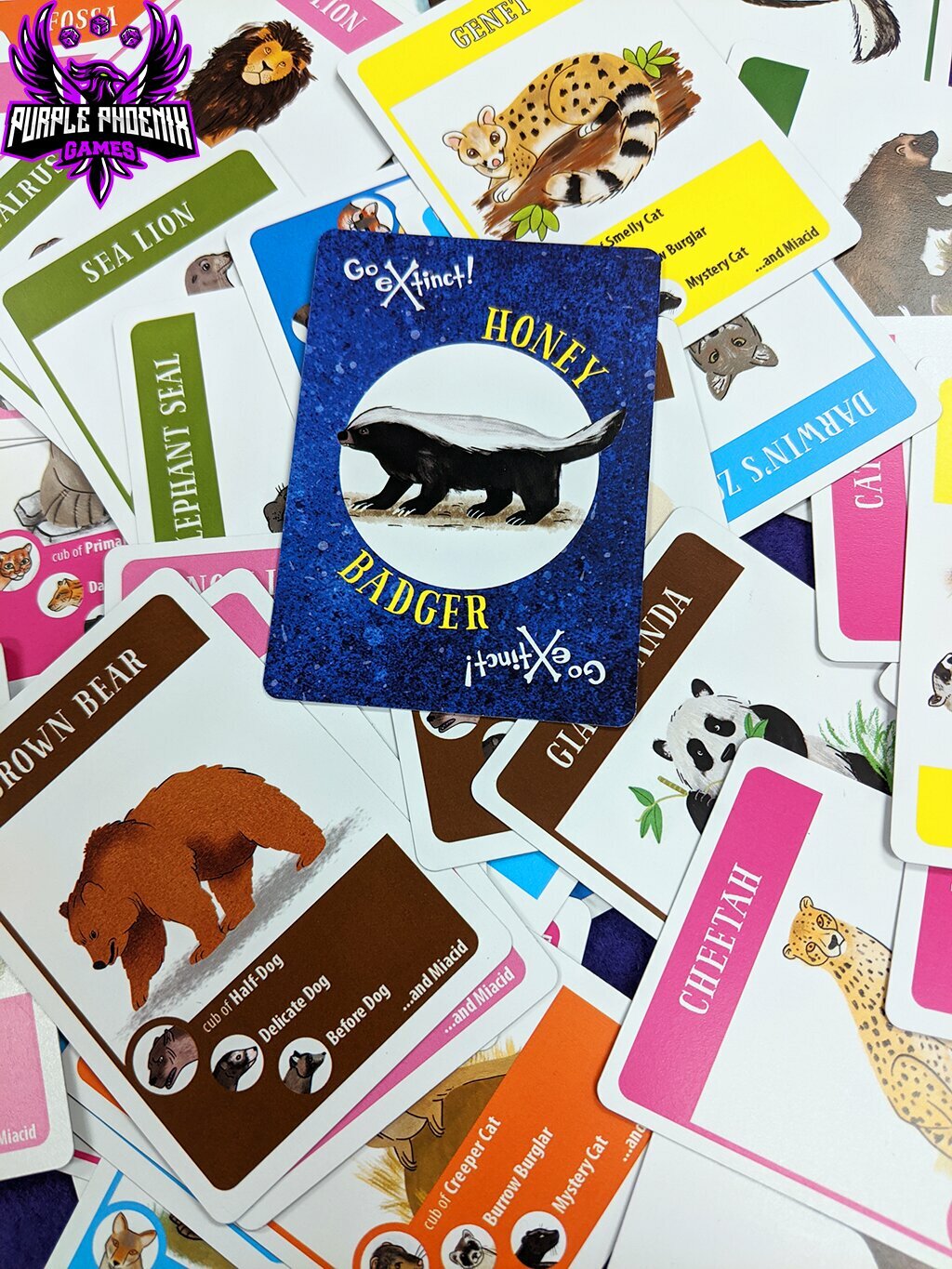
Components. Again, we were provided a prototype copy of this game, which is on Kickstarter now, so the components may be different from what will be produced via a successful KS campaign. That said, the components we received are great! The cards are good quality with excellent card art depicting extinct and current animals. The graphic layout is good, and once you can read the cards, the board is no longer really necessary for play. That board. It is absolutely beautiful, though not overly ornate, and is also completely unnecessary for play. We did enjoy having it on the table while we played, but players never actually interact with it or use for anything other than reference. It is a nice touch, though.
Being a family man, myself, and having young children, this will be great for when my kids learn to read. Learning the names of ancestral animals and scientific nomenclature of current animals is something I cannot wait to teach my kids. I really see no reason for me to ever teach them Go Fish while I have Go Extinct in my collection, and I do believe I will keep it there for a long time. If you enjoy light games with a heavy dose of education and direct player interaction without conflict, then Go Extinct is for you. It may be too light for hardcore gamers, but those gamers are not the intended audience. If you are looking for games to bond with your kids over, then you simply must check out Go Extinct. Or if you just want to learn a little something yourself, go ahead and pick up a copy or three. I recommend it. Visit the Kickstarter campaign here and tell them Purple Phoenix Games sent you!
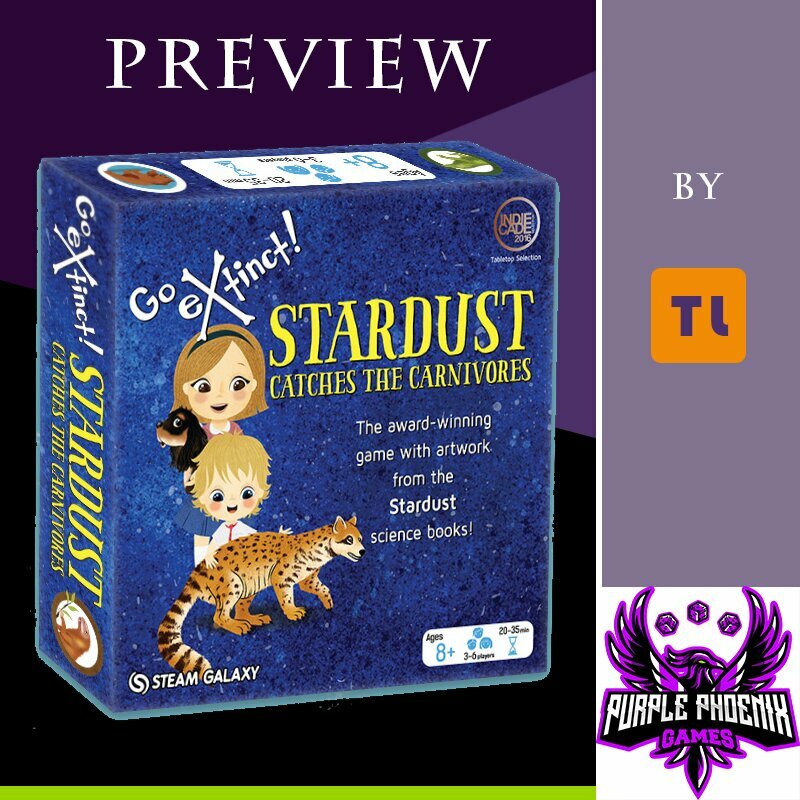
In Go Extinct!: Stardust Catches the Carnivores (which I will shorten to Go Extinct from here on out) players are attempting to score the most points at the end of the game by collecting runs(?) of animals within the same biological family, called “clades.” More points are gained by collecting families with more members, and the game has a known end timeline – when the players’ cards run out.
DISCLAIMER: We were provided a prototype copy of this game for the purposes of this review. These are preview copy components, and I do not know for sure if the final components will be any different from these shown. Also, it is not my intention to detail every rule in the game, but to give a feel for how the game generally plays. You are invited to back the game through the Kickstarter campaign running until April 16, 2020, purchase from your FLGS upon release, or through any retailers stocking it after fulfillment. -T
To setup, place the large board on the table for all to see. Follow the setup rules per player count listed in the rule book (because it’s different for three players and for 4+). Shuffle the cards and deal each player six cards. The rest of the deck becomes the central draw deck. You are now ready to begin!
A game of Go Extinct is played over several rounds where players are trying to collect and play complete clades of animals. Only clades played to the players’ personal score piles can be scored at the end of the game, and once in the score pile, can no longer be stolen (asked for) by other players – just like in Go Fish.
Go Extinct becomes a bit more distinct when asking for cards. A player can ask a specific player for a specific animal (Wolverine, Polar Bear, etc) or can ask for cards within the same family (a cub of Delicate Dog or Ancestor of Ursidae). If a player is given a specific animal species, the asking player may take another turn to ask for more animals or clade members. If the ask is unsuccessful, the asked player announces, “Go Extinct” to indicate that the asking player must hunt for animals elsewhere, namely, the draw pile. Redraw at the end of a turn to a hand size of six and the game continues with the next player.
Again, the game ends once all the cards are played, but when the draw deck runs out, a new rule enters play. When asked for a clade, the asked player must give up to three of their cards, if they have that many of that clade. Once a player runs out of cards in their hand, they are finished, and the game ends when every player is out of cards. Tally up the points per clade size, and determine who is the best at collecting animal clades!
Components. Again, we were provided a prototype copy of this game, which is on Kickstarter now, so the components may be different from what will be produced via a successful KS campaign. That said, the components we received are great! The cards are good quality with excellent card art depicting extinct and current animals. The graphic layout is good, and once you can read the cards, the board is no longer really necessary for play. That board. It is absolutely beautiful, though not overly ornate, and is also completely unnecessary for play. We did enjoy having it on the table while we played, but players never actually interact with it or use for anything other than reference. It is a nice touch, though.
Being a family man, myself, and having young children, this will be great for when my kids learn to read. Learning the names of ancestral animals and scientific nomenclature of current animals is something I cannot wait to teach my kids. I really see no reason for me to ever teach them Go Fish while I have Go Extinct in my collection, and I do believe I will keep it there for a long time. If you enjoy light games with a heavy dose of education and direct player interaction without conflict, then Go Extinct is for you. It may be too light for hardcore gamers, but those gamers are not the intended audience. If you are looking for games to bond with your kids over, then you simply must check out Go Extinct. Or if you just want to learn a little something yourself, go ahead and pick up a copy or three. I recommend it. Visit the Kickstarter campaign here and tell them Purple Phoenix Games sent you!
Purple Phoenix Games (2266 KP) rated Cloud City in Tabletop Games
Oct 21, 2020

Uh oh, another city-building game. I am notoriously horrible with the theme and mechanics, but I do love playing them anyway. But maybe it’s just because most games involve sprawling out, and maybe my specialty is sprawling up. Maybe, just maybe, I can be a vertical architect and leave the land-grubbing to those “other” architects.
Cloud City is a tile and building placing game for two to four players that is super light and super quick to play. In it players are building architects attempting to plan the greatest use of resources to create the most breathtaking buildings and connections of walkways all above the clouds. The winner is the player who amasses the most City Council votes by creating walkways that span daring lengths and connect same-sized buildings in the sky.
DISCLAIMER: We were provided a copy of this game for the purposes of this review. This is a retail copy of the game, so what you see in these photos is exactly what would be received in your box. I do not intend to cover every single rule included in the rulebook, but will describe the overall game flow and major rule set so that our readers may get a sense of how the game plays. For more in depth rules, you may purchase a copy online or from your FLGS. -T
To setup set aside the starter Cloud tiles for use as player tiles (they have bird icons on them). Shuffle the remaining Cloud tiles and make a giant draw stack. Reveal three tiles for an offer row. Each player draws three Cloud tiles into their hand to be kept secret from the other players. They also will take the appropriate building pieces to place on their starting tiles. Keep the building pieces nearby as they will be used during the game. Players may now begin their bids for architect supreme!
On their turn each player will place a tile from their hand to add to their city, place the corresponding building pieces on the two areas of the tile, optionally build walkways to connect buildings, and then refill their hand of tiles.
When placing a tile, a few rules must be observed: tiles must be placed orthogonally adjacent to an existing tile in the city, may be rotated any direction, and must never be placed outside of a 3×3 tile grid (like the placement rules in Kingdomino).
Once tiles are placed, grab the matching-colored building pieces for the newly placed tile and plop them down on the icons. As the building in the city begin the spring up above the clouds they will need to be connected to buildings of the same height.
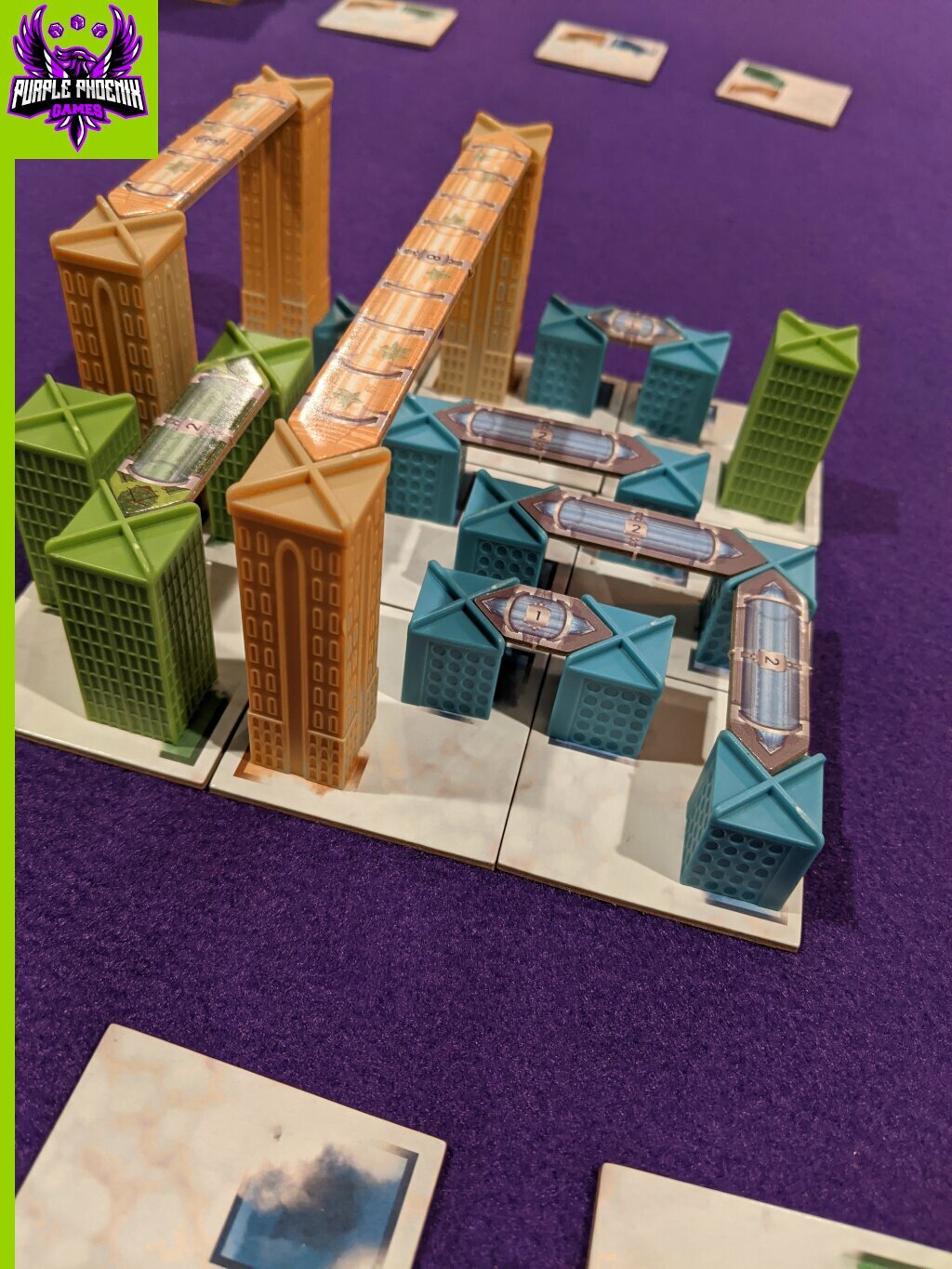
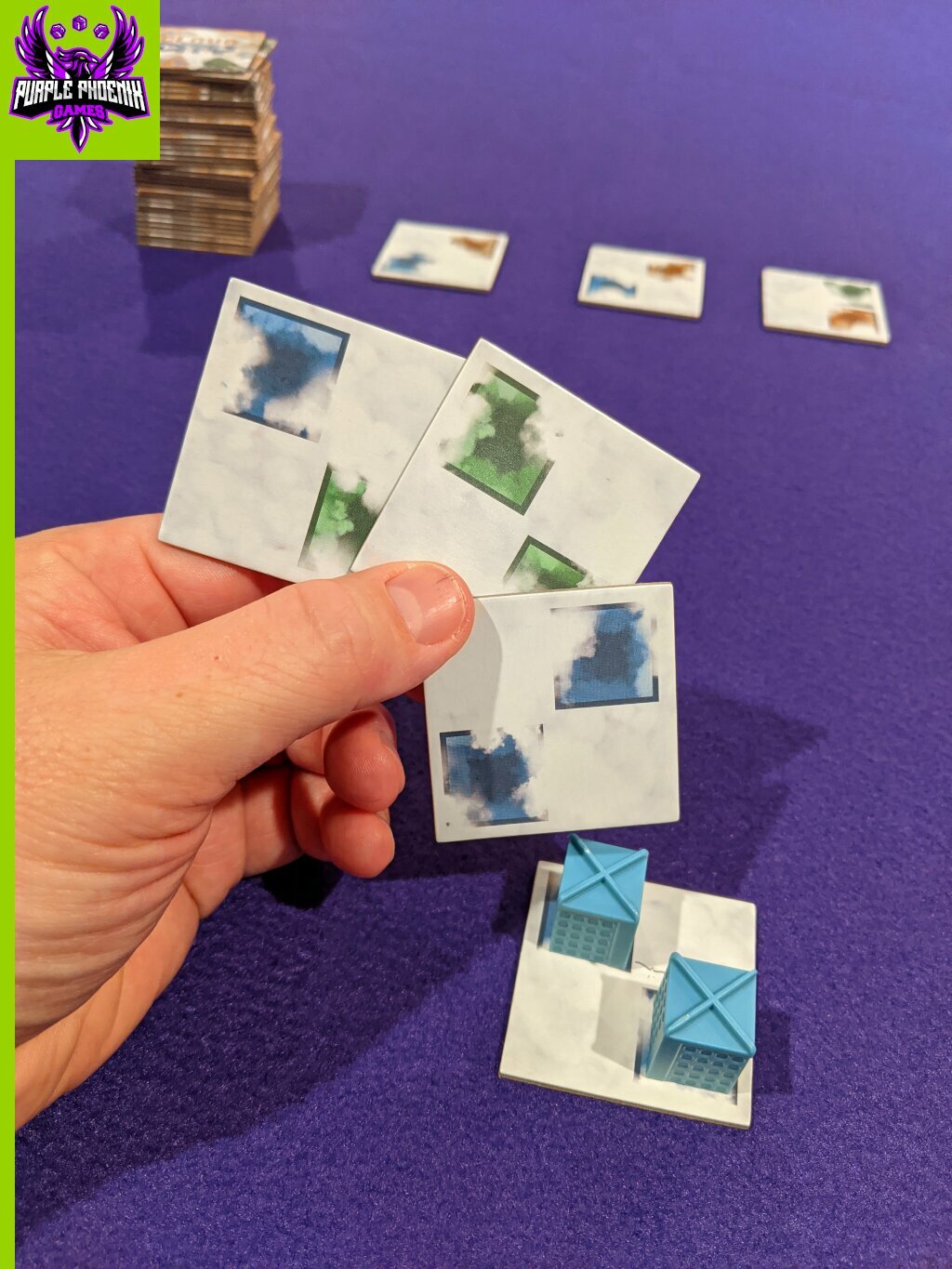
To connect these buildings players will take from the supply walkway tokens of different lengths and place them between building of matching height, as shown below. It is these walkways that score the players points as votes from the City Council.
As the player now has only two tiles in hand, a third tile will need to be drawn from either the offer row or blindly from the top of the draw pile. It is now the next player’s turn and the game ends once all players have built their 3×3 city!
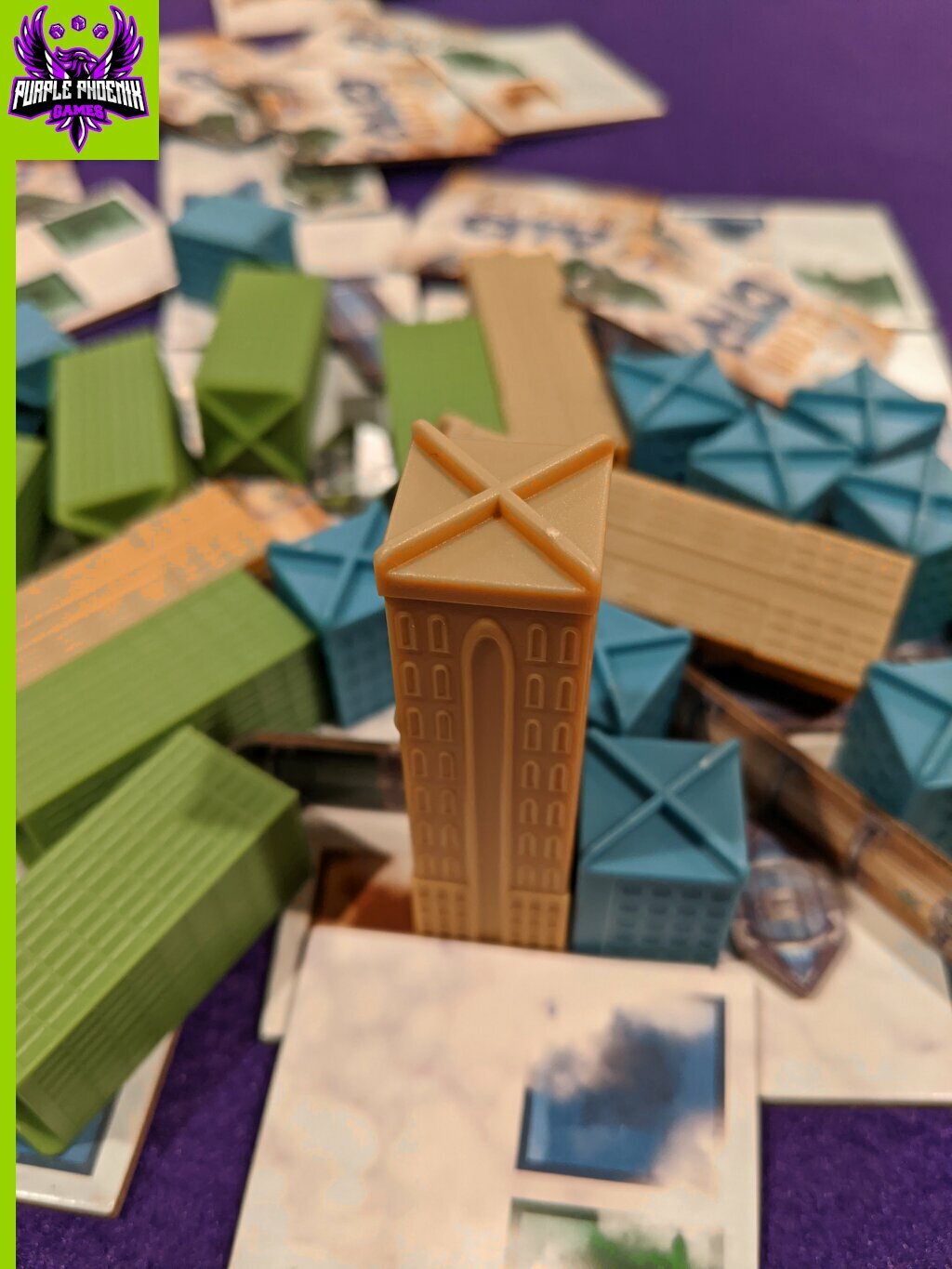
Components. This game consists of a bunch of thick cardboard Cloud tiles (48), a bunch more walkway tokens (93), and even more building pieces (96). The tiles are all thick cardboard with minimal but effective art, and are great quality. The walkways are similar thickness and quality and fit into the depressions on the building tops quite nicely. And finally, those building pieces. Oh man, these are great! Super durable plastic (or resin if there’s a difference? I was never very good at chemistry) in three colors and heights. Not needed but certainly appreciated is the detail on each piece with sculpted windows and doors. These are fun pieces to handle during game play and see being built in front of you. Excellent components in this box!
Gameplay is super simple and quick! There are only four real rules to remember (with some restrictions per rule, but they make sense) and as there are only three tiles in hand to build on a turn, AP-prone gamers will still be able to take acceptable-length turns. It’s quick, light, and boasts some great components.
Cloud City is a sure-fire hit and big time winner for me. In fact, I am planning on having my 4-year-old play it with me to truly test the box stating ages 10+. If I can get him to sit still for 30 minutes and concentrate on something other than the tablet or TV I think he will really enjoy it. If you are looking for a great gateway game that even could act as a filler with great components and gameplay that makes you consider the old, “Just one more” attitude, then give Cloud City a look. Blue Orange Games has really increased their production values and choices of games to release. They are remarkable! Just like Cloud City: remarkable!
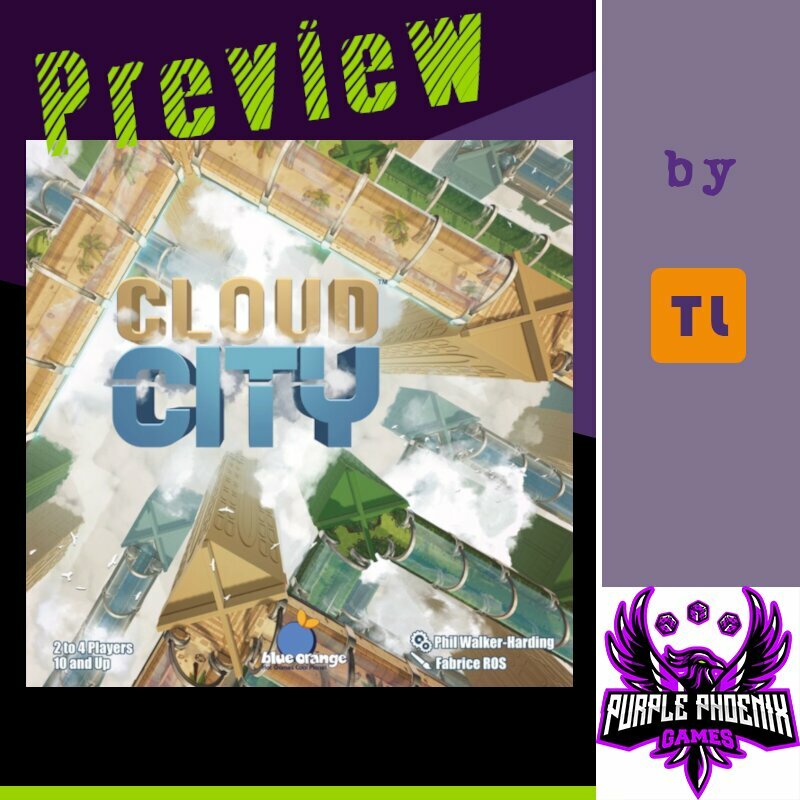
Cloud City is a tile and building placing game for two to four players that is super light and super quick to play. In it players are building architects attempting to plan the greatest use of resources to create the most breathtaking buildings and connections of walkways all above the clouds. The winner is the player who amasses the most City Council votes by creating walkways that span daring lengths and connect same-sized buildings in the sky.
DISCLAIMER: We were provided a copy of this game for the purposes of this review. This is a retail copy of the game, so what you see in these photos is exactly what would be received in your box. I do not intend to cover every single rule included in the rulebook, but will describe the overall game flow and major rule set so that our readers may get a sense of how the game plays. For more in depth rules, you may purchase a copy online or from your FLGS. -T
To setup set aside the starter Cloud tiles for use as player tiles (they have bird icons on them). Shuffle the remaining Cloud tiles and make a giant draw stack. Reveal three tiles for an offer row. Each player draws three Cloud tiles into their hand to be kept secret from the other players. They also will take the appropriate building pieces to place on their starting tiles. Keep the building pieces nearby as they will be used during the game. Players may now begin their bids for architect supreme!
On their turn each player will place a tile from their hand to add to their city, place the corresponding building pieces on the two areas of the tile, optionally build walkways to connect buildings, and then refill their hand of tiles.
When placing a tile, a few rules must be observed: tiles must be placed orthogonally adjacent to an existing tile in the city, may be rotated any direction, and must never be placed outside of a 3×3 tile grid (like the placement rules in Kingdomino).
Once tiles are placed, grab the matching-colored building pieces for the newly placed tile and plop them down on the icons. As the building in the city begin the spring up above the clouds they will need to be connected to buildings of the same height.
To connect these buildings players will take from the supply walkway tokens of different lengths and place them between building of matching height, as shown below. It is these walkways that score the players points as votes from the City Council.
As the player now has only two tiles in hand, a third tile will need to be drawn from either the offer row or blindly from the top of the draw pile. It is now the next player’s turn and the game ends once all players have built their 3×3 city!
Components. This game consists of a bunch of thick cardboard Cloud tiles (48), a bunch more walkway tokens (93), and even more building pieces (96). The tiles are all thick cardboard with minimal but effective art, and are great quality. The walkways are similar thickness and quality and fit into the depressions on the building tops quite nicely. And finally, those building pieces. Oh man, these are great! Super durable plastic (or resin if there’s a difference? I was never very good at chemistry) in three colors and heights. Not needed but certainly appreciated is the detail on each piece with sculpted windows and doors. These are fun pieces to handle during game play and see being built in front of you. Excellent components in this box!
Gameplay is super simple and quick! There are only four real rules to remember (with some restrictions per rule, but they make sense) and as there are only three tiles in hand to build on a turn, AP-prone gamers will still be able to take acceptable-length turns. It’s quick, light, and boasts some great components.
Cloud City is a sure-fire hit and big time winner for me. In fact, I am planning on having my 4-year-old play it with me to truly test the box stating ages 10+. If I can get him to sit still for 30 minutes and concentrate on something other than the tablet or TV I think he will really enjoy it. If you are looking for a great gateway game that even could act as a filler with great components and gameplay that makes you consider the old, “Just one more” attitude, then give Cloud City a look. Blue Orange Games has really increased their production values and choices of games to release. They are remarkable! Just like Cloud City: remarkable!
Blokus
Tabletop Game
Blokus (officially pronounced "Block us") is an abstract strategy game with transparent,...
Boardgames KidsGames AbstractGames

SkySafari 4 Plus: Map the Universe! Discover Sun, Moon, Mars, Stars, Planets, and Satellites with your telescope and NASA space missions!
Reference and Education
App
***SkySafari has been upgraded! For more information on the NEW SkySafari 5 Plus for iOS, visit...
Living with Lynching: African American Lynching Plays, Performance, and Citizenship, 1890-1930
Book
Living with Lynching: African American Lynching Plays, Performance, and Citizenship, 1890-1930...
Infinity Blade
Games and Entertainment
App
Winner of the 2011 Apple Design Award, and more than 20 “Game of the Year” & “Top App”...