Great Horned Owl: An in-Depth Study
Book
The Great Horned Owl is the largest owl found throughout most of North America. Adult owls are...
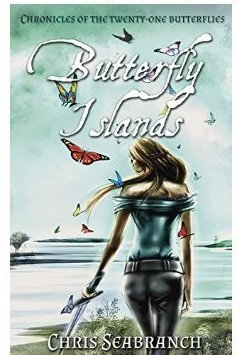
Butterfly Islands (Chronicles of the Twenty-One Butterflies Book 1)
9.0 Rate It
Book
Casey is only fifteen years old when her stepfather tries to marry her to a perverted and brutal man...
YA Young Adult Action Adventure Pirates Treasure

Purple Phoenix Games (2266 KP) rated Bellum Magica in Tabletop Games
Jan 1, 2022
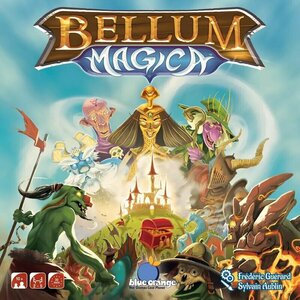

Bellum Magica is a medieval fantasy engine building game for two to five players. In it, players are evil lords waging war on a local village and each other in an attempt to becoming the richest lord of all. The winner is the player who earns the most VP from treasure chests looted during the game.
DISCLAIMER: We were provided a copy of this game for the purposes of this review. This is a retail copy of the game, so what you see in these photos is exactly what would be received in your box. I do not intend to cover every single rule included in the rulebook, but will describe the overall game flow and major rule set so that our readers may get a sense of how the game plays. For more in depth rules, you may purchase a copy online or from your FLGS. -T
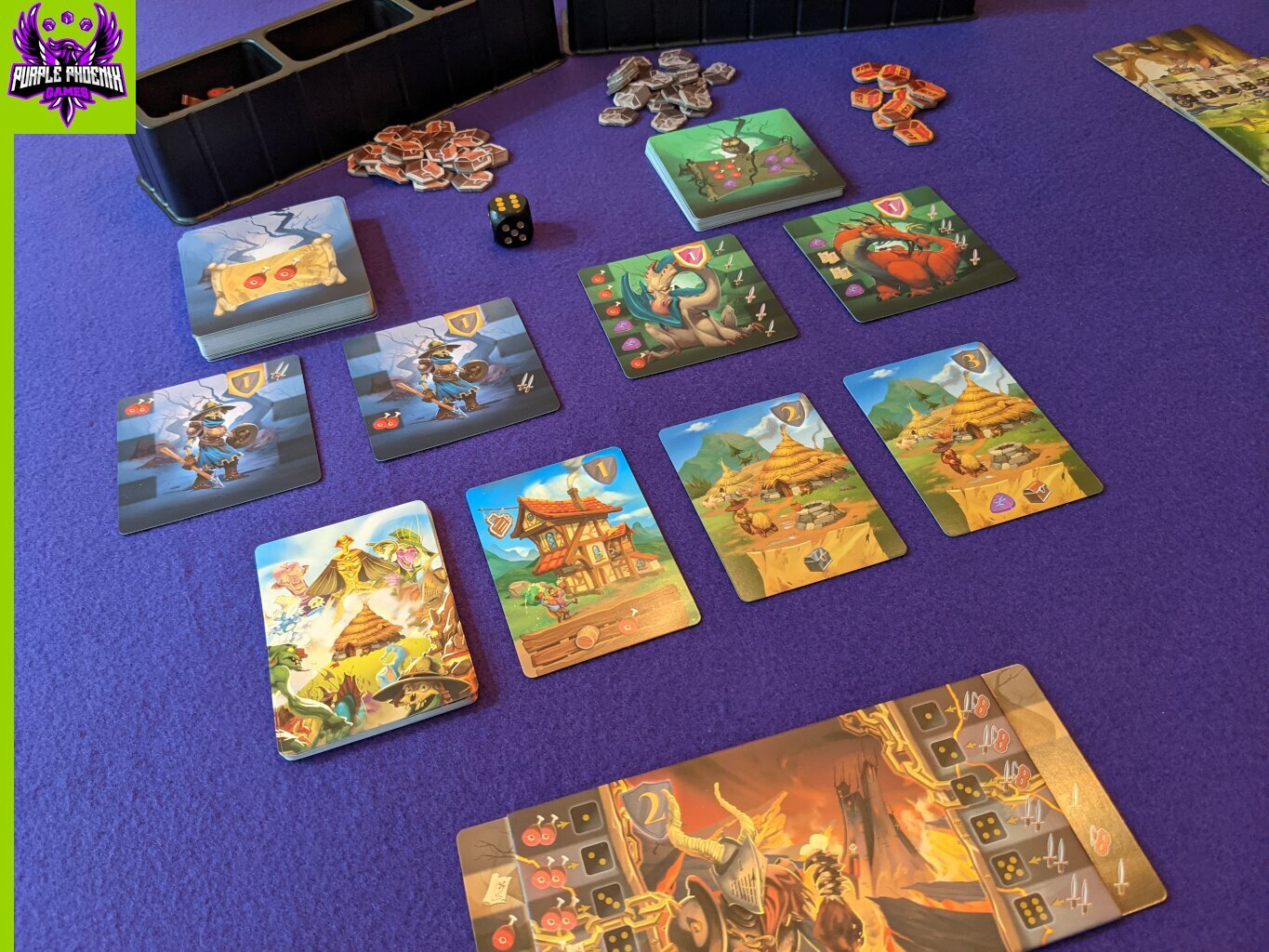
To setup, each player chooses a castle board and is randomly dealt two goblin cards to be added to the castle. These goblin cards have icons on the left and the right of the main character art, and will slide beneath the main castle board on either side to activate their icons for the duration. Next, the human kingdom (that will inevitably be attacked by players) is setup per number of players and placed on the table. The two different creature decks are shuffled and two cards from each pile are revealed. The other tokens are placed in the insert “token reserves” and are available to all. The first player takes the die and is known as the Captain. The game is now setup and ready to begin!
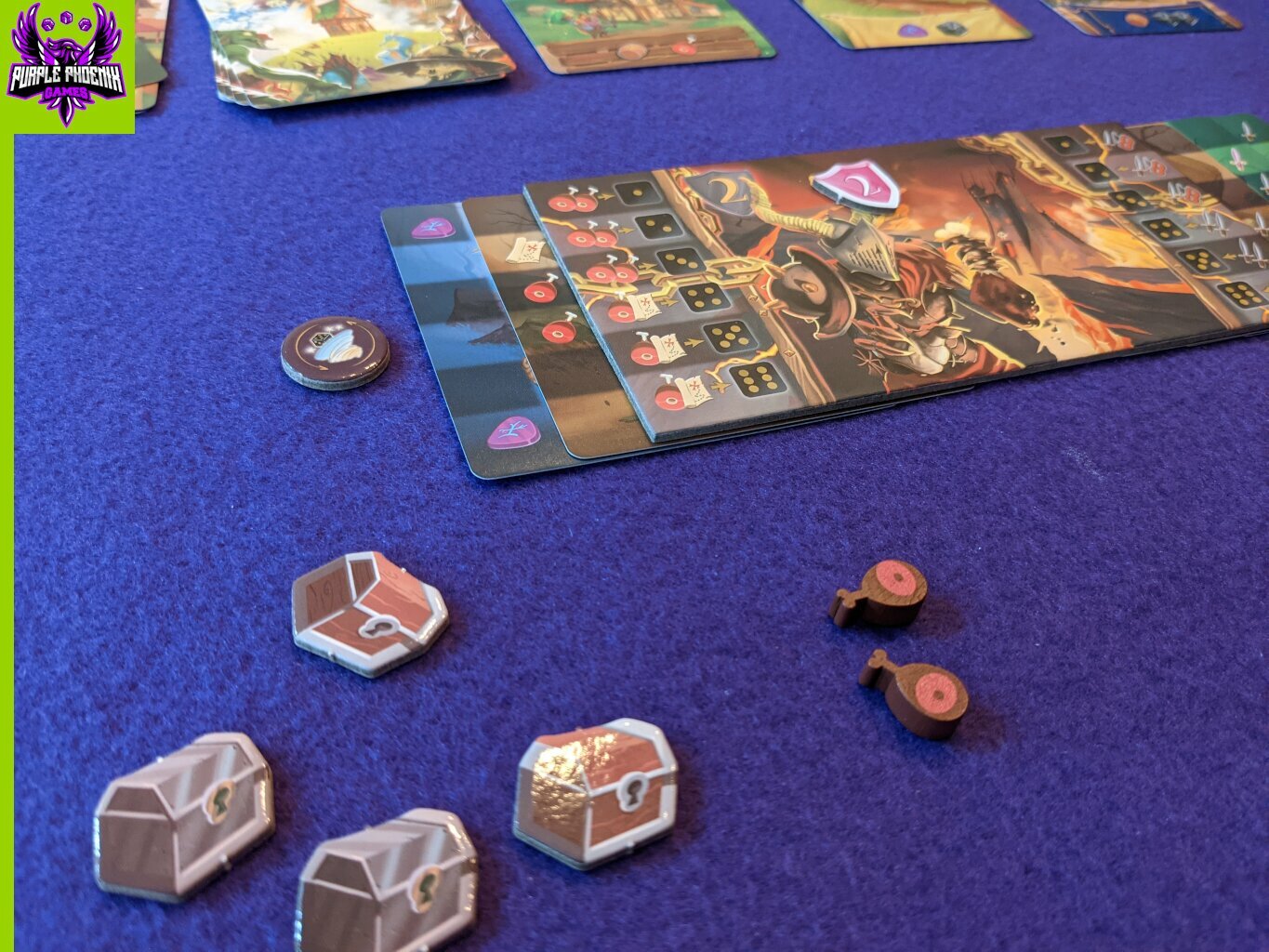
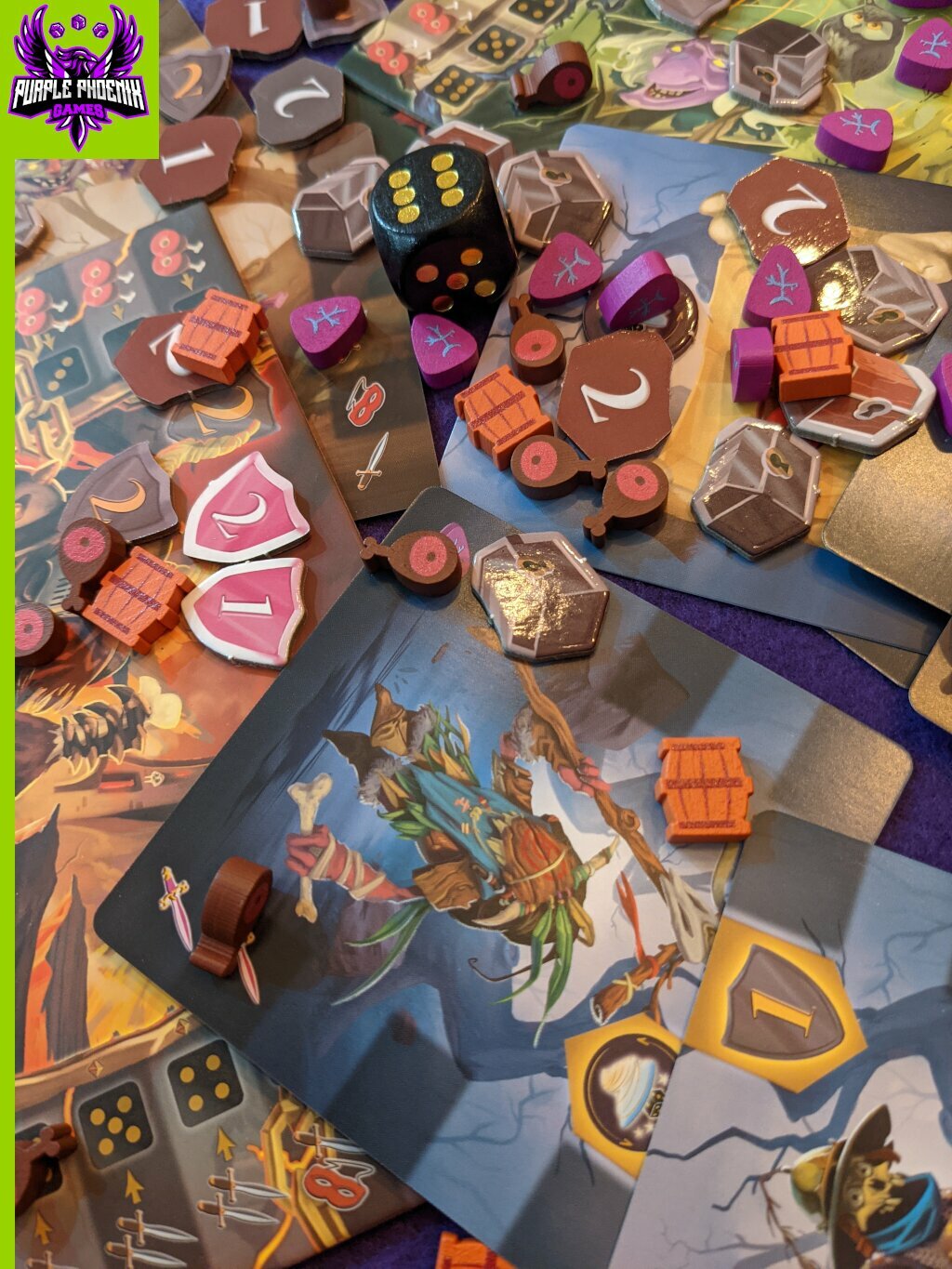
Each turn consists of six phases and, luckily, the game comes with a couple player aids to remind players of the order. First, the Captain rolls the die to Choose an active horde. Whichever result is rolled will then activate the corresponding line on the castle board, with all icons activating during the turn. If a player is unsatisfied with the rolled result, they may discard a barrel token in order to buy a round of drinks for the Captain, forcing them to re-roll the die. The Captain may also discard a Confusion Spell token in order to re-roll the die as well. These items are earned later in the game from different actions. Next, all players Gather resources (collect items) shown on the line that is activated on their castle board and any cards that have been added to alter these items (see photo below). Players will compare treasure map icons shown on the active line, and Call back their scouts who have gone in search of treasure chests. The player with the most icons will collect a metal chest, and if players are tied for the most, they each instead collect a wooden chest.
Once all items have been collected, players may enact the Attack action in turn order. Depending on the number and types of sword icons showing on the right side of players’ castle boards, they may choose to attack one of the face-up kingdom cards in the offer OR may choose to instead attack another player. In order to attack, the player will need to possess at least as many normal swords and/or magic swords as are showing on the kingdom card or on an opponent’s castle board. By successfully attacking, the player will collect spoils shown on the kingdom card, or may steal a treasure from an opponent, provided the attacker also possesses a thief icon on the active line.
When attacks are all resolved, players may next Recruit creatures from the setup creature decks by paying the recruitment costs (in food and glyph tokens). Players then decide under which side of their castle board they will slide the newly-acquired creature to aid in their efforts on future turns. These creatures can provide more resources or more attacking icons, depending on the side added.
After all these phases have been completed, the End of the Turn phase aptly finishes the turn. Cards are replenished and the new Captain is passed the die. Play continues in this fashion until one player has ten treasure chests at the end of an Attack phase. The player with the most VP from collected treasure chests is the winner!
Components. This game boasts some excellent artwork and some of the cutest little tokens I’ve seen. Firstly, the art is simply amazing. I love the looks of it, and the game is beautiful on the table once setup and playing. There are three types of wooden tokens that just make me smile while playing with them: little chicken legs, beer barrels, and cool little purple glyphs. I honestly wish they were bigger, but I understand cost of manufacturing places limitations when trying to keep products within a certain price point. All said, though, the components are great with this one!
I have one super tiny rule shrug: the addition of the Confuse Spell token and its rules. Now, I think I understand WHY it exists – these can be used every turn a player is Captain. So, it acts like a beer barrel, but is useful on future turns when you are Captain. If players are good at the game, and if you play with the full complement of players, you may not have many turns as Captain before someone wins, so I guess I don’t fully agree with the necessity of the Confusion Spells… except to further instill the fantasy theme.
That said, I still really enjoy Bellum Magica as a gateway-level engine builder. The more cards you add to your castle board, the better opportunities you give yourself to gain more and more resources throughout each turn. I have found that getting yourself a magic sword icon or more as soon as possible helps setup bigger turns and can be the difference between victory and embarrassment. As the kingdom cards start running out, their difficulty level increases, so having those extra magic swords come in handy big time. Also, investing in thief icons to be able to control other players’ treasure chest hoards may be invaluable. There are many ways to craft each turn to maximize effectiveness, and that helps keep Bellum Magica relevant and exciting to play.
It is probably no surprise by now, but I do enjoy playing Bellum Magica. When I first tried reading the rules I was a bit confused and wasn’t quite sure what the point was, but as I started playing more and more, the rules are really just pared down, almost like an outline or first draft. If you can stick with it and get it to the table, I believe you will find a very capable gateway engine building game with an accessible theme and great art and components. Purple Phoenix Games gives this one metal treasure chested 4 / 6. I do believe I will continue to love it more and more as I play it more and more. If you align with my board game tastes, this is an easy one to recommend. If you and I normally align somewhat, then I might suggest playing someone else’s copy before grabbing one of your own right away. I am more into gateway-weighted games than most reviewers, I’m sure, so this might be a bit lighter than your normal fare. In any case, I think this one needs to be played. A lot. If you ever see me out and about, or at a convention, let me know that you want to play this with me and I will not turn down the opportunity.


The Heart A Rose
Book
The Heart A Rose: A Masterfully Crafted Poetic Journey Through Lifelong Love Are you a hopeless...
poetry

The Bazaar of Bad Dreams
8.3 Rate It
Book
The short story OBITS won the 2016 Edgar for best short story.The No.1 bestselling author delivers...

David McK (3918 KP) rated Pirates of the Caribbean: The Curse of the Black Pearl (2003) in Movies
Nov 27, 2020 (Updated Nov 27, 2020)
The plot, here, makes much use of the superstition and folklore of the Caribbean - "You better start believing in Ghost stories again, Miss: you're in one!" (to paraphrase a certain other character - with the crew of the Black Pearl all cursed to an everlasting life by an ancient Aztec curse unless they can restore all the stolen coins.
And this is where Will Turner comes in, as the son of 'Bootstrap' Bill, a colleague of Captain Jack Sparrows before his crew mutinied, stole the treasure, and were cursed. When the governors daughter Elizabet Swann is kidnapped, Turner sets off to rescue here in the company of Sparrow and a crew of n'er do wells, in a very entertaining slice of Pirate action!

Lyndsey Gollogly (2893 KP) rated Heart of the Flame ( Dragon Chalice 2) in Books
Mar 21, 2024


Kindle
Heart of the Flame ( Dragon Chalice 2)
By Lara Adrian
⭐️⭐️⭐️
Six months in an enemy's dungeon might have broken a weaker man, but the former Templar knight Kenrick of Clairmont has emerged from imprisonment with an unyielding determination, consumed by a single, daunting quest: to find the Dragon Chalice, a mystical treasure said to grant its bearer unlimited power. It is a dangerous chase, one that pits Kenrick against foes skilled in dark, deadly arts. But no obstacle will prove more treacherous-nor more seductively lethal-than the fiery beauty called Haven.
Caught up in the battle for the Chalice, Haven survives a night of terror that leaves her wounded and near death. Her memory scorched by fever, Haven awakens to find herself in the care of the forbidding, handsome Kenrick, who offers his protection in return for her alliance. A tenuous trust is formed between the two, which soon ignites into a fierce passion neither can deny. But Haven's memory of her past is slowly beginning to surface, and it will threaten the fragile bond she and Henrick share-and embroil them in a fight for their very lives. . .
I like this series it’s historical romance mixed with a hint of magic. This was a quick good read. I do like this author her books are so easy and pleasant to read.

Goddess in the Stacks (553 KP) rated Cinnamon and Gunpowder: A Novel in Books
Sep 19, 2018
The formatting is set up as a kind of personal ship's log, each part dated and written down after the events happen. Wedgwood (or "Spoons," as the crew calls him) even mentions how he hides it and leaves out a decoy log, since he also writes down his dreams (and plans!) of escaping the pirates.
Some of the events in the book are incredibly predictable, but there are still a few surprises. I was a little disappointed when one thing in particular happened; I saw it coming but hoped that wasn't where the author was going with it. I know that's vague, but I don't want to spoil anything!
I enjoyed learning about Mad Hannah's background and why she's a pirate; she's fighting against the opium trade, and she actually gives Wedgwood a pretty accurate summary of the terrible things the opium trade was responsible for.
Any book that can combine sumptuous description of exotic meals with action and cannonballs will have my attention. And Brown does not shy away from proper action scenes. These are pirates, and fights get brutal. Men lose limbs if not their lives to storms and Navy bombardments. Keeping order on a pirate ship involves lashings and brute force. The book doesn't shrink from those, but it also gets philosophical with Wedgwood's description of flavors, and almost comedic with the images of using cannonballs as pestles for grinding herbs. It's that contrast and variety that makes this book so much fun to read.
You can find all my reviews at http://goddessinthestacks.com

Zoe Nock (13 KP) rated The Confessions of Frannie Langton in Books
Jun 26, 2019
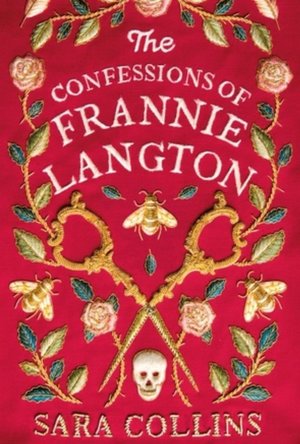
Sometimes a book just grabs you from the beginning, something tells you that treasure lies here. I felt that within a few paragraphs of The Confessions of Frannie Langton. Sara Collins prefaced the novel with an explanation of her enjoyment of stories from Georgian/Victorian era but also her disappoint that she didn’t feel represented in the literature from that time. Her love of literature and that lack of inclusion drove her to write a novel that filled a gap, filled a need for women like Frances Langton to have a voice.
And what a voice! The author embodies Frannie so well. The first thing that struck me was that Frannie’s voice shone through immediately. She sounds so authentic, within a few lines you are engaged and intrigued. So much of the prose is beautiful and evocative, truly poetic. Sara Collins describes the people and places so deftly, you sense the weight of a sultry Jamaican plantation and the drabness of a grey London suburb. You can almost taste the boiling sugar cane and fall under the sway of the delicious, devilish ‘Black Drop’. It’s difficult to read this book without imagining a BBC period drama, it really would make a good screen adaptation. There is no doubt that Collins is a gifted and accomplished writer, a weaver of words both seductive and threatening. I really enjoyed this novel and would like to read anything new from Sara Collins.