
Search
Search results

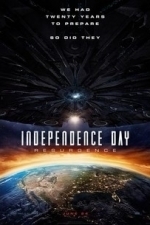
Bob Mann (459 KP) rated Independence Day: Resurgence (2016) in Movies
Sep 29, 2021


Why Will Smith is a wise, wise man.
I’m catching up on a few of the big films I missed during 2016. But Roland Emmerich has a lot to answer for with this one. Twenty years after Independence Day smashed the summer box office of 1996, the aliens are back: bigger and badder than ever. Steven Hiller (Will Smith) is no longer on the scene but, to give Emmerich a little credit, he has gathered an impressive array of the original stars to return led by Hiller’s wife Jasmine (Vivica Fox), President Whitmore (Bill Pullman), Dr Okun (Brent Spiner), David Levinson (Jeff Goldblum) and his dad (Judd Hirsch). The great Robert Loggia even turns up, who played the original General Grey, looking like he is about to expire (which unfortunately he did late last year, and the film is in memorial to him). All of them have weathered over the years apart from Judd Hirsch who must have a picture in his attic.
Playing the new generation (Hiller’s young son Dylan and the president’s daughter Patricia) are Jessie Usher and the comely Maika Monroe respectively, the latter having the pout of a young Jessica Alba and showing promise. Rounding off the young ‘uns, and playing an enormously irritating hunk/hero and his sidekick buddy are Jake (Liam Hemsworth – yes, younger brother of Chris) and Floyd (Nicolas Wright). And with the obvious needs of summer blockbusters to appeal to the ravenous Chinese market there is also Shanghai-born Angelababy as a young hotshot pilot and Chin Han as her uncle, moonbase commander Commander Jiang.
It’s hard to know where to start with criticism of this film. It’s like you’ve caught someone desecrating the grave of a dearly departed relative. The plot is ludicrous…. Uh oh…here comes another One Mann’s Movies Showcase Theatre….
The scene: onboard the alien craft high above central Asia
DRONE K’FAALL: “The use of the anti-gravity weapon worked a treat your Majesty. We have ripped up Shanghai and dumped in from a great height on London! Take that Queenie! All hail our weapons superiority! I take it we should just ‘rinse and repeat’ around the world to wipe them all out? ”
QUEEN ALIEN BEE: “No K’Fall. Let’s land in the Atlantic and then go fight them one-on-one with our little ships in the desert near Area 51.”
DRONE K’FALL: “B-b-b-but your Majesty, with our gravity weapon we could eliminate all threat, drill out the earth’s core and find what we came here for in perfect safety!”.
QUEEN ALIEN BEE: “No… that’s just what they’ll be expecting us to do…”
I thought the Oscar for the dumbest aliens of the year was a shoe-in for the ones who chose a similar tactic in “The 5th Wave” – but no… we have another contender for the crown. This ridiculous London-based CGI sequence – a virtual re-shoot of the ridiculous CGI sequence in Emmerich’s “2012” where John Cusack is fleeing by plane a collapsing Los Angeles – is mitigated only by Goldblum’s witty comment about them “Always going for the landmarks” – the best line in the film.
Elsewhere, the story and screenplay – by an army of writers (never a good sign) – is risible and an insult to intelligence, alien or otherwise. The ludicrous plot points go on and on…
Why on earth is the single landed alien craft from 1996 owned by an African warlord? If mankind have ‘benefited’ so much from the alien technology that must surely have been through the UN-dismantling of that ship?
There seems to be no logical connection between the “visions” (stolen from “Close Encounters”) and the alien craft. The visions might have well have been of the alien’s last shopping list (“six cans of Kraag beans; one bottle of Vollufi ale; … “);
The alien craft is big enough to span the WHOLE Atlantic when it lands, but – who would believe it? – comes to a stop with its edge in Washington JUST ENOUGH to dip the White House flag to a jaunty angle. #cringe;
The alien ship – apparently open to the elements – allows our heroic hunks to wander around without spacesuits;
Breathless… or not. Jessie T Usher and Liam Hemsworth (foreground) not dying of asphyxiation or cold.
At one point it looked like our curvaceous heroine was going to defeat the alien queen in good ol’ Wild West fashion armed only with a handgun (but no, my head could come out of my hands again);
And don’t even get me started on the opening “excitement” about propping up a collapsing supergun on the moon with a spaceship. Gerry Anderson would be spinning in his grave.
The dialogue is little better. The original “Independence Day” was probably most famous for two scenes: the impressive destruction of the White House and Bill Paxton’s ludicrously corny “We will not go quietly into the night” speech. Here trying to go one better we have not just one version of this but two with William Fichner’s General Adams chipping one in from the rough before Paxton delivers an impromptu hanger speech that is toe-curlingly excruciating.
Much of the acting is of the “I really don’t want to be here but it’s good for the pension” variety with Paxton and Goldblum going through the motions and Charlotte Gainsborough being horribly miscast as a French anthropologist running around the world on the trail of Pokemon Go characters… or symbols… or something. Only Brent Spiner and Judd Hirsch really get into their stride with likeably over-the-top performances.
Goldblum and Charlotte Gainsborough. A less likely historic romantic attachment its difficult to imagine.
If this was a standalone story it might scrape a double-Fad… but as it so horrendously sullies a classic movie experience it incurs my cinematic wrath. It might have made Roland Emmer-richer (sic)…. but my recommendation would be to get a big bag of popcorn, the original 1996 movie on DVD and enjoy. Avoid, avoid, avoid.
Playing the new generation (Hiller’s young son Dylan and the president’s daughter Patricia) are Jessie Usher and the comely Maika Monroe respectively, the latter having the pout of a young Jessica Alba and showing promise. Rounding off the young ‘uns, and playing an enormously irritating hunk/hero and his sidekick buddy are Jake (Liam Hemsworth – yes, younger brother of Chris) and Floyd (Nicolas Wright). And with the obvious needs of summer blockbusters to appeal to the ravenous Chinese market there is also Shanghai-born Angelababy as a young hotshot pilot and Chin Han as her uncle, moonbase commander Commander Jiang.
It’s hard to know where to start with criticism of this film. It’s like you’ve caught someone desecrating the grave of a dearly departed relative. The plot is ludicrous…. Uh oh…here comes another One Mann’s Movies Showcase Theatre….
The scene: onboard the alien craft high above central Asia
DRONE K’FAALL: “The use of the anti-gravity weapon worked a treat your Majesty. We have ripped up Shanghai and dumped in from a great height on London! Take that Queenie! All hail our weapons superiority! I take it we should just ‘rinse and repeat’ around the world to wipe them all out? ”
QUEEN ALIEN BEE: “No K’Fall. Let’s land in the Atlantic and then go fight them one-on-one with our little ships in the desert near Area 51.”
DRONE K’FALL: “B-b-b-but your Majesty, with our gravity weapon we could eliminate all threat, drill out the earth’s core and find what we came here for in perfect safety!”.
QUEEN ALIEN BEE: “No… that’s just what they’ll be expecting us to do…”
I thought the Oscar for the dumbest aliens of the year was a shoe-in for the ones who chose a similar tactic in “The 5th Wave” – but no… we have another contender for the crown. This ridiculous London-based CGI sequence – a virtual re-shoot of the ridiculous CGI sequence in Emmerich’s “2012” where John Cusack is fleeing by plane a collapsing Los Angeles – is mitigated only by Goldblum’s witty comment about them “Always going for the landmarks” – the best line in the film.
Elsewhere, the story and screenplay – by an army of writers (never a good sign) – is risible and an insult to intelligence, alien or otherwise. The ludicrous plot points go on and on…
Why on earth is the single landed alien craft from 1996 owned by an African warlord? If mankind have ‘benefited’ so much from the alien technology that must surely have been through the UN-dismantling of that ship?
There seems to be no logical connection between the “visions” (stolen from “Close Encounters”) and the alien craft. The visions might have well have been of the alien’s last shopping list (“six cans of Kraag beans; one bottle of Vollufi ale; … “);
The alien craft is big enough to span the WHOLE Atlantic when it lands, but – who would believe it? – comes to a stop with its edge in Washington JUST ENOUGH to dip the White House flag to a jaunty angle. #cringe;
The alien ship – apparently open to the elements – allows our heroic hunks to wander around without spacesuits;
Breathless… or not. Jessie T Usher and Liam Hemsworth (foreground) not dying of asphyxiation or cold.
At one point it looked like our curvaceous heroine was going to defeat the alien queen in good ol’ Wild West fashion armed only with a handgun (but no, my head could come out of my hands again);
And don’t even get me started on the opening “excitement” about propping up a collapsing supergun on the moon with a spaceship. Gerry Anderson would be spinning in his grave.
The dialogue is little better. The original “Independence Day” was probably most famous for two scenes: the impressive destruction of the White House and Bill Paxton’s ludicrously corny “We will not go quietly into the night” speech. Here trying to go one better we have not just one version of this but two with William Fichner’s General Adams chipping one in from the rough before Paxton delivers an impromptu hanger speech that is toe-curlingly excruciating.
Much of the acting is of the “I really don’t want to be here but it’s good for the pension” variety with Paxton and Goldblum going through the motions and Charlotte Gainsborough being horribly miscast as a French anthropologist running around the world on the trail of Pokemon Go characters… or symbols… or something. Only Brent Spiner and Judd Hirsch really get into their stride with likeably over-the-top performances.
Goldblum and Charlotte Gainsborough. A less likely historic romantic attachment its difficult to imagine.
If this was a standalone story it might scrape a double-Fad… but as it so horrendously sullies a classic movie experience it incurs my cinematic wrath. It might have made Roland Emmer-richer (sic)…. but my recommendation would be to get a big bag of popcorn, the original 1996 movie on DVD and enjoy. Avoid, avoid, avoid.

Connor Sheffield (293 KP) rated Batman v Superman: Dawn of Justice (2016) in Movies
Apr 18, 2017

The Good, The Bad and The Editing
So...here's a movie that split so many fans and has caused COUNTLESS arguments online. My review may also cause arguments, but I'm willing to risk that as I have a fair bit to say about this movie, most importantly and foremost;
I enjoyed the movie!
The Good:
Let me start with what's good because I feel there's never enough positivity around this movie so here goes.
Ben Affleck and Gal Gadot were the two focuses of this movie because they had a lot of pressure on them to bring Batman and Wonder Woman to life and do the characters justice (terrible I know but I couldn't resist). All over the internet I saw hate for Ben Affleck and people saying Gal Gadot was too skinny. At first, I'll be honest, I did think Gal Gadot was really skinny and couldn't imagine her as Wonder Woman, BUT, unlike most people, I knew that before they would film her scenes, she would be 'buffing up' because I have faith in Zack Snyder because he is a fan and has made brilliant films. Man Of Steel made me like Superman, because of the way he was written as conflicted and the whole film made him more human and I loved it.
Here's where some people will disagree highly with me....I am not a big fan of the Nolan trilogy Batman. Now, before you throw a fit and verbally kick my ass, let me try and tell you why. The Voice! (it's not the only reason, but this is the reason I'm trying to make a point of) Batman a.k.a Bruce Wayne is a BILLIONAIRE, so who thought that the best way for him to disguise his voice would be to make him sound like he's fucked up his throat somehow? A billionaire with all those gadgets would surely think that what he needs is a voice modulator. Snyder brought in the voice modulator and I fell in love in that first trailer from hearing Batman talk through a voice modulator because I was sat there like "Hallelujah they finally worked out what a billionaire vigilante would do!" and I think it could be just me, but I honestly would prefer to think of Batman using one of those rather than grumbling his voice, because it just makes more sense.
So...Batfleck was incredible. My favourite portrayal so far and here's why:
- Arkham game fighting style
- Aged personality that says it all about why he's that violent
- He's definitely a great portrayal of the Dark Knight Returns version of Batman
- Ben Affleck is a great actor (in my opinion)
People's biggest complaint was 'Batman Kills' and I've had this discussion with my friends many times. Yes people died, IT'S HAPPENED BEFORE! It's rare but it's happened. You like the realism of Nolan's trilogy but there's a realism to Batfleck that you might not be seeing. He's been through all the same shit year in, year out for decades. Villains cause chaos, Batman fights villain, lets them live, puts them away, they break out, rinse repeat. Doing that for decades, losing people you love because of your choice not to kill, would surely cause a spark in your mind and Bruce Wayne says this in the movie through less words. "How many good guys are left? How many stay that way?"
If you think about it, he's essentially saying "I was a good guy but even I have had my boundaries pushed to the line and over". He's finally at the age where he has a state of mind that from his perspective...bad guys don't deserve to be shown mercy, but at the same time, he doesn't necessarily kill the bad guys directly.
Think of the warehouse scene. Bad Guy throws grenade, Batman kicks it back at him. Grenade goes BOOM. Bad guys die. BUT! If the guy hadn't have tried to throw the grenade, Batman wouldn't have kicked it back, and it wouldn't have ended in their death. Simple as that.
Let's move on though.
Superman is conflicted and the movie gets very political with a message of "Here's a God-Like figure. Should he be allowed to do what he wants or should we take away Choice by having under the Governments thumb?" and Superman personally is having internal issues of "I want this to be my home because it's the only home I've known, but these people don't want me and this stress is affecting both Clark Kent and Superman". He should have been able to see or hear the bomb in the wheelchair, but his mind was preoccupied with "Why does this government and these people hate me when I saved not only my city but the whole world?". Think about your stress with work, with college, school etc. and how it really does effect everything else around you. You might not want to go out with friends because you feel drained from the stress, now try to imagine that on the level of Superman! The poor guy just wanted to help.
My biggest enjoyment from this film was ALL OF THE DC REFERENCES! There were so many cool easter eggs, references etc. that I adored from Riddler Question Marks, to seeing Superman in a skeletal form after the Nuke explosion and then regaining his life force from the flowers through their Photosynthesis just like in the graphic novel! It was an incredible experience and I loved the film mainly for that.
The Bad:
Doomsday....I want to hope it's not the actual Doomsday and maybe just a failed experiment that Lex tried out but at the same time I know it probably is meant to be THE Doomsday.
The Editing:
The editing was jumpy and some cuts didn't make sense UNTIL the Ultimate Cut. The Ultimate Cut gives us some scenes with Clark Kent in Gotham BEFORE the big introduction to Batman in person, and hearing stories and investigating why people fear him, but also respect him. This would have worked so much better in the Theatrical Cut but sadly studios like to cut the film and people blame the Director for it which annoys me slightly.
Guaranteed this post might not change your mind, but I must say that you should try watching the film again if you've avoided it, watch the Ultimate Cut and really pay attention to how its being shown to the audience. Overall this is one of my favourite superhero movies and I will always stand up for it, BUT I'm not blind to it's faults.
I enjoyed the movie!
The Good:
Let me start with what's good because I feel there's never enough positivity around this movie so here goes.
Ben Affleck and Gal Gadot were the two focuses of this movie because they had a lot of pressure on them to bring Batman and Wonder Woman to life and do the characters justice (terrible I know but I couldn't resist). All over the internet I saw hate for Ben Affleck and people saying Gal Gadot was too skinny. At first, I'll be honest, I did think Gal Gadot was really skinny and couldn't imagine her as Wonder Woman, BUT, unlike most people, I knew that before they would film her scenes, she would be 'buffing up' because I have faith in Zack Snyder because he is a fan and has made brilliant films. Man Of Steel made me like Superman, because of the way he was written as conflicted and the whole film made him more human and I loved it.
Here's where some people will disagree highly with me....I am not a big fan of the Nolan trilogy Batman. Now, before you throw a fit and verbally kick my ass, let me try and tell you why. The Voice! (it's not the only reason, but this is the reason I'm trying to make a point of) Batman a.k.a Bruce Wayne is a BILLIONAIRE, so who thought that the best way for him to disguise his voice would be to make him sound like he's fucked up his throat somehow? A billionaire with all those gadgets would surely think that what he needs is a voice modulator. Snyder brought in the voice modulator and I fell in love in that first trailer from hearing Batman talk through a voice modulator because I was sat there like "Hallelujah they finally worked out what a billionaire vigilante would do!" and I think it could be just me, but I honestly would prefer to think of Batman using one of those rather than grumbling his voice, because it just makes more sense.
So...Batfleck was incredible. My favourite portrayal so far and here's why:
- Arkham game fighting style
- Aged personality that says it all about why he's that violent
- He's definitely a great portrayal of the Dark Knight Returns version of Batman
- Ben Affleck is a great actor (in my opinion)
People's biggest complaint was 'Batman Kills' and I've had this discussion with my friends many times. Yes people died, IT'S HAPPENED BEFORE! It's rare but it's happened. You like the realism of Nolan's trilogy but there's a realism to Batfleck that you might not be seeing. He's been through all the same shit year in, year out for decades. Villains cause chaos, Batman fights villain, lets them live, puts them away, they break out, rinse repeat. Doing that for decades, losing people you love because of your choice not to kill, would surely cause a spark in your mind and Bruce Wayne says this in the movie through less words. "How many good guys are left? How many stay that way?"
If you think about it, he's essentially saying "I was a good guy but even I have had my boundaries pushed to the line and over". He's finally at the age where he has a state of mind that from his perspective...bad guys don't deserve to be shown mercy, but at the same time, he doesn't necessarily kill the bad guys directly.
Think of the warehouse scene. Bad Guy throws grenade, Batman kicks it back at him. Grenade goes BOOM. Bad guys die. BUT! If the guy hadn't have tried to throw the grenade, Batman wouldn't have kicked it back, and it wouldn't have ended in their death. Simple as that.
Let's move on though.
Superman is conflicted and the movie gets very political with a message of "Here's a God-Like figure. Should he be allowed to do what he wants or should we take away Choice by having under the Governments thumb?" and Superman personally is having internal issues of "I want this to be my home because it's the only home I've known, but these people don't want me and this stress is affecting both Clark Kent and Superman". He should have been able to see or hear the bomb in the wheelchair, but his mind was preoccupied with "Why does this government and these people hate me when I saved not only my city but the whole world?". Think about your stress with work, with college, school etc. and how it really does effect everything else around you. You might not want to go out with friends because you feel drained from the stress, now try to imagine that on the level of Superman! The poor guy just wanted to help.
My biggest enjoyment from this film was ALL OF THE DC REFERENCES! There were so many cool easter eggs, references etc. that I adored from Riddler Question Marks, to seeing Superman in a skeletal form after the Nuke explosion and then regaining his life force from the flowers through their Photosynthesis just like in the graphic novel! It was an incredible experience and I loved the film mainly for that.
The Bad:
Doomsday....I want to hope it's not the actual Doomsday and maybe just a failed experiment that Lex tried out but at the same time I know it probably is meant to be THE Doomsday.
The Editing:
The editing was jumpy and some cuts didn't make sense UNTIL the Ultimate Cut. The Ultimate Cut gives us some scenes with Clark Kent in Gotham BEFORE the big introduction to Batman in person, and hearing stories and investigating why people fear him, but also respect him. This would have worked so much better in the Theatrical Cut but sadly studios like to cut the film and people blame the Director for it which annoys me slightly.
Guaranteed this post might not change your mind, but I must say that you should try watching the film again if you've avoided it, watch the Ultimate Cut and really pay attention to how its being shown to the audience. Overall this is one of my favourite superhero movies and I will always stand up for it, BUT I'm not blind to it's faults.


Chris Sawin (602 KP) rated The Dark Knight (2008) in Movies
Jun 19, 2019

The Dark Knight picks up not too long after Batman Begins left off. The way the citizens of Gotham look at Batman is still pretty divided. Some see him as a vigilante in a mask who takes the law into his own hands and others see him as a caped crusader who helps keep scum off the streets. A hero to some and a villain to others. Harvey Dent, the man running for DA, enters the picture and could be the face Gotham is looking for to be its new hero. A man who's not only capable of getting rid of the filth on the streets of Gotham in a more efficient manner, but could be the reason Batman hangs up his cape for good. It seems as though Gotham has found itself with a new criminal psychopath though that's keeping Batman, Harvey Dent, and the Gotham PD busy these days. The Joker is, without a doubt, Batman's most dangerous adversary. A madman whose only desire is to give Gotham a better class of criminal. Bruce Wayne goes beyond his limits as Batman to try and take him down and all The Joker wants is for Gotham to be filled with pure chaos. Can Batman bring The Joker to justice? Will Harvey Dent become Gotham's new white knight? How does Rachel Dawes fit into the picture?
I had been looking forward to this movie for what seemed like an eternity and to make it worse is that I had to sit in the theater for an hour since I got there early. All I could think about was that I was finally seeing this movie that I was so excited about. I have never anticipated a film to this capacity. Ever. I was thinking that there was no way a movie could live up to being that good. So the real question is, "Did the film live up to my expectations?" The answer is no. It didn't. It surpassed my expectations in every way possible. The two hours and thirty two minutes running time went by in a blur as there was little to no down time and my eyes were drawn to the screen the entire time. This movie was epic. I don't toss that word around too often, but there's no way else to describe it. It was epic in every sense of the word. I've never seen a film that had this much of a crowd response to not only the film, its actors, its twists and turns, but the trailers beforehand as well. I lost count how many times I had goosebumps throughout the film because what I was witnessing was exactly what I wanted to see and then some. It is truly an extraordinary experience.
The cast was brilliant. The returning cast from the last film continued to be impressive. Michael Caine always manages to be charming and steal a few laughs as Alfred and the film wouldn't be the same without Morgan Freeman as Lucius Fox. Christian Bale is still the best Batman to ever put on the cape, in my opinion. It was nice seeing more Batman this time around than Bruce Wayne. The way he struggles with if continuing to be Batman is the right thing for Gotham still plagues him and is still equally as amazing. Maggie Gyllenhaal has, as I'm sure you've heard by now, replaced Katie Holmes as Rachel Dawes and actually brings a spark to the role. She brought the charisma and overall talent to The Dark Knight that Katie Holmes should have had in Batman Begins. Gary Oldman is an actor who I still think doesn't deserve the credit he deserves and what he brings to the role of Jim Gordon, especially this time around in The Dark Knight, should hopefully get people talking. Which brings me to Aaron Eckhart. By the time the credits start rolling, I can guarantee you'll be praising his work in this film. I can't really imagine anyone else in the role of Harvey Dent now and what he winds up going through and how he portrays it is just incredible. The intensity he put into the role really caused him to steal quite a few scenes.
Hm. That's the whole cast isn't it? I'm not leaving anyone out, right? Oh, of course. Heath Ledger as The Joker. Did it live up to the hype and was it worth all the fuss? It does, my friends. It's actually better than the hype. Ledger steals every scene he's in. Period. Whatever he tapped into and whatever kind of preparation he went through for this role is truly phenomenal. He WAS The Joker in this film. He was somehow able to embody The Joker in a way that is frightening, maniacal, and even hysterical all at the same time. You will wind up holding your breath and trying not to make a sound every time he comes on screen because you don't want to miss a second of this mesmerizing performance. I was reading that he locked himself up in an empty apartment for a month to prepare for the role to get a true feel for the character; his body language, quirks, his voice, etc. He had The Killing Joke, The Man Who Laughed, and a few of the first issues of Batman that had appearances from the Joker as references. I can tell you this...it truly shows, if that's the case. The way he submerged himself in this character is almost beyond words. He deserves every ounce of praise that he gets.
It is ridiculous how much praise The Dark Knight truly deserves. Even the most elaborate descriptions feel like they're still not doing the movie justice. The film is for Batman fans, for Nolan fans, for fans of good storytelling, for fans of good writing, for fans of amazing cinematography, for fans of some of the strongest acting performances ever to be filmed, for fans of action/crime/dramas...long story short, the film can and probably will be enjoyed by anyone. It is the only film to come out in recent years that not only lived up to the hype, but leaped over it and actually deserved every bit of it. By the time you get to the end credits, you'll immediately want to see it again and you'll be just as excited the second time(and possibly third time) through. It's that good.
I had been looking forward to this movie for what seemed like an eternity and to make it worse is that I had to sit in the theater for an hour since I got there early. All I could think about was that I was finally seeing this movie that I was so excited about. I have never anticipated a film to this capacity. Ever. I was thinking that there was no way a movie could live up to being that good. So the real question is, "Did the film live up to my expectations?" The answer is no. It didn't. It surpassed my expectations in every way possible. The two hours and thirty two minutes running time went by in a blur as there was little to no down time and my eyes were drawn to the screen the entire time. This movie was epic. I don't toss that word around too often, but there's no way else to describe it. It was epic in every sense of the word. I've never seen a film that had this much of a crowd response to not only the film, its actors, its twists and turns, but the trailers beforehand as well. I lost count how many times I had goosebumps throughout the film because what I was witnessing was exactly what I wanted to see and then some. It is truly an extraordinary experience.
The cast was brilliant. The returning cast from the last film continued to be impressive. Michael Caine always manages to be charming and steal a few laughs as Alfred and the film wouldn't be the same without Morgan Freeman as Lucius Fox. Christian Bale is still the best Batman to ever put on the cape, in my opinion. It was nice seeing more Batman this time around than Bruce Wayne. The way he struggles with if continuing to be Batman is the right thing for Gotham still plagues him and is still equally as amazing. Maggie Gyllenhaal has, as I'm sure you've heard by now, replaced Katie Holmes as Rachel Dawes and actually brings a spark to the role. She brought the charisma and overall talent to The Dark Knight that Katie Holmes should have had in Batman Begins. Gary Oldman is an actor who I still think doesn't deserve the credit he deserves and what he brings to the role of Jim Gordon, especially this time around in The Dark Knight, should hopefully get people talking. Which brings me to Aaron Eckhart. By the time the credits start rolling, I can guarantee you'll be praising his work in this film. I can't really imagine anyone else in the role of Harvey Dent now and what he winds up going through and how he portrays it is just incredible. The intensity he put into the role really caused him to steal quite a few scenes.
Hm. That's the whole cast isn't it? I'm not leaving anyone out, right? Oh, of course. Heath Ledger as The Joker. Did it live up to the hype and was it worth all the fuss? It does, my friends. It's actually better than the hype. Ledger steals every scene he's in. Period. Whatever he tapped into and whatever kind of preparation he went through for this role is truly phenomenal. He WAS The Joker in this film. He was somehow able to embody The Joker in a way that is frightening, maniacal, and even hysterical all at the same time. You will wind up holding your breath and trying not to make a sound every time he comes on screen because you don't want to miss a second of this mesmerizing performance. I was reading that he locked himself up in an empty apartment for a month to prepare for the role to get a true feel for the character; his body language, quirks, his voice, etc. He had The Killing Joke, The Man Who Laughed, and a few of the first issues of Batman that had appearances from the Joker as references. I can tell you this...it truly shows, if that's the case. The way he submerged himself in this character is almost beyond words. He deserves every ounce of praise that he gets.
It is ridiculous how much praise The Dark Knight truly deserves. Even the most elaborate descriptions feel like they're still not doing the movie justice. The film is for Batman fans, for Nolan fans, for fans of good storytelling, for fans of good writing, for fans of amazing cinematography, for fans of some of the strongest acting performances ever to be filmed, for fans of action/crime/dramas...long story short, the film can and probably will be enjoyed by anyone. It is the only film to come out in recent years that not only lived up to the hype, but leaped over it and actually deserved every bit of it. By the time you get to the end credits, you'll immediately want to see it again and you'll be just as excited the second time(and possibly third time) through. It's that good.

Jamie Towell Cook (13 KP) rated the PlayStation 4 version of Kingdom Hearts III in Video Games
Apr 6, 2020

Contains spoilers, click to show
Kingdom Hearts 3 is the long anticipated third part officially in the series. It started back in 2002 and now in 2019 we finally have the 3rd (and allegedly) final part of what is Sora and his friends story. In this time we have travelled to many beloved Disney classics from Mount Olympus to Neverland and for some bizarre reason we even went to Tarzan's world. During all of this Sora is learning how to be the Keyblade wielder and defend all the worlds from the threat of the darkness. On his journey he meets many familiar faces ranging from final fantasy characters such as Cloud, Tidus and Vivi to famous disney heroes such as Ariel, Beast, Jack Skellington.
Unfortunalty since it began in 2002 Kingdom Hearts became a jumbled mess jumping on different consoles along the way. It may have begun as a PlayStation game but soon after there was a spin off for the game boy advance and another for the psp and another for the nintendo ds. Releasing titles that actually continue the plot from the original game on various different consoles and expecting fans to just role with that and keep up, well thats not exactly the best of ideas! Luckily the story so far has been released and rereleased and rererereleased so that fans can figure out just what the hell is actually going on in this either brilliantly masterminded tale or a way for the game producers to milk the franchise for all its worth. I'll let you decide that one.
So any ways, with a whopping 14 years between KH2 and KH3 a lot has changed within the Disney world and with their new corporate purchases a lot of people had questions about what would we see in a new Kingdom Hearts. Would the new game feature any worlds from Marvel? Would we see something from the Muppet Show? Maybe Star Wars? The answer to this was a big fat no. They were going to keep it old school Disney......although by old school Disney that didn't have the same meaning as what I thought it would. Instead of the familiar faces we have grown accustomed to there is no Halloween Town, no Neverland, no Atlantica (Thank god, good call on that one) instead we visit new realms, draining whatever is left from the Frozen franchise and travelling to worlds such as Arendale, San Frantokyo and some other Disney Pixar worlds. Now i'm not saying there is anything wrong with these worlds because they are beautiful and stunning and fun to play through. Couldn't they have at least tried to feature some golden oldies as well. Something else that i noticed that as well that made me feel disappointed in this release was the lack of final fantasy characters, minus a very brief glimpse of 2 characters as statues thats pretty much it.
The story itself is appealing as it continues the tales of Sora, Ventus and Roxas and ultimately brings the trios story to a (almost) conclusion. The voice acting for the kingdom hearts series will never win any awards and in some areas is just hands down terrible but, as it plays out you notice it a lot less and just want to see where its all headed.
The gameplay is as it has always been, if its not broke don't fix it. There are a few additions though. Kingdom Hearts 1 had abilities, in kingdom hearts 2 we seen this become built upon by fusion. This was a way of fusing Sora's abilities with either Donald or Goofy and eventually both. Leading to Wisdom mode, which was magic based. Valour mode, which was strength and defence based. Master, which, yes you guessed it, is a mix of all the above. Limit mode, which brings Sora's abilities to the spotlight. Then you had Final form which was basically a combination of Limit and Master and finally there was anti form, this turned Sora into a heartless version of himself with attacks and abilities to match. These were all scrapped in Kingdom Hearts 3 to make way for attractions, which is an attack based on Disneyworld theme park attractions. There are also attacks based on whose in your team as well. As fun as these are in the beginning, they get old and repetitive fast. The summons have never really played a main part in the Kingdom Hearts series since its first release and KH3 makes that very apparent again, with what i thought was a very lackluster 5 summons in the form of Ariel, Ralph, Stitch, Simba and a dream eater from Kingdom Hearts own series. I mean come on, wheres Mushu? Genie? Bambi? Dumbo? Tinkerbell? Why aren't there any new ones? They could have played up new Pixar entries such as Bolt or Up, even The Incredibles.
The other feature that is new and unique to KH3 is the ability to transform the Keyblade. Now picking up a new keyblade isn't just about the stat boosts, they each feature something different and unique. Without giving too much away, all i can really say about this is the additions to turn your weapon in to such things as shields, blasters and other random creations based on the worlds they are related to is actually a brilliant concept and makes up for the drive form that was taken from KH2 and not featured again.
I really hope that Square Enix are planning on releasing some decent DLC for KH3. Hopefully in the form of some old Disney worlds, a coliseum and some extra story with old familiar faces. Because it is definitely needed.
The Gummi ship does manage to make a come back (yet again). I would like to say something positive about this because it does seem like a lot of work went into making this feel like a more relevant part of the game but, the controls take a bit of figuring out and there is no real need for it other than it being a mini game really.
If Square Enix does add some DLC that adds worlds, characters, keyblades and modes. Then i honestly believe they could boost the game from being a good game to an amazing game. Just listen to the fans, hear what they want and deliver.
I wish i had better news for Kingdom Hearts fans. Especially those who have waited those 14 years but i am judging this game harshly because of my love for the series and the length of time it has been under development.
Unfortunalty since it began in 2002 Kingdom Hearts became a jumbled mess jumping on different consoles along the way. It may have begun as a PlayStation game but soon after there was a spin off for the game boy advance and another for the psp and another for the nintendo ds. Releasing titles that actually continue the plot from the original game on various different consoles and expecting fans to just role with that and keep up, well thats not exactly the best of ideas! Luckily the story so far has been released and rereleased and rererereleased so that fans can figure out just what the hell is actually going on in this either brilliantly masterminded tale or a way for the game producers to milk the franchise for all its worth. I'll let you decide that one.
So any ways, with a whopping 14 years between KH2 and KH3 a lot has changed within the Disney world and with their new corporate purchases a lot of people had questions about what would we see in a new Kingdom Hearts. Would the new game feature any worlds from Marvel? Would we see something from the Muppet Show? Maybe Star Wars? The answer to this was a big fat no. They were going to keep it old school Disney......although by old school Disney that didn't have the same meaning as what I thought it would. Instead of the familiar faces we have grown accustomed to there is no Halloween Town, no Neverland, no Atlantica (Thank god, good call on that one) instead we visit new realms, draining whatever is left from the Frozen franchise and travelling to worlds such as Arendale, San Frantokyo and some other Disney Pixar worlds. Now i'm not saying there is anything wrong with these worlds because they are beautiful and stunning and fun to play through. Couldn't they have at least tried to feature some golden oldies as well. Something else that i noticed that as well that made me feel disappointed in this release was the lack of final fantasy characters, minus a very brief glimpse of 2 characters as statues thats pretty much it.
The story itself is appealing as it continues the tales of Sora, Ventus and Roxas and ultimately brings the trios story to a (almost) conclusion. The voice acting for the kingdom hearts series will never win any awards and in some areas is just hands down terrible but, as it plays out you notice it a lot less and just want to see where its all headed.
The gameplay is as it has always been, if its not broke don't fix it. There are a few additions though. Kingdom Hearts 1 had abilities, in kingdom hearts 2 we seen this become built upon by fusion. This was a way of fusing Sora's abilities with either Donald or Goofy and eventually both. Leading to Wisdom mode, which was magic based. Valour mode, which was strength and defence based. Master, which, yes you guessed it, is a mix of all the above. Limit mode, which brings Sora's abilities to the spotlight. Then you had Final form which was basically a combination of Limit and Master and finally there was anti form, this turned Sora into a heartless version of himself with attacks and abilities to match. These were all scrapped in Kingdom Hearts 3 to make way for attractions, which is an attack based on Disneyworld theme park attractions. There are also attacks based on whose in your team as well. As fun as these are in the beginning, they get old and repetitive fast. The summons have never really played a main part in the Kingdom Hearts series since its first release and KH3 makes that very apparent again, with what i thought was a very lackluster 5 summons in the form of Ariel, Ralph, Stitch, Simba and a dream eater from Kingdom Hearts own series. I mean come on, wheres Mushu? Genie? Bambi? Dumbo? Tinkerbell? Why aren't there any new ones? They could have played up new Pixar entries such as Bolt or Up, even The Incredibles.
The other feature that is new and unique to KH3 is the ability to transform the Keyblade. Now picking up a new keyblade isn't just about the stat boosts, they each feature something different and unique. Without giving too much away, all i can really say about this is the additions to turn your weapon in to such things as shields, blasters and other random creations based on the worlds they are related to is actually a brilliant concept and makes up for the drive form that was taken from KH2 and not featured again.
I really hope that Square Enix are planning on releasing some decent DLC for KH3. Hopefully in the form of some old Disney worlds, a coliseum and some extra story with old familiar faces. Because it is definitely needed.
The Gummi ship does manage to make a come back (yet again). I would like to say something positive about this because it does seem like a lot of work went into making this feel like a more relevant part of the game but, the controls take a bit of figuring out and there is no real need for it other than it being a mini game really.
If Square Enix does add some DLC that adds worlds, characters, keyblades and modes. Then i honestly believe they could boost the game from being a good game to an amazing game. Just listen to the fans, hear what they want and deliver.
I wish i had better news for Kingdom Hearts fans. Especially those who have waited those 14 years but i am judging this game harshly because of my love for the series and the length of time it has been under development.
Purple Phoenix Games (2266 KP) rated You Said You Could Draw in Tabletop Games
Apr 23, 2021
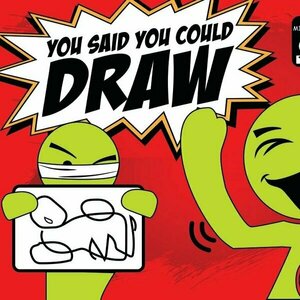
Excuse me, title of game, but I NEVER said I could draw. Is it just me or does nearly everyone feel the need to preface every drawing game with a declaration that they are horrible artists and will probably perform disastrously? I have found this to be the case, as least for myself and about 90%+ of the people with whom I play, and it is especially rampant with the tongue-out drawers in the world. But we all still enjoy the old favorites like Pictionary and Win, Lose, or Draw! How about if we add another gimmick to these classics in order to turn the games on their ears? Enter You Said You Could Draw.
In You Said You Could Draw (I will just acronymize to YSYCD) players are attempting to win the game by scoring the most points. The provided score board has space for each player to earn 20 points, though agreements could be made by players to stop at any number of points.
DISCLAIMER: We were provided a prototype copy of this game for the purposes of this review. These are preview copy components, and I do not know for sure if the final components will be any different from these shown. Also, it is not my intention to detail every rule in the game, but to give an idea of how the game is played. You are invited to download the rulebook, back the game through the Kickstarter campaign launching May 8, 2021, or through any retailers stocking it after fulfillment. -T
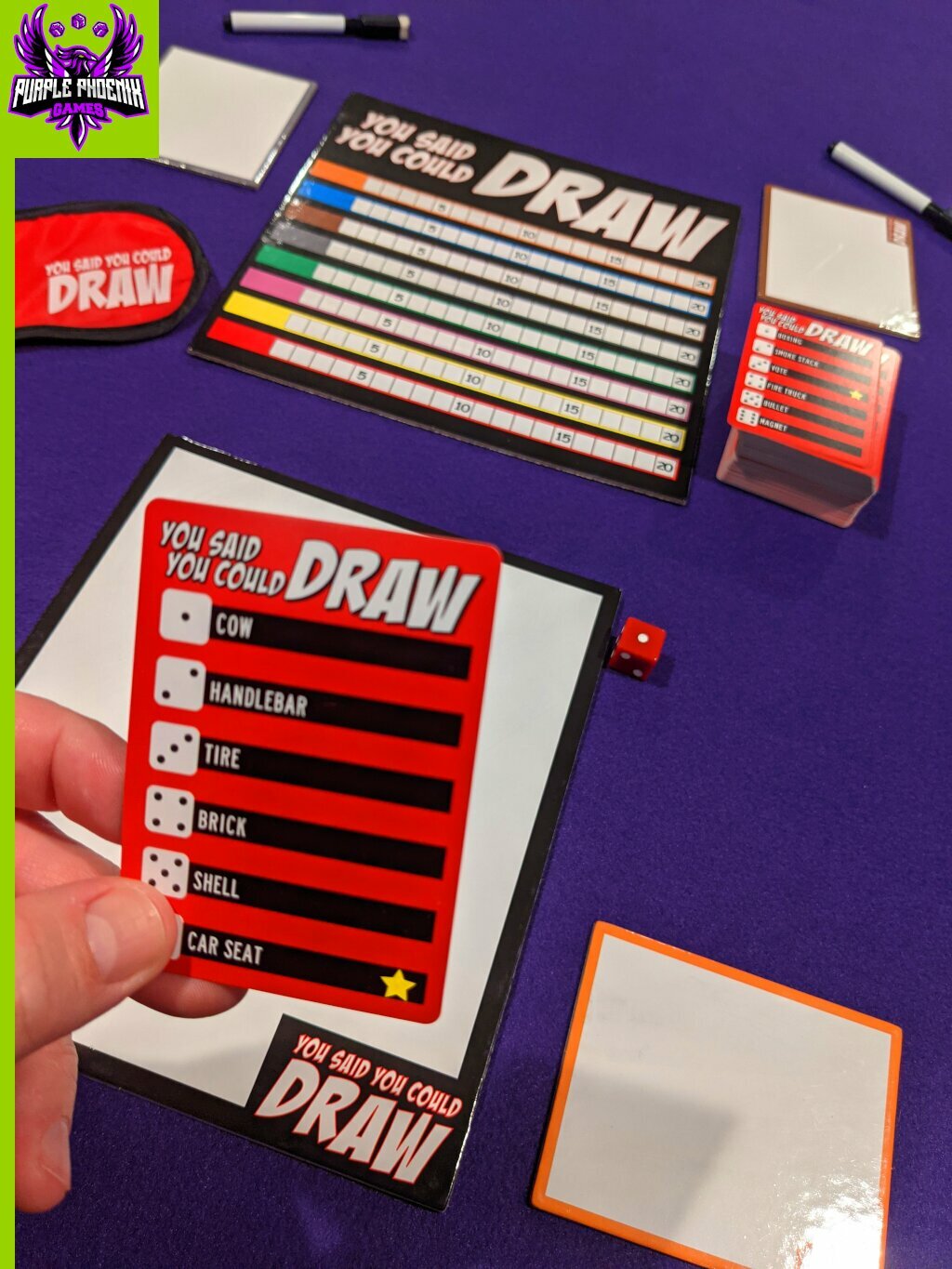
To setup a game of YSYCD place the score board anywhere on the table and players choose which color board they wish to represent themselves. Players are also given a dry erase marker. The large deck of cards is placed somewhere near the score board, along with the blindfold. Players will roll the die to determine the first player, and the game may now begin!
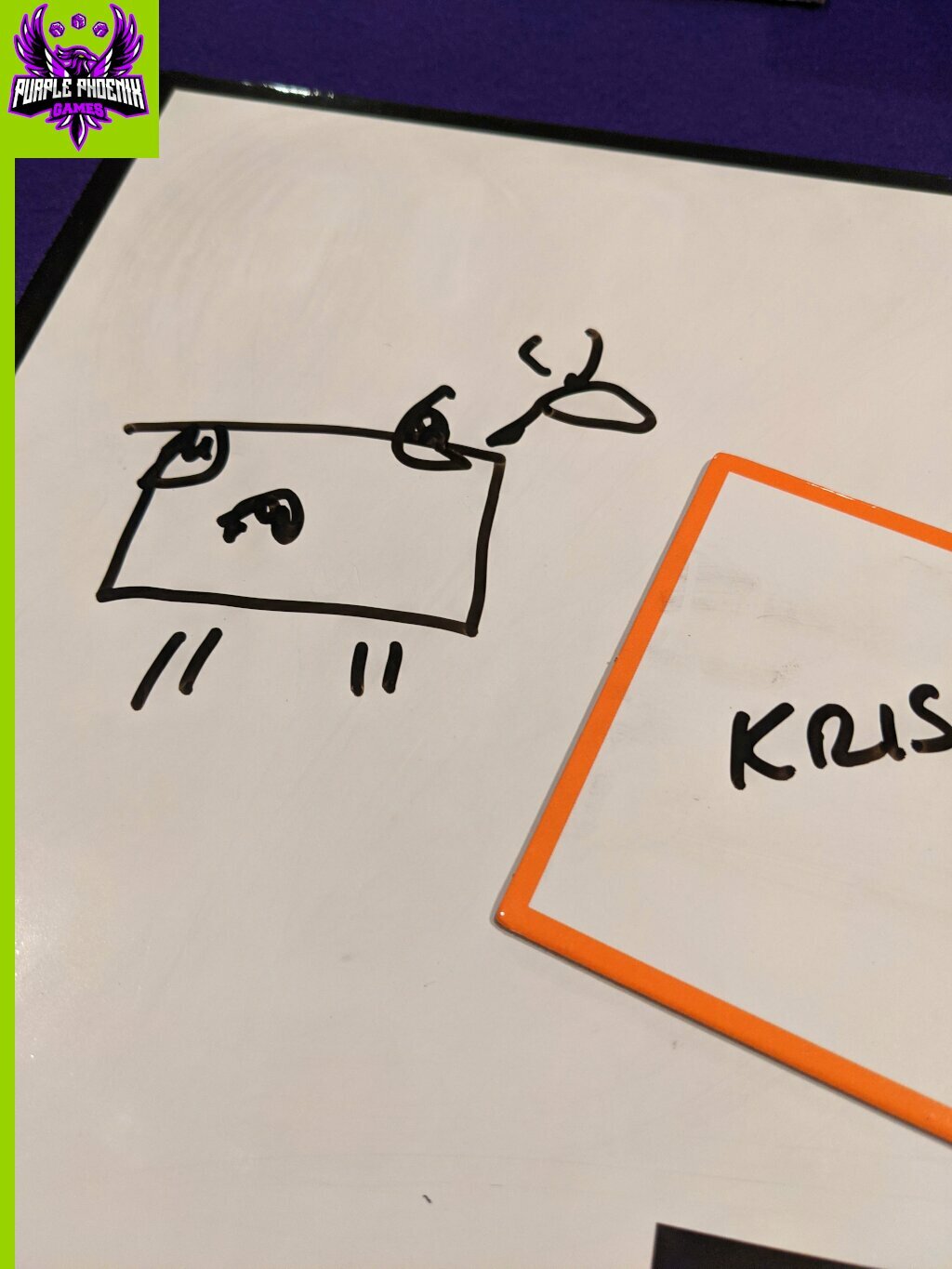
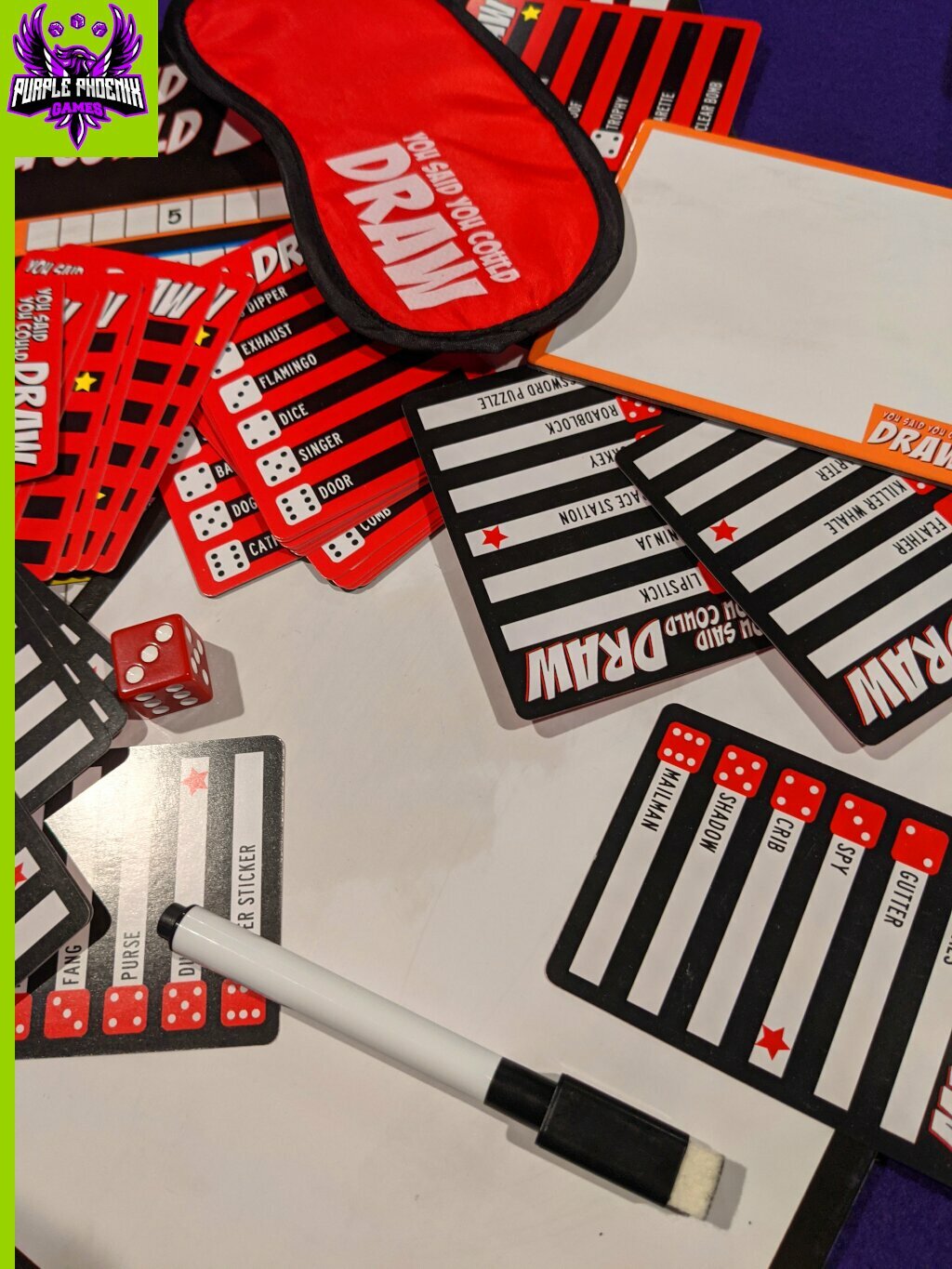
YSYCD is played in turns until a player reaches the aforementioned ending score. On a turn a player will draw a card, roll the die, then draw. On each card is a list of six prompts to be drawn by the player and the result of the die roll determines which prompt the player must draw. Once the player is ready they will don the blindfold and begin drawing on the large board. When the masterpieces is complete the artist will write the name of the player they believe will guess correctly. Both the drawing process and the name writing are secret – no lookyloos! When the artist reveals their labor each player will secretly write their guess on their player boards, to be revealed simultaneously once all players have finished. The artist reveals their choice and the other players reveal their hilarious guesses. Points may now be awarded.
The artist will receive one point if at least one player has guessed correctly, with a bonus one point earned if the player they wrote on their board guessed correctly. Each player who guessed the prompt correctly also scores one point. If ALL players guess correctly except for one lonely player, the lonely player will earn a painful NEGATIVE two ( -2 ) points!
Players will notice that one prompt on each side of the card includes a star icon. Should this prompt be rolled for the turn the points awarded for the artists and correct guessers are three, versus the typical one. Play continues in this fashion until a player has reached the agreed score threshold and claims victory!
Components. This game boasts two large and eight smaller dry erase boards with eight dry erase markers. The boards are fine, but the markers (at least in this prototype version) are very low quality, especially the erasers. We resorted to using napkins for our erasing needs, as they did not smear as much. The 1d6 is fine, and the blindfold is very comfortable (thank you, JPN Games!). The cards are fine quality and there are 100 double-sided cards, offering 1200 prompt options to draw! I normally also cover art direction and theming here, but there is very little art, with most of it on the box cover. The box cover in this version features two players having a great time playing the game in a color VERY close to our logo’s Volt color. So I’m a fan of that for sure.
The rulebook is a simple folded cardstock that could easily become a duplexed sheet of paper or stock. The rules are incredibly simple to learn and teach, which makes this a great entry for families.
I recently broke this one out to play with my brother-in-law, his wife, and their twin 10-year-old children. When I say that it has been a long time since I laughed so hard while playing games, I certainly mean it. Most drawing games favor the talented artists of the group, but YSYCD offers the great equalizer – that blindfold. Sure, someone could be able to draw an excellent Sonic the Hedgehog (not a sponsor), but once you take away the spacial awareness drawing becomes a lot more difficult. And having a 10-year-old look into your eyes and tell you they drew a Chef instead of your guess of Quasimodo makes for a very interesting adult-child dynamic.
All in all I have had a great time with this game. The blindfold is what makes this special, and rolling the die to select the prompt causes each player to begin their turns on the same artistry level as their opponents. I dig that. A lot. I will be honest here – this is not a game that I would see at a store and be interested in buying or playing. But I gave it a shot with the family and I now have a party game that differs from my other party games in my collection and I am all the happier for it. You Said You Could Draw is not for the hard core gamer. It is for the gamer who needs a break from the brain burning and is able to relax a bit and have fun – even at their own expense. If this sounds interesting to you, I urge you to check out the Kickstarter campaign, launching May 8, 2021. Pick up a copy or two or twelve and give some away. The holidays are always just around the corner. Also, be warned that some children cannot accept that their Chef looks like Quasimodo. I learned this the hard way.
In You Said You Could Draw (I will just acronymize to YSYCD) players are attempting to win the game by scoring the most points. The provided score board has space for each player to earn 20 points, though agreements could be made by players to stop at any number of points.
DISCLAIMER: We were provided a prototype copy of this game for the purposes of this review. These are preview copy components, and I do not know for sure if the final components will be any different from these shown. Also, it is not my intention to detail every rule in the game, but to give an idea of how the game is played. You are invited to download the rulebook, back the game through the Kickstarter campaign launching May 8, 2021, or through any retailers stocking it after fulfillment. -T
To setup a game of YSYCD place the score board anywhere on the table and players choose which color board they wish to represent themselves. Players are also given a dry erase marker. The large deck of cards is placed somewhere near the score board, along with the blindfold. Players will roll the die to determine the first player, and the game may now begin!
YSYCD is played in turns until a player reaches the aforementioned ending score. On a turn a player will draw a card, roll the die, then draw. On each card is a list of six prompts to be drawn by the player and the result of the die roll determines which prompt the player must draw. Once the player is ready they will don the blindfold and begin drawing on the large board. When the masterpieces is complete the artist will write the name of the player they believe will guess correctly. Both the drawing process and the name writing are secret – no lookyloos! When the artist reveals their labor each player will secretly write their guess on their player boards, to be revealed simultaneously once all players have finished. The artist reveals their choice and the other players reveal their hilarious guesses. Points may now be awarded.
The artist will receive one point if at least one player has guessed correctly, with a bonus one point earned if the player they wrote on their board guessed correctly. Each player who guessed the prompt correctly also scores one point. If ALL players guess correctly except for one lonely player, the lonely player will earn a painful NEGATIVE two ( -2 ) points!
Players will notice that one prompt on each side of the card includes a star icon. Should this prompt be rolled for the turn the points awarded for the artists and correct guessers are three, versus the typical one. Play continues in this fashion until a player has reached the agreed score threshold and claims victory!
Components. This game boasts two large and eight smaller dry erase boards with eight dry erase markers. The boards are fine, but the markers (at least in this prototype version) are very low quality, especially the erasers. We resorted to using napkins for our erasing needs, as they did not smear as much. The 1d6 is fine, and the blindfold is very comfortable (thank you, JPN Games!). The cards are fine quality and there are 100 double-sided cards, offering 1200 prompt options to draw! I normally also cover art direction and theming here, but there is very little art, with most of it on the box cover. The box cover in this version features two players having a great time playing the game in a color VERY close to our logo’s Volt color. So I’m a fan of that for sure.
The rulebook is a simple folded cardstock that could easily become a duplexed sheet of paper or stock. The rules are incredibly simple to learn and teach, which makes this a great entry for families.
I recently broke this one out to play with my brother-in-law, his wife, and their twin 10-year-old children. When I say that it has been a long time since I laughed so hard while playing games, I certainly mean it. Most drawing games favor the talented artists of the group, but YSYCD offers the great equalizer – that blindfold. Sure, someone could be able to draw an excellent Sonic the Hedgehog (not a sponsor), but once you take away the spacial awareness drawing becomes a lot more difficult. And having a 10-year-old look into your eyes and tell you they drew a Chef instead of your guess of Quasimodo makes for a very interesting adult-child dynamic.
All in all I have had a great time with this game. The blindfold is what makes this special, and rolling the die to select the prompt causes each player to begin their turns on the same artistry level as their opponents. I dig that. A lot. I will be honest here – this is not a game that I would see at a store and be interested in buying or playing. But I gave it a shot with the family and I now have a party game that differs from my other party games in my collection and I am all the happier for it. You Said You Could Draw is not for the hard core gamer. It is for the gamer who needs a break from the brain burning and is able to relax a bit and have fun – even at their own expense. If this sounds interesting to you, I urge you to check out the Kickstarter campaign, launching May 8, 2021. Pick up a copy or two or twelve and give some away. The holidays are always just around the corner. Also, be warned that some children cannot accept that their Chef looks like Quasimodo. I learned this the hard way.
Purple Phoenix Games (2266 KP) rated Deckscape: The Mystery of Eldorado in Tabletop Games
Mar 12, 2021
Who out there has ever gone to an escape room and not enjoyed themselves? I know nobody (though if that’s you, it’s okay). I have only been to one in my life (eek!) and I absolutely loved it! I have watched videos of celebrities tackling escape rooms and have been riveted. I like the shows you can now find streaming of similar type activities and am always glued to the screen. Heck, I have played the EXIT and Unlock systems of board games and enjoyed them as well. So having the experience I have and never having played the Deckscape system, how did it fare for me? Decent. Read on.
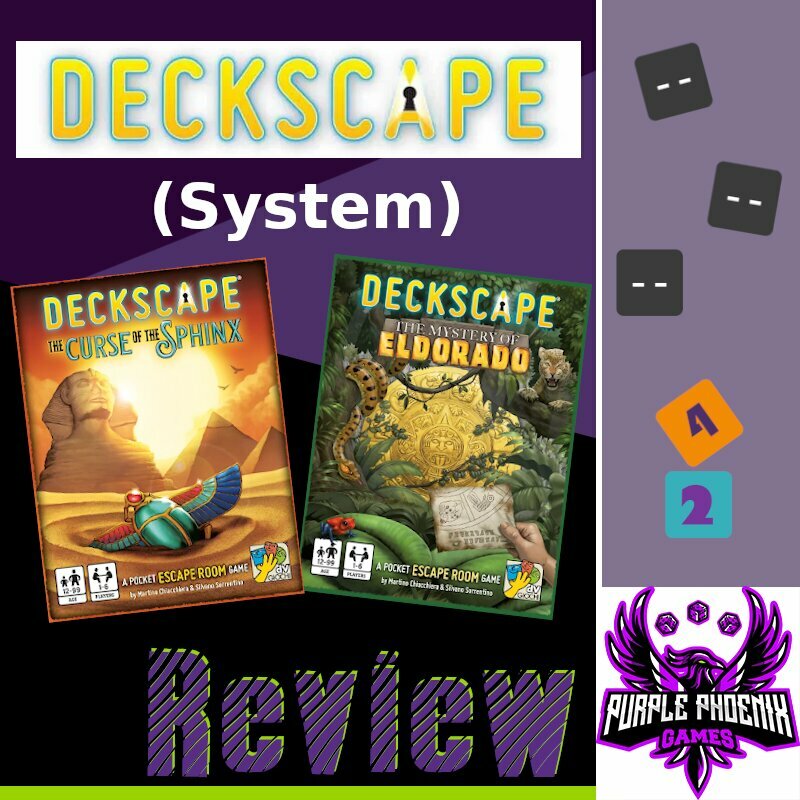
Imagine yourself trapped on a jungle island after your plane crashes. Or being locked within a pyramid whilst visiting Egypt. These are the settings for the pair of games we reviewed and I really cannot and will not be going further into a lot of detail so as to avoid any spoilers as best I can.
DISCLAIMER: We were provided a copy of both The Curse of the Sphinx and The Mystery of Eldorado for the purposes of this review. These are retail copies of the games, so what you see in these photos is exactly what would be received in your boxes. I will describe the overall game flow and major rule set so that our readers may get a sense of how the game plays. For more info, you may purchase a copy online or from your FLGS. -T
To setup a game of Deckscape, open the box and take out the cards. You are now ready to play. Seriously. No rules to read. Nothing to teach others. Just read the top card and do as it says. You have now begun your adventure!
Playing the games involves players (or a solo player) encountering cards in the 60-card deck in order to solve puzzles and use items found to best finish the scenario. There are no turns in these games, and players are encouraged to discuss possibilities before committing to answers to the puzzles. Randy from Dora and the Lost City of Gold would be so happy to be figuring out “Jungle Puzzles” and “Pyramid Puzzles.”
Each card is either a puzzle or an item and each card will more than likely be encountered throughout the game. Players are trying to figure out the puzzle clues and best solve them. Incorrect guesses will result in costly errors that affect endgame scoring. Sometimes correct guesses will allow the players to erase errors or give other positive clues.
Once the players have made their way through the game solving puzzles and riddles they will consult the table at the end to see how well they scored. Usually time is of the essence, and finishing the games sooner is better than later. Once the game is over and the score tallied the game owner may gift the game away as the final result is known and replaying is kinda cheating.
Components. Okay, these games are small boxes full of large cards. There are 60 cards in each game and the cards are beautifully illustrated and laid out well. We had no problems reading anything or deciphering any part of the games, so thumbs up on components from us.
Gameplay is a little polarizing, we found. I like the flow of the game and puzzles within. My wife, however, couldn’t stand them. But she later admitted to now understanding that she just does not enjoy escape room styled board and card games. That said, these games play more like Choose Your Own Adventure games than the typical EXIT/Unlock style games, as most (if not all) cards in Deckscape require players to complete them before moving to the next card in numerical order with either a success or penalty. This can rub players the wrong way if they are used to the other style of escape room games. It was no problem for me, and I enjoyed my plays.
What I liked most about these games is that the story is easy to follow and the puzzles mostly make logical sense. A few of them stumped me, but luckily players may find helper cards to give clues to puzzles in the game. We relied on these helpers a few times, but I did not feel like we were consulting them for every puzzle. So that’s a definite positive. I also liked the thematic immersion. For a card game I felt drawn into the stories and wanted to complete them as well as I could.
What I disliked most about these games is the fact that you end up encountering every card or nearly every card. The intrigue of other escape room games I have played is wondering what was on some of those other cards. Or what did I miss on a card that I should have noticed? While you get SOME of that here, I found Deckscape to be more entry-level in difficulty. That is certainly not a bad thing for most gamers. We were expecting something different than what we played, and I think that unfortunately immediately put us off at first.
However, I played the second game solo and I liked it quite a bit. I think I mostly liked it because I didn’t have my wife around to figure out the puzzles with me and I was truly all alone. This added to my anxiety to finish well, or finish at all! I definitely cannot see myself playing these games with the full compliment of six players as I feel I would be too overwhelmed with people shouting out their guesses and trying to parse everything. But that’s just me. I prefer these with low player counts.
All in all these games are pretty good, and a decent something different from the other games in the same style. If you have yet to try Deckscape and like escape room games in general, I reccomend you give them a try. They are quick (and even quicker as your goal is finish in a short amount of time for the best scores), easy to play with zero teaching and setup time, and gives a great amount of puzzles to decipher. Purple Phoenix Games gives the Deckscape system of games an unsure-but-you-seem-confident-about-your-answer-so-let’s-just-go-with-yours 6 / 12. If you see them on the shelves pick one up and try it out. Add these to your growing collection of escape room games for show, or play them and pass them along, as I intend to do.
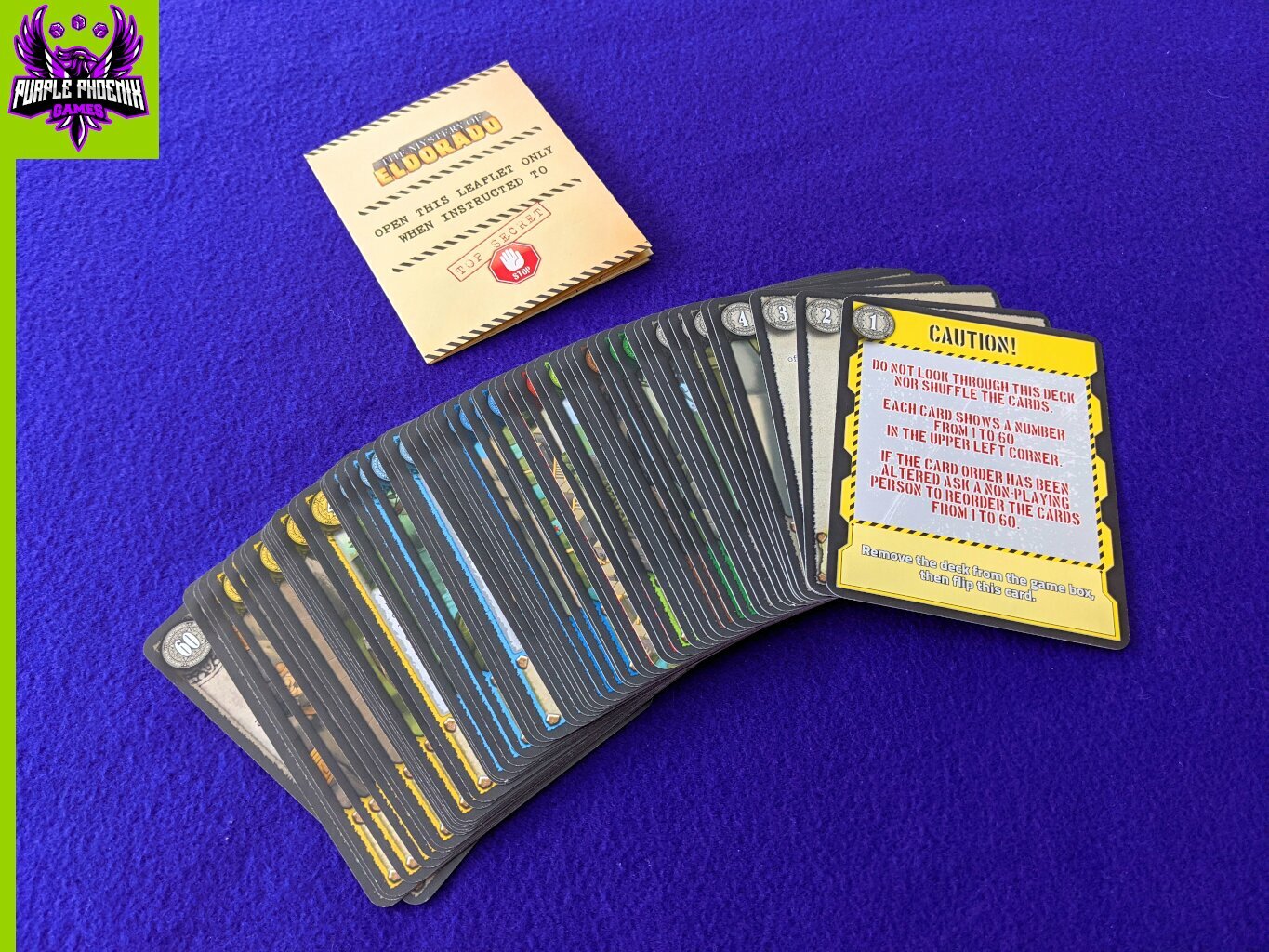
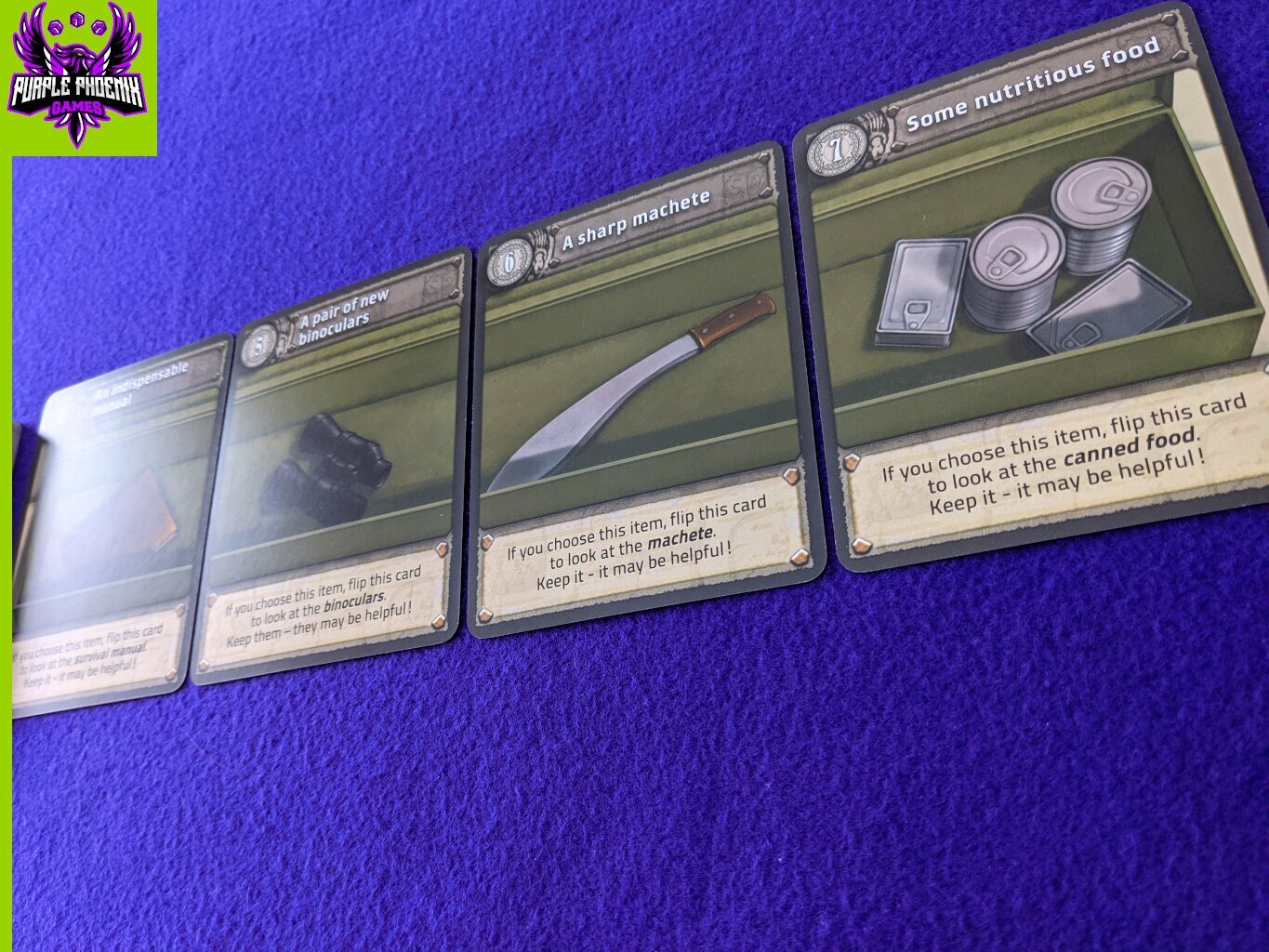
(Note: I usually add a messy components photo at the end of my reviews, but I don’t want to spoil anything, so I’ll just throw some cards down that won’t really ruin anything at all.)
Imagine yourself trapped on a jungle island after your plane crashes. Or being locked within a pyramid whilst visiting Egypt. These are the settings for the pair of games we reviewed and I really cannot and will not be going further into a lot of detail so as to avoid any spoilers as best I can.
DISCLAIMER: We were provided a copy of both The Curse of the Sphinx and The Mystery of Eldorado for the purposes of this review. These are retail copies of the games, so what you see in these photos is exactly what would be received in your boxes. I will describe the overall game flow and major rule set so that our readers may get a sense of how the game plays. For more info, you may purchase a copy online or from your FLGS. -T
To setup a game of Deckscape, open the box and take out the cards. You are now ready to play. Seriously. No rules to read. Nothing to teach others. Just read the top card and do as it says. You have now begun your adventure!
Playing the games involves players (or a solo player) encountering cards in the 60-card deck in order to solve puzzles and use items found to best finish the scenario. There are no turns in these games, and players are encouraged to discuss possibilities before committing to answers to the puzzles. Randy from Dora and the Lost City of Gold would be so happy to be figuring out “Jungle Puzzles” and “Pyramid Puzzles.”
Each card is either a puzzle or an item and each card will more than likely be encountered throughout the game. Players are trying to figure out the puzzle clues and best solve them. Incorrect guesses will result in costly errors that affect endgame scoring. Sometimes correct guesses will allow the players to erase errors or give other positive clues.
Once the players have made their way through the game solving puzzles and riddles they will consult the table at the end to see how well they scored. Usually time is of the essence, and finishing the games sooner is better than later. Once the game is over and the score tallied the game owner may gift the game away as the final result is known and replaying is kinda cheating.
Components. Okay, these games are small boxes full of large cards. There are 60 cards in each game and the cards are beautifully illustrated and laid out well. We had no problems reading anything or deciphering any part of the games, so thumbs up on components from us.
Gameplay is a little polarizing, we found. I like the flow of the game and puzzles within. My wife, however, couldn’t stand them. But she later admitted to now understanding that she just does not enjoy escape room styled board and card games. That said, these games play more like Choose Your Own Adventure games than the typical EXIT/Unlock style games, as most (if not all) cards in Deckscape require players to complete them before moving to the next card in numerical order with either a success or penalty. This can rub players the wrong way if they are used to the other style of escape room games. It was no problem for me, and I enjoyed my plays.
What I liked most about these games is that the story is easy to follow and the puzzles mostly make logical sense. A few of them stumped me, but luckily players may find helper cards to give clues to puzzles in the game. We relied on these helpers a few times, but I did not feel like we were consulting them for every puzzle. So that’s a definite positive. I also liked the thematic immersion. For a card game I felt drawn into the stories and wanted to complete them as well as I could.
What I disliked most about these games is the fact that you end up encountering every card or nearly every card. The intrigue of other escape room games I have played is wondering what was on some of those other cards. Or what did I miss on a card that I should have noticed? While you get SOME of that here, I found Deckscape to be more entry-level in difficulty. That is certainly not a bad thing for most gamers. We were expecting something different than what we played, and I think that unfortunately immediately put us off at first.
However, I played the second game solo and I liked it quite a bit. I think I mostly liked it because I didn’t have my wife around to figure out the puzzles with me and I was truly all alone. This added to my anxiety to finish well, or finish at all! I definitely cannot see myself playing these games with the full compliment of six players as I feel I would be too overwhelmed with people shouting out their guesses and trying to parse everything. But that’s just me. I prefer these with low player counts.
All in all these games are pretty good, and a decent something different from the other games in the same style. If you have yet to try Deckscape and like escape room games in general, I reccomend you give them a try. They are quick (and even quicker as your goal is finish in a short amount of time for the best scores), easy to play with zero teaching and setup time, and gives a great amount of puzzles to decipher. Purple Phoenix Games gives the Deckscape system of games an unsure-but-you-seem-confident-about-your-answer-so-let’s-just-go-with-yours 6 / 12. If you see them on the shelves pick one up and try it out. Add these to your growing collection of escape room games for show, or play them and pass them along, as I intend to do.
(Note: I usually add a messy components photo at the end of my reviews, but I don’t want to spoil anything, so I’ll just throw some cards down that won’t really ruin anything at all.)

Purple Phoenix Games (2266 KP) rated Soul Raiders in Tabletop Games
Jul 5, 2021
Check out that cover art! Amazing! If there is one thing that will certainly help my enjoyment of any game, it is definitely great art and components. Yes, I want the game to play well, but if it also looks great, that merely sends it soaring for me. While Soul Raiders has great art in spades, will I equally love the gameplay? Spoiler: yeah, it’s a pretty good game!
Soul Raiders is a storytelling role-playing game for up to four players. Each player takes the role of an aspiring Soul Raider tasked with saving the realms from the influence of evil. The game is played over several sessions that all affect the overarching plot of the narrative, but this preview version simply allows players to learn the game mechanics through a prologue scenario.
DISCLAIMER: We were provided a prototype copy of this game for the purposes of this review. These are preview copy components, and I do not know for sure which final components will be different from these shown. Also, it is not my intention to detail every rule in the game, as there are just too many. You are invited to download the rulebook, back the game through the Kickstarter campaign, or through any retailers stocking it after fulfillment. -T
To setup, follow the instructions in the rulebook. There are too many to list here. Once setup, the play area may look similar to the photo below.
As there are 36 pages in the preliminary rulebook, I am unable to detail everything in this preview. However, I can give an overall gameplay feeling.
Players control pawns (standees in this version, but plastic minis in the final) that will adventure on Location tiles that spawn baddies, traps, and other elements. Each round played has no turn structure; players can take their actions however they like in any order, and sometimes players will take actions simultaneously. Once all players have taken their actions, the baddies will attack (though some attack immediately upon spawning in a Location as well).
Combat is resolved through clever chaining card play. The cards drawn to the players’ hand are multi-use and can be combined with others in hand to pull off complex combos. All players will have access to melee combat cards, movement cards, and also magic spell cards. Utilizing the cards efficiently, as well as leveraging each players’ inherent strengths, can make or break combats and skill checks throughout the game.
In addition to the myriad combats players will face, they will also be able to encounter events, special characters, and traps. Many times these will result in skill checks or other card shedding activities in order to progress the story.
Throughout the game a tracker board constantly keeps players aware of the current vitae of the party (collective health), threat level, and active events. Players will also be using personalized player boards to keep track of their deck of cards, active engaged enemies, and status tokens. Each character has special talents different from each other, and the final game will have at least four characters, whereas this version has two.
If the players can navigate the game efficiently and quickly enough to satisfy the win conditions, then victory is to be shared. However, if you, like me, are still trying to figure out how to win, the game ships with an interesting session saving ability so you can pick up where you left off with any combination of players and characters.
Components. Again, this is a preview copy of the game, and not everything is final. That said, I can see the direction this game is going, and if it results in a successful Kickstarter campaign, I foresee me praising the publisher for their excellent components. Most of the art seems complete, and the character art is so amazing. In contrast, I feel the landscape art doesn’t necessarily match the intensity and details given in the character art. It just feels out of place in an otherwise excellently-illustrated game.
The gameplay, however, felt very fresh and familiar at the same time. I have played several games where the players’ card decks offer multi-use cards in much the same fashion, and here in Soul Raiders, the cards can be played for their numeric values or their special abilities. What I like about this is the ability to use the cards in hand to pull off sweeping combos of insane damage, or to really nail the lockpicking difficulty checks. There will be times the heroes will need to be engaged in combat with four or more enemies, and having certain spells that can wipe out most of them with one card is always very satisfying.
Movement has largely been neglected in my plays of Soul Raiders, as I haven’t found a great way to make it sing as a card type. Players will need to use movement to travel from one Location card to others, but there are also mechanics in place for the heroes to flee away from battles. I have yet to feel the need to flee from battle. I also have yet to truly understand the need for a big selling point for the game – character invisibility. Yes, I can see how being invisible would be a great benefit, but I rarely had the ability cards in hand to use it properly or effectively. I am told, though, that the game will ship with both a normal character mini and a transparent mini to indicate when they are invisible. So there’s that.
All in all I really do enjoy the storytelling gameplay of Soul Raiders. I think this intro prologue scenario has piqued my interest and triggered my desire to play more in the story. I hope that some adjustments will be made to make invisibility and fleeing more important aspects of the game, but for now I am ignoring them almost systematically. That said, if you are looking for a new game with a great theme and some pretty good mechanics, I invite you to check out the Kickstarter campaign launching very soon. I think this would be a great one to have in a collection, especially as I can see it being infinitely expandable with new books of scenarios and small expansion packs with new heroes, etc.
Soul Raiders is a storytelling role-playing game for up to four players. Each player takes the role of an aspiring Soul Raider tasked with saving the realms from the influence of evil. The game is played over several sessions that all affect the overarching plot of the narrative, but this preview version simply allows players to learn the game mechanics through a prologue scenario.
DISCLAIMER: We were provided a prototype copy of this game for the purposes of this review. These are preview copy components, and I do not know for sure which final components will be different from these shown. Also, it is not my intention to detail every rule in the game, as there are just too many. You are invited to download the rulebook, back the game through the Kickstarter campaign, or through any retailers stocking it after fulfillment. -T
To setup, follow the instructions in the rulebook. There are too many to list here. Once setup, the play area may look similar to the photo below.
As there are 36 pages in the preliminary rulebook, I am unable to detail everything in this preview. However, I can give an overall gameplay feeling.
Players control pawns (standees in this version, but plastic minis in the final) that will adventure on Location tiles that spawn baddies, traps, and other elements. Each round played has no turn structure; players can take their actions however they like in any order, and sometimes players will take actions simultaneously. Once all players have taken their actions, the baddies will attack (though some attack immediately upon spawning in a Location as well).
Combat is resolved through clever chaining card play. The cards drawn to the players’ hand are multi-use and can be combined with others in hand to pull off complex combos. All players will have access to melee combat cards, movement cards, and also magic spell cards. Utilizing the cards efficiently, as well as leveraging each players’ inherent strengths, can make or break combats and skill checks throughout the game.
In addition to the myriad combats players will face, they will also be able to encounter events, special characters, and traps. Many times these will result in skill checks or other card shedding activities in order to progress the story.
Throughout the game a tracker board constantly keeps players aware of the current vitae of the party (collective health), threat level, and active events. Players will also be using personalized player boards to keep track of their deck of cards, active engaged enemies, and status tokens. Each character has special talents different from each other, and the final game will have at least four characters, whereas this version has two.
If the players can navigate the game efficiently and quickly enough to satisfy the win conditions, then victory is to be shared. However, if you, like me, are still trying to figure out how to win, the game ships with an interesting session saving ability so you can pick up where you left off with any combination of players and characters.
Components. Again, this is a preview copy of the game, and not everything is final. That said, I can see the direction this game is going, and if it results in a successful Kickstarter campaign, I foresee me praising the publisher for their excellent components. Most of the art seems complete, and the character art is so amazing. In contrast, I feel the landscape art doesn’t necessarily match the intensity and details given in the character art. It just feels out of place in an otherwise excellently-illustrated game.
The gameplay, however, felt very fresh and familiar at the same time. I have played several games where the players’ card decks offer multi-use cards in much the same fashion, and here in Soul Raiders, the cards can be played for their numeric values or their special abilities. What I like about this is the ability to use the cards in hand to pull off sweeping combos of insane damage, or to really nail the lockpicking difficulty checks. There will be times the heroes will need to be engaged in combat with four or more enemies, and having certain spells that can wipe out most of them with one card is always very satisfying.
Movement has largely been neglected in my plays of Soul Raiders, as I haven’t found a great way to make it sing as a card type. Players will need to use movement to travel from one Location card to others, but there are also mechanics in place for the heroes to flee away from battles. I have yet to feel the need to flee from battle. I also have yet to truly understand the need for a big selling point for the game – character invisibility. Yes, I can see how being invisible would be a great benefit, but I rarely had the ability cards in hand to use it properly or effectively. I am told, though, that the game will ship with both a normal character mini and a transparent mini to indicate when they are invisible. So there’s that.
All in all I really do enjoy the storytelling gameplay of Soul Raiders. I think this intro prologue scenario has piqued my interest and triggered my desire to play more in the story. I hope that some adjustments will be made to make invisibility and fleeing more important aspects of the game, but for now I am ignoring them almost systematically. That said, if you are looking for a new game with a great theme and some pretty good mechanics, I invite you to check out the Kickstarter campaign launching very soon. I think this would be a great one to have in a collection, especially as I can see it being infinitely expandable with new books of scenarios and small expansion packs with new heroes, etc.
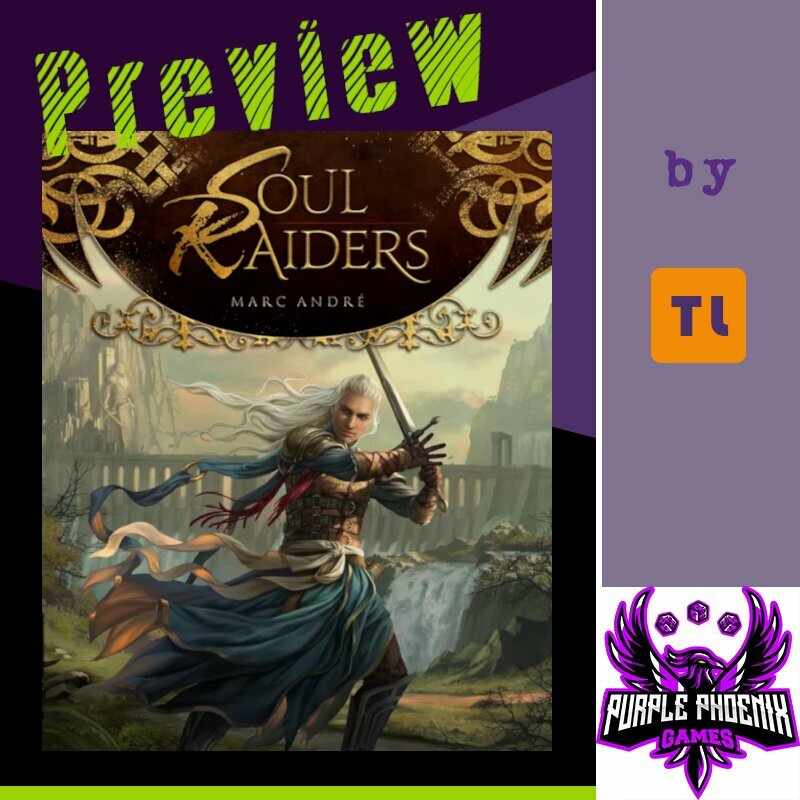
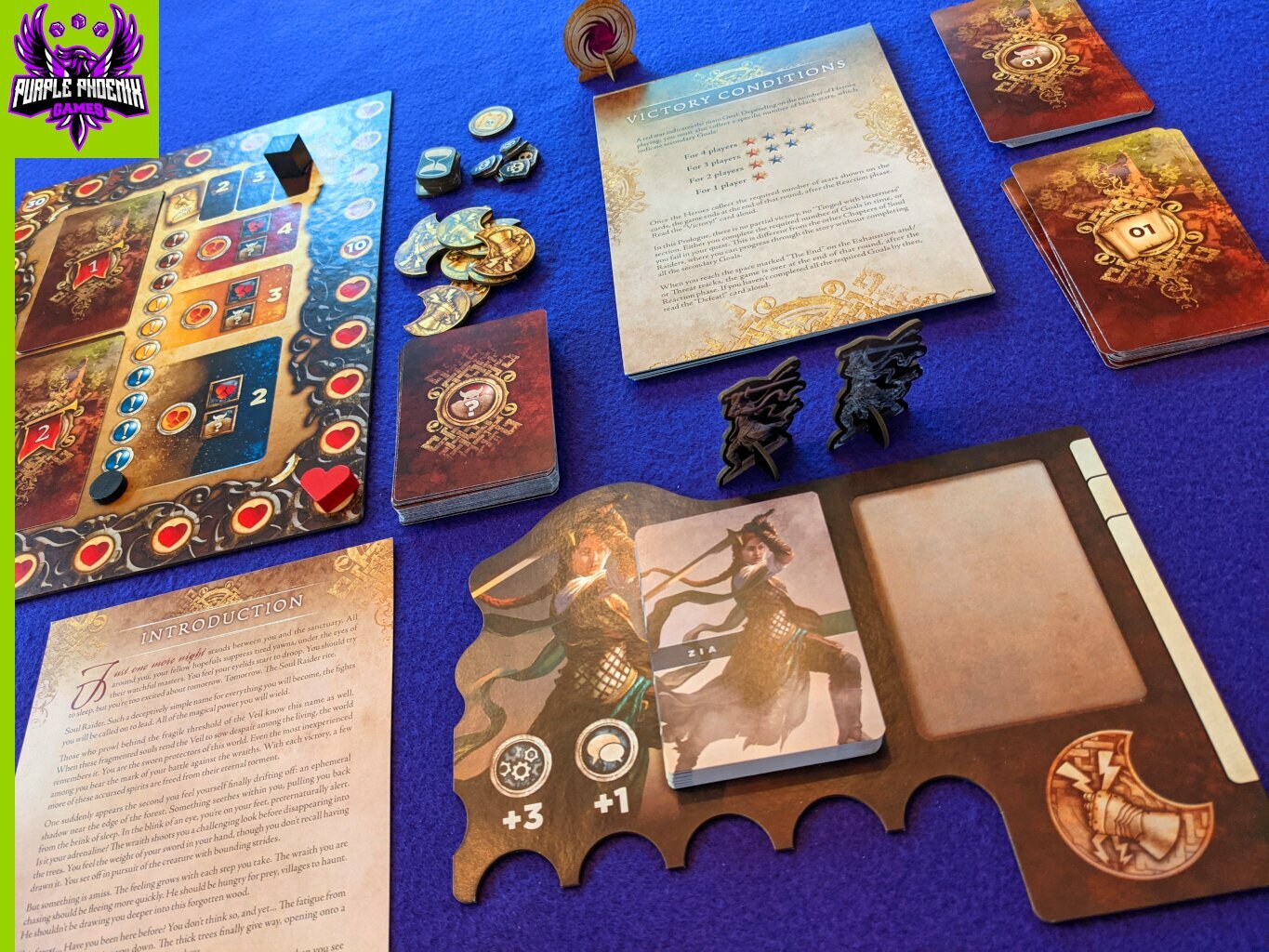
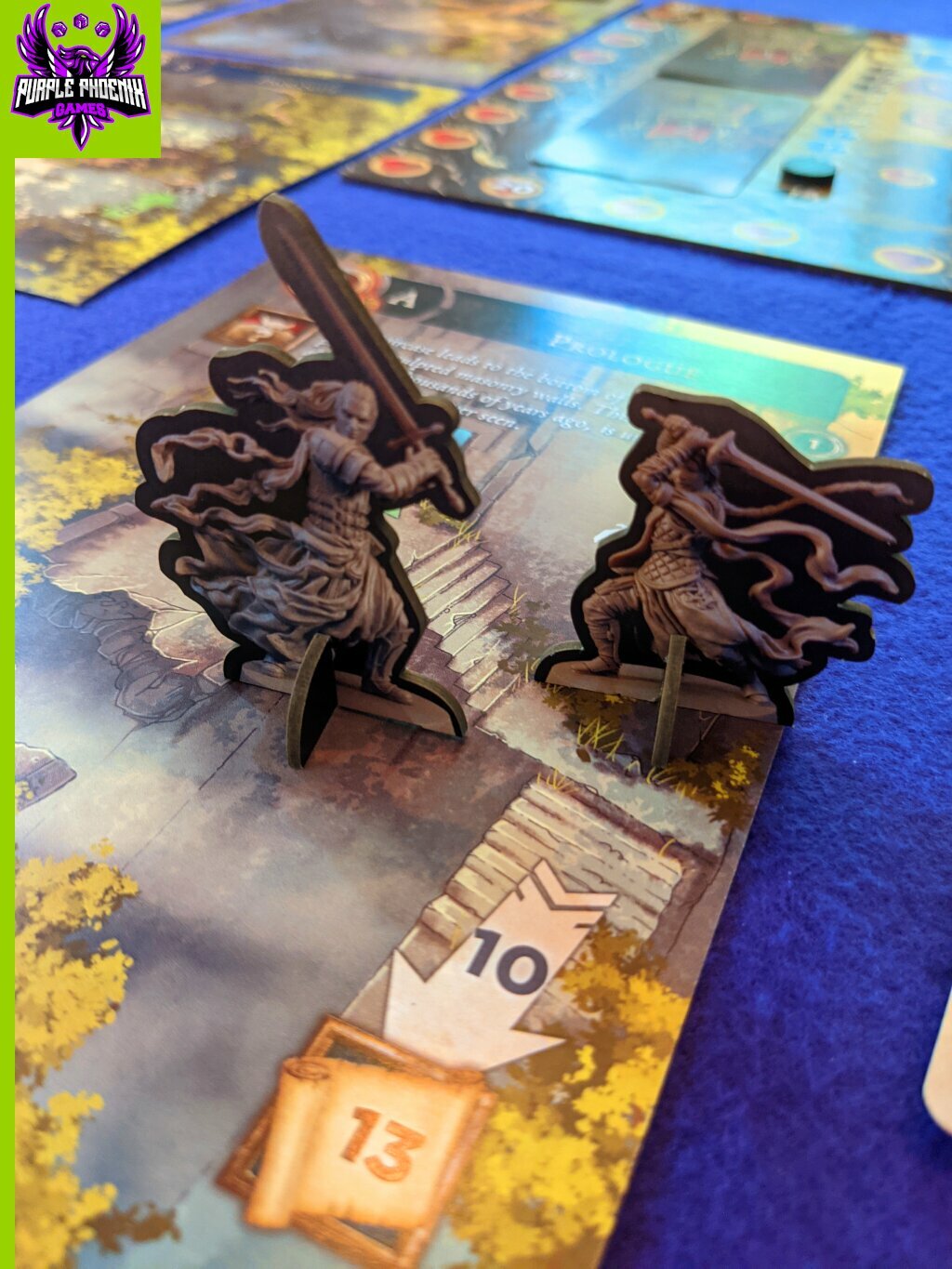
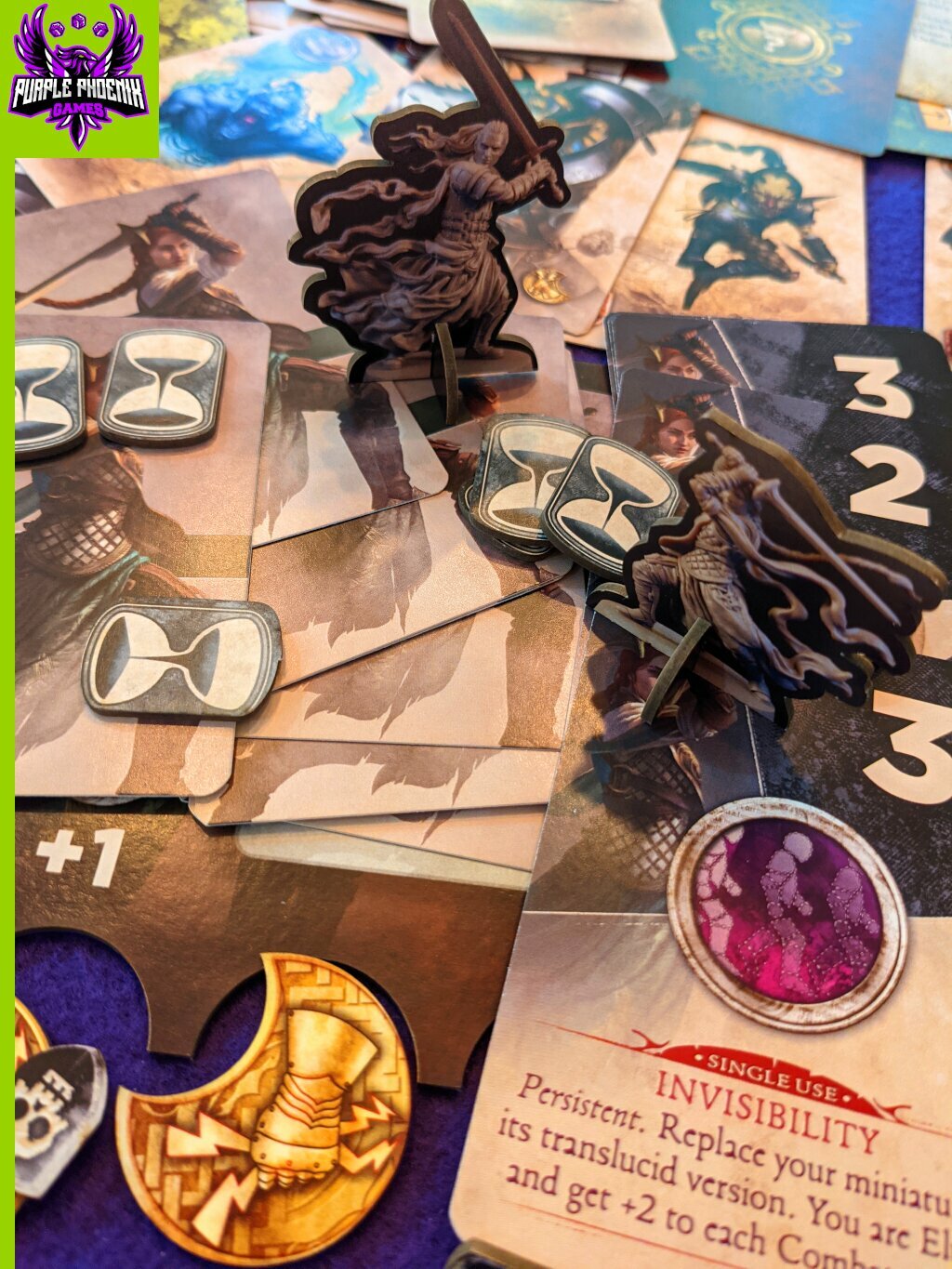
Purple Phoenix Games (2266 KP) rated Dirt Dog in Tabletop Games
Oct 22, 2020


My family is a dog family. Growing up I was lucky to live with a Lhasa Apso named Sasha, and a Jack Russell Terrier named Casey. They were both great dogs to grow up with, and since being with my wife we have added a Yorkshire Terrier named Millie and a Powderpuff Chinese Crested named Mojo (who now lives with Laura). So when I saw a game named Dirt Dog that had cute art and was looking for previews, I knew I had to check it out. I mean, my dogs were ALWAYS dirty, so this should be a cinch, right?
Dirt Dogs is a two or four player game where each side will be building an obstacle course through which the other side will run down a quarry animal. The obstacle course is a series of cards with icons needed to satisfy in order to pass, and each dog runner will have stats that correspond to these challenges that can also be manipulated with additional card play.
DISCLAIMER: We were provided a prototype copy of this game for the purposes of this review. These are preview copy components, and I do not know for sure if the final components will be different from these shown. You are invited to back the game through the Kickstarter campaign, or purchase through any retailers stocking it after fulfillment. -T
To setup, set aside the Entrance and Quarry cards from the large deck of brown-backed Burrow cards. Shuffle the Burrow cards to form a draw deck, and shuffle the gold-backed Obedience cards into their own pile. Each player (or team, but for this preview I will be reviewing from a two-player game perspective) will choose a dog breed card to use and place it in front of themselves. The icon on the bottom right hand side of the dog card signifies Moxie and an amount of Moxie tokens (bones) will be collected for use by the player. Reveal and place in an offer 12 Obedience cards to be drafted by the players. During the first round of play one player will be the builder and the other will be the first runner. Each player will draw five Burrow cards to begin and the game may now commence!
Dirt Dog will last three or more rounds (depending on what the players decide) and each round will have the roles of first builder and runner reversed. The builder will assemble an obstacle course of Burrow cards from their hand along with an Entrance to get in and a Quarry at the end. The cards are multipurpose in that the right side of the card lists obstacle tests the dogs will need to meet or surpass in order to clear it, and the left side includes icons that can be used by the runner player to assist their dog in a successful run. Similarly, Obedience cards may be played during the run to help overcome a particularly difficult obstacle, but then it will be unavailable for use to build the subsequent Burrow course.
Once a course has been decided and placed before the runner, they will analyze the tests on each card encountered and use their dog stats in addition to any cards they would like to play from hand. Should a runner successfully complete a course and capture the Quarry at the end they will collect the Quarry card and immediately add Dachshund tokens (weineeples?) to increase their stats per the card for the rest of the game.
Players then switch roles and whichever player ends the round with the most remaining Moxie will win the round and collect the Round Winner token (black animeeple because I can’t make out which breed it might be) notating such. The winner is the player who collected the most Round Winner tokens at the end of the three (or more) rounds!
Components. Again, this is a prototype copy of the game, and as such the components will not be exactly as shown in these photos. That said, for a prototype copy, the components are pretty decent! The cards are all nice, and the art on them is suuuuper cute. The layout of the cards is ok, and the iconography is easy to understand. The tokens and different -eeples are wonderful, though those may be different in the final version. It all depends on Kickstarter success though, folks, so you know the drill with backing games.
Dirt Dog reminds me of a couple games I have played, or at least certain mechanics. The building of the burrow runs reminds me of Boss Monster dungeon building as you are trying to foil the runner’s progress, but they can also use cards from hand to help overcome the obstacles. Also, many games now are including multi-use cards in the design, and I absolutely love it. Having to really determine the best use for a card – now during my run, or later to build a run for my opponent – is a wonderful layer that I enjoy. Of course building up a character’s stats is a mechanic I wish more games used. I mean, what’s the best part about playing RPGs? It’s level-up day!
This one is very cute to play and is quite light. I may have found a winning dog to use every time, but I will not spoil that for you. If it seems to become a problem in your plays, I suggest just removing that dog from those available to help overcome that. Remember – the winner of the round is the dog that ends the round with the most Moxie. That said, I still very much enjoy Dirt Dog. The art is great, features at least one of my previous breeds, and leaves itself open for expansions of new breeds and obstacles to be added later.
If you are looking for a cute dog-themed game with light rules and pretty good replayability, I suggest you check out Dirt Dog. It’s a fun and quick little card game that you can even play with AP-prone gamers as the choices are not necessarily do-or-die. Plus, enjoy the art along the way. It’s very nice. You are invited to back the game on Kickstarter that launches soon! Tell them Purple Phoenix Games sent you or I’ll sick a Jack Russell on your yard to dig dig dig until they wear themselves out. At least, that’s what MY JRT used to do…
Dirt Dogs is a two or four player game where each side will be building an obstacle course through which the other side will run down a quarry animal. The obstacle course is a series of cards with icons needed to satisfy in order to pass, and each dog runner will have stats that correspond to these challenges that can also be manipulated with additional card play.
DISCLAIMER: We were provided a prototype copy of this game for the purposes of this review. These are preview copy components, and I do not know for sure if the final components will be different from these shown. You are invited to back the game through the Kickstarter campaign, or purchase through any retailers stocking it after fulfillment. -T
To setup, set aside the Entrance and Quarry cards from the large deck of brown-backed Burrow cards. Shuffle the Burrow cards to form a draw deck, and shuffle the gold-backed Obedience cards into their own pile. Each player (or team, but for this preview I will be reviewing from a two-player game perspective) will choose a dog breed card to use and place it in front of themselves. The icon on the bottom right hand side of the dog card signifies Moxie and an amount of Moxie tokens (bones) will be collected for use by the player. Reveal and place in an offer 12 Obedience cards to be drafted by the players. During the first round of play one player will be the builder and the other will be the first runner. Each player will draw five Burrow cards to begin and the game may now commence!
Dirt Dog will last three or more rounds (depending on what the players decide) and each round will have the roles of first builder and runner reversed. The builder will assemble an obstacle course of Burrow cards from their hand along with an Entrance to get in and a Quarry at the end. The cards are multipurpose in that the right side of the card lists obstacle tests the dogs will need to meet or surpass in order to clear it, and the left side includes icons that can be used by the runner player to assist their dog in a successful run. Similarly, Obedience cards may be played during the run to help overcome a particularly difficult obstacle, but then it will be unavailable for use to build the subsequent Burrow course.
Once a course has been decided and placed before the runner, they will analyze the tests on each card encountered and use their dog stats in addition to any cards they would like to play from hand. Should a runner successfully complete a course and capture the Quarry at the end they will collect the Quarry card and immediately add Dachshund tokens (weineeples?) to increase their stats per the card for the rest of the game.
Players then switch roles and whichever player ends the round with the most remaining Moxie will win the round and collect the Round Winner token (black animeeple because I can’t make out which breed it might be) notating such. The winner is the player who collected the most Round Winner tokens at the end of the three (or more) rounds!
Components. Again, this is a prototype copy of the game, and as such the components will not be exactly as shown in these photos. That said, for a prototype copy, the components are pretty decent! The cards are all nice, and the art on them is suuuuper cute. The layout of the cards is ok, and the iconography is easy to understand. The tokens and different -eeples are wonderful, though those may be different in the final version. It all depends on Kickstarter success though, folks, so you know the drill with backing games.
Dirt Dog reminds me of a couple games I have played, or at least certain mechanics. The building of the burrow runs reminds me of Boss Monster dungeon building as you are trying to foil the runner’s progress, but they can also use cards from hand to help overcome the obstacles. Also, many games now are including multi-use cards in the design, and I absolutely love it. Having to really determine the best use for a card – now during my run, or later to build a run for my opponent – is a wonderful layer that I enjoy. Of course building up a character’s stats is a mechanic I wish more games used. I mean, what’s the best part about playing RPGs? It’s level-up day!
This one is very cute to play and is quite light. I may have found a winning dog to use every time, but I will not spoil that for you. If it seems to become a problem in your plays, I suggest just removing that dog from those available to help overcome that. Remember – the winner of the round is the dog that ends the round with the most Moxie. That said, I still very much enjoy Dirt Dog. The art is great, features at least one of my previous breeds, and leaves itself open for expansions of new breeds and obstacles to be added later.
If you are looking for a cute dog-themed game with light rules and pretty good replayability, I suggest you check out Dirt Dog. It’s a fun and quick little card game that you can even play with AP-prone gamers as the choices are not necessarily do-or-die. Plus, enjoy the art along the way. It’s very nice. You are invited to back the game on Kickstarter that launches soon! Tell them Purple Phoenix Games sent you or I’ll sick a Jack Russell on your yard to dig dig dig until they wear themselves out. At least, that’s what MY JRT used to do…
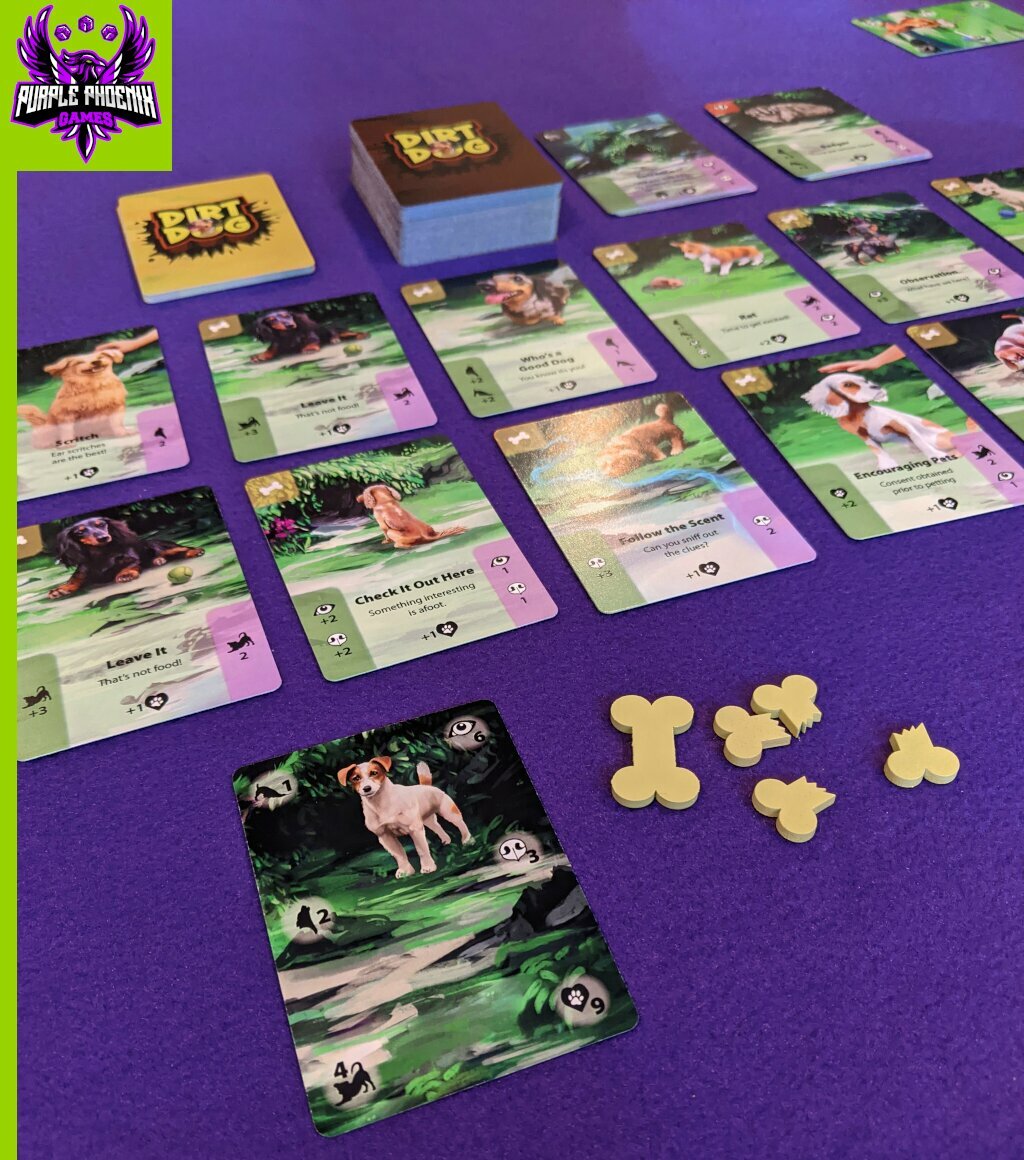

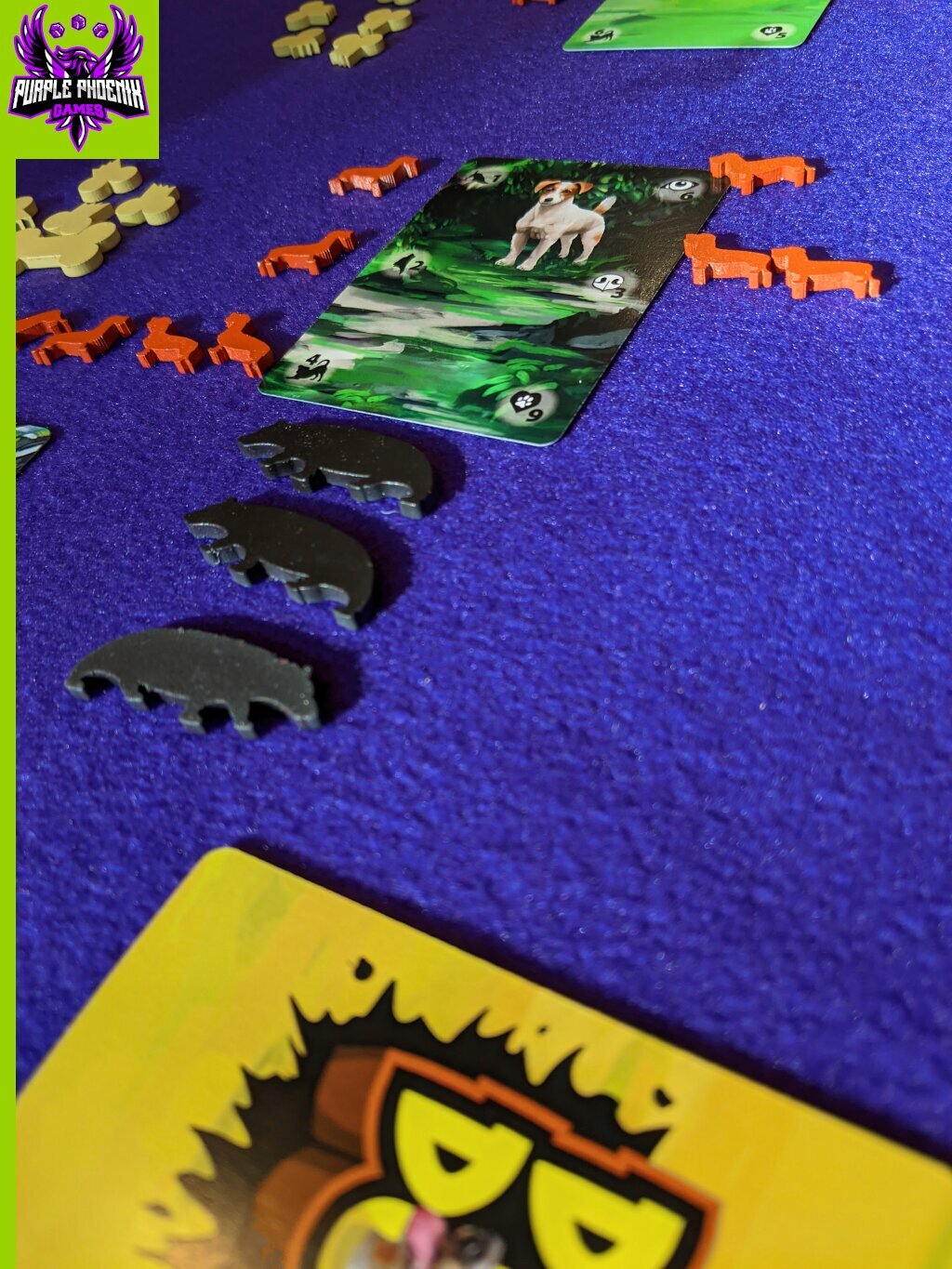
Purple Phoenix Games (2266 KP) rated Dungeon Academy in Tabletop Games
Dec 8, 2020
Roll-and-write style games have come a really long way over the past couple years. In the olden days we had Yahtzee, and that satisfied us. But then designers began dusting off that olde mechanic and breathing new life into it. While roll-and-write may never become my favorite mechanic, I am starting to appreciate the good ones more and more each time I play them. Dungeon Academy is one of these good games.
In Dungeon Academy players are taking the roles of students attempting their finals to become graduated warriors and mages in the land. They must pass their tests though, and that entails surviving through the dreaded Dungeon four times and surpassing all opponents to receive their degree.
DISCLAIMER: We were provided a copy of this game for the purposes of this review. This is a retail copy of the game, so what you see in these photos is exactly what would be received in your box. I do not intend to cover every single rule included in the rulebook, but will describe the overall game flow and major rule set so that our readers may get a sense of how the game plays. For more in depth rules, you may purchase a copy online or from your FLGS. -T
To setup a solo game of Dungeon Academy, assemble the Dungeon component per the instructions. The player is dealt a character card with a special ability and markers to track Health and Mana throughout the game. Pile the Health and Mana tokens on the table, shuffle the Loot cards into a deck, and place the Teacher pawn nearby. Grab the pad of paper and pen and you are ready to begin.
Each attempt in the Dungeon will require the 16 Base Dice to be rolled and set inside the Dungeon. It is then flipped upside down when the timer begins and the mad dash to the Exit commences. As the player marks a line through every “room” (each die is considered a “room” in the Dungeon) they create a path to be checked at the end of the round. Once the player has made it through the Dungeon satisfactorily the Teacher will check the path.
The Teacher pawn is now used to track movement in the Dungeon. As the player tracks the path they drew on the paper, the Teacher is moved through the rooms. In each room (each die face) will be one of these possible encounters: a Mana potion to refill an empty Mana space on the character card, a Health potion, a small red Blob, a small blue Ghost, a large red Colossus, or a large blue Reaper. Each small foe encountered will be overtaken by spending one Health or Mana token from the character card. Each potion will restore spent Health or Mana. Each large foe encountered will require two Health or Mana to be spent. As the Teacher follows the path set by the player, Health and Mana will be spent and replenished on the character card, and foes defeated tracked on the sheet.
Once complete, the player will add up all the points from defeated foes (1VP per foe) and any VP from special character abilities or Loot cards. Additionally, the player will choose one of the four Quests at the bottom of the sheet to score each round for extra VP. They write these numbers on the sheet and prepare for the next level. After four total levels the game ends and the total is compared to a scale in the rulebook.
Multiplayer Dungeon Academy works the exact same way except once a player exits the Dungeon, they must grab the lowest-numbered Exit card as representation of the place finished in the Dungeon (so the first one out grabs the 1 card, etc.). The other difference from solo play is that players all compare total VP at the game end to determine the winner.
Components. This game has a large scorepad of 150 double-sided sheets, a bunch of cards for Hero characters, Loot, and Exits, as well as 18 total dice, about a trillion double-sided Health/Mana tokens and an impressive cardboard Dungeon. Everything is of wonderful Matagot quality… except for the Duneon. In my copy the Dungeon does not stay together very well. I may attempt some glue to keep the parts down that need to stay down, but it is still functional and a great design. The art style across the game is cute and fun, and I like the muted bright color scheme. That feels so weird to say/type, but the colors are vibrant hues, but muted so they stay out of the way. It’s strange and I love it.
Speaking of I love it, I love this game! It is quickly becoming one of my favorite roll-and-write games, and I can play it solo. In about 15 minutes. These are all positives, and I haven’t even really touched on the gameplay. Being able to get through a light solo game in 15 minutes while having a great time throughout is an achievement, and one I would like to applaud here. I wasn’t really sure going into this if I was going to enjoy it, but it has blown me away. Trying to evaluate the best path through the Dungeon while keeping track of how the Health and Mana is always in flux gives my brain a welcomed workout that is just a breath of fresh air for me. I love the art style and the theme, and the simple but easy to understand iconography on the dice is much appreciated.
I think that if you are looking for or lacking a similar type game in your collection you should do yourself a favor and check out Dungeon Academy. It is super quick, easy to grasp and play, requires little table space, and is simply a great time alone or with your gamer friends and family. I know I am going to be tracking lots of plays with this one. I am going to have to find a place on my shelves at eye-level because I don’t want it to be overshadowed down at foot-level.
If you already enjoy roll-and-write games and want something a little different with a great theme, or you don’t have any roll-and-writes and want to check one out for the first time, or you simply cannot get enough games featuring great art about wizards in school check this one out. I recommend it.
In Dungeon Academy players are taking the roles of students attempting their finals to become graduated warriors and mages in the land. They must pass their tests though, and that entails surviving through the dreaded Dungeon four times and surpassing all opponents to receive their degree.
DISCLAIMER: We were provided a copy of this game for the purposes of this review. This is a retail copy of the game, so what you see in these photos is exactly what would be received in your box. I do not intend to cover every single rule included in the rulebook, but will describe the overall game flow and major rule set so that our readers may get a sense of how the game plays. For more in depth rules, you may purchase a copy online or from your FLGS. -T
To setup a solo game of Dungeon Academy, assemble the Dungeon component per the instructions. The player is dealt a character card with a special ability and markers to track Health and Mana throughout the game. Pile the Health and Mana tokens on the table, shuffle the Loot cards into a deck, and place the Teacher pawn nearby. Grab the pad of paper and pen and you are ready to begin.
Each attempt in the Dungeon will require the 16 Base Dice to be rolled and set inside the Dungeon. It is then flipped upside down when the timer begins and the mad dash to the Exit commences. As the player marks a line through every “room” (each die is considered a “room” in the Dungeon) they create a path to be checked at the end of the round. Once the player has made it through the Dungeon satisfactorily the Teacher will check the path.
The Teacher pawn is now used to track movement in the Dungeon. As the player tracks the path they drew on the paper, the Teacher is moved through the rooms. In each room (each die face) will be one of these possible encounters: a Mana potion to refill an empty Mana space on the character card, a Health potion, a small red Blob, a small blue Ghost, a large red Colossus, or a large blue Reaper. Each small foe encountered will be overtaken by spending one Health or Mana token from the character card. Each potion will restore spent Health or Mana. Each large foe encountered will require two Health or Mana to be spent. As the Teacher follows the path set by the player, Health and Mana will be spent and replenished on the character card, and foes defeated tracked on the sheet.
Once complete, the player will add up all the points from defeated foes (1VP per foe) and any VP from special character abilities or Loot cards. Additionally, the player will choose one of the four Quests at the bottom of the sheet to score each round for extra VP. They write these numbers on the sheet and prepare for the next level. After four total levels the game ends and the total is compared to a scale in the rulebook.
Multiplayer Dungeon Academy works the exact same way except once a player exits the Dungeon, they must grab the lowest-numbered Exit card as representation of the place finished in the Dungeon (so the first one out grabs the 1 card, etc.). The other difference from solo play is that players all compare total VP at the game end to determine the winner.
Components. This game has a large scorepad of 150 double-sided sheets, a bunch of cards for Hero characters, Loot, and Exits, as well as 18 total dice, about a trillion double-sided Health/Mana tokens and an impressive cardboard Dungeon. Everything is of wonderful Matagot quality… except for the Duneon. In my copy the Dungeon does not stay together very well. I may attempt some glue to keep the parts down that need to stay down, but it is still functional and a great design. The art style across the game is cute and fun, and I like the muted bright color scheme. That feels so weird to say/type, but the colors are vibrant hues, but muted so they stay out of the way. It’s strange and I love it.
Speaking of I love it, I love this game! It is quickly becoming one of my favorite roll-and-write games, and I can play it solo. In about 15 minutes. These are all positives, and I haven’t even really touched on the gameplay. Being able to get through a light solo game in 15 minutes while having a great time throughout is an achievement, and one I would like to applaud here. I wasn’t really sure going into this if I was going to enjoy it, but it has blown me away. Trying to evaluate the best path through the Dungeon while keeping track of how the Health and Mana is always in flux gives my brain a welcomed workout that is just a breath of fresh air for me. I love the art style and the theme, and the simple but easy to understand iconography on the dice is much appreciated.
I think that if you are looking for or lacking a similar type game in your collection you should do yourself a favor and check out Dungeon Academy. It is super quick, easy to grasp and play, requires little table space, and is simply a great time alone or with your gamer friends and family. I know I am going to be tracking lots of plays with this one. I am going to have to find a place on my shelves at eye-level because I don’t want it to be overshadowed down at foot-level.
If you already enjoy roll-and-write games and want something a little different with a great theme, or you don’t have any roll-and-writes and want to check one out for the first time, or you simply cannot get enough games featuring great art about wizards in school check this one out. I recommend it.
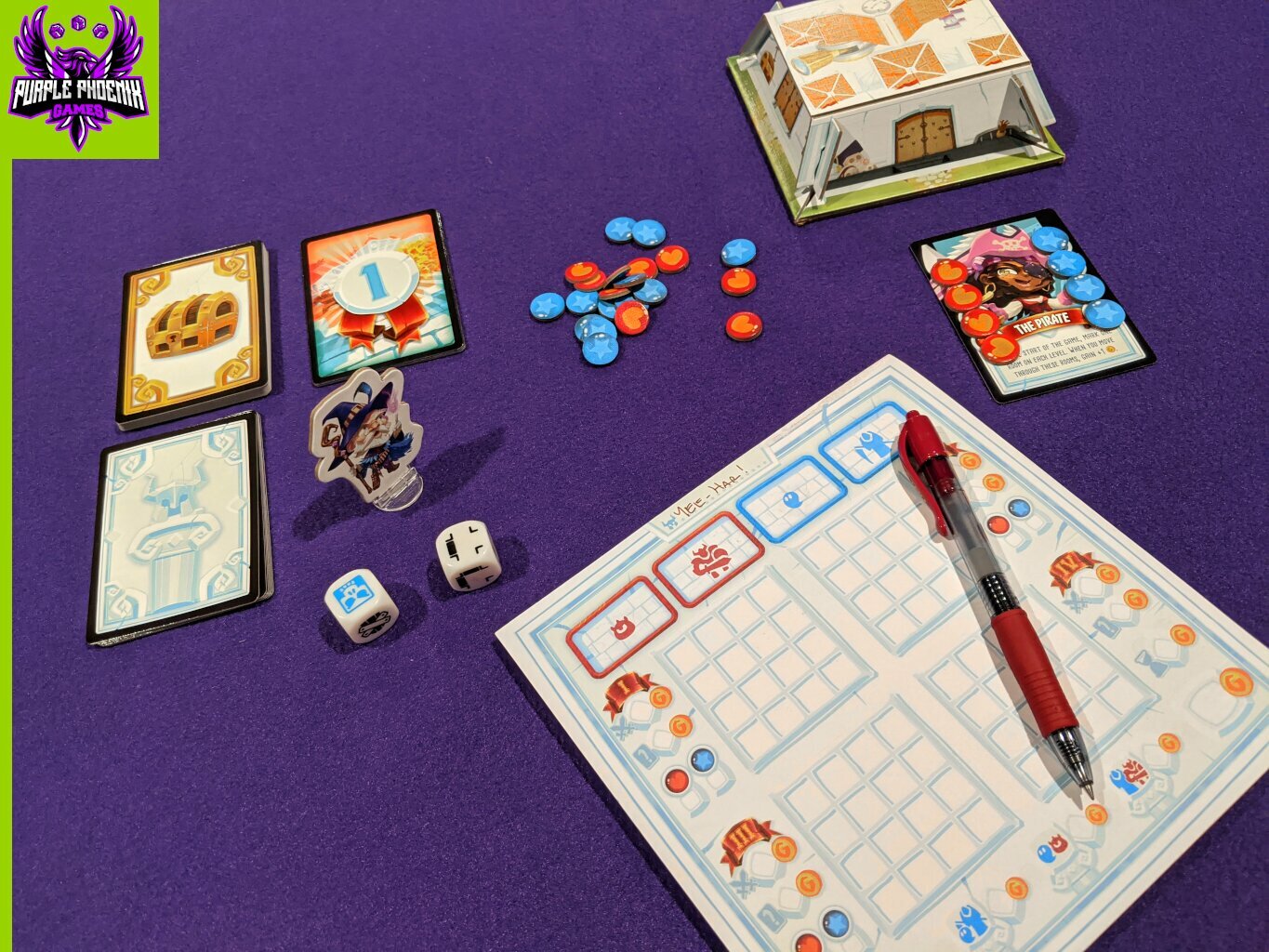
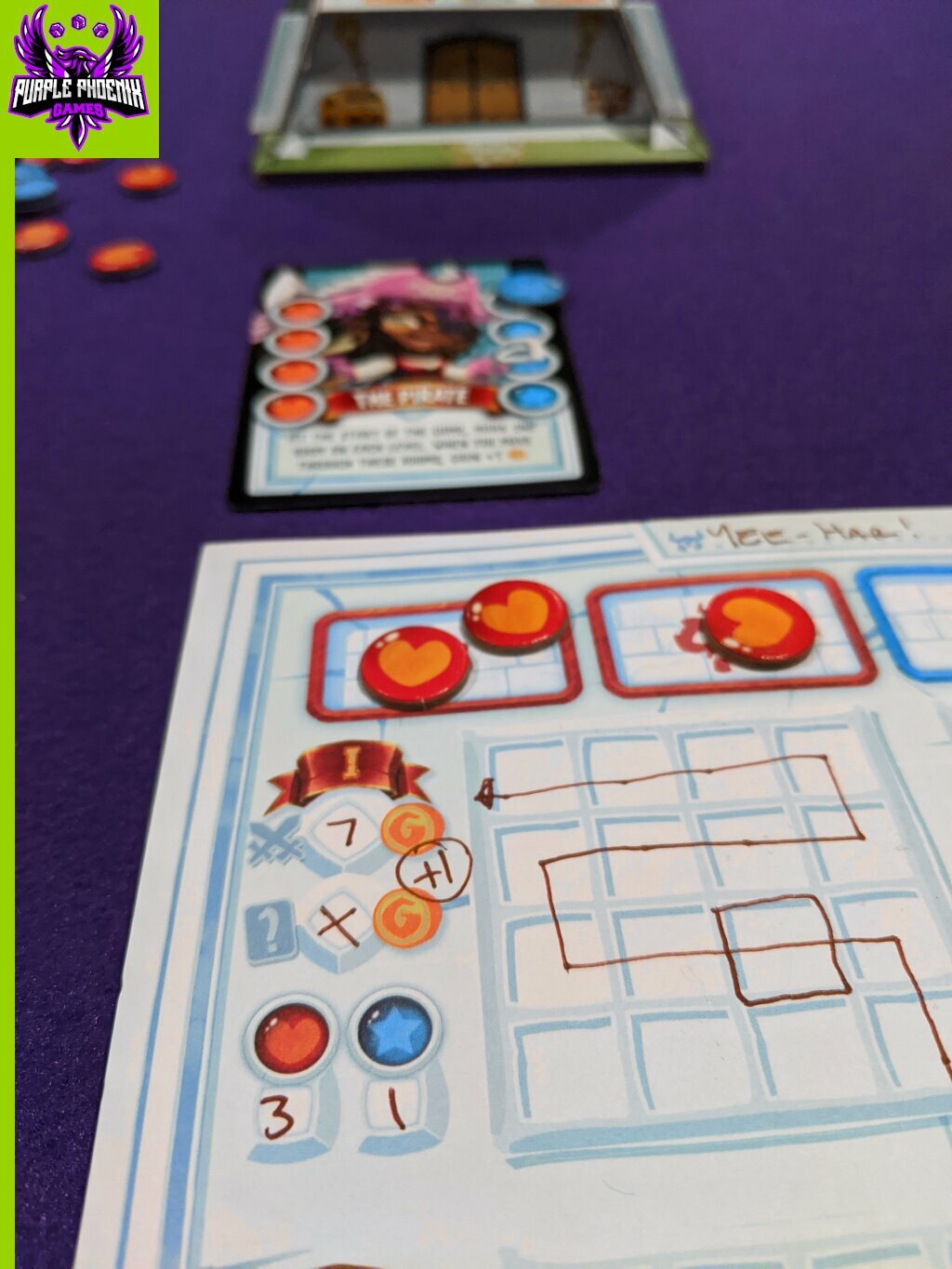
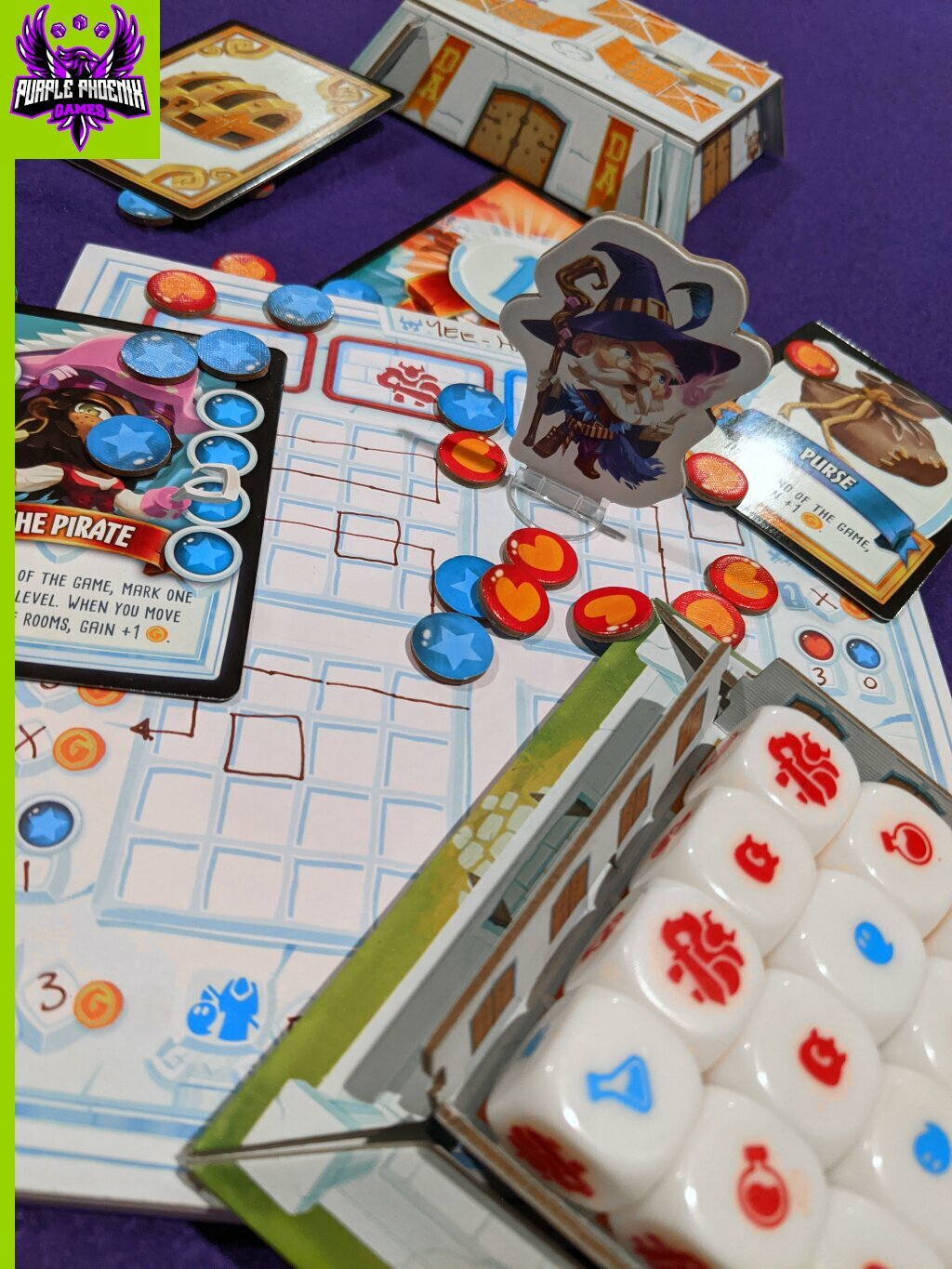

Gareth von Kallenbach (980 KP) rated It: Chapter Two (2019) in Movies
Sep 13, 2019

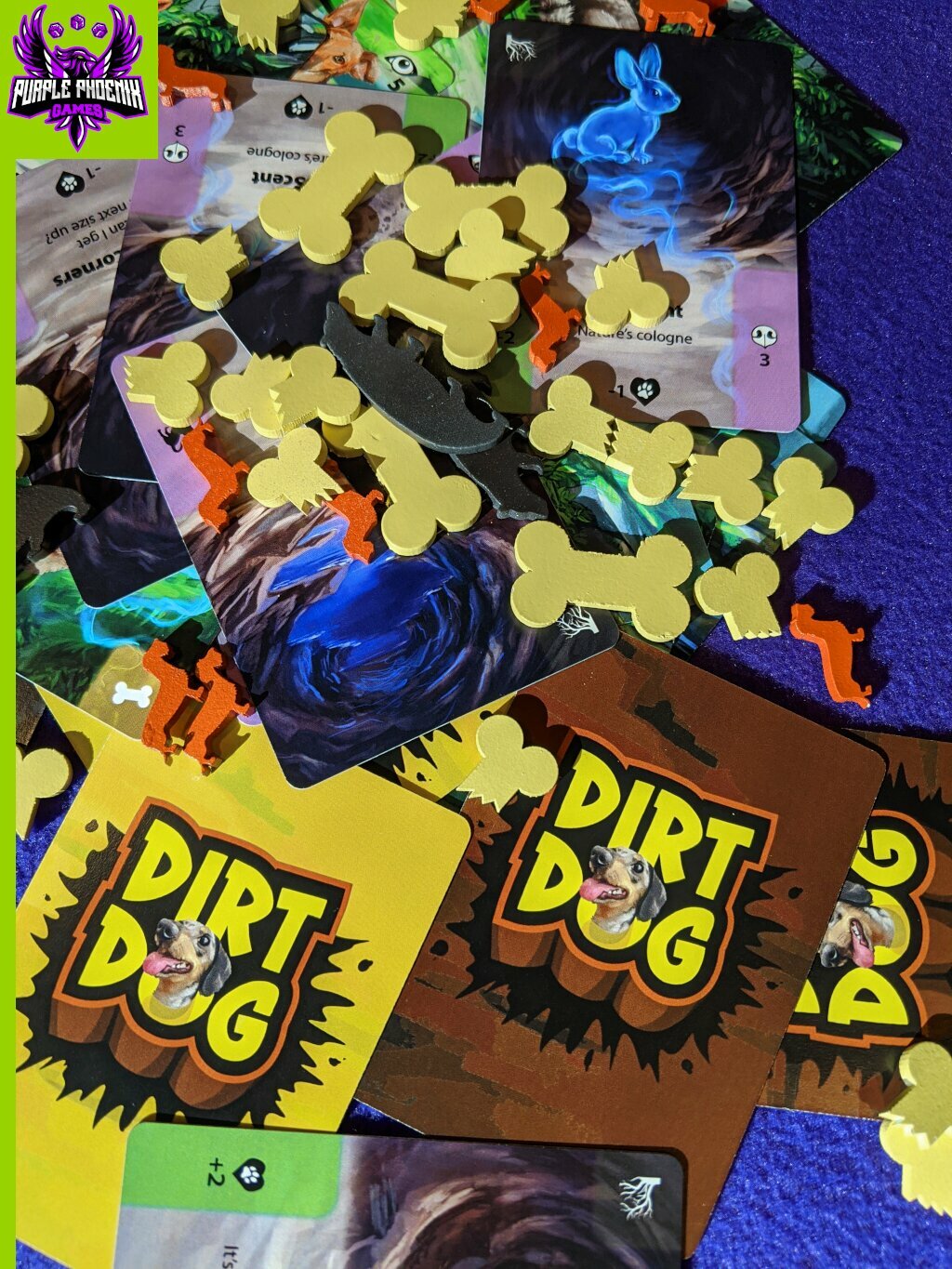
I’ve always been a fan of Stephen King movies, even some of those that were not particularly good or well received. For someone who is a fan you think that would inspire me to pick up at least one of his books to get a feel for what the author truly intended over the stripped down,
“Hollywood-ised” versions. I can’t put my finger on why I haven’t, it’s not because the size of many of his novels are daunting, it’s more that as a reader I’m just not a horror book fan. So when it comes to sitting in on a Stephen king movie I have to rely on the story by it’s modified merits then to compare and contrast what IT does well (or not).
Like many before me, my first movie experience of IT was the classic mini-series featuring an incredibly creepy (and non-CGI’d version) of Pennywise portrayed by the extremely talented Tim Curry.
I even went out and purchased the mini-series before I went to see the first chapter of the remake of IT, just to see how those two compared. IT: Chapter One introduced us in great depth to the teens of the original losers club. A group of misfits, who went on their own personal crusade to attack and kill the nefarious clown while saving one of their own. A strong pact was formed and an oath sworn that if IT ever returned to Derry that the group would once again join together to put a stop to IT for good.
IT: Chapter Two picks up 27 years later, the group has moved on with their lives, all except Mike (Isaiah Mustafa as an adult and Chosen Jacobs as a younger version) who has felt a sense of responsibility to watch over the town and research how to kill IT if IT were to ever return. A horrific killing of an adult at the fair and subsequent disappearances of children alert Mike that the plague that has befallen Derry for generations has returned to feed. Mike reaches out to each of the losers reminding them that something they have all feared has come to pass.
Each when notified experience a fear that is indescribable yet for some reason the groups memories of the past have become clouded.
The now adult losers (with several flashbacks featuring the original cast) come together to remind themselves of the past, and the pact they made to protect the future. Featuring a star studded cast, Mike, Bill (James McAvoy/Jaeden Martell), Beverly (Jessica Chastain/Sophia Lillis), Ben (Jay Ryan/Jeremy Ray Taylor), Richie (Bill Hader/Finn Wolfhard), Eddie (James Ransone/Jack Dylan Grazer) and Stanley (Andy Bean/Wyatt Oleff), must battle their lost memories, their fears and the very real danger if they are to save Derry and themselves.
IT: Chapter 2 continues the incredible character building that Chapter 1 began. Where each of the young actors were perfectly cast as their book counterparts, their adult versions could easily be mistaken for the grown-up versions. This is the area where IT shines the most, the story of the losers who have grown and moved away, yet still share the unescapable bond of friendship. While an older Bill struggles (much like Stephen King himself) to come up with good endings to his stories it’s what he writes at the end of IT: Chapter 2 that really sums up the movie as a whole. To summarize, there are no good friends or bad friends, there are only friends, and chapter 2 is an example of how you take a band of misfits and turn them into heroes.
Sadly, for all the things IT does from a character side, it tends to drag on and over CGI its monster side. Pennywise the clown (portrayed brilliantly by Bill Skarsgård) brings with him all the creepiness and fear that the movie needs, even posters of his maniacal self is promoting lawsuits in other countries due to his ability to scare small children. So, it seems a bit disheartening that the studio felt it was necessary to go overboard with their CGI budgets. Many scenes go from being creepy and scary to simply being silly when our favorite clown is turned into a giant naked hag like figure. This is where I felt the mini-series did a far better job, due to its limited budget and shorter time requirements it allowed for the viewers to imagine the evil and not see it thrown out for the world to see.
IT: Chapter 2 also drags out far longer than it needed to. Make sure you get your bathroom breaks in, because the film, not counting previews, is just about 10 minutes shy of being three hours. I’m normally not one to complain about the length of a movie, as I’d rather they tell the story they want instead of trying to compress it into a shorter run time. However, in this case, it seemed entirely wasted on an overabundance of clown mutations and an extremely drawn out final battle. It’s unfortunate, because one of the most unused (and potentially interesting characters) Henry Bowers (Teach Grant/Nicholas Hamilton) is given only a few minutes of screen time and ultimately adds nothing to the movie as a whole. As I stated earlier, I haven’t read the novel, but I have to assume that he played a far bigger role in the book.
As it stands in the movie, his character is both unnecessary and completely ineffective at whatever he was attempting to do. I think some of the time taken away from the battle scenes to flesh out his (or other supporting characters) would have be time better spent.
IT: Chapter 2 is a good movie, that with some reduced special effects and better time management is just shy of being a great movie. The story of the kids, now grown up, is one of forgiveness, bravery and love. It shows how true friendship can overcome distance and time and that those things never truly vanish, even if the particulars of what separated you in the first place is a bit fuzzy. Horror movies with outrageous budgets tend to lose the spirit of what makes a true horror movie scary…it’s rarely about the effects, and more about the imagination.
That’s what makes the books typically so much better than the movies, after all, each one of us imagines our own version of what truly scares us (although clowns tend to be scary regardless of how they are portrayed). IT: Chapter 2 provides a satisfying ending to a story that began a few years ago, it suffers a bit from its budget and its use of CGI effects, but it’s still a story of what all of us losers can accomplish if we band together.
“Hollywood-ised” versions. I can’t put my finger on why I haven’t, it’s not because the size of many of his novels are daunting, it’s more that as a reader I’m just not a horror book fan. So when it comes to sitting in on a Stephen king movie I have to rely on the story by it’s modified merits then to compare and contrast what IT does well (or not).
Like many before me, my first movie experience of IT was the classic mini-series featuring an incredibly creepy (and non-CGI’d version) of Pennywise portrayed by the extremely talented Tim Curry.
I even went out and purchased the mini-series before I went to see the first chapter of the remake of IT, just to see how those two compared. IT: Chapter One introduced us in great depth to the teens of the original losers club. A group of misfits, who went on their own personal crusade to attack and kill the nefarious clown while saving one of their own. A strong pact was formed and an oath sworn that if IT ever returned to Derry that the group would once again join together to put a stop to IT for good.
IT: Chapter Two picks up 27 years later, the group has moved on with their lives, all except Mike (Isaiah Mustafa as an adult and Chosen Jacobs as a younger version) who has felt a sense of responsibility to watch over the town and research how to kill IT if IT were to ever return. A horrific killing of an adult at the fair and subsequent disappearances of children alert Mike that the plague that has befallen Derry for generations has returned to feed. Mike reaches out to each of the losers reminding them that something they have all feared has come to pass.
Each when notified experience a fear that is indescribable yet for some reason the groups memories of the past have become clouded.
The now adult losers (with several flashbacks featuring the original cast) come together to remind themselves of the past, and the pact they made to protect the future. Featuring a star studded cast, Mike, Bill (James McAvoy/Jaeden Martell), Beverly (Jessica Chastain/Sophia Lillis), Ben (Jay Ryan/Jeremy Ray Taylor), Richie (Bill Hader/Finn Wolfhard), Eddie (James Ransone/Jack Dylan Grazer) and Stanley (Andy Bean/Wyatt Oleff), must battle their lost memories, their fears and the very real danger if they are to save Derry and themselves.
IT: Chapter 2 continues the incredible character building that Chapter 1 began. Where each of the young actors were perfectly cast as their book counterparts, their adult versions could easily be mistaken for the grown-up versions. This is the area where IT shines the most, the story of the losers who have grown and moved away, yet still share the unescapable bond of friendship. While an older Bill struggles (much like Stephen King himself) to come up with good endings to his stories it’s what he writes at the end of IT: Chapter 2 that really sums up the movie as a whole. To summarize, there are no good friends or bad friends, there are only friends, and chapter 2 is an example of how you take a band of misfits and turn them into heroes.
Sadly, for all the things IT does from a character side, it tends to drag on and over CGI its monster side. Pennywise the clown (portrayed brilliantly by Bill Skarsgård) brings with him all the creepiness and fear that the movie needs, even posters of his maniacal self is promoting lawsuits in other countries due to his ability to scare small children. So, it seems a bit disheartening that the studio felt it was necessary to go overboard with their CGI budgets. Many scenes go from being creepy and scary to simply being silly when our favorite clown is turned into a giant naked hag like figure. This is where I felt the mini-series did a far better job, due to its limited budget and shorter time requirements it allowed for the viewers to imagine the evil and not see it thrown out for the world to see.
IT: Chapter 2 also drags out far longer than it needed to. Make sure you get your bathroom breaks in, because the film, not counting previews, is just about 10 minutes shy of being three hours. I’m normally not one to complain about the length of a movie, as I’d rather they tell the story they want instead of trying to compress it into a shorter run time. However, in this case, it seemed entirely wasted on an overabundance of clown mutations and an extremely drawn out final battle. It’s unfortunate, because one of the most unused (and potentially interesting characters) Henry Bowers (Teach Grant/Nicholas Hamilton) is given only a few minutes of screen time and ultimately adds nothing to the movie as a whole. As I stated earlier, I haven’t read the novel, but I have to assume that he played a far bigger role in the book.
As it stands in the movie, his character is both unnecessary and completely ineffective at whatever he was attempting to do. I think some of the time taken away from the battle scenes to flesh out his (or other supporting characters) would have be time better spent.
IT: Chapter 2 is a good movie, that with some reduced special effects and better time management is just shy of being a great movie. The story of the kids, now grown up, is one of forgiveness, bravery and love. It shows how true friendship can overcome distance and time and that those things never truly vanish, even if the particulars of what separated you in the first place is a bit fuzzy. Horror movies with outrageous budgets tend to lose the spirit of what makes a true horror movie scary…it’s rarely about the effects, and more about the imagination.
That’s what makes the books typically so much better than the movies, after all, each one of us imagines our own version of what truly scares us (although clowns tend to be scary regardless of how they are portrayed). IT: Chapter 2 provides a satisfying ending to a story that began a few years ago, it suffers a bit from its budget and its use of CGI effects, but it’s still a story of what all of us losers can accomplish if we band together.