Search

Mothergamer (1652 KP) rated the PC version of Assassin's Creed: Odyssey in Video Games
Apr 3, 2019
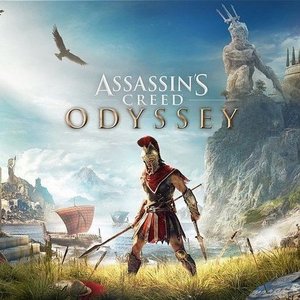


I love the Assassin's Creed series as past Mother Gamer blogs have shown. While there were a couple I wasn't so thrilled with, I have always enjoyed the stories and exploration the games have offered. The recent Origins definitely captured my heart with all the incredible ancient Egypt history and lore. When Odyssey was announced I was pretty excited because it was going to be set in ancient Greece and I could not wait to play it.
Odyssey is a bit different from its predecessors. The story is set at the beginning of the Peloponnesian war; an ongoing struggle between Sparta and Athens for dominion over Greece. This opens up a lot of interesting places to explore and dialogue options. At the beginning of the game you can choose which Misthios (mercenary) you want to play as; Alexios or his sister Kassandra. It really doesn't matter who you choose because the story is essentially the same for both so it's just a matter of whether or not you prefer to play as a man or a woman. For my first playthrough I went with Kassandra.
Kassandra starts her adventure.
Right from the start, Odyssey hooks you in with an action filled introduction and sets the scene for the story. After that you meet the character you chose; in my case Kassandra and you get a brief tutorial on how the gaming controls work. You also get a mount with this and those controls are pretty easy to navigate. Once you have the hang of it, you can get started on your journey with the main story and the vast amount of side quests.
This is where Odyssey differs a bit. There is more of a role playing aspect to the game with you being able to select different dialogue options while talking to people. You can choose to be cutthroat, a mercenary with a conscience, or ridiculously flirty. Yes, with some of the NPC characters be they men or women Kassandra could have flings with them. Don't worry, nothing overly graphic is shown, but it is definitely heavily implied. Your weapons are different as well. There is no assassin's blade here. You have a precursor artifact weapon in the form of a spear and the options of daggers and swords. You also have a bow and arrows which are quite useful for fighting at a distance.
Have a horse for your travels!
As you level up, you gain ability points which you can use to unlock certain skills to enhance your fighting and stealth from the following three categories in the skills menu: Hunter, Warrior, and Assassin. It is beneficial to unlock these because they are incredibly useful in battles against your enemies. There are also ship battles which bring back memories of Black Flag. The ship battles are challenging, but they are so much fun. You can upgrade your ship to make it a force to be reckoned with. Upgrading the hull is definitely a must so you can ram the heck out of other ships and take little to no damage. You need a crew also of course and Odyssey has an ability where rather than assassinating targets, you can knock them out and recruit them to join your crew.
Unlock abilities in the skills menu.
The running theme for your protagonist is all about family. This is where you are introduced to the mysterious villains, The Cult Of Kosmos who have a hand in much of the conflict in Greece all for power. You have to travel all over the world map to find clues about each cult member in order to reveal their true identity and the location of their main hideout. Once you have those, you can find them and take them out. Be wary however, some cult members are heavily guarded and quite the challenge to fight. This is where Odyssey's notoriety system comes in. The more crimes you commit i.e. murder (come on, you know that's what assassination is), the more likely it is that someone will put a bounty on your head. Then you find yourself relentlessly hunted by bounty hunters with very colorful names. The bounty hunters are no joke and if you do not plan out your strategy and tactics, they will end you. There were some who had lions and they would tag team the crap out of me which could be more than a little frustrating, but that's part of the challenge. Two ways around this are offing the person who put the bounty on your head or paying off the bounty. If you have the coin, you can pay the money and the bounty will go away.
Besides the main story, there are a ton of side quests and conquest missions to do. Sneaking around and taking out guards in a fort can be difficult, but rewarding as you take everyone out and diminish that nation's power. Looting the treasures, burning the supplies, and taking out the captains completes that area and will show you a meter with their power depleting. Once you have completely drained their influence, you get a conquest battle option. You get an epic battle between Spartans and Athenians and you have to take out all the captains during this battle in order to win the conquest. There were times where I totally screwed up and a guard saw me and then I had to brawl my way out among five or six of them. That was a whole other adventure in itself. It definitely raises the stakes when that happens and makes Odyssey feel like a whole new game.
Getting caught by guards sucks. Time to brawl my way out!
My favorite thing to do in Odyssey was exploring. I loved discovering new areas and hanging out in ancient Greece. Climbing up to the tops of high buildings, cliffs, and statues just to synchronize the map and see the view from a high vantage point was pretty fantastic. No two areas were alike and there was always something new to see. Some of the small side quests were hit or miss at times, but I was never bored at all. There was always something to see or do.
An eagle's eye view of ancient Greece.
There are a variety of armor and weapons choices in Odyssey. As you progress, you can upgrade to better armor, weapons, and crafting materials. If you have a favorite armor set, when you upgrade you can glamour the armor to look like the favorite set. Again, this adds a role playing aspect where you can actually gather materials and craft weapons and armor in the game. This is also true for your ship. You can choose a variety of sails, ship designs, and even tailor your crew with characters from past Assassin's Creed games as your lieutenants.
If you're looking for more challenge with your challenge, there are legendary beast and mythological monster fights you can do. The locations of each legendary beast is marked on your world map. With the monsters, you happen upon some of them doing certain quests. This was how I accidentally discovered the fight with Medusa. These fights are insanely hard and Medusa seemed to be the hardest one of all. I got my ass handed to me quite a few times before I finally won. It is vindicating when you do win because they are so difficult and you have to be constantly thinking about your tactics and theirs. The fights absolutely keep you on your toes, but man what a thrill!
Medusa fight is crazy!
When you see the world map, it can be a little overwhelming with how vast it is. Areas you have already explored will be highlighted and areas that are not unlocked are grayed out. The map will also show you what level each area is so you can level grind and plan accordingly. I had fun unlocking the areas and receiving contract quests and bounties which offered lots of drachmae and sometimes item rewards such as armor.
The world map is huge. Get out there and explore!
While I loved Odyssey, there were issues with the game. One of the big things was I was one of the unlucky people who got the game breaking bug of the game dropping frames and freezing completely in enemy fort areas. I had wondered if it was just me so I looked up the issue and found that many others had this issue with the game also. The solution Ubisoft offered was to close the game completely and restart the game. That's more than a little irritating. While the voice acting is good, there were strange audio issues with the voices being off sync and delaying at times. In spite of those issues, I still had fun with Odyssey and loved the game. Even after the main crux of the story is finished, there's still so much left to do with legendary hunts and searching for precursor relics and the upcoming DLC. Odyssey is slightly different from the games before it, but it is lots of fun. Now, I'm going to get out there and do more exploring. See you at the next adventure!
Odyssey is a bit different from its predecessors. The story is set at the beginning of the Peloponnesian war; an ongoing struggle between Sparta and Athens for dominion over Greece. This opens up a lot of interesting places to explore and dialogue options. At the beginning of the game you can choose which Misthios (mercenary) you want to play as; Alexios or his sister Kassandra. It really doesn't matter who you choose because the story is essentially the same for both so it's just a matter of whether or not you prefer to play as a man or a woman. For my first playthrough I went with Kassandra.
Kassandra starts her adventure.
Right from the start, Odyssey hooks you in with an action filled introduction and sets the scene for the story. After that you meet the character you chose; in my case Kassandra and you get a brief tutorial on how the gaming controls work. You also get a mount with this and those controls are pretty easy to navigate. Once you have the hang of it, you can get started on your journey with the main story and the vast amount of side quests.
This is where Odyssey differs a bit. There is more of a role playing aspect to the game with you being able to select different dialogue options while talking to people. You can choose to be cutthroat, a mercenary with a conscience, or ridiculously flirty. Yes, with some of the NPC characters be they men or women Kassandra could have flings with them. Don't worry, nothing overly graphic is shown, but it is definitely heavily implied. Your weapons are different as well. There is no assassin's blade here. You have a precursor artifact weapon in the form of a spear and the options of daggers and swords. You also have a bow and arrows which are quite useful for fighting at a distance.
Have a horse for your travels!
As you level up, you gain ability points which you can use to unlock certain skills to enhance your fighting and stealth from the following three categories in the skills menu: Hunter, Warrior, and Assassin. It is beneficial to unlock these because they are incredibly useful in battles against your enemies. There are also ship battles which bring back memories of Black Flag. The ship battles are challenging, but they are so much fun. You can upgrade your ship to make it a force to be reckoned with. Upgrading the hull is definitely a must so you can ram the heck out of other ships and take little to no damage. You need a crew also of course and Odyssey has an ability where rather than assassinating targets, you can knock them out and recruit them to join your crew.
Unlock abilities in the skills menu.
The running theme for your protagonist is all about family. This is where you are introduced to the mysterious villains, The Cult Of Kosmos who have a hand in much of the conflict in Greece all for power. You have to travel all over the world map to find clues about each cult member in order to reveal their true identity and the location of their main hideout. Once you have those, you can find them and take them out. Be wary however, some cult members are heavily guarded and quite the challenge to fight. This is where Odyssey's notoriety system comes in. The more crimes you commit i.e. murder (come on, you know that's what assassination is), the more likely it is that someone will put a bounty on your head. Then you find yourself relentlessly hunted by bounty hunters with very colorful names. The bounty hunters are no joke and if you do not plan out your strategy and tactics, they will end you. There were some who had lions and they would tag team the crap out of me which could be more than a little frustrating, but that's part of the challenge. Two ways around this are offing the person who put the bounty on your head or paying off the bounty. If you have the coin, you can pay the money and the bounty will go away.
Besides the main story, there are a ton of side quests and conquest missions to do. Sneaking around and taking out guards in a fort can be difficult, but rewarding as you take everyone out and diminish that nation's power. Looting the treasures, burning the supplies, and taking out the captains completes that area and will show you a meter with their power depleting. Once you have completely drained their influence, you get a conquest battle option. You get an epic battle between Spartans and Athenians and you have to take out all the captains during this battle in order to win the conquest. There were times where I totally screwed up and a guard saw me and then I had to brawl my way out among five or six of them. That was a whole other adventure in itself. It definitely raises the stakes when that happens and makes Odyssey feel like a whole new game.
Getting caught by guards sucks. Time to brawl my way out!
My favorite thing to do in Odyssey was exploring. I loved discovering new areas and hanging out in ancient Greece. Climbing up to the tops of high buildings, cliffs, and statues just to synchronize the map and see the view from a high vantage point was pretty fantastic. No two areas were alike and there was always something new to see. Some of the small side quests were hit or miss at times, but I was never bored at all. There was always something to see or do.
An eagle's eye view of ancient Greece.
There are a variety of armor and weapons choices in Odyssey. As you progress, you can upgrade to better armor, weapons, and crafting materials. If you have a favorite armor set, when you upgrade you can glamour the armor to look like the favorite set. Again, this adds a role playing aspect where you can actually gather materials and craft weapons and armor in the game. This is also true for your ship. You can choose a variety of sails, ship designs, and even tailor your crew with characters from past Assassin's Creed games as your lieutenants.
If you're looking for more challenge with your challenge, there are legendary beast and mythological monster fights you can do. The locations of each legendary beast is marked on your world map. With the monsters, you happen upon some of them doing certain quests. This was how I accidentally discovered the fight with Medusa. These fights are insanely hard and Medusa seemed to be the hardest one of all. I got my ass handed to me quite a few times before I finally won. It is vindicating when you do win because they are so difficult and you have to be constantly thinking about your tactics and theirs. The fights absolutely keep you on your toes, but man what a thrill!
Medusa fight is crazy!
When you see the world map, it can be a little overwhelming with how vast it is. Areas you have already explored will be highlighted and areas that are not unlocked are grayed out. The map will also show you what level each area is so you can level grind and plan accordingly. I had fun unlocking the areas and receiving contract quests and bounties which offered lots of drachmae and sometimes item rewards such as armor.
The world map is huge. Get out there and explore!
While I loved Odyssey, there were issues with the game. One of the big things was I was one of the unlucky people who got the game breaking bug of the game dropping frames and freezing completely in enemy fort areas. I had wondered if it was just me so I looked up the issue and found that many others had this issue with the game also. The solution Ubisoft offered was to close the game completely and restart the game. That's more than a little irritating. While the voice acting is good, there were strange audio issues with the voices being off sync and delaying at times. In spite of those issues, I still had fun with Odyssey and loved the game. Even after the main crux of the story is finished, there's still so much left to do with legendary hunts and searching for precursor relics and the upcoming DLC. Odyssey is slightly different from the games before it, but it is lots of fun. Now, I'm going to get out there and do more exploring. See you at the next adventure!
Mothergamer (1652 KP) rated the PC version of Assassin's Creed: Origins in Video Games
Apr 3, 2019
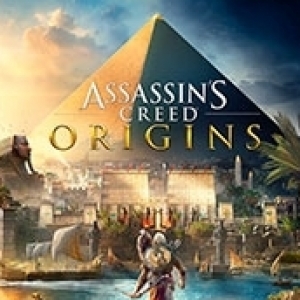
I have been excited about Assassin's Creed Origins since I first heard about it so when I got my copy I began playing right away. The opening for the game is intense and introduces you to Bayek of Siwa, a Medjay (essentially a protector for the people of Egypt sanctioned by the Pharoh) and a bit later his wife Aya. The story starts with a sad event, but it clearly explains in that moment why and how the Brotherhood of Assassins were created. Playing as Bayek, there is an initial tutorial for what the game controls are and they're pretty great. The controls seem more streamlined to the point where my biggest complaint of getting stuck on things during parkour runs and jumps did not happen at all. It was a very welcome change.
Bayek of Siwa.
I did get the season pass and this is truly worth it because you get access to some great weapons, gear, and mounts. Having the season pass will also give you access to the two DLC chapters, The Hidden Ones and The Curse Of The Pharohs on their release dates. If you're part of the Ubisoft Club, you also get some cool rewards ranging from crafting materials to legendary weapons. This also includes the Altair and Ezio outfits. You can also earn a lot of the weapons and gear from doing side quests and daily quests.
Some of the rewards you get with Ubisoft Club.
Ancient Egypt is huge. This is truly an open world game and it is definitely in your interests to explore everything because there are a lot of interesting things to see and do. I took a long time getting to the main story because I was having fun just exploring and doing all the side quests. There are a ton of side quests which give you the needed experience points and give rewards ranging from weapons to mounts. It is a grind to a soft level cap of 40, but because the game is fun to play I never really noticed and I got to level 40 fairly quickly.
One of many great views in the game.
One of my favorite things in the game was the symbiotic relationship Bayek had with his eagle, Senu. When doing missions where you needed to locate a target you could call Senu and with the ability of eagle vision have Senu search the area and seeing the world from her perspective until you find the target. This was a very useful thing to have especially when scouting enemy forts so I could see how many people there actually were.
Senu scouting an area.
The skill tree for Bayek is easy to navigate and there are three sections to unlock skills; Hunter, Warrior, and Seer. Even after you hit the level cap you can still build up these skills as the experience points then go into the meter and when maxed each time, it rewards you with ability points which can be used to unlock skills. Bow Bearer is incredibly useful for the Hunter because it allows you to carry a bow for stealth and one for melee battles. Chain assassination is also useful because it can get you out of a sticky situation.
The skill map is easy to navigate.
You do get to play as Aya for some missions and it is fun to play as her because there are some ship battles with her as well. The ship battles controls are well done and I wish there had been a few more of them because they were exciting and I enjoyed them. I also wish there were more missions with Aya because she was a smart and brave woman and she was just as interesting a character as Bayek. There is normal sailing also and this helps with getting to other areas or finding a spot where treasure is hidden. You can dive into the water and find those treasures as well as other secrets like tunnels leading into hidden temples.
Sailing in the game is great fun.
The main story is excellent. I really liked Bayek and Aya because they were such interesting characters. I felt sad for their pain and a sense of vindication for them when they accomplished their goal. There are of course real historical people in the game like Cleopatra and they are involved in the story. I did feel the main story was a bit short, but I still enjoyed it a great deal. It answered a lot of the big questions such as how the Brotherhood was started and also gave hints about some of the assassins that followed after Bayek and Aya.
Once you're done with the main game, there are still things you can do. There are mini game events like chariot races at the Hippodrome or gladiator fights at the Cyrene Arena. Both are fun to do and give you a break from the main story and side quests in the game. The chariot controls do have a bit of a learning curve, but once you get the hang of them it's a breeze. The gladiator fights have three rounds and then you unlock an elite mode which is just one challenging boss fight with the champion of each of those rounds. You can also compete with your friends for the best score.
Racing at the Hippodrome.
There are daily quests as well which you get from an NPC named Reda. The quests range from rescuing people to recovering stolen merchandise. When these are done, you get a reward from Reda usually a rare or legendary weapon. Sometimes you get a rare mount which comes in handy. You can take photos and share them with the photo share feature. This is a cool thing where you can use the controls to take a photo and share it with other players in the game. You can also avenge other players. If you find a fellow assassin that has been killed, it gives you a quest to find the perpetrators and you can exact revenge on them.
There is also the event Trial Of The Gods. Currently you can fight Anubis, the god of the dead. You should be level 40 for this fight because it's difficult otherwise. This is a great battle and once you defeat Anubis you get rewarded with a spiffy item. If you missed it, don't worry. There will be another chance to fight him and you will be able to fight other gods later on.
Battling the god Anubis.
Assassin's Creed Origins is an amazing adventure. The story is excellent, the side quests are fun, and there are so many beautiful things to see in this game. There is so much wonderful variety in the people, the voice acting, and the music. It is a joy to play and even after you're finished, there's still a lot of things you can do. I loved the game and and I can't wait to play more.
Bayek of Siwa.
I did get the season pass and this is truly worth it because you get access to some great weapons, gear, and mounts. Having the season pass will also give you access to the two DLC chapters, The Hidden Ones and The Curse Of The Pharohs on their release dates. If you're part of the Ubisoft Club, you also get some cool rewards ranging from crafting materials to legendary weapons. This also includes the Altair and Ezio outfits. You can also earn a lot of the weapons and gear from doing side quests and daily quests.
Some of the rewards you get with Ubisoft Club.
Ancient Egypt is huge. This is truly an open world game and it is definitely in your interests to explore everything because there are a lot of interesting things to see and do. I took a long time getting to the main story because I was having fun just exploring and doing all the side quests. There are a ton of side quests which give you the needed experience points and give rewards ranging from weapons to mounts. It is a grind to a soft level cap of 40, but because the game is fun to play I never really noticed and I got to level 40 fairly quickly.
One of many great views in the game.
One of my favorite things in the game was the symbiotic relationship Bayek had with his eagle, Senu. When doing missions where you needed to locate a target you could call Senu and with the ability of eagle vision have Senu search the area and seeing the world from her perspective until you find the target. This was a very useful thing to have especially when scouting enemy forts so I could see how many people there actually were.
Senu scouting an area.
The skill tree for Bayek is easy to navigate and there are three sections to unlock skills; Hunter, Warrior, and Seer. Even after you hit the level cap you can still build up these skills as the experience points then go into the meter and when maxed each time, it rewards you with ability points which can be used to unlock skills. Bow Bearer is incredibly useful for the Hunter because it allows you to carry a bow for stealth and one for melee battles. Chain assassination is also useful because it can get you out of a sticky situation.
The skill map is easy to navigate.
You do get to play as Aya for some missions and it is fun to play as her because there are some ship battles with her as well. The ship battles controls are well done and I wish there had been a few more of them because they were exciting and I enjoyed them. I also wish there were more missions with Aya because she was a smart and brave woman and she was just as interesting a character as Bayek. There is normal sailing also and this helps with getting to other areas or finding a spot where treasure is hidden. You can dive into the water and find those treasures as well as other secrets like tunnels leading into hidden temples.
Sailing in the game is great fun.
The main story is excellent. I really liked Bayek and Aya because they were such interesting characters. I felt sad for their pain and a sense of vindication for them when they accomplished their goal. There are of course real historical people in the game like Cleopatra and they are involved in the story. I did feel the main story was a bit short, but I still enjoyed it a great deal. It answered a lot of the big questions such as how the Brotherhood was started and also gave hints about some of the assassins that followed after Bayek and Aya.
Once you're done with the main game, there are still things you can do. There are mini game events like chariot races at the Hippodrome or gladiator fights at the Cyrene Arena. Both are fun to do and give you a break from the main story and side quests in the game. The chariot controls do have a bit of a learning curve, but once you get the hang of them it's a breeze. The gladiator fights have three rounds and then you unlock an elite mode which is just one challenging boss fight with the champion of each of those rounds. You can also compete with your friends for the best score.
Racing at the Hippodrome.
There are daily quests as well which you get from an NPC named Reda. The quests range from rescuing people to recovering stolen merchandise. When these are done, you get a reward from Reda usually a rare or legendary weapon. Sometimes you get a rare mount which comes in handy. You can take photos and share them with the photo share feature. This is a cool thing where you can use the controls to take a photo and share it with other players in the game. You can also avenge other players. If you find a fellow assassin that has been killed, it gives you a quest to find the perpetrators and you can exact revenge on them.
There is also the event Trial Of The Gods. Currently you can fight Anubis, the god of the dead. You should be level 40 for this fight because it's difficult otherwise. This is a great battle and once you defeat Anubis you get rewarded with a spiffy item. If you missed it, don't worry. There will be another chance to fight him and you will be able to fight other gods later on.
Battling the god Anubis.
Assassin's Creed Origins is an amazing adventure. The story is excellent, the side quests are fun, and there are so many beautiful things to see in this game. There is so much wonderful variety in the people, the voice acting, and the music. It is a joy to play and even after you're finished, there's still a lot of things you can do. I loved the game and and I can't wait to play more.
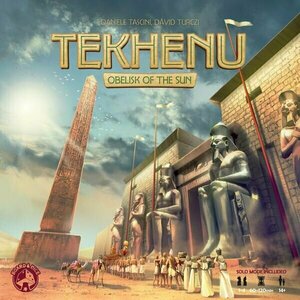
Tekhenu: Obelish of the Sun
Tabletop Game
Four millennia ago on the eastern bank of the Nile river was laid the foundation of the Temple of...

Purple Phoenix Games (2266 KP) rated Tutankhamun in Tabletop Games
Jul 9, 2021
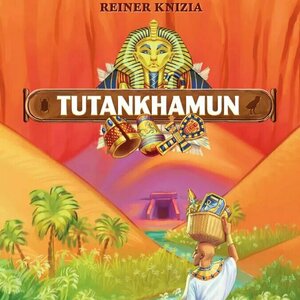
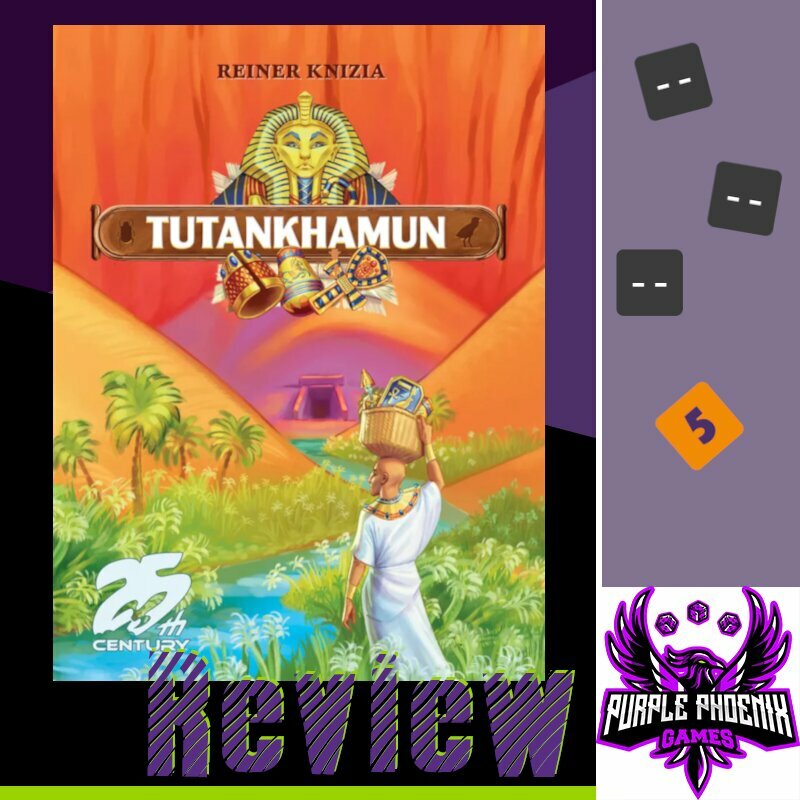
Tutankhamun (per dictionary.com, the pronunciation is as such: [ toot-ahng-kah-muhn ]) is regularly shortened and often referred to as “King Tut.” My real question is that if the first syllable is “toot,” why do we not call him King Toot? I have a 5 year old boy and a 2 year old girl at the time of this writing, so I can tell you EXACTLY why we don’t call him King Toot, but that’s for another discussion. Never having played the original version, will I enjoy this new version of the game by world-renowned designer Dr. Reiner Knizia?
In Tutankhamun, players take on the roles of Egyptian priests attempting to cleanse their souls by gifting the sarcophagus with relics found along the Nile River. The priest who can cleanse their soul quickest will be proclaimed the next High Priest and winner of the game!
DISCLAIMER: We were provided a copy of this game for the purposes of this review. This is a retail copy of the game, so what you see in these photos is exactly what would be received in your box. I do not intend to cover every single rule included in the rulebook, but will describe the overall game flow and major rule set so that our readers may get a sense of how the game plays. For more in depth rules, you may purchase a copy online or from your FLGS. -T
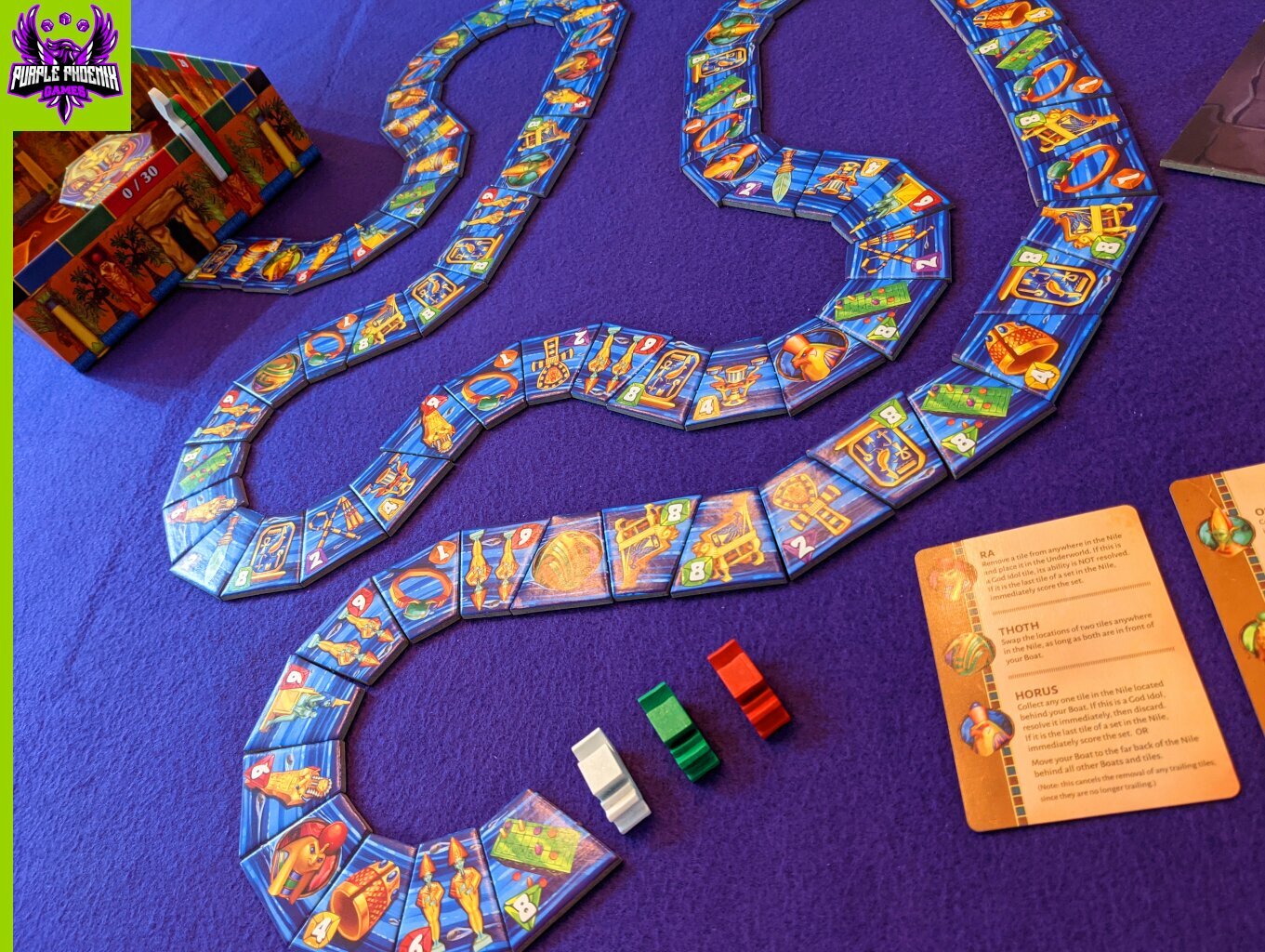
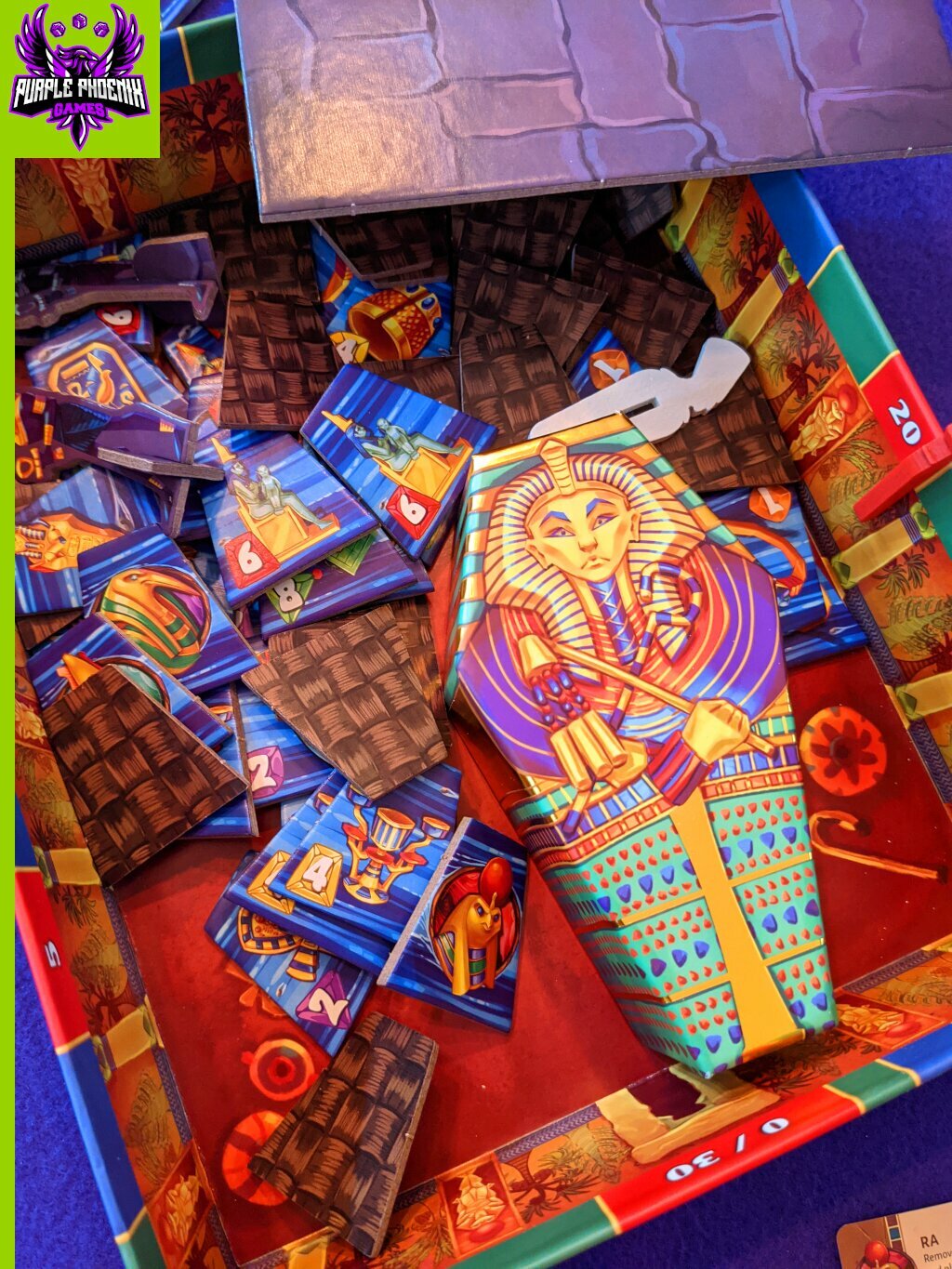
To setup, place the King Tut sarcophagus on the table somewhere inside the box bottom. From this starting place (or you could place these components last I suppose), begin the laborious job of creating the Nile from the trapezoidal Relic TIles. This part took me a good several minutes each game. Place out the Underworld Mat near the start of the Nile, and place upon it the two Guardian Statue standees. From there give every player a reference card, have them choose a player color, place their boats at the start of the Nile, and Canopic Jar scoring markers on the appropriate space along the box bottom score track. The game may now begin!
Tutankhamun is played in turns starting with the starting player and proceeding clockwise. The starting player will choose ANY Relic Tile to collect and move their boat to that location. Once collected, the player will check to make sure there are still matching Relics along the Nile. If so, then play continues to the next player. If the active player had collected the last Relic of that type still active in the game, then the Relic type is scored.
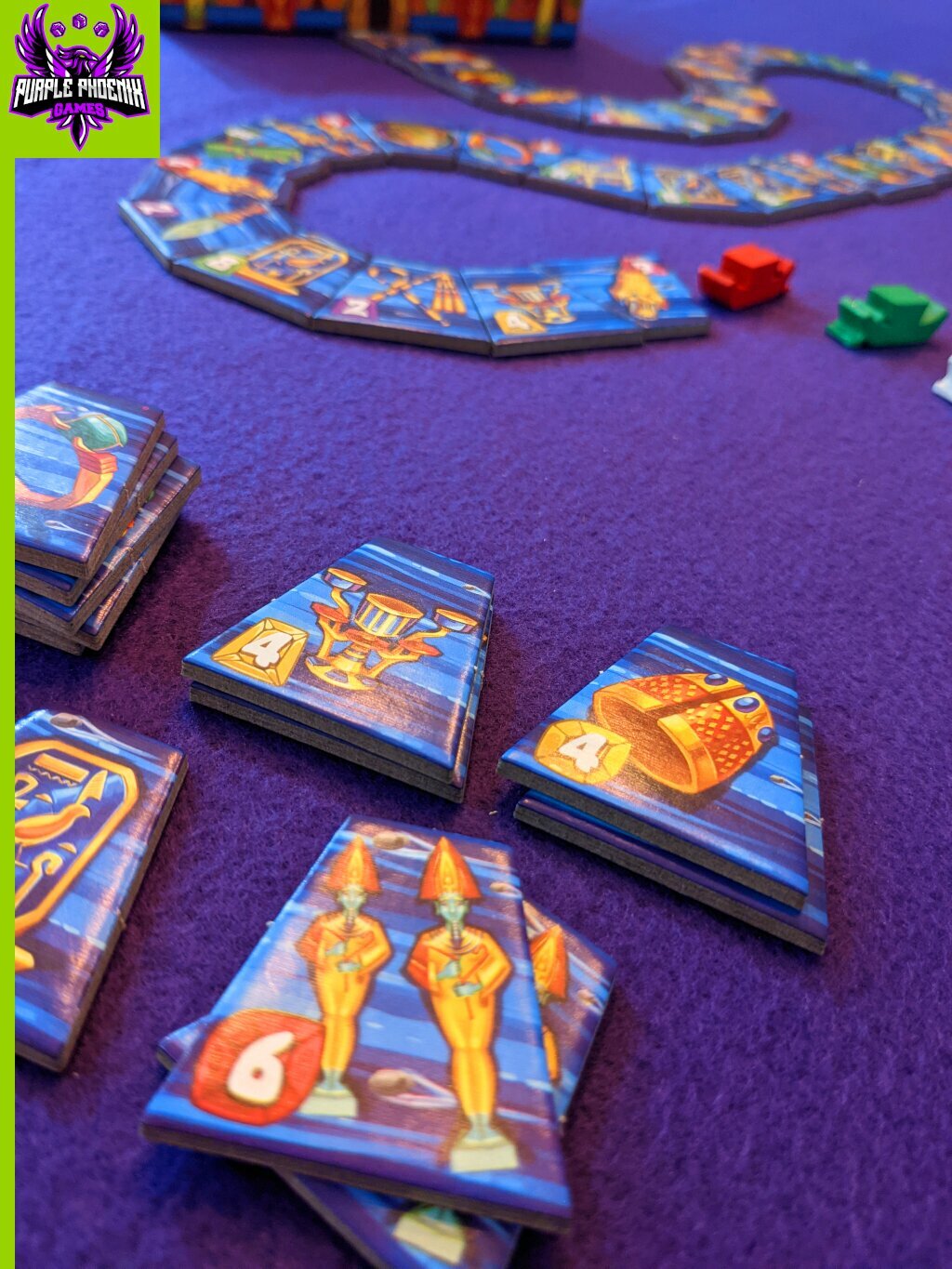
Each Relic Tile features art of a Relic, a God, or a Scarab Ring. Relics come in sets, and when the final Relic of its type is collected, scoring immediately follows. Whichever player possesses the most Relic Tiles of the one being scored will earn points (or rather, negative points, as the priests are trying to cleanse their souls down to the winning score of zero) equal to the number printed on the tile. That number stands for the score earned as well as the number of Relics of that type in the game. The player with the second most Relics of the scored type will score half the number printed on the tile. All others do not score.
God Tiles feature art of one of five ancient Egyptian Gods: Osiris, Isis, Ra, Thoth, and Horus. Each of these Gods provide the collecting player with special powers to be used during the turn, and are always positive for the player.
Finally, Scarab Ring tiles are special in that they feature no number upon them. There are 10 tiles in the game, and as soon as a player collects one they immediately score one point (or one negative point). These tiles are not thrown into the box bottom, as the other scoring tiles are once scored, but are kept with the players to be scored at the end of the game. The player holding the most Scarab Tiles scores five negative points.
Any tile along the Nile that has been passed by all players is deposited onto the Underworld Mat and not added to the box bottom with the King Tut sarcophagus. Tiles may still be collected from the Underworld by permission of the Gods being collected in-game. Whichever priest is able to dwindle down their points and cleanse their soul first will win the game and become the next High Priest of Egypt!
Components. I am more and more becoming a fan of everything 25th Century Games is putting out. This is certainly no exception. I have seen photos of the original versions of this game, entitled Tutankhamen (with an E at the end instead of a U) and this game was certainly begging for a renovation. All the components have updated art, more vibrant colors, and the game even includes luxurious (and completely unnecessary) components. These are the very cool, but very unnecessary King Tut sarcophagus, and the Guardian Statue standees that add nothing to the gameplay but definitely help set the mood and theme. That all said, this version looks amazing on the table and has nearly infinite setup configurations!
What I like most about the game is the fact that on a player’s turn they can literally move forward to ANYWHERE along the Nile to gather whatever Relic they wish. They can pass up a tile or twelve along the way to snatch exactly what they want. However, the quicker a player reaches the sarcophagus does not automatically make them the winner. No, they still need to reduce their soul spirit score to zero in order to win (or be closest by the time all players reach the final spot). Conversely, dilly-dallying along the River just picking up every available tile also will not guarantee a victory. Specializing in a select few items may be the ticket to a victory, or setting oneself to win a couple types and win runner-up on the remainder may be a great path to victory.
Unlike many other games with this lazy race mechanic, the player furthest back does NOT get to keep taking turns to catch up (I’m looking at you, Tokaido), but rather just means that player has many more options ahead of themselves than the other players have. This is very interesting to me, and definitely something worth exploring more. It makes for tough turns when players have to really crunch which options are best for them: take the tile right ahead of them, diversify vs bolster the collection, or hate block another player by taking what you know they need. Ahh, so beautiful are the choices given!
At the end of the day (and this review), Purple Phoenix Games gives this one an Obama-meme-where-he-is-drinking-a-beer-and-giving-a-thumbs-up 5 / 6. I would certainly not have purchased this game in its original form had I seen it in a game store. However, with the changes made to make it more pretty, I would have given it a chance. I am so very glad I have the opportunity to play this a lot, as I can see this getting to the table allllllll the time. It is right up my alley, and I place it high among other Knizia games. Long live King Toot!!
In Tutankhamun, players take on the roles of Egyptian priests attempting to cleanse their souls by gifting the sarcophagus with relics found along the Nile River. The priest who can cleanse their soul quickest will be proclaimed the next High Priest and winner of the game!
DISCLAIMER: We were provided a copy of this game for the purposes of this review. This is a retail copy of the game, so what you see in these photos is exactly what would be received in your box. I do not intend to cover every single rule included in the rulebook, but will describe the overall game flow and major rule set so that our readers may get a sense of how the game plays. For more in depth rules, you may purchase a copy online or from your FLGS. -T
To setup, place the King Tut sarcophagus on the table somewhere inside the box bottom. From this starting place (or you could place these components last I suppose), begin the laborious job of creating the Nile from the trapezoidal Relic TIles. This part took me a good several minutes each game. Place out the Underworld Mat near the start of the Nile, and place upon it the two Guardian Statue standees. From there give every player a reference card, have them choose a player color, place their boats at the start of the Nile, and Canopic Jar scoring markers on the appropriate space along the box bottom score track. The game may now begin!
Tutankhamun is played in turns starting with the starting player and proceeding clockwise. The starting player will choose ANY Relic Tile to collect and move their boat to that location. Once collected, the player will check to make sure there are still matching Relics along the Nile. If so, then play continues to the next player. If the active player had collected the last Relic of that type still active in the game, then the Relic type is scored.
Each Relic Tile features art of a Relic, a God, or a Scarab Ring. Relics come in sets, and when the final Relic of its type is collected, scoring immediately follows. Whichever player possesses the most Relic Tiles of the one being scored will earn points (or rather, negative points, as the priests are trying to cleanse their souls down to the winning score of zero) equal to the number printed on the tile. That number stands for the score earned as well as the number of Relics of that type in the game. The player with the second most Relics of the scored type will score half the number printed on the tile. All others do not score.
God Tiles feature art of one of five ancient Egyptian Gods: Osiris, Isis, Ra, Thoth, and Horus. Each of these Gods provide the collecting player with special powers to be used during the turn, and are always positive for the player.
Finally, Scarab Ring tiles are special in that they feature no number upon them. There are 10 tiles in the game, and as soon as a player collects one they immediately score one point (or one negative point). These tiles are not thrown into the box bottom, as the other scoring tiles are once scored, but are kept with the players to be scored at the end of the game. The player holding the most Scarab Tiles scores five negative points.
Any tile along the Nile that has been passed by all players is deposited onto the Underworld Mat and not added to the box bottom with the King Tut sarcophagus. Tiles may still be collected from the Underworld by permission of the Gods being collected in-game. Whichever priest is able to dwindle down their points and cleanse their soul first will win the game and become the next High Priest of Egypt!
Components. I am more and more becoming a fan of everything 25th Century Games is putting out. This is certainly no exception. I have seen photos of the original versions of this game, entitled Tutankhamen (with an E at the end instead of a U) and this game was certainly begging for a renovation. All the components have updated art, more vibrant colors, and the game even includes luxurious (and completely unnecessary) components. These are the very cool, but very unnecessary King Tut sarcophagus, and the Guardian Statue standees that add nothing to the gameplay but definitely help set the mood and theme. That all said, this version looks amazing on the table and has nearly infinite setup configurations!
What I like most about the game is the fact that on a player’s turn they can literally move forward to ANYWHERE along the Nile to gather whatever Relic they wish. They can pass up a tile or twelve along the way to snatch exactly what they want. However, the quicker a player reaches the sarcophagus does not automatically make them the winner. No, they still need to reduce their soul spirit score to zero in order to win (or be closest by the time all players reach the final spot). Conversely, dilly-dallying along the River just picking up every available tile also will not guarantee a victory. Specializing in a select few items may be the ticket to a victory, or setting oneself to win a couple types and win runner-up on the remainder may be a great path to victory.
Unlike many other games with this lazy race mechanic, the player furthest back does NOT get to keep taking turns to catch up (I’m looking at you, Tokaido), but rather just means that player has many more options ahead of themselves than the other players have. This is very interesting to me, and definitely something worth exploring more. It makes for tough turns when players have to really crunch which options are best for them: take the tile right ahead of them, diversify vs bolster the collection, or hate block another player by taking what you know they need. Ahh, so beautiful are the choices given!
At the end of the day (and this review), Purple Phoenix Games gives this one an Obama-meme-where-he-is-drinking-a-beer-and-giving-a-thumbs-up 5 / 6. I would certainly not have purchased this game in its original form had I seen it in a game store. However, with the changes made to make it more pretty, I would have given it a chance. I am so very glad I have the opportunity to play this a lot, as I can see this getting to the table allllllll the time. It is right up my alley, and I place it high among other Knizia games. Long live King Toot!!