

Hazel (1853 KP) rated Cracking the CRM Code in Books
Jan 9, 2021
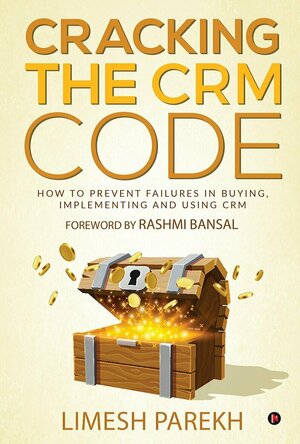

Rather than produce a mundane manual about how to purchase and use CRM software, Parekh writes a story about four friends and their journey with CRM. Liladhar Shastri, a successful business owner, is encouraging his friends, Anubhav, Jagdeep and Irshad to consider using CRM to improve their businesses. What follows is a lengthy discussion about buying CRM, using CRM and getting the most out of the software.
As the Indian entrepreneur, Rashmi Bansal writes in the introduction, Limesh Parekh is "not a salesman but a friend." The author gives advice through the voice of Liladhar, and the other three friends express the reader's questions and concerns. The book is written for small business with the potential to grow with the help of CRM. The story analyses what the friends do wrong and what they need to change.
Cracking the CRM Code is written for business-minded people who understand the jargon and acronyms, many of which are unexplained. As a layperson, some of the information went over my head, but the fiction format helped hold my interest. English is presumably not the author's first language, hence the sentences do not always flow, and the punctuation is far from perfect. At times, it is difficult to work out which character is speaking, making it a little confusing to follow.
Many business books and manuals are nondescript and boring, whereas Limesh Parekh keeps the reader engaged with anecdotes, stories and quotes. Rather than learning how to use CRM, the characters show the process of purchasing and using the software, which is far more enlightening than a step-by-step guide. Cracking the CRM Code has the potential to be a big hit with small business owners and business consultants.

Mothergamer (1658 KP) rated the PC version of Assassin's Creed: Odyssey in Video Games
Apr 3, 2019
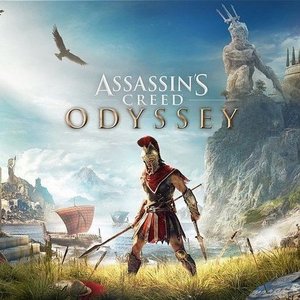


Odyssey is a bit different from its predecessors. The story is set at the beginning of the Peloponnesian war; an ongoing struggle between Sparta and Athens for dominion over Greece. This opens up a lot of interesting places to explore and dialogue options. At the beginning of the game you can choose which Misthios (mercenary) you want to play as; Alexios or his sister Kassandra. It really doesn't matter who you choose because the story is essentially the same for both so it's just a matter of whether or not you prefer to play as a man or a woman. For my first playthrough I went with Kassandra.
Kassandra starts her adventure.
Right from the start, Odyssey hooks you in with an action filled introduction and sets the scene for the story. After that you meet the character you chose; in my case Kassandra and you get a brief tutorial on how the gaming controls work. You also get a mount with this and those controls are pretty easy to navigate. Once you have the hang of it, you can get started on your journey with the main story and the vast amount of side quests.
This is where Odyssey differs a bit. There is more of a role playing aspect to the game with you being able to select different dialogue options while talking to people. You can choose to be cutthroat, a mercenary with a conscience, or ridiculously flirty. Yes, with some of the NPC characters be they men or women Kassandra could have flings with them. Don't worry, nothing overly graphic is shown, but it is definitely heavily implied. Your weapons are different as well. There is no assassin's blade here. You have a precursor artifact weapon in the form of a spear and the options of daggers and swords. You also have a bow and arrows which are quite useful for fighting at a distance.
Have a horse for your travels!
As you level up, you gain ability points which you can use to unlock certain skills to enhance your fighting and stealth from the following three categories in the skills menu: Hunter, Warrior, and Assassin. It is beneficial to unlock these because they are incredibly useful in battles against your enemies. There are also ship battles which bring back memories of Black Flag. The ship battles are challenging, but they are so much fun. You can upgrade your ship to make it a force to be reckoned with. Upgrading the hull is definitely a must so you can ram the heck out of other ships and take little to no damage. You need a crew also of course and Odyssey has an ability where rather than assassinating targets, you can knock them out and recruit them to join your crew.
Unlock abilities in the skills menu.
The running theme for your protagonist is all about family. This is where you are introduced to the mysterious villains, The Cult Of Kosmos who have a hand in much of the conflict in Greece all for power. You have to travel all over the world map to find clues about each cult member in order to reveal their true identity and the location of their main hideout. Once you have those, you can find them and take them out. Be wary however, some cult members are heavily guarded and quite the challenge to fight. This is where Odyssey's notoriety system comes in. The more crimes you commit i.e. murder (come on, you know that's what assassination is), the more likely it is that someone will put a bounty on your head. Then you find yourself relentlessly hunted by bounty hunters with very colorful names. The bounty hunters are no joke and if you do not plan out your strategy and tactics, they will end you. There were some who had lions and they would tag team the crap out of me which could be more than a little frustrating, but that's part of the challenge. Two ways around this are offing the person who put the bounty on your head or paying off the bounty. If you have the coin, you can pay the money and the bounty will go away.
Besides the main story, there are a ton of side quests and conquest missions to do. Sneaking around and taking out guards in a fort can be difficult, but rewarding as you take everyone out and diminish that nation's power. Looting the treasures, burning the supplies, and taking out the captains completes that area and will show you a meter with their power depleting. Once you have completely drained their influence, you get a conquest battle option. You get an epic battle between Spartans and Athenians and you have to take out all the captains during this battle in order to win the conquest. There were times where I totally screwed up and a guard saw me and then I had to brawl my way out among five or six of them. That was a whole other adventure in itself. It definitely raises the stakes when that happens and makes Odyssey feel like a whole new game.
Getting caught by guards sucks. Time to brawl my way out!
My favorite thing to do in Odyssey was exploring. I loved discovering new areas and hanging out in ancient Greece. Climbing up to the tops of high buildings, cliffs, and statues just to synchronize the map and see the view from a high vantage point was pretty fantastic. No two areas were alike and there was always something new to see. Some of the small side quests were hit or miss at times, but I was never bored at all. There was always something to see or do.
An eagle's eye view of ancient Greece.
There are a variety of armor and weapons choices in Odyssey. As you progress, you can upgrade to better armor, weapons, and crafting materials. If you have a favorite armor set, when you upgrade you can glamour the armor to look like the favorite set. Again, this adds a role playing aspect where you can actually gather materials and craft weapons and armor in the game. This is also true for your ship. You can choose a variety of sails, ship designs, and even tailor your crew with characters from past Assassin's Creed games as your lieutenants.
If you're looking for more challenge with your challenge, there are legendary beast and mythological monster fights you can do. The locations of each legendary beast is marked on your world map. With the monsters, you happen upon some of them doing certain quests. This was how I accidentally discovered the fight with Medusa. These fights are insanely hard and Medusa seemed to be the hardest one of all. I got my ass handed to me quite a few times before I finally won. It is vindicating when you do win because they are so difficult and you have to be constantly thinking about your tactics and theirs. The fights absolutely keep you on your toes, but man what a thrill!
Medusa fight is crazy!
When you see the world map, it can be a little overwhelming with how vast it is. Areas you have already explored will be highlighted and areas that are not unlocked are grayed out. The map will also show you what level each area is so you can level grind and plan accordingly. I had fun unlocking the areas and receiving contract quests and bounties which offered lots of drachmae and sometimes item rewards such as armor.
The world map is huge. Get out there and explore!
While I loved Odyssey, there were issues with the game. One of the big things was I was one of the unlucky people who got the game breaking bug of the game dropping frames and freezing completely in enemy fort areas. I had wondered if it was just me so I looked up the issue and found that many others had this issue with the game also. The solution Ubisoft offered was to close the game completely and restart the game. That's more than a little irritating. While the voice acting is good, there were strange audio issues with the voices being off sync and delaying at times. In spite of those issues, I still had fun with Odyssey and loved the game. Even after the main crux of the story is finished, there's still so much left to do with legendary hunts and searching for precursor relics and the upcoming DLC. Odyssey is slightly different from the games before it, but it is lots of fun. Now, I'm going to get out there and do more exploring. See you at the next adventure!
Art Authority for iPad
Art & Design, Education and Reference
App
"Best iPad Reference App" -- App Store editorial team. Art Authority for iPad transports you to an...

BookblogbyCari (345 KP) rated A Short History of the World in Books
Aug 5, 2018
As I hoped, the book often reads like a novel, with 67 distinct sections, each like a mini story. In order to fit the history of the whole world into one book, by nature the story telling ranges from nice and rapid, to a little too rapid. I found it rather like a catalogue of numerous interesting little nuggets of information. Despite covering events from all over the world, the topics often flow seamlessly from one topic to the next. Due to so many overlapping topics, this history of the world isn't told in a linear purely chronological pattern, but has to go backwards a little, now and again.
At various times throughout, the stories are gripping and Wells successfully brings history to life. I particularly liked the various sections on religious leaders. Appropriately, Wells tackles religion as would any unbiased historian-become storyteller. I also enjoyed the beginning, where Wells paints a crystal clear picture of our solar system and the vast empty space that our dramas are within. His description of our galaxy sounds nothing short of beautiful.
The book was meant to be predominantly factual, but Wells did include a substantial amount of speculation and opinion. This does not distract from the storyline, but adds value in generating the concepts of the time periods.
It covers progress and prosperity as much as carnage and decimation, and provides good explanations of everything it covers. (Although it would benefit from more illustrations). At times it feels detail heavy but also gives the reader a feel for each age - the book is not limited to which country went to war with which country and when, but also examines changes in ways of thinking through the ages. Including the Ancient Greek philosophers, Arabian progress in maths and science, the advent of experimental science, and the development of political and social ideas in Wells’ time.
I was reassured to learn that despite not studying the history of the world in its entirety in school, I was already familiar with much of the book’s content. Having said that, there were also topics where I really felt I was learning something. I read Wells’ opinion on why the Roman Empire fell, and how the industrial revolution was not merely a revolution in machinery, but rather a revolution in how people conducted their everyday lives. There were also some important figures from history described that were never mentioned in my school days, particularly Charlemagne and Roger Bacon.
Towards the end of the book, Wells correctly predicts another war like that of the Great War. However his final message was one of faith and hope in humanity’s progress.
With such a huge scope, Wells must have struggled with deciding what topics to include and what to exclude. I thought he ought to have included a touch more detail on Ancient Egypt, and on the causes of the Great War (World War 1). As a British person myself I would have liked to have seen more on British history.
Likewise, if the book were written now rather than 1922 I began to speculate on what he would and wouldn’t have included. I imagine there would certainly be a section on World War 2, rockets into space, the internet, and 9/11. He would have provided an excellently conducted section on how humans are destroying the planet.
One of the beauties of this book has to be its availability. If you type “short history of the world” into Google, the free PDF of this book takes up much of the first 2 pages of results. If you’re sketchy on world history, this book will fill in the main blanks, and is worth a read if this is your aim, especially if you wish to do so quickly. The fact that it’s split up into so many succinct sections also means that you can pick up and put down the book as often as opportunity allows. It also works well as a reference book, as it does not need to be read from cover to cover in order to look up one particular event or time period.
In summary, this book would be a welcome addition to bookshelf (or ebook library) of the general non-fiction fan or historian.
Find more of my book review on www.bookblogbycari.com

Ross (3284 KP) rated Cold Iron (Masters & Mages #1) in Books
Jan 22, 2019
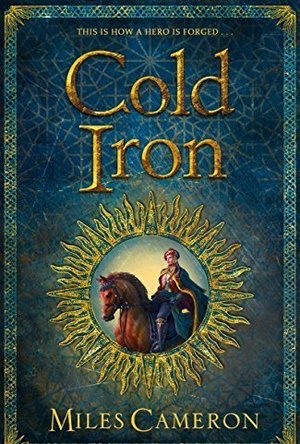
The story that is told is how Aranthur, this young man (selected from his village to attend the big city university) finds himself in the midst of conflict and significant events in the empire's changing status. The idea of fate dictating that this one man would be at the centre of things (see Wheel of Time) is not one that is explored here. While it is hinted at (he is frequently told off for ending up in unusual circumstances), it isn't overly laboured. Nobody tells him he was chosen or anything like that. Instead he gradually learns that he has found himself at the centre of political intrigue, plotting, counter-plotting, conspiracies and war.
This book is not about Aranthur. He is just the focal point of the book, the story is so much bigger than him. This meant it did at times become a little hard to take that he always just happened to meet the right person, go to the right place at the right time in order to witness or participate in a number of significant plot events. In hindsight, this is largely all explained as some hidden agenda and him being put in those places to make those decisions but at the time it was a little jarring.
The narrative is more akin to Robert Jordan than many contemporary writers - so much overly elaborate description of people, places, clothes, horses, weapons etc. At times this adds to the reading experience but I found it over-used and made the book feel like a much longer read (I was shocked when I found out it was just under 450 pages - it reads like around 700). Also, so much of the narrative is in either italics (to show it is a magic/majick/magik delete as appropriate) or is in some odd variation of French ("gonne" for gun, "quaveh" for coffee etc) to become irritating. At times the book is more like a decent fantasy tale or conspiracy and intrigue which has been edited by a historical re-enactment nut. Given this is fictional and the world is the author's to do with as he wishes, forcing some historical accuracy at the expense of reader enjoyment seemed an odd decision to make.
The magical system seems fairly standard fantasy fayre, albeit it is not described or explored in any detail, people just suddenly do things which haven't previously been mentioned. A large aspect of the book is Aranthur's being chosen to translate an ancient text to decode the magical secrets hidden there. I think in all he decodes three of these, and uses them, but there is no mention of them until he has to use them in a fight. It could just be that I have been reading a lot of LitRPG recently, where every spell is described in intimate detail and its uses are discussed way in advance of being needed in combat, but I felt like it was something of an afterthought or rescue from a plot dead-end ("oh sod it, say he done a magic").
While I did enjoy this book on the whole, the narrative style and the focus being on clothes rather than describing the interesting aspects of the world were to its detriment. Also, the book is written as two "books" (chapters), the first "book" covers around 80% and all in one long chapter without breaks. To my mind, ending there would have sufficed. The final 20% in "book 2" felt like part epilogue, part sequel and should maybe have been split as such.
My advice to anyone reading this, is to suspend disbelief that little bit further and trust that things do largely get explained satisfactorily before the end.
The Letter for the King
Tonke Dragt and Laura Watkinson
Book
A young messenger. A secret mission. A kingdom in peril. It is the dead of night. Sixteen-year-old...

Colin Newman recommended Sgt. Pepper's Lonely Hearts Club Band by The Beatles in Music (curated)

GOD Bible Adventure - The Amazing Bible Trivia Game that telling the Greatest Stories ever told!
Games and Entertainment
App
GOD, the most powerful switch and match mobile app Bible Puzzle Adventure game ever created. Take...

Yodha Daily Zodiac Horoscope
Lifestyle and Reference
App
Yodha daily horoscope is a day to day insight into what zodiac signs have in store for you. With...
A Stain in the Blood: The Remarkable Voyage of Sir Kenelm Digby
Book
SHORTLISTED FOR THE JAMES TAIT BLACK PRIZE FOR BIOGRAPHY and THE ELIZABETH LONGFORD PRIZE FOR...
History