Search
Search results

Mothergamer (1655 KP) rated the PC version of Assassin's Creed: Origins in Video Games
Apr 3, 2019
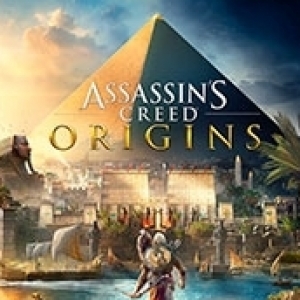


I have been excited about Assassin's Creed Origins since I first heard about it so when I got my copy I began playing right away. The opening for the game is intense and introduces you to Bayek of Siwa, a Medjay (essentially a protector for the people of Egypt sanctioned by the Pharoh) and a bit later his wife Aya. The story starts with a sad event, but it clearly explains in that moment why and how the Brotherhood of Assassins were created. Playing as Bayek, there is an initial tutorial for what the game controls are and they're pretty great. The controls seem more streamlined to the point where my biggest complaint of getting stuck on things during parkour runs and jumps did not happen at all. It was a very welcome change.
Bayek of Siwa.
I did get the season pass and this is truly worth it because you get access to some great weapons, gear, and mounts. Having the season pass will also give you access to the two DLC chapters, The Hidden Ones and The Curse Of The Pharohs on their release dates. If you're part of the Ubisoft Club, you also get some cool rewards ranging from crafting materials to legendary weapons. This also includes the Altair and Ezio outfits. You can also earn a lot of the weapons and gear from doing side quests and daily quests.
Some of the rewards you get with Ubisoft Club.
Ancient Egypt is huge. This is truly an open world game and it is definitely in your interests to explore everything because there are a lot of interesting things to see and do. I took a long time getting to the main story because I was having fun just exploring and doing all the side quests. There are a ton of side quests which give you the needed experience points and give rewards ranging from weapons to mounts. It is a grind to a soft level cap of 40, but because the game is fun to play I never really noticed and I got to level 40 fairly quickly.
One of many great views in the game.
One of my favorite things in the game was the symbiotic relationship Bayek had with his eagle, Senu. When doing missions where you needed to locate a target you could call Senu and with the ability of eagle vision have Senu search the area and seeing the world from her perspective until you find the target. This was a very useful thing to have especially when scouting enemy forts so I could see how many people there actually were.
Senu scouting an area.
The skill tree for Bayek is easy to navigate and there are three sections to unlock skills; Hunter, Warrior, and Seer. Even after you hit the level cap you can still build up these skills as the experience points then go into the meter and when maxed each time, it rewards you with ability points which can be used to unlock skills. Bow Bearer is incredibly useful for the Hunter because it allows you to carry a bow for stealth and one for melee battles. Chain assassination is also useful because it can get you out of a sticky situation.
The skill map is easy to navigate.
You do get to play as Aya for some missions and it is fun to play as her because there are some ship battles with her as well. The ship battles controls are well done and I wish there had been a few more of them because they were exciting and I enjoyed them. I also wish there were more missions with Aya because she was a smart and brave woman and she was just as interesting a character as Bayek. There is normal sailing also and this helps with getting to other areas or finding a spot where treasure is hidden. You can dive into the water and find those treasures as well as other secrets like tunnels leading into hidden temples.
Sailing in the game is great fun.
The main story is excellent. I really liked Bayek and Aya because they were such interesting characters. I felt sad for their pain and a sense of vindication for them when they accomplished their goal. There are of course real historical people in the game like Cleopatra and they are involved in the story. I did feel the main story was a bit short, but I still enjoyed it a great deal. It answered a lot of the big questions such as how the Brotherhood was started and also gave hints about some of the assassins that followed after Bayek and Aya.
Once you're done with the main game, there are still things you can do. There are mini game events like chariot races at the Hippodrome or gladiator fights at the Cyrene Arena. Both are fun to do and give you a break from the main story and side quests in the game. The chariot controls do have a bit of a learning curve, but once you get the hang of them it's a breeze. The gladiator fights have three rounds and then you unlock an elite mode which is just one challenging boss fight with the champion of each of those rounds. You can also compete with your friends for the best score.
Racing at the Hippodrome.
There are daily quests as well which you get from an NPC named Reda. The quests range from rescuing people to recovering stolen merchandise. When these are done, you get a reward from Reda usually a rare or legendary weapon. Sometimes you get a rare mount which comes in handy. You can take photos and share them with the photo share feature. This is a cool thing where you can use the controls to take a photo and share it with other players in the game. You can also avenge other players. If you find a fellow assassin that has been killed, it gives you a quest to find the perpetrators and you can exact revenge on them.
There is also the event Trial Of The Gods. Currently you can fight Anubis, the god of the dead. You should be level 40 for this fight because it's difficult otherwise. This is a great battle and once you defeat Anubis you get rewarded with a spiffy item. If you missed it, don't worry. There will be another chance to fight him and you will be able to fight other gods later on.
Battling the god Anubis.
Assassin's Creed Origins is an amazing adventure. The story is excellent, the side quests are fun, and there are so many beautiful things to see in this game. There is so much wonderful variety in the people, the voice acting, and the music. It is a joy to play and even after you're finished, there's still a lot of things you can do. I loved the game and and I can't wait to play more.
Bayek of Siwa.
I did get the season pass and this is truly worth it because you get access to some great weapons, gear, and mounts. Having the season pass will also give you access to the two DLC chapters, The Hidden Ones and The Curse Of The Pharohs on their release dates. If you're part of the Ubisoft Club, you also get some cool rewards ranging from crafting materials to legendary weapons. This also includes the Altair and Ezio outfits. You can also earn a lot of the weapons and gear from doing side quests and daily quests.
Some of the rewards you get with Ubisoft Club.
Ancient Egypt is huge. This is truly an open world game and it is definitely in your interests to explore everything because there are a lot of interesting things to see and do. I took a long time getting to the main story because I was having fun just exploring and doing all the side quests. There are a ton of side quests which give you the needed experience points and give rewards ranging from weapons to mounts. It is a grind to a soft level cap of 40, but because the game is fun to play I never really noticed and I got to level 40 fairly quickly.
One of many great views in the game.
One of my favorite things in the game was the symbiotic relationship Bayek had with his eagle, Senu. When doing missions where you needed to locate a target you could call Senu and with the ability of eagle vision have Senu search the area and seeing the world from her perspective until you find the target. This was a very useful thing to have especially when scouting enemy forts so I could see how many people there actually were.
Senu scouting an area.
The skill tree for Bayek is easy to navigate and there are three sections to unlock skills; Hunter, Warrior, and Seer. Even after you hit the level cap you can still build up these skills as the experience points then go into the meter and when maxed each time, it rewards you with ability points which can be used to unlock skills. Bow Bearer is incredibly useful for the Hunter because it allows you to carry a bow for stealth and one for melee battles. Chain assassination is also useful because it can get you out of a sticky situation.
The skill map is easy to navigate.
You do get to play as Aya for some missions and it is fun to play as her because there are some ship battles with her as well. The ship battles controls are well done and I wish there had been a few more of them because they were exciting and I enjoyed them. I also wish there were more missions with Aya because she was a smart and brave woman and she was just as interesting a character as Bayek. There is normal sailing also and this helps with getting to other areas or finding a spot where treasure is hidden. You can dive into the water and find those treasures as well as other secrets like tunnels leading into hidden temples.
Sailing in the game is great fun.
The main story is excellent. I really liked Bayek and Aya because they were such interesting characters. I felt sad for their pain and a sense of vindication for them when they accomplished their goal. There are of course real historical people in the game like Cleopatra and they are involved in the story. I did feel the main story was a bit short, but I still enjoyed it a great deal. It answered a lot of the big questions such as how the Brotherhood was started and also gave hints about some of the assassins that followed after Bayek and Aya.
Once you're done with the main game, there are still things you can do. There are mini game events like chariot races at the Hippodrome or gladiator fights at the Cyrene Arena. Both are fun to do and give you a break from the main story and side quests in the game. The chariot controls do have a bit of a learning curve, but once you get the hang of them it's a breeze. The gladiator fights have three rounds and then you unlock an elite mode which is just one challenging boss fight with the champion of each of those rounds. You can also compete with your friends for the best score.
Racing at the Hippodrome.
There are daily quests as well which you get from an NPC named Reda. The quests range from rescuing people to recovering stolen merchandise. When these are done, you get a reward from Reda usually a rare or legendary weapon. Sometimes you get a rare mount which comes in handy. You can take photos and share them with the photo share feature. This is a cool thing where you can use the controls to take a photo and share it with other players in the game. You can also avenge other players. If you find a fellow assassin that has been killed, it gives you a quest to find the perpetrators and you can exact revenge on them.
There is also the event Trial Of The Gods. Currently you can fight Anubis, the god of the dead. You should be level 40 for this fight because it's difficult otherwise. This is a great battle and once you defeat Anubis you get rewarded with a spiffy item. If you missed it, don't worry. There will be another chance to fight him and you will be able to fight other gods later on.
Battling the god Anubis.
Assassin's Creed Origins is an amazing adventure. The story is excellent, the side quests are fun, and there are so many beautiful things to see in this game. There is so much wonderful variety in the people, the voice acting, and the music. It is a joy to play and even after you're finished, there's still a lot of things you can do. I loved the game and and I can't wait to play more.

Ivana A. | Diary of Difference (1171 KP) rated The Tether (The ELI Chronicles, #2) in Books
Feb 3, 2020
<a href="https://diaryofdifference.com/">Blog</a>; | <a href="https://www.facebook.com/diaryofdifference/">Facebook</a>; | <a href="https://twitter.com/DiaryDifference">Twitter</a>; | <a href="https://www.instagram.com/diaryofdifference/">Instagram</a>; | <a href="https://www.pinterest.co.uk/diaryofdifference/pins/">Pinterest</a>;
<b>The ELI Chronicles Series</b>
#1 <a href="https://www.goodreads.com/review/show/2387441859">The One and Only</a> - ★★★★
#2 <a href="https://www.goodreads.com/review/show/2803361466">The Tether</a> - ★★★★
<img src="https://i2.wp.com/diaryofdifference.com/wp-content/uploads/2019/09/Book-Review-Banner-19.png?resize=1024%2C576&ssl=1"/>;
<b><i>As soon as I read <a href="https://diaryofdifference.com/2018/05/29/the-one-and-only-julia-ash-book-review/">The One and Only, the first book of the ELI Chronicles,</a> I knew I had to finish the series. When Julia Ash reached out to me, letting me know the second book, The Tether, is available for review – I obviously jumped at the opportunity!M/i></b>
It took me a bit to get to it due to my busy schedule, but once I finally got my hands on The Tether and started reading it, I couldn’t put it down.
The Tether continues where the first book finished – Ruby managed to save the Earth from the ZOM-B disease and a possible zombie apocalypse, being the only person with a unique blood type that can provide a cure. And then she got turned to a vampire.
And when everything seems quiet, things are starting to escalate again. Ruby’s blood donors are from another planet, and one of the donors is the King of Darkness, an ancient vampire who is in search for food – animals and humans on Earth. And once again, it is up to Ruby to save the planet and her family. Only this time, she discovers she has way more power than she thought.
If you read my review on Book One, you will know I was confused and angry with how the first book ended. Right after a Zombie Apocalypse, we had a vampire ending. For a moment, I thought that once you start mixing too many things up, it can get confusing. But this series somehow manages to keep it all together, and it all logically makes sense. I just fear that perhaps people might not agree with me and find it confusing. I didn’t though.
Ruby, again, was my favourite character. She had to go through so much, and then learn to finally embrace it. She kept herself down on Earth, despite her power, and that made me like her even more. I also respect her so much for sacrificing herself for a greater cause, and always putting her family first!
<i><b>Clay, oh, Clay…</b></i>
We never got along buddy. But I couldn’t help but feel for Clay in this book, and he is slowly growing on me. He has to slowly age and then die, while his wife is immortal. Secretly, I hope he becomes a vampire too, so they can spend their eternity together, even though, let’s be honest, he won’t really bring anything much to the table. But I loved, how he sacrificed himself for his family, and stood up against bullies, even if they were immortal vampires.
I loved our main villain in this book – Zagan. For he had reasoning for everything he did, even though it was wrong. He had a purpose and a goal, and he did have a pinch of good inside him. But he also had evil, and that was never gonna change.
Interestingly enough, and a big no-surprise for me was the government. Their corruption and the depths that they were willing to go to reach their goal was scary – and very accurate to what actually is currently happening in the world. The fear is also represented, and how differently they react as soon as they see someone who has more power than them. Their thinking of making new people similar to this one case, that they could use for greater goals. This moment was captured in the book in a great way, as it is a great discussion point and a very painful subject at the same time for some people.
The new planet, new characters, new powers was an interesting switch within the book. I didn’t expect that at all, but I was pleasantly surprised with how it all fitted in. It was all well thought of, The Tether story, the tree, the blood connection with Ruby, the link between the planet and Earth, the concept of how people lived their belief of healing what they were hurting and keeping the balance. The one thing that confused me was the mentions of their heartbeats, as I thought vampire’s hearts don’t beat.
<b><i>I really enjoyed The Tether and it ended perfectly, getting us ready for the third book and Ruby’s next challenge. I highly recommend it – it is a real page-turner with incredible plot twists!
Thank you to the author, Julia Ash, for sending me a copy of The Tether, in exchange for an honest review!</i></b>
<a href="https://diaryofdifference.com/">Blog</a>; | <a href="https://www.facebook.com/diaryofdifference/">Facebook</a>; | <a href="https://twitter.com/DiaryDifference">Twitter</a>; | <a href="https://www.instagram.com/diaryofdifference/">Instagram</a>; | <a href="https://www.pinterest.co.uk/diaryofdifference/pins/">Pinterest</a>;
<b>The ELI Chronicles Series</b>
#1 <a href="https://www.goodreads.com/review/show/2387441859">The One and Only</a> - ★★★★
#2 <a href="https://www.goodreads.com/review/show/2803361466">The Tether</a> - ★★★★
<img src="https://i2.wp.com/diaryofdifference.com/wp-content/uploads/2019/09/Book-Review-Banner-19.png?resize=1024%2C576&ssl=1"/>;
<b><i>As soon as I read <a href="https://diaryofdifference.com/2018/05/29/the-one-and-only-julia-ash-book-review/">The One and Only, the first book of the ELI Chronicles,</a> I knew I had to finish the series. When Julia Ash reached out to me, letting me know the second book, The Tether, is available for review – I obviously jumped at the opportunity!M/i></b>
It took me a bit to get to it due to my busy schedule, but once I finally got my hands on The Tether and started reading it, I couldn’t put it down.
The Tether continues where the first book finished – Ruby managed to save the Earth from the ZOM-B disease and a possible zombie apocalypse, being the only person with a unique blood type that can provide a cure. And then she got turned to a vampire.
And when everything seems quiet, things are starting to escalate again. Ruby’s blood donors are from another planet, and one of the donors is the King of Darkness, an ancient vampire who is in search for food – animals and humans on Earth. And once again, it is up to Ruby to save the planet and her family. Only this time, she discovers she has way more power than she thought.
If you read my review on Book One, you will know I was confused and angry with how the first book ended. Right after a Zombie Apocalypse, we had a vampire ending. For a moment, I thought that once you start mixing too many things up, it can get confusing. But this series somehow manages to keep it all together, and it all logically makes sense. I just fear that perhaps people might not agree with me and find it confusing. I didn’t though.
Ruby, again, was my favourite character. She had to go through so much, and then learn to finally embrace it. She kept herself down on Earth, despite her power, and that made me like her even more. I also respect her so much for sacrificing herself for a greater cause, and always putting her family first!
<i><b>Clay, oh, Clay…</b></i>
We never got along buddy. But I couldn’t help but feel for Clay in this book, and he is slowly growing on me. He has to slowly age and then die, while his wife is immortal. Secretly, I hope he becomes a vampire too, so they can spend their eternity together, even though, let’s be honest, he won’t really bring anything much to the table. But I loved, how he sacrificed himself for his family, and stood up against bullies, even if they were immortal vampires.
I loved our main villain in this book – Zagan. For he had reasoning for everything he did, even though it was wrong. He had a purpose and a goal, and he did have a pinch of good inside him. But he also had evil, and that was never gonna change.
Interestingly enough, and a big no-surprise for me was the government. Their corruption and the depths that they were willing to go to reach their goal was scary – and very accurate to what actually is currently happening in the world. The fear is also represented, and how differently they react as soon as they see someone who has more power than them. Their thinking of making new people similar to this one case, that they could use for greater goals. This moment was captured in the book in a great way, as it is a great discussion point and a very painful subject at the same time for some people.
The new planet, new characters, new powers was an interesting switch within the book. I didn’t expect that at all, but I was pleasantly surprised with how it all fitted in. It was all well thought of, The Tether story, the tree, the blood connection with Ruby, the link between the planet and Earth, the concept of how people lived their belief of healing what they were hurting and keeping the balance. The one thing that confused me was the mentions of their heartbeats, as I thought vampire’s hearts don’t beat.
<b><i>I really enjoyed The Tether and it ended perfectly, getting us ready for the third book and Ruby’s next challenge. I highly recommend it – it is a real page-turner with incredible plot twists!
Thank you to the author, Julia Ash, for sending me a copy of The Tether, in exchange for an honest review!</i></b>
<a href="https://diaryofdifference.com/">Blog</a>; | <a href="https://www.facebook.com/diaryofdifference/">Facebook</a>; | <a href="https://twitter.com/DiaryDifference">Twitter</a>; | <a href="https://www.instagram.com/diaryofdifference/">Instagram</a>; | <a href="https://www.pinterest.co.uk/diaryofdifference/pins/">Pinterest</a>;

Bob Mann (459 KP) rated Shazam! (2019) in Movies
Sep 28, 2021


Zoltar Rides Again!
All work and no play makes Bob the Movie Man a dull reviewer. Due to work commitments, this is the first film I’ve been able to see at the cinema for over a month. There’s a whole slew of films I wanted to see that have already come and gone. Big sigh. So I might be about the last of the crowd to review this, but I’m glad I caught it before it shuffled off its silver screen coil.
Every review I’ve seen of this starts off with the hackneyed comment that “At last, DC have produced a fun film” – so I won’t (even though it’s true!).
The Plot
“Shazam!” harks back, strongly, to the vehicle that helped launch Tom Hanks‘ illustrious career – Penny Marshall’s “Big” from 1988. In that film the young teen Josh (David Moscow) visits a deserted fairground where “Zoltar” mystically (and without explanation) morphs Josh into his adult self (Hanks). Much fun is had with Hanks showing his best friend Billy the joys (and sometimes otherwise) of booze, girls and other adult pastimes. In similar vein, in “Shazam!” we see the parent-less Billy Batson (Asher Angel) hijacked on a Philadelphia subway train and transformed into a DC superhero as a last-gasp effort of the ancient-wizard (Djimon Hounsou) to find someone ‘good’ to pass his magic onto. “Grab onto my staff with both hands” (Ugh) and say my name – “Juman….”…. no, sorry, wrong film…. “Shazam!”. And as in “Big”, Billy has to explore his new superhero powers with the only person vaguely close to him; his new foster-brother Freddie (Jack Dylan Grazer from “It”).
Billy is not the first to have met the wizard – not by a long shot. There has been a long line of potential candidates examined and rejected on this road, one of which, back in 1974, was the unhappy youngster Thaddeus Sivana (Ethan Pugiotto, but now grown up as Mark Cross), who has a seething chip on his shoulder as big as the Liberty Bell. Gaining evil super-powers of his own, the race is on to see if Dr Sivana can track down the fledgling Billy before he can learn to master his superhero skills and so take him down.
Wizards with red capes?
With the loose exception of possibly Scarlet Witch, I don’t think it’s actually ever been explored before that “superheroes” are actually “magicians” with different coloured capes… it’s a novel take. Before the Marvel/DC wheels eventually come off – which before another twenty years are up they surely must? – will we see a “Harry Potter vs Superman” crossover? “YOUR MOTHER’S NAME WAS LILY AND MINE WAS MARTHA…. L AND M ARE NEXT TO EACH OTHER IN THE DICTIONARY!!!!” The mind boggles.
What does make “Shazam!” interesting is that the story is consciously set in a DC world where Superman, Batman, Wonder Woman, Aquaman and the rest all live and breathe. Freddie has a Bat-a-rang (“only a replica”) and a carefully shrink-wrapped squashed bullet that had impacted on Superman’s body. So when Billy – in superhero form – makes his appearances on the streets of Philly, this makes “Shazam” an “oh look, there’s another one” curiosity rather than an out-and-out marvel.
(Source: Warner Brothers). Lightning from the fingers! Proving very useful for Shazam’s own….
Much fun is obviously had with “Shazam” testing out his powers. Freddie’s Youtube videos gather thousands of hits baas Billy tries to fly; tries to burn; tries to use his “laser sight”; etc.
What works well.
It’s a fun flick that delivers the Marvel laughs of “Ragnarok” and “Ant Man” without ever really getting to the gravitas of either. The screenplay writer (Henry Gayden) is clearly a lover of cinema, as there are numerous references to other movies scattered throughout the film: the victory run of “Rocky” (obviously); the cracking windshield of “The Lost World”; the scary-gross-out body disintegrations of “Indiana Jones”; the portal entry doors of “Monsters, Inc”. Even making an appearance briefly, as a respectful nod presumably to the story’s plagiarism, is the toy-store floor piano of “Big”. There are probably a load of other movie Easter Eggs that I missed.
Playing Billy, the relatively unknown Zachary Levi also charms in a similarly goofball way as Hanks did all those years ago. (Actually, he’s more reminiscent of the wide-eyed delight of Brendan Fraser’s “George of the Jungle” rather than Hanks). In turns, his character is genuinely delighted then shocked at his successes and failures (“Leaping buildings with a single bound” – LOL!). Also holding up their own admirably are the young leads Asher Angel and Jack Dylan Grazer.
Mark Cross, although having flaunted with being the good guy in the “Kingsman” films, is now firmly back in baddie territory as the “supervillain”: and very good he is at it too; I thought he was the best thing in the whole film.
Finally, the movie’s got a satisfying story arc, with Billy undergoing an emotional journey that emphasises the importance of family. But it’s not done in a slushy manipulative way.
What works less well.
As many of you know, I have a few rules-of-thumb for movies, one of which is that a comedy had better by bloody good if it’s going to have a run-time of much more than 90 minutes. At 132 minutes, “Shazam!” overstayed its welcome for me by a good 20 or 30 minutes. Director David F. Sandberg could have made a much tighter and better film if he had wielded the editing knife a bit more freely. I typically enjoy getting backstory to characters, and in many ways this film delivers where many don’t. The pre-credit scenes with Thaddeus nicely paint the character for his (hideous) actions that follow. However, Billy is over-burdened with backstory, and it takes wayyyyyyy too long for the “Shazam!” to happen and the fun to begin. We also lapse into an overlong superhero finale. I didn’t actually see the twist in the plot coming, which was good, but once there then the denouement could and should have been much swifter.
The film also has its scary moments and deserves its 12A certificate. As a film rather painted as kid-friendly from the trailer and the poster, there is probably the potential to traumatise young children here, particularly in a terrifying scene in a board room (with a view). As well as the physical scares there is also a dark streak running under the story that reminded me of both the original “Jumanji” and “Ghostbusters”. Parents beware.
Monkeys?
Following on from the Marvel expectations, there are a couple of “monkeys” (see Glossary) in the title roll: one mid-titles, featuring Dr Sivana and implying an undoubted sequel, and one right at the end pointing fun at the otherwise ignored “Aquaman”.
Final thoughts.
It’s clearly been a long overdue hit for DC, and on the whole I enjoyed it. If the film had been a bit tighter, this would have had the potential to be a classic.
Every review I’ve seen of this starts off with the hackneyed comment that “At last, DC have produced a fun film” – so I won’t (even though it’s true!).
The Plot
“Shazam!” harks back, strongly, to the vehicle that helped launch Tom Hanks‘ illustrious career – Penny Marshall’s “Big” from 1988. In that film the young teen Josh (David Moscow) visits a deserted fairground where “Zoltar” mystically (and without explanation) morphs Josh into his adult self (Hanks). Much fun is had with Hanks showing his best friend Billy the joys (and sometimes otherwise) of booze, girls and other adult pastimes. In similar vein, in “Shazam!” we see the parent-less Billy Batson (Asher Angel) hijacked on a Philadelphia subway train and transformed into a DC superhero as a last-gasp effort of the ancient-wizard (Djimon Hounsou) to find someone ‘good’ to pass his magic onto. “Grab onto my staff with both hands” (Ugh) and say my name – “Juman….”…. no, sorry, wrong film…. “Shazam!”. And as in “Big”, Billy has to explore his new superhero powers with the only person vaguely close to him; his new foster-brother Freddie (Jack Dylan Grazer from “It”).
Billy is not the first to have met the wizard – not by a long shot. There has been a long line of potential candidates examined and rejected on this road, one of which, back in 1974, was the unhappy youngster Thaddeus Sivana (Ethan Pugiotto, but now grown up as Mark Cross), who has a seething chip on his shoulder as big as the Liberty Bell. Gaining evil super-powers of his own, the race is on to see if Dr Sivana can track down the fledgling Billy before he can learn to master his superhero skills and so take him down.
Wizards with red capes?
With the loose exception of possibly Scarlet Witch, I don’t think it’s actually ever been explored before that “superheroes” are actually “magicians” with different coloured capes… it’s a novel take. Before the Marvel/DC wheels eventually come off – which before another twenty years are up they surely must? – will we see a “Harry Potter vs Superman” crossover? “YOUR MOTHER’S NAME WAS LILY AND MINE WAS MARTHA…. L AND M ARE NEXT TO EACH OTHER IN THE DICTIONARY!!!!” The mind boggles.
What does make “Shazam!” interesting is that the story is consciously set in a DC world where Superman, Batman, Wonder Woman, Aquaman and the rest all live and breathe. Freddie has a Bat-a-rang (“only a replica”) and a carefully shrink-wrapped squashed bullet that had impacted on Superman’s body. So when Billy – in superhero form – makes his appearances on the streets of Philly, this makes “Shazam” an “oh look, there’s another one” curiosity rather than an out-and-out marvel.
(Source: Warner Brothers). Lightning from the fingers! Proving very useful for Shazam’s own….
Much fun is obviously had with “Shazam” testing out his powers. Freddie’s Youtube videos gather thousands of hits baas Billy tries to fly; tries to burn; tries to use his “laser sight”; etc.
What works well.
It’s a fun flick that delivers the Marvel laughs of “Ragnarok” and “Ant Man” without ever really getting to the gravitas of either. The screenplay writer (Henry Gayden) is clearly a lover of cinema, as there are numerous references to other movies scattered throughout the film: the victory run of “Rocky” (obviously); the cracking windshield of “The Lost World”; the scary-gross-out body disintegrations of “Indiana Jones”; the portal entry doors of “Monsters, Inc”. Even making an appearance briefly, as a respectful nod presumably to the story’s plagiarism, is the toy-store floor piano of “Big”. There are probably a load of other movie Easter Eggs that I missed.
Playing Billy, the relatively unknown Zachary Levi also charms in a similarly goofball way as Hanks did all those years ago. (Actually, he’s more reminiscent of the wide-eyed delight of Brendan Fraser’s “George of the Jungle” rather than Hanks). In turns, his character is genuinely delighted then shocked at his successes and failures (“Leaping buildings with a single bound” – LOL!). Also holding up their own admirably are the young leads Asher Angel and Jack Dylan Grazer.
Mark Cross, although having flaunted with being the good guy in the “Kingsman” films, is now firmly back in baddie territory as the “supervillain”: and very good he is at it too; I thought he was the best thing in the whole film.
Finally, the movie’s got a satisfying story arc, with Billy undergoing an emotional journey that emphasises the importance of family. But it’s not done in a slushy manipulative way.
What works less well.
As many of you know, I have a few rules-of-thumb for movies, one of which is that a comedy had better by bloody good if it’s going to have a run-time of much more than 90 minutes. At 132 minutes, “Shazam!” overstayed its welcome for me by a good 20 or 30 minutes. Director David F. Sandberg could have made a much tighter and better film if he had wielded the editing knife a bit more freely. I typically enjoy getting backstory to characters, and in many ways this film delivers where many don’t. The pre-credit scenes with Thaddeus nicely paint the character for his (hideous) actions that follow. However, Billy is over-burdened with backstory, and it takes wayyyyyyy too long for the “Shazam!” to happen and the fun to begin. We also lapse into an overlong superhero finale. I didn’t actually see the twist in the plot coming, which was good, but once there then the denouement could and should have been much swifter.
The film also has its scary moments and deserves its 12A certificate. As a film rather painted as kid-friendly from the trailer and the poster, there is probably the potential to traumatise young children here, particularly in a terrifying scene in a board room (with a view). As well as the physical scares there is also a dark streak running under the story that reminded me of both the original “Jumanji” and “Ghostbusters”. Parents beware.
Monkeys?
Following on from the Marvel expectations, there are a couple of “monkeys” (see Glossary) in the title roll: one mid-titles, featuring Dr Sivana and implying an undoubted sequel, and one right at the end pointing fun at the otherwise ignored “Aquaman”.
Final thoughts.
It’s clearly been a long overdue hit for DC, and on the whole I enjoyed it. If the film had been a bit tighter, this would have had the potential to be a classic.

Gareth von Kallenbach (980 KP) rated Indiana Jones and the Kingdom of the Crystal Skull (2008) in Movies
Aug 14, 2019

After 17 years away from the big screen, Indiana Jones has dusted off his trusty fedora and bullwhip in one of the most eagerly awaited returns to the screen in cinema history. Harrison Ford once again plays the rough and rugged archeologist who is as equally adept in the classroom as he is in the depths of an ancient trap laden chamber.
In “Indiana Jones and the Kingdom of the Crystal Skull”, audience are re-introduced to Jones, who is by now an older, and wiser man who spent the years of WWII as a special operative which earned him not only the rank of Colonel, but numerous medals and citations.
The film opens with a group of bad guys forcing Indiana to locate an object from a gigantic storage area in the infamous Area 51. Since Jones was part of a team that examined said object nearly a decade earlier, his services are greatly desired, and he is forced to play along with his captors.
Of course Indiana Jones is still a man of action, and soon turns the tables on his captors in a daring and humor filled action sequence that quickly answers those that doubted Ford could pull off his charismatic character in his 60’s.
The events of the situation do not go unnoticed by the U.S. government who suspect Jones of collaborating with the enemy, and in the Red Scare America of the 1950’s Jones soon finds himself suspended from his teaching position and looking to head overseas.
As Indy’s train heads out of town, he is approached by a motorcycle riding messenger who says his name is Mutt (Shia LaBeouf), and he has been sent to find Indy by a former college of Indy’s Professor Oxle (John Hurt). Intrigued, Jones listens to the tale Mutt tells him that people have kidnapped Oxley and his mother, and he shows him a letter that Oxley instructed him to pass along to Indy should anything happen to him.
Before Indy can dig further into the mystery, he and Mutt are accosted by thugs and after a daring race through traffic on Mutt’s motorcycle, find themselves on a plane to South America in search of Oxley and Mutt’s mother as well as the fabled Crystal Skull that legend says will grant amazing powers to anyone who returns it to the fabled Golden City.
Thinking that his old friend Oxley may have succeeded where Indy was unable to many years earlier, Jones takes up the cause of locating the fabled artifact and the city as he believes that they are also the keys to locating his missing friend. The film really slows down here and devotes a good amount of time to advancing the story and characters and thanks to the amazingly detailed sets and enjoyable characters; you may find yourself not minding the change of pace.
Of course there are plenty of bad guys to add to the mix, including the evil Irinia Spalko (Cate Blanchett), who is leading a team of Russian soldiers who also have designs on the skull, as it would give them the power to read and control the minds of the leaders the world over, amongst other powers that would be used for their aggressive agendas.
What follows is an effects-laden adventure leading to a grand finale that is not as spectacular as past films in the series, but enjoyable nonetheless. When the action comes it is solid, and while some of it seems to be a retread of some of the classic moments of the series, it does deliver enough thrills to keep fans happy. There are some very welcome moments in the film such as a nice tribute to Sean Connery and the Late Denholm Elliot as well as a cleverly placed cameo early in the film during the warehouse fight.
Shia LaBeouf is an interesting addition to the series and his scenes with Ford are very enjoyable. They have a natural chemistry and do not seem forced like the Short Round character from “Indiana Jones and the Temple of Doom”. I was also very happy to see Karen Allen return to the series as Marion Ravenwood. She has truly proven to be the only love interest in the series that truly measures up to Indy, and her fiery temper with a girl next door charm is the perfect foil for Jones.
The effects in the film are not groundbreaking, but solid, however some may find that the films plot is a bit to complex and takes too long to setup. There were funny moments in the film to go along with the action and viewers who pay close attention will catch some very subtle nods to other moments in the series.
I was pleased with the sets in the film as Director Steven Speilberg and Producer George Lucas clearly paid attention to details in the look of the film. The tombs and exotic chambers depicted in the film had a very immersive nature to them much the same way that classic Disneyland rides like Pirates of the Caribbean and The Haunted Mansion place guests right in the middle of the spooky and exotic locales. From cobwebs, skeletons, and insects and well as treasures galore, it was like being in on the adventure with Indy.
The series does have some life in it and while the film does not measure up with the first film in the series, I would say it is on par with “Temple of Doom” and was for me, more enjoyable than “The Last Crusade.” The film leaves the door open for yet another adventure, and if comments from Speilberg and Lucas are to be taken seriously, we may see the beloved archeologist back on the big screen in the not too distant future.
In “Indiana Jones and the Kingdom of the Crystal Skull”, audience are re-introduced to Jones, who is by now an older, and wiser man who spent the years of WWII as a special operative which earned him not only the rank of Colonel, but numerous medals and citations.
The film opens with a group of bad guys forcing Indiana to locate an object from a gigantic storage area in the infamous Area 51. Since Jones was part of a team that examined said object nearly a decade earlier, his services are greatly desired, and he is forced to play along with his captors.
Of course Indiana Jones is still a man of action, and soon turns the tables on his captors in a daring and humor filled action sequence that quickly answers those that doubted Ford could pull off his charismatic character in his 60’s.
The events of the situation do not go unnoticed by the U.S. government who suspect Jones of collaborating with the enemy, and in the Red Scare America of the 1950’s Jones soon finds himself suspended from his teaching position and looking to head overseas.
As Indy’s train heads out of town, he is approached by a motorcycle riding messenger who says his name is Mutt (Shia LaBeouf), and he has been sent to find Indy by a former college of Indy’s Professor Oxle (John Hurt). Intrigued, Jones listens to the tale Mutt tells him that people have kidnapped Oxley and his mother, and he shows him a letter that Oxley instructed him to pass along to Indy should anything happen to him.
Before Indy can dig further into the mystery, he and Mutt are accosted by thugs and after a daring race through traffic on Mutt’s motorcycle, find themselves on a plane to South America in search of Oxley and Mutt’s mother as well as the fabled Crystal Skull that legend says will grant amazing powers to anyone who returns it to the fabled Golden City.
Thinking that his old friend Oxley may have succeeded where Indy was unable to many years earlier, Jones takes up the cause of locating the fabled artifact and the city as he believes that they are also the keys to locating his missing friend. The film really slows down here and devotes a good amount of time to advancing the story and characters and thanks to the amazingly detailed sets and enjoyable characters; you may find yourself not minding the change of pace.
Of course there are plenty of bad guys to add to the mix, including the evil Irinia Spalko (Cate Blanchett), who is leading a team of Russian soldiers who also have designs on the skull, as it would give them the power to read and control the minds of the leaders the world over, amongst other powers that would be used for their aggressive agendas.
What follows is an effects-laden adventure leading to a grand finale that is not as spectacular as past films in the series, but enjoyable nonetheless. When the action comes it is solid, and while some of it seems to be a retread of some of the classic moments of the series, it does deliver enough thrills to keep fans happy. There are some very welcome moments in the film such as a nice tribute to Sean Connery and the Late Denholm Elliot as well as a cleverly placed cameo early in the film during the warehouse fight.
Shia LaBeouf is an interesting addition to the series and his scenes with Ford are very enjoyable. They have a natural chemistry and do not seem forced like the Short Round character from “Indiana Jones and the Temple of Doom”. I was also very happy to see Karen Allen return to the series as Marion Ravenwood. She has truly proven to be the only love interest in the series that truly measures up to Indy, and her fiery temper with a girl next door charm is the perfect foil for Jones.
The effects in the film are not groundbreaking, but solid, however some may find that the films plot is a bit to complex and takes too long to setup. There were funny moments in the film to go along with the action and viewers who pay close attention will catch some very subtle nods to other moments in the series.
I was pleased with the sets in the film as Director Steven Speilberg and Producer George Lucas clearly paid attention to details in the look of the film. The tombs and exotic chambers depicted in the film had a very immersive nature to them much the same way that classic Disneyland rides like Pirates of the Caribbean and The Haunted Mansion place guests right in the middle of the spooky and exotic locales. From cobwebs, skeletons, and insects and well as treasures galore, it was like being in on the adventure with Indy.
The series does have some life in it and while the film does not measure up with the first film in the series, I would say it is on par with “Temple of Doom” and was for me, more enjoyable than “The Last Crusade.” The film leaves the door open for yet another adventure, and if comments from Speilberg and Lucas are to be taken seriously, we may see the beloved archeologist back on the big screen in the not too distant future.

Purple Phoenix Games (2266 KP) rated Divinus in Tabletop Games
Aug 10, 2021
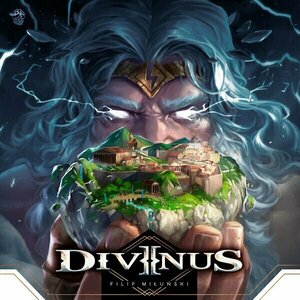
Bragi. Hercules. Percy Jackson. All excellent examples of successful demigods. As you well know, demigods are offspring of a god and a mortal. Of all the things I have conjured in my lifetime to answer the old, “What do you want to be when you grow up?” question, I never really answered, “a demigod.” Well, that’s because I KNOW my parents and have a hard time believing I could be a son of a god or goddess. Unless it was some weird NPCs (novel series by Drew Hayes) universe with Grumble as my patron/parent. In any case, my new dream of becoming the greatest demigod alive must be played out in today’s preview: Divinus.
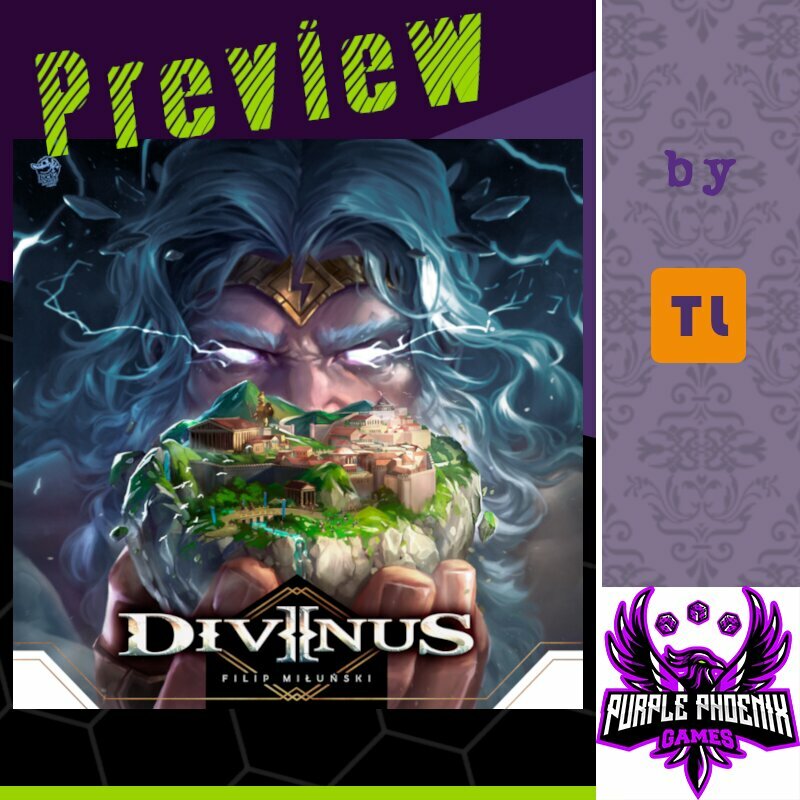
Divinus is a competitive tile placement, campaign, drafting, dice game in which players assume the roles of upcoming demigods fighting over the one last spot at the table. By appeasing the gods of the warring ancient Roman and Norse cultures players will earn their place among them. This game uses some interesting hybrid app-driven story mechanics along with legacy-style component alterations to create this world that is constantly under refurbishment and ripe for the claiming of the future Divinus.
DISCLAIMER: We were provided a prototype copy of this game for the purposes of this review. These are preview copy components, and I do not know for sure if the final components will be any different from these shown. Also, it is not my intention to detail every rule in the game, as there are just too many. You are invited to download the rulebook, back the game through the Gamefound campaign, or through any retailers stocking it after fulfillment. -T
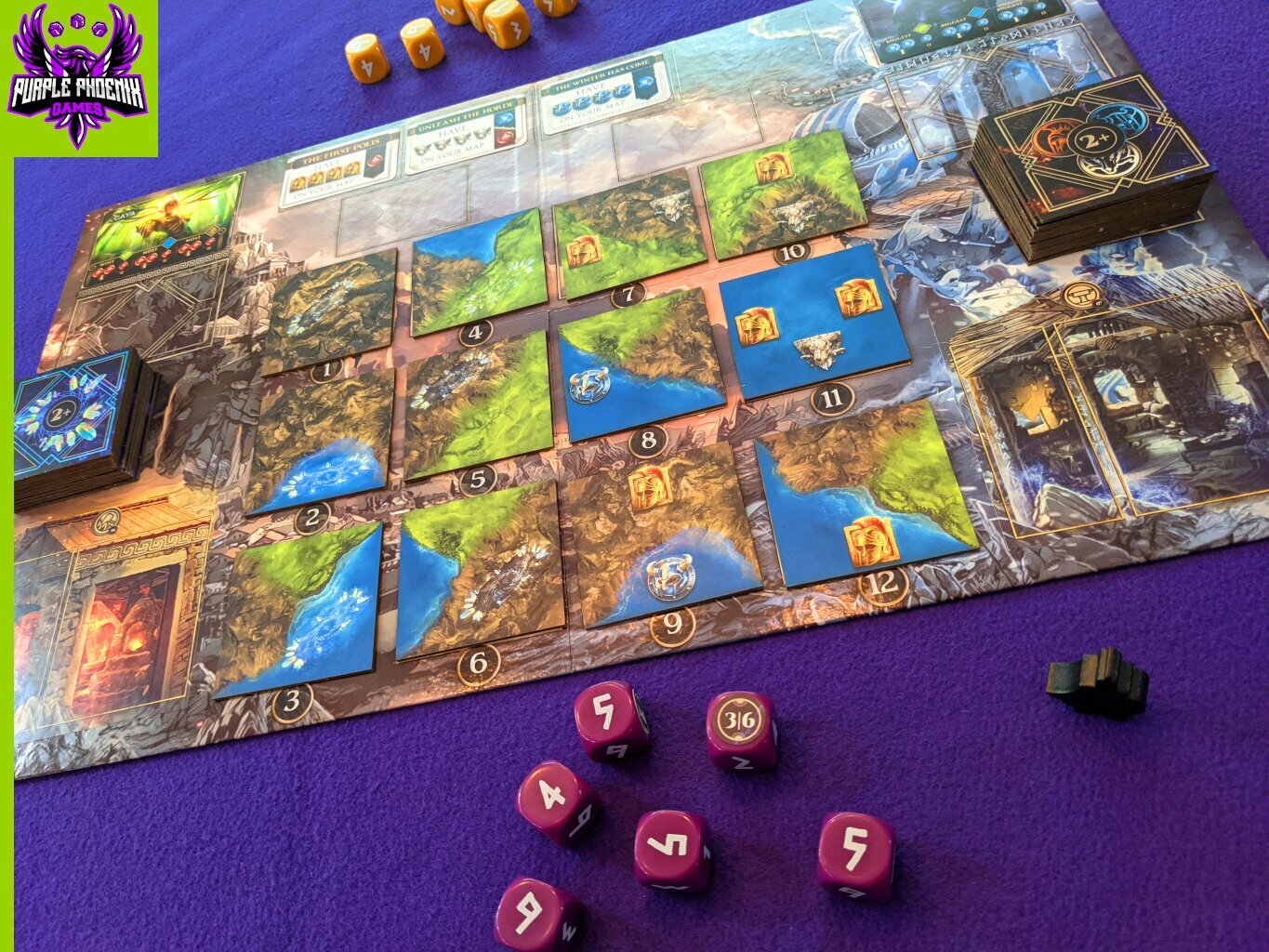
To setup, place the main board on the table, sort out the Map tiles by player count, and populate the board per the rulebook. Each player chooses their Demigod box and takes all components contained within. As Divinus is intended to be played either as a scenario session or its Eternal Mode, which is infinitely replayable using the board and components already altered by previously-played scenarios, open the chosen Scenario Box to be played and allow the app to instruct on how to setup with these components. All players roll their dice and place them in the “ready” pile to be used on their first turn. The first player takes the token (a black meeple in the prototype version) and the game is ready to be played!
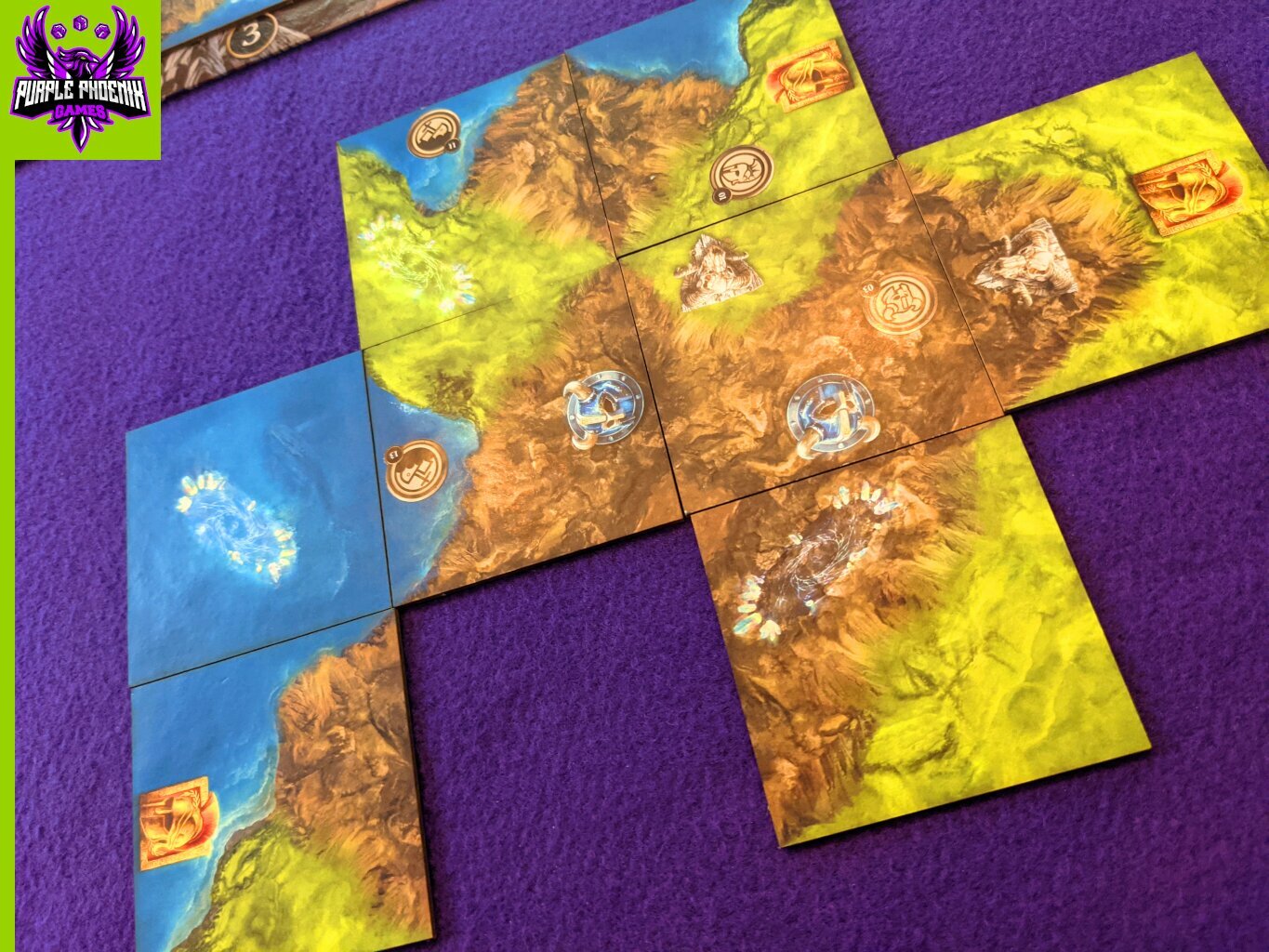
Divinus is played in turns starting with the first player and continuing around the table until one player places their final Map tile signaling the end of the game. On a turn, players will have a choice of using an Explore action or a Rest action. More actions may be available in future scenarios, but for the prototype scenarios, these are the two available choices. During an Explore action, the active player will choose any number of their rolled dice in order to create a mathematical equation that matches with one of the Map tiles on the main board. These spaces range from 1-12 in value, so an appropriate dice combination could be 5 + 4 – 1 = 8 in order to claim the Map tile on the 8 spot. Any number of dice can be used to claim tiles, and once a tile is claimed, it must be placed within the player’s personal play area map. In order to add these tiles, the edges will need to match up by terrain type with tiles already presently in play (see below), or may also be placed atop an existing tile. Map tiles may or may not contain symbols for factions, locations, and also Sacred Places. These will all be used in scenarios for different purposes.
Once a player decides they do not wish to (or cannot) take more Explore actions, they must Rest. To Rest, the active player reclaims all spent (and unspent ready) dice and rerolls them for the next turn, replacing empty spaces on the board with new Map tiles.
Play continues in this fashion of Exploring and Resting until one player places their 16th tile, thus completing their 4×4 personal map. Players will consult the app for scoring instructions and the winner will be announced. Should the players wish to play another scenario (or many, as we would have liked), they simply use the same Demigods and open a new Scenario Box. Inside these boxes are different gods to appease, new quests to fulfill (more on these later), and stickers to be applied to game components to improve their usefulness.
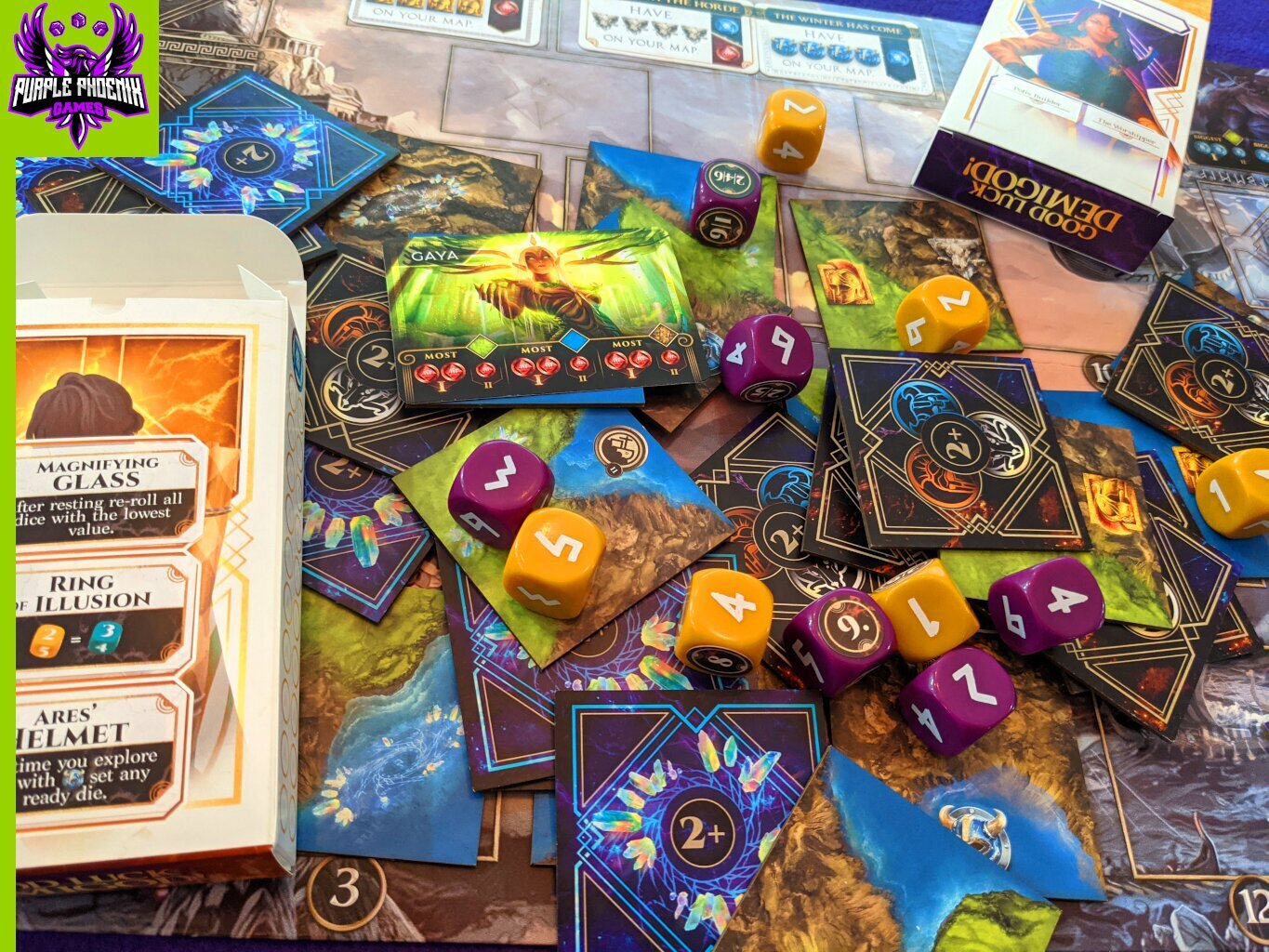
Components. Again, this is a prototype version of the game, and it includes two introductory scenarios, a bunch of sticker sheets, and a developmental app. That said, I really enjoyed my plays of the scenarios and they felt like great first steps to lure me into what I just know is going to be somewhat of a lifestyle game (assuming more and more expansions are in the plans). The sticker sheets are all fine, and as I understand it, the stickers that are placed on the Map tiles will have non-removable glue, but the stickers placed on the dice faces will have removable glue. As I am not a glue expert, I can’t really vouch for either. The app is somewhat similar to those that are used in the Chronicles of Crime series, but Divinus promises to deliver an app that can scan the components WITHOUT the use of QR codes. For those gamers who think the QRs are an eye-sore, then Divinus is taking a promising first step for you! I haven’t even touched on the artwork yet, and that’s usually my favorite aspect of a game’s components. The visual style and art on Divinus really make the game pop on the table, and just draw you into the lore and setting. I love it!
So while initially Divinus is a simple roll-and-draft game of building a 4×4 grid akin to Kingdomino, the addition and usage of the Quests and, later, the Charge Actions, morph this into something quite a bit meatier. Each Scenario Box (at least in this version) contains two god cards (that affect how the end of the scenario is scored) and some Quest cards (that are side-quests players can follow to earn some extra VP and other goodies). I imagine as the game progresses through Scenario Boxes that Quests will get more difficult and the god cards more interesting as well.
All in all Divinus has roped me in, and I am very much looking forward to all the other great things that Lucky Duck Games has planned for it. I can foresee soooooo many expansions being built on this excellent chassis, and I am very eager to finish the entire legacy aspect in order to play through the Eternal Mode a bunch of times. Can I divulge a little dirty secret of mine here? I have never before played any type of legacy board game, and if this is what they are like, then I will be breaking out my copy of Betrayal Legacy way sooner than I originally planned.
I believe that the theming here is great, the gameplay is relatively simple to grasp, and the hybrid app-driven story really adds to the entire experience. If you are someone who, like me, has yet to delve into legacy-style games where the components are constantly changing due to choices made at the table, and you have a penchant for dice games with a splash of ACTUAL math skills used, I urge you to take a look at backing Divinus on Gamefound ASAP. With just the initial two scenarios included, I am already addicted to the game and cannot wait to sink my teeth into more scenarios and more crucial decisions that will alter the landscape of my copy of the game. I know that as of the publish date of this preview, the campaign is already about 1000% funded and so many stretch goals have already been unlocked. It is a great time to hop on board and grab a big ol’ chunk of goodies for this one. You may have a preference for Roman or Norse mythology before playing, but be warned: your loyalties may change as a result of playing Divinus… or maybe you will learn to accept both at the harmonious center of activity in your own little section of the world.
Divinus is a competitive tile placement, campaign, drafting, dice game in which players assume the roles of upcoming demigods fighting over the one last spot at the table. By appeasing the gods of the warring ancient Roman and Norse cultures players will earn their place among them. This game uses some interesting hybrid app-driven story mechanics along with legacy-style component alterations to create this world that is constantly under refurbishment and ripe for the claiming of the future Divinus.
DISCLAIMER: We were provided a prototype copy of this game for the purposes of this review. These are preview copy components, and I do not know for sure if the final components will be any different from these shown. Also, it is not my intention to detail every rule in the game, as there are just too many. You are invited to download the rulebook, back the game through the Gamefound campaign, or through any retailers stocking it after fulfillment. -T
To setup, place the main board on the table, sort out the Map tiles by player count, and populate the board per the rulebook. Each player chooses their Demigod box and takes all components contained within. As Divinus is intended to be played either as a scenario session or its Eternal Mode, which is infinitely replayable using the board and components already altered by previously-played scenarios, open the chosen Scenario Box to be played and allow the app to instruct on how to setup with these components. All players roll their dice and place them in the “ready” pile to be used on their first turn. The first player takes the token (a black meeple in the prototype version) and the game is ready to be played!
Divinus is played in turns starting with the first player and continuing around the table until one player places their final Map tile signaling the end of the game. On a turn, players will have a choice of using an Explore action or a Rest action. More actions may be available in future scenarios, but for the prototype scenarios, these are the two available choices. During an Explore action, the active player will choose any number of their rolled dice in order to create a mathematical equation that matches with one of the Map tiles on the main board. These spaces range from 1-12 in value, so an appropriate dice combination could be 5 + 4 – 1 = 8 in order to claim the Map tile on the 8 spot. Any number of dice can be used to claim tiles, and once a tile is claimed, it must be placed within the player’s personal play area map. In order to add these tiles, the edges will need to match up by terrain type with tiles already presently in play (see below), or may also be placed atop an existing tile. Map tiles may or may not contain symbols for factions, locations, and also Sacred Places. These will all be used in scenarios for different purposes.
Once a player decides they do not wish to (or cannot) take more Explore actions, they must Rest. To Rest, the active player reclaims all spent (and unspent ready) dice and rerolls them for the next turn, replacing empty spaces on the board with new Map tiles.
Play continues in this fashion of Exploring and Resting until one player places their 16th tile, thus completing their 4×4 personal map. Players will consult the app for scoring instructions and the winner will be announced. Should the players wish to play another scenario (or many, as we would have liked), they simply use the same Demigods and open a new Scenario Box. Inside these boxes are different gods to appease, new quests to fulfill (more on these later), and stickers to be applied to game components to improve their usefulness.
Components. Again, this is a prototype version of the game, and it includes two introductory scenarios, a bunch of sticker sheets, and a developmental app. That said, I really enjoyed my plays of the scenarios and they felt like great first steps to lure me into what I just know is going to be somewhat of a lifestyle game (assuming more and more expansions are in the plans). The sticker sheets are all fine, and as I understand it, the stickers that are placed on the Map tiles will have non-removable glue, but the stickers placed on the dice faces will have removable glue. As I am not a glue expert, I can’t really vouch for either. The app is somewhat similar to those that are used in the Chronicles of Crime series, but Divinus promises to deliver an app that can scan the components WITHOUT the use of QR codes. For those gamers who think the QRs are an eye-sore, then Divinus is taking a promising first step for you! I haven’t even touched on the artwork yet, and that’s usually my favorite aspect of a game’s components. The visual style and art on Divinus really make the game pop on the table, and just draw you into the lore and setting. I love it!
So while initially Divinus is a simple roll-and-draft game of building a 4×4 grid akin to Kingdomino, the addition and usage of the Quests and, later, the Charge Actions, morph this into something quite a bit meatier. Each Scenario Box (at least in this version) contains two god cards (that affect how the end of the scenario is scored) and some Quest cards (that are side-quests players can follow to earn some extra VP and other goodies). I imagine as the game progresses through Scenario Boxes that Quests will get more difficult and the god cards more interesting as well.
All in all Divinus has roped me in, and I am very much looking forward to all the other great things that Lucky Duck Games has planned for it. I can foresee soooooo many expansions being built on this excellent chassis, and I am very eager to finish the entire legacy aspect in order to play through the Eternal Mode a bunch of times. Can I divulge a little dirty secret of mine here? I have never before played any type of legacy board game, and if this is what they are like, then I will be breaking out my copy of Betrayal Legacy way sooner than I originally planned.
I believe that the theming here is great, the gameplay is relatively simple to grasp, and the hybrid app-driven story really adds to the entire experience. If you are someone who, like me, has yet to delve into legacy-style games where the components are constantly changing due to choices made at the table, and you have a penchant for dice games with a splash of ACTUAL math skills used, I urge you to take a look at backing Divinus on Gamefound ASAP. With just the initial two scenarios included, I am already addicted to the game and cannot wait to sink my teeth into more scenarios and more crucial decisions that will alter the landscape of my copy of the game. I know that as of the publish date of this preview, the campaign is already about 1000% funded and so many stretch goals have already been unlocked. It is a great time to hop on board and grab a big ol’ chunk of goodies for this one. You may have a preference for Roman or Norse mythology before playing, but be warned: your loyalties may change as a result of playing Divinus… or maybe you will learn to accept both at the harmonious center of activity in your own little section of the world.
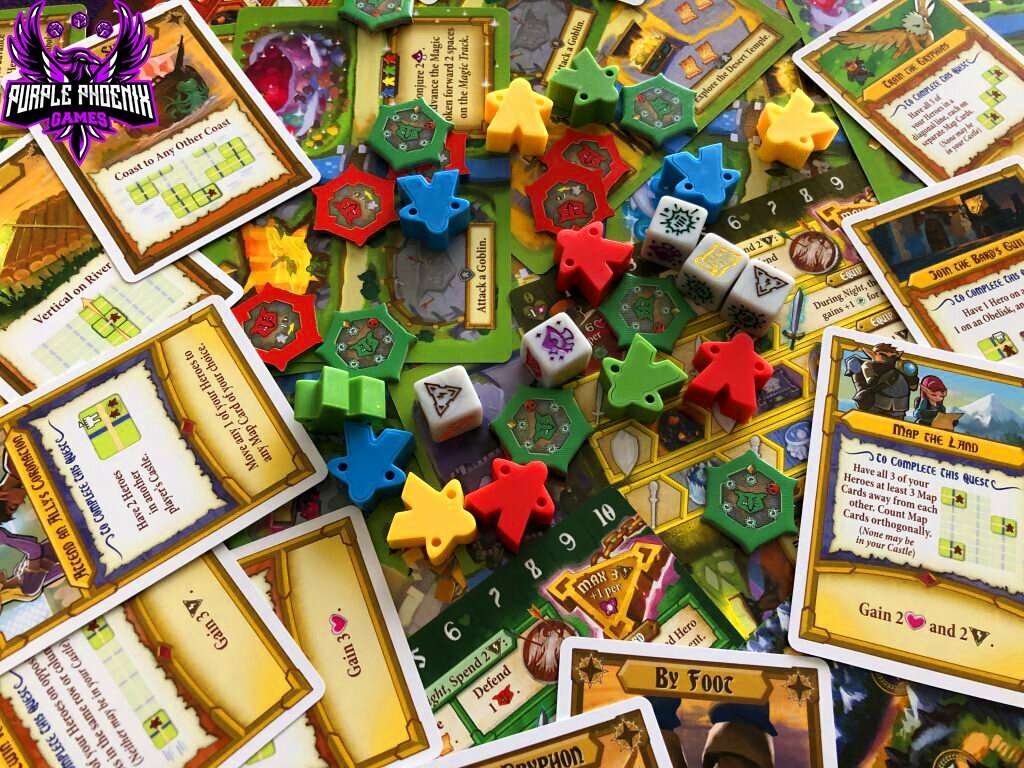
Purple Phoenix Games (2266 KP) rated Tiny Epic Quest in Tabletop Games
Jul 29, 2019 (Updated Jul 9, 2020)
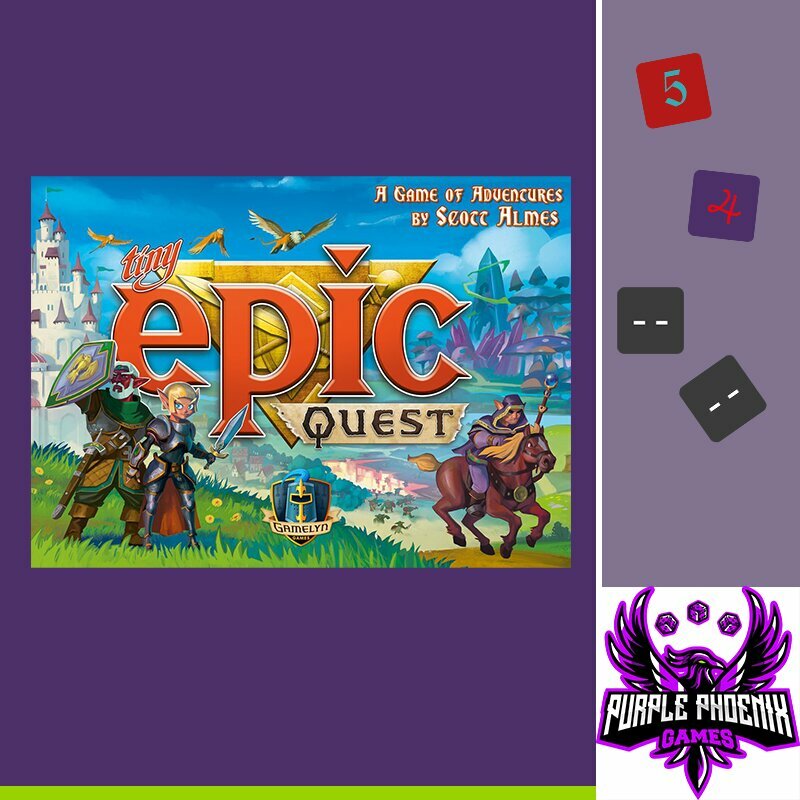
Our next review in the Tiny Epic series is Tiny Epic Quest! I know that we have not been reviewing them in chronological order of release – we are kind of just reviewing them in the order we have discovered and played them. Every Tiny Epic game has its own place in the family, so how does Tiny Epic Quest fit in? Keep reading to find out!
A world at peace has been thrust into chaos once more as mysterious portals have opened across the lands, spewing forth treacherous Goblins! The citizens need heroes – and that is your specialty! Traverse the lands to fight Goblins, learn magic spells, and delve into ancient temples to find powerful artifacts to aid in your battle for good.
Disclaimer: I do not intend to rehash the entire rulebook in this review, but give a general overview of the rules and the gameplay. If you want to read the rules more specifically, pick up a copy of the game at your FLGS or directly from the publisher. – L
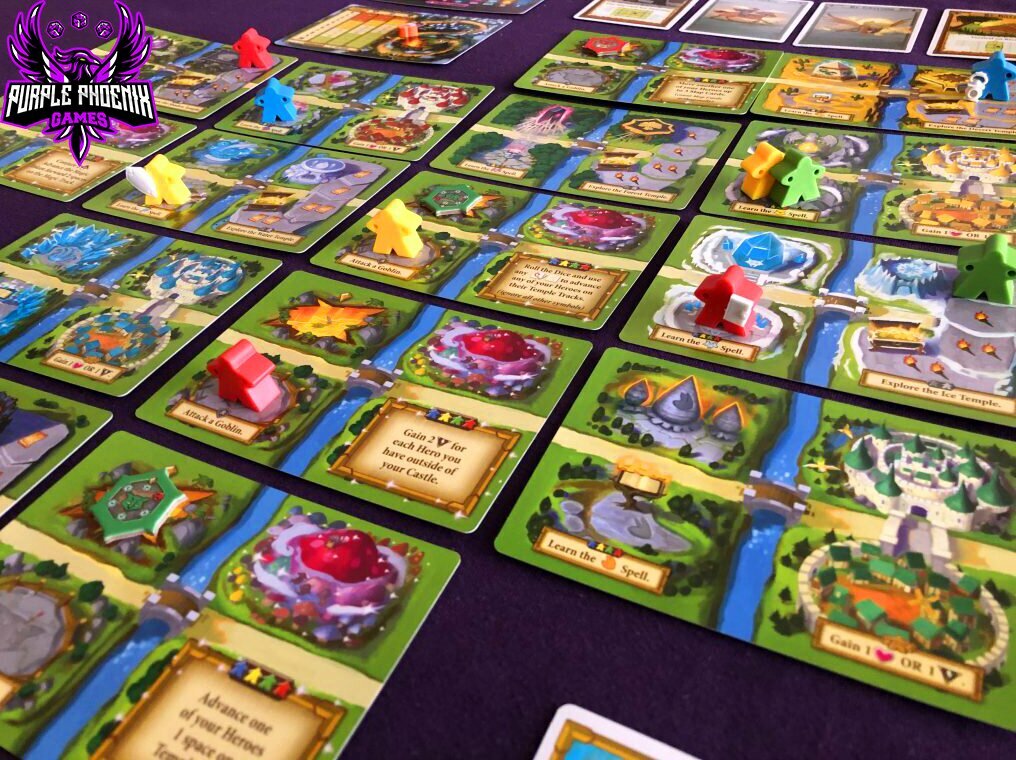
Tiny Epic Quest is a game of area movement, dice rolling, and push your luck, in which players are trying to amass the most end-game victory points. How do you earn VPs? By completing quests, fighting Goblins, and learning spells! A game of Tiny Epic Quest is played over 5 rounds, and each round is broken into 2 phases – the Day Phase and the Night Phase. The Day Phase consists of 4 turns where you will can move your heroes. A turn plays out like this: the starting player selects one of the 5 available movement cards and moves 1 hero according to those restrictions. Following clockwise, each other player may move 1 hero in the same manner, or choose to Idle and not move. Once everyone has moved or idled, the next turn starts and play continues as before. After 4 movement cards have been performed, the Day Phase ends.
Moving on to the Night Phase, players have the opportunity to perform the actions associated with the card regions onto which they moved during the Day Phase. If you moved to a Goblin Portal, for example, you now have the chance to fight. On your turn in the Night Phase, you will roll the Adventure Dice and resolve them in an attempt to complete your goals – defeating goblins, completing temples, or learning spells. Quests can be completed in either the Day or Night Phase, depending on the requirements. When you complete a quest, collect the card and hang onto it for end-game scoring. The Night Phase ends when all players have opted to Rest (either by choice or by becoming exhausted), and the round is over. Perform the round resolutions (refill goblin portals, etc.), and then continue on to the next round. After 5 rounds, tally up your VPs, and the player with the most is the winner!
For such a ‘tiny’ game, Tiny Epic Quest definitely has a lot going on. The amount of strategy required for this game is pretty intense. You not only have to decide where to move your heroes, you also have to think about what you want to do and how you want to earn your VPs. Do you want to take a combative approach and try to kill as many goblins as possible? Do you want to try your luck at learning high-level spells? Or is your strategy dictated by the current quest cards in play? Not only do you have to figure out your own strategy, you are also trying to figure out how your opponents are playing as well. Will you try to beat them to a temple first or will you let them do their own thing as long as they don’t interfere with your plans? There is no single right way to play this game, and that’s what makes it so engaging and fun with every play.
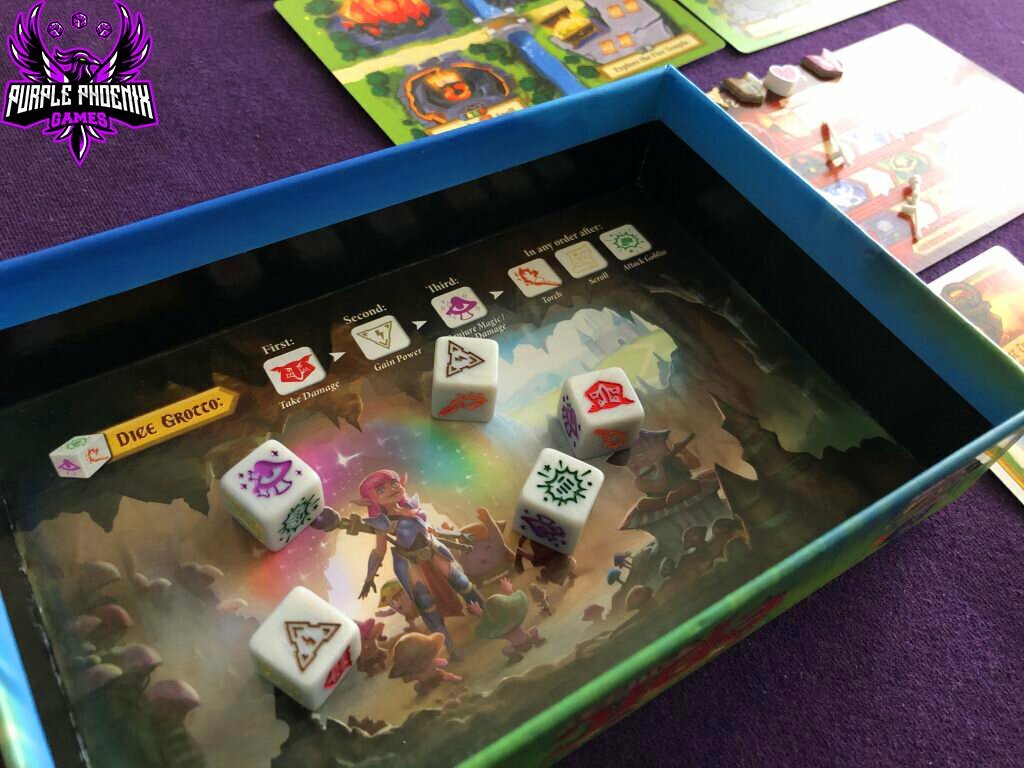
That being said, this game also has a fair amount of push your luck in the form of the Adventure Dice. Not all of the die faces are beneficial to you, and they are resolved in a specific order. Damage always is dealt to you first, and if you take too much damage, you immediately become exhausted. When that happens, all of your heroes are returned to your starting castle, and any progress you had made on goblin fights, temple tracks, or spell-learning is lost. You really have to be thinking about how far you are willing to go, and if it is worth one more roll of the dice to risk success or complete failure.
Tiny Epic Quest is kind of a double-edged sword for me. I enjoy games that require decent strategy, but I also am not too fond of push your luck games. This game can sometimes feel like it’s working against you – all of your strategic setup in the Day Phase could be undone with some unfortunate dice rolls in the Night Phase. No matter how solid your strategy is, the dice will ultimately seal your fate. Don’t get me wrong, part of the fun of Tiny Epic Quest is figuring out how to bounce back after a poor Night Phase. But dice can be brutal sometimes and that can take away from your enjoyment.
So where does Tiny Epic Quest fit into the family? I would say it’s a cousin that you like, but don’t see too often. I enjoy playing this game from time to time, but it is definitely not my go-to Tiny Epic game. The rulebook could use some simplification, and for being a Tiny Epic game, it is kind of a table hog. Some of the strategy for me is negated by the dice-rolling mechanic, but it could also be because I am a notoriously bad dice roller… Would I recommend Tiny Epic Quest? Ultimately, yes I would. I may not personally like some of the aspects of play, but the game itself is engaging and entertaining. If you haven’t checked this one out yet, give it a shot! Purple Phoenix Games gives Tiny Epic Quest a valiant 9 / 12.
A world at peace has been thrust into chaos once more as mysterious portals have opened across the lands, spewing forth treacherous Goblins! The citizens need heroes – and that is your specialty! Traverse the lands to fight Goblins, learn magic spells, and delve into ancient temples to find powerful artifacts to aid in your battle for good.
Disclaimer: I do not intend to rehash the entire rulebook in this review, but give a general overview of the rules and the gameplay. If you want to read the rules more specifically, pick up a copy of the game at your FLGS or directly from the publisher. – L
Tiny Epic Quest is a game of area movement, dice rolling, and push your luck, in which players are trying to amass the most end-game victory points. How do you earn VPs? By completing quests, fighting Goblins, and learning spells! A game of Tiny Epic Quest is played over 5 rounds, and each round is broken into 2 phases – the Day Phase and the Night Phase. The Day Phase consists of 4 turns where you will can move your heroes. A turn plays out like this: the starting player selects one of the 5 available movement cards and moves 1 hero according to those restrictions. Following clockwise, each other player may move 1 hero in the same manner, or choose to Idle and not move. Once everyone has moved or idled, the next turn starts and play continues as before. After 4 movement cards have been performed, the Day Phase ends.
Moving on to the Night Phase, players have the opportunity to perform the actions associated with the card regions onto which they moved during the Day Phase. If you moved to a Goblin Portal, for example, you now have the chance to fight. On your turn in the Night Phase, you will roll the Adventure Dice and resolve them in an attempt to complete your goals – defeating goblins, completing temples, or learning spells. Quests can be completed in either the Day or Night Phase, depending on the requirements. When you complete a quest, collect the card and hang onto it for end-game scoring. The Night Phase ends when all players have opted to Rest (either by choice or by becoming exhausted), and the round is over. Perform the round resolutions (refill goblin portals, etc.), and then continue on to the next round. After 5 rounds, tally up your VPs, and the player with the most is the winner!
For such a ‘tiny’ game, Tiny Epic Quest definitely has a lot going on. The amount of strategy required for this game is pretty intense. You not only have to decide where to move your heroes, you also have to think about what you want to do and how you want to earn your VPs. Do you want to take a combative approach and try to kill as many goblins as possible? Do you want to try your luck at learning high-level spells? Or is your strategy dictated by the current quest cards in play? Not only do you have to figure out your own strategy, you are also trying to figure out how your opponents are playing as well. Will you try to beat them to a temple first or will you let them do their own thing as long as they don’t interfere with your plans? There is no single right way to play this game, and that’s what makes it so engaging and fun with every play.
That being said, this game also has a fair amount of push your luck in the form of the Adventure Dice. Not all of the die faces are beneficial to you, and they are resolved in a specific order. Damage always is dealt to you first, and if you take too much damage, you immediately become exhausted. When that happens, all of your heroes are returned to your starting castle, and any progress you had made on goblin fights, temple tracks, or spell-learning is lost. You really have to be thinking about how far you are willing to go, and if it is worth one more roll of the dice to risk success or complete failure.
Tiny Epic Quest is kind of a double-edged sword for me. I enjoy games that require decent strategy, but I also am not too fond of push your luck games. This game can sometimes feel like it’s working against you – all of your strategic setup in the Day Phase could be undone with some unfortunate dice rolls in the Night Phase. No matter how solid your strategy is, the dice will ultimately seal your fate. Don’t get me wrong, part of the fun of Tiny Epic Quest is figuring out how to bounce back after a poor Night Phase. But dice can be brutal sometimes and that can take away from your enjoyment.
So where does Tiny Epic Quest fit into the family? I would say it’s a cousin that you like, but don’t see too often. I enjoy playing this game from time to time, but it is definitely not my go-to Tiny Epic game. The rulebook could use some simplification, and for being a Tiny Epic game, it is kind of a table hog. Some of the strategy for me is negated by the dice-rolling mechanic, but it could also be because I am a notoriously bad dice roller… Would I recommend Tiny Epic Quest? Ultimately, yes I would. I may not personally like some of the aspects of play, but the game itself is engaging and entertaining. If you haven’t checked this one out yet, give it a shot! Purple Phoenix Games gives Tiny Epic Quest a valiant 9 / 12.
Purple Phoenix Games (2266 KP) rated The Druid Master in Tabletop Games
Jun 2, 2021
When it comes to fantasy worlds, I often think of powerful parties going on epic adventures – fighting monsters, delving through dungeons, and saving the world! But what about when the adventure is over and the party comes home? What do they do in their day-to-day lives? Well, The Druid Master helps give us a glimpse into the regular life of a Druid. Being the local healer might not always be glamorous, but hey, it’s a living!
Disclaimer: We were provided a PnP of The Druid Master for the purposes of this preview. The artwork and design of the cards is not yet finalized, so what you see pictured below is not necessarily what the production copies will look like. It is also important to note that although the game is about natural medicines/remedies, it does not replace professional medical advice and treatments. -L
In The Druid Master, players will take on the roles of (you guessed it) Druids who have mastered the ancient arts of healing, through use of plants, herbs, and other natural elements. Ailing patients will come to you (and your rivals) for help, so you must work quickly to concoct the most effective remedy to heal them back to normal! To setup for a game, each player receives a Player Screen, 1 Effect card, and 7 Plant cards. The remaining Effect and Plant cards are shuffled to form draw decks, and the Event deck is placed nearby as well. Place the deck of Patient cards facedown within reach of all players, and set the Cure tokens to the side. The game is now ready to begin!
Over the course of 8 rounds, players will be using Plant and Effect cards to best help the ailing Patient for each given round. Once the 8th and final Patient card has been resolved, points will be counted to determine the ultimate Druid Master! To start a round, an Event card will be revealed. These Events will alter the round in some way, putting your strategic thinking to the test. For example, an Event card might limit the number of cards you can play this round. After the Event is resolved, the Patient card will be revealed for all players to see. The Patient will have a list of symptoms/ailments, with a percentage corresponding to the severity of the issue. Each player will then secretly select 1-3 Plant cards from their hand to be used to heal the Patient. The different Plant cards offer remedies for the various symptoms/ailments, and also list a corresponding percentage as to how much it will help. Effect cards can also be used during this phase of the game to obtain bonuses/negatively affect opponents. Use them wisely!
Once everyone is ready, all Plant cards will be revealed, and players will determine who has best cured the Patient. Compare the percentages on your Plant cards against those of the Patient – if you have failed to completely cure a symptom, take a Cure token that represents the missing percentages from your played cure. When all Plant cards have been checked, the player that was able to Cure the Patient completely (was able to match all Patient percentages with their played Plant cards) is the winner of the round. They will take the Patient card for end-game scoring. If nobody completely Cured the Patient, the player who accumulated the least number of Cure tokens (thus curing the most Patient percentages of the group) wins the round and collects the Patient card. All Plant and Effect cards used this round are discarded, and each player will draw 2 new Plant cards for the next round. Play continues in this fashion until the 8th Patient has been Cured. Players will count up their points earned from Cured Patients, and the player with the highest score is named the winning Druid Master!
I should say right off the bat that I’m not really a person who is into natural medicine. But my personal preferences do not stop me from playing and enjoying The Druid Master. If you think about it, natural medicine is very thematically appropriate for fantasy worlds, so it makes sense in this setting. Ok, so what about the gameplay? It is very straight-forward, which lends itself to fast teaching, learning, and playing. Ultimately, you are trying to match your Plant cards as best you can to the Patient card in play. And since you can only play a maximum of 3 cards each round, you really have to consider your options. If you aren’t able to completely Cure the Patient, can you play your Plant cards in such a way that you will collect the fewest Cure tokens? It’s all about how you strategize. Another thing that I really like about the gameplay is that all Plant cards are selected secretly and revealed simultaneously. So nobody is at an advantage by being able to see that an opponent was not 100% successful. It adds a little element of risk and hidden information to the game that makes it more engaging.
As I mentioned earlier, this is a PnP version of the game, so these components are not what will be received in a production copy. Also, the card layouts and artwork are not completely finalized either. But going on what I have, I do like the simplicity of the components. The symbolism is clear, the percentages are easy to read, and the text/pictures are informational as well. Once this game is printed on real cards and with cardboard tokens, I know it will be a decent quality production.
So overall, how does The Druid Master fare? I’d say fairly well. The rules and gameplay are straight-forward, it is fast and easy to teach and play, and it keeps all players engaged throughout the entire game. This is certainly not the most complicated or heavy game in existence, but it does offer hints of strategy that will keep the gameplay fresh and players invested. If you are looking for a nice little filler-type game set in a fantasy realm, I would recommend checking out The Druid Master. It is coming to Kickstarter soon, so be on the lookout!
Disclaimer: We were provided a PnP of The Druid Master for the purposes of this preview. The artwork and design of the cards is not yet finalized, so what you see pictured below is not necessarily what the production copies will look like. It is also important to note that although the game is about natural medicines/remedies, it does not replace professional medical advice and treatments. -L
In The Druid Master, players will take on the roles of (you guessed it) Druids who have mastered the ancient arts of healing, through use of plants, herbs, and other natural elements. Ailing patients will come to you (and your rivals) for help, so you must work quickly to concoct the most effective remedy to heal them back to normal! To setup for a game, each player receives a Player Screen, 1 Effect card, and 7 Plant cards. The remaining Effect and Plant cards are shuffled to form draw decks, and the Event deck is placed nearby as well. Place the deck of Patient cards facedown within reach of all players, and set the Cure tokens to the side. The game is now ready to begin!
Over the course of 8 rounds, players will be using Plant and Effect cards to best help the ailing Patient for each given round. Once the 8th and final Patient card has been resolved, points will be counted to determine the ultimate Druid Master! To start a round, an Event card will be revealed. These Events will alter the round in some way, putting your strategic thinking to the test. For example, an Event card might limit the number of cards you can play this round. After the Event is resolved, the Patient card will be revealed for all players to see. The Patient will have a list of symptoms/ailments, with a percentage corresponding to the severity of the issue. Each player will then secretly select 1-3 Plant cards from their hand to be used to heal the Patient. The different Plant cards offer remedies for the various symptoms/ailments, and also list a corresponding percentage as to how much it will help. Effect cards can also be used during this phase of the game to obtain bonuses/negatively affect opponents. Use them wisely!
Once everyone is ready, all Plant cards will be revealed, and players will determine who has best cured the Patient. Compare the percentages on your Plant cards against those of the Patient – if you have failed to completely cure a symptom, take a Cure token that represents the missing percentages from your played cure. When all Plant cards have been checked, the player that was able to Cure the Patient completely (was able to match all Patient percentages with their played Plant cards) is the winner of the round. They will take the Patient card for end-game scoring. If nobody completely Cured the Patient, the player who accumulated the least number of Cure tokens (thus curing the most Patient percentages of the group) wins the round and collects the Patient card. All Plant and Effect cards used this round are discarded, and each player will draw 2 new Plant cards for the next round. Play continues in this fashion until the 8th Patient has been Cured. Players will count up their points earned from Cured Patients, and the player with the highest score is named the winning Druid Master!
I should say right off the bat that I’m not really a person who is into natural medicine. But my personal preferences do not stop me from playing and enjoying The Druid Master. If you think about it, natural medicine is very thematically appropriate for fantasy worlds, so it makes sense in this setting. Ok, so what about the gameplay? It is very straight-forward, which lends itself to fast teaching, learning, and playing. Ultimately, you are trying to match your Plant cards as best you can to the Patient card in play. And since you can only play a maximum of 3 cards each round, you really have to consider your options. If you aren’t able to completely Cure the Patient, can you play your Plant cards in such a way that you will collect the fewest Cure tokens? It’s all about how you strategize. Another thing that I really like about the gameplay is that all Plant cards are selected secretly and revealed simultaneously. So nobody is at an advantage by being able to see that an opponent was not 100% successful. It adds a little element of risk and hidden information to the game that makes it more engaging.
As I mentioned earlier, this is a PnP version of the game, so these components are not what will be received in a production copy. Also, the card layouts and artwork are not completely finalized either. But going on what I have, I do like the simplicity of the components. The symbolism is clear, the percentages are easy to read, and the text/pictures are informational as well. Once this game is printed on real cards and with cardboard tokens, I know it will be a decent quality production.
So overall, how does The Druid Master fare? I’d say fairly well. The rules and gameplay are straight-forward, it is fast and easy to teach and play, and it keeps all players engaged throughout the entire game. This is certainly not the most complicated or heavy game in existence, but it does offer hints of strategy that will keep the gameplay fresh and players invested. If you are looking for a nice little filler-type game set in a fantasy realm, I would recommend checking out The Druid Master. It is coming to Kickstarter soon, so be on the lookout!
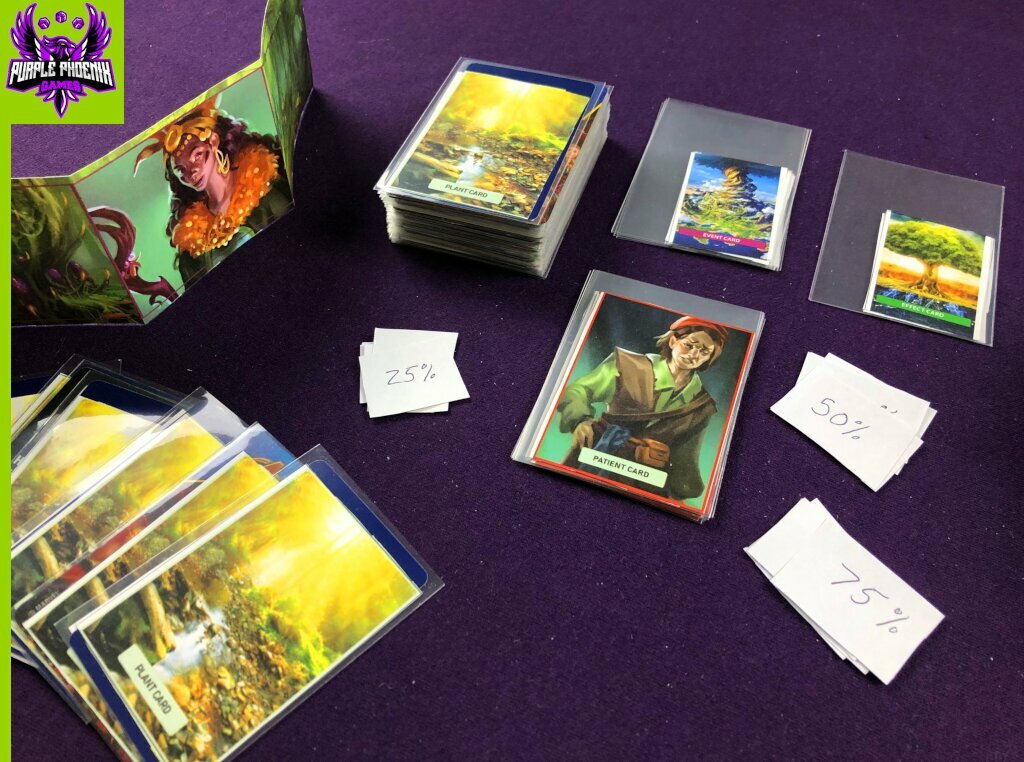
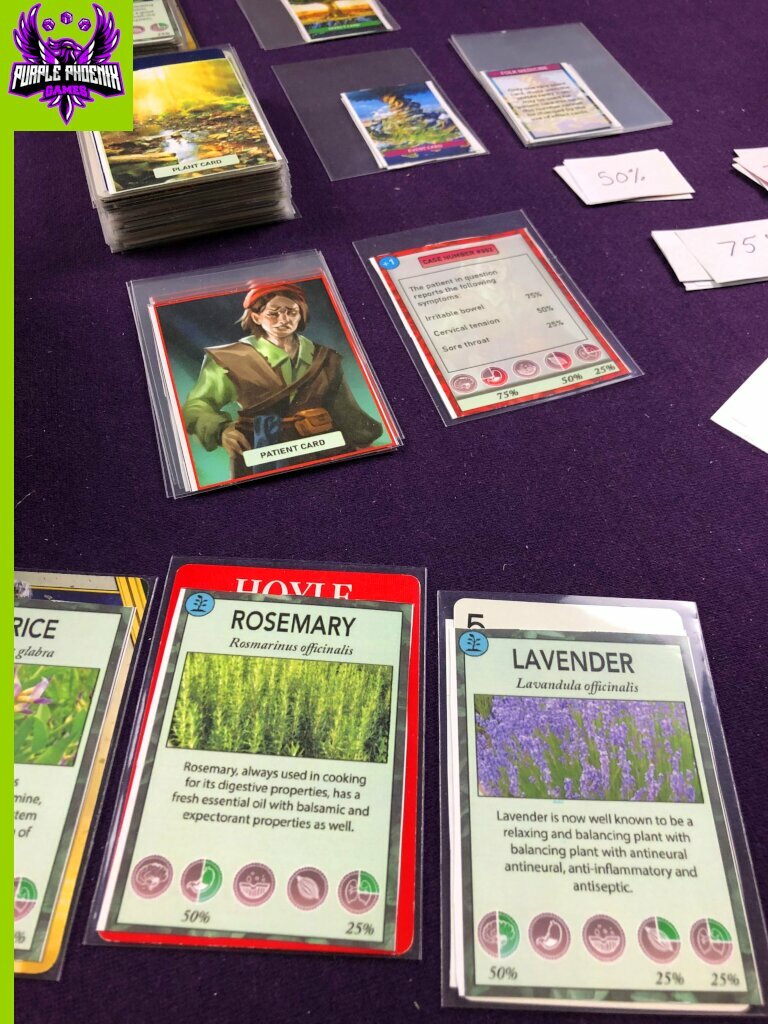
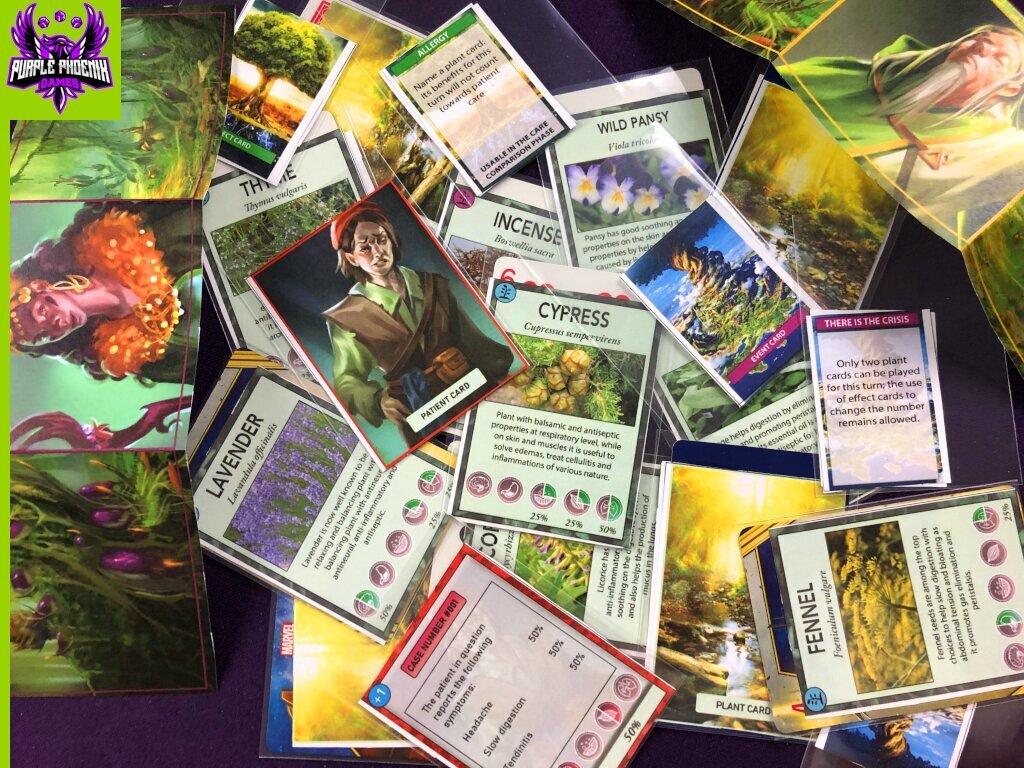
Purple Phoenix Games (2266 KP) rated Among the Stars in Tabletop Games
Dec 3, 2021
If there is a mechanic that we at Purple Phoenix Games seem to really love, it is card drafting. One such game that has been a big hit for us (well, at least for 3 of us….) is 7 Wonders. Draft a card, pass the rest to your neighbor, draft another card from those received from your other neighbor, and repeat. Set in the Ancient World, you are working to build the most wondrous city. But Laura, why all the 7 Wonders talk in this review? Well, because Among the Stars gives me major 7 Wonders vibes, but IN SPACE. Keep reading to see what I mean.
Disclaimer: Among the Stars can be played in two different modes – Aggressive and Non-Aggressive. This review covers the core game Non-Aggressive mode of play. -L
Among the Stars is a game of card drafting and tile placement in which players take on the roles of different alien races attempting to build the most efficient space station over the span of 4 years (rounds). After the 4th and final round, players calculate their final scores, and the player with the highest score is the winner! To setup for a game, assemble the Location deck as described in the rules. Each player takes a Main Reactor card and score marker in their chosen color. Score markers are placed at zero on the score board, and players put their Main Reactor card face-up in front of them, along with 2 Energy Cubes. Players choose, or are randomly given, a Race Tile with a special Racial Ability to be used throughout the game. Randomly draw the requisite number of Objective cards and put them face-up near the score board. The game is now ready to begin!
Over the course of 4 rounds, players will be drafting cards and playing them into their Space Station. At the start of each round, every player collects 10 Credits (game currency), and draws a hand of 6 Location cards. Every turn, players will select one card from their hand, place it face-down in front of them, and will pass the remaining cards in their hand to the next player (in either clockwise or counter-clockwise direction, depending on the round). Players will then simultaneously reveal their chosen card and perform one of three actions: Build a Location, Build Power Reactor, or Discard and gain 3 Credits. To Build a Location, you pay its listed cost in Credits and/or Energy and add it to your Space Station. Locations must be placed orthogonally adjacent to an existing Location. When you build a Location, you immediately gain the listed number of VP (tracked on the score board), and may use its ability. Some abilities are immediate and earn you extra VP now, while some are delayed and will be counted at the end of the game. To Build a Power Reactor, you will first discard your selected card for the turn. Pay the 1 Credit cost of a Power Reactor and place it into your Space Station, along with 2 Energy Cubes. Every round, you get 10 Credits, but Energy Cubes do not replenish unless you build more Power Reactors, so keep an eye on your resources! The last possible action is to Discard and gain 3 Credits, and is pretty self-explanatory.
Players continue taking turns (drafting cards, passing cards, and playing cards) until they are left with no cards in hand. The round is now over. Move the round marker to the next space, and begin a new round by drawing another hand of 6 cards. After the 4th round of play, the game ends and final VP are scored. Victory Points have been earned throughout the game, but now any delayed abilities are triggered and scored, Objective points are added, and players gain points for Power Reactors and remaining Credits. The player with the highest score is the winner!
See what I mean about being 7 Wonders in space? The overall gameplay is pretty much the same thing – draft a card, pass cards, play the card – even though thematically they’re on opposite ends of time. That familiarity and simplicity of the gameplay definitely added to my enjoyment of the game. And when I say ‘simplicity’ of gameplay, I do not mean that it is an easy game necessarily. It still requires a decent amount of strategy! Not only do you have to decide what card to draft for maximum benefit, but you also need to figure out exactly where to put it in your Space Station too. Some Locations may give you extra VP for being adjacent to certain other Locations, or they may even earn more VP for distance between two Locations. You’ve got to be thinking in advance, but also able to adapt on the fly. Do you draft a card that you don’t necessarily want because you can see your opponent needs it? Or do you keep your head down and try to fly under the radar? The strategy and mechanics work very well together in creating an engaging and entertaining game.
Components. This game basically just consists of cards, a score board, and some tokens. So even though it’s nothing too fancy or anything, they’re still pretty decent quality! The artwork is thematic and fun to look at, and the layout of the cards is easy to understand. The cards are square, so that makes for some interesting shuffling, but the square shape really lends itself well to the tile-laying aspect of the gameplay. So all in all, good production quality. Just be warned – as the game progresses, it turns into quite a table hog, since you are constantly adding cards to your Space Station. Not a knock on the game, just a heads up so you give yourself plenty of room!
Will Among the Stars replace 7 Wonders for me? Ultimately, no. Don’t get me wrong, it’s still a great game, but 7 Wonders just offers a little more strategy that bumps it to a higher level than Among the Stars. To introduce players to these mechanics and gameplay style, I would use Among the Stars because it is a little ‘lighter’ than 7 Wonders, if you ask me. If you are a fan of 7 Wonders and are interested in a more futuristic theme, I would definitely recommend checking out Among the Stars. It’s a neat game that has been hiding on my game shelf without the playtime it deserves. Purple Phoenix Games gives this one a stellar 15 / 18.
Disclaimer: Among the Stars can be played in two different modes – Aggressive and Non-Aggressive. This review covers the core game Non-Aggressive mode of play. -L
Among the Stars is a game of card drafting and tile placement in which players take on the roles of different alien races attempting to build the most efficient space station over the span of 4 years (rounds). After the 4th and final round, players calculate their final scores, and the player with the highest score is the winner! To setup for a game, assemble the Location deck as described in the rules. Each player takes a Main Reactor card and score marker in their chosen color. Score markers are placed at zero on the score board, and players put their Main Reactor card face-up in front of them, along with 2 Energy Cubes. Players choose, or are randomly given, a Race Tile with a special Racial Ability to be used throughout the game. Randomly draw the requisite number of Objective cards and put them face-up near the score board. The game is now ready to begin!
Over the course of 4 rounds, players will be drafting cards and playing them into their Space Station. At the start of each round, every player collects 10 Credits (game currency), and draws a hand of 6 Location cards. Every turn, players will select one card from their hand, place it face-down in front of them, and will pass the remaining cards in their hand to the next player (in either clockwise or counter-clockwise direction, depending on the round). Players will then simultaneously reveal their chosen card and perform one of three actions: Build a Location, Build Power Reactor, or Discard and gain 3 Credits. To Build a Location, you pay its listed cost in Credits and/or Energy and add it to your Space Station. Locations must be placed orthogonally adjacent to an existing Location. When you build a Location, you immediately gain the listed number of VP (tracked on the score board), and may use its ability. Some abilities are immediate and earn you extra VP now, while some are delayed and will be counted at the end of the game. To Build a Power Reactor, you will first discard your selected card for the turn. Pay the 1 Credit cost of a Power Reactor and place it into your Space Station, along with 2 Energy Cubes. Every round, you get 10 Credits, but Energy Cubes do not replenish unless you build more Power Reactors, so keep an eye on your resources! The last possible action is to Discard and gain 3 Credits, and is pretty self-explanatory.
Players continue taking turns (drafting cards, passing cards, and playing cards) until they are left with no cards in hand. The round is now over. Move the round marker to the next space, and begin a new round by drawing another hand of 6 cards. After the 4th round of play, the game ends and final VP are scored. Victory Points have been earned throughout the game, but now any delayed abilities are triggered and scored, Objective points are added, and players gain points for Power Reactors and remaining Credits. The player with the highest score is the winner!
See what I mean about being 7 Wonders in space? The overall gameplay is pretty much the same thing – draft a card, pass cards, play the card – even though thematically they’re on opposite ends of time. That familiarity and simplicity of the gameplay definitely added to my enjoyment of the game. And when I say ‘simplicity’ of gameplay, I do not mean that it is an easy game necessarily. It still requires a decent amount of strategy! Not only do you have to decide what card to draft for maximum benefit, but you also need to figure out exactly where to put it in your Space Station too. Some Locations may give you extra VP for being adjacent to certain other Locations, or they may even earn more VP for distance between two Locations. You’ve got to be thinking in advance, but also able to adapt on the fly. Do you draft a card that you don’t necessarily want because you can see your opponent needs it? Or do you keep your head down and try to fly under the radar? The strategy and mechanics work very well together in creating an engaging and entertaining game.
Components. This game basically just consists of cards, a score board, and some tokens. So even though it’s nothing too fancy or anything, they’re still pretty decent quality! The artwork is thematic and fun to look at, and the layout of the cards is easy to understand. The cards are square, so that makes for some interesting shuffling, but the square shape really lends itself well to the tile-laying aspect of the gameplay. So all in all, good production quality. Just be warned – as the game progresses, it turns into quite a table hog, since you are constantly adding cards to your Space Station. Not a knock on the game, just a heads up so you give yourself plenty of room!
Will Among the Stars replace 7 Wonders for me? Ultimately, no. Don’t get me wrong, it’s still a great game, but 7 Wonders just offers a little more strategy that bumps it to a higher level than Among the Stars. To introduce players to these mechanics and gameplay style, I would use Among the Stars because it is a little ‘lighter’ than 7 Wonders, if you ask me. If you are a fan of 7 Wonders and are interested in a more futuristic theme, I would definitely recommend checking out Among the Stars. It’s a neat game that has been hiding on my game shelf without the playtime it deserves. Purple Phoenix Games gives this one a stellar 15 / 18.

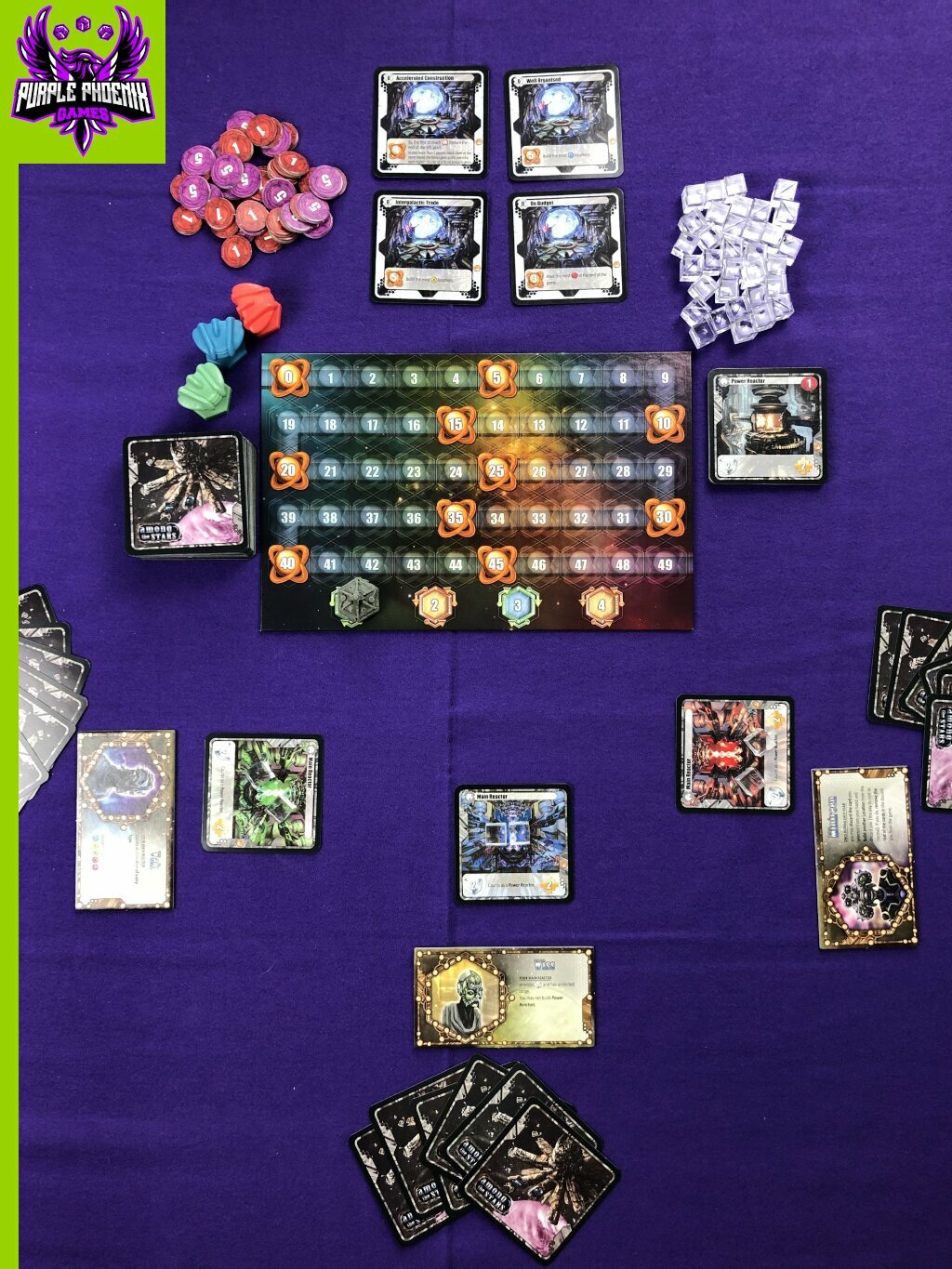
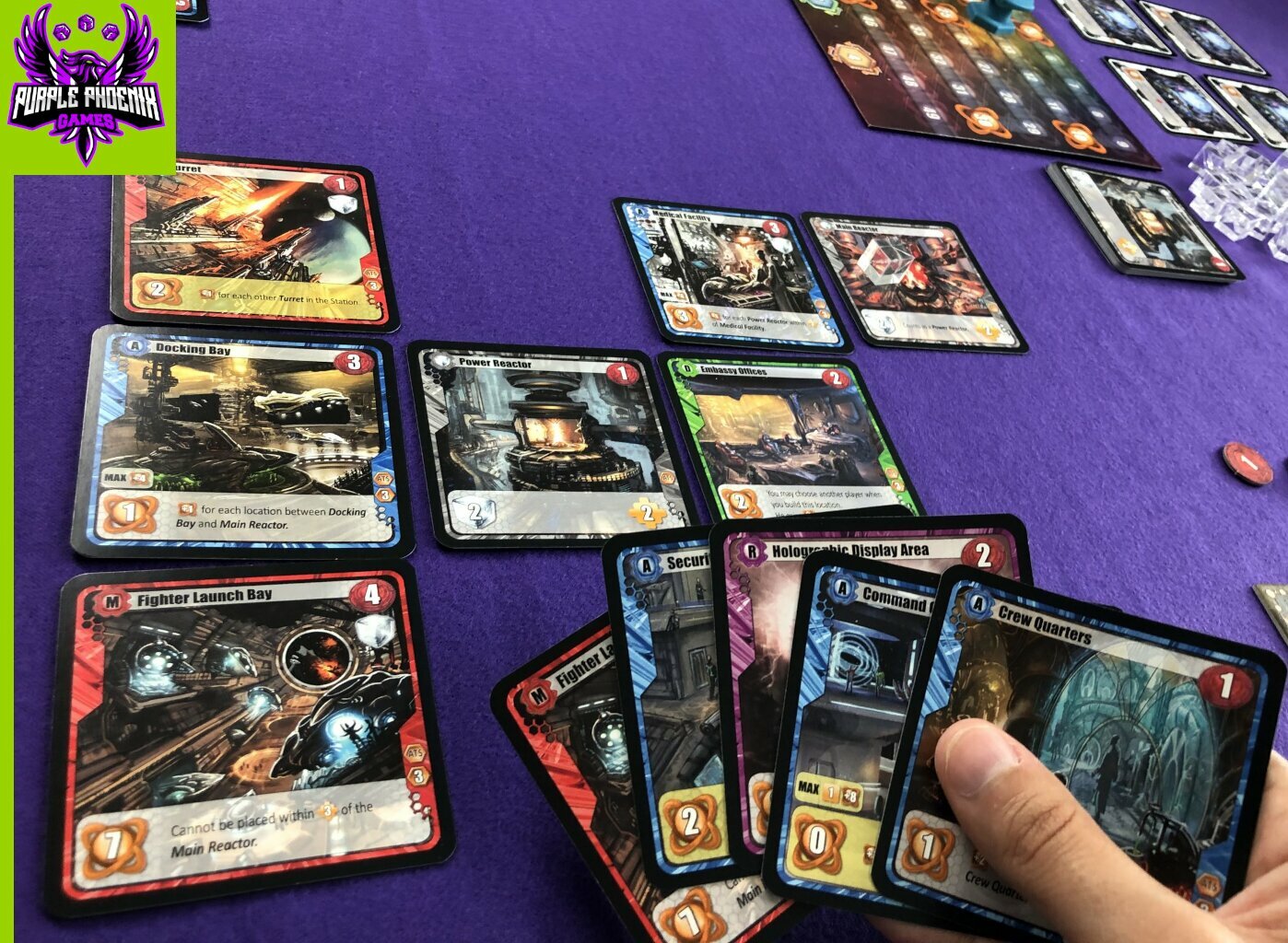

Purple Phoenix Games (2266 KP) rated Tutankhamun in Tabletop Games
Jul 9, 2021
Tutankhamun (per dictionary.com, the pronunciation is as such: [ toot-ahng-kah-muhn ]) is regularly shortened and often referred to as “King Tut.” My real question is that if the first syllable is “toot,” why do we not call him King Toot? I have a 5 year old boy and a 2 year old girl at the time of this writing, so I can tell you EXACTLY why we don’t call him King Toot, but that’s for another discussion. Never having played the original version, will I enjoy this new version of the game by world-renowned designer Dr. Reiner Knizia?
In Tutankhamun, players take on the roles of Egyptian priests attempting to cleanse their souls by gifting the sarcophagus with relics found along the Nile River. The priest who can cleanse their soul quickest will be proclaimed the next High Priest and winner of the game!
DISCLAIMER: We were provided a copy of this game for the purposes of this review. This is a retail copy of the game, so what you see in these photos is exactly what would be received in your box. I do not intend to cover every single rule included in the rulebook, but will describe the overall game flow and major rule set so that our readers may get a sense of how the game plays. For more in depth rules, you may purchase a copy online or from your FLGS. -T
To setup, place the King Tut sarcophagus on the table somewhere inside the box bottom. From this starting place (or you could place these components last I suppose), begin the laborious job of creating the Nile from the trapezoidal Relic TIles. This part took me a good several minutes each game. Place out the Underworld Mat near the start of the Nile, and place upon it the two Guardian Statue standees. From there give every player a reference card, have them choose a player color, place their boats at the start of the Nile, and Canopic Jar scoring markers on the appropriate space along the box bottom score track. The game may now begin!
Tutankhamun is played in turns starting with the starting player and proceeding clockwise. The starting player will choose ANY Relic Tile to collect and move their boat to that location. Once collected, the player will check to make sure there are still matching Relics along the Nile. If so, then play continues to the next player. If the active player had collected the last Relic of that type still active in the game, then the Relic type is scored.
Each Relic Tile features art of a Relic, a God, or a Scarab Ring. Relics come in sets, and when the final Relic of its type is collected, scoring immediately follows. Whichever player possesses the most Relic Tiles of the one being scored will earn points (or rather, negative points, as the priests are trying to cleanse their souls down to the winning score of zero) equal to the number printed on the tile. That number stands for the score earned as well as the number of Relics of that type in the game. The player with the second most Relics of the scored type will score half the number printed on the tile. All others do not score.
God Tiles feature art of one of five ancient Egyptian Gods: Osiris, Isis, Ra, Thoth, and Horus. Each of these Gods provide the collecting player with special powers to be used during the turn, and are always positive for the player.
Finally, Scarab Ring tiles are special in that they feature no number upon them. There are 10 tiles in the game, and as soon as a player collects one they immediately score one point (or one negative point). These tiles are not thrown into the box bottom, as the other scoring tiles are once scored, but are kept with the players to be scored at the end of the game. The player holding the most Scarab Tiles scores five negative points.
Any tile along the Nile that has been passed by all players is deposited onto the Underworld Mat and not added to the box bottom with the King Tut sarcophagus. Tiles may still be collected from the Underworld by permission of the Gods being collected in-game. Whichever priest is able to dwindle down their points and cleanse their soul first will win the game and become the next High Priest of Egypt!
Components. I am more and more becoming a fan of everything 25th Century Games is putting out. This is certainly no exception. I have seen photos of the original versions of this game, entitled Tutankhamen (with an E at the end instead of a U) and this game was certainly begging for a renovation. All the components have updated art, more vibrant colors, and the game even includes luxurious (and completely unnecessary) components. These are the very cool, but very unnecessary King Tut sarcophagus, and the Guardian Statue standees that add nothing to the gameplay but definitely help set the mood and theme. That all said, this version looks amazing on the table and has nearly infinite setup configurations!
What I like most about the game is the fact that on a player’s turn they can literally move forward to ANYWHERE along the Nile to gather whatever Relic they wish. They can pass up a tile or twelve along the way to snatch exactly what they want. However, the quicker a player reaches the sarcophagus does not automatically make them the winner. No, they still need to reduce their soul spirit score to zero in order to win (or be closest by the time all players reach the final spot). Conversely, dilly-dallying along the River just picking up every available tile also will not guarantee a victory. Specializing in a select few items may be the ticket to a victory, or setting oneself to win a couple types and win runner-up on the remainder may be a great path to victory.
Unlike many other games with this lazy race mechanic, the player furthest back does NOT get to keep taking turns to catch up (I’m looking at you, Tokaido), but rather just means that player has many more options ahead of themselves than the other players have. This is very interesting to me, and definitely something worth exploring more. It makes for tough turns when players have to really crunch which options are best for them: take the tile right ahead of them, diversify vs bolster the collection, or hate block another player by taking what you know they need. Ahh, so beautiful are the choices given!
At the end of the day (and this review), Purple Phoenix Games gives this one an Obama-meme-where-he-is-drinking-a-beer-and-giving-a-thumbs-up 5 / 6. I would certainly not have purchased this game in its original form had I seen it in a game store. However, with the changes made to make it more pretty, I would have given it a chance. I am so very glad I have the opportunity to play this a lot, as I can see this getting to the table allllllll the time. It is right up my alley, and I place it high among other Knizia games. Long live King Toot!!
In Tutankhamun, players take on the roles of Egyptian priests attempting to cleanse their souls by gifting the sarcophagus with relics found along the Nile River. The priest who can cleanse their soul quickest will be proclaimed the next High Priest and winner of the game!
DISCLAIMER: We were provided a copy of this game for the purposes of this review. This is a retail copy of the game, so what you see in these photos is exactly what would be received in your box. I do not intend to cover every single rule included in the rulebook, but will describe the overall game flow and major rule set so that our readers may get a sense of how the game plays. For more in depth rules, you may purchase a copy online or from your FLGS. -T
To setup, place the King Tut sarcophagus on the table somewhere inside the box bottom. From this starting place (or you could place these components last I suppose), begin the laborious job of creating the Nile from the trapezoidal Relic TIles. This part took me a good several minutes each game. Place out the Underworld Mat near the start of the Nile, and place upon it the two Guardian Statue standees. From there give every player a reference card, have them choose a player color, place their boats at the start of the Nile, and Canopic Jar scoring markers on the appropriate space along the box bottom score track. The game may now begin!
Tutankhamun is played in turns starting with the starting player and proceeding clockwise. The starting player will choose ANY Relic Tile to collect and move their boat to that location. Once collected, the player will check to make sure there are still matching Relics along the Nile. If so, then play continues to the next player. If the active player had collected the last Relic of that type still active in the game, then the Relic type is scored.
Each Relic Tile features art of a Relic, a God, or a Scarab Ring. Relics come in sets, and when the final Relic of its type is collected, scoring immediately follows. Whichever player possesses the most Relic Tiles of the one being scored will earn points (or rather, negative points, as the priests are trying to cleanse their souls down to the winning score of zero) equal to the number printed on the tile. That number stands for the score earned as well as the number of Relics of that type in the game. The player with the second most Relics of the scored type will score half the number printed on the tile. All others do not score.
God Tiles feature art of one of five ancient Egyptian Gods: Osiris, Isis, Ra, Thoth, and Horus. Each of these Gods provide the collecting player with special powers to be used during the turn, and are always positive for the player.
Finally, Scarab Ring tiles are special in that they feature no number upon them. There are 10 tiles in the game, and as soon as a player collects one they immediately score one point (or one negative point). These tiles are not thrown into the box bottom, as the other scoring tiles are once scored, but are kept with the players to be scored at the end of the game. The player holding the most Scarab Tiles scores five negative points.
Any tile along the Nile that has been passed by all players is deposited onto the Underworld Mat and not added to the box bottom with the King Tut sarcophagus. Tiles may still be collected from the Underworld by permission of the Gods being collected in-game. Whichever priest is able to dwindle down their points and cleanse their soul first will win the game and become the next High Priest of Egypt!
Components. I am more and more becoming a fan of everything 25th Century Games is putting out. This is certainly no exception. I have seen photos of the original versions of this game, entitled Tutankhamen (with an E at the end instead of a U) and this game was certainly begging for a renovation. All the components have updated art, more vibrant colors, and the game even includes luxurious (and completely unnecessary) components. These are the very cool, but very unnecessary King Tut sarcophagus, and the Guardian Statue standees that add nothing to the gameplay but definitely help set the mood and theme. That all said, this version looks amazing on the table and has nearly infinite setup configurations!
What I like most about the game is the fact that on a player’s turn they can literally move forward to ANYWHERE along the Nile to gather whatever Relic they wish. They can pass up a tile or twelve along the way to snatch exactly what they want. However, the quicker a player reaches the sarcophagus does not automatically make them the winner. No, they still need to reduce their soul spirit score to zero in order to win (or be closest by the time all players reach the final spot). Conversely, dilly-dallying along the River just picking up every available tile also will not guarantee a victory. Specializing in a select few items may be the ticket to a victory, or setting oneself to win a couple types and win runner-up on the remainder may be a great path to victory.
Unlike many other games with this lazy race mechanic, the player furthest back does NOT get to keep taking turns to catch up (I’m looking at you, Tokaido), but rather just means that player has many more options ahead of themselves than the other players have. This is very interesting to me, and definitely something worth exploring more. It makes for tough turns when players have to really crunch which options are best for them: take the tile right ahead of them, diversify vs bolster the collection, or hate block another player by taking what you know they need. Ahh, so beautiful are the choices given!
At the end of the day (and this review), Purple Phoenix Games gives this one an Obama-meme-where-he-is-drinking-a-beer-and-giving-a-thumbs-up 5 / 6. I would certainly not have purchased this game in its original form had I seen it in a game store. However, with the changes made to make it more pretty, I would have given it a chance. I am so very glad I have the opportunity to play this a lot, as I can see this getting to the table allllllll the time. It is right up my alley, and I place it high among other Knizia games. Long live King Toot!!