Emma @ The Movies (1786 KP) rated The Little Stranger (2018) in Movies
Sep 25, 2019
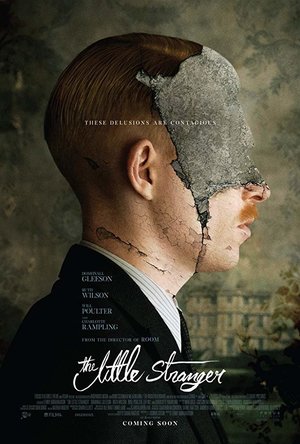
Domhnall Gleeson is an interesting leading actor. He plays the roll well and it feels fitting for the period. But for me Will Poulter really was the best performance. Entirely believable and quite possibly the best thing I've seen him do. I can't say that I was particularly excited about anyone else in this.
The music, or the lack thereof, is very atmospheric. It's really noticable and brings that creepy sense just when it's needed. The visuals get the atmosphere just right too. There's a fantastic slightly out of focus (lets call it squiggly feeling) shot that was used when the supernatural was in the air and it worked intriguingly well.
At the time of writing this I have been out of the screening for six hours... and for six hours I've been annoyed with how the film ended. I've been scouring the internet for a full synopsis of the novel, and while the whole thing seems to match up well, the ending does have a slightly different spin... or it is just handled really weirdly in the film... I really don't know but what I can say is that I came out feeling incredibly unsatisfied.
Based on the book The Little Stranger by Sarah Walters.
What should you do?
I'm tempted to say read the book instead of going to see this one.
Movie thing you wish you could take home
Can I take home Will Poulter?

Complete Arabic Beginner to Intermediate Book and Audio Course: Learn to Read, Write, Speak and Understand a New Language with Teach Yourself
Book
Do you want to be able to speak, read and write Modern Standard Arabic confidently? This bestselling...
Bizzy Bear Builds a House
Book and Games
App
Bizzy Bear is back! This is the second brilliant Bizzy Bear story app, based on the popular board...

Becoming a Romanov. Grand Duchess Elena of Russia and Her World (1807-1873)
Marina Soroka and Charles A. Ruud
Book
The Russian Great Reforms of the 1860s were the last major modernizing effort by the Romanov...
The Colour of Injustice: The Mysterious Murder of the Daughter of a High Court Judge
Book
Based on actual (sometimes exclusive) materials, The Colour of Injustice raises questions about...
The SIRT Food Diet: The Revolutionary Plan for Health and Weight Loss
Book
Welcome to the official Sirt Food Diet - the revolutionary way to lose 7lb in 7 days. Add healthy...
The Lost Detective: Becoming Dashiell Hammett
Book
A 2016 Edgar Award Nominee Before he became a household name in America as perhaps our greatest...
Birthday & Party Planner
Lifestyle and Productivity
App
Plan your family celebration quickly and efficiently with the Party Planner. First choose one of the...

Take off into English Teaching!: How to Prepare for Your Secondary Teacher Training Programme
Book
Planning to become a secondary English teacher? This must-have guide contains everything you need to...
Ross (3284 KP) rated Perfect Death in Books
Sep 28, 2018
As with the previous two books, we join the story at the start of two independent investigations, which inevitably expand and take up the whole team's efforts (it's almost as if there was no crime in the city before these came along as no other cases seem to be mentioned or worked on!). We have the apparent death by misadventure of a young girl on the hills around Arthur's Seat, and the apparent suicide of former DCI Begbie.
Both cases are interesting and very different, the former being a more typical murder investigation, the latter being more focused on police corruption and the Glasgow gangland (I do enjoy the fact that any nasty gangsters in these Edinburgh-based stories have to be based in Glasgow, almost like they are sponsored by the Edinburgh tourist board, or someone with an anti-East Coast agenda).
While the murder investigation is decent, a number of clangers really spoiled it for me. We have a young man who appears to be poisoning people after having ingratiated themselves into their lives and the lives of their loved ones under different false names. However, as is so often the case in these stories, the killer is made too clever to be caught (at least too clever to be caught in under 300 pages!), and so the slightest mistake or piece of luck is what the investigation hinges on. Here it transpires that, while the killer has used false names in every interaction, in one of them he seems to have for some reason used the name of someone who leads the police directly to his backstory and hence uncovering his real identity. This piece of Batman vs Superman ("Your Mom was called Martha?!") level plot pivot was just so jarring and so out of character for this supposedly clever murderer. And yet without it there was pretty much no way of the murderer being found. For a secret poisoner to then start waving a gun around was also a bit hard to accept.
And also, all characters seem to be very well spoken. We have a young man who grew up in care homes from the age of 5, a Glasgow gangster and his henchmen and numerous bad sorts along the way and all are very well spoken, to the point that none of them have a voice and are just ... there. And, of course everyone refers to the police in the same way as the police refer to themselves - I cannot imagine anyone referring to a policeman as "DI something" or ""your DCI said this". It just totally jars and again comes across as the author simply inserting their voice into the mouths of characters that they could not be bothered to properly consider.
This brings me on to the dialogue gripe. I have always struggled to accept the formality in the way fictional detectives speak to members of the public. I get that interviews etc have to be carried out in a certain way, but at one point DCI Turner is speaking to a 17 year old boy about the death of his mother and she says "I cannot leave someone who might be a danger to themselves without establishing first-hand contact". This just struck me as the author inserting a piece of research into dialogue rather than considering how that point would be addressed in a human conversation. Similarly, at one point a DC refers to one of the victims as "she" and Callanach snapped at her "We use victims' names not pronouns", which just struck me as an odd thing to say, and at several times throughout the book he himself refers to victims with pronouns.
And finally, while there was never a great deal of swearing in the first two books, it was believable swearing. Here we have the occasional use of "frigging" instead of the other "f" word, which I cannot think I have ever heard a Scottish person say, unless singing along to the Sex Pistols sea shanty.
Overall, I give this book 4 stars for the plot, 3 stars for the writing, then averaged out and rounded down for the annoying little things.
A definite step down from the second book, and a more slapdash feel to it.