Search

Gareth von Kallenbach (980 KP) rated Spider-Man 3 (2007) in Movies
Aug 14, 2019
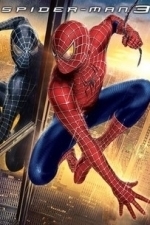


The most anticipated film of the summer, Spider-Man 3 has arrived to the delight of moviegoers the world over. It has been roughly a little more than a year since Spider-Man (Tobey Maguire), defeated Dr. Octopus and saved the city from certain doom.
During this time, Spider-man has become New York City’s celebrated hero, and his day to day alter ego, Peter Parker, delights in his fame, while dating the love of his life, Mary Jane Watson (Kirsten Dunst).
As the film opens, Peter has decided to ask Mary Jane to be his wife, and plans to surprise her with a ring during dinner at a fancy restaurant. Mary Jane is starring in a Broadway play, and despite harsh reviews, she is living her dream and madly in love with Peter.
Things take an unexpected twist for Peter when he is attacked one night by his best friend Harry (James Franco), who blames him for the death of his father at the conclusion of the first film. Enhanced by his father’s Goblin serum, Harry is a deadly adversary for Peter who is able to fend off the attack eventually, and put into motion a series of events that will forever change his life.
When a career criminal named Flint Marko (Thomas Hayden Church), is accidentally caught in an experiment while fleeing the authorities, he becomes a living mass of sand, which enables him to start a string of robberies as “The Sandman”, and provides Spider-man with his most unusual opponent yet.
As if this was not enough, Peter must contend with a new hotshot photographer named Eddie Brock (Topher Grace), who is after a staff position at the Daily Bugle. The fact that Peter has more seniority at the paper is of little interest to Eddie, and he will stop at nothing to get the better of Peter.
At this point one would think that Peter has more than enough on his plate, but fate is about to drop an unexpected player into his life, a space based symbiote that bonds
with Peter’s costume and creates a dark black look for Spider-Man as well as an increase in his powers.
Peter becomes obsessed with his new powers, and there is a dramatic change in his persona, which does not sit well with Mary Jane. When new information is given to Peter about the death of his Uncle Ben, Peter is more than willing to use his new found abilities to exact the revenge that he craves.
Peter also has another area of interest as Gwen Stacy (Bryce Dallas Howard), the daughter of the local Chief of Police has caught his eye, much to the chagrin of both Mary Jane and Gwen’s current boyfriend Eddie Brock.
This tangled web of characters soon forces Peter to take stock of his life and the choices he makes, in order to determine what truly matters to him, the love and respect of his friends, or giving into his darker side and pursing power and unending praise and adulation.
The film starts out well, and the early conflict between Peter and Harry is a brilliantly staged spectacle of sight, sound, and motion. There are also some great moments between the lead characters and Church, Howard and Grace do well with their characters, yet something about Spider-Man 3 did not click for me the way the previous two films in the series have.
Having the luxury of time from the press screener to the opening, I was able to look back at the film the past week and a half to try to determine what did not work for me, and I kept coming back to the same conclusions.
First, the film wants very much to be much darker and edgier than the other films, yet just when you think you are going to see Peter fully cross the line, the film pulls back into campy mode, and we are given scenes of Peter hamming it up as a ladies’ man, and I kid you not, doing an impromptu dance number.
While this works for comedic effect, I am supposed to believe that the darker side of Peter’s soul is being exposed, and I had a hard time thinking that his inner demons include “Saturday Night Fever” style strut down the sidewalk, and a floor show.
The second thing that bothered me was the villains, as aside from Harry as the New Goblin, both the Sandman and Venom were sadly lacking. Neither The Sandman nor Venom had over the top plots to rule the world, kill or enslave the masses, or endanger huge parts of the city as was the case with the original Green Goblin and Dr Octopus.
Rather we have one who is content to steal to fund a noble cause, and wishes only to complete this cause and have Spider-Man out of his way. The second simply wants revenge for being slighted, and does not elude the menace nor danger that the character warrants.
effects wise the film is solid and there are some great moments in the film, but to many times I thought I had seen the same sand effects years early in the “Mummy” series which lead to many cases of “been there, seen that” for me. With a budget that many claim to be the most expensive film ever made when based on current dollar values, I had expected more from the film, especially given the talented and dynamic cast, and the ample backing of the studio.
Director and series Guru Sam Raimi seems to be coasting here as one has to wonder if he used up many of his great ideas in the last two films, and was trying so hard not to repeat himself, that he lost that magic spark that made the last two films such classics.
As it stands, “Spider-Man 3” is a good film, but you can’t help but feel it could have been a better one.
During this time, Spider-man has become New York City’s celebrated hero, and his day to day alter ego, Peter Parker, delights in his fame, while dating the love of his life, Mary Jane Watson (Kirsten Dunst).
As the film opens, Peter has decided to ask Mary Jane to be his wife, and plans to surprise her with a ring during dinner at a fancy restaurant. Mary Jane is starring in a Broadway play, and despite harsh reviews, she is living her dream and madly in love with Peter.
Things take an unexpected twist for Peter when he is attacked one night by his best friend Harry (James Franco), who blames him for the death of his father at the conclusion of the first film. Enhanced by his father’s Goblin serum, Harry is a deadly adversary for Peter who is able to fend off the attack eventually, and put into motion a series of events that will forever change his life.
When a career criminal named Flint Marko (Thomas Hayden Church), is accidentally caught in an experiment while fleeing the authorities, he becomes a living mass of sand, which enables him to start a string of robberies as “The Sandman”, and provides Spider-man with his most unusual opponent yet.
As if this was not enough, Peter must contend with a new hotshot photographer named Eddie Brock (Topher Grace), who is after a staff position at the Daily Bugle. The fact that Peter has more seniority at the paper is of little interest to Eddie, and he will stop at nothing to get the better of Peter.
At this point one would think that Peter has more than enough on his plate, but fate is about to drop an unexpected player into his life, a space based symbiote that bonds
with Peter’s costume and creates a dark black look for Spider-Man as well as an increase in his powers.
Peter becomes obsessed with his new powers, and there is a dramatic change in his persona, which does not sit well with Mary Jane. When new information is given to Peter about the death of his Uncle Ben, Peter is more than willing to use his new found abilities to exact the revenge that he craves.
Peter also has another area of interest as Gwen Stacy (Bryce Dallas Howard), the daughter of the local Chief of Police has caught his eye, much to the chagrin of both Mary Jane and Gwen’s current boyfriend Eddie Brock.
This tangled web of characters soon forces Peter to take stock of his life and the choices he makes, in order to determine what truly matters to him, the love and respect of his friends, or giving into his darker side and pursing power and unending praise and adulation.
The film starts out well, and the early conflict between Peter and Harry is a brilliantly staged spectacle of sight, sound, and motion. There are also some great moments between the lead characters and Church, Howard and Grace do well with their characters, yet something about Spider-Man 3 did not click for me the way the previous two films in the series have.
Having the luxury of time from the press screener to the opening, I was able to look back at the film the past week and a half to try to determine what did not work for me, and I kept coming back to the same conclusions.
First, the film wants very much to be much darker and edgier than the other films, yet just when you think you are going to see Peter fully cross the line, the film pulls back into campy mode, and we are given scenes of Peter hamming it up as a ladies’ man, and I kid you not, doing an impromptu dance number.
While this works for comedic effect, I am supposed to believe that the darker side of Peter’s soul is being exposed, and I had a hard time thinking that his inner demons include “Saturday Night Fever” style strut down the sidewalk, and a floor show.
The second thing that bothered me was the villains, as aside from Harry as the New Goblin, both the Sandman and Venom were sadly lacking. Neither The Sandman nor Venom had over the top plots to rule the world, kill or enslave the masses, or endanger huge parts of the city as was the case with the original Green Goblin and Dr Octopus.
Rather we have one who is content to steal to fund a noble cause, and wishes only to complete this cause and have Spider-Man out of his way. The second simply wants revenge for being slighted, and does not elude the menace nor danger that the character warrants.
effects wise the film is solid and there are some great moments in the film, but to many times I thought I had seen the same sand effects years early in the “Mummy” series which lead to many cases of “been there, seen that” for me. With a budget that many claim to be the most expensive film ever made when based on current dollar values, I had expected more from the film, especially given the talented and dynamic cast, and the ample backing of the studio.
Director and series Guru Sam Raimi seems to be coasting here as one has to wonder if he used up many of his great ideas in the last two films, and was trying so hard not to repeat himself, that he lost that magic spark that made the last two films such classics.
As it stands, “Spider-Man 3” is a good film, but you can’t help but feel it could have been a better one.

Hadley (567 KP) rated Pet Sematary in Books
Jul 31, 2019
Realistic horror scenes (1 more)
Great writing
Overuse of some words (1 more)
Some contradictions
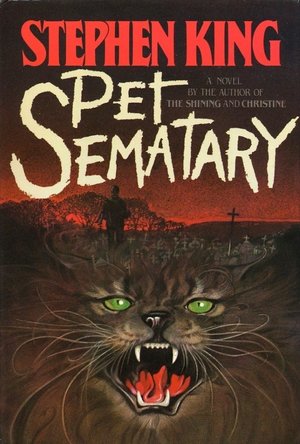
Louis Creed, the main character of Stephen King's 'Pet Sematary,' wants a good life for his family. He's starting his first term as a newly appointed doctor for the University of Maine. Louis' family moved from Chicago to Maine for this very job, which consists of his young daughter, Ellie, his wife, Rachel, his infant son, Gage, and Ellie's black cat, Church (which is short for Winston Churchill). This cat quickly becomes the topic of conversation when the Creeds' new neighbor, Jud Crandall, warns them about the road in front of their house: " 'I'd get him fixed, ' Crandall said, crushing his smoke between his thumb and forefinger. 'A fixed cat don't tend to wander as much. But if it's all the time crossing back and forth, its luck will run out, and it'll end up there with the Ryder kids' coon and little Timmy Dessler's cocker spaniel and Missus Bradleigh's parakeet. Not that the parakeet got run over in the road, you understand. It just went feet up one day.' "
When Louis becomes curious about a trail behind his new home that leads into the woods, Jud gladly introduces the Creed family to the infamous 'Pet Sematary.' A place where children, for years, have buried their pets when they die. This place, and the death of Church, form the starting basis of King's amazing novel.
Louis' life suddenly changes after the death of a University student named Victor Pascow, and gets even worse when Louis starts to have dreams about him. One night, even the ghost of Pascow shows up at Louis' house: " He stood there with his head bashed in behind the left temple. The blood had dried on his face in maroon stripes like Indian warpaint. His collarbone jutted whitely. He was grinning. 'Come on, Doctor,' Pascow said. 'We got places to go.' " Louis ends up following Pascow to the pet sematary where he tells him: " 'I come as a friend,' Pascow said--- but was friend actually the word Pascow had used? Louis thought not. It was as if Pascow had spoken in a foreign language which Louis could understand through some dream magic... and friend was as close as to whatever word Pascow had actually used that Louis's struggling mind could come. ' Your destruction and the destruction of all you love is very near, Doctor.' He was close enough for Louis to be able to smell death on him. "
Later on, Louis feels Pascow's premonition might be coming true when he finds that Church has been killed by a passing vehicle. Jud, who happened to find Church, tells him to follow him so that they can bury the cat, but Jud doesn't stop at the pet sematary as expected, instead he goes past a deadfall barrier and continues on to a place he calls the Micmac Burial Ground, a burial ground that was made by the Micmac Indians. Through this entire scene, Louis experiences paranormal-type things, including the maniacal laughter of a disembodied voice. Jud warns Louis to not pay any attention to anything he experiences here: " 'You might see St. Elmo's fire- - - what the sailors call foo-lights. It makes funny shapes, but it's nothing. If you should see some of those shapes and they bother you, just look the other way. You may hear sounds like voices, but they are the loons down south toward Prospect. The sound carries. It's funny.' "
Now, the real story begins when Church returns to the house after his burial, where Louis finds dried blood on the cat's face and small pieces of plastic from the garbage bag his body had been in. Breathing and eating, the cat has certainly come back to life, but Louis notices that Church isn't the same as he was before; while Louis is in a hot bath, Church takes a seat on the toilet, where we witness him swaying back and forth, from this point on, Louis starts to regret following Jud to the Micmac burial ground.
Ellie, Louis' daughter, begins to suspect that something is different about Church, but she shrugs it off and doesn't necessarily question it:
" 'Daddy?' Ellie said in a low, subdued voice.
'What, Ellie? '
'Church smells funny.'
'Does he?' Louis asked, his voice carefully neutral.
'Yes!' Ellie said, distressed. 'Yes, he does! He never smelled funny before! He smells like... he smells like ka-ka!'
'Well, maybe he rolled in something bad, honey,' Louis said. 'Whatever that bad smell is, he'll lost it.'
'I certainly hope so,' Ellie said in a comical dowager's voice. She walked off. " King spends a majority of 'Pet Sematary' addressing everyone's fear of death; he discusses parents' fear of explaining death to their children for the first time, and even makes readers face the real nightmare of losing a child.
And the realism that King writes about is what makes him the great writer that he is today. King writes about the death of a child, but also makes Louis into a very real character that any parent could relate to. While many books touch on this subject, none can touch on grief like King does: " It was well for Louis- - - well for all three of the remaining family members--- that Steve had shown up as promptly as he had, because Louis was at least temporarily unable to make any kind of decision, even one so minor as giving his wife a shot to mute her deep grief. Louis hadn't even noticed that Rachel had apparently meant to go to the morning viewing in her housecoat, which she had misbuttoned. Her hair was uncombed, unwashed, tangled. Her eyes, blank brown orbits, bulged from sockets so sunken that they had almost become the eyes of a living skull. Her flesh was doughy. It hung from her face. She sat at the breakfast table that morning, munching unbuttered toast and talking in disjointed phrases that made no sense at all. At one point she had said abruptly, 'About that Winnebago you want to buy, Lou---' Louis had last spoken about buying a Winnebago in 1981. "
Yet, this isn't a book about grief, but a horror book about grief, which King masterfully put together. He molds the darkness of losing a child with the horror of making zombies, but King makes the story seem so realistic that any parent would go to the lengths that Louis did - - -and Jud, for that matter - - - even with the dire consequences at stake: " You're slanting all the evidence in favor of the conclusion you want to produce, his [Louis] mind protested. At least tell yourself the goddamned truth about the change in Church. Even if you want to disqualify the animals--- the mice and the birds--- what about the way he is? Muddled... that's the best word of all, that sums it up. The day we were out with the kite. You remember how Gage was that day? How vibrant and alive he was, reacting to everything? Wouldn't it be better to remember him that way? Do you want to resurrect a zombie from a grade-B horror picture? Or even something so prosaic as a retarded little boy? A boy who eats with his fingers and stares blankly at images on the TV screen and who will never learn to write his own name? What did Jud say about his dog? 'It was like washing a piece of meat.' Is that what you want? A piece of breathing meat? And even if you're able to be satisfied with that, how do you explain the return of your son from the dead to your wife? To your daughter? To Steve Masterton? To the world? What happens the first time Missy Dandridge pulls into the driveway and sees Gage riding his trike in the yard? Can't you hear her screams, Louis? Can't you see her harrowing her face with her fingernails? What do you say to the reporters? What do you say when a film crew from 'Real People' turns up on your doorstep, wanting to shoot film of your resurrected son? "
Pet Sematary is an emotional thrill ride, with Louis as a very relatable character, and the writing makes this a must-read book for all readers. With one of my favorite descriptive parts taking place in the 'Little God Swamp' that exists just outside of the Micmac Burial Ground when King describes the legendary Wendigo:
" The mist stained to a dull slate- gray for a moment, but this diffuse, ill-defined watermark was better than sixty feet high. It was no shade, no insubstantial ghost; he could feel the displaced air of its passage, could hear the mammoth thud of its feet coming down, the suck of mud as it moved on. For a moment he believed he saw twin yellow- orange sparks high above him. Sparks like eyes. "
The novel is so well-written that it reads easily, and King's descriptions put the reader right inside of the book.
With a few inconsistencies here and there, and overuse of some words, Pet Sematary is a very enjoyable book for lovers of the horror genre. I highly recommend this book!
When Louis becomes curious about a trail behind his new home that leads into the woods, Jud gladly introduces the Creed family to the infamous 'Pet Sematary.' A place where children, for years, have buried their pets when they die. This place, and the death of Church, form the starting basis of King's amazing novel.
Louis' life suddenly changes after the death of a University student named Victor Pascow, and gets even worse when Louis starts to have dreams about him. One night, even the ghost of Pascow shows up at Louis' house: " He stood there with his head bashed in behind the left temple. The blood had dried on his face in maroon stripes like Indian warpaint. His collarbone jutted whitely. He was grinning. 'Come on, Doctor,' Pascow said. 'We got places to go.' " Louis ends up following Pascow to the pet sematary where he tells him: " 'I come as a friend,' Pascow said--- but was friend actually the word Pascow had used? Louis thought not. It was as if Pascow had spoken in a foreign language which Louis could understand through some dream magic... and friend was as close as to whatever word Pascow had actually used that Louis's struggling mind could come. ' Your destruction and the destruction of all you love is very near, Doctor.' He was close enough for Louis to be able to smell death on him. "
Later on, Louis feels Pascow's premonition might be coming true when he finds that Church has been killed by a passing vehicle. Jud, who happened to find Church, tells him to follow him so that they can bury the cat, but Jud doesn't stop at the pet sematary as expected, instead he goes past a deadfall barrier and continues on to a place he calls the Micmac Burial Ground, a burial ground that was made by the Micmac Indians. Through this entire scene, Louis experiences paranormal-type things, including the maniacal laughter of a disembodied voice. Jud warns Louis to not pay any attention to anything he experiences here: " 'You might see St. Elmo's fire- - - what the sailors call foo-lights. It makes funny shapes, but it's nothing. If you should see some of those shapes and they bother you, just look the other way. You may hear sounds like voices, but they are the loons down south toward Prospect. The sound carries. It's funny.' "
Now, the real story begins when Church returns to the house after his burial, where Louis finds dried blood on the cat's face and small pieces of plastic from the garbage bag his body had been in. Breathing and eating, the cat has certainly come back to life, but Louis notices that Church isn't the same as he was before; while Louis is in a hot bath, Church takes a seat on the toilet, where we witness him swaying back and forth, from this point on, Louis starts to regret following Jud to the Micmac burial ground.
Ellie, Louis' daughter, begins to suspect that something is different about Church, but she shrugs it off and doesn't necessarily question it:
" 'Daddy?' Ellie said in a low, subdued voice.
'What, Ellie? '
'Church smells funny.'
'Does he?' Louis asked, his voice carefully neutral.
'Yes!' Ellie said, distressed. 'Yes, he does! He never smelled funny before! He smells like... he smells like ka-ka!'
'Well, maybe he rolled in something bad, honey,' Louis said. 'Whatever that bad smell is, he'll lost it.'
'I certainly hope so,' Ellie said in a comical dowager's voice. She walked off. " King spends a majority of 'Pet Sematary' addressing everyone's fear of death; he discusses parents' fear of explaining death to their children for the first time, and even makes readers face the real nightmare of losing a child.
And the realism that King writes about is what makes him the great writer that he is today. King writes about the death of a child, but also makes Louis into a very real character that any parent could relate to. While many books touch on this subject, none can touch on grief like King does: " It was well for Louis- - - well for all three of the remaining family members--- that Steve had shown up as promptly as he had, because Louis was at least temporarily unable to make any kind of decision, even one so minor as giving his wife a shot to mute her deep grief. Louis hadn't even noticed that Rachel had apparently meant to go to the morning viewing in her housecoat, which she had misbuttoned. Her hair was uncombed, unwashed, tangled. Her eyes, blank brown orbits, bulged from sockets so sunken that they had almost become the eyes of a living skull. Her flesh was doughy. It hung from her face. She sat at the breakfast table that morning, munching unbuttered toast and talking in disjointed phrases that made no sense at all. At one point she had said abruptly, 'About that Winnebago you want to buy, Lou---' Louis had last spoken about buying a Winnebago in 1981. "
Yet, this isn't a book about grief, but a horror book about grief, which King masterfully put together. He molds the darkness of losing a child with the horror of making zombies, but King makes the story seem so realistic that any parent would go to the lengths that Louis did - - -and Jud, for that matter - - - even with the dire consequences at stake: " You're slanting all the evidence in favor of the conclusion you want to produce, his [Louis] mind protested. At least tell yourself the goddamned truth about the change in Church. Even if you want to disqualify the animals--- the mice and the birds--- what about the way he is? Muddled... that's the best word of all, that sums it up. The day we were out with the kite. You remember how Gage was that day? How vibrant and alive he was, reacting to everything? Wouldn't it be better to remember him that way? Do you want to resurrect a zombie from a grade-B horror picture? Or even something so prosaic as a retarded little boy? A boy who eats with his fingers and stares blankly at images on the TV screen and who will never learn to write his own name? What did Jud say about his dog? 'It was like washing a piece of meat.' Is that what you want? A piece of breathing meat? And even if you're able to be satisfied with that, how do you explain the return of your son from the dead to your wife? To your daughter? To Steve Masterton? To the world? What happens the first time Missy Dandridge pulls into the driveway and sees Gage riding his trike in the yard? Can't you hear her screams, Louis? Can't you see her harrowing her face with her fingernails? What do you say to the reporters? What do you say when a film crew from 'Real People' turns up on your doorstep, wanting to shoot film of your resurrected son? "
Pet Sematary is an emotional thrill ride, with Louis as a very relatable character, and the writing makes this a must-read book for all readers. With one of my favorite descriptive parts taking place in the 'Little God Swamp' that exists just outside of the Micmac Burial Ground when King describes the legendary Wendigo:
" The mist stained to a dull slate- gray for a moment, but this diffuse, ill-defined watermark was better than sixty feet high. It was no shade, no insubstantial ghost; he could feel the displaced air of its passage, could hear the mammoth thud of its feet coming down, the suck of mud as it moved on. For a moment he believed he saw twin yellow- orange sparks high above him. Sparks like eyes. "
The novel is so well-written that it reads easily, and King's descriptions put the reader right inside of the book.
With a few inconsistencies here and there, and overuse of some words, Pet Sematary is a very enjoyable book for lovers of the horror genre. I highly recommend this book!

Purple Phoenix Games (2266 KP) rated Magical Friends and How to Summon Them in Tabletop Games
Sep 29, 2021
If there is one game theme that will never get old for me, it’s fantasy. Something about a world of magic and magical creatures is fascinating to me, and I will never turn down the chance to play any sort of fantasy-themed game. So when I came across Magical Friends and How to Summon Them, I was immediately hooked. Does the gameplay live up to my expectations of what a great fantasy game should be, or does it miss the magical mark?
Disclaimer: We were provided with a prototype copy of this game for the purposes of this preview. The components pictured are not finalized, and could change after a successful Kickstarter campaign. I do not intend to rehash the entire rulebook, but rather provide a general overview of the rules and gameplay. For more information, head to the Magical Friends website. -L
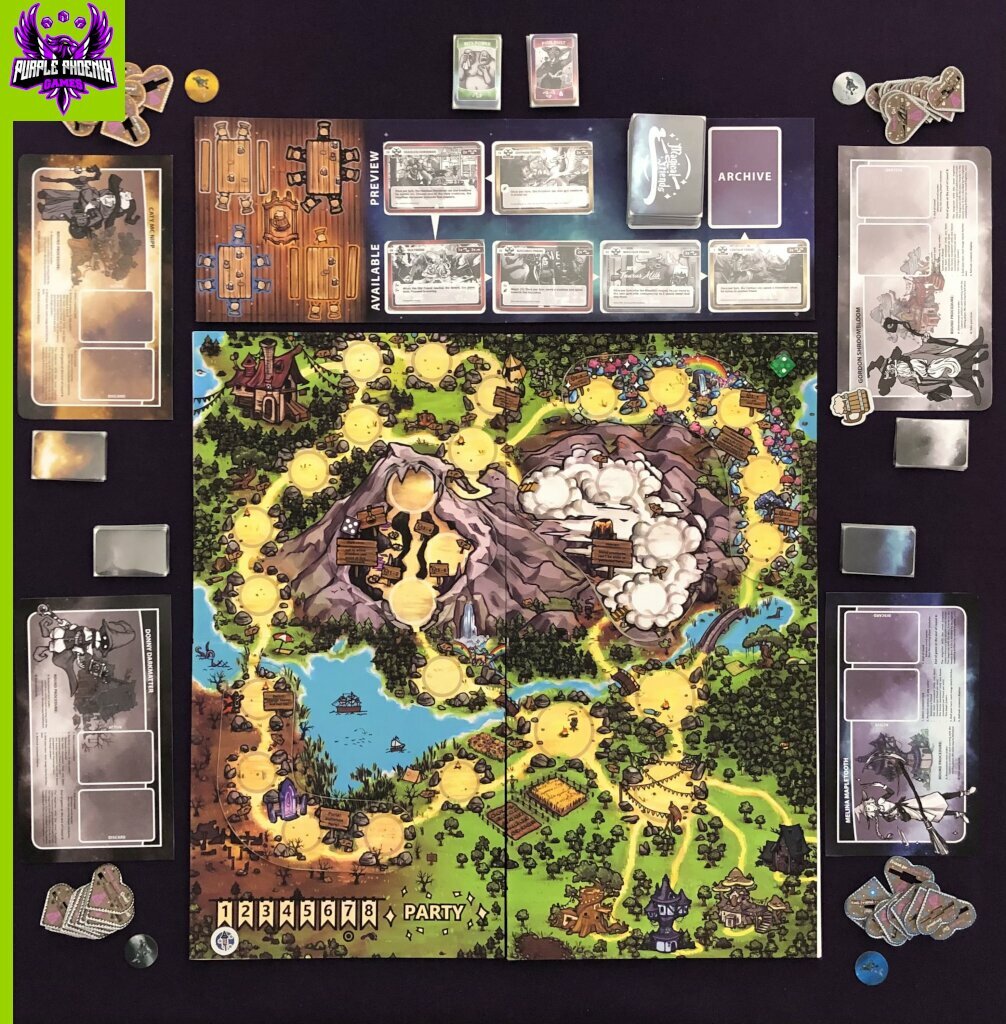
Magical Friends and How to Summon Them (referred to as just Magical Friends from hereon out) is a strategic game of card drafting and variable turn order in which players take on the roles of mages attempting to summon the most magical creatures to the local tavern in order to win the Midsummer festival competition. Played over 8 rounds, players will take turns summoning creatures, moving them towards the tavern, using special creature abilities, and occasionally fighting off your opponents’ creatures. The player who gets the most creatures to the tavern by the end of the 8th round is the winner! To setup for the game, lay out the main board and summoning board in the center of the table. Take the 4 double-sided map tiles, randomly choose a side, and place them in their corresponding places on the main board. Shuffle the Summoning cards and reveal a number of cards, determined by player count, to create a market row and preview row. Each player receives a player mat, heart tokens, and Artifact Cards in their chosen color. Place the round marker on Round 1 of the main board, select a player to get the starting player token, and the game is ready to begin!
To start a round, first you will need to determine turn order. Each player has an identical deck of 11 Artifact Cards, numbered 1-11. The player who offers the most powerful (highest number) Artifact gets to act first in the round. The player with the starting player token chooses their card first, and places it face-up on their player mat. The next player, in clockwise order, will do the same. Here’s the catch though – once a number has been played, it cannot be played by anyone else for this round! So say I put choose my value 8 card – no other player may choose that card for this round. Once all players have chosen their Artifacts, determine the turn order for the round. The player with the highest valued Artifact goes first, then the next highest, and so on.
Once the turn order has been determined, it is time for players to take their turns! On your turn, the first thing you will do is to select a Summoning card from the Summoning board and take it into their tableau. The selected card tells you which friend (creature) you have summoned, and tells you how many moves/what types of movement you may take this round. After choosing your Summoning card, you will take any/all of the following actions: Summon a friend (bring its standee into play), use basic movement (as determined by your new friend), use bonus movement (from other cards), or use the abilities of any friends in your tableau. You may perform as many of these actions as you want and are able to perform. It is important to note that each friend may only use one basic movement and one bonus movement per round. So you can’t just move a single friend with every movement available in one turn.
Once you are finished performing actions, you will end your turn. Refresh the Summoning board by shifting cards down and refilling any empty creature slots. Play then moves to the player with the next highest valued Artifact card. When all players have taken their turn, the round ends. Move the Round marker up one spot, and pass the starting player token to the next clockwise player. A new round will then start with the turn order determination, beginning with the new starting player. After 8 rounds of play, the winner is crowned. Players score points for the number of their friends who reached the tavern, and the player with the highest score wins!
I’ll come right out and say that I really have enjoyed Magical Friends. There are lots of elements that I like and that work well together to create a fun, strategic, and engaging game. First, turn order determination. I love that the turn order isn’t set for the entire game, because that could really be a detriment to whomever would be last every round. Being able to ‘bid’ for turn order, in a sense, allows players to be proactive (or conversely, reactive) with their strategy. And after you’ve used an Artifact card in a round, it is discarded and cannot be used for the rest of the game. So you need to decide when it’s worth it to play your high value cards to hopefully act first, or if you’re willing to risk playing a mid-value card that might be out-bid by an opponent.
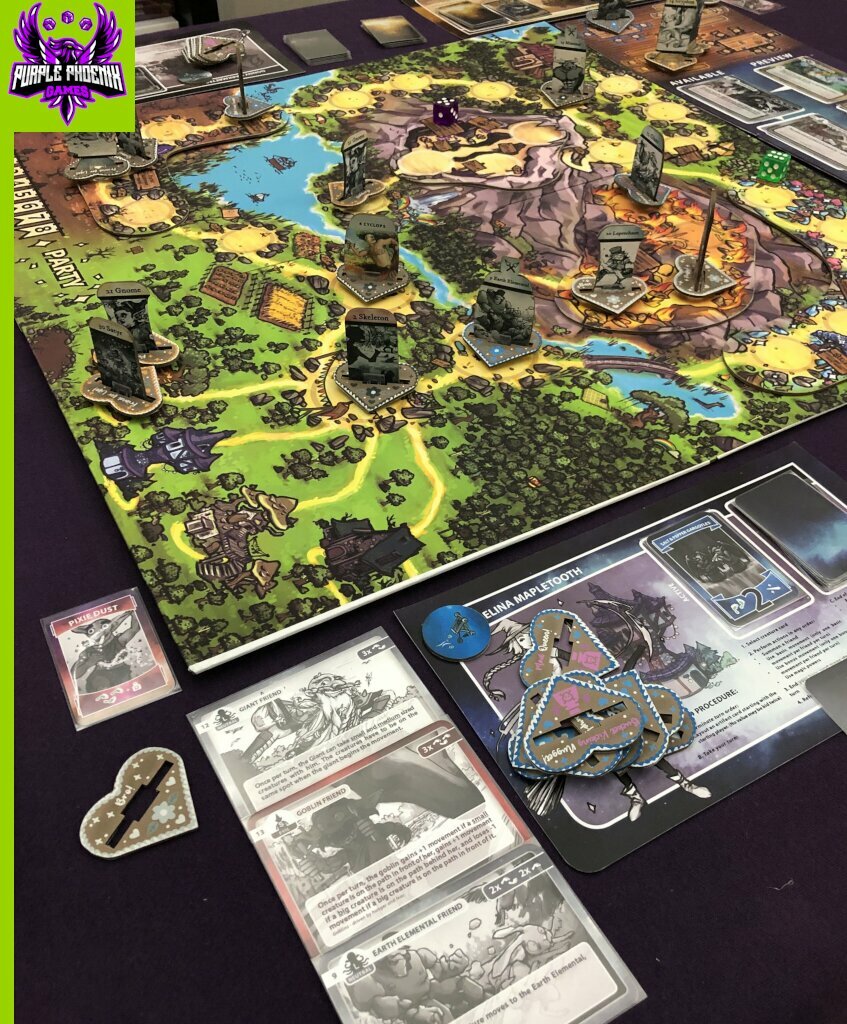
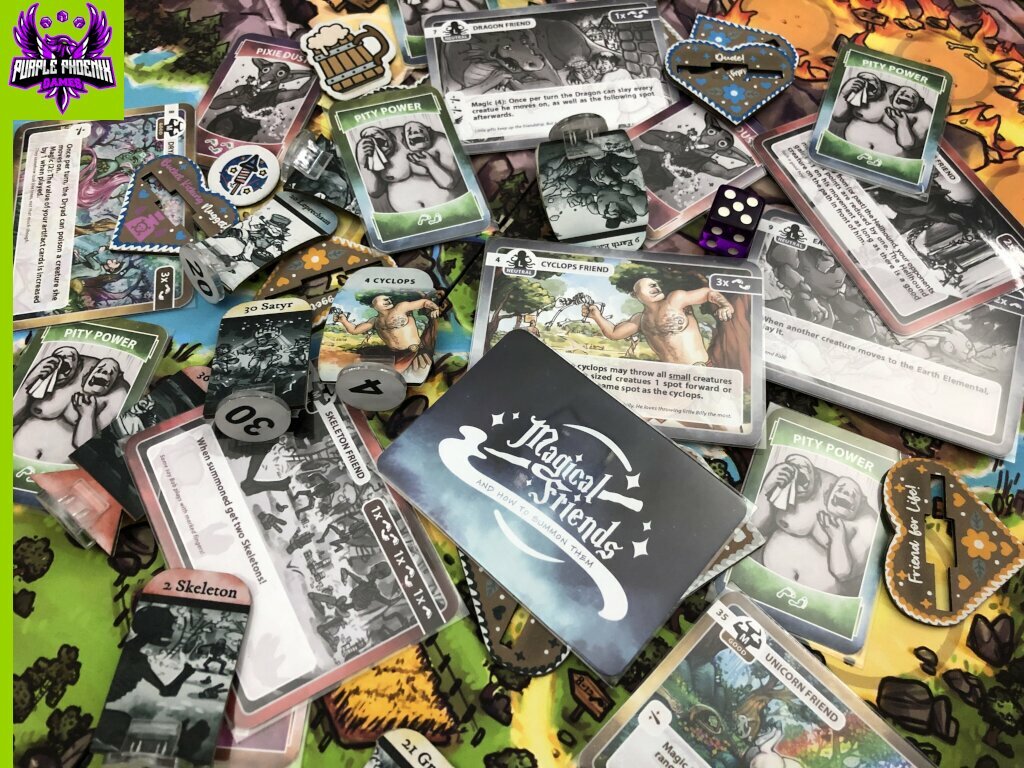
The other awesome strategic element are the friends in the game. Each friend is a different creature with different movement options and special abilities during gameplay. An important thing to note is that although every friend has a printed movement value on its card, you may only ever use that value on the round in which you summon that friend. So a Griffin, for example, lets you move 3 friends 2 spaces, which you may do when you first summon the Griffin. But in future rounds, the Griffin will only move based on the movements provided by the most newly acquired friend. Maybe you don’t necessarily want to summon a Mermaid, but the movement she offers is exactly what you need to get some friends to the tavern for scoring. It’s all a neat mix of strategy that you are changing with every turn. Along with the movements, each friend has a special ability that can be used on your turns. Some abilities allow you to move extra spaces, move opponents, or even slay creatures. When you slay a creature, you collect its heart token for endgame scoring, and the player who controlled that creature gets a Pity Power card (which provide bonus movement). You need to decide when to move which friends, and in what order to trigger your abilities. You must always be paying attention to the board layout and your opponents’ turns as they will help you determine your strategy for future turns.
Components. As I mentioned earlier, this is a prototype version of the game, but with that said, the components are pretty nice! The cards are sturdy, the text is clear, and the artwork is fun to look at. The main game board and summoning boards are colorful, and the creature standees are nicely sized for the board. I do have to say that I really like the heart tokens used to identify to whom each creature belongs on the board. The hearts slide over top of the standee and create a base of sorts to color-code every creature on the board. Just a neat little use of components that make the gameplay smooth. And how about the insert? It’s awesome! The standees are all stored, assembled, in a slotted inlay that allows for quick selection of creatures. I hope that’s something that makes it to final production because it really helps streamline the gameplay. Some of the wording in the rulebook could use some clarification, but I know that it is still a work in progress and continues to undergo edits. The only negative I would have to say is that 2 of the player colors are black and gray – and they are sometimes difficult to differentiate between. But changing one color should be an easy fix!
All in all, I was pleasantly surprised by Magical Friends. At first glance, I thought it would be a pretty simple ‘roll-and-move’ type game, but it proved to be much more strategic and engaging than I initially thought. The variable turn order, the movement rules/restrictions, and the unique friend abilities all work together to create a cohesive, thematic, and strategic game. I very much am looking forward to following the progress of Magical Friends and How to Summon Them on Kickstarter, and I encourage you to check it out as well!
Disclaimer: We were provided with a prototype copy of this game for the purposes of this preview. The components pictured are not finalized, and could change after a successful Kickstarter campaign. I do not intend to rehash the entire rulebook, but rather provide a general overview of the rules and gameplay. For more information, head to the Magical Friends website. -L
Magical Friends and How to Summon Them (referred to as just Magical Friends from hereon out) is a strategic game of card drafting and variable turn order in which players take on the roles of mages attempting to summon the most magical creatures to the local tavern in order to win the Midsummer festival competition. Played over 8 rounds, players will take turns summoning creatures, moving them towards the tavern, using special creature abilities, and occasionally fighting off your opponents’ creatures. The player who gets the most creatures to the tavern by the end of the 8th round is the winner! To setup for the game, lay out the main board and summoning board in the center of the table. Take the 4 double-sided map tiles, randomly choose a side, and place them in their corresponding places on the main board. Shuffle the Summoning cards and reveal a number of cards, determined by player count, to create a market row and preview row. Each player receives a player mat, heart tokens, and Artifact Cards in their chosen color. Place the round marker on Round 1 of the main board, select a player to get the starting player token, and the game is ready to begin!
To start a round, first you will need to determine turn order. Each player has an identical deck of 11 Artifact Cards, numbered 1-11. The player who offers the most powerful (highest number) Artifact gets to act first in the round. The player with the starting player token chooses their card first, and places it face-up on their player mat. The next player, in clockwise order, will do the same. Here’s the catch though – once a number has been played, it cannot be played by anyone else for this round! So say I put choose my value 8 card – no other player may choose that card for this round. Once all players have chosen their Artifacts, determine the turn order for the round. The player with the highest valued Artifact goes first, then the next highest, and so on.
Once the turn order has been determined, it is time for players to take their turns! On your turn, the first thing you will do is to select a Summoning card from the Summoning board and take it into their tableau. The selected card tells you which friend (creature) you have summoned, and tells you how many moves/what types of movement you may take this round. After choosing your Summoning card, you will take any/all of the following actions: Summon a friend (bring its standee into play), use basic movement (as determined by your new friend), use bonus movement (from other cards), or use the abilities of any friends in your tableau. You may perform as many of these actions as you want and are able to perform. It is important to note that each friend may only use one basic movement and one bonus movement per round. So you can’t just move a single friend with every movement available in one turn.
Once you are finished performing actions, you will end your turn. Refresh the Summoning board by shifting cards down and refilling any empty creature slots. Play then moves to the player with the next highest valued Artifact card. When all players have taken their turn, the round ends. Move the Round marker up one spot, and pass the starting player token to the next clockwise player. A new round will then start with the turn order determination, beginning with the new starting player. After 8 rounds of play, the winner is crowned. Players score points for the number of their friends who reached the tavern, and the player with the highest score wins!
I’ll come right out and say that I really have enjoyed Magical Friends. There are lots of elements that I like and that work well together to create a fun, strategic, and engaging game. First, turn order determination. I love that the turn order isn’t set for the entire game, because that could really be a detriment to whomever would be last every round. Being able to ‘bid’ for turn order, in a sense, allows players to be proactive (or conversely, reactive) with their strategy. And after you’ve used an Artifact card in a round, it is discarded and cannot be used for the rest of the game. So you need to decide when it’s worth it to play your high value cards to hopefully act first, or if you’re willing to risk playing a mid-value card that might be out-bid by an opponent.
The other awesome strategic element are the friends in the game. Each friend is a different creature with different movement options and special abilities during gameplay. An important thing to note is that although every friend has a printed movement value on its card, you may only ever use that value on the round in which you summon that friend. So a Griffin, for example, lets you move 3 friends 2 spaces, which you may do when you first summon the Griffin. But in future rounds, the Griffin will only move based on the movements provided by the most newly acquired friend. Maybe you don’t necessarily want to summon a Mermaid, but the movement she offers is exactly what you need to get some friends to the tavern for scoring. It’s all a neat mix of strategy that you are changing with every turn. Along with the movements, each friend has a special ability that can be used on your turns. Some abilities allow you to move extra spaces, move opponents, or even slay creatures. When you slay a creature, you collect its heart token for endgame scoring, and the player who controlled that creature gets a Pity Power card (which provide bonus movement). You need to decide when to move which friends, and in what order to trigger your abilities. You must always be paying attention to the board layout and your opponents’ turns as they will help you determine your strategy for future turns.
Components. As I mentioned earlier, this is a prototype version of the game, but with that said, the components are pretty nice! The cards are sturdy, the text is clear, and the artwork is fun to look at. The main game board and summoning boards are colorful, and the creature standees are nicely sized for the board. I do have to say that I really like the heart tokens used to identify to whom each creature belongs on the board. The hearts slide over top of the standee and create a base of sorts to color-code every creature on the board. Just a neat little use of components that make the gameplay smooth. And how about the insert? It’s awesome! The standees are all stored, assembled, in a slotted inlay that allows for quick selection of creatures. I hope that’s something that makes it to final production because it really helps streamline the gameplay. Some of the wording in the rulebook could use some clarification, but I know that it is still a work in progress and continues to undergo edits. The only negative I would have to say is that 2 of the player colors are black and gray – and they are sometimes difficult to differentiate between. But changing one color should be an easy fix!
All in all, I was pleasantly surprised by Magical Friends. At first glance, I thought it would be a pretty simple ‘roll-and-move’ type game, but it proved to be much more strategic and engaging than I initially thought. The variable turn order, the movement rules/restrictions, and the unique friend abilities all work together to create a cohesive, thematic, and strategic game. I very much am looking forward to following the progress of Magical Friends and How to Summon Them on Kickstarter, and I encourage you to check it out as well!