

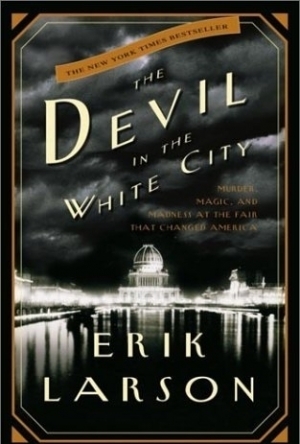
Hadley (567 KP) rated The Devil in the White City: Murder, Magic, and Madness in Books
Jan 18, 2021

He's been a doctor and a licensed pharmacist, who then conned an old couple into selling their drug store to him where he preyed on young girls and ignorant customers that would buy whatever Holmes would tell them to buy, whether it were real or fake tonics.
He was a building owner who had a murder hotel secretly built with " a wooden chute that would descend from a secret location on the second floor all the way to the basement... ", "a room next to his office fitted with a large walk-in vault, with airtight seams and asbestos-coated iron walls. A gas jet embedded in one wall would be controlled from his closet...", "a large basement with hidden chambers and a sub-basement for the permanent storage of sensitive material. "
He owned and ran an alcohol-treatment company known as the Silver Ash Institute that claimed to have the cure for alcoholism.
He was a traveling business man, who had two wives and two children. He established the Campbell-Yates Manufacturing Company, which made nothing and sold nothing.
He was also labeled as America's first serial killer. His body count is unknown even today; his victims were frequently young women, which included stenographers and house wives. He was best known for convincing people who trusted him to sign him as the beneficiary of their life insurance policies, only to kill them and make it seem an accident so he could collect the money.
Holmes grew up in a small farming village in New Hampshire, where he briefly spoke about an early fear of a human skeleton that hung in a doctor's office: " 'I had daily to pass the office of one village doctor, the door of which was seldom if ever barred,' he wrote in a later memoir. 'Partly from its being associated in my mind as the source of all the nauseous mixtures that had been my childish terror (for this was before the day of children's medicines), and partly because of vague rumors I had heard regarding its contents, this place was one of peculiar abhorrence to me.' "... "Two children discovered Mudgett's [Holmes' real last name] fear and one day captured him and dragged him 'struggling and shrieking' into the doctor's office. 'Nor did they desist,' Mudgett wrote, 'until I had been brought face to face with one of its grinning skeletons, which, with arms outstretched, seemed ready in its turn to seize me. It was a wicked and dangerous thing to do to a child of tender years and health,' he wrote, ' but it proved an heroic method of treatment, destined ultimately to cure me of my fears, and to inculcate in me, first, a strong feeling of curiosity, and, later, a desire to learn, which resulted years afterwards in my adopting medicine as a profession.' "
Erik Larson's fourth book, the Devil in the White City, is only partly about Holmes and his dark trail of murder and lies. The story told is mostly centered around the planning and building of the 1893 World's Fair. The prologue opens with one of the architects aboard a ship long after the fair has ended - - - 1912 to be exact- - - where he begins to write of the fair in his diary. The next chapter continues on with Chicago competing against other major cities to win the rights to host the World's Fair. Chicago was not the ideal place for the fair because it was known for it's crime and slaughter houses - - - this was exactly why the politicians wanted it so badly there, so it would help to lighten the image of Chicago for the rest of the world. Even the local Whitechapel Club that had sprouted up after the infamous murders by Jack the Ripper, were excited to win the rights to host the fair in their city, and celebrated in a macabre way:
"Upon learning that Chicago had won the fair, the men of the Whitechapel Club composed a telegram to Chauncey Depew, who more than any other man symbolized New York and its campaign to win the fair. Previously Depew had promised the members of the Whitechapel Club that if Chicago prevailed he would present himself at the club's next meeting, to be hacked apart by the Ripper himself - - - metaphorically, he presumed, although at the Whitechapel Club could one ever be certain? The club's coffin, for example, had once been used to transport the body of a member who had committed suicide. After claiming his body, the club hauled it to the Indiana Dunes on Lake Michigan, where members erected an immense pyre. They placed the body on top, then set it alight. Carrying torches and wearing black hooded robes, they circled the fire singing hymns to the dead between sips of whiskey. The club also had a custom of sending robed members to kidnap visiting celebrities and steal them away in a black coach with covered windows, all without saying a word.
The club's telegram reached Depew in Washington twenty minutes after the final ballot, just as Chicago's congressional delegation began celebrating at the Willard Hotel near the White House. The telegram asked, 'When may we see you at our dissecting table?' "
There are chapters in-between, technically reading like a side story, that tell us about Holmes and his misdeeds in Chicago, but there just wasn't enough about Holmes that I could consider this a True Crime book, nor an informative book about Holmes. Unfortunately, when the reader begins to really dwell into the story of Holmes, it's quickly ended by having two or more chapters about the building of the World's Fair. One interesting point about the story is that the reader does get to see how many inventions were brought to light because of the Fair, such as the invention of the Ferris Wheel. Larson's writing is very coherent and the descriptions are so well done that the reader is practically transported back to the late 1800s, yet, before I finished the book, I felt misled by the title... then coming across everything that happened to not only the Fair, but the people who were involved with it, it's hard not to wonder if the whole thing was cursed, thus the Devil being in the White City.
One of the side stories I did really enjoy was the slow unfolding of a man named Prendergast. A delusional young man who ran one of the groups of paperboys in Chicago, who was also obsessed with politics, became a determined supporter of Mayor Harrison; after Harrison was voted into office again, Prendergast believed it was because of him and the letters he sent out to numerous politicians and potential voters. Prendergast also believed he deserved a chair on the council for Harrison's re-election, for which he even showed up at City Hall to take over. This incident was the straw that broke the camel's back for Prendergast - - - he was humiliated when the people there laughed in his face. Prendergast then decided to take matters into his own hands, and bought a revolver. The day before the Fair would end, Prendergast showed up at Harrison's home and shot him. Harrison died minutes later. Prendergast turned himself in for the murder as soon as he left Harrison's residence. When asked why he had done it, Prendergast responded: " ' Because he betrayed my confidence. I supported him through his campaign and he promised to appoint me corporation counsel. He didn't live up to his word.' "
This book has been voted as a top True Crime must-read novel. I don't agree with this. As I said before: Holmes' chapters are few; eighty percent of this book is about the building of the World's Fair. As a True Crime junkie, I didn't enjoy this one, but also as a history junkie, I enjoyed learning about the Fair and everything that happened. I can't recommend this book to TC fans or horror fans. It's mostly history and architecture.

Lee (2222 KP) rated Queen & Slim (2019) in Movies
Dec 4, 2019
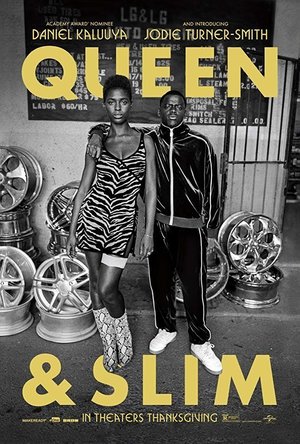

Queen (Jodie Turner-Smith) and Slim (Daniel Kaluuya) are at a diner for their first Tinder date and they seem to be getting along, although a second date isn't exactly a definite just yet. As they drive home afterwards, they are pulled over by a white cop for driving erratically (Slim was quickly reaching to grab his phone back from Queen at the time) and for failure to execute a turn signal. There are clearly some racial motives behind the actions of the police officer though, not helped by Slim's impatience as the officer checks through the contents of his car, and the questioning coming from Queen, who works as a defense attorney and knows their rights. Following a heated exchange, a shot is fired and Queen is left with a flesh wound to her leg. An angered Slim then brawls with the cop and, in what is clearly self defense, shoots and kills the officer. Fearing what will happen to them next and the likelihood of further injustice, they decide to go on the run.
What follows is around 40 minutes of pretty tense drama, unexpectedly peppered with some moments of real humour when as the pair find themselves getting into even more difficult situations. As dash-cam footage from the vehicle of the deceased police officer goes viral, there's a real sense of urgency and intensity to their predicament, making for a really intense and gripping roller-coaster of a ride. They make it to New Orleans, and a brief stopover at the home of Queen's Uncle Earl (Bokeem Woodbine), and it's around this point in the movie that momentum gets lost somewhat, never really recovering until the finale.
Written by Lena Waithe (Master of None and Ready Player One), Queen & Slim is clearly a relevant and important movie, boasting a great look and style from director Melina Matsoukas. Daniel Kaluuya is a great choice for Slim too, no stranger to portraying strong emotions with his eyes and facial expressions, as he did so perfectly in his iconic Get Out role. While I wasn't so keen on Jodie Turner-Smith, the pair did work well together, despite making some questionable character choices at times. When a photo of the pair goes viral, they become a kind of modern day Bonnie & Clyde, hailed as heroes and legends by many as they make their way down towards Florida, where they hope to be able catch a flight to freedom in Cuba. Along the way, their relationship develops and they occasionally find support among the black community in each town they stop at.
But, following that stopover in New Orleans, Queen & Slim becomes much more of a slow meander towards the finish line, and it's a real noticeable tonal shift and change of pacing from those first 40 minutes or so. People in the cinema became fidgety (including me), some gave up on the movie completely and left the cinema (I've done that before, vowed never to do it again though) and all I could think about when they get help from some old friends of Queen's Uncle was "Is that Needles, from Back to the Future?" (it was).
All of this shouldn't detract from how important this movie is though, highlighting racial injustice and delving into real issues unashamedly. While Queen & Slim didn't quite work for me overall, it is certainly a story which deserves to be told and seen by many, getting people talking and hopefully instigating some real change. I'm glad I had the chance to see it, and glad I stuck with it right until the end.


Heather Cranmer (2721 KP) rated Eleanor & Park in Books
Jun 7, 2018

The feels with this book, seriously! I even had a book hangover after reading Eleanor & Park by Rainbow Rowell. That's how good it was!
15 year old Eleanor is starting a new school. What's even worse is she gets bullied for being overweight and for dressing differently then everyone else. On the first day of school, Eleanor sits beside Park on the bus. At first, they ignore each other, but eventually, Park and Eleanor become closer and closer. Eleanor's family is less than perfect. Her step-dad hates Eleanor. Eleanor thinks Park's family is perfect. Will their love survive?
The title of this book is quite simple, but it works. It's very straightforward. It's a book about Eleanor and Park plus their relationship.
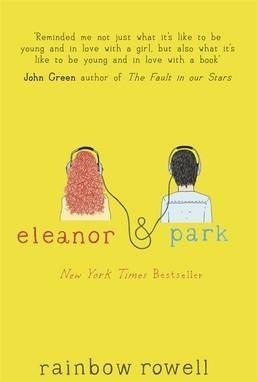
When I first picked up this book, the cover reminded me of a book from the 1980's or 1990's which is perfect considering this book takes place in 1986. Like the time, it is also simplistic, but it works.
I loved the world building! It was quite easy to imagine something like this happening. While the story takes place in 1986, it feels like it could happen in almost any decade. There's talk of cassette tapes and walkmans which were very 80's and 90's. There's talk of bands that were popular around 1986, but when I read it, I felt like it could even take place now.
The pacing was fantastic! From the first page, I was hooked. Every page just kept getting better and better, and by the end of the story, I was sad that it was over. I felt as if I had lost two really good friends.
I enjoyed the plot. A girl from a broken and abused household falls in love with a boy from a "normal" household. She gets her first boyfriend and is overjoyed. The boy swears he has never felt that way before. Yes, it's been done, but I assure you, Rowell makes this story original and unique. I felt that the ending of the book leaves you to form your own opinion of what happens next though. I do wish it was written in black and white because I hate speculating.
I was in love with Eleanor and Park! I can relate to Eleanor though because I was that overweight kid in high school that was sometimes made fun of. I didn't dress like her, but I get how she feels. I hated that Richie, her step-dad, was so mean to her. I kept wanting Richie to just leave. He was such a horrid person! Park was a sweetheart, and I love how he was willing to endure the teasing just to be with Eleanor. Park had a very big heart when it came to Eleanor.
The dialogue was absolutely perfect! I loved the interactions between Park and Eleanor. I also enjoyed how the story would switch between Park and Eleanor so we'd get more of an insight as to what each character was thinking and feeling. There is some swearing in this book and some mild violence.
Overall, Eleanor & Park is such a sweet and emotional read. The characters are easy to love, the pacing is fantastic, and the world building is brilliantly done!
I'd recommend this book to those aged 15+ who would like to get lost in a great book!
(I won an ARC paperback of this title in a competition. I was not required to write a review)

PhotoGrid - Pic & Video Editor
Photo & Video and Lifestyle
4.0 Rate It
App
A must-have free photo editor app for photography fanatics and Instagram users! It's packed with...

Sugar Daddy Gay Dating For Sugar Daddy, Sugar Baby
Social Networking
App
GDaddy is the world’s FIRST and LARGEST gay dating app for gay sugar daddies, gay sugar babies. It...

Bob Mann (459 KP) rated Mank (2020) in Movies
Dec 10, 2020
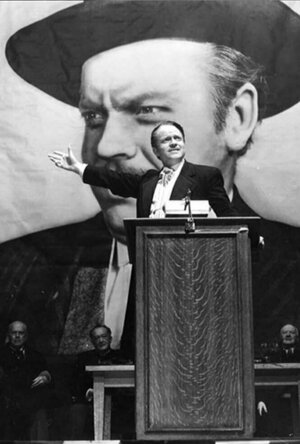

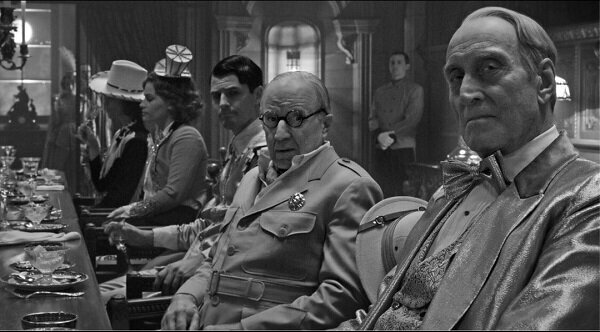
In developing the story, we continuously flash-back six years - - nicely indicated by typed 'script notes' - - to 1934 where Mank is working at MGM studios for Louis B. Mayer (Arliss Howard) and mixing in the circles of millionaire publisher William Randolph Hearst (Charles Dance) and his glamorous young wife, actress Marion Davies (Amanda Seyfried). Allegedly, the "Citizen Kane" script was based on Hearst. But what souring of the relationship could have led to such a stinging betrayal during those six years?
Mank has an embarrassment of acting riches. Mankiewicz is a fascinating character: charismatic, reckless, passionate and the definition of a loose cannon. Basically, a dream for a great actor to portray. And Gary Oldham IS a great actor. After doing Churchill in "Darkest Hour", he here turns in a magnificent performance as the alcoholic writer. Never more so than in a furious tirade at a dinner table late in the film, which will likely be the equivalent to the Churchill "tiger" speech come Oscar time. Surely, there's a Best Actor nomination there?
Equally impressive though are some of the supporting cast.
- Tom Burke - so good as TV's "Strike" - gives a fine impersonation of the great Orson Welles: full of confidence and swagger. It's only a cameo role, but he genuinely 'feels' like the young Welles.
- Amanda Seyfried: It took me almost half of the film to recognize her as Marion Davies, and her performance is pitch perfect - the best of her career in my view, and again Oscar-worthy.
- Arliss Howard for me almost steals the show as the megalomaniac Mayer: his introduction to Mank's brother Joe (Tom Pelphrey) has a memorable "walk with me" walkthrough of the studio with Mayer preaching on the real meaning of MGM and the movies in general. Breathtakingly good.
- But - I said "nearly steals the show".... the guy who made off with it in a swag-bag for me was our own Charles Dance as Hearst. Quietly impressive throughout, he just completely nails it with his "organ-grinder's monkey" speech towards the end of the movie. Probably my favourite monologue of 2020. Chilling. I'd really like to see Dance get a Supporting Actor nomination for this.
The screenplay was originally written by director David Fincher's late father Jack. Jack Fincher died in 2002, and this project has literally been decades in the planning. Mankiewicz has a caustic turn of phrase, and there are laugh-out lines of dialogue scattered throughout the script. "Write hard, aim low" implores Houseman at one point. And my personal favourite: Mank's puncturing of the irony that the Screen Writers Guild has been formed without an apostrophe! A huge LOL!
Aside from the witty dialogue, the script has a nuance to the storytelling that continually surprises. A revelation from Freda about Mank's philanthropic tendencies brings you up short in your face-value impression of his character. And the drivers that engineer the rift between Mankiewicz and Hearst - based around the story of the (fictional) director Shelly Metcalf (Jamie McShane) - are not slapped in your face, but elegantly slipped into your subconscious.
In addition, certain aspects are frustratingly withheld from you. Mank's long-suffering wife (a definition of the phrase) Sara (Tuppence Middleton) only occasionally comes into focus. The only reference to his kids are a crash in the background as they "remodel" the family home. Is the charismatic Mank a faithful husband or a philanderer? Is the relationship with Rita Alexander just professional and platonic (you assume so), or is there more going on? There's a tension there in the storytelling that never quite gets resolved: and that's a good thing.
Mank also has an embarrassment of technical riches. Even from the opening titles, you get the impression that this is a work of genius. All in black and white, and with the appearance of 40's titling, they scroll majestically in the sky and then - after "Charles Dance" - effortlessly scroll down to the desert highway. It's evidence of an attention to detail perhaps forced by lockdown. ("MUM - I'm bored". "Go up to your room and do some more work on that movie then".)
It's deliciously modern, yet retro. I love the fact that the cross-reel "circle" cue-marks appear so prominently... the indicators that the projectionist needs to spin up the next reel. I think they are still used in most modern films, but not as noticeably as in the old films... and this one!
A key contributor to the movie is cinematographer Erik Messerschmidt. Everything looks just BEAUTIFUL, and it is now a big regret that I didn't go to watch this on the big screen after all. Surely there will be a cinematography Oscar nomination for this one. Unbelievably, this is Messerschmidt's debut feature as director of cinematography!
Elsewhere, you can imagine multiple other technical Oscar noms. The tight and effective editing is by Kirk Baxter. And the combination of the glorious production design (Donald Graham Burt) and the costume design (Trish Summerville) make the movie emanate the same nostalgia for Hollywood as did last year's "Once Upon a Time... In Hollywood".... albeit set forty years earlier. Even the music (by the regular team of Trent Reznor and Atticus Ross) might get nominated, since I had to go back and check that it actually HAD music at all: it's subtly unobtrusive and effective.
The only area I had any issue with here was the sound mixing, since I had trouble picking up some of the dialogue.
Although I can gush about this movie as a technical work of art, I'm going to hold off a 10* review on this one. For one reason only. I just didn't feel 100% engaged with the story (at least with a first watch). The illustrious Mrs Movie Man summed it up with the phrase "I just didn't care enough what happened to any of the characters". I think though that this one is sufficiently subtle and cerebral that it deserves another watch.
Will it win Oscars. Yes, for sure. Hell, I would like to put a bet on that "Mank" will top the list of the "most nominations" when they are announced. (Hollywood likes nothing more than a navel-gazing look at its history of course). And an obvious nomination here will be David Fincher for Best Director. But, for me, this falls into a similar bucket as that other black and white multi-Oscar winner of two year's ago "Roma". It's glorious to look at; brilliantly directed; but not a movie I would choose to readily reach for to repeatedly watch again.
(For the full graphical review, please check out the review here - https://bob-the-movie-man.com/2020/12/10/mank-divines-for-oscar-gold-in-a-sea-of-pyrites/. Thanks.)

Movie Metropolis (309 KP) rated The Giver (2014) in Movies
Jun 10, 2019
However, with The Hunger Games on the edge of its tantalising conclusion, director Phillip Noyce introduces teens and adults alike to a whole new world in The Giver, but can it seduce audiences which have already had numerous fantasy worlds to enjoy?
For the most part, yes. Noyce directs this adaptation with extreme visual flair and commands some great performances from the veteran actors, even if the young thespians pale a little in comparison.The-Giver-Brenton-Thwaites-character-poster-691x1024
The Giver follows a community dealing with the aftermath of a brutal conflict. The Elders (people in charge) have been forced to eradicate all feelings, emotion, colour and memories from the past to ensure that this doesn’t happen again. Unfortunately, the plan isn’t fool-proof and one person each generation must be tasked with storing information from the past to ensure the progression of the future.
The book’s intriguing premise brings a striking visual translation. The majority of the picture is shot in black and white which adds to the emotionless atmosphere – just how The Elders want it.
Meryl Streep plays the Chief Elder and despite her limited screen time manages to command each scene she is a part of – though we have come to expect nothing less from the woman who played Margaret Thatcher so beautifully. Jeff Bridges is the title character – The Giver, who manages to impart wisdom to the one teenager each generation.
The teenage characters, despite their constant presence on screen, lack the magic and sparkle of their older counterparts. Brenton Thwaites stars as The Receiver Jonas and is probably the best of the younger stars, though a decent turn by True Blood’s Alexander Skarsgard helps alleviate the offerings somewhat, and there’s even a small role for Taylor Swift.
Despite it’s reasonably small budget of $25million compared to The Hunger Games $78million, the special effects are all of a decent standard. Of course there’s a few lapses here and there in areas were most people would probably never notice, and a few larger issues involving unrealistic space ships – but there isn’t too much to criticise as the striking cinematography is were the eyes are drawn.
Overall, it’s easy to feel sorry for The Giver, it’s come at an awkward time when audiences aren’t ready to get invested in another young adult movie and therefore I predict its box office success will fall short of the quality of the film itself.
The acting is on the whole very good and it’s nice to see Meryl Streep getting her teeth into the role of a villain in a style similar to her role in The Devil Wears Prada, but it all feels a little unsure of itself. Is it a sentimental rom-com or a utopian thriller? Who knows, but it’s definitely worth a watch for the striking visuals alone.
https://moviemetropolis.net/2014/09/24/a-striking-visual-translation-the-giver-review/

Coloring Book For Adults- Stress Free Coloring App
Book and Games
8.0 Rate It
App
Rediscover the simple relaxation and joy of coloring! Plunge into a fairy world of coloring with...

LeftSideCut (3776 KP) rated Thor: Love and Thunder (2022) in Movies
Aug 8, 2022
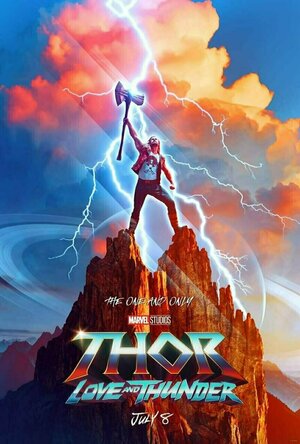
Any other gripes from me would require stepping into spoiler territory so I'll leave it there. Love & Thunder is frequently dumb, but equally fun, colourful and loud, despite being a bit of a mess. The more Marvel Studios venture into Phase Four, the more sporadic and shaky it feels. I have no doubt that everything will plateau into a solid narrative again, I just hope that moment comes sooner, rather than later.
On a final note, the person I watched this with leaned over to me around the halfway point, and said that Thor just sounds like Boris Johnson when he talks, and now I can't unhear it. If I have to suffer, then you do to.

RəX Regent (349 KP) rated Bad Boys II (2003) in Movies
Feb 25, 2019
Bad Boys was Bay's first film and was but a taster of his over the top film making, which first arrives in The Rock a year afterwards, but this made eight years later was obviously going to take this to the next level, if not several levels further than that. But to me, it didn't. Granted, the action was thrilling, outrageous and very enjoyable, but the character development was barely visible. They bicker, Lawrence moaned a lot and Smith was cool and likable but there was just a shell of what there should have been. The entire story, including what's left of their character dynamics are only present to set up the next great action sequence.
Then, the was the taste issue. The crux of the plot as it developed was that the drug dealing villains where using corpses to smuggle drugs, and this was used to "Comic Effect" in two major set-pieces. Though in the first, a car chase, it was black comedy as bodies came thick and fast from the back of a van to be run over by the pursuing cars, the second was pushing the boundaries in a to a more disturbing area.
A criticism levied at Michael Bay by British critic Mark Kermode has been that he is a filmmaker with "pornographic sensibilities". Not just in the literal sense, but in the way that he views everything from cars, women and explosions for example. But this was no more clearly re- enforced than in a scene about 90 minutes in, when our two 'bad boys' are searching a morgue and after pulling back the sheets on fat white guys, they reveal a large breasted young woman, who is refer to as "The Bimbo" if my memory serves. It's worrying because I don't know whether this was being played for laughs or was supposed to be a titillating shot of a well endowed woman? Is it right to show a dead woman, who looks to have been strangled to death and referred to a bimbo in a mainstream 15 certificated movie?
I don't want to sound like a prude but the tone of this and pretty much every scene with the bodies being used, seemed to be in plain Bad, BAD taste and though this humour can play well in the right genre of movie, this just simply wasn't the film to do it in, in my opinion. But, that criticism aside, my main issues are the pacing. It was just too hollow to sustain its running time and my mind was beginning to wander from time to time between the spectacular action and the few moments of decent comedy.
It just didn't have the magic of the 90′s actioner, a genre which had faded considerably by the early 2000′s, and without offering anything new besides improved action, which was worth the ticket or DVD price in its own right, or even retaining the original character of the original, this was a sequel failed to hold its own.