
Search
Search results

Dean (6927 KP) rated the Xbox One version of Forza Horizon 3 in Video Games
Aug 21, 2018



Amazing Graphics, from the cars, scenery and weather effects (2 more)
Good soundtrack
Sooo many options: Freeroam, events, championship, bucket list challenges... Almost endless
Auction system could use tweaking (1 more)
Another mode so xbox live races focus more on where you finish
Groundbreaking Driving game
I've been playing video games for a long time, since the spectrum before moving on to the Megadrive. I love driving games and can honestly say this is probably the best and most fun I've played to date! Not since PGR2 has a driving game been this groundbreaking.
You can sense the PGR2 influence in the realism of the environments and cars and some game modes. Along with a similar skill system. The weather effects are amazing from Fog, rain, clouds along with the times of day including dawn, sunset, night time create so many looks and experiences. You'll pull over to stop and watch a sunset. Every car looks and sounds as it should right down to the interior drivers view. It's a beautiful looking game.
The game itself has tons of variety. You can just cruise around, challenge a rival to a set route, random 1 on 1 races in Free roam. There are exhibitions and championships, you can create your own as well and fully customise the weather and time of day, car class and types of cars. There are bucket list challenges that can be done for times, skills, drifts, jumps, speed etc. Again fully customisable to create your own. There is something for everyone here and it's just so much fun.
The only minor points are the auction system for selling, buying could be better but you don't really need to use it. The other issue when racing others online your place is overall is decided partly on your skills during the race. This does include being quick and clean racing... but you might find slower drivers who drift a lot get more xp and end up ahead of you on the leaderboard even if you beat them in the race.
Overall though the best driving game to date. Roll on Horizon 4 in October.
You can sense the PGR2 influence in the realism of the environments and cars and some game modes. Along with a similar skill system. The weather effects are amazing from Fog, rain, clouds along with the times of day including dawn, sunset, night time create so many looks and experiences. You'll pull over to stop and watch a sunset. Every car looks and sounds as it should right down to the interior drivers view. It's a beautiful looking game.
The game itself has tons of variety. You can just cruise around, challenge a rival to a set route, random 1 on 1 races in Free roam. There are exhibitions and championships, you can create your own as well and fully customise the weather and time of day, car class and types of cars. There are bucket list challenges that can be done for times, skills, drifts, jumps, speed etc. Again fully customisable to create your own. There is something for everyone here and it's just so much fun.
The only minor points are the auction system for selling, buying could be better but you don't really need to use it. The other issue when racing others online your place is overall is decided partly on your skills during the race. This does include being quick and clean racing... but you might find slower drivers who drift a lot get more xp and end up ahead of you on the leaderboard even if you beat them in the race.
Overall though the best driving game to date. Roll on Horizon 4 in October.

Gareth von Kallenbach (980 KP) rated Shining Resonance Refrain in Video Games
Aug 14, 2019
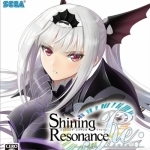

I’ll be the first to admit that I’ve never been a huge fan of JRPG’s, but I really don’t have any reasons why. Growing up I loved watching the Shogun Warrior feature length cartoons and I’m a huge fan of RPG’s in general, so you’d think they’d be right up my alley. I’ve tried and tried to figure out why I have such a hard time sinking into them, and while I have never completed a Final Fantasy game, I continue to buy them in the hopes that one of these days I’ll just get it. So, I’m probably not the first person that would come to mind to review a game like Shining Resonance Refrain, a game that was released exclusively in Japan on PS3 back in 2014. Yet here we are, 4 years later, with a version released for the PS4, Xbox One, PC, and Nintendo Switch, with updated graphics and English voice acting.
Shining Resonance Refrain has you take on the role of a young man named Yuma who has been held captive and experimented on by the main antagonists of the game, the Lombardian Empire. Yuma possesses the soul of the Shining Dragon, the most powerful dragon in the land of Alfheim. The Lombardian Empire is attempting to gather all the souls of the long-forgotten dragons in an effort to break a stalemate between the waring countries of Astoria and the Lombardian Empire. The only thing standing in their way are Yuma, his dragon soul and a powerful set of weapons known as the Armonics.
Quests and exploration are key to moving the story along, with the main quests involving attempts to hinder the Lombardian Empire’s search for the remaining dragon souls. There are also side quests that help you earn money and experience for your characters. The quests are either your typical fetch type quests or the type where you go to this area, fight this major boss, and then return to the castle. The world is broken up into much smaller zones, representing numerous landmarks on the map. Traveling to a particular spot on the map means going from zone to zone until you reach your final destination. The zones are very small, so traveling between them isn’t a huge problem, but not being able to use fast-travel between the zones you have already explored means you will spend a lot of time going back and forth between your castle and your next quest. It isn’t a huge deal breaker in the game, but the areas aren’t always very interesting, and going back and forth amongst the same areas over and over can get old the further you get in the game.
Combat is a mixed bag as well. During your quests, you will encounter various creatures wandering the zones. The battles take place in real time and each character has a set of action points that are used for physical attacks and magic points used for your special abilities and “breaker” moves. As your character levels up, you gain access to different magical attacks, which you can swap out as you choose, but most of the time your battles are simply button mashing your way through them with little strategy involved. The battles are also extremely inconsistent, as battling the various creatures is almost too easy (even at standard difficulty) but battling the boss monsters is almost entirely too hard. There is a HUGE difficulty curve when fighting the boss monsters, to a point where I sometimes had to drop the difficulty to casual and still had to fight a boss 3-4 times to beat them. On standard difficulty, I’d typically give up after succumbing to the same boss repeatedly. Even in the later stages of the games the boss battles do not let up, but the normal battles are practically a cake walk.
In addition to your standard and magical attacks there is also a B.A.N.D special attack where you get additional powers depending on the character who initiates it. Some B.A.N.D attacks provide guaranteed hits, while others increase the damage of your magical attacks. On the left-hand side of the screen there is a bar with three levels that fills while you battle your way through the enemies. Each level increases the longevity that the B.A.N.D lasts, so it’s almost always preferable to save these special attacks for the boss battles. Yuma also has the ability to turn into the Shining Dragon who can release devastating attacks, however if your magic points drop too low the dragon goes into a berserker attack and will throw damage at friends and enemies alike. This is never good, so when playing as the Shining Dragon it’s key to turn back into Yuma before losing control.
Graphically the game is beautiful, and if anime or JRPG’s are your thing you will definitely appreciate the update to the original graphics. The graphics do stick closely to the standard JRPG tropes of ridiculously large weapons and warriors in short skirts, etc. so it looks like many of the other JRPGs on the market today. That’s not necessarily bad, it has just worn out its originality over the years. The sound can get extremely repetitive as well, especially in battle where your characters repeat the same catch phrases over and over again. Once again, that’s not to say that the sound is bad, but it gets old quickly. There are some other technical idiosyncrasies that were also particularly jarring. For example, if Yuma is killed in combat, you can run back to town with whichever character has taken over the “leader” role, but the minute you enter town, Yuma reappears as the controlling character. I get that he’s the main character and it doesn’t make much sense for the other characters to run around asking for quests, but his sudden reappearance even though you know he’s dead takes some getting used to.
So, is Shining Resonance Refrain a game that made me take another look at JRPGs? Well, yes and no if I’m being completely honest. It’s around 30+ hours for the main story and side quests and I’ll admit that the more time I spent with the game the more I enjoyed it. After about an hour of my mental block on JRPG games in general, I was able to get into the groove of things and power my way through it. That being said, I still felt the story was a little bit ridiculous and some of the characters really started to grate on my nerves. Even the main character Yuma tended to be a bit too wimpy for me. He can turn himself into the mightiest of dragons but doesn’t know if he can handle it, I often had the feeling that he should get over himself and embrace this incredible power. In the end, I really did enjoy it, once I overlooked a lot of it, and it actually did put me in the mood to go back and try one of the Final Fantasy games. I can’t say that Shining Resonance Refrain converted me to a diehard JRPG fan, but it certainly made me want to give them another try and that is a win in my book.
What I liked: Unique Characters, General feel of combat
What I liked less: Inconsistent difficulty, Repetitive phrases and sound effects
Shining Resonance Refrain has you take on the role of a young man named Yuma who has been held captive and experimented on by the main antagonists of the game, the Lombardian Empire. Yuma possesses the soul of the Shining Dragon, the most powerful dragon in the land of Alfheim. The Lombardian Empire is attempting to gather all the souls of the long-forgotten dragons in an effort to break a stalemate between the waring countries of Astoria and the Lombardian Empire. The only thing standing in their way are Yuma, his dragon soul and a powerful set of weapons known as the Armonics.
Quests and exploration are key to moving the story along, with the main quests involving attempts to hinder the Lombardian Empire’s search for the remaining dragon souls. There are also side quests that help you earn money and experience for your characters. The quests are either your typical fetch type quests or the type where you go to this area, fight this major boss, and then return to the castle. The world is broken up into much smaller zones, representing numerous landmarks on the map. Traveling to a particular spot on the map means going from zone to zone until you reach your final destination. The zones are very small, so traveling between them isn’t a huge problem, but not being able to use fast-travel between the zones you have already explored means you will spend a lot of time going back and forth between your castle and your next quest. It isn’t a huge deal breaker in the game, but the areas aren’t always very interesting, and going back and forth amongst the same areas over and over can get old the further you get in the game.
Combat is a mixed bag as well. During your quests, you will encounter various creatures wandering the zones. The battles take place in real time and each character has a set of action points that are used for physical attacks and magic points used for your special abilities and “breaker” moves. As your character levels up, you gain access to different magical attacks, which you can swap out as you choose, but most of the time your battles are simply button mashing your way through them with little strategy involved. The battles are also extremely inconsistent, as battling the various creatures is almost too easy (even at standard difficulty) but battling the boss monsters is almost entirely too hard. There is a HUGE difficulty curve when fighting the boss monsters, to a point where I sometimes had to drop the difficulty to casual and still had to fight a boss 3-4 times to beat them. On standard difficulty, I’d typically give up after succumbing to the same boss repeatedly. Even in the later stages of the games the boss battles do not let up, but the normal battles are practically a cake walk.
In addition to your standard and magical attacks there is also a B.A.N.D special attack where you get additional powers depending on the character who initiates it. Some B.A.N.D attacks provide guaranteed hits, while others increase the damage of your magical attacks. On the left-hand side of the screen there is a bar with three levels that fills while you battle your way through the enemies. Each level increases the longevity that the B.A.N.D lasts, so it’s almost always preferable to save these special attacks for the boss battles. Yuma also has the ability to turn into the Shining Dragon who can release devastating attacks, however if your magic points drop too low the dragon goes into a berserker attack and will throw damage at friends and enemies alike. This is never good, so when playing as the Shining Dragon it’s key to turn back into Yuma before losing control.
Graphically the game is beautiful, and if anime or JRPG’s are your thing you will definitely appreciate the update to the original graphics. The graphics do stick closely to the standard JRPG tropes of ridiculously large weapons and warriors in short skirts, etc. so it looks like many of the other JRPGs on the market today. That’s not necessarily bad, it has just worn out its originality over the years. The sound can get extremely repetitive as well, especially in battle where your characters repeat the same catch phrases over and over again. Once again, that’s not to say that the sound is bad, but it gets old quickly. There are some other technical idiosyncrasies that were also particularly jarring. For example, if Yuma is killed in combat, you can run back to town with whichever character has taken over the “leader” role, but the minute you enter town, Yuma reappears as the controlling character. I get that he’s the main character and it doesn’t make much sense for the other characters to run around asking for quests, but his sudden reappearance even though you know he’s dead takes some getting used to.
So, is Shining Resonance Refrain a game that made me take another look at JRPGs? Well, yes and no if I’m being completely honest. It’s around 30+ hours for the main story and side quests and I’ll admit that the more time I spent with the game the more I enjoyed it. After about an hour of my mental block on JRPG games in general, I was able to get into the groove of things and power my way through it. That being said, I still felt the story was a little bit ridiculous and some of the characters really started to grate on my nerves. Even the main character Yuma tended to be a bit too wimpy for me. He can turn himself into the mightiest of dragons but doesn’t know if he can handle it, I often had the feeling that he should get over himself and embrace this incredible power. In the end, I really did enjoy it, once I overlooked a lot of it, and it actually did put me in the mood to go back and try one of the Final Fantasy games. I can’t say that Shining Resonance Refrain converted me to a diehard JRPG fan, but it certainly made me want to give them another try and that is a win in my book.
What I liked: Unique Characters, General feel of combat
What I liked less: Inconsistent difficulty, Repetitive phrases and sound effects

Jordan Binkerd (567 KP) rated Gideon's Angel in Books
Aug 15, 2019
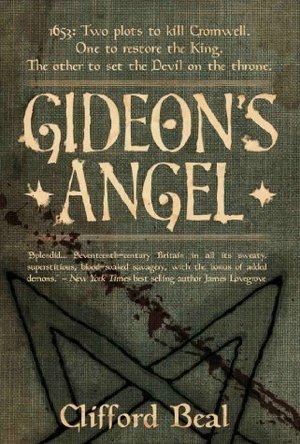
Note: this review is transposted from my personal review blog, and so was originally written several years ago. I figured if I reposted it here, someone might actually read it….
I received my copy of Gideon’s Angel through the Goodreads FirstReads program. This in no way influences my review, except to ensure that I was able to get ahold of this book and thus review it. I have to say, I really enjoyed this one. I want to describe it as “steampunk,” but my understanding is that steampunk is usually set in the 1800s (or at least that level of tech and society) whereas this work is firmly set in 1653. If there’s already a term for pseudo-historical fiction with a fantasy touch set in that timeframe, I apologize for not knowing what it is and using it accordingly.
Things are not going well for Richard Treadwell. The English Civil War is over, the King’s Cavaliers lost to the forces of Parliament and Oliver Cromwell, and Charles I has been executed. Treadwell has managed to escape the destruction of his cause, and has spent the past eight years in exile in France, performing a delicate balancing act between loyalty to his exiled king* and his employer, Cardinal Mazarin. When Mazarin informs him that someone is using the forces of Hell to tip the balance in their favor and asks him to spy on the exile court to find out if it is one of the king’s supporters, Treadwell decides that it’s time to get out of Paris. He accepts a mission for one of the king’s more militant supporters that will take him back to his beloved England–to lead a Royalist uprising, one last try to oust Cromwell and his Puritan cronies. Treadwell has other business to tend to as well, including a wife who by now probably considers herself a widow. Unfortunately for Treadwell’s simple worldview, it soon becomes clear that Cromwell’s power is the only thing preventing the more radical Puritan elements from running roughshod over the whole country. Worse still, a demon from the pits of Hell has appeared to a radical Puritan sect masquerading as an angel of light and ordering the death of Cromwell so that the Kingdom of God may be fulfilled. Now instead of assassinating Cromwell Treadwell will be forced to save him–if he can find a way to fight the forces of Hell, gain some allies in his quest, and avoid d’Artagnan, a young Musketeer dispatched by the Cardinal to bear him back to Paris….
I really enjoyed this book. It’s not exactly “high literature,” but I think I’ve very well established that I care far more about a work’s entertainment value than whatever it is critics look for. The world Beal creates here feels very real, slipping in background historical information without making you feel like you’ve been lectured. Some readers will probably wish for more background on the English Civil War, and that’s fine. If they care that much, there are numerous good books on the subject. If they don’t, there’s a Wikipedia article that should give you a good rundown on what happened. Beal manages to evoke seventeenth-century London in all its grimy glory, much as it would have actually been aside from the fact that all the magic we dismiss as superstition is actually going on behind the scenes. Moreover, this magic very much resembles what you would find depicted in the folklore of the era without obvious modern embellishment. I’m not really all that well versed in the history of the Freemasons, so I can’t accurately speak to how they were portrayed here except to say that I very much doubt their claim to date back to the builders of the pyramids. Then again, I doubt they have the tools to summon demons too, so maybe I shouldn’t be too critical. Secondary characters generally proved to be interestingly complex, especially Billy Chard, but I am seeing criticism of how the female characters in the book act. They aren’t weak characters by any means, but they are constrained by their roles in society. Treadwell’s wife has pragmatically joined her fate to that of the officer who took over Treadwell’s land when he was banished and is pregnant with his child. Is she weak for this? Or is she a strong female doing what she has to in order to protect what is left of her family? Treadwell’s Parisian mistress follows him to England rather than stay in Paris and face the scandal of their liasion alone. Weak, for needing Treadwell by her side? Or strong, for following him into whatever dangers he may be facing? Finally, Isabelle decides to follow her father and the rest of Treadwell’s band into battle against the forces of Darkness, deciding that it would be better to fall by his side than live on without him. Possibly a sign of weakness, but look at her situation realistically. She and her father were driven from Spain for their Jewish heritage, her mother dying along the way. Jews do not fare well in the Christian world of the seventeenth century, not even in England. The lot of a young woman alone in the world is already hard enough in this time without adding the burden of religious and ethnic persecution. She would have no respectable means of supporting herself, and could conceivably find herself forced into prostitution–on her own if she was lucky, as no more than a slave if she was not. Is preferring death in battle to such a fate a sign of weakness or of strength? She certainly has no trouble speaking her mind, and in fact berates Treadwell severely for endangering her father when they first meet. I suppose I can understand where some people would find these characters and their portrayal to be weak and sexist, but I respectfully disagree. I submit that instead they are strong characters reacting realistically to a world where women are not treated equally–in fact, I would have more of a problem with them if they demonstrated anachronistic modern sensibilities.** The ending was a little deus ex machina, but on the whole I didn’t mind. I would say that I want to read a sequel, but I don’t think the author could come up with anything to top this in terms of personal impact on the characters–Treadwell’s internal conflict between hating Cromwell and having to save him is very well done, and I fear Beal would prove unable to find something equally interesting as a follow up. We never really got to find out what happened to Treadwell back during the Thirty Years War that introduced him to the world of angels and demons, so I could see maybe writing that up….I’d buy it, anyway.
CONTENT: R-rated language, occasionally harsh but I would argue not gratuitous. Moderately explicit sexual content, as you would expect from a work in this vein.*** A fair amount of violence, from both man and demon. Not usually too gory in its description. There is also a good deal of occult content, as the villains are summoning a demon they believe to be an angel. This demon’s lesser minions dog Treadwell and his friends, and there are multiple encounters with them. One is implied to be a golem, others appear as strange amalgamations of beast(s) and man. For me, this is adequately balanced by the recognition that, as powerful as the forces of Darkness are, God is far more powerful than they. Bottom line: if you’re mature enough to handle the other content, I don’t believe the occult elements should prove to be an issue.
*Charles I was executed, while his son Charles II went into exile. Just in case you were concerned with the historical accuracy of the book. So far as I can tell, this is pretty accurate. You know, aside from the demons and fictional characters roaming London…..
**Please understand, I’m neither defending nor endorsing the inequality of the seventeenth century. Neither is Clifford Beal, for that matter. I’m simply pointing out that it was how it was, and this was the world the characters would have come from. I’m all for equality, but to whitewash history and pretend it was different from it was….that way lies dangerous waters.
***This evokes more than anything a supernatural-tinged Alexandre Dumas novel for me….and you know how bawdry his musketeers could be when they wanted to be.
Original post: https://jordanbinkerd.wordpress.com/2013/10/24/review-gideons-angel-by-clifford-beal/
I received my copy of Gideon’s Angel through the Goodreads FirstReads program. This in no way influences my review, except to ensure that I was able to get ahold of this book and thus review it. I have to say, I really enjoyed this one. I want to describe it as “steampunk,” but my understanding is that steampunk is usually set in the 1800s (or at least that level of tech and society) whereas this work is firmly set in 1653. If there’s already a term for pseudo-historical fiction with a fantasy touch set in that timeframe, I apologize for not knowing what it is and using it accordingly.
Things are not going well for Richard Treadwell. The English Civil War is over, the King’s Cavaliers lost to the forces of Parliament and Oliver Cromwell, and Charles I has been executed. Treadwell has managed to escape the destruction of his cause, and has spent the past eight years in exile in France, performing a delicate balancing act between loyalty to his exiled king* and his employer, Cardinal Mazarin. When Mazarin informs him that someone is using the forces of Hell to tip the balance in their favor and asks him to spy on the exile court to find out if it is one of the king’s supporters, Treadwell decides that it’s time to get out of Paris. He accepts a mission for one of the king’s more militant supporters that will take him back to his beloved England–to lead a Royalist uprising, one last try to oust Cromwell and his Puritan cronies. Treadwell has other business to tend to as well, including a wife who by now probably considers herself a widow. Unfortunately for Treadwell’s simple worldview, it soon becomes clear that Cromwell’s power is the only thing preventing the more radical Puritan elements from running roughshod over the whole country. Worse still, a demon from the pits of Hell has appeared to a radical Puritan sect masquerading as an angel of light and ordering the death of Cromwell so that the Kingdom of God may be fulfilled. Now instead of assassinating Cromwell Treadwell will be forced to save him–if he can find a way to fight the forces of Hell, gain some allies in his quest, and avoid d’Artagnan, a young Musketeer dispatched by the Cardinal to bear him back to Paris….
I really enjoyed this book. It’s not exactly “high literature,” but I think I’ve very well established that I care far more about a work’s entertainment value than whatever it is critics look for. The world Beal creates here feels very real, slipping in background historical information without making you feel like you’ve been lectured. Some readers will probably wish for more background on the English Civil War, and that’s fine. If they care that much, there are numerous good books on the subject. If they don’t, there’s a Wikipedia article that should give you a good rundown on what happened. Beal manages to evoke seventeenth-century London in all its grimy glory, much as it would have actually been aside from the fact that all the magic we dismiss as superstition is actually going on behind the scenes. Moreover, this magic very much resembles what you would find depicted in the folklore of the era without obvious modern embellishment. I’m not really all that well versed in the history of the Freemasons, so I can’t accurately speak to how they were portrayed here except to say that I very much doubt their claim to date back to the builders of the pyramids. Then again, I doubt they have the tools to summon demons too, so maybe I shouldn’t be too critical. Secondary characters generally proved to be interestingly complex, especially Billy Chard, but I am seeing criticism of how the female characters in the book act. They aren’t weak characters by any means, but they are constrained by their roles in society. Treadwell’s wife has pragmatically joined her fate to that of the officer who took over Treadwell’s land when he was banished and is pregnant with his child. Is she weak for this? Or is she a strong female doing what she has to in order to protect what is left of her family? Treadwell’s Parisian mistress follows him to England rather than stay in Paris and face the scandal of their liasion alone. Weak, for needing Treadwell by her side? Or strong, for following him into whatever dangers he may be facing? Finally, Isabelle decides to follow her father and the rest of Treadwell’s band into battle against the forces of Darkness, deciding that it would be better to fall by his side than live on without him. Possibly a sign of weakness, but look at her situation realistically. She and her father were driven from Spain for their Jewish heritage, her mother dying along the way. Jews do not fare well in the Christian world of the seventeenth century, not even in England. The lot of a young woman alone in the world is already hard enough in this time without adding the burden of religious and ethnic persecution. She would have no respectable means of supporting herself, and could conceivably find herself forced into prostitution–on her own if she was lucky, as no more than a slave if she was not. Is preferring death in battle to such a fate a sign of weakness or of strength? She certainly has no trouble speaking her mind, and in fact berates Treadwell severely for endangering her father when they first meet. I suppose I can understand where some people would find these characters and their portrayal to be weak and sexist, but I respectfully disagree. I submit that instead they are strong characters reacting realistically to a world where women are not treated equally–in fact, I would have more of a problem with them if they demonstrated anachronistic modern sensibilities.** The ending was a little deus ex machina, but on the whole I didn’t mind. I would say that I want to read a sequel, but I don’t think the author could come up with anything to top this in terms of personal impact on the characters–Treadwell’s internal conflict between hating Cromwell and having to save him is very well done, and I fear Beal would prove unable to find something equally interesting as a follow up. We never really got to find out what happened to Treadwell back during the Thirty Years War that introduced him to the world of angels and demons, so I could see maybe writing that up….I’d buy it, anyway.
CONTENT: R-rated language, occasionally harsh but I would argue not gratuitous. Moderately explicit sexual content, as you would expect from a work in this vein.*** A fair amount of violence, from both man and demon. Not usually too gory in its description. There is also a good deal of occult content, as the villains are summoning a demon they believe to be an angel. This demon’s lesser minions dog Treadwell and his friends, and there are multiple encounters with them. One is implied to be a golem, others appear as strange amalgamations of beast(s) and man. For me, this is adequately balanced by the recognition that, as powerful as the forces of Darkness are, God is far more powerful than they. Bottom line: if you’re mature enough to handle the other content, I don’t believe the occult elements should prove to be an issue.
*Charles I was executed, while his son Charles II went into exile. Just in case you were concerned with the historical accuracy of the book. So far as I can tell, this is pretty accurate. You know, aside from the demons and fictional characters roaming London…..
**Please understand, I’m neither defending nor endorsing the inequality of the seventeenth century. Neither is Clifford Beal, for that matter. I’m simply pointing out that it was how it was, and this was the world the characters would have come from. I’m all for equality, but to whitewash history and pretend it was different from it was….that way lies dangerous waters.
***This evokes more than anything a supernatural-tinged Alexandre Dumas novel for me….and you know how bawdry his musketeers could be when they wanted to be.
Original post: https://jordanbinkerd.wordpress.com/2013/10/24/review-gideons-angel-by-clifford-beal/

Purple Phoenix Games (2266 KP) rated Barnyard Roundup in Tabletop Games
Apr 12, 2021
I live in Illinois. I can see cornfields from my house. I do not live on a farm, but have visited farms in the past. There is more to Illinois than Chicago and corn. That all said, farming games tickle me so much and I just enjoy playing them. So imagine my interest level when you combine a publisher known for excellent productions, the designer from said publisher, a member of an art studio in my top three favorite board game artists (Kwanchai and The Mico for the others), and a theme that I already enjoy. This is going to be great! Right?
Barnyard Roundup is a silly game of bluffing and hand management set on a farm. In it players are farmhands trying to help Farmer Brown sell the most animals at market. They do this by bluffing their hands in trade deals with other farmhands, thus making no friends in the process. The player with the most points at the end of the game, when all cards from the draw deck have been drawn, will be the winner!
DISCLAIMER: We were provided a copy of this game for the purposes of this review. This is a retail copy of the game, so what you see in these photos is exactly what would be received in your box. I do not intend to cover every single rule included in the rulebook, but will describe the overall game flow and major rule set so that our readers may get a sense of how the game plays. For more in depth rules, you may purchase a copy online or from your FLGS. -T
To setup place the five Animal Bonus cards in a line with the Set Bonus cards nearby. Shuffle the large deck of animal cards and deal out cards according to the rulebook per the number of players in the game. The Burglar and Excuse Me tokens are sorted and dealt out with the remainders face-down near the other cards. Remove eight cards from the draw deck and decide who will be the start player. The game may now begin!
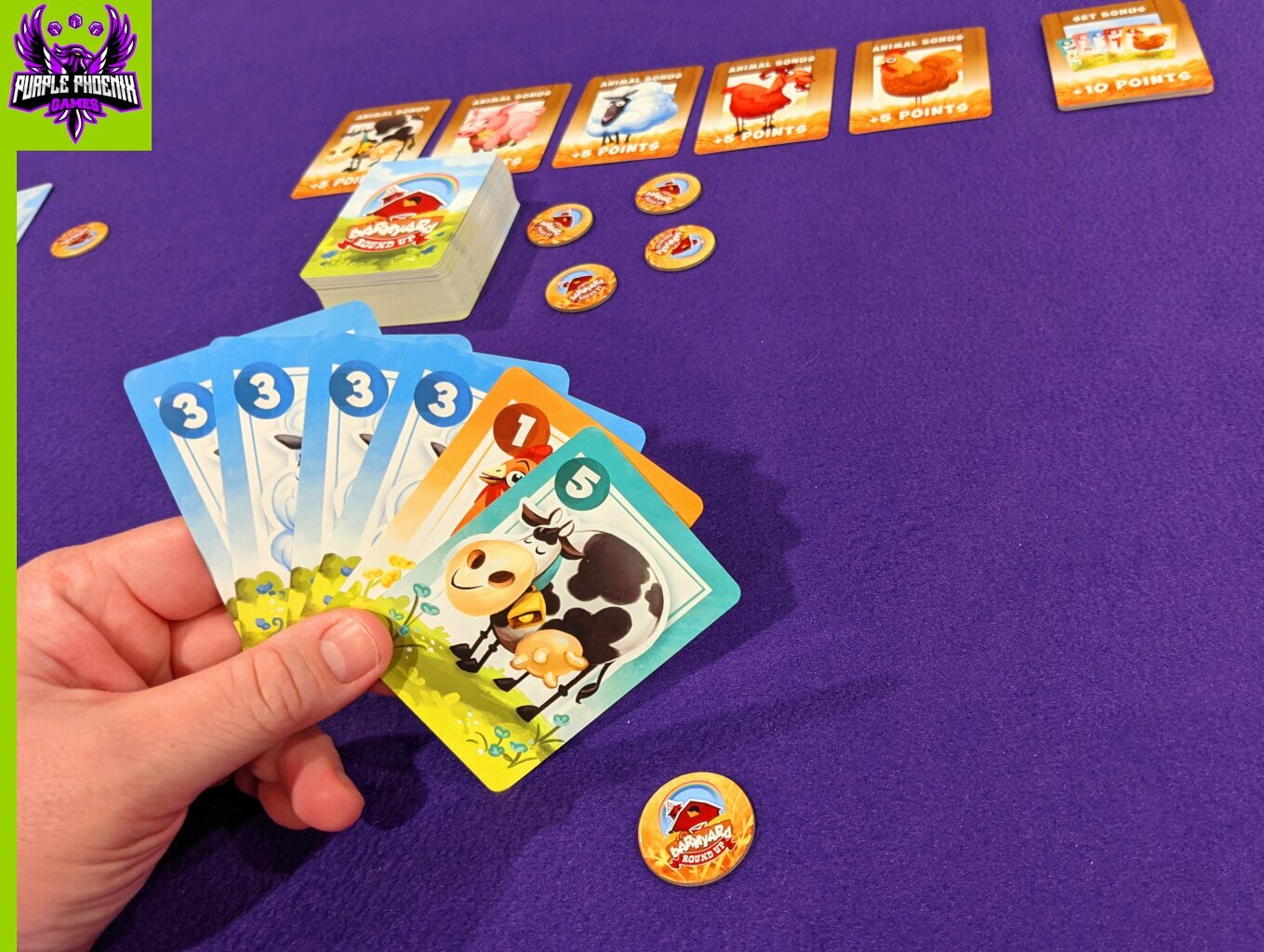
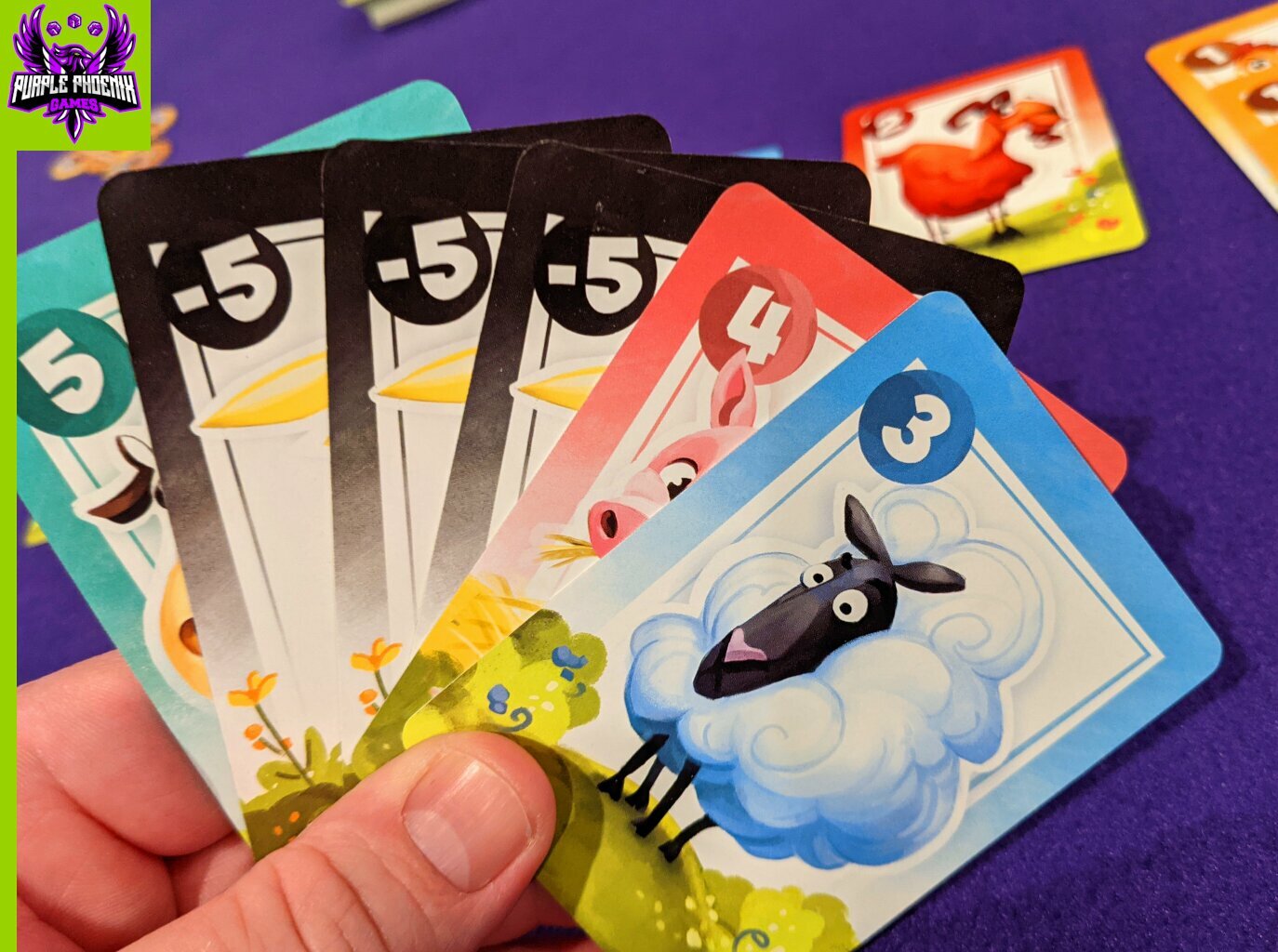
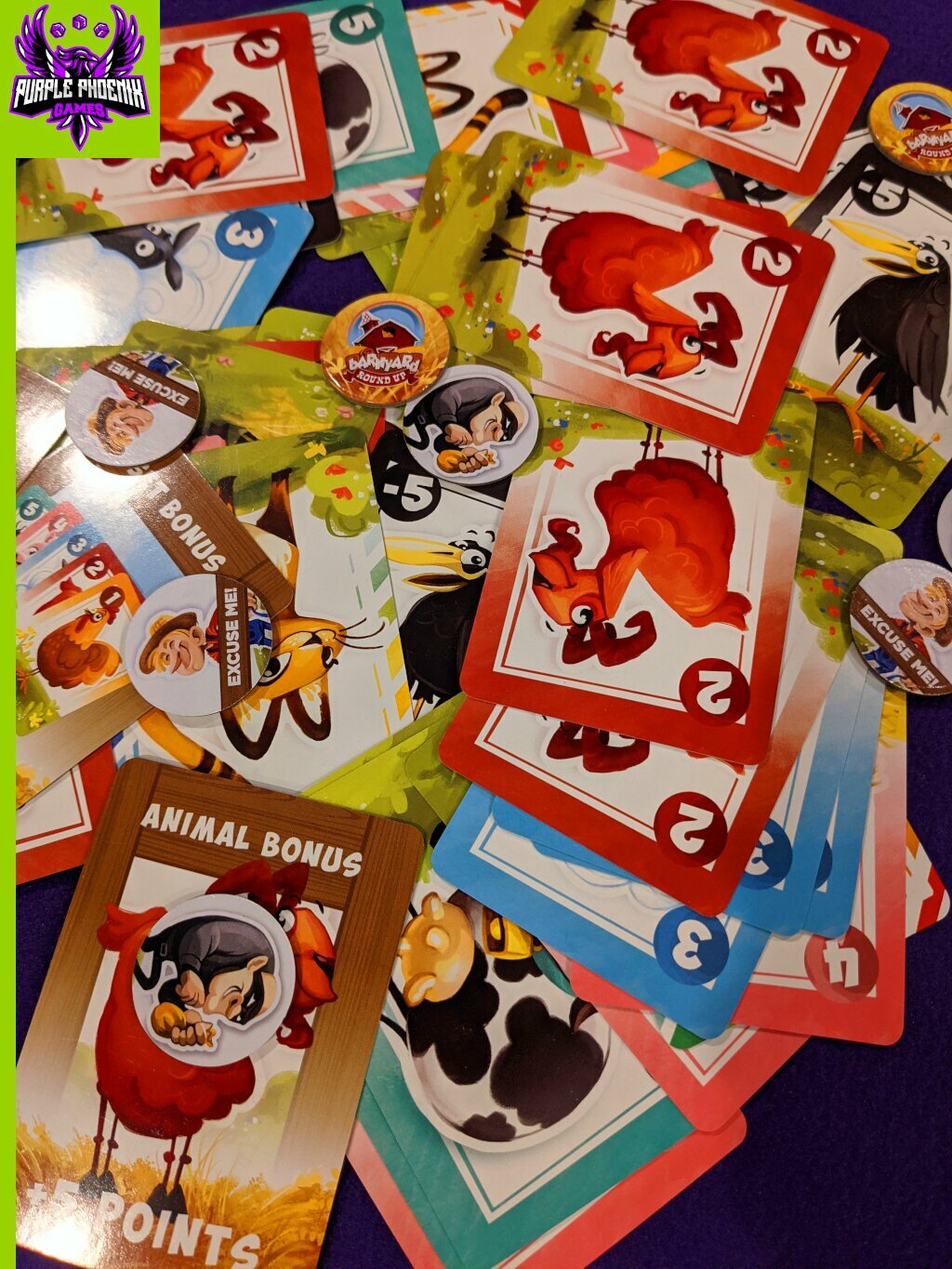
Barnyard Roundup turns are quite simple: take two or three actions and end the turn. The first action is mandatory and it is Passing Cards to another player. Choose anywhere from one to six cards, place them face-down on the table in front of the player with whom to be traded, and announce the number and type of cards to be traded. For example, a player may say, “This is four chickens.” The targeted player now must decide whether that group actually IS a group of four chickens or if they believe the trader (not traitor) is bluffing. If so the targeted player may say, “That is NOT four chickens.” Once the agree/disagree statement has been made the cards are flipped over to see which player will be adding the cards to their pens. If the targeted player guessed correctly then they will received all the animal cards that were passed to them. That is, unless the cards were actually CROWS. Crows are worth -5 VP at the end of the game (see the photo below) and will be taken into the pen of the defeated player in the trade. In addition to crows (bad) the game includes Copy Cats (good) which can be wild cards to be placed with other animals and they copy the animal in their group. When the trade is resolved the active player may choose to perform the next step, but it is not mandatory.
Players must note that any time a player gains crows that would extend their collection of crows to any multiple of 3 that player must then draw another Action Token (Burglar, Excuse Me, Scarecrow) from the supply. If a Scarecrow is drawn it is immediately revealed and three crows are discarded from that player’s collection. The Excuse Me token may be used during a trade, but before cards are revealed, by a player not involved in the trade. When they announce, “Excuse Me,” they immediately take the place of the targeted player and will decide whether the trade is correct as announced or is a bluff.
Should they wish, the active player may now Play a Burglar Token from their collection in order to target another player and ask for all of their animals of a specific type – “I wish to procure all of your cows” That player must then immediately hand over all their cows, or else may tell the active player to Go Fish. Okay, that last part isn’t in the rules, but I started doing it and it stuck for me.
The third and final step of a turn is simply to Draw Cards and End Your Turn. Draw cards back up to the hand limit of 5 or 6 and end the turn. Play then passes to the next player.
Play continues in this fashion until the last card has been drawn. The game ends immediately and players tally their points per the rulebook to arrive at an ultimate winner!
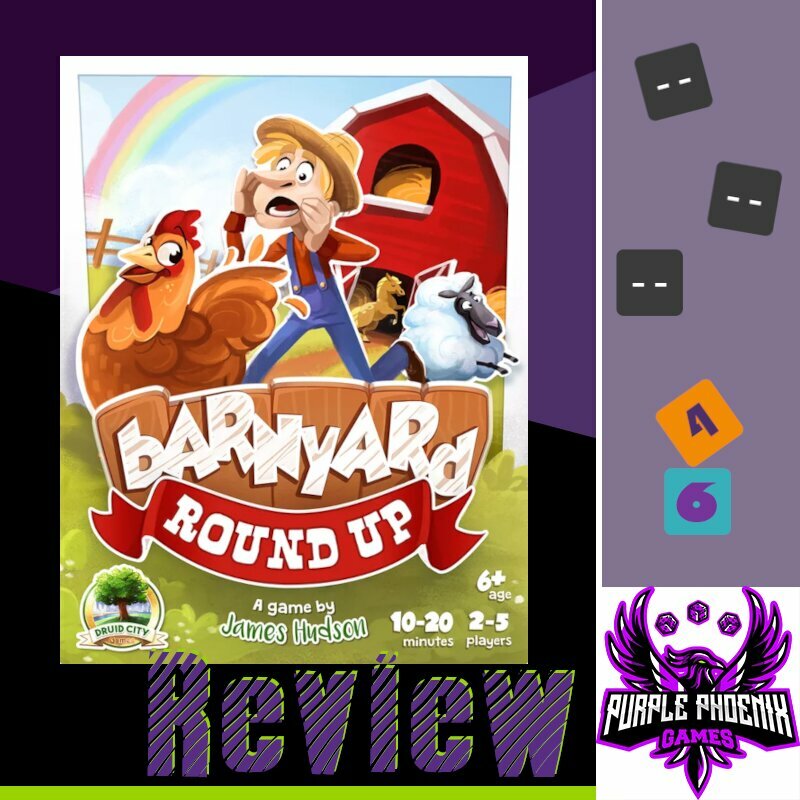
Components. This game is a bunch of cards and some tokens in a double-wide+ tuckbox. I love the art, and that makes sense as it is illustrated by Lina Cossette, half of Mr. Cuddington. If you don’t know about Mr. Cuddington, please check out their website. The cards are good quality, as are the tokens. But that box. Now, it LOOKS great, and is a fine size. But a tuckbox? I would have preferred a lidded box, or even one of those with the magnetic fold-out lids. But it’s a tuckbox and the opening flap dented upon its first opening. Oy. I could give a chef’s kiss to everything else though.
Now, there’s a reason why I rated this game a 4 and my wife a 6: she beats me every single time we play and I just cannot find the strategy to take her down. Am I just horrible at bluffing games? Does she just dominate me at ALL games? I’m not sure, but this one certainly highlights the fact that she’s just better than me. I can still hear her haunting and taunting me with, “OH MY GOSH I LOVE THIS GAME! I’M SOOOOO GOOD AT IT!” Meanwhile I am sitting pretty with a whole flock of crows laughing at me like I am the Scarecrow from Wizard of Oz. Perhaps I am truly brainless as well.
That said, the game is enjoyable. I do like to play bluffing games, but I’m the poor soul who would rather play straight than do ANY sort of bluffing at all. Except when I have lulled my prey into trusting my every declaration. Then pull out the big guns and laugh my way to the bank. Well, I tried that several times and no dice. But I do enjoy playing, and I do keep coming back for more torture. And if that isn’t a sign of a good game, then what is?
All in all the game is quick, light on rules, and features wonderful art style. This is the game I will probably use to introduce my children (or new gamers) to bluffing games as the theme is easily digestible and when you get stuck with the negative points you don’t feel super bad about it. It is easy to pronounce that Purple Phoenix Games gives this one a squawkin’-good 10 / 12. If you are looking for a light introductory game to teach bluffing or to hit that sweet-spot, then I recommend you check out Barnyard Roundup from Druid City Games. I ain’t a-bluffin’ ya.
Barnyard Roundup is a silly game of bluffing and hand management set on a farm. In it players are farmhands trying to help Farmer Brown sell the most animals at market. They do this by bluffing their hands in trade deals with other farmhands, thus making no friends in the process. The player with the most points at the end of the game, when all cards from the draw deck have been drawn, will be the winner!
DISCLAIMER: We were provided a copy of this game for the purposes of this review. This is a retail copy of the game, so what you see in these photos is exactly what would be received in your box. I do not intend to cover every single rule included in the rulebook, but will describe the overall game flow and major rule set so that our readers may get a sense of how the game plays. For more in depth rules, you may purchase a copy online or from your FLGS. -T
To setup place the five Animal Bonus cards in a line with the Set Bonus cards nearby. Shuffle the large deck of animal cards and deal out cards according to the rulebook per the number of players in the game. The Burglar and Excuse Me tokens are sorted and dealt out with the remainders face-down near the other cards. Remove eight cards from the draw deck and decide who will be the start player. The game may now begin!
Barnyard Roundup turns are quite simple: take two or three actions and end the turn. The first action is mandatory and it is Passing Cards to another player. Choose anywhere from one to six cards, place them face-down on the table in front of the player with whom to be traded, and announce the number and type of cards to be traded. For example, a player may say, “This is four chickens.” The targeted player now must decide whether that group actually IS a group of four chickens or if they believe the trader (not traitor) is bluffing. If so the targeted player may say, “That is NOT four chickens.” Once the agree/disagree statement has been made the cards are flipped over to see which player will be adding the cards to their pens. If the targeted player guessed correctly then they will received all the animal cards that were passed to them. That is, unless the cards were actually CROWS. Crows are worth -5 VP at the end of the game (see the photo below) and will be taken into the pen of the defeated player in the trade. In addition to crows (bad) the game includes Copy Cats (good) which can be wild cards to be placed with other animals and they copy the animal in their group. When the trade is resolved the active player may choose to perform the next step, but it is not mandatory.
Players must note that any time a player gains crows that would extend their collection of crows to any multiple of 3 that player must then draw another Action Token (Burglar, Excuse Me, Scarecrow) from the supply. If a Scarecrow is drawn it is immediately revealed and three crows are discarded from that player’s collection. The Excuse Me token may be used during a trade, but before cards are revealed, by a player not involved in the trade. When they announce, “Excuse Me,” they immediately take the place of the targeted player and will decide whether the trade is correct as announced or is a bluff.
Should they wish, the active player may now Play a Burglar Token from their collection in order to target another player and ask for all of their animals of a specific type – “I wish to procure all of your cows” That player must then immediately hand over all their cows, or else may tell the active player to Go Fish. Okay, that last part isn’t in the rules, but I started doing it and it stuck for me.
The third and final step of a turn is simply to Draw Cards and End Your Turn. Draw cards back up to the hand limit of 5 or 6 and end the turn. Play then passes to the next player.
Play continues in this fashion until the last card has been drawn. The game ends immediately and players tally their points per the rulebook to arrive at an ultimate winner!
Components. This game is a bunch of cards and some tokens in a double-wide+ tuckbox. I love the art, and that makes sense as it is illustrated by Lina Cossette, half of Mr. Cuddington. If you don’t know about Mr. Cuddington, please check out their website. The cards are good quality, as are the tokens. But that box. Now, it LOOKS great, and is a fine size. But a tuckbox? I would have preferred a lidded box, or even one of those with the magnetic fold-out lids. But it’s a tuckbox and the opening flap dented upon its first opening. Oy. I could give a chef’s kiss to everything else though.
Now, there’s a reason why I rated this game a 4 and my wife a 6: she beats me every single time we play and I just cannot find the strategy to take her down. Am I just horrible at bluffing games? Does she just dominate me at ALL games? I’m not sure, but this one certainly highlights the fact that she’s just better than me. I can still hear her haunting and taunting me with, “OH MY GOSH I LOVE THIS GAME! I’M SOOOOO GOOD AT IT!” Meanwhile I am sitting pretty with a whole flock of crows laughing at me like I am the Scarecrow from Wizard of Oz. Perhaps I am truly brainless as well.
That said, the game is enjoyable. I do like to play bluffing games, but I’m the poor soul who would rather play straight than do ANY sort of bluffing at all. Except when I have lulled my prey into trusting my every declaration. Then pull out the big guns and laugh my way to the bank. Well, I tried that several times and no dice. But I do enjoy playing, and I do keep coming back for more torture. And if that isn’t a sign of a good game, then what is?
All in all the game is quick, light on rules, and features wonderful art style. This is the game I will probably use to introduce my children (or new gamers) to bluffing games as the theme is easily digestible and when you get stuck with the negative points you don’t feel super bad about it. It is easy to pronounce that Purple Phoenix Games gives this one a squawkin’-good 10 / 12. If you are looking for a light introductory game to teach bluffing or to hit that sweet-spot, then I recommend you check out Barnyard Roundup from Druid City Games. I ain’t a-bluffin’ ya.

Heather Cranmer (2721 KP) rated How to Save a Life in Books
Jun 7, 2018

(This review can also be found on my blog <a href="http://themisadventuresofatwentysomething.blogspot.co.uk/">The (Mis)Adventures of a Twenty-Something Year Old Girl</a>).
I won this book off of Facebook or Twitter; I forget which. I had totally forgot about this book, I'm ashamed to admit, until I was tidying up my bookshelf and came across it again. I'm glad I came across it again as it's definitely become one of my favourite reads of 2012.
Jill's dad has only recently died, and already it seems like her mother wants to replace him with a new baby. Enter Mandy. Mandy is a pregnant teen. She wants to give her baby up for adoption, and Robin, Jill's mother, seems like the perfect person to adopt her baby. Will Mandy and her baby help fill the whole in Robin and Jill's heart? Will Mandy feel loved? What if Mandy decides to keep her baby? Told from both Jill's and Mandy's point of view, this book will tug at your heart strings.
I don't really get the title to this book. Maybe there's some kind of hidden message behind the title, and I'm missing it, but I really don't understand why this book is called How to Save a Life. Perhaps it's to let the reader know that this book will be very emotional.
The cover suits the book especially when it comes to the character of Mandy. Once you read the book, you'll definitely think this cover suits the book. I won't say too much due to spoilers, but just take my word that it does indeed suit the book.
There's really not much to the setting of the book. It mostly takes place at Jill's house in Denver and a few other little places like Jill's school or restaurants. However, the setting of this book is done rather well, and it sounds like Denver!! I mean, I've never been, but it's what I'd imagine it to be.
The pacing was brilliant! It was so hard to put this book down. I was hooked beyond belief. At no point does the pacing slow down enough to become boring. Each chapter is interesting!!
The dialogue was perfect. The two main characters are teens, and I felt their language was appropriate for teen girls. There were a couple of words I didn't understand, but I think this was just down to me not knowing the what the word meant as others probably know what it means. However, this didn't take away from the story in the slightest. There are a few swear words, but not too many.
I loved the characters in this book!! Mandy was my favourite character. It felt as if Mandy's mother had brainwashed her into thinking all sorts of things, so Mandy comes off as being a bit socially inept. She's definitely a bit weird because of it, but that's what I loved about her. She has this sort of innocence and naivety that is both sweet and charming. I also loved Jill. She starts off with a "screw the world" attitude, but it's obvious she's only acting that way because of what she's been through. Jill is actually quite a sweet girl. As for Dylan and Ravi, I also loved them both. Dylan is very caring and comes across as the type that's nice to everyone no matter what. Ravi came across as the geeky but sexy sweet guy.
This book had me laughing and crying (quite literally). It also had me worried and made me feel secure. It plays up to most of the human emotions. It's just a bit hard to explain unless you read it, which I suggest you do ASAP! This book is an emotional rollercoaster. It's one of those books you just have to read!! It will also have you thinking about it long after you've finished reading it.
I'd recommend this book to everyone aged 16+. It's such an amazing book! I can't sing it's praises loud enough!! Please read it and let me know what you think. You won't regret reading it.
I won this book off of Facebook or Twitter; I forget which. I had totally forgot about this book, I'm ashamed to admit, until I was tidying up my bookshelf and came across it again. I'm glad I came across it again as it's definitely become one of my favourite reads of 2012.
Jill's dad has only recently died, and already it seems like her mother wants to replace him with a new baby. Enter Mandy. Mandy is a pregnant teen. She wants to give her baby up for adoption, and Robin, Jill's mother, seems like the perfect person to adopt her baby. Will Mandy and her baby help fill the whole in Robin and Jill's heart? Will Mandy feel loved? What if Mandy decides to keep her baby? Told from both Jill's and Mandy's point of view, this book will tug at your heart strings.
I don't really get the title to this book. Maybe there's some kind of hidden message behind the title, and I'm missing it, but I really don't understand why this book is called How to Save a Life. Perhaps it's to let the reader know that this book will be very emotional.
The cover suits the book especially when it comes to the character of Mandy. Once you read the book, you'll definitely think this cover suits the book. I won't say too much due to spoilers, but just take my word that it does indeed suit the book.
There's really not much to the setting of the book. It mostly takes place at Jill's house in Denver and a few other little places like Jill's school or restaurants. However, the setting of this book is done rather well, and it sounds like Denver!! I mean, I've never been, but it's what I'd imagine it to be.
The pacing was brilliant! It was so hard to put this book down. I was hooked beyond belief. At no point does the pacing slow down enough to become boring. Each chapter is interesting!!
The dialogue was perfect. The two main characters are teens, and I felt their language was appropriate for teen girls. There were a couple of words I didn't understand, but I think this was just down to me not knowing the what the word meant as others probably know what it means. However, this didn't take away from the story in the slightest. There are a few swear words, but not too many.
I loved the characters in this book!! Mandy was my favourite character. It felt as if Mandy's mother had brainwashed her into thinking all sorts of things, so Mandy comes off as being a bit socially inept. She's definitely a bit weird because of it, but that's what I loved about her. She has this sort of innocence and naivety that is both sweet and charming. I also loved Jill. She starts off with a "screw the world" attitude, but it's obvious she's only acting that way because of what she's been through. Jill is actually quite a sweet girl. As for Dylan and Ravi, I also loved them both. Dylan is very caring and comes across as the type that's nice to everyone no matter what. Ravi came across as the geeky but sexy sweet guy.
This book had me laughing and crying (quite literally). It also had me worried and made me feel secure. It plays up to most of the human emotions. It's just a bit hard to explain unless you read it, which I suggest you do ASAP! This book is an emotional rollercoaster. It's one of those books you just have to read!! It will also have you thinking about it long after you've finished reading it.
I'd recommend this book to everyone aged 16+. It's such an amazing book! I can't sing it's praises loud enough!! Please read it and let me know what you think. You won't regret reading it.

Kirk Bage (1775 KP) rated Seinfeld - Season 1 in TV
Jan 22, 2021


I always assumed I wouldn’t like Seinfeld in the 90s. In fact I was opposed to the very idea of it on principle. And that principle was: I’ve never heard of this guy as a comedian, and American stand-up usually isn’t funny. I never saw a single episode until six months ago – in my head it was some dumb, canned laughter show with very forced scripts and little charm. I just didn’t get why it was always quoted amongst the best sitcoms of all time, and I wasn’t willing to find out. This is called “being ignorant”. Guilty.
One random day with nothing else inspiring me I finally took the plunge and put an episode on. Guess what happened? I laughed, I found it completely charming and witty and easy to watch, with some great lines and likeable characters. 3 hours later I had done 6 episodes and was as hooked as anyone can be with anything. It was just so nostalgically and completely 90s! And I loved that!
A show doesn’t run for 9 years and over 170 episodes without being some kind of special, especially taking into account the depreciation due to being dated, as all sitcoms eventually are, and it really is quite remarkable – deserving of a place in the conversation of the greatest ever American half hour shows. Sure, there is an element early on in the preoccupation with everyone’s sex life and dating habits that is a little creepy in 2020, but I am totally willing to forgive it.
Shows that are hyper aware of themselves and the audience are odd creatures the minute they take themselves too seriously, and Seinfeld never does that. It knows it is trivial, essentially about nothing and going nowhere, and style-wise it is always winking at us for being in on the joke and a part of it, even to the point of applauding new characters on their entrance, which is a uniquely American thing to do.
The secret of the show is undoubtedly the chemistry of the four leads, so mismatched that it someone works a spell and creates magic, much in the same way Friends managed to do, times six. Jerry Seinfeld himself is a very likeable everyman, and the schtick of each show beginning and ending with 30 seconds of stand up is a gimmick that grows on you, as does everything about it: the more you watch, the more you love it for what it is.
Jason Alexander as the balding, quirky, self-conscious, opinionated best friend is perhaps my least favourite of the regular quartet, but he has some amazing moments over the course of things, and plays great dead-pan. But the other two are on a plane of equal genius. The verbal timing of the super cute, super smart Julia Louis-Dreyfus as Elaine (who I have fallen in love with a little bit in 1993) and the physical slapstick timing of Michael Richards as Cosmo Kramer (surely one of the most memorable characters in sitcom history) have both left me aching with laughter time after time after time. Just a glance or an expression is often enough.
And the great thing is, it never seems to get old. They are always finding new ways and new situations that keep it fresh. Some trick! Even in the final season of the 9, when there is a small melancholia creeping in because they all know it is coming to an end, it still manages to create moments that aren’t just repeats of previous gags. Which means, as future background watching it is 100% perfect. Leave it on whilst doing something else, look up once in a while, and like the best of all long running US comedy shows each episode is indistinguishable from any other in the best way – it is like having a friend in the room.
I can’t imagine ever saying it is amongst my very favourites, maybe because I missed out on it first time around – which I put down to an inherent middle aged appeal, rather than a youth appeal – but I wouldn’t also ever argue with anyone that did say that it was one of their favourites. Because I get it now. And I’m so glad I got to do it, no matter how late to the party!
One random day with nothing else inspiring me I finally took the plunge and put an episode on. Guess what happened? I laughed, I found it completely charming and witty and easy to watch, with some great lines and likeable characters. 3 hours later I had done 6 episodes and was as hooked as anyone can be with anything. It was just so nostalgically and completely 90s! And I loved that!
A show doesn’t run for 9 years and over 170 episodes without being some kind of special, especially taking into account the depreciation due to being dated, as all sitcoms eventually are, and it really is quite remarkable – deserving of a place in the conversation of the greatest ever American half hour shows. Sure, there is an element early on in the preoccupation with everyone’s sex life and dating habits that is a little creepy in 2020, but I am totally willing to forgive it.
Shows that are hyper aware of themselves and the audience are odd creatures the minute they take themselves too seriously, and Seinfeld never does that. It knows it is trivial, essentially about nothing and going nowhere, and style-wise it is always winking at us for being in on the joke and a part of it, even to the point of applauding new characters on their entrance, which is a uniquely American thing to do.
The secret of the show is undoubtedly the chemistry of the four leads, so mismatched that it someone works a spell and creates magic, much in the same way Friends managed to do, times six. Jerry Seinfeld himself is a very likeable everyman, and the schtick of each show beginning and ending with 30 seconds of stand up is a gimmick that grows on you, as does everything about it: the more you watch, the more you love it for what it is.
Jason Alexander as the balding, quirky, self-conscious, opinionated best friend is perhaps my least favourite of the regular quartet, but he has some amazing moments over the course of things, and plays great dead-pan. But the other two are on a plane of equal genius. The verbal timing of the super cute, super smart Julia Louis-Dreyfus as Elaine (who I have fallen in love with a little bit in 1993) and the physical slapstick timing of Michael Richards as Cosmo Kramer (surely one of the most memorable characters in sitcom history) have both left me aching with laughter time after time after time. Just a glance or an expression is often enough.
And the great thing is, it never seems to get old. They are always finding new ways and new situations that keep it fresh. Some trick! Even in the final season of the 9, when there is a small melancholia creeping in because they all know it is coming to an end, it still manages to create moments that aren’t just repeats of previous gags. Which means, as future background watching it is 100% perfect. Leave it on whilst doing something else, look up once in a while, and like the best of all long running US comedy shows each episode is indistinguishable from any other in the best way – it is like having a friend in the room.
I can’t imagine ever saying it is amongst my very favourites, maybe because I missed out on it first time around – which I put down to an inherent middle aged appeal, rather than a youth appeal – but I wouldn’t also ever argue with anyone that did say that it was one of their favourites. Because I get it now. And I’m so glad I got to do it, no matter how late to the party!

Ivana A. | Diary of Difference (1171 KP) rated Chat Love in Books
Oct 2, 2020
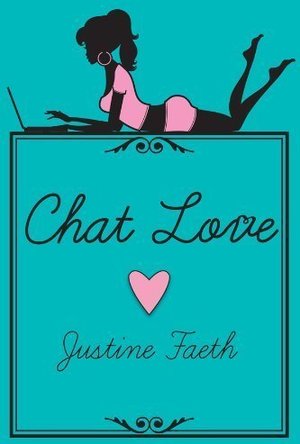

I wanted to read this book immediately after reading the synopsis, and I was honoured when the author, Justine Faeth, approached me and sent me an ebook copy in exchange for an honest review.
The book synopsis is a very promising one. Lucia is having trouble finding a man. After a few disastrous dates, she chooses to follow her friend’s advice and tries Chat Love, an online dating service.
As promising as the synopsis sounds, this book didn’t quite deliver. With Chat Love, I found the whole setting of the book unrealistic. There is a nice background story and a great idea, but it hasn’t been properly executed.
Lucia is an Italian lady. She is a city girl and a business woman. She is searching for love. See, Lucia is under pressure by her Italian family to get married. And I can completely understand that pressure, being born in a country where I have met people with similar beliefs. Lucia’s family thinks that a woman is made to be a mother, and not have a career. They think that if you are thirty and you haven’t got a boyfriend yet, you are useless and unworthy.
And I completely agree with Lucia when she tries to stand up to them and tell them how it’s important for her to find a man she will really love, not just marry in order to please her family. In some scenes though, it appears as if she hates her family, and has very bad attitude towards them. I understand completely where her frustration comes from.
But then, on the other hand, we have a Lucia that is being a hypocrite.
And while this whole book seems like she is searching for her true love, when someone appears and cares about her, she is acting as if she’s not interested. Woman, WHAT DO YOU WANT? She wants true love, and she doesn’t want to be used as a one-night stand, which is completely acceptable. But going on a date with a man for the first time, and telling him you want to get serious is creepy. Even if that is your long-term goal, you DO NOT say it on the first date. It scares people away. It makes people think you are a creep.
Also, given the fact that the synopsis promises an online app, this left me disappointed. During this book, we don’t get to really see a single chat happen through this app. Apart from a few letters from Jake. Honestly, I expected a back and forth conversations with men before a date happens. In the book, we get to see Lucia dating a lot of men. I didn’t stop to count them, but there must’ve been around twenty dates. And all these men had something wrong with them. But she never screwed up.
I will be honest with you now, and you people need to be honest with yourselves. In your life, you will meet people, and some people will make you giggle. Others might make you gag. But sometimes, the reason for a bad date is you. I am only trying to be honest here. I have screwed up a few dates myself, and you must have done the same thing too. That’s life though. We have to move on and try not to blame others for our mistakes. I wish this been represented in this book.
I really wish I loved this book.
I have mixed feelings, because despite all, this book did make me think and bring up discussions with people around the various topics, from family beliefs, to being creepy on first dates, to finding out what you really like. In a summary, as much as I didn’t enjoy it, I also am grateful for this book, for bringing out a lot of things to think about.
If you love chick-lit and short romance funny novels, you might enjoy it. If you think any of this discussion points is intriguing, you might enjoy it. I would love to have a chat and see what you think of this book.
The book synopsis is a very promising one. Lucia is having trouble finding a man. After a few disastrous dates, she chooses to follow her friend’s advice and tries Chat Love, an online dating service.
As promising as the synopsis sounds, this book didn’t quite deliver. With Chat Love, I found the whole setting of the book unrealistic. There is a nice background story and a great idea, but it hasn’t been properly executed.
Lucia is an Italian lady. She is a city girl and a business woman. She is searching for love. See, Lucia is under pressure by her Italian family to get married. And I can completely understand that pressure, being born in a country where I have met people with similar beliefs. Lucia’s family thinks that a woman is made to be a mother, and not have a career. They think that if you are thirty and you haven’t got a boyfriend yet, you are useless and unworthy.
And I completely agree with Lucia when she tries to stand up to them and tell them how it’s important for her to find a man she will really love, not just marry in order to please her family. In some scenes though, it appears as if she hates her family, and has very bad attitude towards them. I understand completely where her frustration comes from.
But then, on the other hand, we have a Lucia that is being a hypocrite.
And while this whole book seems like she is searching for her true love, when someone appears and cares about her, she is acting as if she’s not interested. Woman, WHAT DO YOU WANT? She wants true love, and she doesn’t want to be used as a one-night stand, which is completely acceptable. But going on a date with a man for the first time, and telling him you want to get serious is creepy. Even if that is your long-term goal, you DO NOT say it on the first date. It scares people away. It makes people think you are a creep.
Also, given the fact that the synopsis promises an online app, this left me disappointed. During this book, we don’t get to really see a single chat happen through this app. Apart from a few letters from Jake. Honestly, I expected a back and forth conversations with men before a date happens. In the book, we get to see Lucia dating a lot of men. I didn’t stop to count them, but there must’ve been around twenty dates. And all these men had something wrong with them. But she never screwed up.
I will be honest with you now, and you people need to be honest with yourselves. In your life, you will meet people, and some people will make you giggle. Others might make you gag. But sometimes, the reason for a bad date is you. I am only trying to be honest here. I have screwed up a few dates myself, and you must have done the same thing too. That’s life though. We have to move on and try not to blame others for our mistakes. I wish this been represented in this book.
I really wish I loved this book.
I have mixed feelings, because despite all, this book did make me think and bring up discussions with people around the various topics, from family beliefs, to being creepy on first dates, to finding out what you really like. In a summary, as much as I didn’t enjoy it, I also am grateful for this book, for bringing out a lot of things to think about.
If you love chick-lit and short romance funny novels, you might enjoy it. If you think any of this discussion points is intriguing, you might enjoy it. I would love to have a chat and see what you think of this book.

Emma @ The Movies (1786 KP) rated Long Shot (2019) in Movies
Jun 22, 2019 (Updated Sep 25, 2019)
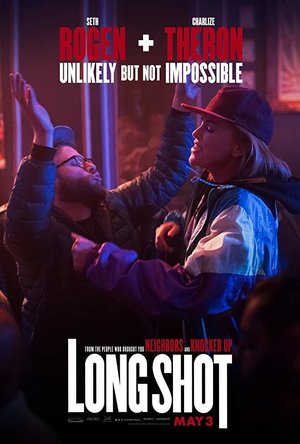

Fred Flarksy is a controversial journalist who likes to uncover the evil and corrupt in the world, when his paper is brought by a company that they themselves have uncovered as the "bad guy" he quits on the spot. Lance, his best friend, knows exactly what he needs to feel better, drink, steak, and a fundraiser with Boyz II Men.
It's fair to say that Fred didn't expect leaving his job to lead him to a chance reunion and such a wild ride.
It's fair to say that I wasn't too sure what this one was going to be like. I've never been a massive fan of Seth Rogen, a lot of his roles seem pointlessly crude. I don't mind that particularly, but too much of it just isn't my cup of tea. The line-up of him and Theron seemed a little mad, and a bit off balance, but the trailers looked like they had something to them so I was willing to have my mind changed... and oh boy did I change my mind.
At this point I've seen the movie twice and it really is great fun, and surprisingly heartwarming.
The odd headlining duo actually work wonderfully together, they bounce off each other so well throughout and that chemistry has shot this up into my favourite rom-coms.
Seth Rogen seems to have a knack for the outraged outbursts in films and we get a few of those at the beginning of the film. We quickly see Fred become a loveable character when he first sees Charlotte across the room at the fundraiser. He's sweet, he's vulnerable and he's funny. That's when you really start rooting for him.
Had you asked me to sum up Charlize Theron's previous acting roles I'd have said they were all of the dramatic and action persuasion, and mostly they are, I'd completely forgotten things like Gringo and A Million Ways To Die In The West. I hope we'll see more of her doing this sort of comedy, she's obviously well suited for it.
It's not just the lead roles though, the support cast are brilliant. June Diane Raphael as Charlotte's right-hand woman was so snippy with Fred to great effect, and O'Shea Jackson Jr. as Lance was the sort of supportive friend we all need. The highlight though was Tristan D. Lalla as secret service Agent M, he takes adorable to a whole new level.
My only negative on the casting was Alexander Skarsgård, but that's not because of his acting, it's because of what they did to him... that slurping, that laugh... why would you do that?! Why!!? After the wonder of him in The Aftermath this has ruined the image of him for me.
Long Shot's plot is entirely predictable. Two people are reunited after years, they catch feelings, something gets in the way, they split up, then they get back together. The fact you know where it's leading just means that you can sit back and enjoy it more. I was expecting the funny, but I really wasn't expecting to cry... yes, I know I'm a wreck. There are some surprisingly touching moments involved and the way they brought the film together at the end was perfect.
This probably deserves 5 stars, and I would give it that extra half star in a heartbeat if it wasn't for the Skarsgård thing and the fact that there's no way I could watch this with my parents even though I know dad would find it hilarious.
What you should do
It's definitely one to see, it doesn't need the big screen but you certainly won't be wasting your money if you went and saw it at the cinema.
It's fair to say that Fred didn't expect leaving his job to lead him to a chance reunion and such a wild ride.
It's fair to say that I wasn't too sure what this one was going to be like. I've never been a massive fan of Seth Rogen, a lot of his roles seem pointlessly crude. I don't mind that particularly, but too much of it just isn't my cup of tea. The line-up of him and Theron seemed a little mad, and a bit off balance, but the trailers looked like they had something to them so I was willing to have my mind changed... and oh boy did I change my mind.
At this point I've seen the movie twice and it really is great fun, and surprisingly heartwarming.
The odd headlining duo actually work wonderfully together, they bounce off each other so well throughout and that chemistry has shot this up into my favourite rom-coms.
Seth Rogen seems to have a knack for the outraged outbursts in films and we get a few of those at the beginning of the film. We quickly see Fred become a loveable character when he first sees Charlotte across the room at the fundraiser. He's sweet, he's vulnerable and he's funny. That's when you really start rooting for him.
Had you asked me to sum up Charlize Theron's previous acting roles I'd have said they were all of the dramatic and action persuasion, and mostly they are, I'd completely forgotten things like Gringo and A Million Ways To Die In The West. I hope we'll see more of her doing this sort of comedy, she's obviously well suited for it.
It's not just the lead roles though, the support cast are brilliant. June Diane Raphael as Charlotte's right-hand woman was so snippy with Fred to great effect, and O'Shea Jackson Jr. as Lance was the sort of supportive friend we all need. The highlight though was Tristan D. Lalla as secret service Agent M, he takes adorable to a whole new level.
My only negative on the casting was Alexander Skarsgård, but that's not because of his acting, it's because of what they did to him... that slurping, that laugh... why would you do that?! Why!!? After the wonder of him in The Aftermath this has ruined the image of him for me.
Long Shot's plot is entirely predictable. Two people are reunited after years, they catch feelings, something gets in the way, they split up, then they get back together. The fact you know where it's leading just means that you can sit back and enjoy it more. I was expecting the funny, but I really wasn't expecting to cry... yes, I know I'm a wreck. There are some surprisingly touching moments involved and the way they brought the film together at the end was perfect.
This probably deserves 5 stars, and I would give it that extra half star in a heartbeat if it wasn't for the Skarsgård thing and the fact that there's no way I could watch this with my parents even though I know dad would find it hilarious.
What you should do
It's definitely one to see, it doesn't need the big screen but you certainly won't be wasting your money if you went and saw it at the cinema.
Emma @ The Movies (1786 KP) rated Like A Boss (2020) in Movies
Jan 22, 2020



Before going in I knew this was either going to be fantastic or a total disaster, it wasn't likely to fall in the middle of the scale. For the most part that was an accurate assumption.
Mia and Mel are lifelong friends and both share a passion for make-up and a more positive way of living. Their business, while a source of joy for them, is close to an end. But when Claire Luna appears on the scene Mel thinks it could be the answer to their financial worries, Mia is a little more sceptical. It appears that Claire is up to something but can they get to the bottom of everything before they lose their business, and each other?
Let us first give a round of applause to the uncredited actors in this film... Salma Hayek's breasts. They did sterling work, everyone else rather paled in comparison.
Now on to the serious things.
Let me be upfront about this... I will never want to watch this film again, if I happened across it being shown I would probably sit in silence for 83 minutes instead.
I love so many of the actors in this and yet I couldn't even rely on them to help this along. It's a fun premise and it had a cast that could definitely have made this great and yet somehow it's really quite poorly executed. Jokes didn't hit home and while I did chuckle a couple of times towards the end the beginning was not strong enough to be drama and not amusing enough to be comedy.
Billy Porter and Karan Soni probably come out the best from the whole ensemble. Porter has a very dramatic humour throughout and his delivery really helped. Soni's bitchy assistant wasn't overly complicated and had a fairly simple storyline to follow which allowed him to be more memorable.
I was rather disappointed with the hand that Jennifer Coolidge got dealt, she is amazingly funny and the humour in Like A Boss needed to give her something better to work with. Tiffany Haddish's return to over the top comedy also left me sad, having seen her in The Kitchen and being so impressed with her dramatic role I was really hoping she would try more of the same. While Mia is perfectly matched to her comedy stylings the script was severely lacking.
Everything about this seemed dated and it's very much a 90's feeling scenario. It felt like they were going for a bit of slapstick but left out the actual slapstick element. The confusion/disappointment did not stop there, the end of the film became evident quite early on and then it was just a case of waiting for it to happen without any anticipation.
The curious thing to me is the film's rating. There is absolutely no reason for this to be rated 15... that's to say that it didn't need any of the bits that would have caused it to be a 15, it easily could have been 12 and still had the same or hopefully a better impact.
Yes, there were some minor plus points but Like A Boss was overwhelmingly poor. I say that but it obviously has an audience out there because a lot of the people in our screening were laughing. Perhaps it would have helped me if so many key laughter points weren't shown in the trailer... but I think that's a little optimistic. On the plus side it did give me a chance to have a catch up with my friend around the dire movie.
Originally posted on: https://emmaatthemovies.blogspot.com/2020/01/like-boss-movie-review.html
Mia and Mel are lifelong friends and both share a passion for make-up and a more positive way of living. Their business, while a source of joy for them, is close to an end. But when Claire Luna appears on the scene Mel thinks it could be the answer to their financial worries, Mia is a little more sceptical. It appears that Claire is up to something but can they get to the bottom of everything before they lose their business, and each other?
Let us first give a round of applause to the uncredited actors in this film... Salma Hayek's breasts. They did sterling work, everyone else rather paled in comparison.
Now on to the serious things.
Let me be upfront about this... I will never want to watch this film again, if I happened across it being shown I would probably sit in silence for 83 minutes instead.
I love so many of the actors in this and yet I couldn't even rely on them to help this along. It's a fun premise and it had a cast that could definitely have made this great and yet somehow it's really quite poorly executed. Jokes didn't hit home and while I did chuckle a couple of times towards the end the beginning was not strong enough to be drama and not amusing enough to be comedy.
Billy Porter and Karan Soni probably come out the best from the whole ensemble. Porter has a very dramatic humour throughout and his delivery really helped. Soni's bitchy assistant wasn't overly complicated and had a fairly simple storyline to follow which allowed him to be more memorable.
I was rather disappointed with the hand that Jennifer Coolidge got dealt, she is amazingly funny and the humour in Like A Boss needed to give her something better to work with. Tiffany Haddish's return to over the top comedy also left me sad, having seen her in The Kitchen and being so impressed with her dramatic role I was really hoping she would try more of the same. While Mia is perfectly matched to her comedy stylings the script was severely lacking.
Everything about this seemed dated and it's very much a 90's feeling scenario. It felt like they were going for a bit of slapstick but left out the actual slapstick element. The confusion/disappointment did not stop there, the end of the film became evident quite early on and then it was just a case of waiting for it to happen without any anticipation.
The curious thing to me is the film's rating. There is absolutely no reason for this to be rated 15... that's to say that it didn't need any of the bits that would have caused it to be a 15, it easily could have been 12 and still had the same or hopefully a better impact.
Yes, there were some minor plus points but Like A Boss was overwhelmingly poor. I say that but it obviously has an audience out there because a lot of the people in our screening were laughing. Perhaps it would have helped me if so many key laughter points weren't shown in the trailer... but I think that's a little optimistic. On the plus side it did give me a chance to have a catch up with my friend around the dire movie.
Originally posted on: https://emmaatthemovies.blogspot.com/2020/01/like-boss-movie-review.html

Home yoga practice
Health & Fitness and Lifestyle
App
What is preventing you from living your life to the fullest TODAY? Body aches? Stress? Your mood? ...