
Super Why! Power to Read
Education and Games
App
UPDATE: Parents’ Choice Award-winning Super Why app now has 50% MORE CONTENT featuring new stories...
Daniel Boyd (1066 KP) rated Mass Effect Trilogy in Video Games
Jul 25, 2017
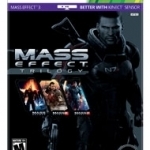


Mass Effect wasn’t the first game to do it, there are plenty of earlier examples of the mechanic being used before in games, such as the Fallout series. Bioware actually included the mechanic themselves in their earlier game in Knights Of The Old Republic, but its inclusion Mass Effect is what brought it to the mainstream and soon every developer was wanting a piece of the dialogue tree pie.
I never owned the original Mass Effect, the most exposure I got of it was through a few mates that owned the game at the time, but eventually the mechanic did end up creeping into games that I did own including; Alpha Protocall, Deus Ex, any Telltale game, The Amazing Spiderman 2, (for some reason,) and even in Uncharted 4.
As much as I enjoy a good ‘choose your own adventure,’ story and as much as I appreciate the trust that developers put in gamers to be able to tell their own story; whether that be through dialogue options, moral choices or customization options, I want you to tell me your story. I didn’t pay 50 quid to get given a setting and a bunch of characters to tell my own story. You guys get paid to craft amazingly immersive works of fiction, so do your job and suck me in. Whenever I’m playing a game with dialogue options and I am starting to get invested in the story and the characters, the inevitable dialogue tree pops up and takes me right out of the experience.
Sure, there are some movies that I watch and wonder why a writer or a director made a certain creative choice, but even if I don’t agree with the decision, it is the creator’s job to make those tough choices and that is what makes great art. One of my favorite movies of the last decade is Nicolas Winding Refn’s ‘Drive’ and that is purely because of the creative choices that the cast and crew made on that movie. I know people that hate Drive and I’m sure if given the option they would change it to be a less daring, more cookie cutter action thriller, but that wouldn’t have earned my respect like it has. Sometimes creators need to stop handholding the audience and make a tough call, even if it could potentially be a polarizing one.
In fact, when I think about it, all of my favorite stories are adored so much because of the definitive, drastic calls that they dare to make. I already spoke about Drive, Fight Club’s twist took some balls to pull off, the ambitious non linear storytelling of Pulp Fiction makes it iconic, Breaking Bad was consistently shocking and yet brilliant, MGS is insanely unconventional and I love it for it and The Last Of Us delivers a divisive finishing blow that we have no choice but to partake in.
That is how you tell a great story and that is how you stand out as a creator, by doing something that no one else could do, especially not your audience. When I come home after a long day at work, I don’t want to do much thinking. I want to relax and be told a story by the folks that are best at doing so. Personally, I think that you should believe in the story you are telling enough to make a definitive decision and if you don’t, is it really a story that’s worth telling?

i Sail GPS : USA NOAA Marine Chart Plotter
Navigation and Travel
App
Your iPhone or WiFi+Cellular iPad can be a high-performance GPS receiver with USA NOAA Raster...

Evolve Basketball
Sports and Social Networking
App
Evolve Basketball App is an all in one basketball training app. It is a complete tool that allows a...
Jason James (3 KP) rated Founders of Gloomhaven in Tabletop Games
Apr 4, 2019
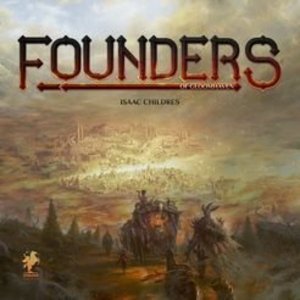
Overall this game is for people who enjoy other similar games like Catan or Ticket to Ride. Players must adjust to the fact that roads are public tiles that can connect any players resources to buildings. The game is high statistical and players must be able to make decisions that may result in other players gaining points. I would give the game an 8/10 as it brings a fresh feel to city-building board games! If you have any questions or have any comments on my review please feel free to message me.
Thanks!
Amazing Farm Baby Animals Puzzle game for Toddlers to Kindergarten
Education and Games
App
Try for FREE, full version -- 66% OFF SALE -- TODAY: September 23-30, 2015 ***** Brought to you by...

B787 Study App
Education and Book
App
B787 Study App by JETPUBS is a flash card based training aid used by airline pilots for memory...

Kung Fu Panda Holiday Storybook
Book and Entertainment
App
★ Featured in "What's Hot" in the Apple App Store iStoryTime brings you Kung Fu Panda Holiday...

Kristy H (1252 KP) rated With or Without You in Books
Sep 17, 2020
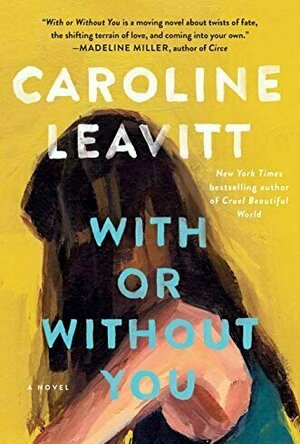
What a beautiful and striking novel. I discovered Caroline Leavitt through the power of ARCs in 2016, falling in love with her work through Cruel Beautiful World. She gives us another book filled with compelling characters here. I so enjoyed reading a book with a different plot, especially knowing that the coma story was somewhat based on Leavitt's own life. She's a remarkable writer in so many ways.
With or Without You is incredibly well-written--almost poetic at times. It's told from both Simon and Stella's perspectives, including while Stella's in her coma, and some of those moments are quite profound and touching. Both Stella's realizations as she struggles to realize where she is, and Simon's, as he tries to grapple with the idea of his partner being ill, as well as the awareness that he may be losing his last chance at fame and fortune as his band moves on without him.
"It's a kind of blankness. She's been erased for a while and then redrawn. When she comes back, she always feels a little bit better..."
Even worse for both Simon and Stella is the fact that they fought shortly before she fell into the coma. What kind of relationship, each wonders, would they come back into should Stella awake? In this way, Leavitt gives a beautiful character study: an in-depth observation into a flawed relationship. It just happens to be a relationship where a woman enters and exits a coma. It's an amazing look into love, loyalty, and loss. The novel makes you think, drawing you into the characters. What would you do in Simon's situation, you think? Or Stella's?
"Mostly she thought of all the things that she herself wanted, and like Simon's dreams, they had an expiration date she couldn't ignore."
Overall, I quite enjoyed this novel. It's so well-done and such a different and intriguing look at two people trying to find happiness. I love Leavitt's way with words. 4 stars.

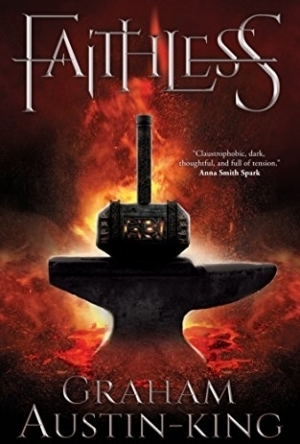
There is a hint of magic here, with chanting at the forge, but until the final few chapters it is unclear whether this is magic or simply a way to mark time and ensure the metal is at the right temperature and worked at the right pace. Not overly labouring the magic here was an excellent choice by the author, as it keeps the attention on the mundane aspects of life, which is excellently told.
The story follows two main characters, firstly Wynn, a young lad sold (or mis-sold in his mind) by his father, a struggling farmer, into the mines for a life of back-breaking work down cramped, dangerous caves, endlessly trying to find enough ore to avoid a beating. His only chance of escaping the mines is to pass the tests and have a chance of ascending to the temple and possibly priesthood. Some way through the book we then meet Kharios, a young adult who appears to have somewhat failed in his first attempts at entering the priesthood (smithing) and is trying to get back to the forge.
The characters' stories are very similar, with hard, thankless, dangerous labour and periods of learning. For some time I struggled to tell the difference between them, thinking they seemed like very similar characters, but I have since re-thought that for reasons.
I found the pacing a little off. There were times I felt like I was reading a biography of a miner, rather than a fantasy novel, as long chapters are essentially that. And then these develop into long chapters learning smithing, was again a bit of a slog. And then all of a sudden we have periods of conflict down the mines, accidents, cave-ins, and the eventual calamity that leads to the second half of the book. The changes in pace were sudden and exciting, but the change was a little extreme at times.
I loved the way the two stories seemed at times independent yet similar, but eventually start to overlap. Though again, we have a change in pace where exciting, cataclysmic events are put aside for another chapter of walloping hot iron.
These pacing issues aside, this was an interesting and well written book with an unusual setting and a good message on belief systems.