
Search

Purple Phoenix Games (2266 KP) rated Tiger Stripes in Tabletop Games
Nov 25, 2021

So it was one of those days when I was checking my email and noticed something odd. I had a random tracking number sitting in my inbox for a game arriving soon. I didn’t recall requesting this game, so why was I having one shipped? A mystery still to this day. However, I recognized the designer’s last name, but could she be related to the designer in mind that I particularly enjoy? And would this game be any good? I was cautiously hopeful.
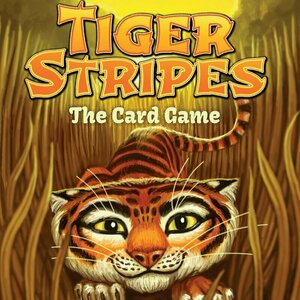
Tiger Stripes is a set collection, hand management, drafting game for two to four players. In it, players are young tiger cubs just earning their stripes (a fact I did not know prior to playing: that tiger cubs aren’t born with stripes). Each cub will earn their stripes by drafting the best available cards and utilizing them to the fullest in order to collect sets of prey.
Oh fact check: tigers are born with stripes already, so this game is not based fully on facts.
DISCLAIMER: We were provided a copy of this game for the purposes of this review. This is a retail copy of the game (I think), so what you see in these photos is probably what would be received in your box. I do not intend to cover every single rule included in the rulebook, but will describe the overall game flow and major rule set so that our readers may get a sense of how the game plays. For more in depth rules, you may purchase a copy online or from your FLGS. -T
To setup, each player will choose their tiger avatar cards and also receive seven Stripe tokens. The card deck is shuffled, and each player is dealt two cards for the starting hand. The remainder of the deck is placed on the table as a draw deck, but five cards are dealt to the table as an offer row. The youngest player goes first, and the stripes are ready to be earned, like Boy Scout badges… but for ferocious tiger cubs.
Turns are taken in three steps. The player must make a choice of one action for the first step of their turn: Draw a card, Take a tiger card, or Capture Prey. A player may choose to blindly draw a card from the top of the deck and add it to their hand as their action. Alternately, the player may instead choose to take a tiger card from the offer row and add it to their hand. Both of these are self-explanatory.
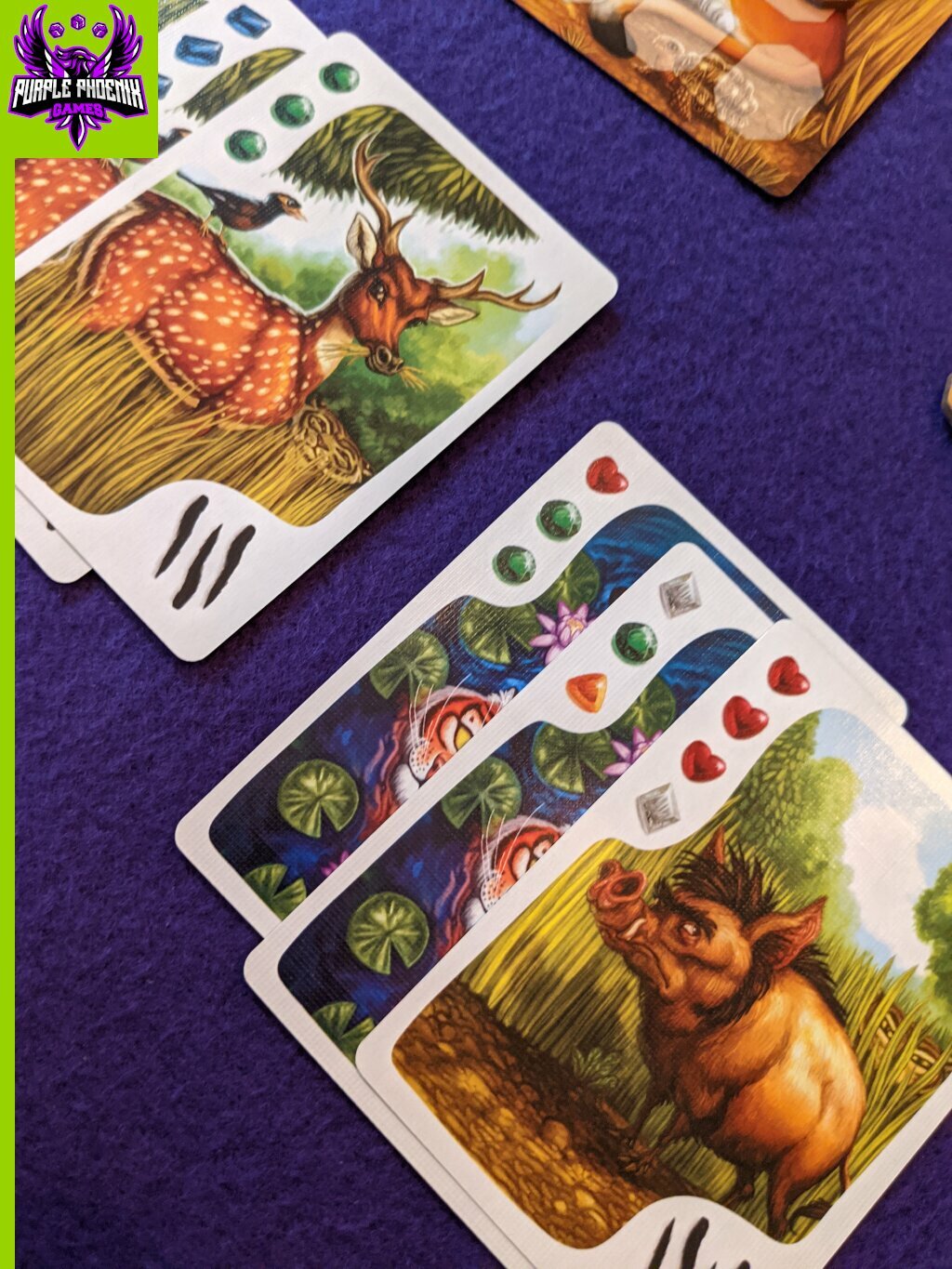
The third action that can be taken is to Capture Prey. A tiger may capture prey from the offer row by discarding cards from their hand with matching symbols to their target cards they wish to capture. Each card in Tiger Stripes has one or more symbols printed in the upper left hand corner. By discarding cards from hand to the discard pile, a player may use all the symbols provided by these cards to match with cards’ symbols from the offer row. For example, a player may discard two tiger cards and a snake card, noting the symbols now provided. By using the purchasing power of these symbols, the player may then draft cards from the offer row by paying their cost in symbols. It is entirely possible for a player to be able to draft cards from hand in order to purchase all available cards in the offer row to be added to their hand. An explanation of the significance of this is coming.
The second step of a turn is mandatory only if the prerequisites are met: every set of three like cards in hand are discarded in return for Stripe Tokens. So, for every set of three matching monkey, snake, deer, and boar, the player will receive one, two, three, or four Stripe Tokens to be added to their avatar card, respectively, with any tiger cards discarded to be treated as wild cards to complete a set. Therefore, a player may wish to purchase all cards from the offer row in an attempt to score multiple sets during this second step to earn as many stripes as possible.
Finally, the third step of the turn is to Replenish the Jungle (the offer row). For any cards drafted in the turn, the player will replace with cards from the draw deck to setup the next player’s turn.
Play continues in this fashion of grabbing cards, discarding cards, and scoring sets for stripes until one player has earned their seventh stripe and won the game!
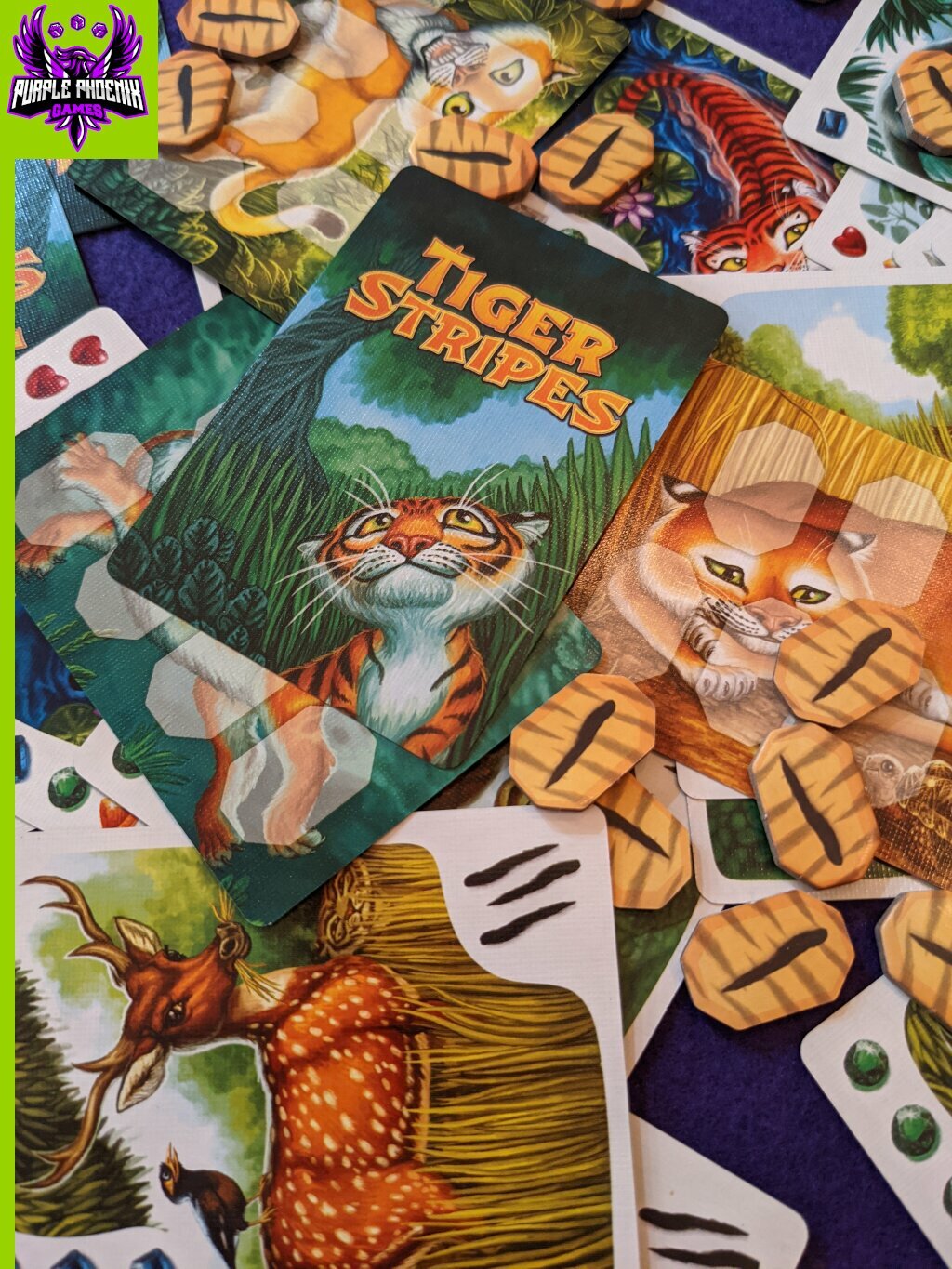
Components. This game is a deck of cards and a bunch of Stripe Tokens. The cards are all nice quality, with linen finish, but are a bit on the thinner side as far as flimsiness is concerned. I think if players are all somewhat careful this will not pose problems. If so, consider sleeving your copy. The Stripe Tokens are oblong octagons with stripey art. Speaking of the art, throughout the game the art is very cute and cuddly… except for the boar. He is crotchety. I do enjoy finding the stalking tiger somewhat hidden on each card’s art. A great nod to the noble tiger’s hunting ability.
Now, as I was typing the rules breakdown I felt like I was typing quite a lot for as light as the game actually is. In fact, though it says on the box that it is intended for ages 7+ I just couldn’t leave out my little 5-year-old gamer son. He grasped the rules really well, and though he hasn’t developed the best strategy-focused brain skills yet, he is still able to play and enjoy Tiger Stripes. In actuality, he and I had a blast playing through this several times. Yes, it is a resource optimization card drafting game, but to him, it was more like procuring a veritable zoo of cute animals that then offered his tiger the stripes needed to win. And win he did. Several times. This certainly isn’t a game of high strategy and multiple-minute turns, but rather a quick and easy card game with a great little theme.
Is the designer, Isabel duBarry, a relative of the great Philip duBarry? Perhaps. And that is a great thing, because one of our favorite games across the board is Revolution! Perchance game design just runs in the family. I am not sure, so maybe someone can chime in on this here.
When my son adds a game to his rotation, that is a sign of a great little game for us. He has added Tiger Stripes to this rotation and we will be playing the mess out of it here over the next several weeks/months. While this is by no means a gamer’s game, it is absolutely perfect for a game day with kids. My child loves it, and I quite enjoy playing as a tiny tiger out on the prowl for their stripes. If you have littles at home, parents who haven’t quite converted fully into game partners, or newbies you are inviting into the hobby, Tiger Stripes is a good little game to get the party started. It’s quick, easy, features great art and theme, and introduces simple mechanics to hook people on gaming. Go grab a copy and just keep it in your back pocket for those times you need something like this for that one special group in front of you.
Tiger Stripes is a set collection, hand management, drafting game for two to four players. In it, players are young tiger cubs just earning their stripes (a fact I did not know prior to playing: that tiger cubs aren’t born with stripes). Each cub will earn their stripes by drafting the best available cards and utilizing them to the fullest in order to collect sets of prey.
Oh fact check: tigers are born with stripes already, so this game is not based fully on facts.
DISCLAIMER: We were provided a copy of this game for the purposes of this review. This is a retail copy of the game (I think), so what you see in these photos is probably what would be received in your box. I do not intend to cover every single rule included in the rulebook, but will describe the overall game flow and major rule set so that our readers may get a sense of how the game plays. For more in depth rules, you may purchase a copy online or from your FLGS. -T
To setup, each player will choose their tiger avatar cards and also receive seven Stripe tokens. The card deck is shuffled, and each player is dealt two cards for the starting hand. The remainder of the deck is placed on the table as a draw deck, but five cards are dealt to the table as an offer row. The youngest player goes first, and the stripes are ready to be earned, like Boy Scout badges… but for ferocious tiger cubs.
Turns are taken in three steps. The player must make a choice of one action for the first step of their turn: Draw a card, Take a tiger card, or Capture Prey. A player may choose to blindly draw a card from the top of the deck and add it to their hand as their action. Alternately, the player may instead choose to take a tiger card from the offer row and add it to their hand. Both of these are self-explanatory.
The third action that can be taken is to Capture Prey. A tiger may capture prey from the offer row by discarding cards from their hand with matching symbols to their target cards they wish to capture. Each card in Tiger Stripes has one or more symbols printed in the upper left hand corner. By discarding cards from hand to the discard pile, a player may use all the symbols provided by these cards to match with cards’ symbols from the offer row. For example, a player may discard two tiger cards and a snake card, noting the symbols now provided. By using the purchasing power of these symbols, the player may then draft cards from the offer row by paying their cost in symbols. It is entirely possible for a player to be able to draft cards from hand in order to purchase all available cards in the offer row to be added to their hand. An explanation of the significance of this is coming.
The second step of a turn is mandatory only if the prerequisites are met: every set of three like cards in hand are discarded in return for Stripe Tokens. So, for every set of three matching monkey, snake, deer, and boar, the player will receive one, two, three, or four Stripe Tokens to be added to their avatar card, respectively, with any tiger cards discarded to be treated as wild cards to complete a set. Therefore, a player may wish to purchase all cards from the offer row in an attempt to score multiple sets during this second step to earn as many stripes as possible.
Finally, the third step of the turn is to Replenish the Jungle (the offer row). For any cards drafted in the turn, the player will replace with cards from the draw deck to setup the next player’s turn.
Play continues in this fashion of grabbing cards, discarding cards, and scoring sets for stripes until one player has earned their seventh stripe and won the game!
Components. This game is a deck of cards and a bunch of Stripe Tokens. The cards are all nice quality, with linen finish, but are a bit on the thinner side as far as flimsiness is concerned. I think if players are all somewhat careful this will not pose problems. If so, consider sleeving your copy. The Stripe Tokens are oblong octagons with stripey art. Speaking of the art, throughout the game the art is very cute and cuddly… except for the boar. He is crotchety. I do enjoy finding the stalking tiger somewhat hidden on each card’s art. A great nod to the noble tiger’s hunting ability.
Now, as I was typing the rules breakdown I felt like I was typing quite a lot for as light as the game actually is. In fact, though it says on the box that it is intended for ages 7+ I just couldn’t leave out my little 5-year-old gamer son. He grasped the rules really well, and though he hasn’t developed the best strategy-focused brain skills yet, he is still able to play and enjoy Tiger Stripes. In actuality, he and I had a blast playing through this several times. Yes, it is a resource optimization card drafting game, but to him, it was more like procuring a veritable zoo of cute animals that then offered his tiger the stripes needed to win. And win he did. Several times. This certainly isn’t a game of high strategy and multiple-minute turns, but rather a quick and easy card game with a great little theme.
Is the designer, Isabel duBarry, a relative of the great Philip duBarry? Perhaps. And that is a great thing, because one of our favorite games across the board is Revolution! Perchance game design just runs in the family. I am not sure, so maybe someone can chime in on this here.
When my son adds a game to his rotation, that is a sign of a great little game for us. He has added Tiger Stripes to this rotation and we will be playing the mess out of it here over the next several weeks/months. While this is by no means a gamer’s game, it is absolutely perfect for a game day with kids. My child loves it, and I quite enjoy playing as a tiny tiger out on the prowl for their stripes. If you have littles at home, parents who haven’t quite converted fully into game partners, or newbies you are inviting into the hobby, Tiger Stripes is a good little game to get the party started. It’s quick, easy, features great art and theme, and introduces simple mechanics to hook people on gaming. Go grab a copy and just keep it in your back pocket for those times you need something like this for that one special group in front of you.


Purple Phoenix Games (2266 KP) rated Tumble Town in Tabletop Games
Mar 5, 2020

Fun fact about me: I used to live in Le Claire, Iowa (birthplace of “Buffalo Bill” Cody) on a street named Wild West Drive. While the town named many of their streets after American West figures and items, it was not your typical Iowa ghost town – if there are such things. That said, I do have an affinity for the Wild West in my gaming preferences, so when I heard about a dice/building game with an American West theme designed by Kevin Russ (who also recently designed Calico) I was immediately interested. But how does this one… stack up?
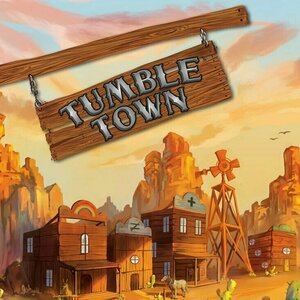
Tumble Town is dice rolling, structure building, drafting game with variable player powers. You are charged with choosing building plans to be added to Main Street of Tumble Town. You do this throughout the game by selecting the plans that will make best use of the resources (dice) you gain. The buildings that you construct may allow you special powers to be used on future turns, or one-time bonuses to be used once built. The player who can turn the greatest profit (in terms of VP) at the end of the game will be the winner!
DISCLAIMER: We were provided a prototype copy of this game for the purposes of this review. These are preview copy components, and the final components will definitely be different from these shown. Also, it is not my intention to detail every rule in the game, as there are just too many. You are invited to back the game through the Kickstarter campaign, from your FLGS, or through any other retailers stocking it after fulfillment. -T
To setup, deal each player a packet of starting components: a unique Horse card, two reference cards, Storehouse card, Main Street card, and two brown (they are red in the prototype) dice to be rolled and placed within the Storehouse. Shuffle and display the 1-, 2-, and 3-cactus building cards per the rulebook instructions to form the market. Set aside a number of each die type per the rulebook (both the building cards and dice are determined by number of players). Determine the first player and give them the first player token (a colorful rubber potted cactus). Players will connect their two Main Street cards at the central icon to create a two-card street (we chose the wagon wheel – Easy) and the game can begin!
Turns in Tumble Town consist of four mini-phases that flow into each other rather naturally. The first phase will have the players choosing a revealed building plan card from the offer market. The face-down draw stack will inform the active player as to how many and which type of dice they must draw and roll. Once they have these dice in their Storehouse, the player may now build plans using the dice they control. Buildings can be constructed and placed right onto Main Street, or be placed on the plan card to be placed on Main Street on a later turn. If the player has collected more dice than their Storehouse can hold, they must discard any of the dice they wish. This concludes a turn and the next player can begin their turn.
Certain iconography on the building plan cards allow players to use special powers throughout the game once built, and there are three types. Cards with the silvery bottom panel of symbols and the 1x notation are powers that must be used only once and only when the building is constructed. These powers could be collecting a die of the player’s choice, or receiving various dice counters. The building plan cards that feature a circular arrow notation are powers that can be used once per turn, every turn, if wished. These powers are found on each player’s Horse as well and can be adjusting a die’s face value, or re-rolling two dice, as examples. The third type of power is from the golden paneled cards that have an arrow pointing to a vertical line. These powers are only activated at the end of the game and mostly include scoring variances, like 1VP for each building a player has constructed that has a vulture icon (or a windmill, for example) featured on the card art.
Once a building is erected, the player may choose to place it onto their Main Street cards. When they place them, the player will need to choose where on Main Street these buildings should live. Like Bob Ross always says, “There are no mistakes, just happy accidents.” A player can place their buildings anywhere they wish on Main Street, but the Main Street cards will give extra bonuses to those players who plan ahead and place their buildings strategically. Some plots will ask for a building of a specific height (one die high or three dice high). Some will ask for the base level of the structure to be made of a specific material/die color (brown wood, black coal, silver metal, and gold… gold). Extra points are awarded if one-die-width alleyways are allotted, and these Main Street placements can score a bunch of endgame points.
Turns can be very quick or very deliberate, depending on the types of players involved. AP-prone players will take longer on their turns as they internalize all possibilities of their rolled results, while people like me just fly by the seats of our breeches. The game continues in this fashion: four mini-phases of drafting cards from the market, grabbing the associated dice, rolling them, and attempting to erect the best buildings on Main Street until two dice pools contain two or fewer dice. The current turn order finishes and the game is over.
Components. Again, this is a prototype copy of the game, and the publisher was decent enough to include a listing of items to be improved in the final version (like the red dice being poured brown in final – that really messed up someone’s strategy during a play-through for us because they kept forgetting that red is actually brown). The overall art style is very simplistic and I do NOT mean that negatively. The graphics and artwork are great, and give exactly what is needed without being so distracting that you cannot concentrate on your strategy. The dice are normal dice quality (that always seem to roll poorly when I’m rolling… hmm…). Once you see the photos of how the game will look during production, you will appreciate how great this is going to look on the table. No problems with components at all, save for the red vs. brown debacle that happened on our table. I really hope they keep the awwwwesome rubber cactus first player marker because it’s amazing.
I absolutely loved this one. I have always enjoyed using items for purposes other than originally intended – in this case, using dice as building materials. Of course, playing any game with dice introduces a bit of luck and instability in strategy, but Tumble Town offers quite a bit of manipulation of dice rolls that keeps almost all dice results feasible and useful. I really enjoyed the stacking, the quick turns, and the desperation when someone takes the last wood die when I was gunning for a wood-based building on my next turn. This game is light, but is chocked full of difficult decisions and luck of the roll. Tumble Town is for people who enjoy the rolling and stacking from FUSE (minus the frenzy), and the spatial building placement chaining of Villages of Valeria.
If this is the game for you, then we highly encourage you to check out the Kickstarter campaign which is running until Thursday, March 26. Tumble Town has already exceeding the funding goal at time of this review, but all future pledges will contribute to stretch goals that will improve components and add other components (spoiler?). So get out there and build up Tumble Town, ya yella-bellied greenhorns!
Tumble Town is dice rolling, structure building, drafting game with variable player powers. You are charged with choosing building plans to be added to Main Street of Tumble Town. You do this throughout the game by selecting the plans that will make best use of the resources (dice) you gain. The buildings that you construct may allow you special powers to be used on future turns, or one-time bonuses to be used once built. The player who can turn the greatest profit (in terms of VP) at the end of the game will be the winner!
DISCLAIMER: We were provided a prototype copy of this game for the purposes of this review. These are preview copy components, and the final components will definitely be different from these shown. Also, it is not my intention to detail every rule in the game, as there are just too many. You are invited to back the game through the Kickstarter campaign, from your FLGS, or through any other retailers stocking it after fulfillment. -T
To setup, deal each player a packet of starting components: a unique Horse card, two reference cards, Storehouse card, Main Street card, and two brown (they are red in the prototype) dice to be rolled and placed within the Storehouse. Shuffle and display the 1-, 2-, and 3-cactus building cards per the rulebook instructions to form the market. Set aside a number of each die type per the rulebook (both the building cards and dice are determined by number of players). Determine the first player and give them the first player token (a colorful rubber potted cactus). Players will connect their two Main Street cards at the central icon to create a two-card street (we chose the wagon wheel – Easy) and the game can begin!
Turns in Tumble Town consist of four mini-phases that flow into each other rather naturally. The first phase will have the players choosing a revealed building plan card from the offer market. The face-down draw stack will inform the active player as to how many and which type of dice they must draw and roll. Once they have these dice in their Storehouse, the player may now build plans using the dice they control. Buildings can be constructed and placed right onto Main Street, or be placed on the plan card to be placed on Main Street on a later turn. If the player has collected more dice than their Storehouse can hold, they must discard any of the dice they wish. This concludes a turn and the next player can begin their turn.
Certain iconography on the building plan cards allow players to use special powers throughout the game once built, and there are three types. Cards with the silvery bottom panel of symbols and the 1x notation are powers that must be used only once and only when the building is constructed. These powers could be collecting a die of the player’s choice, or receiving various dice counters. The building plan cards that feature a circular arrow notation are powers that can be used once per turn, every turn, if wished. These powers are found on each player’s Horse as well and can be adjusting a die’s face value, or re-rolling two dice, as examples. The third type of power is from the golden paneled cards that have an arrow pointing to a vertical line. These powers are only activated at the end of the game and mostly include scoring variances, like 1VP for each building a player has constructed that has a vulture icon (or a windmill, for example) featured on the card art.
Once a building is erected, the player may choose to place it onto their Main Street cards. When they place them, the player will need to choose where on Main Street these buildings should live. Like Bob Ross always says, “There are no mistakes, just happy accidents.” A player can place their buildings anywhere they wish on Main Street, but the Main Street cards will give extra bonuses to those players who plan ahead and place their buildings strategically. Some plots will ask for a building of a specific height (one die high or three dice high). Some will ask for the base level of the structure to be made of a specific material/die color (brown wood, black coal, silver metal, and gold… gold). Extra points are awarded if one-die-width alleyways are allotted, and these Main Street placements can score a bunch of endgame points.
Turns can be very quick or very deliberate, depending on the types of players involved. AP-prone players will take longer on their turns as they internalize all possibilities of their rolled results, while people like me just fly by the seats of our breeches. The game continues in this fashion: four mini-phases of drafting cards from the market, grabbing the associated dice, rolling them, and attempting to erect the best buildings on Main Street until two dice pools contain two or fewer dice. The current turn order finishes and the game is over.
Components. Again, this is a prototype copy of the game, and the publisher was decent enough to include a listing of items to be improved in the final version (like the red dice being poured brown in final – that really messed up someone’s strategy during a play-through for us because they kept forgetting that red is actually brown). The overall art style is very simplistic and I do NOT mean that negatively. The graphics and artwork are great, and give exactly what is needed without being so distracting that you cannot concentrate on your strategy. The dice are normal dice quality (that always seem to roll poorly when I’m rolling… hmm…). Once you see the photos of how the game will look during production, you will appreciate how great this is going to look on the table. No problems with components at all, save for the red vs. brown debacle that happened on our table. I really hope they keep the awwwwesome rubber cactus first player marker because it’s amazing.
I absolutely loved this one. I have always enjoyed using items for purposes other than originally intended – in this case, using dice as building materials. Of course, playing any game with dice introduces a bit of luck and instability in strategy, but Tumble Town offers quite a bit of manipulation of dice rolls that keeps almost all dice results feasible and useful. I really enjoyed the stacking, the quick turns, and the desperation when someone takes the last wood die when I was gunning for a wood-based building on my next turn. This game is light, but is chocked full of difficult decisions and luck of the roll. Tumble Town is for people who enjoy the rolling and stacking from FUSE (minus the frenzy), and the spatial building placement chaining of Villages of Valeria.
If this is the game for you, then we highly encourage you to check out the Kickstarter campaign which is running until Thursday, March 26. Tumble Town has already exceeding the funding goal at time of this review, but all future pledges will contribute to stretch goals that will improve components and add other components (spoiler?). So get out there and build up Tumble Town, ya yella-bellied greenhorns!

Daniel Boyd (1066 KP) rated Captain America: Civil War (2016) in Movies
Jul 24, 2017


Battle Royale
Contains spoilers, click to show
This movie is amazing. I know, I’m supposed to start with an intro but this film is just too good. I knew that I would love it and that I was looking forward to it for a fairly long time, but I loved this movie in ways that I didn’t even expect to. Based on the seminal Mark Millar event comic that saw most of the Marvel comic book universe go up against each other, this movie pits the heroes of the MCU against each other, which results in an exciting battle of all of the heroes that we’ve grown to love. The film doesn’t take much else from the comic though, other than the idea of the heroes fighting one another, there is no talk of exposing secret identities here, nor is there a battle between the massive amount of combatants that there were in the comic. If someone had told me these facts before I saw the film, I would have been going into the movie on a downer, but the thing is that this movie doesn’t have to be totally faithful to the comic book to be great, which is a credit to the writers and directors of the film. Watching the film is still like watching a comic book onscreen, just not the same comic book that you have previously read, which is awesome.
The vast majority of the cast of characters that have been introduced in the MCU so far are present here, besides Thor and Hulk. I can see why they omitted these characters, as they really would have given whatever side they chose an unfair advantage. We are left with two sides, there is Team Cap, made up of Cap, Falcon, Bucky, Ant Man, Scarlett Witch and Hawkeye and then there is Team Stark, made up of Iron Man, Vision, Black Widow, War Machine, Black Panther and Spiderman. I went into this movie siding with Team Cap, probably because Iron Man was ultimately the antagonist in the book, but as the film progressed, I have to admit that I could see either side of the argument. The fight sequences are exciting, due to the excellent stunt work and convincing use of CGI, also the acting here is surprisingly deep, especially for a Marvel movie, with several cast members giving passionate, convincing performances. While the action and humour that we have come to expect from a Marvel movie is present here, this film definitely does take on a darker tone in a few sequences and it also questions the idea of superheroes as a concept, there is not only a physical battle present in this movie, but also a psychological one as well as a socio-political one.
The score is used well, there is actually not too many songs present and the score is mostly made up of orchestral instrumental pieces, which also tells you something about the tone of this movie in comparison with previous Marvel films. The editing is also good, snappy enough to keep a consistent pace, while being clear enough to still tell a comprehensible, cohesive story.
Okay it is becoming difficult to continue writing this review without spoiling the movie, so I’ll do a quick summary then I will delve into spoiler territory. This is probably the best Marvel movie to date. It works as a sequel to Captain America Winter Soldier, it works as an ensemble Avengers piece, it works as a sufficient introduction to several new characters and it also blends the more serious tone of previous Cap movies with the more light hearted tone we have previously seen in the Avengers movies. It is a well told, tightly woven story, that still feels large in scope, which is not an easy thing to achieve, *coughs* Batman V Superman, *coughs.* While it’s not what I expected to get when they told us they were making Civil War, it is still a fantastic comic book movie, 9/10.
Okay, spoiler time. This movie came out in the UK a week before it did in America, so I have had the opportunity to see it twice so far. However, I am very aware that this movie isn’t opening in America until May 5th, so I do want to make it very clear that if you haven’t seen the film yet, you really should before reading the rest of this review.
They absolutely nail Spiderman here, in every way. He is the most faithful adaption we have had on the big screen to date, Tom Holland was the perfect choice and it there is no doubt that this young actor clearly has a very bright future ahead of him. Aunt May is played by Marisa Tomei in the film and because she is so young compared to comic book Aunt May, I did initially have my doubts, but she also nails the small role that she has here. The suit is also awesome and after seeing Civil War, I honestly cannot wait for Spiderman: Homecoming. Black Panther is another new character that they introduce and do a good job with, they establish him quickly and clearly and from the get go, we understand this character and his motivations for feeling the ways that he does. The other surprise star of the film is Ant Man, who for the first time onscreen, becomes Giant Man and it is epic. This would have been so easy to make cheesy and just have it not work at all, but here it is convincing and very well implemented into the airport battle. The CGI during this scene is also fantastic. The airport scene is also a highlight of the movie, to see all of these characters onscreen together is truly amazing and as comic book fan I was in heaven. I still can’t believe that we got to see Spiderman making a Star Wars reference, whilst he was swinging around Giant Man, the nerd part of my brain went into overload and I physically couldn’t wipe off the massive, stupid grin that was on my face. The final battle is also pretty cool.
The third act starts off with Tony Stark deciding that he may be wrong about Bucky and that it wasn’t him who set off the bomb in Wakanda, so he, Bucky and Cap team up again to go and confront Zemo, but then the three are shown a CCTV tape from one of Bucky’s past missions, which reveals that it was in fact Bucky that killed Tony’s parents when he was being mind controlled and that Cap knew about this the whole time. This results in Tony being overcome with rage and attacking Cap and Bucky, during the fight he rips off Bucky’s robot arm, but Cap manages to overpower him and he sticks his shield through Tony’s ark reactor, shutting down his suit. We then learn that Black Panther has followed Tony and intends to kill Bucky for setting off the bomb that killed his father, but when he learns that Zemo was behind it, he confronts him and demands an explanation. Zemo tells him that his family were killed when Ultron attacked Sekovia and that he has planned to destroy the Avengers ever since, but because he knew he couldn’t take them down himself, he decided to instead pit them against each other and let them kill one another. Panther then decides that he is sick of seeing people being consumed by revenge and decides to let Zemo live, but Zemo attempts to kill himself anyway, before Panther stops him, telling him that he must remain alive to answer for his crimes. After their fight, Stark tells Cap that he doesn’t deserve his shield, and so Cap drops his shield and helps Bucky out of the bunker. The movie ends with Cap busting his teammates out of prison, where they were put after the airport battle and going into hiding in Black Panther’s mansion house in Wakanda. While the movie is fairly long I did feel that it could have went on a while longer, it’s almost as if the films are at a point now where they know they are going to continue the story in a few months, so they don’t even bother writing a proper ending for the films. This is the only criticism that I have though and like I said we will be getting another Marvel movie in a few months anyway so it doesn’t really matter how this one ends. So yeah, best Marvel movie so far and whether you are a comic book fan or not, this is a damn good time.
The vast majority of the cast of characters that have been introduced in the MCU so far are present here, besides Thor and Hulk. I can see why they omitted these characters, as they really would have given whatever side they chose an unfair advantage. We are left with two sides, there is Team Cap, made up of Cap, Falcon, Bucky, Ant Man, Scarlett Witch and Hawkeye and then there is Team Stark, made up of Iron Man, Vision, Black Widow, War Machine, Black Panther and Spiderman. I went into this movie siding with Team Cap, probably because Iron Man was ultimately the antagonist in the book, but as the film progressed, I have to admit that I could see either side of the argument. The fight sequences are exciting, due to the excellent stunt work and convincing use of CGI, also the acting here is surprisingly deep, especially for a Marvel movie, with several cast members giving passionate, convincing performances. While the action and humour that we have come to expect from a Marvel movie is present here, this film definitely does take on a darker tone in a few sequences and it also questions the idea of superheroes as a concept, there is not only a physical battle present in this movie, but also a psychological one as well as a socio-political one.
The score is used well, there is actually not too many songs present and the score is mostly made up of orchestral instrumental pieces, which also tells you something about the tone of this movie in comparison with previous Marvel films. The editing is also good, snappy enough to keep a consistent pace, while being clear enough to still tell a comprehensible, cohesive story.
Okay it is becoming difficult to continue writing this review without spoiling the movie, so I’ll do a quick summary then I will delve into spoiler territory. This is probably the best Marvel movie to date. It works as a sequel to Captain America Winter Soldier, it works as an ensemble Avengers piece, it works as a sufficient introduction to several new characters and it also blends the more serious tone of previous Cap movies with the more light hearted tone we have previously seen in the Avengers movies. It is a well told, tightly woven story, that still feels large in scope, which is not an easy thing to achieve, *coughs* Batman V Superman, *coughs.* While it’s not what I expected to get when they told us they were making Civil War, it is still a fantastic comic book movie, 9/10.
Okay, spoiler time. This movie came out in the UK a week before it did in America, so I have had the opportunity to see it twice so far. However, I am very aware that this movie isn’t opening in America until May 5th, so I do want to make it very clear that if you haven’t seen the film yet, you really should before reading the rest of this review.
They absolutely nail Spiderman here, in every way. He is the most faithful adaption we have had on the big screen to date, Tom Holland was the perfect choice and it there is no doubt that this young actor clearly has a very bright future ahead of him. Aunt May is played by Marisa Tomei in the film and because she is so young compared to comic book Aunt May, I did initially have my doubts, but she also nails the small role that she has here. The suit is also awesome and after seeing Civil War, I honestly cannot wait for Spiderman: Homecoming. Black Panther is another new character that they introduce and do a good job with, they establish him quickly and clearly and from the get go, we understand this character and his motivations for feeling the ways that he does. The other surprise star of the film is Ant Man, who for the first time onscreen, becomes Giant Man and it is epic. This would have been so easy to make cheesy and just have it not work at all, but here it is convincing and very well implemented into the airport battle. The CGI during this scene is also fantastic. The airport scene is also a highlight of the movie, to see all of these characters onscreen together is truly amazing and as comic book fan I was in heaven. I still can’t believe that we got to see Spiderman making a Star Wars reference, whilst he was swinging around Giant Man, the nerd part of my brain went into overload and I physically couldn’t wipe off the massive, stupid grin that was on my face. The final battle is also pretty cool.
The third act starts off with Tony Stark deciding that he may be wrong about Bucky and that it wasn’t him who set off the bomb in Wakanda, so he, Bucky and Cap team up again to go and confront Zemo, but then the three are shown a CCTV tape from one of Bucky’s past missions, which reveals that it was in fact Bucky that killed Tony’s parents when he was being mind controlled and that Cap knew about this the whole time. This results in Tony being overcome with rage and attacking Cap and Bucky, during the fight he rips off Bucky’s robot arm, but Cap manages to overpower him and he sticks his shield through Tony’s ark reactor, shutting down his suit. We then learn that Black Panther has followed Tony and intends to kill Bucky for setting off the bomb that killed his father, but when he learns that Zemo was behind it, he confronts him and demands an explanation. Zemo tells him that his family were killed when Ultron attacked Sekovia and that he has planned to destroy the Avengers ever since, but because he knew he couldn’t take them down himself, he decided to instead pit them against each other and let them kill one another. Panther then decides that he is sick of seeing people being consumed by revenge and decides to let Zemo live, but Zemo attempts to kill himself anyway, before Panther stops him, telling him that he must remain alive to answer for his crimes. After their fight, Stark tells Cap that he doesn’t deserve his shield, and so Cap drops his shield and helps Bucky out of the bunker. The movie ends with Cap busting his teammates out of prison, where they were put after the airport battle and going into hiding in Black Panther’s mansion house in Wakanda. While the movie is fairly long I did feel that it could have went on a while longer, it’s almost as if the films are at a point now where they know they are going to continue the story in a few months, so they don’t even bother writing a proper ending for the films. This is the only criticism that I have though and like I said we will be getting another Marvel movie in a few months anyway so it doesn’t really matter how this one ends. So yeah, best Marvel movie so far and whether you are a comic book fan or not, this is a damn good time.
Purple Phoenix Games (2266 KP) rated The Artemis Project in Tabletop Games
Apr 6, 2021
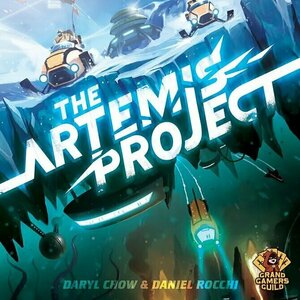
I don’t know about you, but I spend more time than I should probably admit perusing Kickstarter and checking out new projects. Although, that is how I came across The Artemis Project. A game about exploration and colonization of one of Jupiter’s moons? Yes please! The campaign looked promising, the gameplay looked engaging, and the hype was real. Once I finally got the game, did it live up to my expectations? Keep reading to find out!
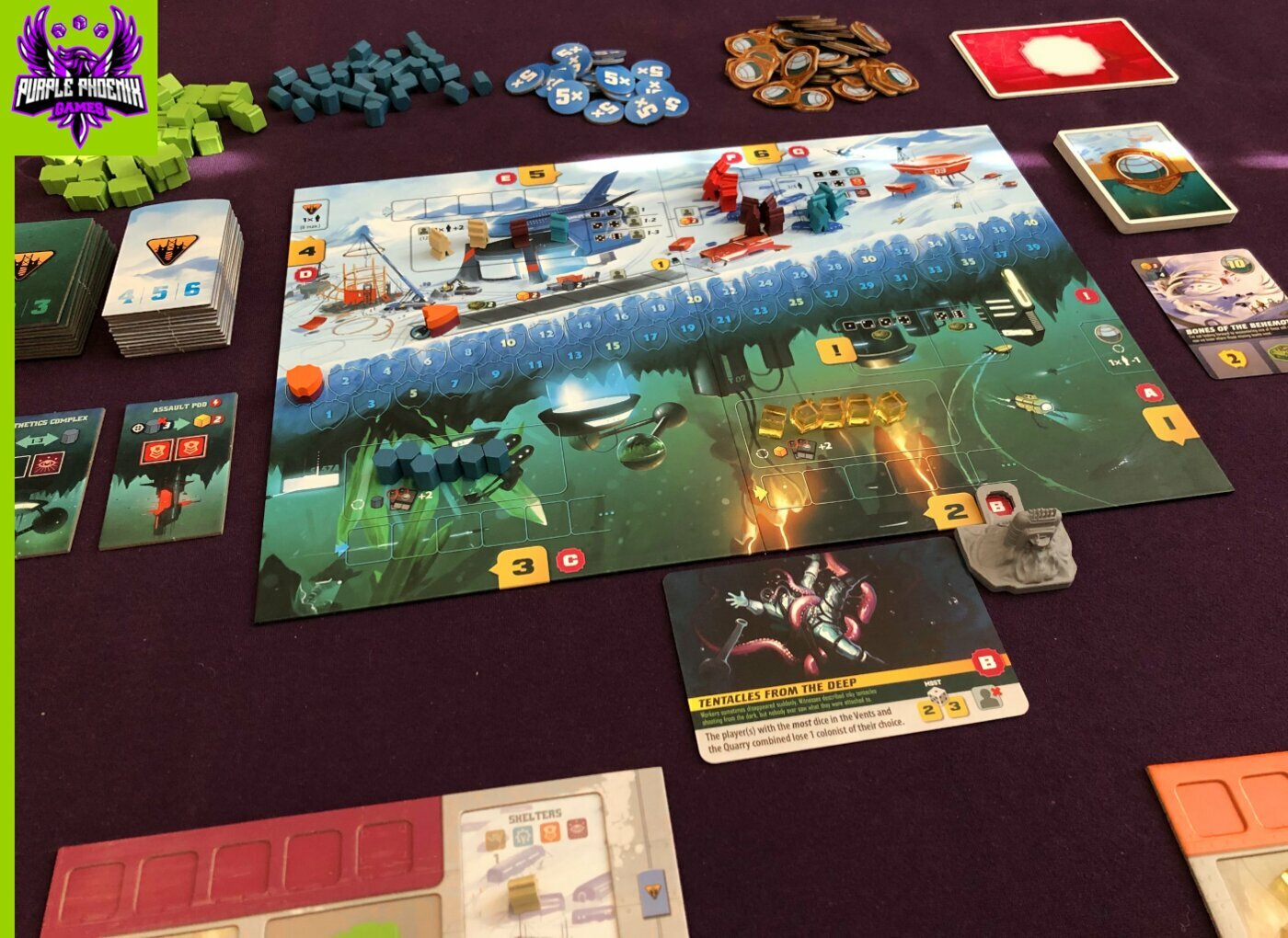
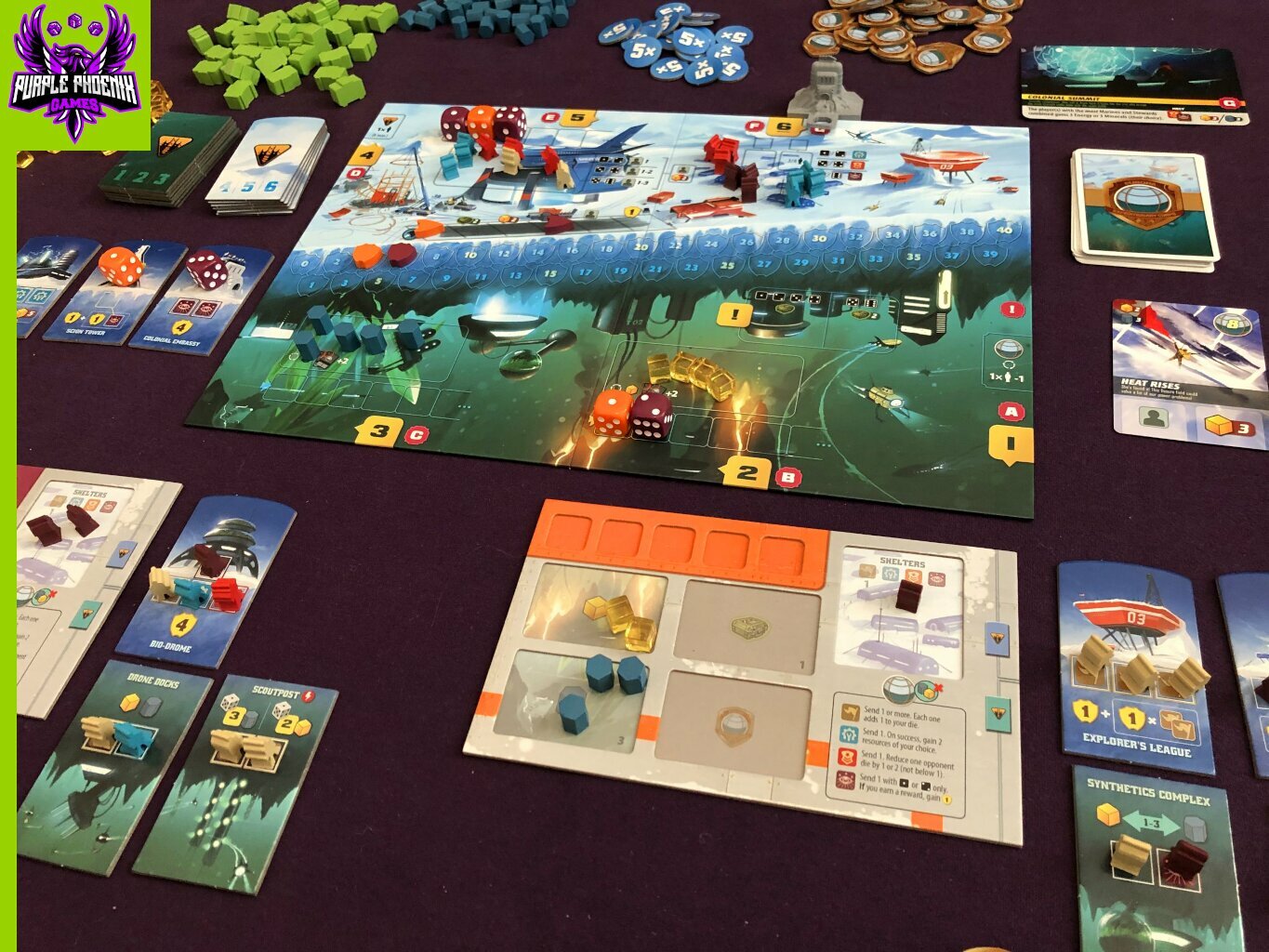
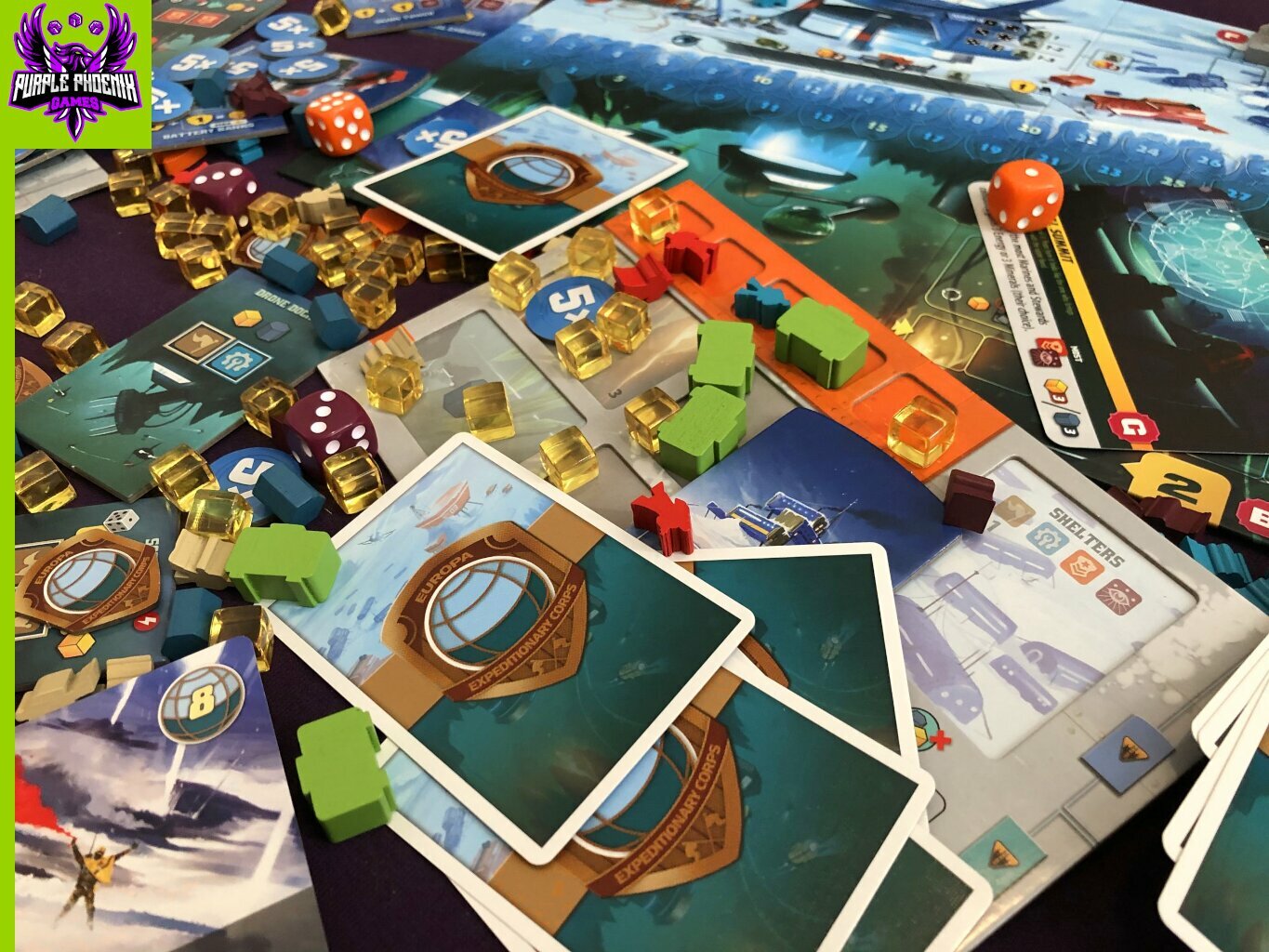
The Artemis Project is a game of dice/worker placement in which players are trying to build and sustain a prosperous colony on Jupiter’s moon Europa. Played over 6 rounds, players will take turns rolling and placing dice across the regions of the board to collect resources, construct buildings, recruit and train colonists, and partake in expeditions to explore this vast ice-land. To begin, follow the setup instructions in the rulebook for the appropriate player count. Each player receives a player board, dice, and markers in their chosen color. Populate the board for the first round, select a starting player, and the game is ready to begin!
Disclaimer: I do not intend to rehash the entire rulebook in this review, as there are just too many details. For a more in-depth look at The Artemis Project, pick up a copy from your FLGS or directly from the publisher! -L
To start each round, all players will simultaneously roll all 5 of their dice. Once players are happy with their results, the round is ready to properly begin. Each round is broken into three phases: Placement, Resolution, and Upkeep. To begin the Placement phase, starting with the first player, players will take turns assigning one die at a time to the 7 regions of the board. These regions are: Basecamp, Vents, Quarry, Gantry, Doorstep, Academy, and Outfitters. (I will explain each region in more detail in the next section!) The value of the dice placed in any region is important, because it will dictate what you are allowed to do, or when you are allowed to resolve the action for that region – so choose your placements wisely.
Once every player has placed all 5 of their dice, the Resolution phase begins. During the Resolution phase, each of the regions of the board will be resolved in order, allowing players to perform their region-specific actions. Resolution starts with Basecamp. Placing dice at Basecamp allows players to partake in Expeditions in an effort to earn Expedition Badges (which translate to end-game VP), as well as extra rewards. Each Expedition has a difficulty level which must be equaled or surpassed by the total of all dice placed on that card. If the difficulty is surpassed, the Expedition is a success and rewards are doled out accordingly, but if the Expedition fails, no rewards are earned by anyone.
The next 2 regions, Vents and Quarry, allow players to collect Energy and Minerals, respectively, and are resolved in the same way. Players will collect a number of resources equal to their played die value. Pretty straight-forward! Moving on to the Gantry region, the value of dice placed on any building tiles are considered bids for buying/constructing that building. You can bid against opponents for building tiles, but each bid must increase the previous amount. When resolving the Gantry, the highest value die on a tile is the winner, and that player must pay their die-amount in Minerals to collect that tile. Buildings are added to your colony, and allow you to perform special actions once they are fully-staffed (all colonist slots on the tile are filled).
Next is the Doorstep – depending on the value of dice you placed there, you will be able to recruit 1-3 new colonists. Recruiting a colonist costs you 2 Energy per new addition, and any new colonists you recruit can be placed immediately into any of your buildings (if space is available), or into your Shelter where they will wait to be used. The Academy region allows you to exchange a colonist of your choice for one of a different type/occupation, again, depending on the value of the die used. And finally, the Outfitters region does not resolved during this phase, because it’s action is performed immediately upon dice placement. Any dice placed to the Outfitters gives Tool Kits (used to manipulate die values at the start of each round) to the player, based upon the die value.
The remaining element of the Resolution phase is the Even card. At the start of each round, an Event card is drawn, and will pertain to a certain region of the board. During the Resolution phase, when that region is reached, the Event card will be resolved – either penalizing players or benefitting them in some way. I have purposefully left out a few elements of the Resolution phase for you to discover on your own!
Once all regions have been resolved, the round moves to the Upkeep phase. During this phase, all players can choose to move 1 colonist to a building tile, or swap any 2 colonists between buildings. This is not required, but can only be performed once during this phase. Next, if any players have fully-staffed buildings (all colonist slots are filled), they may activate the listed ability. And finally, for any colonists left in your shelter and not in a building, you must pay 1 Energy for each to keep them warm! The game board is now refreshed for the next round, a new starting player is selected, and the new round is ready to begin. After the 6th and final round, VPs are tallied – earned through number of building tiles, Expedition Badges, sets of resources, and sets of colonists – and the player with the most VP is the winner!
I know that seems like a lot, but I promise that once you start the first round, everything is pretty intuitive and the game flows well. The turn sequence and phases are logical and easy to understand. The game board itself has lots of helpful icons that work as reminders throughout gameplay, and the rulebook has a nice and concise round overview on the last page as well, which is easy to refer back to at a moment’s notice. I’ll go ahead and touch on components here, since I kind of already started to do so. The components in this game are great! The game board and cards are all sturdy and have colorful and immersive artwork. The dual-layered player boards are high quality, the colonist meeples are cute and effective, the building tiles and cardboard chits are strong and can definitely hold up to many plays, and the dice are easy to roll and read. Definitely an A+ on components from me.
I have to admit that The Artemis Project surprised me. At its core, it is a worker placement game, and that in and of itself lends itself to a certain gameplay. You’re trying to complete your own agenda, being the first to snag those important placements that you need to accomplish those goals, while also blocking opponents from doing the same. The thing that makes The Artemis Project unique is that the ‘workers’ in this game are dice. And their value is what dictates the resolution of each region. Just because you place a die in a region first, does not necessarily mean that you will get to resolve first – depending on how your opponents play, they could block you entirely! The use of dice adds an extra layer of strategy to the gameplay that really elevates it beyond a simple worker placement mechanic. Another great thing about this game is that there is no one way to win – there are several strategies that you could play by in an effort to earn VPs. Maybe you are trying to complete as many Expeditions as possible, or want to construct as many buildings as possible. Either strategy can work, and all strategies can easily be adapted and altered during gameplay.
I am so happy that I came across this game on Kickstarter. The game is strategic, engaging, and just fun to play. I’m not necessarily a huge fan of worker placement games, but the approach to the mechanic taken by The Artemis Project really puts a unique twist on it that adds to the gameplay. This is one KickStarter that was definitely worth the investment. Check it out if you haven’t heard of it, or if you’re looking to elevate your worker placement games. Purple Phoenix Games gives it an enterprising 10 / 12.
The Artemis Project is a game of dice/worker placement in which players are trying to build and sustain a prosperous colony on Jupiter’s moon Europa. Played over 6 rounds, players will take turns rolling and placing dice across the regions of the board to collect resources, construct buildings, recruit and train colonists, and partake in expeditions to explore this vast ice-land. To begin, follow the setup instructions in the rulebook for the appropriate player count. Each player receives a player board, dice, and markers in their chosen color. Populate the board for the first round, select a starting player, and the game is ready to begin!
Disclaimer: I do not intend to rehash the entire rulebook in this review, as there are just too many details. For a more in-depth look at The Artemis Project, pick up a copy from your FLGS or directly from the publisher! -L
To start each round, all players will simultaneously roll all 5 of their dice. Once players are happy with their results, the round is ready to properly begin. Each round is broken into three phases: Placement, Resolution, and Upkeep. To begin the Placement phase, starting with the first player, players will take turns assigning one die at a time to the 7 regions of the board. These regions are: Basecamp, Vents, Quarry, Gantry, Doorstep, Academy, and Outfitters. (I will explain each region in more detail in the next section!) The value of the dice placed in any region is important, because it will dictate what you are allowed to do, or when you are allowed to resolve the action for that region – so choose your placements wisely.
Once every player has placed all 5 of their dice, the Resolution phase begins. During the Resolution phase, each of the regions of the board will be resolved in order, allowing players to perform their region-specific actions. Resolution starts with Basecamp. Placing dice at Basecamp allows players to partake in Expeditions in an effort to earn Expedition Badges (which translate to end-game VP), as well as extra rewards. Each Expedition has a difficulty level which must be equaled or surpassed by the total of all dice placed on that card. If the difficulty is surpassed, the Expedition is a success and rewards are doled out accordingly, but if the Expedition fails, no rewards are earned by anyone.
The next 2 regions, Vents and Quarry, allow players to collect Energy and Minerals, respectively, and are resolved in the same way. Players will collect a number of resources equal to their played die value. Pretty straight-forward! Moving on to the Gantry region, the value of dice placed on any building tiles are considered bids for buying/constructing that building. You can bid against opponents for building tiles, but each bid must increase the previous amount. When resolving the Gantry, the highest value die on a tile is the winner, and that player must pay their die-amount in Minerals to collect that tile. Buildings are added to your colony, and allow you to perform special actions once they are fully-staffed (all colonist slots on the tile are filled).
Next is the Doorstep – depending on the value of dice you placed there, you will be able to recruit 1-3 new colonists. Recruiting a colonist costs you 2 Energy per new addition, and any new colonists you recruit can be placed immediately into any of your buildings (if space is available), or into your Shelter where they will wait to be used. The Academy region allows you to exchange a colonist of your choice for one of a different type/occupation, again, depending on the value of the die used. And finally, the Outfitters region does not resolved during this phase, because it’s action is performed immediately upon dice placement. Any dice placed to the Outfitters gives Tool Kits (used to manipulate die values at the start of each round) to the player, based upon the die value.
The remaining element of the Resolution phase is the Even card. At the start of each round, an Event card is drawn, and will pertain to a certain region of the board. During the Resolution phase, when that region is reached, the Event card will be resolved – either penalizing players or benefitting them in some way. I have purposefully left out a few elements of the Resolution phase for you to discover on your own!
Once all regions have been resolved, the round moves to the Upkeep phase. During this phase, all players can choose to move 1 colonist to a building tile, or swap any 2 colonists between buildings. This is not required, but can only be performed once during this phase. Next, if any players have fully-staffed buildings (all colonist slots are filled), they may activate the listed ability. And finally, for any colonists left in your shelter and not in a building, you must pay 1 Energy for each to keep them warm! The game board is now refreshed for the next round, a new starting player is selected, and the new round is ready to begin. After the 6th and final round, VPs are tallied – earned through number of building tiles, Expedition Badges, sets of resources, and sets of colonists – and the player with the most VP is the winner!
I know that seems like a lot, but I promise that once you start the first round, everything is pretty intuitive and the game flows well. The turn sequence and phases are logical and easy to understand. The game board itself has lots of helpful icons that work as reminders throughout gameplay, and the rulebook has a nice and concise round overview on the last page as well, which is easy to refer back to at a moment’s notice. I’ll go ahead and touch on components here, since I kind of already started to do so. The components in this game are great! The game board and cards are all sturdy and have colorful and immersive artwork. The dual-layered player boards are high quality, the colonist meeples are cute and effective, the building tiles and cardboard chits are strong and can definitely hold up to many plays, and the dice are easy to roll and read. Definitely an A+ on components from me.
I have to admit that The Artemis Project surprised me. At its core, it is a worker placement game, and that in and of itself lends itself to a certain gameplay. You’re trying to complete your own agenda, being the first to snag those important placements that you need to accomplish those goals, while also blocking opponents from doing the same. The thing that makes The Artemis Project unique is that the ‘workers’ in this game are dice. And their value is what dictates the resolution of each region. Just because you place a die in a region first, does not necessarily mean that you will get to resolve first – depending on how your opponents play, they could block you entirely! The use of dice adds an extra layer of strategy to the gameplay that really elevates it beyond a simple worker placement mechanic. Another great thing about this game is that there is no one way to win – there are several strategies that you could play by in an effort to earn VPs. Maybe you are trying to complete as many Expeditions as possible, or want to construct as many buildings as possible. Either strategy can work, and all strategies can easily be adapted and altered during gameplay.
I am so happy that I came across this game on Kickstarter. The game is strategic, engaging, and just fun to play. I’m not necessarily a huge fan of worker placement games, but the approach to the mechanic taken by The Artemis Project really puts a unique twist on it that adds to the gameplay. This is one KickStarter that was definitely worth the investment. Check it out if you haven’t heard of it, or if you’re looking to elevate your worker placement games. Purple Phoenix Games gives it an enterprising 10 / 12.

Mandy and G.D. Burkhead (26 KP) rated Poison Study (Study, #1) in Books
May 20, 2018

Shelf Life – The Chronicles of Ixia merits closer study
Contains spoilers, click to show
This review is for the entire Chronicles of Ixia series.
The first trilogy, comprised of Poison Study, Fire Study, and Magic Study, follows Yelena Zaltana. The second series, also called the Glass series, follows her friend Opal Cowan in Storm Glass, Sea Glass, and Spy Glass. The final trilogy, Shadow Study, Night Study, and Dawn Study, is where things get a bit odd. Maria V. Snyder had thrown in a few short stories/novellas throughout from different characters’ points of view. Perhaps she got bored of just sticking to one POV, or maybe fans wanted more from the other characters, so the third trilogy is from Yelena’s POV in first person and the POV’s of multiple characters (mainly Valek, Leif, and Janco, with a few others popping in from time to time) in third person.
I’m not sure which editor thought it would be a good idea to have POV switch from first person to third person in the same novel, but—yikes—is it jarring. Even with the wonky POV stuff in the third trilogy, these books are amazing and absolutely worth your time to read. Snyder’s world-building is compelling, detailed, and original. The books take place mostly between two pre-industrial countries: Ixia and Sitia. Ixia is a post-revolution country ruled by Commander Ambrose. His personal body guard and assassin is Valek. In the first novel Yelena is in prison for murder and is offered the choice to be the Commander’s food taster in exchange for her life. She agrees, and throughout the first book she and Valek begin to fall in love.
Ixia reminded me a lot of Communist Russia or China. In its attempts to throw away the corrupt government and society that came before, it has also thrown out all culture in the process. The country has been re-divided into districts with numbers instead of names, everyone is forced to wear a uniform, all art and extravagance has been destroyed, people have to have passes to travel between districts, and magic is forbidden. Anyone born with it is killed (or so the reader is led to believe). But Maria V. Snyder does a wonderful job of showing the good with the bad in this totalitarian dictatorship. Everyone has a job and nobody goes hungry, women are now equal to men, and violence and sexual assault are intolerable. This is why Yelena ends up in prison in the first place: she murdered the man that raped her. Now, this is probably my first major gripe with the series. We learn that Commander Ambrose loathes sexual assault and will execute anyone found guilty of it, but apparently killing a rapist in self-defense is also an executable offense. And all of that being said, Ambrose still has his own personal assassin. It all feels a bit contradictory, but again, that’s what I like about this series: it does an excellent job of peeling back the layers of her fictional societies and pointing out that governments and people in power tend to be hypocritical.
Now, the series name (or rather one of them) is Chronicles of Ixia, but honestly, it should have been called Chronicles of Sitia, because that is where most of the story takes place and is by far the more interesting and vibrant country. Sitia is part jungle, part desert, and full of magic. The peoples are divided into multiple clans or tribes that are all unique and compelling. In the second book, Yelena flees to Sitia after the Commander learns she has magic, and there she finds the family she was kidnapped from as a small child. They are part of the Zaltana clan, a group of people that live high in the trees in the jungle. Whenever I read about them, I would have to remind myself that they were not wood elves or dryads, because while there is magic in these books, there are no fantastical creatures: all characters are human or animal.
Another fascinating tribe is the Sandseeds, a group of nomads in the desert known for two major things: breeding super smart horses and having Storyweavers. The Storyweavers are people who have the magical ability to see the future and guide others, but who have to do it really cryptically because reasons (I appreciate that this gets pointed out by an annoyed Yelena multiple times). And of course, the Sandseed horses are fantastic; they choose their rider and able to mentally communicate with magical people. They even have their own horse names for people that they like.
Besides the different clans throughout Sitia, there is also the capitol, the Citadel, which is home to the magic school and the Sitian Council. While very different from Ixia, Sitia is by no means perfect. Its Council epitomizes everything annoying and dysfunctional about a bureaucracy. While the council members are elected and come from every clan in Sitia, they are at best useless and at worst actively impede the main characters.
The magic school is interesting, though the story doesn’t actually spend much time there. I like how magic was done in this series: it usually runs in families, most people with it have control over one or two things (ie. fire, mind-control, telepathy, etc.), but those who have the ability to master more can become Master Magicians after enduring a daunting trial. Magic is bound in people’s blood, so blood magic is a thing and is obviously bad, and magic (and a person’s soul) can be stolen using an intricate and gruesome blood ritual that involves prolonged torture, rape, and then murder.
The power blanket is another interesting concept used in this series. Essentially is resides over the entire world and is the essence of magic, so magicians can pull from it to augment their own magic. However, if they pull too much and lose control, they can flame out, killing themselves and temporarily damaging the blanket in the process. I thought this was a good literary tool to prevent magical characters from being too OP (at least most of the time).
I especially like the romantic relationships in this series. Valek and Yelena are of course the main couple. In the first book they fall in love, in the second book they get separated, and throughout the series they regularly cross paths and save one another. Yelena and Valek are heartmates, and as the series progresses they both have to mature and learn how to trust one another. My biggest complaint about the romance is that all sex scenes are just fade to black, which I personally find a bit boring.
The other major romantic relationship is between Opal and Devlen. This one was a bit awkward. Opal actually goes through a couple of guys first: a stormdancer named Kade and another glassmaker named Ulrick. And I really liked that the author included this. Many people have multiple partners before finding their soulmate, and a woman who does is not a slut. Her relationship with Devlen, however . . . Well, she’s a more forgiving person than me.
You see, it turns out that Devlen is the man who kidnapped Opal a few years earlier and tortured her because he was trying to steal her magic. But he didn’t actually enjoy torturing her and never raped her, which I guess makes it better? Well, he manages to switch bodies with Ulrick and, as Ulrick, tricks Opal into dating him, then, when he’s discovered, kidnaps and tortures her (again) to gain more power. But then she steals his magic, he spends some time in prison, and the combination of the two miraculously turn him into a good guy, claiming that magic is what made him evil in the first place.
I’m going to be honest, I didn’t completely buy his redemption arc even at the end of the third book in the Glass series, but by the ninth book they’re still together and he’s on the good guys’ side, so I guess it was real. And I have definitely watched/read much worse evil asshole to boyfriend stories. At least Devlen genuinely feels guilty for the horrible things he did in the past and attempts to make up for them, and in her defense, Opal has to do a lot of soul-searching before she can find it in her to forgive and trust him, and even more before she can develop romantic feelings for him (that aren’t based on deception, anyway). Also, Ulrick becomes a huge jerk because of his newfound magical abilities, tries to kill Opal, and later gets assassinated by Valek. I appreciate what Maria V. Snyder is trying to do here, which is to teach through her storytelling how good people can become evil, and evil people can redeem themselves and be good. Their romance was uncomfortable to read, but it was supposed to be uncomfortable, because that’s how all parties involved felt.
Now, let’s talk about Commander Ambrose. Towards the end of the first book, Yelena discovers that Ambrose is a female to male trans person. This is revealed to be why Ambrose hates magicians so much: he is afraid that one of them will read his mind and then reveal his secret (which is how Yelena discovers it). After I read the first book, I was really pleased that Snyder did such a good job of depicting a trans person, as that’s really only a small part of his character, and those who know (mainly Valek and Yelena) don’t make a big deal out of it.
And then . . . I really wish that the author would have just left the issue of the Commander being trans alone. Yelena discovers it in the first book, she keeps it to herself because it’s nobody else’s business, the end. But by creating this weird intricate background to explain why Ambrose is trans, Snyder just kind of shoots herself in the foot.
Throughout the rest of the series, I kept hoping for some other LGBTQ+ characters to show up to redeem the blunder with Ambrose. I actually believed that Ari and Janco were a gay couple for the longest time, what with their banter and often being referred to as partners. However, if this was the author’s intention, it was never really explicitly stated, and the partner thing just seems to refer to them being partners in combat and nothing else.
The first trilogy, comprised of Poison Study, Fire Study, and Magic Study, follows Yelena Zaltana. The second series, also called the Glass series, follows her friend Opal Cowan in Storm Glass, Sea Glass, and Spy Glass. The final trilogy, Shadow Study, Night Study, and Dawn Study, is where things get a bit odd. Maria V. Snyder had thrown in a few short stories/novellas throughout from different characters’ points of view. Perhaps she got bored of just sticking to one POV, or maybe fans wanted more from the other characters, so the third trilogy is from Yelena’s POV in first person and the POV’s of multiple characters (mainly Valek, Leif, and Janco, with a few others popping in from time to time) in third person.
I’m not sure which editor thought it would be a good idea to have POV switch from first person to third person in the same novel, but—yikes—is it jarring. Even with the wonky POV stuff in the third trilogy, these books are amazing and absolutely worth your time to read. Snyder’s world-building is compelling, detailed, and original. The books take place mostly between two pre-industrial countries: Ixia and Sitia. Ixia is a post-revolution country ruled by Commander Ambrose. His personal body guard and assassin is Valek. In the first novel Yelena is in prison for murder and is offered the choice to be the Commander’s food taster in exchange for her life. She agrees, and throughout the first book she and Valek begin to fall in love.
Ixia reminded me a lot of Communist Russia or China. In its attempts to throw away the corrupt government and society that came before, it has also thrown out all culture in the process. The country has been re-divided into districts with numbers instead of names, everyone is forced to wear a uniform, all art and extravagance has been destroyed, people have to have passes to travel between districts, and magic is forbidden. Anyone born with it is killed (or so the reader is led to believe). But Maria V. Snyder does a wonderful job of showing the good with the bad in this totalitarian dictatorship. Everyone has a job and nobody goes hungry, women are now equal to men, and violence and sexual assault are intolerable. This is why Yelena ends up in prison in the first place: she murdered the man that raped her. Now, this is probably my first major gripe with the series. We learn that Commander Ambrose loathes sexual assault and will execute anyone found guilty of it, but apparently killing a rapist in self-defense is also an executable offense. And all of that being said, Ambrose still has his own personal assassin. It all feels a bit contradictory, but again, that’s what I like about this series: it does an excellent job of peeling back the layers of her fictional societies and pointing out that governments and people in power tend to be hypocritical.
Now, the series name (or rather one of them) is Chronicles of Ixia, but honestly, it should have been called Chronicles of Sitia, because that is where most of the story takes place and is by far the more interesting and vibrant country. Sitia is part jungle, part desert, and full of magic. The peoples are divided into multiple clans or tribes that are all unique and compelling. In the second book, Yelena flees to Sitia after the Commander learns she has magic, and there she finds the family she was kidnapped from as a small child. They are part of the Zaltana clan, a group of people that live high in the trees in the jungle. Whenever I read about them, I would have to remind myself that they were not wood elves or dryads, because while there is magic in these books, there are no fantastical creatures: all characters are human or animal.
Another fascinating tribe is the Sandseeds, a group of nomads in the desert known for two major things: breeding super smart horses and having Storyweavers. The Storyweavers are people who have the magical ability to see the future and guide others, but who have to do it really cryptically because reasons (I appreciate that this gets pointed out by an annoyed Yelena multiple times). And of course, the Sandseed horses are fantastic; they choose their rider and able to mentally communicate with magical people. They even have their own horse names for people that they like.
Besides the different clans throughout Sitia, there is also the capitol, the Citadel, which is home to the magic school and the Sitian Council. While very different from Ixia, Sitia is by no means perfect. Its Council epitomizes everything annoying and dysfunctional about a bureaucracy. While the council members are elected and come from every clan in Sitia, they are at best useless and at worst actively impede the main characters.
The magic school is interesting, though the story doesn’t actually spend much time there. I like how magic was done in this series: it usually runs in families, most people with it have control over one or two things (ie. fire, mind-control, telepathy, etc.), but those who have the ability to master more can become Master Magicians after enduring a daunting trial. Magic is bound in people’s blood, so blood magic is a thing and is obviously bad, and magic (and a person’s soul) can be stolen using an intricate and gruesome blood ritual that involves prolonged torture, rape, and then murder.
The power blanket is another interesting concept used in this series. Essentially is resides over the entire world and is the essence of magic, so magicians can pull from it to augment their own magic. However, if they pull too much and lose control, they can flame out, killing themselves and temporarily damaging the blanket in the process. I thought this was a good literary tool to prevent magical characters from being too OP (at least most of the time).
I especially like the romantic relationships in this series. Valek and Yelena are of course the main couple. In the first book they fall in love, in the second book they get separated, and throughout the series they regularly cross paths and save one another. Yelena and Valek are heartmates, and as the series progresses they both have to mature and learn how to trust one another. My biggest complaint about the romance is that all sex scenes are just fade to black, which I personally find a bit boring.
The other major romantic relationship is between Opal and Devlen. This one was a bit awkward. Opal actually goes through a couple of guys first: a stormdancer named Kade and another glassmaker named Ulrick. And I really liked that the author included this. Many people have multiple partners before finding their soulmate, and a woman who does is not a slut. Her relationship with Devlen, however . . . Well, she’s a more forgiving person than me.
You see, it turns out that Devlen is the man who kidnapped Opal a few years earlier and tortured her because he was trying to steal her magic. But he didn’t actually enjoy torturing her and never raped her, which I guess makes it better? Well, he manages to switch bodies with Ulrick and, as Ulrick, tricks Opal into dating him, then, when he’s discovered, kidnaps and tortures her (again) to gain more power. But then she steals his magic, he spends some time in prison, and the combination of the two miraculously turn him into a good guy, claiming that magic is what made him evil in the first place.
I’m going to be honest, I didn’t completely buy his redemption arc even at the end of the third book in the Glass series, but by the ninth book they’re still together and he’s on the good guys’ side, so I guess it was real. And I have definitely watched/read much worse evil asshole to boyfriend stories. At least Devlen genuinely feels guilty for the horrible things he did in the past and attempts to make up for them, and in her defense, Opal has to do a lot of soul-searching before she can find it in her to forgive and trust him, and even more before she can develop romantic feelings for him (that aren’t based on deception, anyway). Also, Ulrick becomes a huge jerk because of his newfound magical abilities, tries to kill Opal, and later gets assassinated by Valek. I appreciate what Maria V. Snyder is trying to do here, which is to teach through her storytelling how good people can become evil, and evil people can redeem themselves and be good. Their romance was uncomfortable to read, but it was supposed to be uncomfortable, because that’s how all parties involved felt.
Now, let’s talk about Commander Ambrose. Towards the end of the first book, Yelena discovers that Ambrose is a female to male trans person. This is revealed to be why Ambrose hates magicians so much: he is afraid that one of them will read his mind and then reveal his secret (which is how Yelena discovers it). After I read the first book, I was really pleased that Snyder did such a good job of depicting a trans person, as that’s really only a small part of his character, and those who know (mainly Valek and Yelena) don’t make a big deal out of it.
And then . . . I really wish that the author would have just left the issue of the Commander being trans alone. Yelena discovers it in the first book, she keeps it to herself because it’s nobody else’s business, the end. But by creating this weird intricate background to explain why Ambrose is trans, Snyder just kind of shoots herself in the foot.
Throughout the rest of the series, I kept hoping for some other LGBTQ+ characters to show up to redeem the blunder with Ambrose. I actually believed that Ari and Janco were a gay couple for the longest time, what with their banter and often being referred to as partners. However, if this was the author’s intention, it was never really explicitly stated, and the partner thing just seems to refer to them being partners in combat and nothing else.