Search
Search results

Purple Phoenix Games (2266 KP) rated Questeros in Tabletop Games
Jan 21, 2021


You know that messed up deal when you are just chillin’ in the forest doing goblin-y things when you are caught and forced into a life of servitude by the king of the realm, and then when he needs someone to go on a dangerous quest he calls upon you, the now court jester, to fulfill said quest? Doesn’t that just chap your hide? Such is exactly the setting in which our hero(?) finds themselves in Questeros, or more fitting, Ero’s Quest (the solo adventure variant).
Ero is the goblin court jester from the open who has been “chosen” to quest about the land to rid it of the ne’er-do-wells of the realm. In this solo adventure mode of Questeros the player will be donning the visage and character of Ero as they travel about developing their skills and having encounters with powerful beings. It is up to the player to guide Ero through the kingdom and rid it of the foul that is plaguing it.
DISCLAIMER: We were provided a prototype copy of this game for the purposes of this review. These are preview copy components, and I do not know for sure if the final components will be any different from these shown. Also, it is not my intention to detail every rule in the game, as there are just too many. You are invited to download the rulebook, back the game through the Kickstarter campaign, or through any retailers stocking it after fulfillment. -T
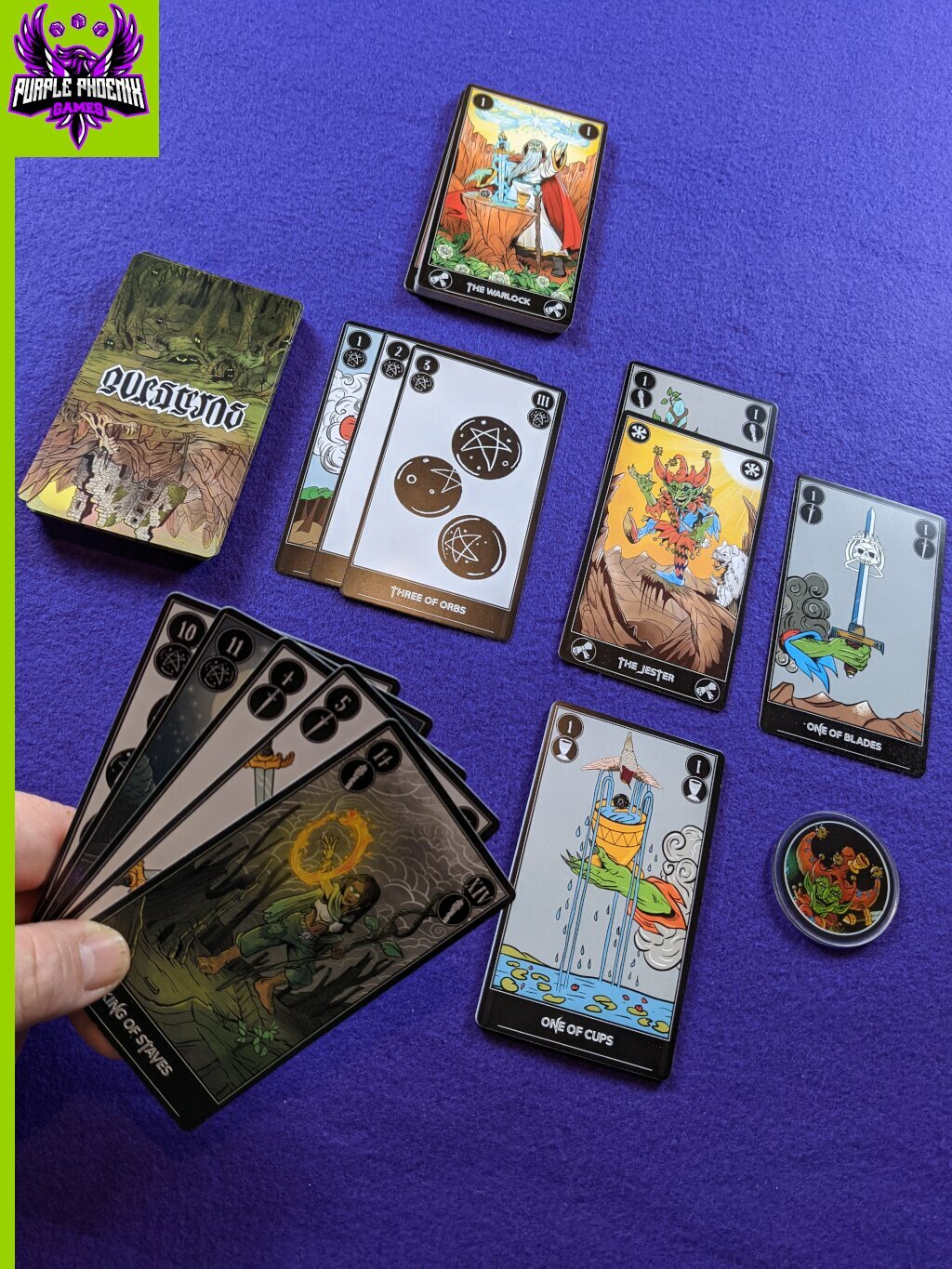
To setup the solo game, fondly and ingeniously-named “Ero’s Quest,” follow the rulebook to divide the tarot cards into their specific stacks and splays so that it roughly imitates the photo below. Draw a hand of five cards from the deck and the game may begin.
On a turn the player has a choice of seven actions that may be performed in any order. Each action may only be performed once per turn and when the turn is over the final action is Rest. To use the Develop action the player will place a card from their hand onto the Blades, Staves, or Orbs stacks in next-numerical order. This increases Ero’s attack and spending power. To Puchase cards Ero will spend Orb cards to look at the spent Orb value worth of cards from the draw deck, add one to their hand, and place the others at the bottom of the draw deck. At times Ero will need to Forget cards from hand in order to make room for more cards to enter it via the Learn action. Forgetting simply discards cards from hand while learning draws cards into hand from the draw deck. Recover is used to stand any kneeling/turned/rotated cards into an unused state by destroying cards of higher value from hand. As stated previously, to Rest is to end the turn by discarding the top card of the draw deck to setup the next turn.
I purposely left out the final action choice, Encounter, for a specific reason. Ero’s Quest is won when the entire deck of 21 Encounter cards is defeated. Each of these cards depicts a person or persons that Ero meets in his travels. Some require Ero to give them cards in order to pass. Some require Ero to succeed in battle against them in order to progress. In either case, Ero will need to get through the entire deck before his draw deck runs out in order to win the game.
Battle in Ero’s Quest is turn-based, where the Encounter persona attacks first, thus handing Ero wounds immediately. Wounds are suffered by spending Cups cards in value of the wound taken. For example, the Assassin is a value of 12, so they immediately wound Ero for 12 damage at the start of the encounter. Ero will spend a value of 12 Cups cards to simulate damage taken. Ero may then attack with a combination of available Blades, Staves, and any Ally cards obtained – one of each per attack turn. If the Encounter is defeated, Ero lives on. If the Encounter is not yet defeated, the battle continues with the Encounter card dealing damage and Ero responding with damage until one is defeated.
As mentioned earlier, the Encounter deck contains 21 cards with six of these being combat encounters. Ero has a ton of work to do and when each turn requires a card to be discarded before a new round may begin, they also have an in-game clock ticking and ticking each turn. However, if Ero is able to Develop their skills and overcome all the Encounters, the game is won and Ero becomes a Hero.
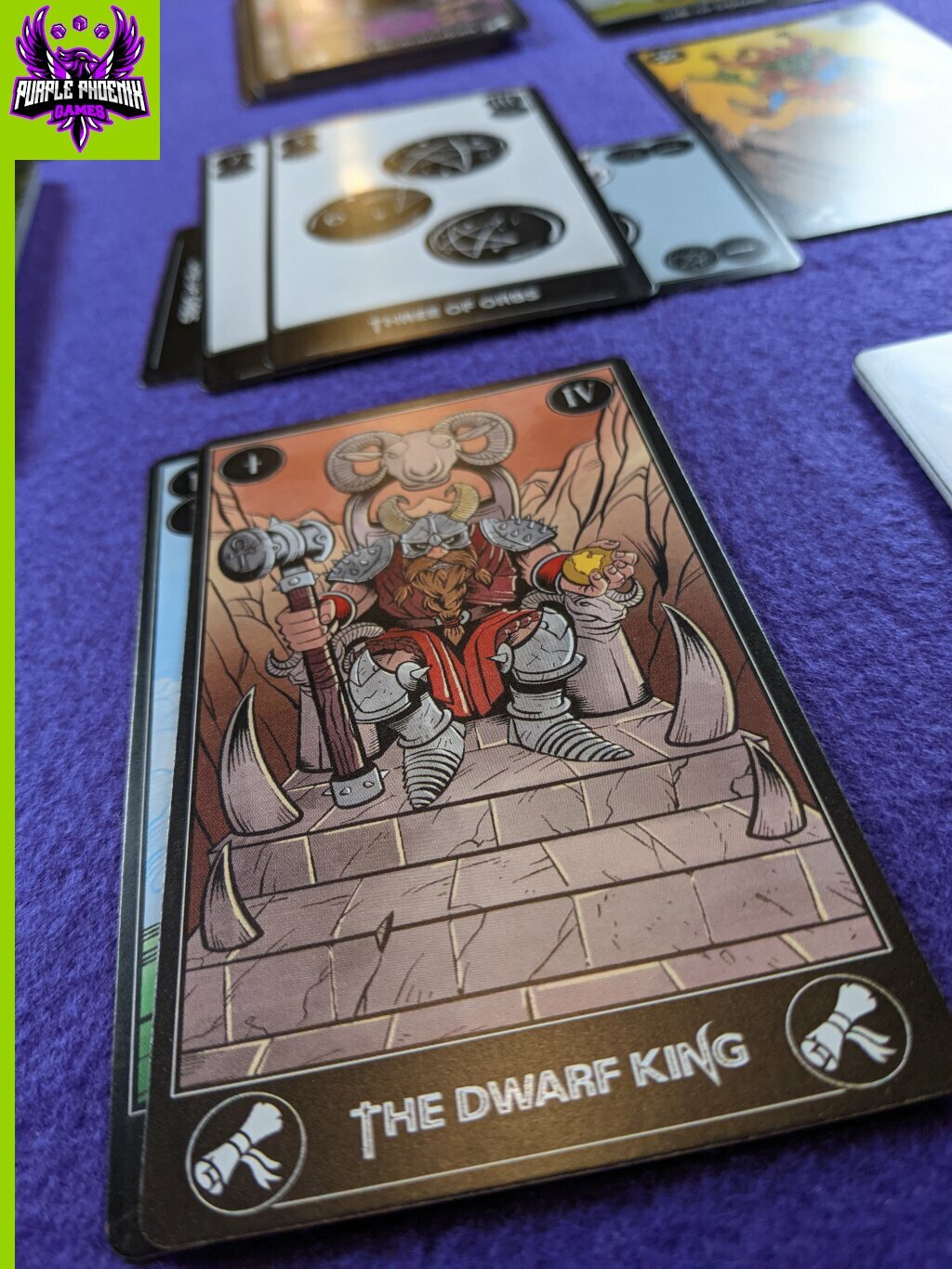
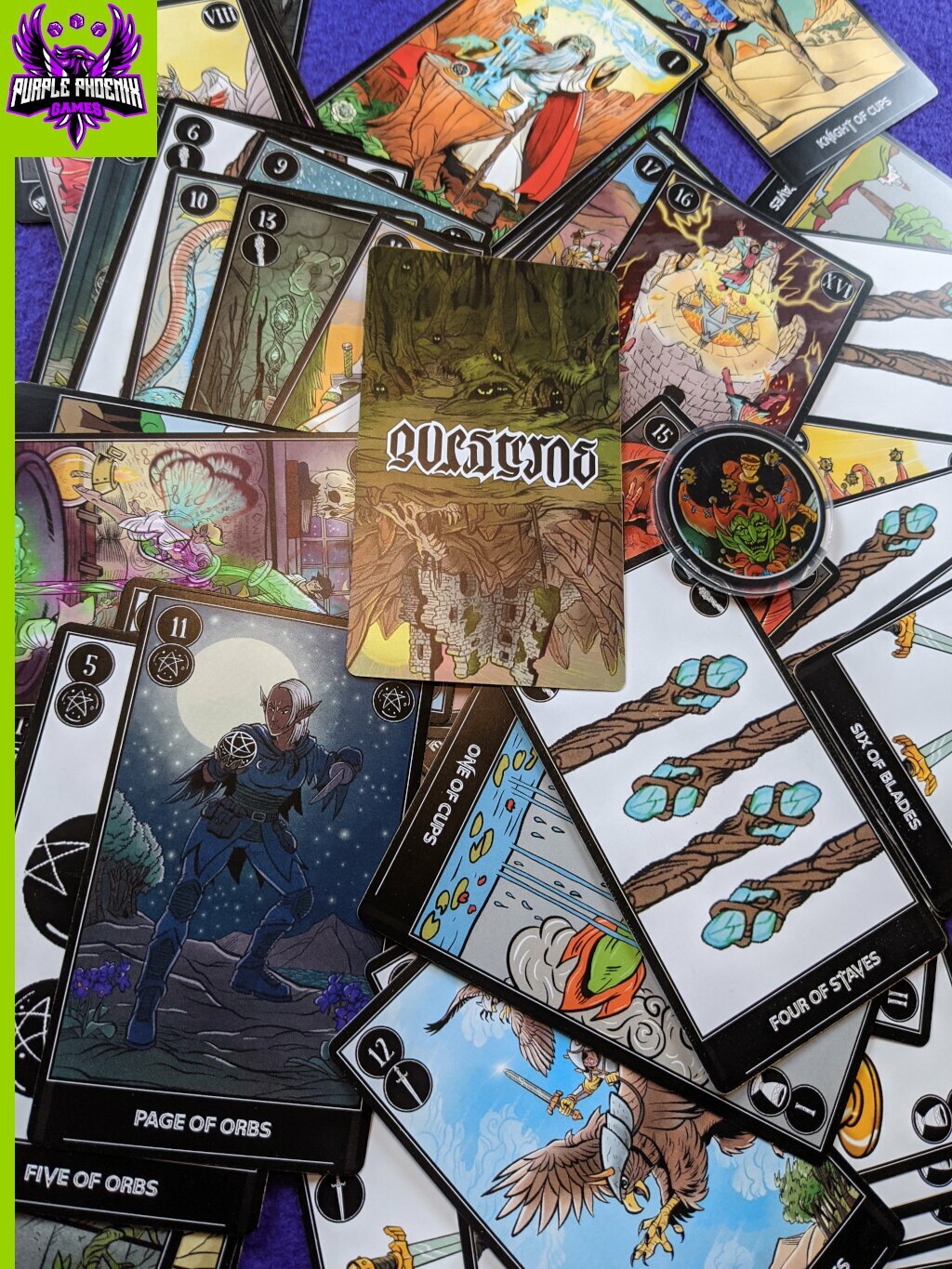
Components. Again, this is a prototype copy of the game, and many items are not fully completed in this version. That said, what we were provided is a large stack of tarot-sized cards, a first player Ero token (for multiplayer games), and a large pad of scoring sheets (also for multiplayer use). The cards are great quality and feature some really excellent artwork (on the cards that have the completed artwork on them). I do like the art style employed here, as I am a fan of fantasy themes, and I know that the game will probably ship with similar iconography, but may also be color-coded for ease of reference. All in all I believe Questeros is headed in the right direction for components, and a successful Kickstarter campaign may improve that even further.
The gameplay for the solo adventure of Ero’s Quest is really decent and engaging. So often I have found myself crunching numbers in my head and attempting to utilize my horrible card-counting “skills” to determine my next actions to take. Turns can be very intense and fruitful, or very frustrating and minimal, especially when you are waiting to draw that 3 of Blades so you can place it on the 2 of Blades sitting there, but it just won’t come up. And here you are sitting with the 4, 5, and 6 of Blades in hand and a Necromancer staring right at you awaiting combat. That is the definition of frustrating, but games usually take less than an hour, so even if an entire game is chock full of these turns, you can always setup a new game quickly and hope for better luck.
I like this one. I really do. It is interesting, has a great theme, so many delicious choices, and multiple ways to use the cards for game modes or tarot decks or even RPG FATE decks! On versatility alone I would rate this one high. If you are looking for a little card game to satisfy your mid-weight solo thirst, then check out Questeros. If you need a tarot game in your collection (as I look at mine and see no others), consider this one. It takes up very little shelf space, but looks great on the table and offers a great little solo experience. I have yet to beat the solo adventure, but Ero is calling my name for another go, and I might just have to give in. Again. And again.
Ero is the goblin court jester from the open who has been “chosen” to quest about the land to rid it of the ne’er-do-wells of the realm. In this solo adventure mode of Questeros the player will be donning the visage and character of Ero as they travel about developing their skills and having encounters with powerful beings. It is up to the player to guide Ero through the kingdom and rid it of the foul that is plaguing it.
DISCLAIMER: We were provided a prototype copy of this game for the purposes of this review. These are preview copy components, and I do not know for sure if the final components will be any different from these shown. Also, it is not my intention to detail every rule in the game, as there are just too many. You are invited to download the rulebook, back the game through the Kickstarter campaign, or through any retailers stocking it after fulfillment. -T
To setup the solo game, fondly and ingeniously-named “Ero’s Quest,” follow the rulebook to divide the tarot cards into their specific stacks and splays so that it roughly imitates the photo below. Draw a hand of five cards from the deck and the game may begin.
On a turn the player has a choice of seven actions that may be performed in any order. Each action may only be performed once per turn and when the turn is over the final action is Rest. To use the Develop action the player will place a card from their hand onto the Blades, Staves, or Orbs stacks in next-numerical order. This increases Ero’s attack and spending power. To Puchase cards Ero will spend Orb cards to look at the spent Orb value worth of cards from the draw deck, add one to their hand, and place the others at the bottom of the draw deck. At times Ero will need to Forget cards from hand in order to make room for more cards to enter it via the Learn action. Forgetting simply discards cards from hand while learning draws cards into hand from the draw deck. Recover is used to stand any kneeling/turned/rotated cards into an unused state by destroying cards of higher value from hand. As stated previously, to Rest is to end the turn by discarding the top card of the draw deck to setup the next turn.
I purposely left out the final action choice, Encounter, for a specific reason. Ero’s Quest is won when the entire deck of 21 Encounter cards is defeated. Each of these cards depicts a person or persons that Ero meets in his travels. Some require Ero to give them cards in order to pass. Some require Ero to succeed in battle against them in order to progress. In either case, Ero will need to get through the entire deck before his draw deck runs out in order to win the game.
Battle in Ero’s Quest is turn-based, where the Encounter persona attacks first, thus handing Ero wounds immediately. Wounds are suffered by spending Cups cards in value of the wound taken. For example, the Assassin is a value of 12, so they immediately wound Ero for 12 damage at the start of the encounter. Ero will spend a value of 12 Cups cards to simulate damage taken. Ero may then attack with a combination of available Blades, Staves, and any Ally cards obtained – one of each per attack turn. If the Encounter is defeated, Ero lives on. If the Encounter is not yet defeated, the battle continues with the Encounter card dealing damage and Ero responding with damage until one is defeated.
As mentioned earlier, the Encounter deck contains 21 cards with six of these being combat encounters. Ero has a ton of work to do and when each turn requires a card to be discarded before a new round may begin, they also have an in-game clock ticking and ticking each turn. However, if Ero is able to Develop their skills and overcome all the Encounters, the game is won and Ero becomes a Hero.
Components. Again, this is a prototype copy of the game, and many items are not fully completed in this version. That said, what we were provided is a large stack of tarot-sized cards, a first player Ero token (for multiplayer games), and a large pad of scoring sheets (also for multiplayer use). The cards are great quality and feature some really excellent artwork (on the cards that have the completed artwork on them). I do like the art style employed here, as I am a fan of fantasy themes, and I know that the game will probably ship with similar iconography, but may also be color-coded for ease of reference. All in all I believe Questeros is headed in the right direction for components, and a successful Kickstarter campaign may improve that even further.
The gameplay for the solo adventure of Ero’s Quest is really decent and engaging. So often I have found myself crunching numbers in my head and attempting to utilize my horrible card-counting “skills” to determine my next actions to take. Turns can be very intense and fruitful, or very frustrating and minimal, especially when you are waiting to draw that 3 of Blades so you can place it on the 2 of Blades sitting there, but it just won’t come up. And here you are sitting with the 4, 5, and 6 of Blades in hand and a Necromancer staring right at you awaiting combat. That is the definition of frustrating, but games usually take less than an hour, so even if an entire game is chock full of these turns, you can always setup a new game quickly and hope for better luck.
I like this one. I really do. It is interesting, has a great theme, so many delicious choices, and multiple ways to use the cards for game modes or tarot decks or even RPG FATE decks! On versatility alone I would rate this one high. If you are looking for a little card game to satisfy your mid-weight solo thirst, then check out Questeros. If you need a tarot game in your collection (as I look at mine and see no others), consider this one. It takes up very little shelf space, but looks great on the table and offers a great little solo experience. I have yet to beat the solo adventure, but Ero is calling my name for another go, and I might just have to give in. Again. And again.

Purple Phoenix Games (2266 KP) rated Spy Club in Tabletop Games
Aug 12, 2021


You guys have heard of “Where in the World is Carmen Sandiego?” The globetrotting super-spy who is hard to pin down? Well imagine what she may have been like as a young person. I bet she had her own spy club. And now we have a game to play to emulate what it may have been like in such a club. **This game has nothing to do with Carmen Sandiego.
Spy Club is a cooperative memory and deduction card game utilizing an action point system and sharing of resources. It is set in any neighborhood where kids can gather in groups and snuff out a mystery. The goal is to whittle the clues down to the correct Motive, Suspect, Location, Crime, and Object of the Crime. Are you intrepid youths up to the task?
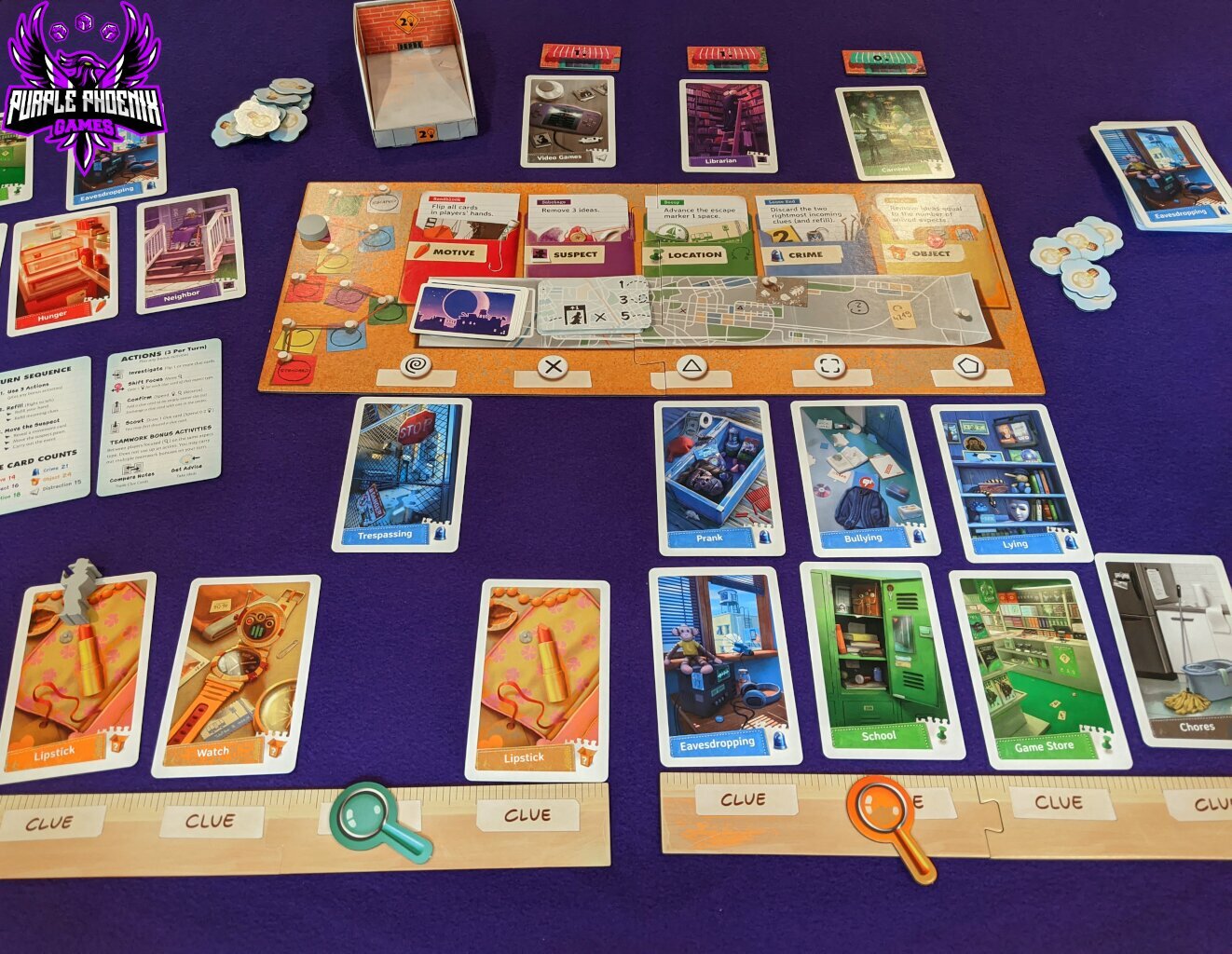
To setup, place the main board on the table, and the Escape Marker upon it at the bottom of the track. Shuffle the Movement Deck cards separately by backs, remove one from each differently-backed set, and place them in day – sunset – night order in its space. Each player receives a play board according to the number of players and a spyglass in their favorite color to go upon their play board. The Idea markers can be in a rough pile near everything else. The Clue Deck is to be shuffled and placed face-down (or face-up, whichever you prefer; they are double-sided) and each player is dealt a number of Clues equal to the number of spaces on their play boards. Clues will also be dealt to an “Incoming Clues” area (an offer row or “market”). DO NOT LOOK AT THE BACKS OF THE CARDS. Like, EVER. Unless you use an action to do so. The Suspecteeple will be placed on the right-most Clue Card of the starting player’s board. The game of sleuthing may now begin!
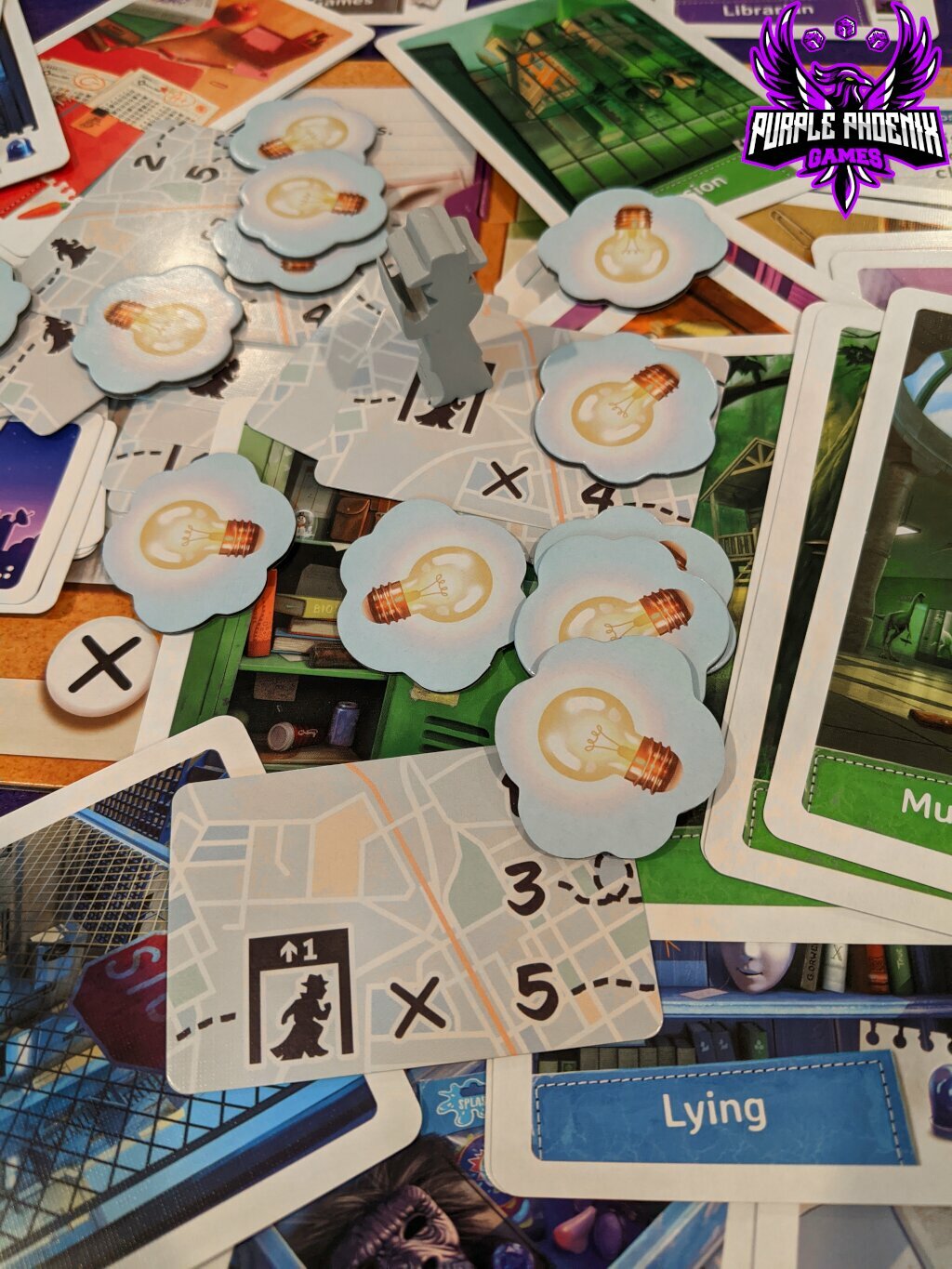
A player’s turn will consist of three main steps with different phases in those steps. Step 1 is Use Actions. Players will be able to use three Actions on their turn. These Actions are: Investigate, Shift Focus, Confirm, and Scout. To Investigate the active player will flip a Clue Card from their collection to its back. They may then continue flipping their cards or stop at any time. To Shift Focus a player will simply move their spyglass to a different Clue and collect Ideas equal to the number of Clues whose aspects match the newly-focused one (two Ideas if moving to a Location and a player has two Location Clues). Skipping Confirm, to Scout simply means purchasing a card from the Incoming Clues area to a player’s board, with a discard of an existing card already there.
Confirming is where the main action in Spy Club lies. Players will be attempting to Confirm five Clues of matching aspect (Location, Motive, etc) in order to hone in on the correct aspect. To Confirm, a player can submit a Clue from their collection (hand) to the main board. The cost, in Ideas, depends on where the spyglass lies. If the spyglass is directly under the Clue to be submitted the cost is nothing. However, if a player wishes to complete three Confirm actions and they have matching Clues on either side of their spyglass, they would need to spend two Ideas for each Clue resting one space away from the spyglass.
There are also rules for taking “Teamwork Bonus Actions,” but I will let you discover those on your own.
After these Actions are carried out, Step 2 is Refill. Firstly the active player’s hand will need to be refilled from the Incoming Clues row, and more Incoming Clues come out to fill that row.
Step 3 is Move the Suspect. Drawing from the Movement Deck the active player will match up the Movement cards from the previous round and the current round to find out how many spaces the Suspecteeple will be moving through players’ cards. Depending upon which aspect Clue the Suspecteeple lands a negative action will be levied against the players. In some ways the Suspect could land on cards that trigger no negative action, but I will leave that for you to discover as well. I am a bit… distracted.
Play continues in this fashion of players Using Actions, Refilling the Clue cards, and Moving the Suspect until players win by solving all five aspects of the crime, the Suspect escapes, the players run out of Idea markers, the Suspect escapes due to running out of Movement cards, or there are insufficient Incoming Clues to refill a player’s hand. So there are four ways to lose and one way to win.
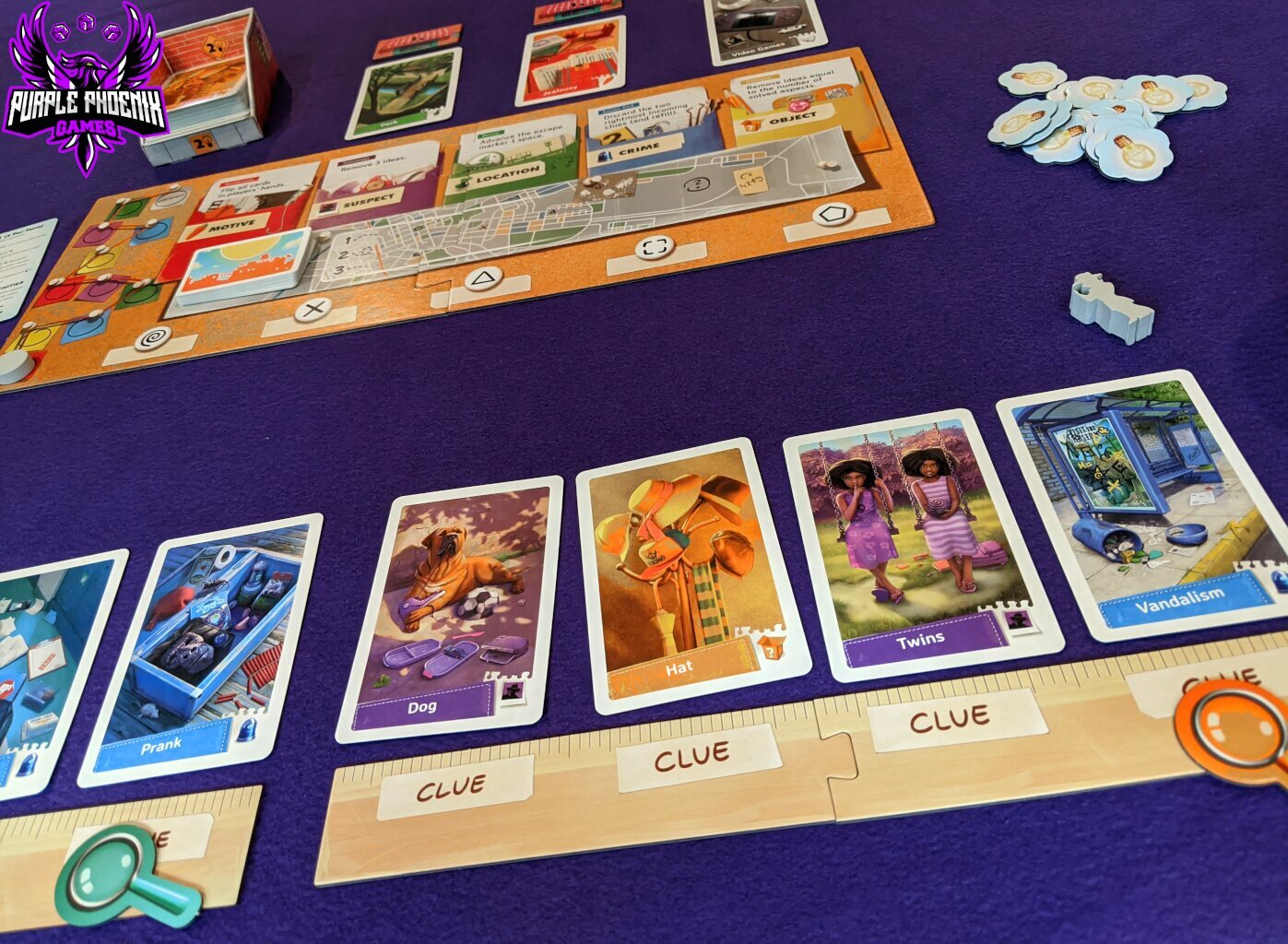
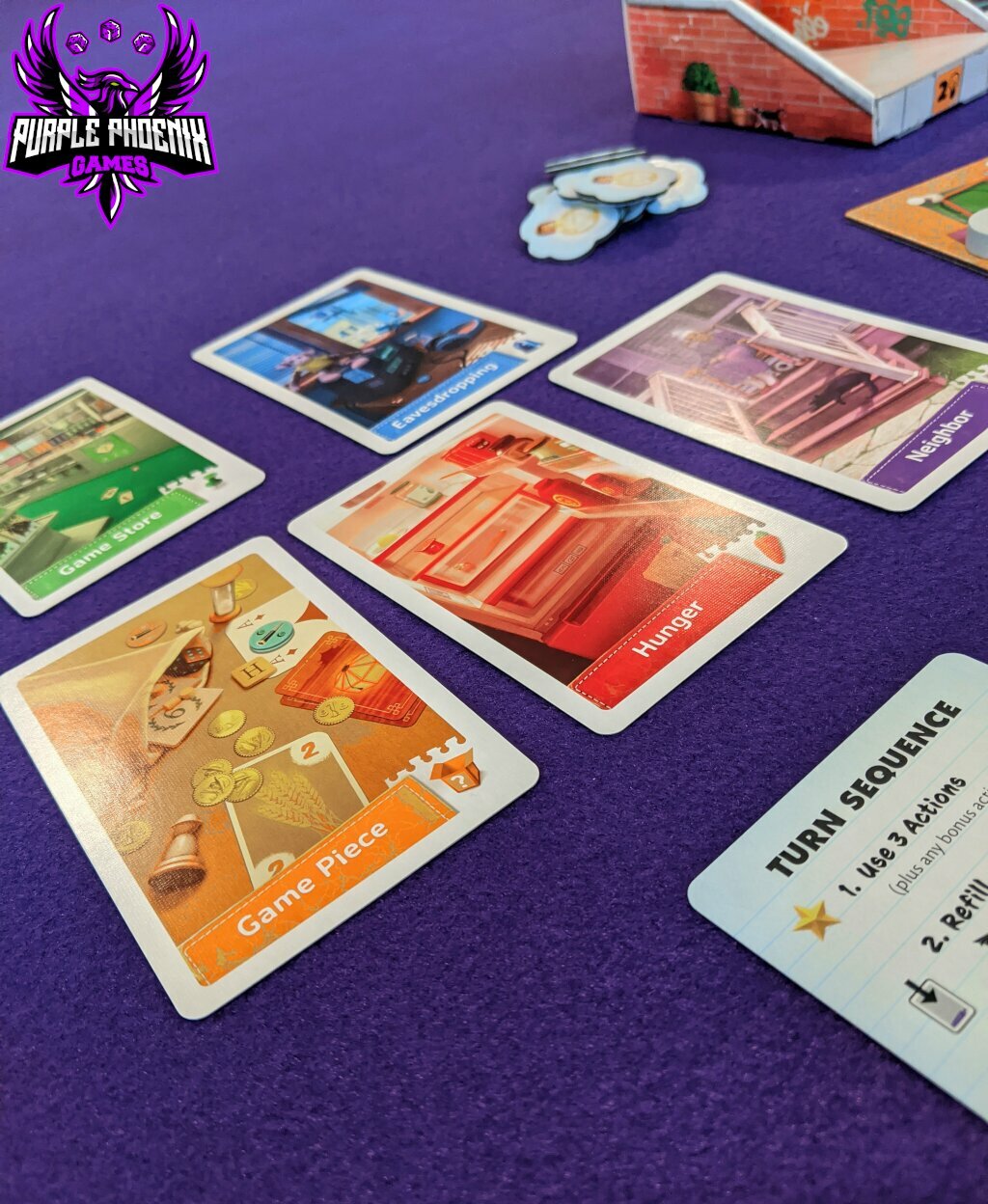
Components. I find the components in Spy Club to be good overall. Nothing really stands out as amazing, either in design or quality. The art is very good, though. One thing I will say about the components as a whole is that once the game is setup and in play it looks fascinating on the table. I love the way it looks and certainly assists with full immersion. Always a plus in my book.
There are so many things I love about this game. And there are so many things I didn’t even explain here! Ok I’ll tell you one. Spy Club can be played as a one-shot game night medium-length (60 minutes) game, or can be converted into a campaign game where players will play five connected scenarios using a giant stack of cards that are not in use for the one-shots. That is simply fabulous! I can play one game of this to get people hooked, then reel them in by offering to continue this as a campaign to see what the main story arc is really trying to tell us. Oh man, that’s just special and I love it!
I feel like I have been playing a lot of really great games lately, and Spy Club is certainly a GREAT game. In fact, I told the rest of the team that this one is a contender for my Top 10 Games of All Time list. It has everything I love in a game: it is difficult (my first game I would have lost had it lasted one more turn) without being too heavy, it is inviting me to play more games (especially with the campaign mode active), I just like looking at it on the table, and creates a stunning amount of tension as we race against the game clock to figure out the crime aspects.
I have had this in my collection for too long without it being played, and I am so sorry that it took me so long to get into it. I will certainly be playing this a LOT more, and introducing as many people to it as I can. I think in the gaming world it is flying under the radar, but I will be one of its champions and suggest it as much as possible. If you like certain aspects (hehe) of Clue, 13 Dead End Drive, Carmen Sandiego, and even Jaipur, then take a look at Spy Club. Purple Phoenix Games gives this a super-sleuth 11 / 12. I actually might go play it right now. Yes, at 11:07pm.
Spy Club is a cooperative memory and deduction card game utilizing an action point system and sharing of resources. It is set in any neighborhood where kids can gather in groups and snuff out a mystery. The goal is to whittle the clues down to the correct Motive, Suspect, Location, Crime, and Object of the Crime. Are you intrepid youths up to the task?
To setup, place the main board on the table, and the Escape Marker upon it at the bottom of the track. Shuffle the Movement Deck cards separately by backs, remove one from each differently-backed set, and place them in day – sunset – night order in its space. Each player receives a play board according to the number of players and a spyglass in their favorite color to go upon their play board. The Idea markers can be in a rough pile near everything else. The Clue Deck is to be shuffled and placed face-down (or face-up, whichever you prefer; they are double-sided) and each player is dealt a number of Clues equal to the number of spaces on their play boards. Clues will also be dealt to an “Incoming Clues” area (an offer row or “market”). DO NOT LOOK AT THE BACKS OF THE CARDS. Like, EVER. Unless you use an action to do so. The Suspecteeple will be placed on the right-most Clue Card of the starting player’s board. The game of sleuthing may now begin!
A player’s turn will consist of three main steps with different phases in those steps. Step 1 is Use Actions. Players will be able to use three Actions on their turn. These Actions are: Investigate, Shift Focus, Confirm, and Scout. To Investigate the active player will flip a Clue Card from their collection to its back. They may then continue flipping their cards or stop at any time. To Shift Focus a player will simply move their spyglass to a different Clue and collect Ideas equal to the number of Clues whose aspects match the newly-focused one (two Ideas if moving to a Location and a player has two Location Clues). Skipping Confirm, to Scout simply means purchasing a card from the Incoming Clues area to a player’s board, with a discard of an existing card already there.
Confirming is where the main action in Spy Club lies. Players will be attempting to Confirm five Clues of matching aspect (Location, Motive, etc) in order to hone in on the correct aspect. To Confirm, a player can submit a Clue from their collection (hand) to the main board. The cost, in Ideas, depends on where the spyglass lies. If the spyglass is directly under the Clue to be submitted the cost is nothing. However, if a player wishes to complete three Confirm actions and they have matching Clues on either side of their spyglass, they would need to spend two Ideas for each Clue resting one space away from the spyglass.
There are also rules for taking “Teamwork Bonus Actions,” but I will let you discover those on your own.
After these Actions are carried out, Step 2 is Refill. Firstly the active player’s hand will need to be refilled from the Incoming Clues row, and more Incoming Clues come out to fill that row.
Step 3 is Move the Suspect. Drawing from the Movement Deck the active player will match up the Movement cards from the previous round and the current round to find out how many spaces the Suspecteeple will be moving through players’ cards. Depending upon which aspect Clue the Suspecteeple lands a negative action will be levied against the players. In some ways the Suspect could land on cards that trigger no negative action, but I will leave that for you to discover as well. I am a bit… distracted.
Play continues in this fashion of players Using Actions, Refilling the Clue cards, and Moving the Suspect until players win by solving all five aspects of the crime, the Suspect escapes, the players run out of Idea markers, the Suspect escapes due to running out of Movement cards, or there are insufficient Incoming Clues to refill a player’s hand. So there are four ways to lose and one way to win.
Components. I find the components in Spy Club to be good overall. Nothing really stands out as amazing, either in design or quality. The art is very good, though. One thing I will say about the components as a whole is that once the game is setup and in play it looks fascinating on the table. I love the way it looks and certainly assists with full immersion. Always a plus in my book.
There are so many things I love about this game. And there are so many things I didn’t even explain here! Ok I’ll tell you one. Spy Club can be played as a one-shot game night medium-length (60 minutes) game, or can be converted into a campaign game where players will play five connected scenarios using a giant stack of cards that are not in use for the one-shots. That is simply fabulous! I can play one game of this to get people hooked, then reel them in by offering to continue this as a campaign to see what the main story arc is really trying to tell us. Oh man, that’s just special and I love it!
I feel like I have been playing a lot of really great games lately, and Spy Club is certainly a GREAT game. In fact, I told the rest of the team that this one is a contender for my Top 10 Games of All Time list. It has everything I love in a game: it is difficult (my first game I would have lost had it lasted one more turn) without being too heavy, it is inviting me to play more games (especially with the campaign mode active), I just like looking at it on the table, and creates a stunning amount of tension as we race against the game clock to figure out the crime aspects.
I have had this in my collection for too long without it being played, and I am so sorry that it took me so long to get into it. I will certainly be playing this a LOT more, and introducing as many people to it as I can. I think in the gaming world it is flying under the radar, but I will be one of its champions and suggest it as much as possible. If you like certain aspects (hehe) of Clue, 13 Dead End Drive, Carmen Sandiego, and even Jaipur, then take a look at Spy Club. Purple Phoenix Games gives this a super-sleuth 11 / 12. I actually might go play it right now. Yes, at 11:07pm.

Purple Phoenix Games (2266 KP) rated Matryoshka in Tabletop Games
Apr 8, 2022


I don’t know about you, but I have always been fascinated by Russian nesting dolls, known as Matryoshka dolls. Something about opening the outer-most doll and finding an exact replica, but smaller, just brings me so much joy and satisfaction. I could play with them all day. So whilst perusing Miniature Market, I came across this little card game. Does Matryoshka give me the same sense of satisfaction as playing with physical nesting dolls? Or does it leave me feeling empty, like a Matryoshka that is missing its inner dolls? (This analogy is a stretch, but I’m sticking with it)
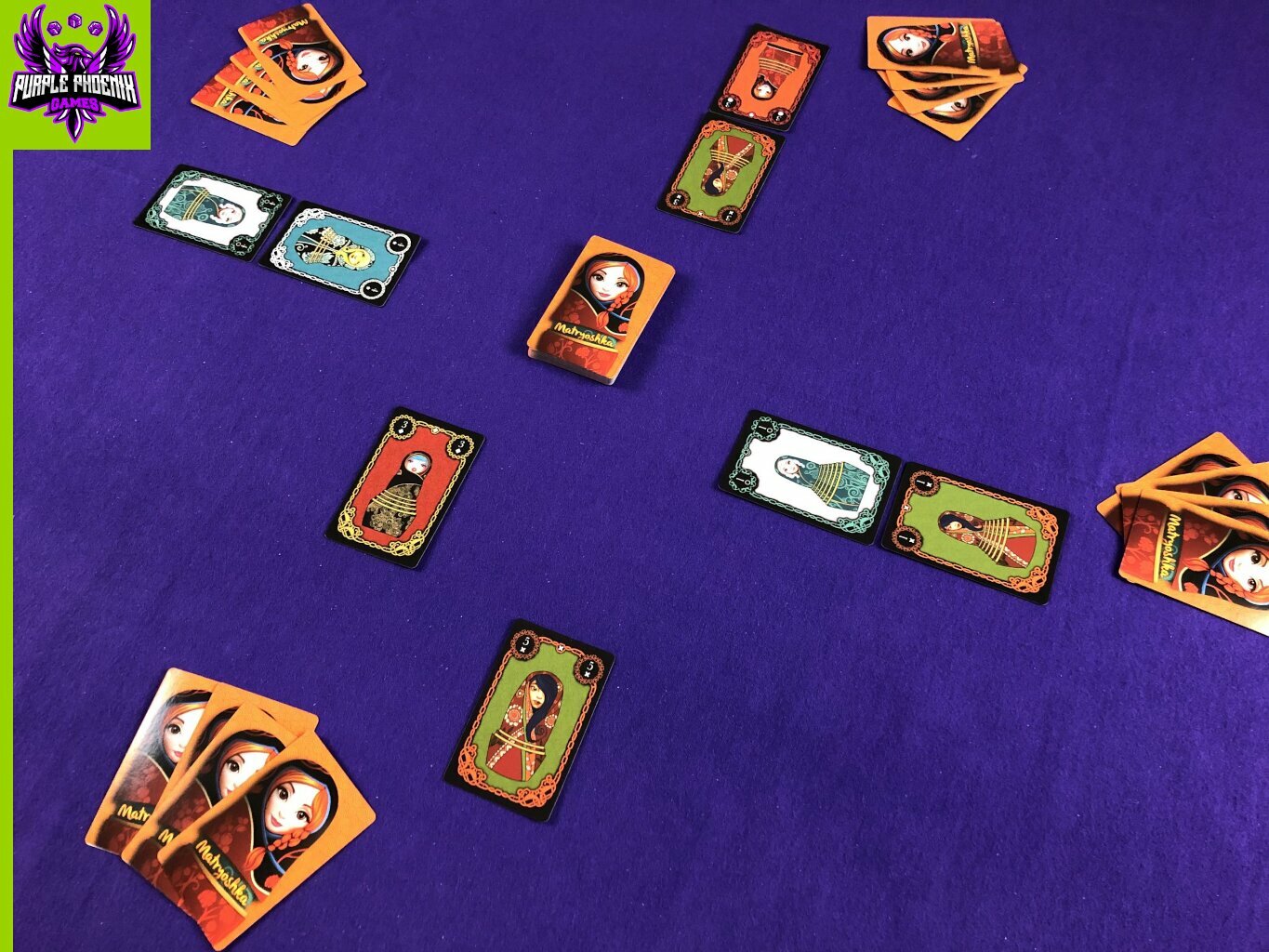
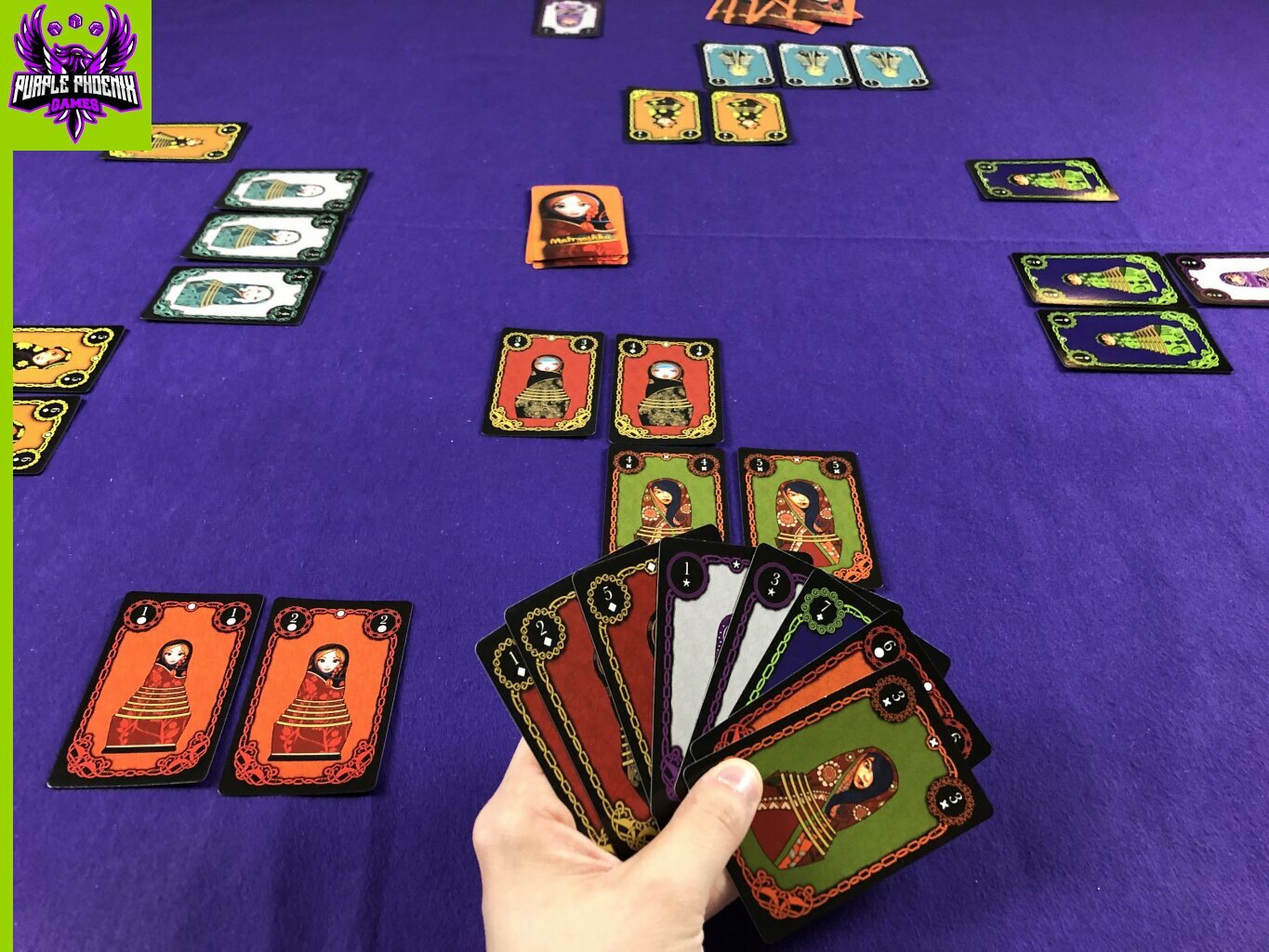
Matryoshka is a card game of hand management and set collection in which players are antique collectors attempting to gather complete sets of valuable Matryoshka dolls. Over the course of 4 rounds, players will be trading (in a sort of auction/bidding way) cards in their attempts to collect different sets of numerically ascending Matryoshka dolls. To setup for a game, you will first create the game deck. Depending on the player count, you will use a specific number of Matryoshka sets for the game – each set ranging from values 1-7. Shuffle the deck and deal 6 cards to each player, placing the remaining cards in the middle of the play area in a face-down draw deck. Players will then select 2 cards from their hand to place in their Display (tableau), organized as described in the rules. Cards in your display are visible to all players, and provide information as to what cards you have, and what cards you may be looking for. So deciding which cards to Display is part of your strategy. Select a starting player, and the game is ready to begin! Pictured below is the setup for a four-player game.
Each round is consists of 3 phases: Draw, Exchange, and Display. To begin the round, all players will draw 2 new cards from the deck. The Exchange phase is played in turns, beginning with the starting player as the active player. The active player will select one card from their hand to be placed face-up in the middle of the table. This is the card that is up for trade. All other players must then choose one card from their hands to be offered in exchange. Players keep their offer cards hidden, and the active player will secretly look at all offer cards. The active player then chooses one of the offer cards to take into their hand, and the player whose card was chosen takes the active player’s face-up card. All other players take their offer cards back into their own hand. Play then moves clock-wise, beginning another Exchange with a new active player.
When all players have had the opportunity to be the active player, the game moves to the Display phase. Players take all cards from their Display into their hand, and will then create a new Display. As the game rounds progress, the number of cards in each Display increases. To start the game, all players Display 2 cards. After the first round, the Display will have 4 cards, then 6, 8, and finally 13 to end the game. Again, cards in your Display are visible to all players, and that information could be used strategically when Exchanging cards in the second game phase. After the fourth and final round, players will have a total of 13 cards in their Display. Each Display is now scored, earning points for consecutive cards per row as well as sets of the same size of doll. The player with the highest total score is the winner of the game!
I should probably start by saying that I’m a sucker for set collection. So when I stumbled across Matryoshka, the theme drew me in and the set collection mechanic prompted me to hit ‘Add to Cart.’ And I have to say that I am loving this game. One major element that I like about Matryoshka is the simplicity of the gameplay. Draw 2 cards each round, offer cards from your hand in Exchange for others, create Displays of your sets. Easy as pie.
What really takes this game above and beyond for me are the strategic elements. Deciding which cards to Display at the end of each round is a major strategy point of the game. You have to be careful with which cards you choose to Display, because they are visible to all players. So maybe you’ve got a set of 5 consecutive cards, but do you really want your opponents to know that? Is it better to only Display a couple and use other sets to finish your Display? Or maybe you do want people to know you’re gunning for that set, as it may prompt them to offer any of those cards from their hand, for which you would pay a pretty price. You scratch my back, I’ll scratch yours, right? Along with that comes the negotiation tactic. During every Exchange, players are allowed to try to influence the active player for certain trades. Take my card now and I’ll owe you a favor later sort of thing. It’s neat to see what strategies players will try with each passing round.
ALSO it pays to pay careful attention to all opponents each round. When creating your Display at the end of every round, you do not have to use the same cards as in your last Display. So you can strategize to bait opponents to giving you cards you want, or to try and keep your chosen sets secret. That being said, paying attention to opposing Displays can be a good tactic. Maybe your neighbor just had a consecutive run of 3 cards in their Display, but now are choosing to only Display 1 of those cards – just because you can’t see the others, doesn’t mean they’re not necessarily there. So changing up Displays can be a way to maybe trick your opponents into thinking you do or do not have specific cards. If you keep a careful eye out, you may be able to deduce what everyone is hiding…
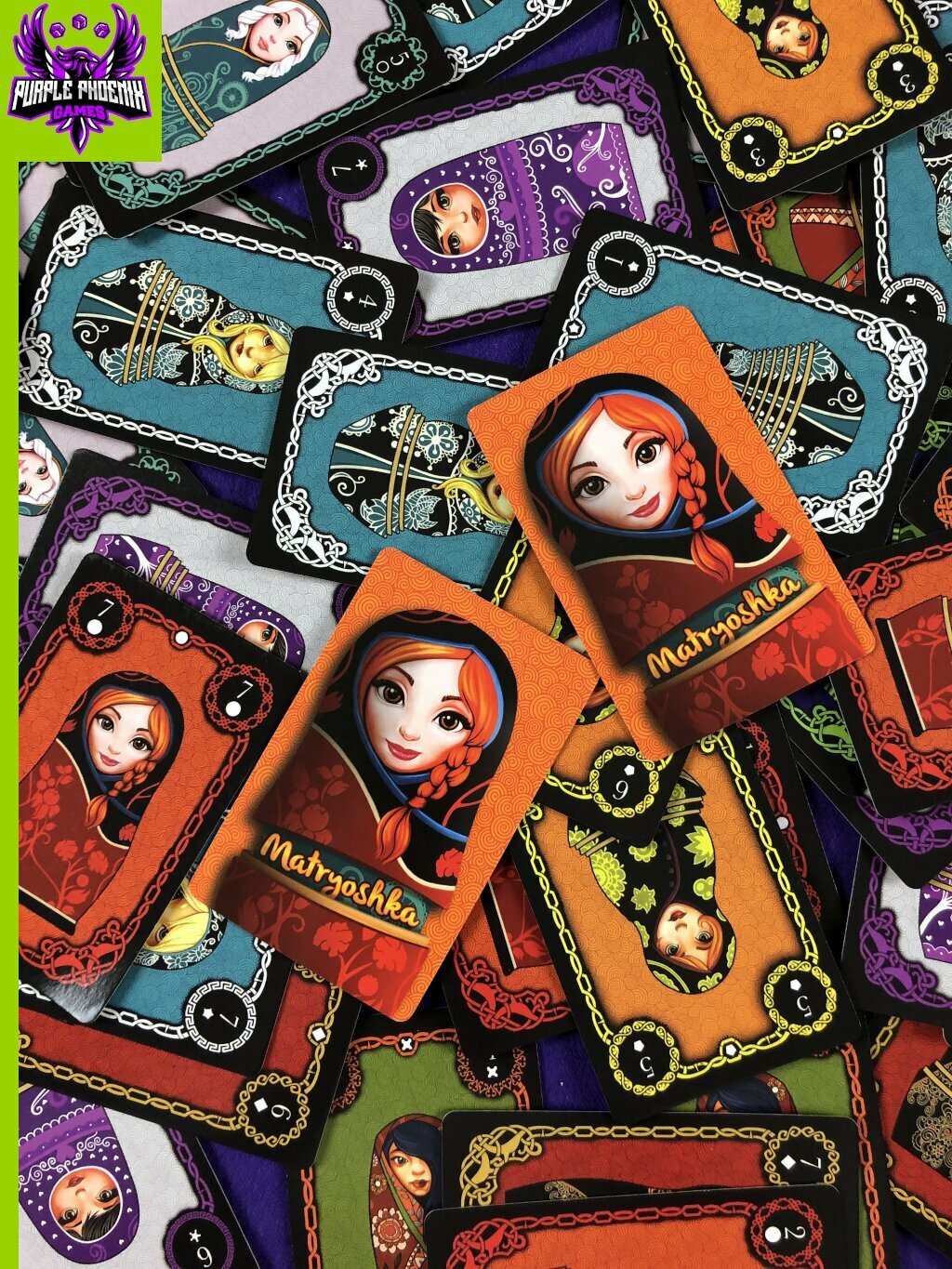
A quick note on components – this game is a stack of cards in a small magnetically-closing box. The artwork is thematic and unique, the rules and scoring aids are understandable, and the box itself is nice and sturdy. The cards are not the most high-quality I’ve seen in games, but as long as my players are gentle, that shouldn’t be a problem in the long run.
So all in all, I think you can tell that I love Matryoshka. The gameplay is simple and fast, yet the strategic options really get you thinking and perhaps second-guessing every Exchange that is made. I really like the element of changing Displays at the end of every round, as it allows players to adapt their strategy for the coming round. I wasn’t really sure what to expect when I picked up this game, but I was pleasantly surprised. It’s one that I’m definitely happy to have, and can see myself pulling it out often for a quick, yet strategic game between some of the bigger games out there. To bring back my analogy from my intro (yep, I’m committed to this joke), I would say that Matryoshka is nearly as satisfying as playing with a physical set of nesting dolls. If you’re looking for something light yet engaging, I would definitely recommend picking this one up. Purple Phoenix Games gives Matryoshka a nestled 5 / 6.
Matryoshka is a card game of hand management and set collection in which players are antique collectors attempting to gather complete sets of valuable Matryoshka dolls. Over the course of 4 rounds, players will be trading (in a sort of auction/bidding way) cards in their attempts to collect different sets of numerically ascending Matryoshka dolls. To setup for a game, you will first create the game deck. Depending on the player count, you will use a specific number of Matryoshka sets for the game – each set ranging from values 1-7. Shuffle the deck and deal 6 cards to each player, placing the remaining cards in the middle of the play area in a face-down draw deck. Players will then select 2 cards from their hand to place in their Display (tableau), organized as described in the rules. Cards in your display are visible to all players, and provide information as to what cards you have, and what cards you may be looking for. So deciding which cards to Display is part of your strategy. Select a starting player, and the game is ready to begin! Pictured below is the setup for a four-player game.
Each round is consists of 3 phases: Draw, Exchange, and Display. To begin the round, all players will draw 2 new cards from the deck. The Exchange phase is played in turns, beginning with the starting player as the active player. The active player will select one card from their hand to be placed face-up in the middle of the table. This is the card that is up for trade. All other players must then choose one card from their hands to be offered in exchange. Players keep their offer cards hidden, and the active player will secretly look at all offer cards. The active player then chooses one of the offer cards to take into their hand, and the player whose card was chosen takes the active player’s face-up card. All other players take their offer cards back into their own hand. Play then moves clock-wise, beginning another Exchange with a new active player.
When all players have had the opportunity to be the active player, the game moves to the Display phase. Players take all cards from their Display into their hand, and will then create a new Display. As the game rounds progress, the number of cards in each Display increases. To start the game, all players Display 2 cards. After the first round, the Display will have 4 cards, then 6, 8, and finally 13 to end the game. Again, cards in your Display are visible to all players, and that information could be used strategically when Exchanging cards in the second game phase. After the fourth and final round, players will have a total of 13 cards in their Display. Each Display is now scored, earning points for consecutive cards per row as well as sets of the same size of doll. The player with the highest total score is the winner of the game!
I should probably start by saying that I’m a sucker for set collection. So when I stumbled across Matryoshka, the theme drew me in and the set collection mechanic prompted me to hit ‘Add to Cart.’ And I have to say that I am loving this game. One major element that I like about Matryoshka is the simplicity of the gameplay. Draw 2 cards each round, offer cards from your hand in Exchange for others, create Displays of your sets. Easy as pie.
What really takes this game above and beyond for me are the strategic elements. Deciding which cards to Display at the end of each round is a major strategy point of the game. You have to be careful with which cards you choose to Display, because they are visible to all players. So maybe you’ve got a set of 5 consecutive cards, but do you really want your opponents to know that? Is it better to only Display a couple and use other sets to finish your Display? Or maybe you do want people to know you’re gunning for that set, as it may prompt them to offer any of those cards from their hand, for which you would pay a pretty price. You scratch my back, I’ll scratch yours, right? Along with that comes the negotiation tactic. During every Exchange, players are allowed to try to influence the active player for certain trades. Take my card now and I’ll owe you a favor later sort of thing. It’s neat to see what strategies players will try with each passing round.
ALSO it pays to pay careful attention to all opponents each round. When creating your Display at the end of every round, you do not have to use the same cards as in your last Display. So you can strategize to bait opponents to giving you cards you want, or to try and keep your chosen sets secret. That being said, paying attention to opposing Displays can be a good tactic. Maybe your neighbor just had a consecutive run of 3 cards in their Display, but now are choosing to only Display 1 of those cards – just because you can’t see the others, doesn’t mean they’re not necessarily there. So changing up Displays can be a way to maybe trick your opponents into thinking you do or do not have specific cards. If you keep a careful eye out, you may be able to deduce what everyone is hiding…
A quick note on components – this game is a stack of cards in a small magnetically-closing box. The artwork is thematic and unique, the rules and scoring aids are understandable, and the box itself is nice and sturdy. The cards are not the most high-quality I’ve seen in games, but as long as my players are gentle, that shouldn’t be a problem in the long run.
So all in all, I think you can tell that I love Matryoshka. The gameplay is simple and fast, yet the strategic options really get you thinking and perhaps second-guessing every Exchange that is made. I really like the element of changing Displays at the end of every round, as it allows players to adapt their strategy for the coming round. I wasn’t really sure what to expect when I picked up this game, but I was pleasantly surprised. It’s one that I’m definitely happy to have, and can see myself pulling it out often for a quick, yet strategic game between some of the bigger games out there. To bring back my analogy from my intro (yep, I’m committed to this joke), I would say that Matryoshka is nearly as satisfying as playing with a physical set of nesting dolls. If you’re looking for something light yet engaging, I would definitely recommend picking this one up. Purple Phoenix Games gives Matryoshka a nestled 5 / 6.

Purple Phoenix Games (2266 KP) rated Harsh Shadows in Tabletop Games
Apr 20, 2021

I am definitely a social gamer, but if there is one positive thing to come from the year 2020, it was rediscovering my love of playing solo games. So when Wonderspell reached out about previewing their newest casual solo card game, I was hooked! Taking on the role of a secret agent trying to track down an enemy spy? Yes please! Keep reading to find out more.
Disclaimer: We were provided a copy of this game for the purposes of this preview. The pictured components might not be finalized, and could differ after a successful Kickstarter campaign. -L
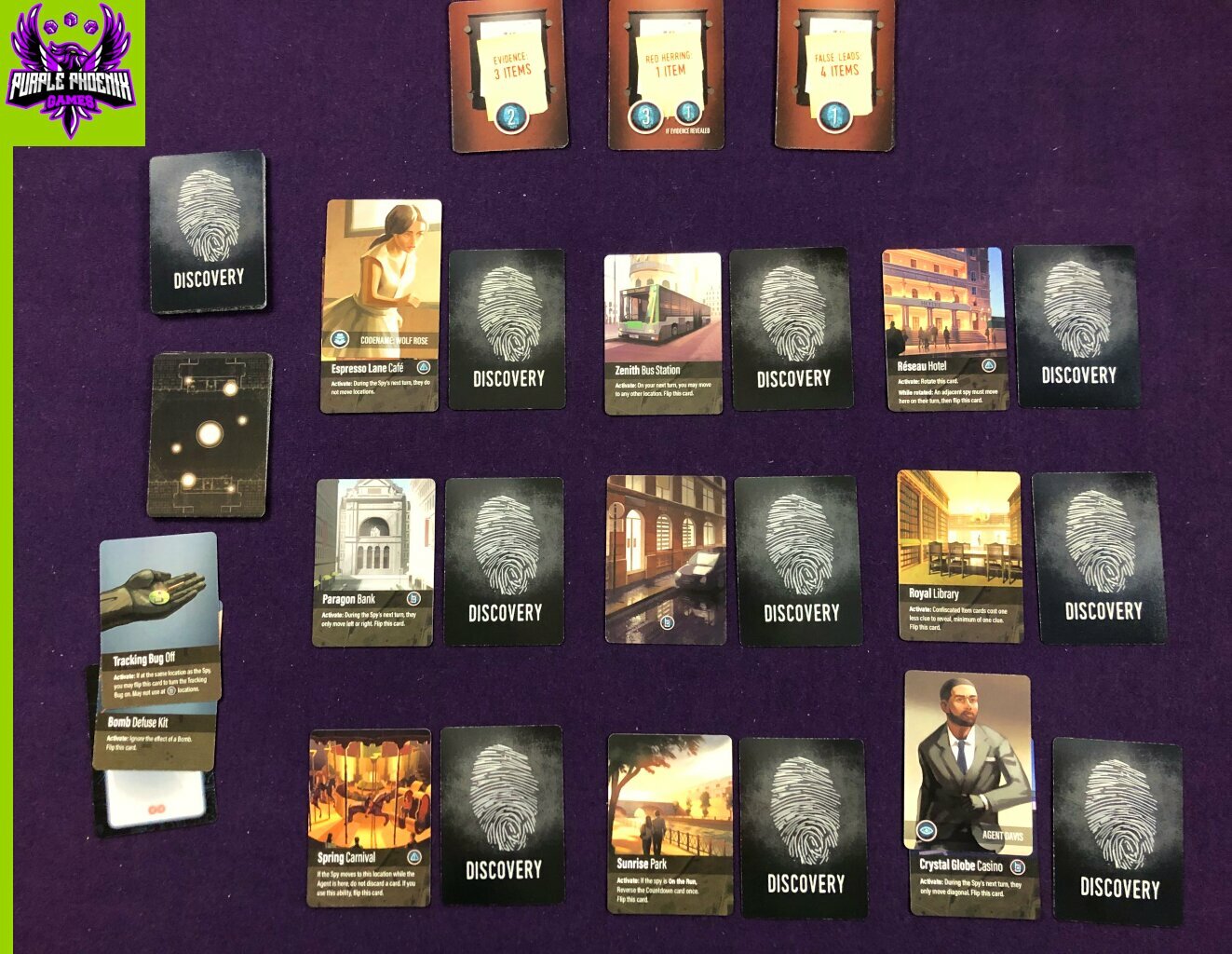
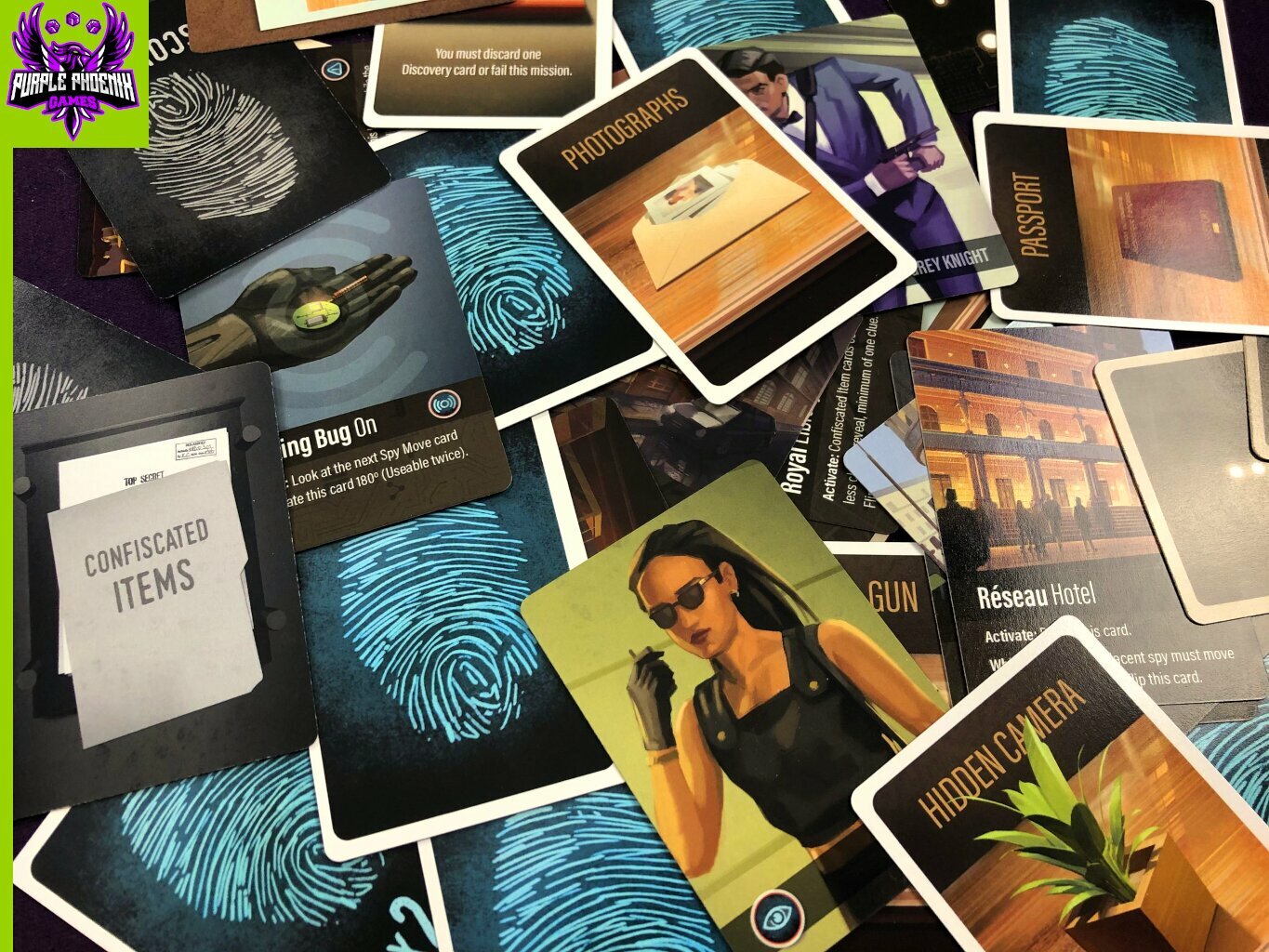
Harsh Shadows is a solo card game of hand management, grid movement, and deduction where you are an agent working to collect evidence necessary to apprehend an enemy spy. To setup for a game, randomly place the 9 Location cards in a 3×3 grid. Prepare the Discovery deck as described in the rules, place 1 face-down Discovery card to the right of each Location, and place the rest of the deck off to the side of the grid. Shuffle the Confiscated Item cards and deal the appropriate number to each of the Case File cards – 3 to Evidence, 1 to Red Herring, and 4 to False Leads. The Spy card is placed on the upper-left-most Location, and your Agent card on the lower-right-most Location. Shuffle the Spy Movement cards, and the game is ready to begin! It should look similar to the picture below.
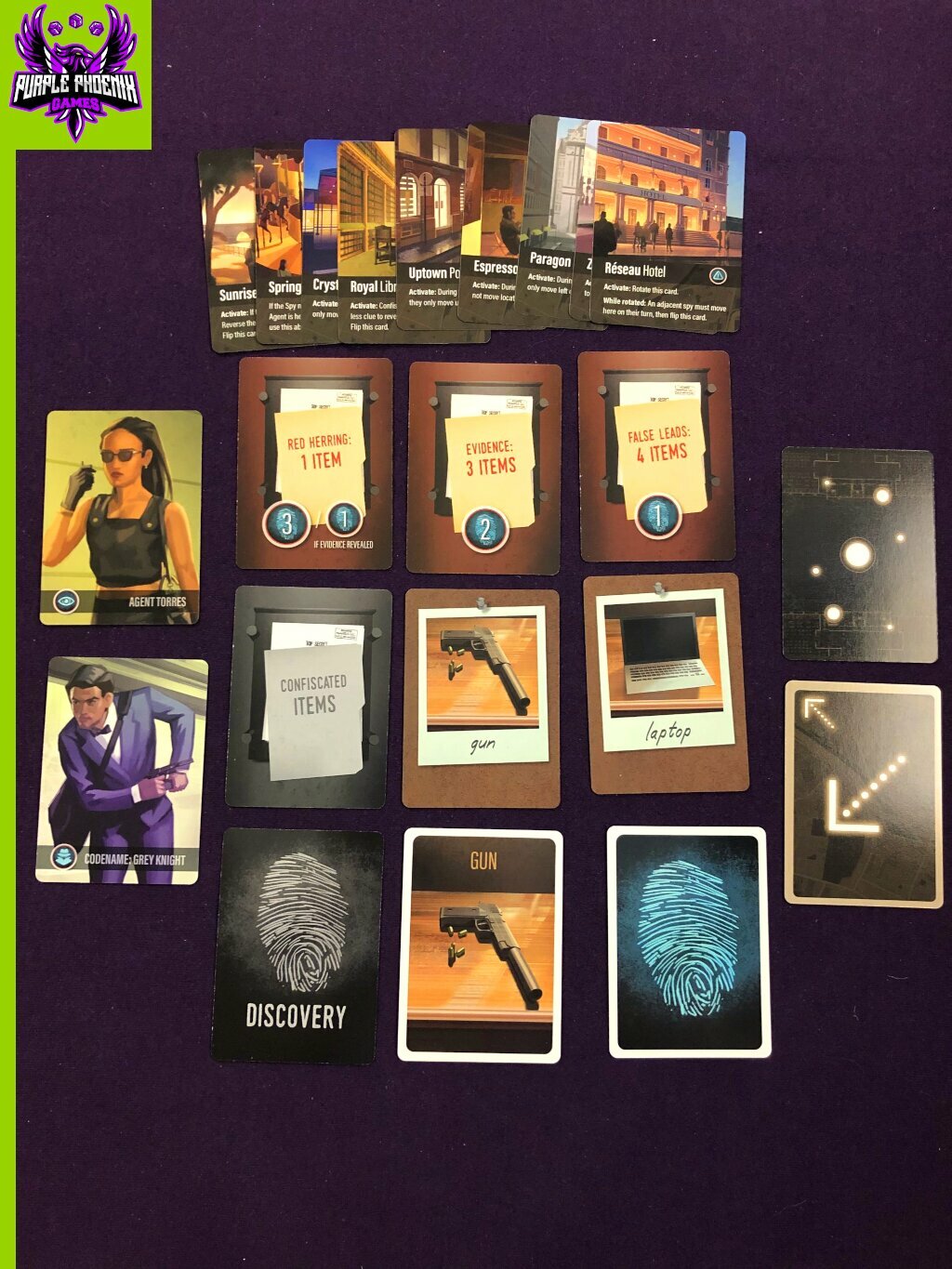
The game is played over a series of rounds in which you will be moving your Agent, performing additional actions, and then moving the Spy. The goal is to track down the Spy, with the correct evidence in hand, before the Spy is able to flee the scene. The first thing that you will do each round is to move your Agent. You may only move to a Location that is adjacent or diagonal to your current Location. Once you move to a new Location, you will draw the top Discovery card from that Location. Discovery cards will either be Items, Clues, or Bombs. Items are collected as potential Evidence, Clues are used to reveal Confiscated Items from Case Files, and Bombs force you to discard a card from your tableau. After you have moved and collected a new Discovery card, you may perform any/all of these additional actions: Use Clue Cards, Place the Tracking Bug, Track the Spy, or Use your current Location’s ability. To Use Clue cards, you will discard a number of clues in order to reveal a Confiscated Item card from a Case File. The Confiscated Items under the Evidence Case File show the 3 items you are required to have in hand to apprehend the Spy by the end of the game. The item under the Red Herring, if you have it in hand at game’s end, will cause you to automatically lose. The 4 items under the False Leads will neither help you win, nor cause you to lose – they simply offer fodder for you to discard when necessary.
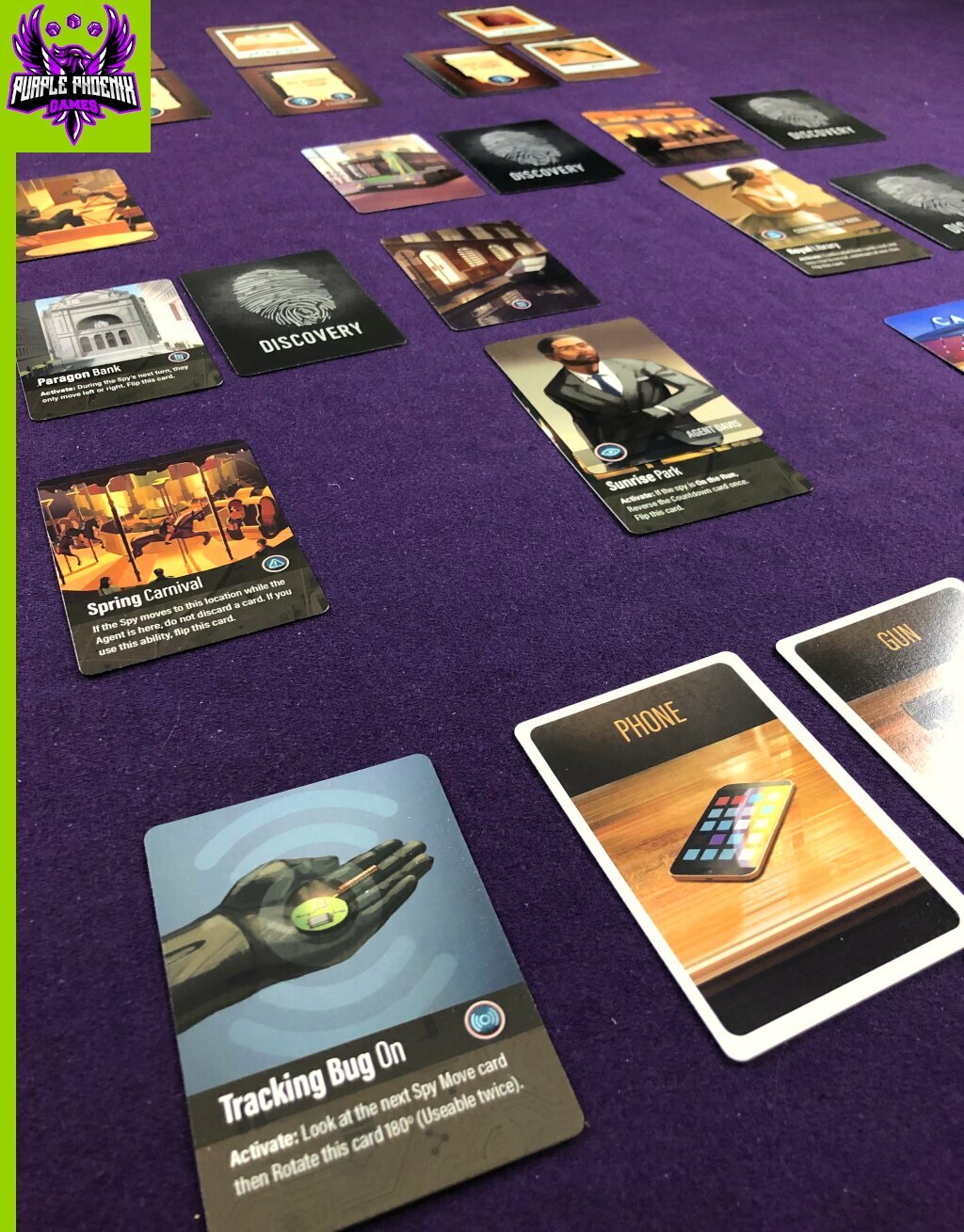
Another element required to win the game is to place the Tracking Bug on the Spy. On your turn, you may place the Tracking Bug at your current Location card – if the Spy moves to the Location on a future turn, they are considered to be ‘bugged’ and the Tracking Bug is live! Twice per game, you are allowed to Track the Spy. To do so, you will look at the top card of the Spy Movement deck, and return it to the top. This just lets you see to which Location the Spy is about to move. And finally, you can use your Location’s ability. Once you have taken as many of the additional actions as you want, it is time to move the Spy. Reveal the top card of the Spy Movement deck, and move the Spy in the appropriate direction to a new Location. At the Spy’s new Location, add a Discovery card to its pile. Play continues in this manner until either you make an accusation, or the Spy escapes. In order to make an accusation, you must have Evidence cards in hand, the Spy must be bugged, and you must be at the same Location as the Spy. When you make an accusation, you will reveal any remaining cards under the Evidence and Red Herring Case Files. If you have the 3 matching Evidence cards, you win and apprehend the Spy! BUT if you have the Red Herring card, or you are missing any of the required Evidence cards, you lose. If you haven’t made an accusation in time, the Spy could escape, causing you to lose the game as well – I’ll leave those details for you to discover on your own!
In theory, Harsh Shadows seems like a neat and strategic card game, but how does it hold up in reality? Pretty well, actually! The first thing I want to talk about is how strategic it is, even with its elements of deduction. You need to collect Evidence fast in order to catch the Spy, so what’s the best plan of movement? Also, each Location has a special ability, so is there an ability you need to use now or do you want to wait a bit longer? After using a Location’s ability, it is no longer available for the rest of the game, so you have to time those uses carefully. Along those lines comes the deduction. Sure, you can try to reveal all the Confiscated Items so that you’re 100% sure that you’ve got the right Evidence. But if you don’t work fast enough, the Spy could escape. Are you willing to risk only knowing for sure what 1 piece of Evidence in order to confront the Spy before it’s too late? Or do you want to save up Clues to purchase that coveted Red Herring, to know for sure what not to keep in order to win. There’s a balance of risk with deduction, as well as a real-time element in the sense that the game has a finite amount of rounds. You’re not racing a physical clock, but once the Discovery deck runs out, the Spy is considered to be on the run, on the verge of escaping. Overall, this is a casual card game, but it has a decent amount of strategy to keep you engaged and entertained.
Let’s touch on components for a second. Obviously, this is just a card game, and this is a preview copy. As I said earlier, the final production could differ from this version, but I have to say that this preview copy is good quality. The cards are nice and thick, the artwork thematic and clean. I imagine the rules would get some final edits for slight clarifications, but for the most part the production quality is already pretty decent.
I have to say that Harsh Shadows surprised me. I’d never played a solo game with deduction elements, and it was actually quite exciting. Usually the deduction games I’ve played are based around sussing out a traitor amongst a group of people, so there is that human interaction element that can really help guide your thoughts and decisions. In Harsh Shadows, there’s nobody but yourself – you can’t look for tells in other players because the cards won’t speak to you. It feels riskier in this way because it’s more a game of odds then, instead of your ability to pick out social cues. Other people may feel differently, but I thought this was a neat twist on the deduction mechanic. If you’re looking for a strategic solo game, that plays relatively quickly and casually, I would definitely recommend checking out Harsh Shadows. It goes live on Kickstarter here in April, and I look forward to following its progress!
Disclaimer: We were provided a copy of this game for the purposes of this preview. The pictured components might not be finalized, and could differ after a successful Kickstarter campaign. -L
Harsh Shadows is a solo card game of hand management, grid movement, and deduction where you are an agent working to collect evidence necessary to apprehend an enemy spy. To setup for a game, randomly place the 9 Location cards in a 3×3 grid. Prepare the Discovery deck as described in the rules, place 1 face-down Discovery card to the right of each Location, and place the rest of the deck off to the side of the grid. Shuffle the Confiscated Item cards and deal the appropriate number to each of the Case File cards – 3 to Evidence, 1 to Red Herring, and 4 to False Leads. The Spy card is placed on the upper-left-most Location, and your Agent card on the lower-right-most Location. Shuffle the Spy Movement cards, and the game is ready to begin! It should look similar to the picture below.
The game is played over a series of rounds in which you will be moving your Agent, performing additional actions, and then moving the Spy. The goal is to track down the Spy, with the correct evidence in hand, before the Spy is able to flee the scene. The first thing that you will do each round is to move your Agent. You may only move to a Location that is adjacent or diagonal to your current Location. Once you move to a new Location, you will draw the top Discovery card from that Location. Discovery cards will either be Items, Clues, or Bombs. Items are collected as potential Evidence, Clues are used to reveal Confiscated Items from Case Files, and Bombs force you to discard a card from your tableau. After you have moved and collected a new Discovery card, you may perform any/all of these additional actions: Use Clue Cards, Place the Tracking Bug, Track the Spy, or Use your current Location’s ability. To Use Clue cards, you will discard a number of clues in order to reveal a Confiscated Item card from a Case File. The Confiscated Items under the Evidence Case File show the 3 items you are required to have in hand to apprehend the Spy by the end of the game. The item under the Red Herring, if you have it in hand at game’s end, will cause you to automatically lose. The 4 items under the False Leads will neither help you win, nor cause you to lose – they simply offer fodder for you to discard when necessary.
Another element required to win the game is to place the Tracking Bug on the Spy. On your turn, you may place the Tracking Bug at your current Location card – if the Spy moves to the Location on a future turn, they are considered to be ‘bugged’ and the Tracking Bug is live! Twice per game, you are allowed to Track the Spy. To do so, you will look at the top card of the Spy Movement deck, and return it to the top. This just lets you see to which Location the Spy is about to move. And finally, you can use your Location’s ability. Once you have taken as many of the additional actions as you want, it is time to move the Spy. Reveal the top card of the Spy Movement deck, and move the Spy in the appropriate direction to a new Location. At the Spy’s new Location, add a Discovery card to its pile. Play continues in this manner until either you make an accusation, or the Spy escapes. In order to make an accusation, you must have Evidence cards in hand, the Spy must be bugged, and you must be at the same Location as the Spy. When you make an accusation, you will reveal any remaining cards under the Evidence and Red Herring Case Files. If you have the 3 matching Evidence cards, you win and apprehend the Spy! BUT if you have the Red Herring card, or you are missing any of the required Evidence cards, you lose. If you haven’t made an accusation in time, the Spy could escape, causing you to lose the game as well – I’ll leave those details for you to discover on your own!
In theory, Harsh Shadows seems like a neat and strategic card game, but how does it hold up in reality? Pretty well, actually! The first thing I want to talk about is how strategic it is, even with its elements of deduction. You need to collect Evidence fast in order to catch the Spy, so what’s the best plan of movement? Also, each Location has a special ability, so is there an ability you need to use now or do you want to wait a bit longer? After using a Location’s ability, it is no longer available for the rest of the game, so you have to time those uses carefully. Along those lines comes the deduction. Sure, you can try to reveal all the Confiscated Items so that you’re 100% sure that you’ve got the right Evidence. But if you don’t work fast enough, the Spy could escape. Are you willing to risk only knowing for sure what 1 piece of Evidence in order to confront the Spy before it’s too late? Or do you want to save up Clues to purchase that coveted Red Herring, to know for sure what not to keep in order to win. There’s a balance of risk with deduction, as well as a real-time element in the sense that the game has a finite amount of rounds. You’re not racing a physical clock, but once the Discovery deck runs out, the Spy is considered to be on the run, on the verge of escaping. Overall, this is a casual card game, but it has a decent amount of strategy to keep you engaged and entertained.
Let’s touch on components for a second. Obviously, this is just a card game, and this is a preview copy. As I said earlier, the final production could differ from this version, but I have to say that this preview copy is good quality. The cards are nice and thick, the artwork thematic and clean. I imagine the rules would get some final edits for slight clarifications, but for the most part the production quality is already pretty decent.
I have to say that Harsh Shadows surprised me. I’d never played a solo game with deduction elements, and it was actually quite exciting. Usually the deduction games I’ve played are based around sussing out a traitor amongst a group of people, so there is that human interaction element that can really help guide your thoughts and decisions. In Harsh Shadows, there’s nobody but yourself – you can’t look for tells in other players because the cards won’t speak to you. It feels riskier in this way because it’s more a game of odds then, instead of your ability to pick out social cues. Other people may feel differently, but I thought this was a neat twist on the deduction mechanic. If you’re looking for a strategic solo game, that plays relatively quickly and casually, I would definitely recommend checking out Harsh Shadows. It goes live on Kickstarter here in April, and I look forward to following its progress!