
Search

Hadley (567 KP) rated The Amazing Crime and Trial of Leopold and Loeb in Books
Apr 13, 2019
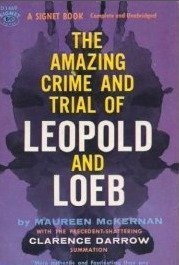

"The crime itself was indefensible. The brilliant, spoiled and bored sons of two of Chicago's wealthiest families planned to commit the perfect crime both for the thrill of and to prove their perverse misunderstanding of Friedrich Nietzsche's philosophy of the 'superman,' who was above all law so long as he made no mistake. Their plan, worked out over several months, was to kidnap and immediately kill one of their younger neighbors and hide his body. They would then demand and collect a ransom. The body would never be discovered, the crime would never be solved and only they would know that they had prevailed over ordinary human beings and their simple-minded legal system. But far from being the 'perfect crime,' the murder of 14-year-old Bobby Franks turned out to be amateurishly botched. Before any ransom could be paid, the boy's body was discovered in a culvert near where Nathan Leopold often went bird-watching. A pair of telltale glasses were found adjacent to the body. They were easily traced to Leopold who first came up with a paper-thin alibi and soon thereafter confessed to the crime. His fellow murderer likewise confessed. Each of the 'superboys' placed blame for the actual killing on the other." - Alan M. Dershowitz
If you mentioned the names Leopold and Loeb today, many people wouldn't know who you were talking about, but if you had mentioned them just thirty years ago, many people would recall the 'murder of the century.'
If you are a fan of the True Crime genre, you'll come across the case of two wealthy Chicago boys who thought they could get away with murder. (The trial is probably the most talked about trial to-date because this is the first time that psychology was brought before a court room.)
For a good part of the late 1920's, Leopold and Loeb were household names for good reason: they came from millionaire families, they were college graduates before they were 18-years-old, and their trial was the first time in history that the world saw psychology put in front of a judge. The trial was even more unforgettable due to a closing speech given by famous defense attorney, Clarence Darrow, which is reprinted in its entirety,spanning a hefty 93 pages.
Nathan Leopold, Jr. and Richard Loeb were two people who should have never met, according to the courtroom. The two met at about the age of fifteen, soon after they began to embark on criminal acts together, ranging from theft to arson. It's stated in 'the Amazing Crime and Trial of Leopold and Loeb' that Loeb had created a fantasy world where he was a crime ringleader that was too smart for the police to catch. Readers get to judge for themselves whether or not they believe Loeb was the cause of their crimes, or if Leopold was the one really in charge.
After robbing Loeb's fraternity house together, Leopold and Loeb came up with a plan to kidnap a wealthy child that they could then ransom. "They began to devise elaborate plans for this kidnapping, and soon the planning became the all-important thing. They gave up the idea of kidnapping this particular person [a young man named William], and settled on the idea of kidnapping anyone who would fit in their kidnapping plans." Throughout the book, we find out that the boys were pretty desperate for a kidnapping victim, that they even thought about kidnapping one of their close friends:
"The plan of kidnaping Dick Rubel was given up because Dick Rubel's father was so tight we might not get any money from him."
Leopold and Loeb discussed everything from how they would receive the ransom, what weapons they would use, how they would get the victim inside a rented vehicle, and what they would do with the body afterwards. "In March, 1924, the patient [Loeb] conceived the idea of securing the money by having it thrown off a moving train. This idea was discussed in great detail, and gradually developed into a carefully systematized plan. As time wore on the plan became greatly modified from the original one. They discussed at considerable length the choice of a suitable subject for kidnapping. The patient's companion [Leopold] suggested that they kidnap a young girl instead of a boy, but the patient [Loeb] objected to this. His companion [Leopold] also suggested that they kidnap the patient's [Loeb] younger brother, but the patient apparently did not seriously consider doing this. They then considered half a dozen boys, any one of whom would do, for the following reasons: that they were physically small enough to be easily handled and their parents were extremely wealthy and would have no difficulty or disinclination to pay ransom money."
During the trial, Leopold and Loeb's psychological evaluations became the forefront of their guilty plea, stating that they were not responsible for their actions due to their upbringing and environment. "I submit the facts do not rest on the evidence of these boys alone. It is proven by the writings; it is proven by every act. It is proven by their companions, and there can by no question about it." Clarence Darrow explains in his famous closing statement. "We brought into this courtroom a number of their boy friends, whom they had known day by day, who had associated with them in the club house, were their constant companions, and they tell the same stories. They tell the story that neither of these two boys was responsible for his conduct."
'The Amazing Crime and Trial of Leopold and Loeb' contains the portions of the psychiatric evaluations that were submitted in court,but the testimony of character witnesses is omitted. For a factual telling of a real life trial, this book is okay. If the reader pays attention, they may notice that some of the book contradicts itself, such as one page states that the car robe used to wrap up Franks' body was found buried near Lake Michigan,but then pages later, the book states it had been burned at Loeb's home.
The psychiatric reports are very repetitive,just using different words to describe the same things. Yet, these reports are the backbone of the trial and well worth a read. The evaluations and Darrow's extensive speech were what saved Leopold and Loeb from a death sentence.
There are very few books written about the 'murder of the century,' and even less about the 'lawyer of the century.' Leopold and Loeb, as well as Darrow, have faded into the obscurity of the True Crime genre, but because the boys' mental state was brought into question, we now accept forensic science/psychology in the court room today. I feel that only people who are truly interested in True Crime, or even have a fascination for the court room are the only ones who will enjoy 'The Amazing Crime and Trial of Leopold and Loeb.'

Mothergamer (1664 KP) rated The Last of Us in Video Games
Apr 3, 2019

I have been slowly but surely going through my backlog of games, so I chose The Last Of Us Remastered to play next because I have been curious about it and many of my friends have been telling me I needed to play this game. To them I say you were right. I did need to play this game because it wasn't just fun to play; it was phenomenal story telling. When a game's story has me getting choked up about something within the first few minutes, I know it's going to be a heck of a ride and be great.
I couldn't help, but like Joel. This is a character that has been through something that is so devastating to him and yet somehow he's kept going on and had to do things that are not necessarily good, but that he felt had to be done in order to keep surviving especially since the world as everyone knows it has ended and a post-apocalyptic world is the new normal.
Is Joel a good person? No, not really. He's not really a terrible person either. His partner Tess was interesting also and she's another character that's not really good or evil. The Last Of Us really showcases that this world isn't really that black and white; there are varying shades of grey and not everyone is completely good or bad and that many of the people are just trying to survive any way they can.
It wasn't long before the story progressed to meeting Ellie. I loved Ellie. She was this mouthy 14 year old kid, but you come to realize that a lot of why she's like that is because she's scared of losing those she cares about and having to parent herself. In spite of that, Ellie always managed to dig down deep and find the courage to do what needed to be done and I admired and respected that level of strength in her. The interaction between Ellie and Joel at first was rather terse, but I understood that was normal especially for Joel because he just wanted to finish the mission and not get attached.
I really got into it because the game was that good for me. The combat controls are great; not clunky at all. Sometimes I would get nailed by an infected and have to start over from that point (I really HATE the Clickers and Bloaters, they're terrifying), but I didn't really mind because I was enjoying the story and wanted to know what happened next. There are human factions as well such as military, the Fireflies, and Hunters. This is definitely a game for adults because of how dark the story can be at certain points and because of the harsh violence.
Infected are scary!
The environments in the game are beautifully done. I found myself stopping and just looking at everything often. From riding a horse in the woods to an abandoned college campus with a herd of giraffes, all of it looks great and really stands out. The music in the game is perfectly done as well with some hauntingly beautiful melodies that add to the emotions of moments in the story.
Horse riding in the woods
Even an abandoned campus can be pretty
There were points in the story where I got pretty emotional because I came to care about the characters. I had to remind myself it was just a game, but it was difficult especially when it came to the characters of Henry and Sam. I actually had to walk away for a few minutes because I was so saddened by what happened to them especially with Sam because he and Ellie were close to the same age and they had bonded and became friends.
The big thing that stood out for me is the relationship between Joel and Ellie. I loved how it slowly progressed from Joel being reluctant about getting to know Ellie to during some slower moments like navigating an area to look for supplies there would be a bit of talking between them back and forth about different things such as what a type of video game was like or that an ice cream truck was a real thing. I also found myself chuckling at some of the awful puns that Ellie would read from her book of puns.
As I got further in the game I recognized that Joel is a very angry and desperate man, but when it came to Ellie he could have these moments of kindness and really seemed to look out for her. The story isn't in your face about it and it becomes this gradual evolution of Joel treating her like a daughter and her coming to trust him while they both support each other in a situation that is pretty dangerous and exhausting on many levels. It's poignant and the emotions from both characters is so incredible that it draws you into the story fully which shows how fantastic the voice acting was in this.
Joel and Ellie watching some giraffes.
When I got to the ending of the game, it made me think about a lot. It made me ask questions like could I do what Joel had done? Was the leader of the Fireflies right about sacrificing a few for the many? It brought up a lot of ideas about the choices that people have to make in this world and not all of them are easy; much of it involves hard choices. I liked the ending, but it definitely wasn't a sunshine happy ending because that's not the kind of game The Last of Us is.
I played the Left Behind DLC also and I thought it was interesting to get a chance to see what Ellie was like before she met Joel. It also shows you some moments that are pivotal in the main story line that focus on Ellie which are also great. I liked the interaction between her and Riley because it brings some lightheartedness to the game with them just being kids and having fun, forgetting about the dark things going on in their world for a moment. It also shows some great emotional moments between Ellie and Riley that don't feel forced and seem to happen quite naturally. Of course the cheerful stuff only lasts for so long and then it's back to some very sad things happening. The final conversation between Ellie and Riley just before Left Behind ends had me choking back some tears because it was this heartfelt moment between two characters that truly cared for and loved each other.
Ellie and Riley having fun in a photo booth.
This is exactly why I loved The Last Of Us. It is hands down one of the best games I've ever played because of how intelligent the writing for this was creating a game that is perfectly story driven with some very memorable characters; characters that you find yourself caring about a great deal. The exploration of the various relationships are wonderfully executed making for a fantastic gaming and story experience. The game play is excellent and it shows that a lot of thought was put into getting things just right. The Last Of Us is a game title that I am thrilled to have in my gaming collection and it's absolutely worth playing.
Cynthia Armistead (17 KP) rated Enthralled: Paranormal Diversions in Books
Mar 1, 2018


Journeys, literal or otherwise, are the theme of this young adult anthology. Appropriately enough, it was conceived as the result of a book tour.
"Giovanni’s Farewell" by [a:Claudia Gray|1192311|Claudia Gray|http://photo.goodreads.com/authors/1234643683p2/1192311.jpg] is a sweet, coming-of-age story of sorts. The twist is that it features a brother and sister, twins, rather than just one person. They visit Rome with a school group while dealing with major changes in their lives. There was too much background crammed into a short story, but it was interesting.
[a:Carrie Ryan|1443712|Carrie Ryan|http://photo.goodreads.com/authors/1343410049p2/1443712.jpg]'s "Scenic Route" is a disturbing, post-apocalyptic story set in the world of [b:The Forest of Hands and Teeth|3432478|The Forest of Hands and Teeth (The Forest of Hands and Teeth, #1)|Carrie Ryan|http://photo.goodreads.com/books/1320633297s/3432478.jpg|3473471] about two young sisters trying to survive in an isolated cabin. The older sister keeps the younger one occupied with the planning of a road trip that will never happen, always hoping against hope that the girl won't realize what their reality is. How long can they stay isolated enough to survive? Bloody, frightening, and visceral.
"Red Run" by [a:Kami Garcia|2895706|Kami Garcia|http://photo.goodreads.com/authors/1289693388p2/2895706.jpg] is the story of a girl who has lost the only person she loves in the world, and the trip she takes to avenge his death. How do you hunt a ghost? Maybe it isn't fair, coming right after Ryan's story, but I didn't truly feel the main character's feelings.
[a:Jackson Pearce|2761947|Jackson Pearce|http://photo.goodreads.com/authors/1336840299p2/2761947.jpg]'s "Things About Love" is a sweet story involving a jinn researching love. I felt like I'd come into the middle of something, so I checked and found that she's written a novel, [b:As You Wish|6750586|As You Wish|Jackson Pearce|http://photo.goodreads.com/books/1319175193s/6750586.jpg|6217232], in the same setting. While this story technically stands on its own, it would probably be enriched by having read As You Wish.
"Niederwald" by [a:Rachel Vincent|415967|Rachel Vincent|http://photo.goodreads.com/authors/1262900481p2/415967.jpg] is the first story I've read in her Soul Screamers series. Sabine, a macha (nightmare), takes a road trip with a human acquaintance and detours to Niederwald, Texas, home to the harpies. No, there's no way that could go wrong. Of course you know from the moment they hit the parking lot that it will go wrong, but at least it's an interesting sort of wrong.
[a:Melissa Marr|175855|Melissa Marr|http://photo.goodreads.com/authors/1192302741p2/175855.jpg]'s "Merely Mortal" feels as though it's probably set in the same world as her Wicked Lovely series.
"Facing Facts" by [a:Kelley Armstrong|7581|Kelley Armstrong|http://photo.goodreads.com/authors/1199068298p2/7581.jpg] is set in her Darkest Powers universe. I read the first of those books, but obviously a lot has passed since then, and there were spoilers in this story. It really centers around Chloe and Tori, with a little Derek tossed in. Tori learns something she doesn't want to know and reacts badly, running off on her own, which is dangerous. Chloe goes after her and they get into trouble. That seemed rather predictable to me, but at least the type of trouble wasn't what I expected. Tori doesn't seem to have changed since the first book, but Chloe is coming into control of her abilities.
[a:Sarah Rees Brennan|836009|Sarah Rees Brennan|http://photo.goodreads.com/authors/1254149255p2/836009.jpg]'s "Let’s Get this Undead Show on the Road" is about a boy band that features a vampire, Christian. He's an unusual vampire, all alone without a nest or a sire. His journey seems to be about his identity as a vampire, although the band is on tour and has another sort of journey to make, as well.
"Bridge" by [a:Jeri Smith-Ready|56019|Jeri Smith-Ready|http://photo.goodreads.com/authors/1204922569p2/56019.jpg] is told from a ghost's point of view, 233 days after death. It's frustrating being a ghost, because most people can't see or hear you. There are things you have to accomplish before moving on, though, that require communication with the living. Finding a "bridge" and working things out takes a lot of effort. This was a touching story, bittersweet and well-told.
[a:Kimberly Derting|2755160|Kimberly Derting|http://photo.goodreads.com/authors/1229976464p2/2755160.jpg]'s "Skin Contact" nearly broke me. Rafe is looking for his girlfriend. He knows where he needs to go, and he's guided by dreams. This story nearly broke me. It's told sparingly, and something feels perfectly right about it, but it hurts. According to her author biography, Rafe was introduced in her novel Desires of the Dead.
"Leaving" by [a:Ally Condie|1304470|Ally Condie|http://photo.goodreads.com/authors/1325882614p2/1304470.jpg] is a very literary story, about a girl left behind after her mother dies and her father leaves. She spends the story preparing to go after her father. It's hard to describe much more than that, or to have much of an opinion. It was well-written and I think I'll probably remember it for a long time.
[a:Jessica Verday|1290625|Jessica Verday|http://photo.goodreads.com/authors/1243816082p2/1290625.jpg]'s "At The Late Night, Double Feature, Picture Show" is a darkly funny story about a girl from a family of monster hunters. She's usually the bait, but tonight she has decided to be the hunter — without backup. I'd like to read more from Verday.
"IV League" by [a:Margaret Stohl|2895707|Margaret Stohl|http://photo.goodreads.com/authors/1241421033p2/2895707.jpg] just didn't hit me right. It's the story of a bunch of southern vampires on a college tour, which could have been funny but wasn't written that way. The whole thing just didn't sit well with me, perhaps because the main character seemed too unrealistically out of touch for someone who obviously had access to television and the internet.
[a:Mary E. Pearson|123463|Mary E. Pearson|http://photo.goodreads.com/authors/1238978651p2/123463.jpg]'s "Gargouille" is the most touching love story in the collection. Just read it.
"The Third Kind" by [a:Jennifer Lynn Barnes|164187|Jennifer Lynn Barnes|http://photo.goodreads.com/authors/1243935916p2/164187.jpg] is, on the surface, about a road trip to San Antonio. The real journey is much deeper, one of coming to understanding one's calling.
[a:Rachel Caine|15292|Rachel Caine|http://photo.goodreads.com/authors/1272650500p2/15292.jpg]'s Morganville is the setting for her "Automatic." I think I've read a Morganville novella, but my memory of it is dim. The Morganville Blood Bank introduces an automated withdrawal machine, essentially a soda can dispenser. Michael Glass is ordered to try it first, as a demonstration for the older, more traditional vampires, with unexpected results. His journey is one of self-knowledge. I didn't really care much about him, his journey, his girlfriend, or anything else. The setting and characters do nothing for me, but your mileage may vary.
Altogether, the anthology was worth reading. There were some low spots, but that's true of any collection. To be fair, I'm sure someone who is more enthusiastic about young adult fiction would also be more enthusiastic about the works here.