
Search
Search results
Purple Phoenix Games (2266 KP) rated Lonely Undead in Tabletop Games
May 24, 2021

“I’m so hungry I could eat a horse.” Now, this is an acceptable saying that one might utter flippantly to anyone around them. However, “I’m so lonely I could bite the town Mayor” is generally something that would raise some eyebrows or nervous smiles from eavesdroppers. But why, I ask. Why are we okay with eating horses but not simply biting another human? Probably because of laws. I get that. But sometimes you just need a friend. Someone… like you.
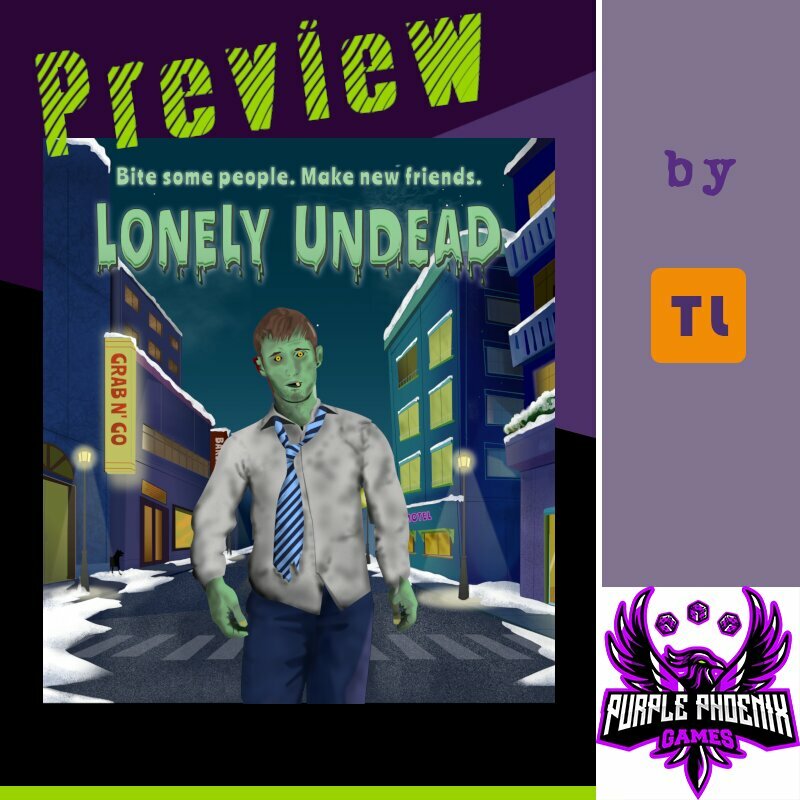
Lonely Undead is a hand management, grid movement, zombie adventure game for one to four players with a super crazy theme. In it, players are Zs looking to make some friends in the neighborhood, but most unturnt neighbors are keeping their distance. So what’s a Z to do? Go bite and infect people so they can be friends forever, of course!
DISCLAIMER: We were provided a prototype copy of this game for the purposes of this review. These are preview copy components, and I do not know for sure if the final components will be any different from these shown. Also, it is not my intention to detail every rule in the game, as there are just too many. This preview will be highlighting the co-op mode with two players. You are invited to download the rulebook, back the game through the Kickstarter campaign, or through any retailers stocking it after fulfillment. -T
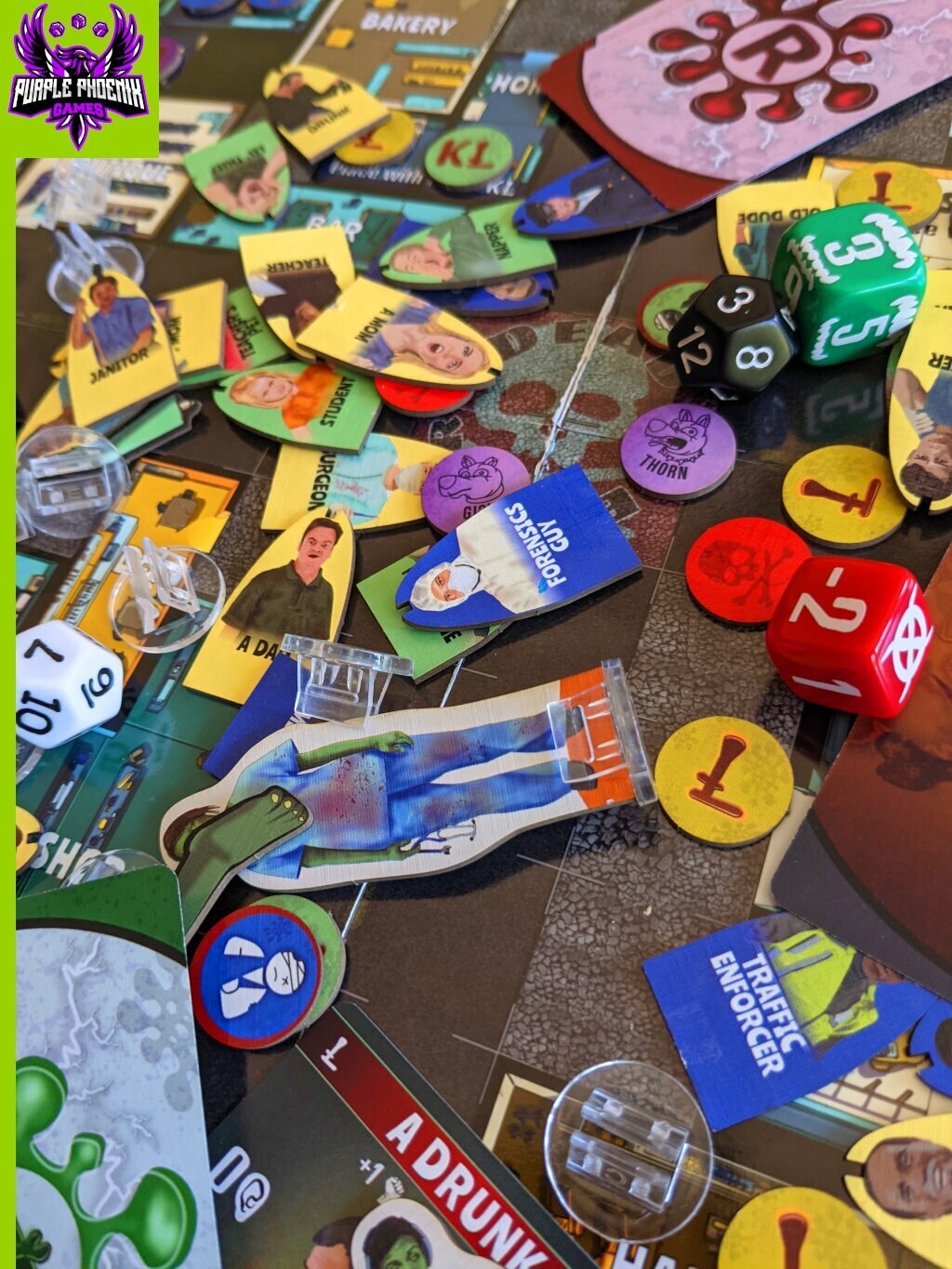
To setup, lay out the board somewhere on the table (thankfully the rules do not specify where, so go ahead and be a bit off-center this time). Zs (the players) all start in “Dead Center” of the board. The rulebook indicated how to construct the Living deck, and each deck of different types of cards should be shuffled and put in their place either on the board or just off it. For sake of ease, use the rulebook’s suggested placement of Living (so, NOT the Zs) tokens. Each player receives or chooses a Z to embody, receives two Aid cards, four Limbs, and the game is setup and ready to begin!
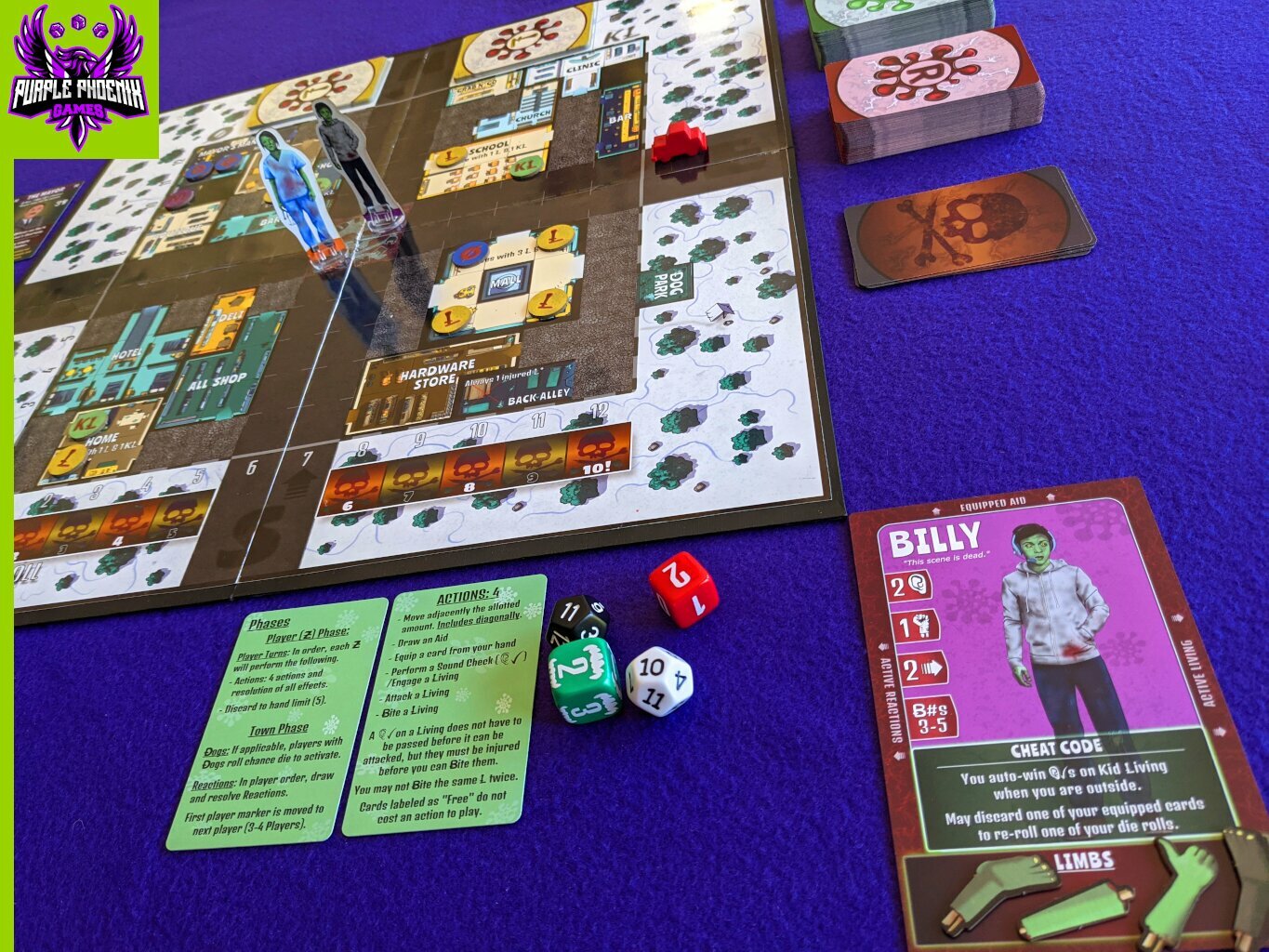
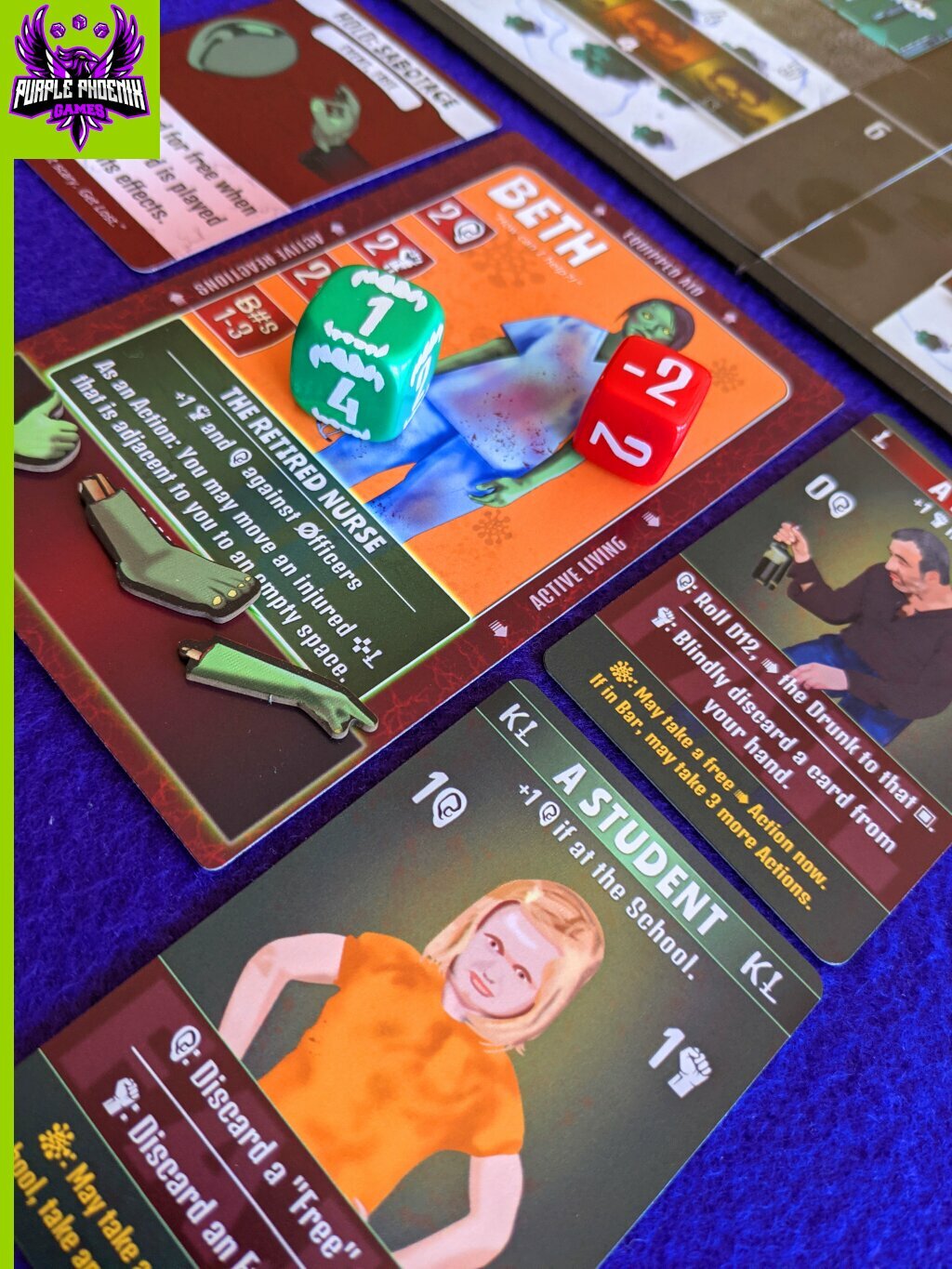
Lonely Undead is played over a series of rounds, with each round consisting of two phases: Z Phase and Town Phase. During the Z Phase, the active player will have four actions they may take from the following choices: Movement, Draw an Aid Card, Equip a Card, Sound Check, Attack, and Bite. Each Z has their own unique card with their special actions and other stats. A Z may move up to their Movement amount,including diagonally, for one action.
Aid Cards are very helpful to Zs, and for an action a Z may Draw an Aid Card to their hand. Aid Cards could be stat modifiers, or other special actions available to be used. Some Aid Cards are free to use, but if that text is not on the card, a Z will need to spend an action to Equip a Card to their Z.
When the Z is adjacent to a Living token, they must Sound Check it in order to identify the kind of Living they are stalking. To do this a Z rolls the Chance Die and applies any modifier rolled to their base stat on their card for hearing. This is compared against the Living card that is drawn to see if the Living notices the hunting Z. If the Z is successful in this Sound Check (winning all ties), then the Z may continue with their turn. If the Z fails the check, however, the Z will suffer the consequence detailed on the Living’s card. Once the Living has been identified through a Sound Check (successfully or not), the Z may next Attack the Living by rolling the Chance Die again and applying the modifier to the base attack stat. If successful, the Z flips the Living token over to reveal the injured side, notating that the Living does not need to be Sound Checked again, and is ripe for the bitening. If the Z fails an Attack, though, they will suffer any consequences detailed on the Living’s card. When a Living is injured, they are vulnerable to a Z’s Bite. The Z will roll the special Bite die in an attempt to meet their Bite range on the Z’s character card. A successful Bite means the Z collects a friend and moves that much closer to victory! A failed Bite means the Z must place a color-matched Bite token on the Living standee to signify they cannot be Bitten by that same Z again.
Once a Z has taken their turn, they will draw a Reaction card from its pile. Reactions could be either beneficial to the Z, or could be very very bad news. Some Reaction cards bring Dogs into the game, and these Dogs chase and bite the Zs that drew them. Every Dog bite causes damage to the Z and after all their Limbs are gone, they are perma-dead and out of the game. Other Reactions could cause a Car to zoom down the street, mowing over anything in their path (Zs, Dogs, Living, etc).
In the cooperative mode, players work together to gain 15 friends before 10 Living perish and are placed on the Death Toll tracker. Every two Living tokens on the Death Toll tracker forces the players to draw and enact a Death Toll card. Once the win condition is met the players win!
Components. Again, this is a prototype copy of the game, so components will probably be a bit different in the final version. That said, I do have some opinions here. Firstly, there are a LOT of components included in this game. I am sure that they will all receive some kind of improvement in the final copy, so I will not comment on quality. I was able to play the prototype several times and had no problems with the components doing their job. I do have a comment on the art style. It’s just not my favorite. Now, this is obviously personal opinion, and it certainly does does not turn me off from the game at all. I just need to get it out to the aether that a different art style or genre may fit the game a bit better.
That all said, I THOROUGHLY enjoyed all my plays of Lonely Undead. Once the turns start cookin, you just don’t want to stop playing. Yes, there are random events or spawns that cause some chaos for our heroes, chief of which are the Dogs. Those little buggers will chase you all over town to get that juicy bite off and take one of your Limbs. I hate to say this, but there were many times I hoped to draw a Car card so that it could run over the Dogs (now, in real life I love dogs, but they are perfectly annoying in Lonely Undead). The variety of Z special powers lead to interesting combinations when playing co-op or competitively. However, I honestly prefer the co-op mode here.
In co-op, players are (obviously) working together to Bite and infect as many Living as they possibly can. This makes for some strategic placement between players, as well as combat tactics when Livings are clustered together in a building. Perhaps one Z is better at handling Officers, while another can more easily prey upon Livings from outside areas. Being able to set strategies and tactics by working together has made for some very excellent gaming experiences.
I’m going to be honest, as I always try to do. When I opened up Lonely Undead and saw the art style, I was a bit turned off. But, as I learned the game and played through it several times, I grew to really enjoy the game. I think it’s a great example of taking a tired theme and breathing a bit of new life into it. Yes, zombies are trying to eat people, but typically in zombie games the players are working AGAINST the zombies, not AS the zombies. I think this is a very clever spin. I have certainly and purposefully left out a few rules as surprises for gamers who decide to back this one, and I would recommend that you at least check out the Kickstarter campaign. This may not be for everyone, and even if the art doesn’t change, it is definitely for me. Kudos to Shelby Matussak and Dead Lemon Games for a fine first entry into the gaming world.
CHOMP!
Lonely Undead is a hand management, grid movement, zombie adventure game for one to four players with a super crazy theme. In it, players are Zs looking to make some friends in the neighborhood, but most unturnt neighbors are keeping their distance. So what’s a Z to do? Go bite and infect people so they can be friends forever, of course!
DISCLAIMER: We were provided a prototype copy of this game for the purposes of this review. These are preview copy components, and I do not know for sure if the final components will be any different from these shown. Also, it is not my intention to detail every rule in the game, as there are just too many. This preview will be highlighting the co-op mode with two players. You are invited to download the rulebook, back the game through the Kickstarter campaign, or through any retailers stocking it after fulfillment. -T
To setup, lay out the board somewhere on the table (thankfully the rules do not specify where, so go ahead and be a bit off-center this time). Zs (the players) all start in “Dead Center” of the board. The rulebook indicated how to construct the Living deck, and each deck of different types of cards should be shuffled and put in their place either on the board or just off it. For sake of ease, use the rulebook’s suggested placement of Living (so, NOT the Zs) tokens. Each player receives or chooses a Z to embody, receives two Aid cards, four Limbs, and the game is setup and ready to begin!
Lonely Undead is played over a series of rounds, with each round consisting of two phases: Z Phase and Town Phase. During the Z Phase, the active player will have four actions they may take from the following choices: Movement, Draw an Aid Card, Equip a Card, Sound Check, Attack, and Bite. Each Z has their own unique card with their special actions and other stats. A Z may move up to their Movement amount,including diagonally, for one action.
Aid Cards are very helpful to Zs, and for an action a Z may Draw an Aid Card to their hand. Aid Cards could be stat modifiers, or other special actions available to be used. Some Aid Cards are free to use, but if that text is not on the card, a Z will need to spend an action to Equip a Card to their Z.
When the Z is adjacent to a Living token, they must Sound Check it in order to identify the kind of Living they are stalking. To do this a Z rolls the Chance Die and applies any modifier rolled to their base stat on their card for hearing. This is compared against the Living card that is drawn to see if the Living notices the hunting Z. If the Z is successful in this Sound Check (winning all ties), then the Z may continue with their turn. If the Z fails the check, however, the Z will suffer the consequence detailed on the Living’s card. Once the Living has been identified through a Sound Check (successfully or not), the Z may next Attack the Living by rolling the Chance Die again and applying the modifier to the base attack stat. If successful, the Z flips the Living token over to reveal the injured side, notating that the Living does not need to be Sound Checked again, and is ripe for the bitening. If the Z fails an Attack, though, they will suffer any consequences detailed on the Living’s card. When a Living is injured, they are vulnerable to a Z’s Bite. The Z will roll the special Bite die in an attempt to meet their Bite range on the Z’s character card. A successful Bite means the Z collects a friend and moves that much closer to victory! A failed Bite means the Z must place a color-matched Bite token on the Living standee to signify they cannot be Bitten by that same Z again.
Once a Z has taken their turn, they will draw a Reaction card from its pile. Reactions could be either beneficial to the Z, or could be very very bad news. Some Reaction cards bring Dogs into the game, and these Dogs chase and bite the Zs that drew them. Every Dog bite causes damage to the Z and after all their Limbs are gone, they are perma-dead and out of the game. Other Reactions could cause a Car to zoom down the street, mowing over anything in their path (Zs, Dogs, Living, etc).
In the cooperative mode, players work together to gain 15 friends before 10 Living perish and are placed on the Death Toll tracker. Every two Living tokens on the Death Toll tracker forces the players to draw and enact a Death Toll card. Once the win condition is met the players win!
Components. Again, this is a prototype copy of the game, so components will probably be a bit different in the final version. That said, I do have some opinions here. Firstly, there are a LOT of components included in this game. I am sure that they will all receive some kind of improvement in the final copy, so I will not comment on quality. I was able to play the prototype several times and had no problems with the components doing their job. I do have a comment on the art style. It’s just not my favorite. Now, this is obviously personal opinion, and it certainly does does not turn me off from the game at all. I just need to get it out to the aether that a different art style or genre may fit the game a bit better.
That all said, I THOROUGHLY enjoyed all my plays of Lonely Undead. Once the turns start cookin, you just don’t want to stop playing. Yes, there are random events or spawns that cause some chaos for our heroes, chief of which are the Dogs. Those little buggers will chase you all over town to get that juicy bite off and take one of your Limbs. I hate to say this, but there were many times I hoped to draw a Car card so that it could run over the Dogs (now, in real life I love dogs, but they are perfectly annoying in Lonely Undead). The variety of Z special powers lead to interesting combinations when playing co-op or competitively. However, I honestly prefer the co-op mode here.
In co-op, players are (obviously) working together to Bite and infect as many Living as they possibly can. This makes for some strategic placement between players, as well as combat tactics when Livings are clustered together in a building. Perhaps one Z is better at handling Officers, while another can more easily prey upon Livings from outside areas. Being able to set strategies and tactics by working together has made for some very excellent gaming experiences.
I’m going to be honest, as I always try to do. When I opened up Lonely Undead and saw the art style, I was a bit turned off. But, as I learned the game and played through it several times, I grew to really enjoy the game. I think it’s a great example of taking a tired theme and breathing a bit of new life into it. Yes, zombies are trying to eat people, but typically in zombie games the players are working AGAINST the zombies, not AS the zombies. I think this is a very clever spin. I have certainly and purposefully left out a few rules as surprises for gamers who decide to back this one, and I would recommend that you at least check out the Kickstarter campaign. This may not be for everyone, and even if the art doesn’t change, it is definitely for me. Kudos to Shelby Matussak and Dead Lemon Games for a fine first entry into the gaming world.
CHOMP!
A Bibliophagist (113 KP) rated Scythe (Arc of a Scythe #1) in Books
Jan 27, 2020
Well written (3 more)
Unique plot
Less YA tropes
No teen angst and romance
Not your typical YA
I approached this book with little expectation. I saw it cluttering up my feed on Instagram and being posted by everyone. I liked the cover (I'm a sucker for good covers and any YA without a photo manipulated monstrosity catches my eye). However every time I picked it up in the store and read the back and I just wasn't interested.
So in a New year new me moment, I forced myself to pick up two popular books that I was not interested in. Since they were both YA, they'd be quick reads and my expectations could below. I also forced my picks to not be hard SciFi, as I need to step out of my comfort zone. I picked this up, and developed more concern when I noticed how divided the reviews were, I noticed people were either firmly in the "this is my most favorite book ever" or in the "this is the most boring book ever I hated it" camps. I rarely rate books 1 or 5, so I wanted to see how I felt.
Honestly, I was very pleasantly surprised. This book is YA, and obviously has some YA aspects, but it doesn't follow the tropes unless stripped down to bullet points and is surprisingly well written. This well written aspect, with no intentions of making people mad, I think is why so many found it boring. If you primarily read YA, and are used to it's over the top writing, it's over the top dialogue and relationships and emotions, then yes, this book was probably horribly boring.
We do open with the standard tropes of uninteresting, normal girl and boy get thrown into something extraordinary. But that's where the stereotypes ended for me. The author quickly throws us into the world and the events of the story. We're in the future, who knows how far past the present, where society has overcome death. AI has evolved and "The Cloud" is now "The Thunderhead" a massive AI database that has solved most of the world's problems, eliminated poverty, war, government, created jobs for everyone, and even defeated death. We all have healing nanites that prevent illness and repair injury, and even in the case of death, we can be revived at a revival center and be greeted with some tasty ice cream. If we start feeling our age, we can just "turn a corner" resetting ourselves to a younger version of ourselves while retaining our memories.
Now, in a world without death, but babies are still being born, some form of population control is in order, the balance must be restored. So the world created the Scythedom. An organization outside the authority of "The Thunderhead" because death has and always should be a responsibility of the living. Those who become Scythes, must "Glean" (permanently kill) a quota of people every year to maintain population control. How they do so is up to them, but there are rules, a Scythe cannot show bias or malice in their choices, they cannot marry or have a family, they cannot kill another Scythe (but they can glean themselves) or someone with immunity, They may grant immunity to those they feel worthy, they must kill the families of those who resist, and they are above all other laws. The vagueness of these laws worked when the Scythedom was first created, but the world has become complicated, and some people have decided to find joy in what they do, even if it's killing.
Our story follows two teenagers who recently encountered the Honorable Scythe Faraday, Citra, and Rowan. Citra showed gumption and sass and moral balance, and Rowan held the hand of a boy that was not his friend as he was gleaned. Faraday is considered old school and chooses all that is gleaned by old school, age of mortality statistics. If a percentage of teenagers died in alcohol-related car accidents, he found a teenager with a penchant for drinking, who just got a car, and gleaned them. He believes the job is necessary, but should never be enjoyed, you need to be moral and compassionate and hurt every time. He is granted permission to take on an apprentice, and he takes on two, Rowan and Citra. Neither want it, nor should they, but should they become a Scythe, their families will receive immunity as long as they shall live, which in this day in age could be forever. So, reluctantly they both take it. There is a glamour to Scythedom as well, they'll wat for nothing, people will bend over backward to provide them with their desires in the hopes of immunity. If these two follow the teachings of Faraday, they won't be tempted by this, they won't abuse it, but not everyone feels the same way.
Citra and Rowan begin training (it gets a bit YAish here) studying history, poisons, combat, weapons. The goal to make them perfect, moral, compassionate, killing machines. Everything is going as well as it can, and luckily the book doesn't do what every other YA author would do and give us pages upon pages of the two falling in love, awkward encounters, stolen kisses. We have none of that thankfully. The dialogue is all purposeful and helps propel the plot, not flowery passages talking about teenage angst and feelings. But, it is a book, after all, so everything starts falling apart when a group of "New Age" Scythes, Scythes that believe they should enjoy their jobs, who take pleasure in mass killings (entire flights, festivals, food courts) stir things up at a Scythe Conclave meeting. They question if having two apprentices hurts whether or not the Conclave can judge the worthiness of either, or if them being friends will result in them always helping each other. How can they truly judge their ability if they always have each other's support? So they propose, since no law prevents it, that whichever apprentice should be chosen (remember Faraday was given permission to have ONE apprentice) will have to Glean the other. The Lead Scythe allows it, and honestly, this is one aspect of the book I struggled with, but I think was supposed to express the corruption of the Scythedom, at times when things aren't in writing they say "welp can't do it" and other times they say "welp nothing says we can't do it". Faraday attempts to free our two protagonists from their apprenticeships, but instead, they are separated, one going to a respected Old School Scythe, one going to the very modern group that started this whole problem, thrusting them into a world excess, deprivation, and honestly psychotic murdering. They now train, separately, knowing that one will die unless they can figure out a way to change things.
Even writing that sounds so Yaish, but it doesn't feel that way because it's so well written. The author doesn't give us Romeo and Juliet, no pining, no romance, just two kids trying to be that, good. Even when surrounded by something very bad. So, if you want to star crossed lovers, you won't like this book. If you like character development and struggle, you might like this book. We arguably see more of Rowan's development, Citra for me felt less focused on or given fewer opportunities for growth, and she had a bit of an attitude that made me no like her much, but given her circumstances, I UNDERSTOOD why she was the way she is, and I can't say I wouldn't be just as grumpy. If anything her response to the corruption and the situation felt very real, even if it sacrificed having a manic pixie daydream mary sue to project myself into. While appearances weren't really given for the two, setting them up to be good old fashioned Mary Sue and Gary Stu, they were very much their own people, with little room for the reader to pretend to be them. So another star in the breaking the YA mold category. We watch them struggle with where they are, and how to come to terms with their inevitable future, either being takers of life or having their life taken.
Overall this was refreshing, while it was an easy read and was a good "palette cleanser" and m boyfriend calls my YA marathons in between books that actually linger in my soul. It felt elevated, sure it was still very much YA, but it was more thought out than the standard, it focused on the story and not the romance, it focused on important things, and it never lost sight of its story. I started at 11am on a Sunday and Finished by noon on Monday, eager for the next. It was an unexpected, refreshing read, with a unique concept that has room for more. The sequel doesn't feel forced, and if I never got it, this story is finished, but the world and situation created to allow for more, without feeling like a forced trilogy. I wanted to know how this story was going to play out, and now that it has, I want to know how the next story in this set up plays out.
So in a New year new me moment, I forced myself to pick up two popular books that I was not interested in. Since they were both YA, they'd be quick reads and my expectations could below. I also forced my picks to not be hard SciFi, as I need to step out of my comfort zone. I picked this up, and developed more concern when I noticed how divided the reviews were, I noticed people were either firmly in the "this is my most favorite book ever" or in the "this is the most boring book ever I hated it" camps. I rarely rate books 1 or 5, so I wanted to see how I felt.
Honestly, I was very pleasantly surprised. This book is YA, and obviously has some YA aspects, but it doesn't follow the tropes unless stripped down to bullet points and is surprisingly well written. This well written aspect, with no intentions of making people mad, I think is why so many found it boring. If you primarily read YA, and are used to it's over the top writing, it's over the top dialogue and relationships and emotions, then yes, this book was probably horribly boring.
We do open with the standard tropes of uninteresting, normal girl and boy get thrown into something extraordinary. But that's where the stereotypes ended for me. The author quickly throws us into the world and the events of the story. We're in the future, who knows how far past the present, where society has overcome death. AI has evolved and "The Cloud" is now "The Thunderhead" a massive AI database that has solved most of the world's problems, eliminated poverty, war, government, created jobs for everyone, and even defeated death. We all have healing nanites that prevent illness and repair injury, and even in the case of death, we can be revived at a revival center and be greeted with some tasty ice cream. If we start feeling our age, we can just "turn a corner" resetting ourselves to a younger version of ourselves while retaining our memories.
Now, in a world without death, but babies are still being born, some form of population control is in order, the balance must be restored. So the world created the Scythedom. An organization outside the authority of "The Thunderhead" because death has and always should be a responsibility of the living. Those who become Scythes, must "Glean" (permanently kill) a quota of people every year to maintain population control. How they do so is up to them, but there are rules, a Scythe cannot show bias or malice in their choices, they cannot marry or have a family, they cannot kill another Scythe (but they can glean themselves) or someone with immunity, They may grant immunity to those they feel worthy, they must kill the families of those who resist, and they are above all other laws. The vagueness of these laws worked when the Scythedom was first created, but the world has become complicated, and some people have decided to find joy in what they do, even if it's killing.
Our story follows two teenagers who recently encountered the Honorable Scythe Faraday, Citra, and Rowan. Citra showed gumption and sass and moral balance, and Rowan held the hand of a boy that was not his friend as he was gleaned. Faraday is considered old school and chooses all that is gleaned by old school, age of mortality statistics. If a percentage of teenagers died in alcohol-related car accidents, he found a teenager with a penchant for drinking, who just got a car, and gleaned them. He believes the job is necessary, but should never be enjoyed, you need to be moral and compassionate and hurt every time. He is granted permission to take on an apprentice, and he takes on two, Rowan and Citra. Neither want it, nor should they, but should they become a Scythe, their families will receive immunity as long as they shall live, which in this day in age could be forever. So, reluctantly they both take it. There is a glamour to Scythedom as well, they'll wat for nothing, people will bend over backward to provide them with their desires in the hopes of immunity. If these two follow the teachings of Faraday, they won't be tempted by this, they won't abuse it, but not everyone feels the same way.
Citra and Rowan begin training (it gets a bit YAish here) studying history, poisons, combat, weapons. The goal to make them perfect, moral, compassionate, killing machines. Everything is going as well as it can, and luckily the book doesn't do what every other YA author would do and give us pages upon pages of the two falling in love, awkward encounters, stolen kisses. We have none of that thankfully. The dialogue is all purposeful and helps propel the plot, not flowery passages talking about teenage angst and feelings. But, it is a book, after all, so everything starts falling apart when a group of "New Age" Scythes, Scythes that believe they should enjoy their jobs, who take pleasure in mass killings (entire flights, festivals, food courts) stir things up at a Scythe Conclave meeting. They question if having two apprentices hurts whether or not the Conclave can judge the worthiness of either, or if them being friends will result in them always helping each other. How can they truly judge their ability if they always have each other's support? So they propose, since no law prevents it, that whichever apprentice should be chosen (remember Faraday was given permission to have ONE apprentice) will have to Glean the other. The Lead Scythe allows it, and honestly, this is one aspect of the book I struggled with, but I think was supposed to express the corruption of the Scythedom, at times when things aren't in writing they say "welp can't do it" and other times they say "welp nothing says we can't do it". Faraday attempts to free our two protagonists from their apprenticeships, but instead, they are separated, one going to a respected Old School Scythe, one going to the very modern group that started this whole problem, thrusting them into a world excess, deprivation, and honestly psychotic murdering. They now train, separately, knowing that one will die unless they can figure out a way to change things.
Even writing that sounds so Yaish, but it doesn't feel that way because it's so well written. The author doesn't give us Romeo and Juliet, no pining, no romance, just two kids trying to be that, good. Even when surrounded by something very bad. So, if you want to star crossed lovers, you won't like this book. If you like character development and struggle, you might like this book. We arguably see more of Rowan's development, Citra for me felt less focused on or given fewer opportunities for growth, and she had a bit of an attitude that made me no like her much, but given her circumstances, I UNDERSTOOD why she was the way she is, and I can't say I wouldn't be just as grumpy. If anything her response to the corruption and the situation felt very real, even if it sacrificed having a manic pixie daydream mary sue to project myself into. While appearances weren't really given for the two, setting them up to be good old fashioned Mary Sue and Gary Stu, they were very much their own people, with little room for the reader to pretend to be them. So another star in the breaking the YA mold category. We watch them struggle with where they are, and how to come to terms with their inevitable future, either being takers of life or having their life taken.
Overall this was refreshing, while it was an easy read and was a good "palette cleanser" and m boyfriend calls my YA marathons in between books that actually linger in my soul. It felt elevated, sure it was still very much YA, but it was more thought out than the standard, it focused on the story and not the romance, it focused on important things, and it never lost sight of its story. I started at 11am on a Sunday and Finished by noon on Monday, eager for the next. It was an unexpected, refreshing read, with a unique concept that has room for more. The sequel doesn't feel forced, and if I never got it, this story is finished, but the world and situation created to allow for more, without feeling like a forced trilogy. I wanted to know how this story was going to play out, and now that it has, I want to know how the next story in this set up plays out.
Mandy and G.D. Burkhead (26 KP) rated Poison Study (Study, #1) in Books
May 20, 2018
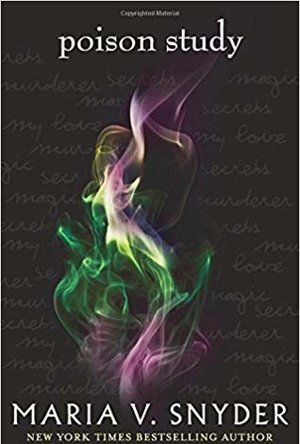

Shelf Life – The Chronicles of Ixia merits closer study
Contains spoilers, click to show
This review is for the entire Chronicles of Ixia series.
The first trilogy, comprised of Poison Study, Fire Study, and Magic Study, follows Yelena Zaltana. The second series, also called the Glass series, follows her friend Opal Cowan in Storm Glass, Sea Glass, and Spy Glass. The final trilogy, Shadow Study, Night Study, and Dawn Study, is where things get a bit odd. Maria V. Snyder had thrown in a few short stories/novellas throughout from different characters’ points of view. Perhaps she got bored of just sticking to one POV, or maybe fans wanted more from the other characters, so the third trilogy is from Yelena’s POV in first person and the POV’s of multiple characters (mainly Valek, Leif, and Janco, with a few others popping in from time to time) in third person.
I’m not sure which editor thought it would be a good idea to have POV switch from first person to third person in the same novel, but—yikes—is it jarring. Even with the wonky POV stuff in the third trilogy, these books are amazing and absolutely worth your time to read. Snyder’s world-building is compelling, detailed, and original. The books take place mostly between two pre-industrial countries: Ixia and Sitia. Ixia is a post-revolution country ruled by Commander Ambrose. His personal body guard and assassin is Valek. In the first novel Yelena is in prison for murder and is offered the choice to be the Commander’s food taster in exchange for her life. She agrees, and throughout the first book she and Valek begin to fall in love.
Ixia reminded me a lot of Communist Russia or China. In its attempts to throw away the corrupt government and society that came before, it has also thrown out all culture in the process. The country has been re-divided into districts with numbers instead of names, everyone is forced to wear a uniform, all art and extravagance has been destroyed, people have to have passes to travel between districts, and magic is forbidden. Anyone born with it is killed (or so the reader is led to believe). But Maria V. Snyder does a wonderful job of showing the good with the bad in this totalitarian dictatorship. Everyone has a job and nobody goes hungry, women are now equal to men, and violence and sexual assault are intolerable. This is why Yelena ends up in prison in the first place: she murdered the man that raped her. Now, this is probably my first major gripe with the series. We learn that Commander Ambrose loathes sexual assault and will execute anyone found guilty of it, but apparently killing a rapist in self-defense is also an executable offense. And all of that being said, Ambrose still has his own personal assassin. It all feels a bit contradictory, but again, that’s what I like about this series: it does an excellent job of peeling back the layers of her fictional societies and pointing out that governments and people in power tend to be hypocritical.
Now, the series name (or rather one of them) is Chronicles of Ixia, but honestly, it should have been called Chronicles of Sitia, because that is where most of the story takes place and is by far the more interesting and vibrant country. Sitia is part jungle, part desert, and full of magic. The peoples are divided into multiple clans or tribes that are all unique and compelling. In the second book, Yelena flees to Sitia after the Commander learns she has magic, and there she finds the family she was kidnapped from as a small child. They are part of the Zaltana clan, a group of people that live high in the trees in the jungle. Whenever I read about them, I would have to remind myself that they were not wood elves or dryads, because while there is magic in these books, there are no fantastical creatures: all characters are human or animal.
Another fascinating tribe is the Sandseeds, a group of nomads in the desert known for two major things: breeding super smart horses and having Storyweavers. The Storyweavers are people who have the magical ability to see the future and guide others, but who have to do it really cryptically because reasons (I appreciate that this gets pointed out by an annoyed Yelena multiple times). And of course, the Sandseed horses are fantastic; they choose their rider and able to mentally communicate with magical people. They even have their own horse names for people that they like.
Besides the different clans throughout Sitia, there is also the capitol, the Citadel, which is home to the magic school and the Sitian Council. While very different from Ixia, Sitia is by no means perfect. Its Council epitomizes everything annoying and dysfunctional about a bureaucracy. While the council members are elected and come from every clan in Sitia, they are at best useless and at worst actively impede the main characters.
The magic school is interesting, though the story doesn’t actually spend much time there. I like how magic was done in this series: it usually runs in families, most people with it have control over one or two things (ie. fire, mind-control, telepathy, etc.), but those who have the ability to master more can become Master Magicians after enduring a daunting trial. Magic is bound in people’s blood, so blood magic is a thing and is obviously bad, and magic (and a person’s soul) can be stolen using an intricate and gruesome blood ritual that involves prolonged torture, rape, and then murder.
The power blanket is another interesting concept used in this series. Essentially is resides over the entire world and is the essence of magic, so magicians can pull from it to augment their own magic. However, if they pull too much and lose control, they can flame out, killing themselves and temporarily damaging the blanket in the process. I thought this was a good literary tool to prevent magical characters from being too OP (at least most of the time).
I especially like the romantic relationships in this series. Valek and Yelena are of course the main couple. In the first book they fall in love, in the second book they get separated, and throughout the series they regularly cross paths and save one another. Yelena and Valek are heartmates, and as the series progresses they both have to mature and learn how to trust one another. My biggest complaint about the romance is that all sex scenes are just fade to black, which I personally find a bit boring.
The other major romantic relationship is between Opal and Devlen. This one was a bit awkward. Opal actually goes through a couple of guys first: a stormdancer named Kade and another glassmaker named Ulrick. And I really liked that the author included this. Many people have multiple partners before finding their soulmate, and a woman who does is not a slut. Her relationship with Devlen, however . . . Well, she’s a more forgiving person than me.
You see, it turns out that Devlen is the man who kidnapped Opal a few years earlier and tortured her because he was trying to steal her magic. But he didn’t actually enjoy torturing her and never raped her, which I guess makes it better? Well, he manages to switch bodies with Ulrick and, as Ulrick, tricks Opal into dating him, then, when he’s discovered, kidnaps and tortures her (again) to gain more power. But then she steals his magic, he spends some time in prison, and the combination of the two miraculously turn him into a good guy, claiming that magic is what made him evil in the first place.
I’m going to be honest, I didn’t completely buy his redemption arc even at the end of the third book in the Glass series, but by the ninth book they’re still together and he’s on the good guys’ side, so I guess it was real. And I have definitely watched/read much worse evil asshole to boyfriend stories. At least Devlen genuinely feels guilty for the horrible things he did in the past and attempts to make up for them, and in her defense, Opal has to do a lot of soul-searching before she can find it in her to forgive and trust him, and even more before she can develop romantic feelings for him (that aren’t based on deception, anyway). Also, Ulrick becomes a huge jerk because of his newfound magical abilities, tries to kill Opal, and later gets assassinated by Valek. I appreciate what Maria V. Snyder is trying to do here, which is to teach through her storytelling how good people can become evil, and evil people can redeem themselves and be good. Their romance was uncomfortable to read, but it was supposed to be uncomfortable, because that’s how all parties involved felt.
Now, let’s talk about Commander Ambrose. Towards the end of the first book, Yelena discovers that Ambrose is a female to male trans person. This is revealed to be why Ambrose hates magicians so much: he is afraid that one of them will read his mind and then reveal his secret (which is how Yelena discovers it). After I read the first book, I was really pleased that Snyder did such a good job of depicting a trans person, as that’s really only a small part of his character, and those who know (mainly Valek and Yelena) don’t make a big deal out of it.
And then . . . I really wish that the author would have just left the issue of the Commander being trans alone. Yelena discovers it in the first book, she keeps it to herself because it’s nobody else’s business, the end. But by creating this weird intricate background to explain why Ambrose is trans, Snyder just kind of shoots herself in the foot.
Throughout the rest of the series, I kept hoping for some other LGBTQ+ characters to show up to redeem the blunder with Ambrose. I actually believed that Ari and Janco were a gay couple for the longest time, what with their banter and often being referred to as partners. However, if this was the author’s intention, it was never really explicitly stated, and the partner thing just seems to refer to them being partners in combat and nothing else.
The first trilogy, comprised of Poison Study, Fire Study, and Magic Study, follows Yelena Zaltana. The second series, also called the Glass series, follows her friend Opal Cowan in Storm Glass, Sea Glass, and Spy Glass. The final trilogy, Shadow Study, Night Study, and Dawn Study, is where things get a bit odd. Maria V. Snyder had thrown in a few short stories/novellas throughout from different characters’ points of view. Perhaps she got bored of just sticking to one POV, or maybe fans wanted more from the other characters, so the third trilogy is from Yelena’s POV in first person and the POV’s of multiple characters (mainly Valek, Leif, and Janco, with a few others popping in from time to time) in third person.
I’m not sure which editor thought it would be a good idea to have POV switch from first person to third person in the same novel, but—yikes—is it jarring. Even with the wonky POV stuff in the third trilogy, these books are amazing and absolutely worth your time to read. Snyder’s world-building is compelling, detailed, and original. The books take place mostly between two pre-industrial countries: Ixia and Sitia. Ixia is a post-revolution country ruled by Commander Ambrose. His personal body guard and assassin is Valek. In the first novel Yelena is in prison for murder and is offered the choice to be the Commander’s food taster in exchange for her life. She agrees, and throughout the first book she and Valek begin to fall in love.
Ixia reminded me a lot of Communist Russia or China. In its attempts to throw away the corrupt government and society that came before, it has also thrown out all culture in the process. The country has been re-divided into districts with numbers instead of names, everyone is forced to wear a uniform, all art and extravagance has been destroyed, people have to have passes to travel between districts, and magic is forbidden. Anyone born with it is killed (or so the reader is led to believe). But Maria V. Snyder does a wonderful job of showing the good with the bad in this totalitarian dictatorship. Everyone has a job and nobody goes hungry, women are now equal to men, and violence and sexual assault are intolerable. This is why Yelena ends up in prison in the first place: she murdered the man that raped her. Now, this is probably my first major gripe with the series. We learn that Commander Ambrose loathes sexual assault and will execute anyone found guilty of it, but apparently killing a rapist in self-defense is also an executable offense. And all of that being said, Ambrose still has his own personal assassin. It all feels a bit contradictory, but again, that’s what I like about this series: it does an excellent job of peeling back the layers of her fictional societies and pointing out that governments and people in power tend to be hypocritical.
Now, the series name (or rather one of them) is Chronicles of Ixia, but honestly, it should have been called Chronicles of Sitia, because that is where most of the story takes place and is by far the more interesting and vibrant country. Sitia is part jungle, part desert, and full of magic. The peoples are divided into multiple clans or tribes that are all unique and compelling. In the second book, Yelena flees to Sitia after the Commander learns she has magic, and there she finds the family she was kidnapped from as a small child. They are part of the Zaltana clan, a group of people that live high in the trees in the jungle. Whenever I read about them, I would have to remind myself that they were not wood elves or dryads, because while there is magic in these books, there are no fantastical creatures: all characters are human or animal.
Another fascinating tribe is the Sandseeds, a group of nomads in the desert known for two major things: breeding super smart horses and having Storyweavers. The Storyweavers are people who have the magical ability to see the future and guide others, but who have to do it really cryptically because reasons (I appreciate that this gets pointed out by an annoyed Yelena multiple times). And of course, the Sandseed horses are fantastic; they choose their rider and able to mentally communicate with magical people. They even have their own horse names for people that they like.
Besides the different clans throughout Sitia, there is also the capitol, the Citadel, which is home to the magic school and the Sitian Council. While very different from Ixia, Sitia is by no means perfect. Its Council epitomizes everything annoying and dysfunctional about a bureaucracy. While the council members are elected and come from every clan in Sitia, they are at best useless and at worst actively impede the main characters.
The magic school is interesting, though the story doesn’t actually spend much time there. I like how magic was done in this series: it usually runs in families, most people with it have control over one or two things (ie. fire, mind-control, telepathy, etc.), but those who have the ability to master more can become Master Magicians after enduring a daunting trial. Magic is bound in people’s blood, so blood magic is a thing and is obviously bad, and magic (and a person’s soul) can be stolen using an intricate and gruesome blood ritual that involves prolonged torture, rape, and then murder.
The power blanket is another interesting concept used in this series. Essentially is resides over the entire world and is the essence of magic, so magicians can pull from it to augment their own magic. However, if they pull too much and lose control, they can flame out, killing themselves and temporarily damaging the blanket in the process. I thought this was a good literary tool to prevent magical characters from being too OP (at least most of the time).
I especially like the romantic relationships in this series. Valek and Yelena are of course the main couple. In the first book they fall in love, in the second book they get separated, and throughout the series they regularly cross paths and save one another. Yelena and Valek are heartmates, and as the series progresses they both have to mature and learn how to trust one another. My biggest complaint about the romance is that all sex scenes are just fade to black, which I personally find a bit boring.
The other major romantic relationship is between Opal and Devlen. This one was a bit awkward. Opal actually goes through a couple of guys first: a stormdancer named Kade and another glassmaker named Ulrick. And I really liked that the author included this. Many people have multiple partners before finding their soulmate, and a woman who does is not a slut. Her relationship with Devlen, however . . . Well, she’s a more forgiving person than me.
You see, it turns out that Devlen is the man who kidnapped Opal a few years earlier and tortured her because he was trying to steal her magic. But he didn’t actually enjoy torturing her and never raped her, which I guess makes it better? Well, he manages to switch bodies with Ulrick and, as Ulrick, tricks Opal into dating him, then, when he’s discovered, kidnaps and tortures her (again) to gain more power. But then she steals his magic, he spends some time in prison, and the combination of the two miraculously turn him into a good guy, claiming that magic is what made him evil in the first place.
I’m going to be honest, I didn’t completely buy his redemption arc even at the end of the third book in the Glass series, but by the ninth book they’re still together and he’s on the good guys’ side, so I guess it was real. And I have definitely watched/read much worse evil asshole to boyfriend stories. At least Devlen genuinely feels guilty for the horrible things he did in the past and attempts to make up for them, and in her defense, Opal has to do a lot of soul-searching before she can find it in her to forgive and trust him, and even more before she can develop romantic feelings for him (that aren’t based on deception, anyway). Also, Ulrick becomes a huge jerk because of his newfound magical abilities, tries to kill Opal, and later gets assassinated by Valek. I appreciate what Maria V. Snyder is trying to do here, which is to teach through her storytelling how good people can become evil, and evil people can redeem themselves and be good. Their romance was uncomfortable to read, but it was supposed to be uncomfortable, because that’s how all parties involved felt.
Now, let’s talk about Commander Ambrose. Towards the end of the first book, Yelena discovers that Ambrose is a female to male trans person. This is revealed to be why Ambrose hates magicians so much: he is afraid that one of them will read his mind and then reveal his secret (which is how Yelena discovers it). After I read the first book, I was really pleased that Snyder did such a good job of depicting a trans person, as that’s really only a small part of his character, and those who know (mainly Valek and Yelena) don’t make a big deal out of it.
And then . . . I really wish that the author would have just left the issue of the Commander being trans alone. Yelena discovers it in the first book, she keeps it to herself because it’s nobody else’s business, the end. But by creating this weird intricate background to explain why Ambrose is trans, Snyder just kind of shoots herself in the foot.
Throughout the rest of the series, I kept hoping for some other LGBTQ+ characters to show up to redeem the blunder with Ambrose. I actually believed that Ari and Janco were a gay couple for the longest time, what with their banter and often being referred to as partners. However, if this was the author’s intention, it was never really explicitly stated, and the partner thing just seems to refer to them being partners in combat and nothing else.