
Search
Search results

Charlie Cobra Reviews (1840 KP) rated The Kitchen (2019) in Movies
Jul 7, 2020


A Very Messy Kitchen: Good Ingredients But No Flavor
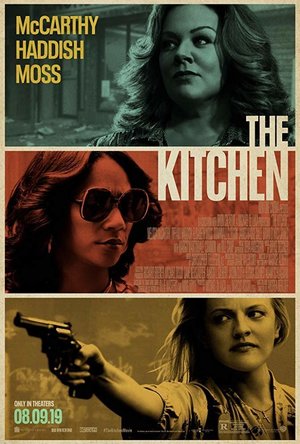
The Kitchen is a 2019 action crime movie written and directed by Andrea Berloff and producers Michael Dell Luca and Marcus Viscidi. It's based on the Vertigo comic created by Ollie Masters and Ming Doyle and produced by New Line Cinema, Bron Creative, D.C. Vertigo and Michael Dell Luca Productions with distribution by Warner Bros. Pictures. The film stars Melissa McCarthy, Tiffany Haddish, Elisabeth Moss and Common.
In 1978 Hell's Kitchen, 3 women married to husbands in the Irish mob face hardship as all 3 of their husbands are arrested and sentenced to 3 years in prison. The new head of the mob ensures that they will be taken care of financially but gives them each a tiny pittance. When they go to ask him for more they are aggressively refused. At a loss for what to do next the women seize an opportunity when they are told that despite local businesses paying protection fees, the mob has done little to help them. They themselves begin collecting protection fees and helping the neighborhood becoming beloved and making a huge profit as well as lots of enemies.
This movie was not what I expected. I was really let down, especially for it having a great cast of actors. I don't think it was over hyped either, I felt like it was false advertising. From the trailer it looked like it was supposed to be a gritty female led mob movie but didn't deliver. From the beginning and throughout the movie it felt really lackluster and didn't have enough going for it to remain interesting. I honestly don't know how I made it through the movie, I guess I just kept waiting for it to get better and it never really did. I did like certain things, Melissa McCarthy's acting was good for being a drama and Tiffany Haddish did a decent job, also Elisabeth Moss's character was probably the one that had the most character development, but even then, you'll see what I'm talking about if you ever decide to watch this movie. It also didn't have a very compelling plot, and with the girl's situation and what they were dealing with, you would think it would be more gripping but there was not enough tension for a movie dealing with the mob and the dangers of being killed. I would have to give this movie a 4/10 because I felt it was really below average.
In 1978 Hell's Kitchen, 3 women married to husbands in the Irish mob face hardship as all 3 of their husbands are arrested and sentenced to 3 years in prison. The new head of the mob ensures that they will be taken care of financially but gives them each a tiny pittance. When they go to ask him for more they are aggressively refused. At a loss for what to do next the women seize an opportunity when they are told that despite local businesses paying protection fees, the mob has done little to help them. They themselves begin collecting protection fees and helping the neighborhood becoming beloved and making a huge profit as well as lots of enemies.
This movie was not what I expected. I was really let down, especially for it having a great cast of actors. I don't think it was over hyped either, I felt like it was false advertising. From the trailer it looked like it was supposed to be a gritty female led mob movie but didn't deliver. From the beginning and throughout the movie it felt really lackluster and didn't have enough going for it to remain interesting. I honestly don't know how I made it through the movie, I guess I just kept waiting for it to get better and it never really did. I did like certain things, Melissa McCarthy's acting was good for being a drama and Tiffany Haddish did a decent job, also Elisabeth Moss's character was probably the one that had the most character development, but even then, you'll see what I'm talking about if you ever decide to watch this movie. It also didn't have a very compelling plot, and with the girl's situation and what they were dealing with, you would think it would be more gripping but there was not enough tension for a movie dealing with the mob and the dangers of being killed. I would have to give this movie a 4/10 because I felt it was really below average.

Kristy H (1252 KP) rated Do No Harm in Books
Feb 25, 2021

A dark look into how far a mother would go to save her child
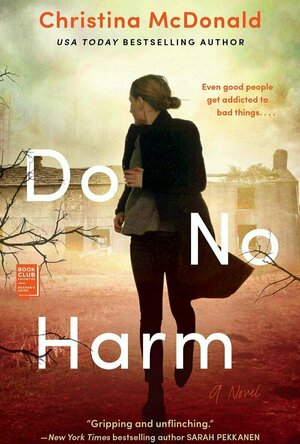
After a tough childhood, where she was orphaned and spent time in foster care, Emma finally has the life she's always wanted. A successful doctor, she has a loving husband, Nate, and a young son, Josh. But that all stands to change when Josh, who is only five, is diagnosed with leukemia. Even with her hospital insurance, Josh's potential life-saving treatment will cost hundreds of thousands of dollars. Determined to save Josh no matter what, Emma makes the decision to sell opioids. Her choice puts her directly against Nate, a local police officer, who is investigating the death of a potential drug dealer. Emma will do anything to save Josh--does that include murder?
"I felt like I'd been dropped down a rabbit hole with the wolf sitting right outside. And the wolf was my husband."
This is a brutal dark read that pulls you into Emma and Nate's dilemma immediately. Personally, I found it hard to read about Josh's illness. I have a difficult time with books about kids being sick. But, McDonald is an excellent writer, and she does a wonderful job portraying stricken parents, pushed to the brink, who would do anything for their child. For Emma, it's turning to selling drugs. For Nate, it's working constantly to solve his current case, which means a promotion that could brings additional money for their family. The story is told from each of their perspectives, ratcheting up the tension with each chapter.
Emma, it seems, really has no limits on what she would do for Josh. McDonald makes the reader question: how far would you go to save your child? The book also offers a nuanced perspective on the opioid crisis, versus the usual "drugs bad" stance we get in many novels, which I appreciated. The entire novel makes you think and question standard perspectives in so many ways. It turns good versus evil and right versus wrong on its heels. And it offers a dark and insightful look into drug addiction and chronic pain and how families support each other (or don't).
Overall, this isn't an easy read, but it's a well-written and compelling one. It's timely, with an excellent perspective on the drug problems facing Americans and leaves the reader questioning much about right versus wrong. 4 stars.
I received a copy of this book from Gallery Books and Netgalley in return for an unbiased review. It is available on 2/16/2021.
"I felt like I'd been dropped down a rabbit hole with the wolf sitting right outside. And the wolf was my husband."
This is a brutal dark read that pulls you into Emma and Nate's dilemma immediately. Personally, I found it hard to read about Josh's illness. I have a difficult time with books about kids being sick. But, McDonald is an excellent writer, and she does a wonderful job portraying stricken parents, pushed to the brink, who would do anything for their child. For Emma, it's turning to selling drugs. For Nate, it's working constantly to solve his current case, which means a promotion that could brings additional money for their family. The story is told from each of their perspectives, ratcheting up the tension with each chapter.
Emma, it seems, really has no limits on what she would do for Josh. McDonald makes the reader question: how far would you go to save your child? The book also offers a nuanced perspective on the opioid crisis, versus the usual "drugs bad" stance we get in many novels, which I appreciated. The entire novel makes you think and question standard perspectives in so many ways. It turns good versus evil and right versus wrong on its heels. And it offers a dark and insightful look into drug addiction and chronic pain and how families support each other (or don't).
Overall, this isn't an easy read, but it's a well-written and compelling one. It's timely, with an excellent perspective on the drug problems facing Americans and leaves the reader questioning much about right versus wrong. 4 stars.
I received a copy of this book from Gallery Books and Netgalley in return for an unbiased review. It is available on 2/16/2021.
LeftSideCut (3776 KP) rated Doctor Strange (2016) in Movies
Feb 3, 2021

On the surface, you could argue that Doctor Strange isn't all that different from Iron Man in terms of structure. Rich, white dude with a goatee lives out his life, arrogantly full of himself until a life altering incident forces him to fight to survive, setting him on a path of betterment and redemption. Whilst this is unarguably true, the fact is that this movie is so much more than retreading familiar ground. Gone are the times where superhero movies play it safe. Guardians of the Galaxy may have knocked down the doors, but Doctor Strange takes the cosmic concept, and runs full speed with it. Marvel Studios have got to the point where they can make a movie about the Dark Dimension, the Mirror Dimension, the Sorcerer Supreme, Dormammu, the multiverse, and audiences will still lap it up, and I'm here for it.
Sinister director Scott Derrickson proves to be a smart choice, as he provides us a story that's humourous, full of heart, brimming with new lore, and is visually mind bending. The aesthetic if this movie is what sets it apart from its kin. Sure it doesn't stray too far from the Marvel formula, but it does something different. Many have compared it to Inception, which isn't an unfair note, and it makes for some wonderful looking set pieces.
Benedict Cumberbatch is picture perfect as Stephen Strange himself and is joined by a stellar supporting cast. Chiwetel Ejiofor, Tilda Swinton, Mads Mikkelsen, Benedict Wong, and Rachel McAdams are all great in their respective roles. Mikkelsen gives us a compelling villain in Kaecilius, jaded by an order he's followed for years and turning tail to pursue what he thinks is right (not to dissimilar to Thanos in that respect). We're also introduced briefly to Dormammu, which is certainly exciting to any fans of the comics. With the Infinity Saga all wrapped up, this could prove to be seed planting for a future big bad.
Doctor Strange could have easily just been another run of the mill origin story (which some believe it is, and that's ok!) but for me, it's so much more. It manages to build on Marvel lore, whilst teasing future story lines by flirting with the Multiverse and the Dark Dimension, all while never losing focus on its very human story. It's a fantastic first outing for one of Marvel's more out there characters and one of my favourites of the whole franchise.
Sinister director Scott Derrickson proves to be a smart choice, as he provides us a story that's humourous, full of heart, brimming with new lore, and is visually mind bending. The aesthetic if this movie is what sets it apart from its kin. Sure it doesn't stray too far from the Marvel formula, but it does something different. Many have compared it to Inception, which isn't an unfair note, and it makes for some wonderful looking set pieces.
Benedict Cumberbatch is picture perfect as Stephen Strange himself and is joined by a stellar supporting cast. Chiwetel Ejiofor, Tilda Swinton, Mads Mikkelsen, Benedict Wong, and Rachel McAdams are all great in their respective roles. Mikkelsen gives us a compelling villain in Kaecilius, jaded by an order he's followed for years and turning tail to pursue what he thinks is right (not to dissimilar to Thanos in that respect). We're also introduced briefly to Dormammu, which is certainly exciting to any fans of the comics. With the Infinity Saga all wrapped up, this could prove to be seed planting for a future big bad.
Doctor Strange could have easily just been another run of the mill origin story (which some believe it is, and that's ok!) but for me, it's so much more. It manages to build on Marvel lore, whilst teasing future story lines by flirting with the Multiverse and the Dark Dimension, all while never losing focus on its very human story. It's a fantastic first outing for one of Marvel's more out there characters and one of my favourites of the whole franchise.

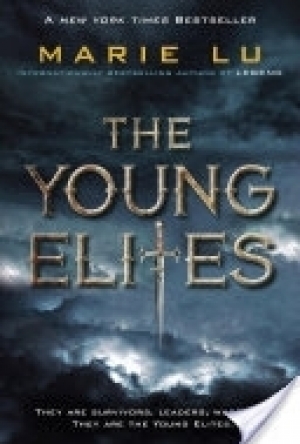
Adam Silvera recommended The Young Elites in Books (curated)
BookInspector (124 KP) rated Friend Request in Books
Sep 24, 2020
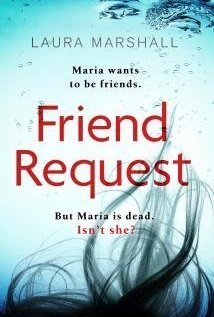

I got kind of sucked in from the first pages of this book. It started quite idyllic, a single mother with her little boy. The pressure slowly building up after Louise receives the friend request, and it continues throughout the whole book.
Our main character is, of course, Louise, even though she had a tough divorce which broke her, she got her life together and is a successful businesswoman. Throughout the book, we meet a lot of unique characters, not only from her present but from the past as well. I really liked Louise as a character, she proved to me, that people are able to change.
The narrative, that is the part of this book which I really loved. It is told from a single perspective, but the plot is very well crafted and filled with a lot of feelings, emotions and fantastic twists and turns. It is pretty hard to describe it without spoilers, but let’s try. I do have to mention, that this novel is about bullying, drugs and its consequences to peoples lives. Louise has done something really bad when she was at school, and that thing is haunting her 25 years later. The author does not leave it to this disappearance of Maria only, she spices it up with a ton of twists and illusions. I should say that Laura is a master for creating an illusion.
The plot was time travelling between the present and 1989, revealing the events that took place little by little, and creating even more suspense and wish to find out more. One thing that really annoyed me was that the author exaggerated the character’s secrets, and when you expect something grand and you receive a very uninteresting surprise, it kind of left me disappointed. :/ Another thing what really annoyed me, the way drug use was portrayed in this book. I think drug use is a serious issue, and shouldn’t be portrayed as “cool” or as a “not a big deal”, especially when it comes to school kids.
This was a very well thought through novel, with easy language and overall great writing style. I liked the not-too-long, not-too-short chapters, and I think that the ending of this book was incredibly unexpected, and rounded this story really nicely. So, to conclude, I do strongly recommend this compelling and chilling book, filled with incredible story, unexpected turns, and things which are not as they seem to be. I hope you will enjoy it as much as I did.
Our main character is, of course, Louise, even though she had a tough divorce which broke her, she got her life together and is a successful businesswoman. Throughout the book, we meet a lot of unique characters, not only from her present but from the past as well. I really liked Louise as a character, she proved to me, that people are able to change.
The narrative, that is the part of this book which I really loved. It is told from a single perspective, but the plot is very well crafted and filled with a lot of feelings, emotions and fantastic twists and turns. It is pretty hard to describe it without spoilers, but let’s try. I do have to mention, that this novel is about bullying, drugs and its consequences to peoples lives. Louise has done something really bad when she was at school, and that thing is haunting her 25 years later. The author does not leave it to this disappearance of Maria only, she spices it up with a ton of twists and illusions. I should say that Laura is a master for creating an illusion.
The plot was time travelling between the present and 1989, revealing the events that took place little by little, and creating even more suspense and wish to find out more. One thing that really annoyed me was that the author exaggerated the character’s secrets, and when you expect something grand and you receive a very uninteresting surprise, it kind of left me disappointed. :/ Another thing what really annoyed me, the way drug use was portrayed in this book. I think drug use is a serious issue, and shouldn’t be portrayed as “cool” or as a “not a big deal”, especially when it comes to school kids.
This was a very well thought through novel, with easy language and overall great writing style. I liked the not-too-long, not-too-short chapters, and I think that the ending of this book was incredibly unexpected, and rounded this story really nicely. So, to conclude, I do strongly recommend this compelling and chilling book, filled with incredible story, unexpected turns, and things which are not as they seem to be. I hope you will enjoy it as much as I did.
Gareth von Kallenbach (980 KP) rated Antebellum (2020) in Movies
Sep 21, 2020
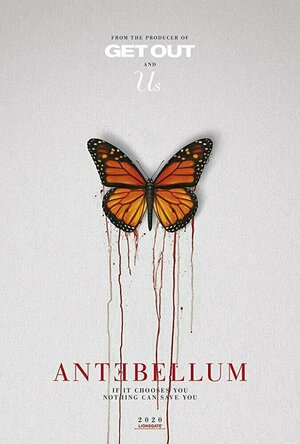
Janelle Monáe stars as Eden who at the start of the new film “Antebellum” is brought back to a Southern Plantation against her will by Union Soldiers. The consequences of her escape attempt are brutally taken out against two others as the rest of the plantation looks on in submissive silence.
Weeks later more slaves arrive and are given the rules by the brutal Overseer who demands silence and utter obedience at all times.
The slaves are made to work the fields and serve the plantation including the women being assigned to whichever soldier desires them.
Their plight grabs you from the start in its brutality as they have no rights, live in fear daily, and are subject to whatever whims those in charge desire and they are required to obey and suffer in silence.
One night after the General falls asleep after having his way with her; Eden awakens to a different reality. One set in the modern day where she is a wife, mother, and very successful author and activist. The film follows her life in the modern world before springing the twist which makes doing an in-depth review difficult without spoiling things. While I was able to predict the twist coming; it was still effective and chilling in how it was carried out.
The film does get a bit lax in the final act as it relies on too many Hollywood clichés which while highly entertaining for me undermined the messages of the film and the situation.
Gerard Bush and Christopher Rend both wrote and directed the film and there are some powerful and highly gripping moments to the film but it grabs you from the start and is compelling and deeply disturbing.
The cast is very strong and the film is unforgettable. My biggest issue with the film was the final act as I alluded to prior. The film tries to tie things up a bit too neatly yet fails to adequately explain key aspects of the story. The audience is given some information and forced to fill in the gaps for themselves which in many ways makes the film even more disturbing.
In the time of deep division in our country it is very upsetting to see how little has changed for many who do not see equality and justice applied equally and still live day to day with fear and uncertainty.
“Antebellum” is the rare film that entertains, informs, and makes you think and will remain with you after the movie ends.
4 stars out of 5
Weeks later more slaves arrive and are given the rules by the brutal Overseer who demands silence and utter obedience at all times.
The slaves are made to work the fields and serve the plantation including the women being assigned to whichever soldier desires them.
Their plight grabs you from the start in its brutality as they have no rights, live in fear daily, and are subject to whatever whims those in charge desire and they are required to obey and suffer in silence.
One night after the General falls asleep after having his way with her; Eden awakens to a different reality. One set in the modern day where she is a wife, mother, and very successful author and activist. The film follows her life in the modern world before springing the twist which makes doing an in-depth review difficult without spoiling things. While I was able to predict the twist coming; it was still effective and chilling in how it was carried out.
The film does get a bit lax in the final act as it relies on too many Hollywood clichés which while highly entertaining for me undermined the messages of the film and the situation.
Gerard Bush and Christopher Rend both wrote and directed the film and there are some powerful and highly gripping moments to the film but it grabs you from the start and is compelling and deeply disturbing.
The cast is very strong and the film is unforgettable. My biggest issue with the film was the final act as I alluded to prior. The film tries to tie things up a bit too neatly yet fails to adequately explain key aspects of the story. The audience is given some information and forced to fill in the gaps for themselves which in many ways makes the film even more disturbing.
In the time of deep division in our country it is very upsetting to see how little has changed for many who do not see equality and justice applied equally and still live day to day with fear and uncertainty.
“Antebellum” is the rare film that entertains, informs, and makes you think and will remain with you after the movie ends.
4 stars out of 5
The Chocolate Lady (94 KP) rated Nine Folds Make a Paper Swan in Books
Oct 6, 2020
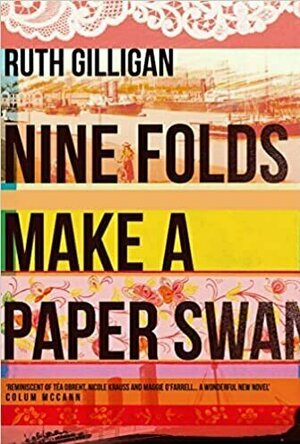
Okay, so I didn't actually finish reading this book. You see, I really wanted to like this book, because I think that Gillian is a talented writer. Unfortunately, I was unable to finish reading this book. On the plus side, the contemporary parts of this book were very interesting, if not compelling. Aisling's slow discovery of the Jewish world, while fighting the urge to get more committed to it was very nicely done. However, the historical parts put me off most of the time. I didn't understand the characters - either their language, or their motivations. I realize that had I finished this book, some of these questions might have been answered, but I just couldn't get past the fact that I found myself wanting to skip over large chunks of the narrative.
I think the problem was that Gillian's inexperience made her try a bit too hard to impress the Jewish and Irish aspects of this book. I've read quite a few books by Irish authors, and I've never felt like I was overwhelmed with jargon and slang, some of which I didn't understand. Unfortunately, these interjections came far too often, and they were jarring, to say the least. Certainly, her editor should have realized this, and toned it down - unless that person too was worried that the book wouldn't sound either Jewish or Irish enough for the American public.
For me, the heavy use of Irish and Yiddish slang words feels pretentious. More importantly, if your story doesn't sound Irish or Jewish enough so that you have to throw these in at every turn, then maybe you've not chosen the right subject matter.
I might have continued on, doing my best to ignore this, but the final death knell for me came when she broke my #1 cardinal rule of writing Jewish characters - a glaring mistake on a simple point of Judaism. I am willing to forgive a whole lot, but when someone describes a strict Jewish household having lamb with a side dish of potatoes, dripping with butter in the same meal (i.e., she mixed milk and meat, and it is the most basic of all things that Jewish dietary laws forbid), that's a bridge too far. No one who goes to the amount of trouble she describes in this book to get their house Kosher and ready for Passover, would ever in their right mind put butter on potatoes for a meat meal.
If any of this can be fixed before publication, I would be thrilled to read a new version of this book.
I think the problem was that Gillian's inexperience made her try a bit too hard to impress the Jewish and Irish aspects of this book. I've read quite a few books by Irish authors, and I've never felt like I was overwhelmed with jargon and slang, some of which I didn't understand. Unfortunately, these interjections came far too often, and they were jarring, to say the least. Certainly, her editor should have realized this, and toned it down - unless that person too was worried that the book wouldn't sound either Jewish or Irish enough for the American public.
For me, the heavy use of Irish and Yiddish slang words feels pretentious. More importantly, if your story doesn't sound Irish or Jewish enough so that you have to throw these in at every turn, then maybe you've not chosen the right subject matter.
I might have continued on, doing my best to ignore this, but the final death knell for me came when she broke my #1 cardinal rule of writing Jewish characters - a glaring mistake on a simple point of Judaism. I am willing to forgive a whole lot, but when someone describes a strict Jewish household having lamb with a side dish of potatoes, dripping with butter in the same meal (i.e., she mixed milk and meat, and it is the most basic of all things that Jewish dietary laws forbid), that's a bridge too far. No one who goes to the amount of trouble she describes in this book to get their house Kosher and ready for Passover, would ever in their right mind put butter on potatoes for a meat meal.
If any of this can be fixed before publication, I would be thrilled to read a new version of this book.
Kristy H (1252 KP) rated To Tell You The Truth in Books
Oct 8, 2020
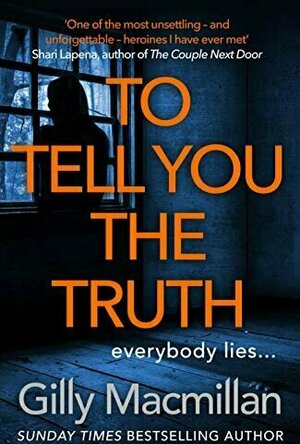
A twisty thriller with a disappointing ending
Lucy Harper is a famous writer, known for her crime fiction stories featuring her beloved character, Eliza. Her work has made her wealthy, something that particularly pleases her husband, Dan, a once aspiring writer who now "manages" Lucy's career and money. Lucy and Dan's life and marriage look perfect from the outside, but they are anything but. Then Dan suddenly goes missing. His disappearance reminds Lucy of another time someone vanished from her life: her younger brother, Teddy, who was lost in the woods very near the house Lucy and Dan now live in. Soon Lucy finds herself reminded more and more of her past, which seems to be quickly and dangerously colliding with her present.
"After all, what kind of person creates a character who walks right out of their books and into their life? He would think I'd lost my mind."
I absolutely adore Gilly Macmillan and her books, but this was not one of my all-time favorites. It's still good, though, and twisty, and I will admit that I didn't guess the (rather bizarre) outcome. However, the ending leaves much to be desired and does not wrap everything up, which left me frustrated. (And seemed to kick off a trend in my recent thrillers, where things end with plot pieces left hanging--I'm not okay with this.)
Lucy is an unreliable narrator extraordinaire--ever since she was small, she's had a best friend named Eliza. Why yes, Eliza happens to be the name of her fictional character, as well. Lucy talks to her imaginary friend, who seems to have untold power over her. If this sounds weird and creepy, it is, and Macmillan does a good job with the eerie oddity of it all and allowing us to wonder if we can trust anything that Lucy--or Eliza--say. Knowing who and what to believe is certainly a central theme here.
Dan, meanwhile, is absolutely despicable, and I was not too sad when he disappeared, honestly. The story alternates between present-day, with Lucy's point of view, and the past, around the time Teddy disappeared. It's certainly compelling. All in all, I would have probably rated this 4-stars if there had been a better ending, versus one that felt rushed and forced, without tying up all the loose ends. This is still a good, atmospheric thriller, with plenty of twists. 3.5 stars. And if you want to read more from Macmillan, I highly recommend The Perfect Girl or her Jim Clemo series--all books that I adore.
"After all, what kind of person creates a character who walks right out of their books and into their life? He would think I'd lost my mind."
I absolutely adore Gilly Macmillan and her books, but this was not one of my all-time favorites. It's still good, though, and twisty, and I will admit that I didn't guess the (rather bizarre) outcome. However, the ending leaves much to be desired and does not wrap everything up, which left me frustrated. (And seemed to kick off a trend in my recent thrillers, where things end with plot pieces left hanging--I'm not okay with this.)
Lucy is an unreliable narrator extraordinaire--ever since she was small, she's had a best friend named Eliza. Why yes, Eliza happens to be the name of her fictional character, as well. Lucy talks to her imaginary friend, who seems to have untold power over her. If this sounds weird and creepy, it is, and Macmillan does a good job with the eerie oddity of it all and allowing us to wonder if we can trust anything that Lucy--or Eliza--say. Knowing who and what to believe is certainly a central theme here.
Dan, meanwhile, is absolutely despicable, and I was not too sad when he disappeared, honestly. The story alternates between present-day, with Lucy's point of view, and the past, around the time Teddy disappeared. It's certainly compelling. All in all, I would have probably rated this 4-stars if there had been a better ending, versus one that felt rushed and forced, without tying up all the loose ends. This is still a good, atmospheric thriller, with plenty of twists. 3.5 stars. And if you want to read more from Macmillan, I highly recommend The Perfect Girl or her Jim Clemo series--all books that I adore.
Gareth von Kallenbach (980 KP) rated Man Down (2016) in Movies
Jul 12, 2019
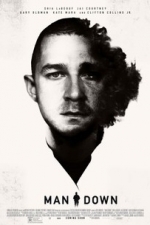

This Dito Montiel (Fighting, The Son of No One) directed film is a look at mental health and how soldiers returning from war can be affected by the tragedy of war and life.
This film tries to put us inside the mind of a soldier and they lead up to his deployment to war, the trauma that can be suffered at war and the result of seeing things that can’t be unseen. It begins with U.S. Marine Gabriel Drummer (Shia LaBeouf) searching for his son, Johnathan (Charlie Shotwell), and wife, Natalie (Kate Mara), in a post-apocalyptic America.
His only company is his best friend and fellow war veteran Devin Roberts (Jai Courtney). We then flash back to a counseling session between Gabriel and Counselor Peyton (Gary Oldman). They are recounting an incident that happened while Gabriel and Devin were in the field as well as talk about the relationship between the two brothers in arms. Peyton probes Gabriel for answers to what happened in the field and what his life at home will be like when he returns. The story takes us through Gabriel’s journey from boot camp to his search to be reunited with his wife and child.
The beginning of the film is so scattered with flash backs and flash forwards it is not the easiest story to follow. Montiel tries to tie the story all together at the end but it really done quickly and sloppily. There was no really good flow to the film.
The message at the end was really powerful but there execution to get there really didn’t work for me. The cast individual performances were good but I thought that as a whole there was not cohesion.
The relationships between all the characters seemed forced and it was hard to get emotionally invested in what should have been and emotionally compelling story. LaBeouf does commit and his performance I would say the bright spot. I think the intention was that the end of the movie should be a surprise or twist but the ending for me was never really in doubt.
There were points when the film seemed to have momentum but that was stopped by a flash back or forward that would take you out of the moment. All trying to set up a conclusion that seemed inevitable.
The idea of bringing awareness to a real issue in our country, of returning veterans suffering from PTSD, is a noble one and I applaud them for trying. I just wish the execution would have been better overall.
This film tries to put us inside the mind of a soldier and they lead up to his deployment to war, the trauma that can be suffered at war and the result of seeing things that can’t be unseen. It begins with U.S. Marine Gabriel Drummer (Shia LaBeouf) searching for his son, Johnathan (Charlie Shotwell), and wife, Natalie (Kate Mara), in a post-apocalyptic America.
His only company is his best friend and fellow war veteran Devin Roberts (Jai Courtney). We then flash back to a counseling session between Gabriel and Counselor Peyton (Gary Oldman). They are recounting an incident that happened while Gabriel and Devin were in the field as well as talk about the relationship between the two brothers in arms. Peyton probes Gabriel for answers to what happened in the field and what his life at home will be like when he returns. The story takes us through Gabriel’s journey from boot camp to his search to be reunited with his wife and child.
The beginning of the film is so scattered with flash backs and flash forwards it is not the easiest story to follow. Montiel tries to tie the story all together at the end but it really done quickly and sloppily. There was no really good flow to the film.
The message at the end was really powerful but there execution to get there really didn’t work for me. The cast individual performances were good but I thought that as a whole there was not cohesion.
The relationships between all the characters seemed forced and it was hard to get emotionally invested in what should have been and emotionally compelling story. LaBeouf does commit and his performance I would say the bright spot. I think the intention was that the end of the movie should be a surprise or twist but the ending for me was never really in doubt.
There were points when the film seemed to have momentum but that was stopped by a flash back or forward that would take you out of the moment. All trying to set up a conclusion that seemed inevitable.
The idea of bringing awareness to a real issue in our country, of returning veterans suffering from PTSD, is a noble one and I applaud them for trying. I just wish the execution would have been better overall.

Becs (244 KP) rated Foundations Of Faith in Books
Oct 2, 2019
Style: Light
Point of view: Third person
Difficulty reading: It was as easy as singing the ABC’s!
Promise: Foundations of Faith promises a compelling religious read that will have you answering questions about your own faith.
Quality: All around good read, wasn’t what I was expecting but would definitely reread again.
Insights: Usually when it comes to Fantasy style of books, I always think powers (spells), mythical creatures, places that don’t exist, etc. etc. Foundations of Faith didn’t really have the typical Fantasy aspect to it. Theresa and Thomas have ‘powers’ but they aren’t magical powers like a witch or wizard would have. But it was still a great read that will end up being reread a couple more times.
Ah-Ha Moment: There wasn’t really a moment where I went ‘Ah yea, that’s the turning point’. One scene did come pretty darn close though. This scene: Thomas returns back from the retreat and finds out his mother is in the hospital and his father is in jail for putting his mother in the hospital. It’s never revealed how Thomas’s mother was hurt, and I would have definitely loved if that was explained better but then again this isn’t a Thriller so it’s also okay.
Favorite quote: “She shared how she had finally found God, not in the back of a church with hands held in prayer, but in the back of a police car with hands held in cuffs.” – I feel like this is a huge reason why most end up finding religion/ God. Something terrible or even life-threatening happens to them and they just start praying, see some signs and boom they now believe.
“As he walked, he felt the darkness behind him, following him. He swore he heard it whisper, “Run!” – Hello darkness, my old friend. I’ve come to talk with you again. Because a vision softly creeping, left its seeds while I was sleeping. And the vision that was planted in my brain still remains, within the sound of silence. Sorry, I couldn’t help myself 🙂
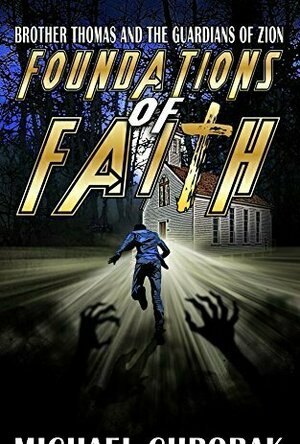
Aesthetics: I reallyyyyy dig the cover! It gives it that mystery horror feel even though there isn’t really any horror in Foundations of Faith. The chapter headings, awesome font. Great read. But that cover is just so aesthetically pleasing. 🙂
“The deeper the feelings of unworthiness dug into his heart, the darker the room became. It spread from the outside in, growing darker and more ominous with each new thought. He feared it would swallow him whole.”
Point of view: Third person
Difficulty reading: It was as easy as singing the ABC’s!
Promise: Foundations of Faith promises a compelling religious read that will have you answering questions about your own faith.
Quality: All around good read, wasn’t what I was expecting but would definitely reread again.
Insights: Usually when it comes to Fantasy style of books, I always think powers (spells), mythical creatures, places that don’t exist, etc. etc. Foundations of Faith didn’t really have the typical Fantasy aspect to it. Theresa and Thomas have ‘powers’ but they aren’t magical powers like a witch or wizard would have. But it was still a great read that will end up being reread a couple more times.
Ah-Ha Moment: There wasn’t really a moment where I went ‘Ah yea, that’s the turning point’. One scene did come pretty darn close though. This scene: Thomas returns back from the retreat and finds out his mother is in the hospital and his father is in jail for putting his mother in the hospital. It’s never revealed how Thomas’s mother was hurt, and I would have definitely loved if that was explained better but then again this isn’t a Thriller so it’s also okay.
Favorite quote: “She shared how she had finally found God, not in the back of a church with hands held in prayer, but in the back of a police car with hands held in cuffs.” – I feel like this is a huge reason why most end up finding religion/ God. Something terrible or even life-threatening happens to them and they just start praying, see some signs and boom they now believe.
“As he walked, he felt the darkness behind him, following him. He swore he heard it whisper, “Run!” – Hello darkness, my old friend. I’ve come to talk with you again. Because a vision softly creeping, left its seeds while I was sleeping. And the vision that was planted in my brain still remains, within the sound of silence. Sorry, I couldn’t help myself 🙂
Aesthetics: I reallyyyyy dig the cover! It gives it that mystery horror feel even though there isn’t really any horror in Foundations of Faith. The chapter headings, awesome font. Great read. But that cover is just so aesthetically pleasing. 🙂
“The deeper the feelings of unworthiness dug into his heart, the darker the room became. It spread from the outside in, growing darker and more ominous with each new thought. He feared it would swallow him whole.”