Search
Search results

Chris Sawin (602 KP) rated Texas Chainsaw Massacre (2022) in Movies
Feb 19, 2022 (Updated Feb 19, 2022)


Wasted backstories that go nowhere. (3 more)
Rehashes and recreates the original film while not offering much of its own material.
New characters fall flat.
Feels like a half-cocked attempt at a new "film. "
Tearing the Face Off of a Horror Franchise
Texas Chainsaw Massacre is a direct sequel to the original 1974 film nearly 50 years later. Directed by David Blue Garcia with a screenplay by Chris Thomas Devlin and a story by Fede Alvarez (co-writer and director of the 2013 Evil Dead remake) and Rodo Sayagues (Don’t Breathe 1 & 2), Texas Chainsaw Massacre follows a group of young 20-somethings as they venture from Austin to Harlow, TX; a seven hour drive.
Dante (Jacob Latimore, Detroit) and Melody (Sarah Yarkin, Happy Death Day 2U) are business partners with somewhat of an impressive internet following. Dante is a chef who is looking to expand and Harlow is just the type of remote town to do it in. Melody’s teenage sister Lila (Elsie Fisher, Eighth Grade) and Dante’s fiancé Ruth (Nell Hudson) have tagged along mostly for emotional support.
With bank investors on the way to scout the location, the young foursome discovers a dilapidated orphanage with an old woman (Alice Krige, Gretel & Hansel) still living inside along with the last of what she refers to as, “her boys.” Dante and his friends awaken the mostly dormant monster known as Leatherface. Sally Hardesty (Olwen Fouéré) has been searching for Leatherface since he killed her friends all those years ago and now she can finally have the vengeful closure that she deserves.
The Texas Chainsaw Massacre franchise is mostly trash. Leatherface has gotten the manure treatment outside of the original film, the 2003 remake, and maybe the 1986 sequel. The timeline is as messy and inconsistent as Halloween as whatever takes place behind the scenes between sequels, remakes, and reboots all seems to result in lackluster or sometimes atrocious outings for one of the most recognizable horror movie icons.
This new film can’t seem to decide what it wants to be. Sally is brought back for a half-hearted cameo as she does nothing but wear a cowboy hat, stare at a picture, cock a shotgun, and gut a pig. She’s meant to be the connection between this film and the original and it just doesn’t work. Texas Chainsaw Massacre also just seems to lift aspects from the original film as well as other non-genre films without ever offering its audience anything original or actually worthwhile.
The ending is basically lifted directly from the original as is the aspect of a group of young people running into trouble on a road trip far away from home. It’s young, city outsiders versus born-and-bred country veterans. The film also has a weird amount of homage to Terminator 2 (Melody’s leg wound and the shotgun blasts to Leatherface by the water being similar to Sarah Connor’s showdown with the T-1000 near the end of T2). It also feels like it’s trying to capitalize on the success Halloween has had since it follows a similar format (making a direct sequel to the original film decades later).
On the bright side, the kills and the gore are mostly satisfying. The wrist breaking scene followed by being stabbed in the neck with the broken bone is gnarly. There’s a brutal head smashing scene with a hammer and the bus sequence is essentially horror movie fan heaven even if the setup and dialogue in said sequence is awful. The swinging door kill feels like it could have been better than it was since it covers up more than it reveals. You can either leave the brutality to the audience’s imagination or show everything in its nasty and gruesome glory; trying to do both in the same sequence just results in disappointment.
You can make the argument that you watch a film like this for the gore and not the story anyway, but that isn’t the point. When there’s this much of a wait between new entries fans deserve better. The frustrating aspect is that Fede Alvarez and Rodo Sayagues are capable of providing a worthwhile story along with the blood and guts because they gave it to us with Evil Dead. There’s nothing here worth the nine year gap between this and the last Texas Chainsaw film (Texas Chainsaw 3D) or the five year gap between this and Leatherface. When it’s not recycling gags from the original film or borrowing from other franchises, it’s just young people being dumb for the sake of a cheap scare or kill.
Texas Chainsaw Massacre isn’t as unwatchable as some reviews are making it out to be, but it’s not a good film by any stretch of the imagination. It’s barely 80-minutes long, so it has a relatively quick pace and the kills are solid. But the story is seriously lacking as there are elements that literally go nowhere; Lila’s backstory about why she’s so quiet doesn’t add much of anything other than a reason for her to never leave a padded cell when and if a sequel to this is ever made.
The problem now is that the successful film formula revolves around nostalgia, rehashing familiar sequences and storylines, and bringing back survivors for one final confrontation. This has all proven to crush the box office, especially during the pandemic. This results in there being no originality or creativity anymore; it’s just a repetition of what we’ve already seen. Until Leatherface can get a fresh face to wear, the Texas Chainsaw Massacre franchise is doomed to run in circles with a sputtering chainsaw on a mostly deserted road no one wants to travel down.
Dante (Jacob Latimore, Detroit) and Melody (Sarah Yarkin, Happy Death Day 2U) are business partners with somewhat of an impressive internet following. Dante is a chef who is looking to expand and Harlow is just the type of remote town to do it in. Melody’s teenage sister Lila (Elsie Fisher, Eighth Grade) and Dante’s fiancé Ruth (Nell Hudson) have tagged along mostly for emotional support.
With bank investors on the way to scout the location, the young foursome discovers a dilapidated orphanage with an old woman (Alice Krige, Gretel & Hansel) still living inside along with the last of what she refers to as, “her boys.” Dante and his friends awaken the mostly dormant monster known as Leatherface. Sally Hardesty (Olwen Fouéré) has been searching for Leatherface since he killed her friends all those years ago and now she can finally have the vengeful closure that she deserves.
The Texas Chainsaw Massacre franchise is mostly trash. Leatherface has gotten the manure treatment outside of the original film, the 2003 remake, and maybe the 1986 sequel. The timeline is as messy and inconsistent as Halloween as whatever takes place behind the scenes between sequels, remakes, and reboots all seems to result in lackluster or sometimes atrocious outings for one of the most recognizable horror movie icons.
This new film can’t seem to decide what it wants to be. Sally is brought back for a half-hearted cameo as she does nothing but wear a cowboy hat, stare at a picture, cock a shotgun, and gut a pig. She’s meant to be the connection between this film and the original and it just doesn’t work. Texas Chainsaw Massacre also just seems to lift aspects from the original film as well as other non-genre films without ever offering its audience anything original or actually worthwhile.
The ending is basically lifted directly from the original as is the aspect of a group of young people running into trouble on a road trip far away from home. It’s young, city outsiders versus born-and-bred country veterans. The film also has a weird amount of homage to Terminator 2 (Melody’s leg wound and the shotgun blasts to Leatherface by the water being similar to Sarah Connor’s showdown with the T-1000 near the end of T2). It also feels like it’s trying to capitalize on the success Halloween has had since it follows a similar format (making a direct sequel to the original film decades later).
On the bright side, the kills and the gore are mostly satisfying. The wrist breaking scene followed by being stabbed in the neck with the broken bone is gnarly. There’s a brutal head smashing scene with a hammer and the bus sequence is essentially horror movie fan heaven even if the setup and dialogue in said sequence is awful. The swinging door kill feels like it could have been better than it was since it covers up more than it reveals. You can either leave the brutality to the audience’s imagination or show everything in its nasty and gruesome glory; trying to do both in the same sequence just results in disappointment.
You can make the argument that you watch a film like this for the gore and not the story anyway, but that isn’t the point. When there’s this much of a wait between new entries fans deserve better. The frustrating aspect is that Fede Alvarez and Rodo Sayagues are capable of providing a worthwhile story along with the blood and guts because they gave it to us with Evil Dead. There’s nothing here worth the nine year gap between this and the last Texas Chainsaw film (Texas Chainsaw 3D) or the five year gap between this and Leatherface. When it’s not recycling gags from the original film or borrowing from other franchises, it’s just young people being dumb for the sake of a cheap scare or kill.
Texas Chainsaw Massacre isn’t as unwatchable as some reviews are making it out to be, but it’s not a good film by any stretch of the imagination. It’s barely 80-minutes long, so it has a relatively quick pace and the kills are solid. But the story is seriously lacking as there are elements that literally go nowhere; Lila’s backstory about why she’s so quiet doesn’t add much of anything other than a reason for her to never leave a padded cell when and if a sequel to this is ever made.
The problem now is that the successful film formula revolves around nostalgia, rehashing familiar sequences and storylines, and bringing back survivors for one final confrontation. This has all proven to crush the box office, especially during the pandemic. This results in there being no originality or creativity anymore; it’s just a repetition of what we’ve already seen. Until Leatherface can get a fresh face to wear, the Texas Chainsaw Massacre franchise is doomed to run in circles with a sputtering chainsaw on a mostly deserted road no one wants to travel down.

Fred (860 KP) rated the PlayStation 4 version of Red Dead Redemption 2 in Video Games
Dec 4, 2018


Beautiful humongous world (5 more)
Tons to do. Hours & hours of stuff.
Great acting and characters
Lots of Easter eggs
Wonderful music
Great story
That feckin robin (2 more)
Big world means lots of riding
New Austin is kind of dead
Rockstar let my mama's baby grow up to be a cowboy
Yes, I'm a little late to this party, but I wanted to play until I completed the game & today, I finally did. I've also played a few hours of the online beta, but I'll get to that later.
Let's start with what this game is about. It's an open world game, set in the old west. It's set before the events of Red Dead Redemption. In that game, you played as John Marston. In that game, John was a man trying to change his life. He was a criminal, a thief, a murderer, but he's gone straight In this game, you play as Arthur Morgan. A criminal in the same gang with John. He is a bad guy, no doubt. But throughout the game, he has many opportunities to do good. Of course, you can play him that way, or you can play him as a heartless bastard. This will effect some of the story, the dialogue & the ending of the game. I played the game as if Arthur was a good guy inside & the ending I got was very satisfying, very emotional.
For most of the story, you're on the run with your gang, setting up different camps throughout the map, evading rival gangs & the law. This is a great way to get to know the world, however, you're free to explore most of the map freely. It is enormous & gorgeous. Some of the best scenery I've seen in a game. Sometimes you will really feel you're living in a real world. And that's the greatest thing about this game. The immersion. You really feel like you're living the life of your character. And Rockstar did that by making you take care of your character. You shave, bathe, eat & take care of your horse. Yes, you name your horse, feed it, brush it, pet it. You get very attached to it, as it is your main way of getting around. If your horse dies, it's gone. And believe me, it hurts to lose your horse.
Rockstar fills the game with so many missions, side activities, random encounters & hidden Easter eggs that it will take you weeks to do them all. I've been playing since day one, an average of 6 to 7 hours a day, & today, 5 & a half weeks later, I finally got 100% in the game. To be honest, when I first started, I spent lots of time just riding around, finding activities & hidden goodies & enjoying the scenery. Like most of their games, there's a supernatural element to some things as well as supernatural encounters. Steampunk, monsters, etc... a little bit of everything. Some encounters are funny, some terrifying, all of them cool.
I think what makes this game different & better than it's predecessor is the characters themselves. I'm not talking about the main characters alone, I'm talking about the people who litter the world. In RDR, some of the characters were silly, off-the-wall & unnatural. They were cartoonish. In RDR2, the people are real. Some may be weird and a bit crazy, but they never feel fake. They never feel like a character. Because of this, the world lives. They breathe life into it with every interaction. From the
Civil War veterans to the blind beggar, to the racist jackass standing on the corner in Saint Denis handing out pro-white pamphlets. They really make you feel like you're there. Again, immersion.
Some of the things you can do besides the missions are rob people, trains, coaches, banks. Another thing is hunting. Hunting can be a great way to make money. During the game, there are many challenges that you can undertake as well. There's are 9 categories with 10 challenges to each that can be done at your leisure. I left a lot of these to do last. I honestly didn't think I'd be able to do some of them. They just seemed ridiculous. But funny enough, I did about 50 of the last challenges within 2 days. And when I finished, I expected my 100% trophy to pop up. But it didn't. I was at 99%. What the? Looking at my completion list, there was something under the collections section that said unknown collection. Searching the internet, I found that most sites didn't have it listed. But I finally found a site that did. The last collection was the hunting challenge. And this brings us to that feckin robin.
Okay, let me explain. The hunting challenge you are given is to kill 5 different lists of animals. Each animal must be a perfect carcass. Which means, they have to be of perfect quality before you kill them & you must not damage them while killing them. Well, all of these animals are small animals. And most of them are small birds. It was fairly easy to get most of these animals. But there was one that was a huge pain in the ass. Can you guess what it was? Yes, a robin. A small, fast bird that is so rare, there are pages & videos galore on finding one. Most of which as total bollocks. How do I know? I spent over 7 hours trying to find one. Going to all these spots, seeing 3 of them total, shooting one & ruining it's carcass, & missing the other 2 based on their disappearance through the trees. I was really going to give up. So close, but so far. Luckily, using some people's hints & coming up with my own, I finally figured out how to get him. And it then took me 15 minutes. Yes, 15 minutes with 7 hours of wasted time. I am putting this as a negative, because it was really ridiculous to try to hunt this thing. So aggrivating. I understand if they want to make something rare, but it's just not nice. I felt like Rockstar was pulling a joke on it's players.
But anyway, this still doesn't bring down my score of the game. It's one of the greatest games I've ever played. But Rockstar has many perfect 10 games under it's belt in my opinion, including RDR. Is this game better. Yes, I think so. But it's oh so close.
A quick word on RDR online. It's only in beta, so I can't give a true review yet. However, I'm finding it so much fun doing missions with other people. Of course, there are jackasses going around shooting people for no reason. It gives no benefit to do so. Not all of the features are in there yet, but I will be playing when it goes to full online & will giv an update.
Let's start with what this game is about. It's an open world game, set in the old west. It's set before the events of Red Dead Redemption. In that game, you played as John Marston. In that game, John was a man trying to change his life. He was a criminal, a thief, a murderer, but he's gone straight In this game, you play as Arthur Morgan. A criminal in the same gang with John. He is a bad guy, no doubt. But throughout the game, he has many opportunities to do good. Of course, you can play him that way, or you can play him as a heartless bastard. This will effect some of the story, the dialogue & the ending of the game. I played the game as if Arthur was a good guy inside & the ending I got was very satisfying, very emotional.
For most of the story, you're on the run with your gang, setting up different camps throughout the map, evading rival gangs & the law. This is a great way to get to know the world, however, you're free to explore most of the map freely. It is enormous & gorgeous. Some of the best scenery I've seen in a game. Sometimes you will really feel you're living in a real world. And that's the greatest thing about this game. The immersion. You really feel like you're living the life of your character. And Rockstar did that by making you take care of your character. You shave, bathe, eat & take care of your horse. Yes, you name your horse, feed it, brush it, pet it. You get very attached to it, as it is your main way of getting around. If your horse dies, it's gone. And believe me, it hurts to lose your horse.
Rockstar fills the game with so many missions, side activities, random encounters & hidden Easter eggs that it will take you weeks to do them all. I've been playing since day one, an average of 6 to 7 hours a day, & today, 5 & a half weeks later, I finally got 100% in the game. To be honest, when I first started, I spent lots of time just riding around, finding activities & hidden goodies & enjoying the scenery. Like most of their games, there's a supernatural element to some things as well as supernatural encounters. Steampunk, monsters, etc... a little bit of everything. Some encounters are funny, some terrifying, all of them cool.
I think what makes this game different & better than it's predecessor is the characters themselves. I'm not talking about the main characters alone, I'm talking about the people who litter the world. In RDR, some of the characters were silly, off-the-wall & unnatural. They were cartoonish. In RDR2, the people are real. Some may be weird and a bit crazy, but they never feel fake. They never feel like a character. Because of this, the world lives. They breathe life into it with every interaction. From the
Civil War veterans to the blind beggar, to the racist jackass standing on the corner in Saint Denis handing out pro-white pamphlets. They really make you feel like you're there. Again, immersion.
Some of the things you can do besides the missions are rob people, trains, coaches, banks. Another thing is hunting. Hunting can be a great way to make money. During the game, there are many challenges that you can undertake as well. There's are 9 categories with 10 challenges to each that can be done at your leisure. I left a lot of these to do last. I honestly didn't think I'd be able to do some of them. They just seemed ridiculous. But funny enough, I did about 50 of the last challenges within 2 days. And when I finished, I expected my 100% trophy to pop up. But it didn't. I was at 99%. What the? Looking at my completion list, there was something under the collections section that said unknown collection. Searching the internet, I found that most sites didn't have it listed. But I finally found a site that did. The last collection was the hunting challenge. And this brings us to that feckin robin.
Okay, let me explain. The hunting challenge you are given is to kill 5 different lists of animals. Each animal must be a perfect carcass. Which means, they have to be of perfect quality before you kill them & you must not damage them while killing them. Well, all of these animals are small animals. And most of them are small birds. It was fairly easy to get most of these animals. But there was one that was a huge pain in the ass. Can you guess what it was? Yes, a robin. A small, fast bird that is so rare, there are pages & videos galore on finding one. Most of which as total bollocks. How do I know? I spent over 7 hours trying to find one. Going to all these spots, seeing 3 of them total, shooting one & ruining it's carcass, & missing the other 2 based on their disappearance through the trees. I was really going to give up. So close, but so far. Luckily, using some people's hints & coming up with my own, I finally figured out how to get him. And it then took me 15 minutes. Yes, 15 minutes with 7 hours of wasted time. I am putting this as a negative, because it was really ridiculous to try to hunt this thing. So aggrivating. I understand if they want to make something rare, but it's just not nice. I felt like Rockstar was pulling a joke on it's players.
But anyway, this still doesn't bring down my score of the game. It's one of the greatest games I've ever played. But Rockstar has many perfect 10 games under it's belt in my opinion, including RDR. Is this game better. Yes, I think so. But it's oh so close.
A quick word on RDR online. It's only in beta, so I can't give a true review yet. However, I'm finding it so much fun doing missions with other people. Of course, there are jackasses going around shooting people for no reason. It gives no benefit to do so. Not all of the features are in there yet, but I will be playing when it goes to full online & will giv an update.

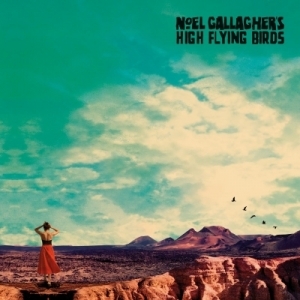
Daniel Boyd (1066 KP) rated Who Built The Moon? by Noel Gallagher / Noel Gallagher's High Flying Birds in Music
Nov 28, 2017 (Updated Nov 28, 2017)

A new direction from Noel (1 more)
Some unexpectedly bold creative choices are made
A Breath Of Fresh Air
Who Built The Moon? was released on Friday 24/11/17 and has already proved to be the most divisive album that Noel has ever been a part of. I personally love it. I think if Noel had dropped another record in the now expected style of the first two HFB's records, we would be rolling our eyes. Instead he is trying something new, a bold step for a man of 50 who has been making music publicly for the last quarter of a century.
Working with notorious industry producer, David Holmes, this record possesses a whole new sound for Noel, his lyrics and vocals are obviously instantly recognisable, but the instrumentation and production on the record is like something we have never heard him do before. Now it's all well and good trying something new, but is it any good? Well, it is actually.
The record opens with a stomping instrumental called Fort Knox. A track reminiscent of George Harrison meets the Gorillaz, that you can't help but at least nod along to. This isn't the first time that Noel has opened a record with an instrumental, (2000's Standing On The Shoulders of Giants opened with Fuckin' In The Bushes,) but I think it may be his best instrumental to date.
Next up is the record's lead single; Holy Mountain. This track carries on the pace set by Fort Knox and contains elements of Slade and Bowie to boot. Much has already been said about the comparison to She Bangs, but it doesn't bother me, this is a fantastic song and I feel like it was a solid choice for the album's first single. Having Paul Weller playing the organ on it doesn't hurt much either.
Following this is one of my favourite songs on the record, Keep On Reaching. I actually heard Noel talking about this song in an interview before I heard the track itself and from what he was describing, I didn't think I was going to care for it. Well my preconceptions were whacked away once I got around to listening to the track. Absolutely brilliant song that feels uplifting and triumphant.
The next song is called It's A Beautiful World and I have to admit I found it to be a bit of a grower. I first heard the track played live on Jools Holland and didn't love it, then I heard the album track and liked it a bit more, then I listened to it again and wasn't feeling it as much. Now six or seven listens later, I love this song. There are a few odd choices made here and I can understand why people would initially be put off, but I think this track works perfectly, especially within the context of the rest of the album.
After this we hear She Taught Me How To Fly, which is probably my least favourite track on the record. Again though I have to admit that this has grown on me since I first heard it. Hearing it live for the first time on Jools Holland, combined with seeing that scissor player for the first time was a bit much for me and to be honest I really wasn't a fan of the track. While I still don't love the track, I do enjoy it within the context of the album and I much prefer it now to when I initially heard it.
Track six is called Be Careful What You Wish For and for me, it falls into the same category as She Taught Me How To Fly, in that it is good, but not great. I'd say that these two songs are definitely the 'filler' section of the album. On any other record, these songs would be highlights, but on a Noel Gallagher record, they only qualify as filler in my opinion. They do add to the album as a whole though and are absolutely necessary if you are looking to experience the album all the way through from start to finish, which is also definitely the best way to experience this album.
The record picks up again with Black & White Sunshine. A roaring rock n' roll stomper that definitely sounds the most like Oasis over anything else on the album. The song's upbeat tone and slightly melancholy lyrics match up with Noel's signature writing style and it works just as well here as it did in the Oasis days. It's nice to hear something that feels slightly more familiar in amongst all of the other more experimental stuff on this record.
After hearing Fort Knox, I was really excited to hear the other instrumental on this album, Wednesday - Part 1. Unfortunately it's nowhere near as good as Fort Knox and it's been split into two parts. It's still a decently enjoyable piece of music that helps the album plod along into it's final stretch, but if like me you were hoping this to be just as good as Fort Knox, you will be left disappointed.
Next up is what is perhaps my favourite track on the record; If Love Is The Law. This glorious banger of a tune adds so much to the record overall and sounds mega through a good set of headphones. Johnny Marr's unmistakable guitar playing works awesomely on this track, as does his harmonica work. The lyrics are top notch, Noel's voice sounds great and it is a brilliant tune from start to finish.
The last official track on the album is the title track, The Man Who Built the Moon. This song tells the story of a cowboy full of regrets, using all sorts of interesting metaphors it is definitely the most narrative track on the album. The tone of the song slightly reminds me of The Ballad Of The Mighty I, the closing track from Noel's last record. It is a great song and works fantastically as a way to end this record.
Lastly we have Wednesday - Part 2, which is simply a continuation of Wednesday - Part 1, not much else to say here really.
Finally, we have a bonus track called Dead In The Water. This was recorded live during a session Noel did on an Irish radio station while promoting his previous album. Noel apparently didn't even know he was being recorded at the time while he was singing, which I think makes this song even more special. Allegedly, David Holmes was reluctant to put this on the record, as he felt it was out of place with the rest of the songs on the record, but I am so glad that Noel convinced him otherwise. Noel's voice here, sounds pure and frankly astonishing and the lyrics are fantastic too. The tone sounds similar to Talk Tonight and it is definitely one of the album's best moments.
The one gripe I have about this album, is that while this is a fresh new direction for Noel, it's not a style that hasn't been done before by other bands and arguably been done better. The Gorillaz' records or any of the late Beatles albums serve as a good example of this. Then again, Noel is well known from 'borrowing,' song elements from other artists, so maybe this is as original as it gets for him and we should be grateful for that.
Regardless, as a long time Oasis, (and particularly Noel Gallagher,) fan, I am glad that Noel is doing something new. I am also glad that with both Gallagher brothers now producing music, we won't be getting two extremely similar sounding albums. This is exciting for Oasis fans and can maybe serve as a step forward for fans who are still stuck in the past, in finally getting over their favourite band breaking up - it only took 8 years.
Working with notorious industry producer, David Holmes, this record possesses a whole new sound for Noel, his lyrics and vocals are obviously instantly recognisable, but the instrumentation and production on the record is like something we have never heard him do before. Now it's all well and good trying something new, but is it any good? Well, it is actually.
The record opens with a stomping instrumental called Fort Knox. A track reminiscent of George Harrison meets the Gorillaz, that you can't help but at least nod along to. This isn't the first time that Noel has opened a record with an instrumental, (2000's Standing On The Shoulders of Giants opened with Fuckin' In The Bushes,) but I think it may be his best instrumental to date.
Next up is the record's lead single; Holy Mountain. This track carries on the pace set by Fort Knox and contains elements of Slade and Bowie to boot. Much has already been said about the comparison to She Bangs, but it doesn't bother me, this is a fantastic song and I feel like it was a solid choice for the album's first single. Having Paul Weller playing the organ on it doesn't hurt much either.
Following this is one of my favourite songs on the record, Keep On Reaching. I actually heard Noel talking about this song in an interview before I heard the track itself and from what he was describing, I didn't think I was going to care for it. Well my preconceptions were whacked away once I got around to listening to the track. Absolutely brilliant song that feels uplifting and triumphant.
The next song is called It's A Beautiful World and I have to admit I found it to be a bit of a grower. I first heard the track played live on Jools Holland and didn't love it, then I heard the album track and liked it a bit more, then I listened to it again and wasn't feeling it as much. Now six or seven listens later, I love this song. There are a few odd choices made here and I can understand why people would initially be put off, but I think this track works perfectly, especially within the context of the rest of the album.
After this we hear She Taught Me How To Fly, which is probably my least favourite track on the record. Again though I have to admit that this has grown on me since I first heard it. Hearing it live for the first time on Jools Holland, combined with seeing that scissor player for the first time was a bit much for me and to be honest I really wasn't a fan of the track. While I still don't love the track, I do enjoy it within the context of the album and I much prefer it now to when I initially heard it.
Track six is called Be Careful What You Wish For and for me, it falls into the same category as She Taught Me How To Fly, in that it is good, but not great. I'd say that these two songs are definitely the 'filler' section of the album. On any other record, these songs would be highlights, but on a Noel Gallagher record, they only qualify as filler in my opinion. They do add to the album as a whole though and are absolutely necessary if you are looking to experience the album all the way through from start to finish, which is also definitely the best way to experience this album.
The record picks up again with Black & White Sunshine. A roaring rock n' roll stomper that definitely sounds the most like Oasis over anything else on the album. The song's upbeat tone and slightly melancholy lyrics match up with Noel's signature writing style and it works just as well here as it did in the Oasis days. It's nice to hear something that feels slightly more familiar in amongst all of the other more experimental stuff on this record.
After hearing Fort Knox, I was really excited to hear the other instrumental on this album, Wednesday - Part 1. Unfortunately it's nowhere near as good as Fort Knox and it's been split into two parts. It's still a decently enjoyable piece of music that helps the album plod along into it's final stretch, but if like me you were hoping this to be just as good as Fort Knox, you will be left disappointed.
Next up is what is perhaps my favourite track on the record; If Love Is The Law. This glorious banger of a tune adds so much to the record overall and sounds mega through a good set of headphones. Johnny Marr's unmistakable guitar playing works awesomely on this track, as does his harmonica work. The lyrics are top notch, Noel's voice sounds great and it is a brilliant tune from start to finish.
The last official track on the album is the title track, The Man Who Built the Moon. This song tells the story of a cowboy full of regrets, using all sorts of interesting metaphors it is definitely the most narrative track on the album. The tone of the song slightly reminds me of The Ballad Of The Mighty I, the closing track from Noel's last record. It is a great song and works fantastically as a way to end this record.
Lastly we have Wednesday - Part 2, which is simply a continuation of Wednesday - Part 1, not much else to say here really.
Finally, we have a bonus track called Dead In The Water. This was recorded live during a session Noel did on an Irish radio station while promoting his previous album. Noel apparently didn't even know he was being recorded at the time while he was singing, which I think makes this song even more special. Allegedly, David Holmes was reluctant to put this on the record, as he felt it was out of place with the rest of the songs on the record, but I am so glad that Noel convinced him otherwise. Noel's voice here, sounds pure and frankly astonishing and the lyrics are fantastic too. The tone sounds similar to Talk Tonight and it is definitely one of the album's best moments.
The one gripe I have about this album, is that while this is a fresh new direction for Noel, it's not a style that hasn't been done before by other bands and arguably been done better. The Gorillaz' records or any of the late Beatles albums serve as a good example of this. Then again, Noel is well known from 'borrowing,' song elements from other artists, so maybe this is as original as it gets for him and we should be grateful for that.
Regardless, as a long time Oasis, (and particularly Noel Gallagher,) fan, I am glad that Noel is doing something new. I am also glad that with both Gallagher brothers now producing music, we won't be getting two extremely similar sounding albums. This is exciting for Oasis fans and can maybe serve as a step forward for fans who are still stuck in the past, in finally getting over their favourite band breaking up - it only took 8 years.

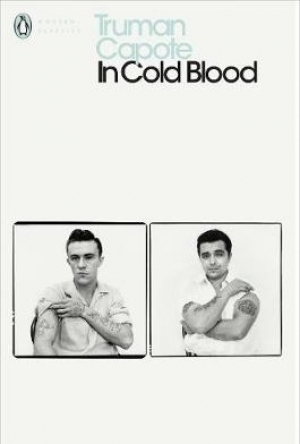
Hadley (567 KP) rated In Cold Blood: A True Account of a Multiple Murder and Its Consequences in Books
Aug 2, 2020

The writing (1 more)
The flow
In the 'Introduction' of Capote's true crime novel In Cold Blood, American writer Bob Colacello states: "Capote was one of the first who dared to elevate journalism to the level of art. In Cold Blood is a work of great discipline and even greater restraint, a tale of fate, as spare and elegiac as a Greek tragedy, as rich in its breadth and depth as the classic French novels of Stendhal and Flaubert. 'We all have our souls and we all have facades,' Truman Capote told his friend Kay Meehan a year or so before he came upon the news that would inspire his masterpiece, 'and then there's something in between that makes us function as people. That's what I have the ability to communicate.' "
The novel, which was published in 1965, is an eyewitness account of Capote's visitation to the scene of the murder as well as meetings with the murderers and townspeople- - - a retelling of the crime and aftermath, mostly from the eyes of those affected, by hundreds of hours of interviews and interrogations. The novel, ultimately, was the end of Capote which led him to alcoholism that took his life in 1984.
Like most small-town murders, a tension between residences is created when a well-known and well-liked family of four is brutally murdered, and everyone begins to point a finger at the other: "But afterward the townspeople, theretofore sufficiently unfearful of each other to seldom trouble to lock their doors, found fantasy re-creating them over and again - - - those somber explosions that stimulated fires of mistrust in the glare of which many old neighbors viewed each other strangely, and as strangers." Fortunately, the KBI (Kansas Bureau of Investigation) didn't allow these accusations to keep them from finding the real killers.
" 'Deep down,' Perry continued, 'way, way rock bottom, I never thought I could do it. A thing like that.' " Perry Smith, one of the murderers, confesses to his cohort and partner-in-crime, Richard Hickock, about murdering the Clutter family. "Presently, he said, 'Know what it is that really bugs me? About that other thing[Clutter murder]? It's just I don't believe it- - - that anyone can get away with a thing like that.' And he suspected that Dick [Richard] didn't, either. For Dick was at least partly inhabited by Perry's mystical-moral apprehensions. Thus: 'Now, just shut up!' "
Capote writes clearly of the impact that Smith's and Hickock's past may have played leading up to the murders, mostly focusing on Smith's traumatic childhood. During the trial portion of the book, a psychologist is brought in to point out how the two murderers may not have been responsible for their actions due-to instances in their past - - - a horrific car crash in Hickock's that left him with a lop-sided face and black-out spells, as well as Smith being physically and emotional abused by his alcoholic mother and father. In exploring these traumas, In Cold Blood leaves the impression that these two men were merely ticking time bombs and that the Clutter family, unfortunately, had to pay for it.
The trauma shared by Hickock and Smith help to shape the two murderers into actual human beings rather than monsters throughout the novel: one scene, where we get to read a letter to Smith from his last living sister, readers get to see how he was perceived by his family members, as his sister goes on to degrade him to the maturity level of a child and that she is above him because of that- - -but she also reveals her jealousy of their father loving him more than he ever loved her (despite the excessive abuse). A close friend of Smith's tells him to be careful writing her anymore because he believes that: 'they can only serve to increase your already dangerous anti-social instincts.'
Part of the narrative, too, is the KBI agent in-charge of the Clutter murder, Alvin Dewey: One day while visiting Holcomb's well-known cafe (Hartman's) where Dewey is told he looks awful from weight loss and fatigue - - - Dewey recalls that he had spent: 'two wearying and wasted days trying to trace that phantom pair, the Mexicans sworn by Paul Helm to have visited Mr. Clutter on the eve of the murders.' And then he gets heckled by a local, who wants to know why he hasn't found the people responsible yet,but Dewey simply smiles and walks away, having put up with numerous people being angry that the murders were taking so long to solve.
But it wasn't footwork that got the pair arrested, it was an old cellmate who had given Hickock the idea that there was $10,000 in a safe at the Clutter farm that came forward: (read this on my blog because I had to cut it out since my review was too long!).
Meanwhile, readers also get to experience Hickock and Smith's troubles as they are on the run after the murders which is done masterfully by Capote. And although one would assume that the killers would stay as far away from Kansas as possible, the two end up back there, only to miraculously get out before the police can catch up with them. The pair decide to head to Florida, where, on December 19, 1959, an entire family was murdered in the exact same way as the Clutters; Hickock and Smith both adamantly denied that they were involved with it - - - and back in 2012- - - Hickock and Smith's bodies were exhumed to compare their DNA with a profile found on one of the victim's clothing: they were not a match. The case remains unsolved til this day.
" Presently he[Smith] came across an inner-page story that won his entire attention. It concerned murder, the slaying of a Florida family, a Mr. and Mrs. Clifford Walker, their four-year-old son, and their two-year-old daughter. Each of the victims, though not bound or gagged, had been shot through the head with a .22 weapon. The crime, clueless and apparently motiveless, had taken place Saturday night, December 19, at the Walker home, on a cattle-raising ranch not far from Tallahassee."
Not soon after the pair leave the Florida beaches, they are arrested on what they believe to be parole violations, but it's clear, when the arresting officers are KBI agents that they had been caught for the Clutter murders. " 'Listen good, Perry. Because Mr. Duntz[KBI agent] is going to tell you where you really were...' Midway in the questioning, after he'd[Smith] begun to notice the number of allusions to a particular November weekend, he'd nerved himself for what he knew was coming, yet when it did, when the big cowboy with the sleepy voice said, 'You were killing the Clutter family' - - - well, he'd damn near died. That's all. "
The confession that follows is the most intense part of the book, given in it's entirety, readers finally get to know what happened to the Clutter family that cold night in November, 1959. Smith reveals that he never had the intention to kill anyone in the home, and that when the safe hadn't been found, he had fully intended to leave, even without Hickock, but what kept him there was Hickock threatening to rape Nancy Clutter. Smith states that he hates people who can't control themselves sexually, and that he didn't allow his partner to touch her at all. He also reveals that he thought about killing Hickock afterwards,stating: " no witnesses."
Capote didn't write 'In Cold Blood' until after Hickock and Smith were executed. The amount of interviews, court room appearances, and even witnessing the executions of both murderers shines through in this novel. But the book has also brought about doubters; a handful of people have since come forward to state that Capote's masterpiece is either 'not the full story' or 'completely wrong.' Just as recent as 2017, a man came forward with a 'manuscript' of a book that Hickock was writing, that contained a different confession on how and why the murders took place- - - Hickock states in this unpublished manuscript that a man by the name 'Roberts' had hired him and Smith to kill the Clutters.
Whether or not you believe that Capote wrote the whole truth or some of the truth, this novel is flawless and beautiful. The writing is poetic and the flow of the story keeps moving, page after page, never stopping long enough to bore the reader. I highly recommend this book as a MUST READ for anyone who loves the True Crime genre.
The novel, which was published in 1965, is an eyewitness account of Capote's visitation to the scene of the murder as well as meetings with the murderers and townspeople- - - a retelling of the crime and aftermath, mostly from the eyes of those affected, by hundreds of hours of interviews and interrogations. The novel, ultimately, was the end of Capote which led him to alcoholism that took his life in 1984.
Like most small-town murders, a tension between residences is created when a well-known and well-liked family of four is brutally murdered, and everyone begins to point a finger at the other: "But afterward the townspeople, theretofore sufficiently unfearful of each other to seldom trouble to lock their doors, found fantasy re-creating them over and again - - - those somber explosions that stimulated fires of mistrust in the glare of which many old neighbors viewed each other strangely, and as strangers." Fortunately, the KBI (Kansas Bureau of Investigation) didn't allow these accusations to keep them from finding the real killers.
" 'Deep down,' Perry continued, 'way, way rock bottom, I never thought I could do it. A thing like that.' " Perry Smith, one of the murderers, confesses to his cohort and partner-in-crime, Richard Hickock, about murdering the Clutter family. "Presently, he said, 'Know what it is that really bugs me? About that other thing[Clutter murder]? It's just I don't believe it- - - that anyone can get away with a thing like that.' And he suspected that Dick [Richard] didn't, either. For Dick was at least partly inhabited by Perry's mystical-moral apprehensions. Thus: 'Now, just shut up!' "
Capote writes clearly of the impact that Smith's and Hickock's past may have played leading up to the murders, mostly focusing on Smith's traumatic childhood. During the trial portion of the book, a psychologist is brought in to point out how the two murderers may not have been responsible for their actions due-to instances in their past - - - a horrific car crash in Hickock's that left him with a lop-sided face and black-out spells, as well as Smith being physically and emotional abused by his alcoholic mother and father. In exploring these traumas, In Cold Blood leaves the impression that these two men were merely ticking time bombs and that the Clutter family, unfortunately, had to pay for it.
The trauma shared by Hickock and Smith help to shape the two murderers into actual human beings rather than monsters throughout the novel: one scene, where we get to read a letter to Smith from his last living sister, readers get to see how he was perceived by his family members, as his sister goes on to degrade him to the maturity level of a child and that she is above him because of that- - -but she also reveals her jealousy of their father loving him more than he ever loved her (despite the excessive abuse). A close friend of Smith's tells him to be careful writing her anymore because he believes that: 'they can only serve to increase your already dangerous anti-social instincts.'
Part of the narrative, too, is the KBI agent in-charge of the Clutter murder, Alvin Dewey: One day while visiting Holcomb's well-known cafe (Hartman's) where Dewey is told he looks awful from weight loss and fatigue - - - Dewey recalls that he had spent: 'two wearying and wasted days trying to trace that phantom pair, the Mexicans sworn by Paul Helm to have visited Mr. Clutter on the eve of the murders.' And then he gets heckled by a local, who wants to know why he hasn't found the people responsible yet,but Dewey simply smiles and walks away, having put up with numerous people being angry that the murders were taking so long to solve.
But it wasn't footwork that got the pair arrested, it was an old cellmate who had given Hickock the idea that there was $10,000 in a safe at the Clutter farm that came forward: (read this on my blog because I had to cut it out since my review was too long!).
Meanwhile, readers also get to experience Hickock and Smith's troubles as they are on the run after the murders which is done masterfully by Capote. And although one would assume that the killers would stay as far away from Kansas as possible, the two end up back there, only to miraculously get out before the police can catch up with them. The pair decide to head to Florida, where, on December 19, 1959, an entire family was murdered in the exact same way as the Clutters; Hickock and Smith both adamantly denied that they were involved with it - - - and back in 2012- - - Hickock and Smith's bodies were exhumed to compare their DNA with a profile found on one of the victim's clothing: they were not a match. The case remains unsolved til this day.
" Presently he[Smith] came across an inner-page story that won his entire attention. It concerned murder, the slaying of a Florida family, a Mr. and Mrs. Clifford Walker, their four-year-old son, and their two-year-old daughter. Each of the victims, though not bound or gagged, had been shot through the head with a .22 weapon. The crime, clueless and apparently motiveless, had taken place Saturday night, December 19, at the Walker home, on a cattle-raising ranch not far from Tallahassee."
Not soon after the pair leave the Florida beaches, they are arrested on what they believe to be parole violations, but it's clear, when the arresting officers are KBI agents that they had been caught for the Clutter murders. " 'Listen good, Perry. Because Mr. Duntz[KBI agent] is going to tell you where you really were...' Midway in the questioning, after he'd[Smith] begun to notice the number of allusions to a particular November weekend, he'd nerved himself for what he knew was coming, yet when it did, when the big cowboy with the sleepy voice said, 'You were killing the Clutter family' - - - well, he'd damn near died. That's all. "
The confession that follows is the most intense part of the book, given in it's entirety, readers finally get to know what happened to the Clutter family that cold night in November, 1959. Smith reveals that he never had the intention to kill anyone in the home, and that when the safe hadn't been found, he had fully intended to leave, even without Hickock, but what kept him there was Hickock threatening to rape Nancy Clutter. Smith states that he hates people who can't control themselves sexually, and that he didn't allow his partner to touch her at all. He also reveals that he thought about killing Hickock afterwards,stating: " no witnesses."
Capote didn't write 'In Cold Blood' until after Hickock and Smith were executed. The amount of interviews, court room appearances, and even witnessing the executions of both murderers shines through in this novel. But the book has also brought about doubters; a handful of people have since come forward to state that Capote's masterpiece is either 'not the full story' or 'completely wrong.' Just as recent as 2017, a man came forward with a 'manuscript' of a book that Hickock was writing, that contained a different confession on how and why the murders took place- - - Hickock states in this unpublished manuscript that a man by the name 'Roberts' had hired him and Smith to kill the Clutters.
Whether or not you believe that Capote wrote the whole truth or some of the truth, this novel is flawless and beautiful. The writing is poetic and the flow of the story keeps moving, page after page, never stopping long enough to bore the reader. I highly recommend this book as a MUST READ for anyone who loves the True Crime genre.

Purple Phoenix Games (2266 KP) rated Tiny Epic Western in Tabletop Games
Dec 30, 2021


It’s no secret that we at Purple Phoenix Games are fans of the Tiny Epic series. But one that had evaded our reviews until this point was Tiny Epic Western. Admittedly, this one has been sitting on my shelf of shame for quite some time, so I finally decided it was time to take it off the shelf and bring it to the table! After squaring up with TEW, how does it compare to the rest in the series? Is this the rootinest tootinest of the bunch, or should it be bucked off my shelf?
Disclaimer: I do not intend to rehash the entire rulebook in this review, as there are just too many details, but will instead provide a more general overview of the rules and gameplay. -L
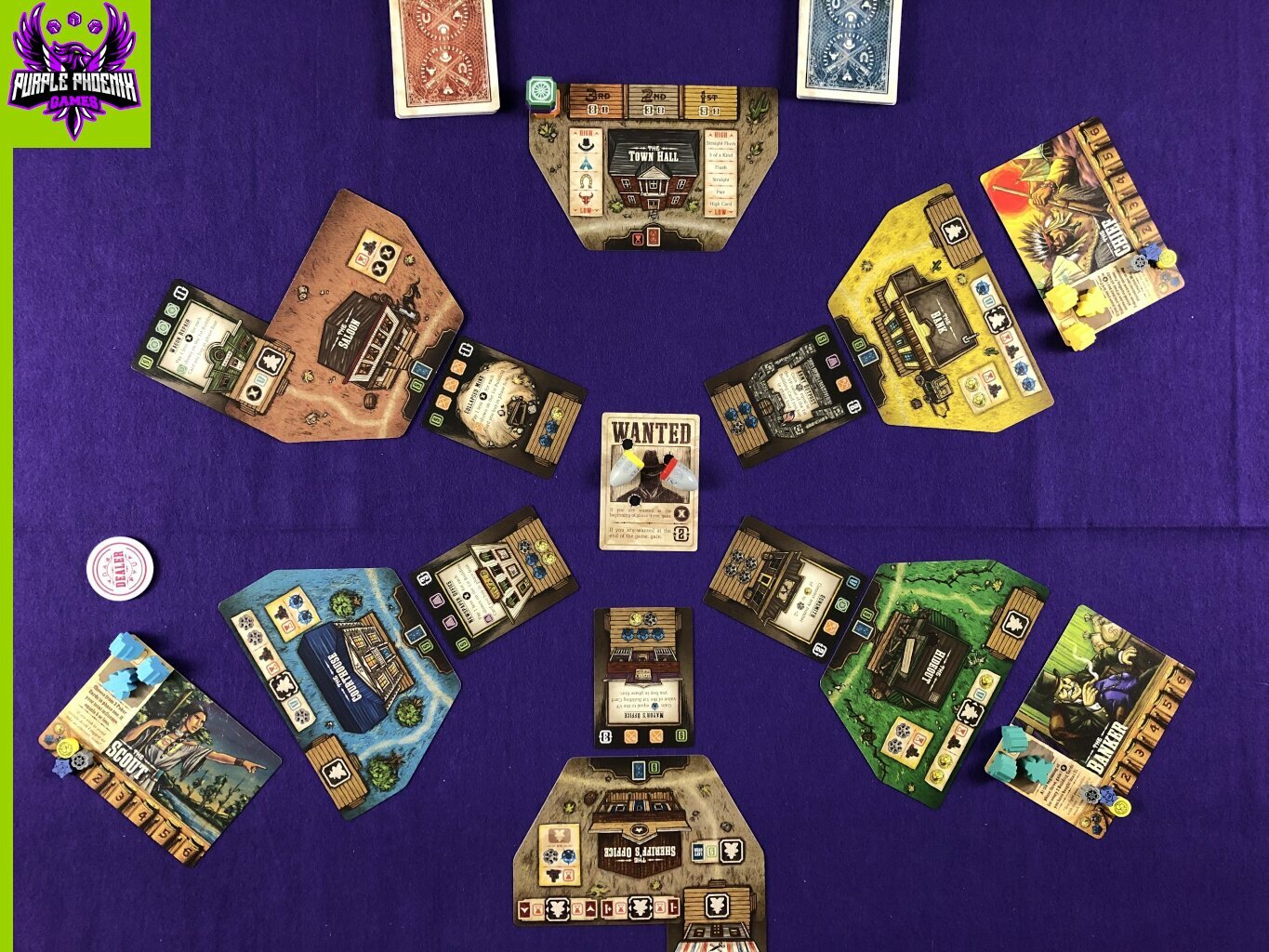
Tiny Epic Western is a game of worker placement and set collection in which players are trying to amass the most end-game victory points. Played over a series of rounds, players will be placing their Posse (Meeples), collecting Influence and taking actions, dueling opponents (if necessary), playing a bit of poker, and buying buildings in an effort to become the most powerful boss in this wild west town. To setup for a game, place the Location Mats as described in the rules, dealing a Building Card where appropriate. Each player receives a Boss card, 3 Posse tokens (Meeples), and one of each of the Influence trackers (Money, Law, and Force), placed on the 1 space of their card. Shuffle the decks of Building Cards and Poker Cards separately, choose a starting player (who receives the Dealer token), place the Wanted card/Gunslinger dice in the center of the play area, and the game is ready to begin! Pictured below is the starting setup for a 3-player game.
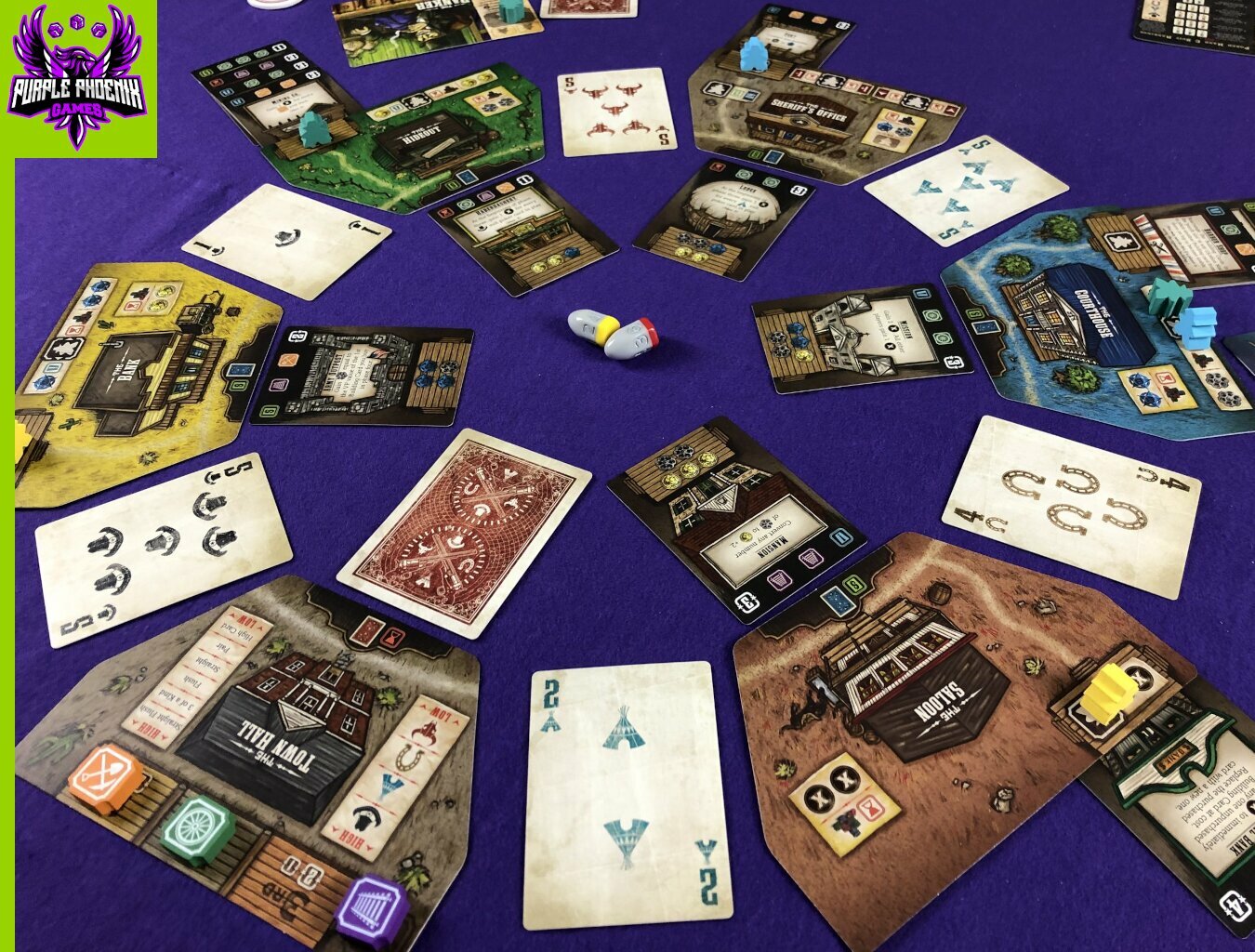
The game is played over 6 total rounds, each of which is broken into 4 phases: Shuffle and Deal, Posse Placement, Resolution, and Buy. To start a round, the Dealer shuffles the deck of Poker cards, and then deals 1 card face-up to the 6 empty spaces between the Location Mats. One Poker card is dealt face-down to the Rival Space (under the Town Hall Location Mat), and 2 Poker cards are dealt face-down to each player. Players look at both of their cards and pick 1 to keep, discarding the other. The round then moves to phase 2: Posse Placement. Starting with the Dealer, players will take turns placing Posse tokens onto the placement spots on any of the Location mats. All placement spots grant unique benefits (collecting different Influence or performing Building card actions) that are performed either immediately or during later phases of the round. What happens if an opponent took a placement spot that you wanted? Then it’s time for an old-fashioned duel! The dueling players each roll a Gunslinger die, modify it if they so choose, and determine a winner. Players continue taking turns placing Posse tokens until all available Posse tokens have been placed.
When all Posse tokens have been placed, the round moves to phase 3: Resolution. The first step of this phase is to reveal Poker cards – all players reveal their cards, and the card in the Rival Space is also revealed. Moving clockwise from the Town Hall, each Location will be resolved by ‘playing’ three-card poker. Each Location has 2 Poker cards directly adjacent to it (placed between the Locations in phase 1), and those 2 cards plus the one in your hand will form your Poker hand. Any players with Posse tokens on the Location will compare their Poker hands to determine a winner. If you win the hand, you collect the Winner’s Pot (extra benefits) and are able to collect any delayed benefits from placement spots in the Posse Placement phase. Losing the hand earns you nothing *womp womp*. If you are the only Posse on a Location (with no opponents) you will compare your hand to that of the Rival. The Rival’s hand uses the cards adjacent to the Town Hall, plus the revealed card in the Rival Space. If you have a better hand, you win the benefits on your Location. If the Rival wins, though, you do not collect these benefits. All Locations are resolved in this fashion before the last phase of the round, Buy, begins.
To start this phase, all players will compare their three-card Poker hands using the 2 Poker cards adjacent to the Town Hall. The player with the best hand will act first in this phase, followed by the next best hand, and so on. The first player may now choose to buy a Building card from any Location on which they have a Posse token. Pay the requisite amount of Influence to purchase a Building, and add it to the Porch Slot on your color-corresponding Location Mat. The power granted by this Building card is now available for use in future rounds. Once all players have had the option to purchase a Building, the player with the best hand will advance one of the Industry Tokens at Town Hall. The placements of Industry Tokens will affect end-game scoring, so keep that in mind as the game progresses. When all steps of the Buy phase are performed, the round now ends. Players collect all their Posse tokens back to their boss cards, all Poker cards are collected and re-shuffled, new Building cards are dealt to Locations from which they were purchased this round, and the Dealer token is passed to the next clockwise player. If a player did not buy a Building at all during the round, they have gained the Third Posse Benefit for the coming round – granting them an additional Posse token to place during phase 2. Otherwise, all players will only ever have 2 Posse tokens to place.
After a total of 6 complete rounds, the game ends and points are tallied. Victory Points are earned from Building cards bought throughout the game. Building cards have a specified VP amount, and also have a collection of Industry Icons on them. Using the final placement of the Industry Tokens on the board, players will earn points for Industry Icon sets they have collected. And finally, whomever holds the Wanted card (won the last duel) gains an additional 2 VP. Points are all counted, and the player with the highest score is the winner.
That all probably sounds pretty complicated. But I do have to say that verbally explaining/teaching the game (and being able to use components for examples) is waaaaay easier than doing so through a text review. So please do not let the seemingly complex gameplay turn you off from this game. Once you get a basic understanding of the phases of each round, the game moves along pretty seamlessly. Honestly, the biggest learning curve for me to conquer was playing three-card poker. As someone who has never played any form of poker before, this was probably what had me most hesitant about learning TEW. After having played it now, three-card poker really isn’t too complicated, and there are some nice player reference cards to help you figure it out.
Aside from the poker element, this game really comes down to worker placement and strategy. Each Location card only has a finite number of placement spots, and the resources required to buy Buildings are not exactly in abundance. This affects your strategy, as you must decide which resources to collect at what times, as well as deciding whether you need to duel someone for a coveted resource. Another element to your strategy? You may only buy Building cards from Locations on which you have a Posse token. Maybe none of those placement spots really appeal to you this round, but you reaaaaally want that specific Building card. Are you willing to ‘burn’ a Posse token for the chance to buy it? Or is there a different Location that offers a useful resources and a desirable Building card? Also, keep in mind how your poker hand will come into play. Since poker cards are dealt to each Location at the start of a round, you are able to see what your hand will be for each Location. Maybe you have a pretty strong hand at the Bank Location, but at the Courthouse the cards end up being a bust. Are you willing to risk a placement in hopes that you have the best hand of the bunch? Because remember – if you don’t have the best hand at a Location, you get no resources/rewards! There are so many elements to a successful strategy with this game, and it really keeps all players engaged at all times. Be warned though – the variety of strategic options could be difficult for some AP-prone players.
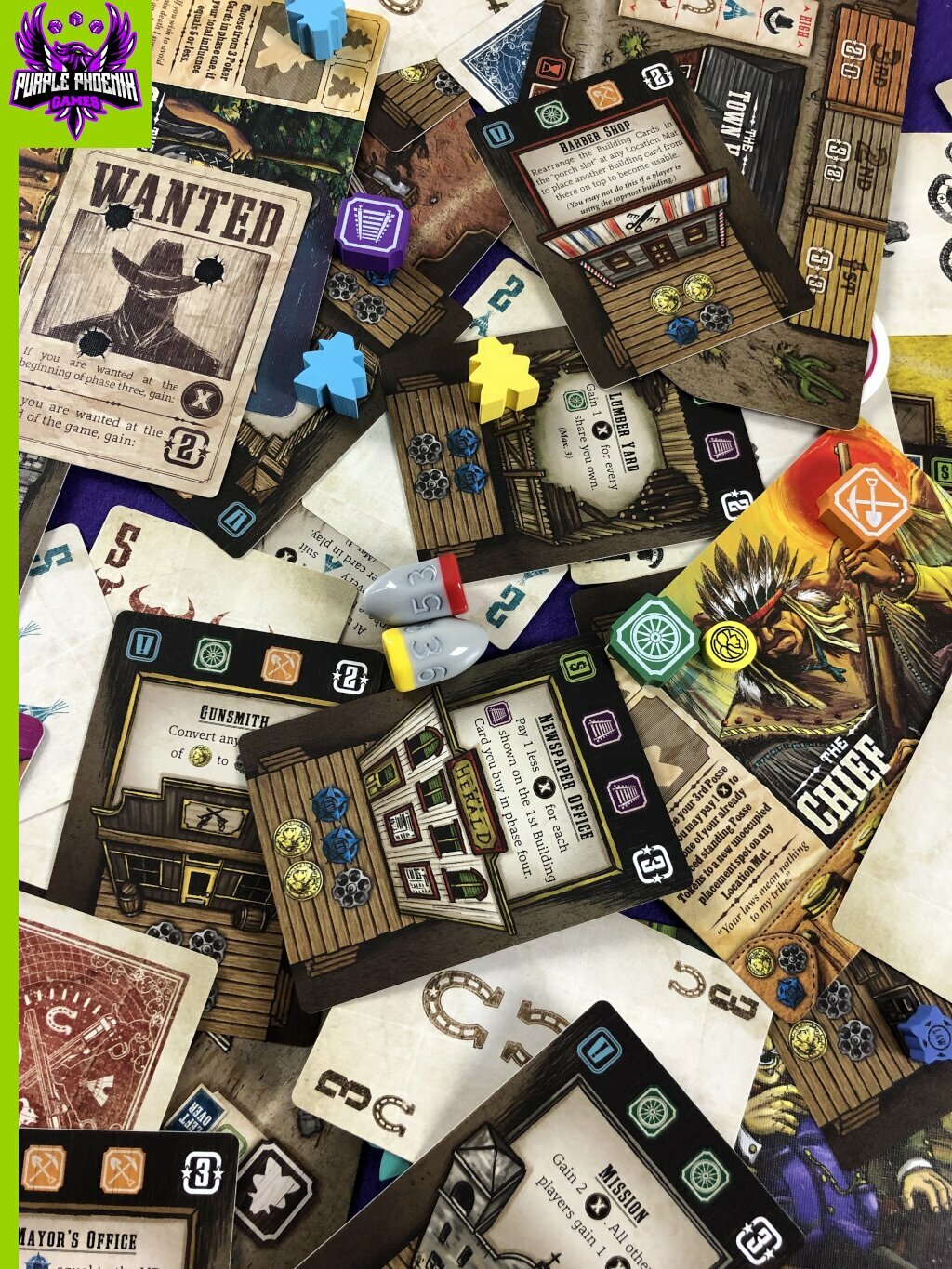
Let me touch on components for a minute. As with all Tiny Epic games, the production quality of TEW is pretty stellar. The cards are nice and sturdy, and the iconography is clear. The Posse tokens are cute Meeples with cowboy hats, and they are nice and chunky. The only thing I don’t really like about this game are the Gunslinger dice. In theory, they are super cool, but in actual execution, they leave much to be desired. The numbers aren’t really clearly define, so they’re a bit tricky to read. Aside from that, a pretty high quality game here.
So all in all, how does Tiny Epic Western stand up in the series? It is definitely one of the heavier games of the bunch, and there is so much more going on than initially meets the eye. It feels daunting for the first few plays, but once you get the phases under your belt, it really flows pretty well. I can’t say that it is my favorite Tiny Epic game, as I just personally feel like there are too many elements going on at the same time. You’re strategizing your worker placement, but also need to consider buying Buildings for VP and to collect sets of Industry Icons and for their specific abilities, as well as figuring out your poker hand for 5 different Locations, and dealing with duels. Some people might really be into that amount of strategic forethought, but it feels a bit cumbersome to me. That being said, Purple Phoenix Games gives this three-card poker game a 3/6. The gameplay is decent, just not really my kind of game.
Disclaimer: I do not intend to rehash the entire rulebook in this review, as there are just too many details, but will instead provide a more general overview of the rules and gameplay. -L
Tiny Epic Western is a game of worker placement and set collection in which players are trying to amass the most end-game victory points. Played over a series of rounds, players will be placing their Posse (Meeples), collecting Influence and taking actions, dueling opponents (if necessary), playing a bit of poker, and buying buildings in an effort to become the most powerful boss in this wild west town. To setup for a game, place the Location Mats as described in the rules, dealing a Building Card where appropriate. Each player receives a Boss card, 3 Posse tokens (Meeples), and one of each of the Influence trackers (Money, Law, and Force), placed on the 1 space of their card. Shuffle the decks of Building Cards and Poker Cards separately, choose a starting player (who receives the Dealer token), place the Wanted card/Gunslinger dice in the center of the play area, and the game is ready to begin! Pictured below is the starting setup for a 3-player game.
The game is played over 6 total rounds, each of which is broken into 4 phases: Shuffle and Deal, Posse Placement, Resolution, and Buy. To start a round, the Dealer shuffles the deck of Poker cards, and then deals 1 card face-up to the 6 empty spaces between the Location Mats. One Poker card is dealt face-down to the Rival Space (under the Town Hall Location Mat), and 2 Poker cards are dealt face-down to each player. Players look at both of their cards and pick 1 to keep, discarding the other. The round then moves to phase 2: Posse Placement. Starting with the Dealer, players will take turns placing Posse tokens onto the placement spots on any of the Location mats. All placement spots grant unique benefits (collecting different Influence or performing Building card actions) that are performed either immediately or during later phases of the round. What happens if an opponent took a placement spot that you wanted? Then it’s time for an old-fashioned duel! The dueling players each roll a Gunslinger die, modify it if they so choose, and determine a winner. Players continue taking turns placing Posse tokens until all available Posse tokens have been placed.
When all Posse tokens have been placed, the round moves to phase 3: Resolution. The first step of this phase is to reveal Poker cards – all players reveal their cards, and the card in the Rival Space is also revealed. Moving clockwise from the Town Hall, each Location will be resolved by ‘playing’ three-card poker. Each Location has 2 Poker cards directly adjacent to it (placed between the Locations in phase 1), and those 2 cards plus the one in your hand will form your Poker hand. Any players with Posse tokens on the Location will compare their Poker hands to determine a winner. If you win the hand, you collect the Winner’s Pot (extra benefits) and are able to collect any delayed benefits from placement spots in the Posse Placement phase. Losing the hand earns you nothing *womp womp*. If you are the only Posse on a Location (with no opponents) you will compare your hand to that of the Rival. The Rival’s hand uses the cards adjacent to the Town Hall, plus the revealed card in the Rival Space. If you have a better hand, you win the benefits on your Location. If the Rival wins, though, you do not collect these benefits. All Locations are resolved in this fashion before the last phase of the round, Buy, begins.
To start this phase, all players will compare their three-card Poker hands using the 2 Poker cards adjacent to the Town Hall. The player with the best hand will act first in this phase, followed by the next best hand, and so on. The first player may now choose to buy a Building card from any Location on which they have a Posse token. Pay the requisite amount of Influence to purchase a Building, and add it to the Porch Slot on your color-corresponding Location Mat. The power granted by this Building card is now available for use in future rounds. Once all players have had the option to purchase a Building, the player with the best hand will advance one of the Industry Tokens at Town Hall. The placements of Industry Tokens will affect end-game scoring, so keep that in mind as the game progresses. When all steps of the Buy phase are performed, the round now ends. Players collect all their Posse tokens back to their boss cards, all Poker cards are collected and re-shuffled, new Building cards are dealt to Locations from which they were purchased this round, and the Dealer token is passed to the next clockwise player. If a player did not buy a Building at all during the round, they have gained the Third Posse Benefit for the coming round – granting them an additional Posse token to place during phase 2. Otherwise, all players will only ever have 2 Posse tokens to place.
After a total of 6 complete rounds, the game ends and points are tallied. Victory Points are earned from Building cards bought throughout the game. Building cards have a specified VP amount, and also have a collection of Industry Icons on them. Using the final placement of the Industry Tokens on the board, players will earn points for Industry Icon sets they have collected. And finally, whomever holds the Wanted card (won the last duel) gains an additional 2 VP. Points are all counted, and the player with the highest score is the winner.
That all probably sounds pretty complicated. But I do have to say that verbally explaining/teaching the game (and being able to use components for examples) is waaaaay easier than doing so through a text review. So please do not let the seemingly complex gameplay turn you off from this game. Once you get a basic understanding of the phases of each round, the game moves along pretty seamlessly. Honestly, the biggest learning curve for me to conquer was playing three-card poker. As someone who has never played any form of poker before, this was probably what had me most hesitant about learning TEW. After having played it now, three-card poker really isn’t too complicated, and there are some nice player reference cards to help you figure it out.
Aside from the poker element, this game really comes down to worker placement and strategy. Each Location card only has a finite number of placement spots, and the resources required to buy Buildings are not exactly in abundance. This affects your strategy, as you must decide which resources to collect at what times, as well as deciding whether you need to duel someone for a coveted resource. Another element to your strategy? You may only buy Building cards from Locations on which you have a Posse token. Maybe none of those placement spots really appeal to you this round, but you reaaaaally want that specific Building card. Are you willing to ‘burn’ a Posse token for the chance to buy it? Or is there a different Location that offers a useful resources and a desirable Building card? Also, keep in mind how your poker hand will come into play. Since poker cards are dealt to each Location at the start of a round, you are able to see what your hand will be for each Location. Maybe you have a pretty strong hand at the Bank Location, but at the Courthouse the cards end up being a bust. Are you willing to risk a placement in hopes that you have the best hand of the bunch? Because remember – if you don’t have the best hand at a Location, you get no resources/rewards! There are so many elements to a successful strategy with this game, and it really keeps all players engaged at all times. Be warned though – the variety of strategic options could be difficult for some AP-prone players.
Let me touch on components for a minute. As with all Tiny Epic games, the production quality of TEW is pretty stellar. The cards are nice and sturdy, and the iconography is clear. The Posse tokens are cute Meeples with cowboy hats, and they are nice and chunky. The only thing I don’t really like about this game are the Gunslinger dice. In theory, they are super cool, but in actual execution, they leave much to be desired. The numbers aren’t really clearly define, so they’re a bit tricky to read. Aside from that, a pretty high quality game here.
So all in all, how does Tiny Epic Western stand up in the series? It is definitely one of the heavier games of the bunch, and there is so much more going on than initially meets the eye. It feels daunting for the first few plays, but once you get the phases under your belt, it really flows pretty well. I can’t say that it is my favorite Tiny Epic game, as I just personally feel like there are too many elements going on at the same time. You’re strategizing your worker placement, but also need to consider buying Buildings for VP and to collect sets of Industry Icons and for their specific abilities, as well as figuring out your poker hand for 5 different Locations, and dealing with duels. Some people might really be into that amount of strategic forethought, but it feels a bit cumbersome to me. That being said, Purple Phoenix Games gives this three-card poker game a 3/6. The gameplay is decent, just not really my kind of game.