
Search
Purple Phoenix Games (2266 KP) rated Chronicles of Crime: 1900 in Tabletop Games
Apr 23, 2021

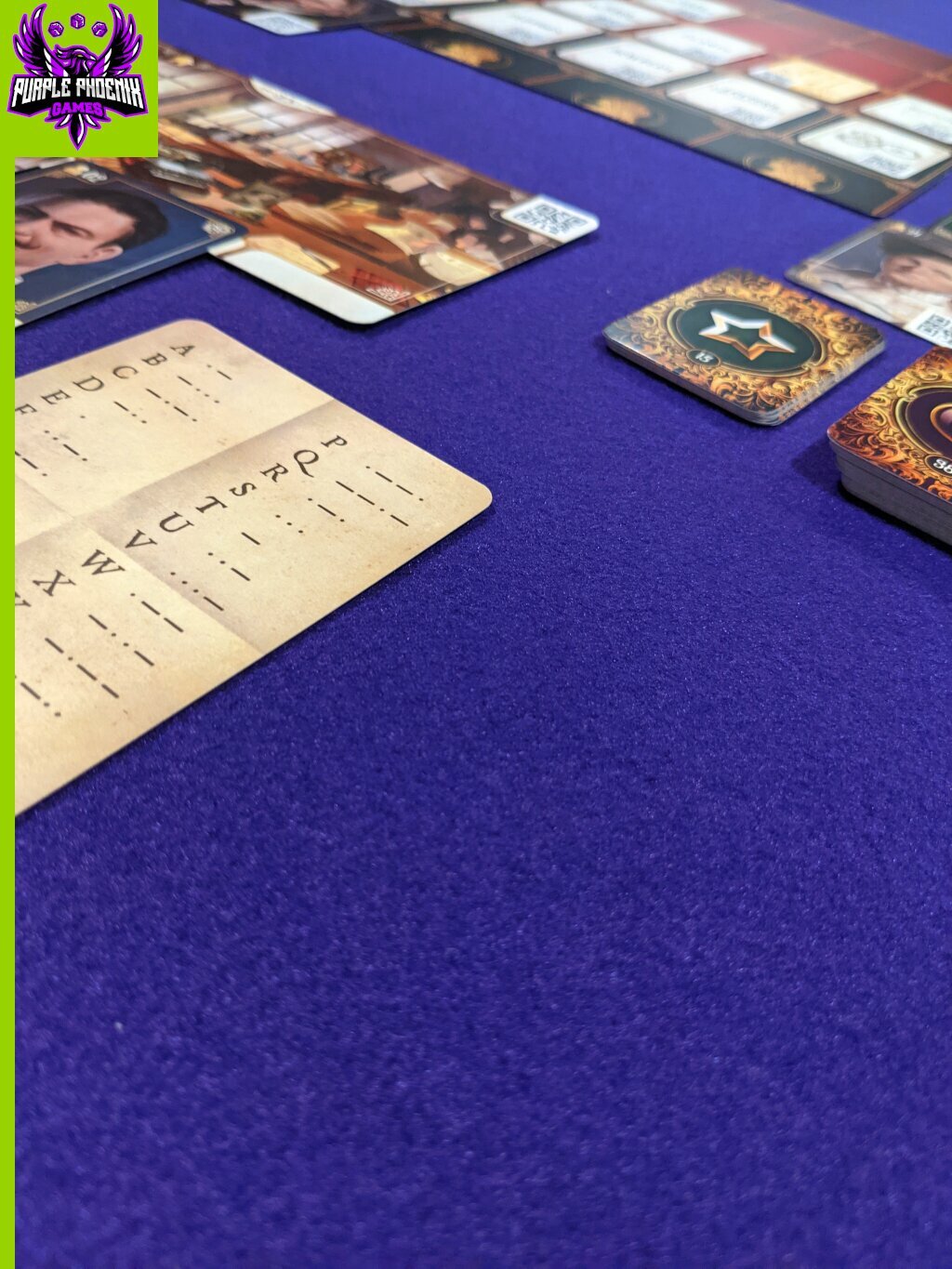
WARNING: Extremely minor spoilers ahead (in the photos)! Don’t say I didn’t warn you (they aren’t big spoilers).
If you have been following us for a while now you have probably noticed we have published another title from the Millennium Series – Chronicles of Crime: 1400. While that title takes place in the year, well, 1400, this new title is set 500 years later in Paris. How do these games compare? What about the link to the original Chronicles of Crime (review to be posted later)? Should one purchase copies of all Chronicles of Crime games?
Chronicles of Crime: 1900 (which I shall refer to as CoC1900 from here) is a cooperative campaign, deduction, storytelling, puzzle solving adventure game, but I prefer to play it, and its relatives, solo. In it, the player(s) take control of the journalist Victor Lavel, a descendent of the main character from CoC1400. Victor has a limited amount of time to complete his investigation and return the scoop to the local newspaper by which he is employed. Players will be tackling the investigations of our noble hero in attempts to solve the case that is presented.
DISCLAIMER: We were provided a copy of this game for the purposes of this review. This is a retail copy of the game, so what you see in these photos is exactly what would be received in your box. I do not intend to cover every single rule included in the rulebook, but will describe the overall game flow and major rule set so that our readers may get a sense of how the game plays. For more in depth rules, you may purchase a copy online or from your FLGS. -T
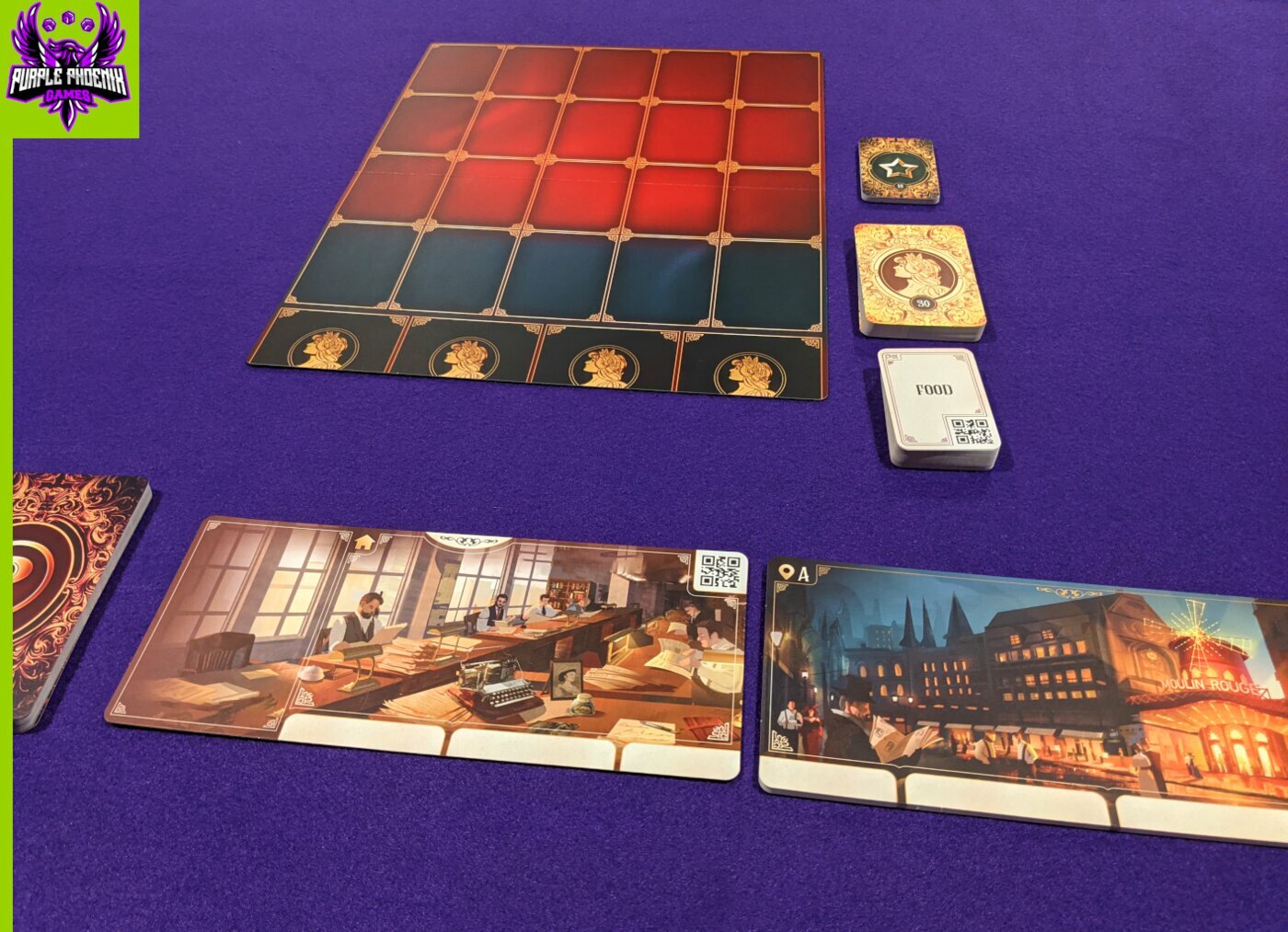
To setup, place the main card holder board on the table. Anywhere. I called it. Next, keep the card decks in order (or don’t) and place them near the board. Similarly, place the location boards on the table and ready the main newspaper board for play. Launch the Chronicles of Crime app on a device, choose 1900, and select the scenario you wish to play. The app will drive the remainder of the game, so hold onto your butts!
How do I explain this game succinctly? Well, each of the cases will involve players traveling to different Location Boards and meeting Characters at these locations. Many cases will be involving several Special Items and, new for the 1900 version, Puzzle Cards that players will need to solve or use in special ways in order to progress with certain leads. These Puzzle Cards do not really give the story away or anything, but are merely tools to be used to help solve the cases.
By using the app and scanning the QR codes on the boards and cards players will be learning about the case, viewing the scene of the crime(s), inspecting items, and chatting up locals for information. Play will continue not so much in “rounds” but until the players have enough evidence and a good handle on the situation enough to return to the paper’s office to report to their coworkers all the details of the crime(s) by scanning answers to their questions about the case. The app then assesses the accuracy of the answers and outputs a score. Based on the score achieved players can play again to pick up clues they missed along the way or try another scenario entirely.
Components. As with all CoC games I have played, the components are simply wonderful. Most of what is in the box is cardstock of varying thickness, but the art is what really stands out. This is a gorgeous game and when it is displayed on the table, people become fascinated by its presence. Then when the onlookers see an app driving the gameplay they are hooked. I have heard complaints from other reviewers that the Character cards in the game are lacking in variation, and I would have to agree. Yes, it is set in 1900 Paris, but all the Character cards feature white people, most of whom seem to be upper crust, and with most of the males sporting an awful mustache. So I get that complaint and agree. With inclusivity and diversity being major hot issues currently, you would expect to see more of it in our industry. I would have liked to have come across more diverse characters, and maybe a mini expansion can add many alternate art characters to the game.
All in all I loved this theme of Chronicles of Crime. Being set in Paris and following a young investigative journalist is a nice twist on the protagonists commonly featured in these games. The gameplay is the same as previous versions of CoC, save for the new Puzzle cards. I do enjoy their addition, and look to find more of these in future versions. I love the Chronicles of Crime system so I was bound to love this one as well.
Now, should you buy this version if you already have base Chronicles of Crime? Sure! Why? I like this one because it adds a different mechanic to the game with all-new scenarios, and I enjoy having more of a good thing. I think I personally prefer the theme in 1400 more, but 1900 is a great addition to the family. If you are someone who has and enjoys the base CoC, or any of its iterations, and are looking for more content to devour, then definitely grab a copy of 1900. If you are new to the system, I say go ahead and start with 1900. The Puzzle cards do not add enough complexity to take it out of reach for beginner gamers or those who enjoy lighter games, but certainly add a new and welcome layer to the series. Purple Phoenix Games certainly recommends this one to all our fans. Can’t get enough Chronicles of Crime? Grab 1900. Want to start in the series but London or Medieval times don’t do it for you? Grab 1900. Like tons of portraits of mustachioed white dudes and floofy ladies? Grab 1900. Whatever your motivation, play the game and let me know how you score. I am not advertising my first score here because I am mortified by my performance. (I did get better on subsequent plays.)

If you have been following us for a while now you have probably noticed we have published another title from the Millennium Series – Chronicles of Crime: 1400. While that title takes place in the year, well, 1400, this new title is set 500 years later in Paris. How do these games compare? What about the link to the original Chronicles of Crime (review to be posted later)? Should one purchase copies of all Chronicles of Crime games?
Chronicles of Crime: 1900 (which I shall refer to as CoC1900 from here) is a cooperative campaign, deduction, storytelling, puzzle solving adventure game, but I prefer to play it, and its relatives, solo. In it, the player(s) take control of the journalist Victor Lavel, a descendent of the main character from CoC1400. Victor has a limited amount of time to complete his investigation and return the scoop to the local newspaper by which he is employed. Players will be tackling the investigations of our noble hero in attempts to solve the case that is presented.
DISCLAIMER: We were provided a copy of this game for the purposes of this review. This is a retail copy of the game, so what you see in these photos is exactly what would be received in your box. I do not intend to cover every single rule included in the rulebook, but will describe the overall game flow and major rule set so that our readers may get a sense of how the game plays. For more in depth rules, you may purchase a copy online or from your FLGS. -T
To setup, place the main card holder board on the table. Anywhere. I called it. Next, keep the card decks in order (or don’t) and place them near the board. Similarly, place the location boards on the table and ready the main newspaper board for play. Launch the Chronicles of Crime app on a device, choose 1900, and select the scenario you wish to play. The app will drive the remainder of the game, so hold onto your butts!
How do I explain this game succinctly? Well, each of the cases will involve players traveling to different Location Boards and meeting Characters at these locations. Many cases will be involving several Special Items and, new for the 1900 version, Puzzle Cards that players will need to solve or use in special ways in order to progress with certain leads. These Puzzle Cards do not really give the story away or anything, but are merely tools to be used to help solve the cases.
By using the app and scanning the QR codes on the boards and cards players will be learning about the case, viewing the scene of the crime(s), inspecting items, and chatting up locals for information. Play will continue not so much in “rounds” but until the players have enough evidence and a good handle on the situation enough to return to the paper’s office to report to their coworkers all the details of the crime(s) by scanning answers to their questions about the case. The app then assesses the accuracy of the answers and outputs a score. Based on the score achieved players can play again to pick up clues they missed along the way or try another scenario entirely.
Components. As with all CoC games I have played, the components are simply wonderful. Most of what is in the box is cardstock of varying thickness, but the art is what really stands out. This is a gorgeous game and when it is displayed on the table, people become fascinated by its presence. Then when the onlookers see an app driving the gameplay they are hooked. I have heard complaints from other reviewers that the Character cards in the game are lacking in variation, and I would have to agree. Yes, it is set in 1900 Paris, but all the Character cards feature white people, most of whom seem to be upper crust, and with most of the males sporting an awful mustache. So I get that complaint and agree. With inclusivity and diversity being major hot issues currently, you would expect to see more of it in our industry. I would have liked to have come across more diverse characters, and maybe a mini expansion can add many alternate art characters to the game.
All in all I loved this theme of Chronicles of Crime. Being set in Paris and following a young investigative journalist is a nice twist on the protagonists commonly featured in these games. The gameplay is the same as previous versions of CoC, save for the new Puzzle cards. I do enjoy their addition, and look to find more of these in future versions. I love the Chronicles of Crime system so I was bound to love this one as well.
Now, should you buy this version if you already have base Chronicles of Crime? Sure! Why? I like this one because it adds a different mechanic to the game with all-new scenarios, and I enjoy having more of a good thing. I think I personally prefer the theme in 1400 more, but 1900 is a great addition to the family. If you are someone who has and enjoys the base CoC, or any of its iterations, and are looking for more content to devour, then definitely grab a copy of 1900. If you are new to the system, I say go ahead and start with 1900. The Puzzle cards do not add enough complexity to take it out of reach for beginner gamers or those who enjoy lighter games, but certainly add a new and welcome layer to the series. Purple Phoenix Games certainly recommends this one to all our fans. Can’t get enough Chronicles of Crime? Grab 1900. Want to start in the series but London or Medieval times don’t do it for you? Grab 1900. Like tons of portraits of mustachioed white dudes and floofy ladies? Grab 1900. Whatever your motivation, play the game and let me know how you score. I am not advertising my first score here because I am mortified by my performance. (I did get better on subsequent plays.)
The Martian Ambassador
Book
WELCOME TO LONDON, 1899 It has been six years since the discovery of intelligent life on Mars, and...

Death in Her Hands
Book
While on her daily walk with her dog in a secluded woods, a woman comes across a note, handwritten...
Mark @ Carstairs Considers (2680 KP) rated Partners in Crime in Books
Jan 4, 2024
Five Cases of Crime in the Old West
This book collects five stories featuring Old Red and Big Red, the stars of the Holmes on the Range series. They are set during late fall 1893 and winter 1894, and find the brothers solving a variety of cases. The first story finds the brothers returning to their home town in Kansas with mixed results. When the brothers set out to find a Christmas tree for their landlady, they find a dead body instead. A series of strange events leads them to go to Idaho to try to help the sheep ranchers involved. A request in Colorado finds them in the middle of newspaper wars. Finally, they have to clear their own names when their landlady thinks they are responsible for the things that have been disappearing around their boarding house.
Combined, these five stories reach novel length. Individually, they vary in length. The first one seems to wander a bit at first, but as a fan of the series, I didn’t mind. The stories take place around two of the novels, but there aren’t any spoilers. Instead, we get Big Red and Old Red and some great new characters in each story to keep us engaged. The crimes don’t always involve murder, which I enjoyed seeing. If you haven’t tried the series yet, this would be a fun way to sample the characters. If you’re already a fan, you’ll enjoy seeing what the brothers get up to here.

Hazel (1853 KP) rated Timmy Failure: The Cat Stole My Pants in Books
Sep 12, 2017

Amusing ... If you are a child
I received this book for free through Goodreads First Reads.
For fans of Diary of a Wimpy Kid (Kinney, 2004) is a juvenile series by American author, Stephan Pastis, about a young boy who believes he is the world’s greatest detective. A series that is continually growing, the sixth Timmy Failure story is now available for fans and new readers. Subtitled The Cat Stole My Pants, Timmy Failure embarks on an adventure of mystery and crime solving whilst getting himself into all sorts of mischief.
Emulating both real and fictional detectives, Timmy has established his own agency, Failure, Inc., of which he is the sole employee after the flight of his (imaginary) ex-business partner, Total the polar bear, who is currently seeking political asylum in Cuba. Unfortunately, Timmy has been forced to join his mother and Doorman Dave on their honeymoon in Key West, Florida, along with Doorman Dave’s nephew, Emilio.
“Crime doesn’t take a holiday. Neither does greatness.” Determined to continue solving crimes, Timmy hires Emilio as an unpaid intern and sets off searching for crimes, greatly over exaggerating every little piece of “evidence” he finds. However, it soon appears that someone is out to get Timmy and he, along with Emilio, is determined to find out whom.
Timmy is a melodramatic, unconventional child with a large ego and is constantly getting told off. From annoying adults to having his pants stolen by a polydactyl cat – or so he claims – there is no end to the hilarious situations he causes.
The cat that stole Timmy’s pants only makes a brief appearance in the book, therefore the subtitle is more to attract the attention of young readers with its silliness rather than be suggestive of a certain storyline.
Despite his grand claims, Timmy is not a very good detective and a lot of his unsolved crimes have been invented by his overactive imagination. This adds to the humour because, although he seems like an intelligent child, his ideas are completely silly.
Adorned with childish drawings and diagrams, Timmy Failure narrates the story from his subjective point of view, inflating his successes and blaming any failure on poor Emilio. No one takes Timmy seriously, which is something many of the target readers may appreciate, although they should also understand how futile Timmy’s attempts are at being a detective.
The storyline is not particularly clear until the final chapters of the book. Up until that moment, the book is full of disastrous, imaginary detective endeavours that prove Timmy to be nothing more than an annoying, inventive boy.
Some of the language may be above children’s reading capabilities, however, the humour is directly on their level. Whereas an adult may not find the idea of a cat stealing someone’s pants amusing, a child would find that hysterical.
There is no reason to read the Timmy Failure books in order, so if you, like me, read book six first, there is no problem. The stories are particularly aimed at young boys and will hopefully encourage the demographic to start reading more. Whilst it may not be a great feat of literature, it is a good enough introduction to the world of books.
A Darkness More Than Night (Harry Bosch, #7; Terry McCaleb, #2; Harry Bosch Universe, #9)
Book
Harry Bosch is up to his neck in a case that has transfixed all of celebrity-mad Los Angeles: a...

ClareR (6256 KP) rated The Long Long Afternoon in Books
Mar 2, 2021

The Long, Long Afternoon really gives a sense of time and place - and I loved that about this book. We’re steeped in the 1950’s suburban world of perfect housewives, dosed up on their happy pills, trapped in their blissful domestic lives, keeping a perfect home and looking their best at all times for their hardworking husbands. Meanwhile, they employ black maids for a pitiful wage, taking advantage of them and treating them appallingly.
Ruby Wright arrives to start her afternoons work at Joyce Hanley’s house, and instead finds her young daughter outside and a screaming toddler upstairs in her bedroom. When Ruby goes in to the kitchen, she is confronted with a room awash with blood and signs of a struggle.
When the police arrive, they arrest Ruby for murder. After all, she was the first person there - and she’s black.
Detective Mick Blanke takes on the case. It’s an interesting book, because not only is Mick solving the crime (with some considerable help from Ruby), he’s also showing the social divides in the USA at this time - rich and poor, black and white. He’s clearly not comfortable about the way that white people treat black people in Santa Monica, but he’s still not quite brave enough to call people out on their racism.
This is an engaging, quick read - or perhaps I read it quickly because I didn’t want to put it down. It’s a clever, unpredictable story. In all, it’s a book I’d recommend without hesitation!
Mark @ Carstairs Considers (2680 KP) rated Murder at the Fortune Teller’s Table in Books
Jul 22, 2021
Mystery From the Past; Murder in the Present
When Summer approaches Kelly and the Senior Sentinels asking them for a favor, they are only too willing to agree. Her request seems rather daunting, find two people she hasn’t seen in fifty years. Yet the group of crime solving enthusiasts are able to do so rather quickly. However, before Summer can follow up with the people who wanted found with her real request, she turns up dead. The police view it as a tragic accident, but Kelly thinks something else is going on. Can she figure out what is really happening?
Since it has been a while since I read the previous book in the series, it took me a bit to remember who all the characters are, but it wasn’t too long before I was back up to speed. The series regulars are a charming bunch, and this is especially true for the group of senior citizens that help Kelly figure out what is going on around town. The mystery is great with some creative scenes and strong characters that kept me guessing. Being from Northern California originally, I love the setting, and the talk of food made me drool as I read. I do think the internal timeline of the book is off, mainly because the characters seem younger than they’d have to be, but I didn’t even think about that until I’d finished the book. Overall, I enjoyed this book and am anxious to return to the series soon.

Christine A. (965 KP) rated Somebody’s Daughter (Detective Natalie Ward #7) by Carol Wyer in Books
Aug 24, 2020
I was provided with a complimentary copy of this book so I could give an honest review. The opinions are entirely my own, and any quotes are taken from the ARC and may be different in the final published copy.
Somebody's Daughter is the 7th book in Carol Wyer's Detective Natalie Ward series. If you have read my reviews of her earlier works, you know I enjoy her series. Somebody's Daughter is no exception.
This time, significant changes have shaken up and changed the dynamics of the team. Detective Natalie Ward has been promoted to DCI and Lucy Carmichael is now the DI for the team.
The new team's first case finds Natalie not sitting behind the desk as much as she should. But would anyone expect anything else from her? At first, the killings seem unrelated, and Lucy is unsure if it is even one murderer or two. The bodies pile up, and the team begins to doubt themselves and feel pressure from the top to close the case.
Wyer's police procedurals are well-written with relatable characters. She focuses on solving the crime but also on the police team's interactions with each other and with their home life. By now, they are so familiar they feel like old friends.
No future books are listed on Goodreads, but Wyer recently tweeted she completed the first draft of her 25th novel! Of course, I will be on the lookout for it.
This 200-word review was published on Philomathinphila.com on 7/15/20 and updated on 8/24/20.
Somebody's Daughter is the 7th book in Carol Wyer's Detective Natalie Ward series. If you have read my reviews of her earlier works, you know I enjoy her series. Somebody's Daughter is no exception.
This time, significant changes have shaken up and changed the dynamics of the team. Detective Natalie Ward has been promoted to DCI and Lucy Carmichael is now the DI for the team.
The new team's first case finds Natalie not sitting behind the desk as much as she should. But would anyone expect anything else from her? At first, the killings seem unrelated, and Lucy is unsure if it is even one murderer or two. The bodies pile up, and the team begins to doubt themselves and feel pressure from the top to close the case.
Wyer's police procedurals are well-written with relatable characters. She focuses on solving the crime but also on the police team's interactions with each other and with their home life. By now, they are so familiar they feel like old friends.
No future books are listed on Goodreads, but Wyer recently tweeted she completed the first draft of her 25th novel! Of course, I will be on the lookout for it.
This 200-word review was published on Philomathinphila.com on 7/15/20 and updated on 8/24/20.
A Christmas Carol Murder (A Dickens of a Crime #3)
Book
The latest novel from Heather Redmond’s acclaimed mystery series finds young Charles Dickens...
Historical Mystery