
Search
Search results
The China Factor: Leveraging Emerging Business Strategies to Compete, Grow, and Win in the New Global Economy
Wiley, Amy Karam and Ken Wilcox
Book
The Innovation of Globalization proven strategies to succeed and out-compete emerging competition...

Emma @ The Movies (1786 KP) rated Aladdin (2019) in Movies
Jun 22, 2019 (Updated Sep 25, 2019)
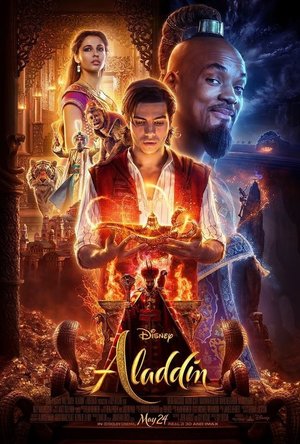


Oh. My. This was always going to be a tough one for me, and I've been thinking long and hard about how on earth I was going to review this. I love the original, anyone who even remotely enjoys it would be able to sing you at least one of the songs, and therein lies one of the problems. Would I have had a different opinion about some of the elements had I not seen the original so many times? After a lot of contemplating I think the answer in most cases is no.
Note: I went to see this for a second time so I'm going to edit what I previously wrote up as I go because on second viewing it was better. Once the initial shock and annoyance had passed after seeing it the first time it was much easier to watch for the second time.
Remaking something that's peak Disney has so many issues, recasting roles, changing social views and cultural sensitivities, are probably the biggest ones.
Let's talk about the (blue) elephant in the room... although I guess that phrase isn't really accurate as we all want to talk about it. Oh Genie, my Genie. I don't think anyone would have been able to fill that lamp the way Robin Williams did, he was larger than life and brought such a sense of fun whenever he did roles like this. The man is a comedic legend. Recasting this was always going to be difficult, and honestly, I don't know if there's anyone I would have been happy with taking over the mantle.
When I found out that Will Smith was on board I wasn't completely put off. On paper he's got everything you'd need for this role. He had one of two choices, stick to the original faithfully or take it your own way. I just don't think Smith actually had a choice though, he was going to have to do a reinterpretation of the role, but how could you ever follow Williams?
The thing I'm most surprised about with Genie is just how bad the CGI is. It's not like this is something Disney are unfamiliar with. Why did some of it even need to be CGId? I obviously don't know the ins and outs of these techniques or options, but if people can make Robbie Coltrane look larger than life in Harry Potter without mucking it up then why aren't they smurfing Will Smith up and doing the same?
Casting across the rest of the film wasn't such an epic task, Mena Massoud as Aladdin and Navid Negahban as the Sultan hit exactly the right spot. I had issues with Jafar, that's nothing to do with Marwan Kenzari's acting which was very good, but it was the fact that in my head Jafar should have been older. (Dream casting: Ben Kingsley.) I'm sure I won't be popular saying this but I didn't really like Naomi Scott as Jasmine, I don't think she brought enough sass to the role, I also felt that some of the new inclusions into the film around Jasmine negatively affected my view of her.
By far and away my favourite from the live action cast was Nasim Pedrad as Dalia, Jasmine's lady in waiting. I don't know why they felt the need to bring this character in, but I'm really glad they did. She's funny and a welcome break in some scenes. She completely outshines Jasmine as almost every point in the film... actually, I retract the word "almost". While I might not be happy about part of her character's story (ask me for the spoilers) she was definitely the best added extra in the film.
Our group of sidekicks, Abu, Iago, Rajah and Carpet all come out with varying degrees of success. Abu wasn't entirely lucky with the CGI and didn't get such a fun part as before. Iago was much more bird-like than previously which meant less actual talking so I have to wonder why they hired Alan Tudyk if they weren't going to use him properly. Rajah while less quizzical than in the original was entertaining and luckily wasn't mutilated by the CGI. Carpet though, I loved Carpet. He was super cute and absolutely adorable with Abu.
I'm not going to go over every change they made to the original, but one tweak particularly bugged me. They change the way that Aladdin gets out of the cave of wonders. The verbal trickery that Aladdin uses in the original is gone and they switch it out for a much more deceitful moment. The idea isn't as clever as its predecessor and also means that later in the film when Aladdin tricks Jafar you don't get that same connection, watching Genie working out what was going on was painful viewing.
I can't really put off talking about the songs anymore.
As trailers and sneak peeks appeared online I became increasingly nervous about the songs. Prince Ali seemed to be less upbeat than before, and while the sequence looked like it had potential all of it together didn't feel as vibrant. I appreciate that they tried to keep all those little Genie added extra in but it felt like they went with a "safe" option.
I enjoy Will Smith's singing, but I'm not a fan of it in this. I don't think the change in style is suited to these songs. I've seen people saying about how he's rapping in it... but I wouldn't have identified it as rapping. If anything it felt like they went "you should get some rapping in there, but we're Disney so tone it down... a lot."
We get a new offering on the soundtrack in the shape of Speechless, Jasmine's empowering song. I like the song, it certainly has the Disney vibe, and Scott sings it beautifully... but it didn't give me those goosebumps that I expect from power songs. I probably would have given the song a pass had it not been for the way it was included in the film. The frozen scenes with Jasmine dramatically moving in and out of the cast and set... ugh... that just didn't work for me.
Massoud had originally given me so much hope for the music when I heard One Jump Ahead at the beginning. It was excellent, and throughout the film I loved his singing.
Here's where my opinion changed a bit after my second visit... the songs weren't all as bad as I'd felt after the first viewing. I still didn't enjoy Genie's offering, but Aladdin and Jasmine both felt like an excellent choice. The main thing that didn't change was the fact that I didn't feel the songs fit well into the scenes. Part of the draw of Disney is the toe-tapping singalong vibe you get from the music, and there was a lack of pizzaz in most of the sequences that left my toes untapped.
I could probably go on for a very long time about this film. (I already have.) Ultimately, I don't think it's an improvement on the original, I don't think these modern rehashes really add a lot when you have to adjust for the modern culture. I'm not saying that you shouldn't take the changing times into consideration, I just think you should do it in a way that doesn't just come across as trying to score points with the audience to prove how "with it" you are. I also don't think that coming up with 30 minutes of extra footage is ever a sensible idea. If that's what you want to do then perhaps you need to really mix things up and come up with a whole new concept for the story.
What you should do
You're either a Disney nut or you're not. Personally, I would recommend staying at home and having a binge of old Disney classics, starting with the one true Genie.
Movie thing you wish you could take home
Could I get Genie powers without the itty-bitty living space?
Note: I went to see this for a second time so I'm going to edit what I previously wrote up as I go because on second viewing it was better. Once the initial shock and annoyance had passed after seeing it the first time it was much easier to watch for the second time.
Remaking something that's peak Disney has so many issues, recasting roles, changing social views and cultural sensitivities, are probably the biggest ones.
Let's talk about the (blue) elephant in the room... although I guess that phrase isn't really accurate as we all want to talk about it. Oh Genie, my Genie. I don't think anyone would have been able to fill that lamp the way Robin Williams did, he was larger than life and brought such a sense of fun whenever he did roles like this. The man is a comedic legend. Recasting this was always going to be difficult, and honestly, I don't know if there's anyone I would have been happy with taking over the mantle.
When I found out that Will Smith was on board I wasn't completely put off. On paper he's got everything you'd need for this role. He had one of two choices, stick to the original faithfully or take it your own way. I just don't think Smith actually had a choice though, he was going to have to do a reinterpretation of the role, but how could you ever follow Williams?
The thing I'm most surprised about with Genie is just how bad the CGI is. It's not like this is something Disney are unfamiliar with. Why did some of it even need to be CGId? I obviously don't know the ins and outs of these techniques or options, but if people can make Robbie Coltrane look larger than life in Harry Potter without mucking it up then why aren't they smurfing Will Smith up and doing the same?
Casting across the rest of the film wasn't such an epic task, Mena Massoud as Aladdin and Navid Negahban as the Sultan hit exactly the right spot. I had issues with Jafar, that's nothing to do with Marwan Kenzari's acting which was very good, but it was the fact that in my head Jafar should have been older. (Dream casting: Ben Kingsley.) I'm sure I won't be popular saying this but I didn't really like Naomi Scott as Jasmine, I don't think she brought enough sass to the role, I also felt that some of the new inclusions into the film around Jasmine negatively affected my view of her.
By far and away my favourite from the live action cast was Nasim Pedrad as Dalia, Jasmine's lady in waiting. I don't know why they felt the need to bring this character in, but I'm really glad they did. She's funny and a welcome break in some scenes. She completely outshines Jasmine as almost every point in the film... actually, I retract the word "almost". While I might not be happy about part of her character's story (ask me for the spoilers) she was definitely the best added extra in the film.
Our group of sidekicks, Abu, Iago, Rajah and Carpet all come out with varying degrees of success. Abu wasn't entirely lucky with the CGI and didn't get such a fun part as before. Iago was much more bird-like than previously which meant less actual talking so I have to wonder why they hired Alan Tudyk if they weren't going to use him properly. Rajah while less quizzical than in the original was entertaining and luckily wasn't mutilated by the CGI. Carpet though, I loved Carpet. He was super cute and absolutely adorable with Abu.
I'm not going to go over every change they made to the original, but one tweak particularly bugged me. They change the way that Aladdin gets out of the cave of wonders. The verbal trickery that Aladdin uses in the original is gone and they switch it out for a much more deceitful moment. The idea isn't as clever as its predecessor and also means that later in the film when Aladdin tricks Jafar you don't get that same connection, watching Genie working out what was going on was painful viewing.
I can't really put off talking about the songs anymore.
As trailers and sneak peeks appeared online I became increasingly nervous about the songs. Prince Ali seemed to be less upbeat than before, and while the sequence looked like it had potential all of it together didn't feel as vibrant. I appreciate that they tried to keep all those little Genie added extra in but it felt like they went with a "safe" option.
I enjoy Will Smith's singing, but I'm not a fan of it in this. I don't think the change in style is suited to these songs. I've seen people saying about how he's rapping in it... but I wouldn't have identified it as rapping. If anything it felt like they went "you should get some rapping in there, but we're Disney so tone it down... a lot."
We get a new offering on the soundtrack in the shape of Speechless, Jasmine's empowering song. I like the song, it certainly has the Disney vibe, and Scott sings it beautifully... but it didn't give me those goosebumps that I expect from power songs. I probably would have given the song a pass had it not been for the way it was included in the film. The frozen scenes with Jasmine dramatically moving in and out of the cast and set... ugh... that just didn't work for me.
Massoud had originally given me so much hope for the music when I heard One Jump Ahead at the beginning. It was excellent, and throughout the film I loved his singing.
Here's where my opinion changed a bit after my second visit... the songs weren't all as bad as I'd felt after the first viewing. I still didn't enjoy Genie's offering, but Aladdin and Jasmine both felt like an excellent choice. The main thing that didn't change was the fact that I didn't feel the songs fit well into the scenes. Part of the draw of Disney is the toe-tapping singalong vibe you get from the music, and there was a lack of pizzaz in most of the sequences that left my toes untapped.
I could probably go on for a very long time about this film. (I already have.) Ultimately, I don't think it's an improvement on the original, I don't think these modern rehashes really add a lot when you have to adjust for the modern culture. I'm not saying that you shouldn't take the changing times into consideration, I just think you should do it in a way that doesn't just come across as trying to score points with the audience to prove how "with it" you are. I also don't think that coming up with 30 minutes of extra footage is ever a sensible idea. If that's what you want to do then perhaps you need to really mix things up and come up with a whole new concept for the story.
What you should do
You're either a Disney nut or you're not. Personally, I would recommend staying at home and having a binge of old Disney classics, starting with the one true Genie.
Movie thing you wish you could take home
Could I get Genie powers without the itty-bitty living space?
Kirk Bage (1775 KP) rated The Umbrella Academy in TV
Sep 19, 2020 (Updated Jan 22, 2021)
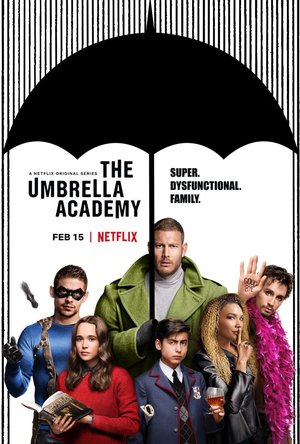


I came to this gloriously colourful, energetic and super smart comic book adaptation in August (when Netflix advertised season 2), at a time of lockdown where I really needed something cheerful and fun to keep me going. It worked so well I watched both full seasons twice over, back to back, and key episodes 3 times! A rare thing indeed for me and a TV show.
Since then the rigours of isolation have set me back with a really long backlog for The Wasteland – currently I have a list of over 40 cultural artifacts I want to talk about and share with you- but, I am very glad to be talking about this one today, as even though it wasn’t that long ago, it evokes such fond happy memories of becoming just a little bit obsessed by something. A phenomenon that only seems to happen when you go into something with low to medium expectations and come out feeling like you have found a diamond in the rough.
The concept of 7 children with mysterious powers being adopted and raised by a shady and strict, umbrella wielding, father has been around a few years in the form of several graphic novels, penned by My Chemical Romance frontman Gerard Way. You can feel the vibe of something slightly emo and arty coming through – just cool enough but also self conscious; melancholy and dark in places but also lots of sardonic fun. But, unlike the books, which often look stark and minimal, the world created by show runner and director Steve Blackman is vivid and full to the brim with things to overwhelm the senses.
For the last few years, and especially of late, the Superhero genre has been so oversaturated that it is almost impossible to come up with anything original, but The Umbrella Academy together with Amazon’s The Boys, definitely manage to do that. It has enough mystique to be intriguingly confusing for the first few episodes, as we piece together the Hargreaves’ past that has led to the current situation, and discover the dynamic tension that exists between the adopted siblings. Oh, and there is a talking chimpanzee butler / guardian called Pogo, that feels like CGI gimmickery for a while, before growing into something truly wonderful.
The first thing you notice about this set of misfits, as they reassemble for their father’s funeral after years of bitterness and estrangement, is that they are all a little bit broken and uncomfortable in their own skins – their powers as individuals are all a bit, well frankly underwhelming, and their personalities are not exactly attractive in every case. Season one is all about re-establishing connections and working through identity crises. In many ways it is a coming of age story, as circumstances lead to them needing to grow up fast and join together to achieve true power. It works both on the surface and as a deeper allegory.
As each main character is introduced you inevitably get drawn into ranking them from most to least favourite, and the trick of it is how much those feelings shift as the story progresses. Everyone loves Klaus, the twitchy junkie who can see dead people, his completely non heroic yet hilariously stoned outlook gives him many of the best lines and most fun scenes. I changed allegiance several times with the others, but Klaus, played by the charismatic Irish actor Robert Sheehan, always remained my favourite, because of his hippie rockstar vibe. Although it’s hard not to have a soft spot for Number 5, the time travelling schoolboy that has been missing for years and re-emerges as a middle aged man still trapped in the boys’ body. Aiden Gillen is superb in conveying that he is older whilst always looking like a teenager, and in many ways he is the true pivot and anchor of the story.
I suppose before the show aired it was Ellen Page that was the “star” draw amongst the young and mostly unknown cast of “heroes”. As Vanya, the only Hargreaves child never to demonstrate a power, and held aside by their controlling father, she is the outsider and most insecure of the bunch. You sense her storyline is going to be crucial to the whole shebang, and so it turns out, but her fame as an actress of note never overshadows the show as a whole – it feels instantly like a group effort, and in that sense a true family, the deeper you get into it.
I could go on explaining each character and the details of the intricate plot forever, but I would never do it justice. The only way to see what the fuss is about is to watch it. Anything else would just sound like mad confusion to the uninitiated. All I can say is that it does an incredible job of unfolding its charms and secrets piece by piece. So much so that by the climax of season two I am still not entirely sure we have all the information necessary to know what is going on in a complete sense; there are several questions and mysteries still to be unearthed, and I like that very much.
I have recommended this show to anyone I know who enjoys something entertaining that has substance yet doesn’t take itself too seriously – so that is everyone then! I think it’s allure is that very thing: it manages to hit a zeitgeist of perfect balance between a smart script and plotline with many cliffhangers, and enough disposable moments of fun, to be exactly what the modern Netflix viewer is looking for. Super easy to watch with one eye or with both, depending on what mood you are in.
There is also the style of the thing – a veritable candy box of colours and neat visual tricks, mixed in with some of the best musical montage sequences I have ever seen. I understand from several interviews that Steve Blackman specifically wrote certain scenes around the feel of a piece of music he wanted to include. That is a clever way of building a cult following: find songs that both tell a story and appeal to the cool kids, then use them as mini music video segments that punctuate the heavier elements of storytelling. It’s not a new trick, but the song choices here are so good that it has rarely been done this well before.
It all works especially well as we move into season two and an historical context that brings up a lot of pertinent issues for some of the siblings regarding race, sexuality and other freedoms of identity that can be taken for granted in the modern era. I don’t want to spoil too much of that here, but suffice to say as a hook to pin the themes on it is a genius touch that makes season two a huge leap forward on something that was already pretty decent in season one. All the characters become more rounded and relatable, even the so called bad guys – an increasingly eccentric bunch of creations that leave you in no doubt this is a comic book world not to be confused with reality.
At time of writing, a third season has still not being given the greenlight. Considering the massive cliffhanger we are left with at the end of season two, and how big the cult following seems to be by now, it would be an absolute crime not to allow it to continue. The only reason I can see it wouldn’t is that the stories of the source material are now exhausted, and anywhere they go from here will need to be truly original. However, there is so much scope to do almost anything from here that I don’t see it as any kind of issue.
If you haven’t seen it, I urge you whole-heartedly to give it a go. There really is something in there to please everyone, except perhaps the most serious minded of realists. Even then, they’d be hard pressed not to raise a smile or tap a toe at some of the best musical moments of emo hero mayhem.
Since then the rigours of isolation have set me back with a really long backlog for The Wasteland – currently I have a list of over 40 cultural artifacts I want to talk about and share with you- but, I am very glad to be talking about this one today, as even though it wasn’t that long ago, it evokes such fond happy memories of becoming just a little bit obsessed by something. A phenomenon that only seems to happen when you go into something with low to medium expectations and come out feeling like you have found a diamond in the rough.
The concept of 7 children with mysterious powers being adopted and raised by a shady and strict, umbrella wielding, father has been around a few years in the form of several graphic novels, penned by My Chemical Romance frontman Gerard Way. You can feel the vibe of something slightly emo and arty coming through – just cool enough but also self conscious; melancholy and dark in places but also lots of sardonic fun. But, unlike the books, which often look stark and minimal, the world created by show runner and director Steve Blackman is vivid and full to the brim with things to overwhelm the senses.
For the last few years, and especially of late, the Superhero genre has been so oversaturated that it is almost impossible to come up with anything original, but The Umbrella Academy together with Amazon’s The Boys, definitely manage to do that. It has enough mystique to be intriguingly confusing for the first few episodes, as we piece together the Hargreaves’ past that has led to the current situation, and discover the dynamic tension that exists between the adopted siblings. Oh, and there is a talking chimpanzee butler / guardian called Pogo, that feels like CGI gimmickery for a while, before growing into something truly wonderful.
The first thing you notice about this set of misfits, as they reassemble for their father’s funeral after years of bitterness and estrangement, is that they are all a little bit broken and uncomfortable in their own skins – their powers as individuals are all a bit, well frankly underwhelming, and their personalities are not exactly attractive in every case. Season one is all about re-establishing connections and working through identity crises. In many ways it is a coming of age story, as circumstances lead to them needing to grow up fast and join together to achieve true power. It works both on the surface and as a deeper allegory.
As each main character is introduced you inevitably get drawn into ranking them from most to least favourite, and the trick of it is how much those feelings shift as the story progresses. Everyone loves Klaus, the twitchy junkie who can see dead people, his completely non heroic yet hilariously stoned outlook gives him many of the best lines and most fun scenes. I changed allegiance several times with the others, but Klaus, played by the charismatic Irish actor Robert Sheehan, always remained my favourite, because of his hippie rockstar vibe. Although it’s hard not to have a soft spot for Number 5, the time travelling schoolboy that has been missing for years and re-emerges as a middle aged man still trapped in the boys’ body. Aiden Gillen is superb in conveying that he is older whilst always looking like a teenager, and in many ways he is the true pivot and anchor of the story.
I suppose before the show aired it was Ellen Page that was the “star” draw amongst the young and mostly unknown cast of “heroes”. As Vanya, the only Hargreaves child never to demonstrate a power, and held aside by their controlling father, she is the outsider and most insecure of the bunch. You sense her storyline is going to be crucial to the whole shebang, and so it turns out, but her fame as an actress of note never overshadows the show as a whole – it feels instantly like a group effort, and in that sense a true family, the deeper you get into it.
I could go on explaining each character and the details of the intricate plot forever, but I would never do it justice. The only way to see what the fuss is about is to watch it. Anything else would just sound like mad confusion to the uninitiated. All I can say is that it does an incredible job of unfolding its charms and secrets piece by piece. So much so that by the climax of season two I am still not entirely sure we have all the information necessary to know what is going on in a complete sense; there are several questions and mysteries still to be unearthed, and I like that very much.
I have recommended this show to anyone I know who enjoys something entertaining that has substance yet doesn’t take itself too seriously – so that is everyone then! I think it’s allure is that very thing: it manages to hit a zeitgeist of perfect balance between a smart script and plotline with many cliffhangers, and enough disposable moments of fun, to be exactly what the modern Netflix viewer is looking for. Super easy to watch with one eye or with both, depending on what mood you are in.
There is also the style of the thing – a veritable candy box of colours and neat visual tricks, mixed in with some of the best musical montage sequences I have ever seen. I understand from several interviews that Steve Blackman specifically wrote certain scenes around the feel of a piece of music he wanted to include. That is a clever way of building a cult following: find songs that both tell a story and appeal to the cool kids, then use them as mini music video segments that punctuate the heavier elements of storytelling. It’s not a new trick, but the song choices here are so good that it has rarely been done this well before.
It all works especially well as we move into season two and an historical context that brings up a lot of pertinent issues for some of the siblings regarding race, sexuality and other freedoms of identity that can be taken for granted in the modern era. I don’t want to spoil too much of that here, but suffice to say as a hook to pin the themes on it is a genius touch that makes season two a huge leap forward on something that was already pretty decent in season one. All the characters become more rounded and relatable, even the so called bad guys – an increasingly eccentric bunch of creations that leave you in no doubt this is a comic book world not to be confused with reality.
At time of writing, a third season has still not being given the greenlight. Considering the massive cliffhanger we are left with at the end of season two, and how big the cult following seems to be by now, it would be an absolute crime not to allow it to continue. The only reason I can see it wouldn’t is that the stories of the source material are now exhausted, and anywhere they go from here will need to be truly original. However, there is so much scope to do almost anything from here that I don’t see it as any kind of issue.
If you haven’t seen it, I urge you whole-heartedly to give it a go. There really is something in there to please everyone, except perhaps the most serious minded of realists. Even then, they’d be hard pressed not to raise a smile or tap a toe at some of the best musical moments of emo hero mayhem.
Purple Phoenix Games (2266 KP) rated Buru in Tabletop Games
Feb 22, 2021
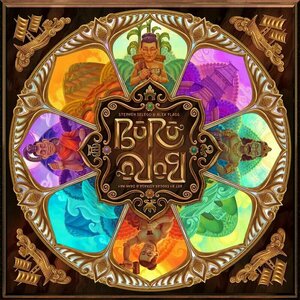
I would consider myself somewhat of a world traveler. I haven’t quite visited as many places as I would like, and certain worldwide pandemics have prevented me from scheduling any international travel plans. My family and I enjoy cruises and visiting all sorts of different countries. Now, Buru has never been specifically on our list of places to visit, but should we ever get the chance to head to Indonesia, now after playing this game I think I will want to visit this little island.
Buru (http://burugame.com/)is a mid-weight economic worker placement game with a large dose of bidding thrown in for fun. In it players are visitors to the island sent to compete to become the governor of Buru by hiring indigenous peoples to assist with tasks, by providing fish for the peoples, pleasing the island’s elders, and by paying homages to the spirits of the land. The emissary who can utilize all their resources efficiently and impactfully will be deemed governor of Buru and winner of the game.
DISCLAIMER: We were provided a prototype copy of this game for the purposes of this review. These are preview copy components, and I do not know for sure if the final components will be any different from these shown. Also, it is not my intention to detail every rule in the game, as there are just too many. You are invited to download the rulebook, back the game through the Kickstarter campaign, or through any retailers stocking it after fulfillment. -T
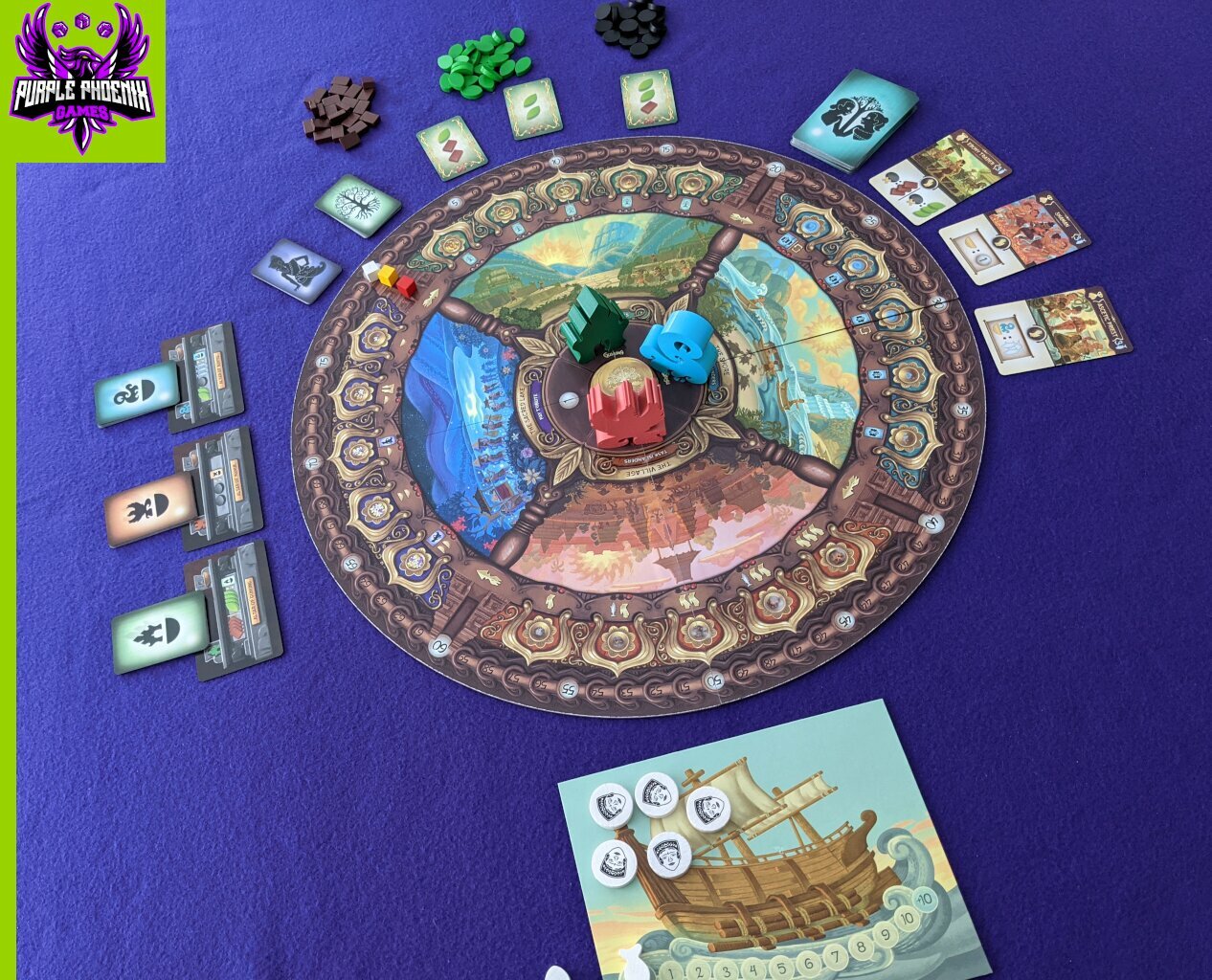
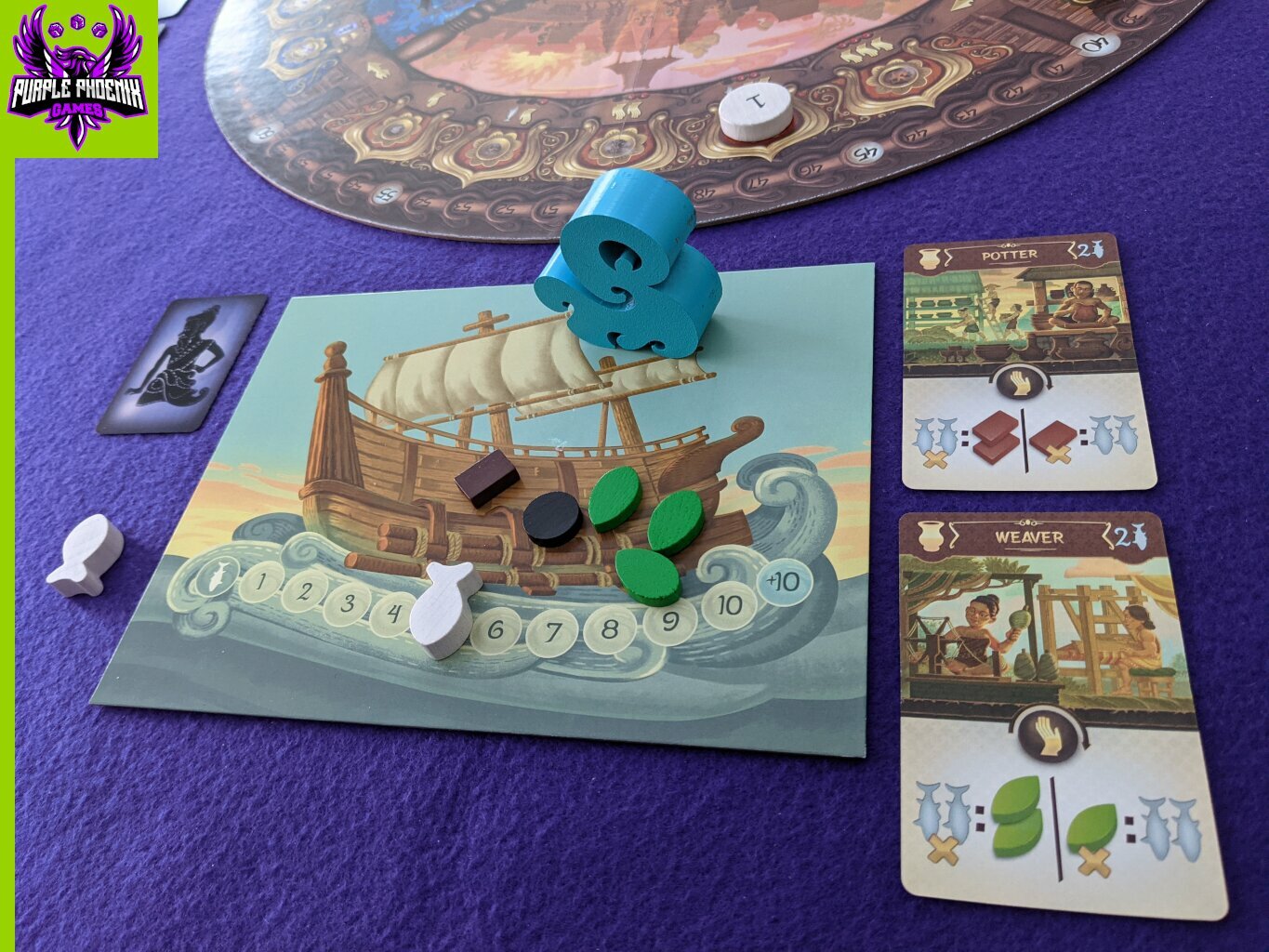
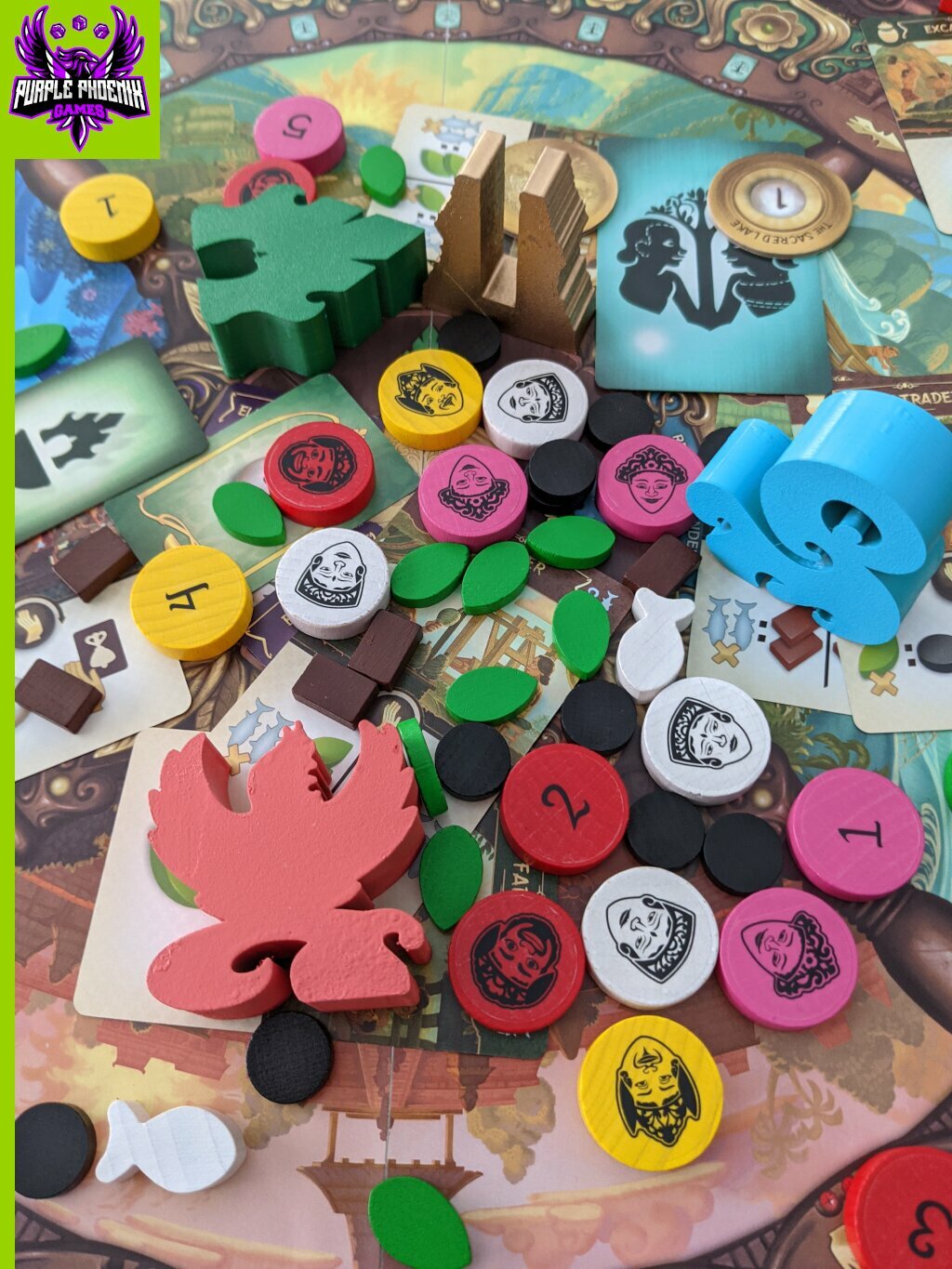
To setup, follow the instructions in the rulebook. There are just too many steps to detail here and the rulebook is fantastic. Once setup, the play area should look similar to the photo below.
The game of Buru lasts five rounds, and each round consists of five phases of the day: Dawn, Morning, Noon, Afternoon, and Dusk. At the end of the fifth round the game is over and players will tally points to arrive at the winner.
During the Dawn phase players will flip over the top two Decrees tokens from the middle of the main circular board. These Decrees will be placed in certain areas and are worth bonus points or other advantages for the round. Also during this phase the Forest cards will be reset from the previous round. Once complete play moves to the Morning phase.
In the Morning players will be sending out their numbered Explorer tokens (from 1-5) onto the various board areas in turn starting with the current Emissary (first player). Each player will place one of their Explorer tokens at a time until each player has only one Explorer token left. Players may place multiple Explorers in a location to increase their bid for majority, but these Explorer tokens are placed face-up (literally with the face showing and the number on the board not showing) so that their values are hidden. Once Explorers are placed, play moves to the Noon phase.
At Noon the people must fish for food and have lunch. The leftover Explorer token that was not used in the Morning is then revealed and its value is converted to fish. Fish are needed to recruit islanders and are converted into other resources. Fish are tracked on the individual player boards. After a hearty lunch play continues into the Afternoon.
The Afternoon is where much of the action in Buru takes place. During this phase the Explorer tokens that were placed in the Morning are revealed and players take actions in each area by order of majority in each area. First the highest-bidding player will claim their chosen action space, then the next highest bidder, and so on. The Forest is resolved first. Players reveal the Explorer tokens in the Forest and whichever player has majority in this area is able to place their tokens a claim space on the board and will receive a Forest card of their choice. Forest cards are typically resources immediately earned by the player. Resources include Clay, Palm Leaves, and Ebony. The player with majority also earns the favor of Gunung (green spirit) and takes its giant statueeple.
Next, the Shore is resolved in the same manner. The Shore is where players may use their supplies of fish to recruit islanders to their taskforces and carry out tasks. The majority leader in this area chooses a space to place their Explorer tokens and resolves the action. This could include purchasing islander cards and refreshing the offer of islander cards in whichever order the player chooses. The player with the majority also earns the favor of Banyu (blue spirit) and takes its giant statueeple.
The Village is the area where islanders are able to complete tasks. The majority leader in this area chooses a space and takes the actions. These actions include activating islanders for the actions printed on the bottom of their cards and possibly even earning more fish. The player with the majority also earns the favor of Manuk (orange spirit) and takes its giant statueeple.
Finally, The Sacred Lake is resolved in the same manner. Here players are able to pay tributes to the spirits in order to earn bonuses from them. The majority leader in this area chooses a space to place their Explorer tokens, earns an immediate Esteem (VP tracked along the outer edge of the board), and takes the action of the space claimed. These spaces offer opportunities to pay tribute to one or more of the spirits as well as earning an Elder card, which provides conditions for earning bonus points at the end of the game. When a spirit is tributed they offer bonus Esteem cards and other benefits to be used. Once this area is completely resolved and players have all taken their turns play moves onto Dusk.
In Dusk players will reset the board for the next round of play. Players retrieve all their Explorer tokens from the board and untask their islanders that have completed tasks this day. After the fifth round the game is over and players tally their scores from their position on the Esteem track, any spirit Tribute cards earned, and Elder card point conditions met. The player with the most points will be crowned the winner!
Components. Okay, I have to give a giant shout-out to the team at Crafty Games. This is one of the highest-quality prototypes I have ever played in terms of component quality. When I opened the game box all components were separated into baggies and card cases and LABELED with the number of components, the titles, and even a picture of the components to be placed within. I don’t even organize my games to this level and I feel I am a tad OCD about my game organization. Kudos here. But also the components are all fine quality and the finished product promises to be just spectacular if this is what is received as a prototype.
I love the art and art style throughout this game. It is difficult to have theme shine through in a very Euro-style game, but I did feel the theme here. The art is very suggestive of island life, and Crafty Games even hired Cultural Consultants to assure all avenues are culturally appropriate. What a great call. I wish all publishers would be so thorough.
The gameplay is also quite stunning. The game just flows so naturally and everything makes complete sense. Of course you need to collect natural resources before recruiting islanders before asking said islanders to complete tasks before you pay respects to their spirits. I like the flow, and after a couple rounds I no longer needed the rulebook as a crutch.
I have very much enjoyed my plays of Buru for many reasons. The game is absolutely gorgeous. The art sings and truly adds to the gameplay. The rules are not light, but not over my head, and I appreciate that. The choices given to each player are crunchy without being too burdensome, and players of many skill levels will be able to find joy contemplating when and where to send their Explorers in each area. The game builds up to a big ending where many points are scored from places unknown to opponents and bulleting ahead from last place to first from exploiting bonus cards is so satisfying.
It is easy to understand why I love this game and would certainly recommend it to all gamers. If you have been looking for something a little heavier in your collection but don’t want to go TOO heavy, please do yourself a favor and consider backing Buru. Crafty Games has been working on some truly great games here the past couple years and I am excited to see where Buru ends up after another undoubtedly successful Kickstarter campaign. I will always be up for a game of Buru, and I hope to play it often as the years continue.
Buru (http://burugame.com/)is a mid-weight economic worker placement game with a large dose of bidding thrown in for fun. In it players are visitors to the island sent to compete to become the governor of Buru by hiring indigenous peoples to assist with tasks, by providing fish for the peoples, pleasing the island’s elders, and by paying homages to the spirits of the land. The emissary who can utilize all their resources efficiently and impactfully will be deemed governor of Buru and winner of the game.
DISCLAIMER: We were provided a prototype copy of this game for the purposes of this review. These are preview copy components, and I do not know for sure if the final components will be any different from these shown. Also, it is not my intention to detail every rule in the game, as there are just too many. You are invited to download the rulebook, back the game through the Kickstarter campaign, or through any retailers stocking it after fulfillment. -T
To setup, follow the instructions in the rulebook. There are just too many steps to detail here and the rulebook is fantastic. Once setup, the play area should look similar to the photo below.
The game of Buru lasts five rounds, and each round consists of five phases of the day: Dawn, Morning, Noon, Afternoon, and Dusk. At the end of the fifth round the game is over and players will tally points to arrive at the winner.
During the Dawn phase players will flip over the top two Decrees tokens from the middle of the main circular board. These Decrees will be placed in certain areas and are worth bonus points or other advantages for the round. Also during this phase the Forest cards will be reset from the previous round. Once complete play moves to the Morning phase.
In the Morning players will be sending out their numbered Explorer tokens (from 1-5) onto the various board areas in turn starting with the current Emissary (first player). Each player will place one of their Explorer tokens at a time until each player has only one Explorer token left. Players may place multiple Explorers in a location to increase their bid for majority, but these Explorer tokens are placed face-up (literally with the face showing and the number on the board not showing) so that their values are hidden. Once Explorers are placed, play moves to the Noon phase.
At Noon the people must fish for food and have lunch. The leftover Explorer token that was not used in the Morning is then revealed and its value is converted to fish. Fish are needed to recruit islanders and are converted into other resources. Fish are tracked on the individual player boards. After a hearty lunch play continues into the Afternoon.
The Afternoon is where much of the action in Buru takes place. During this phase the Explorer tokens that were placed in the Morning are revealed and players take actions in each area by order of majority in each area. First the highest-bidding player will claim their chosen action space, then the next highest bidder, and so on. The Forest is resolved first. Players reveal the Explorer tokens in the Forest and whichever player has majority in this area is able to place their tokens a claim space on the board and will receive a Forest card of their choice. Forest cards are typically resources immediately earned by the player. Resources include Clay, Palm Leaves, and Ebony. The player with majority also earns the favor of Gunung (green spirit) and takes its giant statueeple.
Next, the Shore is resolved in the same manner. The Shore is where players may use their supplies of fish to recruit islanders to their taskforces and carry out tasks. The majority leader in this area chooses a space to place their Explorer tokens and resolves the action. This could include purchasing islander cards and refreshing the offer of islander cards in whichever order the player chooses. The player with the majority also earns the favor of Banyu (blue spirit) and takes its giant statueeple.
The Village is the area where islanders are able to complete tasks. The majority leader in this area chooses a space and takes the actions. These actions include activating islanders for the actions printed on the bottom of their cards and possibly even earning more fish. The player with the majority also earns the favor of Manuk (orange spirit) and takes its giant statueeple.
Finally, The Sacred Lake is resolved in the same manner. Here players are able to pay tributes to the spirits in order to earn bonuses from them. The majority leader in this area chooses a space to place their Explorer tokens, earns an immediate Esteem (VP tracked along the outer edge of the board), and takes the action of the space claimed. These spaces offer opportunities to pay tribute to one or more of the spirits as well as earning an Elder card, which provides conditions for earning bonus points at the end of the game. When a spirit is tributed they offer bonus Esteem cards and other benefits to be used. Once this area is completely resolved and players have all taken their turns play moves onto Dusk.
In Dusk players will reset the board for the next round of play. Players retrieve all their Explorer tokens from the board and untask their islanders that have completed tasks this day. After the fifth round the game is over and players tally their scores from their position on the Esteem track, any spirit Tribute cards earned, and Elder card point conditions met. The player with the most points will be crowned the winner!
Components. Okay, I have to give a giant shout-out to the team at Crafty Games. This is one of the highest-quality prototypes I have ever played in terms of component quality. When I opened the game box all components were separated into baggies and card cases and LABELED with the number of components, the titles, and even a picture of the components to be placed within. I don’t even organize my games to this level and I feel I am a tad OCD about my game organization. Kudos here. But also the components are all fine quality and the finished product promises to be just spectacular if this is what is received as a prototype.
I love the art and art style throughout this game. It is difficult to have theme shine through in a very Euro-style game, but I did feel the theme here. The art is very suggestive of island life, and Crafty Games even hired Cultural Consultants to assure all avenues are culturally appropriate. What a great call. I wish all publishers would be so thorough.
The gameplay is also quite stunning. The game just flows so naturally and everything makes complete sense. Of course you need to collect natural resources before recruiting islanders before asking said islanders to complete tasks before you pay respects to their spirits. I like the flow, and after a couple rounds I no longer needed the rulebook as a crutch.
I have very much enjoyed my plays of Buru for many reasons. The game is absolutely gorgeous. The art sings and truly adds to the gameplay. The rules are not light, but not over my head, and I appreciate that. The choices given to each player are crunchy without being too burdensome, and players of many skill levels will be able to find joy contemplating when and where to send their Explorers in each area. The game builds up to a big ending where many points are scored from places unknown to opponents and bulleting ahead from last place to first from exploiting bonus cards is so satisfying.
It is easy to understand why I love this game and would certainly recommend it to all gamers. If you have been looking for something a little heavier in your collection but don’t want to go TOO heavy, please do yourself a favor and consider backing Buru. Crafty Games has been working on some truly great games here the past couple years and I am excited to see where Buru ends up after another undoubtedly successful Kickstarter campaign. I will always be up for a game of Buru, and I hope to play it often as the years continue.
Kirk Bage (1775 KP) rated The Mandalorian in TV
Jan 22, 2021 (Updated Jan 22, 2021)
Being a child of Star Wars, born in ’73, whose first memory of a cinema was A New Hope in ’77, of course the entire franchise is still close to my heart. I am no superfan, however. I do not need to remember every name of every character, or know the obscure names of planets to enjoy it. I remember that deeply competitive nature back in the playground – how important it was to prove Star Wars was yours by knowing more than any other kid! Fortunately I managed to let that go shortly after The Return of the Jedi. Ok, maybe 1995.
The Mandalorian is definitely for all Star Wars fans, but it is mostly for the kids that never grew up and need those details of “the canonical Star Wars” universe in their lives. And there are plenty of them. It is a geek’s wet dream! With chat rooms and fan sites going wild in debate and argument over the smallest of Easter eggs and hints to connections across the medium. As if this is a lost historical document that sheds light on the truth of many characters and events, that until now were shrouded in darkness and speculation only.
I find that phenomenon weird and a little creepy, but I do appreciate where it comes from. For me, I am merely glad it isn’t crap. It is nice to be in the Star Wars universe without holding your face in your hands for shame of lazy storytelling and moments that shit on the spirit of the original trilogy. The first thing that pleased me about The Mandolorian is how close it is in feel to the old school trilogy. In fact it surprised me, because, despite the very modern effects and full budget of Disney behind it, it feels very old fashioned, like a TV show from around 1986, maybe. And I wonder how they have achieved that every time I watch it. It has an intangible magic about it.
In fact, the feel of the show as a whole is often a little cheap, shockingly – the posters and toys and all associated media is as glossy and crisp as all money can afford, creating an image of the show that isn’t actually what the show is. In reality it is a cross between old spaghetti westerns, with The Mandalorian cast as The Man With No Name, and episodes of The A-Team or Knightrider. I kinda like it; very nostalgic, and a smart move by Jon Favreau and the other show-runners. It appeals to middle aged audiences and new alike, because it is a knowing hybrid of all things cool and nerdy!
Design-wise, the look of The Mandalorian himself is perfect fan bait and very cool. The music goes a long way to drawing you in – Ludwig Göransson, known for his work on Black Panther and Tenet, has hit on a career defining theme that blends Clint Eastwood and Star Wars in perfect harmony. I can’t imagine the show working half as well without that theme music! The spaceships and detail of every alien and weapon and costume is meticulous (if at times a little wobbly or cheap looking), and the wider feel of background and tertiary characters is pretty damn good.
But, let’s face it… The Mandalorian is the success it has been predominantly for one reason. I could give him his real name, but if you haven’t finished it yet that would count as a huge spoiler, so I will refer to him as The Child. The temptation to use the phrase Baby Yoda is hard to resist, and has been a cultural phenomenon that only comes along once or twice in a decade, but on this I agree with the fans: it is inaccurate and misleading. The Child is fine. It’ll do until you learn his true moniker.
In season one, where the build up of story, character and mystery is superb, we see very little of The Child at first. But we cannot take our eyes off him for every second he is on screen. The whole concept is so beyond cute and incredibly strong as a hook for a Star Wars story it is almost impossible not to squeal out loud at everything he does. Who is he? Why is he? What is he capable of? How will he fit in to the longterm idea for the story? So exciting, and total genius to keep everyone watching.
It isn’t all about The Child on his own though. It is about the unlikely symbiotic bond, like father and son, that develops between the tiny, vulnerable and childlike focal point, and the increasingly confident and loyal antihero, who will stop at nothing to protect his ward, as he struggles to find his own place in the universe. After a very short time, we care more about this relationship than 90% of all romances in all of TV history.
Through danger, mayhem and a touch of comedy, we grow to adore the two of them together, and can’t bear to think of them being apart. Some trick when you realise The Child is as much a mini-muppet style prosthetic as it is added CGI for expression and detail. Perhaps another callback to our 80s sensibilities, when we accepted ETs and Gremlins and all of the residents of Mos Eisley’s cantina as real without hesitation. It doesn’t have to look real, is the point, as long as it fits the story, is cool and is fun! Which The Child totally is – for entertainment value they have got the tone of the show so right.
What doesn’t hold up that strongly to critical scrutiny though is quite a lot of the scripts, the repetitive nature of the context of many episodes and missions the duo find themselves on, the mismatch quality of the guest directors abilities, and quite a lot of the dodgy acting by supporting characters. It’s as if at some production meeting at one early point they all said, look it’s Star Wars, we make the aliens and the spaceships and the weapons look good and we can’t fail… plus we have The Child and Boba Fett’s (yes, I know) armour, we can’t fail!
The basic storyline is enough to hook it on, just about, it is the detail that sometimes feels weak and lazy. But don’t worry, any minute something cool to look at and a big fight will happen, so we’re all good! I’m sure Pedro Pascal (the actor under the armour) can’t believe his luck! He is one of the biggest stars in TV all of a sudden, for basically doing a fairly monotone voice-over performance of some seriously dodgy dialogue. That is the magic of Star Wars.
So, I came to season one late, having no access at that time to Disney plus. In fact, I watched all of season one in a day the day before the launch of season two, so the switch to a new episode to look forward to suited me well. It gave me something to look forward to on a Friday between Halloween and Christmas. Trouble was that, although still having fun with the exploits of The Kid, I was starting to weary of the plotlines, and put my viewing on hold after S2E4 in favour of the far superior scripting of His Dark Materials on BBC.
I must have needed the hiatus, because when I came back to mop it up and finish season two a few days ago I realised that I had in fact missed it. It also helped that episode 5 onwards is when the season gets really good again. Rosario Dawson as Ashoka Tano (known well by fans of The Clone Wars) was a truly great addition that the show much needed by that point.
I had no trouble after that in bingeing to the end. You could feel a climax and a revelation coming, and although the character of Moff Gideon (Giancarlo Esposito) crumbled disappointly away into nothing much, the last 15 minutes of the final episode had me slack jawed in fan wonderment. I felt 9 years old again, and I loved it! I had been amazingly lucky not to stumble upon spoilers, I guess. Amazing ending, and all faults forgiven for that unforgettable moment and feel. Wonderful stuff!
To say any more, again, is to spoil. So, let’s just talk about it privately, or, you know, in about a year when season 3 is over and it is old news. Hmmm, season 3…? I wonder where they will take that now…? Actually, properly exciting, in a back in the playground kind of way.
The Mandalorian is definitely for all Star Wars fans, but it is mostly for the kids that never grew up and need those details of “the canonical Star Wars” universe in their lives. And there are plenty of them. It is a geek’s wet dream! With chat rooms and fan sites going wild in debate and argument over the smallest of Easter eggs and hints to connections across the medium. As if this is a lost historical document that sheds light on the truth of many characters and events, that until now were shrouded in darkness and speculation only.
I find that phenomenon weird and a little creepy, but I do appreciate where it comes from. For me, I am merely glad it isn’t crap. It is nice to be in the Star Wars universe without holding your face in your hands for shame of lazy storytelling and moments that shit on the spirit of the original trilogy. The first thing that pleased me about The Mandolorian is how close it is in feel to the old school trilogy. In fact it surprised me, because, despite the very modern effects and full budget of Disney behind it, it feels very old fashioned, like a TV show from around 1986, maybe. And I wonder how they have achieved that every time I watch it. It has an intangible magic about it.
In fact, the feel of the show as a whole is often a little cheap, shockingly – the posters and toys and all associated media is as glossy and crisp as all money can afford, creating an image of the show that isn’t actually what the show is. In reality it is a cross between old spaghetti westerns, with The Mandalorian cast as The Man With No Name, and episodes of The A-Team or Knightrider. I kinda like it; very nostalgic, and a smart move by Jon Favreau and the other show-runners. It appeals to middle aged audiences and new alike, because it is a knowing hybrid of all things cool and nerdy!
Design-wise, the look of The Mandalorian himself is perfect fan bait and very cool. The music goes a long way to drawing you in – Ludwig Göransson, known for his work on Black Panther and Tenet, has hit on a career defining theme that blends Clint Eastwood and Star Wars in perfect harmony. I can’t imagine the show working half as well without that theme music! The spaceships and detail of every alien and weapon and costume is meticulous (if at times a little wobbly or cheap looking), and the wider feel of background and tertiary characters is pretty damn good.
But, let’s face it… The Mandalorian is the success it has been predominantly for one reason. I could give him his real name, but if you haven’t finished it yet that would count as a huge spoiler, so I will refer to him as The Child. The temptation to use the phrase Baby Yoda is hard to resist, and has been a cultural phenomenon that only comes along once or twice in a decade, but on this I agree with the fans: it is inaccurate and misleading. The Child is fine. It’ll do until you learn his true moniker.
In season one, where the build up of story, character and mystery is superb, we see very little of The Child at first. But we cannot take our eyes off him for every second he is on screen. The whole concept is so beyond cute and incredibly strong as a hook for a Star Wars story it is almost impossible not to squeal out loud at everything he does. Who is he? Why is he? What is he capable of? How will he fit in to the longterm idea for the story? So exciting, and total genius to keep everyone watching.
It isn’t all about The Child on his own though. It is about the unlikely symbiotic bond, like father and son, that develops between the tiny, vulnerable and childlike focal point, and the increasingly confident and loyal antihero, who will stop at nothing to protect his ward, as he struggles to find his own place in the universe. After a very short time, we care more about this relationship than 90% of all romances in all of TV history.
Through danger, mayhem and a touch of comedy, we grow to adore the two of them together, and can’t bear to think of them being apart. Some trick when you realise The Child is as much a mini-muppet style prosthetic as it is added CGI for expression and detail. Perhaps another callback to our 80s sensibilities, when we accepted ETs and Gremlins and all of the residents of Mos Eisley’s cantina as real without hesitation. It doesn’t have to look real, is the point, as long as it fits the story, is cool and is fun! Which The Child totally is – for entertainment value they have got the tone of the show so right.
What doesn’t hold up that strongly to critical scrutiny though is quite a lot of the scripts, the repetitive nature of the context of many episodes and missions the duo find themselves on, the mismatch quality of the guest directors abilities, and quite a lot of the dodgy acting by supporting characters. It’s as if at some production meeting at one early point they all said, look it’s Star Wars, we make the aliens and the spaceships and the weapons look good and we can’t fail… plus we have The Child and Boba Fett’s (yes, I know) armour, we can’t fail!
The basic storyline is enough to hook it on, just about, it is the detail that sometimes feels weak and lazy. But don’t worry, any minute something cool to look at and a big fight will happen, so we’re all good! I’m sure Pedro Pascal (the actor under the armour) can’t believe his luck! He is one of the biggest stars in TV all of a sudden, for basically doing a fairly monotone voice-over performance of some seriously dodgy dialogue. That is the magic of Star Wars.
So, I came to season one late, having no access at that time to Disney plus. In fact, I watched all of season one in a day the day before the launch of season two, so the switch to a new episode to look forward to suited me well. It gave me something to look forward to on a Friday between Halloween and Christmas. Trouble was that, although still having fun with the exploits of The Kid, I was starting to weary of the plotlines, and put my viewing on hold after S2E4 in favour of the far superior scripting of His Dark Materials on BBC.
I must have needed the hiatus, because when I came back to mop it up and finish season two a few days ago I realised that I had in fact missed it. It also helped that episode 5 onwards is when the season gets really good again. Rosario Dawson as Ashoka Tano (known well by fans of The Clone Wars) was a truly great addition that the show much needed by that point.
I had no trouble after that in bingeing to the end. You could feel a climax and a revelation coming, and although the character of Moff Gideon (Giancarlo Esposito) crumbled disappointly away into nothing much, the last 15 minutes of the final episode had me slack jawed in fan wonderment. I felt 9 years old again, and I loved it! I had been amazingly lucky not to stumble upon spoilers, I guess. Amazing ending, and all faults forgiven for that unforgettable moment and feel. Wonderful stuff!
To say any more, again, is to spoil. So, let’s just talk about it privately, or, you know, in about a year when season 3 is over and it is old news. Hmmm, season 3…? I wonder where they will take that now…? Actually, properly exciting, in a back in the playground kind of way.