
Search
Search results
Purple Phoenix Games (2266 KP) rated Marvel United in Tabletop Games
Sep 1, 2021
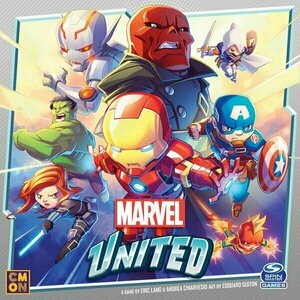

This has probably been mentioned before, but I love Marvel superheroes. My favorite has got to be Spider-Man, hands down. Feel free to send me an email if you’d like to hear my thoughts on who is the best Spider-Man – Tobey Maguire, Andrew Garfield, or Tom Holland. I’m getting off topic here… Anyway – when I saw the massive Kickstarter campaign for Marvel United, I knew it was going to be big. Admittedly, I didn’t join in on the campaign (teacher salaries, amiright?), but I did snag a copy of the base game post-campaign. Does the game live up to my expectations? Or does it fall flat, like a DC movie? (OOOOOOH BURN)
Disclaimer: This review encompasses only the base game of Marvel United. There are a number of expansions, but they will not be addressed in this review. -L
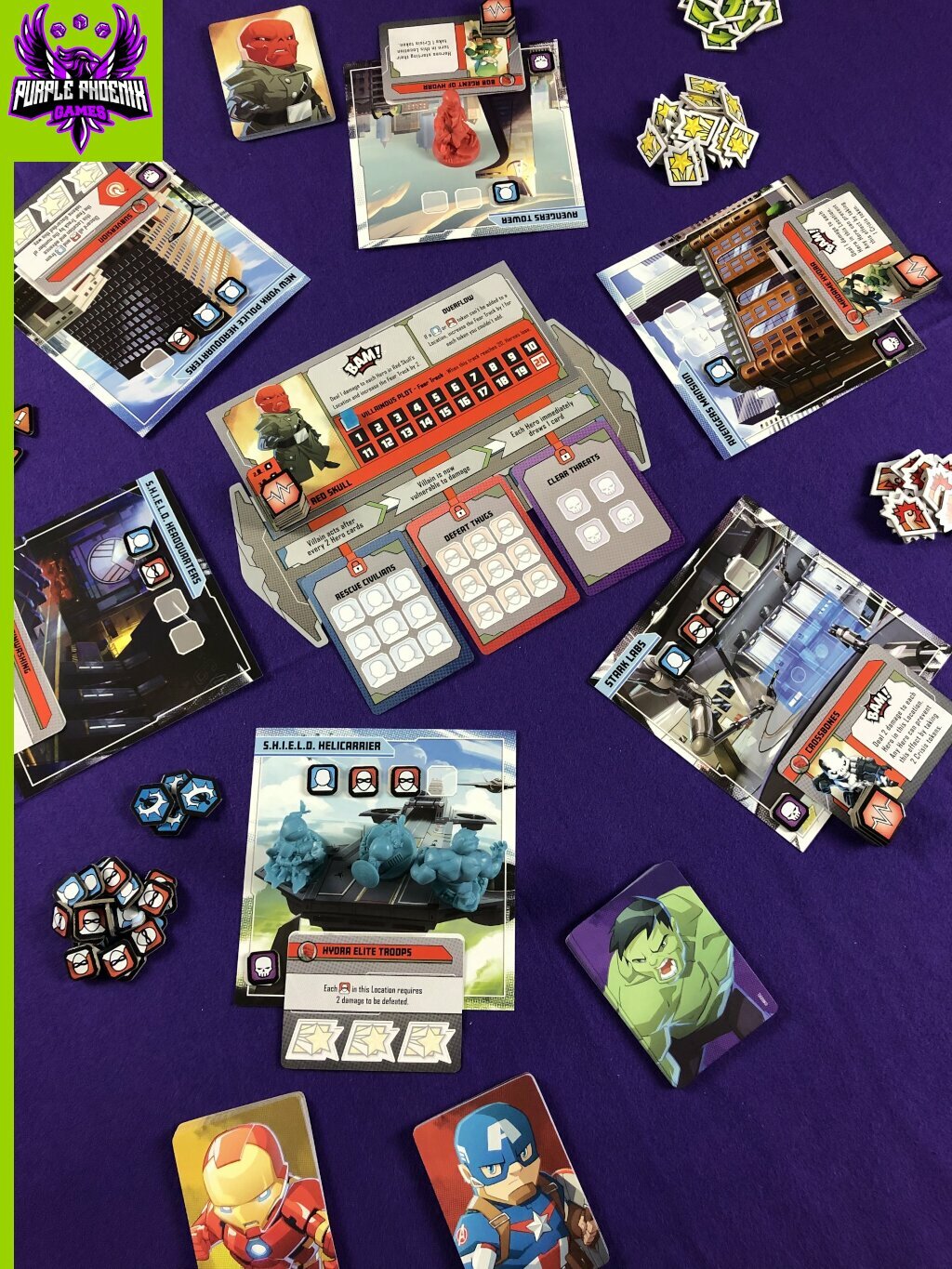
Marvel United is a cooperative game in which players take on the roles of various Marvel superheroes tasked with stopping the main Villain from completing their Villainous Plot. Follow the setup instructions detailed in the rulebook, selecting a Villain with whom to battle, 6 random Locations, and whichever Heroes you decide to use to fight the big bad. Place Threat cards, Civilians, and Thugs on the various Locations as indicated, and place the Villain and Heroes as described in the rules. Shuffle the Master Plan deck and respective Hero decks, and each player draws a hand of 3 cards. Choose a Hero as the ‘starting’ Hero, and the game is now ready to begin!
Over a series of turns, players will be resolving Villain effects and playing Hero cards to perform actions. The game always begins with a Villain turn, and the first step is to reveal a Master Plan card, adding it to the Storyline (table). Master Plan cards have different effects to be resolved – move the Villain to a new Location, BAM! effects (usually attacking Heroes or advancing their Villainous Plot towards victory), and adding Civilians/Thugs to surrounding Locations. Once all effects on the Master Plan card are dealt with, the game moves to a Hero turn. During a Hero turn, the player will perform 4 steps: Draw a card, Play a Card, Resolve Actions, and Location Effects. To start, the player will draw a card from their Hero deck and add it to their hand. They then select a card from their hand to play, adding it to the end of the Storyline.
Looking at the symbols at the bottom of their played card, the Hero will now resolve their actions. Actions could be Movement (to an adjacent Location), Attack (Thugs/Henchmen or the Villain in their current Location), Heroic Actions (rescuing Civilians or working to clear the Threat on their current Location), or Wild (any of the previous actions). During this step, a cool twist comes into play – after all, the game is called Marvel United, right? When a Hero plays a card, they resolve the symbols on the bottom of their card AND the symbols on the bottom of the previously played Hero card! This simulates the various Heroes uniting their efforts to take down the Villain! So when selecting your card, be sure to check out the last card to see if you can create a sweet chain of actions for maximum benefit. The final step is to use Location effects, if applicable. Location effects are only available after the Threat to the Location has been cleared, and allows the player to perform special actions (draw extra cards, move to other Locations, etc.). If you end your turn on a Location that has been cleared, you may use its ability if you so choose.
In order to defeat the Villain, the Heroes must complete Missions. The 3 Missions in each game are to Rescue Civilians, Defeat Thugs, and Clear Threats. So with their actions on their turns, Heroes will be working to complete these Missions, moving them closer to victory. The turn sequence of the game is unique as well – the Villain will take a turn after every 3rd Hero turn, not opposite every single Hero. Keep that in mind as you decide which card to play when! The game essentially continues in this fashion (with a few extra effects) until either the Heroes win or they lose. Heroes win if they defeat the Villain! The Villain is defeated when at least 2 Missions are completed, and the Villain has been sufficiently damaged by Attacks. Heroes lose if the Villain completes their Villainous Plot, the deck of Master Plan cards has run out, or if any Hero starts their turn with no cards left to play. The Heroes either win together or lose together.
So I know that kind of sounds like a lot, but I promise that once you get playing, the game flows really well and is pretty intuitive. Marvel United can basically be broken down into 2 steps: Villain turn and Hero turn. All you are doing is playing cards and resolving actions to complete your goals. One of the coolest things about this gameplay is the fact that on your turn you resolve not only your played card, but also the previously played Hero card as well. It does a good job emulating the Heroes working together, and adds a strategic element to the overall gameplay. Maybe you wanted to play a certain card, but based on the last Hero card, you should play this one to benefit the group the most. Players really are all working together to defeat the Villain, instead of each playing their own Hero and going in for the fight one-on-one.
Another neat aspect of the game is the inclusion of the Missions. Heroes are not allowed to directly attack the Villain until at least 2 Missions have been completed. This ups the gameplay because it stops players from just going straight for the Villain from the start, not taking anything else into account. In ‘real life,’ Heroes are also concerned with saving Civilians and neutralizing threats, so the Mission requirement makes the gameplay feel more authentic. Well, as authentic as a superhero game can feel…. The variability of Locations and the random setup of Threats each game means that you likely won’t play the same game twice. Add in expansions too and you’ve got even more scenarios. With different Hero choices, you get to try out different combinations and find out which Heroes really work well together. The gameplay itself may be simple (draw cards, play cards, resolve cards) but the variety of Heroes, Villains, Locations, Threats, etc. keeps it engaging and entertaining.
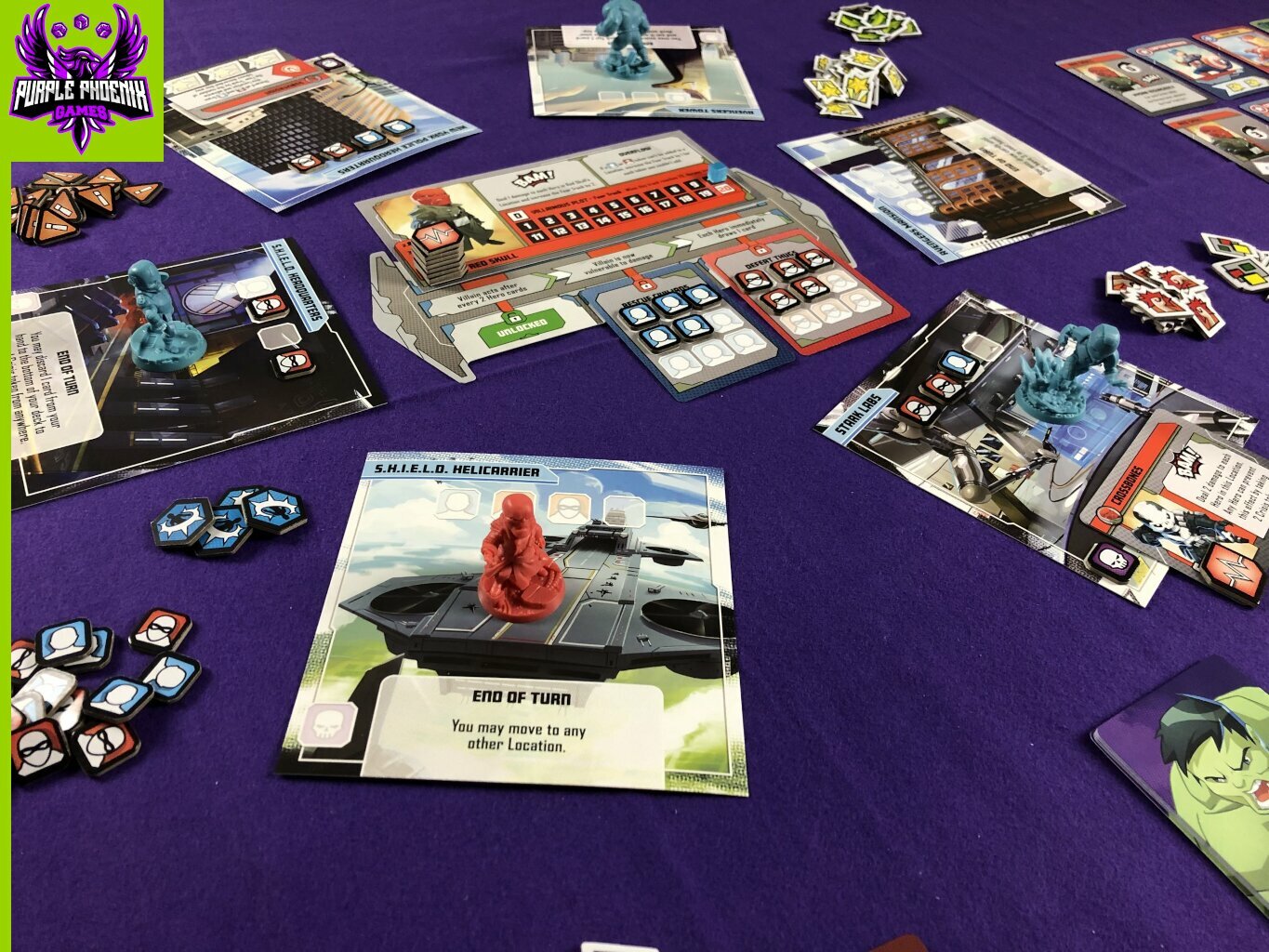
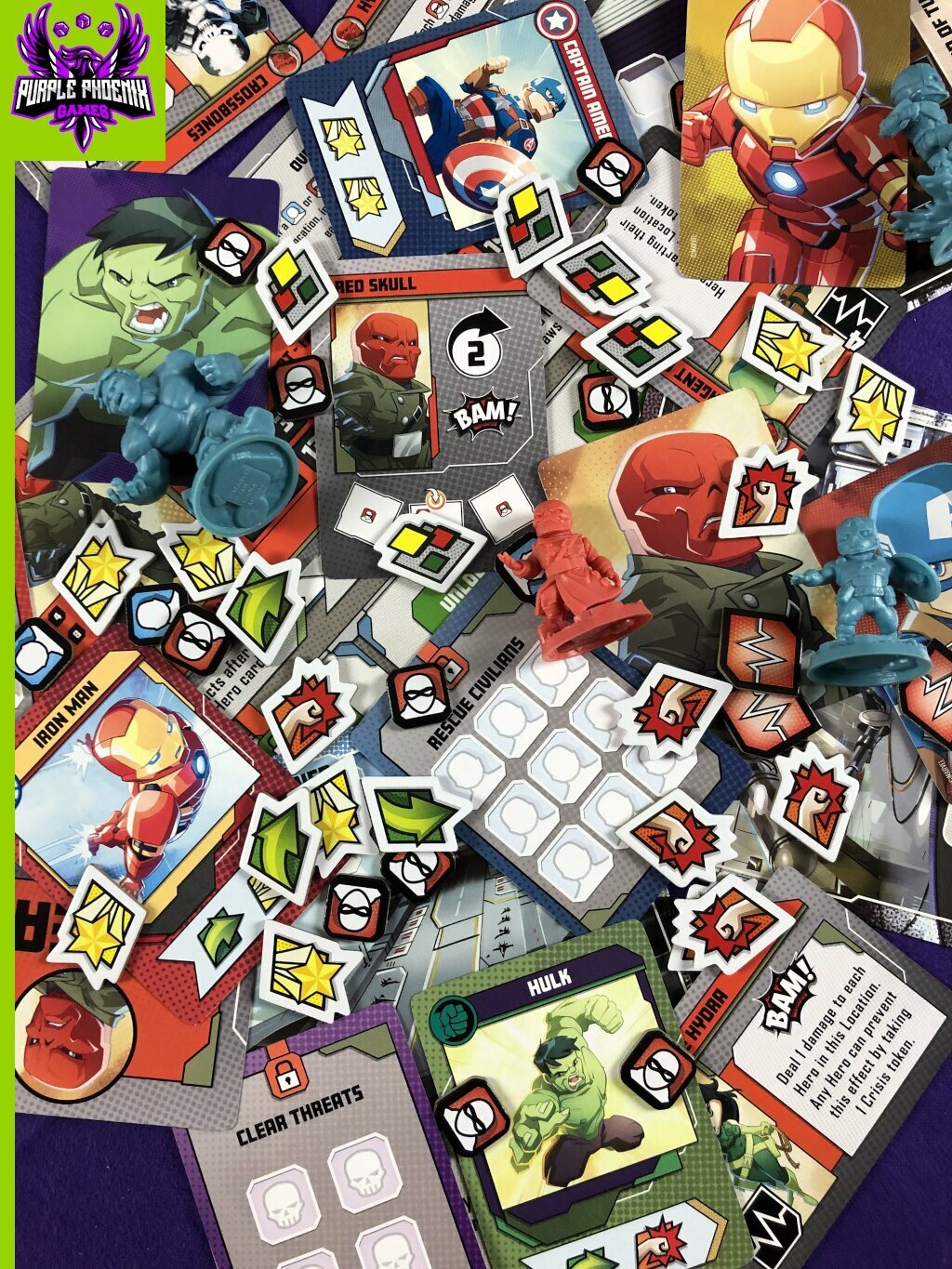
As for components, I only have positive things to say. The Villain/Hero minis are chunky and cute, the artwork is all colorful and fun to look at, and the cardboard tokens are thick and crisp. All the symbolism in the game is clear, and the text is legible and easy to comprehend. One thing to consider is that this game can be a bit of a table hog if you let it. So just be prepared for a bit of a bigger footprint with this one. Overall, great production quality of the base game, and from what I’ve seen of the expansions, those are top notch as well.
Don’t let the cutesy artwork fool you – Marvel United isn’t an easy game by any means. It takes a decent amount of strategy to be successful, and it does really take a team effort. You stay engaged in the gameplay right up until the very end, and it’s more involved than you would think for being a lighter game. I am also a big fan of Marvel Legendary, and I have to say that this gives me those vibes, but in a more simplified and streamlined way. I’m not sure I would go as far as to call Marvel United “Marvel Legendary Jr.,” but it’s also not entirely a bad idea….. Overall though, I really liked Marvel United way more than I first anticipated. It’s light, yet strategic, and has some unique elements that keep you on your toes. I can’t wait to get my hands on some of the expansions to see how I can mix and match and create even more awesome scenarios! Purple Phoenix Games gives this one a heroic 16 / 18.
Disclaimer: This review encompasses only the base game of Marvel United. There are a number of expansions, but they will not be addressed in this review. -L
Marvel United is a cooperative game in which players take on the roles of various Marvel superheroes tasked with stopping the main Villain from completing their Villainous Plot. Follow the setup instructions detailed in the rulebook, selecting a Villain with whom to battle, 6 random Locations, and whichever Heroes you decide to use to fight the big bad. Place Threat cards, Civilians, and Thugs on the various Locations as indicated, and place the Villain and Heroes as described in the rules. Shuffle the Master Plan deck and respective Hero decks, and each player draws a hand of 3 cards. Choose a Hero as the ‘starting’ Hero, and the game is now ready to begin!
Over a series of turns, players will be resolving Villain effects and playing Hero cards to perform actions. The game always begins with a Villain turn, and the first step is to reveal a Master Plan card, adding it to the Storyline (table). Master Plan cards have different effects to be resolved – move the Villain to a new Location, BAM! effects (usually attacking Heroes or advancing their Villainous Plot towards victory), and adding Civilians/Thugs to surrounding Locations. Once all effects on the Master Plan card are dealt with, the game moves to a Hero turn. During a Hero turn, the player will perform 4 steps: Draw a card, Play a Card, Resolve Actions, and Location Effects. To start, the player will draw a card from their Hero deck and add it to their hand. They then select a card from their hand to play, adding it to the end of the Storyline.
Looking at the symbols at the bottom of their played card, the Hero will now resolve their actions. Actions could be Movement (to an adjacent Location), Attack (Thugs/Henchmen or the Villain in their current Location), Heroic Actions (rescuing Civilians or working to clear the Threat on their current Location), or Wild (any of the previous actions). During this step, a cool twist comes into play – after all, the game is called Marvel United, right? When a Hero plays a card, they resolve the symbols on the bottom of their card AND the symbols on the bottom of the previously played Hero card! This simulates the various Heroes uniting their efforts to take down the Villain! So when selecting your card, be sure to check out the last card to see if you can create a sweet chain of actions for maximum benefit. The final step is to use Location effects, if applicable. Location effects are only available after the Threat to the Location has been cleared, and allows the player to perform special actions (draw extra cards, move to other Locations, etc.). If you end your turn on a Location that has been cleared, you may use its ability if you so choose.
In order to defeat the Villain, the Heroes must complete Missions. The 3 Missions in each game are to Rescue Civilians, Defeat Thugs, and Clear Threats. So with their actions on their turns, Heroes will be working to complete these Missions, moving them closer to victory. The turn sequence of the game is unique as well – the Villain will take a turn after every 3rd Hero turn, not opposite every single Hero. Keep that in mind as you decide which card to play when! The game essentially continues in this fashion (with a few extra effects) until either the Heroes win or they lose. Heroes win if they defeat the Villain! The Villain is defeated when at least 2 Missions are completed, and the Villain has been sufficiently damaged by Attacks. Heroes lose if the Villain completes their Villainous Plot, the deck of Master Plan cards has run out, or if any Hero starts their turn with no cards left to play. The Heroes either win together or lose together.
So I know that kind of sounds like a lot, but I promise that once you get playing, the game flows really well and is pretty intuitive. Marvel United can basically be broken down into 2 steps: Villain turn and Hero turn. All you are doing is playing cards and resolving actions to complete your goals. One of the coolest things about this gameplay is the fact that on your turn you resolve not only your played card, but also the previously played Hero card as well. It does a good job emulating the Heroes working together, and adds a strategic element to the overall gameplay. Maybe you wanted to play a certain card, but based on the last Hero card, you should play this one to benefit the group the most. Players really are all working together to defeat the Villain, instead of each playing their own Hero and going in for the fight one-on-one.
Another neat aspect of the game is the inclusion of the Missions. Heroes are not allowed to directly attack the Villain until at least 2 Missions have been completed. This ups the gameplay because it stops players from just going straight for the Villain from the start, not taking anything else into account. In ‘real life,’ Heroes are also concerned with saving Civilians and neutralizing threats, so the Mission requirement makes the gameplay feel more authentic. Well, as authentic as a superhero game can feel…. The variability of Locations and the random setup of Threats each game means that you likely won’t play the same game twice. Add in expansions too and you’ve got even more scenarios. With different Hero choices, you get to try out different combinations and find out which Heroes really work well together. The gameplay itself may be simple (draw cards, play cards, resolve cards) but the variety of Heroes, Villains, Locations, Threats, etc. keeps it engaging and entertaining.
As for components, I only have positive things to say. The Villain/Hero minis are chunky and cute, the artwork is all colorful and fun to look at, and the cardboard tokens are thick and crisp. All the symbolism in the game is clear, and the text is legible and easy to comprehend. One thing to consider is that this game can be a bit of a table hog if you let it. So just be prepared for a bit of a bigger footprint with this one. Overall, great production quality of the base game, and from what I’ve seen of the expansions, those are top notch as well.
Don’t let the cutesy artwork fool you – Marvel United isn’t an easy game by any means. It takes a decent amount of strategy to be successful, and it does really take a team effort. You stay engaged in the gameplay right up until the very end, and it’s more involved than you would think for being a lighter game. I am also a big fan of Marvel Legendary, and I have to say that this gives me those vibes, but in a more simplified and streamlined way. I’m not sure I would go as far as to call Marvel United “Marvel Legendary Jr.,” but it’s also not entirely a bad idea….. Overall though, I really liked Marvel United way more than I first anticipated. It’s light, yet strategic, and has some unique elements that keep you on your toes. I can’t wait to get my hands on some of the expansions to see how I can mix and match and create even more awesome scenarios! Purple Phoenix Games gives this one a heroic 16 / 18.

Ryan Hill (152 KP) rated Wonder Woman (2017) in Movies
May 18, 2019

"I can save today, you can save the world"
Remember when some trickster claiming to be a former worker from Warner Bros. wrote an open letter saying that Wonder Woman was just another mess of a DC movie, et cetera? I remember how Patty Jenkins responded to that. She tweeted: "Just wait and you'll see".
Honestly, I don't know how anyone could even consider that there was the slightest chance of this movie not being good, and I'm gonna tell you why: this is the very first big female-led superhero movie, in which the title character also happens to be the greatest female superhero in history. If you really think that Patty Jenkins, also the first woman to ever direct a superhero movie of this caliber in a industry where women barely stand any chances to get to direct major blockbusters, would let this movie be anything less than great... You've got another thing coming, mate.
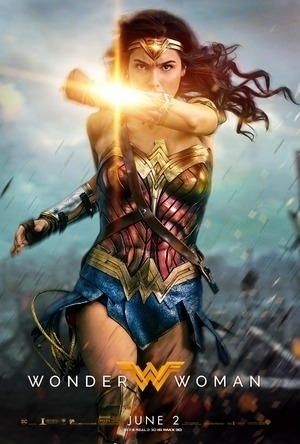
Wonder Woman is a traditional, oldschool superhero movie, but the first essentially feminist one at it, and they couldn't have chosen a better setting to tell this story, or a better character to star in it. The movie's social comments are strong and constantly present, but never forced, because it is only natural: by placing Diana, a princess raised in an island of warrior women, in the middle of the reality of World War I, the absurdities of the feminine role in the world - and so many other human corruptions - automatically come to light. The way Diana reacts to this world raises a great sense of awareness, with a touch of poignant humor to it. There is a very funny subtle arc of her wanting to take out her cloak, but not being able to because her armor is "barely any clothes", hinting not only at society's sexist feminine dressing code - which is still a thing today -, but also gradually adding power to the iconography of Wonder Woman in full costume; this is Wonder Woman's much awaited debut on the big screen in a solo movie, and like Superman and Batman before her, her first appearance needed to be something incredibly striking. Patty knew that, Gal knew that, and they made it happen. Even if we already saw her in BVS, the very first time Wonder Woman walks up in full costume here is undoubtedly one of the most iconic moments in superhero cinema.
Jenkins is extremely devoted to giving Wonder Woman the iconic debut film she deserves, and she nails it - there's quite a bit of remarkable shots and set pieces that let out the same imagetic power as in Donner's Superman, Burton's Batman or even Raimi's Spider-Man, and I must highlight the No Man's Land sequence. It's my favorite part of the movie; Jenkins and Heinberg carefully work on Diana's mindset as she first witness the horrors of human war, not being able to help everyone, horses being hurt so they can move faster, a mother and a child begging for help, and it all leads up to the powerful moment of a woman crossing the land no man could cross - and Heinberg's dialogue doesn't rely on obvious statements such as "fortunately I'm a woman" (I'm looking at you, Batwoman trailer), it simply lets the image strike us, because it is powerful enough by itself, and boy did that cause some serious goosebumps.
Speaking of dialogue... It's so terrific, so well written. The exchanges between Diana and Steve Trevor are very clever and funny, but most of all natural. All the characters are also extremely likable; Allan Heinberg's writing knows that not all of them can be given deep development, but nonetheless he gives them stories, personalities and purposes, and that - plus the charismatic performances - makes them very empathetic. The villains are not as remarkable as in some of the other DCEU films, but they didn't need to be; the movie doesn't require in-depth arcs from its villains. They have a strong presence when they're in scene and a well elaborated lore, and that's everything they need.
Contrary to the Nordic mythology depicted in the MCU, here we are talking about real gods, true deities, not superpowerful aliens that only strike a similar image - and that also brings a few narrative dangers along with it, after all, it was in greek mythological stories that the concept of Deus Ex Machina first appeared. Heinberg's screenplay, though, makes a few clever twists in that mythology to avoid easy solutions, which adds to the storytelling, the world building and the developing of the themes as well. The lore surrounding the God of War Ares, for example, is not a simple Diabolus Ex Machina as "he influences men to war and if you kill him every man goes back to being good and everything's alright", no, it's more narratively complicated and socially engaging than that.
And Gal Gadot... I'm at a loss for words. I'll confess right here that when she was first announced as Wonder Woman, I was one of the few who were very opposed to that casting. I've never been so wrong in my life, and I've never been so happy about it. She really is Wonder Woman. She's so graceful and adorable, but a major badass when she needs to be. The way she moves, the way she curiously looks at things, the way she speaks, and the way she incarnates Diana's evolving from her naive beginnings to the wise warrior... She's not only an icon, she's a true hero. Comparisons to Christopher Reeve's Superman were made for good reasons.
Chris Pine is also great, he walks perfectly in the line between funny and serious, Steve Trevor is a darling character and his chemistry with Gal is on point. Their relationship is very well constructed and becomes highly emotional by the end - there are scenes that filled my heart with joy, and others that made it ache.
The action is exciting and full of originality, and I like how Jenkins uses slow-motion differently than Zack Snyder. I know that Snyder helped her direct some of the action sequences, which is understandable since Jenkins had no experience with this type of movie, but you can tell it's not the same. In the fights themselves, there's this feel of sensibility to how these people react to Diana, and it's slightly different from the typical "regular people react to superhumans among them" trope. The cinematography is very keen on portraying the difference between Themyscira - an island of colors and natural beauty - and "jolly ol' London" - desaturated and smoggy, a scenario in which Diana's colorful armor shines in a most beautiful contrast.
And the soundtrack. Rupert Gregson-Williams made a beautiful score that brings out the best in every scene. It's heroic, very heartfelt, and loyal to the foundations of what makes superhero music so memorable. Gregson-Williams adds new themes to compose Wonder Woman's musical identity, but Hans Zimmer's main theme from BVS still lives, and it plays in some heart-pounding scenes. I love that they're dedicating that much attention to the musical continuity, because amongst Marvel's many qualities, they're doing a lousy job in that area. Wonder Woman's theme is the most catchy superhero theme in a long time, it quickly gained a lot of appreciation and by continuing on using it, Gregson-Williams collaborates to making Wonder Woman the strong cinematic icon she's setting out to be.
The irregular reception of previous DCEU movies also extols the impact of Wonder Woman, as do the distinct styles between the films. One of the DCEU's biggest virtues is that singularity of each film; be it a near disaster movie epic such as Man Of Steel, a complex deconstruction of heroic values such as Batman v Superman, an stylish chaos such as Suicide Squad or a traditional, graceful superhero film such as Wonder Woman, these movies are all in the same universe, and that very fact is an example of its richness. A lot of people will think Wonder Woman is the best DCEU movie of the lot, some will stick to BVS, others to MOS, maybe for some it's Shazam, but that's the fun of it: we can discuss this forever. Each of these movies mean different things to different people, we're way past simply labelling one as "better" and the other as "worse".
Wonder Woman, however, is not simply a movie about a very strong woman. It's an achievement for every woman. There were tons of girls dressed up as Wonder Woman in the theater, and just seeing how ecstatic they were after the movie brought me joy. There were tons of applause. It's a mark. Be that as it may, Wonder Woman will be remembered as the most impactful superhero film of its time. In 1978, Superman showed to the world how a man could fly; in 2017, Wonder Woman showed to the world how a woman can fight.
Honestly, I don't know how anyone could even consider that there was the slightest chance of this movie not being good, and I'm gonna tell you why: this is the very first big female-led superhero movie, in which the title character also happens to be the greatest female superhero in history. If you really think that Patty Jenkins, also the first woman to ever direct a superhero movie of this caliber in a industry where women barely stand any chances to get to direct major blockbusters, would let this movie be anything less than great... You've got another thing coming, mate.
Wonder Woman is a traditional, oldschool superhero movie, but the first essentially feminist one at it, and they couldn't have chosen a better setting to tell this story, or a better character to star in it. The movie's social comments are strong and constantly present, but never forced, because it is only natural: by placing Diana, a princess raised in an island of warrior women, in the middle of the reality of World War I, the absurdities of the feminine role in the world - and so many other human corruptions - automatically come to light. The way Diana reacts to this world raises a great sense of awareness, with a touch of poignant humor to it. There is a very funny subtle arc of her wanting to take out her cloak, but not being able to because her armor is "barely any clothes", hinting not only at society's sexist feminine dressing code - which is still a thing today -, but also gradually adding power to the iconography of Wonder Woman in full costume; this is Wonder Woman's much awaited debut on the big screen in a solo movie, and like Superman and Batman before her, her first appearance needed to be something incredibly striking. Patty knew that, Gal knew that, and they made it happen. Even if we already saw her in BVS, the very first time Wonder Woman walks up in full costume here is undoubtedly one of the most iconic moments in superhero cinema.
Jenkins is extremely devoted to giving Wonder Woman the iconic debut film she deserves, and she nails it - there's quite a bit of remarkable shots and set pieces that let out the same imagetic power as in Donner's Superman, Burton's Batman or even Raimi's Spider-Man, and I must highlight the No Man's Land sequence. It's my favorite part of the movie; Jenkins and Heinberg carefully work on Diana's mindset as she first witness the horrors of human war, not being able to help everyone, horses being hurt so they can move faster, a mother and a child begging for help, and it all leads up to the powerful moment of a woman crossing the land no man could cross - and Heinberg's dialogue doesn't rely on obvious statements such as "fortunately I'm a woman" (I'm looking at you, Batwoman trailer), it simply lets the image strike us, because it is powerful enough by itself, and boy did that cause some serious goosebumps.
Speaking of dialogue... It's so terrific, so well written. The exchanges between Diana and Steve Trevor are very clever and funny, but most of all natural. All the characters are also extremely likable; Allan Heinberg's writing knows that not all of them can be given deep development, but nonetheless he gives them stories, personalities and purposes, and that - plus the charismatic performances - makes them very empathetic. The villains are not as remarkable as in some of the other DCEU films, but they didn't need to be; the movie doesn't require in-depth arcs from its villains. They have a strong presence when they're in scene and a well elaborated lore, and that's everything they need.
Contrary to the Nordic mythology depicted in the MCU, here we are talking about real gods, true deities, not superpowerful aliens that only strike a similar image - and that also brings a few narrative dangers along with it, after all, it was in greek mythological stories that the concept of Deus Ex Machina first appeared. Heinberg's screenplay, though, makes a few clever twists in that mythology to avoid easy solutions, which adds to the storytelling, the world building and the developing of the themes as well. The lore surrounding the God of War Ares, for example, is not a simple Diabolus Ex Machina as "he influences men to war and if you kill him every man goes back to being good and everything's alright", no, it's more narratively complicated and socially engaging than that.
And Gal Gadot... I'm at a loss for words. I'll confess right here that when she was first announced as Wonder Woman, I was one of the few who were very opposed to that casting. I've never been so wrong in my life, and I've never been so happy about it. She really is Wonder Woman. She's so graceful and adorable, but a major badass when she needs to be. The way she moves, the way she curiously looks at things, the way she speaks, and the way she incarnates Diana's evolving from her naive beginnings to the wise warrior... She's not only an icon, she's a true hero. Comparisons to Christopher Reeve's Superman were made for good reasons.
Chris Pine is also great, he walks perfectly in the line between funny and serious, Steve Trevor is a darling character and his chemistry with Gal is on point. Their relationship is very well constructed and becomes highly emotional by the end - there are scenes that filled my heart with joy, and others that made it ache.
The action is exciting and full of originality, and I like how Jenkins uses slow-motion differently than Zack Snyder. I know that Snyder helped her direct some of the action sequences, which is understandable since Jenkins had no experience with this type of movie, but you can tell it's not the same. In the fights themselves, there's this feel of sensibility to how these people react to Diana, and it's slightly different from the typical "regular people react to superhumans among them" trope. The cinematography is very keen on portraying the difference between Themyscira - an island of colors and natural beauty - and "jolly ol' London" - desaturated and smoggy, a scenario in which Diana's colorful armor shines in a most beautiful contrast.
And the soundtrack. Rupert Gregson-Williams made a beautiful score that brings out the best in every scene. It's heroic, very heartfelt, and loyal to the foundations of what makes superhero music so memorable. Gregson-Williams adds new themes to compose Wonder Woman's musical identity, but Hans Zimmer's main theme from BVS still lives, and it plays in some heart-pounding scenes. I love that they're dedicating that much attention to the musical continuity, because amongst Marvel's many qualities, they're doing a lousy job in that area. Wonder Woman's theme is the most catchy superhero theme in a long time, it quickly gained a lot of appreciation and by continuing on using it, Gregson-Williams collaborates to making Wonder Woman the strong cinematic icon she's setting out to be.
The irregular reception of previous DCEU movies also extols the impact of Wonder Woman, as do the distinct styles between the films. One of the DCEU's biggest virtues is that singularity of each film; be it a near disaster movie epic such as Man Of Steel, a complex deconstruction of heroic values such as Batman v Superman, an stylish chaos such as Suicide Squad or a traditional, graceful superhero film such as Wonder Woman, these movies are all in the same universe, and that very fact is an example of its richness. A lot of people will think Wonder Woman is the best DCEU movie of the lot, some will stick to BVS, others to MOS, maybe for some it's Shazam, but that's the fun of it: we can discuss this forever. Each of these movies mean different things to different people, we're way past simply labelling one as "better" and the other as "worse".
Wonder Woman, however, is not simply a movie about a very strong woman. It's an achievement for every woman. There were tons of girls dressed up as Wonder Woman in the theater, and just seeing how ecstatic they were after the movie brought me joy. There were tons of applause. It's a mark. Be that as it may, Wonder Woman will be remembered as the most impactful superhero film of its time. In 1978, Superman showed to the world how a man could fly; in 2017, Wonder Woman showed to the world how a woman can fight.