

Purple Phoenix Games (2266 KP) rated Shelfie Stacker in Tabletop Games
Jul 29, 2021
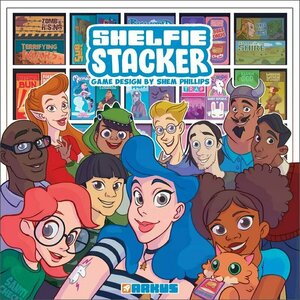

Disclaimer: I do not intend to rehash the entire rulebook in this review, but rather provide an overview of the rules and gameplay. For a more in-depth look, check out the game at your FLGS or directly from the publisher. -L
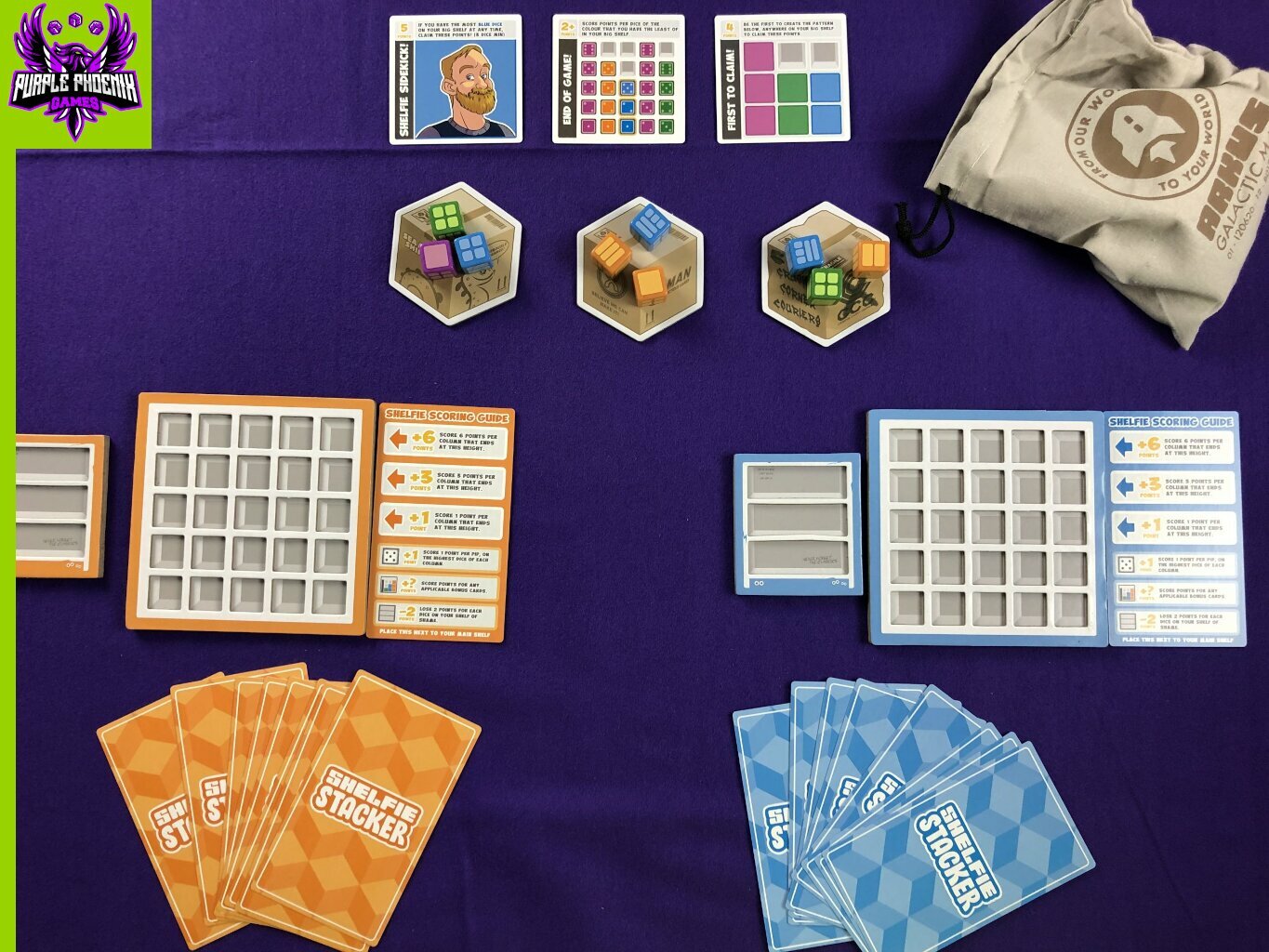
Shelfie Stacker is a game of dice drafting and hand management in which players are trying to create the most prestigious board game shelf in the group. Players will be drafting dice, manipulating them with special abilities, and placing them on their Big Shelf in an effort to amass the most points by the end of 7 rounds. To setup for the game, each player receives a Big Shelf, Shelf of Shame, and Character Cards in their chosen color. Of the 16 Character Cards, you will select 8 with which to play this game, and return the others to the box. Place the Delivery Boxes in the center of the table (1 per player, plus 1 more), and place the dice into the dice bag. Randomly select 1 Sidekick, First to Claim, and End of Game cards and place them face-up in view of all players. The game is now ready to begin!
The game is played over a series of 7 rounds, each broken down into 5 phases. The first phase is to fill the Delivery Boxes. To do so, one player will draw and place 3 dice from the dice bag onto each Delivery Box. The dice don’t need to be rolled, but the drawing player shouldn’t change the faces in any way when placing. In the next phase, all players will select a Character Card to play. This will determine the turn order for the round. The Character Cards are numbered 1-16 (you only use 8 total cards in a game though), and each provide a special one-time ability for use in the game. Players select their Character Card in secret, and then will simultaneously reveal them. Starting with the player who played the lowest-value Character Card, each player will select one of the available Delivery Boxes as their own.
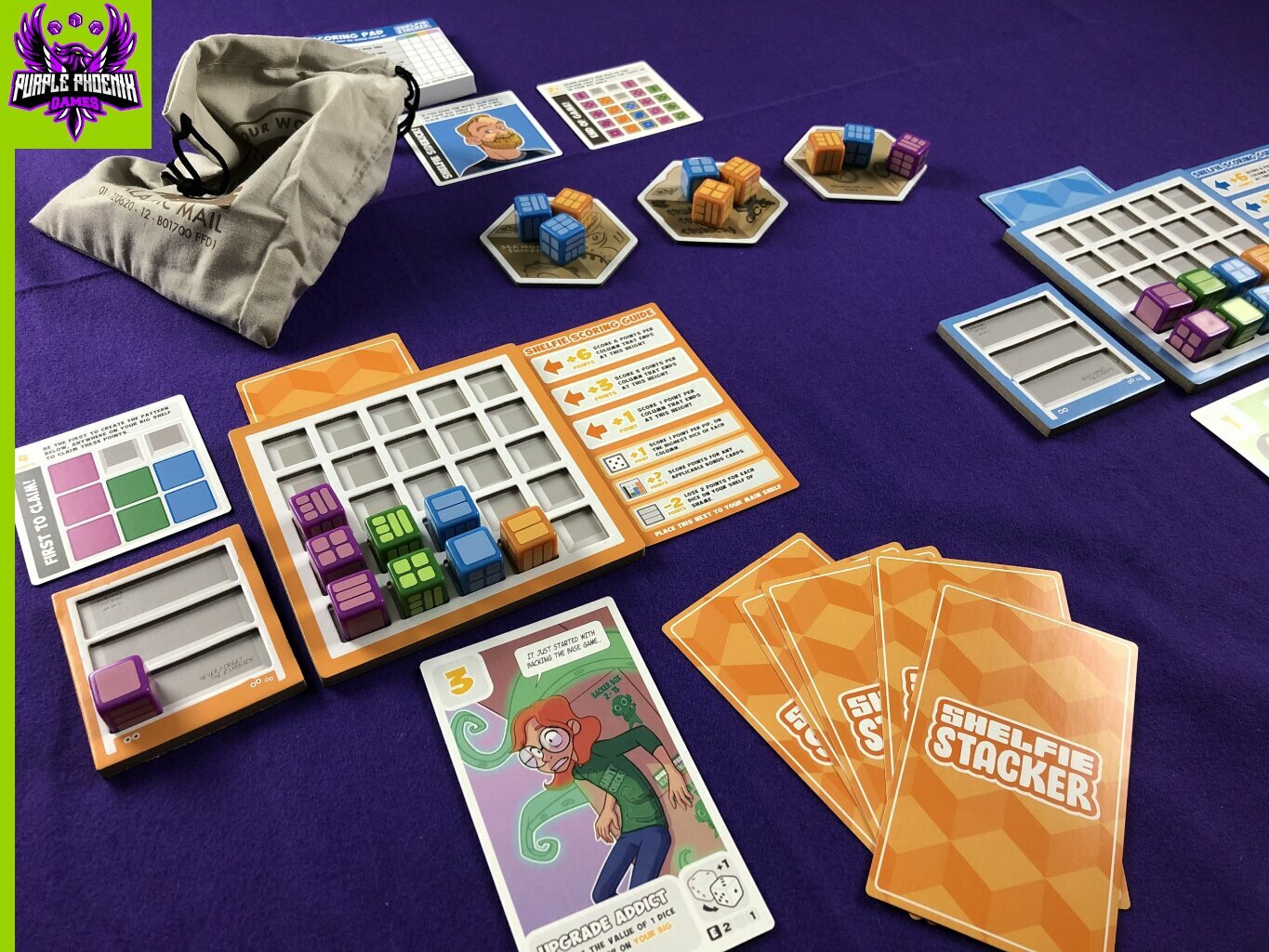
Once you have a Delivery Box, you will then start placing the dice in your Big Shelf! You must place all of your dice, following the placement rules (detailed in the rulebook). During this phase of the round is when most Character Card abilities will be used. These are one-time abilities to be used throughout the game, and allow you to manipulate your dice in various ways. One super important note is that the Character abilities do not need to be used on the same round in which they are played! So I could play a card for its number value (securing my spot in the turn order), but not use its ability until a later round. This really gives you the opportunity to strategize and potentially chain abilities together for maximum results! Once an ability has been used, it is discarded from the game and cannot be used again.
At any point during a round, a player may be able to claim the First to Claim or Sidekick cards, which provide end-game points. The first player to create the depicted pattern on the First to Claim card takes and keeps it for the end of the game. The Sidekick, however, won’t necessarily remain with one player. For example, I may have the most blue dice now and claim the Sidekick, but if in a later round you have more blue dice than me, you can steal it from me! If you are unable to place any/all of your dice on your Big Shelf. they will be placed on your Shelf of Shame *womp womp* and any dice there earn negative points in final scoring. When everyone has finished placing their dice, you prepare for the next round. The Delivery Boxes are returned to the center, and the game is ready to move to the next round.
After the 7th round, the game ends and final scoring takes place. Players can earn points in several ways: if columns get to a certain height, points per pip on the highest die of each column, bonus cards (First to Claim, Sidekick, and End of Game), and you lose 2 points for every die in your Shelf of Shame. Points are totaled and the player with the highest score is the winner!
Putting aside the humor and the theme, Shelfie Stacker is actually a very solid game. The premise is simple (manipulate and place dice) but the actual execution is more strategic than I first thought. The placement rules alone create quite a challenge. The first couple of rounds really determine your success in later rounds. If you don’t set yourself up early in the game with a good strategy, it could all come crashing down as the game progresses. Couple that with the Character Card abilities, and the strategy is elevated once more. You have to decide when to use which abilities, knowing that they are a one-time use. One of my favorite parts of this game is the fact that abilities do not have to be used immediately when played. So maybe I want to go early in the round so I play a low-value card. I can hang onto that special ability until I am ready to play it – I am not forced to use it until I decide to. This adds to the strategy because it allows you to choose when to use cards for maximum benefit, potentially even using multiple abilities in a row to get the desired result. Be warned though, this game could be a little AP-inducing as it gets into later rounds and you have to be more focused with your strategy. Not that the game necessarily halts altogether, but be ready for a little downtime as all players consider their options at the top of a round.
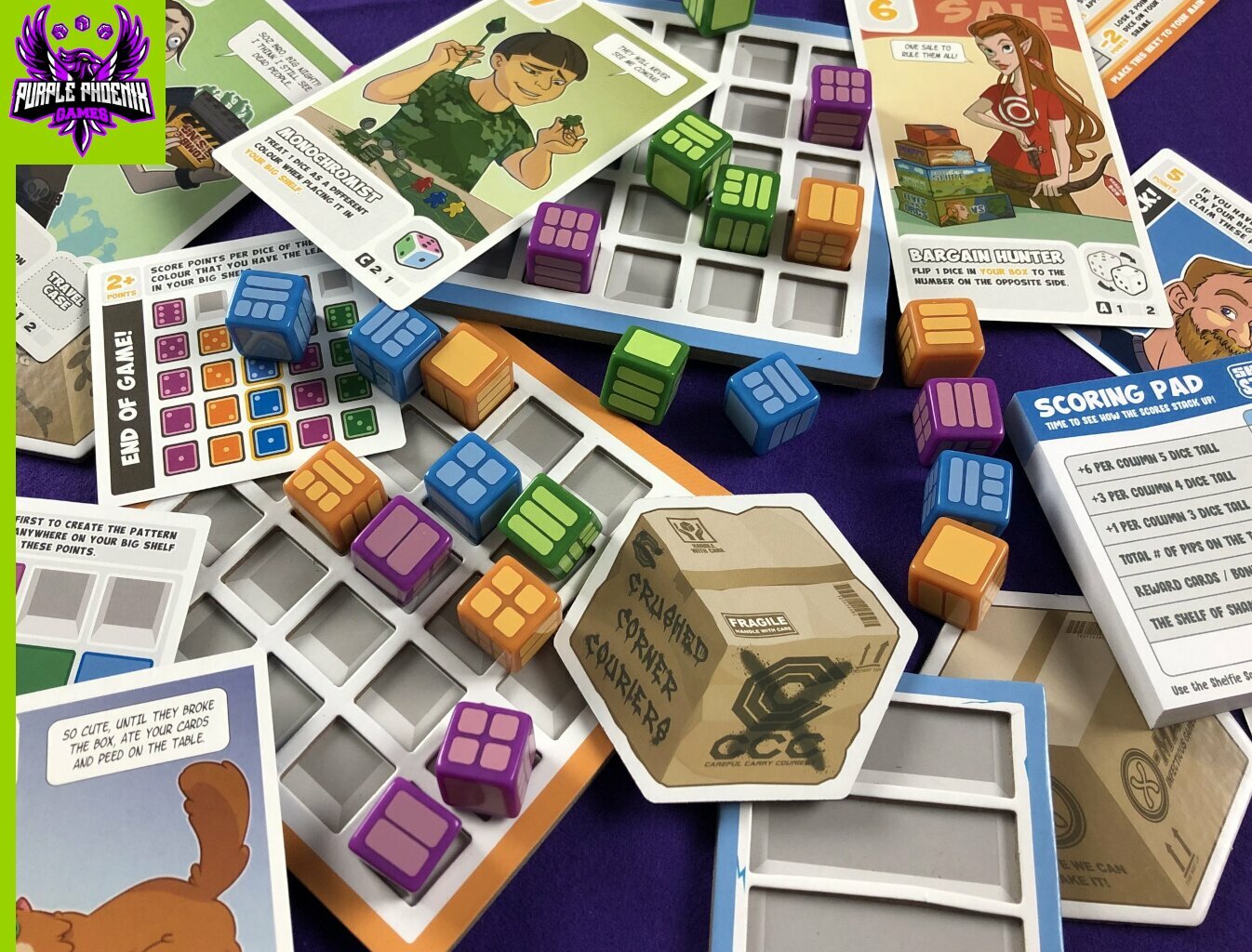
The components of Shelfie Stacker are excellent. The Big Shelf and Shelf of Shame boards are nice and thick dual-layered cardboard that really keep the dice in place. The dice themselves are fun colors, clear to read, and easy to manipulate. The artwork on all the cards is unique and fun, and the rulebook is clear and concise. So all in all, Shelfie Stacker gets an A+ from me with regards to production quality.
Obviously, as you saw in my graphic at the top of this review, Shelfie Stacker gets nothing but praise from me. The theme might not be one that appeals to everyone (especially non-gamers), but the gameplay is super solid and engaging. Every game is unique and strategically challenging, and it really puts you to the test mentally. If you’re in the market for something with a light and fun theme, but that really packs a punch with serious gameplay, I would highly recommend Shelfie Stacker. Then, of course, when you get it you have to decide where to put it on your shelf. The eternal struggle of gamers! Purple Phoenix Games awards this one the coveted Golden Feather Award! That’s right – I think this is a contender for my Top 10! Ooh, what if I put my Top 10 all together on my shelf……


Taco Ninja Adventure
7.0 Rate It
Tabletop Game
Taco Ninja Adventure is a card game for 2-6 players created by Turn Sideways Games. Players are...
Purple Phoenix Games (2266 KP) rated Elder Sign in Tabletop Games
Jul 16, 2019 (Updated Aug 21, 2019)
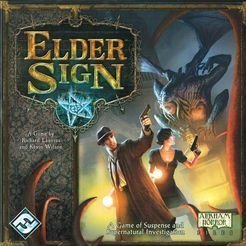
Disclaimer: There are many expansions for Elder Sign. I do not have any of them, nor do I have any gameplay experience with any of them. If and when I do get them added into my base game, I will either amend this review or write a new one! – L
In Elder Sign, players take on the roles of Investigators who must use their supernatural knowledge and keen wit to seal dimensional portals and prevent the Ancient Ones from entering our world and destroying humanity. Just another day at the office, right? Players take turns rolling dice to fight monsters and complete adventures that will reward them with artifacts, health and/or sanity, clues, or even Elder Signs – the symbols necessary for sealing away the Ancient Ones for good. Be careful, though – if you fail to complete an adventure, you will be harshly punished! I’m talking losing health and sanity, accidentally summoning monsters, or even bringing the Ancient One one step closer to our world! As a solo game, Elder Sign plays the same way as it would in a group setting. The only difference is that the solo player cannot use the ‘Assisting’ ability because there are no other players who can offer you aid. Besides that, gameplay remains the same – even a lone Investigator can put their dice to good use to ward off evil!
I enjoy playing Elder Sign as a solo game. Although mostly dominated by dice rolling, there is a fair amount of strategy required for this game. I don’t feel like I’m mindlessly rolling dice – I have to decide which adventures are attainable with my given items, and which rewards benefit me the most in my overall task. There are rewards and consequences to be weighed with every decision, so action must be taken with great thought. Because of the strategic implications, Elder Sign keeps me thoroughly engaged, even when playing solo, and that’s one reason why I keep coming back to it.
On the flip side, one thing that isn’t my favorite about Elder Sign is its reliance on dice rolls to progress in the game. Yeah, I know, it’s a dice game – what did I expect? Sometimes, though, you just can’t roll to save your life (quite literally, in this game) and that can make the game frustrating to play. A series of poor rolls can feel like they completely negate any strategy you’ve enacted and can unravel your entire plan. On a good dice-rolling day for me, I love this game! On a not-so-good dice-rolling day, I find it a little harder to enjoy myself. But hey – if it was totally easy, it wouldn’t be fun, right? One positive of this, I guess, is that I always have to be adjusting my strategy to take the current dice into account. I can’t just pick one strategy and run with it since almost all outcomes are dependent on the luck of the roll! Elder Sign keeps me on my toes, that’s for sure.
I got Elder Sign from Travis as a birthday present last year, and it has been a good addition to my collection. There is enough going on to keep me engaged the entire game, but not so much that I feel overwhelmed. And yeah, maybe I’m not always the greatest dice-roller, but that just makes me adapt my strategy to deal with the current situation. I have read that adding expansions makes the game even more enjoyable, and hopefully one of these days I’ll get to experience that for myself. For the time being, though, I’m content with the base game. If you enjoy Elder Sign, I recommend you try it solo – it doesn’t feel any different to play, and I think you’ll enjoy it just as much as a group game!

Matthew Krueger (10051 KP) rated The Manhattan Project: Energy Empire in Tabletop Games
Feb 22, 2021


Players sit in the roles of countries trying to develop industry and energy production over a period of time roughly from the end of World War II to the present day. Throughout the game, players will construct buildings, power plants as dice, and manage the pollution in their environment with the aim of scoring the most points.
To begin play, the main board for Energy Empire is seeded with starting Building cards. These are divided into three different sectors: Government spaces, Industry spaces, and Commerce spaces. A set of pollution tokens, depending on the number of players, is also stacked on a track as the game timer.
Once the game begins, it flows continuously without rounds. Each player chooses, on their turn, to take a Work Turn or a Generate Turn.
Work Turn- During this type of turn, players must place a single worker on the main board on one of the spaces which represent activities and resources to collect. For example, this may be gaining science, steel, or purchasing oil. Afterwards, depending on which sector the player placed their worker, they can activate any previously purchased buildings, assuming they have enough workers and/or energy. Players can also activate their nation card and move up on the United Nations track, which is a pure competition for end game points. Energy is also used if a player wishes to place a worker on a space occupied by another worker. The player must place additional energy under the worker until their placement stack is larger than any other already placed.
Generate Turn: This type of turn represents the player resetting their work potential for a new set of placing workers. They do this by first potentially collecting an achievement which represents end game points for a variety of goals. They then recall any workers to their Player Mat and discard all Energy tokens. Players can also spend any oil resources to gain oil power plant dice. Finally the player rolls any or all power plant dice they have. This might include Solar/Wind (green dice), Hydro Power (blue dice, limited to one per player), Coal (black dice), and Nuclear (yellow dice). The resulting number of lightning bolts on the dice are delivered as energy tokens to the player. If a clean energy source rolled the highest cardinal number, the player does not collect pollution. If coal, oil, or nuclear dice resulted in the highest number, then the player places a single pollution token into their environment. Players continue this process one after another until a predesignated number of pollution tokens are removed from the game. Players get one final turn and then points are tallied. Players receive points for keeping their player mat free of pollution, building power plants, the United Nations track, and various points for each building constructed.
The most engaging part of the game and the main reason to seek it out, comes from the theme of global power intrigue. The building cards show off the exceptional art in the game.
Manhattan Project: Energy Empire Cards
The global impact cards for the first half of the game are green with a milder impact. Once they go red, prepare for some serious negative events. On top of this theme, the actions associated with everything in the game fit just right. The concept in game actions connect directly to the theme concept. In addition, the country actions to move up on the United Nations track also represent the tone and success formulas for those countries. The mechanism for rolling dice to gain energy and how much pollution is delivered feels just perfect given the competing goals of clean environments and high energy production.
The worker placement mechanism itself (largest stack among existing workers) is not new, but it is just the right mechanism to promote the overall feeling of energy competition. Choosing the space on which to place a worker is highly engaging and the choices tense to maximize efficiency. It is easy to connect with both strategy and tactics in this game.
Even with this engagement, it is also easy to see optimal routes for gaining points assuming opponents follow their strategies. It’s not “easy”, but it is possible to not even worry about opponents blocking a particular path to victory with low numbers of players.
Its a excellent work placement game. One i highly recordmend getting and play.

Jess Palin (52 KP) rated Welcome To... in Tabletop Games
Feb 5, 2020

Under Falling Skies
Tabletop Game
Aliens have arrived to conquer Earth. Enemy ships fill the skies. Humanity retreats to underground...
The Grand Grimoire of Cthulhu Mythos Magic
8.0 Rate It
Tabletop Game
Sourcebook for the 7th edition of Chaosium's legendary horror-fantasy RPG Call of Cthulhu. A...
cthulhu fthagn

Parfs (178 KP) rated Jumanji: The Game in Tabletop Games
May 2, 2019


The game says for people aged 8 to adult but have to say my 4 and 6 year old have been able to play this and really enjoy it fully. We can normally finish the game in about 30 minutes so is a great little time killer and the replay ability is good.
I would have liked the counters to have been shaped to match the game pieces from the movie instead of the plain coloured cones that are supplied but it is a minor gripe.
All in all if you are after an enjoyable board game you really can't go wrong with this game. It is well priced at below £15 from most retailers and is worth every penny.