

Purple Phoenix Games (2266 KP) rated Elysium in Tabletop Games
Aug 3, 2021
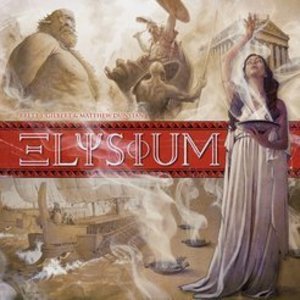

Elysium is a set collection card drafting game for two to four players. Each player will be attempting to complete the greatest collection of Legends written and subsequently transferred to their Elysium (Ancient Grecian version of heaven) for Victory Points. Whomever weaves the greatest Legendary tapestry will emerge victorious and really have a story to tell.
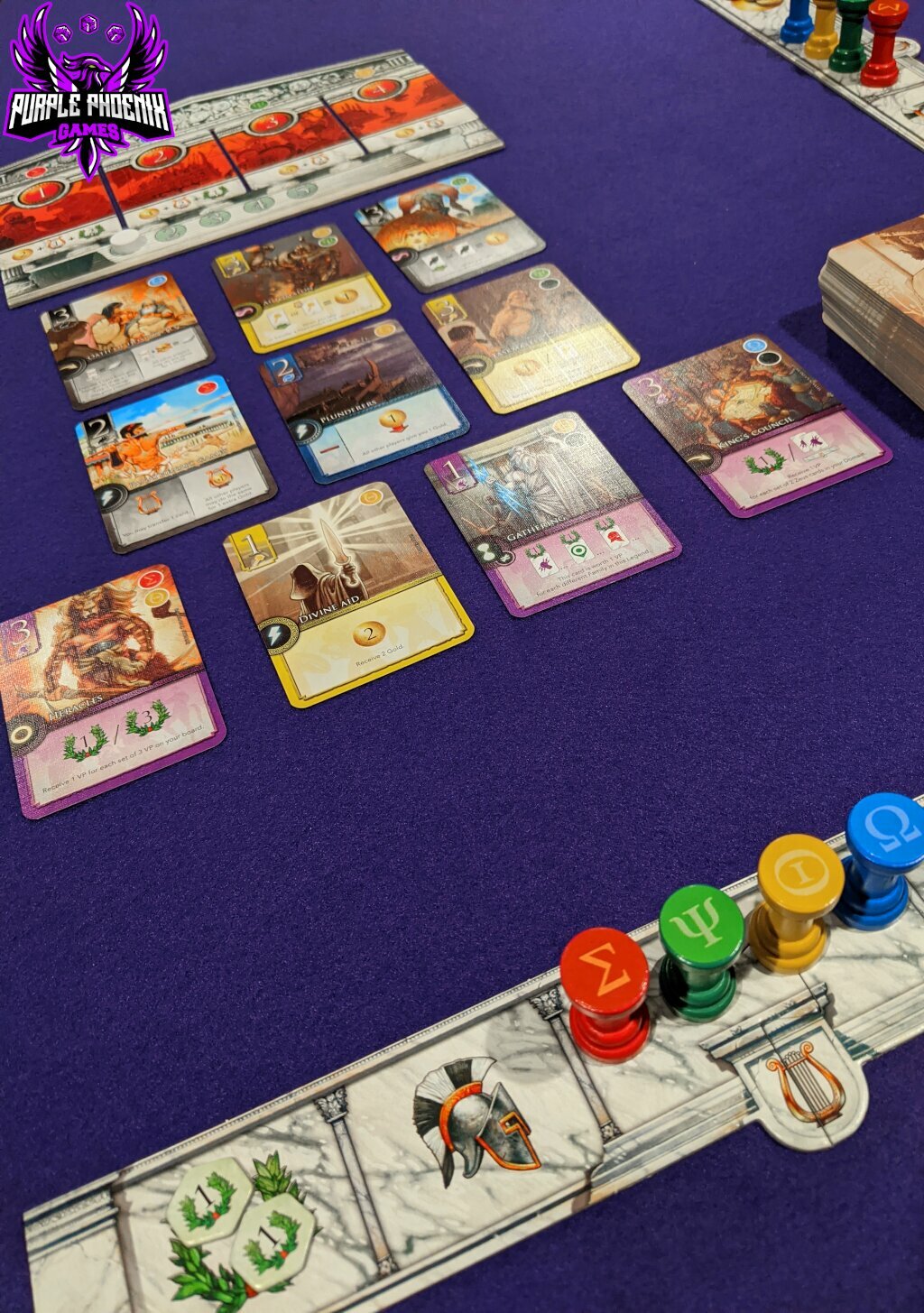
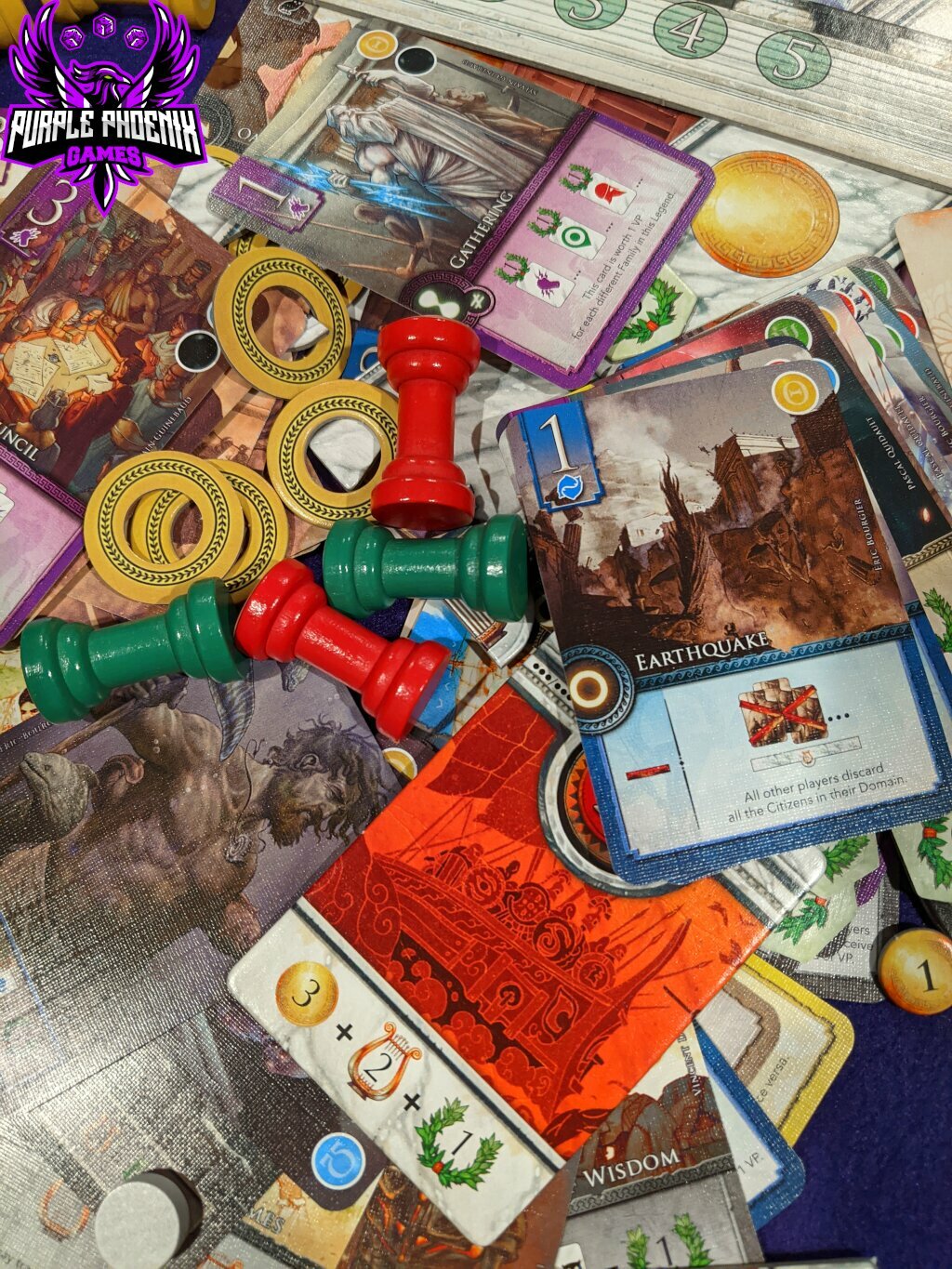
To setup, follow the instructions in the rulebook, but a three player game should look similar to what is pictured above. Players will receive their own player board, starting VP tokens and gold, and a set of columns. Cards from five different Grecian families will be shuffled and displayed in The Agora (middle of the board and the place to draft the cards). Once setup the game may begin.
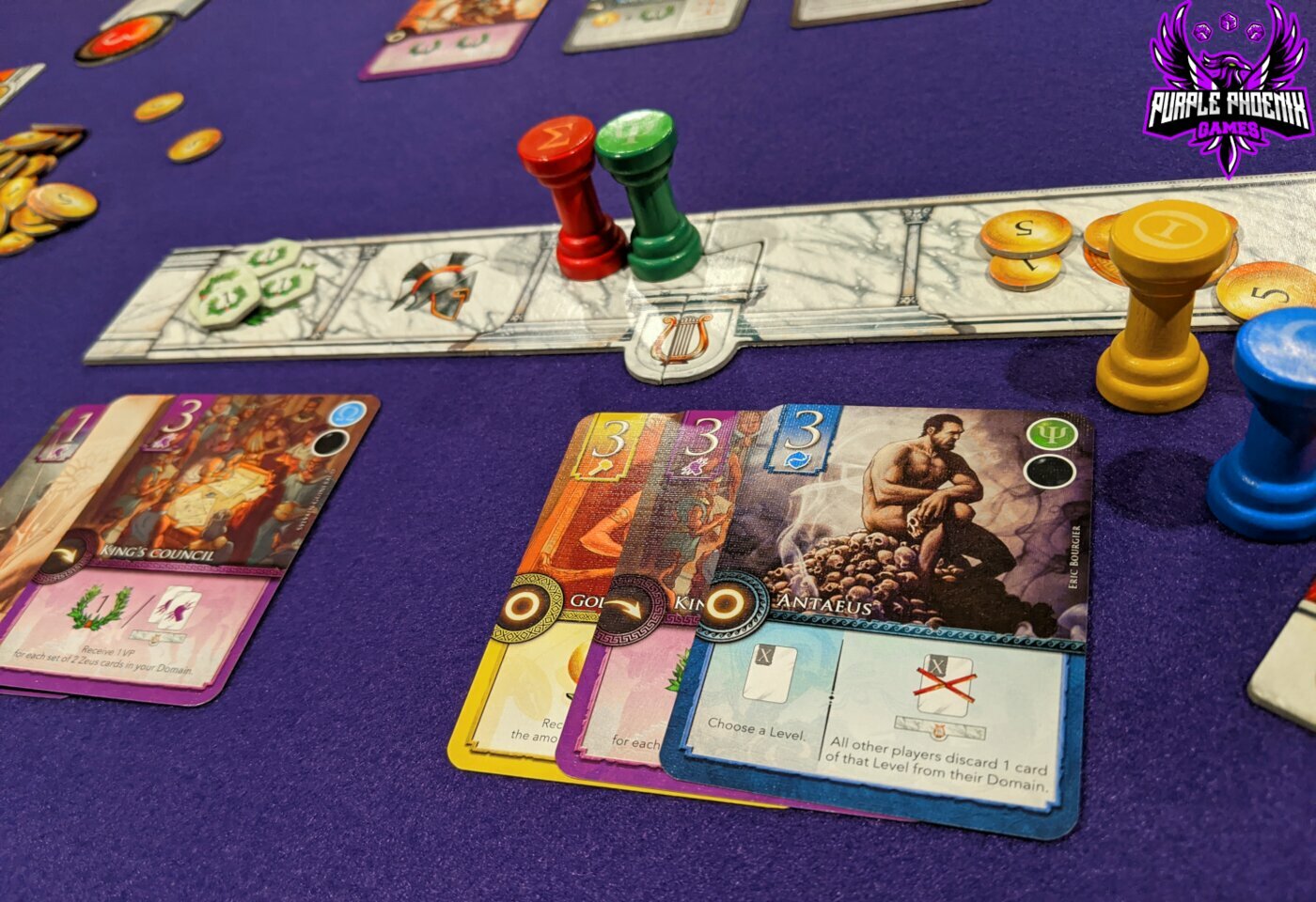
Elysium is played over five Epochs (rounds) and each Epoch is divided into four phases. Phase I is Awakening, which is simply setting up The Agora for the new Epoch by removing all existing cards there and revealing more. Phase II is Actions, where players will be using their columns to draft cards from The Agora (as long as the color of column matches one of the icons on the card) and taking at least one Quest tile (also denotes player order for the next Epoch). Phase III is Writing the Legends, where players will redistribute the player order discs, receive gold and VP per their Quest tile, and transfer any cards from their Domain – active holding area – to their Elysium for VP at game end. Phase IV is End of Epoch, where players will perform basic cleanup tasks to prepare for the next Epoch of play. Play will continue in this fashion until the end of the fifth Epoch and players tally their final VP to determine the greatest Legend-crafter in all the land!
I know this is a VERY brief summary of what is done during the game, but Elysium has many card effects and combos to consider that I just cannot detail here for fear of readers falling asleep or my fingers falling off.
Components. Elysium has simply an incredible aesthetic. The non-card components certainly radiate ancient times and the art on the cards is breathtaking. Every piece is very high quality, which is something I have grown to expect from Space Cowboys games. The columns are fun to hold and move, and as a whole is just visually stunning. I love playing this game and seeing it all out on the table.
Obviously we place our ratings on the very first graphic you see so it is no surprise by the time you read down here, but I love Elysium. Like I mentioned in my open it was in my Top 10 for quite a while, and for very good reasons. First, I love games that simply LOOK good. Is that shallow? Maybe, but it’s what I like. Second, I love the card interplay and combo potential in Elysium. Chaining together cards to build small engines is always fun and provides so much replayability by never really being able to experience every card combo in the box. Finally, it has great components and a theme that speaks to me and my personal interests. It feels like a game that was meant to be played by me specifically. When you find a game like that you have to give it high ratings.
So if you are at all like me and enjoy games with a great theme, excellent art and components, and intriguing replayability, then certainly grab a copy of Elysium. Purple Phoenix Games gives it an Olympus-sized 11 / 12. So many Ancient Greece themed games exist and Elysium is simply one of the best.

Whatchareadin (174 KP) rated Bridal Girl in Books
Apr 9, 2019

Thank you to NetGalley and Henery Press for the opportunity to read and review this book.
Wedding season is among us. From now through the beginning of fall, finding a ballroom, limousine, or a bakery may prove very difficult.
Bridal Girl is the third book in the Blogger Girl Series. I have not read the other books in the series, but I did purchase them while reading this book. Kim Long is a blogger turned author. With such high success of her blog she decided to go ahead and write a book, the previous books give you details about this journey for Kim. Her first book was recently published and is up for it's second printing run. If Kim can stop looking at all of the negative reviews and focus on what is in front of her, she may be able to get book two out in time.
Luckily for Kim she has Nicholas. Nicholas and Kim are perfect together, they are each other support system. When Kim is overwhelmed with trying to find a dress that not only she will love, but that the rest of her bridal party agrees on too, Nicholas is there to be the shoulder to cry on and even offers to go dress shopping with her.
With ex-girlfriends, pregnancy, writers's block, frenemies, new editors, and life in general, will it all be too much for Kim to handle?
Get this book for your entire bridal party, for your friend getting married this year, for those thinking about writing a book. Heck, get the whole series.

Marshal K.K. Rokossovsky: The Red Army's Gentleman Commander
Boris Sokolov and Stuart Britton
Book
The author Boris Sokolov offers this first objective and intriguing biography of Marshal Konstantin...

EU Energy Law: Volume 10: Insider Trading and Market Manipulation in the European Wholesale Energy Markets - Remit
John Ratliff and Roberto Grasso
8.0 Rate It
Book
Regulation (EU) No 1227/2011 of the European Parliament and of the Council on Wholesale Energy...

Arena Calculator for Hearthstone
Reference and Utilities
App
++ The Grand Tournament Updated ++ Arena Calculator is a great tool to get passed 5~6 wins in...


FinanzManager für Numbers
Productivity and Finance
App
Appropriate communication with German Authorities, Companies, Schools, Universities, Doctors and...

Designer - Layer Based Photos Combine Tool Pro
Photo & Video and Lifestyle
App
FotoShop is a photo editing app with so many designing tools like Color fill, drawing, eraser,...

The System of the World
Book
The System of the World by Isaac Newton. The process of writing that first edition of the Principia...
Purple Phoenix Games (2266 KP) rated Sagrada in Tabletop Games
Jun 12, 2019

In Sagrada, you are an artist who has been tasked with creating a beautiful stained glass window. Working piece by piece, you build a masterpiece – the likes of which have never before been witnessed. Finding the perfect pieces can be tricky, but through careful use of your tools and with your artistic vision, you can create the best window in the town! The game is played over 10 rounds in which players draft dice and place them in their windows, following certain placement restrictions. A set number of tools are available for use, and can aid you in manipulating the dice to your benefit. Points are scored based on successful completion of private and public objectives, and the player with the highest score at the end of 10 drafting rounds is the winner!
My favorite part about playing Sagrada solo is that the game is essentially played the same way, regardless of player count. The only difference is how you win! In both group and solo play, each player will draft two dice every round. In group play, any leftover dice are discarded, while in solo play, the remaining two dice will be added towards the Target Score – the score you are trying to beat at the end of the game! To find the Target Score, you add all of the die values of your unused dice from each round. If, at the end of the 10 rounds, you have earned more points than the Target Score, you win! But if the Target Score is higher than your final score, you lose.
The game play differences are simple enough, but actually winning the game solo is a different story. I have played Sagrada solo quite a bit, and have won maybe 25% of the time. Depending on which window card and objectives are in play, and because of placement restrictions, I often have to sacrifice high-valued dice to the Target Score. And since there are no placement restrictions for the Target Score, and two dice are added to it each round, it is very easy for that score to sky-rocket. I either barely pull off a win, or I lose by a huge margin. Playing in a group is nicer in this regard because the other players have the same placement restrictions that I have – nobody is just getting points for free. Without the Target Score, there really is no way to play Sagrada solo, but it makes the game feel a little imbalanced to me.
Just because it is difficult to win solo does not mean that I do not like the game. It requires quite a bit of strategy, and that keeps me engaged for the entire game. There are dice placement restrictions based on color AND value, so there are two different ways in which you have to constantly be strategizing. You can’t just focus on either value or color – your strategy must always be changing based on which color dice are drawn and what values are subsequently rolled. Even with the amount of strategy required, Sagrada actually plays pretty quickly as a solo game, and I really like that. I like the challenge of this game, and often try to play until I can win. Since I can finish an entire solo game in probably 10-15 minutes, I am able to get multiple plays in a row!
Sagrada is a challenging game to play solo, but not in a way that feels futile. I don’t win a lot, but the strategic implications and the pretty dice colors are what keep me coming back to this game! If you haven’t tried Sagrada solo yet, I’d encourage you to give it a shot. But be warned – you might not always win.
https://purplephoenixgames.wordpress.com/2019/02/26/solo-chronicles-sagrada/