Search

Purple Phoenix Games (2266 KP) rated Bellum Magica in Tabletop Games
Jan 1, 2022
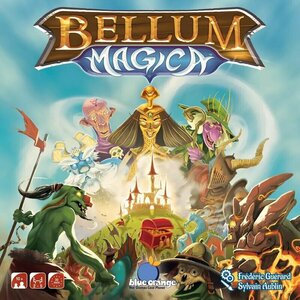

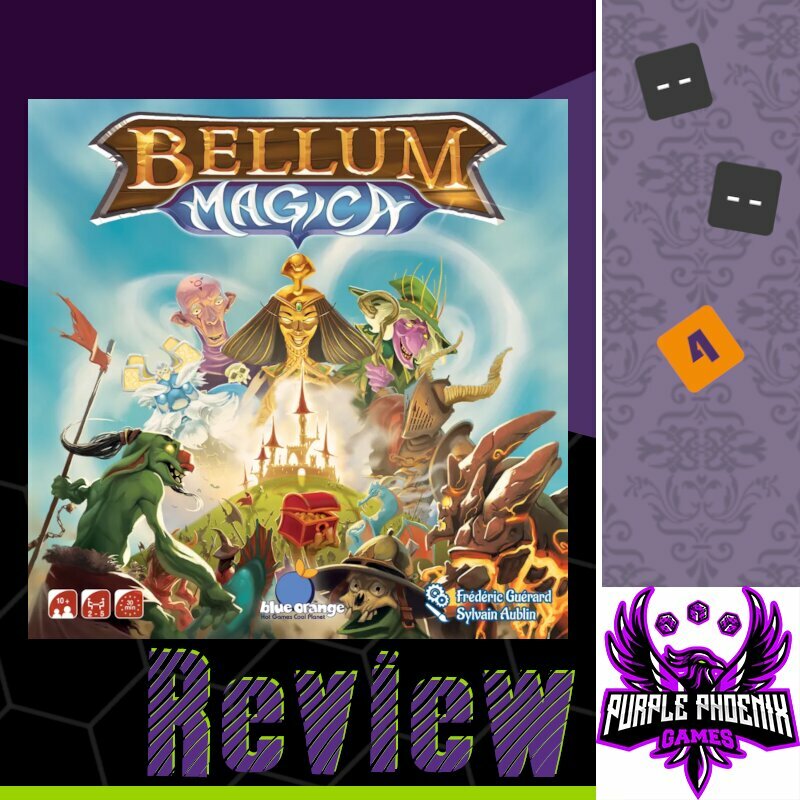
One of the many recent trends in board games has been that of playing as the villains in the game’s lore. One of the bigger games that I remember employing this little shift is Legendary: Marvel Villains, and another that I truly enjoy is Disney Villainous. There is just something about playing as the bad guys in a game that is designed for the bad guys to finally win. Enter Bellum Magica, a game that I didn’t even realize existed until it arrived on my door step from Blue Orange Games. I wonder, will this one find its way into my collection permanently?
Bellum Magica is a medieval fantasy engine building game for two to five players. In it, players are evil lords waging war on a local village and each other in an attempt to becoming the richest lord of all. The winner is the player who earns the most VP from treasure chests looted during the game.
DISCLAIMER: We were provided a copy of this game for the purposes of this review. This is a retail copy of the game, so what you see in these photos is exactly what would be received in your box. I do not intend to cover every single rule included in the rulebook, but will describe the overall game flow and major rule set so that our readers may get a sense of how the game plays. For more in depth rules, you may purchase a copy online or from your FLGS. -T
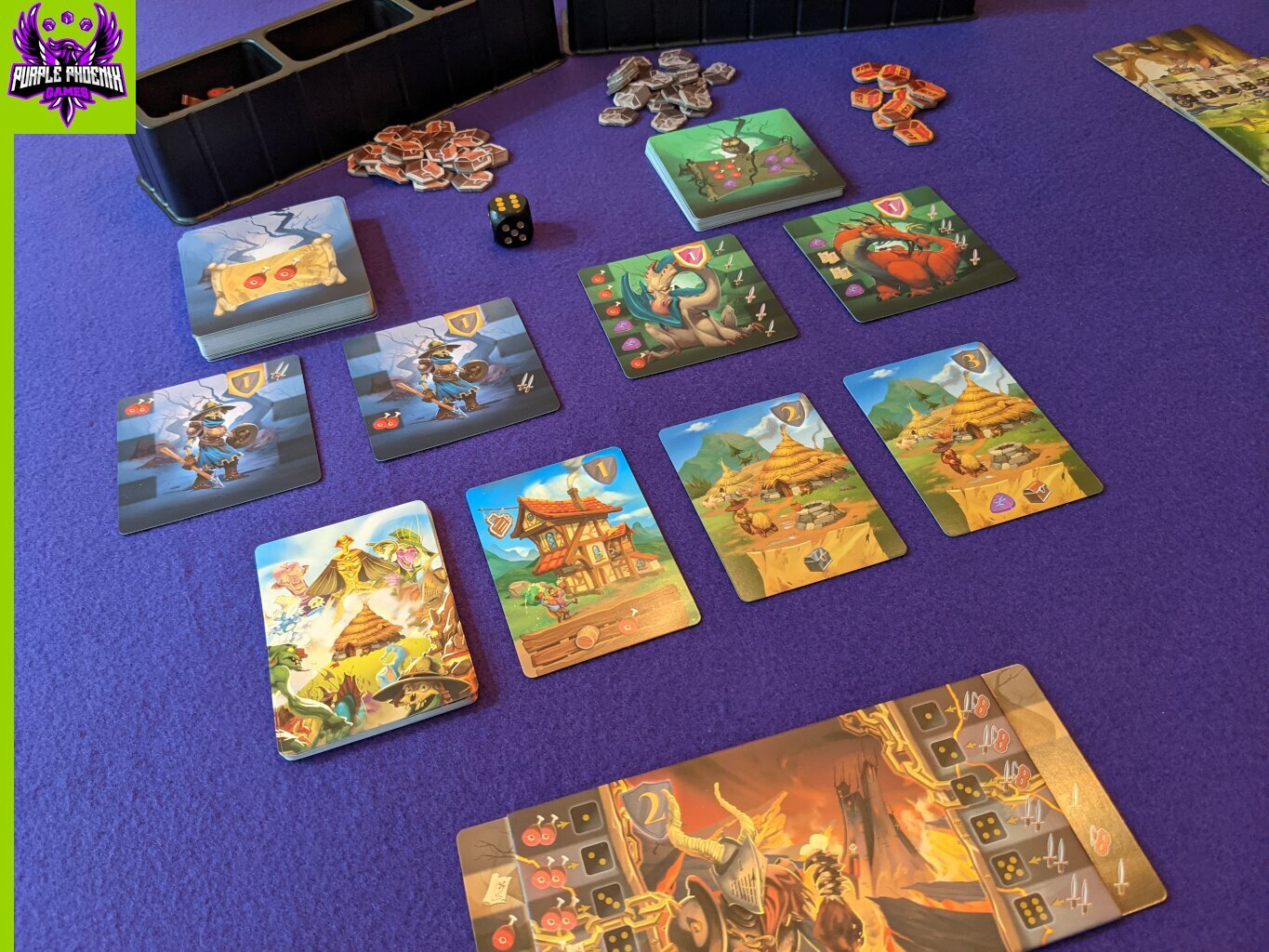
To setup, each player chooses a castle board and is randomly dealt two goblin cards to be added to the castle. These goblin cards have icons on the left and the right of the main character art, and will slide beneath the main castle board on either side to activate their icons for the duration. Next, the human kingdom (that will inevitably be attacked by players) is setup per number of players and placed on the table. The two different creature decks are shuffled and two cards from each pile are revealed. The other tokens are placed in the insert “token reserves” and are available to all. The first player takes the die and is known as the Captain. The game is now setup and ready to begin!
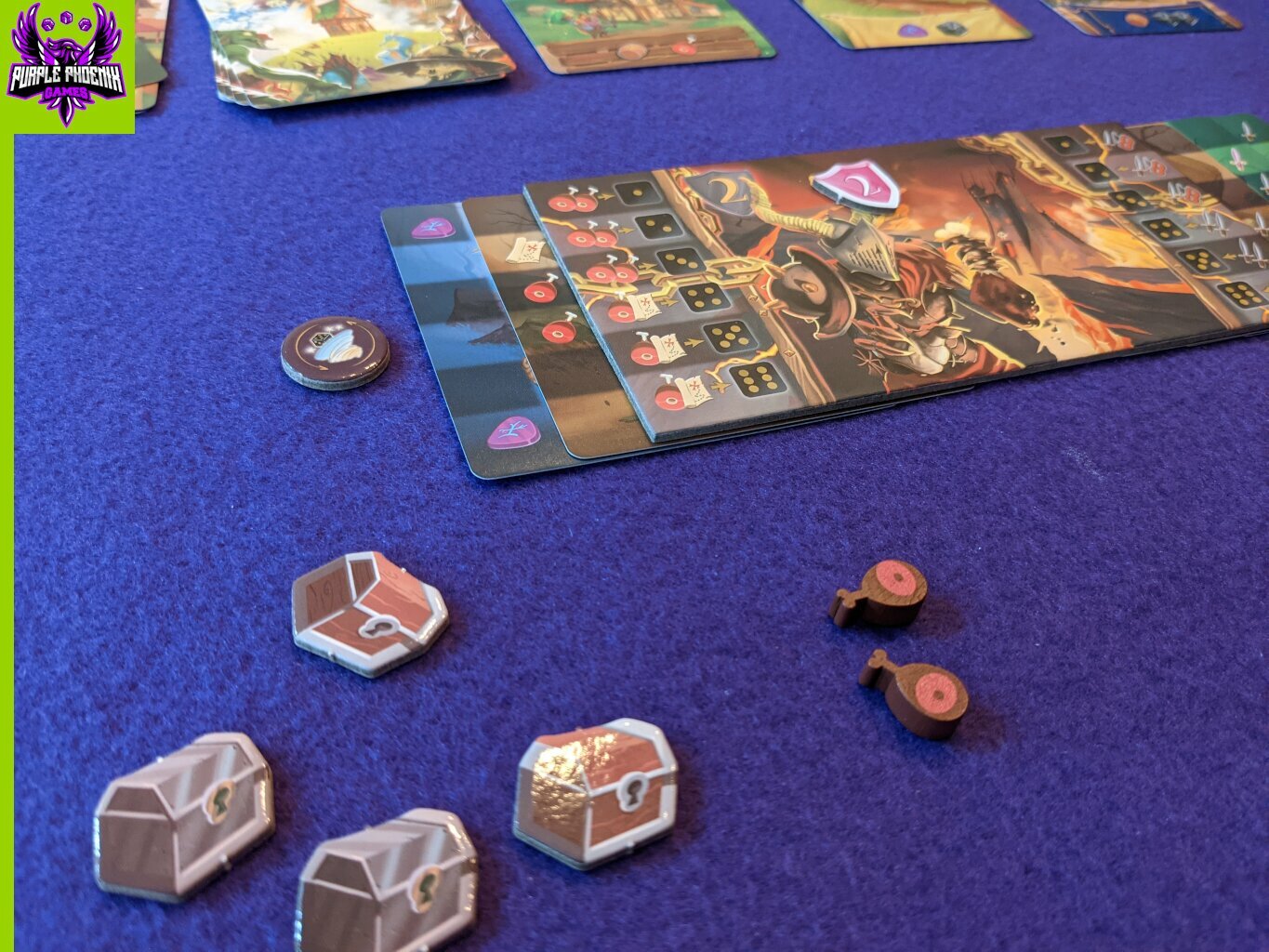
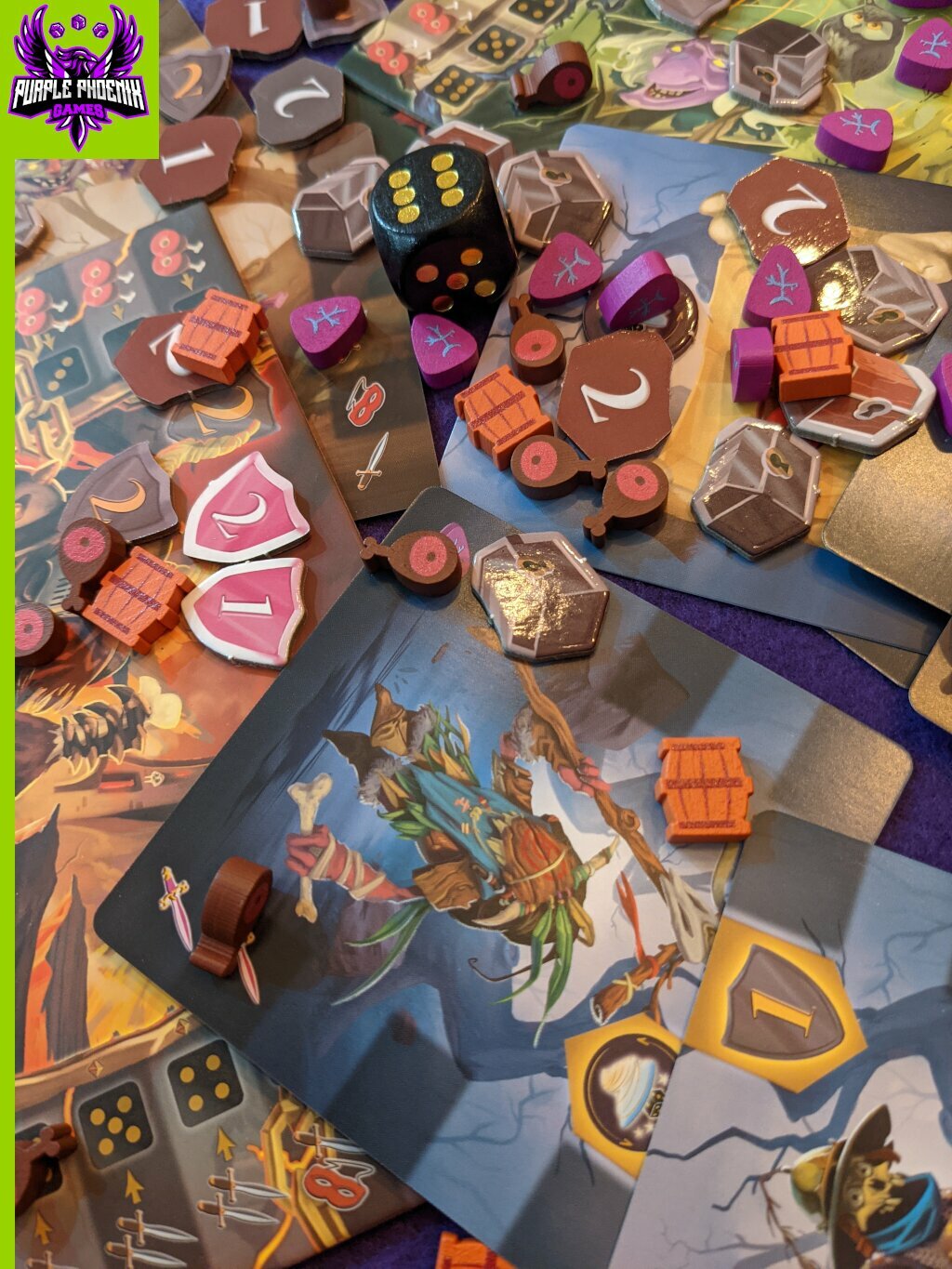
Each turn consists of six phases and, luckily, the game comes with a couple player aids to remind players of the order. First, the Captain rolls the die to Choose an active horde. Whichever result is rolled will then activate the corresponding line on the castle board, with all icons activating during the turn. If a player is unsatisfied with the rolled result, they may discard a barrel token in order to buy a round of drinks for the Captain, forcing them to re-roll the die. The Captain may also discard a Confusion Spell token in order to re-roll the die as well. These items are earned later in the game from different actions. Next, all players Gather resources (collect items) shown on the line that is activated on their castle board and any cards that have been added to alter these items (see photo below). Players will compare treasure map icons shown on the active line, and Call back their scouts who have gone in search of treasure chests. The player with the most icons will collect a metal chest, and if players are tied for the most, they each instead collect a wooden chest.
Once all items have been collected, players may enact the Attack action in turn order. Depending on the number and types of sword icons showing on the right side of players’ castle boards, they may choose to attack one of the face-up kingdom cards in the offer OR may choose to instead attack another player. In order to attack, the player will need to possess at least as many normal swords and/or magic swords as are showing on the kingdom card or on an opponent’s castle board. By successfully attacking, the player will collect spoils shown on the kingdom card, or may steal a treasure from an opponent, provided the attacker also possesses a thief icon on the active line.
When attacks are all resolved, players may next Recruit creatures from the setup creature decks by paying the recruitment costs (in food and glyph tokens). Players then decide under which side of their castle board they will slide the newly-acquired creature to aid in their efforts on future turns. These creatures can provide more resources or more attacking icons, depending on the side added.
After all these phases have been completed, the End of the Turn phase aptly finishes the turn. Cards are replenished and the new Captain is passed the die. Play continues in this fashion until one player has ten treasure chests at the end of an Attack phase. The player with the most VP from collected treasure chests is the winner!
Components. This game boasts some excellent artwork and some of the cutest little tokens I’ve seen. Firstly, the art is simply amazing. I love the looks of it, and the game is beautiful on the table once setup and playing. There are three types of wooden tokens that just make me smile while playing with them: little chicken legs, beer barrels, and cool little purple glyphs. I honestly wish they were bigger, but I understand cost of manufacturing places limitations when trying to keep products within a certain price point. All said, though, the components are great with this one!
I have one super tiny rule shrug: the addition of the Confuse Spell token and its rules. Now, I think I understand WHY it exists – these can be used every turn a player is Captain. So, it acts like a beer barrel, but is useful on future turns when you are Captain. If players are good at the game, and if you play with the full complement of players, you may not have many turns as Captain before someone wins, so I guess I don’t fully agree with the necessity of the Confusion Spells… except to further instill the fantasy theme.
That said, I still really enjoy Bellum Magica as a gateway-level engine builder. The more cards you add to your castle board, the better opportunities you give yourself to gain more and more resources throughout each turn. I have found that getting yourself a magic sword icon or more as soon as possible helps setup bigger turns and can be the difference between victory and embarrassment. As the kingdom cards start running out, their difficulty level increases, so having those extra magic swords come in handy big time. Also, investing in thief icons to be able to control other players’ treasure chest hoards may be invaluable. There are many ways to craft each turn to maximize effectiveness, and that helps keep Bellum Magica relevant and exciting to play.
It is probably no surprise by now, but I do enjoy playing Bellum Magica. When I first tried reading the rules I was a bit confused and wasn’t quite sure what the point was, but as I started playing more and more, the rules are really just pared down, almost like an outline or first draft. If you can stick with it and get it to the table, I believe you will find a very capable gateway engine building game with an accessible theme and great art and components. Purple Phoenix Games gives this one metal treasure chested 4 / 6. I do believe I will continue to love it more and more as I play it more and more. If you align with my board game tastes, this is an easy one to recommend. If you and I normally align somewhat, then I might suggest playing someone else’s copy before grabbing one of your own right away. I am more into gateway-weighted games than most reviewers, I’m sure, so this might be a bit lighter than your normal fare. In any case, I think this one needs to be played. A lot. If you ever see me out and about, or at a convention, let me know that you want to play this with me and I will not turn down the opportunity.
Bellum Magica is a medieval fantasy engine building game for two to five players. In it, players are evil lords waging war on a local village and each other in an attempt to becoming the richest lord of all. The winner is the player who earns the most VP from treasure chests looted during the game.
DISCLAIMER: We were provided a copy of this game for the purposes of this review. This is a retail copy of the game, so what you see in these photos is exactly what would be received in your box. I do not intend to cover every single rule included in the rulebook, but will describe the overall game flow and major rule set so that our readers may get a sense of how the game plays. For more in depth rules, you may purchase a copy online or from your FLGS. -T
To setup, each player chooses a castle board and is randomly dealt two goblin cards to be added to the castle. These goblin cards have icons on the left and the right of the main character art, and will slide beneath the main castle board on either side to activate their icons for the duration. Next, the human kingdom (that will inevitably be attacked by players) is setup per number of players and placed on the table. The two different creature decks are shuffled and two cards from each pile are revealed. The other tokens are placed in the insert “token reserves” and are available to all. The first player takes the die and is known as the Captain. The game is now setup and ready to begin!
Each turn consists of six phases and, luckily, the game comes with a couple player aids to remind players of the order. First, the Captain rolls the die to Choose an active horde. Whichever result is rolled will then activate the corresponding line on the castle board, with all icons activating during the turn. If a player is unsatisfied with the rolled result, they may discard a barrel token in order to buy a round of drinks for the Captain, forcing them to re-roll the die. The Captain may also discard a Confusion Spell token in order to re-roll the die as well. These items are earned later in the game from different actions. Next, all players Gather resources (collect items) shown on the line that is activated on their castle board and any cards that have been added to alter these items (see photo below). Players will compare treasure map icons shown on the active line, and Call back their scouts who have gone in search of treasure chests. The player with the most icons will collect a metal chest, and if players are tied for the most, they each instead collect a wooden chest.
Once all items have been collected, players may enact the Attack action in turn order. Depending on the number and types of sword icons showing on the right side of players’ castle boards, they may choose to attack one of the face-up kingdom cards in the offer OR may choose to instead attack another player. In order to attack, the player will need to possess at least as many normal swords and/or magic swords as are showing on the kingdom card or on an opponent’s castle board. By successfully attacking, the player will collect spoils shown on the kingdom card, or may steal a treasure from an opponent, provided the attacker also possesses a thief icon on the active line.
When attacks are all resolved, players may next Recruit creatures from the setup creature decks by paying the recruitment costs (in food and glyph tokens). Players then decide under which side of their castle board they will slide the newly-acquired creature to aid in their efforts on future turns. These creatures can provide more resources or more attacking icons, depending on the side added.
After all these phases have been completed, the End of the Turn phase aptly finishes the turn. Cards are replenished and the new Captain is passed the die. Play continues in this fashion until one player has ten treasure chests at the end of an Attack phase. The player with the most VP from collected treasure chests is the winner!
Components. This game boasts some excellent artwork and some of the cutest little tokens I’ve seen. Firstly, the art is simply amazing. I love the looks of it, and the game is beautiful on the table once setup and playing. There are three types of wooden tokens that just make me smile while playing with them: little chicken legs, beer barrels, and cool little purple glyphs. I honestly wish they were bigger, but I understand cost of manufacturing places limitations when trying to keep products within a certain price point. All said, though, the components are great with this one!
I have one super tiny rule shrug: the addition of the Confuse Spell token and its rules. Now, I think I understand WHY it exists – these can be used every turn a player is Captain. So, it acts like a beer barrel, but is useful on future turns when you are Captain. If players are good at the game, and if you play with the full complement of players, you may not have many turns as Captain before someone wins, so I guess I don’t fully agree with the necessity of the Confusion Spells… except to further instill the fantasy theme.
That said, I still really enjoy Bellum Magica as a gateway-level engine builder. The more cards you add to your castle board, the better opportunities you give yourself to gain more and more resources throughout each turn. I have found that getting yourself a magic sword icon or more as soon as possible helps setup bigger turns and can be the difference between victory and embarrassment. As the kingdom cards start running out, their difficulty level increases, so having those extra magic swords come in handy big time. Also, investing in thief icons to be able to control other players’ treasure chest hoards may be invaluable. There are many ways to craft each turn to maximize effectiveness, and that helps keep Bellum Magica relevant and exciting to play.
It is probably no surprise by now, but I do enjoy playing Bellum Magica. When I first tried reading the rules I was a bit confused and wasn’t quite sure what the point was, but as I started playing more and more, the rules are really just pared down, almost like an outline or first draft. If you can stick with it and get it to the table, I believe you will find a very capable gateway engine building game with an accessible theme and great art and components. Purple Phoenix Games gives this one metal treasure chested 4 / 6. I do believe I will continue to love it more and more as I play it more and more. If you align with my board game tastes, this is an easy one to recommend. If you and I normally align somewhat, then I might suggest playing someone else’s copy before grabbing one of your own right away. I am more into gateway-weighted games than most reviewers, I’m sure, so this might be a bit lighter than your normal fare. In any case, I think this one needs to be played. A lot. If you ever see me out and about, or at a convention, let me know that you want to play this with me and I will not turn down the opportunity.
Purple Phoenix Games (2266 KP) rated Mutants in Tabletop Games
Mar 11, 2022

Boy, we have some crazy ideas when it comes to what the world will look like in the future. Flying cars? Probably. Robot house butlers? Maybe. Mutant fighters that can be formed immediately and placed into battle seconds after “birth?” Now, that’s a stretch. But, embrace the stretch here, because Mutants is all about it.
Mutants is a crazy-themed deck building, hand management, fighting, card game for one to four players. Usually in this instance I would put together a Solo Chronicles review, but I wanted to first get the multiplayer rules down and then delve into solo. In any case, this game pits players against each other in a royal rumble where controlling mutants to fight one another most effectively and efficiently will earn the player riches galore. Come check out the world of Mutants.
To setup, well, there are many steps. The biggest and perhaps most confusing step is creating the decks of mutants that will be used by players throughout the game. I will recommend you follow the rulebook for drafting your team, or simply use one of the provided pre-constructed team suggestions. Otherwise, place the main board on the table, along with the power and scoring tokens for each player. Players choose their player board according to color chosen, take their starting deck, and divide their Advanced Mutant deck into three piles, with the top card flipped face-up. Players draw a hand of six Basic Mutant cards (one of each type initially) and the battle may begin!
Mutants is played over five rounds, tracked on the main board. Each round encompasses three phases: Crush the Competition, Move Active Mutant, and Take Action. As the game progresses, the power tokens for players will be moving up and down the Power Track. If, at the start of the current player’s turn, an opponent’s power token is located in one of the last three Power Track spaces (named the Dread Zone), and the current player’s token is on the Fury Space (furthest along the Track), then the current player will score immediate bonus points by Crushing the Competition.
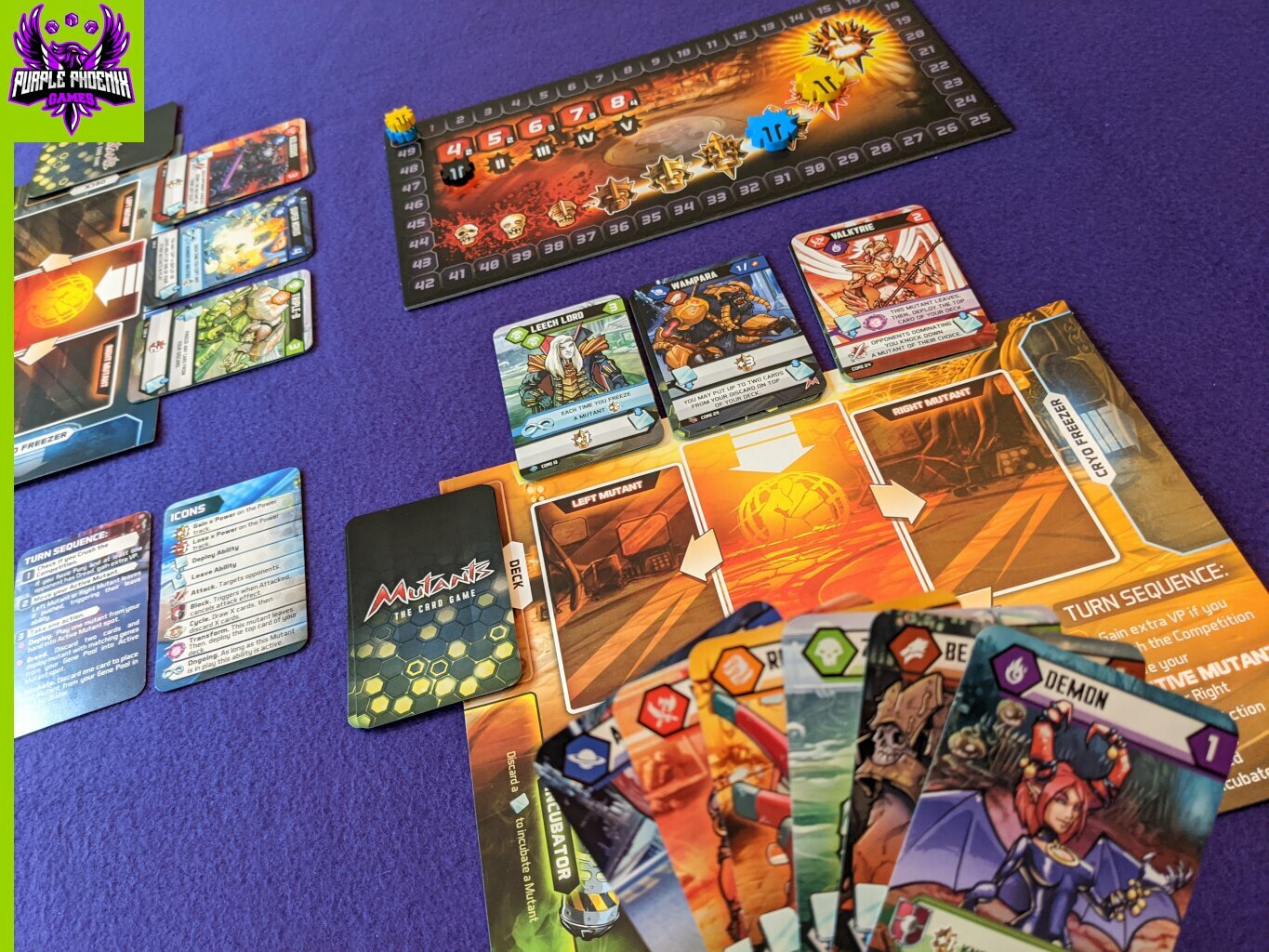
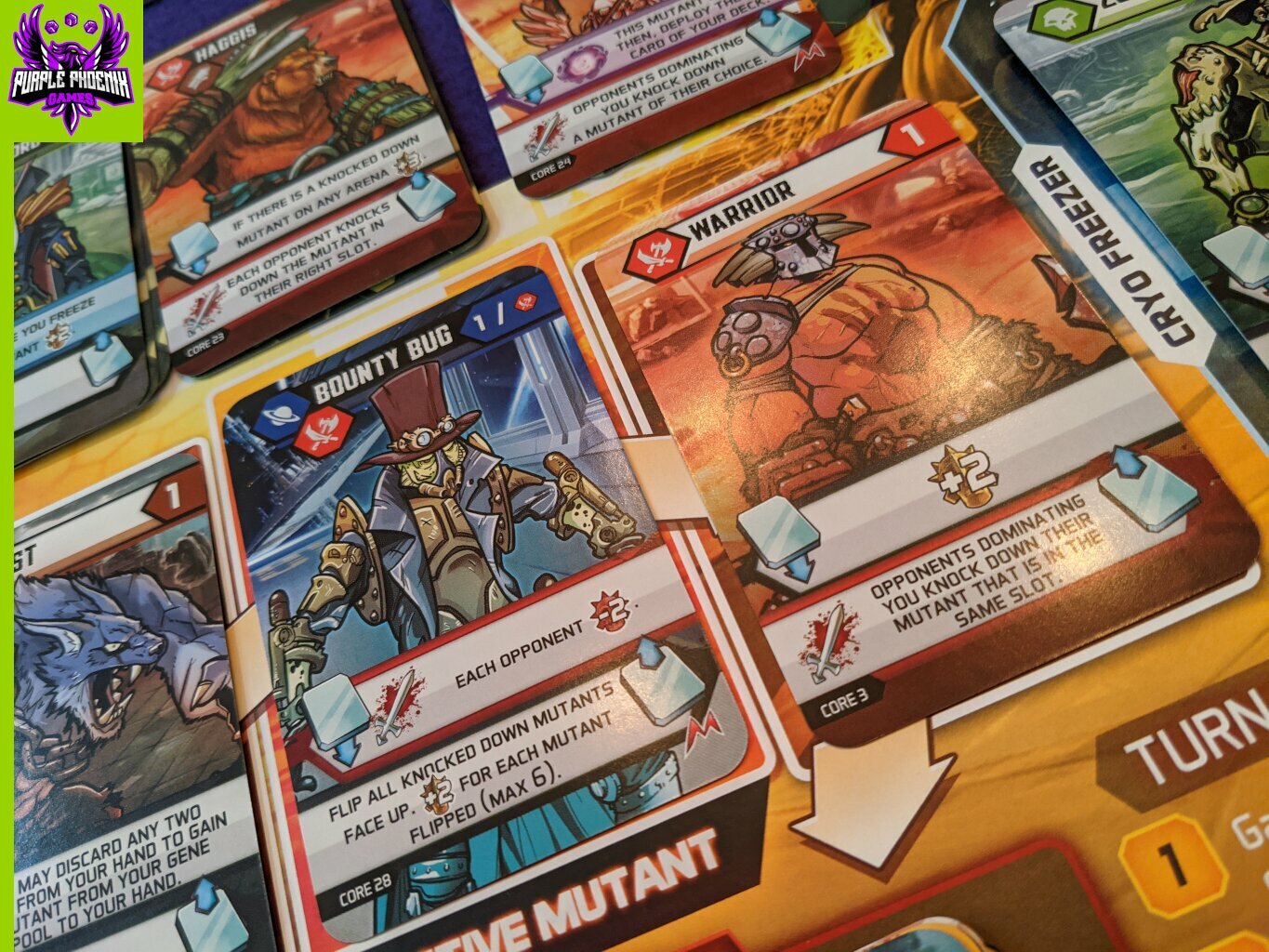
The first turn will not utilize the Move Active Mutant phase, but on subsequent phases, this will need to be resolved. A player’s board consists of three main slots: Left Mutant, Active Mutant, and Right Mutant. Mutants may only enter the Active Mutant slot in the middle, so if a Mutant is currently placed in that slot, it will need to be moved either to the Left or Right slot, at the player’s discretion. Should all slots be filled, one of the Mutants will need to be moved off the board to make room for the new one. Once this happens, the Mutant’s Leave Ability (at the bottom of the Mutant’s card) will activate. This could give the player more Power, some Attacking abilities, or other unique abilities. Once a card leaves their slot and applies their Leave Ability, it is placed in the Discard space at the bottom of the player board.
Now that the Active Mutant slot is available, the current player may choose from one of the Take Action choices: Deploy Mutant, Breed, or Incubate. To Deploy Mutant, simply play a card from hand to the Active Mutant slot, activating the Deploy Ability once placed. These Deploy Abilities could range from cycling (draw a card from the deck and discard a card from the hand), gaining Power, or even reactionary abilities. Breeding Mutants requires the player to discard two cards from hand whose type icons match those of one of the face-up Advanced Mutant cards atop the player board. Discarding these cards allows the Advanced Mutant to enter play on the Active Mutant slot. Finally, the player may instead choose to Incubate an Advanced Mutant from one on offer by discarding one card (and it does NOT need to match icons) and placing the chosen Advanced Mutant on the Incubator slot on the left side of the board. These incubated Advanced Mutants will be placed atop the draw deck at the end of the round, so it will be drawn during the next round.
If at any time a player needs to draw a card from their draw deck and there are no cards remaining, they will first choose a card from their Discards to Freeze, by placing it in the appropriate Cryo Freezer on the right side of the player board. Frozen cards will be scored at game end, and can really boost a final score.
At the end of the round players will perform a few more tasks and setup for the next round. First, the Power Tokens are scored according to which is in first place along the Track and so on, using the red and black VP numbers printed on the main board. The round marker is advanced one level, and each Mutant in Incubation is moved to the players’ draw decks. Players then draw a new hand of six cards, and Power Tokens are reset according to the previous round’s placement, in reverse order. The player whose Power Token is now furthest behind will be the starting player for the next round.
Play continues in this fashion of moving Mutants around, taking actions, and jockeying for supremacy along the Power Track until the end of the fifth round. At that time, the final VPs are awarded for the Power Track placement, and all cards in the Cryo Freezer are tallied. The player with the most VP at the end of the game is the winner of Mutants!
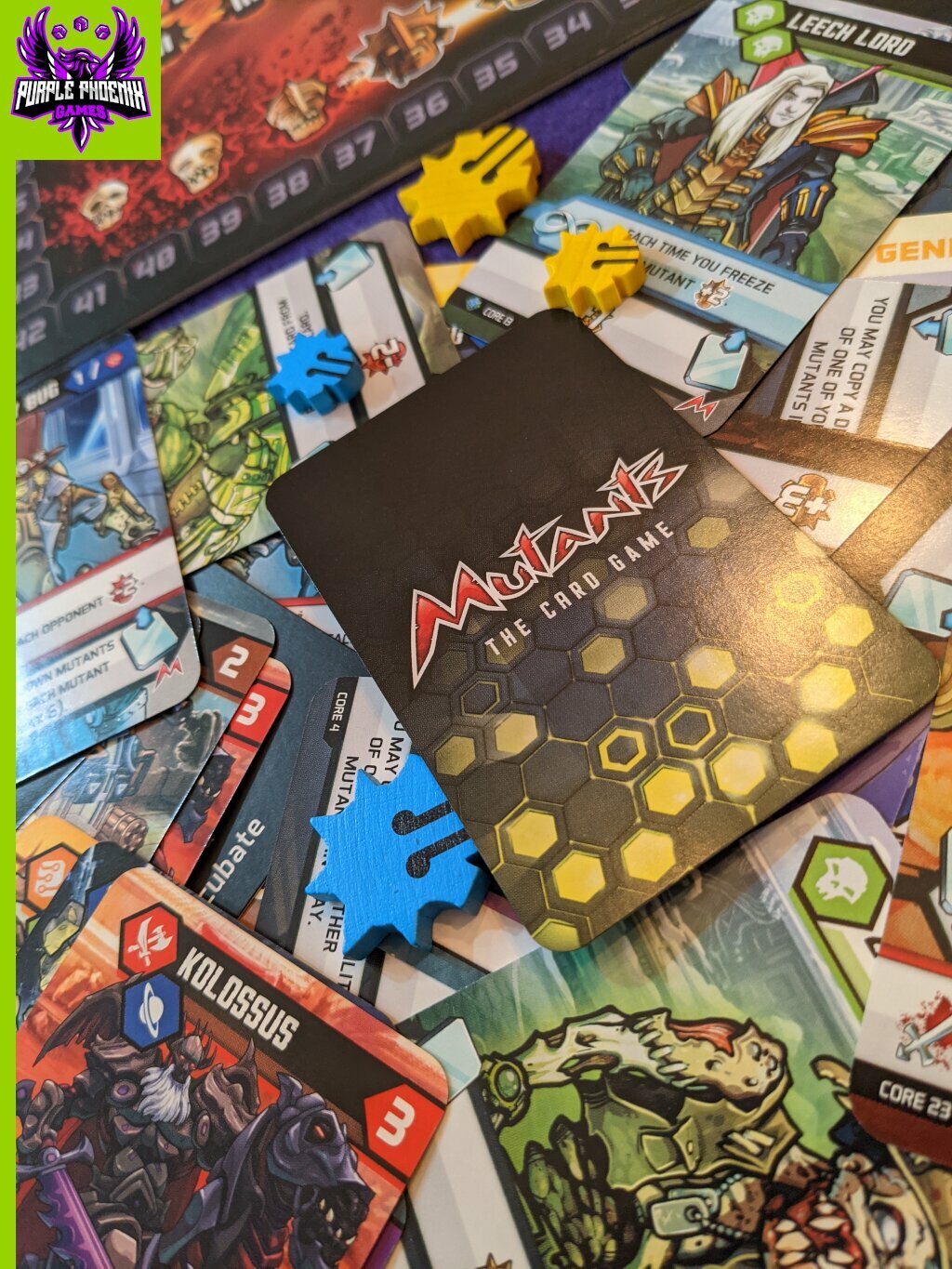
Components. Okay, I have some thoughts here, and more than just, “oh hey, they are nice.” The game comes with a bevvy of cards, some wooden tokens, and a couple “boards.” I used quotations because only the main board is an actual board. The player boards are slick cardstock and, while functional, feel a little cheap. The cards themselves are all super great and the artwork is appropriate and quite excellent. I have a couple issues with some other components, however. The Power and Score Tokens are the only wooden components in the box and I just do not understand them. They look like Sauron/Spartan helmets, or someone who is crying because they just shoved a fork into the power outlet. Now, there are four of each type in different colors, and though the colors aren’t the primary colors we have grown to accept for our player colors, they have swapped out the green for purple, and I think the game is colorful enough to include more exciting colors. So I’m not a fan of the Power and Score Tokens. Similarly, I don’t really understand the insert that comes with the game. I see that it is setup to hold TONS of cards, and maybe there were/are plans for many many expansions, but the base game can be housed in two of the 14 total card slots provided. Also, I have no idea what is going on in the middle of the insert, but I also don’t own any of the expansions yet, so hopefully those molded spots are actually meant to hold something. Everything else, though, is great!
For me, art and components are very high on my list of items that affect how much I enjoy a game. Now, I can live with the wonky Power and Score Tokens, and I suppose I don’t mind carrying around a giant box of cards, when the game could ALMOST fit inside a box the size of Bohnanza or Point Salad or the like. That said, I have definitely enjoyed my plays of Mutants. The rulebook is a little daunting at first, mostly because the theme is unique and the game style is similarly different to me. Once the game gets into the thick of it, though, strategy and tactics take over so strongly. Each card is carefully considered for its usability as either a card to be played or discarded for varying effects. I love that about this game.
This is certainly more than a “deck builder,” even though deck building and hand management are at the forefront of the mechanics here. You aren’t necessarily building your deck and cycling through it quickly enough for me to consider this a true deck builder alone, but using each card for different purposes certainly increases the replayability with Mutants. When is the best time to freeze a card versus keeping it in the deck for its abilities? Do I move off the Left Mutant or keep it around for another turn? Why did I pick these Advanced Mutants during the draft, when I have crappy supporting cards? Every play of Mutants has been a wonderful challenge of maximizing my deck and choosing just the right opponents to attack with my monstrous creations. Purple Phoenix Games gives this one a horrifically delightful 5 / 6. I hate having to bling out my games, but I think I will probably try to find replacements for the Power and Score Tokens (though maybe a little spray paint will help?), and look into grabbing one or all of the expansions so that I may be able to fill up that confusing insert. I look forward to my next games of this, and to getting the word out on this little gem I finally tried.
Mutants is a crazy-themed deck building, hand management, fighting, card game for one to four players. Usually in this instance I would put together a Solo Chronicles review, but I wanted to first get the multiplayer rules down and then delve into solo. In any case, this game pits players against each other in a royal rumble where controlling mutants to fight one another most effectively and efficiently will earn the player riches galore. Come check out the world of Mutants.
To setup, well, there are many steps. The biggest and perhaps most confusing step is creating the decks of mutants that will be used by players throughout the game. I will recommend you follow the rulebook for drafting your team, or simply use one of the provided pre-constructed team suggestions. Otherwise, place the main board on the table, along with the power and scoring tokens for each player. Players choose their player board according to color chosen, take their starting deck, and divide their Advanced Mutant deck into three piles, with the top card flipped face-up. Players draw a hand of six Basic Mutant cards (one of each type initially) and the battle may begin!
Mutants is played over five rounds, tracked on the main board. Each round encompasses three phases: Crush the Competition, Move Active Mutant, and Take Action. As the game progresses, the power tokens for players will be moving up and down the Power Track. If, at the start of the current player’s turn, an opponent’s power token is located in one of the last three Power Track spaces (named the Dread Zone), and the current player’s token is on the Fury Space (furthest along the Track), then the current player will score immediate bonus points by Crushing the Competition.
The first turn will not utilize the Move Active Mutant phase, but on subsequent phases, this will need to be resolved. A player’s board consists of three main slots: Left Mutant, Active Mutant, and Right Mutant. Mutants may only enter the Active Mutant slot in the middle, so if a Mutant is currently placed in that slot, it will need to be moved either to the Left or Right slot, at the player’s discretion. Should all slots be filled, one of the Mutants will need to be moved off the board to make room for the new one. Once this happens, the Mutant’s Leave Ability (at the bottom of the Mutant’s card) will activate. This could give the player more Power, some Attacking abilities, or other unique abilities. Once a card leaves their slot and applies their Leave Ability, it is placed in the Discard space at the bottom of the player board.
Now that the Active Mutant slot is available, the current player may choose from one of the Take Action choices: Deploy Mutant, Breed, or Incubate. To Deploy Mutant, simply play a card from hand to the Active Mutant slot, activating the Deploy Ability once placed. These Deploy Abilities could range from cycling (draw a card from the deck and discard a card from the hand), gaining Power, or even reactionary abilities. Breeding Mutants requires the player to discard two cards from hand whose type icons match those of one of the face-up Advanced Mutant cards atop the player board. Discarding these cards allows the Advanced Mutant to enter play on the Active Mutant slot. Finally, the player may instead choose to Incubate an Advanced Mutant from one on offer by discarding one card (and it does NOT need to match icons) and placing the chosen Advanced Mutant on the Incubator slot on the left side of the board. These incubated Advanced Mutants will be placed atop the draw deck at the end of the round, so it will be drawn during the next round.
If at any time a player needs to draw a card from their draw deck and there are no cards remaining, they will first choose a card from their Discards to Freeze, by placing it in the appropriate Cryo Freezer on the right side of the player board. Frozen cards will be scored at game end, and can really boost a final score.
At the end of the round players will perform a few more tasks and setup for the next round. First, the Power Tokens are scored according to which is in first place along the Track and so on, using the red and black VP numbers printed on the main board. The round marker is advanced one level, and each Mutant in Incubation is moved to the players’ draw decks. Players then draw a new hand of six cards, and Power Tokens are reset according to the previous round’s placement, in reverse order. The player whose Power Token is now furthest behind will be the starting player for the next round.
Play continues in this fashion of moving Mutants around, taking actions, and jockeying for supremacy along the Power Track until the end of the fifth round. At that time, the final VPs are awarded for the Power Track placement, and all cards in the Cryo Freezer are tallied. The player with the most VP at the end of the game is the winner of Mutants!
Components. Okay, I have some thoughts here, and more than just, “oh hey, they are nice.” The game comes with a bevvy of cards, some wooden tokens, and a couple “boards.” I used quotations because only the main board is an actual board. The player boards are slick cardstock and, while functional, feel a little cheap. The cards themselves are all super great and the artwork is appropriate and quite excellent. I have a couple issues with some other components, however. The Power and Score Tokens are the only wooden components in the box and I just do not understand them. They look like Sauron/Spartan helmets, or someone who is crying because they just shoved a fork into the power outlet. Now, there are four of each type in different colors, and though the colors aren’t the primary colors we have grown to accept for our player colors, they have swapped out the green for purple, and I think the game is colorful enough to include more exciting colors. So I’m not a fan of the Power and Score Tokens. Similarly, I don’t really understand the insert that comes with the game. I see that it is setup to hold TONS of cards, and maybe there were/are plans for many many expansions, but the base game can be housed in two of the 14 total card slots provided. Also, I have no idea what is going on in the middle of the insert, but I also don’t own any of the expansions yet, so hopefully those molded spots are actually meant to hold something. Everything else, though, is great!
For me, art and components are very high on my list of items that affect how much I enjoy a game. Now, I can live with the wonky Power and Score Tokens, and I suppose I don’t mind carrying around a giant box of cards, when the game could ALMOST fit inside a box the size of Bohnanza or Point Salad or the like. That said, I have definitely enjoyed my plays of Mutants. The rulebook is a little daunting at first, mostly because the theme is unique and the game style is similarly different to me. Once the game gets into the thick of it, though, strategy and tactics take over so strongly. Each card is carefully considered for its usability as either a card to be played or discarded for varying effects. I love that about this game.
This is certainly more than a “deck builder,” even though deck building and hand management are at the forefront of the mechanics here. You aren’t necessarily building your deck and cycling through it quickly enough for me to consider this a true deck builder alone, but using each card for different purposes certainly increases the replayability with Mutants. When is the best time to freeze a card versus keeping it in the deck for its abilities? Do I move off the Left Mutant or keep it around for another turn? Why did I pick these Advanced Mutants during the draft, when I have crappy supporting cards? Every play of Mutants has been a wonderful challenge of maximizing my deck and choosing just the right opponents to attack with my monstrous creations. Purple Phoenix Games gives this one a horrifically delightful 5 / 6. I hate having to bling out my games, but I think I will probably try to find replacements for the Power and Score Tokens (though maybe a little spray paint will help?), and look into grabbing one or all of the expansions so that I may be able to fill up that confusing insert. I look forward to my next games of this, and to getting the word out on this little gem I finally tried.
Purple Phoenix Games (2266 KP) rated Way Too Many Cats! in Tabletop Games
Jan 24, 2022

Before we had children and pets my wife and I would love to visit the humane societies back home on a Saturday morning. Sometimes looking for ourselves, sometimes just to see the lovelies being kept, and maybe once or twice volunteering to walk the animals. One place I never really enjoyed visiting was the cat room. I am a dog person. Actually, the older I get, the more I am becoming strictly an aquatic animal lover. Give me a 55 gallon saltwater tank and I’ll be happy raising my Firefish Gobies and Coral Beauty Angelfish. However, when I was asked to preview Way Too Many Cats, I just couldn’t say no. One of my favorite publishers calls for help, I will do my best. Just know I wish it were fish themed instead of cats. Cats…
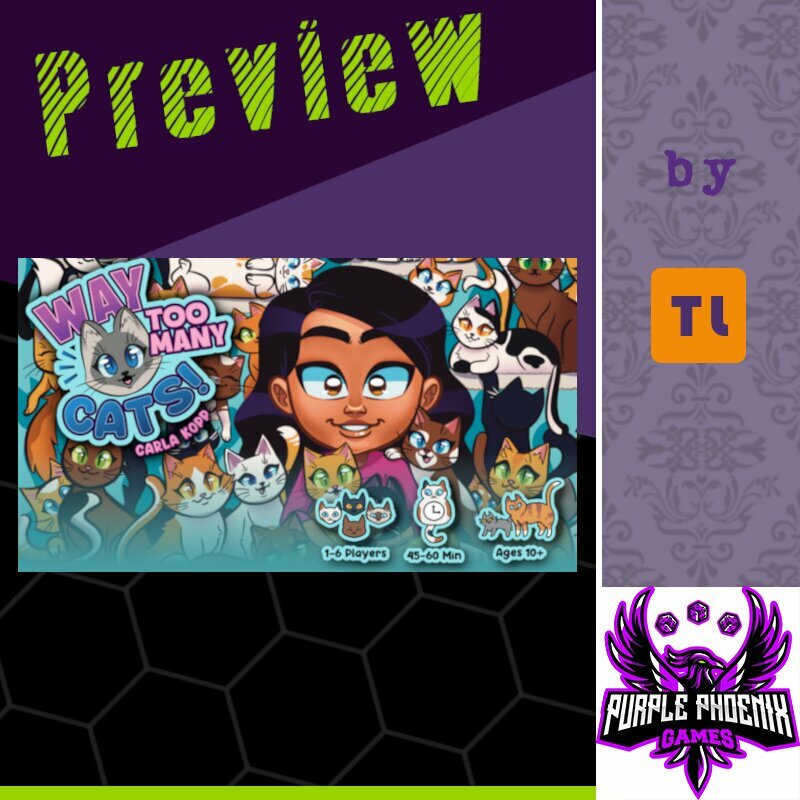
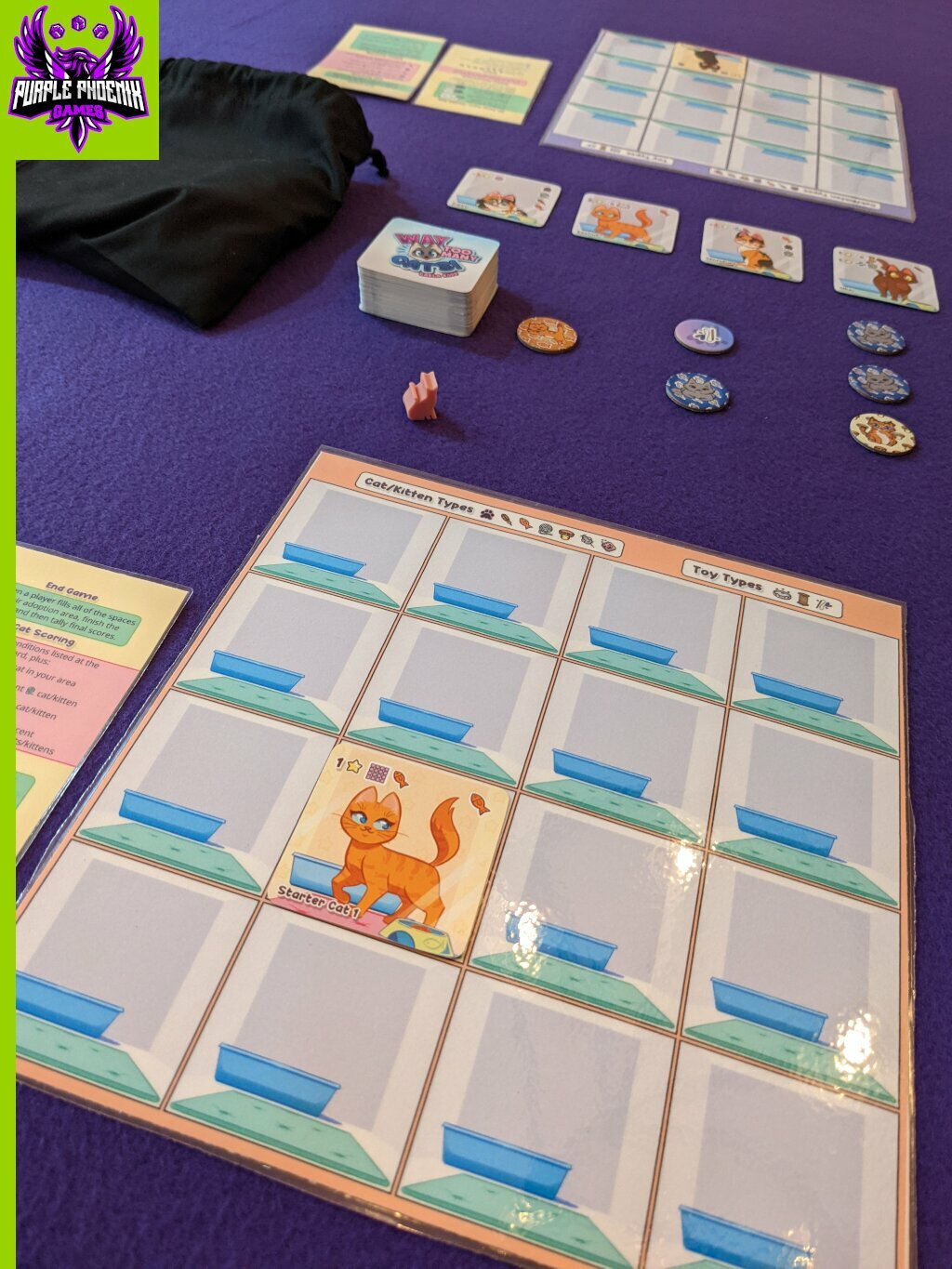
Way Too Many Cats is a cat and kitten drafting and spatial puzzle game for one to six players. In it, players work at feline adoption centers with the goal of having all stock adopted. To do this, players will be placing specific cats adjacent to other favorable cats for points, giving kittens a habitat of their own, and even supplying the cats with toys. The player who completes these tasks most effectively by the end of the game will score the most points and win!
DISCLAIMER: We were provided a prototype copy of this game for the purposes of this review. These are preview copy components, and I do not know for sure if the final components will be any different from these shown. Also, it is not my intention to detail every rule in the game, as there are just too many. You are invited to download the rulebook, back the game through the Kickstarter campaign, or through any retailers stocking it after fulfillment. -T
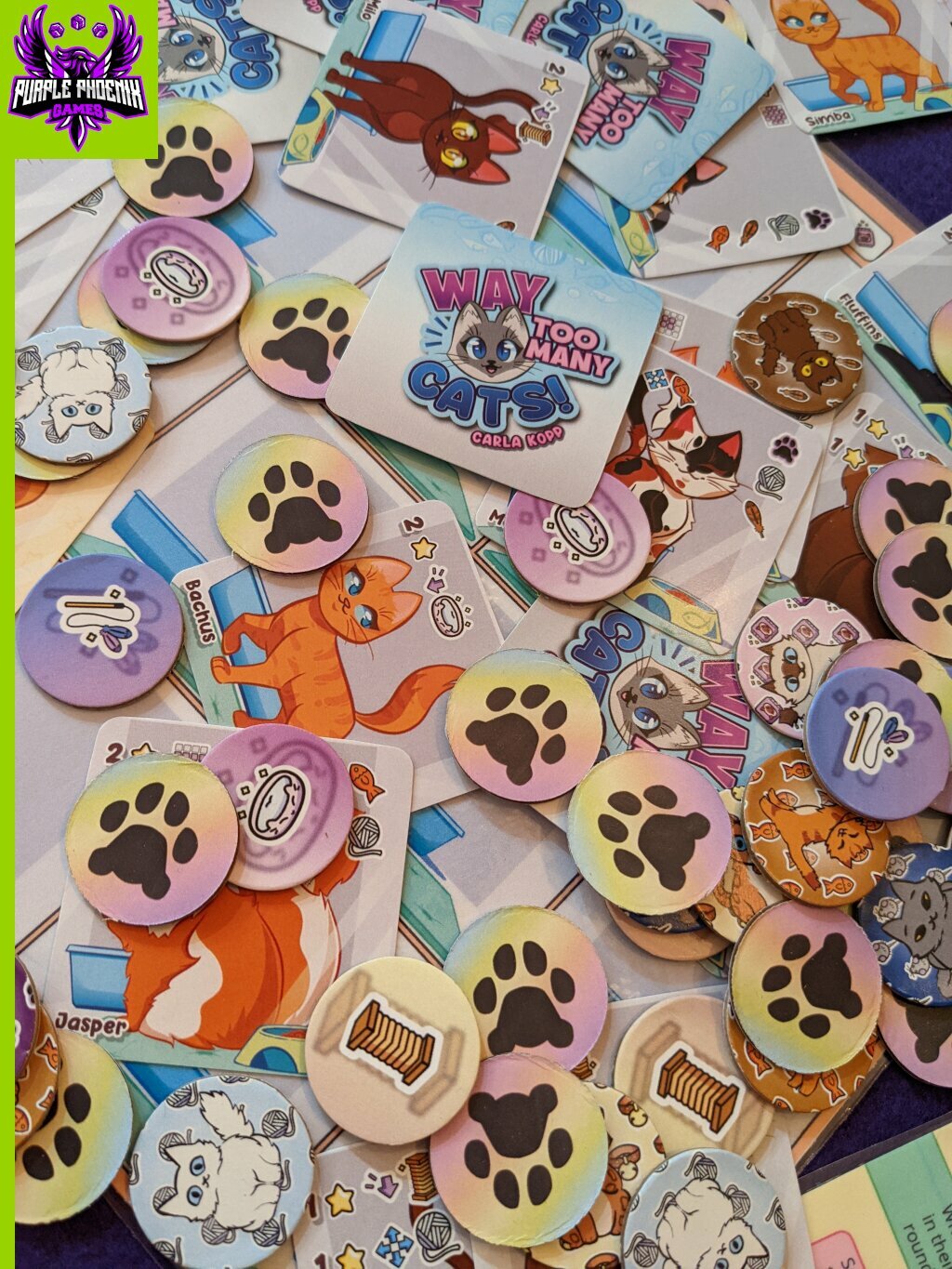
To setup, each player receives an adoption center board, starter cat tile, and a reference card. The kitten and toy tokens are placed into the provided bag to be shuffled and drawn later. The stack of adoptable cats is shuffled, and four drawn and revealed to create Cat Alley (from which players will be drafting). Nearby, three stacks of kitten/toy tokens are made with one stack containing one token, the next stack containing two, and the final stack containing three tokens. The starting player marker is given to the player who most recently pet a cat (aka probably attacked by a cat) and the game may begin!
A game of Way Too Many Cats lasts many rounds, and ends once all players have had the same amount of turns and one player having completely filled their adoption center. On a turn, the active player will take one mandatory action, and then will choose to take another two actions. The mandatory action that all players take each turn is to Choose a Token Set and Cat Card(s) and Place Them. A bit wordy, but this is a prototype, so I will let it slide. In any case, the player will choose to (1) take the smallest group of tokens and two Cat tiles of their choice, (2) take the mid-sized group of tokens and one Cat tile of their choice, or (3) take the largest group of tokens and the right-most Cat tile from Cat Alley (the offer row). Once the choice has been made and all components taken, the player then refreshes Cat Alley by sliding all tiles to the right and refilling to four tiles. Also, the player pulls three tokens from the bag and adds one to each group of tokens on the table. Note, as the player has just chosen a group of tokens, one of the groups will be empty until they place a token there – thus creating the smallest group and embiggening (I’m on a Marvel kick right now) the other two groups.
As an optional second action, the player may choose to give any cat in their adoption center a toy from their personal supply. Cat tiles show icons for toys that the cat will appreciate, though not every cat is into toys. Note, the toy tokens may be given to the cats on any turn, and even at the end of the game just before scoring.
Finally, at the end of the turn, the player may Create a Kitten Habitat by discarding three toy tokens to the bag. The player then designates a space on their adoption center to be the kitty haven and it can house any number of kittens.
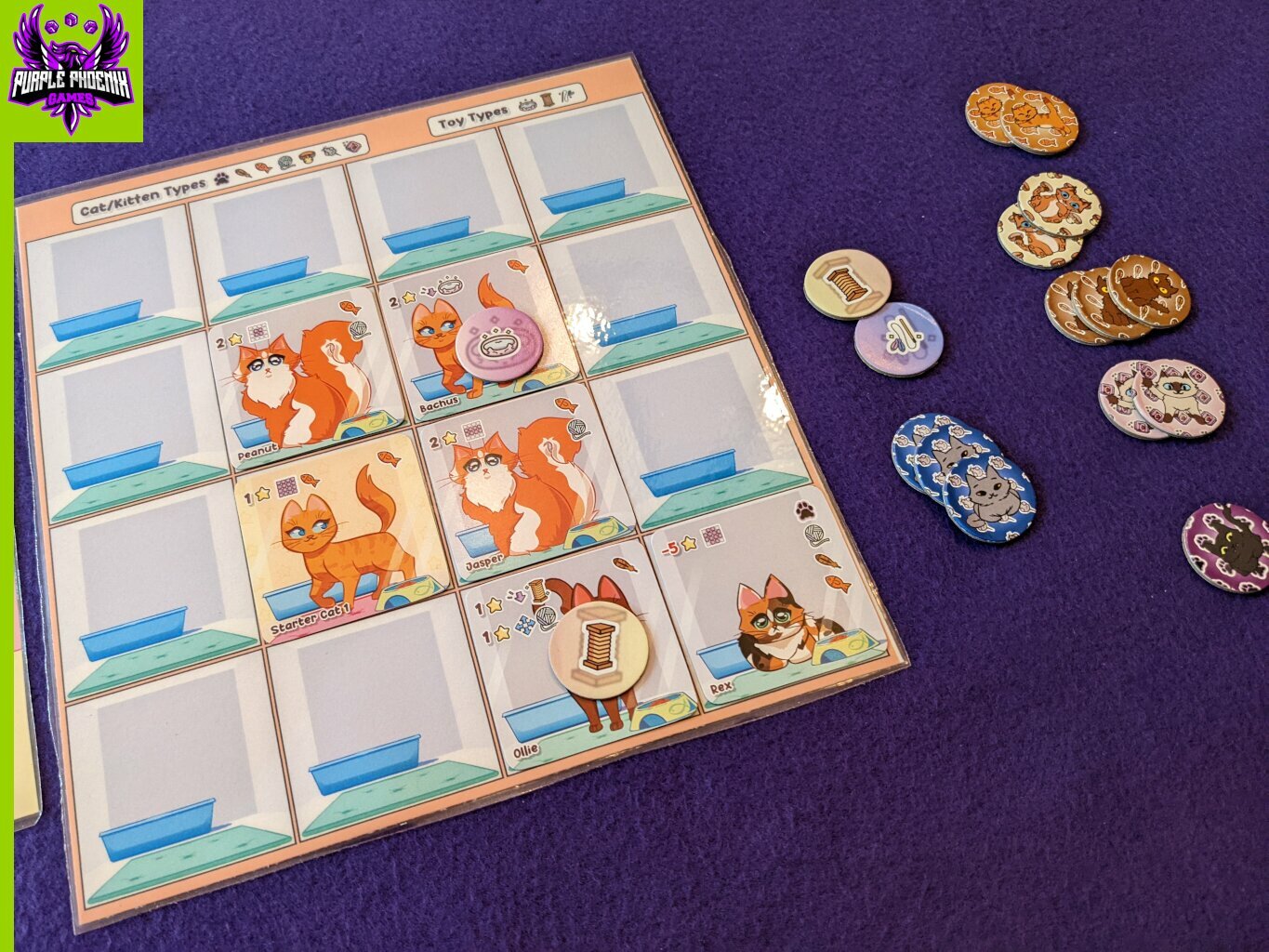
Once a player fills their last adoption center slot, the end game is triggered. Players will finish out the round so that all have an equal amount of turns. Then, points are tallied and scored following an involved scoring process. Points in this game are scored in numerous ways. Firstly, the starter cats are scored, and then each type of cat is scored. For example, the paw icon on cat tiles earn 1 VP for each adjacent cat of a different color. Each ball of yarn icon on cat tiles scores 2 VP. The goldfish cracker icon scores 2 VP for each adjacent cat or kitten sporting a ball of yarn icon. Finally, the feather icon scores 3/7/12/18 VP for each group of adjacent feather cats of train size 2/3/4/5 cats. So placement is very important in this game. Not enough scoring?
Players will score more points for kittens and for specific icons on cat tiles. 15 VP is awarded to a player who holds a complete set of the seven different types of kitten tokens, while another 8 VP is earned for holding a set of four matching kitten types. The player receives a -2VP penalty for each kitten token not associated with either type of set nor in a habitat on the board. Additionally, for each cat tile on the board, special scoring will be earned for supplying the tile with the requested toy, or placing it in the preferred space in the center, or even for other adjacency considerations.
Players will be scoring hundreds of points, and hopefully having their felines adopted by unsuspecting travelers and goo-goo eyed children. The player with the most VP at the end of the game is the winner!
Components. Again, this is a prototype copy of the game, so I know that these are not final components at all. Having had many opportunities to preview for Weird Giraffe Games now, I am confident that the final game will be sparkling with upgrades and cool features. To reiterate, my interest in the theme is on the lower side, as I am not a cat person, but I can definitely understand the theme and it works well with this type of game. I guarantee that you will be able to spot Way Too Many Cats in stores right away because that box art is super colorful and busy. I do enjoy the cartoony art style, and it fits the theme really well. The final version of the game will undoubtedly affect this paragraph in the future, but for now this is well on the way to being a very solid title with regards to components, artwork, and theme.
But do I like it? Surprisingly, yes I do. Quite a bit. Theme goes a really long way with me, but I have been known to enjoy other games with themes that don’t necessarily resonate with me, so perhaps “surprising” isn’t the best term here. I really enjoy the spatial puzzle aspect of the game. I highlighted puzzle because that’s exactly what is going on here. When I am playing, I have to debate whether to take all those kitten tokens to complete my sets and be stuck with the right-most card, or perhaps taking the smallest group is more beneficial so that I can draft the two best cards for what I am building on my board. Is it really worth it to me to grab Taco just because I am starting to realize I have a food themed cat dispensary? Why does this cat need a scratching post token when it’s clearly been de-clawed?? These are serious questions, folks!
I kid, but only because this is a very light game, and one that I think works well in many situations. Have newer to intermediate level players coming over tonight? Grab Way Too Many Cats! Having an animal-themed game night? Pull this one out! Sticking with a mechanic-specific lineup? You got it. Now, I haven’t seen the Kickstarter page yet, nor have I asked Carla (the designer) what the plans are for it, but I know this one is close to many peoples’ hearts, so I imagine it will get all the love that’s possible in making this a wonder in a box. The mechanics are there. The theme is… great for some. Way Too Many Cats is a thinker in a catsuit disguise, but it is not too heavy to turn off casual or intermediate gamers. I can certainly add my stamp of approval and recommend checking out Way Too Many Cats. Look for it to hit Kickstarter in February and click here to be notified on launch. You will probably want to get in on this project early if any of this sounds appealing to you.
PS – How many catfolk did I offend in this preview? How many aquarists have I now befriended? What up, my peeps!
Way Too Many Cats is a cat and kitten drafting and spatial puzzle game for one to six players. In it, players work at feline adoption centers with the goal of having all stock adopted. To do this, players will be placing specific cats adjacent to other favorable cats for points, giving kittens a habitat of their own, and even supplying the cats with toys. The player who completes these tasks most effectively by the end of the game will score the most points and win!
DISCLAIMER: We were provided a prototype copy of this game for the purposes of this review. These are preview copy components, and I do not know for sure if the final components will be any different from these shown. Also, it is not my intention to detail every rule in the game, as there are just too many. You are invited to download the rulebook, back the game through the Kickstarter campaign, or through any retailers stocking it after fulfillment. -T
To setup, each player receives an adoption center board, starter cat tile, and a reference card. The kitten and toy tokens are placed into the provided bag to be shuffled and drawn later. The stack of adoptable cats is shuffled, and four drawn and revealed to create Cat Alley (from which players will be drafting). Nearby, three stacks of kitten/toy tokens are made with one stack containing one token, the next stack containing two, and the final stack containing three tokens. The starting player marker is given to the player who most recently pet a cat (aka probably attacked by a cat) and the game may begin!
A game of Way Too Many Cats lasts many rounds, and ends once all players have had the same amount of turns and one player having completely filled their adoption center. On a turn, the active player will take one mandatory action, and then will choose to take another two actions. The mandatory action that all players take each turn is to Choose a Token Set and Cat Card(s) and Place Them. A bit wordy, but this is a prototype, so I will let it slide. In any case, the player will choose to (1) take the smallest group of tokens and two Cat tiles of their choice, (2) take the mid-sized group of tokens and one Cat tile of their choice, or (3) take the largest group of tokens and the right-most Cat tile from Cat Alley (the offer row). Once the choice has been made and all components taken, the player then refreshes Cat Alley by sliding all tiles to the right and refilling to four tiles. Also, the player pulls three tokens from the bag and adds one to each group of tokens on the table. Note, as the player has just chosen a group of tokens, one of the groups will be empty until they place a token there – thus creating the smallest group and embiggening (I’m on a Marvel kick right now) the other two groups.
As an optional second action, the player may choose to give any cat in their adoption center a toy from their personal supply. Cat tiles show icons for toys that the cat will appreciate, though not every cat is into toys. Note, the toy tokens may be given to the cats on any turn, and even at the end of the game just before scoring.
Finally, at the end of the turn, the player may Create a Kitten Habitat by discarding three toy tokens to the bag. The player then designates a space on their adoption center to be the kitty haven and it can house any number of kittens.
Once a player fills their last adoption center slot, the end game is triggered. Players will finish out the round so that all have an equal amount of turns. Then, points are tallied and scored following an involved scoring process. Points in this game are scored in numerous ways. Firstly, the starter cats are scored, and then each type of cat is scored. For example, the paw icon on cat tiles earn 1 VP for each adjacent cat of a different color. Each ball of yarn icon on cat tiles scores 2 VP. The goldfish cracker icon scores 2 VP for each adjacent cat or kitten sporting a ball of yarn icon. Finally, the feather icon scores 3/7/12/18 VP for each group of adjacent feather cats of train size 2/3/4/5 cats. So placement is very important in this game. Not enough scoring?
Players will score more points for kittens and for specific icons on cat tiles. 15 VP is awarded to a player who holds a complete set of the seven different types of kitten tokens, while another 8 VP is earned for holding a set of four matching kitten types. The player receives a -2VP penalty for each kitten token not associated with either type of set nor in a habitat on the board. Additionally, for each cat tile on the board, special scoring will be earned for supplying the tile with the requested toy, or placing it in the preferred space in the center, or even for other adjacency considerations.
Players will be scoring hundreds of points, and hopefully having their felines adopted by unsuspecting travelers and goo-goo eyed children. The player with the most VP at the end of the game is the winner!
Components. Again, this is a prototype copy of the game, so I know that these are not final components at all. Having had many opportunities to preview for Weird Giraffe Games now, I am confident that the final game will be sparkling with upgrades and cool features. To reiterate, my interest in the theme is on the lower side, as I am not a cat person, but I can definitely understand the theme and it works well with this type of game. I guarantee that you will be able to spot Way Too Many Cats in stores right away because that box art is super colorful and busy. I do enjoy the cartoony art style, and it fits the theme really well. The final version of the game will undoubtedly affect this paragraph in the future, but for now this is well on the way to being a very solid title with regards to components, artwork, and theme.
But do I like it? Surprisingly, yes I do. Quite a bit. Theme goes a really long way with me, but I have been known to enjoy other games with themes that don’t necessarily resonate with me, so perhaps “surprising” isn’t the best term here. I really enjoy the spatial puzzle aspect of the game. I highlighted puzzle because that’s exactly what is going on here. When I am playing, I have to debate whether to take all those kitten tokens to complete my sets and be stuck with the right-most card, or perhaps taking the smallest group is more beneficial so that I can draft the two best cards for what I am building on my board. Is it really worth it to me to grab Taco just because I am starting to realize I have a food themed cat dispensary? Why does this cat need a scratching post token when it’s clearly been de-clawed?? These are serious questions, folks!
I kid, but only because this is a very light game, and one that I think works well in many situations. Have newer to intermediate level players coming over tonight? Grab Way Too Many Cats! Having an animal-themed game night? Pull this one out! Sticking with a mechanic-specific lineup? You got it. Now, I haven’t seen the Kickstarter page yet, nor have I asked Carla (the designer) what the plans are for it, but I know this one is close to many peoples’ hearts, so I imagine it will get all the love that’s possible in making this a wonder in a box. The mechanics are there. The theme is… great for some. Way Too Many Cats is a thinker in a catsuit disguise, but it is not too heavy to turn off casual or intermediate gamers. I can certainly add my stamp of approval and recommend checking out Way Too Many Cats. Look for it to hit Kickstarter in February and click here to be notified on launch. You will probably want to get in on this project early if any of this sounds appealing to you.
PS – How many catfolk did I offend in this preview? How many aquarists have I now befriended? What up, my peeps!