Search
Search results
Great writing (1 more)
Unpredictable
Some typos (1 more)
The mom was a waste of a character
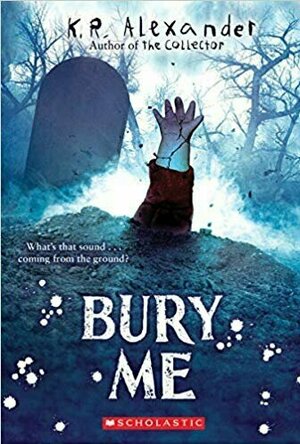
In horror books and movies, we often see dolls as the main source of scares( such as Annabelle or Child's Play). In K.R. Alexander's Bury Me we get another scary doll to add to the list with some pretty good spine chilling moments, too.
We start with Kimberly Rice, who is a kid with a vivid imagination that can imagine up anything her heart desires, but because of this, people don't believe her when strange things begin to happen in Copper Hollow. She has two friends named Alicia and James- - -but Kimberly feels like she doesn't fit in with them because they live in houses while she lives in a trailer. "I wait for them to say, Hey, Kimberly, do you want to come over for dinner? They don't. They never have. It hurt my feelings at first, but I got over it fast. They're still my best and only friends, so I can't really complain when they don't have me over to their houses. It's not like I can really invite them over to mine. " Kimberly explains.
Although she states that they are her best friends, there is another part that may suggest otherwise. At first, we read about Kimberly being ashamed of her home although she states she has never tried to invite her friends over - - - as far as we know - - - but during a scene where Kimberly goes over to Alicia's home for help with this doll, Alicia doesn't invite her inside, which Kimberly points out.
But Kimberly's dysfunctional friendships aren't what the story is about. The book is about a doll that suddenly shows up with the words 'bury me' written across its dress in black ink. The perfect setting for a horror story. Kimberly teams up with her friends, Alicia and James, to figure out what this doll wants.
Alicia convinces Kimberly to do what the doll's dress says: 'bury me.' But even after they do this, the doll somehow shows up again, without having disturbed its burial place. They finally begin to question whether or not the doll is possessed by an evil spirit because the doll's mouth moves on its own, making frowns and even seeming to silently scream at one point, and no matter what they do, the doll always comes back completely intact. Yet, the only one the doll seems to be 'haunting' is Kimberly, although James and Alicia participate in trying to get rid of it. Kimberly is also haunted by dreams that aren't exactly her own, but she doesn't reveal these to her friends- - - which doing so may have helped in the long run. As a result, the friends never really figure out how to get rid of the doll, it seems that only Kimberly's dreams can figure this out (it just takes her nearly the entire book to figure it out).
The horror elements in this story are pretty good, but as the book recommended age states, it's for pre-teens. Yet, Alexander did a better job on this than 'The Collector' when it came to those elements. I honestly really enjoyed this book, even as an adult.
We continue with Alicia and James beginning to question Kimberly, thinking that this is just a prank she has come up with because their town is boring: " 'Did you do this?' Alicia asks, looking straight at me. Once more, my heart throbs- - -but this time, with a note of anger.
'Why would I do something like this?' I ask.
'Because Copper Hollow is boring and you're trying to make it fun with another one of your wild stories?' She doesn't sound accusatory; she sounds like she's running out of options that make sense, and she doesn't like that at all. "
Kimberly also has to deal with a history book on Copper Hollow that only shows blank pages to her, even when she shows it to adults, they seem to go into a daze as if the book doesn't even exist to them. Even when she asks the Mayor about this very book, he has no idea what she's speaking of. " I try to change the subject. 'I finished that book. The one about our history.'
'Book? ' Mayor Couch asks. 'What book?'
'The one I showed you.'
He chuckles. 'You and your imagination. I don't remember you showing me a book. ' "
Readers and Kimberly still have no idea what is going half way through the book. "Something weird is going on with him. It makes me wonder. . . is it linked to the doll? Or maybe he just has some sort of memory loss? "
While Kimberly is going through all of this, her mother seems like a wasted character to introduce. She, who is rarely home and works double shifts throughout the entire book, is never there for Kimberly, but also,Kimberly never goes to her mother for help.
The story starts quickly, getting right into the doll appearing, and by the end, we learn something that was not predictable - - -this is good writing. Bury Me is what YA horror books should be: suspense, unpredictable moments and likable characters. And compared to Alexander's first book, The Collector, his story telling is getting better to the point that I am looking forward to reading his other recent books, but hopefully he sticks to telling stories with children and not adults.
I highly recommend this book to fans of R.L. Stine's 'Goosebumps,' because I truly believe we have our next R.L. Stine. Great story, great writing.

We start with Kimberly Rice, who is a kid with a vivid imagination that can imagine up anything her heart desires, but because of this, people don't believe her when strange things begin to happen in Copper Hollow. She has two friends named Alicia and James- - -but Kimberly feels like she doesn't fit in with them because they live in houses while she lives in a trailer. "I wait for them to say, Hey, Kimberly, do you want to come over for dinner? They don't. They never have. It hurt my feelings at first, but I got over it fast. They're still my best and only friends, so I can't really complain when they don't have me over to their houses. It's not like I can really invite them over to mine. " Kimberly explains.
Although she states that they are her best friends, there is another part that may suggest otherwise. At first, we read about Kimberly being ashamed of her home although she states she has never tried to invite her friends over - - - as far as we know - - - but during a scene where Kimberly goes over to Alicia's home for help with this doll, Alicia doesn't invite her inside, which Kimberly points out.
But Kimberly's dysfunctional friendships aren't what the story is about. The book is about a doll that suddenly shows up with the words 'bury me' written across its dress in black ink. The perfect setting for a horror story. Kimberly teams up with her friends, Alicia and James, to figure out what this doll wants.
Alicia convinces Kimberly to do what the doll's dress says: 'bury me.' But even after they do this, the doll somehow shows up again, without having disturbed its burial place. They finally begin to question whether or not the doll is possessed by an evil spirit because the doll's mouth moves on its own, making frowns and even seeming to silently scream at one point, and no matter what they do, the doll always comes back completely intact. Yet, the only one the doll seems to be 'haunting' is Kimberly, although James and Alicia participate in trying to get rid of it. Kimberly is also haunted by dreams that aren't exactly her own, but she doesn't reveal these to her friends- - - which doing so may have helped in the long run. As a result, the friends never really figure out how to get rid of the doll, it seems that only Kimberly's dreams can figure this out (it just takes her nearly the entire book to figure it out).
The horror elements in this story are pretty good, but as the book recommended age states, it's for pre-teens. Yet, Alexander did a better job on this than 'The Collector' when it came to those elements. I honestly really enjoyed this book, even as an adult.
We continue with Alicia and James beginning to question Kimberly, thinking that this is just a prank she has come up with because their town is boring: " 'Did you do this?' Alicia asks, looking straight at me. Once more, my heart throbs- - -but this time, with a note of anger.
'Why would I do something like this?' I ask.
'Because Copper Hollow is boring and you're trying to make it fun with another one of your wild stories?' She doesn't sound accusatory; she sounds like she's running out of options that make sense, and she doesn't like that at all. "
Kimberly also has to deal with a history book on Copper Hollow that only shows blank pages to her, even when she shows it to adults, they seem to go into a daze as if the book doesn't even exist to them. Even when she asks the Mayor about this very book, he has no idea what she's speaking of. " I try to change the subject. 'I finished that book. The one about our history.'
'Book? ' Mayor Couch asks. 'What book?'
'The one I showed you.'
He chuckles. 'You and your imagination. I don't remember you showing me a book. ' "
Readers and Kimberly still have no idea what is going half way through the book. "Something weird is going on with him. It makes me wonder. . . is it linked to the doll? Or maybe he just has some sort of memory loss? "
While Kimberly is going through all of this, her mother seems like a wasted character to introduce. She, who is rarely home and works double shifts throughout the entire book, is never there for Kimberly, but also,Kimberly never goes to her mother for help.
The story starts quickly, getting right into the doll appearing, and by the end, we learn something that was not predictable - - -this is good writing. Bury Me is what YA horror books should be: suspense, unpredictable moments and likable characters. And compared to Alexander's first book, The Collector, his story telling is getting better to the point that I am looking forward to reading his other recent books, but hopefully he sticks to telling stories with children and not adults.
I highly recommend this book to fans of R.L. Stine's 'Goosebumps,' because I truly believe we have our next R.L. Stine. Great story, great writing.
Gareth von Kallenbach (980 KP) rated The Hobbit: An Unexpected Journey (2012) in Movies
Aug 7, 2019
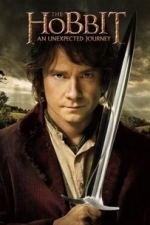
Following the Lord of the Rings Trilogy was going to be no easy feat. The series not only made incredible amounts of cash at the box office worldwide, but also garnered an Academy award for best picture for the final film in the series. In the years since the trilogy, writer-director-producer Peter Jackson has not overwhelmed at the box office. His big-budget remake of “King Kong” performed below expectations and the high-profile collapse of the “Halo” movie to which he was attached, as well as the underwhelming box office of “The Lovely Bones” made many people question if Jackson had peaked and was better suited for the lower budgeted independent films that first gave him his start.
When it was announced that a film version of “The Hobbit” was in the works and that director Guillermo del Toro would direct the film as well as help write the screenplay and that Jackson would produce, the fans’ interest level was definitely piqued. But after a long state of pre-production, del Torro decided not to direct the film as he was unwilling to commit the next six years to living and working in New Zealand. Jackson then took over the film and soon after it was announced that it would be stretched into three movies to form a new trilogy.
For those unfamiliar with the story it was actually the first book written by J.R.R. Tolkien, which sets the stage for what was to follow in the Lord of the Rings even though it was originally conceived as a standalone story. The film opens with an older Bilbo Baggins (Martin Freeman), writing a memoir while preparations for a party are underway. Bilbo discusses how there was one story that he had not disclosed and sets pen to paper in order to chronicle his legendary journey 60 years prior.
Gandolf Wizard (Sir Ian McKellen) visits the younger Bilbo and suggests he go on an adventure. Bilbo immediately declines, as being a Hobbit, he has no desire to leave the creature comforts and serenity of The Shire, much less face the dangers that exist in the world beyond. A group of dwarves arrive’ that evening and despite their gluttonous appetites and loud behavior, Bilbo has a change of heart the following morning and accompanies them on their quest.
The group’s goal is to travel to the dwarves’ kingdom of Erebor to reclaim their stronghold which was lost many years earlier to a vicious Dragon named Smaug. In the decades since, the dwarves existed as people without a home, forced to live as nomads taking work wherever they can find it. Along the way the group deals with all manner of threats and dangers ranging from trolls, goblins, orcs, and other supernatural elements. Of course there were some internal tensions and conflicts within the group as it marched towards a finale that sets the stage for the next film.
The movie has a runtime of nearly 3 hours and there were times that I caught a couple members in press row dozing briefly. While I enjoyed the film more than I did any of the Lord of the Rings movies, it was clearly obvious that things were being stretched out in order to justify a third film in the series. There were countless scenes of the band walking over hills and across the countryside so much so that at times I felt that I was watching the longest commercial for New Zealand tourism ever created. We get it. It’s a long journey. They travel near and far. I got it. I don’t need to see it every 10 minutes.
There were also several scenes that were done almost as if in aside that truthfully did not add much to the story but seem to exist as nothing more than time fillers. In the subsequent films it is learned that characters and scenes that did not appear in the book will be inserted into the film. Once again I have to question this as I do believe they could have easily cut an hour out of this movie and not lose much of the necessary narrative.
There’s been a lot of talk about the higher frame rate 3-D that was used to create the film. There have been claims that it was distracting, jerky, and detracted from the movie. I on the other hand found it absolutely captivating because it did not have that movie look to it, and it felt like I was watching an HD television. Even during the CGI heavy sequences, it did appear as if the performers were literally right there in front of me and I got the impression more of watching a play than of watching a movie.
The visual effects in the film were quite stunning. The live-action and computer-generated elements were absolutely amazing, especially during the latter part of the film when we meet Gollum (Andy Serkis), and during the battle and the goblin stronghold. Although the book is considered a children’s novel, I would really have to think twice about bringing young children to see this film as there is a lot of action and violence in the film as well as potential scares in the form of the monsters that abound.
The film could have definitely used some star power to it. While the cast does a solid job, they are fairly generic and almost interchangeable during certain segments of the film. That being said, the film works because despite its issues, it’s a visually spectacular masterpiece that, if you can endure the long periods of inaction, pays off especially well during the film’s battle sequences.
When it was announced that a film version of “The Hobbit” was in the works and that director Guillermo del Toro would direct the film as well as help write the screenplay and that Jackson would produce, the fans’ interest level was definitely piqued. But after a long state of pre-production, del Torro decided not to direct the film as he was unwilling to commit the next six years to living and working in New Zealand. Jackson then took over the film and soon after it was announced that it would be stretched into three movies to form a new trilogy.
For those unfamiliar with the story it was actually the first book written by J.R.R. Tolkien, which sets the stage for what was to follow in the Lord of the Rings even though it was originally conceived as a standalone story. The film opens with an older Bilbo Baggins (Martin Freeman), writing a memoir while preparations for a party are underway. Bilbo discusses how there was one story that he had not disclosed and sets pen to paper in order to chronicle his legendary journey 60 years prior.
Gandolf Wizard (Sir Ian McKellen) visits the younger Bilbo and suggests he go on an adventure. Bilbo immediately declines, as being a Hobbit, he has no desire to leave the creature comforts and serenity of The Shire, much less face the dangers that exist in the world beyond. A group of dwarves arrive’ that evening and despite their gluttonous appetites and loud behavior, Bilbo has a change of heart the following morning and accompanies them on their quest.
The group’s goal is to travel to the dwarves’ kingdom of Erebor to reclaim their stronghold which was lost many years earlier to a vicious Dragon named Smaug. In the decades since, the dwarves existed as people without a home, forced to live as nomads taking work wherever they can find it. Along the way the group deals with all manner of threats and dangers ranging from trolls, goblins, orcs, and other supernatural elements. Of course there were some internal tensions and conflicts within the group as it marched towards a finale that sets the stage for the next film.
The movie has a runtime of nearly 3 hours and there were times that I caught a couple members in press row dozing briefly. While I enjoyed the film more than I did any of the Lord of the Rings movies, it was clearly obvious that things were being stretched out in order to justify a third film in the series. There were countless scenes of the band walking over hills and across the countryside so much so that at times I felt that I was watching the longest commercial for New Zealand tourism ever created. We get it. It’s a long journey. They travel near and far. I got it. I don’t need to see it every 10 minutes.
There were also several scenes that were done almost as if in aside that truthfully did not add much to the story but seem to exist as nothing more than time fillers. In the subsequent films it is learned that characters and scenes that did not appear in the book will be inserted into the film. Once again I have to question this as I do believe they could have easily cut an hour out of this movie and not lose much of the necessary narrative.
There’s been a lot of talk about the higher frame rate 3-D that was used to create the film. There have been claims that it was distracting, jerky, and detracted from the movie. I on the other hand found it absolutely captivating because it did not have that movie look to it, and it felt like I was watching an HD television. Even during the CGI heavy sequences, it did appear as if the performers were literally right there in front of me and I got the impression more of watching a play than of watching a movie.
The visual effects in the film were quite stunning. The live-action and computer-generated elements were absolutely amazing, especially during the latter part of the film when we meet Gollum (Andy Serkis), and during the battle and the goblin stronghold. Although the book is considered a children’s novel, I would really have to think twice about bringing young children to see this film as there is a lot of action and violence in the film as well as potential scares in the form of the monsters that abound.
The film could have definitely used some star power to it. While the cast does a solid job, they are fairly generic and almost interchangeable during certain segments of the film. That being said, the film works because despite its issues, it’s a visually spectacular masterpiece that, if you can endure the long periods of inaction, pays off especially well during the film’s battle sequences.
Bob Mann (459 KP) rated The Roads Not Taken (2020) in Movies
Sep 15, 2020
Javier Bardem and Elle Fanning act their socks off (1 more)
Robbie Ryan cinematography is Oscar worthy
Pain and not a lot of Glory.
If you like your movies action packed you are going to dislike this movie. If you like light and uplifting stories you are going to positively loathe this one! For everyone else, "The Roads Not Taken" is a very thought-provoking piece of film-making from writer/director Sally Potter that I have a lot of respect for. Even more so, since I learned that the film is based on the director's time caring for her now deceased brother Nic, diagnosed with early onset dementia in 2010.
It's not a promising premise. "The Roads Not Taken" concerns a New Yorker with dementia being taking to the dentist and the opticians. Gripped yet? Nope... didn't think so. But stay with me here.
Elle Fanning plays Molly, daughter of the almost catatonic Leo (Javier Bardem) who is receiving a lot of support to stay in his own home. As his daughter assists him on his trip to his medical appointments, he is only about 10% 'there'. Glassy-eyed and almost incomprehensible, his utterances are often taken to refer to his present experiences. But actually, he's 90% somewhere else, revisiting two key episodes in his past life and reacting in the real world to what's happening in his dreams.
As he relives 'the roads not taken' we can piece together the elements of a life that's lived and - perhaps - lay out some elements that might have contributed to his mental decline in later life.
Before we plunge into the doom and gloom of the story, there was one moment of levity for me in the opening titles. I commented in my review of "The Farewell" that the company 'dog-tags' at the start of the film reminded me of a famous Family Guy comic moment. But this is kindergarten level compared to this movie. I assume Sally Potter must have tapped her complete phone contacts list to raise the funding for this one! Since I counted FOURTEEN different production companies referenced! Is this a record?
As you enter later life, it's common for many of us to suffer a significant source of stress. Sometimes - if you're lucky - four sources of stress. The reason? You stop worrying about your kids as much and start worrying about your aged parents and in-laws. Like heating up a frog in water, it's often imperceptible how much stress you are actually carrying with that until the last of the relatives 'shuffles off this mortal coil'. Within the grief, there's also a source of guilty relief in there somewhere. Such is the maelstrom that young Molly is in - with knobs on - given the disability of Leo. As a professional in her 20's, she is also having the juggle this responsibility with progressing her career.
It's a bit early in this turbulent year to talk of Oscar nominations. But for me, there are three standout performances in this movie:
1) Javier Bardem: what an acting masterclass! As with Daniel Day-Lewis's win in 1990 for "My Left Foot", the Academy loves a disability-based performance. I haven't seen much Oscar-buzz about this performance, but I'd personally throw his hat into the ring, for at least my long-list;
2) Elle Fanning: this young lady has been in movies since the age of 2, but rose to stardom with "Super 8". She's building a formidable filmography behind her. Here she matches Bardem shot-for-shot in the acting stakes: a caring daughter being emotionally torn apart; always needing to be in two places at the same time (as nicely positioned by the cryptic ending). A first Oscar-nomination perhaps?
3) Robbie Ryan: with an Oscar-nom previously for "The Favourite", could another one follow for this? For this is a beautiful film to look at, despite its downbeat story. There are some drop-dead gorgeous shots. One in particular is where a sun-lit Fanning has a "Marilyn Monroe subway skirt moment" at a window (with her hair being blown, I should add). Glorious. And all of the Mexican/Greek scenes (all Spain I believe) are deliciously lit and coloured.
"The Roads Not Taken" is an intelligent watch for sure, and reminiscent to me of Almodovar's "Pain and Glory": another artist's life lived again in flashback. If anything, this one is more unstructured in setting out a box of jigsaw pieces that you need to piece together through the unreliable narrator's random memories. ("Ooh, look - here's a bit with Laura Linney on it... ah, that goes there"; "So that's who Selma Hayek is"; etc.) But, as with a jigsaw, staying the course and putting the last pieces in is a very satisfying experience.
There's also a really feelgood scene in a taxi rank that restores your faith in the underlying goodness of people.... and a rant by a "Trump-voter" that gives you quite the opposite view!
Where I found some frustration was in the lack of backstory for Molly. She seems to be painted rather two-dimensionally. Yes - young with job, but of her personal life we see nothing. Adding another dimension (a young family for example) would have added yet another set of stresses to the mix. Leo's flashbacks are also focused on just two time periods. More wide-ranging reminiscences might have broadened the drama.
But I personally found "The Roads Not Taken" intensely moving. I'm not sure I could say I "enjoyed" it, but it is a worthy watch and has left me with thought-provoking images to chew on.
(For the full graphical review, please check out the One Mann's Movies here https://bob-the-movie-man.com/2020/09/15/the-roads-not-taken-2020-pain-and-very-little-glory/.)
It's not a promising premise. "The Roads Not Taken" concerns a New Yorker with dementia being taking to the dentist and the opticians. Gripped yet? Nope... didn't think so. But stay with me here.
Elle Fanning plays Molly, daughter of the almost catatonic Leo (Javier Bardem) who is receiving a lot of support to stay in his own home. As his daughter assists him on his trip to his medical appointments, he is only about 10% 'there'. Glassy-eyed and almost incomprehensible, his utterances are often taken to refer to his present experiences. But actually, he's 90% somewhere else, revisiting two key episodes in his past life and reacting in the real world to what's happening in his dreams.
As he relives 'the roads not taken' we can piece together the elements of a life that's lived and - perhaps - lay out some elements that might have contributed to his mental decline in later life.
Before we plunge into the doom and gloom of the story, there was one moment of levity for me in the opening titles. I commented in my review of "The Farewell" that the company 'dog-tags' at the start of the film reminded me of a famous Family Guy comic moment. But this is kindergarten level compared to this movie. I assume Sally Potter must have tapped her complete phone contacts list to raise the funding for this one! Since I counted FOURTEEN different production companies referenced! Is this a record?
As you enter later life, it's common for many of us to suffer a significant source of stress. Sometimes - if you're lucky - four sources of stress. The reason? You stop worrying about your kids as much and start worrying about your aged parents and in-laws. Like heating up a frog in water, it's often imperceptible how much stress you are actually carrying with that until the last of the relatives 'shuffles off this mortal coil'. Within the grief, there's also a source of guilty relief in there somewhere. Such is the maelstrom that young Molly is in - with knobs on - given the disability of Leo. As a professional in her 20's, she is also having the juggle this responsibility with progressing her career.
It's a bit early in this turbulent year to talk of Oscar nominations. But for me, there are three standout performances in this movie:
1) Javier Bardem: what an acting masterclass! As with Daniel Day-Lewis's win in 1990 for "My Left Foot", the Academy loves a disability-based performance. I haven't seen much Oscar-buzz about this performance, but I'd personally throw his hat into the ring, for at least my long-list;
2) Elle Fanning: this young lady has been in movies since the age of 2, but rose to stardom with "Super 8". She's building a formidable filmography behind her. Here she matches Bardem shot-for-shot in the acting stakes: a caring daughter being emotionally torn apart; always needing to be in two places at the same time (as nicely positioned by the cryptic ending). A first Oscar-nomination perhaps?
3) Robbie Ryan: with an Oscar-nom previously for "The Favourite", could another one follow for this? For this is a beautiful film to look at, despite its downbeat story. There are some drop-dead gorgeous shots. One in particular is where a sun-lit Fanning has a "Marilyn Monroe subway skirt moment" at a window (with her hair being blown, I should add). Glorious. And all of the Mexican/Greek scenes (all Spain I believe) are deliciously lit and coloured.
"The Roads Not Taken" is an intelligent watch for sure, and reminiscent to me of Almodovar's "Pain and Glory": another artist's life lived again in flashback. If anything, this one is more unstructured in setting out a box of jigsaw pieces that you need to piece together through the unreliable narrator's random memories. ("Ooh, look - here's a bit with Laura Linney on it... ah, that goes there"; "So that's who Selma Hayek is"; etc.) But, as with a jigsaw, staying the course and putting the last pieces in is a very satisfying experience.
There's also a really feelgood scene in a taxi rank that restores your faith in the underlying goodness of people.... and a rant by a "Trump-voter" that gives you quite the opposite view!
Where I found some frustration was in the lack of backstory for Molly. She seems to be painted rather two-dimensionally. Yes - young with job, but of her personal life we see nothing. Adding another dimension (a young family for example) would have added yet another set of stresses to the mix. Leo's flashbacks are also focused on just two time periods. More wide-ranging reminiscences might have broadened the drama.
But I personally found "The Roads Not Taken" intensely moving. I'm not sure I could say I "enjoyed" it, but it is a worthy watch and has left me with thought-provoking images to chew on.
(For the full graphical review, please check out the One Mann's Movies here https://bob-the-movie-man.com/2020/09/15/the-roads-not-taken-2020-pain-and-very-little-glory/.)
Kaysee Hood (83 KP) rated All the Crooked Saints in Books
Nov 17, 2017
Music (2 more)
Mental Illness
Family
Saints Have Darkness, Too
Forget all you know about Stiefvater's previous books.
Okay, don't forget everything. Let me make it a bit clearer. Forget the characters you've known before. Forget the twists and turns, plots, and bits of information before. You'll need your mind clear to process All the Crooked Saints because a whole new world has been created in 1962 Colorado on a ranch in Bicho Raro where miracles take place, yet not the type of miracles you may have in mind.
The Sorias have a gift to perform these miracles on people who come, called pilgrims, where the darkness within a person becomes tangible. Some come believing once it is done then all is well. This is not the case. Drawing out the darkness is the first part. The second part is on the pilgrim to figure out on their own or darkness shall overcome the Soria who attempts to help. This is how it has always been. This is what the Sorias have been told. This is what the cousins, who the story is greatly based around, have been told. Yet is this the truth?
This is what the cousins (Beatriz and Joaquin) are trying to figure out when Daniel, the oldest of their trio, breaks the rule in aiding one of the pilgrims. They know neither can directly interfere. So Beatriz goes out on a limb using the radio system she has built for Joaquin to see if the broadcasting can help the others and let Daniel know he is not alone until they figure out how to change his fate. They've noticed the broadcast has done well for the other pilgrims, so why not their dear cousin, too? They have to figure it out before he dies out in the valley from the darkness, starvation, dehydration, or the elements.
However, there may be a slight problem with this plan. Well, two problems. One, Pete Wyatt arrived with a pilgrim to do odd jobs around the ranch to earn the box truck. The very box truck Beatriz fixed up and built the radio station in. As well as he is doing Pete may earn the truck before they can help Daniel. It's hard enough working under the time frame they have without the ticking time of Pete. Two, a Soria recognized Joaquin's voice. This means their secret is no longer a secret. This means they may not be able to help Daniel anyway.
They're pressed for time. Can Pete be talked to? Can Daniel, the saint, who should have known better, even be saved from his darkness? Or will the little bit of work be all in vain?
All this can be found out in the tale that will have you turning pages to find out if Daniel can be saved from his darkness, why he risked his life, and if the other pilgrims can be helped without bringing darkness to them all.
Okay, don't forget everything. Let me make it a bit clearer. Forget the characters you've known before. Forget the twists and turns, plots, and bits of information before. You'll need your mind clear to process All the Crooked Saints because a whole new world has been created in 1962 Colorado on a ranch in Bicho Raro where miracles take place, yet not the type of miracles you may have in mind.
The Sorias have a gift to perform these miracles on people who come, called pilgrims, where the darkness within a person becomes tangible. Some come believing once it is done then all is well. This is not the case. Drawing out the darkness is the first part. The second part is on the pilgrim to figure out on their own or darkness shall overcome the Soria who attempts to help. This is how it has always been. This is what the Sorias have been told. This is what the cousins, who the story is greatly based around, have been told. Yet is this the truth?
This is what the cousins (Beatriz and Joaquin) are trying to figure out when Daniel, the oldest of their trio, breaks the rule in aiding one of the pilgrims. They know neither can directly interfere. So Beatriz goes out on a limb using the radio system she has built for Joaquin to see if the broadcasting can help the others and let Daniel know he is not alone until they figure out how to change his fate. They've noticed the broadcast has done well for the other pilgrims, so why not their dear cousin, too? They have to figure it out before he dies out in the valley from the darkness, starvation, dehydration, or the elements.
However, there may be a slight problem with this plan. Well, two problems. One, Pete Wyatt arrived with a pilgrim to do odd jobs around the ranch to earn the box truck. The very box truck Beatriz fixed up and built the radio station in. As well as he is doing Pete may earn the truck before they can help Daniel. It's hard enough working under the time frame they have without the ticking time of Pete. Two, a Soria recognized Joaquin's voice. This means their secret is no longer a secret. This means they may not be able to help Daniel anyway.
They're pressed for time. Can Pete be talked to? Can Daniel, the saint, who should have known better, even be saved from his darkness? Or will the little bit of work be all in vain?
All this can be found out in the tale that will have you turning pages to find out if Daniel can be saved from his darkness, why he risked his life, and if the other pilgrims can be helped without bringing darkness to them all.
Phillip McSween (751 KP) rated The Signal (2014) in Movies
Apr 30, 2018
Meh
Three college students get more than what they bargained for when they try to track down a computer genius that hacked their computers and end up fighting for their lives instead.
Acting: 10
Beginning: 5
Characters: 4
The characters harbored no depth whatsoever. As a result there was never a point in the film where I cared about what happened to any of them. They were stale, moving about the film aimlessly. The only time they were remotely interesting was towards the end and I won't spoil why.
Not only did they bore me, they infuriated me at the same time. The decision-making of main character Nic (Brenton Thwaites) was just maddening. How he repeatedly found himself in the same perilous situations blew my mind. At one point, I remember saying, "At this point, you deserve what happens." You know it's going to be a long film when the main character can't win you over.
Cinematography/Visuals: 8
Conflict: 4
While there are some points of intrigue, the film seems to bumble along for the most part with much ado about nothing. You recognize that there is a mystery unfolding, but the terrible character development didn't help to raise my level of caring. The two action sequences that are worthwhile don't redeem the film as a whole.
Genre: 4
I love sci-fi. There are too many films to count that have helped shape the genre. When it comes to sci-fi, this ranks towards the bottom of the barrel for me. There are no real points of connection that gave it the spark it needed to capture my interest. The true sci-fi elements come too little too late.
Memorability: 7
Pace: 5
Watching this film is like watching a baby trying to walk, but not quite as cute. You're waiting for the film to collapse at any moment due to its shaky foundation and then you get to a point where you say, "Just be done already." After about the fourth or fifth eyeroll, I was beyond ready for the film's conclusion.
Plot: 3
Just dumb. Do I need to expand on this? The story has enough holes to make swiss cheese jealous. Sure, things became less confusing as the story progressed, but the answers given were beyond far-fetched. I think a stronger story overall is what could have turned the tides of the entire film.
Resolution: 6
From a visuals standpoint, the ending was pretty cool. From a justifiable and satisfaction-level standpoint? Going to take a hard pass. I won't spoil the ending, but I'll just say the payoff is far from worth it. Interesting yes...but incomplete.
Overall: 56
Even before the ending brought the film to a necessary close, there were so many points along the way director William Eubank could have tweaked to improve this film. Alas, it didnt seem to be worth his time and neither should this film be for yours.
Acting: 10
Beginning: 5
Characters: 4
The characters harbored no depth whatsoever. As a result there was never a point in the film where I cared about what happened to any of them. They were stale, moving about the film aimlessly. The only time they were remotely interesting was towards the end and I won't spoil why.
Not only did they bore me, they infuriated me at the same time. The decision-making of main character Nic (Brenton Thwaites) was just maddening. How he repeatedly found himself in the same perilous situations blew my mind. At one point, I remember saying, "At this point, you deserve what happens." You know it's going to be a long film when the main character can't win you over.
Cinematography/Visuals: 8
Conflict: 4
While there are some points of intrigue, the film seems to bumble along for the most part with much ado about nothing. You recognize that there is a mystery unfolding, but the terrible character development didn't help to raise my level of caring. The two action sequences that are worthwhile don't redeem the film as a whole.
Genre: 4
I love sci-fi. There are too many films to count that have helped shape the genre. When it comes to sci-fi, this ranks towards the bottom of the barrel for me. There are no real points of connection that gave it the spark it needed to capture my interest. The true sci-fi elements come too little too late.
Memorability: 7
Pace: 5
Watching this film is like watching a baby trying to walk, but not quite as cute. You're waiting for the film to collapse at any moment due to its shaky foundation and then you get to a point where you say, "Just be done already." After about the fourth or fifth eyeroll, I was beyond ready for the film's conclusion.
Plot: 3
Just dumb. Do I need to expand on this? The story has enough holes to make swiss cheese jealous. Sure, things became less confusing as the story progressed, but the answers given were beyond far-fetched. I think a stronger story overall is what could have turned the tides of the entire film.
Resolution: 6
From a visuals standpoint, the ending was pretty cool. From a justifiable and satisfaction-level standpoint? Going to take a hard pass. I won't spoil the ending, but I'll just say the payoff is far from worth it. Interesting yes...but incomplete.
Overall: 56
Even before the ending brought the film to a necessary close, there were so many points along the way director William Eubank could have tweaked to improve this film. Alas, it didnt seem to be worth his time and neither should this film be for yours.
Phillip McSween (751 KP) rated Bad Times at the El Royale (2018) in Movies
Feb 13, 2019
Great Mystery
A strange mystery unfolds at a seedy motel that resides on the border of California and Nevada.
Acting: 10
Beginning: 10
Characters: 10
Cinematography/Visuals: 10
The cinematics of Bad Times At the El Royale are both vibrant and dark at the same time. The El Royale hotel itself is captured in a nostalgic sense where you get the feel that it’s full of history and not all good history either. There is a seedy undertone that’s unshakeable throughout. I love how director Drew Goddard plays with different elements like rain and close spaces. The two-way mirror scenes definitely increase the intensity of the film. There is so much to appreciate here, I will probably have to watch this again to get the full grasp.
Conflict: 7
While the film definitely could have used more action, the scenes that do exist are pretty solid. It leaves you guessing as you have no idea how things are going to play out. Who will die next? Will this person find what they’re looking for? The conflict is not always driven through direct action, but tension as well. There is one scene in particular involving Jeff Bridges, Cynthia Erivo, and Dakota Johnson that is easily my favorite in the entire movie.
Genre: 9
The characters really contribute in making this a strong mystery. Most times, it’s hard to tell up from down and you get just a little bit closer as you learn the backstory of each of the motel residents. From beginning to end, you wonder how things will ultimately play out amongst the group. Clever twists and turns along the way help to give the film life.
Memorability: 8
Never quite seen anything like it which makes Bad Times memorable in and of itself. It all goes back to the one scene I mentioned above, a scene that paralyzed me and had me on the edge of my seat. It was masterfully crafted and I can think of about three other scenes (at least) that come almost as close. Much discussion was had on the drive home.
Pace: 7
Although the twists keep things interesting the movie does get slow in some spots. It’s almost like it’s lulling you to sleep before picking up the pace yet again, like a car shifting gears. Some may have balked at the singing interludes, but I welcomed them. Erivo’s voice is captivating and heartwarming.
Plot: 10
Great storytelling here filled with intrigue and misdirection. From beginning to end, I felt pretty entertained for the most part. Watching everything unfold and all the stories collide was a definite treat.
Resolution: 10
Overall: 91
Great beginning that hooks you immediately. A shady cast of characters. Solid performances from the likes of Bridges and Chris Hemsworth. Solid ending. Bad Times At the El Royale is an awesome movie that is well worth your time.
Acting: 10
Beginning: 10
Characters: 10
Cinematography/Visuals: 10
The cinematics of Bad Times At the El Royale are both vibrant and dark at the same time. The El Royale hotel itself is captured in a nostalgic sense where you get the feel that it’s full of history and not all good history either. There is a seedy undertone that’s unshakeable throughout. I love how director Drew Goddard plays with different elements like rain and close spaces. The two-way mirror scenes definitely increase the intensity of the film. There is so much to appreciate here, I will probably have to watch this again to get the full grasp.
Conflict: 7
While the film definitely could have used more action, the scenes that do exist are pretty solid. It leaves you guessing as you have no idea how things are going to play out. Who will die next? Will this person find what they’re looking for? The conflict is not always driven through direct action, but tension as well. There is one scene in particular involving Jeff Bridges, Cynthia Erivo, and Dakota Johnson that is easily my favorite in the entire movie.
Genre: 9
The characters really contribute in making this a strong mystery. Most times, it’s hard to tell up from down and you get just a little bit closer as you learn the backstory of each of the motel residents. From beginning to end, you wonder how things will ultimately play out amongst the group. Clever twists and turns along the way help to give the film life.
Memorability: 8
Never quite seen anything like it which makes Bad Times memorable in and of itself. It all goes back to the one scene I mentioned above, a scene that paralyzed me and had me on the edge of my seat. It was masterfully crafted and I can think of about three other scenes (at least) that come almost as close. Much discussion was had on the drive home.
Pace: 7
Although the twists keep things interesting the movie does get slow in some spots. It’s almost like it’s lulling you to sleep before picking up the pace yet again, like a car shifting gears. Some may have balked at the singing interludes, but I welcomed them. Erivo’s voice is captivating and heartwarming.
Plot: 10
Great storytelling here filled with intrigue and misdirection. From beginning to end, I felt pretty entertained for the most part. Watching everything unfold and all the stories collide was a definite treat.
Resolution: 10
Overall: 91
Great beginning that hooks you immediately. A shady cast of characters. Solid performances from the likes of Bridges and Chris Hemsworth. Solid ending. Bad Times At the El Royale is an awesome movie that is well worth your time.
Movie Metropolis (309 KP) rated Halloween II (2009) in Movies
Jun 10, 2019
Michael Myers has returned, again! But this time it’s personal. Halloween II is the brainchild of Rob Zombie who directed the remake of the 1978 John Carpenter original.
However, in this, the first sequel of the rebooted slasher series, Zombie has been able to splash his creative wisdom all over the celluloid with somewhat successful results. Unfortunately, in some parts, the phrase somewhat successful seems even more appropriate.
By now, we all know that having Sheri Moon in a Rob Zombie film is a given, but her role here is perhaps slightly too implausible for even the most hardened fans to appreciate, playing what seems like a schizophrenic Michael’s dead mother. Unfortunately, the idea, whilst being excellent at the pre-production stages of the movie, is badly executed on screen and what we’re left with, is a mess of a storyline that doesn’t ever know which way it is going; supernatural thriller one-minute and slasher flick the next.
Regrettably, Zombie has made some horrific choices concerning Michael’s character. Of course we have to give him credit for taking on a Halloween sequel without any prior experience. The inexperience shows in Michael, who has been turned into a Jason Voorhees rip off; grunting as he kills and not using the typical kitchen knife as the primary weapon. Here, Zombie also decides to remove Michael’s iconic mask, which should in theory become an iconic cinema moment; unfortunately it does not and is forgotten in a mass of blood and gore.
Negativity aside, the story is pretty much the same as last time around, though Zombie has focused in on Laurie Strode (Scout Taylor Compton) and the way her character changes from the events of Halloween night. As with giving the characters a back-story in the 2007 Halloween, this storyline change really does work and gives the film something which isn’t usually necessary for the horror genre; depth.
The acting is surprisingly superb; Compton is much better this time around and really brings a whole new grungy side to her character and most of the other returning characters are given much more room to grown and develop, probably due to the film’s long running time. On the other hand, Malcolm McDowell’s portrayal of the iconic Sam Loomis has been shoddily remastered into a greedy, fame-obsessed man whose objectives are simply to make as much money as possible. This doesn’t suit the role and leaves the usually excellent McDowell wanting.
Overall, Halloween II is a decent stab at recreating the old franchise; Zombie has made it work on so many levels and it certainly moves the game on. Unfortunately, he has tried to pack too many elements into the film and the pay off for that is a messy looking cinema encounter. Enjoyable as a film, yes, but the jury is still out on whether this deserves a spot on the Halloween collector’s shelf.
https://moviemetropolis.net/2010/10/19/halloween-ii-2009/
However, in this, the first sequel of the rebooted slasher series, Zombie has been able to splash his creative wisdom all over the celluloid with somewhat successful results. Unfortunately, in some parts, the phrase somewhat successful seems even more appropriate.
By now, we all know that having Sheri Moon in a Rob Zombie film is a given, but her role here is perhaps slightly too implausible for even the most hardened fans to appreciate, playing what seems like a schizophrenic Michael’s dead mother. Unfortunately, the idea, whilst being excellent at the pre-production stages of the movie, is badly executed on screen and what we’re left with, is a mess of a storyline that doesn’t ever know which way it is going; supernatural thriller one-minute and slasher flick the next.
Regrettably, Zombie has made some horrific choices concerning Michael’s character. Of course we have to give him credit for taking on a Halloween sequel without any prior experience. The inexperience shows in Michael, who has been turned into a Jason Voorhees rip off; grunting as he kills and not using the typical kitchen knife as the primary weapon. Here, Zombie also decides to remove Michael’s iconic mask, which should in theory become an iconic cinema moment; unfortunately it does not and is forgotten in a mass of blood and gore.
Negativity aside, the story is pretty much the same as last time around, though Zombie has focused in on Laurie Strode (Scout Taylor Compton) and the way her character changes from the events of Halloween night. As with giving the characters a back-story in the 2007 Halloween, this storyline change really does work and gives the film something which isn’t usually necessary for the horror genre; depth.
The acting is surprisingly superb; Compton is much better this time around and really brings a whole new grungy side to her character and most of the other returning characters are given much more room to grown and develop, probably due to the film’s long running time. On the other hand, Malcolm McDowell’s portrayal of the iconic Sam Loomis has been shoddily remastered into a greedy, fame-obsessed man whose objectives are simply to make as much money as possible. This doesn’t suit the role and leaves the usually excellent McDowell wanting.
Overall, Halloween II is a decent stab at recreating the old franchise; Zombie has made it work on so many levels and it certainly moves the game on. Unfortunately, he has tried to pack too many elements into the film and the pay off for that is a messy looking cinema encounter. Enjoyable as a film, yes, but the jury is still out on whether this deserves a spot on the Halloween collector’s shelf.
https://moviemetropolis.net/2010/10/19/halloween-ii-2009/
Movie Metropolis (309 KP) rated Fantastic Four (2015) in Movies
Jun 11, 2019
An absolute snooze
Here comes yet another superhero film. Ending Marvel’s year that has included the charming Big Hero 6, the overstuffed Avengers: Age of Ultron and the surprisingly excellent Ant-Man, the Fox produced Fantastic Four reboot has a tough job trying to get audiences to forget the horror that came before it.
It’s been a tough ride for the quartet of heroes, but does director Josh Trank’s modern day reimagining of Marvel’s first team do enough to change perceptions?
Not by a long shot. Despite some excellent special effects, this yawnfest of a film that was plagued by rumours of constant behind-the-scenes tension and last-minute editing doesn’t have an ounce of originality in its short 100 minute running time.
Miles Teller (Insurgent), Kate Mara (Transcendence), Michael B. Jordan (Chronicle) and Jamie Bell (Billy Elliot) take on the roles of Reed Richards, Sue Storm, Johnny Storm and Ben Grimm respectively and are fine, if lacking in any real chemistry.
Fantastic Four is above all, an origins story as the four young adults try to crack interdimensional travel. Naturally, things don’t go quite to plan and they, alongside fellow colleague Victor Von Doom end up with an unusual set of powers – with Doom becoming the main antagonist.
Unfortunately, the plot, devised by no less than three writers is a complete bore. There is hardly anything of interest throughout the entire film as Trank pushes his cast from one underwhelming set piece to another.
When things do get tense, it’s only for a five minute scene involving Doom breaking out of a research facility. This is when we get to see what Fantastic Four could’ve been, a dark and brooding film with a disturbing villain at its core.
However, it seems this has been pushed back to make way for an unusually flat sense of humour and an uninteresting origins story. Marvel films live and die on their comedic elements and unfortunately Fantastic Four is as poor as they come.
Nevertheless, the film’s special effects are on the whole, very good. The other dimension looks fantastic and The Thing in particular is rendered using excellent motion capture animation.
An underwhelming climax wraps up a bitterly disappointing outing for the four heroes. Most superhero films end with a spectacular showdown of good versus evil but Fantastic Four has none of this. The ending is clichéd, short and has no real payoff.
Overall, expectations were already low for this reboot and despite director Josh Trank’s obvious talent for direction, this talent is nowhere to be found in Fantastic Four.
A cast that doesn’t gel together, a poor soundtrack and a lack of tonal balance ensures it will rest alongside X-Men Origins: Wolverine as proof that Marvel Studios needs the rights to all of its heroes returning to it.
https://moviemetropolis.net/2015/08/09/an-absolute-snooze-fantastic-four-review/
It’s been a tough ride for the quartet of heroes, but does director Josh Trank’s modern day reimagining of Marvel’s first team do enough to change perceptions?
Not by a long shot. Despite some excellent special effects, this yawnfest of a film that was plagued by rumours of constant behind-the-scenes tension and last-minute editing doesn’t have an ounce of originality in its short 100 minute running time.
Miles Teller (Insurgent), Kate Mara (Transcendence), Michael B. Jordan (Chronicle) and Jamie Bell (Billy Elliot) take on the roles of Reed Richards, Sue Storm, Johnny Storm and Ben Grimm respectively and are fine, if lacking in any real chemistry.
Fantastic Four is above all, an origins story as the four young adults try to crack interdimensional travel. Naturally, things don’t go quite to plan and they, alongside fellow colleague Victor Von Doom end up with an unusual set of powers – with Doom becoming the main antagonist.
Unfortunately, the plot, devised by no less than three writers is a complete bore. There is hardly anything of interest throughout the entire film as Trank pushes his cast from one underwhelming set piece to another.
When things do get tense, it’s only for a five minute scene involving Doom breaking out of a research facility. This is when we get to see what Fantastic Four could’ve been, a dark and brooding film with a disturbing villain at its core.
However, it seems this has been pushed back to make way for an unusually flat sense of humour and an uninteresting origins story. Marvel films live and die on their comedic elements and unfortunately Fantastic Four is as poor as they come.
Nevertheless, the film’s special effects are on the whole, very good. The other dimension looks fantastic and The Thing in particular is rendered using excellent motion capture animation.
An underwhelming climax wraps up a bitterly disappointing outing for the four heroes. Most superhero films end with a spectacular showdown of good versus evil but Fantastic Four has none of this. The ending is clichéd, short and has no real payoff.
Overall, expectations were already low for this reboot and despite director Josh Trank’s obvious talent for direction, this talent is nowhere to be found in Fantastic Four.
A cast that doesn’t gel together, a poor soundtrack and a lack of tonal balance ensures it will rest alongside X-Men Origins: Wolverine as proof that Marvel Studios needs the rights to all of its heroes returning to it.
https://moviemetropolis.net/2015/08/09/an-absolute-snooze-fantastic-four-review/
Movie Metropolis (309 KP) rated Big Hero 6 (2014) in Movies
Jun 11, 2019
Genuinely Moving
The Marvel Studios movie train has been non-stop over the last few years, from Iron Man to The Avengers, it shows no signs of slowing. Now though, a take-over by Disney has ensured both studios enter into rather unknown territory.
The first film from this collaboration is Big Hero 6, an animated superhero film in the same vein as Pixar’s The Incredibles. But does it reach those dizzying heights?
Big Hero 6 follows Hiro Hamada, a 14-year-old robotics prodigy as he goes about his life in the fictional city of San Fransokyo alongside his brother Tadashi. Hiro has lost his way after a family tragedy and it takes his brother’s robot Baymax to help find himself again.
The story unfortunately is the film’s weakest link, being predictable at best and downright clichéd at its worst. In this respect, Big Hero 6 falls well short of the standards set by the majority of Pixar’s movies.
Thankfully, the visuals are absolutely stunning, a match for Disney’s best, if not quite up to the level of last year’s How to Train YourBig_Hero_6_Poster_2 Dragon 2. The city of San Fransokyo is beautifully realised in sweeping, gloriously colourful shots that show of the animation best when they’re from above.
The characters themselves are rendered in painstaking detail and in particular sequences it becomes difficult to tell the film apart from a live-action feature.
Vocal performances are also very good. Ryan Potter plays Hiro as a vulnerable, pre-pubescent teen who by the end of the film comes to realise just who he is exceptionally well. James Cromwell, Maya Rudolph and Damon Wayans also lend their recognisable voices to people in the film.
However, by far the stand-out is Baymax, a hilariously funny healthcare robot. Disney’s animators should be given plaudits for crafting a character which despite its lack of facial features and emotive tones is so engaging to watch.
Unfortunately, when Baymax evolves into super-Baymax, his characterisation suffers and the funny, caring nature of him is lost somewhat.
The final third of the film delves into generic superhero fodder, but picks up again just before the end credits role with a deeply emotive.
Big Hero 6 also gets increasingly dark the further into the movie you get, the comedic elements get muddled in a plot which isn’t quite sure which way it wants to go and young children may find it a little to scary to stomach.
Thankfully the negatives here are far outweighed by the positives and Big Hero 6 steamrolls itself into a moving finale which leaves itself open for a sequel nicely.
Overall, from stunning visuals to engaging characters, Big Hero 6 continues Disney’s penchant for creating fun and watchable films. Despite a lack of originality, the character of Baymax makes up for most of the other shortcomings and ensures the generic story is genuinely moving.
https://moviemetropolis.net/2015/02/05/genuinely-moving-big-hero-6-review/
The first film from this collaboration is Big Hero 6, an animated superhero film in the same vein as Pixar’s The Incredibles. But does it reach those dizzying heights?
Big Hero 6 follows Hiro Hamada, a 14-year-old robotics prodigy as he goes about his life in the fictional city of San Fransokyo alongside his brother Tadashi. Hiro has lost his way after a family tragedy and it takes his brother’s robot Baymax to help find himself again.
The story unfortunately is the film’s weakest link, being predictable at best and downright clichéd at its worst. In this respect, Big Hero 6 falls well short of the standards set by the majority of Pixar’s movies.
Thankfully, the visuals are absolutely stunning, a match for Disney’s best, if not quite up to the level of last year’s How to Train YourBig_Hero_6_Poster_2 Dragon 2. The city of San Fransokyo is beautifully realised in sweeping, gloriously colourful shots that show of the animation best when they’re from above.
The characters themselves are rendered in painstaking detail and in particular sequences it becomes difficult to tell the film apart from a live-action feature.
Vocal performances are also very good. Ryan Potter plays Hiro as a vulnerable, pre-pubescent teen who by the end of the film comes to realise just who he is exceptionally well. James Cromwell, Maya Rudolph and Damon Wayans also lend their recognisable voices to people in the film.
However, by far the stand-out is Baymax, a hilariously funny healthcare robot. Disney’s animators should be given plaudits for crafting a character which despite its lack of facial features and emotive tones is so engaging to watch.
Unfortunately, when Baymax evolves into super-Baymax, his characterisation suffers and the funny, caring nature of him is lost somewhat.
The final third of the film delves into generic superhero fodder, but picks up again just before the end credits role with a deeply emotive.
Big Hero 6 also gets increasingly dark the further into the movie you get, the comedic elements get muddled in a plot which isn’t quite sure which way it wants to go and young children may find it a little to scary to stomach.
Thankfully the negatives here are far outweighed by the positives and Big Hero 6 steamrolls itself into a moving finale which leaves itself open for a sequel nicely.
Overall, from stunning visuals to engaging characters, Big Hero 6 continues Disney’s penchant for creating fun and watchable films. Despite a lack of originality, the character of Baymax makes up for most of the other shortcomings and ensures the generic story is genuinely moving.
https://moviemetropolis.net/2015/02/05/genuinely-moving-big-hero-6-review/
Movie Metropolis (309 KP) rated Everest (2015) in Movies
Jun 11, 2019
A by the numbers adventure
The 1996 Everest disaster remains one of the greatest true stories to have ever been told. From made-for-TV movies to award-winning documentaries, it appears that audiences simply cannot get enough of this tale of survival.
Now, Universal Pictures ends its record-breaking summer campaign with Everest, a high-budget thriller based on those events in 1996. But does it get the balance between all-out spectacle and human characterisation spot on?
Everest follows the fortunes of two climbing teams planning on making it to the top of the deadly mountain. The Adventure Consultants, led by Rob Hall, and Mountain Madness, guided by Scott Fischer, all make their way to the summit of Everest, battling against horrific storms, avalanches and the mountain itself along the way.
The film features an all-star cast, something not forgotten in its marketing campaign, with the likes of Jason Clarke as Hall, Jake Gyllenhaal as Fischer, Josh Brolin, Keira Knightley, Emily Watson and Sam Worthington all making an appearance as climbers and base-camp attendees.
There’s some great talent here but Everest simply cannot cope with that many characters jostling for screen time and the majority of the cast, bar Clarke, feel like cardboard cut-outs – this is a real shame given the true-story that the writers had to work with.
Knightley in particular is wasted with only ten minutes of screen time and Brolin’s side story is never fully explored to make you remember his character – especially when the onslaught of stormy weather makes it difficult to pick out each person at a glance.
Effects-wise, this is a huge spectacle. The cinematography is absolutely astounding and every shot is filled to the brim with colours, sounds and ragged landscapes – it’s absolutely stunning.
The scenes before the mountaineers start their final climb are particularly beautiful and the summit sequences themselves feel ridiculously real, all culminating in a film that looks and sounds spectacular, but just lacks that human touch needed to make it matter.
Unfortunately, there are no risks here, despite the ones being taken by our intrepid explorers and whilst the true-story elements lend the film some gravitas, everything else feels a little clichéd with a been there, done that attitude.
Naturally, the finale is when the emotional side comes into play with a selection of real video footage and photographs. This ensures that Everest finishes on a thought-provoking and intentionally sombre note. Yes, this is Hollywood at work, but this is not a film to be ‘enjoyed’ in the traditional sense.
Overall, Everest is a fine film with some breath-taking action sequences and top-notch special effects. Unfortunately, despite the fascinating true-story, the human characters don’t register until the final act and this stops it from being as memorable as it should be.
https://moviemetropolis.net/2015/09/27/a-by-the-numbers-adventure-everest-review/
Now, Universal Pictures ends its record-breaking summer campaign with Everest, a high-budget thriller based on those events in 1996. But does it get the balance between all-out spectacle and human characterisation spot on?
Everest follows the fortunes of two climbing teams planning on making it to the top of the deadly mountain. The Adventure Consultants, led by Rob Hall, and Mountain Madness, guided by Scott Fischer, all make their way to the summit of Everest, battling against horrific storms, avalanches and the mountain itself along the way.
The film features an all-star cast, something not forgotten in its marketing campaign, with the likes of Jason Clarke as Hall, Jake Gyllenhaal as Fischer, Josh Brolin, Keira Knightley, Emily Watson and Sam Worthington all making an appearance as climbers and base-camp attendees.
There’s some great talent here but Everest simply cannot cope with that many characters jostling for screen time and the majority of the cast, bar Clarke, feel like cardboard cut-outs – this is a real shame given the true-story that the writers had to work with.
Knightley in particular is wasted with only ten minutes of screen time and Brolin’s side story is never fully explored to make you remember his character – especially when the onslaught of stormy weather makes it difficult to pick out each person at a glance.
Effects-wise, this is a huge spectacle. The cinematography is absolutely astounding and every shot is filled to the brim with colours, sounds and ragged landscapes – it’s absolutely stunning.
The scenes before the mountaineers start their final climb are particularly beautiful and the summit sequences themselves feel ridiculously real, all culminating in a film that looks and sounds spectacular, but just lacks that human touch needed to make it matter.
Unfortunately, there are no risks here, despite the ones being taken by our intrepid explorers and whilst the true-story elements lend the film some gravitas, everything else feels a little clichéd with a been there, done that attitude.
Naturally, the finale is when the emotional side comes into play with a selection of real video footage and photographs. This ensures that Everest finishes on a thought-provoking and intentionally sombre note. Yes, this is Hollywood at work, but this is not a film to be ‘enjoyed’ in the traditional sense.
Overall, Everest is a fine film with some breath-taking action sequences and top-notch special effects. Unfortunately, despite the fascinating true-story, the human characters don’t register until the final act and this stops it from being as memorable as it should be.
https://moviemetropolis.net/2015/09/27/a-by-the-numbers-adventure-everest-review/