
Search

Search only in certain items:

The One and Only Ivan (2020)
2020 | Adventure, Family
Better than most CGI talking animal Disney movies
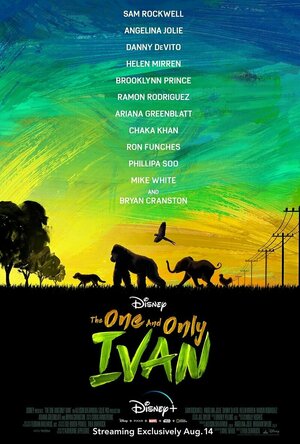
Originally scheduled for a cinematic release, but now arriving on Disney+ instead, The One and Only Ivan is the latest in a long line of stories involving CGI animals who can talk, banding together to outsmart us humans in order to escape captivity. Only this one is actually based on a true story.

There were no talking animals in the real version of events this is based on, but there was a silverback gorilla named Ivan,

Stolen as an infant from the rainforests of Congo and made to live in a tiny cage, while regularly putting on a show for visitors to a shopping centre for 27 years in total. This being a Disney movie though, the cruelty of that is glossed over somewhat, with funny animal friends with wacky voices aiming to brighten things up. Although, the message that his captivity was wrong is certainly there for all to see, and hopefully to be appreciated.

Bryan Cranston is Mack, the showman responsible for raising Ivan and making him a star, bristling when enthusiasm and “the show must go on” spirit, despite dwindling audiences and occasional animal illness. From flashbacks, it’s clear that Mack loves Ivan, his passion for raising him having cost him his marriage. But now that Ivan is the star of the show at the mini circus in the mall, complacency has set in, and Mack cannot see that all Ivan now truly wants is his freedom.

In an attempt to try and bring in the crowds, Mack brings in a baby elephant, which takes over top billing status from Ivan, much to his disappointment. Elderly elephant Stella (Angelina Jolie) takes the new baby under her wing, and during some late night storytelling sessions between the animals, we learn that Ivan had a sister back in the jungle, and was actually a budding artist, using mud to paint on rocks. When Julia, young daughter of one of the helping hands at the circus, gives Ivan some of her old crayons and finger paints, Ivan begins drawing again, and is soon moved back up to top billing in the show.

When I first saw the trailer for The One and Only Ivan, I was totally on board. That is, until the animals started talking. I thought the CGI remake of The Lion King last year was just terrible, and the Lady and the Tramp remake which landed on Disney+ earlier this year was even worse. Realistic looking animals simply cannot convey emotions like their traditionally animated counterparts, while retaining their realistic looks. But The One and Only Ivan thankfully feels so different, much better than those movies do. And a lot of that is down to the voice cast.

Sam Rockwell is Ivan. Perfectly cast, he brings a real much needed gravitas to the sombre silverback. Along with the stray dog (Danny DeVito) that visits Ivan’s cage and sleeps on his belly at night, they form a delightful double act, discussing freedom, and the fortunes of the circus. With a lot of time being spent with the animals in their cages, the movie does drag a little at times, but then maybe that’s the whole idea – portraying the solitude and boredom experienced when you do not have your freedom.

As if it wasn’t already clear enough, The One and Only Ivan nicely drives home the important message that animals really shouldn’t be kept in pokey cages for long periods of time, and certainly not for decades either. The end of the movie reminds us that Ivan’s story is actually based on truth, as we’re shown photos of the real Ivan, who stayed with a family before becoming a circus act. Seeing the photos of his eventual release to the vastly improved setting of Atlanta zoo, where he lived out the rest of his days, certainly proves to be very emotional, and a fitting end to a surprisingly enjoyable family movie.

  
    Hello Next! Forget your ex.

    Hello Next! Forget your ex.

    Entertainment and Lifestyle

    (0 Ratings) Rate It

    App

    Just broke up? Haven’t seen your ex for a while but your heart is still broken with no one there...

Sweetheart (2021)
Sweetheart (2021)
2021 | Comedy, Drama, Romance
8
8.0 (1 Ratings)
Movie Rating
Great ensemble cast (1 more)
Sensitive and moving writing by Marley Morrison
Didn't care for the voiceover narrative (0 more)
A Gregory's Girl for the 21st Century
When I was in my late teen's, Bill Forsyth's "Gregory's Girl" perfectly epitomised the angst of the school years' emotions I'd left behind me. And I was very much heterosexual. With "Sweetheart", Marley Morrison in an astonishing feature debut delivers a "Gregory's Girl" for today's much more sexually fluid times.

Positives:
- What a great ensemble cast! It's all headed up by Nell Barlow, amazingly in her feature debut. Nell manages to perfectly deliver the hair-pullingly frustrating unpredictability of a teenage girl: always planning to go off doing something worthy like "knitting jumpers for elephants in Indonesia". But she manages to keep the portrayal just the right side of parody, not straying into 'Kevin and Perry' territory. "What's wrong with you?" asks her mother. "I'm 17. Everything's wrong with me" she replies. It's an immaculate performance for someone so young.
- Jo Hartley is also fabulous as A. J.'s mum, a lost soul struggling with her own worries, without having those of AJ to add to them. It's not portrayed as a typical 'Mum v Teen' battle, but beautifully nuanced. "Just because you're a lesbian now, it doesn't mean you have to dress like a boy" she pleads with A. J.
- If you're trying to place her, Ella Rae-Smith was the striking girl in the baseball cap in Netflix's "The Stranger". She is also wonderful here, as the 'hot girl' who you think has it all but is underneath deeply troubled and conflicted. A sex scene (beautifully lit and filmed by Emily Almond Barr and Matthew Wicks) manages to show absolutely nothing but is deliciously erotic as a result.
- The writing by Marley Morrison feels very autobiographical. And, as I found through reading this Guardian article about Morrison's gender-journey, there is a lot of personal experience in here. It's clever that the film is claustrophobically set in the remote holiday park (actually the real Freshwater Beach Holiday Park near Bridport on the Dorset coast). If it had been set in a big city like London, AJ could have constantly fled from her feelings, never resolving them. Here, she is constantly running into Isla.... there is no escape.
- I also very much liked the relationship written between A. J. and Steve. Steve is almost the safety valve on the pressure cooker, always helpfully allowing some steam to escape. It adds warmth to the story.
- For such an indie picture, there's a range of great tunes on the soundtrack: mostly from bands I have never heard of (probably making it affordable). I'm not sure if there's to be a soundtrack album released, but it's worth a listen if so.

Negatives:
- I wasn't fond of the sound mix on the film. Some of the dialogue was indistinct.
- A. J. gives us an occasional running commentary of her thoughts as a voiceover. Regular readers of my blog will know my thoughts on this subject! I'm not sure if it added much to the story: a 'show-not-tell' approach would have been my preference.

Summary Thoughts on "Sweetheart": I likened this film to 1980's "Gregory's Girl", and that's a great compliment. That movie made stars out of John Gordon Sinclair and Clare Grogan. I'd predict similar great things for Nell Barlow, Ella Rae-Smith and particularly for writer/director Marley Morrison. I'll very much look forward to Marley's future projects.

It's a cracking little British film. It deserves a major cinema release, but I suspect this is one that you might need to hunt out at your less mainstream cinemas. But please do so - it's well worth it. Very much recommended.

(For the full graphical review and video, check out #onemannsmovies on the web, Facebook and Tiktok. Thanks.)
  
The Lost Daughter (2021)
2021 | Drama
8
8.0 (1 Ratings)
Movie Rating
Strong Acting and Direction
The nice thing about being fanatical about catching all of the Oscar Nominated films in the “Major” categories is that it forces me to watch films that, normally, my interests would not gravitate towards - and, most of the time, I am rewarded and my mind and emotions are expanded because of this.

Such is the case with THE LOST DAUGHTER, Maggie Gyllenhaal’s film Directing debut (she is also Oscar nominated for Adapted Screenplay) that follows the emotional journey of a College Professor (the great Olivia Colman) on Holiday in Greece who is forced to confront her past decisions amidst the emotional toil that these decisions have created.

Normally, these introspective, “Art House” films are not my cup of tea and during the first half of this film, I did find myself wandering a bit. This is because Colman’s character of Leda arrives on-screen at the onset of this film heavy with emotional (almost crippling so) baggage and it is almost too much to bear…which is the point. The movie, then, peels the layers back slowly to reveal why.

It is, yet again, a tour-de-force performance by Colman - who just might win ANOTHER Oscar for this work - it is that strong without being show-offey (if that is a word). Colman becomes Leda and delves strongly into the introspection, guilt, hurt and confusion that this character has. She allows the character to breathe (sometimes in gulps of crying). It is the type of character (and performance) that film today rarely allows time for on screen.

Credit for this has to go to Directer/ScreenWriter Maggie Gyllenhaal who adapted Elana Ferrante’s novel into a quiet, retrospective film. The adaptation works well for someone who has no prior knowledge of the novel and the direction and camerawork of this film is unwavering in it’s look into a character that is flawed and at times unlikeable. It is a strong Directorial and Screenwriting debut for Gyllenhaal.

Jessie Buckley is also Oscar nominated (for Best Supporting Actress) for her role as the younger Leda - a character who’s actions strongly affect the older Leda. While this character is not as nuanced as Colman’s version of Leda, she still is strong and Buckley’s performance is just as confident, self-centered, and fierce showing the roots of the person that would become Colman’s character. This is only the 3rd time in Oscars history that 2 actresses have been nominated for Academy Awards for playing younger and older versions of the same person (Kate Winslet/Gloria Stewart playing Rose in TITANIC and Kate Winslet/Judi Dench playing Iris in IRIS).

Ed Harris shows up as the proprietor of the space that Leda is renting in Greece and is a welcome presence (as always). The surprises to me in this film were the performances of Dakota Johnson and Jack Farthing. Johnson is proving that she is more than just the “50 SHADES” girl and spars with Colman quite well, more than holding her own. Farthing, who played the cold and distant Prince Charles in SPENCER is the husband of the younger Leda and he is the polar opposite of Prince Charles - open, loving and emotional. It is fun to see 2 clearly differing performances by the same actor. Farthing is someone to keep an eye on.

As is Gyllenhaal, Colman and THE LOST DAUGHTER. It is a strong piece of film-making and not an easy watch. But, if you can click into the emotion of this flawed character - and stick with this film through the ugliness and mistakes that Leda selfishly makes, you will be rewarded with a character study, the likes of which is rare in film today.

Letter Grade: A-

8 stars (out of 10) and you can take that to the Bank(ofMarquis)
  
God: A Human History
Reza Aslan | 2017 | Philosophy, Psychology & Social Sciences, Religion
6
5.0 (4 Ratings)
Book Rating
An Ambiguous History
I received this book for free through Goodreads First Reads.

Where did religion come from? This is the question Reza Aslan, a scholar of religions, attempts to answer in his latest publication, God: A Human History. To date, Aslan has tackled subjects such as the life of Jesus of Nazareth, and the origins, evolution and future of Islam. In this book, the author journeys back to the earliest evidence of human existence and, using a mix of resources, theories and investigations, tries to determine how our ancestors conceived the idea of gods and souls. Maintaining the idea that the majority of humans think of God as a divine version of ourselves, Aslan also looks at the way our perception of life after death has altered due to the changes in our governments and cultures.

Reza Aslan claims that he, a Muslim-devout-Christian-convert-turned-Sufi, is neither trying to prove or disprove the existence of God or gods. Instead, he is providing readers with a thorough history of religion with a strong suggestion that we, as believers, have fashioned God in our image, and not the other way around.

Insisting that belief systems are inherited from each previous generation, Aslan takes a look at ancient cave drawings where he, and many other theorists, surmise that a form of religion was already well underway. Lack of written word results in a lot of speculation and hypothesis as to what these, usually animal-like, drawings represent, however, many have come to the conclusion that early humans had some form of animistic belief system.

Although not a dig at religion, after all, the author is religious himself, the following chapters bring in to question the authenticity of past and present beliefs. With reference to various psychologists, Aslan poses the theory that ancient humans may have misinterpreted dreams as evidence of a spirit realm. With no one qualified to clarify the things they did not understand, anything without a clear explanation may have been attributed to a god or gods.

As the author describes how religious ideas may have developed from these primitive beliefs to the fully detailed faiths of today, he labels the human race as anthropocentric creatures that have based their religions on human traits and emotions. By reporting in this way, it comes across that the past ideas of the soul, spiritual realms, gods and so forth could not possibly be true, yet, as the final chapters suggest, Aslan is still adamant about the existence of God.

Aslan’s narrative speeds up, finally reaching the recognizable religions of today. Beginning with the Israelites, enslaved by the Egyptians, the author explains, using biblical references, how the first successful monotheistic religion came about. However, researchers have studied the early Bible texts and are inconclusive as to whether the God worshipped by the Jews was the only divine being or whether there were others of a similar standing.

Next, Aslan explores Christianity, posing more questions than he solves, for example, is God one or is God three (i.e. the Holy Trinity)? He defines and compares the definitions of monotheism and pantheism, eventually bringing in Islam and the development of Sufism, which he is not afraid of admitting he agrees with.

God: A Human History is disappointingly short, ending with the feeble conclusion that humans are born with the ability to be convinced of the existence of a divine being and the soul, but it is our own choice to decide whether or not to believe in them. The remaining third of the book is an abundance of notes on the texts, bibliographical references, and Reza Aslan’s personal opinions about the ideas and theories mentioned in his history of religion.

Although an extensive history on the origins of religion, God: A Human History leaves readers none the wiser as to whether their belief is founded in truth or whether it is something that has evolved over time due to lack of understanding about the world. Granted, it was not the aim of the book to prove or disprove the existence of God, however, it may unintentionally sow seeds of doubt or, potentially, anger devout believers. However, there is no attempt at persuading readers to believe one thing or another, thus making it suitable for people of all religion and none.