
Search
Search results

Movie Metropolis (309 KP) rated Gods Of Egypt (2016) in Movies
Jun 10, 2019


God Awful
Those of you who keep up to date with the goings on in the film world may be thinking Gods of Egypt was released way back in February; and you’d be right for thinking that.
The film, directed by Alex Proyas (I, Robot, Knowing) performed so poorly in America at the start of the year that its UK release was scrapped, until now. But is the resulting film as bad as its figures would suggest? Or are we looking at a future cult classic?
Good god no. From shocking dialogue to laughable special effects; Gods of Egypt is a dreadful dirge of a movie with practically no saving graces. It’s just that bad.
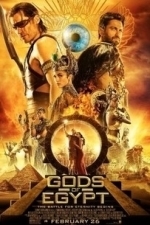
The survival of mankind hangs in the balance when Set (Gerard Butler), the merciless god of darkness, usurps Egypt’s throne and plunges the empire into chaos. Hoping to save the world and rescue his true love, a defiant mortal named Bek (Brenton Thwaites) forms an alliance with the powerful god Horus (Nikolaj Coster-Waldau) to stop Set before he destroys everything.
Thankfully, the plot itself isn’t too bad and has a vaguely interesting premise. The problem is how it is executed. Alex Proyas takes our protagonists on a rollercoaster ride of bland set pieces, populated by cardboard enemies and special effects that manage to look expensive and awful at the same time.
Gold, blood red, sparkling granite and deep, rich blacks all combine for a nauseating colour palate, only worsened by the cinematography. No shot is lingered on for any great amount of time – it’s like Alex Proyas was too terrified of allowing his audience to see the mess up close, shifting from frame to frame every few seconds.
Elsewhere, the acting is fairly inconsistent. Gerard Butler yet again channels his character from 300, while newcomer Brenton Thwaites looks po-faced as he spouts complete and utter drivel, a departure from his promising turn in 2013’s The Giver. The painful attempts at comedy fall flat on every single occasion and ensure no cast member leaves with their dignity intact.
2016 has thrown up some pretty bad films. London Has Fallen, Through the Looking Glass and Zoolander 2 spring immediately to mind, but this manages to outdo them by a country mile.
Overall, Gods of Egypt leaves you with more questions than it answers. Why is the Egyptian god of darkness Scottish? Why is it over two hours long? What on earth was Summit Entertainment thinking pouring $140million into this thing?
There is some good news at the end of this rather murky rainbow however. Your question as to whether you should go and see it may well be the only question that can be answered.
https://moviemetropolis.net/2016/06/18/god-awful-gods-of-egypt-review/
The film, directed by Alex Proyas (I, Robot, Knowing) performed so poorly in America at the start of the year that its UK release was scrapped, until now. But is the resulting film as bad as its figures would suggest? Or are we looking at a future cult classic?
Good god no. From shocking dialogue to laughable special effects; Gods of Egypt is a dreadful dirge of a movie with practically no saving graces. It’s just that bad.
The survival of mankind hangs in the balance when Set (Gerard Butler), the merciless god of darkness, usurps Egypt’s throne and plunges the empire into chaos. Hoping to save the world and rescue his true love, a defiant mortal named Bek (Brenton Thwaites) forms an alliance with the powerful god Horus (Nikolaj Coster-Waldau) to stop Set before he destroys everything.
Thankfully, the plot itself isn’t too bad and has a vaguely interesting premise. The problem is how it is executed. Alex Proyas takes our protagonists on a rollercoaster ride of bland set pieces, populated by cardboard enemies and special effects that manage to look expensive and awful at the same time.
Gold, blood red, sparkling granite and deep, rich blacks all combine for a nauseating colour palate, only worsened by the cinematography. No shot is lingered on for any great amount of time – it’s like Alex Proyas was too terrified of allowing his audience to see the mess up close, shifting from frame to frame every few seconds.
Elsewhere, the acting is fairly inconsistent. Gerard Butler yet again channels his character from 300, while newcomer Brenton Thwaites looks po-faced as he spouts complete and utter drivel, a departure from his promising turn in 2013’s The Giver. The painful attempts at comedy fall flat on every single occasion and ensure no cast member leaves with their dignity intact.
2016 has thrown up some pretty bad films. London Has Fallen, Through the Looking Glass and Zoolander 2 spring immediately to mind, but this manages to outdo them by a country mile.
Overall, Gods of Egypt leaves you with more questions than it answers. Why is the Egyptian god of darkness Scottish? Why is it over two hours long? What on earth was Summit Entertainment thinking pouring $140million into this thing?
There is some good news at the end of this rather murky rainbow however. Your question as to whether you should go and see it may well be the only question that can be answered.
https://moviemetropolis.net/2016/06/18/god-awful-gods-of-egypt-review/

Canadian Journal of Ophthalmology
Medical and Magazines & Newspapers
App
Canadian Journal of Ophthalmology Now it’s easy to stay current in the field of ophthalmology and...

Merissa (14150 KP) rated Demon Crew (The Wolfborne Saga #5) in Books
Jan 21, 2020

Demon Crew is the fifth book in The Wolfborne Saga and we continue with Zev and Virgo being part of a super-secret government agency... although Zev didn't actually agree to any of it! I admire Zev's resilience and his ability to forgive because I honestly don't think I would be able to do so! There is also a new woman in Zev's life although he's not sure if he actually likes this one as she is dhampir. Needless to say, the action and adventure start immediately and Zev remains the humble hero.
Now, I'm going to admit that I wasn't all that happy about reading this book. Virgo really did me in at the end of the last one and the thought of Zev back in chains did absolutely nothing for me. However, Ms. Alsop has managed to win me over yet again. Not only did I enjoy this book but it has become my favourite (so far) of the series! And yes, I know I've moved that title as I've read through the series, but that should tell you something!!!
As with all the books, this one leaves you on a cliffhanger, wanting more. The world continues to delight with all the action and fights you could ask for. The characters are lifelike and full of sarcasm and wit. The pacing is once again smooth and will keep you turning the pages. I really can't recommend either the book or the series highly enough.
* A copy of this book was provided to me with no requirements for a review. I voluntarily read this book, and the comments here are my honest opinion. *
Merissa
Archaeolibrarian - I Dig Good Books!
Now, I'm going to admit that I wasn't all that happy about reading this book. Virgo really did me in at the end of the last one and the thought of Zev back in chains did absolutely nothing for me. However, Ms. Alsop has managed to win me over yet again. Not only did I enjoy this book but it has become my favourite (so far) of the series! And yes, I know I've moved that title as I've read through the series, but that should tell you something!!!
As with all the books, this one leaves you on a cliffhanger, wanting more. The world continues to delight with all the action and fights you could ask for. The characters are lifelike and full of sarcasm and wit. The pacing is once again smooth and will keep you turning the pages. I really can't recommend either the book or the series highly enough.
* A copy of this book was provided to me with no requirements for a review. I voluntarily read this book, and the comments here are my honest opinion. *
Merissa
Archaeolibrarian - I Dig Good Books!
Night of the Vampire (Deathless Night - Into the Dark #1)
8.0 Rate It
Book
Killian walked into my new voodoo shop late one night with an urgent request - he needed me to heal...
Paranormal Romance Vampires Witches

Kyera (8 KP) rated Morning Star in Books
Feb 1, 2018
As with the two previous books in the series, Morning Star is brutally violent and honest in its portrayal of the darkness of humanity. It's a strange series that I don't quite know how I feel. While overall the plot and storytelling are good and I enjoy reading the series, for the most part, I am also frequently horrified by events and actions. As a result, I would recommend again that younger teen readers do not pick this up. Wait until you are older to read the series.
Sevro is such a strange character, but I love him. Some of the things he said, although unintentionally funny, had me laughing aloud (and probably sounding like a crazy person because I was by myself). Sadly, the course of the war and things that he has experienced seem to change him - as the war alters all of the characters. In the third book, he is just as funny and strangely likable as he was in the previous two books despite the horrors that he has endured.
I love the honest wonder of Ragnar, despite his fierce size and fighting skills he was not born to the same world as Darrow. He is genuinely pleased or fascinated by things most would take for granted in that world. Despite the fact that Ragnar is a terrifying killing machine - you can't help but like him.
Although there is a lot of death and destruction in these books, it is not until halfway through the third book that the pain of a character affected me. I got a little teary-eyed because it was one of the characters that I had grown to care about. I don't feel a very strong connection to them in general, which I feel is probably the main weakness of this series for me.
The second book fell prey to the typical slow nature of a middle book in a trilogy. In general, I feel that these books take some time to get into but become very engaging eventually. The third book was a little slower to start than even the others, although there were some enjoyable moments early on it wasn't until a little over halfway through the book that I really thought 'wow this is where things start happening.'
Once I was in the second half of the book, I felt like this was my favorite of the books in the series. I think Pierce Brown does his best work when he's talking about a battle. So the fighting you see in this part of the book really shines.
While it is very authentic to a war scenario, I don't personally like that so many characters die. I know people would complain if no one died because then the stakes wouldn't be as high for the characters but it makes me so sad when a character I like doesn't make it.
Despite the slow start of the third book, by the end, I had completely forgotten about it and felt that this was my favorite book in the series. The action, the schemes, everything just pulled me in and I was riveted, guessing, gasping and cheering until the very last page.
Sevro is such a strange character, but I love him. Some of the things he said, although unintentionally funny, had me laughing aloud (and probably sounding like a crazy person because I was by myself). Sadly, the course of the war and things that he has experienced seem to change him - as the war alters all of the characters. In the third book, he is just as funny and strangely likable as he was in the previous two books despite the horrors that he has endured.
I love the honest wonder of Ragnar, despite his fierce size and fighting skills he was not born to the same world as Darrow. He is genuinely pleased or fascinated by things most would take for granted in that world. Despite the fact that Ragnar is a terrifying killing machine - you can't help but like him.
Although there is a lot of death and destruction in these books, it is not until halfway through the third book that the pain of a character affected me. I got a little teary-eyed because it was one of the characters that I had grown to care about. I don't feel a very strong connection to them in general, which I feel is probably the main weakness of this series for me.
The second book fell prey to the typical slow nature of a middle book in a trilogy. In general, I feel that these books take some time to get into but become very engaging eventually. The third book was a little slower to start than even the others, although there were some enjoyable moments early on it wasn't until a little over halfway through the book that I really thought 'wow this is where things start happening.'
Once I was in the second half of the book, I felt like this was my favorite of the books in the series. I think Pierce Brown does his best work when he's talking about a battle. So the fighting you see in this part of the book really shines.
While it is very authentic to a war scenario, I don't personally like that so many characters die. I know people would complain if no one died because then the stakes wouldn't be as high for the characters but it makes me so sad when a character I like doesn't make it.
Despite the slow start of the third book, by the end, I had completely forgotten about it and felt that this was my favorite book in the series. The action, the schemes, everything just pulled me in and I was riveted, guessing, gasping and cheering until the very last page.




Emma Montague is an Englishwoman living in the U.S. She left behind her parents as soon as she could: feeling trapped by her mother's snobbery and outgoing personality, so different from Emma's quiet and introverted self. But life in the high-powered banking world in New York City isn't exactly for Emma either. She finds everyone so false: women who only care about clothes and finding a man, too many nights at bars, and pressure to use dating apps. Her one long-term relationship winds up nowhere, and so Emma finds herself on the move again: this time to the beach town of Westport, CT. She takes a break from banking and finds herself renting a house in this seaside town. Emma quickly finds herself falling for landlord, Dominic, a bartender in Westport. A father to six-year-old Jesse, Dominic seems to be the opposite of Emma in every way. Emma isn't sure that the two could ever really be together, but she can't seem to stop her heart from falling for Dominic. Are they meant to be?
Ugh, this book. Some of it was enjoyable, and yet so much of it was just so damn frustrating. First of all, the entire thing seemed like it was based on just a mountain of stereotypes and tropes. Emma has built-in stereotypes and preconceived notions about Dominic (a bartender can't be anything like a banker, apparently, or share any of the same interests). Every woman in the banking world is a vapid idiot except Emma. All New Yorkers just want to get married and move to the suburbs. And so on and so on. It gets really old after a while.
Then, the whole different worlds thing: Emma versus Dom style. As a moving forward plot device, it just seemed incredibly forced. I understand that the "we're from two different worlds" idea still exists today, but really? It's that hard to overcome that a woman considers just dropping the only guy who has ever made her happy, because he seems beneath her? It would be different if the book put forth some real reasons that their class differences threatened their relationship, but it really doesn't. It's all half developed and mostly based on Emma's speculation.
That brings me to Emma. I wanted to like Emma. I could see a lot of Emma in myself - a quiet introvert who doesn't take well to people, who needs time to warm up. I understand that. But oh my gosh, she drove me crazy. So wishy washy! So indecisive! So unable to just follow her *own* thoughts and feelings. She drove me insane. It's very hard to fully enjoy a novel where you often want to wring the neck of the main character.
All of that, truly, I could have probably forgiven if Green hadn't taken the plot off the deep end near the end of the novel. I was so irritated and so upset: I went through all of the above for THIS? I won't spoil it, but let's just say I didn't sign up for a Nicholas Sparks novel. Any of the novel's redeeming qualities (a cute cat, a somewhat cute kid, Emma's dad) went out the window.
Overall, I just didn't enjoy this one. Too much of the plot devices irritated me, and then-BOOM-the actual plot drove me over the edge.
Ugh, this book. Some of it was enjoyable, and yet so much of it was just so damn frustrating. First of all, the entire thing seemed like it was based on just a mountain of stereotypes and tropes. Emma has built-in stereotypes and preconceived notions about Dominic (a bartender can't be anything like a banker, apparently, or share any of the same interests). Every woman in the banking world is a vapid idiot except Emma. All New Yorkers just want to get married and move to the suburbs. And so on and so on. It gets really old after a while.
Then, the whole different worlds thing: Emma versus Dom style. As a moving forward plot device, it just seemed incredibly forced. I understand that the "we're from two different worlds" idea still exists today, but really? It's that hard to overcome that a woman considers just dropping the only guy who has ever made her happy, because he seems beneath her? It would be different if the book put forth some real reasons that their class differences threatened their relationship, but it really doesn't. It's all half developed and mostly based on Emma's speculation.
That brings me to Emma. I wanted to like Emma. I could see a lot of Emma in myself - a quiet introvert who doesn't take well to people, who needs time to warm up. I understand that. But oh my gosh, she drove me crazy. So wishy washy! So indecisive! So unable to just follow her *own* thoughts and feelings. She drove me insane. It's very hard to fully enjoy a novel where you often want to wring the neck of the main character.
All of that, truly, I could have probably forgiven if Green hadn't taken the plot off the deep end near the end of the novel. I was so irritated and so upset: I went through all of the above for THIS? I won't spoil it, but let's just say I didn't sign up for a Nicholas Sparks novel. Any of the novel's redeeming qualities (a cute cat, a somewhat cute kid, Emma's dad) went out the window.
Overall, I just didn't enjoy this one. Too much of the plot devices irritated me, and then-BOOM-the actual plot drove me over the edge.
Merissa (14150 KP) rated Songbird (The Tudor Court #1) in Books
Apr 13, 2021 (Updated Jul 27, 2023)
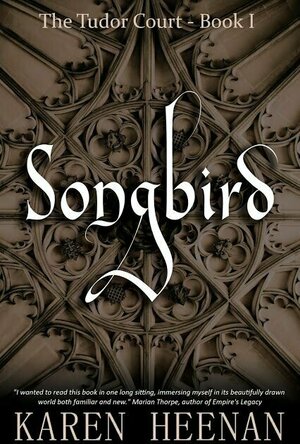
SONGBIRD is the first book in the Tudor Court series, and we are introduced to the world of King Henry VIII, and his love of music. Bess is sold to the King just before her tenth birthday and, with hard study and lots of practice, becomes a favourite of his. We stay with her as she grows from a young child, to a young woman, with friends and lovers along the way.
Reading about Henry, Katherine, Mary, and the Boleyn sisters, from a servant's perspective made it all the more fascinating. Her life at court is comfortable, but she is still a servant. There is romance for Bess, from Tom, who was with her from the start, to Nick, a courtier currently in favour with the King. Bess has her own choices to make, some of which end up being heartbreaking.
If I had one thing to say, it would be I was disappointed we skipped so much of Henry's reign, but then, if we'd had it all, it would have been enough for more books! A fascinating story, with realism and character development a-plenty. This was a book I thoroughly enjoyed and have no hesitation in recommending, and I am so happy to see there is a second book in this series!
* A copy of this book was provided to me with no requirements for a review. I voluntarily read this book, and the comments here are my honest opinion. *
Merissa
Archaeolibrarian - I Dig Good Books!
Apr 13, 2021
Reading about Henry, Katherine, Mary, and the Boleyn sisters, from a servant's perspective made it all the more fascinating. Her life at court is comfortable, but she is still a servant. There is romance for Bess, from Tom, who was with her from the start, to Nick, a courtier currently in favour with the King. Bess has her own choices to make, some of which end up being heartbreaking.
If I had one thing to say, it would be I was disappointed we skipped so much of Henry's reign, but then, if we'd had it all, it would have been enough for more books! A fascinating story, with realism and character development a-plenty. This was a book I thoroughly enjoyed and have no hesitation in recommending, and I am so happy to see there is a second book in this series!
* A copy of this book was provided to me with no requirements for a review. I voluntarily read this book, and the comments here are my honest opinion. *
Merissa
Archaeolibrarian - I Dig Good Books!
Apr 13, 2021

Purple Phoenix Games (2266 KP) rated Space Plague in Tabletop Games
Mar 9, 2021
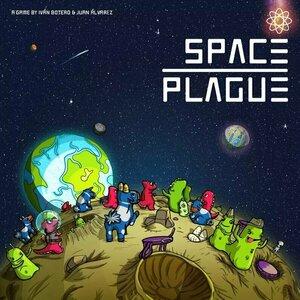

When is the word “plague” ever a good thing? We as a people have endured several plagues and none of them could be considered super great. However, what if the term plague was merely that of endearment? What if, in a fantasy sci-fi world, a plague was merely a settler of new worlds? Now you can play as a plague and be inspired by the game’s tagline: “We are many, yet we are one. We are the plague.”
Space Plague is a new game from first time designers who hail from the country of Colombia. In it players assume the command of a race of aliens attempting to colonize a newfound planet before the other races assume majority. Each race is essentially the same, and have similar tactics, but may use these tactics differently from other races. The player who amasses the most plagues from their race by the time the game ends will be crowned champion, and settler of the new world.
DISCLAIMER: We were provided a prototype copy of this game for the purposes of this review. These are preview copy components, and I do not know for sure if the final components will be any different from these shown. Also, it is not my intention to detail every rule in the game, as there are just too many. You are invited to download the rulebook, back the game through the Kickstarter campaign, or through any retailers stocking it after fulfillment. -T
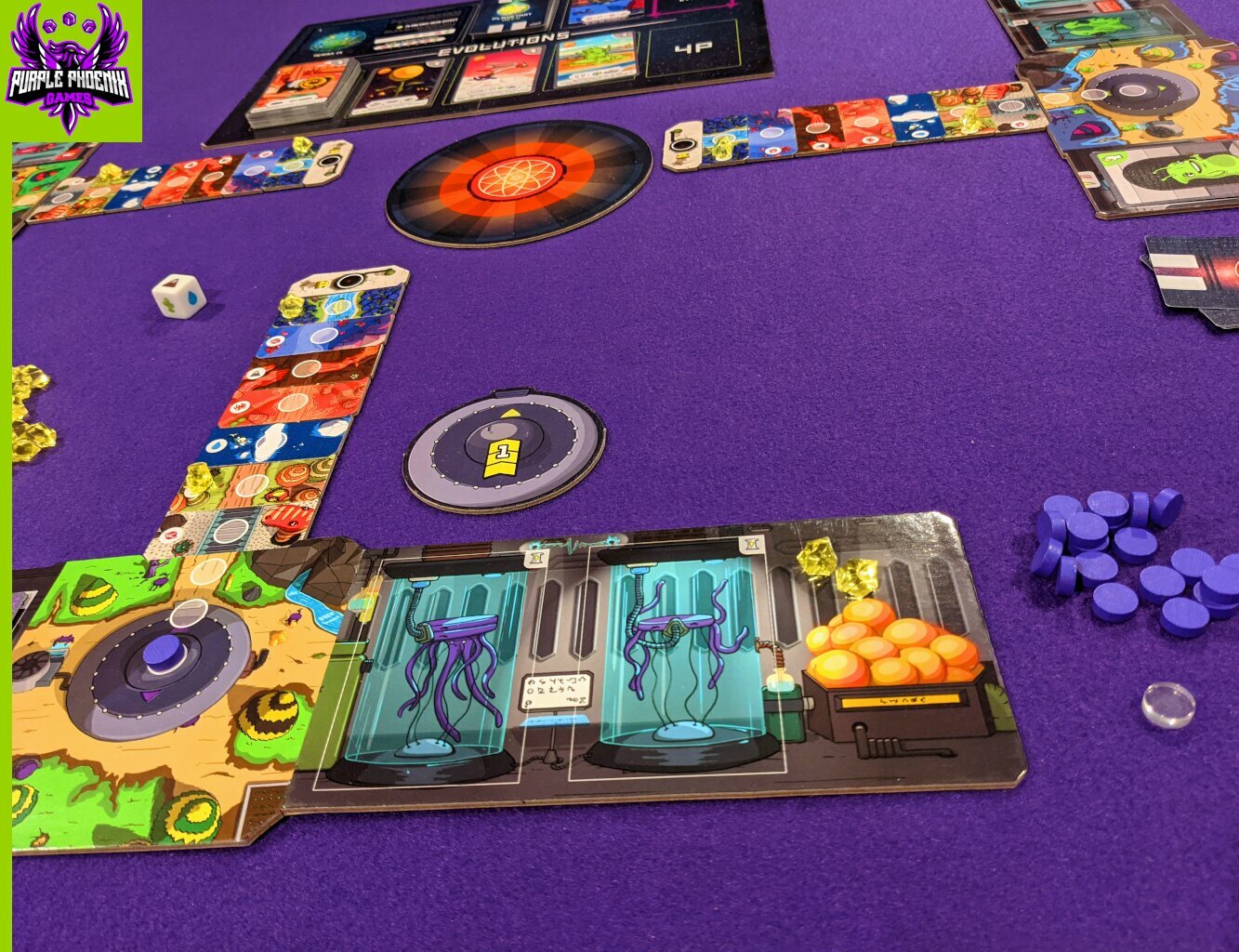
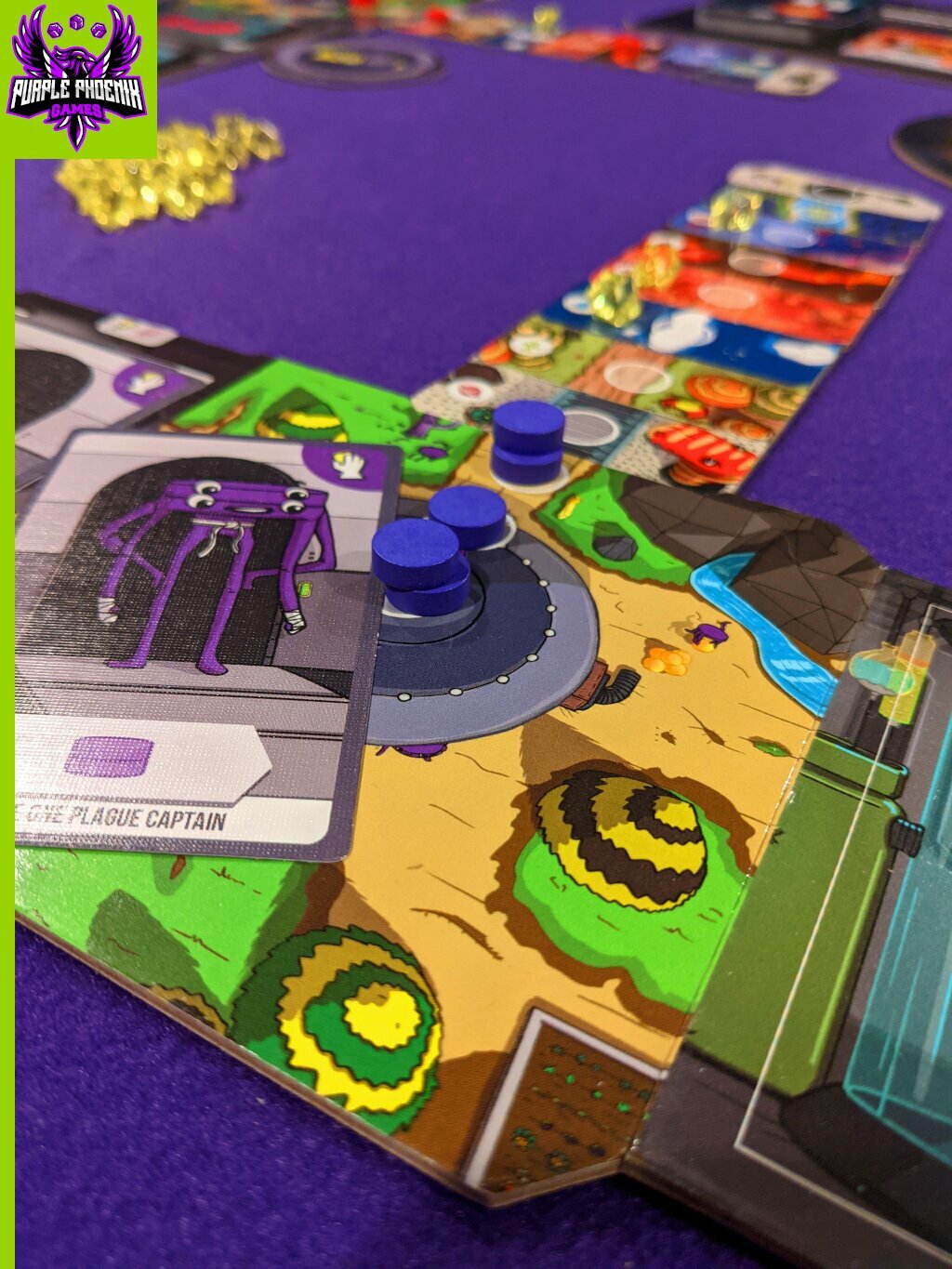
To setup, follow the instructions, as there are many steps for setup. Once complete, the game should look similar to the photo below. You will see in this photo the main board at the top, the circular world core board (in black and red), and individual board setups for three players. Of course, for this review I will be playing the purple faction: The Flat-Earthers (not that I agree with the actual group of Flat-Earthers). Each player receives the same components, just in their player color. This includes six action cards to serve as the opening hand.
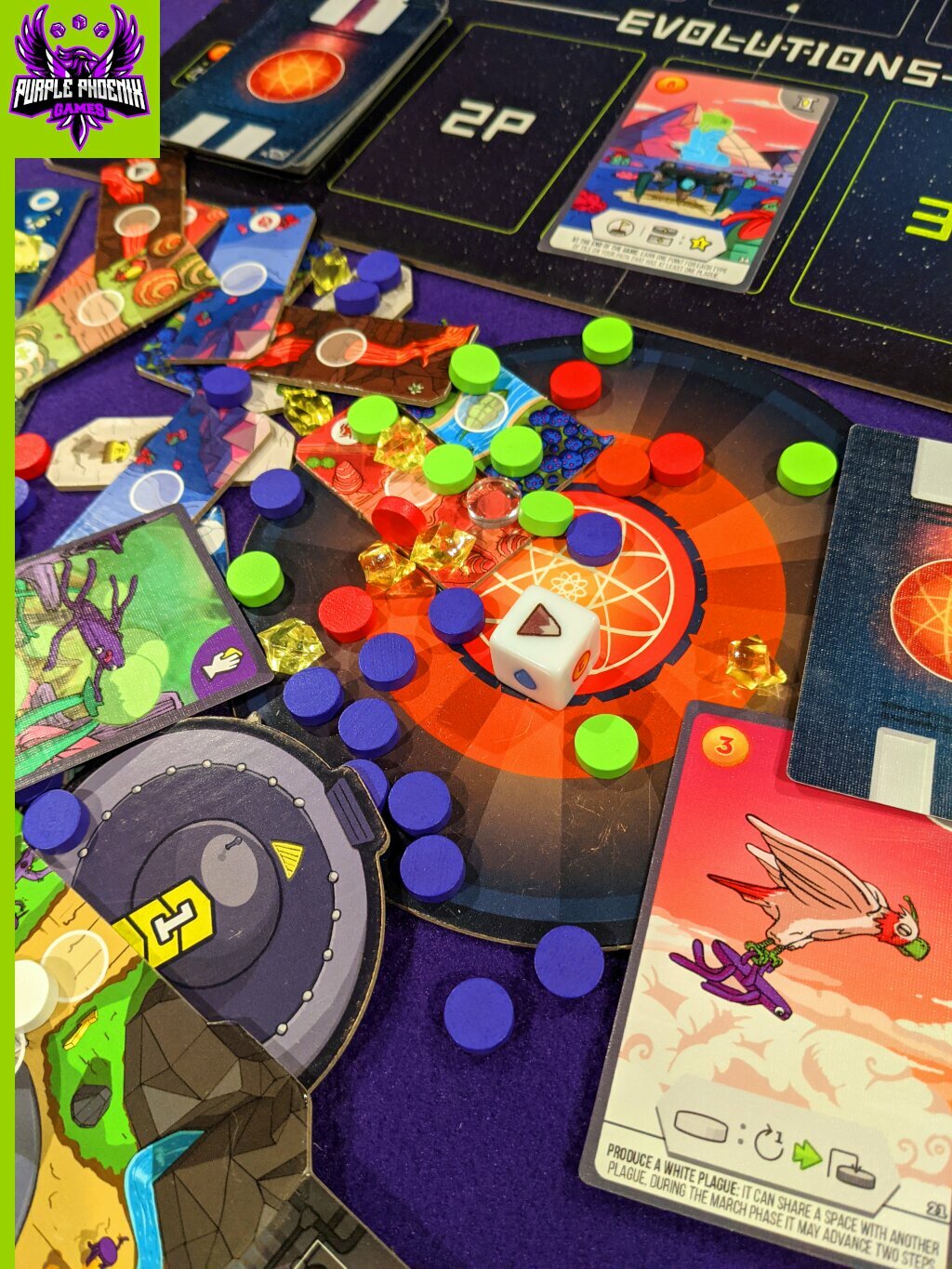
Each round follows four phases: Planetary Deck, Play Action Cards, Planetary Event, and March. On the main board a Planetary Event Card is flipped at the start of each round. This will inform the players which terrain type will generate energy this turn, as well as give a glimpse into the future event that will occur once the card travels to the activation zone on the board. Once players have placed energy shards onto the requisite terrain tiles they must each choose one card to be played this turn from their hand. As each player has the same six beginning Action Cards turns may seem similar. These action cards include Producing Plague (placing a plague disc on the space furthest from the end of the terrain tile line, on top of the picture of the player’s spaceship), Producing a Captain (a stronger version of the normal plague disc), Fast Movement (allows plague discs to move twice toward the core or two discs to move one space each), Slow But Steady (allows one plague disc to move forward one space OR allows the player to place a shield disc on top of a plague to protect it from harm), and Evolving OR Getting Lucky (which allows the player to purchase an Evolution Card from the Market or to roll the energy die and place energy shards on the resulting terrain type). More action cards can be purchased at the Market and used on future turns in order to buff certain actions, abduct opponent plagues, or even create new types of plagues with special abilities.
Once all players have played and resolved their action card for the round the Planetary Event phase begins. If an event card has moved its way to the activation zone of the main board its event text is resolved now. These events signify death of plague discs if they reside on specific terrain types, allow for purchasing cards at the Market or else destroying the plague furthest toward the core, or other various and nefarious events.
When the event has been resolved the active player token is passed to the next player and the March phase ensues. Players will move each of their plague discs one space toward the core to make room for more incoming plagues and captains.
Once the final event card has made its way through each of the main board slots and past the activation zone the game will end. Players will count their plague discs that made it onto the core of the planet and the player with the most discs will win! The rules also include several tie-breakers, ending with a shared victory and a snarky, “tough toothpaste,” style of comment.
Components. Again, this is a prototype copy of the game, and components are not at all final. However, component quality aside, this game looks amazing on the table and hints at some really excellent plans for the final aesthetic. The character art and art on the cards is cartoony, but not in a bad way, and the other art in the graphic design is just stellar (checks around the room for the hook). The game feels “spacey” and “alieny” but also hip and lighthearted. I like it. I like it a lot. My hope for the final product is that the rulebook gets much more detailed, as I had to ask several questions to the designer that just were not clear or present in the rules. I am also hoping that the cards themselves will see quite a bit of beefiness added to them, as this prototype copy shipped with mega-thin cards that are delicate to handle. For a prototype, the components are good and show me what could be upon a successful Kickstarter campaign.
The gameplay is definitely something I want to discuss. I was blown away by how much fun I had playing this game! I cannot count how many times I vocalized how impressed I was with the design and how much fun I was having. I love the mechanic of giving all players the same components but allowing them to choose how to use them best for their strategies. Sometimes I felt that I need to flood my track with plagues and get them moving, while other times I wanted to just upgrade my race by using the evolution cards from the market. Those evolution cards are so interesting to use because they can change the course of the game, especially if specific cards come out near the beginning of the game.
Players can choose which world they wish to conquer at the start of each game (five were included with this copy), and each world possesses different strategies of play. That said, Space Plague definitely scores points for replayability from us.
While it was difficult to get into at first (remember all the rules questions I had), once I was able to truly learn the game it became so enjoyable, and everyone I have played with has thoroughly enjoyed it. If this is the style of game we can expect to come out of Colombia and Bamboo Studios in particular, I am very excited for the future and for the board game community as a whole. This one is a gem and I cannot recommend it highly enough. If you are looking for something a little kooky but with great art and super fun play, then it’s a no-brainer. Space Plague is a must-play at the very least.
Space Plague is a new game from first time designers who hail from the country of Colombia. In it players assume the command of a race of aliens attempting to colonize a newfound planet before the other races assume majority. Each race is essentially the same, and have similar tactics, but may use these tactics differently from other races. The player who amasses the most plagues from their race by the time the game ends will be crowned champion, and settler of the new world.
DISCLAIMER: We were provided a prototype copy of this game for the purposes of this review. These are preview copy components, and I do not know for sure if the final components will be any different from these shown. Also, it is not my intention to detail every rule in the game, as there are just too many. You are invited to download the rulebook, back the game through the Kickstarter campaign, or through any retailers stocking it after fulfillment. -T
To setup, follow the instructions, as there are many steps for setup. Once complete, the game should look similar to the photo below. You will see in this photo the main board at the top, the circular world core board (in black and red), and individual board setups for three players. Of course, for this review I will be playing the purple faction: The Flat-Earthers (not that I agree with the actual group of Flat-Earthers). Each player receives the same components, just in their player color. This includes six action cards to serve as the opening hand.
Each round follows four phases: Planetary Deck, Play Action Cards, Planetary Event, and March. On the main board a Planetary Event Card is flipped at the start of each round. This will inform the players which terrain type will generate energy this turn, as well as give a glimpse into the future event that will occur once the card travels to the activation zone on the board. Once players have placed energy shards onto the requisite terrain tiles they must each choose one card to be played this turn from their hand. As each player has the same six beginning Action Cards turns may seem similar. These action cards include Producing Plague (placing a plague disc on the space furthest from the end of the terrain tile line, on top of the picture of the player’s spaceship), Producing a Captain (a stronger version of the normal plague disc), Fast Movement (allows plague discs to move twice toward the core or two discs to move one space each), Slow But Steady (allows one plague disc to move forward one space OR allows the player to place a shield disc on top of a plague to protect it from harm), and Evolving OR Getting Lucky (which allows the player to purchase an Evolution Card from the Market or to roll the energy die and place energy shards on the resulting terrain type). More action cards can be purchased at the Market and used on future turns in order to buff certain actions, abduct opponent plagues, or even create new types of plagues with special abilities.
Once all players have played and resolved their action card for the round the Planetary Event phase begins. If an event card has moved its way to the activation zone of the main board its event text is resolved now. These events signify death of plague discs if they reside on specific terrain types, allow for purchasing cards at the Market or else destroying the plague furthest toward the core, or other various and nefarious events.
When the event has been resolved the active player token is passed to the next player and the March phase ensues. Players will move each of their plague discs one space toward the core to make room for more incoming plagues and captains.
Once the final event card has made its way through each of the main board slots and past the activation zone the game will end. Players will count their plague discs that made it onto the core of the planet and the player with the most discs will win! The rules also include several tie-breakers, ending with a shared victory and a snarky, “tough toothpaste,” style of comment.
Components. Again, this is a prototype copy of the game, and components are not at all final. However, component quality aside, this game looks amazing on the table and hints at some really excellent plans for the final aesthetic. The character art and art on the cards is cartoony, but not in a bad way, and the other art in the graphic design is just stellar (checks around the room for the hook). The game feels “spacey” and “alieny” but also hip and lighthearted. I like it. I like it a lot. My hope for the final product is that the rulebook gets much more detailed, as I had to ask several questions to the designer that just were not clear or present in the rules. I am also hoping that the cards themselves will see quite a bit of beefiness added to them, as this prototype copy shipped with mega-thin cards that are delicate to handle. For a prototype, the components are good and show me what could be upon a successful Kickstarter campaign.
The gameplay is definitely something I want to discuss. I was blown away by how much fun I had playing this game! I cannot count how many times I vocalized how impressed I was with the design and how much fun I was having. I love the mechanic of giving all players the same components but allowing them to choose how to use them best for their strategies. Sometimes I felt that I need to flood my track with plagues and get them moving, while other times I wanted to just upgrade my race by using the evolution cards from the market. Those evolution cards are so interesting to use because they can change the course of the game, especially if specific cards come out near the beginning of the game.
Players can choose which world they wish to conquer at the start of each game (five were included with this copy), and each world possesses different strategies of play. That said, Space Plague definitely scores points for replayability from us.
While it was difficult to get into at first (remember all the rules questions I had), once I was able to truly learn the game it became so enjoyable, and everyone I have played with has thoroughly enjoyed it. If this is the style of game we can expect to come out of Colombia and Bamboo Studios in particular, I am very excited for the future and for the board game community as a whole. This one is a gem and I cannot recommend it highly enough. If you are looking for something a little kooky but with great art and super fun play, then it’s a no-brainer. Space Plague is a must-play at the very least.

BackToTheMovies (56 KP) rated Haunted (2013) in Movies
Jun 12, 2019

About As Scary As A Trip To Seaworld
Contains spoilers, click to show
Haunted, a film Directed by Steven M Smith is an unusual addition to anyone's 'film' collection, as instantly you question whether this is even a film to begin with, the content is very documentary based, opening with factual accounts and a history of an abandoned railway museum. All of the opening shots are filmed in documentary format and this continues throughout the film even when found footage elements are introduced.
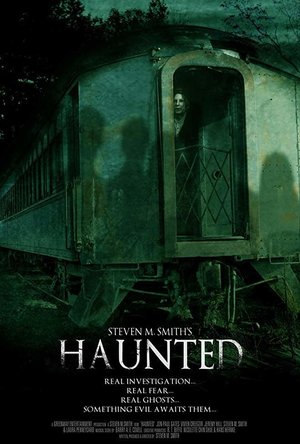
A TV crew will film a paranormal investigation and obtain evidence that proves we are not alone. Something Evil awaits them! They will all discover the truth, that we are not alone.
The above quote is taken directly from the synopsis on the website, contestants are invited to visit a haunted railway as part of the show of which they are filming, they are all packed into a limousine and taken to the event. The whole scenes within the limo following the group around SHOULD of been filmed by a professional camera and a professional cinematographer but it looks as thou the entire film has been shot on someone's mobile phone.
Budget constraints aside, decent camera's should of been used to document the entire film from introduction to the actual paranormal investigations, rather than Sony handycam's that cost £120. The only time still camera's are used is to document an almost news style report at the start of the film and a few segments in between. Using handycams this instantly brings us into frustrating territory of moving shaky pictures, blurred images, and camera operators with shaky hands. Very poor quality recording even for a documentary style shooting as you're watching a black screen for the duration, has anyone ever heard of night vision? Next the acting, now the contestants themselves are not in on the game, they are not aware of what's going on or what they have signed up too, however Jon our 'medium' gives the game away at every opportunity. The strategically placed actor in the movie is Jon Paul Gates a supposed 'medium' who describes what he is feeling and how strong a presence is in a particular area. I personally would of caught on very easily to this poor display as not only was the acting questionable, but his descriptions of certain ghosts and characters were so detailed that it was obvious they had been memorised from a script or prior knowledge. There is one scene where the ghost is apparently on top of Jon as he is weighed to the ground, I found this scene hysterical, I was literally crying with laughter of how poor he not only acted it out but how a ghost was piggy backing a ride around the railway yard.
For the first 30 minutes of the movie, the group have arrived, walked around some railway tracks and picked up some weird force that only Jon can feel yet no one around the group has even felt or experienced anything out of this world. Now Most Haunted the popular paranormal TV show would of thrust the audience into some action by now but for the opening 30 minutes of Haunted, nothing of the sort has happened, as it stands the documentary as I refuse to call it a film has displayed more history about the railways than anything remotely paranormal. Maybe a title change would be for the best? I am neither scared, nor intrigued at this moment in time, quite frankly I'm hoping this heats up and soon.
I feel as thou if this film was cut shorter, much shorter, with a voice over documentary style about where each group is going and what they are doing it would be much more easier to watch. Cut the best bits in, jump scares, certain happenings, instead of mundane walking around a railway yard, because as it stands I could grab a camera, head off out tonight and shoot an identical piece of footage, its neither scary nor intriguing. It needs to have production value and Haunted is really suffering from a lack of it as a result.
There is one event throughout the whole movie which is the main talking point and then the film has the audacity to kill people off towards the end after a whole run time of nothingness, no build up, no real meaning or reason why. It was basically like watching the worst episode of Most Haunted to find one of your group dead on the floor at the end of it, planned, boring and drawn out far too long.
Shorten the run time, have a voice over, documentary coverage and film, DON'T kill anyone off at the end with some cheesy fake characters who no one now believes and have a genuine vigil, no pranks or set ups and this could of been a cool little paranormal programme.
Sadly none of the above happened. What a shame. A few sequels are in the works, shorten the duration, fix the countless problems and maybe, just maybe show some true paranormal / experiences and I guarantee it will be more of a success !
A TV crew will film a paranormal investigation and obtain evidence that proves we are not alone. Something Evil awaits them! They will all discover the truth, that we are not alone.
The above quote is taken directly from the synopsis on the website, contestants are invited to visit a haunted railway as part of the show of which they are filming, they are all packed into a limousine and taken to the event. The whole scenes within the limo following the group around SHOULD of been filmed by a professional camera and a professional cinematographer but it looks as thou the entire film has been shot on someone's mobile phone.
Budget constraints aside, decent camera's should of been used to document the entire film from introduction to the actual paranormal investigations, rather than Sony handycam's that cost £120. The only time still camera's are used is to document an almost news style report at the start of the film and a few segments in between. Using handycams this instantly brings us into frustrating territory of moving shaky pictures, blurred images, and camera operators with shaky hands. Very poor quality recording even for a documentary style shooting as you're watching a black screen for the duration, has anyone ever heard of night vision? Next the acting, now the contestants themselves are not in on the game, they are not aware of what's going on or what they have signed up too, however Jon our 'medium' gives the game away at every opportunity. The strategically placed actor in the movie is Jon Paul Gates a supposed 'medium' who describes what he is feeling and how strong a presence is in a particular area. I personally would of caught on very easily to this poor display as not only was the acting questionable, but his descriptions of certain ghosts and characters were so detailed that it was obvious they had been memorised from a script or prior knowledge. There is one scene where the ghost is apparently on top of Jon as he is weighed to the ground, I found this scene hysterical, I was literally crying with laughter of how poor he not only acted it out but how a ghost was piggy backing a ride around the railway yard.
For the first 30 minutes of the movie, the group have arrived, walked around some railway tracks and picked up some weird force that only Jon can feel yet no one around the group has even felt or experienced anything out of this world. Now Most Haunted the popular paranormal TV show would of thrust the audience into some action by now but for the opening 30 minutes of Haunted, nothing of the sort has happened, as it stands the documentary as I refuse to call it a film has displayed more history about the railways than anything remotely paranormal. Maybe a title change would be for the best? I am neither scared, nor intrigued at this moment in time, quite frankly I'm hoping this heats up and soon.
I feel as thou if this film was cut shorter, much shorter, with a voice over documentary style about where each group is going and what they are doing it would be much more easier to watch. Cut the best bits in, jump scares, certain happenings, instead of mundane walking around a railway yard, because as it stands I could grab a camera, head off out tonight and shoot an identical piece of footage, its neither scary nor intriguing. It needs to have production value and Haunted is really suffering from a lack of it as a result.
There is one event throughout the whole movie which is the main talking point and then the film has the audacity to kill people off towards the end after a whole run time of nothingness, no build up, no real meaning or reason why. It was basically like watching the worst episode of Most Haunted to find one of your group dead on the floor at the end of it, planned, boring and drawn out far too long.
Shorten the run time, have a voice over, documentary coverage and film, DON'T kill anyone off at the end with some cheesy fake characters who no one now believes and have a genuine vigil, no pranks or set ups and this could of been a cool little paranormal programme.
Sadly none of the above happened. What a shame. A few sequels are in the works, shorten the duration, fix the countless problems and maybe, just maybe show some true paranormal / experiences and I guarantee it will be more of a success !