
Search
Search results
Merissa (14188 KP) rated Shadow Bound (Shadow #1) in Books
Oct 20, 2023
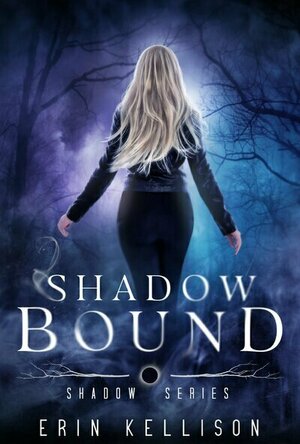

SHADOW BOUND is the first book in the Shadow series, starting off with the Daughter of Death, Talia. Not only that, but you get a nice prologue that tells you about the love between her father and mother, and just what their situation was. I really liked that.
After the prologue, you move forward twenty-six years to find Talia packing for a new job after successfully defending her dissertation. All that changes when two Wraiths force their way into her home and kill her flatmate. Talia goes on the run, successfully hiding for a few months until her luck seems to run out. While this has been going on, Adam has been searching for her. She is the only one so far he has found that mentions 'Shadowman' and he is desperate to find her. He does, in the nick of time, and that's when the fun really starts.
Talia doesn't simply turn into a kick-ass bad-ass b!tch. Nope, she claws her way through her instincts to run and hide, only really coming into her own during the last part of the book. Adam is a bitter, arrogant jerk (with reason) who wants to use Talia at the beginning and, by the end, will do anything to protect her.
This is a fast-paced story that will keep you turning the pages. The world-building was great and really helped to set the scene, not only for this book but also for the others in the series. Talia and Adam are ably supported by a fascinating group of characters that I hope will be in later books. I found it to be a great start to the series and look forward to Custo's story, which is next.
** same worded review will appear elsewhere **
* A copy of this book was provided to me with no requirements for a review. I voluntarily read this book; the comments here are my honest opinion. *
Merissa
Archaeolibrarian - I Dig Good Books!
Oct 20, 2023
After the prologue, you move forward twenty-six years to find Talia packing for a new job after successfully defending her dissertation. All that changes when two Wraiths force their way into her home and kill her flatmate. Talia goes on the run, successfully hiding for a few months until her luck seems to run out. While this has been going on, Adam has been searching for her. She is the only one so far he has found that mentions 'Shadowman' and he is desperate to find her. He does, in the nick of time, and that's when the fun really starts.
Talia doesn't simply turn into a kick-ass bad-ass b!tch. Nope, she claws her way through her instincts to run and hide, only really coming into her own during the last part of the book. Adam is a bitter, arrogant jerk (with reason) who wants to use Talia at the beginning and, by the end, will do anything to protect her.
This is a fast-paced story that will keep you turning the pages. The world-building was great and really helped to set the scene, not only for this book but also for the others in the series. Talia and Adam are ably supported by a fascinating group of characters that I hope will be in later books. I found it to be a great start to the series and look forward to Custo's story, which is next.
** same worded review will appear elsewhere **
* A copy of this book was provided to me with no requirements for a review. I voluntarily read this book; the comments here are my honest opinion. *
Merissa
Archaeolibrarian - I Dig Good Books!
Oct 20, 2023
Christina Haynes (148 KP) rated The Cruel Prince in Books
Jul 24, 2018
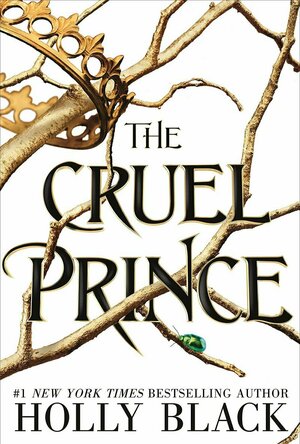
The Cruel Prince
Jude is a mortal in a Fae world. She was brought into that world when a Faerie called Madoc killed her Mother and Father. He took her, her twin sister Taryn and older (half Fae sister) Vivi to his mansion and raised her as his own. She learnt how to sword fight, and how to strategise as if she was Fae. She wanted to be like the Fae. she grew to love their world and not want to go back to the human realm. But she never wanted to be them. She did want to be like them, but better.
"Of course I want to be like them. They’re beautiful as blades forged in some divine fire. They will live forever."
The Fae don't treat the humans well, they use them as slaves or take them as wives or husbands. Though that could be see as a nice thing, the latter is not. They drug them with Fae magic and most humans are unaware of where they are and whom their company is. Truth is Fae would die out if it wasn't for humans. Humans breed and most have more than one. Fae don't or wait a long time and some only have one child. Not all Fae are bad, sure Madoc killed her parents but he also raised her and her sister and treated them rather well. This gives her respect with the other Fae, as Madoc is the kings General and very powerful one at that. But Fae can be bad, they can be mean and nasty.
Cardan is the worst.
When Jude looks at him, she hates him. He hates her too. But when they look at each other they can't breathe.
This is the story of Jude and Cardan. Jude is wanting to be better than the Fae, she is tired of them being horrible to her and humans alike. She wants Cardan to stop being nasty, she wants to be a knight for the palace. She wants to do something. Cardan wants to get drunk and drink his life away. To carry on being the Cruel Prince.
That's all about to change for them both. But one will lose and the other will gain... for now.
This book is brilliant, the twist at the end is something to look forward too. It's got a slow start, but the writing is great so that helps. But once you get half way and you uncover the story, your be hooked. I promise... remember Fae can't lie.
I can't wait for 'The Wicked King' 2019
4.5 – I REALLY LIKED IT (because of the slow start - but doesn't mean it was bad... I just wanted to know the story earlier as I'm impatient)
Love, Christina
"Of course I want to be like them. They’re beautiful as blades forged in some divine fire. They will live forever."
The Fae don't treat the humans well, they use them as slaves or take them as wives or husbands. Though that could be see as a nice thing, the latter is not. They drug them with Fae magic and most humans are unaware of where they are and whom their company is. Truth is Fae would die out if it wasn't for humans. Humans breed and most have more than one. Fae don't or wait a long time and some only have one child. Not all Fae are bad, sure Madoc killed her parents but he also raised her and her sister and treated them rather well. This gives her respect with the other Fae, as Madoc is the kings General and very powerful one at that. But Fae can be bad, they can be mean and nasty.
Cardan is the worst.
When Jude looks at him, she hates him. He hates her too. But when they look at each other they can't breathe.
This is the story of Jude and Cardan. Jude is wanting to be better than the Fae, she is tired of them being horrible to her and humans alike. She wants Cardan to stop being nasty, she wants to be a knight for the palace. She wants to do something. Cardan wants to get drunk and drink his life away. To carry on being the Cruel Prince.
That's all about to change for them both. But one will lose and the other will gain... for now.
This book is brilliant, the twist at the end is something to look forward too. It's got a slow start, but the writing is great so that helps. But once you get half way and you uncover the story, your be hooked. I promise... remember Fae can't lie.
I can't wait for 'The Wicked King' 2019
4.5 – I REALLY LIKED IT (because of the slow start - but doesn't mean it was bad... I just wanted to know the story earlier as I'm impatient)
Love, Christina

Gareth von Kallenbach (980 KP) rated Jimmy's Hall (2015) in Movies
Aug 6, 2019
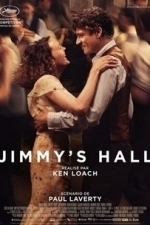
It’s not to often that we folks in America have the opportunity to catch any movies from Ireland.
The few that do come along almost certainly rate high on the scale of exceptional movies that one would want to see. I myself can’t remember a ‘bad’ Irish film. Perhaps one of the reasons for that is the fact that this country has a solid history of countless Irish immigrants coming here and helping to build the foundations for America. Well, today’s film for your consideration doesn’t go back THAT far. It doesn’t even take place in America. However, the history of Irish immigrants (specifically one immigrant) does play a role. Only it involves an Irish immigrant how came to America and then several years later returned to Ireland only to be forcibly deported back to America. I know I know. That explanation makes it sound like a comedy and although the film has many lighthearted moments, I can assure you it’s NOT a comedy. In fact, it deals with an influential figure in one of the more politically turbulent periods in Ireland’s history just before the beginning of the Second World War.
‘Jimmy’s Hall’ is a 2014 Irish-British drama directed by English television and film director Kenneth ‘Ken’ Loach. The film focuses on the events leading up to the deportation from Ireland of Jimmy Gralton, who led a precursor to Ireland’s communist party in the county Leitrim.
Starring Barry Ward, Simone Kirby, and Irish character actor Jim Norton, the film opens in 1932. Jimmy (Ward) has just returned to his home to help his mother tend the family farm after spending 10 years in the United States in the midst of the Great Depression coinciding with the establishment of a new government in the aftermath of the Civil War between pro-British and anti-British forces.
Reluctant to anger his old enemies, the church and the landowners who forced him to leave Ireland, but eager to meet the needs of the people of Leitrim, Jimmy (Ward) decides to reopen the ‘Hall’, a center for young people where they can meet to study, talk, dance, play music, learn to read, debate issues of the day. Free to all and open to anyone who wishes to learn while respecting the views and opinions of others, the ‘Hall’ is an immediate success. Not everyone is pleased to see Jimmy resuming his old activities. In particular the church and local priest (Norton) who see Gralton as not only a ‘bad influence’, but also as a follower of Stalin who as history knows sent countless millions (including religious leaders) to their deaths.
Despite the complaints and at times violent reactions on the part of the supporters of the church and the landowners, Gralton tries desperately to make them realize he has absolutely no connection to Stalin and has no desire to bring down the church. Only to better the situation for everyone. Jimmy even invites the local priest to take a leadership role in the Hall’s committee. In the end though, the fears of the church and the state go unchanged. Jimmy is a communist and although he has no connection Stalin the church and the government see them as one in the same. The police take Jimmy into custody at his family’s farm and forcibly deport him back to America even so much as denying him on last chance to see his ailing mother.
In education systems there are books and films which are considered ‘required reading’ or in this case ‘required viewing’. This film should be required viewing. It is not just an excellent film about a historical Irish political figure or as I mentioned earlier a film about a turbulent point in Irish history. It’s an example of the greater ‘world conflict’ between what became the western bloc and the eastern bloc. Both sides in that grater conflict saw each other the same way the two sides in the Irish countryside of the 1930s saw each other. The ones that meant well and only wanted to better the situation for everyone including themselves inspired fear in those who had power and those who had the power inspired fear in those who meant well. This movie showed that not all political figures are evil … nor are all religious figures. It’s the individual or several individuals within those groups that are reluctant to change.
I would highly recommend this film. Regardless of the content it’s an excellent film. If this film is as good as most films made in Ireland, they definitely need to start exporting them on a grander scale. I’d give this film 4 out of 5 stars.
This is your friendly neighborhood photographer ‘The CameraMan’ and on behalf of my fellows at ‘Skewed & Reviewed’ I’d like to say thanks for reading and we’ll see you at the movies
The few that do come along almost certainly rate high on the scale of exceptional movies that one would want to see. I myself can’t remember a ‘bad’ Irish film. Perhaps one of the reasons for that is the fact that this country has a solid history of countless Irish immigrants coming here and helping to build the foundations for America. Well, today’s film for your consideration doesn’t go back THAT far. It doesn’t even take place in America. However, the history of Irish immigrants (specifically one immigrant) does play a role. Only it involves an Irish immigrant how came to America and then several years later returned to Ireland only to be forcibly deported back to America. I know I know. That explanation makes it sound like a comedy and although the film has many lighthearted moments, I can assure you it’s NOT a comedy. In fact, it deals with an influential figure in one of the more politically turbulent periods in Ireland’s history just before the beginning of the Second World War.
‘Jimmy’s Hall’ is a 2014 Irish-British drama directed by English television and film director Kenneth ‘Ken’ Loach. The film focuses on the events leading up to the deportation from Ireland of Jimmy Gralton, who led a precursor to Ireland’s communist party in the county Leitrim.
Starring Barry Ward, Simone Kirby, and Irish character actor Jim Norton, the film opens in 1932. Jimmy (Ward) has just returned to his home to help his mother tend the family farm after spending 10 years in the United States in the midst of the Great Depression coinciding with the establishment of a new government in the aftermath of the Civil War between pro-British and anti-British forces.
Reluctant to anger his old enemies, the church and the landowners who forced him to leave Ireland, but eager to meet the needs of the people of Leitrim, Jimmy (Ward) decides to reopen the ‘Hall’, a center for young people where they can meet to study, talk, dance, play music, learn to read, debate issues of the day. Free to all and open to anyone who wishes to learn while respecting the views and opinions of others, the ‘Hall’ is an immediate success. Not everyone is pleased to see Jimmy resuming his old activities. In particular the church and local priest (Norton) who see Gralton as not only a ‘bad influence’, but also as a follower of Stalin who as history knows sent countless millions (including religious leaders) to their deaths.
Despite the complaints and at times violent reactions on the part of the supporters of the church and the landowners, Gralton tries desperately to make them realize he has absolutely no connection to Stalin and has no desire to bring down the church. Only to better the situation for everyone. Jimmy even invites the local priest to take a leadership role in the Hall’s committee. In the end though, the fears of the church and the state go unchanged. Jimmy is a communist and although he has no connection Stalin the church and the government see them as one in the same. The police take Jimmy into custody at his family’s farm and forcibly deport him back to America even so much as denying him on last chance to see his ailing mother.
In education systems there are books and films which are considered ‘required reading’ or in this case ‘required viewing’. This film should be required viewing. It is not just an excellent film about a historical Irish political figure or as I mentioned earlier a film about a turbulent point in Irish history. It’s an example of the greater ‘world conflict’ between what became the western bloc and the eastern bloc. Both sides in that grater conflict saw each other the same way the two sides in the Irish countryside of the 1930s saw each other. The ones that meant well and only wanted to better the situation for everyone including themselves inspired fear in those who had power and those who had the power inspired fear in those who meant well. This movie showed that not all political figures are evil … nor are all religious figures. It’s the individual or several individuals within those groups that are reluctant to change.
I would highly recommend this film. Regardless of the content it’s an excellent film. If this film is as good as most films made in Ireland, they definitely need to start exporting them on a grander scale. I’d give this film 4 out of 5 stars.
This is your friendly neighborhood photographer ‘The CameraMan’ and on behalf of my fellows at ‘Skewed & Reviewed’ I’d like to say thanks for reading and we’ll see you at the movies

Lingvo Live Dictionary
Education and Reference
App
Lingvo Live is a service for all who seriously study foreign languages. It is a collection of top...

Pili Pop English: learn English for kids
Education and Games
App
Pili Pop helps your child become bilingual by practicing their English oral skills every day! Winner...

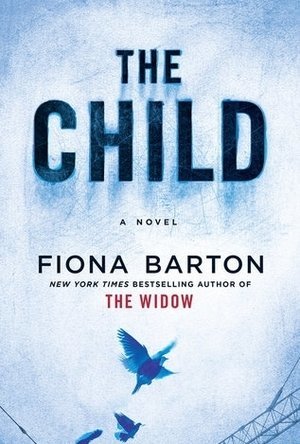
As a worker tears apart an old house under construction in London, he makes an unsettling discovery: tiny bones. The police believe they belong to a baby who was buried years earlier. The story catches the eye of journalist Kate Waters, who immediately wants to determine the child's identity. Her research leads her to a missing child from several decades in the past: a stolen baby, who was never found. Kate finds herself drawn into the missing baby's case and the lives of several women: Angela, a mother who had her baby stolen many years ago; Emma, who once lived on the block where the baby's bones were found; and Jude, Emma's mother.
I really enjoyed Barton's previous novel, The Widow, and I have to say that THE CHILD did not disappoint. It's hard exactly to describe her books, but they have some sort of power over you, drawing you into their narrative and making it difficult to come back to reality until you've reached the end. Much like THE WIDOW, we're presented with a cast of disparate characters-not all of whom are particularly likeable. I hadn't realized, for some reason, that THE CHILD would feature Kate again--a journalist we previously met in Barton's earlier book. I found Kate a much more engaging protagonist this time around: she came across as more human and flawed.
Otherwise, the novel focuses on timid, depressed Emma and her difficult relationship with her mother, Jude, who kicked Emma out of the house at the sixteen. Each woman has a turn at the narration, as does Angela, who is still reeling from having her baby stolen from the hospital (and never found). Barton does a skillful job weaving their stories together. Everything unfolds in bits and pieces as the tale progresses in the eyes of each of our narrators. For me, it was extremely riveting: just as one shocking piece came out, another one would fall into place.
Barton also gives us an excellent look into the journalism business, with a focus on how Kate writes her stories, with a strong emphasis on real (face-to-face, non-Internet-based) research. We see firsthand how the current social media craze is affecting the newspaper world. It's refreshing, as we get to basically see a crime/story solved, yet not necessarily through the lens of a typical police drama.
Overall, I really enjoyed this one. I figured out parts of it as it went along, but found it to be a very compelling read. Definitely worth picking up.
I really enjoyed Barton's previous novel, The Widow, and I have to say that THE CHILD did not disappoint. It's hard exactly to describe her books, but they have some sort of power over you, drawing you into their narrative and making it difficult to come back to reality until you've reached the end. Much like THE WIDOW, we're presented with a cast of disparate characters-not all of whom are particularly likeable. I hadn't realized, for some reason, that THE CHILD would feature Kate again--a journalist we previously met in Barton's earlier book. I found Kate a much more engaging protagonist this time around: she came across as more human and flawed.
Otherwise, the novel focuses on timid, depressed Emma and her difficult relationship with her mother, Jude, who kicked Emma out of the house at the sixteen. Each woman has a turn at the narration, as does Angela, who is still reeling from having her baby stolen from the hospital (and never found). Barton does a skillful job weaving their stories together. Everything unfolds in bits and pieces as the tale progresses in the eyes of each of our narrators. For me, it was extremely riveting: just as one shocking piece came out, another one would fall into place.
Barton also gives us an excellent look into the journalism business, with a focus on how Kate writes her stories, with a strong emphasis on real (face-to-face, non-Internet-based) research. We see firsthand how the current social media craze is affecting the newspaper world. It's refreshing, as we get to basically see a crime/story solved, yet not necessarily through the lens of a typical police drama.
Overall, I really enjoyed this one. I figured out parts of it as it went along, but found it to be a very compelling read. Definitely worth picking up.

Fishing Kings Free+
Games and Entertainment
App
Now you can play the best fishing game on mobile for FREE! Grab your rod and make the biggest...

Purple Phoenix Games (2266 KP) rated Tutankhamun in Tabletop Games
Jul 9, 2021
Tutankhamun (per dictionary.com, the pronunciation is as such: [ toot-ahng-kah-muhn ]) is regularly shortened and often referred to as “King Tut.” My real question is that if the first syllable is “toot,” why do we not call him King Toot? I have a 5 year old boy and a 2 year old girl at the time of this writing, so I can tell you EXACTLY why we don’t call him King Toot, but that’s for another discussion. Never having played the original version, will I enjoy this new version of the game by world-renowned designer Dr. Reiner Knizia?
In Tutankhamun, players take on the roles of Egyptian priests attempting to cleanse their souls by gifting the sarcophagus with relics found along the Nile River. The priest who can cleanse their soul quickest will be proclaimed the next High Priest and winner of the game!
DISCLAIMER: We were provided a copy of this game for the purposes of this review. This is a retail copy of the game, so what you see in these photos is exactly what would be received in your box. I do not intend to cover every single rule included in the rulebook, but will describe the overall game flow and major rule set so that our readers may get a sense of how the game plays. For more in depth rules, you may purchase a copy online or from your FLGS. -T
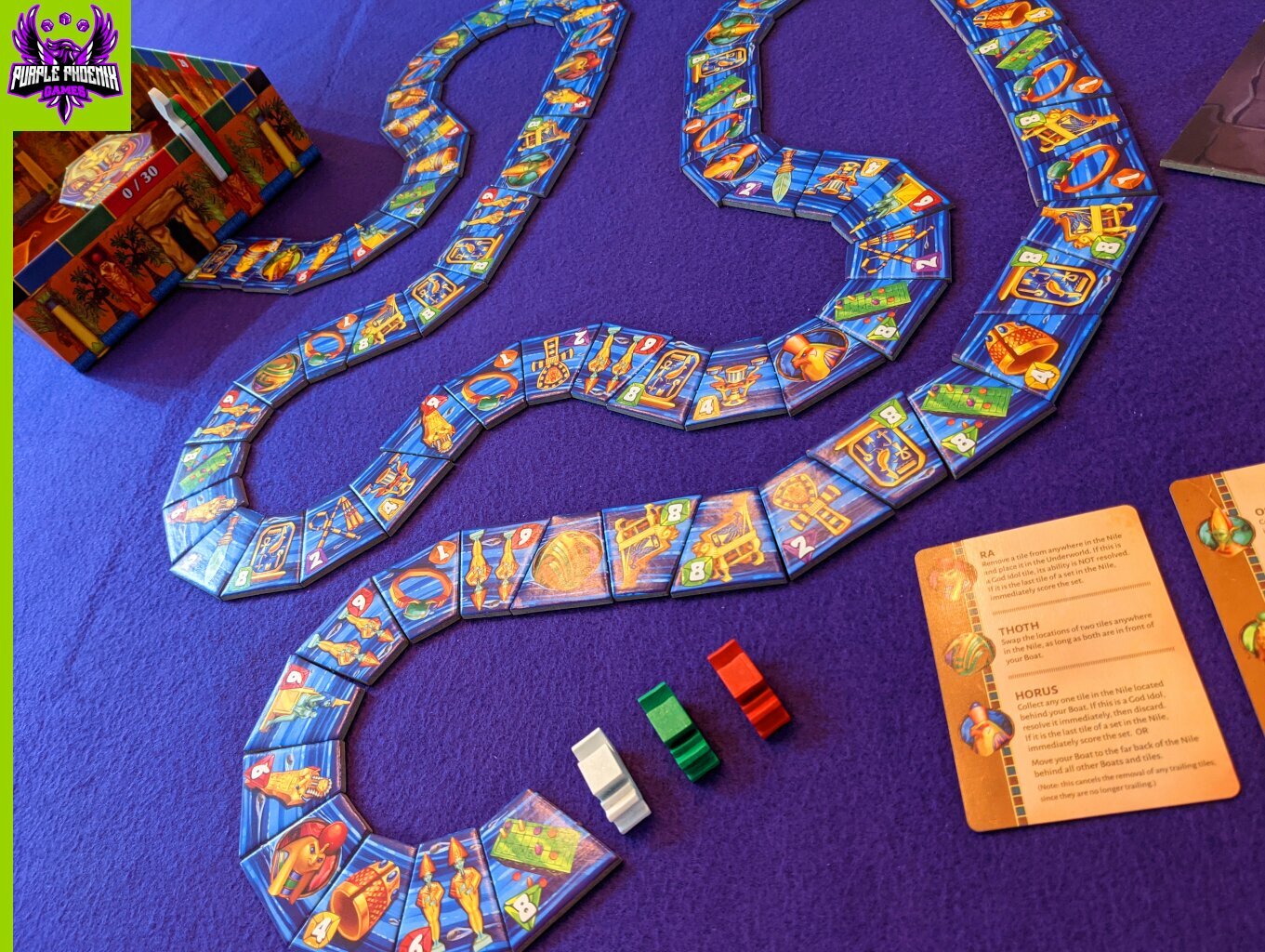
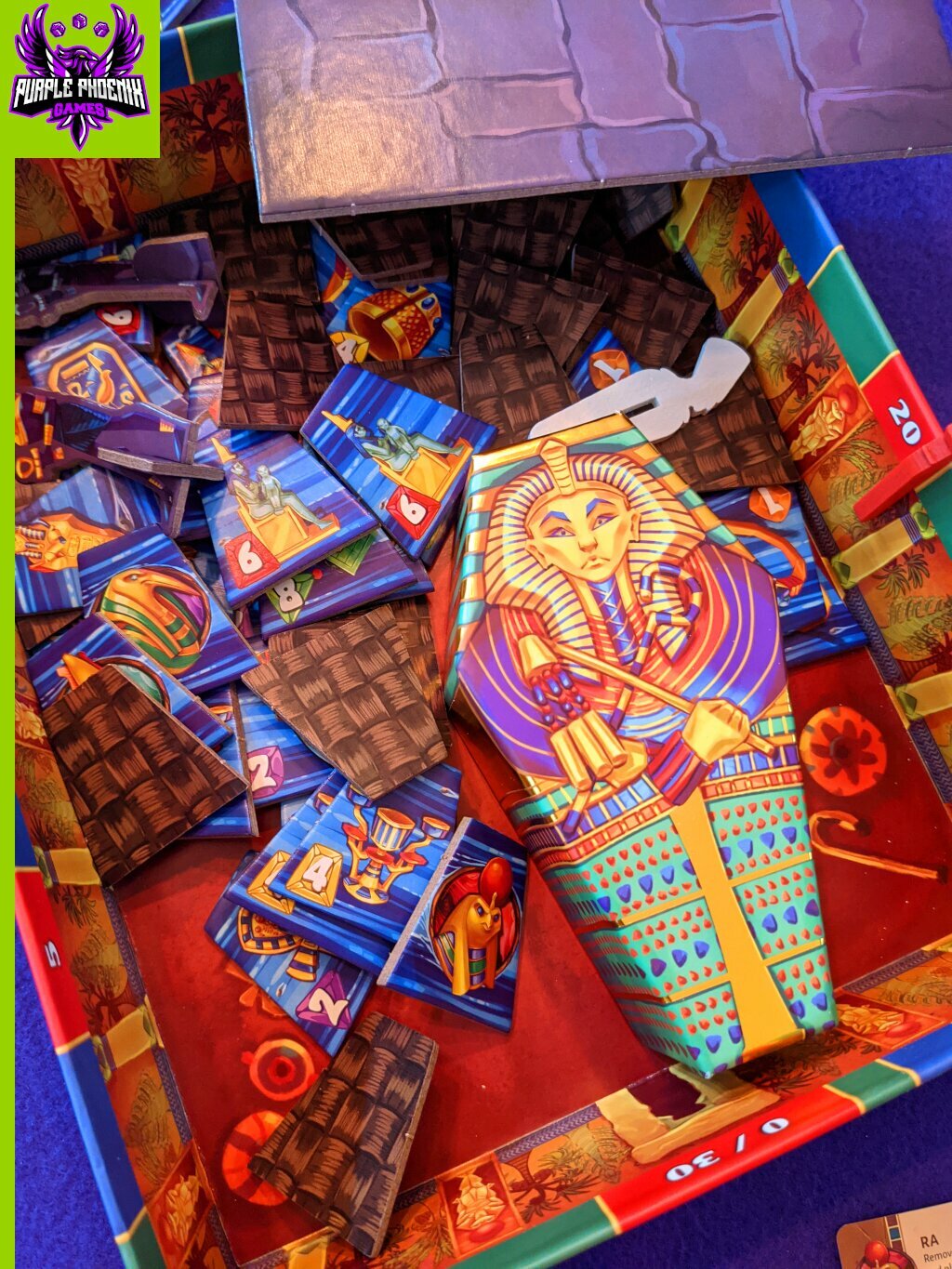
To setup, place the King Tut sarcophagus on the table somewhere inside the box bottom. From this starting place (or you could place these components last I suppose), begin the laborious job of creating the Nile from the trapezoidal Relic TIles. This part took me a good several minutes each game. Place out the Underworld Mat near the start of the Nile, and place upon it the two Guardian Statue standees. From there give every player a reference card, have them choose a player color, place their boats at the start of the Nile, and Canopic Jar scoring markers on the appropriate space along the box bottom score track. The game may now begin!
Tutankhamun is played in turns starting with the starting player and proceeding clockwise. The starting player will choose ANY Relic Tile to collect and move their boat to that location. Once collected, the player will check to make sure there are still matching Relics along the Nile. If so, then play continues to the next player. If the active player had collected the last Relic of that type still active in the game, then the Relic type is scored.
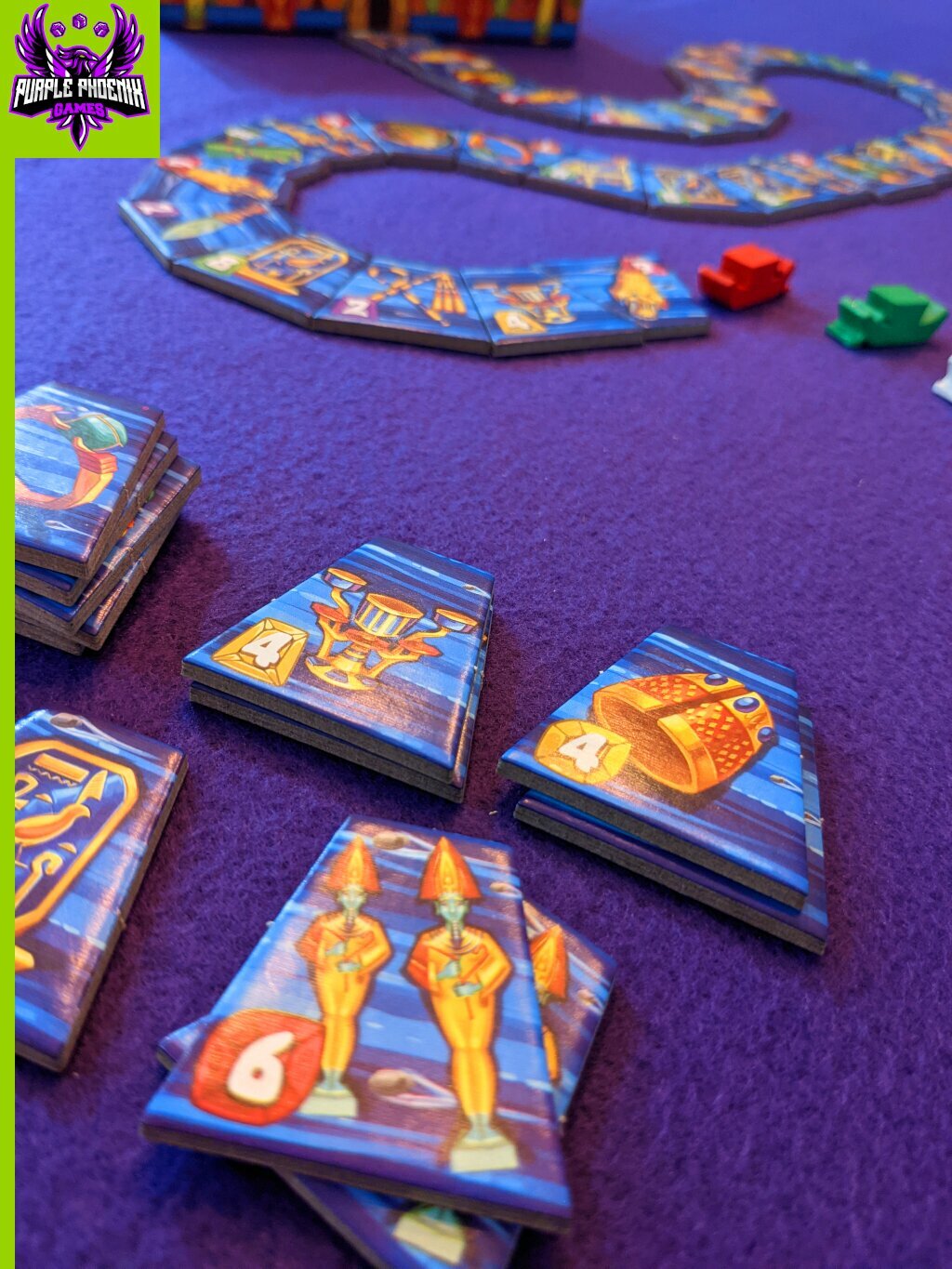
Each Relic Tile features art of a Relic, a God, or a Scarab Ring. Relics come in sets, and when the final Relic of its type is collected, scoring immediately follows. Whichever player possesses the most Relic Tiles of the one being scored will earn points (or rather, negative points, as the priests are trying to cleanse their souls down to the winning score of zero) equal to the number printed on the tile. That number stands for the score earned as well as the number of Relics of that type in the game. The player with the second most Relics of the scored type will score half the number printed on the tile. All others do not score.
God Tiles feature art of one of five ancient Egyptian Gods: Osiris, Isis, Ra, Thoth, and Horus. Each of these Gods provide the collecting player with special powers to be used during the turn, and are always positive for the player.
Finally, Scarab Ring tiles are special in that they feature no number upon them. There are 10 tiles in the game, and as soon as a player collects one they immediately score one point (or one negative point). These tiles are not thrown into the box bottom, as the other scoring tiles are once scored, but are kept with the players to be scored at the end of the game. The player holding the most Scarab Tiles scores five negative points.
Any tile along the Nile that has been passed by all players is deposited onto the Underworld Mat and not added to the box bottom with the King Tut sarcophagus. Tiles may still be collected from the Underworld by permission of the Gods being collected in-game. Whichever priest is able to dwindle down their points and cleanse their soul first will win the game and become the next High Priest of Egypt!
Components. I am more and more becoming a fan of everything 25th Century Games is putting out. This is certainly no exception. I have seen photos of the original versions of this game, entitled Tutankhamen (with an E at the end instead of a U) and this game was certainly begging for a renovation. All the components have updated art, more vibrant colors, and the game even includes luxurious (and completely unnecessary) components. These are the very cool, but very unnecessary King Tut sarcophagus, and the Guardian Statue standees that add nothing to the gameplay but definitely help set the mood and theme. That all said, this version looks amazing on the table and has nearly infinite setup configurations!
What I like most about the game is the fact that on a player’s turn they can literally move forward to ANYWHERE along the Nile to gather whatever Relic they wish. They can pass up a tile or twelve along the way to snatch exactly what they want. However, the quicker a player reaches the sarcophagus does not automatically make them the winner. No, they still need to reduce their soul spirit score to zero in order to win (or be closest by the time all players reach the final spot). Conversely, dilly-dallying along the River just picking up every available tile also will not guarantee a victory. Specializing in a select few items may be the ticket to a victory, or setting oneself to win a couple types and win runner-up on the remainder may be a great path to victory.
Unlike many other games with this lazy race mechanic, the player furthest back does NOT get to keep taking turns to catch up (I’m looking at you, Tokaido), but rather just means that player has many more options ahead of themselves than the other players have. This is very interesting to me, and definitely something worth exploring more. It makes for tough turns when players have to really crunch which options are best for them: take the tile right ahead of them, diversify vs bolster the collection, or hate block another player by taking what you know they need. Ahh, so beautiful are the choices given!
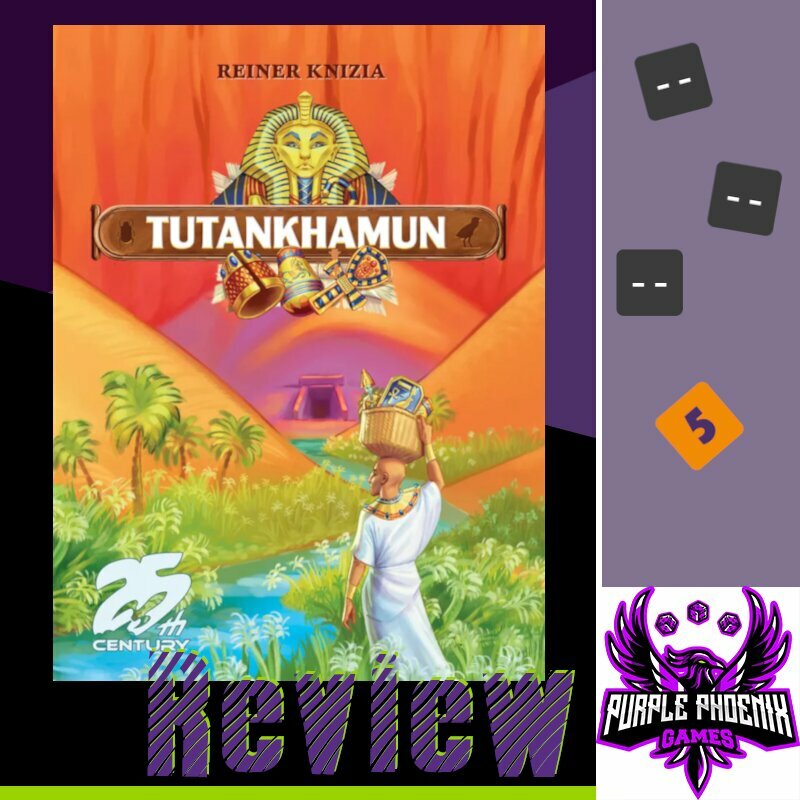
At the end of the day (and this review), Purple Phoenix Games gives this one an Obama-meme-where-he-is-drinking-a-beer-and-giving-a-thumbs-up 5 / 6. I would certainly not have purchased this game in its original form had I seen it in a game store. However, with the changes made to make it more pretty, I would have given it a chance. I am so very glad I have the opportunity to play this a lot, as I can see this getting to the table allllllll the time. It is right up my alley, and I place it high among other Knizia games. Long live King Toot!!
In Tutankhamun, players take on the roles of Egyptian priests attempting to cleanse their souls by gifting the sarcophagus with relics found along the Nile River. The priest who can cleanse their soul quickest will be proclaimed the next High Priest and winner of the game!
DISCLAIMER: We were provided a copy of this game for the purposes of this review. This is a retail copy of the game, so what you see in these photos is exactly what would be received in your box. I do not intend to cover every single rule included in the rulebook, but will describe the overall game flow and major rule set so that our readers may get a sense of how the game plays. For more in depth rules, you may purchase a copy online or from your FLGS. -T
To setup, place the King Tut sarcophagus on the table somewhere inside the box bottom. From this starting place (or you could place these components last I suppose), begin the laborious job of creating the Nile from the trapezoidal Relic TIles. This part took me a good several minutes each game. Place out the Underworld Mat near the start of the Nile, and place upon it the two Guardian Statue standees. From there give every player a reference card, have them choose a player color, place their boats at the start of the Nile, and Canopic Jar scoring markers on the appropriate space along the box bottom score track. The game may now begin!
Tutankhamun is played in turns starting with the starting player and proceeding clockwise. The starting player will choose ANY Relic Tile to collect and move their boat to that location. Once collected, the player will check to make sure there are still matching Relics along the Nile. If so, then play continues to the next player. If the active player had collected the last Relic of that type still active in the game, then the Relic type is scored.
Each Relic Tile features art of a Relic, a God, or a Scarab Ring. Relics come in sets, and when the final Relic of its type is collected, scoring immediately follows. Whichever player possesses the most Relic Tiles of the one being scored will earn points (or rather, negative points, as the priests are trying to cleanse their souls down to the winning score of zero) equal to the number printed on the tile. That number stands for the score earned as well as the number of Relics of that type in the game. The player with the second most Relics of the scored type will score half the number printed on the tile. All others do not score.
God Tiles feature art of one of five ancient Egyptian Gods: Osiris, Isis, Ra, Thoth, and Horus. Each of these Gods provide the collecting player with special powers to be used during the turn, and are always positive for the player.
Finally, Scarab Ring tiles are special in that they feature no number upon them. There are 10 tiles in the game, and as soon as a player collects one they immediately score one point (or one negative point). These tiles are not thrown into the box bottom, as the other scoring tiles are once scored, but are kept with the players to be scored at the end of the game. The player holding the most Scarab Tiles scores five negative points.
Any tile along the Nile that has been passed by all players is deposited onto the Underworld Mat and not added to the box bottom with the King Tut sarcophagus. Tiles may still be collected from the Underworld by permission of the Gods being collected in-game. Whichever priest is able to dwindle down their points and cleanse their soul first will win the game and become the next High Priest of Egypt!
Components. I am more and more becoming a fan of everything 25th Century Games is putting out. This is certainly no exception. I have seen photos of the original versions of this game, entitled Tutankhamen (with an E at the end instead of a U) and this game was certainly begging for a renovation. All the components have updated art, more vibrant colors, and the game even includes luxurious (and completely unnecessary) components. These are the very cool, but very unnecessary King Tut sarcophagus, and the Guardian Statue standees that add nothing to the gameplay but definitely help set the mood and theme. That all said, this version looks amazing on the table and has nearly infinite setup configurations!
What I like most about the game is the fact that on a player’s turn they can literally move forward to ANYWHERE along the Nile to gather whatever Relic they wish. They can pass up a tile or twelve along the way to snatch exactly what they want. However, the quicker a player reaches the sarcophagus does not automatically make them the winner. No, they still need to reduce their soul spirit score to zero in order to win (or be closest by the time all players reach the final spot). Conversely, dilly-dallying along the River just picking up every available tile also will not guarantee a victory. Specializing in a select few items may be the ticket to a victory, or setting oneself to win a couple types and win runner-up on the remainder may be a great path to victory.
Unlike many other games with this lazy race mechanic, the player furthest back does NOT get to keep taking turns to catch up (I’m looking at you, Tokaido), but rather just means that player has many more options ahead of themselves than the other players have. This is very interesting to me, and definitely something worth exploring more. It makes for tough turns when players have to really crunch which options are best for them: take the tile right ahead of them, diversify vs bolster the collection, or hate block another player by taking what you know they need. Ahh, so beautiful are the choices given!
At the end of the day (and this review), Purple Phoenix Games gives this one an Obama-meme-where-he-is-drinking-a-beer-and-giving-a-thumbs-up 5 / 6. I would certainly not have purchased this game in its original form had I seen it in a game store. However, with the changes made to make it more pretty, I would have given it a chance. I am so very glad I have the opportunity to play this a lot, as I can see this getting to the table allllllll the time. It is right up my alley, and I place it high among other Knizia games. Long live King Toot!!
Merissa (14188 KP) rated Warrior Hearts Academy: Dragon Rule in Books
May 18, 2025
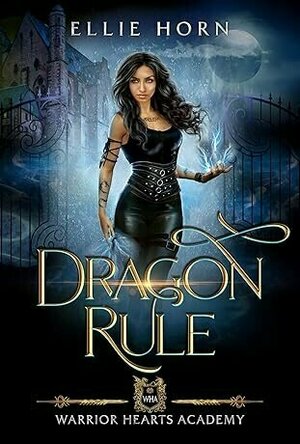

DRAGON RULE is the third and final book in the Warrior Hearts Academy Dragon trilogy and brings a satisfying conclusion to Bree's story. I say Bree's because she is the one who brings and holds them all together. This MUST be read after the other two books as the story continues on from where it left off.
In other words, Bree is taken by Victor, Riggs is unable to shift, Caliel is still fighting a losing battle against the Ice Drake, and Tez is still someone who leaves a lot to be desired. Does this change?
Erm, yes. Just a little bit! The storyline is amazing and so intricate. I loved watching the pieces fall into place. And seeing Bree become stronger with every passing moment, while still retaining the core essence of who she was, was outstanding. I even warmed up to Tez! Now, how about that?!
If I had one niggle, it would be Nar and the informant. It was never actually confirmed for sure that it was one and the same, so will be playing on my mind.
I really hope this isn't the end of this world. There are open-ended moments that could be followed on (cough, cough, Mykhal) but this one concludes nicely. Now, I want to go back (in their time) and read all of the others from the beginning to get the full experience!
A great read that I thoroughly enjoyed and ABSOLUTELY RECOMMENDED.
** Same worded review will appear elsewhere. **
* A copy of this book was provided to me with no requirements for a review. I voluntarily read this book; the comments here are my honest opinion. *
Merissa
Archaeolibrarian - I Dig Good Books!
May 18, 2025
In other words, Bree is taken by Victor, Riggs is unable to shift, Caliel is still fighting a losing battle against the Ice Drake, and Tez is still someone who leaves a lot to be desired. Does this change?
Erm, yes. Just a little bit! The storyline is amazing and so intricate. I loved watching the pieces fall into place. And seeing Bree become stronger with every passing moment, while still retaining the core essence of who she was, was outstanding. I even warmed up to Tez! Now, how about that?!
If I had one niggle, it would be Nar and the informant. It was never actually confirmed for sure that it was one and the same, so will be playing on my mind.
I really hope this isn't the end of this world. There are open-ended moments that could be followed on (cough, cough, Mykhal) but this one concludes nicely. Now, I want to go back (in their time) and read all of the others from the beginning to get the full experience!
A great read that I thoroughly enjoyed and ABSOLUTELY RECOMMENDED.
** Same worded review will appear elsewhere. **
* A copy of this book was provided to me with no requirements for a review. I voluntarily read this book; the comments here are my honest opinion. *
Merissa
Archaeolibrarian - I Dig Good Books!
May 18, 2025

Jamie (131 KP) rated Nasty Women in Books
May 24, 2017
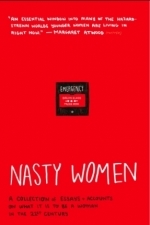

A timely collection of personal and political essays
It was really cool to get to see the world through the eyes of women coming from walks of life entirely removed from my own. There were many whose struggles I couldn’t even begin to imagine dealing with, while others I found comfort that I wasn’t alone in the issues that I have faced. The anthology really does cover a wide range of topics by authors from drastically different backgrounds.
The one essay that stood out the most to me was “Choices” by Rowan C. Clarke, which discussed the author’s difficult relationship with her mother and that never ending struggle to please. While the underlying messages in all of the stories were political and feminist, they were also very personal and down to earth which is what made this collection pretty emotional.
I did have a few issues with the anthology, however, that I need to address. The first was that the quality of each essay varied pretty wildly. The version I read was an ARC so it’s difficult for me to judge the final product, but there were several that weren’t well structured or were rife with grammatical and formatting errors. There were citations (I love citations!) that weren’t formatted all that well for my ebook version (cutting into the middle of paragraphs) that perhaps would’ve been better placed at the end. As for the actual content, most were incredibly well written and heartfelt, a few felt like angry rants that were more alienating than empowering, then there was one that just felt stiff and spent more time with the preface rather than the story.
While on the subject of alienation, despite the rather diverse sets of authors and essays, I feel like there were some missing pieces still. It’s obvious from the title what many of the authors thought about the last election and I didn’t like how black and white things were with barely any room in-between. In cases like this, I’m sure most of the readers would be those looking for confirmation of beliefs that they already share, which is fine except that it closes the door on discussion with the other side which is truly unfortunate.
Don’t get me wrong, I think that what was already here was pretty great. I see what they were going for and I appreciated it. I love to see discussion about politics and social issues, but I worry when the tone leans too far toward one extreme it only invites backlash from the other extreme. It’s a difficult balancing act between maintaining one’s own core beliefs while also trying to open things up to the other side so that perhaps they could engage in the conversation and, ideally, listen and have their own perceptions changed.
But I digress, despite the complaints I had about the book, I found it to be a pretty quick and enjoyable read. It gives a voice to groups of women that aren’t often heard in the greater narrative of the feminist movement. The experiences of these many women enrich that narrative and there’s a lot we can all learn from each other especially in these troubling times.
The one essay that stood out the most to me was “Choices” by Rowan C. Clarke, which discussed the author’s difficult relationship with her mother and that never ending struggle to please. While the underlying messages in all of the stories were political and feminist, they were also very personal and down to earth which is what made this collection pretty emotional.
I did have a few issues with the anthology, however, that I need to address. The first was that the quality of each essay varied pretty wildly. The version I read was an ARC so it’s difficult for me to judge the final product, but there were several that weren’t well structured or were rife with grammatical and formatting errors. There were citations (I love citations!) that weren’t formatted all that well for my ebook version (cutting into the middle of paragraphs) that perhaps would’ve been better placed at the end. As for the actual content, most were incredibly well written and heartfelt, a few felt like angry rants that were more alienating than empowering, then there was one that just felt stiff and spent more time with the preface rather than the story.
While on the subject of alienation, despite the rather diverse sets of authors and essays, I feel like there were some missing pieces still. It’s obvious from the title what many of the authors thought about the last election and I didn’t like how black and white things were with barely any room in-between. In cases like this, I’m sure most of the readers would be those looking for confirmation of beliefs that they already share, which is fine except that it closes the door on discussion with the other side which is truly unfortunate.
Don’t get me wrong, I think that what was already here was pretty great. I see what they were going for and I appreciated it. I love to see discussion about politics and social issues, but I worry when the tone leans too far toward one extreme it only invites backlash from the other extreme. It’s a difficult balancing act between maintaining one’s own core beliefs while also trying to open things up to the other side so that perhaps they could engage in the conversation and, ideally, listen and have their own perceptions changed.
But I digress, despite the complaints I had about the book, I found it to be a pretty quick and enjoyable read. It gives a voice to groups of women that aren’t often heard in the greater narrative of the feminist movement. The experiences of these many women enrich that narrative and there’s a lot we can all learn from each other especially in these troubling times.