Search
Search results
Cooking Games Chef Restaurant
Games
App
Cooking Games Chef Restaurant is a New Free game for kids, mothers and entire families that love...

Haley Mathiot (9 KP) rated Blood Red Road (Dust Lands, #1) in Books
Apr 27, 2018
Blood Red Road has a searing pace, a poetically minimal writing style, violent action, and an epic love story. Moira Young is one of the most promising and startling new voices in teen fiction.
Blood Red Road completely took over my life for the few hours I was reading it. I found myself physically excited from reading. It was one of those books where you forget how long you've been reading and you look up to discover it's four hours later than it was five minutes ago, and the book is almost over. Dang. Then someone calls you to do chores and you get upset because you can't stop reading now!
Blood Red Road has everything a book should have: Immediately developed characters, tension the whole time, a multi-layered plot, and conflict around ever turn.
It seemed that one thing just naturally led to another—and that's the way it should be. Things don't always go as planned, people don't always do as you tell them to, and we're not always honest with ourselves about our feelings and motives. There were so many different layers, so many different things that influenced the book, that it felt real.
The writing was interesting. It was written the way the characters spoke. "Aks" instead of "Ask," "Thinkin" instead of "Thinking," "Fer" instead of "for," and a lot of slang like "kinda" and "ain't." At first it was really annoying, but then I got used to it and it didn't bother me. It slowed down my reading a little, but it didn't interfere with the pacing of the book (just my reading speed). It greatly added to the characters.
People betray us. People change. People fall in love. They argue with each other, they hate and they love at the same time, they put up with crap and they pitch fits. And that's what happens, so that's the way the characters were. I loved the change in Saba and Emmi's relationship (Emmi is her little sister) and I loved the growth, tearing down, tension, and forgiveness in the relationship between Saba and Jack.
Of course it wouldn't have been complete without a love story. Saba is so totally against outside help, so against Jack's attention (or maybe just terrified of it), that it causes an annoying and infuriating love story that gave me flashbacks to Mortal Instruments. (Only much better, because Jack is much more of a man than Jace. They both flirt about as often, though...)
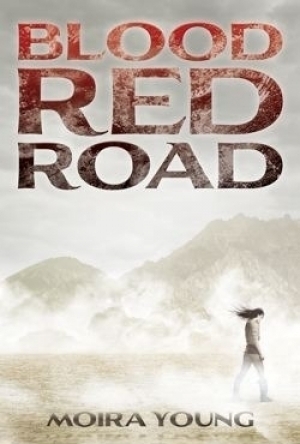
I liked everything about this book except that it's only 512 pages. I didn't want it to end. I even like the cover. I saw it and thought "Oh I'm going to like that book." Saba looked like a kick-ass heroine. She is. I like her a lot (when she's not being a smart-aleck to Jack, and a jerk to her little sister).
And now I wait. This happened to me when I read The Hunger Games, Birthmarked, and Magic Under Glass, too. I read it first (either the day it was released, or I read the ARC), then had to wait longer than everyone else to get the sequel because I read it before they did. It stinks. Luckily, Blood Red Road doesn't have the horrible cliff hanger endings that Suzanne Collins, Cassandra Claire, and Jaclyn Dolamore have in their books. However, you can bet I will be holding my breath for the next one. Moria Young is going on my "auto-buy" list.
Content: Some violence, but not gore. I don't remember if there was any minor language, but there was so strong language. No sex. Ages 14+

Blood Red Road completely took over my life for the few hours I was reading it. I found myself physically excited from reading. It was one of those books where you forget how long you've been reading and you look up to discover it's four hours later than it was five minutes ago, and the book is almost over. Dang. Then someone calls you to do chores and you get upset because you can't stop reading now!
Blood Red Road has everything a book should have: Immediately developed characters, tension the whole time, a multi-layered plot, and conflict around ever turn.
It seemed that one thing just naturally led to another—and that's the way it should be. Things don't always go as planned, people don't always do as you tell them to, and we're not always honest with ourselves about our feelings and motives. There were so many different layers, so many different things that influenced the book, that it felt real.
The writing was interesting. It was written the way the characters spoke. "Aks" instead of "Ask," "Thinkin" instead of "Thinking," "Fer" instead of "for," and a lot of slang like "kinda" and "ain't." At first it was really annoying, but then I got used to it and it didn't bother me. It slowed down my reading a little, but it didn't interfere with the pacing of the book (just my reading speed). It greatly added to the characters.
People betray us. People change. People fall in love. They argue with each other, they hate and they love at the same time, they put up with crap and they pitch fits. And that's what happens, so that's the way the characters were. I loved the change in Saba and Emmi's relationship (Emmi is her little sister) and I loved the growth, tearing down, tension, and forgiveness in the relationship between Saba and Jack.
Of course it wouldn't have been complete without a love story. Saba is so totally against outside help, so against Jack's attention (or maybe just terrified of it), that it causes an annoying and infuriating love story that gave me flashbacks to Mortal Instruments. (Only much better, because Jack is much more of a man than Jace. They both flirt about as often, though...)
I liked everything about this book except that it's only 512 pages. I didn't want it to end. I even like the cover. I saw it and thought "Oh I'm going to like that book." Saba looked like a kick-ass heroine. She is. I like her a lot (when she's not being a smart-aleck to Jack, and a jerk to her little sister).
And now I wait. This happened to me when I read The Hunger Games, Birthmarked, and Magic Under Glass, too. I read it first (either the day it was released, or I read the ARC), then had to wait longer than everyone else to get the sequel because I read it before they did. It stinks. Luckily, Blood Red Road doesn't have the horrible cliff hanger endings that Suzanne Collins, Cassandra Claire, and Jaclyn Dolamore have in their books. However, you can bet I will be holding my breath for the next one. Moria Young is going on my "auto-buy" list.
Content: Some violence, but not gore. I don't remember if there was any minor language, but there was so strong language. No sex. Ages 14+
Goddess in the Stacks (553 KP) rated Alanna: The First Adventure in Books
Apr 16, 2018
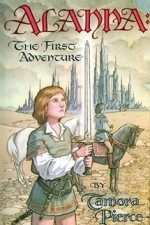
The Song of the Lioness quartet is Tamora Pierce's first set of books. I read her latest trilogy (the Beka Cooper trilogy) first, which didn't exactly prepare me for The Song of the Lioness. It's obvious, going from the latest trilogy to her first writing, how much her writing has matured since the 80s. My first thought upon completing Alanna: the First Adventure was "I'm very glad she's gotten better at writing!" The story itself is still interesting and worth reading, but the style is a little difficult to read when I KNOW how well she writes now. The characters are mostly one-dimensional; few of the side characters seem to have plots going or events happening to them when they're not with Alanna. Characters pop up, have a significant interaction with Alanna, and are gone again, with no indication they exist outside of their usefulness to the main character. This is in stark contrast to her latest work, where every character that has a significant role to play has a history of their own, and thoughts and feelings of their own. They're much more fleshed out in her recent books.
That complaint aside, the Alanna books are really the foundation that the rest of Tortall was built upon. It's interesting to see how Pierce has fleshed out some of the concepts she touched on in the Alanna saga, and it's fun to see where some of the things from the Beka Cooper trilogy originated. It also pays to keep in mind that though the Alanna books were written first, the Beka Cooper trilogy is based two hundred years earlier. We learn a lot more about the office of The Rogue in the Beka Cooper trilogy, something that isn't explained very well in the Alanna quartet, even though one of Alanna's main romantic interests is George Cooper (yes, a descendant of Beka!), the Rogue. Pierce also never explains the origins of Alanna's cat, Faithful, in the actual Alanna books. That explanation lies in the Beka Cooper books as well.
The Song of the Lioness quartet is the story of a girl who decides to rebel against tradition and follow her heart to become a knight. In her time, ladies simply do NOT become knights. They learn to organize households and marry well. Alanna, however, is lucky enough to have a twin brother who does not want to become a knight; instead Thom wants to be a mage. So when they're sent off to face their futures, they switch places, with Alanna becoming "Alan", the younger twin. (Thom stays Thom; the school that ladies are sent to is the same school mages start at.)
Alan/Alanna begins as a page, then moves to squire, and eventually a knight. Her secret is discovered, but due to her influential friends, most of whom knew she was a girl by then, she is able to keep her status. Her adventures take her from uncovering a plot against the royal family, to being adopted by a desert tribe, to recovering a magic jewel of prosperity, with many small adventures in between.
I love reading Pierce's heroines; both Alanna and Beka have problems reconciling their feminine natures with the work they've chosen. The scenes where Alanna's love interests see her in a dress for the first time, instead of her normal boy-garb and armor, is heart-warming in one case, and sad in another. In both womens' lives it's the man who can accept all of their aspects who ultimately wins their heart, which is a wonderful message.
Ultimately, the technical flaws in the writing of the Alanna saga faded as I became absorbed in the story. I'll be requesting more Tortall books from the library in the near future!
You can find all my reviews at http://goddessinthestacks.wordpress.com
That complaint aside, the Alanna books are really the foundation that the rest of Tortall was built upon. It's interesting to see how Pierce has fleshed out some of the concepts she touched on in the Alanna saga, and it's fun to see where some of the things from the Beka Cooper trilogy originated. It also pays to keep in mind that though the Alanna books were written first, the Beka Cooper trilogy is based two hundred years earlier. We learn a lot more about the office of The Rogue in the Beka Cooper trilogy, something that isn't explained very well in the Alanna quartet, even though one of Alanna's main romantic interests is George Cooper (yes, a descendant of Beka!), the Rogue. Pierce also never explains the origins of Alanna's cat, Faithful, in the actual Alanna books. That explanation lies in the Beka Cooper books as well.
The Song of the Lioness quartet is the story of a girl who decides to rebel against tradition and follow her heart to become a knight. In her time, ladies simply do NOT become knights. They learn to organize households and marry well. Alanna, however, is lucky enough to have a twin brother who does not want to become a knight; instead Thom wants to be a mage. So when they're sent off to face their futures, they switch places, with Alanna becoming "Alan", the younger twin. (Thom stays Thom; the school that ladies are sent to is the same school mages start at.)
Alan/Alanna begins as a page, then moves to squire, and eventually a knight. Her secret is discovered, but due to her influential friends, most of whom knew she was a girl by then, she is able to keep her status. Her adventures take her from uncovering a plot against the royal family, to being adopted by a desert tribe, to recovering a magic jewel of prosperity, with many small adventures in between.
I love reading Pierce's heroines; both Alanna and Beka have problems reconciling their feminine natures with the work they've chosen. The scenes where Alanna's love interests see her in a dress for the first time, instead of her normal boy-garb and armor, is heart-warming in one case, and sad in another. In both womens' lives it's the man who can accept all of their aspects who ultimately wins their heart, which is a wonderful message.
Ultimately, the technical flaws in the writing of the Alanna saga faded as I became absorbed in the story. I'll be requesting more Tortall books from the library in the near future!
You can find all my reviews at http://goddessinthestacks.wordpress.com
Ryan Hill (152 KP) rated The Incredible Hulk (2008) in Movies
May 9, 2019
"As far as I'm concerned, that man's whole body is property of the U.S. army."
I will defend this gem until the day I die.
The Incredible Hulk is without a doubt one of the most underrated, underappreciated film's that I have ever seen. There it is. I'm just putting it out there. Don't worry, I have my reasons that I'll get into but if you don't like this film, if you hate this film even, I encourage you to read this review. I encourage this because I hope to open your eyes to how beautiful and tragic The Incredible Hulk is.
For one, let's take it back to May 1962 when Stan Lee and Jack Kirby introduced to us, in his very own debut issue, the Hulk himself. According to interviews, Lee spoke of how this film truly captured the essence of the character and the comics. In those comics, General Thunderbolt Ross, along with the military, was always chasing Dr. Banner ever since the accident. This is portrayed brilliantly here by Louis Leterrier. I'm not a huge fan of his work but I got to give credit where credit's due.
I don't even know where to start for positives because there's so many. For one, Edward Norton is brilliant (yes brilliant) as Bruce Banner. His performance is so emotionally subdued, filled with great sadness and longing. They even show him suffering from PTSD, which has never been touched on with this character on film. Really great stuff on Norton's part. We also get to finally see Bruce Banner be a scientist. We've seen it in the future films sure, but not to this extent. Bruce is working with scraps, using solely his wits, in a third world country . . . just like in the comics.
The story of Hulk is really a tragic love story. I got serious King Kong vibes from the similar dynamic here and it's beautiful. The chemistry between Banner and Elizabeth Ross is great. It's so believable; two people put in an impossible situation and making it work. That's love.
Hulk's character is so well realized here. He suffers from PTSD like I said, but the actual monster himself is perfect. They even throw in a bit of a horror vibe for the first Hulk-out scene. Oh yeah, there's numerous Hulk-out scenes!!! There's so many great omages to the comics as well and I loved every bit of it.
Lastly, looking at it from a technical side it's great. The cinematography is extremely well done and a total feast for the eyes. The pacing is great and goes by like the snap of Thanos himself. The editing is top-notch. The soundtrack by Craig Armstrong is one of my favorites of all time and is so iconic and beautiful. Finally, there's a serious tone. FINALLY. There are some well incorporated jokes but unlike some other Marvel films, it's not overbearing.
As for negatives, they are almost none to nonexistent. Really just nitpicks. The taxi scene is a bit unrealistic and silly. It's the only scene of humor that felt a bit forced and silly, yet I can easily ignore it. But since this is an analysis, I had to mention it. Also, unlike Ruffalo's Hulk, Norton's Hulk doesn't look very similar to Norton himself. Again, purely a nitpick.
Overall, I absolutely love The Incredible Hulk
The Incredible Hulk is without a doubt one of the most underrated, underappreciated film's that I have ever seen. There it is. I'm just putting it out there. Don't worry, I have my reasons that I'll get into but if you don't like this film, if you hate this film even, I encourage you to read this review. I encourage this because I hope to open your eyes to how beautiful and tragic The Incredible Hulk is.
For one, let's take it back to May 1962 when Stan Lee and Jack Kirby introduced to us, in his very own debut issue, the Hulk himself. According to interviews, Lee spoke of how this film truly captured the essence of the character and the comics. In those comics, General Thunderbolt Ross, along with the military, was always chasing Dr. Banner ever since the accident. This is portrayed brilliantly here by Louis Leterrier. I'm not a huge fan of his work but I got to give credit where credit's due.
I don't even know where to start for positives because there's so many. For one, Edward Norton is brilliant (yes brilliant) as Bruce Banner. His performance is so emotionally subdued, filled with great sadness and longing. They even show him suffering from PTSD, which has never been touched on with this character on film. Really great stuff on Norton's part. We also get to finally see Bruce Banner be a scientist. We've seen it in the future films sure, but not to this extent. Bruce is working with scraps, using solely his wits, in a third world country . . . just like in the comics.
The story of Hulk is really a tragic love story. I got serious King Kong vibes from the similar dynamic here and it's beautiful. The chemistry between Banner and Elizabeth Ross is great. It's so believable; two people put in an impossible situation and making it work. That's love.
Hulk's character is so well realized here. He suffers from PTSD like I said, but the actual monster himself is perfect. They even throw in a bit of a horror vibe for the first Hulk-out scene. Oh yeah, there's numerous Hulk-out scenes!!! There's so many great omages to the comics as well and I loved every bit of it.
Lastly, looking at it from a technical side it's great. The cinematography is extremely well done and a total feast for the eyes. The pacing is great and goes by like the snap of Thanos himself. The editing is top-notch. The soundtrack by Craig Armstrong is one of my favorites of all time and is so iconic and beautiful. Finally, there's a serious tone. FINALLY. There are some well incorporated jokes but unlike some other Marvel films, it's not overbearing.
As for negatives, they are almost none to nonexistent. Really just nitpicks. The taxi scene is a bit unrealistic and silly. It's the only scene of humor that felt a bit forced and silly, yet I can easily ignore it. But since this is an analysis, I had to mention it. Also, unlike Ruffalo's Hulk, Norton's Hulk doesn't look very similar to Norton himself. Again, purely a nitpick.
Overall, I absolutely love The Incredible Hulk
Movie Metropolis (309 KP) rated Finding Dory (2016) in Movies
Jun 11, 2019
Is it a return to form for Pixar/
For years, Pixar was an unstoppable force. The studio combined stunning animation with thought-provoking stories that adults and children could enjoy. From Toy Story to Wall.E, everyone, at some point will have watched a Pixar film.
Then a few things caused the bubble to burst. Firstly, other companies upped their game, big time, with Dreamworks in particular being hot on the heels of their rival. Secondly, Pixar’s own partner, Disney started churning out great animated films with Zootropolis and Wreck-it Ralph worth a mention.
Finally, Pixar lost its way. Cars and its dreadful sequel, followed by an underwhelming prequel to Monsters Inc and the marketing disaster that was The Good Dinosaur all culminated in a studio damaged by its own high standards. Now, in 2016, we have a sequel to arguably Pixar’s best film, Finding Nemo, but does Finding Dory build on its predecessor or sink faster than a stone?
Dory (Ellen DeGeneres) is a wide-eyed, blue tang fish who suffers from memory loss. The one thing she can remember is she somehow became separated from her parents as a child. With help from Nemo and Marlin, Dory embarks on an epic adventure to find them. Her journey brings her to the Marine Life Institute, a rehabilitation centre for diverse ocean species and from there; she tries to reunite with her long-lost relatives.
Finding Dory opens with a neatly packaged throwback to its predecessor, providing an easy way of getting the audience up to speed with what came before it – after all, it’s been 13 years since the release of the first film. From then on, it’s full steam ahead with a story that lacks the subtlety of Finding Nemo, but is engaging nonetheless.
The animation is you guessed it, exceptional. Nemo was one of the best films to showcase Pixar’s talents and its sequel continues that trend. The vibrancy of the colour palette is breath-taking and each shimmering wave makes you feel part of the watery depths. The blacks feel endless and the diversity of marine life just adds to the sparkle.
For adults, there are some cracking references to other films. Would you believe me if I told you Pixar managed to shoehorn an Alien homage in there? Well, they did, and it works beautifully. Couple that with a surprise turn from Sigourney Weaver as a park announcer and it’s a recipe for laughs all around.
Ellen DeGeneres takes centre stage this time around and rightly so. Dory is a loveable character, especially in her wide-eyed youth, and a very well-written one, despite her constant forgetfulness. Elsewhere, Idris Elba provides some laughs as a lazy sea lion and Ed O’Neill steals the show as a grumpy octopus.
Unfortunately, the final act of the film delves into unnecessarily and uncharacteristically silly territory. The joy of Pixar’s other works is that, despite their often out-of-this-world themes, they still feel grounded in reality. Dory’s finale is so ridiculous that it spoils the effect of the plot.
Nevertheless, you’ll be reaching for your tissues more than once as director and scriptwriter Andrew Stanton combines that heart-warming story with some lovely dialogue that will resonate with all generations.
Overall, Finding Dory isn’t the outright success it could’ve been, but it doesn’t continue the slip in Pixar’s quality either. The animation is truly wonderful and some of the references to more adult films are worked in very cleverly – but that final act; it’s just awful.
https://moviemetropolis.net/2016/08/01/is-it-a-return-to-form-for-pixar-finding-dory-review/
Then a few things caused the bubble to burst. Firstly, other companies upped their game, big time, with Dreamworks in particular being hot on the heels of their rival. Secondly, Pixar’s own partner, Disney started churning out great animated films with Zootropolis and Wreck-it Ralph worth a mention.
Finally, Pixar lost its way. Cars and its dreadful sequel, followed by an underwhelming prequel to Monsters Inc and the marketing disaster that was The Good Dinosaur all culminated in a studio damaged by its own high standards. Now, in 2016, we have a sequel to arguably Pixar’s best film, Finding Nemo, but does Finding Dory build on its predecessor or sink faster than a stone?
Dory (Ellen DeGeneres) is a wide-eyed, blue tang fish who suffers from memory loss. The one thing she can remember is she somehow became separated from her parents as a child. With help from Nemo and Marlin, Dory embarks on an epic adventure to find them. Her journey brings her to the Marine Life Institute, a rehabilitation centre for diverse ocean species and from there; she tries to reunite with her long-lost relatives.
Finding Dory opens with a neatly packaged throwback to its predecessor, providing an easy way of getting the audience up to speed with what came before it – after all, it’s been 13 years since the release of the first film. From then on, it’s full steam ahead with a story that lacks the subtlety of Finding Nemo, but is engaging nonetheless.
The animation is you guessed it, exceptional. Nemo was one of the best films to showcase Pixar’s talents and its sequel continues that trend. The vibrancy of the colour palette is breath-taking and each shimmering wave makes you feel part of the watery depths. The blacks feel endless and the diversity of marine life just adds to the sparkle.
For adults, there are some cracking references to other films. Would you believe me if I told you Pixar managed to shoehorn an Alien homage in there? Well, they did, and it works beautifully. Couple that with a surprise turn from Sigourney Weaver as a park announcer and it’s a recipe for laughs all around.
Ellen DeGeneres takes centre stage this time around and rightly so. Dory is a loveable character, especially in her wide-eyed youth, and a very well-written one, despite her constant forgetfulness. Elsewhere, Idris Elba provides some laughs as a lazy sea lion and Ed O’Neill steals the show as a grumpy octopus.
Unfortunately, the final act of the film delves into unnecessarily and uncharacteristically silly territory. The joy of Pixar’s other works is that, despite their often out-of-this-world themes, they still feel grounded in reality. Dory’s finale is so ridiculous that it spoils the effect of the plot.
Nevertheless, you’ll be reaching for your tissues more than once as director and scriptwriter Andrew Stanton combines that heart-warming story with some lovely dialogue that will resonate with all generations.
Overall, Finding Dory isn’t the outright success it could’ve been, but it doesn’t continue the slip in Pixar’s quality either. The animation is truly wonderful and some of the references to more adult films are worked in very cleverly – but that final act; it’s just awful.
https://moviemetropolis.net/2016/08/01/is-it-a-return-to-form-for-pixar-finding-dory-review/
Daniel Boyd (1066 KP) rated the PlayStation 4 version of Injustice 2 in Video Games
Oct 17, 2017 (Updated Oct 3, 2018)
Technically sound (1 more)
Good online functionality
Naff character redesigns (1 more)
Lack of character motivations
Gods & Monsters
Quick disclaimer before I start the review, I am not a huge online gamer. Whilst playing through Injustice 2, I dabbled in a few online fights and played a few co op games with my better half, but for the most part, this is a review of the single player story portion of the game.
I was so pleasantly surprised when I played the first Injustice game. I am a big DC fan, but fighting games aren’t one of my preferred genres in gaming, yet this fighting game set in the DC universe blew me away. The story was intriguing, the characters were diverse and it was a unique taste on a beloved universe. Therefore, the sequel had a fair amount to live up to and while it is still a fun fighting game with a multitude of colourful characters, it doesn’t feel anywhere near as special as Gods Among Us did.
The setup this time around revolves around Brainiac descending upon the earth in search of Kal-El and Kara, the last two remaining Kryptonians and eliminating them. Since the events of the last game, Batman has been keeping Superman in a special prison that suppresses his powers and the world has remained relatively free of crime, however Brainaic’s arrival changes all this. From here onwards we have our superhero story, which sees epic battles occur and mortal enemies being forced to work together against a common evil.
Most importantly, the game is fun. Gameplay feels pretty tight, which is both a positive and a negative when compared to Gods Among Us. The controls feel more solid and purposeful, but also feel more restrictive and less forgiving since the last time. This makes button bashing a void method and forces you to learn intricate button sequences if you want to pull off a decent combo. Thankfully, the super-moves are really fun to watch and make you feel awesome when you manage to successfully pull them off.
I’m going to delve deeper into the game’s story mode, so if you want to avoid spoilers, I would skip this paragraph. I was so looking forward to the story mode in this game, I loved the story mode in the first game and was relying on this one to deliver also, unfortunately I found it jarring and hard to swallow, even as a lifelong comic book fan. The story in Gods Among Us was controversial amongst DC fans, as it turned a number of iconic characters on their head, causing them to fight on the opposing side from what we are used to seeing. In that game though, I thought it worked, character motivations were clear and there was context given for the heroes and villains who switched sides. This time around, characters switch sides faster than a tennis ball at Wimbledon and half the time, there is no apparent reason for it. The most jarring moment came when Wonder Woman turned on Kara. In the mission that preceded it, Wonder Woman inhales Scarecrow’s toxin and through a hallucination and it is revealed that her worst fear is turning on her friends, yet in the mission immediately after this sequence, she turns on her friends in reality! With no apparent motive to do so other than she is unconditionally on Superman’s side, making no moral decisions for herself. It came across so awkwardly and felt lazy, it’s as if the writers totally forgot about the last scene that illustrated that the last thing that Wonder Woman wants to do is turn on her friends.
I did appreciate the graphics in the game. Netherealm have really stepped up their game since the first Injustice and there are some truly stunning moments throughout Injustice 2 and I don’t just mean the cut-scenes. The area transitions are gorgeous to look at, the super-moves are very visually impressive and the detailed locations where the fights take place are also effective. The multiple unique environmental hazards present in each environment add an extra layer of unpredictability and opportunity to the fights and they do a good job of helping a player on the back foot start a comeback against their opponent. Facial animations and voice acting across the stable of characters are also solid.
Although the game is technically sound and the graphics are good looking, I wasn’t a fan of the character design overall this time around. The last game updated a few character designs, but for the most part followed the traditional style that the characters are portrayed in. This time, a lot of the character’s costumes look goofy and come off looking like toy armour rather than something a superhero would realistically wear. Also the redesign of the Joker makes no sense. Not only did it look like they were trying too hard to make him look edgy, but in this universe, Joker was killed at the beginning of the first Injustice game and he didn’t look like that when he died. In this game he appears to Harley through one of Scarecrow’s hallucinations and looks similar to the Jared Leto version of the character, but why? As far as we know, he has never looked like that in this universe during the time he was alive and if you are going to redesign him, don’t base it on Leto’s Joker, (AKA the worst version of the character.)
The co-op is as much fun as you would expect and certain matchups are more interesting than others. As with the first Injustice, pulling off combos and super-moves on someone that is physically sitting next to you is a lot more satisfying than doing it to some AI or an online player thousands of miles away. There is nothing quite like the couch co-op experience when it comes to a fighting game. Injustice 2 is a lot of fun to play in a group as well, setting up a tournament and throwing in real life forfeits also makes things more interesting.
As for the online play, the few matches I did play ran pretty well, there were no sudden glitches present throughout my time, the lag time between the player pressing a button and the character executing the corresponding move wasn’t that noticeable and matchmaking was fairly quick.
In summary, other than some jarring moments in the story, unclear character motivations and some naff character redesigns, there is a fun fighting game here buried underneath all of the nonsense, it’s just a pity that you have to put up with all of these hindrances to get to it. If you are a fan of the first game, then sure, I would recommend you picking this up and playing through it, but if you aren’t familiar with the series and are looking to jump into it and are considering grabbing the latest entry, I would highly encourage you to avoid it. You would be much better served picking up the first game. It will be a great deal cheaper than the latest version, the character designs are better and it’s a lot simpler and more fun overall.
I was so pleasantly surprised when I played the first Injustice game. I am a big DC fan, but fighting games aren’t one of my preferred genres in gaming, yet this fighting game set in the DC universe blew me away. The story was intriguing, the characters were diverse and it was a unique taste on a beloved universe. Therefore, the sequel had a fair amount to live up to and while it is still a fun fighting game with a multitude of colourful characters, it doesn’t feel anywhere near as special as Gods Among Us did.
The setup this time around revolves around Brainiac descending upon the earth in search of Kal-El and Kara, the last two remaining Kryptonians and eliminating them. Since the events of the last game, Batman has been keeping Superman in a special prison that suppresses his powers and the world has remained relatively free of crime, however Brainaic’s arrival changes all this. From here onwards we have our superhero story, which sees epic battles occur and mortal enemies being forced to work together against a common evil.
Most importantly, the game is fun. Gameplay feels pretty tight, which is both a positive and a negative when compared to Gods Among Us. The controls feel more solid and purposeful, but also feel more restrictive and less forgiving since the last time. This makes button bashing a void method and forces you to learn intricate button sequences if you want to pull off a decent combo. Thankfully, the super-moves are really fun to watch and make you feel awesome when you manage to successfully pull them off.
I’m going to delve deeper into the game’s story mode, so if you want to avoid spoilers, I would skip this paragraph. I was so looking forward to the story mode in this game, I loved the story mode in the first game and was relying on this one to deliver also, unfortunately I found it jarring and hard to swallow, even as a lifelong comic book fan. The story in Gods Among Us was controversial amongst DC fans, as it turned a number of iconic characters on their head, causing them to fight on the opposing side from what we are used to seeing. In that game though, I thought it worked, character motivations were clear and there was context given for the heroes and villains who switched sides. This time around, characters switch sides faster than a tennis ball at Wimbledon and half the time, there is no apparent reason for it. The most jarring moment came when Wonder Woman turned on Kara. In the mission that preceded it, Wonder Woman inhales Scarecrow’s toxin and through a hallucination and it is revealed that her worst fear is turning on her friends, yet in the mission immediately after this sequence, she turns on her friends in reality! With no apparent motive to do so other than she is unconditionally on Superman’s side, making no moral decisions for herself. It came across so awkwardly and felt lazy, it’s as if the writers totally forgot about the last scene that illustrated that the last thing that Wonder Woman wants to do is turn on her friends.
I did appreciate the graphics in the game. Netherealm have really stepped up their game since the first Injustice and there are some truly stunning moments throughout Injustice 2 and I don’t just mean the cut-scenes. The area transitions are gorgeous to look at, the super-moves are very visually impressive and the detailed locations where the fights take place are also effective. The multiple unique environmental hazards present in each environment add an extra layer of unpredictability and opportunity to the fights and they do a good job of helping a player on the back foot start a comeback against their opponent. Facial animations and voice acting across the stable of characters are also solid.
Although the game is technically sound and the graphics are good looking, I wasn’t a fan of the character design overall this time around. The last game updated a few character designs, but for the most part followed the traditional style that the characters are portrayed in. This time, a lot of the character’s costumes look goofy and come off looking like toy armour rather than something a superhero would realistically wear. Also the redesign of the Joker makes no sense. Not only did it look like they were trying too hard to make him look edgy, but in this universe, Joker was killed at the beginning of the first Injustice game and he didn’t look like that when he died. In this game he appears to Harley through one of Scarecrow’s hallucinations and looks similar to the Jared Leto version of the character, but why? As far as we know, he has never looked like that in this universe during the time he was alive and if you are going to redesign him, don’t base it on Leto’s Joker, (AKA the worst version of the character.)
The co-op is as much fun as you would expect and certain matchups are more interesting than others. As with the first Injustice, pulling off combos and super-moves on someone that is physically sitting next to you is a lot more satisfying than doing it to some AI or an online player thousands of miles away. There is nothing quite like the couch co-op experience when it comes to a fighting game. Injustice 2 is a lot of fun to play in a group as well, setting up a tournament and throwing in real life forfeits also makes things more interesting.
As for the online play, the few matches I did play ran pretty well, there were no sudden glitches present throughout my time, the lag time between the player pressing a button and the character executing the corresponding move wasn’t that noticeable and matchmaking was fairly quick.
In summary, other than some jarring moments in the story, unclear character motivations and some naff character redesigns, there is a fun fighting game here buried underneath all of the nonsense, it’s just a pity that you have to put up with all of these hindrances to get to it. If you are a fan of the first game, then sure, I would recommend you picking this up and playing through it, but if you aren’t familiar with the series and are looking to jump into it and are considering grabbing the latest entry, I would highly encourage you to avoid it. You would be much better served picking up the first game. It will be a great deal cheaper than the latest version, the character designs are better and it’s a lot simpler and more fun overall.
Daniel Boyd (1066 KP) rated UNCHARTED 4: A Thief's End in Video Games
Jul 21, 2017
Visuals (1 more)
Characters
Lack of set pieces (1 more)
Nadine
One Last Time...
This game was definitely my most anticipated of the year. Production was shaky, with the lead game designers being swapped over during the early stages of the game’s development, but the fact that Neil Druckman and Bruce Strailey had just finished developing the masterpiece that was The Last Of Us when they took this project on, I had every faith that this game was going to be great and it was, for the most part. The game opens with an aged Nathan who has left the treasure hunting life to settle down with his wife Elena. He now works as a diver for a salvaging company, but it is clear that he misses the more adventurous life. Then, long story short, Nate’s brother Sam is introduced into the fold and we get a fairly generic reason why Nate has never mentioned him in the past. Essentially Sam is in trouble and needs to pay off some dangerous people, which is why he needs Nate’s help in tracking down the pirate treasure that they began chasing a good number of years ago. Nate then lies to Elena about having to go to Malaysia for work reasons and their adventure begins.
The first thing that I want to praise this game for is its insanely impressive visuals. This is probably the best looking game that I have ever played through. Throughout the duration of the story, the player is granted with several outright beautiful landscapes and vistas. During the first half of Sam and Nate’s adventure, we see them go to Scotland, (which is actually where I’m from,) but that is probably the most boring location that they visit, everywhere else is warm and exotic and truly stunning. The incredible visuals caused me several times to get confused when I was given control of the player character, often times thinking that I was still watching a cutscene before realising, “wait, I can play this?!” The animations are also smooth for the majority of the game, for example early on in the game there is a mass brawl scene that takes place in a prison and although I was playing and controlling the punches that Nate was throwing, it looked like a choreographed fight from a movie like the Raid, which really did impress me in a big way. Although there are some animations that are a little more janky looking, especially when climbing and using the rope, but I’ll get back to that later.
As a character study, this is by far the best Uncharted game. The script is the best it’s been, the majority of the actors are brilliant in their roles and the relationships and emotions that are explored in this game are complex and compelling. However Uncharted is as much known for its characters and their relationships as it is for its epic, insane set pieces and that is sorely lacking here. There a few rinse and repeat building collapse and escape set pieces, which is nothing new to the Uncharted series and other than that, the big set piece of the game is the jeep chase that we saw at E3. Yeah, the biggest set piece in this game is a glorified car chase, as in pretty much the exact same jeep chase as we played though in Uncharted 2, but in Uncharted 2 it led to an epic train battle, which then led to the escape of the collapsed train. So basically, the biggest set piece in this game is only a portion of the awesome set piece that we already played through seven years ago. That is where this game sorely misses Amy Hennig’s influence, she really is a genius when it comes to epic action set pieces, whereas because Neil and Bruce are better are character, this is the main focus of Uncharted 4, but that’s never been the main selling point of the Uncharted series for me, but hey, it’s what we got, so let’s go through the characters that appear in Uncharted 4.
First of all, I do like this version of Nate, he is older more restrained and more reluctant to get himself into danger than he was before. His brother Sam is an okay character, if a bit of an arse at times, although he clearly knows his way around a treasure map and his relationship with Nate is quite an interesting one. It’s also nice to see Sully again even though his role in this game is fairly reserved, he is getting pretty old after all. The villains in this game aren’t great, which is pretty par for the course in the Uncharted series. The main antagonist is a wealthy man called Raef, he is about ages with Nate and he is a spoiled brat. He is a serviceable villain, but fairly generic and nothing to write home about. His sidekick, Nadine is the most unnecessary character I have seen in a game in a long time. There is literally no reason for her to be there other than for them to say, “look at us, we have a strong female character that can kick the male character’s ass, we aren’t sexist at all!” She brings absolutely nothing to the plot and if she didn’t exist the game would literally be no different to what it is now.
As I played through the game I marvelled at how well made everything was and up until about halfway through the game, my experience was totally smooth and seamless, but as I started making my way towards the end of the game, Nate started to randomly jut around as the animations felt more stiff and less free flowing. His hand was going through rocks, rather than leaning on them, his feet would either sink below the ground under him or hover above it slightly and then during one of the last chapters in the game, during yet another collapsing building escape sequence, while Nate was sliding, because I didn’t quite slide into the spot that I was supposed to, he got caught on a piece of debris and the game glitched out indefinitely. Eventually I had to restart the game from the last checkpoint to proceed. This was the only major glitch that I experienced during my playthrough, but when the rest of the game is so smooth, and that smooth standard is what you expect from all Naughty Dog games, this moment stands out like a sore thumb.
I feel like I have been quite critical of the game so far, but I really did enjoy my time with it. I was working full time while playing the game at nights, so it served as a nice respite from work and I savoured every moment of it, I had no intention to rush my way through to the end of the game, I think I beat it over 10 nights or so and that to me was a nice rate to play through the game at, because after you beat this one, that’s it, no more Uncharted, ever, so yeah, enjoy it. The game was a suitable send off for the epic series and as of now, it is my second favourite Uncharted game, behind Among Thieves. Unfortunately the glitches that I experienced towards the end of the game and the disturbing lack of set pieces throughout did detract from my experience, but if you are a long time Uncharted fan this is a must play and the standard of storytelling is truly astonishing.
The first thing that I want to praise this game for is its insanely impressive visuals. This is probably the best looking game that I have ever played through. Throughout the duration of the story, the player is granted with several outright beautiful landscapes and vistas. During the first half of Sam and Nate’s adventure, we see them go to Scotland, (which is actually where I’m from,) but that is probably the most boring location that they visit, everywhere else is warm and exotic and truly stunning. The incredible visuals caused me several times to get confused when I was given control of the player character, often times thinking that I was still watching a cutscene before realising, “wait, I can play this?!” The animations are also smooth for the majority of the game, for example early on in the game there is a mass brawl scene that takes place in a prison and although I was playing and controlling the punches that Nate was throwing, it looked like a choreographed fight from a movie like the Raid, which really did impress me in a big way. Although there are some animations that are a little more janky looking, especially when climbing and using the rope, but I’ll get back to that later.
As a character study, this is by far the best Uncharted game. The script is the best it’s been, the majority of the actors are brilliant in their roles and the relationships and emotions that are explored in this game are complex and compelling. However Uncharted is as much known for its characters and their relationships as it is for its epic, insane set pieces and that is sorely lacking here. There a few rinse and repeat building collapse and escape set pieces, which is nothing new to the Uncharted series and other than that, the big set piece of the game is the jeep chase that we saw at E3. Yeah, the biggest set piece in this game is a glorified car chase, as in pretty much the exact same jeep chase as we played though in Uncharted 2, but in Uncharted 2 it led to an epic train battle, which then led to the escape of the collapsed train. So basically, the biggest set piece in this game is only a portion of the awesome set piece that we already played through seven years ago. That is where this game sorely misses Amy Hennig’s influence, she really is a genius when it comes to epic action set pieces, whereas because Neil and Bruce are better are character, this is the main focus of Uncharted 4, but that’s never been the main selling point of the Uncharted series for me, but hey, it’s what we got, so let’s go through the characters that appear in Uncharted 4.
First of all, I do like this version of Nate, he is older more restrained and more reluctant to get himself into danger than he was before. His brother Sam is an okay character, if a bit of an arse at times, although he clearly knows his way around a treasure map and his relationship with Nate is quite an interesting one. It’s also nice to see Sully again even though his role in this game is fairly reserved, he is getting pretty old after all. The villains in this game aren’t great, which is pretty par for the course in the Uncharted series. The main antagonist is a wealthy man called Raef, he is about ages with Nate and he is a spoiled brat. He is a serviceable villain, but fairly generic and nothing to write home about. His sidekick, Nadine is the most unnecessary character I have seen in a game in a long time. There is literally no reason for her to be there other than for them to say, “look at us, we have a strong female character that can kick the male character’s ass, we aren’t sexist at all!” She brings absolutely nothing to the plot and if she didn’t exist the game would literally be no different to what it is now.
As I played through the game I marvelled at how well made everything was and up until about halfway through the game, my experience was totally smooth and seamless, but as I started making my way towards the end of the game, Nate started to randomly jut around as the animations felt more stiff and less free flowing. His hand was going through rocks, rather than leaning on them, his feet would either sink below the ground under him or hover above it slightly and then during one of the last chapters in the game, during yet another collapsing building escape sequence, while Nate was sliding, because I didn’t quite slide into the spot that I was supposed to, he got caught on a piece of debris and the game glitched out indefinitely. Eventually I had to restart the game from the last checkpoint to proceed. This was the only major glitch that I experienced during my playthrough, but when the rest of the game is so smooth, and that smooth standard is what you expect from all Naughty Dog games, this moment stands out like a sore thumb.
I feel like I have been quite critical of the game so far, but I really did enjoy my time with it. I was working full time while playing the game at nights, so it served as a nice respite from work and I savoured every moment of it, I had no intention to rush my way through to the end of the game, I think I beat it over 10 nights or so and that to me was a nice rate to play through the game at, because after you beat this one, that’s it, no more Uncharted, ever, so yeah, enjoy it. The game was a suitable send off for the epic series and as of now, it is my second favourite Uncharted game, behind Among Thieves. Unfortunately the glitches that I experienced towards the end of the game and the disturbing lack of set pieces throughout did detract from my experience, but if you are a long time Uncharted fan this is a must play and the standard of storytelling is truly astonishing.
RəX Regent (349 KP) rated Ben-Hur (2016) in Movies
Feb 20, 2019
Who thought it was a good idea to remake Ben-Hur? Well, on paper, it would seem to be a possibility. Ben-Hur has been hitting our cinema screens since 1907, with three other theatrical versions before this one; a short silent effort in 1907, the 1925 silent epic and the blockbusting MGM epic from 1959.
But this follows stage plays, TV movies and even animated movies, all based on General Lee Wallace's 1880 novel of the same name. But if a comparison is to be made, let us focus on the 1959 Charlton Heston movie. That, which ran for over three and half hours, takes its time to establish characters and situations, then takes us on a journey across the Roman Empire as we follow the turmoil of Judah Ben-Hur, betrayed by his best friend, a Roman who he considered to be a brother.
This journey takes place and parallels the life and ultimate execution of Jesus Christ and with this parallel, Judah is gradually inspired to temper his vengeance against his friend turned enemy and after the famous chariot race and the hollow victory therein, he will witness the crucifixion and through several machinations, find solace in the fledgling Christian movement.
So, how does this version hold up? To the 1959 version; not very well. This two-hour action movie is centred around the chariot race from start to finish, something which happens in the second act of the 1959 version but this is NOT the conclusion, but a catalyst for the finale.
Here, even though the events play out in a similar fashion, they are rushed and none of the character moments are earned. It is as if the film was pitched soley on the concept of showing an action packed chariot race in the 21st century.
If you want to see a modern interpretation of this race, possibly cinema's greatest such sequence, then look at Star Wars: Episode I's Podrace which captures the spirit perfectly. The positioning of this race and its significance to the plot was the same in the 1925 version as well, yet the fifteen minute 1907 short pretty much cherry picked the same plot elements as this 2016 version, which is quite telling really.
There was little interest in the story, just a cynical desire to bring this iconic movie back to the big screen and milk it as they would any franchise. But Ben-Hur is a poisoned chalice, so iconic that it would have to have offered something new without losing the original feel to succeed, as this classic simply did not warrant a remake.
But if you are going to remake it, give it a mega budget, which they did not, an all star cast, again, not the case and bring on board a top director to lead this project.
Instead we have a cast of relative unknowns, with Morgan Freeman being the most notable cast member, the director of such movies as Wanted (2007) and a small budget of just $100,000,000, when a blockbuster these days is usually pushing $200,000,000.
The main selling point for the previous two Ben-Hurs was the scale. These were epics and pushed the technology, filmmaking styles and never shied away from the strong religious overtones. Here it looks like it is given little more than lip service hoping to pander to the religious right.
It failed. Darren Aronofsky's Noah (2013) made more of an impact and it divided audiences, but at least it was faithful to itself, pushed boundaries and left its mark on cinema.
But by the end, my jaw was literally on the floor as the maimed Massalia reconciled with Judah and the pair ride off into the sunset together, all forgiven....
WHAT!!!
And more importantly, what was the point? Jesus sacrified himself, (in the story) so that people like Judah would put down their swords and learn to forgive, yet in the end, Judah and Massalia sacrifice nothing as they both regain their friendship and live happily ever after. In the previous versions, Ben-Hur beat Massalia but he has the last laugh as his mother and sister have been left with leprosy, that is until Jesus' death sparks a miracle which cures them. This was his reward for seeing the error of his ways, not getting his family and his friend back.
In the end, this is not a bad action romp, very watchable and is an entertaining spectacle but ultimately forgettable. It will entertain for two hours but leaves you with nothing to think about, unlike the books, plays and films which have preceded this.
A real shame...
But this follows stage plays, TV movies and even animated movies, all based on General Lee Wallace's 1880 novel of the same name. But if a comparison is to be made, let us focus on the 1959 Charlton Heston movie. That, which ran for over three and half hours, takes its time to establish characters and situations, then takes us on a journey across the Roman Empire as we follow the turmoil of Judah Ben-Hur, betrayed by his best friend, a Roman who he considered to be a brother.
This journey takes place and parallels the life and ultimate execution of Jesus Christ and with this parallel, Judah is gradually inspired to temper his vengeance against his friend turned enemy and after the famous chariot race and the hollow victory therein, he will witness the crucifixion and through several machinations, find solace in the fledgling Christian movement.
So, how does this version hold up? To the 1959 version; not very well. This two-hour action movie is centred around the chariot race from start to finish, something which happens in the second act of the 1959 version but this is NOT the conclusion, but a catalyst for the finale.
Here, even though the events play out in a similar fashion, they are rushed and none of the character moments are earned. It is as if the film was pitched soley on the concept of showing an action packed chariot race in the 21st century.
If you want to see a modern interpretation of this race, possibly cinema's greatest such sequence, then look at Star Wars: Episode I's Podrace which captures the spirit perfectly. The positioning of this race and its significance to the plot was the same in the 1925 version as well, yet the fifteen minute 1907 short pretty much cherry picked the same plot elements as this 2016 version, which is quite telling really.
There was little interest in the story, just a cynical desire to bring this iconic movie back to the big screen and milk it as they would any franchise. But Ben-Hur is a poisoned chalice, so iconic that it would have to have offered something new without losing the original feel to succeed, as this classic simply did not warrant a remake.
But if you are going to remake it, give it a mega budget, which they did not, an all star cast, again, not the case and bring on board a top director to lead this project.
Instead we have a cast of relative unknowns, with Morgan Freeman being the most notable cast member, the director of such movies as Wanted (2007) and a small budget of just $100,000,000, when a blockbuster these days is usually pushing $200,000,000.
The main selling point for the previous two Ben-Hurs was the scale. These were epics and pushed the technology, filmmaking styles and never shied away from the strong religious overtones. Here it looks like it is given little more than lip service hoping to pander to the religious right.
It failed. Darren Aronofsky's Noah (2013) made more of an impact and it divided audiences, but at least it was faithful to itself, pushed boundaries and left its mark on cinema.
But by the end, my jaw was literally on the floor as the maimed Massalia reconciled with Judah and the pair ride off into the sunset together, all forgiven....
WHAT!!!
And more importantly, what was the point? Jesus sacrified himself, (in the story) so that people like Judah would put down their swords and learn to forgive, yet in the end, Judah and Massalia sacrifice nothing as they both regain their friendship and live happily ever after. In the previous versions, Ben-Hur beat Massalia but he has the last laugh as his mother and sister have been left with leprosy, that is until Jesus' death sparks a miracle which cures them. This was his reward for seeing the error of his ways, not getting his family and his friend back.
In the end, this is not a bad action romp, very watchable and is an entertaining spectacle but ultimately forgettable. It will entertain for two hours but leaves you with nothing to think about, unlike the books, plays and films which have preceded this.
A real shame...
Phillip McSween (751 KP) rated Avengers: Endgame (2019) in Movies
Apr 26, 2019 (Updated Apr 29, 2019)
Epic Indeed
Hours after viewing Avengers: Endgame, it’s taken me awhile to really get to the meat of what I wanted to say. The movie is bananas and heavy, both in a good way. It’s kind of like eating a really delicious meal, thinking you want more before deciding, “No, I think I’ve had the perfect amount actually.” The movie isn’t perfect, but damn if it isn’t an amazing spectacle. After The Snap, the Avengers set out to fix what went wrong by whatever means they can muster.
Acting: 10
From Robert Downey Jr. to Paul Rudd, each of these actors/actresses manage to fit into their roles just right as if it was a part made just for them. One might say, “Well, they’ve played the roles for x amount of years. They should be good at it by now.” But it isn’t just their roles but the maturation of those roles that really make an impact. While one might think it easy just to play the same character repeatedly, we neglect to take into account the growth that characters do/should endure and how it affects the characters overall. Side note: I just love how much of a bad ass Brie Larson is and I can’t wait to see what Marvel has in store for her next.
Beginning: 10
Not only does the beginning have a strong emotional setup, it turns the entire film on its head. What you expected to happen is actually not happening at all. And furthermore…I LOVE IT!
Characters: 10
Cinematography/Visuals: 10
Visuals are absolutely jaw-dropping in certain spots. The movie probably had some of the absolute best one-shots in film PERIOD. I can’t go into detail without giving anything away, but serious eye candy awaits, especially during the battles.
Conflict: 10
Whatever the film lacks in action more than makes up for things in Endgame’s grand finale. The battle reminded me of old kung fu films and Helm’s Deep all rolled into one. Outside of The Lord of the Rings Trilogy, I can’t remember a battle so epic in movies. If you don’t love it, you don’t love movies.
Genre: 10
Memorability: 10
My brain is running 100 miles an hour as I type this, thinking of all the different scenes and how everything tied so seamlessly together. Just masterful and wonderfully crafted. This movie will remain etched in your brain for a long time to come. Talk about setting a bar.
Pace: 10
With a three-hour runtime, this was honestly where I expected the film to trip up. Thing is, it doesn’t feel like three hours, not even in the slightest. I would’ve watched another hour if they had let me. There are so many stories to tell and so much going on that you’re at the end before you know it.
Plot: 10
I did have to put my thinking cap on in some spots, but all plot points tied in really nicely with no glaring holes I could see. It would be easy to make the storyline overly complex, but The Russo Brothers were firing on all cylinders with the execution of the story. It’s just complex enough to keep you engaged, but not to over-the-top where you lose interest.
Resolution: 10
Overall: 100
Eleven years of these great superheroes leading up to this moment. Was Avengers: Endgame worth the wait? You better freakin’ believe it. Go see this with all the confidence in the world that you will walk away with a smile on your face and perhaps a tear or two in your eye. And, when you go, you might see me there because I’m DEFINITELY watching this again in theaters. All three hours.
Acting: 10
From Robert Downey Jr. to Paul Rudd, each of these actors/actresses manage to fit into their roles just right as if it was a part made just for them. One might say, “Well, they’ve played the roles for x amount of years. They should be good at it by now.” But it isn’t just their roles but the maturation of those roles that really make an impact. While one might think it easy just to play the same character repeatedly, we neglect to take into account the growth that characters do/should endure and how it affects the characters overall. Side note: I just love how much of a bad ass Brie Larson is and I can’t wait to see what Marvel has in store for her next.
Beginning: 10
Not only does the beginning have a strong emotional setup, it turns the entire film on its head. What you expected to happen is actually not happening at all. And furthermore…I LOVE IT!
Characters: 10
Cinematography/Visuals: 10
Visuals are absolutely jaw-dropping in certain spots. The movie probably had some of the absolute best one-shots in film PERIOD. I can’t go into detail without giving anything away, but serious eye candy awaits, especially during the battles.
Conflict: 10
Whatever the film lacks in action more than makes up for things in Endgame’s grand finale. The battle reminded me of old kung fu films and Helm’s Deep all rolled into one. Outside of The Lord of the Rings Trilogy, I can’t remember a battle so epic in movies. If you don’t love it, you don’t love movies.
Genre: 10
Memorability: 10
My brain is running 100 miles an hour as I type this, thinking of all the different scenes and how everything tied so seamlessly together. Just masterful and wonderfully crafted. This movie will remain etched in your brain for a long time to come. Talk about setting a bar.
Pace: 10
With a three-hour runtime, this was honestly where I expected the film to trip up. Thing is, it doesn’t feel like three hours, not even in the slightest. I would’ve watched another hour if they had let me. There are so many stories to tell and so much going on that you’re at the end before you know it.
Plot: 10
I did have to put my thinking cap on in some spots, but all plot points tied in really nicely with no glaring holes I could see. It would be easy to make the storyline overly complex, but The Russo Brothers were firing on all cylinders with the execution of the story. It’s just complex enough to keep you engaged, but not to over-the-top where you lose interest.
Resolution: 10
Overall: 100
Eleven years of these great superheroes leading up to this moment. Was Avengers: Endgame worth the wait? You better freakin’ believe it. Go see this with all the confidence in the world that you will walk away with a smile on your face and perhaps a tear or two in your eye. And, when you go, you might see me there because I’m DEFINITELY watching this again in theaters. All three hours.
Suswatibasu (1703 KP) rated Killers of the Flower Moon: The Osage Murder and the Birth of the FBI in Books
Nov 24, 2017 (Updated Nov 24, 2017)
Mind-blowing and a disconcerting read
I can say without a doubt, this is one of the best novels I've read this year. It is a disturbing and excellent real-life account of the plight of Native Americans who found themselves the unwitting beneficiaries of a financial boom in the 1920's after oil was discovered under the previously barren and worthless reservation they were moved to.
This fantastic book relates to a story covered in blood, racism and greed. Oil, black gold, made the Plains Osage tribe incredibly wealthy. By the 1890's, the remnants of this great people were in the scrub lands of Northern Oklahoma.
Their life was continually harsh, the soil poor. In the late 1890's, by chance, oil was struck in Osage County, flowing in abundance and in great demand. From 1918 to 1928, $202 million was paid to the tribe which by then numbered around 3000, transforming their lives. 680 barrels were obtained in a day in 1920 from a strike at Burbank, angering the whites and thus began the "Reign of Terror" in which hundreds of the Osage tribe members were subsequently killed in the most horrendous display of corruption.
The book itself begins in 1921 with an Osage woman who had a share of the mineral riches to be found under the Osage land. Mollie like others was subject to a law that treated her tribe as juveniles whose estates had to be administered by white guardians, that is local lawyers and businessmen, appointed by local courts.
Guardianship was unpoliced and few records were kept. Fraud was therefore prevalent and many of the local white community participated in corruption - murder was widespread as a result. Mollie's sister, Anna, was the first noticeable murder in which she was shot and killed, launching a major probe into similar killings in the area. Many other murders were committed over the following years, with poisoning as the most common method of killing. Essentially it was a covert form of genocide.
The locals refused to act, partly due to fear or involvement in this heinous plot, so J. Edgar Hoover, who was the first president of the FBI, became involved in the investigation. He sent a tall Texas Ranger called Tom White to scrutinise an epic series of murders in which even investigators were targets.
What follows is not only history but a riveting detective story and the book demonstrates yet again the enormous cost of American nationhood. It provides some fascinating insight into the early workings of the FBI (not least Hoover's nascent megalomania) for whom this was a celebrated case and a valuable reminder for folk who thought the persecution of American Indians ended in the late 19th century. Author and journalist David Grann does a superb job in collating all of the information with dozens of pages solely highlighting attributions and references - it is thorough and well-researched. Therefore it is hardly surprising that Hollywood has snapped up this book to turn it into a major motion picture - let's hope they don't whitewash history once again.
This fantastic book relates to a story covered in blood, racism and greed. Oil, black gold, made the Plains Osage tribe incredibly wealthy. By the 1890's, the remnants of this great people were in the scrub lands of Northern Oklahoma.
Their life was continually harsh, the soil poor. In the late 1890's, by chance, oil was struck in Osage County, flowing in abundance and in great demand. From 1918 to 1928, $202 million was paid to the tribe which by then numbered around 3000, transforming their lives. 680 barrels were obtained in a day in 1920 from a strike at Burbank, angering the whites and thus began the "Reign of Terror" in which hundreds of the Osage tribe members were subsequently killed in the most horrendous display of corruption.
The book itself begins in 1921 with an Osage woman who had a share of the mineral riches to be found under the Osage land. Mollie like others was subject to a law that treated her tribe as juveniles whose estates had to be administered by white guardians, that is local lawyers and businessmen, appointed by local courts.
Guardianship was unpoliced and few records were kept. Fraud was therefore prevalent and many of the local white community participated in corruption - murder was widespread as a result. Mollie's sister, Anna, was the first noticeable murder in which she was shot and killed, launching a major probe into similar killings in the area. Many other murders were committed over the following years, with poisoning as the most common method of killing. Essentially it was a covert form of genocide.
The locals refused to act, partly due to fear or involvement in this heinous plot, so J. Edgar Hoover, who was the first president of the FBI, became involved in the investigation. He sent a tall Texas Ranger called Tom White to scrutinise an epic series of murders in which even investigators were targets.
What follows is not only history but a riveting detective story and the book demonstrates yet again the enormous cost of American nationhood. It provides some fascinating insight into the early workings of the FBI (not least Hoover's nascent megalomania) for whom this was a celebrated case and a valuable reminder for folk who thought the persecution of American Indians ended in the late 19th century. Author and journalist David Grann does a superb job in collating all of the information with dozens of pages solely highlighting attributions and references - it is thorough and well-researched. Therefore it is hardly surprising that Hollywood has snapped up this book to turn it into a major motion picture - let's hope they don't whitewash history once again.