Search

Chris Sawin (602 KP) rated Jojo Rabbit (2019) in Movies
Oct 8, 2019
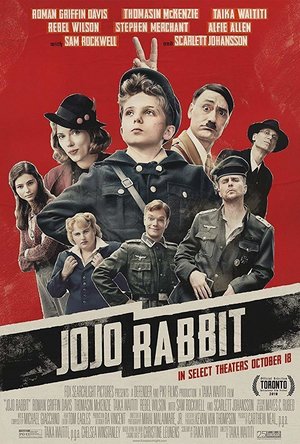


Roman Griffin Davis stars as Jojo Betzler in Taika Waititi’s black comedy Jojo Rabbit. Along with his second best friend Yorki (Archie Yates), Jojo is a part of a Nazi training camp for young boys and girls to become the men and women suited for Hitler supporting soldiers. Meanwhile, Jojo’s mom Rosie (Scarlett Johansson) is secretly hiding a young Jewish girl named Elsa (Thomasin McKenzie) within the walls of their home. Jojo, who is incredibly adamant about Hitler becoming his first best friend, has Hitler as an imaginary friend (portrayed by Taika Waititi) who shows up whenever Jojo seems to need a pep talk.
Based on the 2008 novel Caging Skies by Christine Leunens, Jojo Rabbit is a bonkers twist on one of the most devastating wars and tyrannical madmen in history. On the surface, the film is about a child attempting to become a Nazi because he views HItler as this great leader. He has to attempt to learn to kill, hate Jews, and essentially ignore all of his morals in order to just fit in with an army who believes they are the superior race. The intriguing aspect is that Waititi injects this unexpected tenderness and has concocted a film that has a heartbeat that is entirely too human and too genuine for any sort of project involving the likes of Adolf Hitler.
The Jojo/Hitler dynamic is an incredibly playful one. Hitler only seems to show up when something doesn’t go according to plan for Jojo or he needs some words of encouragement when times get tough. Hitler is a figment of Jojo’s imagination and is completely reactionary to Jojo’s world. If Jojo gets scared, Hitler shows up to remind him why he’s risking his own self comfort. While Waititi is funny and awkwardly charming as Hitler, which is an odd thing to say in itself, don’t overlook Archie Yates. Roman Griffin Davis encapsulates this innocence that even Elsa describes as something along the lines of a ten year old playing dress up with his friends in order to join a club. But Yates often plays off of Davis humorously and amusingly and will likely be forgotten about by some by the time they leave the theater.
Seemingly tapping into his inspiration for Gentlemen Broncos, Sam Rockwell portrays Captain Klenzendorf - a former war veteran who lost an eye and is now forced to teach children how to be soldiers. He has this strange tension on the verge of romance thing going on with his right hand man Finkel (Alfie Allen) and has extravagant taste with intricate ideas for his new uniform. Rockwell and Allen are hilarious and outshine Rebel Wilson’s Fräulein Rahm who never seems to serve much purpose before or after her line about, “having 18 kids for Germany.”
The sweet nature of Jojo Rabbit is expanded upon with the mother/son relationship between Rosie and Jojo. They have completely different viewpoints of a world on the verge of total annihilation where Jojo is slowly nudged into his mother’s mindset. It’s not so much a brainwashing as it is Jojo coming to terms with how he feels about people. Jojo Rabbit defines who we all are on the inside and simply explores the path anyone with an everyday beating heart (not rooted by a tiny mustache) would travel down over the course of their youth.
It’s kind of extraordinary that Jojo Rabbit has been released during a time when Fox Searchlight Pictures is owned by Walt Disney Studios Motion Pictures where a guy directing two of the biggest Thor movies did a side project where he plays Hitler and never had to attempt to keep that a secret. Waititi puts Jojo Betzler through the ringer by blowing him up repeatedly and throwing him down a flight of stairs all while being bullied and pushed around the entire time. But dammit if Jojo Rabbit isn’t one of the most heartfelt and imaginative fairy tales of the year.
This is a film where storytelling, embellishing and elongating false reputations, and glorifying urban myths is the driving force of entertainment. Underneath its layers of SS uniforms, dangerous pistols, and knives you should never leave home without, Jojo Rabbit is a touching film about human compassion with an intimacy that is absolutely unparalleled. Categorized somewhere between Wes Anderson’s Moonrise Kingdom and an imaginative concept that is an obvious homage to Calvin and Hobbes, love feels like it’s the only thing spreading across the world more powerful than war and Jojo Rabbit is more than happy to hype you up and throw you in love’s way without remorse.
Based on the 2008 novel Caging Skies by Christine Leunens, Jojo Rabbit is a bonkers twist on one of the most devastating wars and tyrannical madmen in history. On the surface, the film is about a child attempting to become a Nazi because he views HItler as this great leader. He has to attempt to learn to kill, hate Jews, and essentially ignore all of his morals in order to just fit in with an army who believes they are the superior race. The intriguing aspect is that Waititi injects this unexpected tenderness and has concocted a film that has a heartbeat that is entirely too human and too genuine for any sort of project involving the likes of Adolf Hitler.
The Jojo/Hitler dynamic is an incredibly playful one. Hitler only seems to show up when something doesn’t go according to plan for Jojo or he needs some words of encouragement when times get tough. Hitler is a figment of Jojo’s imagination and is completely reactionary to Jojo’s world. If Jojo gets scared, Hitler shows up to remind him why he’s risking his own self comfort. While Waititi is funny and awkwardly charming as Hitler, which is an odd thing to say in itself, don’t overlook Archie Yates. Roman Griffin Davis encapsulates this innocence that even Elsa describes as something along the lines of a ten year old playing dress up with his friends in order to join a club. But Yates often plays off of Davis humorously and amusingly and will likely be forgotten about by some by the time they leave the theater.
Seemingly tapping into his inspiration for Gentlemen Broncos, Sam Rockwell portrays Captain Klenzendorf - a former war veteran who lost an eye and is now forced to teach children how to be soldiers. He has this strange tension on the verge of romance thing going on with his right hand man Finkel (Alfie Allen) and has extravagant taste with intricate ideas for his new uniform. Rockwell and Allen are hilarious and outshine Rebel Wilson’s Fräulein Rahm who never seems to serve much purpose before or after her line about, “having 18 kids for Germany.”
The sweet nature of Jojo Rabbit is expanded upon with the mother/son relationship between Rosie and Jojo. They have completely different viewpoints of a world on the verge of total annihilation where Jojo is slowly nudged into his mother’s mindset. It’s not so much a brainwashing as it is Jojo coming to terms with how he feels about people. Jojo Rabbit defines who we all are on the inside and simply explores the path anyone with an everyday beating heart (not rooted by a tiny mustache) would travel down over the course of their youth.
It’s kind of extraordinary that Jojo Rabbit has been released during a time when Fox Searchlight Pictures is owned by Walt Disney Studios Motion Pictures where a guy directing two of the biggest Thor movies did a side project where he plays Hitler and never had to attempt to keep that a secret. Waititi puts Jojo Betzler through the ringer by blowing him up repeatedly and throwing him down a flight of stairs all while being bullied and pushed around the entire time. But dammit if Jojo Rabbit isn’t one of the most heartfelt and imaginative fairy tales of the year.
This is a film where storytelling, embellishing and elongating false reputations, and glorifying urban myths is the driving force of entertainment. Underneath its layers of SS uniforms, dangerous pistols, and knives you should never leave home without, Jojo Rabbit is a touching film about human compassion with an intimacy that is absolutely unparalleled. Categorized somewhere between Wes Anderson’s Moonrise Kingdom and an imaginative concept that is an obvious homage to Calvin and Hobbes, love feels like it’s the only thing spreading across the world more powerful than war and Jojo Rabbit is more than happy to hype you up and throw you in love’s way without remorse.
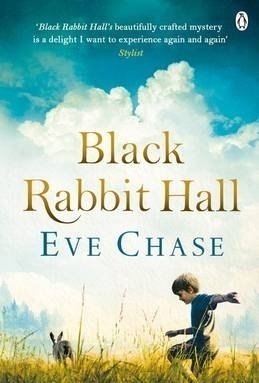
Black Rabbit Hall
6.0 Rate It
Book
One golden family. One fateful summer. Four lives changed forever. Amber Alton knows that the hours...
Sophia (Bookwyrming Thoughts) (530 KP) rated A Wicked Thing (A Wicked Thing, #1) in Books
Jan 23, 2020



<b><i>I received this book for free from Publisher in exchange for an honest review. This does not affect my opinion of the book or the content of my review.</i></b>
My all-time favorite Disney movie (in VCR) – along with Pocahontas and Mulan, to which there are literally zilch retellings to my knowledge – while growing up was <i>Sleeping Beauty</i>. I even reenacted it... for fun and on my own (expected of a four or five year old).
And perhaps it is also one of the most difficult tales to be retold. There's a princess who has a curse placed on her that she would prick her finger on the spindle of a spinning wheel before her sixteenth birthday and die – not entirely too much to take a spin on, is there?
No pun intended.
Much as I give props to Rhiannon Thomas for taking <i>Sleeping Beauty</i> on another path, <i>A Wicked Thing</i> is certainly not a book I would enjoy even for the pleasure of reading. In fact, truth be told in maybe a harsh way, <i>A Wicked Thing</i> was funny. And while funny typically means a good thing, I honestly had a field day reading the first three chapters in between chess matches and poking fun at the book (aka making sassy comments that will make no appearance whatsoever in this review aside from a big basket of mozzarella sticks).
<i>A Wicked Thing</i> is almost a sequel to the original <i>Sleeping Beauty</i>. Some time has passed, and then the prince kisses Aurora – all that jazz is pretty much the same aside from maybe happily ever after, to which I won't bother finding out. Perhaps there <i>is</i> a happily ever after by the end of the book – I'm still not going to go and find out because I'm too focused on making it to at least the top 10 in the class now that I'm extremely close to it.
But let's start with the prince kisses Aurora. She wakes up and screams. It probably makes sense to scream when you wake up to a random stranger hovering above your face and actually kissed you. Honestly, a pretty fantastic opening scene – and I'm serious – aside from the part where the "boy" (we don't know he's a prince YET) says, "I did it. I actually did it."
Then I get a sled and start laughing gleefully (read: found it absolutely amusing) while sliding down a hill (read: continuing the book just see how it all plays out because I haven't found reasons to throw this aside yet and then I do).
Prince Rodric, the "boy," is pathetic. The <i>royal family</i>, in my opinion, is a little pathetic and cheesy. Are they actually pathetic? Perhaps not when you really get to know them and perhaps they're marvelous rulers and the people love them oh-so-dearly, but from the little bit of the book that I read and met the royal family, I find myself disappointed. Particularly disappointed in Rodric the princeling because he will obviously make a huge appearance throughout the rest of the book and I've got to at least like the main characters to enjoy the book.
The dear prince blushes <i>at almost every single sentence he speaks to Aurora</i>. I'm pretty sure the amount of blushes will be the equal amount of election commercials soon (Vote for me! Vote for me!).
<blockquote>He stopped and blushed again.</blockquote>
Princeling probably stutters as well, and is most likely a descendant of Romeo.
<blockquote>“I mean, you always look beautiful. But you look especially beautiful tonight. Is what I mean.”</blockquote>
The king is overly cheery, and while there seems to be a probable reason (my son woke up a slumbering princess!), "overly cheery" really means "exuberantly happy-go-lucky."
<blockquote>“Please send out the heralds. A little extra pomp and circumstance, if you please. It is hardly a normal day.”</blockquote>
No... definitely not a normal day. That much I'll agreee with. But isn't celebrating as soon as Aurora wakes up a little overboard? The chick just woke up from a hundred plus years of slumber and everything literally comes crashing down over on her head upside down! I'm not sure Aurora appreciated that – she was quite confuzzled when she woke up (whoa... what's going on here?!) and even protested a little (not that anyone heard her).
Betsy the maid babbles in excitement and is worse than the king.
<blockquote>“I was so honored, Princess, when they asked me to assist you. I never expected it! But then, I never expected you’d be standing here, if you don’t mind me saying. Not that I didn’t think Rodric could be your true love, because of course he’s wonderful, but it always seemed too much like a dream to ever happen while I was here. Things will be amazing, now, you’ll see. Everyone loves you already. How could they not?”</blockquote>
Reasonable babbling of excitement, seeing as she's a humble servant.
But she and everyone else aside from Aurora is also a little naïve with the assumption that everything is going to be fantastic and happily ever after Aurora and Rodric marry, simply based a fairy tale.
Aurora, however, might have been a character that I would actually like had I continued the book. But by that point in the novel, when Rodric and Aurora are first dining together, I was quite cheesed (it was the constant blushing and cheeriness). While I normally feel guilty for throwing a book aside really early, I don't think I feel too guilty in <i>A Wicked Thing's</i> case.
<a href="https://bookwyrmingthoughts.com/dnf-arc-review-wicked-thing-by-rhiannon-thomas/"; target="_blank">This review was originally posted on Bookwyrming Thoughts</a>
My all-time favorite Disney movie (in VCR) – along with Pocahontas and Mulan, to which there are literally zilch retellings to my knowledge – while growing up was <i>Sleeping Beauty</i>. I even reenacted it... for fun and on my own (expected of a four or five year old).
And perhaps it is also one of the most difficult tales to be retold. There's a princess who has a curse placed on her that she would prick her finger on the spindle of a spinning wheel before her sixteenth birthday and die – not entirely too much to take a spin on, is there?
No pun intended.
Much as I give props to Rhiannon Thomas for taking <i>Sleeping Beauty</i> on another path, <i>A Wicked Thing</i> is certainly not a book I would enjoy even for the pleasure of reading. In fact, truth be told in maybe a harsh way, <i>A Wicked Thing</i> was funny. And while funny typically means a good thing, I honestly had a field day reading the first three chapters in between chess matches and poking fun at the book (aka making sassy comments that will make no appearance whatsoever in this review aside from a big basket of mozzarella sticks).
<i>A Wicked Thing</i> is almost a sequel to the original <i>Sleeping Beauty</i>. Some time has passed, and then the prince kisses Aurora – all that jazz is pretty much the same aside from maybe happily ever after, to which I won't bother finding out. Perhaps there <i>is</i> a happily ever after by the end of the book – I'm still not going to go and find out because I'm too focused on making it to at least the top 10 in the class now that I'm extremely close to it.
But let's start with the prince kisses Aurora. She wakes up and screams. It probably makes sense to scream when you wake up to a random stranger hovering above your face and actually kissed you. Honestly, a pretty fantastic opening scene – and I'm serious – aside from the part where the "boy" (we don't know he's a prince YET) says, "I did it. I actually did it."
Then I get a sled and start laughing gleefully (read: found it absolutely amusing) while sliding down a hill (read: continuing the book just see how it all plays out because I haven't found reasons to throw this aside yet and then I do).
Prince Rodric, the "boy," is pathetic. The <i>royal family</i>, in my opinion, is a little pathetic and cheesy. Are they actually pathetic? Perhaps not when you really get to know them and perhaps they're marvelous rulers and the people love them oh-so-dearly, but from the little bit of the book that I read and met the royal family, I find myself disappointed. Particularly disappointed in Rodric the princeling because he will obviously make a huge appearance throughout the rest of the book and I've got to at least like the main characters to enjoy the book.
The dear prince blushes <i>at almost every single sentence he speaks to Aurora</i>. I'm pretty sure the amount of blushes will be the equal amount of election commercials soon (Vote for me! Vote for me!).
<blockquote>He stopped and blushed again.</blockquote>
Princeling probably stutters as well, and is most likely a descendant of Romeo.
<blockquote>“I mean, you always look beautiful. But you look especially beautiful tonight. Is what I mean.”</blockquote>
The king is overly cheery, and while there seems to be a probable reason (my son woke up a slumbering princess!), "overly cheery" really means "exuberantly happy-go-lucky."
<blockquote>“Please send out the heralds. A little extra pomp and circumstance, if you please. It is hardly a normal day.”</blockquote>
No... definitely not a normal day. That much I'll agreee with. But isn't celebrating as soon as Aurora wakes up a little overboard? The chick just woke up from a hundred plus years of slumber and everything literally comes crashing down over on her head upside down! I'm not sure Aurora appreciated that – she was quite confuzzled when she woke up (whoa... what's going on here?!) and even protested a little (not that anyone heard her).
Betsy the maid babbles in excitement and is worse than the king.
<blockquote>“I was so honored, Princess, when they asked me to assist you. I never expected it! But then, I never expected you’d be standing here, if you don’t mind me saying. Not that I didn’t think Rodric could be your true love, because of course he’s wonderful, but it always seemed too much like a dream to ever happen while I was here. Things will be amazing, now, you’ll see. Everyone loves you already. How could they not?”</blockquote>
Reasonable babbling of excitement, seeing as she's a humble servant.
But she and everyone else aside from Aurora is also a little naïve with the assumption that everything is going to be fantastic and happily ever after Aurora and Rodric marry, simply based a fairy tale.
Aurora, however, might have been a character that I would actually like had I continued the book. But by that point in the novel, when Rodric and Aurora are first dining together, I was quite cheesed (it was the constant blushing and cheeriness). While I normally feel guilty for throwing a book aside really early, I don't think I feel too guilty in <i>A Wicked Thing's</i> case.
<a href="https://bookwyrmingthoughts.com/dnf-arc-review-wicked-thing-by-rhiannon-thomas/"; target="_blank">This review was originally posted on Bookwyrming Thoughts</a>

Ivana A. | Diary of Difference (1171 KP) rated Romanov in Books
Oct 5, 2020
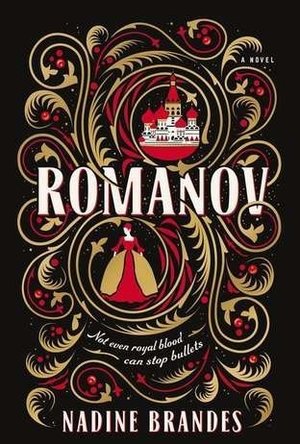
From the author of Fawkes comes a magical take on the story of Anastasia Romanov.
The history books say I died.
They don’t know the half of it.
Ever since I read Fawkes, I knew I loved Nadine’s writing, and when Romanov was announced, I couldn’t be happier. As I have spend my childhood and young adult life in the Balkans, whilst travelling across Europe, I have always admired Russia, and always enjoyed reading all the theories about the Romanov family.
As a child I would be told stories and fairy tales, I would watch the Disney adaptation of Anastasia, and as I was growing up, I would read history books and fiction on this very subject. When I got my hands on ‘’Romanov’’, I knew I would be up for an adventure, with lots of expectations, but what I never knew was that I would be blown away of how beautiful this book is!
This book is split into two main parts, before and after the Romanov’s execution, but it is also split into the first being the historical part, and the second being the fictional part. Both parts of the book are quite intense, and very different emotions come up to surface, but they are both very powerful throughout, and fitted together quite well.
In the first part, we are introduced to the Romanov family, and how they are kept as hostages by the Bolsheviks. It would’ve been much better if we had more details on the pre-hostage period, why the revolution began, why the king abducted the throne, who are the Bolsheviks and what they believed in. The book starts in the middle of this whole situation, and whilst I knew the beginning before, I am certain a lot of people wouldn’t have.
The history, as much accurate as it was, also had a personalized feeling that the author wanted to give. I have to admit, a lot of the details, especially around the family were quite accurate. The family did stick together and loved each other, they did have secrets and they did make friends with their captors. Anastasia’s brother did indeed had hemophilia and Rasputin was allegedly helping him. However, the author decided to put her personal feelings into the history as well. The king is presented as a wonderful leader that cares about the people. I understand that we see this story from Anastasia’s point of view, and as his daughter, she is supposed to see her father as the best figure in the world. But I still believe this part should be more objective, if not from Anastasia’s point of view, then at least by the king’s actions and dialogues. The other big element that bothered me was the portrayal of Rasputin. He is shown in this book as a family helper and a kind man, when in fact, he was far from that. In the history books, he is described as a madman, a creepy person, and the king was not happy of him coming in the house. The family’s secrecy and the queen’s silent domination over the king, together with Rasputin’s doings were the start of the revolution, and I believe that it one of the required truths that this books should have included, but didn’t. And that troubled me.
On top of this, is the Russian language used throughout this book. There were a lot of spelling errors, and misinterpretations. And whilst I can understand these words, many people can’t, and translation wasn’t provided in the book. Also, I really found this quote interesting, talking about the Russian culture, and how they don’t show emotions. Just a note – this is most of the time true, people won’t be nice to strangers, but actually, Russian people are quite friendly and emotional as well.
‘’We Russians weren’t required to share any amount of emotion we didn’t want to.’’
Apart from these few things that slightly bothered me, I really enjoyed this book. Anastasia is an amazing character, and through her we can see her love towards her family, her country, and even towards the people that wish her harm. We get to see her love, cry, be hurt, be afraid, forgive, and grow throughout the book, and her journey was magical.
‘’As I lay in the grass next to the spell that could rid me of heart pain, I realized that a part of forgiveness was accepting the things someone had done – and the pain that came with that – and moving on with love. Forgiveness was a personal battle that must always be fought in my heart.’’
I loved the beginning of the book the most. The setting was well-written, and I got the feel the same way as the Romanov family did. They tried to act as if everything was normal, when in fact, they were held captive, and moved out of their home. They weren’t allowed to go out in the garden often, and when they did have this opportunity, they enjoyed every single second of it. And they all had hope every single day. They kept smiling and stayed together.
There are number of scenes that will always stay close to my heart – the relationship between Zash and Anastasia (as unrealistic as it might be), always kept me on my toes, his desperation, and his guilt, and her ability to forgive and love regardless.
The brother’s illness, and his persistence through it. His motivation and his will to never give up. The love he holds for his family, and especially his sister Anastasia, and the toughness and not letting go. A few scenes were unrealistic with him, as I hardly believe anyone suffering from hemophilia can survive all those injuries mentioned in the book and the pools of blood, but above all – this character did achieve what he was meant to do – show hope where there is none.
A wonderful and magical tale, with a history behind it of a mysterious family, especially their end – this book brought tears on my eyes and made me think about the power of forgiveness and love. A true masterpiece.
Thank you to Nadine Brandes, for letting me be a part of her Ninja Team.
The history books say I died.
They don’t know the half of it.
Ever since I read Fawkes, I knew I loved Nadine’s writing, and when Romanov was announced, I couldn’t be happier. As I have spend my childhood and young adult life in the Balkans, whilst travelling across Europe, I have always admired Russia, and always enjoyed reading all the theories about the Romanov family.
As a child I would be told stories and fairy tales, I would watch the Disney adaptation of Anastasia, and as I was growing up, I would read history books and fiction on this very subject. When I got my hands on ‘’Romanov’’, I knew I would be up for an adventure, with lots of expectations, but what I never knew was that I would be blown away of how beautiful this book is!
This book is split into two main parts, before and after the Romanov’s execution, but it is also split into the first being the historical part, and the second being the fictional part. Both parts of the book are quite intense, and very different emotions come up to surface, but they are both very powerful throughout, and fitted together quite well.
In the first part, we are introduced to the Romanov family, and how they are kept as hostages by the Bolsheviks. It would’ve been much better if we had more details on the pre-hostage period, why the revolution began, why the king abducted the throne, who are the Bolsheviks and what they believed in. The book starts in the middle of this whole situation, and whilst I knew the beginning before, I am certain a lot of people wouldn’t have.
The history, as much accurate as it was, also had a personalized feeling that the author wanted to give. I have to admit, a lot of the details, especially around the family were quite accurate. The family did stick together and loved each other, they did have secrets and they did make friends with their captors. Anastasia’s brother did indeed had hemophilia and Rasputin was allegedly helping him. However, the author decided to put her personal feelings into the history as well. The king is presented as a wonderful leader that cares about the people. I understand that we see this story from Anastasia’s point of view, and as his daughter, she is supposed to see her father as the best figure in the world. But I still believe this part should be more objective, if not from Anastasia’s point of view, then at least by the king’s actions and dialogues. The other big element that bothered me was the portrayal of Rasputin. He is shown in this book as a family helper and a kind man, when in fact, he was far from that. In the history books, he is described as a madman, a creepy person, and the king was not happy of him coming in the house. The family’s secrecy and the queen’s silent domination over the king, together with Rasputin’s doings were the start of the revolution, and I believe that it one of the required truths that this books should have included, but didn’t. And that troubled me.
On top of this, is the Russian language used throughout this book. There were a lot of spelling errors, and misinterpretations. And whilst I can understand these words, many people can’t, and translation wasn’t provided in the book. Also, I really found this quote interesting, talking about the Russian culture, and how they don’t show emotions. Just a note – this is most of the time true, people won’t be nice to strangers, but actually, Russian people are quite friendly and emotional as well.
‘’We Russians weren’t required to share any amount of emotion we didn’t want to.’’
Apart from these few things that slightly bothered me, I really enjoyed this book. Anastasia is an amazing character, and through her we can see her love towards her family, her country, and even towards the people that wish her harm. We get to see her love, cry, be hurt, be afraid, forgive, and grow throughout the book, and her journey was magical.
‘’As I lay in the grass next to the spell that could rid me of heart pain, I realized that a part of forgiveness was accepting the things someone had done – and the pain that came with that – and moving on with love. Forgiveness was a personal battle that must always be fought in my heart.’’
I loved the beginning of the book the most. The setting was well-written, and I got the feel the same way as the Romanov family did. They tried to act as if everything was normal, when in fact, they were held captive, and moved out of their home. They weren’t allowed to go out in the garden often, and when they did have this opportunity, they enjoyed every single second of it. And they all had hope every single day. They kept smiling and stayed together.
There are number of scenes that will always stay close to my heart – the relationship between Zash and Anastasia (as unrealistic as it might be), always kept me on my toes, his desperation, and his guilt, and her ability to forgive and love regardless.
The brother’s illness, and his persistence through it. His motivation and his will to never give up. The love he holds for his family, and especially his sister Anastasia, and the toughness and not letting go. A few scenes were unrealistic with him, as I hardly believe anyone suffering from hemophilia can survive all those injuries mentioned in the book and the pools of blood, but above all – this character did achieve what he was meant to do – show hope where there is none.
A wonderful and magical tale, with a history behind it of a mysterious family, especially their end – this book brought tears on my eyes and made me think about the power of forgiveness and love. A true masterpiece.
Thank you to Nadine Brandes, for letting me be a part of her Ninja Team.

Lottie disney bookworm (1056 KP) rated The Beast Within: A Tale of Beauty's Prince (Villains #2) in Books
Aug 24, 2019
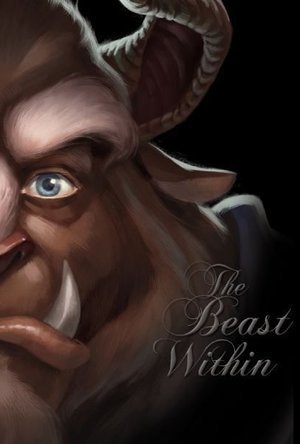
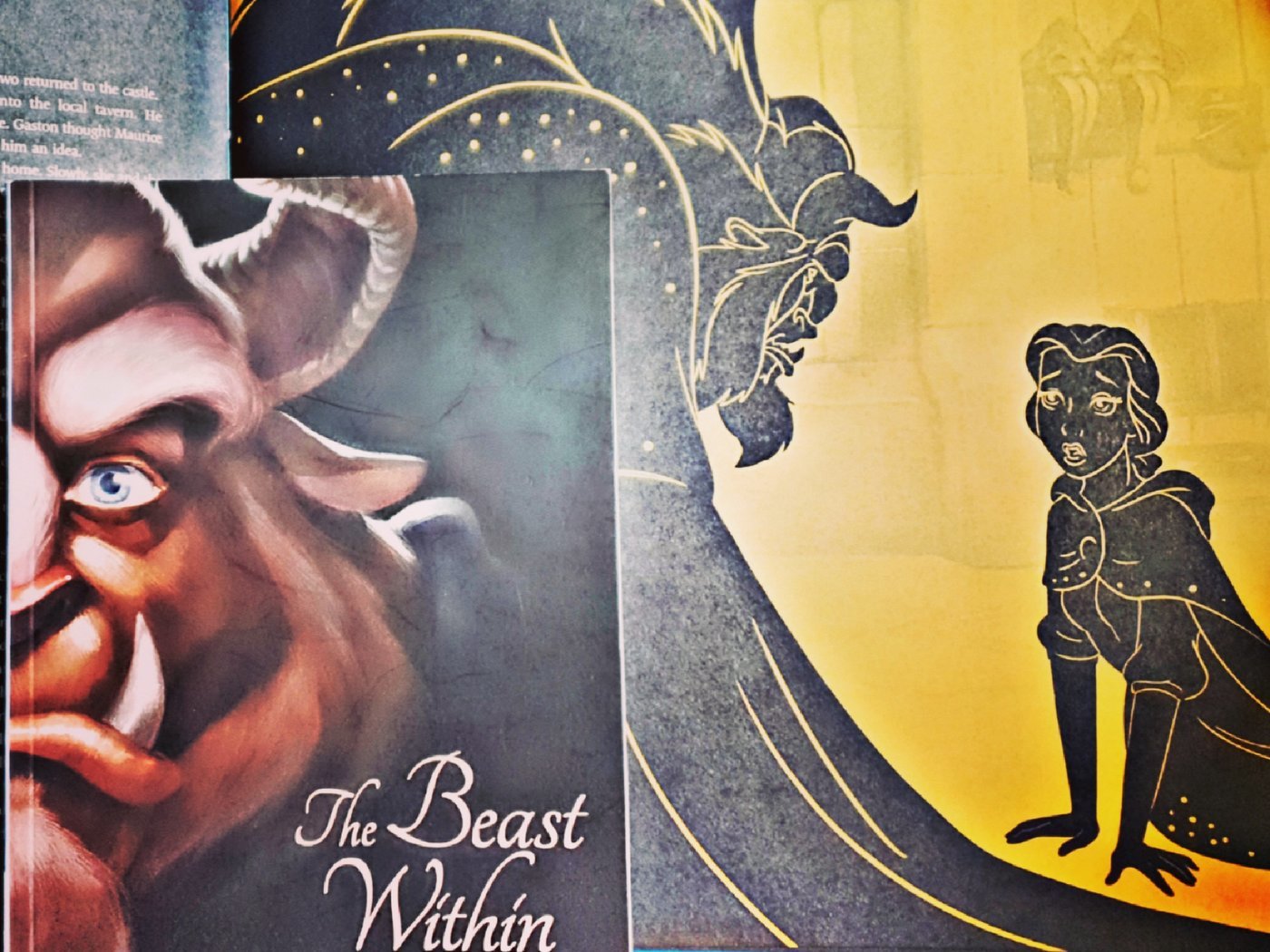
Beauty and the Beast is arguably one of my favourite Disney classics. I adored Tale as Old as Time and so the Beast’s version of the villain’s tale series had some pretty big boots to fill.
The Beast Within is the second book in the villains’ series and shifts between time periods to provide the reader with an insight to the Beast’s life before and after he was cursed. This was such an interesting concept because each version of Beauty and the Beast contains the vain prince who shuns the enchantress: it’s a pretty key part of the story! However, Serena Valentino expands upon this and, although the Prince becomes no more likeable, Valentino humanises him. We learn the extent of his vanity and, to be honest, probably dislike him more than the original version!
We also receive more of an insight into the Odd Sisters within this novel. We visit their house and gain an idea of the pecking order within the foursome. Yes foursome! I have not drunk too much prosecco and can no longer count (well not yet) – the witches have a little sister.
Circe is as beautiful as her sisters are odd and also happens to be engaged to the Prince (massive coincidence I am sure) but is rejected by him when his best friend Gaston reveals that her family are pig farmers. He claims she deceived him with her beauty and is sickened by her grotesque appearance now he knows the truth.
In fact, by placing Gaston and the Prince side by side we start to think that maybe Belle made the wrong choice by dismissing the shallow hunter so quickly!
Needless to say, Circe is crushed: she accuses him of behaving like a beast, being tainted by vanity and not capable of true love. The spurned witch curses the Prince, warning him that he will slowly transform into the horrifying creature that he is within.
The fact that the reader witnesses the full transformation of Prince into Beast is really interesting and Circe’s words have a profound effect on the Prince, his grasp on his sanity and his future relationships. He veers wildly between dismissing Circe as crazy whilst simultaneously finding a bride in order to break the spell.
Naturally, the Prince is not alone in this story: Mrs Potts, Cogsworth and Lumiere unwittingly become swept up in Circe’s curse. In fact, the odd sisters taunt the Beast, implying that he is only concerned about his servants because of what they may do to him if the curse is not lifted.
Valentino does choose to express that Mrs Potts, in particular, had great affection for the Prince and Gaston as children but this isn’t really played on at all. The reader does gain the sense that the Prince is cared for by his staff but there are no real relationships developed here. Even when Lumiere realises that the Prince views the objects of the curse differently from everyone else; there lacks the compassion and assistance of their animated counterparts.
Another relationship that lacked conviction was that between the Beast and Belle. This is one of the most iconic love stories in the Disney portfolio but I’m afraid I just wasn’t feeling it. I understand that Valentino needs to focus on Tulip: she is an important character who shows the Prince’s desperation, his unwillingness to change and his escalating beastly behaviour (she also links into the next book in the series). However, the focus on Tulip seems to sacrifice any detail when it comes to Belle. Yes, we learn that she attended the original ball and that she will do anything to save her father but that’s pretty much it. The blossoming romance that ensues is witnessed third hand via the odd sisters’ mirror and it begs the question: is this the tale of Beauty’s Prince or is the tale of Circe and her sisters?
Despite Circe being the youngest, it is often implied that she is more powerful than her older sisters and, although she does seem more sane, it cannot be said that Circe is a pushover: upon learning of her sisters’ involvement in the Beast’s fate, Circe punishes them; removes the curse and creates the spinning prince complete with fireworks that we remember from the original movie. This transition from bitter, heartbroken witch to sympathetic and forgiving is unforeseen and abrupt. To be honest it felt like it was a convenient way of shoe-horning the movie ending into the book.
Overall, I loved the potential of The Beast Within. I really enjoyed learning more about the Prince’s character and seeing a side of him that the reader cannot merely brush off as young or vain: he was a truly horrible person. I also loved the little nods to the fairy-tale world, such as Gaston suggesting a ball because it all worked out for the Prince’s friend “after the business with the slipper”.
Valentino also provides hints to future novels and so the references to Ursula were very intriguing as I prepare to read ‘Poor Unfortunate Soul’ next. There is the occasional reference to the old Queen, as well as the continuation of the theme of mirrors and love as a weakness: the odd sisters really do dominate the tales.
In a way I almost feel that the book has a little too much going on: we have the beast’s battle against the curse; the odd sister’s magic; Circe and Ursula’s little tangent and the original storyline. In my opinion, all of these factors make the ending of the book very rushed. For example, the Beast juxtaposes from being unable to fall in love with someone like Belle to presenting her with an entire library just to see her smile in a matter of sentences!
It is a shame because, after the ending of ‘Fairest of All’ I was expecting so much more. I did still like the book but I didn’t love it- I felt like the book could have expanded more on the more unique/dark aspects of the story, such as the creepy statues and the Beast’s alternative view of the curse.
Ah well, you can’t love them all! Onwards and upwards to Poor Unfortunate Soul!
The Beast Within is the second book in the villains’ series and shifts between time periods to provide the reader with an insight to the Beast’s life before and after he was cursed. This was such an interesting concept because each version of Beauty and the Beast contains the vain prince who shuns the enchantress: it’s a pretty key part of the story! However, Serena Valentino expands upon this and, although the Prince becomes no more likeable, Valentino humanises him. We learn the extent of his vanity and, to be honest, probably dislike him more than the original version!
We also receive more of an insight into the Odd Sisters within this novel. We visit their house and gain an idea of the pecking order within the foursome. Yes foursome! I have not drunk too much prosecco and can no longer count (well not yet) – the witches have a little sister.
Circe is as beautiful as her sisters are odd and also happens to be engaged to the Prince (massive coincidence I am sure) but is rejected by him when his best friend Gaston reveals that her family are pig farmers. He claims she deceived him with her beauty and is sickened by her grotesque appearance now he knows the truth.
In fact, by placing Gaston and the Prince side by side we start to think that maybe Belle made the wrong choice by dismissing the shallow hunter so quickly!
Needless to say, Circe is crushed: she accuses him of behaving like a beast, being tainted by vanity and not capable of true love. The spurned witch curses the Prince, warning him that he will slowly transform into the horrifying creature that he is within.
The fact that the reader witnesses the full transformation of Prince into Beast is really interesting and Circe’s words have a profound effect on the Prince, his grasp on his sanity and his future relationships. He veers wildly between dismissing Circe as crazy whilst simultaneously finding a bride in order to break the spell.
Naturally, the Prince is not alone in this story: Mrs Potts, Cogsworth and Lumiere unwittingly become swept up in Circe’s curse. In fact, the odd sisters taunt the Beast, implying that he is only concerned about his servants because of what they may do to him if the curse is not lifted.
Valentino does choose to express that Mrs Potts, in particular, had great affection for the Prince and Gaston as children but this isn’t really played on at all. The reader does gain the sense that the Prince is cared for by his staff but there are no real relationships developed here. Even when Lumiere realises that the Prince views the objects of the curse differently from everyone else; there lacks the compassion and assistance of their animated counterparts.
Another relationship that lacked conviction was that between the Beast and Belle. This is one of the most iconic love stories in the Disney portfolio but I’m afraid I just wasn’t feeling it. I understand that Valentino needs to focus on Tulip: she is an important character who shows the Prince’s desperation, his unwillingness to change and his escalating beastly behaviour (she also links into the next book in the series). However, the focus on Tulip seems to sacrifice any detail when it comes to Belle. Yes, we learn that she attended the original ball and that she will do anything to save her father but that’s pretty much it. The blossoming romance that ensues is witnessed third hand via the odd sisters’ mirror and it begs the question: is this the tale of Beauty’s Prince or is the tale of Circe and her sisters?
Despite Circe being the youngest, it is often implied that she is more powerful than her older sisters and, although she does seem more sane, it cannot be said that Circe is a pushover: upon learning of her sisters’ involvement in the Beast’s fate, Circe punishes them; removes the curse and creates the spinning prince complete with fireworks that we remember from the original movie. This transition from bitter, heartbroken witch to sympathetic and forgiving is unforeseen and abrupt. To be honest it felt like it was a convenient way of shoe-horning the movie ending into the book.
Overall, I loved the potential of The Beast Within. I really enjoyed learning more about the Prince’s character and seeing a side of him that the reader cannot merely brush off as young or vain: he was a truly horrible person. I also loved the little nods to the fairy-tale world, such as Gaston suggesting a ball because it all worked out for the Prince’s friend “after the business with the slipper”.
Valentino also provides hints to future novels and so the references to Ursula were very intriguing as I prepare to read ‘Poor Unfortunate Soul’ next. There is the occasional reference to the old Queen, as well as the continuation of the theme of mirrors and love as a weakness: the odd sisters really do dominate the tales.
In a way I almost feel that the book has a little too much going on: we have the beast’s battle against the curse; the odd sister’s magic; Circe and Ursula’s little tangent and the original storyline. In my opinion, all of these factors make the ending of the book very rushed. For example, the Beast juxtaposes from being unable to fall in love with someone like Belle to presenting her with an entire library just to see her smile in a matter of sentences!
It is a shame because, after the ending of ‘Fairest of All’ I was expecting so much more. I did still like the book but I didn’t love it- I felt like the book could have expanded more on the more unique/dark aspects of the story, such as the creepy statues and the Beast’s alternative view of the curse.
Ah well, you can’t love them all! Onwards and upwards to Poor Unfortunate Soul!

Purple Phoenix Games (2266 KP) rated The Grimm Masquerade in Tabletop Games
Apr 8, 2021
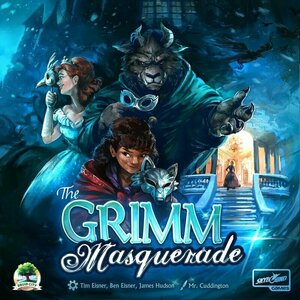
Have you ever been to a proper masquerade? I have not, though I would enjoy it, I think. I would enjoy it even more if I were competing against the other attendees to figure out who is who (and avoid having to do those Victorian square dances). But what if I were actually fairytale folk cavorting around with others trying to gain artifacts that speak to me while refusing any artifacts that may hurt me. Well now you understand my plight and the premise of this game.
The Grimm Masquerade is a hidden role competitive bluffing game for two to five players. In it player take on the roles of well-known fairytale folk attending a magical masquerade thrown by The Beast (I mean, he has a name, right? Not just “The Beast…”). Attendees are tasked with trying to unmask other attendees while earning magical roses in the process. The winner is the player who can earn the most roses at the end of three rounds of bluffing and guessing, unless one player is able to earn 10 roses before the end.
DISCLAIMER: We were provided a copy of this game for the purposes of this review. This is a retail copy of the game, so what you see in these photos is exactly what would be received in your box. I do not intend to cover every single rule included in the rulebook, but will describe the overall game flow and major rule set so that our readers may get a sense of how the game plays. For more in depth rules, you may purchase a copy online or from your FLGS. Also, this review concentrates on the two-player variant for the game as I played it mostly with my wife. -T
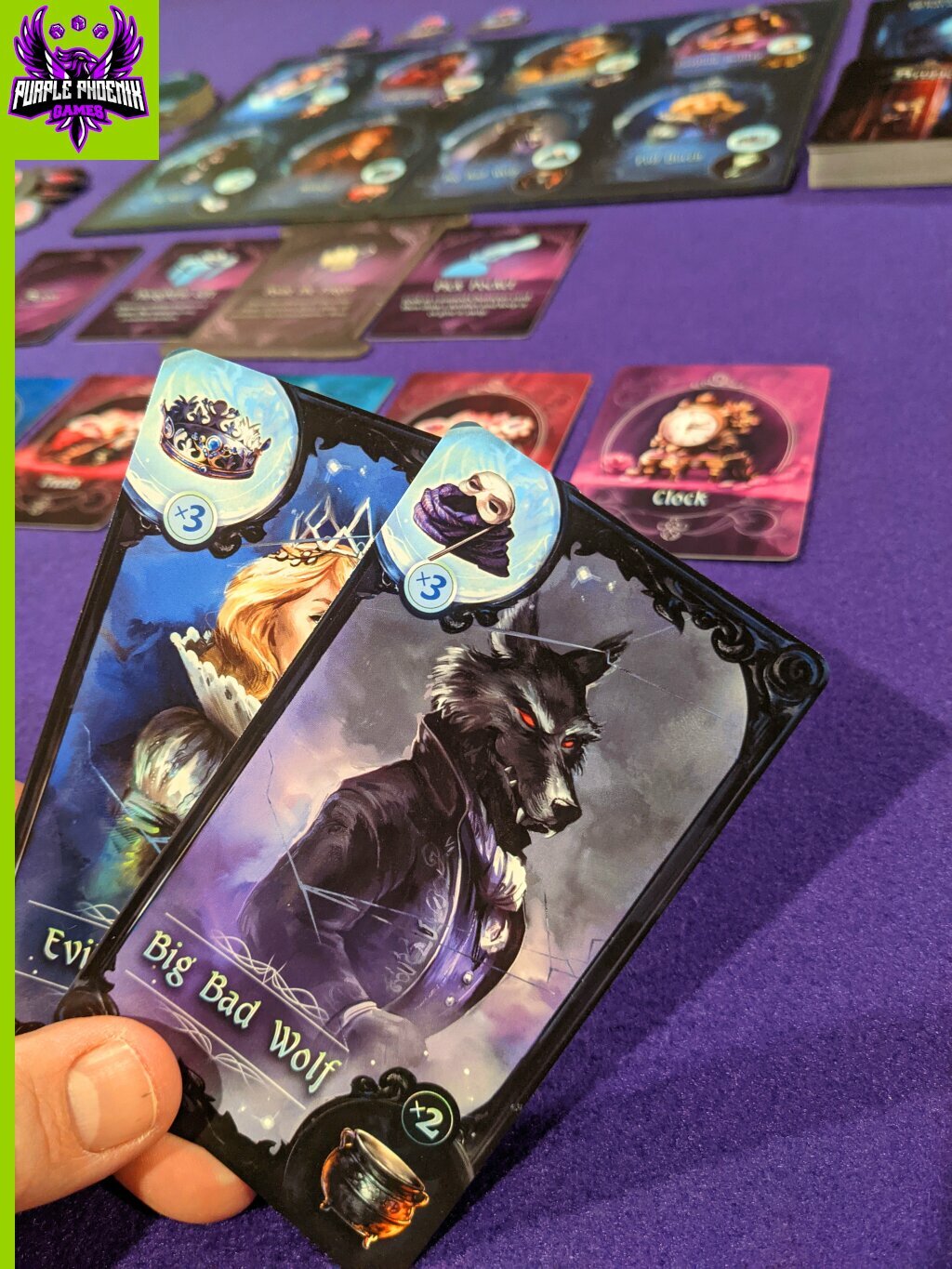
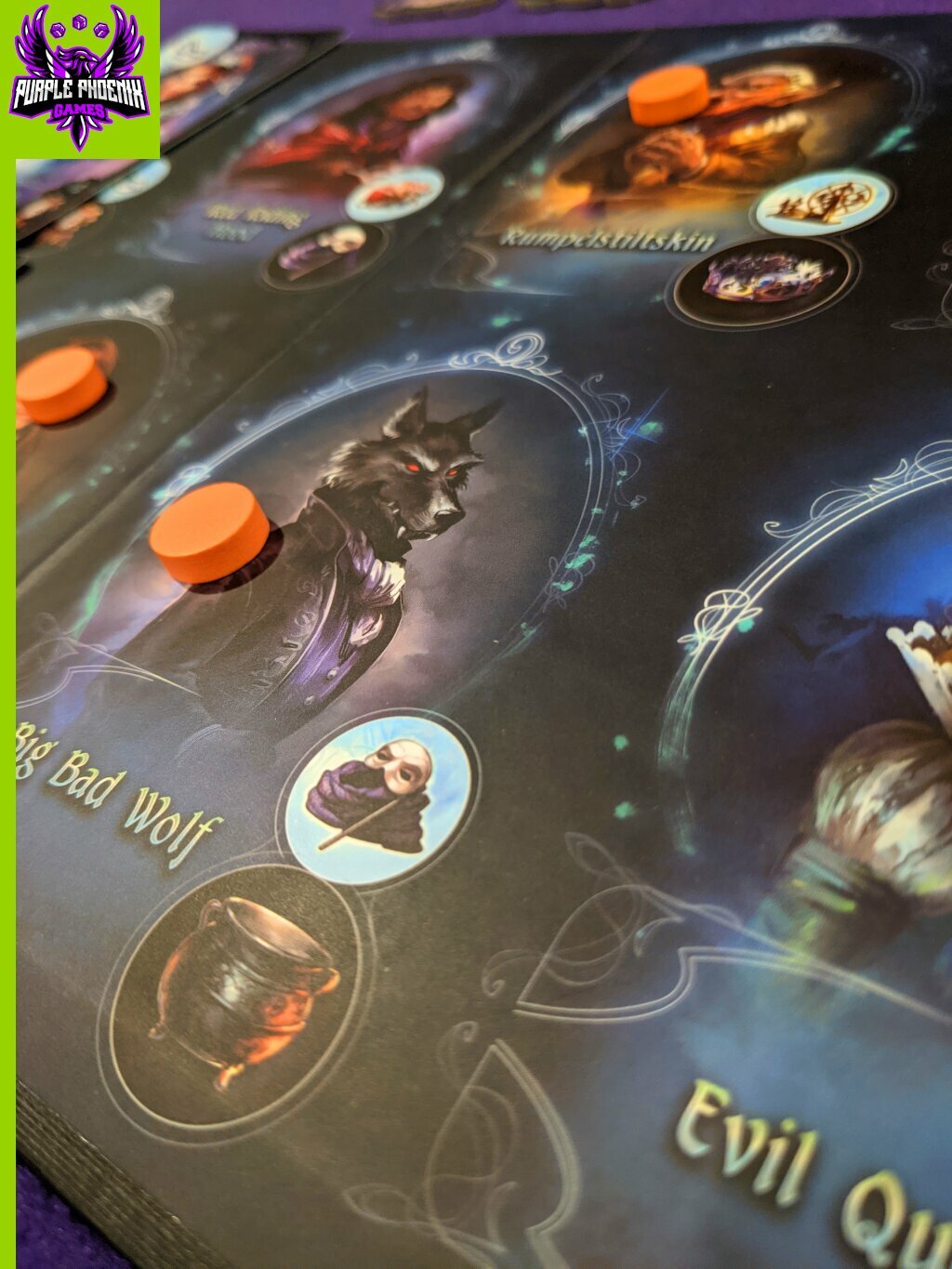
To setup, place the main board showing all the fairytale folk in the middle of the table. Each player will receive two (one if playing multi-player rules) Character cards, all Evidence Markers of their chosen color, and Reference cards. Around the board is placed the remaining Character cards, the Artifact deck, the stack of Broken Mirror tokens, the pile of roses, and the Action Board with two random Action cards revealed on either side. For the two-player game six Artifact cards are revealed in a line and each player will choose one Artifact for each of their two characters they are playing. The unchosen Artifacts will form the discard pile near the Artifact draw pile. Whomever most recently wore a costume will be the lead player and the game may begin!
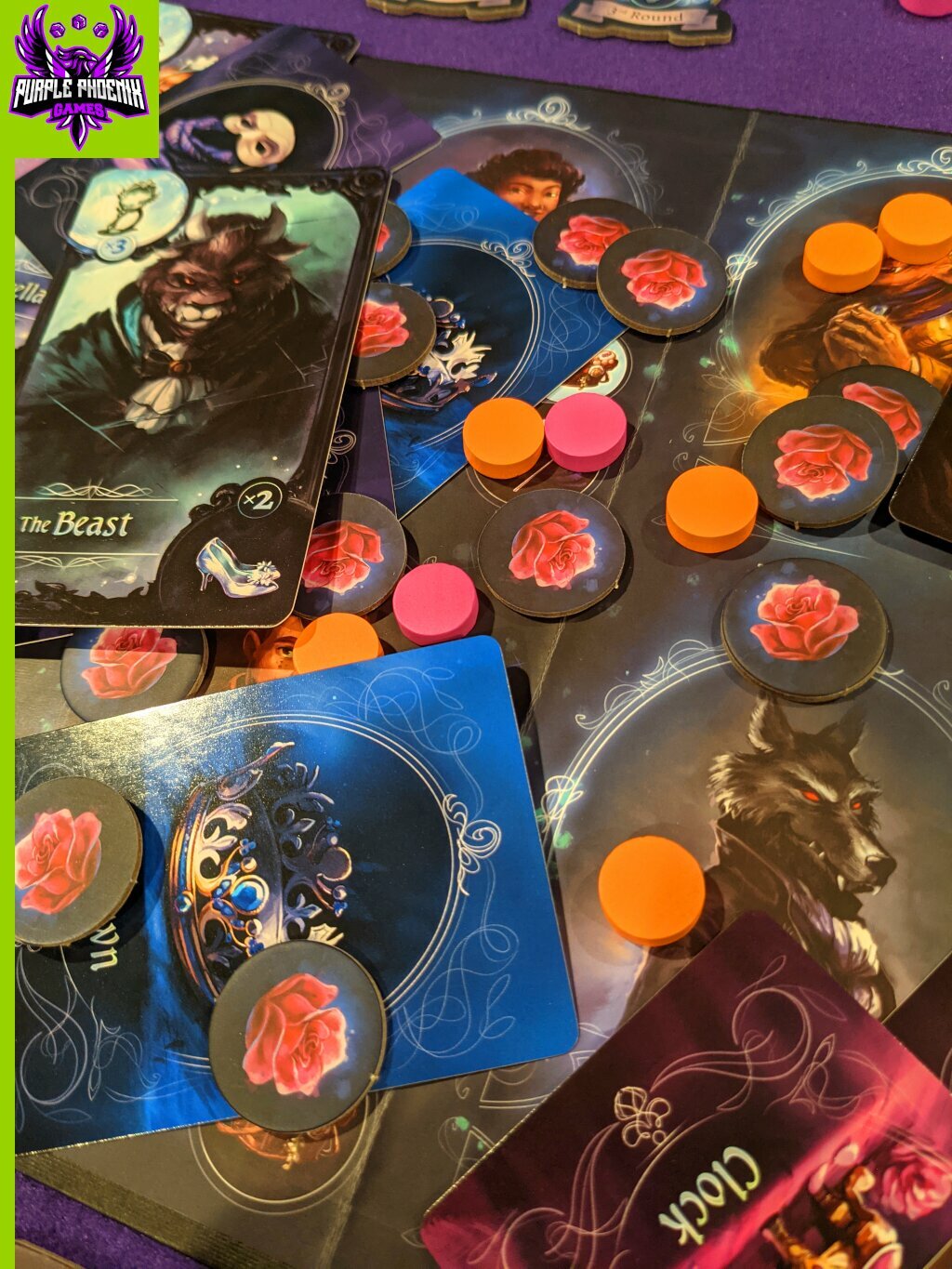
The game is played in rounds, with each turn of a round consisting of two steps. First, the active player draws an Artifact card and decides to keep it in their face-up tableau of Artifacts for all to see or give the Artifact to another player. Then the active player will draw a second card and either keep or give, whichever is opposite of their first choice. For example, should the first card drawn be kept, the next card would need to be given away. Each character has one Boon suit (which they love), and one Bane suit (which they despise). If at any time a character receives a card to create a matching pair in their tableau they must indicate whether that Artifact is in fact their Bane suit or not. They do this by placing one of their Evidence Markers on the character who owns that suit’s Bane value. However, if the player is actually the character who has that suit as their Bane, they have been unmasked and will play their other character in hopes of winning with them.
Should a player receive a card that would cause a set of three matching suit cards, they must indicate that they have either won the round or that they are not the character that matches that suit’s Boon value. For example, should a player receive their third Treats card they must declare they have won the round (if they happen to be Red Riding Hood), or that they are not indeed Red Riding Hood by placing an Evidence Marker on Red Riding Hood.
After this card play at the beginning of their turn the active player may choose to discard a matching pair of Artifact cards in order to activate an Action available (optional step). The Actions available are on the revealed Action cards on either side of the Action Board (which also shows an always-available Action of Point the Finger). So by discarding a pair of Crowns, for example, a player could utilize the Action card Eavesdrop in order to force the other player(s) to place Evidence Markers on characters they are NOT. This gives the active player more insight into who the other player(s) may actually BE.
Once cards have been drawn and the optional Actions taken, play passes to the next player. Players win the round by collecting three matching Boon Artifact cards or by unmasking all other characters in play. Whichever player wins the round also takes the Rose Trophy depending on which of the three rounds was just completed (value 1 for the first round, 3 for the second, and 5 for the third). At the end of the third round players count up their total roses (unless one player has earned 10 or more at the end of a previous round) and whomever has collected the most is the winner of The Grimm Masquerade!
Components. I have to say, every game I have played by Druid City Games has had amazing components, and this one is certainly no different. All the cardboard pieces, the cards, and the wooden discs are all excellent quality. But what I want to concentrate on here is the perfect choice to employ Mr. Cuddington for the art. Every time I see Mr. Cuddington on the credits for a game I know I am going to love looking at it on the table. They just have amazing style and everything is so detailed and perfectly matched for the setting. This FEELS like a Grimm’s Fairy Tales game for sure, and I love it.
It is definitely no secret that I love this one. I enjoy hidden role games to begin with (The Resistance: Avalon also being one of my favorites), and this setting feels excellently matched to the genre and the execution is wonderful. I really have a great time sussing out who is who and giving those final Artifacts in order to unmask players that are perceived to be leading is so fulfilling. Being able to spend matching cards in order to use Actions is also great design, especially when you can bluff by discarding your Boon cards to throw opponents off your trail. So much deceit in a fun package.
If you have few hidden role games and you want something with a light theme and relatively quick playtime, please do yourself a favor and check out The Grimm Masquerade. Purple Phoenix Games gives this one a playful 15 / 18. If you are like us and enjoy games where you control some information and can guess other players’ identities, but also like games where you can still play on even when you have been found out, this one is for you. If only this could support even more players, I could see it unseating Avalon for me. As it is, I may still end up using this one more often than Avalon unless I have a larger group of people at the table. That is a big statement from me as Avalon is a proven winner and has been a staple of my collection for years. But The Grimm Masquerade is that good. Play it and let me know if you agree.
The Grimm Masquerade is a hidden role competitive bluffing game for two to five players. In it player take on the roles of well-known fairytale folk attending a magical masquerade thrown by The Beast (I mean, he has a name, right? Not just “The Beast…”). Attendees are tasked with trying to unmask other attendees while earning magical roses in the process. The winner is the player who can earn the most roses at the end of three rounds of bluffing and guessing, unless one player is able to earn 10 roses before the end.
DISCLAIMER: We were provided a copy of this game for the purposes of this review. This is a retail copy of the game, so what you see in these photos is exactly what would be received in your box. I do not intend to cover every single rule included in the rulebook, but will describe the overall game flow and major rule set so that our readers may get a sense of how the game plays. For more in depth rules, you may purchase a copy online or from your FLGS. Also, this review concentrates on the two-player variant for the game as I played it mostly with my wife. -T
To setup, place the main board showing all the fairytale folk in the middle of the table. Each player will receive two (one if playing multi-player rules) Character cards, all Evidence Markers of their chosen color, and Reference cards. Around the board is placed the remaining Character cards, the Artifact deck, the stack of Broken Mirror tokens, the pile of roses, and the Action Board with two random Action cards revealed on either side. For the two-player game six Artifact cards are revealed in a line and each player will choose one Artifact for each of their two characters they are playing. The unchosen Artifacts will form the discard pile near the Artifact draw pile. Whomever most recently wore a costume will be the lead player and the game may begin!
The game is played in rounds, with each turn of a round consisting of two steps. First, the active player draws an Artifact card and decides to keep it in their face-up tableau of Artifacts for all to see or give the Artifact to another player. Then the active player will draw a second card and either keep or give, whichever is opposite of their first choice. For example, should the first card drawn be kept, the next card would need to be given away. Each character has one Boon suit (which they love), and one Bane suit (which they despise). If at any time a character receives a card to create a matching pair in their tableau they must indicate whether that Artifact is in fact their Bane suit or not. They do this by placing one of their Evidence Markers on the character who owns that suit’s Bane value. However, if the player is actually the character who has that suit as their Bane, they have been unmasked and will play their other character in hopes of winning with them.
Should a player receive a card that would cause a set of three matching suit cards, they must indicate that they have either won the round or that they are not the character that matches that suit’s Boon value. For example, should a player receive their third Treats card they must declare they have won the round (if they happen to be Red Riding Hood), or that they are not indeed Red Riding Hood by placing an Evidence Marker on Red Riding Hood.
After this card play at the beginning of their turn the active player may choose to discard a matching pair of Artifact cards in order to activate an Action available (optional step). The Actions available are on the revealed Action cards on either side of the Action Board (which also shows an always-available Action of Point the Finger). So by discarding a pair of Crowns, for example, a player could utilize the Action card Eavesdrop in order to force the other player(s) to place Evidence Markers on characters they are NOT. This gives the active player more insight into who the other player(s) may actually BE.
Once cards have been drawn and the optional Actions taken, play passes to the next player. Players win the round by collecting three matching Boon Artifact cards or by unmasking all other characters in play. Whichever player wins the round also takes the Rose Trophy depending on which of the three rounds was just completed (value 1 for the first round, 3 for the second, and 5 for the third). At the end of the third round players count up their total roses (unless one player has earned 10 or more at the end of a previous round) and whomever has collected the most is the winner of The Grimm Masquerade!
Components. I have to say, every game I have played by Druid City Games has had amazing components, and this one is certainly no different. All the cardboard pieces, the cards, and the wooden discs are all excellent quality. But what I want to concentrate on here is the perfect choice to employ Mr. Cuddington for the art. Every time I see Mr. Cuddington on the credits for a game I know I am going to love looking at it on the table. They just have amazing style and everything is so detailed and perfectly matched for the setting. This FEELS like a Grimm’s Fairy Tales game for sure, and I love it.
It is definitely no secret that I love this one. I enjoy hidden role games to begin with (The Resistance: Avalon also being one of my favorites), and this setting feels excellently matched to the genre and the execution is wonderful. I really have a great time sussing out who is who and giving those final Artifacts in order to unmask players that are perceived to be leading is so fulfilling. Being able to spend matching cards in order to use Actions is also great design, especially when you can bluff by discarding your Boon cards to throw opponents off your trail. So much deceit in a fun package.
If you have few hidden role games and you want something with a light theme and relatively quick playtime, please do yourself a favor and check out The Grimm Masquerade. Purple Phoenix Games gives this one a playful 15 / 18. If you are like us and enjoy games where you control some information and can guess other players’ identities, but also like games where you can still play on even when you have been found out, this one is for you. If only this could support even more players, I could see it unseating Avalon for me. As it is, I may still end up using this one more often than Avalon unless I have a larger group of people at the table. That is a big statement from me as Avalon is a proven winner and has been a staple of my collection for years. But The Grimm Masquerade is that good. Play it and let me know if you agree.
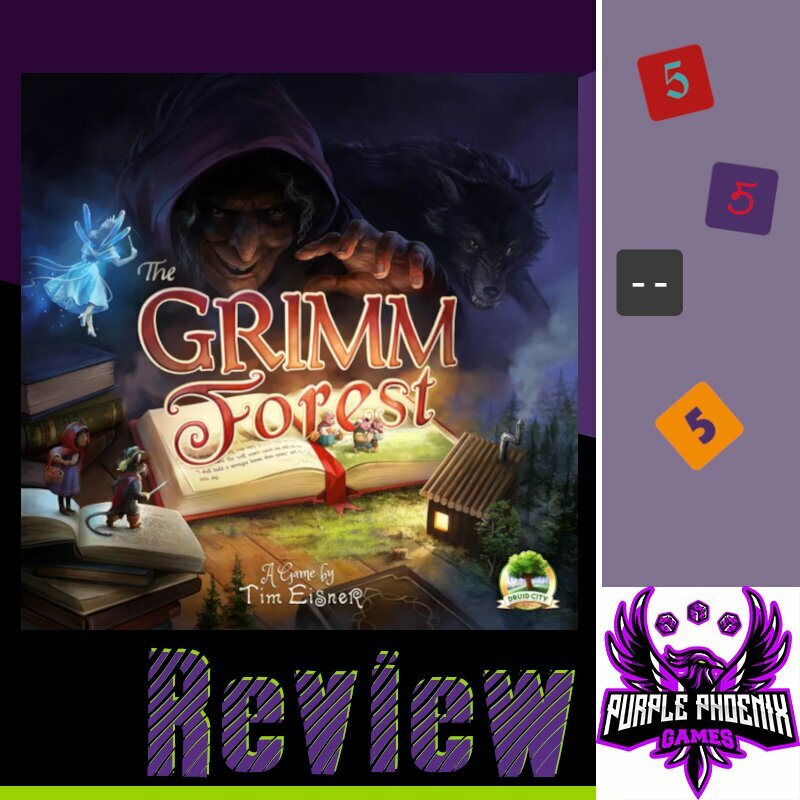
Purple Phoenix Games (2266 KP) rated The Grimm Forest in Tabletop Games
Apr 9, 2021
I am so psyched to be reviewing another board game based on fairytale lore. The Brothers Grimm material is such an enchanting (eh? eh?) theme and games can be taken in so many wonderful directions. Though I have never actually read any of the Grimm’s Fairy Tales (I know, I know), I have seen most of the movies based on the stories. I also know that the source material happens to be way darker than what Disney puts out, so when I heard we would be receiving The Grimm Forest to review, and not having really researched it much beforehand, I had a feeling it would be darker fare. But how dark does it go? Let’s find out.
The Grimm Forest is a simultaneous action selection, set collection, take that game for four family members of the infamous Three Little Pigs. As fantasy contractors players are tasked with constructing three houses as sturdy and quickly as they can. However, these contractors will have competition for limited resources, as well as the occasional interference from scary creatures and buddies of opponents. Like the baseball movie says, “If you build it, you will win the contract to build more stuff.” Or something like that.
DISCLAIMER: We were provided a copy of this game for the purposes of this review. This is a retail copy of the game, so what you see in these photos is exactly what would be received in your box. I do not intend to cover every single rule included in the rulebook, but will describe the overall game flow and major rule set so that our readers may get a sense of how the game plays. For more in depth rules, you may purchase a copy online or from your FLGS. -T
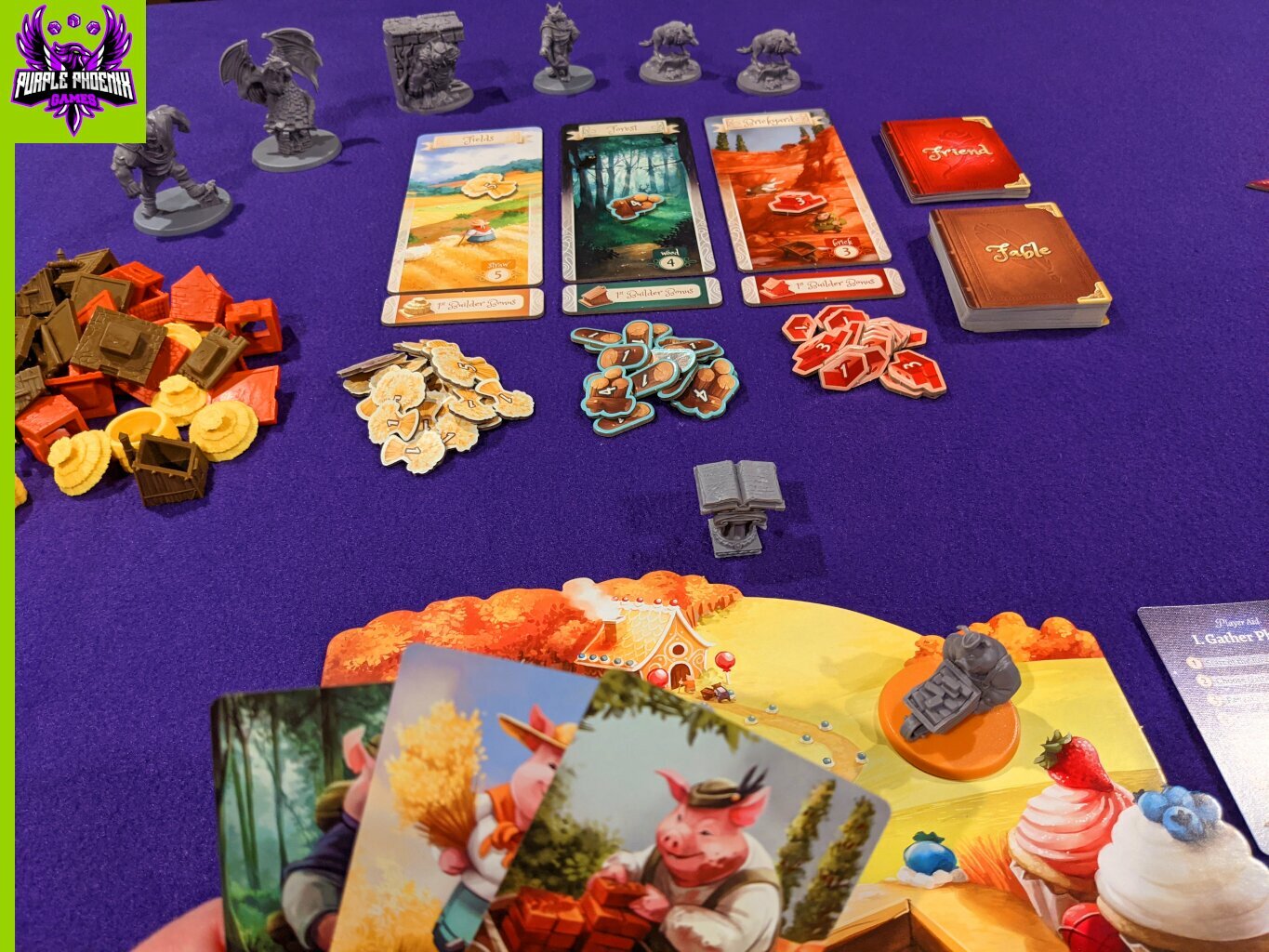
To setup, place the Location boards on the table for the Fields, Forest, and Brickyard (for a three-player game, as below). The First Builder Bonus tokens are placed below the matching Locations as well as the resources that can be harvested. One of each Mega Resource (5 Straw, 4 Wood, 3 Brick) are placed on the matching Location at the beginning of each round. The Friend and Fable decks are shuffled and placed nearby, as are the House sections (Floors, Walls, Roofs – Rooves?), and the Monster minis. Each player chooses a color and collects the Player board, Pig mini, and Gather cards matching that color. The first player is given the Starting Player tome token and the game may now begin!
The Grimm Forest is played over a series of rounds with each pig having a multi-step turn. Initially, however, the pigs will be deciding from which Location they would like to harvest resources by laying the corresponding Gather card from their hand to the table face-down. Once all pigs have laid their card, the Gather cards are flipped and revealed simultaneously. If any pig had chosen to also play one Fable card it would have been revealed and possibly resolved prior to this step. Players will place their Pig mini on the Location board they chose and then harvesting of resources may begin, unless a player has a Fable card that resolves at this point in the turn. If a Pig is alone in a Location they receive all resources currently found there. If Pigs share a Location then the shared minis will share the resources equally, keeping any remaining resources on the Location for the next round. If any player used a Fable card that activates at the end of the Gather phase, it is resolved now.
After the Gather phase, the Pigs will be able to take actions. On their turn, in turn order, each Pig may choose to perform two of the following actions in any order they wish (actions may be repeated except for Friend Special Actions): Draw a Fable card, Gain 1 Resource, Build, Special Actions. Drawing a Fable card is self-explanatory and players will keep their Fable cards secret from the other players. They may choose to play one of these Fable cards during the choosing of Gather cards portion of the beginning phase of a turn. A Pig may instead wish to gain one resource of their choosing and add it to their collection. As mentioned earlier, a Pig may also use their active Friend card’s (which is earned by building a Wall section) Special Action once per turn, should they have collected one earlier.
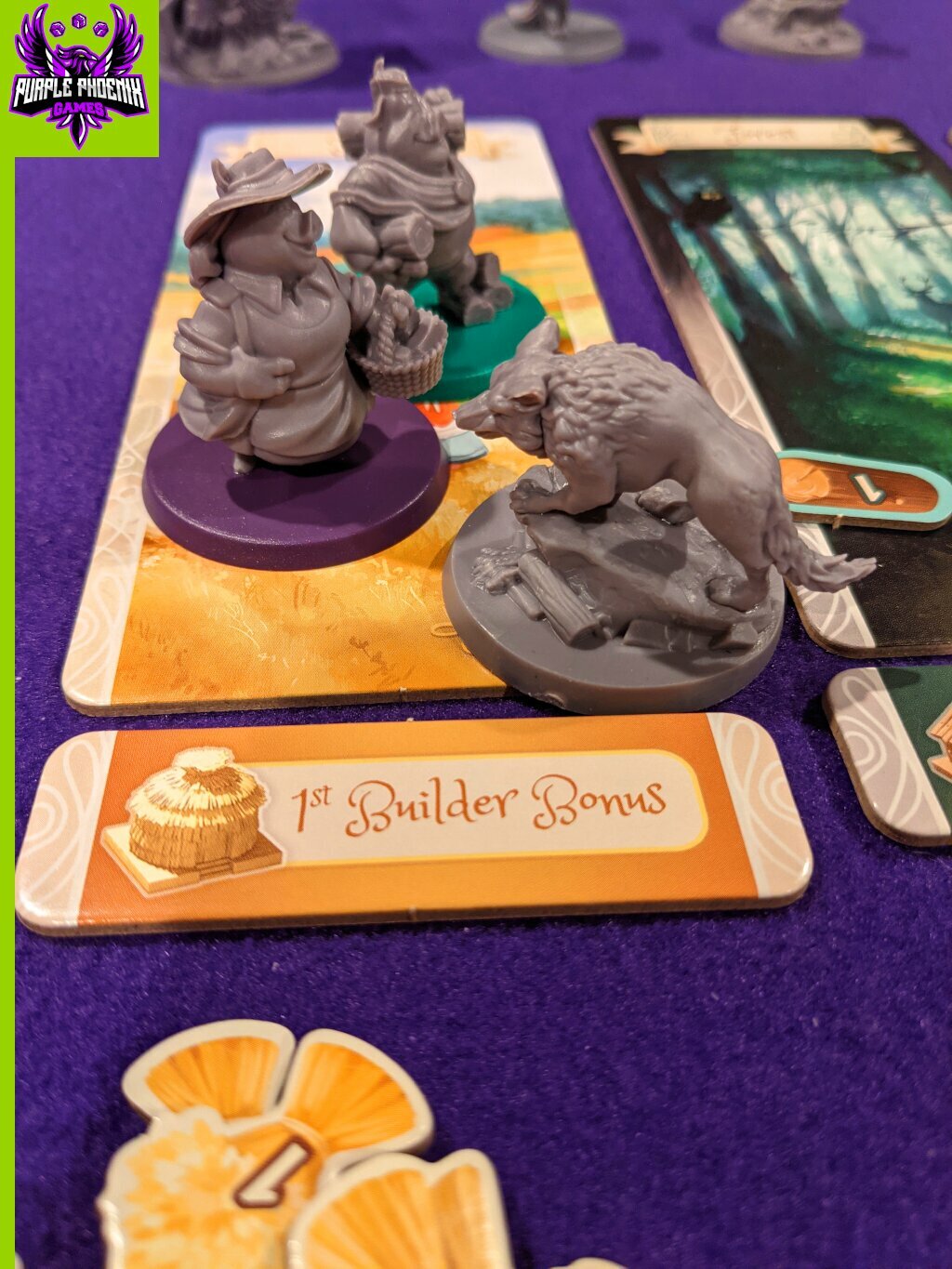
The true hero of The Grimm Forest is the Build action as this is what propels players to victory. Pigs may Build any house type they wish, as long as that type is not currently under construction elsewhere on their board. Also note that houses must be built from the ground up so Floors must be present before Walls can be built and Walls need to be constructed in order to hold up a Roof. Pigs may build these sections of houses by discarding the appropriate number and type of resources they have gathered previously: two resources for a Floor, four resources for Walls, and six resources for a Roof. Once a Pig completes construction of the first house of a type they will grab the matching First Builder Bonus token and reap its rewards.
The game continues in this fashion until one player has built three houses of any type, or multiple players have completed their three houses by the end of the round. Those tied players then check for sturdiness to break their tie: brick houses are sturdier than wood, which are sturdier than straw. The winner is the player with the sturdiest collection of houses, and then all players are invited to share a plate of bacon in celebration of the win (not in the rules, but I added that for… flavor).
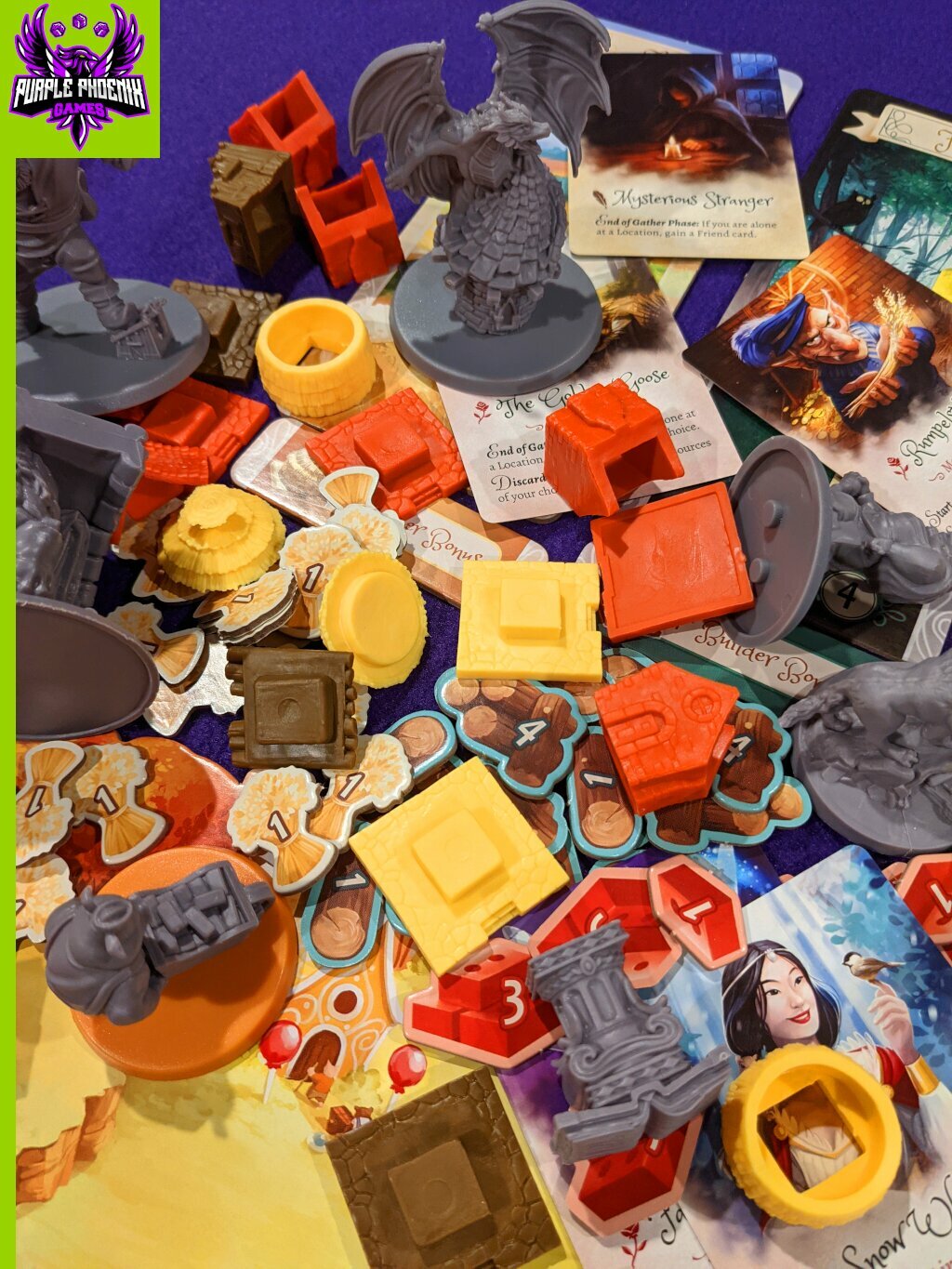
Components. This game is chocked full of killer components. I do not oftentimes compliment boxes and inserts, but when a game comes with GameTrayz already, you know that the publisher cared a ton about the game. Everything sets up and tears down so much nicer and quicker with a GameTrayz insert that I wish every game would come with them. Yeah, I know, $$$. Outside of the insert (or inside?) the other components in the game are simply stellar. Everything from the card backs resembling book covers, the incredible plastic house pieces, and amazing minis, just makes this one sing when on the table. The art is done by the incredible Mr. Cuddington, and they are quickly becoming some of my favorite board game artists.
Wait, there are monster minis? But I didn’t talk about that in my overview. Well, yes, that’s correct. These monsters come into play from certain Fable cards, and when they are played it instructs the player to introduce the appropriate monster mini on the playing area. This can be done with such dramatic flair that you truly get a sense of dread that little piggies may feel. If you have seen Stranger Things (not a sponsor) and remember the part when the Demogorgon mini hits the table, then you understand how I introduce my monster minis. These monsters wreak havoc on the players and sometimes deny them resources, and other chaos to mess with pigs.
Overall, I am so enamored with this game. It has nearly everything I love about games. It has amazing theme and art. That is always big with me. The components are super high quality, as all Druid City Games/Skybound Games usually are, and the game is so smooth once it is learned. All phases and turn components work together well, and there are plenty of choices each player makes every round. The game comes with advanced rules and components as well once all players are comfortable with the base game, and I love when games come with that added complexity and difficulty.
I have nothing bad to say about this game at all, which makes me sad, because I can usually find something to improve with every game I play. Okay wait, I just thought of one: I appreciate that the player colors include both orange and purple, but then the others are blue and green. I think the player colors could have come with some different choices as I feel blue, green, and purple are within similar color bands. Maybe pink and aqua would be better choices for my taste? I don’t know, and I am sure research was done to decide on the player colors, but like I said, I needed to find SOMETHING to complain about.
So it is certainly no surprise that I love this game and rated so highly. I doubt it will ever truly break into my Top 10, but I feel it ticks all of my boxes for a great game and a 6 from me. Purple Phoenix Games as a whole gives this one a porky 15 / 18. If you are looking for a great game that is admittedly lighter, but gives great gameplay throughout, features incredible art and components, and offers opportunities for role-play then you definitely need to grab a copy of The Grimm Forest. I will be recommending this to so many gamers in the future, and I will be pushing the floor of the age suggestion on the box once my son decides he wants to learn to read. I think I am going to go try out the Advanced rules now, and remember: don’t eat an apple that a scary person gave you at the door.
The Grimm Forest is a simultaneous action selection, set collection, take that game for four family members of the infamous Three Little Pigs. As fantasy contractors players are tasked with constructing three houses as sturdy and quickly as they can. However, these contractors will have competition for limited resources, as well as the occasional interference from scary creatures and buddies of opponents. Like the baseball movie says, “If you build it, you will win the contract to build more stuff.” Or something like that.
DISCLAIMER: We were provided a copy of this game for the purposes of this review. This is a retail copy of the game, so what you see in these photos is exactly what would be received in your box. I do not intend to cover every single rule included in the rulebook, but will describe the overall game flow and major rule set so that our readers may get a sense of how the game plays. For more in depth rules, you may purchase a copy online or from your FLGS. -T
To setup, place the Location boards on the table for the Fields, Forest, and Brickyard (for a three-player game, as below). The First Builder Bonus tokens are placed below the matching Locations as well as the resources that can be harvested. One of each Mega Resource (5 Straw, 4 Wood, 3 Brick) are placed on the matching Location at the beginning of each round. The Friend and Fable decks are shuffled and placed nearby, as are the House sections (Floors, Walls, Roofs – Rooves?), and the Monster minis. Each player chooses a color and collects the Player board, Pig mini, and Gather cards matching that color. The first player is given the Starting Player tome token and the game may now begin!
The Grimm Forest is played over a series of rounds with each pig having a multi-step turn. Initially, however, the pigs will be deciding from which Location they would like to harvest resources by laying the corresponding Gather card from their hand to the table face-down. Once all pigs have laid their card, the Gather cards are flipped and revealed simultaneously. If any pig had chosen to also play one Fable card it would have been revealed and possibly resolved prior to this step. Players will place their Pig mini on the Location board they chose and then harvesting of resources may begin, unless a player has a Fable card that resolves at this point in the turn. If a Pig is alone in a Location they receive all resources currently found there. If Pigs share a Location then the shared minis will share the resources equally, keeping any remaining resources on the Location for the next round. If any player used a Fable card that activates at the end of the Gather phase, it is resolved now.
After the Gather phase, the Pigs will be able to take actions. On their turn, in turn order, each Pig may choose to perform two of the following actions in any order they wish (actions may be repeated except for Friend Special Actions): Draw a Fable card, Gain 1 Resource, Build, Special Actions. Drawing a Fable card is self-explanatory and players will keep their Fable cards secret from the other players. They may choose to play one of these Fable cards during the choosing of Gather cards portion of the beginning phase of a turn. A Pig may instead wish to gain one resource of their choosing and add it to their collection. As mentioned earlier, a Pig may also use their active Friend card’s (which is earned by building a Wall section) Special Action once per turn, should they have collected one earlier.
The true hero of The Grimm Forest is the Build action as this is what propels players to victory. Pigs may Build any house type they wish, as long as that type is not currently under construction elsewhere on their board. Also note that houses must be built from the ground up so Floors must be present before Walls can be built and Walls need to be constructed in order to hold up a Roof. Pigs may build these sections of houses by discarding the appropriate number and type of resources they have gathered previously: two resources for a Floor, four resources for Walls, and six resources for a Roof. Once a Pig completes construction of the first house of a type they will grab the matching First Builder Bonus token and reap its rewards.
The game continues in this fashion until one player has built three houses of any type, or multiple players have completed their three houses by the end of the round. Those tied players then check for sturdiness to break their tie: brick houses are sturdier than wood, which are sturdier than straw. The winner is the player with the sturdiest collection of houses, and then all players are invited to share a plate of bacon in celebration of the win (not in the rules, but I added that for… flavor).
Components. This game is chocked full of killer components. I do not oftentimes compliment boxes and inserts, but when a game comes with GameTrayz already, you know that the publisher cared a ton about the game. Everything sets up and tears down so much nicer and quicker with a GameTrayz insert that I wish every game would come with them. Yeah, I know, $$$. Outside of the insert (or inside?) the other components in the game are simply stellar. Everything from the card backs resembling book covers, the incredible plastic house pieces, and amazing minis, just makes this one sing when on the table. The art is done by the incredible Mr. Cuddington, and they are quickly becoming some of my favorite board game artists.
Wait, there are monster minis? But I didn’t talk about that in my overview. Well, yes, that’s correct. These monsters come into play from certain Fable cards, and when they are played it instructs the player to introduce the appropriate monster mini on the playing area. This can be done with such dramatic flair that you truly get a sense of dread that little piggies may feel. If you have seen Stranger Things (not a sponsor) and remember the part when the Demogorgon mini hits the table, then you understand how I introduce my monster minis. These monsters wreak havoc on the players and sometimes deny them resources, and other chaos to mess with pigs.
Overall, I am so enamored with this game. It has nearly everything I love about games. It has amazing theme and art. That is always big with me. The components are super high quality, as all Druid City Games/Skybound Games usually are, and the game is so smooth once it is learned. All phases and turn components work together well, and there are plenty of choices each player makes every round. The game comes with advanced rules and components as well once all players are comfortable with the base game, and I love when games come with that added complexity and difficulty.
I have nothing bad to say about this game at all, which makes me sad, because I can usually find something to improve with every game I play. Okay wait, I just thought of one: I appreciate that the player colors include both orange and purple, but then the others are blue and green. I think the player colors could have come with some different choices as I feel blue, green, and purple are within similar color bands. Maybe pink and aqua would be better choices for my taste? I don’t know, and I am sure research was done to decide on the player colors, but like I said, I needed to find SOMETHING to complain about.
So it is certainly no surprise that I love this game and rated so highly. I doubt it will ever truly break into my Top 10, but I feel it ticks all of my boxes for a great game and a 6 from me. Purple Phoenix Games as a whole gives this one a porky 15 / 18. If you are looking for a great game that is admittedly lighter, but gives great gameplay throughout, features incredible art and components, and offers opportunities for role-play then you definitely need to grab a copy of The Grimm Forest. I will be recommending this to so many gamers in the future, and I will be pushing the floor of the age suggestion on the box once my son decides he wants to learn to read. I think I am going to go try out the Advanced rules now, and remember: don’t eat an apple that a scary person gave you at the door.