Search
Search results
Purple Phoenix Games (2266 KP) rated Munchkin in Tabletop Games
Jan 6, 2020
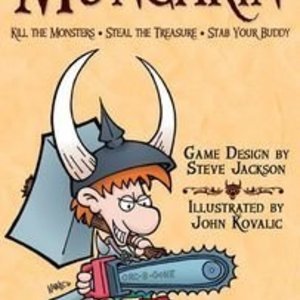

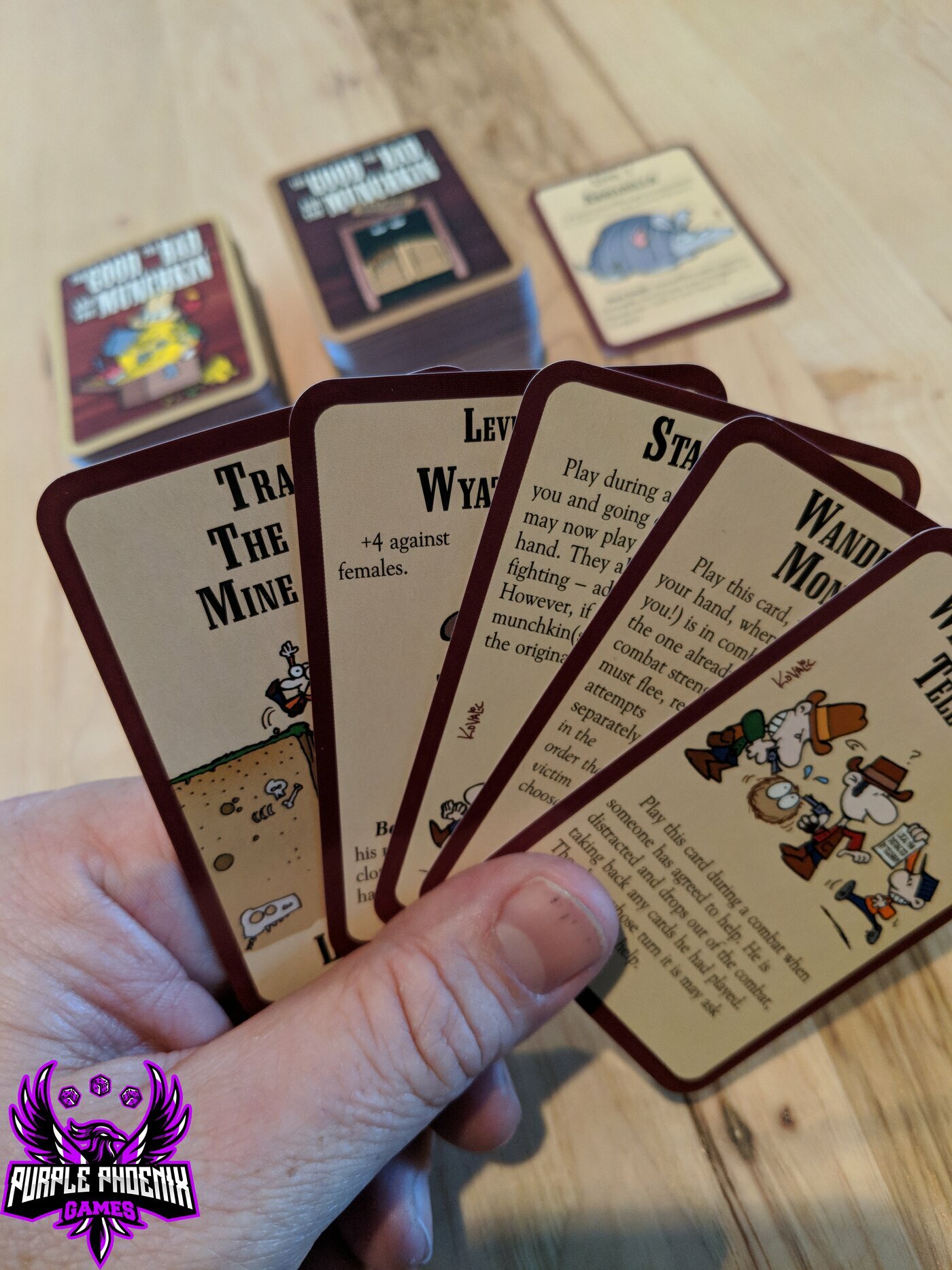
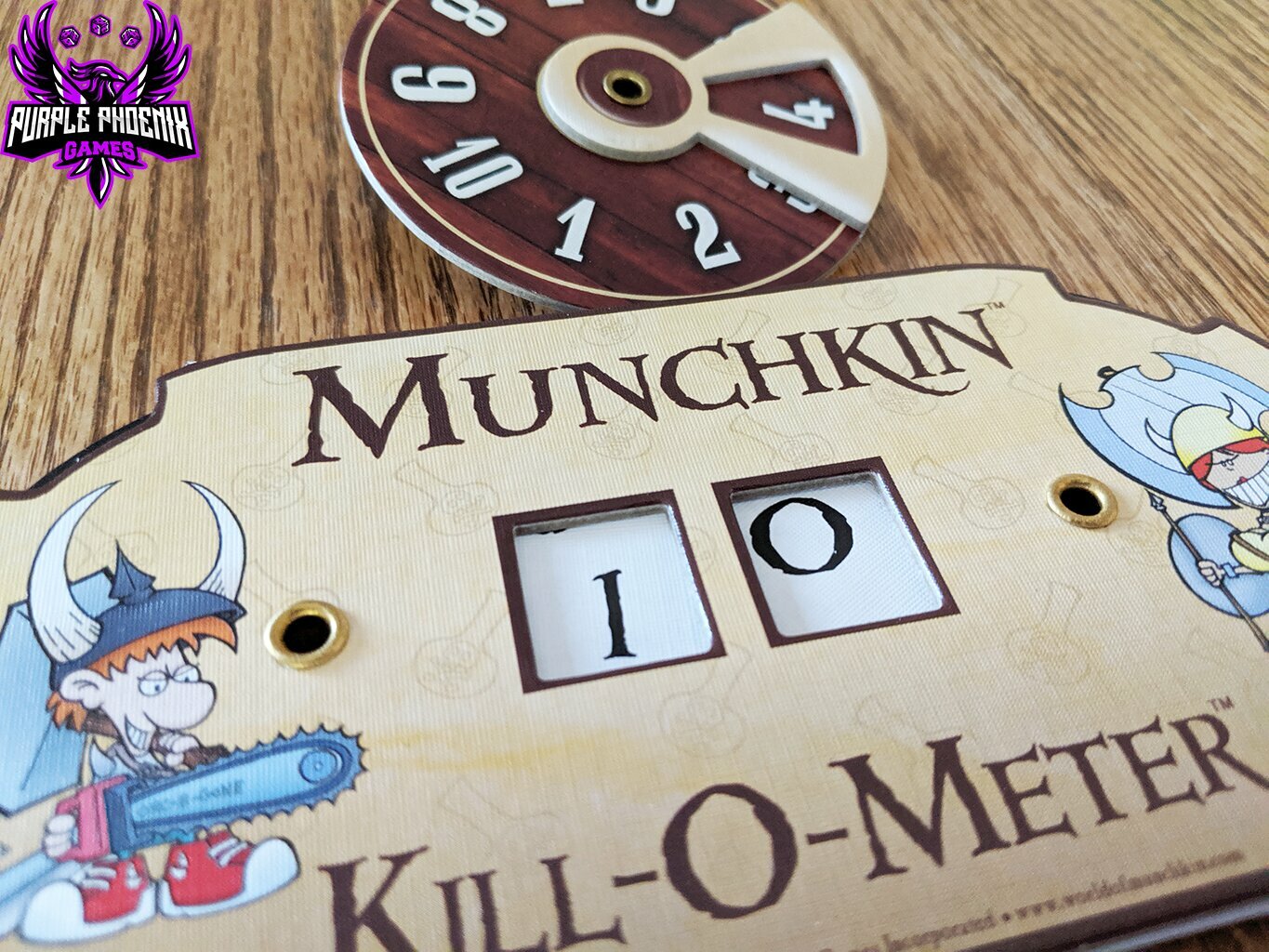
A “Munchkin,” in gamer terms, is someone who is only out to better themselves with treasure and power at the expense of everyone else in their adventuring party. That rings so very true in the Munchkin line of games, as you are trying to be the first to gain 10th Level in a VERY loosely-based RPG setting. OG vanilla Munchkin (pictured above) was my first entry into hobby board gaming. Many many games later I ask myself: How has this system of games aged for me as my gaming tastes have changed? Let’s see.
In Munchkin games, you are trying to become the first player to reach 10th Level. That’s the goal. You take on the persona of a 1st Level basic human (no Starbucks jokes please) who will be adventuring with a party of your opponents through a dungeon. You will be kicking down doors, fighting monsters, placing curses on your fellow party members, and buffing yourself with cards featuring funny art and punny references. Your party mates are also trying to achieve 10th Level and will do everything they can to block your progress, so be prepared!
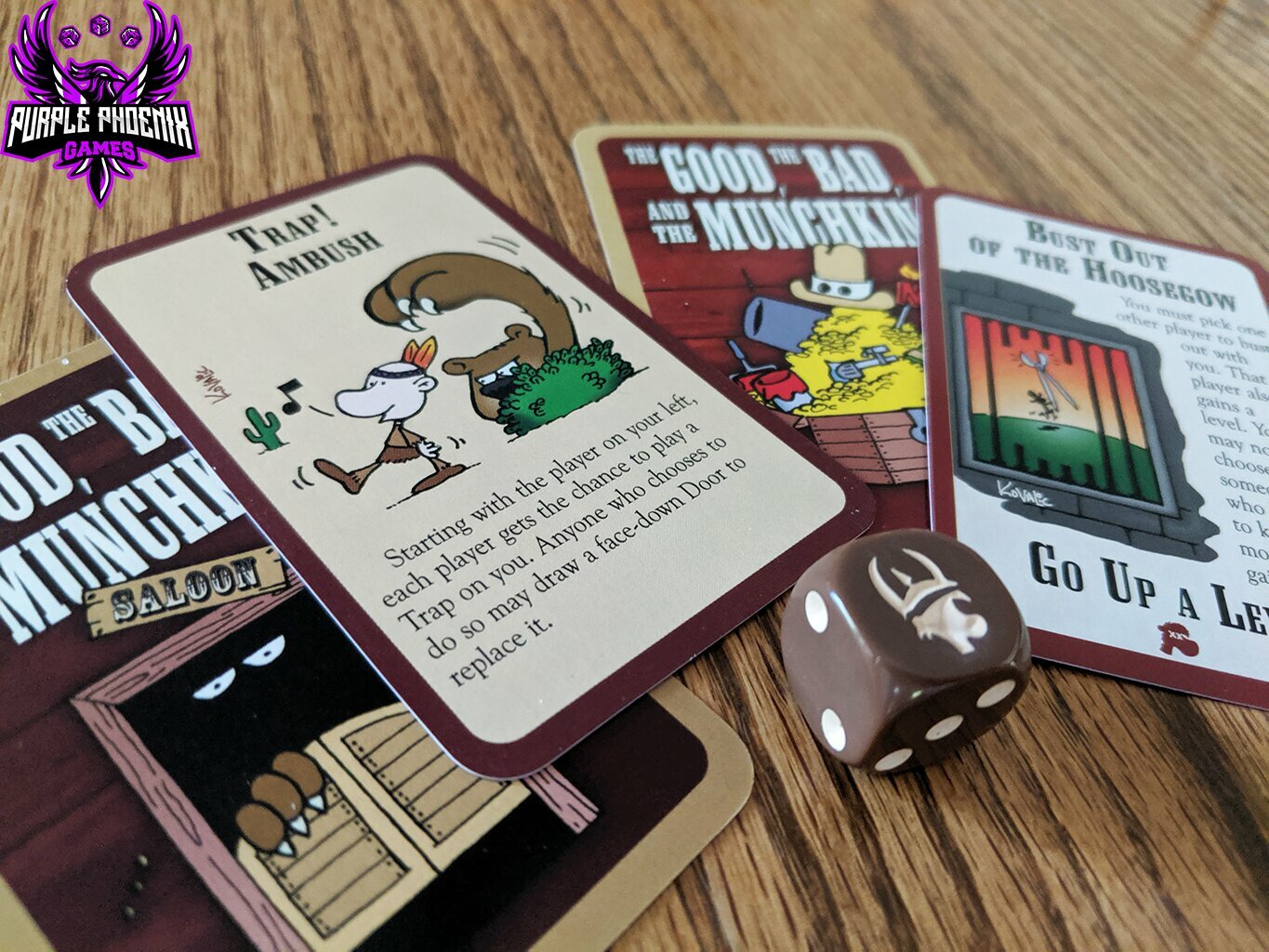
DISCLAIMER: This review is not for a specific game within the Munchkin universe, but for the system as a whole. All Munchkin games will pretty much use similar, if not exactly the same, rules to play the game with minor variations and different theming. I will be using The Good, The Bad, and The Munchkin for my review as it is one of the two versions I still own of the franchise. Also, I will not be detailing every rule in the book(s), but giving a brief overview of how the game plays. -T
Setup is easy: shuffle the deck of Door cards and the deck of Treasure cards. Deal cards to the players for their opening hands and keep the included die handy.
Your turn consists of just a few phases: Open a Door, Look for Trouble, Loot the Room, and Charity. To Open a Door, flip over the top card of the Door deck. If it is a monster you must fight it or run. If not a monster, you can move on to the next phase. If it IS a monster, prepare for combat. Combat is simple in that you add up all your bonuses from your gear cards you have attached to your character and try to beat the strength of the monster. Your party mates can screw with you during combat by adding strength to the monster or adding monsters to the fight to make it a more difficult encounter. If you win, you gain a Level on the spot. Some monsters are worth even more than one Level. If you did not encounter a monster, you will add the non-monster card you drew to your hand and you may Look for Trouble by playing a monster card from your hand to initiate a combat. This fight will work the same way and you will be susceptible to pile-ons as before. You may Loot the Room if you defeated a monster on your turn by drawing Treasure cards equal to the printed reward on the bottom of the monster card you defeated. If you defeated the monster yourself, unaided, these are drawn in secret. If you were given help by your mates then you may have to split up the loot per any agreements made. These cards are usually very advantageous to you so they are usually very valuable to others as they attempt to steal away your goods. If you did not fight a monster yet this turn, you may draw another secret card from the Door deck to add to your hand. Should your hand size climb above your limit (dictated by your Race card, if any) you will slide into the Charity phase to relieve your hand of extra cards. Give all excess cards to the player of lowest Level, or split them among those that share the lowest Level. It is now the next player’s turn and you continue play until someone reaches 10th Level.
Components. It’s a bunch of cards and one die. The cards are of okay quality. Nothing to write home about. The die is nice with one of the faces having the Munchkin logo head imprinted on it. It will also have a color scheme that matches the version of Munchkin you are playing, so it’s easy to match them back up if they become integrated with each other. Overall, the components are fine, but not wonderful. That’s probably why these are pretty inexpensive to purchase.
Okay, so like I said earlier the original vanilla Munchkin was the first hobby board game I ever purchased. My friends and family had no idea hobby games existed, so there was actually a pretty steep learning curve for us. Once we figured it out, however, we began to play it a ton and really love it! The cards are cute, the game play is pretty easy if you have played hobby games before, and the puns kept us rolling for a good while. There was a time when I owned every version of Munchkin in circulation and we never even played half of them. Seeing this I got rid of them through BGG Auctions. I have The Good, The Bad, and The Munchkin and Munchkin Zombies right now and I feel that will be plenty for me from here on out – unless they make a Doctor Who or Firefly set or something /*checks warehouse23 to find out if these are available/.
Do I still love Munchkin? No, not really. I LIKE it, but I don’t really want to play it all the time any more. Why? Well, as my gamer experience increases and I level up, my game tastes also level up. I see why people enjoy and even love this game system. I myself loved it for a time. But there are better games out there that accomplish the same feelings without being as sophomoric and have better choices to be made. Will I still play these games? Heck yeah! If someone asks to play a Munchkin game I am all in. I have different tastes and preferences now, but I’m no snob. Just come prepared, because I won’t go easy on you.
We at Purple Phoenix Games give this family of titles a backstabby 16 / 24.
In Munchkin games, you are trying to become the first player to reach 10th Level. That’s the goal. You take on the persona of a 1st Level basic human (no Starbucks jokes please) who will be adventuring with a party of your opponents through a dungeon. You will be kicking down doors, fighting monsters, placing curses on your fellow party members, and buffing yourself with cards featuring funny art and punny references. Your party mates are also trying to achieve 10th Level and will do everything they can to block your progress, so be prepared!
DISCLAIMER: This review is not for a specific game within the Munchkin universe, but for the system as a whole. All Munchkin games will pretty much use similar, if not exactly the same, rules to play the game with minor variations and different theming. I will be using The Good, The Bad, and The Munchkin for my review as it is one of the two versions I still own of the franchise. Also, I will not be detailing every rule in the book(s), but giving a brief overview of how the game plays. -T
Setup is easy: shuffle the deck of Door cards and the deck of Treasure cards. Deal cards to the players for their opening hands and keep the included die handy.
Your turn consists of just a few phases: Open a Door, Look for Trouble, Loot the Room, and Charity. To Open a Door, flip over the top card of the Door deck. If it is a monster you must fight it or run. If not a monster, you can move on to the next phase. If it IS a monster, prepare for combat. Combat is simple in that you add up all your bonuses from your gear cards you have attached to your character and try to beat the strength of the monster. Your party mates can screw with you during combat by adding strength to the monster or adding monsters to the fight to make it a more difficult encounter. If you win, you gain a Level on the spot. Some monsters are worth even more than one Level. If you did not encounter a monster, you will add the non-monster card you drew to your hand and you may Look for Trouble by playing a monster card from your hand to initiate a combat. This fight will work the same way and you will be susceptible to pile-ons as before. You may Loot the Room if you defeated a monster on your turn by drawing Treasure cards equal to the printed reward on the bottom of the monster card you defeated. If you defeated the monster yourself, unaided, these are drawn in secret. If you were given help by your mates then you may have to split up the loot per any agreements made. These cards are usually very advantageous to you so they are usually very valuable to others as they attempt to steal away your goods. If you did not fight a monster yet this turn, you may draw another secret card from the Door deck to add to your hand. Should your hand size climb above your limit (dictated by your Race card, if any) you will slide into the Charity phase to relieve your hand of extra cards. Give all excess cards to the player of lowest Level, or split them among those that share the lowest Level. It is now the next player’s turn and you continue play until someone reaches 10th Level.
Components. It’s a bunch of cards and one die. The cards are of okay quality. Nothing to write home about. The die is nice with one of the faces having the Munchkin logo head imprinted on it. It will also have a color scheme that matches the version of Munchkin you are playing, so it’s easy to match them back up if they become integrated with each other. Overall, the components are fine, but not wonderful. That’s probably why these are pretty inexpensive to purchase.
Okay, so like I said earlier the original vanilla Munchkin was the first hobby board game I ever purchased. My friends and family had no idea hobby games existed, so there was actually a pretty steep learning curve for us. Once we figured it out, however, we began to play it a ton and really love it! The cards are cute, the game play is pretty easy if you have played hobby games before, and the puns kept us rolling for a good while. There was a time when I owned every version of Munchkin in circulation and we never even played half of them. Seeing this I got rid of them through BGG Auctions. I have The Good, The Bad, and The Munchkin and Munchkin Zombies right now and I feel that will be plenty for me from here on out – unless they make a Doctor Who or Firefly set or something /*checks warehouse23 to find out if these are available/.
Do I still love Munchkin? No, not really. I LIKE it, but I don’t really want to play it all the time any more. Why? Well, as my gamer experience increases and I level up, my game tastes also level up. I see why people enjoy and even love this game system. I myself loved it for a time. But there are better games out there that accomplish the same feelings without being as sophomoric and have better choices to be made. Will I still play these games? Heck yeah! If someone asks to play a Munchkin game I am all in. I have different tastes and preferences now, but I’m no snob. Just come prepared, because I won’t go easy on you.
We at Purple Phoenix Games give this family of titles a backstabby 16 / 24.
Purple Phoenix Games (2266 KP) rated Aroma in Tabletop Games
Feb 20, 2021

Hello. My name is Travis and I have a big nose. It has always been big, and I used to tell people that it is so because I could smell so much better than everyone else. For a while this was partly true. However, as I age I find that I am less and less amazing than I thought I was when I was younger. Enter a game that revolves around actually using this schnoz and its wonderful ability and I thought I would have it in the bag! I was wrong. Again.
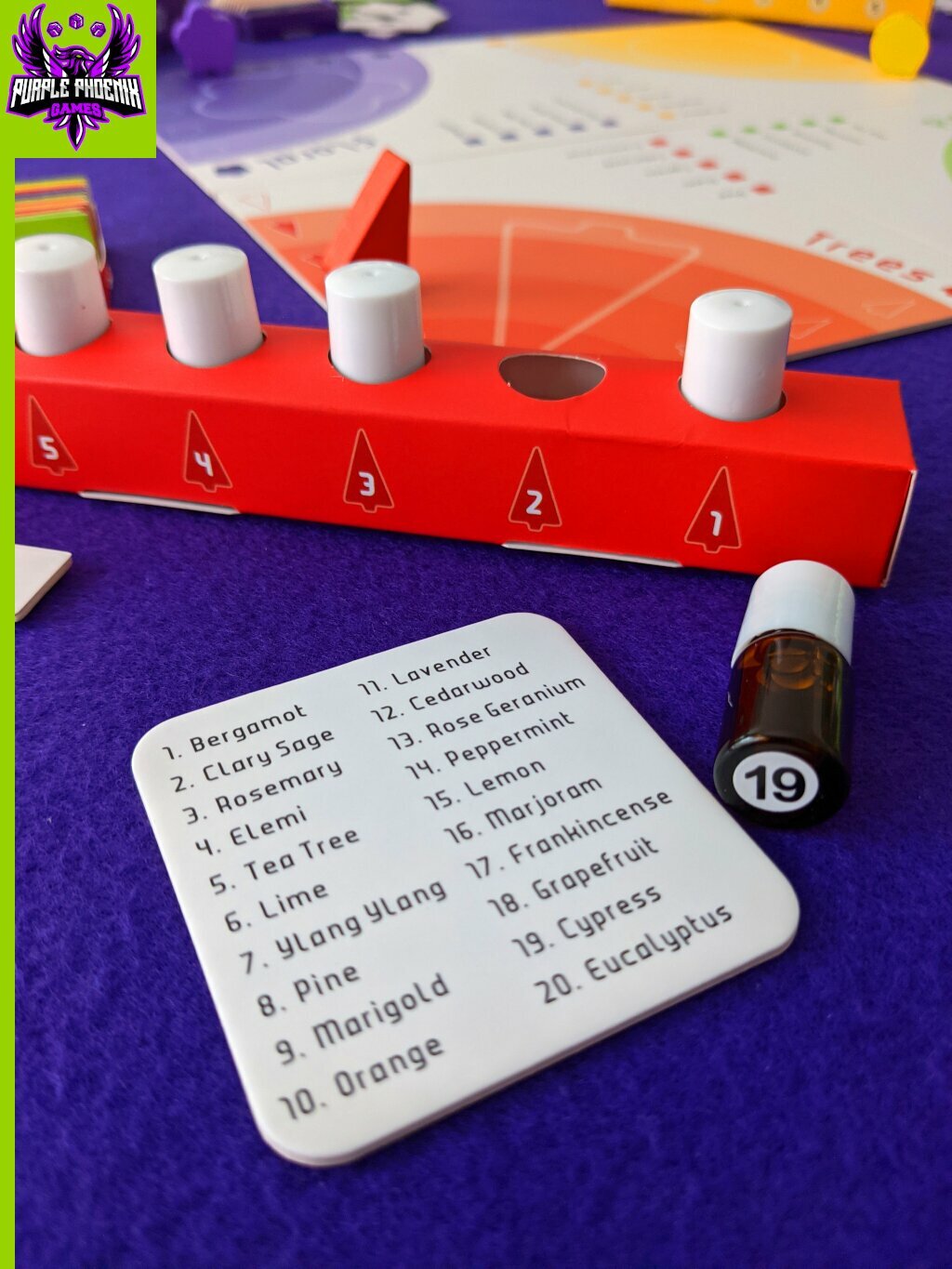
Aroma is a board game that originates from an essential oil company wishing to produce a board game utilizing its oils. Designer Odd Hackwelder then crafted a board game utilizing said essential oils that can be played four different ways. That’s right, Aroma is a game with four different play modes. Most of the modes revolve around the ability to guess the correct scent to score points. For this review I will be referencing rules for the Revolve mode with four players.
DISCLAIMER: We were provided a copy of this game for the purposes of this review. This is a retail copy of the game, so what you see in these photos is exactly what would be received in your box. I do not intend to cover every single rule included in the rulebook, but will describe the overall game flow and major rule set so that our readers may get a sense of how the game plays. For more in depth rules, you may purchase a copy online or from your FLGS. -T
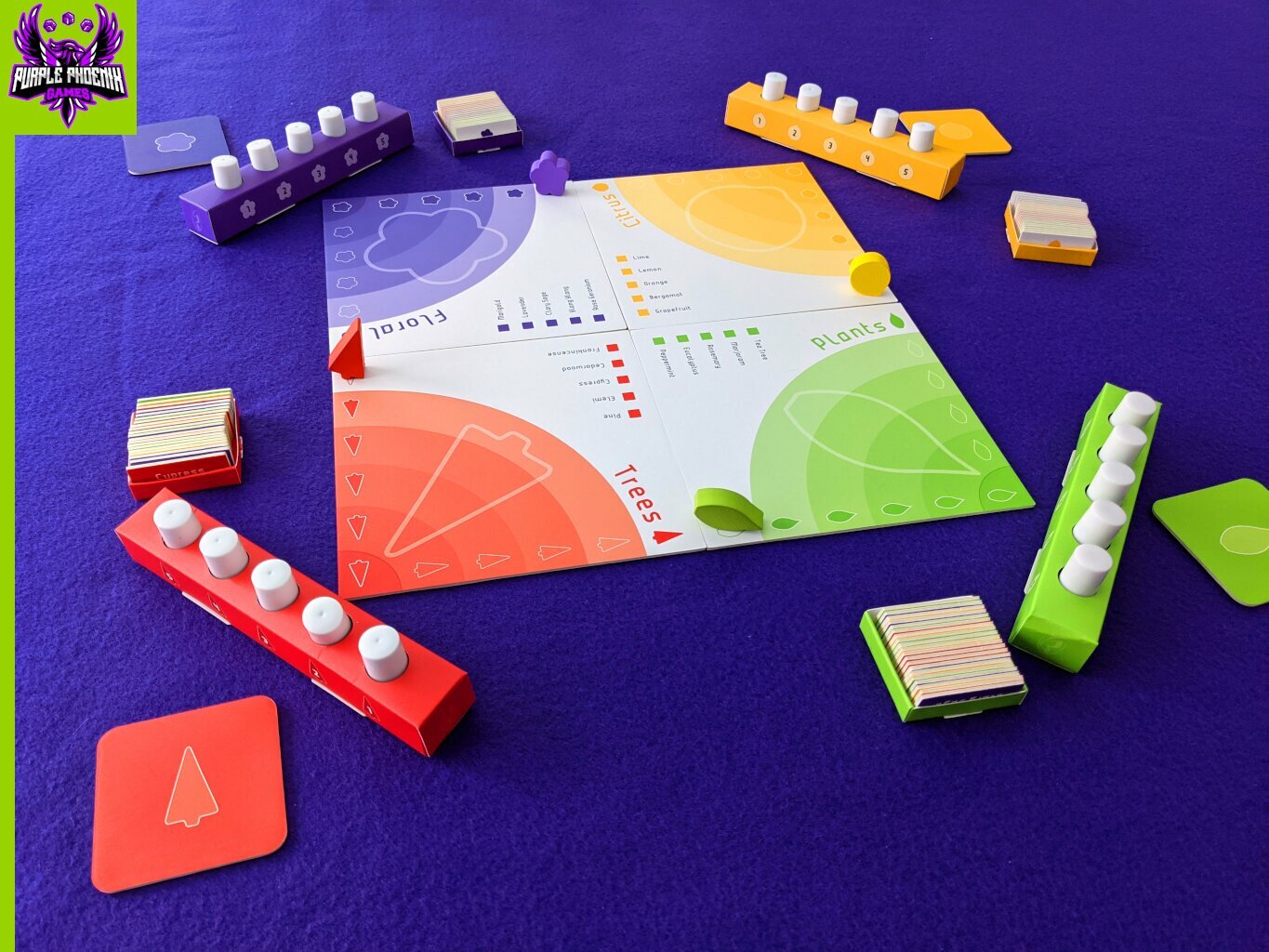
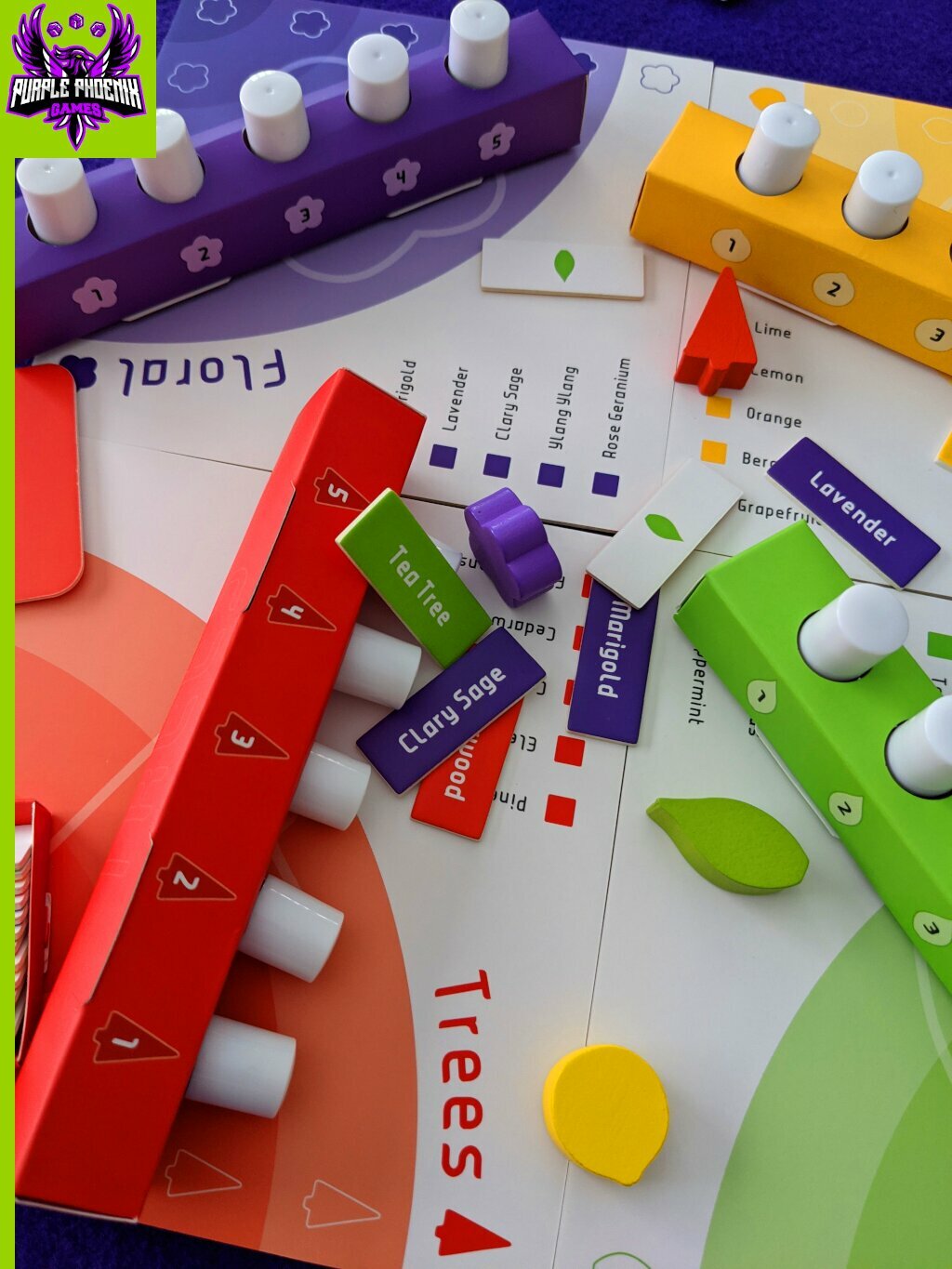
To setup a game of Revolve each player will choose one of the themed player boards and bits from the following: Citrus, Trees, Plants, Floral. They will lay the boards touching in the middle of the table and their oil trays with essential oil bottles in front of them. Each player will also receive the wooden player token and scent tokens in their color. Place the wooden player tokens on the point tracker zero space and the game is setup to begin!
Revolve is played in rounds where each player will choose one of their oil vials from their tray, place its matching scent token face-down on their board and pass it to the player on their left simultaneously. The players then take the vials just given to them, smell the oils inside and try to guess its content scent by choosing the appropriate scent token and placing it face-down on the board in front of them as well. Play continues in this fashion until all players have smelled the vials from all players and made their guesses.
Players then flip over their scent tokens to compare what was given to them throughout the round and they will score points based on how many were guessed correctly. The players then choose a different vial and the process starts anew. The game ends at the end of the fourth round and the player with the most correct guesses is the winner!
Components. This game has pretty amazing components. The oil trays with the little oil bottles are great, but a little flimsy. The boards and scent tokens are thick, and the wooden player pieces are nice and medium-sized. The overall look of the game is very clean and colorful, reminiscent of the art style in T.I.M.E Stories, but with more colors and smells. Aside from the flimsy cardboard used in the oil trays, the rest of the components are top notch. I do have one gripe: the oil bottles themselves sometimes take quite a bit of effort to get the smell going. We tried manually rolling with our fingers, and the suggested technique of rolling on a sheet of paper (we used a paper napkin). The best way was to just drench oneself in essential oil by manually rolling the ball with one’s finger.
As a game Aroma’s Revolve is interesting and invokes feelings not normally used to describe board games. I have not played another game like it, nor one that I can remember using my sense of smell at all. For this point alone I feel attracted to Aroma. However, smelling all the scents over and over can sometimes get a little overwhelming for me. I KNOW what a lemon smells like, but when you pass around a vial and I sniff it, I feel like I am smelling lemon. When the card is revealed and it is actually grapefruit I just smelled I become frustrated. I guess I never realized how closely many things smell to other items in the same family. I like to reminisce about the first time I ever smelled pine, or its unmistakable scent down in my wood shop. But the pine scent in Aroma doesn’t really smell like pine to me. Maybe my snout is aging faster than I thought, but I am really no good at picking out some of these scents.
I have also played the Survive mode with just my wife and of course she always beats me. Survive is the only mode that is designed for two players, and I wish there were more. Getting together during the lockdown is difficult, and I game mostly with my wife. That said, on the rare occasion I got to play games with another couple in our quarantine pod I wanted to break Aroma out and try a different mode. Revolve is good, and Survive is good too, but I would prefer both with the full compliment of players.
If you are looking for something completely different for your collection, Aroma is it. I don’t know if it will make many gamers’ Top 10 lists, but it is so interesting to use the sense of smell in a board game that I think it is almost essential (see what I did there?). I mean that Aroma currently has no competition in the same space, so it will not be replaced by another similar game for quite some time, I’m sure. And what guest wouldn’t be impressed by playing a board game that includes 20 vials of essential oil? How novel is that, anyway? Purple Phoenix Games gives this one a lovely-sniffed 8 / 12. Do be warned: Aroma may accidentally perfume some other games it is stored near, but the scent is pleasant. At least I THINK it is. Now I’m doubting my ability to smell anything correctly.
Aroma is a board game that originates from an essential oil company wishing to produce a board game utilizing its oils. Designer Odd Hackwelder then crafted a board game utilizing said essential oils that can be played four different ways. That’s right, Aroma is a game with four different play modes. Most of the modes revolve around the ability to guess the correct scent to score points. For this review I will be referencing rules for the Revolve mode with four players.
DISCLAIMER: We were provided a copy of this game for the purposes of this review. This is a retail copy of the game, so what you see in these photos is exactly what would be received in your box. I do not intend to cover every single rule included in the rulebook, but will describe the overall game flow and major rule set so that our readers may get a sense of how the game plays. For more in depth rules, you may purchase a copy online or from your FLGS. -T
To setup a game of Revolve each player will choose one of the themed player boards and bits from the following: Citrus, Trees, Plants, Floral. They will lay the boards touching in the middle of the table and their oil trays with essential oil bottles in front of them. Each player will also receive the wooden player token and scent tokens in their color. Place the wooden player tokens on the point tracker zero space and the game is setup to begin!
Revolve is played in rounds where each player will choose one of their oil vials from their tray, place its matching scent token face-down on their board and pass it to the player on their left simultaneously. The players then take the vials just given to them, smell the oils inside and try to guess its content scent by choosing the appropriate scent token and placing it face-down on the board in front of them as well. Play continues in this fashion until all players have smelled the vials from all players and made their guesses.
Players then flip over their scent tokens to compare what was given to them throughout the round and they will score points based on how many were guessed correctly. The players then choose a different vial and the process starts anew. The game ends at the end of the fourth round and the player with the most correct guesses is the winner!
Components. This game has pretty amazing components. The oil trays with the little oil bottles are great, but a little flimsy. The boards and scent tokens are thick, and the wooden player pieces are nice and medium-sized. The overall look of the game is very clean and colorful, reminiscent of the art style in T.I.M.E Stories, but with more colors and smells. Aside from the flimsy cardboard used in the oil trays, the rest of the components are top notch. I do have one gripe: the oil bottles themselves sometimes take quite a bit of effort to get the smell going. We tried manually rolling with our fingers, and the suggested technique of rolling on a sheet of paper (we used a paper napkin). The best way was to just drench oneself in essential oil by manually rolling the ball with one’s finger.
As a game Aroma’s Revolve is interesting and invokes feelings not normally used to describe board games. I have not played another game like it, nor one that I can remember using my sense of smell at all. For this point alone I feel attracted to Aroma. However, smelling all the scents over and over can sometimes get a little overwhelming for me. I KNOW what a lemon smells like, but when you pass around a vial and I sniff it, I feel like I am smelling lemon. When the card is revealed and it is actually grapefruit I just smelled I become frustrated. I guess I never realized how closely many things smell to other items in the same family. I like to reminisce about the first time I ever smelled pine, or its unmistakable scent down in my wood shop. But the pine scent in Aroma doesn’t really smell like pine to me. Maybe my snout is aging faster than I thought, but I am really no good at picking out some of these scents.
I have also played the Survive mode with just my wife and of course she always beats me. Survive is the only mode that is designed for two players, and I wish there were more. Getting together during the lockdown is difficult, and I game mostly with my wife. That said, on the rare occasion I got to play games with another couple in our quarantine pod I wanted to break Aroma out and try a different mode. Revolve is good, and Survive is good too, but I would prefer both with the full compliment of players.
If you are looking for something completely different for your collection, Aroma is it. I don’t know if it will make many gamers’ Top 10 lists, but it is so interesting to use the sense of smell in a board game that I think it is almost essential (see what I did there?). I mean that Aroma currently has no competition in the same space, so it will not be replaced by another similar game for quite some time, I’m sure. And what guest wouldn’t be impressed by playing a board game that includes 20 vials of essential oil? How novel is that, anyway? Purple Phoenix Games gives this one a lovely-sniffed 8 / 12. Do be warned: Aroma may accidentally perfume some other games it is stored near, but the scent is pleasant. At least I THINK it is. Now I’m doubting my ability to smell anything correctly.
5 Minute Movie Guy (379 KP) rated The Fault In Our Stars (2014) in Movies
Jun 26, 2019 (Updated Jun 26, 2019)

Undoubtedly one of the great love stories of our time. (3 more)
Shailene Woodley and Ansel Elgort are a perfect match.
John Green's novel is brilliantly adapted to the silver screen.
This is a movie that will stay with you long after it's over.
On the surface, it's easy to dismiss The Fault in Our Stars as being a sappy teenage love affair, but I can fortunately say that this is one of the great love stories of our time.
Based on John Green’s popular young adult novel, The Fault in Our Stars is a film that is profoundly beautiful, eloquent and heartfelt. It tells of an extraordinary love between two unforgettable characters who are brought together by similarly ill-fated circumstances. Hazel Grace Lancaster and Augustus Waters are both victims of cancer. Although they do their best to hide it, these two young adults are each afraid of their ominous and unstable futures. They’re just trying to live purposeful lives and experience life like normal teenagers, but the looming threat of an untimely death impedes that desire. However, for a film filled with so much uncertainty, I can fortunately say that there is little doubt that The Fault in Our Stars is one of the great love stories of our time.
On the surface, it’s easy to dismiss The Fault in Our Stars as being a sappy teenage love affair. I’ll confess that I went into the theater expecting to be fully surrounded by crying teenage girls, while I would be quietly laughing to myself at their heartache. What I surely didn’t anticipate, however, was to be so deeply drawn into the film. Even more surprising is the fact that The Fault in Our Stars has actually turned out to be my favorite movie of the year so far. This is a film that is sincerely heartfelt and unflinchingly genuine. It brings truth to the romantic fantasies we have, and teaches us that we can’t let the fear of possible heartache hold us back from the endless potential of love.
Make no mistake about it, The Fault in Our Stars is a tear-jerker. It’s difficult to watch these lovable characters endure such unjustifiable hardship. Hazel and Augustus are each forced to face a formidable fate that they shouldn’t have to. I really felt a strong attachment to both of them, and found them to be remarkably identifiable. This connection makes it all the more unsettling when their situations turn dire. The reason that The Fault in Our Stars manages to be so effective is because of its authenticity and accessibility. The characters are not only admirable, but relatable. They’re not simply reduced to being unfortunate young cancer patients that we’re meant to feel sorry for. While of course we can sympathize with their condition, it is their compassion and the content of their characters that make them so compelling.
While the film features its fair share of tragedy, I should make it clear that it’s not heart-wrenchingly malicious in the way it deals with its ensuing sadness. This is not a film that is deliberately trying to make anyone feel bad. It is merely being honest in its depiction of the unfairness that often exists in life. While you very well might cry when watching the film, it’s not entirely depressing and hopeless. In fact, I would argue that The Fault in Our Stars is more pleasant than painful. The sadness it makes you feel ends up all being worthwhile because of the joyous, unforgettable memories the movie creates along the way. This is a film that will stay with you long after seeing it. To answer the question you’re all wondering: no, the movie didn’t make me cry. Though my lack of tears is not a particularly good indicator of the emotional quality of the film. I don’t really allow myself to cry during movies, but I certainly came close, and it undeniably left me deeply touched and forever grateful that I watched it.
Being that this is a romance, I must warn you that this isn’t a movie for everyone. Truth be told, I’m a sucker for a good romance, but I’m aware not everyone has the patience for these kind of movies. The Fault in Our Stars is a slow-burning journey that takes its time to relish in the moments. It does this skillfully, maintaining a steady, balanced pace while building up to a powerful climax. Some may find the film to be a little too cutesy, but I think anyone who approaches it with an open-mind will find that it’s legitimately a really great film. My only real criticism of the movie involves the awkward return of a particular character towards the end of the movie. It makes for a rather unwelcome and perplexing intrusion, although it does at least help to set up the film’s wonderful ending.
John Green’s story is refreshing, witty, and modern. It is not only insightful in its depiction of love and life, but also offers an amazing attention to detail. It nails the feelings of love, and perfectly captures the life of being a teenager. The characters created by Green truly come to life in this film. Divergent star Shailene Woodley shines as Hazel, a young woman suffering from terminal thyroid cancer. Additionally, Ansel Elgort is incredibly charming as Augustus, a high school basketball star whose career ended short when cancer turned him into an amputee. The two of them are a perfect complementary match. Laura Dern also puts in a commendable performance as Hazel’s mom, a selfless, loving parent and companion. The film’s soundtrack is sensational. It’s appropriately fitting and delightful, featuring great work by artists such as Ed Sheeran, Birdy, and Ray LaMontagne. Every aspect of the movie comes together to produce a thoroughly poignant and relevant package.
The Fault in Our Stars is a film that speaks to our generation. It stares boldly into our fears of the eminent death that haunts us all, and makes no attempt to glamorize it. Even though it’s about a pair of teenagers, it’s not afraid to deal with mature content. It’s actually all the more engrossing and troubling because these two characters are young. They’re already facing a pivotal time in their lives and are learning to experience the world on their own accord, and yet their journeys are plagued by the callous complications of cancer. Their age gives the film a stronger emotional impact, emphasizing the preciousness of life and the importance of living it to the fullest. The Fault in Our Stars is a smart and stimulating movie, and just like its star characters, it is wholly worthy of remembrance.
(This review was originally posted at 5mmg.com on 7.12.14.)
On the surface, it’s easy to dismiss The Fault in Our Stars as being a sappy teenage love affair. I’ll confess that I went into the theater expecting to be fully surrounded by crying teenage girls, while I would be quietly laughing to myself at their heartache. What I surely didn’t anticipate, however, was to be so deeply drawn into the film. Even more surprising is the fact that The Fault in Our Stars has actually turned out to be my favorite movie of the year so far. This is a film that is sincerely heartfelt and unflinchingly genuine. It brings truth to the romantic fantasies we have, and teaches us that we can’t let the fear of possible heartache hold us back from the endless potential of love.
Make no mistake about it, The Fault in Our Stars is a tear-jerker. It’s difficult to watch these lovable characters endure such unjustifiable hardship. Hazel and Augustus are each forced to face a formidable fate that they shouldn’t have to. I really felt a strong attachment to both of them, and found them to be remarkably identifiable. This connection makes it all the more unsettling when their situations turn dire. The reason that The Fault in Our Stars manages to be so effective is because of its authenticity and accessibility. The characters are not only admirable, but relatable. They’re not simply reduced to being unfortunate young cancer patients that we’re meant to feel sorry for. While of course we can sympathize with their condition, it is their compassion and the content of their characters that make them so compelling.
While the film features its fair share of tragedy, I should make it clear that it’s not heart-wrenchingly malicious in the way it deals with its ensuing sadness. This is not a film that is deliberately trying to make anyone feel bad. It is merely being honest in its depiction of the unfairness that often exists in life. While you very well might cry when watching the film, it’s not entirely depressing and hopeless. In fact, I would argue that The Fault in Our Stars is more pleasant than painful. The sadness it makes you feel ends up all being worthwhile because of the joyous, unforgettable memories the movie creates along the way. This is a film that will stay with you long after seeing it. To answer the question you’re all wondering: no, the movie didn’t make me cry. Though my lack of tears is not a particularly good indicator of the emotional quality of the film. I don’t really allow myself to cry during movies, but I certainly came close, and it undeniably left me deeply touched and forever grateful that I watched it.
Being that this is a romance, I must warn you that this isn’t a movie for everyone. Truth be told, I’m a sucker for a good romance, but I’m aware not everyone has the patience for these kind of movies. The Fault in Our Stars is a slow-burning journey that takes its time to relish in the moments. It does this skillfully, maintaining a steady, balanced pace while building up to a powerful climax. Some may find the film to be a little too cutesy, but I think anyone who approaches it with an open-mind will find that it’s legitimately a really great film. My only real criticism of the movie involves the awkward return of a particular character towards the end of the movie. It makes for a rather unwelcome and perplexing intrusion, although it does at least help to set up the film’s wonderful ending.
John Green’s story is refreshing, witty, and modern. It is not only insightful in its depiction of love and life, but also offers an amazing attention to detail. It nails the feelings of love, and perfectly captures the life of being a teenager. The characters created by Green truly come to life in this film. Divergent star Shailene Woodley shines as Hazel, a young woman suffering from terminal thyroid cancer. Additionally, Ansel Elgort is incredibly charming as Augustus, a high school basketball star whose career ended short when cancer turned him into an amputee. The two of them are a perfect complementary match. Laura Dern also puts in a commendable performance as Hazel’s mom, a selfless, loving parent and companion. The film’s soundtrack is sensational. It’s appropriately fitting and delightful, featuring great work by artists such as Ed Sheeran, Birdy, and Ray LaMontagne. Every aspect of the movie comes together to produce a thoroughly poignant and relevant package.
The Fault in Our Stars is a film that speaks to our generation. It stares boldly into our fears of the eminent death that haunts us all, and makes no attempt to glamorize it. Even though it’s about a pair of teenagers, it’s not afraid to deal with mature content. It’s actually all the more engrossing and troubling because these two characters are young. They’re already facing a pivotal time in their lives and are learning to experience the world on their own accord, and yet their journeys are plagued by the callous complications of cancer. Their age gives the film a stronger emotional impact, emphasizing the preciousness of life and the importance of living it to the fullest. The Fault in Our Stars is a smart and stimulating movie, and just like its star characters, it is wholly worthy of remembrance.
(This review was originally posted at 5mmg.com on 7.12.14.)
5 Minute Movie Guy (379 KP) rated Scary Stories to Tell in the Dark (2019) in Movies
Sep 16, 2019
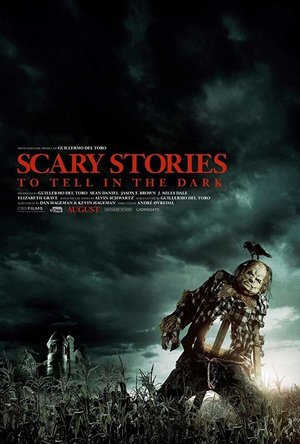

In the early 1980s, author Alvin Schwartz created a book of short horror stories titled Scary Stories to Tell in the Dark that would go on to terrorize a whole generation of curious young readers. Combined with its morbid and ghastly illustrations by artist Stephen Gammell, the book would serve as an introduction to horror for many. Over the next ten years, Schwartz wrote two more books in the Scary Stories series, and now, nearly forty years later, it has finally been adapted into a major motion picture. Produced by Academy Award-winning director Guillermo Del Toro and directed by André Øvredal, the Scary Stories to Tell in the Dark film constructs a new narrative around several of the iconic short stories from the book series, and brings them to life to haunt the movie’s teenage characters.
In Mill Valley, Pennsylvania in 1968, a group of teenage friends fleeing from a band of bullies hide out in an abandoned haunted house on Halloween night. They know the story of this house well, whose folklore is rooted in the origins of their own small town. It was once owned by the wealthy Bellows Family, who according to urban legend, locked away their own daughter, Sarah Bellows, inside the cellar of their home. Sarah had been accused of killing the town’s children, and so her family kept her hidden away and attempted to erase her from existence, even removing her from their own family portraits. According to legend, Sarah wrote a book of horror stories and would read them aloud through the walls of her room to frighten the local townspeople.
While inside this haunted house, our group of protagonists; Stella (Zoe Colletti), Ramón (Michael Garza), Auggie (Gabriel Rush), and Chuck (Austin Zajur), discover the room Sarah had spent her life trapped in. Stella, an amateur horror writer herself, finds the rumored book that was written by Sarah. Upon opening it she sees that a new page is somehow being written in blood right before her very eyes, and it happens to be about the bully that chased them into the house. The next day, they realize that it seems as though the story actually came true, and that the book itself may be haunted. This establishes the basic premise of the film, in which new stories are being written in the book and they appear to be targeting Stella and everyone else that entered the Bellows’ house that night.
It’s an interesting set-up that cleverly mixes horror with mystery, as the characters are not only trying to survive these stories as they come to life, but are also trying to figure out how to stop them from happening. The film features five different stories from the series, most of which come from the third and final book, and a sixth story centered around Stella and Sarah Bellows that is at least in part inspired by one of the original tales. To give an example without giving too much away, one story for instance, involves a haunted scarecrow, whereas another is about a walking corpse in search of its severed big toe. The stories themselves are much more dark and grotesque than I had anticipated. I was expecting something more along the lines of Goosebumps, which was a series of children’s horror books that I personally loved and grew up with as a child, but these are much more disturbing than that. While I only found the first story of the film, “Harold”, to actually be scary, I do imagine this movie might be a little too frightening for some teenagers.
I should clarify that I’m not familiar with the original written source material of Scary Stories to Tell in the Dark, and I had truthfully never even heard of the books prior to the movie’s announcement. I don’t have any personal stake in these stories, but I do admire the thoughtfulness and creativity that went into building the film around them. I thought the film started out really strong with a likable cast of characters, and with most of its best moments featured early on. I loved the introduction to the haunted house and the legend of the Bellows Family. I enjoyed the playful nature of our group of young protagonists, who in the beginning felt reminiscent of the fun and crazy kids you might find in an 80s movie like The Goonies. Additionally, I liked the mystery of Sarah Bellows that the kids were trying to uncover, all the while struggling to survive the dangers of her haunting stories that had come to life.
Unfortunately, as the movie went on, I found myself less and less invested in it with each passing story, all of which I would argue are weaker than the previous one before it. The Pale Lady storyline was particularly dull and underwhelming. The final act itself, although smartly designed with its use of parallels, wound up feeling poorly executed and unsatisfying overall.
Similarly, in regards to the acting, I liked the performances even less by the end as well. Early on I had been impressed with Zoe Colletti as Stella, but I found her to be annoying in the later parts of the movie. The same goes for Austin Zajur as Chuck. The cast for the most part was decent, but everything about the movie began to drop in quality as it dragged on, which is especially unfortunate given how well it starts out.
The special effects are mostly quite good and adequately disturbing, but on the same token, I wish they were more clearly visible at times. A lot of the horror settings take place in dark rooms, so at times it can be hard to see the monsters with much clarity. Still, I love the design of Harold the Scarecrow, as well as The Jangly Man, who is played by contortionist Troy James whose extreme flexibility allows the character to move in unnatural and disturbing looking ways.
To conclude, I’m left with some mixed feelings on Scary Stories to Tell in the Dark. For me, it almost hits the mark, but unfortunately it isn’t a movie that I think I’d bother to watch again. It made a solid first impression with its rich atmosphere and creepy first act, but it failed to maintain its momentum and level of quality. In the end, my favorite thing about the whole movie is actually the excellent cover song of “Season of the Witch” by Lana Del Rey that plays during the credits. However that’s not in any way to say the movie is so bad that the credits were my favorite part. It’s just a great song by an artist I very much enjoy. If you grew up with the Scary Stories to Tell in the Dark series, then by all means, I recommend that you at least check it out. If you like horror and have any troublesome teenaged kids, this may be a perfect opportunity to have some fun scaring the heck out of them.
In Mill Valley, Pennsylvania in 1968, a group of teenage friends fleeing from a band of bullies hide out in an abandoned haunted house on Halloween night. They know the story of this house well, whose folklore is rooted in the origins of their own small town. It was once owned by the wealthy Bellows Family, who according to urban legend, locked away their own daughter, Sarah Bellows, inside the cellar of their home. Sarah had been accused of killing the town’s children, and so her family kept her hidden away and attempted to erase her from existence, even removing her from their own family portraits. According to legend, Sarah wrote a book of horror stories and would read them aloud through the walls of her room to frighten the local townspeople.
While inside this haunted house, our group of protagonists; Stella (Zoe Colletti), Ramón (Michael Garza), Auggie (Gabriel Rush), and Chuck (Austin Zajur), discover the room Sarah had spent her life trapped in. Stella, an amateur horror writer herself, finds the rumored book that was written by Sarah. Upon opening it she sees that a new page is somehow being written in blood right before her very eyes, and it happens to be about the bully that chased them into the house. The next day, they realize that it seems as though the story actually came true, and that the book itself may be haunted. This establishes the basic premise of the film, in which new stories are being written in the book and they appear to be targeting Stella and everyone else that entered the Bellows’ house that night.
It’s an interesting set-up that cleverly mixes horror with mystery, as the characters are not only trying to survive these stories as they come to life, but are also trying to figure out how to stop them from happening. The film features five different stories from the series, most of which come from the third and final book, and a sixth story centered around Stella and Sarah Bellows that is at least in part inspired by one of the original tales. To give an example without giving too much away, one story for instance, involves a haunted scarecrow, whereas another is about a walking corpse in search of its severed big toe. The stories themselves are much more dark and grotesque than I had anticipated. I was expecting something more along the lines of Goosebumps, which was a series of children’s horror books that I personally loved and grew up with as a child, but these are much more disturbing than that. While I only found the first story of the film, “Harold”, to actually be scary, I do imagine this movie might be a little too frightening for some teenagers.
I should clarify that I’m not familiar with the original written source material of Scary Stories to Tell in the Dark, and I had truthfully never even heard of the books prior to the movie’s announcement. I don’t have any personal stake in these stories, but I do admire the thoughtfulness and creativity that went into building the film around them. I thought the film started out really strong with a likable cast of characters, and with most of its best moments featured early on. I loved the introduction to the haunted house and the legend of the Bellows Family. I enjoyed the playful nature of our group of young protagonists, who in the beginning felt reminiscent of the fun and crazy kids you might find in an 80s movie like The Goonies. Additionally, I liked the mystery of Sarah Bellows that the kids were trying to uncover, all the while struggling to survive the dangers of her haunting stories that had come to life.
Unfortunately, as the movie went on, I found myself less and less invested in it with each passing story, all of which I would argue are weaker than the previous one before it. The Pale Lady storyline was particularly dull and underwhelming. The final act itself, although smartly designed with its use of parallels, wound up feeling poorly executed and unsatisfying overall.
Similarly, in regards to the acting, I liked the performances even less by the end as well. Early on I had been impressed with Zoe Colletti as Stella, but I found her to be annoying in the later parts of the movie. The same goes for Austin Zajur as Chuck. The cast for the most part was decent, but everything about the movie began to drop in quality as it dragged on, which is especially unfortunate given how well it starts out.
The special effects are mostly quite good and adequately disturbing, but on the same token, I wish they were more clearly visible at times. A lot of the horror settings take place in dark rooms, so at times it can be hard to see the monsters with much clarity. Still, I love the design of Harold the Scarecrow, as well as The Jangly Man, who is played by contortionist Troy James whose extreme flexibility allows the character to move in unnatural and disturbing looking ways.
To conclude, I’m left with some mixed feelings on Scary Stories to Tell in the Dark. For me, it almost hits the mark, but unfortunately it isn’t a movie that I think I’d bother to watch again. It made a solid first impression with its rich atmosphere and creepy first act, but it failed to maintain its momentum and level of quality. In the end, my favorite thing about the whole movie is actually the excellent cover song of “Season of the Witch” by Lana Del Rey that plays during the credits. However that’s not in any way to say the movie is so bad that the credits were my favorite part. It’s just a great song by an artist I very much enjoy. If you grew up with the Scary Stories to Tell in the Dark series, then by all means, I recommend that you at least check it out. If you like horror and have any troublesome teenaged kids, this may be a perfect opportunity to have some fun scaring the heck out of them.
graveyardgremlin (7194 KP) rated The Taken (Celestial Blues, #1) in Books
Feb 15, 2019


Even though I'm not especially fond of angels, I decided to try out this new series based on my previous experiences with Vicki Pettersson's work. Sadly, after an intriguing first chapter, any enjoyment I may have expected never came knocking (guess it was too busy knockin' on heaven's door).
Meet one of the two main characters, rockabilly girl Katherine "Kit" Craig. She's an eternally optimistic and peppy reporter whose best friend and co-worker, Nicole, was just murdered while following a lead. Our other MC is a haunted Centurion angel named Griffin Shaw who ushers the newly murdered into the afterlife, otherwise known as the Everlast, while bemoaning the murders of both himself and his wife Evie back in 1960. After making a mistake concerning Nicole, he's been sent back to earth as a human with some angelic senses still intact. Kit and Grif soon meet up and begin investigating the circumstances around Nicole's death, whilst Griffin seeks out any details involving his own.
Problem Number One:
The Cardboard Characters
Character development is supposed to unfold over the course of a book, in this case it actually appeared to deteriorate as the book went on. Kit never developed into anything but one of those annoyingly chipper people you just want to hit with a sledgehammer, while Grif started promisingly enough but then stagnated. They were both very shallow characterizations, and on top of that, I never understood Kit's actions or reactions to just about anything. I never felt her sadness about her best friend's death, whom she rarely gave a passing thought, believed she was smart (by the end, I thought her a dolt), or seem in any way human with nary a rational thought in her head. About mid-way through the book, Grif tells her he's an angel after they kiss, so what does she do? Does she a) run away screaming, b) think he's a few feathers short of a goose and tell him to get hell out of her house and life, or c) have a calm Q&A session followed by giving him a whatfor that consists of "I won't kiss you again" and "you're watching me walk out that door (in her own house) because you can't handle any emotion blah, blah, blah by pretending you're an angel" and then proceed to attend a charity event wherein she acts and converses normally, like nothing happened? If you picked "c" *ding ding ding*, you're a winner! Because as we all know, any sensible guy will pull out the "I'm an angel" trick and expect a woman to believe him. *rolls eyes* Never was it ever crystal clear if Kit thought Grif was either crazy or a liar. It was all a bit hazy, but what can you expect from someone we're never allowed to know? All we discern is she dresses and lives (somewhat) rockabilly, but it's all a veneer to her hollowness inside, which led me to dub her Rockabilly Barbie.
<img src="http://i272.photobucket.com/albums/jj183/piscesrain/reviews/RockabillyBarbie.jpg">;
Because that's all she is and nothing more. The only character that I found a little more well-rounded was the secondary character Bridget Moore and the two Centurions introduced close to the end. Everyone else was either forgettably two-dimensional or they were a caricature, a la Caleb Chambers and Paul Raggio.
Problem Number Two:
The Relationship(s)
I'm expected to believe in a possible relationship between Grif and Rockabilly Barbie, err I mean Kit, but there's not much there to believe in. Like the characters, it was shallow with the same descriptions reiterated over and over again. Basically it's a case of telling instead of showing. I felt no love, maybe some attraction, but that's all she wrote. Likewise I never bought that Kit and Paul could ever have gotten far enough to be married, they were just too different. Most people don't do a 180 after they get married, the seed of who Paul really was deep down inside would have already been there and if Kit was even a fraction astute, she should have caught that. All this served was to be a plot point in the book.
Problem Number Three:
The Plot(s)
The main plot involving Nicole's death and Chambers had a "been there, done that" quality to it. The plot didn't shock me or seem like anything new, I've come across the same before or at least plots that were very close, and it wasn't even told in a fresh way. So I wasn't as affected by anything in the book as I probably should have been, partially due to the indifference I felt and the fact that I figured out everything long before the author dropped, what I guess she thought, were informational bombshells.
The book had three major plotlines: Grif and Evie's deaths, Nicole's death/prostitution ring, and Grif and the Pure Anas' philosophical moments. They weren't juggled well at all. Ms. Pettersson should have picked only one and paid more attention to developing that specific plot and the characters. The scenes with Anas (or Anne) especially didn't mesh with the other stories and felt as if the author was overreaching the boundaries set up by the book. One scene in particular was extremely bizarre and pointless to the book as a whole.
Where was the noir? I've seen enough film noirs to know it ain't here.
Problem Number Four:
The Ending
What happened at the end is what I'd expect in a book that's exclusively romance and not in a mystery/urban fantasy hybrid, which made the rushed ending seem even more ridiculous and sappy. It was incredibly unbelievable to the story and didn't seem to set up the next book in any way. Also, one of the plotlines was all but left dangling with no foreshadowing or anything. Poor, poor, poor execution. Don't expound on a storyline if you're not going to finish it up or at least leave it dangling in a way that makes the reader want to come back. All that boring set-up for a completely stupid and cheesy ending. I expected rainbows and unicorns to pop out at any moment.
Overall the book felt more like a rough copy than a finished one and definitely could have used a few more goings over. Several descriptions were rushed and chaotic or simply poorly done so that I was scrambling to picture what was going on. The book is almost 400 pages and it is simply too long. With so many storylines, I'm not sure how they managed to both crawl and have very little action at the same time. I was going to give this two stars because I didn't hate the book, that would imply that it elicited any feelings what-so-ever, but the truth of the matter is that there isn't one thing I really liked about the book either. The only way I'd read a sequel to the bafflingly-named Celestial Blues series is if it featured different leads like the aforementioned Centurions, and even then I'd cautiously dip my toes into the book.
Originally reviewed: June 29
Received: Amazon Vine
Meet one of the two main characters, rockabilly girl Katherine "Kit" Craig. She's an eternally optimistic and peppy reporter whose best friend and co-worker, Nicole, was just murdered while following a lead. Our other MC is a haunted Centurion angel named Griffin Shaw who ushers the newly murdered into the afterlife, otherwise known as the Everlast, while bemoaning the murders of both himself and his wife Evie back in 1960. After making a mistake concerning Nicole, he's been sent back to earth as a human with some angelic senses still intact. Kit and Grif soon meet up and begin investigating the circumstances around Nicole's death, whilst Griffin seeks out any details involving his own.
Problem Number One:
The Cardboard Characters
Character development is supposed to unfold over the course of a book, in this case it actually appeared to deteriorate as the book went on. Kit never developed into anything but one of those annoyingly chipper people you just want to hit with a sledgehammer, while Grif started promisingly enough but then stagnated. They were both very shallow characterizations, and on top of that, I never understood Kit's actions or reactions to just about anything. I never felt her sadness about her best friend's death, whom she rarely gave a passing thought, believed she was smart (by the end, I thought her a dolt), or seem in any way human with nary a rational thought in her head. About mid-way through the book, Grif tells her he's an angel after they kiss, so what does she do? Does she a) run away screaming, b) think he's a few feathers short of a goose and tell him to get hell out of her house and life, or c) have a calm Q&A session followed by giving him a whatfor that consists of "I won't kiss you again" and "you're watching me walk out that door (in her own house) because you can't handle any emotion blah, blah, blah by pretending you're an angel" and then proceed to attend a charity event wherein she acts and converses normally, like nothing happened? If you picked "c" *ding ding ding*, you're a winner! Because as we all know, any sensible guy will pull out the "I'm an angel" trick and expect a woman to believe him. *rolls eyes* Never was it ever crystal clear if Kit thought Grif was either crazy or a liar. It was all a bit hazy, but what can you expect from someone we're never allowed to know? All we discern is she dresses and lives (somewhat) rockabilly, but it's all a veneer to her hollowness inside, which led me to dub her Rockabilly Barbie.
<img src="http://i272.photobucket.com/albums/jj183/piscesrain/reviews/RockabillyBarbie.jpg">;
Because that's all she is and nothing more. The only character that I found a little more well-rounded was the secondary character Bridget Moore and the two Centurions introduced close to the end. Everyone else was either forgettably two-dimensional or they were a caricature, a la Caleb Chambers and Paul Raggio.
Problem Number Two:
The Relationship(s)
I'm expected to believe in a possible relationship between Grif and Rockabilly Barbie, err I mean Kit, but there's not much there to believe in. Like the characters, it was shallow with the same descriptions reiterated over and over again. Basically it's a case of telling instead of showing. I felt no love, maybe some attraction, but that's all she wrote. Likewise I never bought that Kit and Paul could ever have gotten far enough to be married, they were just too different. Most people don't do a 180 after they get married, the seed of who Paul really was deep down inside would have already been there and if Kit was even a fraction astute, she should have caught that. All this served was to be a plot point in the book.
Problem Number Three:
The Plot(s)
The main plot involving Nicole's death and Chambers had a "been there, done that" quality to it. The plot didn't shock me or seem like anything new, I've come across the same before or at least plots that were very close, and it wasn't even told in a fresh way. So I wasn't as affected by anything in the book as I probably should have been, partially due to the indifference I felt and the fact that I figured out everything long before the author dropped, what I guess she thought, were informational bombshells.
The book had three major plotlines: Grif and Evie's deaths, Nicole's death/prostitution ring, and Grif and the Pure Anas' philosophical moments. They weren't juggled well at all. Ms. Pettersson should have picked only one and paid more attention to developing that specific plot and the characters. The scenes with Anas (or Anne) especially didn't mesh with the other stories and felt as if the author was overreaching the boundaries set up by the book. One scene in particular was extremely bizarre and pointless to the book as a whole.
Where was the noir? I've seen enough film noirs to know it ain't here.
Problem Number Four:
The Ending
What happened at the end is what I'd expect in a book that's exclusively romance and not in a mystery/urban fantasy hybrid, which made the rushed ending seem even more ridiculous and sappy. It was incredibly unbelievable to the story and didn't seem to set up the next book in any way. Also, one of the plotlines was all but left dangling with no foreshadowing or anything. Poor, poor, poor execution. Don't expound on a storyline if you're not going to finish it up or at least leave it dangling in a way that makes the reader want to come back. All that boring set-up for a completely stupid and cheesy ending. I expected rainbows and unicorns to pop out at any moment.
Overall the book felt more like a rough copy than a finished one and definitely could have used a few more goings over. Several descriptions were rushed and chaotic or simply poorly done so that I was scrambling to picture what was going on. The book is almost 400 pages and it is simply too long. With so many storylines, I'm not sure how they managed to both crawl and have very little action at the same time. I was going to give this two stars because I didn't hate the book, that would imply that it elicited any feelings what-so-ever, but the truth of the matter is that there isn't one thing I really liked about the book either. The only way I'd read a sequel to the bafflingly-named Celestial Blues series is if it featured different leads like the aforementioned Centurions, and even then I'd cautiously dip my toes into the book.
Originally reviewed: June 29
Received: Amazon Vine

Bong Mines Entertainment (15 KP) rated The Life of Pablo by Kanye West in Music
Jun 7, 2019


Kanye West is an iconic rapper from Chicago, Illinois. Not too long ago, he released his seventh studio album, entitled, “The Life of Pablo“.
ULTRA LIGHT BEAMS
The opening track functions as a Sunday-morning church revival, where Kanye is the ordained minister. He’s standing in the pulpit, preaching a time-sensitive sermon to his loyal congregation.
His message: God over Satan, keep the faith, pray for Paris, pray for parents, and we’re living God’s dream.
West sets the tone and declares where he stands on religious and socially-driven issues.
A Gospel choir emerges. The Dream and Kelly Price reinforce West’s message by singing verses of encouragement, leading to a heartfelt testimonial by Chance The Rapper.
While the collection plates are being filled with hopes of a better tomorrow, Kirk Franklin concludes the service by praying for everyone. He uplifts those who feel they are not good enough or have said, “I’m sorry,” too many times.
Father Stretch My Hands (Pt. 1)
A spiritual figure, Pastor T.L. Barrett, ushers in the second track with praises to The Most High. Future appears for a brief moment and Kid Cudi delivers a stunning chorus.
A liberated West returns to the pulpit and gives a brief, but somewhat explicit testimony of his past and present relationships to Amber Rose and Kim Kardashian.
Father Stretch My Hands (Pt. 2)
West continues his testimony and raps about his personal experiences. He speaks on the importance of returning his wife’s phone calls and not wanting to make the same mistakes his father made. Also, he mentions the passing of the mother in Hollywood, being broke, and the reason why he broke his jaw.
West’s words hit home, making room for another liberated soul to tell his story of triumph.
Desiigner, a newly-signed artist of G.O.O.D. Music, emerges from the underbelly of the ghetto. He raps about getting money illegally, drugs, and violence-familiarized by urban-street hustlers.
Though his grim subject matter contradicts the song’s hopeful message of liberation, it somehow adds mysticism or substance to Kanye’s brutally-honest testimony.
Desiigner, blessed with a futuristic flow, highlights a few things that West’s congregation needs to examine in order to be totally liberated.
FAMOUS
Whenever an important event occurs in an urban community, an after party is sure to follow. And a host of celebrities are always on standby to attend it. The Life of Pablo is no exception.
The fourth song features Rihanna and legendary-producer Swizz Beatz. Also, it contains timeless vocals from Sister Nancy and Nina Simone.
West, no longer in church clothes, stands out lyrically with witty, braggadocios lyrics.
Whether that statement is factual or not, it’s doesn’t really matter because West believes it is.
FEEDBACK
The fifth song serves as a transformational period, where West shows signs of the old Kanye.
West doesn’t need a psychiatrist to diagnose his problems. He does that himself by wearing them on his sleeves.
LOW LIGHTS
On the sixth track, West wrote via Twitter, “I put Low Lights on my album just thinking about all the moms driving their kids to school, then going to work.”
Listeners can now relate to the everyday struggle that mothers endure.
The song features an acapella sample from “So Alive” by Kings of Tomorrow.
The woman gives a grateful-testimony of God’s graciousness over a laid-back, simple piano groove. Her honesty is felt. Also, she sounds liberated because her Creator has accepted her for who she is.
HIGH LIGHTS
From lows to high, the seventh track is in direct correlation to “Low Lights”.
West and Young Thug put on their festive robes because it’s time to celebrate life. El Debarge and The Dream chime in, and West addresses a lingering issue.
But this is only the beginning. West finishes strong with more thought-provoking lyrics.
FREESTYLE 4
The eighth track features Desiigner. Again, when he and West are together, all hell breaks loose.
The once festive scene transforms into a grimy underworld filled with a prostitute that West is explicitly lusting after. The temptation makes it difficult for him to stand on his opening statement of Jesus over Satan. But the power of darkness is more powerful than West thinks. So, he subconsciously indulges in sexual misconduct.
I LOVE KANYE
On the ninth track, West realizes that he’s at war with himself. The old Kanye, known for chopping up soul records is fighting against the new Kanye that everyone hates. But Kanye wants to go back to being sweet again if that’s even possible. His multiple egos are fighting for control over the ‘real’ Kanye.
WAVE
West doesn’t stare in the mirror for too long. On the tenth track, redemption happens. Chris Brown, disguised as an angel, comes to West’s aid by providing much-needed light.
Miraculously, the sun emerges from the shade, a bird flies out its cage, and a nostalgic feeling is felt.
West realizes that nothing is impossible because waves don’t die and feelings don’t really go away.
FML (FOR MY LADY)
On the eleventh track, West realizes what’s really important to him and that’s his wife. Someone he won’t jeopardize for no other woman. Also, his children are all layers of his soul.
The Weeknd appears in the form of West’s conscience.
West remains focused and listeners can feel the positive aura of God surrounding him. He is determined to remain faithful to only Kim, no other woman.
REAL FRIENDS
West continues his introspective outlook and raps about trust issues that everyone can relate to. His honest, down-to-earth lyrics, mixed in with Ty Dolla $ign’s vocals, paints a vivid picture. Also, it forms a collectible souvenir that hangs nicely in listeners’ collective memories.
WOLVES
The thirteenth track provides a cooling effect with wild emotions and bizarre-sounds.
The setting, maybe an extraterritorial realm in West’s subconscious mind. Perhaps, it’s the Milky Way Galaxy or a dream-state of Saturn.
A time for relaxation, preparing listeners for a surprise guest.
SILVER SURFER INTERMISSION
The fourteenth track features a phone conversation between incarcerated Max B and French Montana. Also, Max voices his gratitude to West for showing him love.
30 HOURS
On the fifteenth track, West takes a trip down memory lane and raps about an ex-girlfriend that he used to drive 30-hours to see. He used to drive from Chicago to St. Louis, St. Louis to Chicago. He recalls the good times they shared. But unfortunately, her infidelity was the reason why they broke up.
NO PARTIES IN L.A.
The sixteenth track will go down in history as a legendary bar-fest between two elite emcees. Kendrick Lamar and West rap with dope punchlines and clever metaphors over a Madlib-produced track. Once again, West is flowing like the old Kanye that people love.
FACTS
The seventeenth track is a standout anthem where West brags that Yeezy just jumped over Jumpman. He’s in boss-mode, talking that big-money talk.
FADE
The final track features Post Malone and Ty Dollar $ign. The song has a reoccurring sample from Rare Earth, “Your love is fading/I feel it fade.”
The Eli Linnetz-directed video shows Teyana Taylor explicitly dancing.
CONCLUSION
Kanye West’s “The Life of Pablo” is a memorable hip-hop album with solid content and heavy replay value.
https://www.bongminesentertainment.com/kanye-west-life-pablo/
ULTRA LIGHT BEAMS
The opening track functions as a Sunday-morning church revival, where Kanye is the ordained minister. He’s standing in the pulpit, preaching a time-sensitive sermon to his loyal congregation.
His message: God over Satan, keep the faith, pray for Paris, pray for parents, and we’re living God’s dream.
West sets the tone and declares where he stands on religious and socially-driven issues.
A Gospel choir emerges. The Dream and Kelly Price reinforce West’s message by singing verses of encouragement, leading to a heartfelt testimonial by Chance The Rapper.
While the collection plates are being filled with hopes of a better tomorrow, Kirk Franklin concludes the service by praying for everyone. He uplifts those who feel they are not good enough or have said, “I’m sorry,” too many times.
Father Stretch My Hands (Pt. 1)
A spiritual figure, Pastor T.L. Barrett, ushers in the second track with praises to The Most High. Future appears for a brief moment and Kid Cudi delivers a stunning chorus.
A liberated West returns to the pulpit and gives a brief, but somewhat explicit testimony of his past and present relationships to Amber Rose and Kim Kardashian.
Father Stretch My Hands (Pt. 2)
West continues his testimony and raps about his personal experiences. He speaks on the importance of returning his wife’s phone calls and not wanting to make the same mistakes his father made. Also, he mentions the passing of the mother in Hollywood, being broke, and the reason why he broke his jaw.
West’s words hit home, making room for another liberated soul to tell his story of triumph.
Desiigner, a newly-signed artist of G.O.O.D. Music, emerges from the underbelly of the ghetto. He raps about getting money illegally, drugs, and violence-familiarized by urban-street hustlers.
Though his grim subject matter contradicts the song’s hopeful message of liberation, it somehow adds mysticism or substance to Kanye’s brutally-honest testimony.
Desiigner, blessed with a futuristic flow, highlights a few things that West’s congregation needs to examine in order to be totally liberated.
FAMOUS
Whenever an important event occurs in an urban community, an after party is sure to follow. And a host of celebrities are always on standby to attend it. The Life of Pablo is no exception.
The fourth song features Rihanna and legendary-producer Swizz Beatz. Also, it contains timeless vocals from Sister Nancy and Nina Simone.
West, no longer in church clothes, stands out lyrically with witty, braggadocios lyrics.
Whether that statement is factual or not, it’s doesn’t really matter because West believes it is.
FEEDBACK
The fifth song serves as a transformational period, where West shows signs of the old Kanye.
West doesn’t need a psychiatrist to diagnose his problems. He does that himself by wearing them on his sleeves.
LOW LIGHTS
On the sixth track, West wrote via Twitter, “I put Low Lights on my album just thinking about all the moms driving their kids to school, then going to work.”
Listeners can now relate to the everyday struggle that mothers endure.
The song features an acapella sample from “So Alive” by Kings of Tomorrow.
The woman gives a grateful-testimony of God’s graciousness over a laid-back, simple piano groove. Her honesty is felt. Also, she sounds liberated because her Creator has accepted her for who she is.
HIGH LIGHTS
From lows to high, the seventh track is in direct correlation to “Low Lights”.
West and Young Thug put on their festive robes because it’s time to celebrate life. El Debarge and The Dream chime in, and West addresses a lingering issue.
But this is only the beginning. West finishes strong with more thought-provoking lyrics.
FREESTYLE 4
The eighth track features Desiigner. Again, when he and West are together, all hell breaks loose.
The once festive scene transforms into a grimy underworld filled with a prostitute that West is explicitly lusting after. The temptation makes it difficult for him to stand on his opening statement of Jesus over Satan. But the power of darkness is more powerful than West thinks. So, he subconsciously indulges in sexual misconduct.
I LOVE KANYE
On the ninth track, West realizes that he’s at war with himself. The old Kanye, known for chopping up soul records is fighting against the new Kanye that everyone hates. But Kanye wants to go back to being sweet again if that’s even possible. His multiple egos are fighting for control over the ‘real’ Kanye.
WAVE
West doesn’t stare in the mirror for too long. On the tenth track, redemption happens. Chris Brown, disguised as an angel, comes to West’s aid by providing much-needed light.
Miraculously, the sun emerges from the shade, a bird flies out its cage, and a nostalgic feeling is felt.
West realizes that nothing is impossible because waves don’t die and feelings don’t really go away.
FML (FOR MY LADY)
On the eleventh track, West realizes what’s really important to him and that’s his wife. Someone he won’t jeopardize for no other woman. Also, his children are all layers of his soul.
The Weeknd appears in the form of West’s conscience.
West remains focused and listeners can feel the positive aura of God surrounding him. He is determined to remain faithful to only Kim, no other woman.
REAL FRIENDS
West continues his introspective outlook and raps about trust issues that everyone can relate to. His honest, down-to-earth lyrics, mixed in with Ty Dolla $ign’s vocals, paints a vivid picture. Also, it forms a collectible souvenir that hangs nicely in listeners’ collective memories.
WOLVES
The thirteenth track provides a cooling effect with wild emotions and bizarre-sounds.
The setting, maybe an extraterritorial realm in West’s subconscious mind. Perhaps, it’s the Milky Way Galaxy or a dream-state of Saturn.
A time for relaxation, preparing listeners for a surprise guest.
SILVER SURFER INTERMISSION
The fourteenth track features a phone conversation between incarcerated Max B and French Montana. Also, Max voices his gratitude to West for showing him love.
30 HOURS
On the fifteenth track, West takes a trip down memory lane and raps about an ex-girlfriend that he used to drive 30-hours to see. He used to drive from Chicago to St. Louis, St. Louis to Chicago. He recalls the good times they shared. But unfortunately, her infidelity was the reason why they broke up.
NO PARTIES IN L.A.
The sixteenth track will go down in history as a legendary bar-fest between two elite emcees. Kendrick Lamar and West rap with dope punchlines and clever metaphors over a Madlib-produced track. Once again, West is flowing like the old Kanye that people love.
FACTS
The seventeenth track is a standout anthem where West brags that Yeezy just jumped over Jumpman. He’s in boss-mode, talking that big-money talk.
FADE
The final track features Post Malone and Ty Dollar $ign. The song has a reoccurring sample from Rare Earth, “Your love is fading/I feel it fade.”
The Eli Linnetz-directed video shows Teyana Taylor explicitly dancing.
CONCLUSION
Kanye West’s “The Life of Pablo” is a memorable hip-hop album with solid content and heavy replay value.
https://www.bongminesentertainment.com/kanye-west-life-pablo/

Dana (24 KP) rated Stars Above (The Lunar Chronicles, #4.5) in Books
Mar 23, 2018
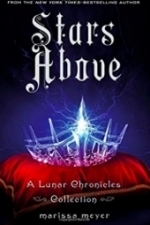
This book is actually receiving a 4.5 star review, but as you all know, we can't do that on here, so I just gave it a four star.
There will be spoliers, so ye be warned.
I'm going to go at this story by story, so bear with me.
The Keeper
I very much enjoyed getting to know Michelle Benoit because we do not get much of her in the base series. I love getting to know her and Scarlet's relationship on a first hand basis, but also getting to see the strain on their relationship because of the secrecy of Cinder. There are quite a few special moments between Michelle and Scarlet, namely, the one where she gives Scarlet her flight pin for her birthday present. Not going to lie, I choked up a bit on that one.
Another level of this story is the interactions between Michelle and Cinder. I loved seeing Michelle doting on Cinder, even though Cinder is in a suspended animation tank where she can't actually interact with Michelle. But being able to see the fear and the care Michelle feels toward Cinder was something very special and it warmed my heart to read it. I loved that Michelle gave Cinder her name to remind her that she is rising from the cinders and ashes of her past. So symbolic!
Glitches
Okay, now moving on to Cinder's early childhood. Garan was not really the best dad, from what I read. He is quite aloof and absent, not only in Cinder's early life, but in his own daughters'. It hurt to see how Cinder was mistreated by Adri from the beginning, even though I kind of undertand where Adri is coming from. I am by no means saying what she did was right. Let me just put that out there. She was a horrible mother to Cinder and I am not forgiving her, but her husband threw this child on her when they were already having a hard enough time supporting their two daughters. It must have been really difficult.
I loved how we got Cinder finding out that she was good at mechanics and fixed Iko! I was so happy when those two got together because I knew it was the beginning of a glorious friendship!
The Queen's Army
Ze'ev! Ugh, his childhood was almost no better. Yes, he had parents that loved him, but he had no choice in being conscripted into the army, then having to take care of his little brother who kinda hated him, then having to prove himself (and in turn save every person in his pack) by killing another person. He didn't even really have a choice in that either because Levana shoved the idea in his head. I'm just glad he gets to be happy with Scarlet.
Carswell's Guide to Being Lucky
Carswell, aka Mr. Smooth, having a crush on the sweet and smart kind. Hm. Where have we seen that before? Oh yeah, with my girl Cress! He has a thing for nerds and I am okay with that. I loved getting to see baby Thorne learning all of his tricks and tricking people out of their money. Goals.
After Sunshine Passes By
Baby Cress! This story made me so emotional because she had so much hope that she was going to go to earth, but beotch Sybil had other plans because she is horrible. Her reaction to learning that she was going to be isolated was heartbreaking as hell. But I did really enjoy getting to see how she was trying to help the other Shells learn how to read. I'm glad she got to learn at least.
The Princess and the Guard
Baby Winter and Jacin playing Princess and the Guard was so freaking cute, but then it got real dark, real quick. We start with the moment she thought she was helping that poor maid who was being manipulated by Thaumaturge Park (asshole #1 right there, by the way), then we have to see her learn that she didn't acutally save the girl, but subjected her to more torment. And then her promise to not use her glamour and her eventually going mad. That first hallucination and her reaction to it made me almost start sobbing, to be completely honest. It hurt so freaking much.
And then we get the big moment: Levana making her cut herself. She was so strong throughout the whole thing. She didn't let it get to her one bit, until she was back with Jacin, the only one who could protect her. She was so strong throughout the whole ordeal, and even afterwards. It breaks my heart to see that she was almost completely broken by not using her gift. I'm just glad everything is okay with her now.
The Little Android
Talk about crying, this story brought out all the tears. The original Little Mermaid is sad enough, but this one got to me so much. I know a lot of people don't really like this story because it didn't add anything to the rest of the series, but it added depth to the world. I loved being able to see another android other that Nasani and Iko. And on top of that, she was another one with a "faulty" programming chip. Is it mandatory that all androids fall in love with Kai or people who look like Kai? No? Okay, it just seems that way from this series.
But in all seriousness, this story was heartbreaking. Especially the ending when she allows herself to die for the one she loved to be happy. Come on! I didn't need this sadness in my life! (But I actually did, because it was beautiful and I loved it. I just wish I didn't cry at it as much.)
The Mechanic:
I was glad to see that this was the next story, because at least it would be happy. Kai's perspective of meeting Cinder was the cutest thing ever. He was so shy and dumbfounded and had no idea how to flirt. It was so endearing. They both also seemed so young becasue, well, it was the beginning. I adored how he was obsessed with the foot from the moment he first saw it. Not because of a foot fetish, but because he was acknowledging cyborgs (that acknowledgement eventually growing into action, but hey, it was a start!)
Something Old, Something New
Talk about super cute, this story stole my heart on the cute scale. A wedding! Woo!! Wolflet's wedding: double WOO!!! I love these two and their interactions, but I loved even more that it was told from Cinder's perspective.
Them setting up an early surprise wedding was so adorable, I almost exploded from happiness. I loved how they all teamed up together to get Scarlet to get ready early and trying to not get her suspicious was adorable. The boys all setting up the wedding and making it beautiful, if not a little dangerous at times, also adorable. Thorne being the number one decorator was hilariously cute! I honestly loved every bit of this story. I called Kai proposing to Cinder from the start of the story, though. I am super happy that it happened though! So cute! And they were looking at the stars because they were star crossed lovers for a while. Ugh. I just can't with these feelings.
Overall, I loved this book. I am giving it a 4.5 because there were a few moments in the stories that were a little slow, but it was still really freaking good!!
There will be spoliers, so ye be warned.
I'm going to go at this story by story, so bear with me.
The Keeper
I very much enjoyed getting to know Michelle Benoit because we do not get much of her in the base series. I love getting to know her and Scarlet's relationship on a first hand basis, but also getting to see the strain on their relationship because of the secrecy of Cinder. There are quite a few special moments between Michelle and Scarlet, namely, the one where she gives Scarlet her flight pin for her birthday present. Not going to lie, I choked up a bit on that one.
Another level of this story is the interactions between Michelle and Cinder. I loved seeing Michelle doting on Cinder, even though Cinder is in a suspended animation tank where she can't actually interact with Michelle. But being able to see the fear and the care Michelle feels toward Cinder was something very special and it warmed my heart to read it. I loved that Michelle gave Cinder her name to remind her that she is rising from the cinders and ashes of her past. So symbolic!
Glitches
Okay, now moving on to Cinder's early childhood. Garan was not really the best dad, from what I read. He is quite aloof and absent, not only in Cinder's early life, but in his own daughters'. It hurt to see how Cinder was mistreated by Adri from the beginning, even though I kind of undertand where Adri is coming from. I am by no means saying what she did was right. Let me just put that out there. She was a horrible mother to Cinder and I am not forgiving her, but her husband threw this child on her when they were already having a hard enough time supporting their two daughters. It must have been really difficult.
I loved how we got Cinder finding out that she was good at mechanics and fixed Iko! I was so happy when those two got together because I knew it was the beginning of a glorious friendship!
The Queen's Army
Ze'ev! Ugh, his childhood was almost no better. Yes, he had parents that loved him, but he had no choice in being conscripted into the army, then having to take care of his little brother who kinda hated him, then having to prove himself (and in turn save every person in his pack) by killing another person. He didn't even really have a choice in that either because Levana shoved the idea in his head. I'm just glad he gets to be happy with Scarlet.
Carswell's Guide to Being Lucky
Carswell, aka Mr. Smooth, having a crush on the sweet and smart kind. Hm. Where have we seen that before? Oh yeah, with my girl Cress! He has a thing for nerds and I am okay with that. I loved getting to see baby Thorne learning all of his tricks and tricking people out of their money. Goals.
After Sunshine Passes By
Baby Cress! This story made me so emotional because she had so much hope that she was going to go to earth, but beotch Sybil had other plans because she is horrible. Her reaction to learning that she was going to be isolated was heartbreaking as hell. But I did really enjoy getting to see how she was trying to help the other Shells learn how to read. I'm glad she got to learn at least.
The Princess and the Guard
Baby Winter and Jacin playing Princess and the Guard was so freaking cute, but then it got real dark, real quick. We start with the moment she thought she was helping that poor maid who was being manipulated by Thaumaturge Park (asshole #1 right there, by the way), then we have to see her learn that she didn't acutally save the girl, but subjected her to more torment. And then her promise to not use her glamour and her eventually going mad. That first hallucination and her reaction to it made me almost start sobbing, to be completely honest. It hurt so freaking much.
And then we get the big moment: Levana making her cut herself. She was so strong throughout the whole thing. She didn't let it get to her one bit, until she was back with Jacin, the only one who could protect her. She was so strong throughout the whole ordeal, and even afterwards. It breaks my heart to see that she was almost completely broken by not using her gift. I'm just glad everything is okay with her now.
The Little Android
Talk about crying, this story brought out all the tears. The original Little Mermaid is sad enough, but this one got to me so much. I know a lot of people don't really like this story because it didn't add anything to the rest of the series, but it added depth to the world. I loved being able to see another android other that Nasani and Iko. And on top of that, she was another one with a "faulty" programming chip. Is it mandatory that all androids fall in love with Kai or people who look like Kai? No? Okay, it just seems that way from this series.
But in all seriousness, this story was heartbreaking. Especially the ending when she allows herself to die for the one she loved to be happy. Come on! I didn't need this sadness in my life! (But I actually did, because it was beautiful and I loved it. I just wish I didn't cry at it as much.)
The Mechanic:
I was glad to see that this was the next story, because at least it would be happy. Kai's perspective of meeting Cinder was the cutest thing ever. He was so shy and dumbfounded and had no idea how to flirt. It was so endearing. They both also seemed so young becasue, well, it was the beginning. I adored how he was obsessed with the foot from the moment he first saw it. Not because of a foot fetish, but because he was acknowledging cyborgs (that acknowledgement eventually growing into action, but hey, it was a start!)
Something Old, Something New
Talk about super cute, this story stole my heart on the cute scale. A wedding! Woo!! Wolflet's wedding: double WOO!!! I love these two and their interactions, but I loved even more that it was told from Cinder's perspective.
Them setting up an early surprise wedding was so adorable, I almost exploded from happiness. I loved how they all teamed up together to get Scarlet to get ready early and trying to not get her suspicious was adorable. The boys all setting up the wedding and making it beautiful, if not a little dangerous at times, also adorable. Thorne being the number one decorator was hilariously cute! I honestly loved every bit of this story. I called Kai proposing to Cinder from the start of the story, though. I am super happy that it happened though! So cute! And they were looking at the stars because they were star crossed lovers for a while. Ugh. I just can't with these feelings.
Overall, I loved this book. I am giving it a 4.5 because there were a few moments in the stories that were a little slow, but it was still really freaking good!!

Cynthia Armistead (17 KP) rated Enthralled: Paranormal Diversions in Books
Mar 1, 2018
Journeys, literal or otherwise, are the theme of this young adult anthology. Appropriately enough, it was conceived as the result of a book tour.
"Giovanni’s Farewell" by [a:Claudia Gray|1192311|Claudia Gray|http://photo.goodreads.com/authors/1234643683p2/1192311.jpg] is a sweet, coming-of-age story of sorts. The twist is that it features a brother and sister, twins, rather than just one person. They visit Rome with a school group while dealing with major changes in their lives. There was too much background crammed into a short story, but it was interesting.
[a:Carrie Ryan|1443712|Carrie Ryan|http://photo.goodreads.com/authors/1343410049p2/1443712.jpg]'s "Scenic Route" is a disturbing, post-apocalyptic story set in the world of [b:The Forest of Hands and Teeth|3432478|The Forest of Hands and Teeth (The Forest of Hands and Teeth, #1)|Carrie Ryan|http://photo.goodreads.com/books/1320633297s/3432478.jpg|3473471] about two young sisters trying to survive in an isolated cabin. The older sister keeps the younger one occupied with the planning of a road trip that will never happen, always hoping against hope that the girl won't realize what their reality is. How long can they stay isolated enough to survive? Bloody, frightening, and visceral.
"Red Run" by [a:Kami Garcia|2895706|Kami Garcia|http://photo.goodreads.com/authors/1289693388p2/2895706.jpg] is the story of a girl who has lost the only person she loves in the world, and the trip she takes to avenge his death. How do you hunt a ghost? Maybe it isn't fair, coming right after Ryan's story, but I didn't truly feel the main character's feelings.
[a:Jackson Pearce|2761947|Jackson Pearce|http://photo.goodreads.com/authors/1336840299p2/2761947.jpg]'s "Things About Love" is a sweet story involving a jinn researching love. I felt like I'd come into the middle of something, so I checked and found that she's written a novel, [b:As You Wish|6750586|As You Wish|Jackson Pearce|http://photo.goodreads.com/books/1319175193s/6750586.jpg|6217232], in the same setting. While this story technically stands on its own, it would probably be enriched by having read As You Wish.
"Niederwald" by [a:Rachel Vincent|415967|Rachel Vincent|http://photo.goodreads.com/authors/1262900481p2/415967.jpg] is the first story I've read in her Soul Screamers series. Sabine, a macha (nightmare), takes a road trip with a human acquaintance and detours to Niederwald, Texas, home to the harpies. No, there's no way that could go wrong. Of course you know from the moment they hit the parking lot that it will go wrong, but at least it's an interesting sort of wrong.
[a:Melissa Marr|175855|Melissa Marr|http://photo.goodreads.com/authors/1192302741p2/175855.jpg]'s "Merely Mortal" feels as though it's probably set in the same world as her Wicked Lovely series.
"Facing Facts" by [a:Kelley Armstrong|7581|Kelley Armstrong|http://photo.goodreads.com/authors/1199068298p2/7581.jpg] is set in her Darkest Powers universe. I read the first of those books, but obviously a lot has passed since then, and there were spoilers in this story. It really centers around Chloe and Tori, with a little Derek tossed in. Tori learns something she doesn't want to know and reacts badly, running off on her own, which is dangerous. Chloe goes after her and they get into trouble. That seemed rather predictable to me, but at least the type of trouble wasn't what I expected. Tori doesn't seem to have changed since the first book, but Chloe is coming into control of her abilities.
[a:Sarah Rees Brennan|836009|Sarah Rees Brennan|http://photo.goodreads.com/authors/1254149255p2/836009.jpg]'s "Let’s Get this Undead Show on the Road" is about a boy band that features a vampire, Christian. He's an unusual vampire, all alone without a nest or a sire. His journey seems to be about his identity as a vampire, although the band is on tour and has another sort of journey to make, as well.
"Bridge" by [a:Jeri Smith-Ready|56019|Jeri Smith-Ready|http://photo.goodreads.com/authors/1204922569p2/56019.jpg] is told from a ghost's point of view, 233 days after death. It's frustrating being a ghost, because most people can't see or hear you. There are things you have to accomplish before moving on, though, that require communication with the living. Finding a "bridge" and working things out takes a lot of effort. This was a touching story, bittersweet and well-told.
[a:Kimberly Derting|2755160|Kimberly Derting|http://photo.goodreads.com/authors/1229976464p2/2755160.jpg]'s "Skin Contact" nearly broke me. Rafe is looking for his girlfriend. He knows where he needs to go, and he's guided by dreams. This story nearly broke me. It's told sparingly, and something feels perfectly right about it, but it hurts. According to her author biography, Rafe was introduced in her novel Desires of the Dead.
"Leaving" by [a:Ally Condie|1304470|Ally Condie|http://photo.goodreads.com/authors/1325882614p2/1304470.jpg] is a very literary story, about a girl left behind after her mother dies and her father leaves. She spends the story preparing to go after her father. It's hard to describe much more than that, or to have much of an opinion. It was well-written and I think I'll probably remember it for a long time.
[a:Jessica Verday|1290625|Jessica Verday|http://photo.goodreads.com/authors/1243816082p2/1290625.jpg]'s "At The Late Night, Double Feature, Picture Show" is a darkly funny story about a girl from a family of monster hunters. She's usually the bait, but tonight she has decided to be the hunter — without backup. I'd like to read more from Verday.
"IV League" by [a:Margaret Stohl|2895707|Margaret Stohl|http://photo.goodreads.com/authors/1241421033p2/2895707.jpg] just didn't hit me right. It's the story of a bunch of southern vampires on a college tour, which could have been funny but wasn't written that way. The whole thing just didn't sit well with me, perhaps because the main character seemed too unrealistically out of touch for someone who obviously had access to television and the internet.
[a:Mary E. Pearson|123463|Mary E. Pearson|http://photo.goodreads.com/authors/1238978651p2/123463.jpg]'s "Gargouille" is the most touching love story in the collection. Just read it.
"The Third Kind" by [a:Jennifer Lynn Barnes|164187|Jennifer Lynn Barnes|http://photo.goodreads.com/authors/1243935916p2/164187.jpg] is, on the surface, about a road trip to San Antonio. The real journey is much deeper, one of coming to understanding one's calling.
[a:Rachel Caine|15292|Rachel Caine|http://photo.goodreads.com/authors/1272650500p2/15292.jpg]'s Morganville is the setting for her "Automatic." I think I've read a Morganville novella, but my memory of it is dim. The Morganville Blood Bank introduces an automated withdrawal machine, essentially a soda can dispenser. Michael Glass is ordered to try it first, as a demonstration for the older, more traditional vampires, with unexpected results. His journey is one of self-knowledge. I didn't really care much about him, his journey, his girlfriend, or anything else. The setting and characters do nothing for me, but your mileage may vary.
Altogether, the anthology was worth reading. There were some low spots, but that's true of any collection. To be fair, I'm sure someone who is more enthusiastic about young adult fiction would also be more enthusiastic about the works here.
"Giovanni’s Farewell" by [a:Claudia Gray|1192311|Claudia Gray|http://photo.goodreads.com/authors/1234643683p2/1192311.jpg] is a sweet, coming-of-age story of sorts. The twist is that it features a brother and sister, twins, rather than just one person. They visit Rome with a school group while dealing with major changes in their lives. There was too much background crammed into a short story, but it was interesting.
[a:Carrie Ryan|1443712|Carrie Ryan|http://photo.goodreads.com/authors/1343410049p2/1443712.jpg]'s "Scenic Route" is a disturbing, post-apocalyptic story set in the world of [b:The Forest of Hands and Teeth|3432478|The Forest of Hands and Teeth (The Forest of Hands and Teeth, #1)|Carrie Ryan|http://photo.goodreads.com/books/1320633297s/3432478.jpg|3473471] about two young sisters trying to survive in an isolated cabin. The older sister keeps the younger one occupied with the planning of a road trip that will never happen, always hoping against hope that the girl won't realize what their reality is. How long can they stay isolated enough to survive? Bloody, frightening, and visceral.
"Red Run" by [a:Kami Garcia|2895706|Kami Garcia|http://photo.goodreads.com/authors/1289693388p2/2895706.jpg] is the story of a girl who has lost the only person she loves in the world, and the trip she takes to avenge his death. How do you hunt a ghost? Maybe it isn't fair, coming right after Ryan's story, but I didn't truly feel the main character's feelings.
[a:Jackson Pearce|2761947|Jackson Pearce|http://photo.goodreads.com/authors/1336840299p2/2761947.jpg]'s "Things About Love" is a sweet story involving a jinn researching love. I felt like I'd come into the middle of something, so I checked and found that she's written a novel, [b:As You Wish|6750586|As You Wish|Jackson Pearce|http://photo.goodreads.com/books/1319175193s/6750586.jpg|6217232], in the same setting. While this story technically stands on its own, it would probably be enriched by having read As You Wish.
"Niederwald" by [a:Rachel Vincent|415967|Rachel Vincent|http://photo.goodreads.com/authors/1262900481p2/415967.jpg] is the first story I've read in her Soul Screamers series. Sabine, a macha (nightmare), takes a road trip with a human acquaintance and detours to Niederwald, Texas, home to the harpies. No, there's no way that could go wrong. Of course you know from the moment they hit the parking lot that it will go wrong, but at least it's an interesting sort of wrong.
[a:Melissa Marr|175855|Melissa Marr|http://photo.goodreads.com/authors/1192302741p2/175855.jpg]'s "Merely Mortal" feels as though it's probably set in the same world as her Wicked Lovely series.
"Facing Facts" by [a:Kelley Armstrong|7581|Kelley Armstrong|http://photo.goodreads.com/authors/1199068298p2/7581.jpg] is set in her Darkest Powers universe. I read the first of those books, but obviously a lot has passed since then, and there were spoilers in this story. It really centers around Chloe and Tori, with a little Derek tossed in. Tori learns something she doesn't want to know and reacts badly, running off on her own, which is dangerous. Chloe goes after her and they get into trouble. That seemed rather predictable to me, but at least the type of trouble wasn't what I expected. Tori doesn't seem to have changed since the first book, but Chloe is coming into control of her abilities.
[a:Sarah Rees Brennan|836009|Sarah Rees Brennan|http://photo.goodreads.com/authors/1254149255p2/836009.jpg]'s "Let’s Get this Undead Show on the Road" is about a boy band that features a vampire, Christian. He's an unusual vampire, all alone without a nest or a sire. His journey seems to be about his identity as a vampire, although the band is on tour and has another sort of journey to make, as well.
"Bridge" by [a:Jeri Smith-Ready|56019|Jeri Smith-Ready|http://photo.goodreads.com/authors/1204922569p2/56019.jpg] is told from a ghost's point of view, 233 days after death. It's frustrating being a ghost, because most people can't see or hear you. There are things you have to accomplish before moving on, though, that require communication with the living. Finding a "bridge" and working things out takes a lot of effort. This was a touching story, bittersweet and well-told.
[a:Kimberly Derting|2755160|Kimberly Derting|http://photo.goodreads.com/authors/1229976464p2/2755160.jpg]'s "Skin Contact" nearly broke me. Rafe is looking for his girlfriend. He knows where he needs to go, and he's guided by dreams. This story nearly broke me. It's told sparingly, and something feels perfectly right about it, but it hurts. According to her author biography, Rafe was introduced in her novel Desires of the Dead.
"Leaving" by [a:Ally Condie|1304470|Ally Condie|http://photo.goodreads.com/authors/1325882614p2/1304470.jpg] is a very literary story, about a girl left behind after her mother dies and her father leaves. She spends the story preparing to go after her father. It's hard to describe much more than that, or to have much of an opinion. It was well-written and I think I'll probably remember it for a long time.
[a:Jessica Verday|1290625|Jessica Verday|http://photo.goodreads.com/authors/1243816082p2/1290625.jpg]'s "At The Late Night, Double Feature, Picture Show" is a darkly funny story about a girl from a family of monster hunters. She's usually the bait, but tonight she has decided to be the hunter — without backup. I'd like to read more from Verday.
"IV League" by [a:Margaret Stohl|2895707|Margaret Stohl|http://photo.goodreads.com/authors/1241421033p2/2895707.jpg] just didn't hit me right. It's the story of a bunch of southern vampires on a college tour, which could have been funny but wasn't written that way. The whole thing just didn't sit well with me, perhaps because the main character seemed too unrealistically out of touch for someone who obviously had access to television and the internet.
[a:Mary E. Pearson|123463|Mary E. Pearson|http://photo.goodreads.com/authors/1238978651p2/123463.jpg]'s "Gargouille" is the most touching love story in the collection. Just read it.
"The Third Kind" by [a:Jennifer Lynn Barnes|164187|Jennifer Lynn Barnes|http://photo.goodreads.com/authors/1243935916p2/164187.jpg] is, on the surface, about a road trip to San Antonio. The real journey is much deeper, one of coming to understanding one's calling.
[a:Rachel Caine|15292|Rachel Caine|http://photo.goodreads.com/authors/1272650500p2/15292.jpg]'s Morganville is the setting for her "Automatic." I think I've read a Morganville novella, but my memory of it is dim. The Morganville Blood Bank introduces an automated withdrawal machine, essentially a soda can dispenser. Michael Glass is ordered to try it first, as a demonstration for the older, more traditional vampires, with unexpected results. His journey is one of self-knowledge. I didn't really care much about him, his journey, his girlfriend, or anything else. The setting and characters do nothing for me, but your mileage may vary.
Altogether, the anthology was worth reading. There were some low spots, but that's true of any collection. To be fair, I'm sure someone who is more enthusiastic about young adult fiction would also be more enthusiastic about the works here.
Purple Phoenix Games (2266 KP) rated Monster Stomping: Heroes in Tabletop Games
Dec 15, 2020
Godzilla. King Kong. Goldar. Large monsters that terrorize cities. We’ve all seen ’em. They’ve kicked in our schools, workplaces, and neighborhood parks. Luckily, even greater heroes are around to save the day and protect our livelihoods with their amazing superpowers. What, just my neighborhood? Oh. Well, get ready to play a game based on my neighborhood superhero and the kaijus that wreak havoc and bring devastation everywhere they tread.
Ok, so I don’t have these monsters and superheroes in my area. I wish we did. In any case, Monster Stomping: Heroes is a card game of building heroes to protect your city and also building monsters to attack other cities. The first player to have six City Defense cards in their tableau will win!
DISCLAIMER: We were provided a prototype copy of this game for the purposes of this review. These are preview copy components, and I do not know for sure if the final components will be any different from these shown. Also, it is not my intention to detail every rule in the game, as there are just too many. You are invited to download the rulebook, back the game through the Kickstarter campaign, or through any retailers stocking it after fulfillment. -T
To setup, each player will receive one monster body card, one hero body card, and one city card to be placed in front of them on the table. The remaining setup cards can be placed back in the box. The remaining cards will be shuffled to create the large draw deck. Each player is dealt five cards from this deck to create their hand and the game may now begin!
On a player’s turn they will have a choice of three actions to take: Play, Discard Your Hand, or Attack! When the active player decides to Play they will first draw cards to increase their hand to six cards. Next they may play a card face-up on the table. These cards are Monster Powers, Hero Powers, or City Defense cards. Both Monster and Hero Powers are mix-and-match body parts that add value to the Attack phase. City Defense cards are placed around the city card. Six of these are needed to win. After one of these three card types are played to the table the player may also play a blue-bordered Special Card. The Special Cards could allow players to view the contents of an opponent’s hand, or skip a player’s turn, or even discard a City Defense card.
A player may dislike their hand of cards and wish to Discard Your Hand any number of cards. Once done the player will draw back up to six cards and then discard one to return to the hand limit of five cards.
If the active player is feeling lucky or particularly surly they may Attack! another player’s city. During an Attack! the attacking player and defending player will both roll 1d6. The result of the die roll is then added to any bonuses afforded them from their built Monster (attacker) or Hero (defender). At this time any involved player may play a Combat card from their hand to tip the scales of battle. These will either add or subtract values from the Monster or Hero, or block the Monster altogether, or even switch a player’s Hero and Monster values during the battle. The winning attacker then steals one of the defender’s City Defense cards and places it in their own city. The winning defender will receive the Morale Boost meeple to earn a +1 to their hero the next time they are attacked.
Once the active player has completed their turn play continues to the next player until a sixth City Defense card has been placed. When this happens the next player is allowed one more turn to either earn their sixth City Defense card or thwart the previous player by causing them to lose their sixth card. Play continues in this fashion until one player is the ultimate winner and completely defends their city!
Components. Again, this is a prototype copy of the game and I do not know if these will be updated in any fashion in the final copy. That said, we were provided a box with 2d6, a Morale Boost meeple, and a bunch of cards. The dice are fine and can be switched out with prettier ones if you prefer (I might), and the meeple is an interesting shape and excellent orange color. The cards are matte finished and the art on them is pretty good. The layout of the cards is easy to use. In fact, the layout of the cards (especially the Special and Combat cards) are incredibly reminiscent of the cards in Munchkin.
Actually, the entire time I was playing Monster Stomping: Heroes I could not help but feel like I was playing a better version of Munchkin. It is essentially the same game: the winner has to get to six City Defense cards (10th level in Munchkin), uses cards to debilitate opponents (same in Munchkin), creates better toons in front of themselves (same in Munchkin), and has the additional ability of a helper to aid in battle (same in Munchkin). Let me reiterate that this game is a BETTER version of Munchkin, even though it is extremely similar.
What I really like about this one is the quick play that can be had and the ability to be played by two players. Since I’m comparing it to Munchkin now, a game of Munchkin can easily take a frustrating two or more hours to complete. I say frustrating because all players end up simply ganging up on their opponents at the end just trying to prevent them from winning. While the same is partially true in Monster Stomping, there are only six cards to be collected before becoming the winner and some players may become untouchable at times due to their impressive Monster or Hero-building skills. Another aspect I truly appreciate and enjoy here is that the game can be played with only two players, while Munchkin requires at least three. That may not seem like a huge difference, but if I can play a game at home with my wife without having to add house rules or other ways to doctor up the rules, then I am a much happier man.
I enjoy building the different characters in the game and seeing what kind of abomination I end up with at game’s end. This is much more personal preference for me because building a character in Munchkin is handled much the same way, but differently. For those who have played Munchkin, I am sure you understand.
So all in all, if you are a closet fan of Munchkin and want to protect your gamer cred, you certainly need to check out Monster Stomping: Heroes. It will give you all the good parts of Munchkin but filter out the underwhelming or over-stuffed feelings. It plays quickly, and gives players lots of options to build their characters. The game is easy to teach and learn, and you may even wish to play several games in a row. While I have compared this to Munchkin quite a bit, Monster Stomping: Heroes is its own game and offers several differences to players. If you have been looking for a Munchkin replacement, I may have found it for you. You’re welcome.
Ok, so I don’t have these monsters and superheroes in my area. I wish we did. In any case, Monster Stomping: Heroes is a card game of building heroes to protect your city and also building monsters to attack other cities. The first player to have six City Defense cards in their tableau will win!
DISCLAIMER: We were provided a prototype copy of this game for the purposes of this review. These are preview copy components, and I do not know for sure if the final components will be any different from these shown. Also, it is not my intention to detail every rule in the game, as there are just too many. You are invited to download the rulebook, back the game through the Kickstarter campaign, or through any retailers stocking it after fulfillment. -T
To setup, each player will receive one monster body card, one hero body card, and one city card to be placed in front of them on the table. The remaining setup cards can be placed back in the box. The remaining cards will be shuffled to create the large draw deck. Each player is dealt five cards from this deck to create their hand and the game may now begin!
On a player’s turn they will have a choice of three actions to take: Play, Discard Your Hand, or Attack! When the active player decides to Play they will first draw cards to increase their hand to six cards. Next they may play a card face-up on the table. These cards are Monster Powers, Hero Powers, or City Defense cards. Both Monster and Hero Powers are mix-and-match body parts that add value to the Attack phase. City Defense cards are placed around the city card. Six of these are needed to win. After one of these three card types are played to the table the player may also play a blue-bordered Special Card. The Special Cards could allow players to view the contents of an opponent’s hand, or skip a player’s turn, or even discard a City Defense card.
A player may dislike their hand of cards and wish to Discard Your Hand any number of cards. Once done the player will draw back up to six cards and then discard one to return to the hand limit of five cards.
If the active player is feeling lucky or particularly surly they may Attack! another player’s city. During an Attack! the attacking player and defending player will both roll 1d6. The result of the die roll is then added to any bonuses afforded them from their built Monster (attacker) or Hero (defender). At this time any involved player may play a Combat card from their hand to tip the scales of battle. These will either add or subtract values from the Monster or Hero, or block the Monster altogether, or even switch a player’s Hero and Monster values during the battle. The winning attacker then steals one of the defender’s City Defense cards and places it in their own city. The winning defender will receive the Morale Boost meeple to earn a +1 to their hero the next time they are attacked.
Once the active player has completed their turn play continues to the next player until a sixth City Defense card has been placed. When this happens the next player is allowed one more turn to either earn their sixth City Defense card or thwart the previous player by causing them to lose their sixth card. Play continues in this fashion until one player is the ultimate winner and completely defends their city!
Components. Again, this is a prototype copy of the game and I do not know if these will be updated in any fashion in the final copy. That said, we were provided a box with 2d6, a Morale Boost meeple, and a bunch of cards. The dice are fine and can be switched out with prettier ones if you prefer (I might), and the meeple is an interesting shape and excellent orange color. The cards are matte finished and the art on them is pretty good. The layout of the cards is easy to use. In fact, the layout of the cards (especially the Special and Combat cards) are incredibly reminiscent of the cards in Munchkin.
Actually, the entire time I was playing Monster Stomping: Heroes I could not help but feel like I was playing a better version of Munchkin. It is essentially the same game: the winner has to get to six City Defense cards (10th level in Munchkin), uses cards to debilitate opponents (same in Munchkin), creates better toons in front of themselves (same in Munchkin), and has the additional ability of a helper to aid in battle (same in Munchkin). Let me reiterate that this game is a BETTER version of Munchkin, even though it is extremely similar.
What I really like about this one is the quick play that can be had and the ability to be played by two players. Since I’m comparing it to Munchkin now, a game of Munchkin can easily take a frustrating two or more hours to complete. I say frustrating because all players end up simply ganging up on their opponents at the end just trying to prevent them from winning. While the same is partially true in Monster Stomping, there are only six cards to be collected before becoming the winner and some players may become untouchable at times due to their impressive Monster or Hero-building skills. Another aspect I truly appreciate and enjoy here is that the game can be played with only two players, while Munchkin requires at least three. That may not seem like a huge difference, but if I can play a game at home with my wife without having to add house rules or other ways to doctor up the rules, then I am a much happier man.
I enjoy building the different characters in the game and seeing what kind of abomination I end up with at game’s end. This is much more personal preference for me because building a character in Munchkin is handled much the same way, but differently. For those who have played Munchkin, I am sure you understand.
So all in all, if you are a closet fan of Munchkin and want to protect your gamer cred, you certainly need to check out Monster Stomping: Heroes. It will give you all the good parts of Munchkin but filter out the underwhelming or over-stuffed feelings. It plays quickly, and gives players lots of options to build their characters. The game is easy to teach and learn, and you may even wish to play several games in a row. While I have compared this to Munchkin quite a bit, Monster Stomping: Heroes is its own game and offers several differences to players. If you have been looking for a Munchkin replacement, I may have found it for you. You’re welcome.
Purple Phoenix Games (2266 KP) rated Talisman: Kingdom Hearts in Tabletop Games
Dec 10, 2020
I do not play video games much anymore. There was a time that I would spend most of my waking hours on my computer trying to LFG in Jeuno or the Valkurm Dunes as a DRG/THF to get those dang 10-20s. I completely understand if you have no idea what I am talking about, but if you did, hello from Limber on Ramuh! The last two sentences refer to my 3 and a half years playing Final Fantasy XI online. It was a glorious game and I made really great friends playing it. This version of Final Fantasy released within months of the very first Kingdom Hearts game. If you are also unfamiliar with the Kingdom Hearts IP, it is a mashup of Final Fantasy and Disney characters. That’s right, medieval style hack ‘n slash with magic fighting fantastical beasts meets Mickey Mouse. I don’t know why, but it worked and it still does. Obviously, combining two universes that I happen to love will automatically endear a high level of affinity from me, but is this implementation of an older board game going to satisfy my need for nostalgia or will it simply be a strange skin over a bad game?
In Talisman Kingdom Hearts (which I will now call simply Talisman for this review) players will be taking on roles of Kingdom Hearts characters to traverse the world with the ultimate goal of reaching the Door to Darkness and sealing it forever. The player who seals the Door ends the game, but it does not necessarily mean they will win this semi-cooperative-but-mostly-competitive roll-and-move game.
DISCLAIMER: We were provided a copy of this game for the purposes of this review. This is a retail copy of the game, so what you see in these photos is exactly what would be received in your box. I do not intend to cover every single rule included in the rulebook, but will describe the overall game flow and major rule set so that our readers may get a sense of how the game plays. For more in depth rules, you may purchase a copy online or from your FLGS. -T
To setup, follow the instructions in the rulebook. Each player will either be dealt a character at random or may choose from the 11 characters in the box. The gigantic board goes wherever it will fit on the table, and the decks of cards are to be shuffled and stacked nearby. The Object cards will be separated by type and placed face-up near the face-up pile of Keyblade cards. Players will adjust their Stat Dials to match the starting stats printed on their character card and the game is ready to begin!
Talisman is a game played over a series of many very quick turns. Each turn is comprised of two phases: Movement and Encounters. During the Movement phase within the Outer and Middle Regions the active player will roll 1d6 and decide to move clockwise or counter-clockwise that many spaces around the board. Once within the Inner Region players will move one space at a time and no longer need to roll. Once a player lands on a space they will have Encounters while stopping.
Encounters on a space may involve several cards in play. Spaces on the board will have written instructions or merely iconography to instruct players what to do on each space. If drawing an Adventure Card from the deck, the active player may come across enemies to fight, followers to recruit, or even items to help in their journeys.
Combat is pretty slick and easy in the game: the player has a base Strength or Magic stat on their dials to which is added the result of a die roll. Compare this to the enemy’s matching base stat plus their roll. The larger result wins the combat. The player takes the enemy card as a trophy when they win, and loses a Health value when they lose and the enemy typically stays on the board space until defeated.
Play continues in this way (with a few more surprises along the way that I will have you play to discover on your own) of taking turns moving and encountering spaces until one player seals the Door to Darkness. Players are then awarded VP for various numbers of cards, where they end up on the board, stat differentials, and other means. The player with the most VP wins the game!
Components. This is a large box and comes with several different types of components. The first is a monstrously-sized game board that takes up a lot of space. That’s not at all bad, but it is certainly a busy board. There is so much information and artwork on the board, and also may have tokens set upon it to be linked to cards on the table. With over 200 cards in the box along with player character cards, stat dials, and 11 plastic minis you get a lot in the box for your money. I would say that all of the components are of excellent quality and I have no qualms with any of them aside from the very large and very busy main board.
I have some good and bad news here. First the bad. This plays somewhat similarly to a game I happen to have very lukewarm feelings for: Jim Henson’s Labyrinth. In both games players are rolling a die and deciding which direction to travel in order to have an encounter on the space. Combat is decided primarily by stats and die rolls with only the Fate tokens in Talisman to assist with a re-roll of one die. Combine that with the frustration of needing to land exactly on a space on the board in order to progress to the next Region inward and players may be volleying themselves back and forth trying to roll just the right number to hop into the Middle or Inner Regions.
That all said, I still do enjoy this game. Yes, I like it because of the art and the theme. I have always said that I prefer my games to have great art and a great theme before I start to care about mechanics and other attributes. This is a case in point. I love the look of the game, the table presence, the Kingdom Hearts IP, and I typically do not gravitate toward roll-and-move games. But, there is enough in Talisman that it keeps me interested in playing more and more. I will eventually be able to play with all of the different characters to experience their own unique special abilities and select a character with whom I most relate. I think I will enjoy that journey.
I can also play this game with my wife pretty readily, and that is a huge positive for me. I know that in time my children will be able to play this game without much arm-twisting as well as we are a huge Disney household. The rules are relatively light, and the rulebook does a great job of breaking everything down. That said, Purple Phoenix Games gives this one a hybridized and limit broken 9 / 12. If you love the Kingdom Hearts IP, or the Talisman games, or even games to introduce to newer players, then you need to take a look at Talisman Kingdom Hearts. I am still discovering things in the game that I hadn’t noticed on previous plays and that keeps me coming back for more. You won’t feel the brain burn here but you will have a great time having Chip ‘n Dale, Dumbo, and Tinkerbell following you along your adventure.
In Talisman Kingdom Hearts (which I will now call simply Talisman for this review) players will be taking on roles of Kingdom Hearts characters to traverse the world with the ultimate goal of reaching the Door to Darkness and sealing it forever. The player who seals the Door ends the game, but it does not necessarily mean they will win this semi-cooperative-but-mostly-competitive roll-and-move game.
DISCLAIMER: We were provided a copy of this game for the purposes of this review. This is a retail copy of the game, so what you see in these photos is exactly what would be received in your box. I do not intend to cover every single rule included in the rulebook, but will describe the overall game flow and major rule set so that our readers may get a sense of how the game plays. For more in depth rules, you may purchase a copy online or from your FLGS. -T
To setup, follow the instructions in the rulebook. Each player will either be dealt a character at random or may choose from the 11 characters in the box. The gigantic board goes wherever it will fit on the table, and the decks of cards are to be shuffled and stacked nearby. The Object cards will be separated by type and placed face-up near the face-up pile of Keyblade cards. Players will adjust their Stat Dials to match the starting stats printed on their character card and the game is ready to begin!
Talisman is a game played over a series of many very quick turns. Each turn is comprised of two phases: Movement and Encounters. During the Movement phase within the Outer and Middle Regions the active player will roll 1d6 and decide to move clockwise or counter-clockwise that many spaces around the board. Once within the Inner Region players will move one space at a time and no longer need to roll. Once a player lands on a space they will have Encounters while stopping.
Encounters on a space may involve several cards in play. Spaces on the board will have written instructions or merely iconography to instruct players what to do on each space. If drawing an Adventure Card from the deck, the active player may come across enemies to fight, followers to recruit, or even items to help in their journeys.
Combat is pretty slick and easy in the game: the player has a base Strength or Magic stat on their dials to which is added the result of a die roll. Compare this to the enemy’s matching base stat plus their roll. The larger result wins the combat. The player takes the enemy card as a trophy when they win, and loses a Health value when they lose and the enemy typically stays on the board space until defeated.
Play continues in this way (with a few more surprises along the way that I will have you play to discover on your own) of taking turns moving and encountering spaces until one player seals the Door to Darkness. Players are then awarded VP for various numbers of cards, where they end up on the board, stat differentials, and other means. The player with the most VP wins the game!
Components. This is a large box and comes with several different types of components. The first is a monstrously-sized game board that takes up a lot of space. That’s not at all bad, but it is certainly a busy board. There is so much information and artwork on the board, and also may have tokens set upon it to be linked to cards on the table. With over 200 cards in the box along with player character cards, stat dials, and 11 plastic minis you get a lot in the box for your money. I would say that all of the components are of excellent quality and I have no qualms with any of them aside from the very large and very busy main board.
I have some good and bad news here. First the bad. This plays somewhat similarly to a game I happen to have very lukewarm feelings for: Jim Henson’s Labyrinth. In both games players are rolling a die and deciding which direction to travel in order to have an encounter on the space. Combat is decided primarily by stats and die rolls with only the Fate tokens in Talisman to assist with a re-roll of one die. Combine that with the frustration of needing to land exactly on a space on the board in order to progress to the next Region inward and players may be volleying themselves back and forth trying to roll just the right number to hop into the Middle or Inner Regions.
That all said, I still do enjoy this game. Yes, I like it because of the art and the theme. I have always said that I prefer my games to have great art and a great theme before I start to care about mechanics and other attributes. This is a case in point. I love the look of the game, the table presence, the Kingdom Hearts IP, and I typically do not gravitate toward roll-and-move games. But, there is enough in Talisman that it keeps me interested in playing more and more. I will eventually be able to play with all of the different characters to experience their own unique special abilities and select a character with whom I most relate. I think I will enjoy that journey.
I can also play this game with my wife pretty readily, and that is a huge positive for me. I know that in time my children will be able to play this game without much arm-twisting as well as we are a huge Disney household. The rules are relatively light, and the rulebook does a great job of breaking everything down. That said, Purple Phoenix Games gives this one a hybridized and limit broken 9 / 12. If you love the Kingdom Hearts IP, or the Talisman games, or even games to introduce to newer players, then you need to take a look at Talisman Kingdom Hearts. I am still discovering things in the game that I hadn’t noticed on previous plays and that keeps me coming back for more. You won’t feel the brain burn here but you will have a great time having Chip ‘n Dale, Dumbo, and Tinkerbell following you along your adventure.