

Purple Phoenix Games (2266 KP) rated Tumble Town in Tabletop Games
Mar 5, 2020
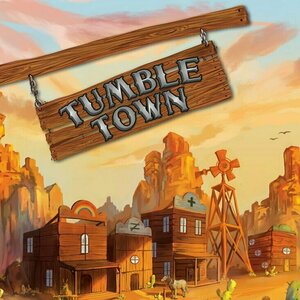


Tumble Town is dice rolling, structure building, drafting game with variable player powers. You are charged with choosing building plans to be added to Main Street of Tumble Town. You do this throughout the game by selecting the plans that will make best use of the resources (dice) you gain. The buildings that you construct may allow you special powers to be used on future turns, or one-time bonuses to be used once built. The player who can turn the greatest profit (in terms of VP) at the end of the game will be the winner!
DISCLAIMER: We were provided a prototype copy of this game for the purposes of this review. These are preview copy components, and the final components will definitely be different from these shown. Also, it is not my intention to detail every rule in the game, as there are just too many. You are invited to back the game through the Kickstarter campaign, from your FLGS, or through any other retailers stocking it after fulfillment. -T
To setup, deal each player a packet of starting components: a unique Horse card, two reference cards, Storehouse card, Main Street card, and two brown (they are red in the prototype) dice to be rolled and placed within the Storehouse. Shuffle and display the 1-, 2-, and 3-cactus building cards per the rulebook instructions to form the market. Set aside a number of each die type per the rulebook (both the building cards and dice are determined by number of players). Determine the first player and give them the first player token (a colorful rubber potted cactus). Players will connect their two Main Street cards at the central icon to create a two-card street (we chose the wagon wheel – Easy) and the game can begin!
Turns in Tumble Town consist of four mini-phases that flow into each other rather naturally. The first phase will have the players choosing a revealed building plan card from the offer market. The face-down draw stack will inform the active player as to how many and which type of dice they must draw and roll. Once they have these dice in their Storehouse, the player may now build plans using the dice they control. Buildings can be constructed and placed right onto Main Street, or be placed on the plan card to be placed on Main Street on a later turn. If the player has collected more dice than their Storehouse can hold, they must discard any of the dice they wish. This concludes a turn and the next player can begin their turn.
Certain iconography on the building plan cards allow players to use special powers throughout the game once built, and there are three types. Cards with the silvery bottom panel of symbols and the 1x notation are powers that must be used only once and only when the building is constructed. These powers could be collecting a die of the player’s choice, or receiving various dice counters. The building plan cards that feature a circular arrow notation are powers that can be used once per turn, every turn, if wished. These powers are found on each player’s Horse as well and can be adjusting a die’s face value, or re-rolling two dice, as examples. The third type of power is from the golden paneled cards that have an arrow pointing to a vertical line. These powers are only activated at the end of the game and mostly include scoring variances, like 1VP for each building a player has constructed that has a vulture icon (or a windmill, for example) featured on the card art.
Once a building is erected, the player may choose to place it onto their Main Street cards. When they place them, the player will need to choose where on Main Street these buildings should live. Like Bob Ross always says, “There are no mistakes, just happy accidents.” A player can place their buildings anywhere they wish on Main Street, but the Main Street cards will give extra bonuses to those players who plan ahead and place their buildings strategically. Some plots will ask for a building of a specific height (one die high or three dice high). Some will ask for the base level of the structure to be made of a specific material/die color (brown wood, black coal, silver metal, and gold… gold). Extra points are awarded if one-die-width alleyways are allotted, and these Main Street placements can score a bunch of endgame points.
Turns can be very quick or very deliberate, depending on the types of players involved. AP-prone players will take longer on their turns as they internalize all possibilities of their rolled results, while people like me just fly by the seats of our breeches. The game continues in this fashion: four mini-phases of drafting cards from the market, grabbing the associated dice, rolling them, and attempting to erect the best buildings on Main Street until two dice pools contain two or fewer dice. The current turn order finishes and the game is over.
Components. Again, this is a prototype copy of the game, and the publisher was decent enough to include a listing of items to be improved in the final version (like the red dice being poured brown in final – that really messed up someone’s strategy during a play-through for us because they kept forgetting that red is actually brown). The overall art style is very simplistic and I do NOT mean that negatively. The graphics and artwork are great, and give exactly what is needed without being so distracting that you cannot concentrate on your strategy. The dice are normal dice quality (that always seem to roll poorly when I’m rolling… hmm…). Once you see the photos of how the game will look during production, you will appreciate how great this is going to look on the table. No problems with components at all, save for the red vs. brown debacle that happened on our table. I really hope they keep the awwwwesome rubber cactus first player marker because it’s amazing.
I absolutely loved this one. I have always enjoyed using items for purposes other than originally intended – in this case, using dice as building materials. Of course, playing any game with dice introduces a bit of luck and instability in strategy, but Tumble Town offers quite a bit of manipulation of dice rolls that keeps almost all dice results feasible and useful. I really enjoyed the stacking, the quick turns, and the desperation when someone takes the last wood die when I was gunning for a wood-based building on my next turn. This game is light, but is chocked full of difficult decisions and luck of the roll. Tumble Town is for people who enjoy the rolling and stacking from FUSE (minus the frenzy), and the spatial building placement chaining of Villages of Valeria.
If this is the game for you, then we highly encourage you to check out the Kickstarter campaign which is running until Thursday, March 26. Tumble Town has already exceeding the funding goal at time of this review, but all future pledges will contribute to stretch goals that will improve components and add other components (spoiler?). So get out there and build up Tumble Town, ya yella-bellied greenhorns!

James P. Sumner (65 KP) rated Fast & Furious Presents: Hobbs & Shaw (2019) in Movies
Aug 1, 2019


I have to admit, I had my reservations about this one. Firstly, it's basically a F&F movie... we all know what they are and what to expect, which is why we love them. Except it's not a proper F&F movie, and I was worried labelling it as part of that story universe would burden it with unrealistic expectations. Secondly, I've spent the last few months trying to avoid trailers for it, when I realised they were basically showing the entire film in them. After the first three or four, I was left genuinely concerned they had nothing left to show me. I thought there was no way they could have any eye candy that I hadn't at least seen a snapshot of.
So, I entered the cinema expecting very little. Which is probably why I left the cinema feeling very happy and satisfied.
Saying this is a F&F movie is like saying Captain America and Guardians of the Galaxy are Marvel movies. Yes, they technically are, but they are two hugely different types of movie. The similarities are obviously more prevalent here, along with the formulaic and predictable buddy-cop routine, but this film manages to confidently and successfully stand on its own two feet, and not in the shadow of Vin Diesel as I first feared.
And yes, the trailers showed snippets of pretty much every major action sequence, but weirdly, they didn't give away as much you would think. There are also some nice surprises in there. I won't spoil them, but let's just say I'm very impressed at how they managed to keep the cameos under wraps!
Okay, let's get into it. The plot (such as it is) revolves around a mysterious tech firm trying to get a hold of a deadly virus, using Idris Elba's enjoyable villain, Brixton to track it down. It takes all of five minutes for things to go sideways, leaving Hattie Shaw on the run from the bad guys. The Powers That Be (the CIA and MI6) decide they need the best bad guy trackers in the business to hunt down Brixton and retrieve this virus, and the girl... thus saving the world. The former recruits Mr. Johnson; the latter, Mr. Statham. As we know from the trailers, Vanessa Kirby portrays Shaw's sister - it becomes a family affair and we're off to the races.
The on-screen chemistry between Statham and Johnson is clear to see. The comedic dialogue they have lands a lot more than it misses. There's perhaps a bit too much gung-ho stereotyping and fan-service catchphrases, but again, you have to expect that kind of thing from a film like this.
What I liked about it was that whilst they didn't re-invent the wheel, it didn't feel like a carbon-copy of every other action film, like so many others do. It had heart. It had character. Yes, some of the stunts were silly. Yes, the bad guy being genetically-enhanced was a bit weird - blending sci-fi with real-world action whilst never actually acknowledging it took some getting used to. But the film just kinda worked. It was very good without being great. It was predictable but still managed to be enjoyable. It's a good two-hour investment of your time for an afternoon/evening out with the family.
Hobbs and Shaw is proof that whatever your criticisms, whatever your reservations, anything Dwayne Johnson touches turns to gold right now. It's also what a potential future Expendables reboot will probably look like.
Meanwhile F&F9 is now filming (sans Statham and Johnson, apparently) and with an inevitable H&S sequel surely not too far away, you can't help but wonder if they're gearing this all up to be a super-charged, car-based competitor to the MCU. The ending, two mid-credits and one post-credits scene in this film clearly set up another outing and tease a sinister, overarching enemy with ties to the character's pasts... could this be a way to link it all back to Vin Diesel and Co? Could a crossover Summer blockbuster be the only way to tell this story? If early box office figures are anything to go by here, the smart money would say yes.
Go, enjoy, eat popcorn and leave your brain and the real world in the car.

Pool Break 3D Billiards 8 Ball, 9 Ball, Snooker
Games and Lifestyle
App
Pool Break is a suite of games featuring several variations of 3D Pool, Billiards, Snooker, and the...

Pool Break Lite 3D Billiards 8 Ball Snooker Carrom
Games and Sports
9.0 Rate It
App
Pool Break Lite is a free suite of games featuring several variations of 3D Pool, Billiards,...
Purple Phoenix Games (2266 KP) rated Cartooner: The Fast & Furious Game of Drawing Comics in Tabletop Games
Jul 23, 2019
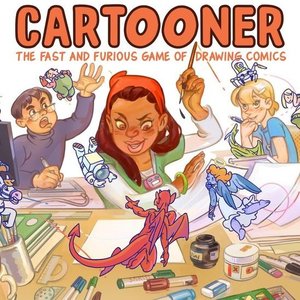
A typical game of Cartooner will last four rounds and each round will be the same length – five, six, or seven minutes each. During these rounds players will create comics using increasing numbers of panels each round. So Round 1 will be a 2-panel comic, Round 2 will have 4 panels, Round 3 will have 6 panels, and the final round will contain 8 panels to fill with glorious comic gold. This is the basic game flow. Where the actual “game” part comes in is through the use of the two decks of cards.
DISCLAIMER: I do not intend to cover every single rule included in the rule book, but will describe the overall game flow and major rule set so that our readers may get a sense of how the game plays. For more in depth rules, you may purchase a copy from the publisher directly or from your FLGS. -T
Three “Theme” cards are dealt at the beginning of the game to each player, which describe the player’s obsessions. Players score points at the end of each round for including their Themes in the comic. This may sound somewhat easy, but the game comes with about 28,000 Theme cards and the combinations can be pretty wonky. For example, for my first game I was dealt Fear of Growing Old, Infidelity, and Desire to Be Famous. My 10-year old niece was dealt Aliens, Flowers, and Animals. I mean, come on! AND her dad is an art teacher (who also played with us and totally killed the art). So I thought I was beaten before we even began. The three Theme cards kept everyone pretty busy in Round 1, but it was about to get harder.
Round 2 introduces a new element to the game that refreshes every round: “Trend” cards. Whomever scored lowest in the previous round will draw Trend cards (the number of which is determined by which round you are currently playing) and choose cards to enact for the upcoming round. Trends are basically bonus cards that you can attempt to incorporate into your comic for the round to score fabulous amounts of points. These are optional, of course, but really can boost those scores for the round, so are not to be ignored.
At the end of each round players will present and read their comics to the group to be scored. Points are awarded for including your Themes, completing objectives from the Trend cards, and also for filling in every panel on your page – which I thought would be a breeze, but apparently eight panels is way too hard for me because I neglected to draw something in the final two panels. Tally up your points from all the rounds and determine the greatest comic artist at the table (it was me)!
Components. This game is a large pad of paper, 28,000 cards, and cardboard VP tokens. You must supply your own writing utensil. As you can see below, I like to live on the edge and used ballpoint pen for my artwork. The tokens are fine and the cards are of good quality. What I really want to highlight is the pad of paper that is provided. Every game each player will need four sheets of paper from the pad, one for each round. These pages are wonderfully organized and include the game rules at the bottom of each page to remind you of what will score points. This helps you to prioritize your panels to include the most VP-worthy elements and to (hopefully) tell a good story as well.
All in all this is a frantic comic drawing game that will have you pulling out your hair trying to compose a somewhat cohesive short visual story including elements that may not, and probably WILL not, fit into that narrative. It is relatively quick, as long as the presentations and arbitrations are held in check for time. We do not have many drawing games in our collections, and I am overjoyed that we now have an enjoyable representative of the genre. Purple Phoenix Games eagerly awards this one a 10/12. Go check it out and test your own illustration skills.
Purple Phoenix Games (2266 KP) rated Bunny Party at Maple Valley in Tabletop Games
Oct 11, 2021
Bunny Party at Maple Valley (which I shall refer to as simply Bunny Party from here) is a sweet and cute little card game for three or four players. In it players are the titular bunnies decorating for and competing to win the chance to host the Night Sky Party at their place. However, in this game more often than not the victory is shared between they who amass the requisite five decorations and their neighbor who also co-hosts the event! The bunnies gotta get crackin’ so let’s get going!
PS – I will be reviewing the 3-player version of the game, which has ever-so-slightly different rules.
DISCLAIMER: We were provided a copy of this game for the purposes of this review. This is a retail copy of the game, so what you see in these photos is exactly what would be received in your box. I do not intend to cover every single rule included in the rulebook, but will describe the overall game flow and major rule set so that our readers may get a sense of how the game plays. For more in depth rules, you may purchase a copy online or from your FLGS. -T
To setup, character cards are shuffled and two dealt to each player. They choose one to be their avatar and discard the other back to the box. The large deck of cards with the house on the back is shuffled and placed on the table within reach. The villager cards are shuffled and one is drawn and placed outside the play area – it will not be used this round. The other five villagers are arranged as a market of friends. Each player draws three cards on the first round, and the game is ready to begin!
Bunny Party is played over a series of rounds until one player satisfies the win condition. Each round consists of eight phases: Turn Start, Tidy a Card, Villagers Visit, Play Cards, Trade, Play Cards (again), Party Start?, and Villagers Go Home. Turn Start typically involves players setting the table for the round. First, the villager cards are re-shuffled, one set aside to be ignored this round (they are staying home), and the remainders displayed. Then each player draws two cards from the deck and collects one Trade Token.
Next, all players will choose one of their cards they drew during the Tidy a Card step to be placed in a temporary discard pile face-down. Alternatively, a player may forego the Tidy in order to place a card in front of another player by spending one Trade Token. Once all players have tidied a card or placed one in front of another player, the Tidy pile is shuffled, then flipped as a stack to the top of the discard pile, face-up.
The villagers are now becoming impatient, so players will allow them audience during this Villagers Visit phase. Each player chooses a villager from those available to host during their party preparation. These villagers offer special abilities each round and can be very valuable at certain times during the game.
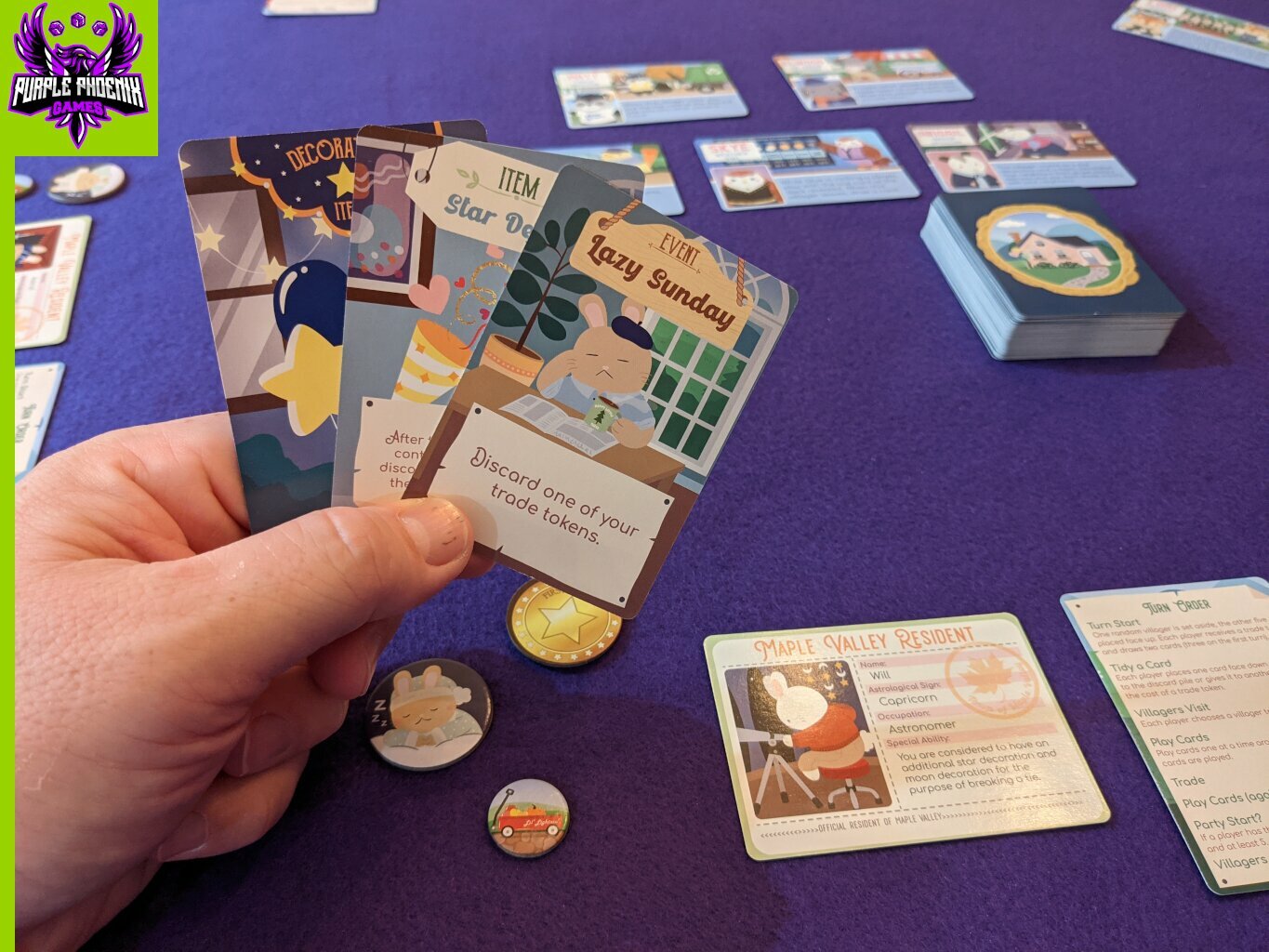
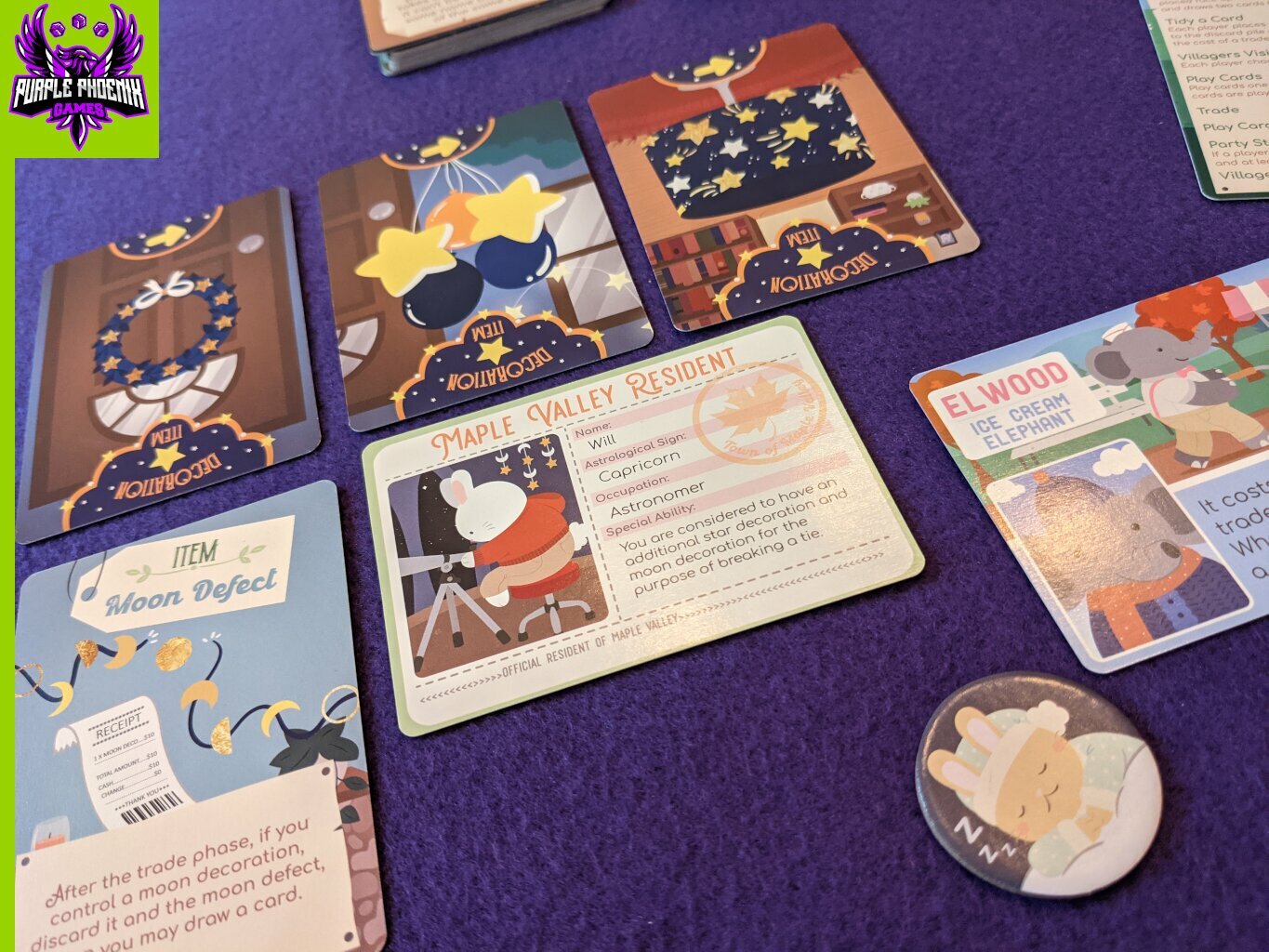
While the villagers are visiting, players may next Play Cards from their hand. These cards are typically of three types: Item, Event, or Decoration. Item cards are placed in the player’s tableau and offer one-time or lingering effects. Event cards are typically one-and-done cards to be completed and then discarded. Decorations are what players are really after, as they are what determine win conditions. With five star or moon cards the player can start the party and end the game. At the bottom of the decoration cards is printed an arrow. This arrow points to the neighbor that will co-host and also win the game. In a three-player game Decoration cards are displayed upside down, so that is why the photo below looks a little strange.
When players have all played their hand of cards, the Trade phase may begin. Players may offer Item cards to other players and a trade may be struck by each player discarding a Trade Token from their stash. This may result in a player receiving a new card to be played. When this happens, the next phase is immediately played (after all trades have been completed). Any player who now holds an unplayed card may Play Cards (again) as before.
If a player (or players) have now collected five or more star or moon Decoration cards, they may claim victory during this Party Start? phase. Again, the Decoration cards have arrows printed to determine the co-host/co-victor in the game, and the winners may then invite the rest of the burrow to their den for the Night Sky Party! However, if no victor emerges during the Party Start? phase, then all the Villagers Go Home, and a new round begins with the Turn Start phase.
Play continues in this fashion until winners have been crowned host and co-host of the Night Sky Party in Maple Valley!
Components. This one is a bunch of cards a few cardboard chits. The cards are all fine quality, as are the chits. What is really great about these components is the art on them. I cannot think of many cuter themes than uber-nice bunnies throwing a party and sharing their victory with a neighbor. So obviously the art has to match the theme, tone, and style of the game. I believe Bunny Party knocks it out of the park here. The art is so playful and cute, and I absolutely have to give a huge shout out to Evan’s Games for the very apparent inclusivity and representation. I see you and I applaud you!
Gameplay for me is where I take just a little issue. Everything works, and once you understand the phases it does flow better, but, I can see myself really only playing this with children or in a gateway/breaking in new gamers situation. It is very light, but there are eight phases to a round! So while each phase is easy to understand and execute, each round takes a little longer because there are a few too many steps. Once my kids really know how to read well they will be playing this with me and I know right now that we will have a great time with it. I really do appreciate the special efforts that were made with regards to representation (yes, even with anthropomorphic cartoon animals) and with the design being more focused on sharing victory and being nice to neighbors. My children will certain have good habits reinforced while playing this, and that is what makes this game important.
Again, this is not the game for hardcore gamers, nor those who are interested in bigger and more complex medium-weight games. This is a quick filler at best during a game night when newer gamers are gathered. That being said, I still find a great deal of value in this one, and will be keeping it for a long time. Purple Phoenix Games gives this one a 4 / 6 on stand-by. I do want to try this with different types of people (once we are able again) to see if my predictions are correct. I have only been able to play it with adult family, and none of them are medium to heavy weight game enthusiasts. If you are needing a nice game that can be played among other games for a themed game night (like Bunny Party + Bob Ross: Art of Chill + Hues and Cues + Escape: The Curse of the Temple) then this certainly fits that niche.
So my official stance, for now, is that Bunny Party has a great theme, excellent art, a wonderful message of harmony, but is both too light and too complex for what it is. I realize that sounds ridiculous. Please try it and let me know your thoughts. For now, I am keeping this close and I will be trying it with various groups with whom I game.


Call of Duty: Zombies
Games and Social Networking
App
Four Massive Zombie Maps. One Great New Price. Now includes the ALL-NEW fan favorite, Der Riese, the...

You Can't Spell America Without Me: The Really Tremendous Inside Story of My Fantastic First Year as President
Kurt Andersen and Alec Baldwin
Book
Political satire as deeper truth: Donald Trump’s presidential memoir, as recorded by two...
politics comedy
Purple Phoenix Games (2266 KP) rated Castle: The Detective Card Game in Tabletop Games
Jul 17, 2021

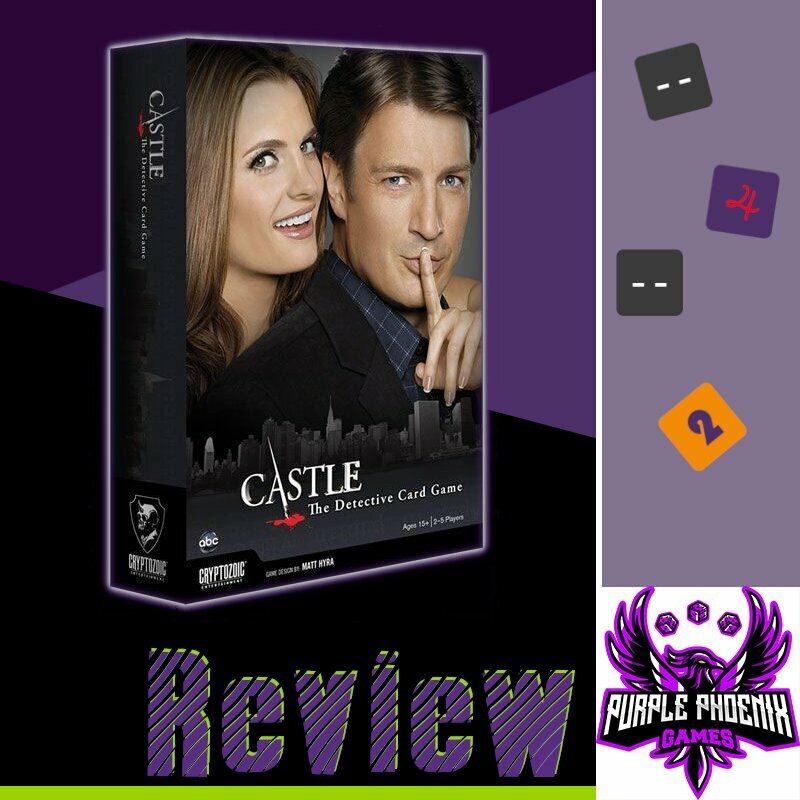
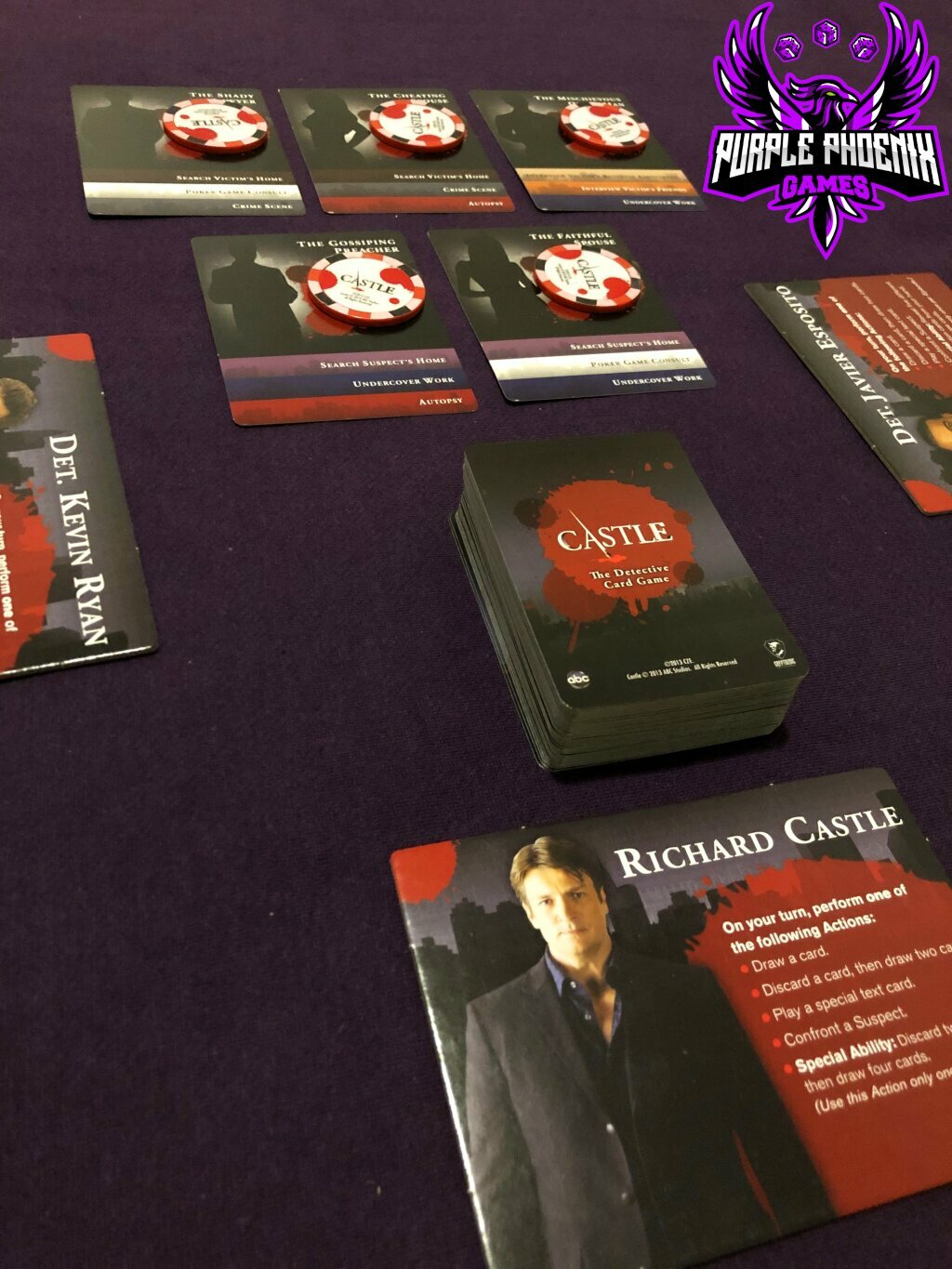
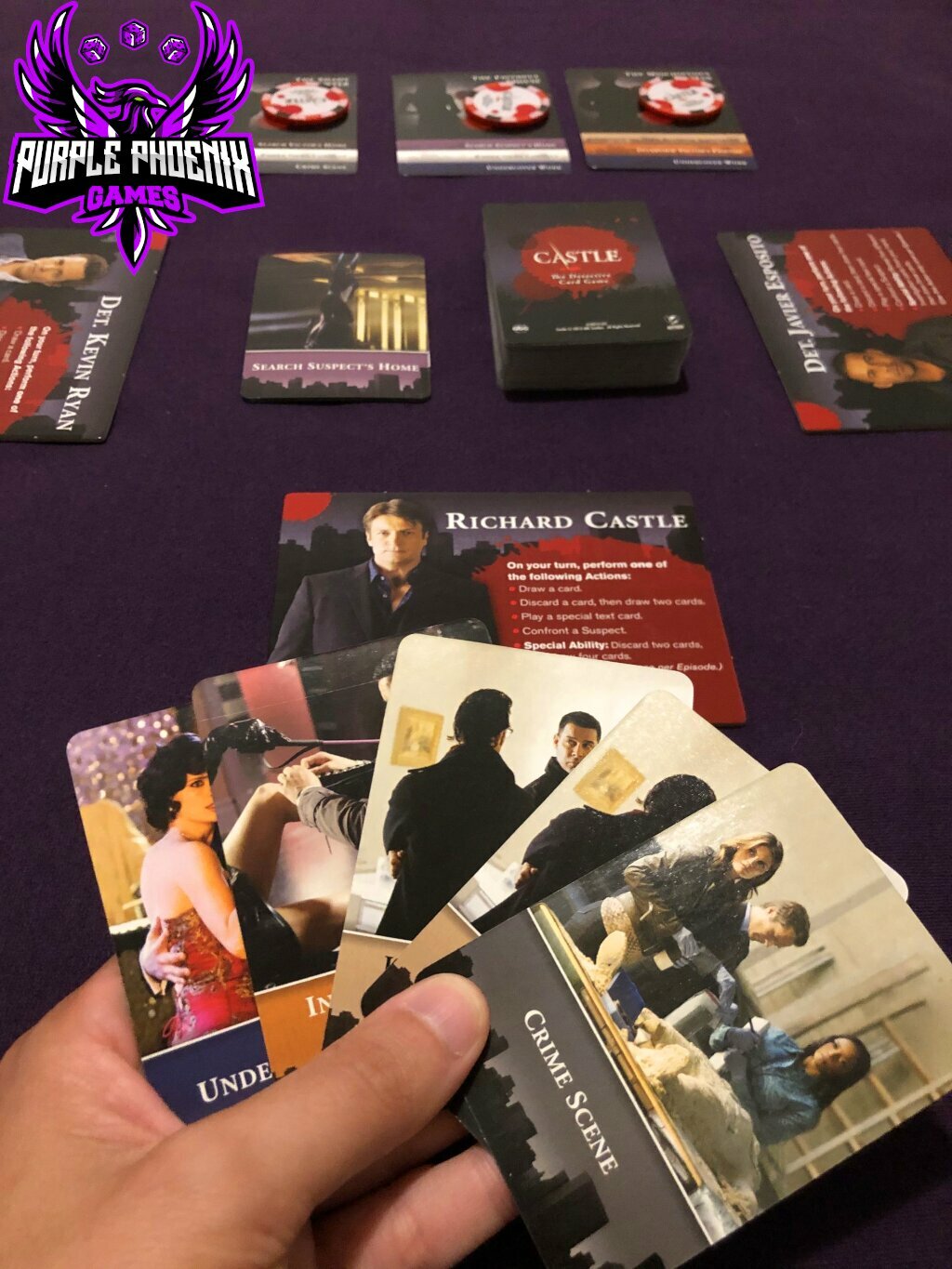
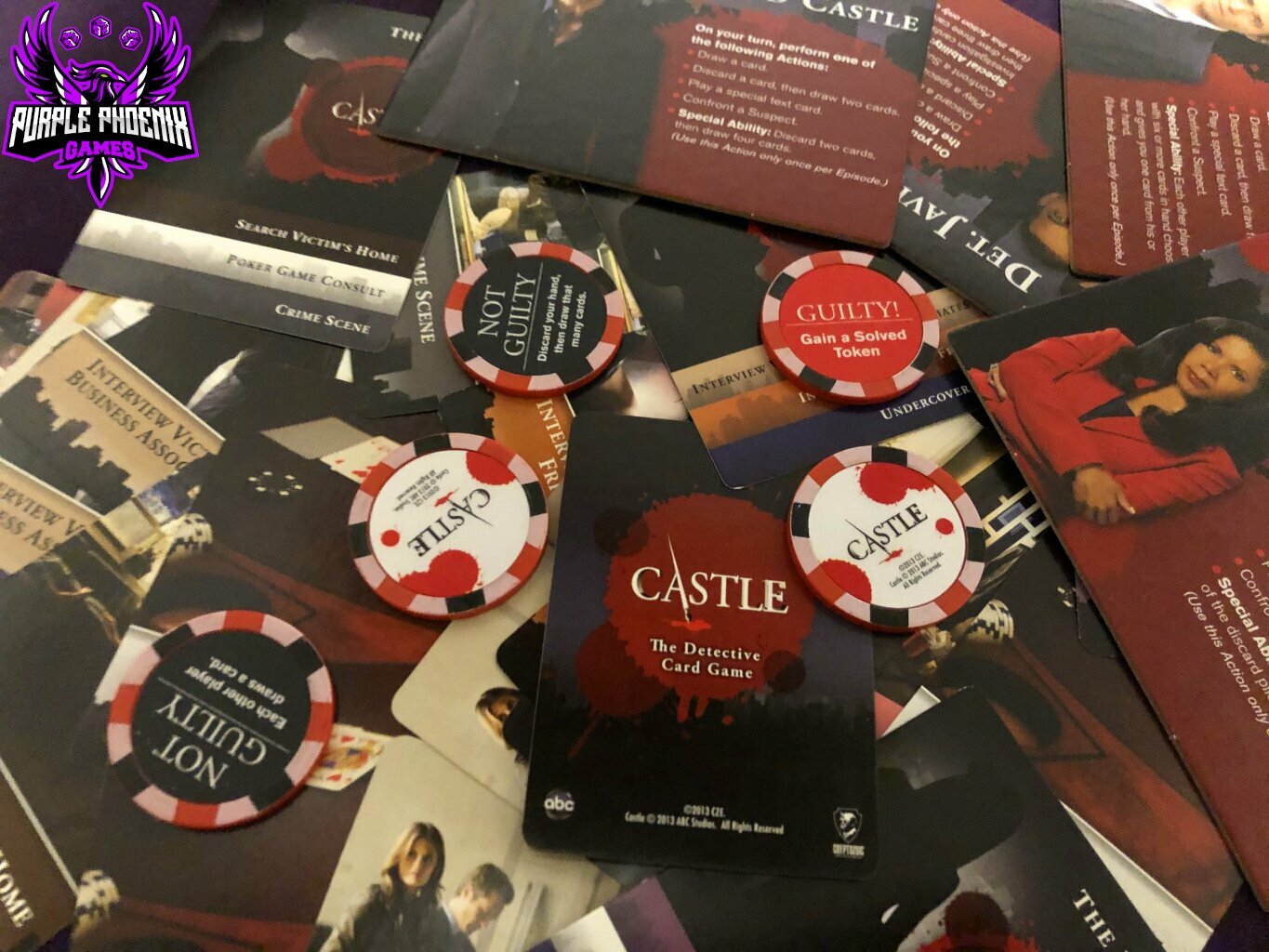
In Castle: The Detective Card Game (referred to as just Castle for the rest of this review) is a murder-mystery card game in which players assume the role of a character from the show, and work to gather evidence and conduct investigations in order to solve the murder at hand! To set up a game, give every player a Character card that represents one of the main characters from the show. Each Character card has a unique Special Ability to be used during play. Shuffle the Suspect cards, and randomly draw five to be placed face-up in the middle of the table. Select one Guilty token and four Not Guilty tokens – shuffle them together face-down and then place one token on each of the Suspect cards. Shuffle the deck of Investigation cards, deal 3 to each player, place the remaining cards into a Draw deck, and the game is ready to begin!
Moving in clockwise order, players will take turns performing one of the following actions: Draw a card, Discard one card to draw two cards, Play a Special Text card, Use your Special Ability, or Confront a Suspect. The first two actions regarding drawing cards are pretty self-explanatory. Throughout the game, you might draw into your hand an Investigation card with Special Text. You may play a Special Text card, and perform the specified action on your turn. Each Character has a Special Ability that can be used once per game, so plan wisely and use it appropriately! The last action, Confront a Suspect, is what the entire game is leading to. In order to Confront a Suspect, you must have the three Investigation cards listed on the bottom of the Suspect card in hand. When performing this action, you will reveal the three requisite Investigation cards, and then you flip the token on that Suspect card. If the token reads Guilty, then you have won the game! If the token reads Not Guilty, perform the action listed on the token, remove that Suspect and token from the game, discard your used Investigation cards, and play continue with a narrowed Suspect pool! The goal is to be the first player to find the Guilty party before the Draw deck runs out of cards.
Pretty straight-forward, right? I think so, and that’s one of the things I really like about this game. The gameplay is fast and simple, and makes for a quick little set collection game. Another neat element of this game is that although it is based around the Castle TV show, you do not need to have watched any of the show to play. Anyone can play and not feel like they are missing any vital information if they haven’t seen the show, and that makes it accessible to all players, not just fans of the show.
Even though I love the show, I have to admit that the gameplay, although fast and simple, is heavily dependent on the luck of the draw. Throughout the game, you are working to collect sets of the necessary Investigation cards for individual suspects, but the only way in which cards are distributed is through drawing them from the deck. There isn’t an offering that you ‘pay’ certain resources for coveted cards, there’s no real way to know in advance what card you are going to draw, etc. It really depends on how the deck was shuffled whether you will be successful or not. There are no real opportunities to strategize, and that keeps the overall gameplay kind of stagnant. Yes, there are Special Text cards and each Character has a unique ability, but deciding when to use them is kind of a shot in the dark due to the dependence on luck.
Let’s talk components for a minute. All of the Investigation and Character cards use photos or stills from the actual TV show. Again, you need not have watched it to play, but the use of the stills makes the game more immersive and nostalgic for those that have seen it. I love looking at the cards and trying to remember from which episode each still is, and if I remember who the killer was in that specific scenario. It’s just a fun little thing. The cards are all of good sturdy quality and will hold up decently in the long run. The Guilty/Not Guilty tokens in this game are some thick and heavy poker chips and they are AWESOME. They are so high quality, I just love to manipulate them, and they add some cool ‘bling’ to the game.
All in all, is Castle a great card game? No, not necessarily. It is a fun little murder mystery game, but not one that requires and real strategy or brain power to successfully play. Do I like it though? Absolutely, because it is based on my favorite show! If you’re looking for a nice filler game, or a game that doesn’t require too much focus, give Castle: The Detective Card Game a shot. That being said, I feel like only fans of the show will be trying this game, but I guess you can prove me wrong! Purple Phoenix Games give this a mischievous 6 / 12.

Ease My Mind by Shout Out Louds
Album Watch
In their 15 years as a band, Shout Out Louds have toured the world many times. The band played a...
alternative rock