p3anut (62 KP) rated the Xbox One version of Dauntless in Video Games
Jun 1, 2019


At first glance I was a little put off since it was made by epic, had fortnite looking character models and I didn't know anything about the game. And right now I'm a little burnt out on the fortnite craze.
After about 10mins of playtime, I found myself really enjoying the hunting aspect of the game. The monsters are huge and sometimes they have little ones around them that you have to kill before attacking the bigger ones. The battles range from 5min to 30min so far which is pretty nice depending on your time constraints.
The world hub that you visit in between hunts is fairly decent sized and full of human characters. They have this cool little icon feature where you can see if the player is on pc or Xbox. The hub is full of what you would expect from an RPG games as a service title. It has your typical weapon master, grenade master, potions master, and armor master. And of course looped into all of those are micro transactions for skins and dye packs etc.
Which if you're like me you don't really care about customizing the color of your hat etc. Enough to spend actual money on.
I've only played about 4 hrs of dauntless and so far I'm pretty into it. I do feel like eventually the grind will get repetitive but I will update once I have at least 10hrs put into it. As I mentioned in my tags it is in a beta stage so don't be surprised from some lag from time to time or quests not showing on the screen as completed because even tho it doesn't show, it does complete them

Mr. Wolf? {Telling Time Game}
Education and Games
App
What Time is it Mr Wolf? Tell the time and run for your life in this exciting, fast-paced game! ...

My Sweet Pizza Shop - Make & Serve Yummy Dessert
Games and Entertainment
App
It’s pizza time! The smell of hot, fresh pizza makes everyone’s tummy rumble in hunger. Here we...

Pokémon TCG Online
Games and Entertainment
7.0 Rate It
App
**AN INTERNET CONNECTION AND AN iPad WITH RETINA DISPLAY (iPad mini with Retina Display, iPad 3 or...

Fairy tale princess coloring book for girls
Games and Education
App
Fairy tale princess coloring pages for girls! coloring pages for entertain and educational, Favorite...


Super Badminton
Games and Entertainment
App
Over a million downloads! Get addicted to the Best Racquet Sports Game on the App Store! "I can...

Real Boxing Manny Pacquiao
Games and Entertainment
App
The greatest mobile boxing game Real Boxing® is proud to introduce the 8-time boxing world champion...

The Real Deal: A Novel
10.0 Rate It
Book
Get ready for your next favorite romantic comedy, THE REAL DEAL! April Hamilton wants you to know...

Purple Phoenix Games (2266 KP) rated Harsh Shadows in Tabletop Games
Apr 20, 2021


Disclaimer: We were provided a copy of this game for the purposes of this preview. The pictured components might not be finalized, and could differ after a successful Kickstarter campaign. -L
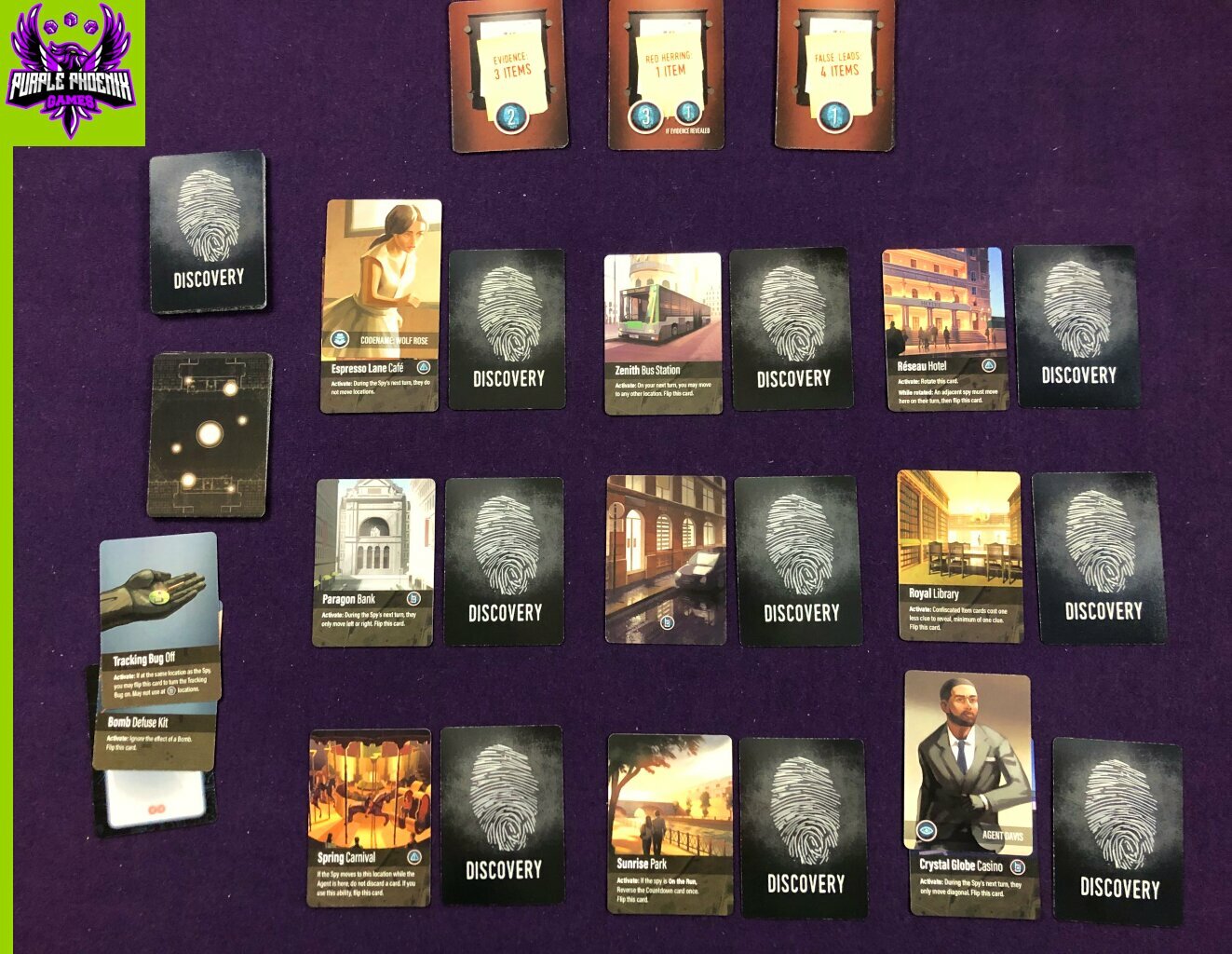
Harsh Shadows is a solo card game of hand management, grid movement, and deduction where you are an agent working to collect evidence necessary to apprehend an enemy spy. To setup for a game, randomly place the 9 Location cards in a 3×3 grid. Prepare the Discovery deck as described in the rules, place 1 face-down Discovery card to the right of each Location, and place the rest of the deck off to the side of the grid. Shuffle the Confiscated Item cards and deal the appropriate number to each of the Case File cards – 3 to Evidence, 1 to Red Herring, and 4 to False Leads. The Spy card is placed on the upper-left-most Location, and your Agent card on the lower-right-most Location. Shuffle the Spy Movement cards, and the game is ready to begin! It should look similar to the picture below.
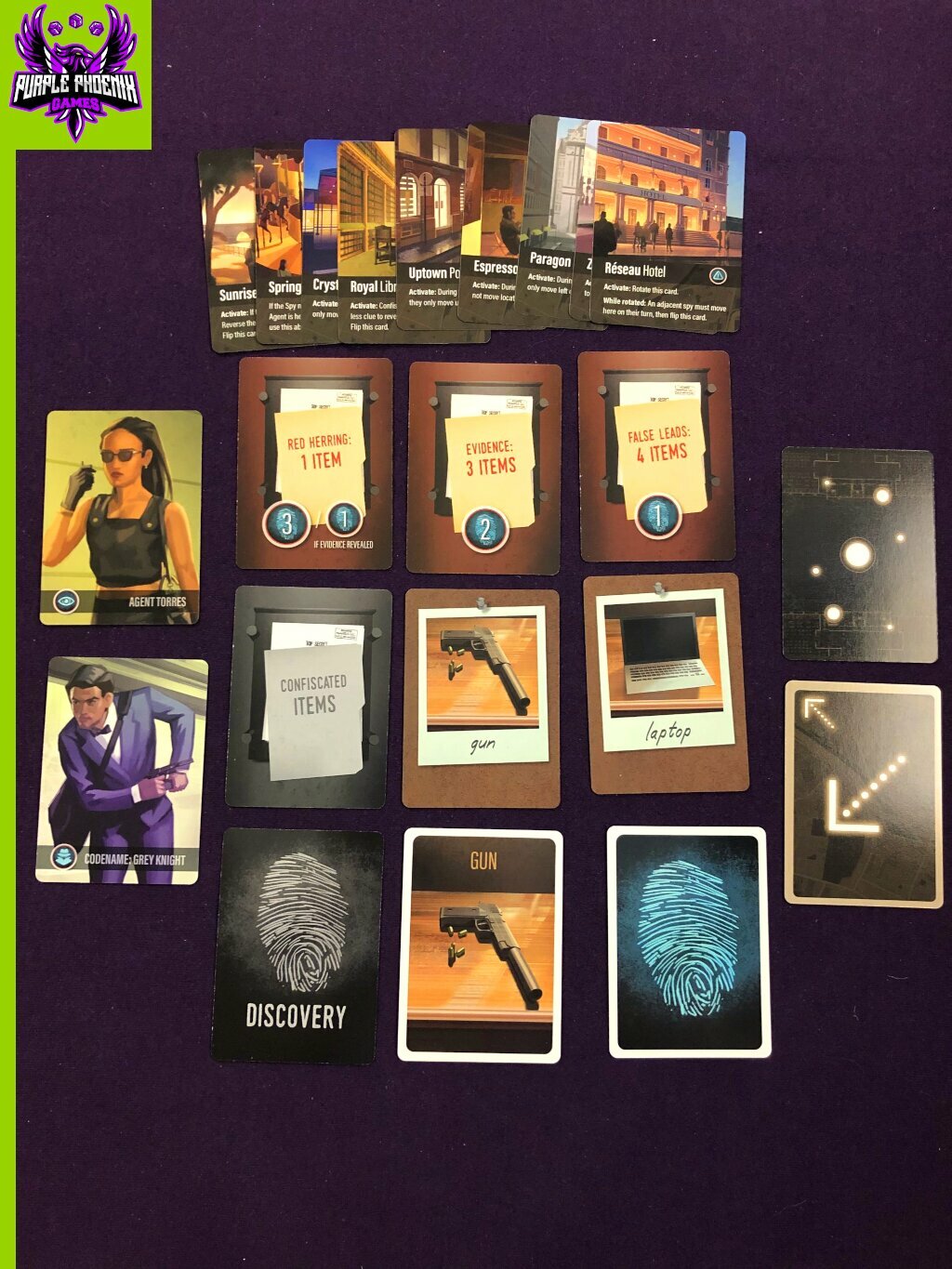
The game is played over a series of rounds in which you will be moving your Agent, performing additional actions, and then moving the Spy. The goal is to track down the Spy, with the correct evidence in hand, before the Spy is able to flee the scene. The first thing that you will do each round is to move your Agent. You may only move to a Location that is adjacent or diagonal to your current Location. Once you move to a new Location, you will draw the top Discovery card from that Location. Discovery cards will either be Items, Clues, or Bombs. Items are collected as potential Evidence, Clues are used to reveal Confiscated Items from Case Files, and Bombs force you to discard a card from your tableau. After you have moved and collected a new Discovery card, you may perform any/all of these additional actions: Use Clue Cards, Place the Tracking Bug, Track the Spy, or Use your current Location’s ability. To Use Clue cards, you will discard a number of clues in order to reveal a Confiscated Item card from a Case File. The Confiscated Items under the Evidence Case File show the 3 items you are required to have in hand to apprehend the Spy by the end of the game. The item under the Red Herring, if you have it in hand at game’s end, will cause you to automatically lose. The 4 items under the False Leads will neither help you win, nor cause you to lose – they simply offer fodder for you to discard when necessary.
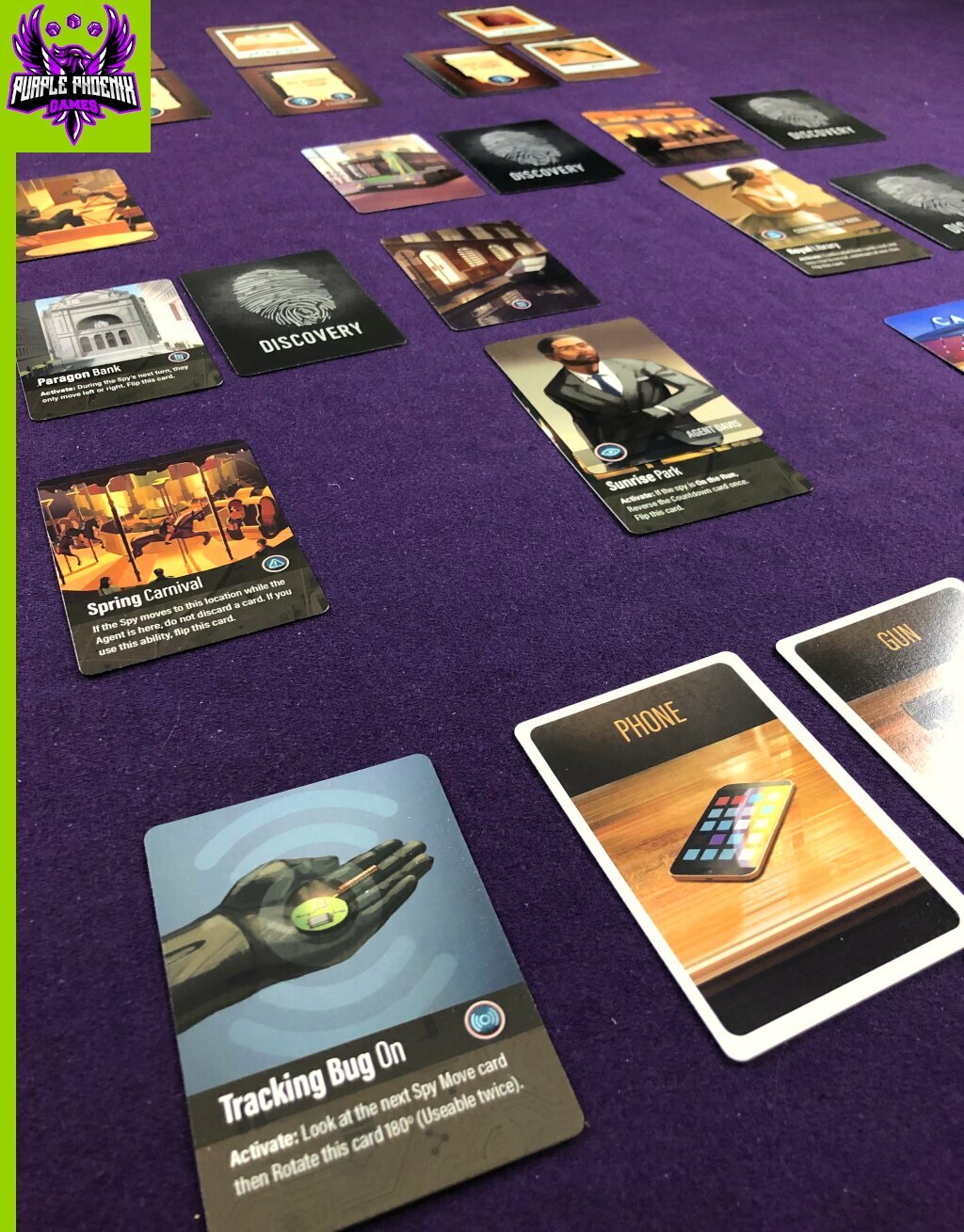
Another element required to win the game is to place the Tracking Bug on the Spy. On your turn, you may place the Tracking Bug at your current Location card – if the Spy moves to the Location on a future turn, they are considered to be ‘bugged’ and the Tracking Bug is live! Twice per game, you are allowed to Track the Spy. To do so, you will look at the top card of the Spy Movement deck, and return it to the top. This just lets you see to which Location the Spy is about to move. And finally, you can use your Location’s ability. Once you have taken as many of the additional actions as you want, it is time to move the Spy. Reveal the top card of the Spy Movement deck, and move the Spy in the appropriate direction to a new Location. At the Spy’s new Location, add a Discovery card to its pile. Play continues in this manner until either you make an accusation, or the Spy escapes. In order to make an accusation, you must have Evidence cards in hand, the Spy must be bugged, and you must be at the same Location as the Spy. When you make an accusation, you will reveal any remaining cards under the Evidence and Red Herring Case Files. If you have the 3 matching Evidence cards, you win and apprehend the Spy! BUT if you have the Red Herring card, or you are missing any of the required Evidence cards, you lose. If you haven’t made an accusation in time, the Spy could escape, causing you to lose the game as well – I’ll leave those details for you to discover on your own!
In theory, Harsh Shadows seems like a neat and strategic card game, but how does it hold up in reality? Pretty well, actually! The first thing I want to talk about is how strategic it is, even with its elements of deduction. You need to collect Evidence fast in order to catch the Spy, so what’s the best plan of movement? Also, each Location has a special ability, so is there an ability you need to use now or do you want to wait a bit longer? After using a Location’s ability, it is no longer available for the rest of the game, so you have to time those uses carefully. Along those lines comes the deduction. Sure, you can try to reveal all the Confiscated Items so that you’re 100% sure that you’ve got the right Evidence. But if you don’t work fast enough, the Spy could escape. Are you willing to risk only knowing for sure what 1 piece of Evidence in order to confront the Spy before it’s too late? Or do you want to save up Clues to purchase that coveted Red Herring, to know for sure what not to keep in order to win. There’s a balance of risk with deduction, as well as a real-time element in the sense that the game has a finite amount of rounds. You’re not racing a physical clock, but once the Discovery deck runs out, the Spy is considered to be on the run, on the verge of escaping. Overall, this is a casual card game, but it has a decent amount of strategy to keep you engaged and entertained.
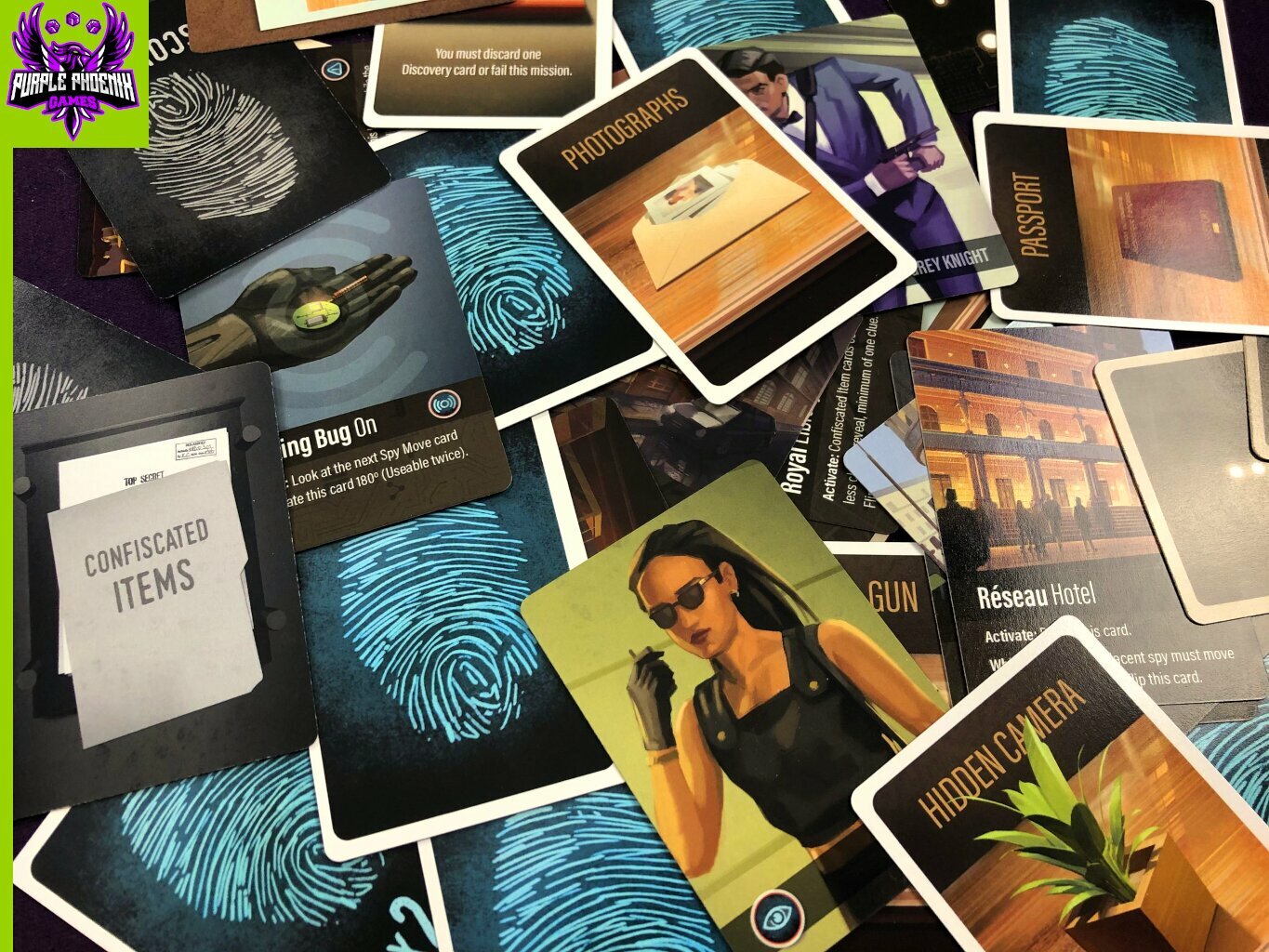
Let’s touch on components for a second. Obviously, this is just a card game, and this is a preview copy. As I said earlier, the final production could differ from this version, but I have to say that this preview copy is good quality. The cards are nice and thick, the artwork thematic and clean. I imagine the rules would get some final edits for slight clarifications, but for the most part the production quality is already pretty decent.
I have to say that Harsh Shadows surprised me. I’d never played a solo game with deduction elements, and it was actually quite exciting. Usually the deduction games I’ve played are based around sussing out a traitor amongst a group of people, so there is that human interaction element that can really help guide your thoughts and decisions. In Harsh Shadows, there’s nobody but yourself – you can’t look for tells in other players because the cards won’t speak to you. It feels riskier in this way because it’s more a game of odds then, instead of your ability to pick out social cues. Other people may feel differently, but I thought this was a neat twist on the deduction mechanic. If you’re looking for a strategic solo game, that plays relatively quickly and casually, I would definitely recommend checking out Harsh Shadows. It goes live on Kickstarter here in April, and I look forward to following its progress!