
Search
Search results

BackToTheMovies (56 KP) rated Child's Play (2019) in Movies
Jun 21, 2019
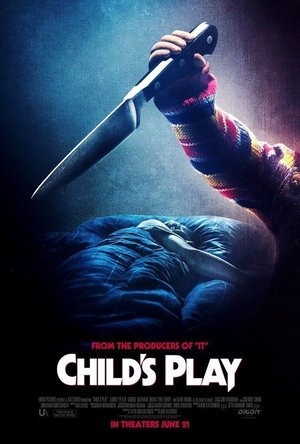


After moving to a new city, young Andy Barclay receives a special present from his mother. A seemingly innocent Buddi doll that becomes his best friend. When the doll suddenly takes on a life of its own, Andy unites with other neighborhood children to stop the sinister toy from wreaking bloody havoc.
For months I’ve been hating on this reboot. Whilst I still don’t necessarily agree with the politics of how this film came to be. I left the theatre quite surprised at how much I enjoyed this movie. Child’s Play is reimagined for a modern generation. Whilst this film is an alternate timeline twist to the original it still manages to throw in that classic Chucky humor we all know and love. Here’s my Child’s Play 2019 review.
Lars Klevberg tells the story of Buddi, an artificial intelligence robot that can control your home appliances and become your best friend. He will play with you, interact with you like a real human being and you can do activities together. After a man is fired at the Buddi factory he reprograms one of the dolls to disobey its commands and the reign of Chucky begins when it falls into the hands of young Andy (Gabriel Bateman) given to him as a present by his mum Karen (Aubrey Plaza). What follows is a thoroughly enjoyable feature that flies by. Chucky’s murderous rage ramps up to artificial intelligence warfare with epic results.
Disregarding the original storyline of a serial killer whose soul inhabits a Good Guys doll the new Child’s Play tells a more chilling tale. The movie runs a very close to home social commentary about our reliance on technology and the implications that could follow. Buddi is your walking, talking Amazon Echo. Every home device is controlled at his fingertips from TV’s to telephones and even as far as automated cars. You can only imagine the terror that unfolds as Chucky learns to utilize his technological surroundings for evil.
Chucky starts off innocent enough. He’s programmed to be Andy’s best friend but what starts out as a unique interaction between boy and robot instantly changes when Chucky becomes sentient. Influenced by those around him and watching horror movies with Andy suddenly Buddi becomes more sinister in nature. Instead of a treasured companion, Chucky becomes possessive and will protect Andy by any means necessary. Quite the different approach from that of previous installments. Even when Chucky begins his reign of terror Andy is still loyal to him to some degree. Whilst he cannot understand why Chucky is doing the things he does there’s a loneliness about Andy’s character that almost seems to justify Chucky’s behavior. He doesn’t agree with it but at the same time, he has a friend, albeit a murderous little rampaging doll.
Child’s Play has some incredible humour mixed in throughout which allows the film to flow freely. Whilst Seed of Chucky and Bride of Chucky had free-speaking souls it’s harder to convey this type of humour within a robotic doll. Instead, the doll spills one-liners and is influenced by those around him leading to some comical results. Chucky’s infamous one-liners come to the fold and various facial expressions on the doll are hysterical.
The vocal work and comedic delivery from Mark Hamil is nothing short of wonderful. There is nothing this man cannot do. The force is strong with him even in a Chucky movie. Whilst more robotic in nature the way the lines are delivered with such dry-pan straight-faced edge is just brilliant. But once again we cannot compare this new Chucky to the sublime work of Brad Dourif. Brad is delivering dialogue as a human being whereas Mark is delivering lines as a robotic entity. They just cannot be compared and it would be a stupid comparison to make. All in all the voice work is great It’s just a shame I can’t take this ugly doll seriously for one second!
Whoever designed the Buddi doll in pre-production needs a serious talking to! I’m not quite sure what look they were going for with this but it certainly isn’t a good one. The film becomes even more of a comedy the more you look at it. The old dolls had that look of innocence in the originals, this one is just so damn weird. I can’t picture a production meeting where everyone in the room agreed that this is the final look of the doll without intense laughing involved. It’s like the production team are openly fucking with us. No one on this planet can take this doll seriously and for me, Child’s Play is way more of a comedy than it will ever be a horror movie.
For the most part, casting within Child’s Play is very strong. Gabriel Bateman (Andy) puts in a strong performance single-handedly carrying the film. Brian Tyree Henry (Mike) who plays a neighbor/detective is also a nice comedic relief within the feature. Ty Consiglio, Beatrice Kitsos and Carlease Burke also play strong supporting roles. Where casting failed for me however was Aubrey Plaza. I’ve seen Aubrey in comedies where her humor never really hits home in any roles she’s in.
Arrogant and annoying in many roles this cookie cutter casting has her playing the same role in every film she’s in. Playing Andy’s mum in this film doesn’t work for me whatsoever. There’s no conviction, no depth, no family dynamic feel of any sort. She almost plays an annoying older sister rather than a mother. Thankfully, she doesn’t play a key role as such to Andy’s arc and thus I can overlook her involvement as such. I think Aubrey should have played a sister role or similar, it would have played to her on-screen strengths.
When Chucky starts killing is when this movie comes into its own. It has nothing to compare it to previous Chucky films. Our new technologically manipulative little doll runs havoc on the millennial generation of mobile phone and gadget addicted humans. The death scenes are gory and for the most part, all have comedy elements to them. Whilst the kills are unimaginative it’s how Chucky delivers those kills that really add that star gore power to proceedings.
Endearing, gory and mostly hilarious. The contrast of tone in Child’s Play may even persuade the die-hard fans to enjoy this one. It shouldn’t really be compared to the originals in any way shape or form although it does have an 80’s flair to it. Child’s Play has taken a new direction but has stayed relevant to modern times and whilst it’s taking a different path than the upcoming TV series, it’s safe to say Chucky really is back!
Thanks for checking out my Child’s Play 2019 review. I hope you enjoy it as much as I did!
https://backtothemovies.com/childs-play-2019-review/

Purple Phoenix Games (2266 KP) rated DiTiC in Tabletop Games
Oct 2, 2019

Purple Phoenix Games Preview
Abstract strategy games hold a special place in my heart. I’m not really a fan of Chess, but I am a fan of games that are light on rules and components but heavier in strategy needed to best your opponents. Yes, I like games that have zombies and gore or adventure and treasures as well, but abstracts are a great escape from those Ameritrashy games we all love.
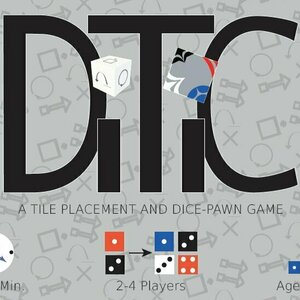
So my original thought was to try to open this preview with a dastardly abstract statement to truly emphasize how theming is irrelevant with some activities. Not quite having done that, DiTiC is an abstract strategy game of “tile placement and dice-pawn” movement. How does it play? Read on.
In DiTiC the winner is the first player to upgrade one of their dice from a smaller-valued die into a value of six. Bring out smaller value dice and move them around the “board” to combine with other dice and win the game!
DISCLAIMER: We were provided a review copy of this game for the purposes of this review. These are preview copy components, and I do not know if the final components will be similar or different, or if the Kickstarter campaign will alter or add anything through stretch goals. -T
To setup a game of DiTiC, each player chooses a color of dice and takes all dice into their hand. The tile with “DiTiC START” on it is the, well, starting tile and is placed in the middle of the table. Roll off to see who goes first and you are ready to play!
On a turn a player may draw and place a tile or move one of their dice. Players start with zero dice on the board, so the first few turns will be drawing a tile from the bag and placing it on the board either side face-up. As you can see from the photos the tiles will have different colored (and shaped) corners. It’s when these corners complete an intersection of four tile corners that dice may enter the board. Depending on the color of the intersection’s majority control a die of said majority color comes into play on the value of the number of icons present. That’s a mouthful. So there are four corners to the intersection. If said intersection contains two red, a blue, and a black icon then red will place a die with value of two pips showing on that intersection. These dice may now be moved and combined with like-valued dice (with an exception). If a player has at least one die on the board when initiating this action, they may roll the action die after placement and complete any other actions the die result allows.
When a player decides instead to move, combine, or overtake a die, they simply move the die along the edge of a tile to the next closest intersection. Exception to movement: players can move all dice with a value of one BEFORE any other dice movement, and dice with value of one or two may move in any direction – even diagonally.
To combine/upgrade dice players will need to move one die into the same intersection as an equal-valued die in order to combine into a die of value +1. Example: a four die and a four die combine to make a five die. Exception to combinations: a value one die may combine with a value three die (remember the exception from the previous paragraph?) to create a value four die.
To overtake an opponent’s die, a player simply moves a superior die onto an occupied intersection. Typically, a die of larger value can overtake any die of smaller value. Exceptions: nothing may overtake a four or five, and only a five can overtake a three. Three-value dice seem to be the superheros of DiTiC.
So after many back-and-forth turns of placing tiles and rolling dice or moving/combining/overtaking dice the winner is crowned once they have upgraded any die into a value six die.
Components. Again, this is a prototype version of the game, so I will comment on what I can. I think the game looks very nice, even in this stage of production. The icons on the tiles are clear – and THANK YOU for considering the colorblind gamer community by making each icon different by both color and art style. The dice are your typical d6 (and I do not know if there will be any changes made to these as a result of a successful campaign). The icons on the action die make sense and I really dig the laser-etched wooden design, and I kinda hope that detail makes it into the final product. But I prefer wooden dice to plastic every time. The game also came with a burlap bag to house and conceal the tiles, and coupled with the wooden dice makes a nice little natural organic combo. My only request for the final version of the game? Go crazy with the color scheme. Black, red, white, and blue are great colors, but fling out the purple and the gold and the orange and the aqua. But I’m no designer. It looks great as it is.
So like I said up top, I love abstracts. Surprisingly so. The more I play them the more I love them. And this game definitely adds to my love of the genre. The rules are kinda wacky, and the dice of different values each can do their own thing, and I think that’s really interesting. It’s not simply a game of moving big dice around eating all the little dice. I mean, you CAN do that, but you will not advance your own strategies. But there is an amount of take that in this game, from the action dice to the tile placement to the overtaking of dice, that will really appeal to lots of people. It’s not a big game, but it looks great on the table, and plays really well once you have immersed yourself in the rules. I really believe that the more I play it the more I will fall in love with it. In fact, as I type this I want to go home and play it right now. And that’s a mark of a good, if not great, game, isn’t it?
If you like abstract strategy games and have a little room for this small game in your collection (or better, MAKE some room for it) then you should definitely consider backing it on Kickstarter, or (depending on when you read this) picking it up at your FLGS.

5 Minute Movie Guy (379 KP) rated 47 Meters Down: Uncaged (2019) in Movies
Aug 26, 2019


I love a good shark movie. Since as far back as I can remember, I have been fascinated by sharks. I think they’re some of the most interesting creatures on our planet. Even when I was a kid, I used to wear shark tooth necklaces because I thought they were so cool. Basically any time you’ve got sharks in a movie, I’m all in for it. Amusingly enough, that same sentiment does not apply to video games where I think they’re terrifying! (Jaws on the original Nintendo freaked-me-out as a child.) Having said all that, I was excited to see 47 Meters Down: Uncaged, even though I missed out on the original film back in 2017. Johannes Roberts, the director of the minimalistic first film, 47 Meters Down, returns for this sequel and brings back the great white sharks, but shakes up for the formula a bit by adding an underwater maze to the mix.
The sequel focuses on teenaged loner Mia (Sophie Nélisse) who has recently relocated to Mexico with her father and step-family. Her father Grant (John Corbett) scouts and maps out underwater locations for a living, and has recently discovered an ancient sunken Mayan city. With the help of his two assistants, he’s currently in the process of mapping out its maze-like design. One day, Mia joins her sister Sasha (Corinne Foxx) whose two friends, Alexa (Brianne Tju) and Nicole (Sistine Stallone), take them to a hidden local cove for a day of fun. This location turns out to be one of the entrances to the historic labyrinth that Mia’s father Grant has been exploring. Alexa, who once dated one of Grant’s assistants, had gone diving with this former boyfriend into the submerged city before. Upon finding enough extra scuba gear for all of them on a floating dock in this isolated cove, Alexa pressures her friends into joining her on a brief underwater tour that ends up being anything but.
This sunken Mayan labyrinth that the four girls go inside to explore is the setting for most of the film. They’re supposed to be following Alexa, who knows part of the maze well enough to navigate it without getting them lost, but their stubborn and defiant friend Nicole decides to venture off-course and winds up endangering them all. In the aftermath of Nicole’s senselessness, a pillar gets knocked over, creating a domino effect of destruction that causes the entrance they came in through to collapse and get sealed off. Now they’ll have to find another way out. With limited oxygen and even less light and visibility, the girls have to swim deeper into the maze to try to look for an exit.
Quickly the girls come to discover they’re not as alone in this labyrinth as they first thought, and they find themselves in the presence of great white sharks. These sharks, blind from living their whole lives in the darkness of this lost city, have their other senses heightened as a result, and they’re on the hunt for blood. The arrival of these sharks, however, opens up a big plot hole in the story. How is it that Mia’s father has never seen these deadly sharks nor made any reference to them when he’s already spent weeks, possibly even months, exploring this sunken city? I suppose it’s possible that in the collapse of the entrance, another passageway may have opened up that let the sharks in. However, that logic doesn’t hold up, because had they came in from outside, they wouldn’t be blind. These particular sharks evolved down here, so it’s hard to believe they were never noticed before, especially considering how violent and aggressive they are.
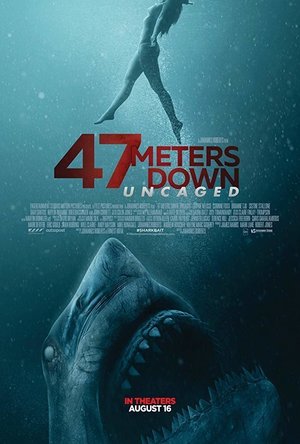
That’s far from being the only problem with these sharks, though. They also look flat out awful. The quality of their special effects in this film is simply pitiful. I’m not even exaggerating when I say they often reminded me of that infamously bad shark attack scene from Jaws 3D. They look so fake and unbelievable that instead of feeling any sense of fear when they randomly appeared, I couldn’t help but cringe. It literally looks almost as bad as the Sharknado movies, but the key difference is that unlike the intentionally campy Sharknado movies, 47 Meters Down: Uncaged is actually trying to take itself seriously. Plus it has even has double the budget to work with.
47 Meters Down: Uncaged takes a very lazy and bare-bones approach to filmmaking. The story lacks substance, the characters and dialogue lack depth, and the visuals throughout most of the film are muddied and unclear. It’s rough on the eyes because the visuals are so obscured and are shrouded in so much darkness that it’s hard to actually see what’s happening on screen. This is often exploited as a cheap tactic to create jump scares by having the sharks suddenly appear from literally out of nowhere, which seems especially hard to believe since it’s doubtful these large sharks could smoothly navigate most of these narrow passageways in the first place. Despite the restrictive maze design, the film fails to create a sense of claustrophobia, and instead just gave me a headache.
The story progression in the film mostly feels generic and expected. There are new complications that arise and circumstances that change, but it’s all pretty standard fare. The ending, however, sets up a decent scenario, but it ends up being ruined by how unrealistic it is. Besides, after wading through all of the garbage to get there, I couldn’t be bothered to care much at that point. The acting in the film is mostly poor, but truthfully they’re never given much to work with. It’s also difficult to keep track of who is who once they’re inside the maze anyway because the visuals are so muddled. The movie does feature its share of violence and death, but its light on the gore and to me it always felt unsatisfying.
In all, 47 Meters Down: Uncaged sinks right to the bottom of my rating list as the worst movie I’ve seen in 2019. It’s lazy and bland to the point of being exhausting. There’s ultimately not one single thing about it that I can sincerely commend. The only thing I’m probably going to remember this movie for is how dreadful it looks and the 90 minutes of boredom and disappointment it caused me.