
Search
Purple Phoenix Games (2266 KP) rated 13 Monsters in Tabletop Games
Dec 5, 2019

Guys and gals, I have a confession. I am not good at memory games. I already surmised it is due to my increasing age, as my 3-year-old son tore through our plays of Farm Rescue, so I am not above resigning myself to the fact that it may be age. In any case, 13 Monsters starts out as a memory game then quickly transforms into a punish-thy-neighbor-into-oblivion monster battle game. Intrigued? We were too…
As I mentioned in the intro, and as you can see in the first photo below, 13 Monsters starts out as a memory tile-flipping game and then becomes a bash-em’-up for domination. The goal of 13 Monsters is to end the game holding the monsters with the highest total Hit Points (HP). Now how you get there is another matter entirely.
DISCLAIMER: We were provided a prototype copy of this game for the purposes of this review. These are preview copy components, and I do not know for sure if the final components will be any different from these shown. Also, it is not my intention to detail every rule in the game, as there are just too many. You are invited to download the rulebook, purchase the game through the Kickstarter campaign running until December 20, 2019, or through any retailers stocking it after fulfillment. -T
To setup 13 Monsters, a randomized 9×9 grid of monster tiles are spread across the play surface with the longer title tile placed square in the middle (see what I did there?). Place the five d6 on the table to be used by any player. Determine the first player (whomever is the most beastly) and you are ready to play!
Turns are played in phases where you will initially be hunting the playing field trying to find matching monstersets to build a complete monster. Monstersets are horizontally matching tiles belonging to the same monster. So the top set is the head, the middle is the eyes, and the bottom is the body of the monster. This phase will continue in turns until multiple players have at least one monsterset. Things now start getting interesting.
Once you have at least one monsterset you can, before hunting from the field, offer to trade monstersets with other players. You may also use an ability named “Sacrifice,” which allows you to rearrange your monstersets to create a more powerful monster. Why would you want to rearrange? Monsters come in five elemental flavors – fire, water, earth, air, and ghost. Monsters with matching elemental monstersets are more powerful than those with mismatched elemental monstersets. This will come into play later when the monsters battle for supremacy.
Battles. Once you have a complete monster (head, eyes, body) you can, on your turn and before hunting, attack another monster. When attacking, both the attacker and defender will be throwing the five dice in hopes of ending with the highest total of pips of a matching set (like five 6s on the d6). The winner will then claim a monsterset from the involved monster (or separate monsterset) and add it to their collection. Monsters with more elementally-matching sets will be able to throw the dice more times versus a completed monster with mismatched elemental sets, so THAT is why using Sacrifice can make or break a battle.
There are other special abilities that are unlocked with different combinations of monsters: “Permafrost” allows the player to place a die on a tile that other players will not be able to flip on their hunting turn. However, once a battle is initiated all Permafrost dice are removed from the board to be used in the battle, so it is not a long-term tactic to be used. “Prophet” allows the player to flip over three tiles instead of the normal two tiles and can be very powerful when used correctly – you need to have a “Monster O.G.” which is a monster with all matching tiles belonging to the same completed monster. The final ability is “Supernova” and can only be used by a completed 13th Monster (the only Ghost-element monster, shown below). Supernova allows the player to sacrifice the 13th Monster in order to absorb (steal) a complete monster from any player and add it to their personal collection. The 13th Monster then leaves the game, but the controlling player will still receive the HP points for having collected and used it.
Play continues in this fashion until all tiles have been collected from the playing field. Once the final pair is taken, players are then allowed to declare one final battle against any opponent in hopes to bolster their final score. The player with the most HP shared among their completed monsters is the winner and ultimate Beast Master!
Components. Again, we were provided a prototype copy of the game, but from what I understand, the final production copy of the game will be very similar to this version if not exactly the same. What comprises the game is a ton of monster tiles and five dice. That doesn’t sound like a lot, and it’s not. But these are great quality tiles and normal quality dice (which I am hoping will become pink to match the main color found throughout the game). I love the overall art style. The art is what really pops out at you because the monsters are all uniquely weird and intriguing and kinda cute at the same time. I also very much appreciate that the team thought to include little bubbles next to the element icon on the tiles to indicate to which layer the tile belongs: head, eyes, body. Excellent touch. Overall the components are great, and the rulebook is killer. Outstanding work went into making this game visually stunning.
Is it a good game? It is certainly a very cool spin on Memory and adds modular monster building and player vs player battles where you can win each others’ components. I love it! Even though I am horrible at memory games, this gives me options once I do find a monsterset. I can trade and attack my way to building more and better monsters – but the dice have to be on my side, and I’m cool with that. If you are looking for something to add to your collection that is a brilliant hybrid of many different mechanics and looks absolutely incredible on the table, then please check out 13 Monsters. It rewards tactics, but also has that element of luck to help balance everything out. I’m a big fan!
As I mentioned in the intro, and as you can see in the first photo below, 13 Monsters starts out as a memory tile-flipping game and then becomes a bash-em’-up for domination. The goal of 13 Monsters is to end the game holding the monsters with the highest total Hit Points (HP). Now how you get there is another matter entirely.
DISCLAIMER: We were provided a prototype copy of this game for the purposes of this review. These are preview copy components, and I do not know for sure if the final components will be any different from these shown. Also, it is not my intention to detail every rule in the game, as there are just too many. You are invited to download the rulebook, purchase the game through the Kickstarter campaign running until December 20, 2019, or through any retailers stocking it after fulfillment. -T
To setup 13 Monsters, a randomized 9×9 grid of monster tiles are spread across the play surface with the longer title tile placed square in the middle (see what I did there?). Place the five d6 on the table to be used by any player. Determine the first player (whomever is the most beastly) and you are ready to play!
Turns are played in phases where you will initially be hunting the playing field trying to find matching monstersets to build a complete monster. Monstersets are horizontally matching tiles belonging to the same monster. So the top set is the head, the middle is the eyes, and the bottom is the body of the monster. This phase will continue in turns until multiple players have at least one monsterset. Things now start getting interesting.
Once you have at least one monsterset you can, before hunting from the field, offer to trade monstersets with other players. You may also use an ability named “Sacrifice,” which allows you to rearrange your monstersets to create a more powerful monster. Why would you want to rearrange? Monsters come in five elemental flavors – fire, water, earth, air, and ghost. Monsters with matching elemental monstersets are more powerful than those with mismatched elemental monstersets. This will come into play later when the monsters battle for supremacy.
Battles. Once you have a complete monster (head, eyes, body) you can, on your turn and before hunting, attack another monster. When attacking, both the attacker and defender will be throwing the five dice in hopes of ending with the highest total of pips of a matching set (like five 6s on the d6). The winner will then claim a monsterset from the involved monster (or separate monsterset) and add it to their collection. Monsters with more elementally-matching sets will be able to throw the dice more times versus a completed monster with mismatched elemental sets, so THAT is why using Sacrifice can make or break a battle.
There are other special abilities that are unlocked with different combinations of monsters: “Permafrost” allows the player to place a die on a tile that other players will not be able to flip on their hunting turn. However, once a battle is initiated all Permafrost dice are removed from the board to be used in the battle, so it is not a long-term tactic to be used. “Prophet” allows the player to flip over three tiles instead of the normal two tiles and can be very powerful when used correctly – you need to have a “Monster O.G.” which is a monster with all matching tiles belonging to the same completed monster. The final ability is “Supernova” and can only be used by a completed 13th Monster (the only Ghost-element monster, shown below). Supernova allows the player to sacrifice the 13th Monster in order to absorb (steal) a complete monster from any player and add it to their personal collection. The 13th Monster then leaves the game, but the controlling player will still receive the HP points for having collected and used it.
Play continues in this fashion until all tiles have been collected from the playing field. Once the final pair is taken, players are then allowed to declare one final battle against any opponent in hopes to bolster their final score. The player with the most HP shared among their completed monsters is the winner and ultimate Beast Master!
Components. Again, we were provided a prototype copy of the game, but from what I understand, the final production copy of the game will be very similar to this version if not exactly the same. What comprises the game is a ton of monster tiles and five dice. That doesn’t sound like a lot, and it’s not. But these are great quality tiles and normal quality dice (which I am hoping will become pink to match the main color found throughout the game). I love the overall art style. The art is what really pops out at you because the monsters are all uniquely weird and intriguing and kinda cute at the same time. I also very much appreciate that the team thought to include little bubbles next to the element icon on the tiles to indicate to which layer the tile belongs: head, eyes, body. Excellent touch. Overall the components are great, and the rulebook is killer. Outstanding work went into making this game visually stunning.
Is it a good game? It is certainly a very cool spin on Memory and adds modular monster building and player vs player battles where you can win each others’ components. I love it! Even though I am horrible at memory games, this gives me options once I do find a monsterset. I can trade and attack my way to building more and better monsters – but the dice have to be on my side, and I’m cool with that. If you are looking for something to add to your collection that is a brilliant hybrid of many different mechanics and looks absolutely incredible on the table, then please check out 13 Monsters. It rewards tactics, but also has that element of luck to help balance everything out. I’m a big fan!
Purple Phoenix Games (2266 KP) rated Crazier Eights: Camelot in Tabletop Games
Dec 23, 2020
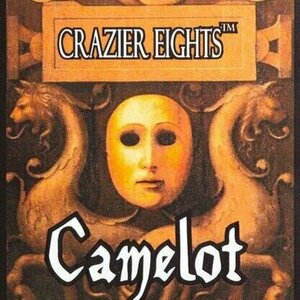

DISCLAIMER: We have previously reviewed Crazier Eights: Olympus and Crazier Eights: Pantheon, and this preview has much of the same verbiage as the family of games share most things. Near the end of the preview are my thoughts about the differences in Camelot vs Olympus and Pantheon.
War. Old Maid. Go Fish. Crazy Eights. These are classic card games we probably all grew up playing. There have been many re-themes and new difficulty layers spread upon them to make them even more interesting. While UNO certainly has cornered the market on the Crazy Eights base, we have a new contender: Crazier Eights. Recoculous has published several versions of this card game with different themes: Avalon, One Thousand & One Nights, Olympus, and Shahrzad. Today we are taking a preview of Crazier Eights: Camelot.
You HAVE played Crazy Eights right? The card game where you attempt to be the first to exhaust your hand of cards, but you can only play down if you can match the suit or number on top of the discard pile? And if you can’t, you throw down an 8 as a wild and call the color to be played next? Well there you have the easy rules. Crazier Eights: Camelot (which I will from here call C8C) holds basically the same rule-set with a few new mechanics and a theme. The win condition is still the same: be the first to exhaust your hand of cards, but to win you will need to play your hand strategically against your opponents.
DISCLAIMER: We were provided a copy of this game for the purposes of this review. This is a retail copy of the game, so what you see in these photos is exactly what would be received in your box. I do not intend to cover every single rule included in the rulebook, but will describe the overall game flow and major rule set so that our readers may get a sense of how the game plays. For more in depth rules, you may purchase a copy online or from your FLGS. -T
To setup, shuffle the large deck of cards and place the deck in the middle of the table. Flip the top card to begin the discard pile and dictate the first card play. Deal each player seven cards and you are ready to begin!
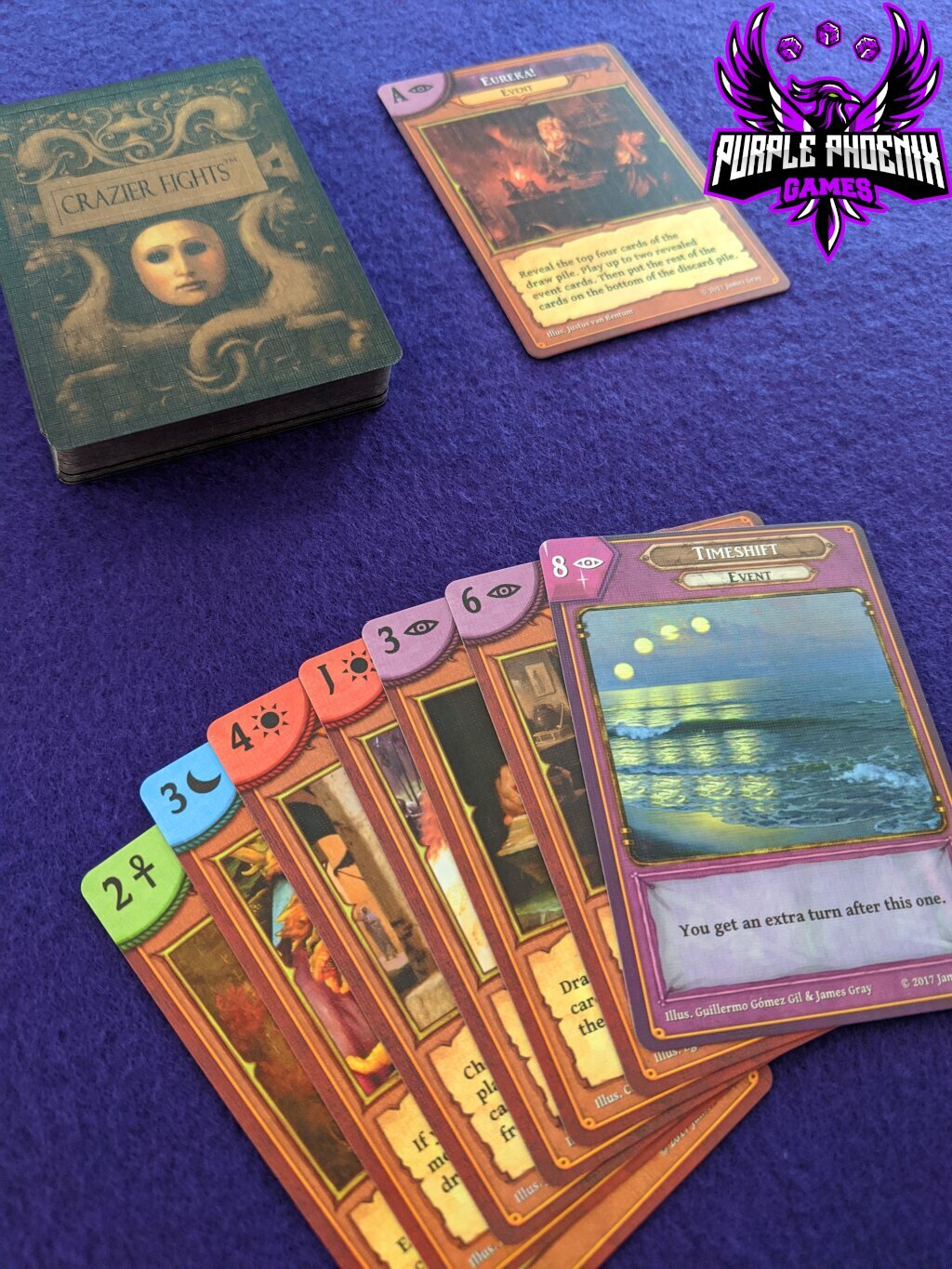
The turn structure is familiar: check for any “start of turn” effects and apply them, draw a card, play and/or discard a card, then resolve any “end of turn” effects. The deck is comprised of Events and Assets in different colors (suits) and numbers like in a typical deck of playing cards. After checking and resolving start of turn effects on Asset cards in your personal tableau, you must draw a card from the deck. This is where C8C strays from OG Crazy Eights a bit. You may play a card from your hand (Assets and Events) and discard a card to the discard pile (matching the suit/number/or an Eight), or simply play a card from your hand without discarding. Cards played from your hand can be Event cards that are played, resolved, and then discarded to the bottom of the discard pile, or an Asset card that is played to your tableau that cause chain reactions or other abilities on future turns. Next, resolve any end of turn effects from Assets in your tableau before the next player begins their turn.
Play continues in this fashion until one player has rid themselves of their hand and is crowned the Master of the Camelot! Or at least, the winner of the game.
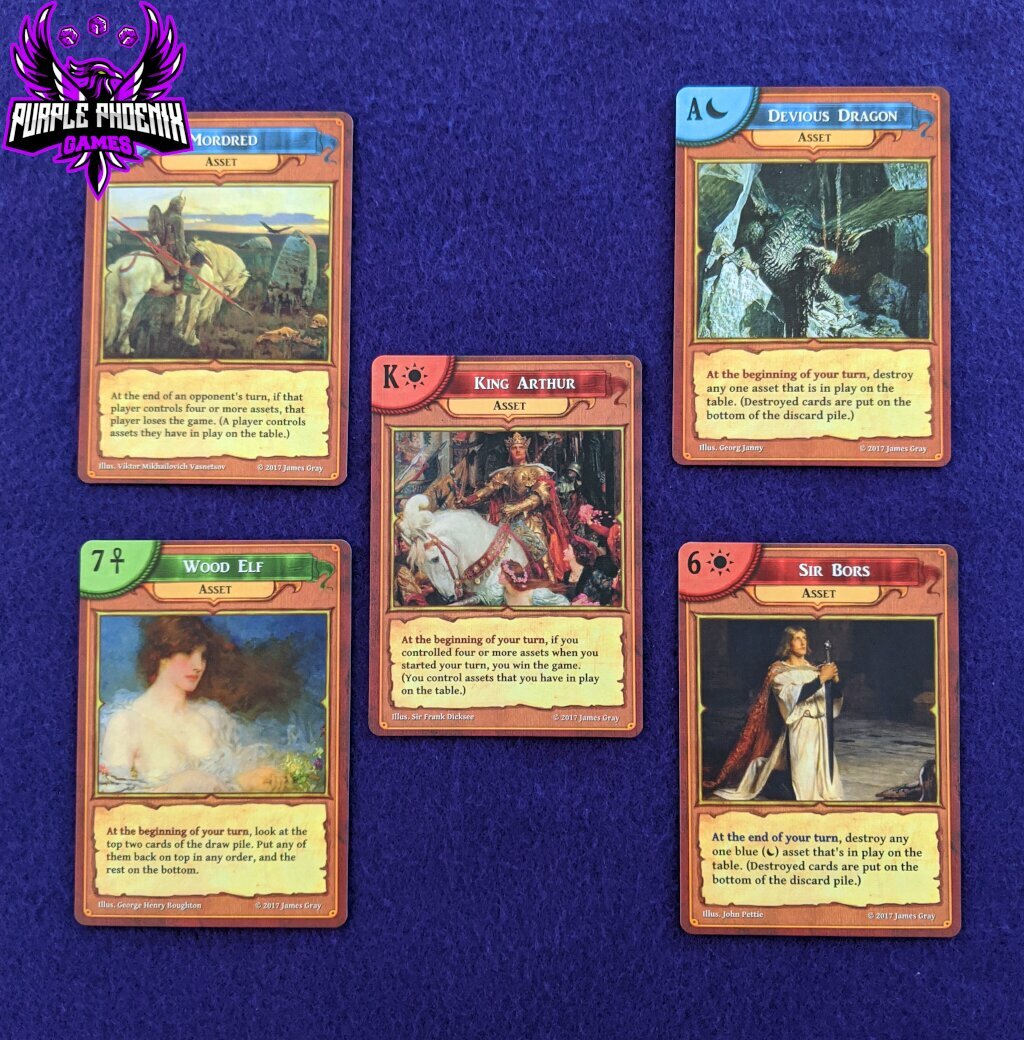
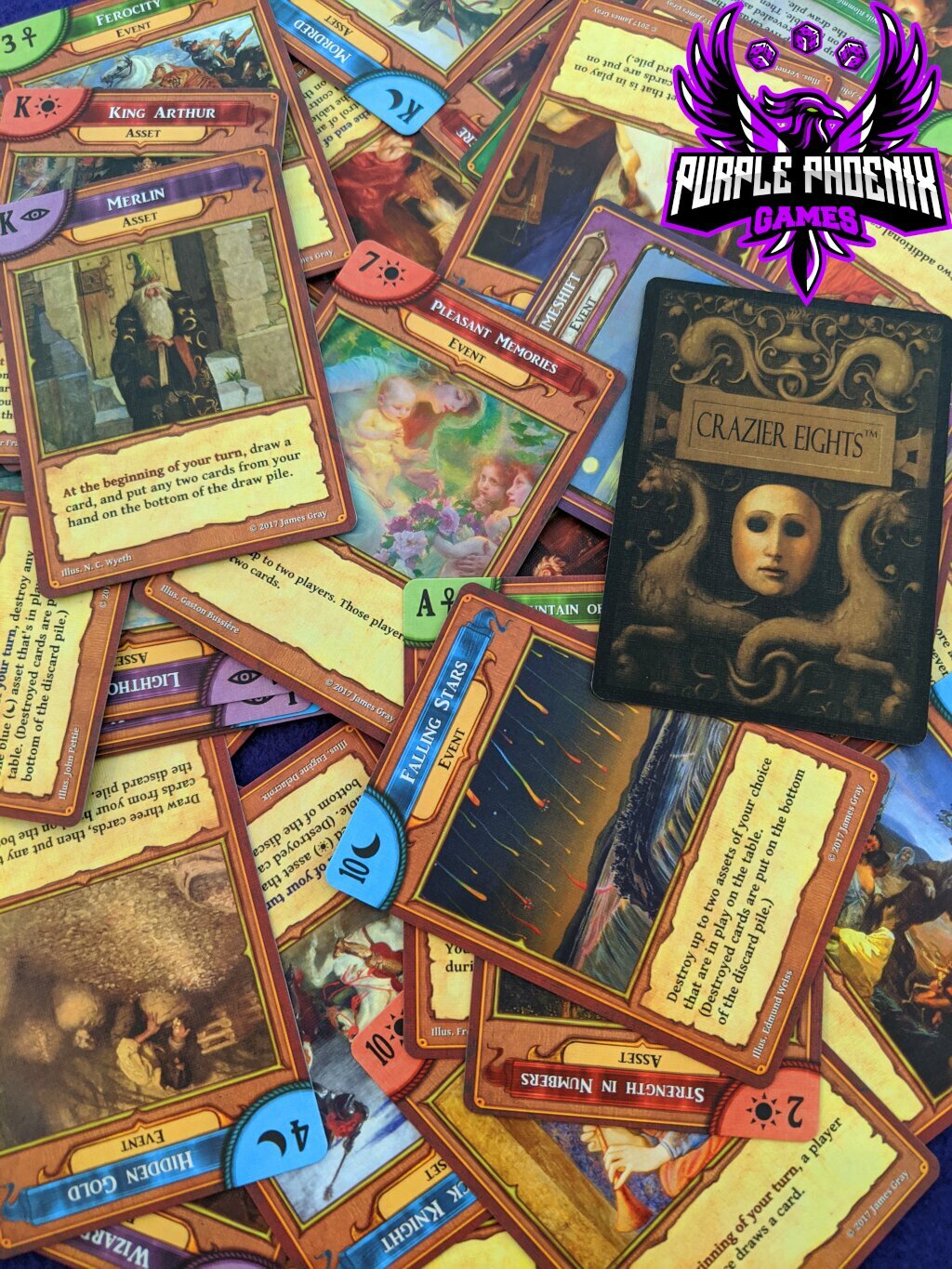
Components. This game is a box full of cards. The cards are good. The layout makes sense, and the art on the faces of the cards remind me of very classic art depicting ancient Arthurian scenes. I am no art historian, so I do not know if they are existing art pieces or new ones crafted for this game, but either way, they are a joy to behold… if you can spend the time appreciating the art instead of tracking what cards you need to play and what effects you can chain together (that was me). Extra points to the Recoculous team for associating symbols with the different suit colors for our colorblind friends. This is something that unfortunately goes unaddressed far too often.
This implementation is the third Crazier Eights we have had the chance to try, and I can say that we really enjoyed our plays of it (we played Olympus first and recently also reviewed Pantheon). The game comes with many interesting and varied effects to craft an ingenious strategy, and the art is stellar. Beware of playing with AP-prone gamers, as there is a lot going on and it is more than just a skinned Crazy Eights.
This Camelot set is slightly different than our previous experiences with both Olympus and Pantheon in a few ways. Firstly, it is more of a base game deck like Olympus instead of a standalone/expansion like Pantheon. Secondly, this set seems to use more cards that affect the assets of other players, specifically in destroying them. Additionally, I have noticed a few cards in the deck that specifically say if certain criteria are met one player automatically wins or loses the game. That’s it. Done-zo. Maybe I missed these cards in the other sets, but I do not remember them ever surfacing. Having each set focus on different aspects of the game and the manipulation of the rules ever so slightly to affect a player’s strategy from one set to the next is quite enchanting to me. Could you put all the sets together to make a massive meta-deck a la Munchkin with all the sets and expansions? Probably, but like Munchkin, I probably would rather keep them separate.
Now having played this family of games several times, I can say that it is my favorite Crazy Eights derivative and certainly worthy of a look. If your game collection is sorely lacking in Arthurian-themed card games, or if you want a hybrid game of old school rules with interesting twists, then do consider purchasing this or one of its predecessors.
PS – Don’t worry if, while you are playing, you have all your Assets stolen or destroyed. I have won the game with zero Assets in front of me while opponents have had eight, ironically. Assets are great, but you still need to shed your hand.
War. Old Maid. Go Fish. Crazy Eights. These are classic card games we probably all grew up playing. There have been many re-themes and new difficulty layers spread upon them to make them even more interesting. While UNO certainly has cornered the market on the Crazy Eights base, we have a new contender: Crazier Eights. Recoculous has published several versions of this card game with different themes: Avalon, One Thousand & One Nights, Olympus, and Shahrzad. Today we are taking a preview of Crazier Eights: Camelot.
You HAVE played Crazy Eights right? The card game where you attempt to be the first to exhaust your hand of cards, but you can only play down if you can match the suit or number on top of the discard pile? And if you can’t, you throw down an 8 as a wild and call the color to be played next? Well there you have the easy rules. Crazier Eights: Camelot (which I will from here call C8C) holds basically the same rule-set with a few new mechanics and a theme. The win condition is still the same: be the first to exhaust your hand of cards, but to win you will need to play your hand strategically against your opponents.
DISCLAIMER: We were provided a copy of this game for the purposes of this review. This is a retail copy of the game, so what you see in these photos is exactly what would be received in your box. I do not intend to cover every single rule included in the rulebook, but will describe the overall game flow and major rule set so that our readers may get a sense of how the game plays. For more in depth rules, you may purchase a copy online or from your FLGS. -T
To setup, shuffle the large deck of cards and place the deck in the middle of the table. Flip the top card to begin the discard pile and dictate the first card play. Deal each player seven cards and you are ready to begin!
The turn structure is familiar: check for any “start of turn” effects and apply them, draw a card, play and/or discard a card, then resolve any “end of turn” effects. The deck is comprised of Events and Assets in different colors (suits) and numbers like in a typical deck of playing cards. After checking and resolving start of turn effects on Asset cards in your personal tableau, you must draw a card from the deck. This is where C8C strays from OG Crazy Eights a bit. You may play a card from your hand (Assets and Events) and discard a card to the discard pile (matching the suit/number/or an Eight), or simply play a card from your hand without discarding. Cards played from your hand can be Event cards that are played, resolved, and then discarded to the bottom of the discard pile, or an Asset card that is played to your tableau that cause chain reactions or other abilities on future turns. Next, resolve any end of turn effects from Assets in your tableau before the next player begins their turn.
Play continues in this fashion until one player has rid themselves of their hand and is crowned the Master of the Camelot! Or at least, the winner of the game.
Components. This game is a box full of cards. The cards are good. The layout makes sense, and the art on the faces of the cards remind me of very classic art depicting ancient Arthurian scenes. I am no art historian, so I do not know if they are existing art pieces or new ones crafted for this game, but either way, they are a joy to behold… if you can spend the time appreciating the art instead of tracking what cards you need to play and what effects you can chain together (that was me). Extra points to the Recoculous team for associating symbols with the different suit colors for our colorblind friends. This is something that unfortunately goes unaddressed far too often.
This implementation is the third Crazier Eights we have had the chance to try, and I can say that we really enjoyed our plays of it (we played Olympus first and recently also reviewed Pantheon). The game comes with many interesting and varied effects to craft an ingenious strategy, and the art is stellar. Beware of playing with AP-prone gamers, as there is a lot going on and it is more than just a skinned Crazy Eights.
This Camelot set is slightly different than our previous experiences with both Olympus and Pantheon in a few ways. Firstly, it is more of a base game deck like Olympus instead of a standalone/expansion like Pantheon. Secondly, this set seems to use more cards that affect the assets of other players, specifically in destroying them. Additionally, I have noticed a few cards in the deck that specifically say if certain criteria are met one player automatically wins or loses the game. That’s it. Done-zo. Maybe I missed these cards in the other sets, but I do not remember them ever surfacing. Having each set focus on different aspects of the game and the manipulation of the rules ever so slightly to affect a player’s strategy from one set to the next is quite enchanting to me. Could you put all the sets together to make a massive meta-deck a la Munchkin with all the sets and expansions? Probably, but like Munchkin, I probably would rather keep them separate.
Now having played this family of games several times, I can say that it is my favorite Crazy Eights derivative and certainly worthy of a look. If your game collection is sorely lacking in Arthurian-themed card games, or if you want a hybrid game of old school rules with interesting twists, then do consider purchasing this or one of its predecessors.
PS – Don’t worry if, while you are playing, you have all your Assets stolen or destroyed. I have won the game with zero Assets in front of me while opponents have had eight, ironically. Assets are great, but you still need to shed your hand.
graveyardgremlin (7194 KP) rated The Taken (Celestial Blues, #1) in Books
Feb 15, 2019


Even though I'm not especially fond of angels, I decided to try out this new series based on my previous experiences with Vicki Pettersson's work. Sadly, after an intriguing first chapter, any enjoyment I may have expected never came knocking (guess it was too busy knockin' on heaven's door).
Meet one of the two main characters, rockabilly girl Katherine "Kit" Craig. She's an eternally optimistic and peppy reporter whose best friend and co-worker, Nicole, was just murdered while following a lead. Our other MC is a haunted Centurion angel named Griffin Shaw who ushers the newly murdered into the afterlife, otherwise known as the Everlast, while bemoaning the murders of both himself and his wife Evie back in 1960. After making a mistake concerning Nicole, he's been sent back to earth as a human with some angelic senses still intact. Kit and Grif soon meet up and begin investigating the circumstances around Nicole's death, whilst Griffin seeks out any details involving his own.
Problem Number One:
The Cardboard Characters
Character development is supposed to unfold over the course of a book, in this case it actually appeared to deteriorate as the book went on. Kit never developed into anything but one of those annoyingly chipper people you just want to hit with a sledgehammer, while Grif started promisingly enough but then stagnated. They were both very shallow characterizations, and on top of that, I never understood Kit's actions or reactions to just about anything. I never felt her sadness about her best friend's death, whom she rarely gave a passing thought, believed she was smart (by the end, I thought her a dolt), or seem in any way human with nary a rational thought in her head. About mid-way through the book, Grif tells her he's an angel after they kiss, so what does she do? Does she a) run away screaming, b) think he's a few feathers short of a goose and tell him to get hell out of her house and life, or c) have a calm Q&A session followed by giving him a whatfor that consists of "I won't kiss you again" and "you're watching me walk out that door (in her own house) because you can't handle any emotion blah, blah, blah by pretending you're an angel" and then proceed to attend a charity event wherein she acts and converses normally, like nothing happened? If you picked "c" *ding ding ding*, you're a winner! Because as we all know, any sensible guy will pull out the "I'm an angel" trick and expect a woman to believe him. *rolls eyes* Never was it ever crystal clear if Kit thought Grif was either crazy or a liar. It was all a bit hazy, but what can you expect from someone we're never allowed to know? All we discern is she dresses and lives (somewhat) rockabilly, but it's all a veneer to her hollowness inside, which led me to dub her Rockabilly Barbie.
<img src="http://i272.photobucket.com/albums/jj183/piscesrain/reviews/RockabillyBarbie.jpg">;
Because that's all she is and nothing more. The only character that I found a little more well-rounded was the secondary character Bridget Moore and the two Centurions introduced close to the end. Everyone else was either forgettably two-dimensional or they were a caricature, a la Caleb Chambers and Paul Raggio.
Problem Number Two:
The Relationship(s)
I'm expected to believe in a possible relationship between Grif and Rockabilly Barbie, err I mean Kit, but there's not much there to believe in. Like the characters, it was shallow with the same descriptions reiterated over and over again. Basically it's a case of telling instead of showing. I felt no love, maybe some attraction, but that's all she wrote. Likewise I never bought that Kit and Paul could ever have gotten far enough to be married, they were just too different. Most people don't do a 180 after they get married, the seed of who Paul really was deep down inside would have already been there and if Kit was even a fraction astute, she should have caught that. All this served was to be a plot point in the book.
Problem Number Three:
The Plot(s)
The main plot involving Nicole's death and Chambers had a "been there, done that" quality to it. The plot didn't shock me or seem like anything new, I've come across the same before or at least plots that were very close, and it wasn't even told in a fresh way. So I wasn't as affected by anything in the book as I probably should have been, partially due to the indifference I felt and the fact that I figured out everything long before the author dropped, what I guess she thought, were informational bombshells.
The book had three major plotlines: Grif and Evie's deaths, Nicole's death/prostitution ring, and Grif and the Pure Anas' philosophical moments. They weren't juggled well at all. Ms. Pettersson should have picked only one and paid more attention to developing that specific plot and the characters. The scenes with Anas (or Anne) especially didn't mesh with the other stories and felt as if the author was overreaching the boundaries set up by the book. One scene in particular was extremely bizarre and pointless to the book as a whole.
Where was the noir? I've seen enough film noirs to know it ain't here.
Problem Number Four:
The Ending
What happened at the end is what I'd expect in a book that's exclusively romance and not in a mystery/urban fantasy hybrid, which made the rushed ending seem even more ridiculous and sappy. It was incredibly unbelievable to the story and didn't seem to set up the next book in any way. Also, one of the plotlines was all but left dangling with no foreshadowing or anything. Poor, poor, poor execution. Don't expound on a storyline if you're not going to finish it up or at least leave it dangling in a way that makes the reader want to come back. All that boring set-up for a completely stupid and cheesy ending. I expected rainbows and unicorns to pop out at any moment.
Overall the book felt more like a rough copy than a finished one and definitely could have used a few more goings over. Several descriptions were rushed and chaotic or simply poorly done so that I was scrambling to picture what was going on. The book is almost 400 pages and it is simply too long. With so many storylines, I'm not sure how they managed to both crawl and have very little action at the same time. I was going to give this two stars because I didn't hate the book, that would imply that it elicited any feelings what-so-ever, but the truth of the matter is that there isn't one thing I really liked about the book either. The only way I'd read a sequel to the bafflingly-named Celestial Blues series is if it featured different leads like the aforementioned Centurions, and even then I'd cautiously dip my toes into the book.
Originally reviewed: June 29
Received: Amazon Vine
Meet one of the two main characters, rockabilly girl Katherine "Kit" Craig. She's an eternally optimistic and peppy reporter whose best friend and co-worker, Nicole, was just murdered while following a lead. Our other MC is a haunted Centurion angel named Griffin Shaw who ushers the newly murdered into the afterlife, otherwise known as the Everlast, while bemoaning the murders of both himself and his wife Evie back in 1960. After making a mistake concerning Nicole, he's been sent back to earth as a human with some angelic senses still intact. Kit and Grif soon meet up and begin investigating the circumstances around Nicole's death, whilst Griffin seeks out any details involving his own.
Problem Number One:
The Cardboard Characters
Character development is supposed to unfold over the course of a book, in this case it actually appeared to deteriorate as the book went on. Kit never developed into anything but one of those annoyingly chipper people you just want to hit with a sledgehammer, while Grif started promisingly enough but then stagnated. They were both very shallow characterizations, and on top of that, I never understood Kit's actions or reactions to just about anything. I never felt her sadness about her best friend's death, whom she rarely gave a passing thought, believed she was smart (by the end, I thought her a dolt), or seem in any way human with nary a rational thought in her head. About mid-way through the book, Grif tells her he's an angel after they kiss, so what does she do? Does she a) run away screaming, b) think he's a few feathers short of a goose and tell him to get hell out of her house and life, or c) have a calm Q&A session followed by giving him a whatfor that consists of "I won't kiss you again" and "you're watching me walk out that door (in her own house) because you can't handle any emotion blah, blah, blah by pretending you're an angel" and then proceed to attend a charity event wherein she acts and converses normally, like nothing happened? If you picked "c" *ding ding ding*, you're a winner! Because as we all know, any sensible guy will pull out the "I'm an angel" trick and expect a woman to believe him. *rolls eyes* Never was it ever crystal clear if Kit thought Grif was either crazy or a liar. It was all a bit hazy, but what can you expect from someone we're never allowed to know? All we discern is she dresses and lives (somewhat) rockabilly, but it's all a veneer to her hollowness inside, which led me to dub her Rockabilly Barbie.
<img src="http://i272.photobucket.com/albums/jj183/piscesrain/reviews/RockabillyBarbie.jpg">;
Because that's all she is and nothing more. The only character that I found a little more well-rounded was the secondary character Bridget Moore and the two Centurions introduced close to the end. Everyone else was either forgettably two-dimensional or they were a caricature, a la Caleb Chambers and Paul Raggio.
Problem Number Two:
The Relationship(s)
I'm expected to believe in a possible relationship between Grif and Rockabilly Barbie, err I mean Kit, but there's not much there to believe in. Like the characters, it was shallow with the same descriptions reiterated over and over again. Basically it's a case of telling instead of showing. I felt no love, maybe some attraction, but that's all she wrote. Likewise I never bought that Kit and Paul could ever have gotten far enough to be married, they were just too different. Most people don't do a 180 after they get married, the seed of who Paul really was deep down inside would have already been there and if Kit was even a fraction astute, she should have caught that. All this served was to be a plot point in the book.
Problem Number Three:
The Plot(s)
The main plot involving Nicole's death and Chambers had a "been there, done that" quality to it. The plot didn't shock me or seem like anything new, I've come across the same before or at least plots that were very close, and it wasn't even told in a fresh way. So I wasn't as affected by anything in the book as I probably should have been, partially due to the indifference I felt and the fact that I figured out everything long before the author dropped, what I guess she thought, were informational bombshells.
The book had three major plotlines: Grif and Evie's deaths, Nicole's death/prostitution ring, and Grif and the Pure Anas' philosophical moments. They weren't juggled well at all. Ms. Pettersson should have picked only one and paid more attention to developing that specific plot and the characters. The scenes with Anas (or Anne) especially didn't mesh with the other stories and felt as if the author was overreaching the boundaries set up by the book. One scene in particular was extremely bizarre and pointless to the book as a whole.
Where was the noir? I've seen enough film noirs to know it ain't here.
Problem Number Four:
The Ending
What happened at the end is what I'd expect in a book that's exclusively romance and not in a mystery/urban fantasy hybrid, which made the rushed ending seem even more ridiculous and sappy. It was incredibly unbelievable to the story and didn't seem to set up the next book in any way. Also, one of the plotlines was all but left dangling with no foreshadowing or anything. Poor, poor, poor execution. Don't expound on a storyline if you're not going to finish it up or at least leave it dangling in a way that makes the reader want to come back. All that boring set-up for a completely stupid and cheesy ending. I expected rainbows and unicorns to pop out at any moment.
Overall the book felt more like a rough copy than a finished one and definitely could have used a few more goings over. Several descriptions were rushed and chaotic or simply poorly done so that I was scrambling to picture what was going on. The book is almost 400 pages and it is simply too long. With so many storylines, I'm not sure how they managed to both crawl and have very little action at the same time. I was going to give this two stars because I didn't hate the book, that would imply that it elicited any feelings what-so-ever, but the truth of the matter is that there isn't one thing I really liked about the book either. The only way I'd read a sequel to the bafflingly-named Celestial Blues series is if it featured different leads like the aforementioned Centurions, and even then I'd cautiously dip my toes into the book.
Originally reviewed: June 29
Received: Amazon Vine
Kirk Bage (1775 KP) rated The Mandalorian in TV
Jan 22, 2021 (Updated Jan 22, 2021)

Being a child of Star Wars, born in ’73, whose first memory of a cinema was A New Hope in ’77, of course the entire franchise is still close to my heart. I am no superfan, however. I do not need to remember every name of every character, or know the obscure names of planets to enjoy it. I remember that deeply competitive nature back in the playground – how important it was to prove Star Wars was yours by knowing more than any other kid! Fortunately I managed to let that go shortly after The Return of the Jedi. Ok, maybe 1995.
The Mandalorian is definitely for all Star Wars fans, but it is mostly for the kids that never grew up and need those details of “the canonical Star Wars” universe in their lives. And there are plenty of them. It is a geek’s wet dream! With chat rooms and fan sites going wild in debate and argument over the smallest of Easter eggs and hints to connections across the medium. As if this is a lost historical document that sheds light on the truth of many characters and events, that until now were shrouded in darkness and speculation only.
I find that phenomenon weird and a little creepy, but I do appreciate where it comes from. For me, I am merely glad it isn’t crap. It is nice to be in the Star Wars universe without holding your face in your hands for shame of lazy storytelling and moments that shit on the spirit of the original trilogy. The first thing that pleased me about The Mandolorian is how close it is in feel to the old school trilogy. In fact it surprised me, because, despite the very modern effects and full budget of Disney behind it, it feels very old fashioned, like a TV show from around 1986, maybe. And I wonder how they have achieved that every time I watch it. It has an intangible magic about it.
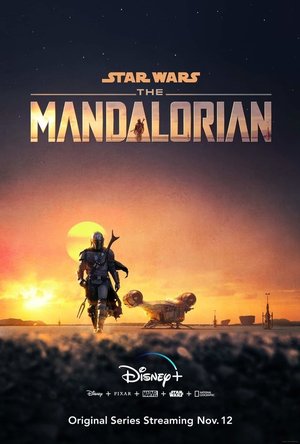
In fact, the feel of the show as a whole is often a little cheap, shockingly – the posters and toys and all associated media is as glossy and crisp as all money can afford, creating an image of the show that isn’t actually what the show is. In reality it is a cross between old spaghetti westerns, with The Mandalorian cast as The Man With No Name, and episodes of The A-Team or Knightrider. I kinda like it; very nostalgic, and a smart move by Jon Favreau and the other show-runners. It appeals to middle aged audiences and new alike, because it is a knowing hybrid of all things cool and nerdy!
Design-wise, the look of The Mandalorian himself is perfect fan bait and very cool. The music goes a long way to drawing you in – Ludwig Göransson, known for his work on Black Panther and Tenet, has hit on a career defining theme that blends Clint Eastwood and Star Wars in perfect harmony. I can’t imagine the show working half as well without that theme music! The spaceships and detail of every alien and weapon and costume is meticulous (if at times a little wobbly or cheap looking), and the wider feel of background and tertiary characters is pretty damn good.
But, let’s face it… The Mandalorian is the success it has been predominantly for one reason. I could give him his real name, but if you haven’t finished it yet that would count as a huge spoiler, so I will refer to him as The Child. The temptation to use the phrase Baby Yoda is hard to resist, and has been a cultural phenomenon that only comes along once or twice in a decade, but on this I agree with the fans: it is inaccurate and misleading. The Child is fine. It’ll do until you learn his true moniker.
In season one, where the build up of story, character and mystery is superb, we see very little of The Child at first. But we cannot take our eyes off him for every second he is on screen. The whole concept is so beyond cute and incredibly strong as a hook for a Star Wars story it is almost impossible not to squeal out loud at everything he does. Who is he? Why is he? What is he capable of? How will he fit in to the longterm idea for the story? So exciting, and total genius to keep everyone watching.
It isn’t all about The Child on his own though. It is about the unlikely symbiotic bond, like father and son, that develops between the tiny, vulnerable and childlike focal point, and the increasingly confident and loyal antihero, who will stop at nothing to protect his ward, as he struggles to find his own place in the universe. After a very short time, we care more about this relationship than 90% of all romances in all of TV history.
Through danger, mayhem and a touch of comedy, we grow to adore the two of them together, and can’t bear to think of them being apart. Some trick when you realise The Child is as much a mini-muppet style prosthetic as it is added CGI for expression and detail. Perhaps another callback to our 80s sensibilities, when we accepted ETs and Gremlins and all of the residents of Mos Eisley’s cantina as real without hesitation. It doesn’t have to look real, is the point, as long as it fits the story, is cool and is fun! Which The Child totally is – for entertainment value they have got the tone of the show so right.
What doesn’t hold up that strongly to critical scrutiny though is quite a lot of the scripts, the repetitive nature of the context of many episodes and missions the duo find themselves on, the mismatch quality of the guest directors abilities, and quite a lot of the dodgy acting by supporting characters. It’s as if at some production meeting at one early point they all said, look it’s Star Wars, we make the aliens and the spaceships and the weapons look good and we can’t fail… plus we have The Child and Boba Fett’s (yes, I know) armour, we can’t fail!
The basic storyline is enough to hook it on, just about, it is the detail that sometimes feels weak and lazy. But don’t worry, any minute something cool to look at and a big fight will happen, so we’re all good! I’m sure Pedro Pascal (the actor under the armour) can’t believe his luck! He is one of the biggest stars in TV all of a sudden, for basically doing a fairly monotone voice-over performance of some seriously dodgy dialogue. That is the magic of Star Wars.
So, I came to season one late, having no access at that time to Disney plus. In fact, I watched all of season one in a day the day before the launch of season two, so the switch to a new episode to look forward to suited me well. It gave me something to look forward to on a Friday between Halloween and Christmas. Trouble was that, although still having fun with the exploits of The Kid, I was starting to weary of the plotlines, and put my viewing on hold after S2E4 in favour of the far superior scripting of His Dark Materials on BBC.
I must have needed the hiatus, because when I came back to mop it up and finish season two a few days ago I realised that I had in fact missed it. It also helped that episode 5 onwards is when the season gets really good again. Rosario Dawson as Ashoka Tano (known well by fans of The Clone Wars) was a truly great addition that the show much needed by that point.
I had no trouble after that in bingeing to the end. You could feel a climax and a revelation coming, and although the character of Moff Gideon (Giancarlo Esposito) crumbled disappointly away into nothing much, the last 15 minutes of the final episode had me slack jawed in fan wonderment. I felt 9 years old again, and I loved it! I had been amazingly lucky not to stumble upon spoilers, I guess. Amazing ending, and all faults forgiven for that unforgettable moment and feel. Wonderful stuff!
To say any more, again, is to spoil. So, let’s just talk about it privately, or, you know, in about a year when season 3 is over and it is old news. Hmmm, season 3…? I wonder where they will take that now…? Actually, properly exciting, in a back in the playground kind of way.
The Mandalorian is definitely for all Star Wars fans, but it is mostly for the kids that never grew up and need those details of “the canonical Star Wars” universe in their lives. And there are plenty of them. It is a geek’s wet dream! With chat rooms and fan sites going wild in debate and argument over the smallest of Easter eggs and hints to connections across the medium. As if this is a lost historical document that sheds light on the truth of many characters and events, that until now were shrouded in darkness and speculation only.
I find that phenomenon weird and a little creepy, but I do appreciate where it comes from. For me, I am merely glad it isn’t crap. It is nice to be in the Star Wars universe without holding your face in your hands for shame of lazy storytelling and moments that shit on the spirit of the original trilogy. The first thing that pleased me about The Mandolorian is how close it is in feel to the old school trilogy. In fact it surprised me, because, despite the very modern effects and full budget of Disney behind it, it feels very old fashioned, like a TV show from around 1986, maybe. And I wonder how they have achieved that every time I watch it. It has an intangible magic about it.
In fact, the feel of the show as a whole is often a little cheap, shockingly – the posters and toys and all associated media is as glossy and crisp as all money can afford, creating an image of the show that isn’t actually what the show is. In reality it is a cross between old spaghetti westerns, with The Mandalorian cast as The Man With No Name, and episodes of The A-Team or Knightrider. I kinda like it; very nostalgic, and a smart move by Jon Favreau and the other show-runners. It appeals to middle aged audiences and new alike, because it is a knowing hybrid of all things cool and nerdy!
Design-wise, the look of The Mandalorian himself is perfect fan bait and very cool. The music goes a long way to drawing you in – Ludwig Göransson, known for his work on Black Panther and Tenet, has hit on a career defining theme that blends Clint Eastwood and Star Wars in perfect harmony. I can’t imagine the show working half as well without that theme music! The spaceships and detail of every alien and weapon and costume is meticulous (if at times a little wobbly or cheap looking), and the wider feel of background and tertiary characters is pretty damn good.
But, let’s face it… The Mandalorian is the success it has been predominantly for one reason. I could give him his real name, but if you haven’t finished it yet that would count as a huge spoiler, so I will refer to him as The Child. The temptation to use the phrase Baby Yoda is hard to resist, and has been a cultural phenomenon that only comes along once or twice in a decade, but on this I agree with the fans: it is inaccurate and misleading. The Child is fine. It’ll do until you learn his true moniker.
In season one, where the build up of story, character and mystery is superb, we see very little of The Child at first. But we cannot take our eyes off him for every second he is on screen. The whole concept is so beyond cute and incredibly strong as a hook for a Star Wars story it is almost impossible not to squeal out loud at everything he does. Who is he? Why is he? What is he capable of? How will he fit in to the longterm idea for the story? So exciting, and total genius to keep everyone watching.
It isn’t all about The Child on his own though. It is about the unlikely symbiotic bond, like father and son, that develops between the tiny, vulnerable and childlike focal point, and the increasingly confident and loyal antihero, who will stop at nothing to protect his ward, as he struggles to find his own place in the universe. After a very short time, we care more about this relationship than 90% of all romances in all of TV history.
Through danger, mayhem and a touch of comedy, we grow to adore the two of them together, and can’t bear to think of them being apart. Some trick when you realise The Child is as much a mini-muppet style prosthetic as it is added CGI for expression and detail. Perhaps another callback to our 80s sensibilities, when we accepted ETs and Gremlins and all of the residents of Mos Eisley’s cantina as real without hesitation. It doesn’t have to look real, is the point, as long as it fits the story, is cool and is fun! Which The Child totally is – for entertainment value they have got the tone of the show so right.
What doesn’t hold up that strongly to critical scrutiny though is quite a lot of the scripts, the repetitive nature of the context of many episodes and missions the duo find themselves on, the mismatch quality of the guest directors abilities, and quite a lot of the dodgy acting by supporting characters. It’s as if at some production meeting at one early point they all said, look it’s Star Wars, we make the aliens and the spaceships and the weapons look good and we can’t fail… plus we have The Child and Boba Fett’s (yes, I know) armour, we can’t fail!
The basic storyline is enough to hook it on, just about, it is the detail that sometimes feels weak and lazy. But don’t worry, any minute something cool to look at and a big fight will happen, so we’re all good! I’m sure Pedro Pascal (the actor under the armour) can’t believe his luck! He is one of the biggest stars in TV all of a sudden, for basically doing a fairly monotone voice-over performance of some seriously dodgy dialogue. That is the magic of Star Wars.
So, I came to season one late, having no access at that time to Disney plus. In fact, I watched all of season one in a day the day before the launch of season two, so the switch to a new episode to look forward to suited me well. It gave me something to look forward to on a Friday between Halloween and Christmas. Trouble was that, although still having fun with the exploits of The Kid, I was starting to weary of the plotlines, and put my viewing on hold after S2E4 in favour of the far superior scripting of His Dark Materials on BBC.
I must have needed the hiatus, because when I came back to mop it up and finish season two a few days ago I realised that I had in fact missed it. It also helped that episode 5 onwards is when the season gets really good again. Rosario Dawson as Ashoka Tano (known well by fans of The Clone Wars) was a truly great addition that the show much needed by that point.
I had no trouble after that in bingeing to the end. You could feel a climax and a revelation coming, and although the character of Moff Gideon (Giancarlo Esposito) crumbled disappointly away into nothing much, the last 15 minutes of the final episode had me slack jawed in fan wonderment. I felt 9 years old again, and I loved it! I had been amazingly lucky not to stumble upon spoilers, I guess. Amazing ending, and all faults forgiven for that unforgettable moment and feel. Wonderful stuff!
To say any more, again, is to spoil. So, let’s just talk about it privately, or, you know, in about a year when season 3 is over and it is old news. Hmmm, season 3…? I wonder where they will take that now…? Actually, properly exciting, in a back in the playground kind of way.