
Search
Search results

Gareth von Kallenbach (980 KP) rated Snow White and the Huntsman (2012) in Movies
Aug 7, 2019
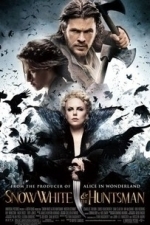

It is easy to be cynical or dismissive regarding the trend in Hollywood to take up beloved gems of the past – namely our childhoods – and adapt them to the big screen with all of the flare and clichés of a summer blockbuster. Yet, what happens when it actually ends up winning you over? There’s a moment in movies like “Snow White and the Huntsman” in which you realize you have let go of those prejudices and notions of incorruptible nostalgia and you’ve actually started to enjoy a new rendition of something old. It’s the directorial debut for the film’s helmer, Rupert Sanders; and to be honest he’s the star of the show. As shallow as it is to say, the visual effects and action overshadow most flaws with characters, acting, or uneven pacing. Not only because his directing ability is well done, but because any flaws with the movie are relatively minor.
The movie retells the familiar story of Snow White (Kristen Stewart), likely popularized by Disney’s adaptation for most of us. Yet, the film takes more influence from the original fairy tale with the additional focus on the Huntsman (Chris Hemsworth). Snow White grows up in a kingdom under the rule of her wicked step-mother, Queen Ravenna (Charlize Theron). The Queen is a narcissistic tyrant obsessed with preserving her physical beauty – at the behest of the entire land and its people. One day, the Queen’s mirror warns that Snow White is fairer than her which leads her to order Snow White’s death. Snow White escapes, and goes on an adventure to save herself and her kingdom with the help of the Huntsman, seven dwarves, and other fantastical allies.
The movie’s framework holds up fairly well. To be honest it was my biggest worry going into the movie – that its plot would break under bloating or simply feeling uninspired. Neither was the case, yet if it were to tip in one side or the other it definitely tips in the direction of a bloated plot. Some characters simply do not get the screentime they require, and with so many characters already it feels like some of them could have been taken out entirely without much effect. Trimming down of characters and irrelevant plot threads could have benefitted the movie greatly. It does, however, do a serviceable job establishing its own identity among fantasy epics. It’s refreshing to see a movie fully embrace two extremes – full-on hard fantasy and the more gritty, realistic and perhaps minimalist fantasy. It strikes a balance with both, so you will see great effects for trolls and fairies while still maintaining a gothic medieval feel. The plot moves forward at a mostly well-paced format, but unfortunately wavers here and there. Sometimes I wished the movie would linger on certain scenes longer – as it can help to have us dwell on great character moments or moments of visual beauty – an unfortunate side effect of a bloated script. While not a problem for the overall plot, the uneven pacing in some scenes can feel a bit rushed. Some questions in the plot went unanswered, but fortunately they aren’t important to the overall understanding of the story.
The only other major issue with the movie is acting. Kristen Stewart as Snow White was an odd choice. Not to say her performance is bad in this film, but it is awkward at points. In some moments she does very well but in others she seems uninspired. It is hard to see her as the titular character instead of just Kristen Stewart in those instances; and in those scenes it feels like she’s as much part of the audience as we are – just with more of a one-note “concerned” facial expression for every instance. While not a breaking element, it leaves more to be desired from her, especially in interactions with others. Chris Hemsworth was much more enjoyable as the Huntsman, and honestly I think his performance along with Theron’s far outbalance any flaws in Kristen Stewart’s acting. The chemistry between the two protagonists seems one sided, as Chris Hemsworth acts well on his side of the equation, but Stewart unfortunately does not reciprocate. Essentially this makes a potential major relationship fall flat. However, Theron completely inhibits the role as the evil Queen. While she may overact in some scenes, she does an excellent job playing a sinister, abusive, powerful and surprisingly tragic villain.
The highlight of the movie is definitely its visual design, cinematography, and action. The only downside in this area is that this movie will definitely remind you of other great movies from long ago. Obvious inspiration from “The Lord of the Rings” echoes while watching, as it even features the same faraway montage shots of the group traversing grand vistas. If you can get passed these obvious influences, it does establish a vibrant and inspired design. That is one of the greatest aspects of the movie – the fact that the director can do so much in a single scene to really draw you in. He does an excellent job using color and pattern contrasts to a striking and awesome effect. There are some great moments that have no action yet are just as enthralling to watch, something difficult to do with just visual style. A great use of color really brings out the themes of the movie – the grey monotones and gothic style bring out a sense of dread and annihilation throughout the Queen’s empire. She truly is a force of parasitism – entirely vampiric in the way she sucks the life out of the entire land around her. She is the embodiment of self-obsession with physical beauty – a force so vain and narcissistic that she acts as a black hole absorbing all beauty around her. Sanders plays this against the vibrant designs of the forest in which Snow White spends most of her time. Alive, colorful, and natural – she embodies natural beauty – and in doing so she seemingly commands nature itself.
Sanders’ directing ability really shines in scenes of action. Instead of lazy overuse of “shaky-cam” to get the effect, he balances it with just enough on-screen choreography so you get intensity without confusion. The movie is truly action packed with familiar medieval-esque battles throughout, but highlighted by truly amazing shots of action and use of fantastical effects. There were a couple instances of eye-rolling wonder at battlefield tactics, but that gets into too much of an area of nitpicking. The action really is one of the best aspects of the movie, and these scenes by themselves outweigh many already mentioned issues.
Overall, “Snow White and the Huntsman” has proven to be a great initial outing for director Rupert Sanders. There are some issues in the flick – namely some instances of uneven pacing and acting issues which leaves some potential to be desired. But even these seemingly huge issues are overshadowed by an excellent use of visual design, cinematography, and action. The plot may be merely serviceable overall, and the movie will remind you of great films long past; yet it still happens to triumph in its main goal – to retell the classic fairly tale of Snow White in the modern Blockbuster sense. In a summer packed with science fiction and superheroes, an entertaining fantasy movie fits in quite nicely.
The movie retells the familiar story of Snow White (Kristen Stewart), likely popularized by Disney’s adaptation for most of us. Yet, the film takes more influence from the original fairy tale with the additional focus on the Huntsman (Chris Hemsworth). Snow White grows up in a kingdom under the rule of her wicked step-mother, Queen Ravenna (Charlize Theron). The Queen is a narcissistic tyrant obsessed with preserving her physical beauty – at the behest of the entire land and its people. One day, the Queen’s mirror warns that Snow White is fairer than her which leads her to order Snow White’s death. Snow White escapes, and goes on an adventure to save herself and her kingdom with the help of the Huntsman, seven dwarves, and other fantastical allies.
The movie’s framework holds up fairly well. To be honest it was my biggest worry going into the movie – that its plot would break under bloating or simply feeling uninspired. Neither was the case, yet if it were to tip in one side or the other it definitely tips in the direction of a bloated plot. Some characters simply do not get the screentime they require, and with so many characters already it feels like some of them could have been taken out entirely without much effect. Trimming down of characters and irrelevant plot threads could have benefitted the movie greatly. It does, however, do a serviceable job establishing its own identity among fantasy epics. It’s refreshing to see a movie fully embrace two extremes – full-on hard fantasy and the more gritty, realistic and perhaps minimalist fantasy. It strikes a balance with both, so you will see great effects for trolls and fairies while still maintaining a gothic medieval feel. The plot moves forward at a mostly well-paced format, but unfortunately wavers here and there. Sometimes I wished the movie would linger on certain scenes longer – as it can help to have us dwell on great character moments or moments of visual beauty – an unfortunate side effect of a bloated script. While not a problem for the overall plot, the uneven pacing in some scenes can feel a bit rushed. Some questions in the plot went unanswered, but fortunately they aren’t important to the overall understanding of the story.
The only other major issue with the movie is acting. Kristen Stewart as Snow White was an odd choice. Not to say her performance is bad in this film, but it is awkward at points. In some moments she does very well but in others she seems uninspired. It is hard to see her as the titular character instead of just Kristen Stewart in those instances; and in those scenes it feels like she’s as much part of the audience as we are – just with more of a one-note “concerned” facial expression for every instance. While not a breaking element, it leaves more to be desired from her, especially in interactions with others. Chris Hemsworth was much more enjoyable as the Huntsman, and honestly I think his performance along with Theron’s far outbalance any flaws in Kristen Stewart’s acting. The chemistry between the two protagonists seems one sided, as Chris Hemsworth acts well on his side of the equation, but Stewart unfortunately does not reciprocate. Essentially this makes a potential major relationship fall flat. However, Theron completely inhibits the role as the evil Queen. While she may overact in some scenes, she does an excellent job playing a sinister, abusive, powerful and surprisingly tragic villain.
The highlight of the movie is definitely its visual design, cinematography, and action. The only downside in this area is that this movie will definitely remind you of other great movies from long ago. Obvious inspiration from “The Lord of the Rings” echoes while watching, as it even features the same faraway montage shots of the group traversing grand vistas. If you can get passed these obvious influences, it does establish a vibrant and inspired design. That is one of the greatest aspects of the movie – the fact that the director can do so much in a single scene to really draw you in. He does an excellent job using color and pattern contrasts to a striking and awesome effect. There are some great moments that have no action yet are just as enthralling to watch, something difficult to do with just visual style. A great use of color really brings out the themes of the movie – the grey monotones and gothic style bring out a sense of dread and annihilation throughout the Queen’s empire. She truly is a force of parasitism – entirely vampiric in the way she sucks the life out of the entire land around her. She is the embodiment of self-obsession with physical beauty – a force so vain and narcissistic that she acts as a black hole absorbing all beauty around her. Sanders plays this against the vibrant designs of the forest in which Snow White spends most of her time. Alive, colorful, and natural – she embodies natural beauty – and in doing so she seemingly commands nature itself.
Sanders’ directing ability really shines in scenes of action. Instead of lazy overuse of “shaky-cam” to get the effect, he balances it with just enough on-screen choreography so you get intensity without confusion. The movie is truly action packed with familiar medieval-esque battles throughout, but highlighted by truly amazing shots of action and use of fantastical effects. There were a couple instances of eye-rolling wonder at battlefield tactics, but that gets into too much of an area of nitpicking. The action really is one of the best aspects of the movie, and these scenes by themselves outweigh many already mentioned issues.
Overall, “Snow White and the Huntsman” has proven to be a great initial outing for director Rupert Sanders. There are some issues in the flick – namely some instances of uneven pacing and acting issues which leaves some potential to be desired. But even these seemingly huge issues are overshadowed by an excellent use of visual design, cinematography, and action. The plot may be merely serviceable overall, and the movie will remind you of great films long past; yet it still happens to triumph in its main goal – to retell the classic fairly tale of Snow White in the modern Blockbuster sense. In a summer packed with science fiction and superheroes, an entertaining fantasy movie fits in quite nicely.
Daniel Boyd (1066 KP) rated Batman v Superman: Dawn of Justice (2016) in Movies
Jul 24, 2017

Batfleck (1 more)
It's every comic fan's childhood dream
Sloppy editing (2 more)
Bad performances
Poor script
A Whole Mess Of Awesome
Contains spoilers, click to show
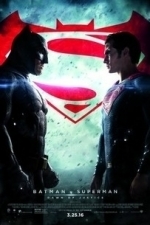
Okay, if you are reading this I assume you have at least read a few other reviews of the movie, as it is all that anyone is talking about online at the minute, so what is left to say I hear you ask? Well first off I’ll give you some context, for the last three years I have been reading and collecting comics to an obsessive level and it is due to this movie. I have always been a superhero fan (especially Batman,) and I had read some comics in the past, but when this movie was announced at San Diego Comic-Con in 2013, (3 years ago!!) I was so hyped and I decided that I had to read the comic that this film was taking inspiration from. So I went to my local A1 Comics and bought The Dark Knight Returns, which underwhelmed me but that’s another story. Since then I have become a huge comic book fan and that is thanks to this movie. Seriously what was not to like here, it would have been so difficult to get this wrong, it’s Batman fighting Superman, how amazing is it that this actually happened? And yet they still managed to fuck it up…
Do you read? You will. And then realise how superior the comic that this is based on is to the actual movie itself, (and I’m not even a massive fan of the comic.)
I saw 10 Cloverfield Lane last week and while that movie wasn’t perfect, what made that a great movie is exactly what makes BvS a subpar movie. 10CL had a small team of people working on a restrictive budget, so every aspect of the movie was scrutinised and perfected to make up the end product and that attention to detail really paid off. BvS had a huge budget and a massive team of people working on it and I think that is what gives the movie it’s unfocused and sloppy feel. The script is a mess, there are clearly scenes cut, the editing is jarring, not all of the performances were up to scratch and while the imagery and visuals are incredible, the best way to describe this movie is all style and no substance. I like Zack Snyder, I love his Watchmen movie, I like 300 and I enjoyed Man of Steel, but I can’t help but feel that this is his fault. His decision to make years of comic book stories into one two and a half hour movie honestly baffles me. The events of this movie should have taken place over at least three movies, which I will discuss more in the spoiler section of this review, so stick around for that if you have seen the movie already. This movie really is all over the place and the pace and tone are random at best and if you have seen the trailers then you have essentially seen the movie. Let’s talk about the best part of the movie, which is quite easily Ben Affleck’s Batman and Jeremy Irons’ Alfred. Seeing the two characters and their chemistry are worth the ticket price of the film alone. This is probably the most faithful to the source material Batman that we have had on the big screen to date, except for one pretty major change. Batman in DoJ is pretty much Punisher in a cowl. During the Batmobile chase (which was really fucking awesome by the way,) he questionably kills some goons. I mean, some of them could have survived like, if they had Wolverine’s healing powers I guess? But then there is that badass warehouse scene that we see in the trailers and during that he near enough shoots some guys himself. If you can get over this and see this as an alternate version of Batman you should be able to appreciate Affleck’s performance though, which by the way is amazing, he knocks it out of the park. I would have liked some kind of reference to it, even a scene where he discusses breaking his code with Alfred, just a few lines would have made me get on board with this version of the character a lot quicker. Critics have been calling Henry Cavil’s Superman performance wooden, but I think that is too harsh, he is perfectly serviceable but he isn’t going to be praised for his memorable performance either. Gal Gadot as Wonder Woman is badass, my only complaint is that she isn’t in the movie enough as Wonder Woman. Jesse Eisenberg is the stand out worst performance in the movie. It isn’t necessarily a bad performance, it just does not fit that character at all. He was truly miscast here, if they had cast him as Riddler in the Batman solo movie and he put in this performance I would be praising him like mad. Lex Luthor shouldn’t be crazy on a surface level, he should be a respectable businessman and an intellectual force to be reckoned with and he will go out of his way to ensure that this is what everyone sees him as, it is only ever the people closest to him that that he allows to see him crack. He certainly shouldn’t be making strange noises and gestures like someone with OCD or a mental issue. Also Doomsday is silly and is just shoehorned in at the end for the sake of giving the trinity and enemy to battle against.
Do you pee? You will. After sitting though near three hours of this garbage.
So to give my overall opinion before I get into spoilers, I will say that I enjoyed this movie better than Man of Steel, but only slightly and I dislike it for a lot of the same reasons. Just like Man of Steel there are parts of this movie that I adored and parts that I hated. Mixed emotions is an understatement. In my mind any movie above a 7 is a great movie and unfortunately I can’t call this a great movie. I fully believe that everyone should see this movie and form their own opinion, especially since reactions have been so mixed, but I felt that it simply didn’t live up to the hype that it set for itself and I feel like Zack Snyder may be doing more harm than good setting up the DCU. 6.5/10.
Do you see? You will. Or at least you better have seen it by now because I am about to spoil the shit out of the whole movie.
Like I said earlier, the events of the movie really should have been split across several movies and explored more rather than rushed through at a breakneck speed. We should have had a whole movie on Batman V Superman, the conflict ideals between them and the discussion of whether or not this world needs a Superman. Then we should have had a movie just based on the dawn of the justice league, with Batman and Superman eventually understanding each other and becoming friends and with way more scenes with Wonder Woman and a proper introduction to the other characters rather than the literal plot device USB stick we got in BvS. Then we should have had a few Justice League movies and once Superman was an established character within the universe, they should have killed him off then and did the Death and Return of Superman story, not in this one where Batman and Wonder Woman hardly know him and the public still don’t know whether he is good or bad. Also if Batman kills now, what reason is there for the Joker to still be alive? The whole point of their relationship is that Batman won’t kill Joker because of his code and Joker won’t kill Batman because he loves fighting him, but if Batman has no code and he has been Batman for years then he really should have killed Joker a long time ago. I did enjoy Batfleck and I am very much looking forward to his solo Batman movie, but BvS is rushed and sloppy. So I’ve said my piece, now let the fanboy hate commence.
Do you read? You will. And then realise how superior the comic that this is based on is to the actual movie itself, (and I’m not even a massive fan of the comic.)
I saw 10 Cloverfield Lane last week and while that movie wasn’t perfect, what made that a great movie is exactly what makes BvS a subpar movie. 10CL had a small team of people working on a restrictive budget, so every aspect of the movie was scrutinised and perfected to make up the end product and that attention to detail really paid off. BvS had a huge budget and a massive team of people working on it and I think that is what gives the movie it’s unfocused and sloppy feel. The script is a mess, there are clearly scenes cut, the editing is jarring, not all of the performances were up to scratch and while the imagery and visuals are incredible, the best way to describe this movie is all style and no substance. I like Zack Snyder, I love his Watchmen movie, I like 300 and I enjoyed Man of Steel, but I can’t help but feel that this is his fault. His decision to make years of comic book stories into one two and a half hour movie honestly baffles me. The events of this movie should have taken place over at least three movies, which I will discuss more in the spoiler section of this review, so stick around for that if you have seen the movie already. This movie really is all over the place and the pace and tone are random at best and if you have seen the trailers then you have essentially seen the movie. Let’s talk about the best part of the movie, which is quite easily Ben Affleck’s Batman and Jeremy Irons’ Alfred. Seeing the two characters and their chemistry are worth the ticket price of the film alone. This is probably the most faithful to the source material Batman that we have had on the big screen to date, except for one pretty major change. Batman in DoJ is pretty much Punisher in a cowl. During the Batmobile chase (which was really fucking awesome by the way,) he questionably kills some goons. I mean, some of them could have survived like, if they had Wolverine’s healing powers I guess? But then there is that badass warehouse scene that we see in the trailers and during that he near enough shoots some guys himself. If you can get over this and see this as an alternate version of Batman you should be able to appreciate Affleck’s performance though, which by the way is amazing, he knocks it out of the park. I would have liked some kind of reference to it, even a scene where he discusses breaking his code with Alfred, just a few lines would have made me get on board with this version of the character a lot quicker. Critics have been calling Henry Cavil’s Superman performance wooden, but I think that is too harsh, he is perfectly serviceable but he isn’t going to be praised for his memorable performance either. Gal Gadot as Wonder Woman is badass, my only complaint is that she isn’t in the movie enough as Wonder Woman. Jesse Eisenberg is the stand out worst performance in the movie. It isn’t necessarily a bad performance, it just does not fit that character at all. He was truly miscast here, if they had cast him as Riddler in the Batman solo movie and he put in this performance I would be praising him like mad. Lex Luthor shouldn’t be crazy on a surface level, he should be a respectable businessman and an intellectual force to be reckoned with and he will go out of his way to ensure that this is what everyone sees him as, it is only ever the people closest to him that that he allows to see him crack. He certainly shouldn’t be making strange noises and gestures like someone with OCD or a mental issue. Also Doomsday is silly and is just shoehorned in at the end for the sake of giving the trinity and enemy to battle against.
Do you pee? You will. After sitting though near three hours of this garbage.
So to give my overall opinion before I get into spoilers, I will say that I enjoyed this movie better than Man of Steel, but only slightly and I dislike it for a lot of the same reasons. Just like Man of Steel there are parts of this movie that I adored and parts that I hated. Mixed emotions is an understatement. In my mind any movie above a 7 is a great movie and unfortunately I can’t call this a great movie. I fully believe that everyone should see this movie and form their own opinion, especially since reactions have been so mixed, but I felt that it simply didn’t live up to the hype that it set for itself and I feel like Zack Snyder may be doing more harm than good setting up the DCU. 6.5/10.
Do you see? You will. Or at least you better have seen it by now because I am about to spoil the shit out of the whole movie.
Like I said earlier, the events of the movie really should have been split across several movies and explored more rather than rushed through at a breakneck speed. We should have had a whole movie on Batman V Superman, the conflict ideals between them and the discussion of whether or not this world needs a Superman. Then we should have had a movie just based on the dawn of the justice league, with Batman and Superman eventually understanding each other and becoming friends and with way more scenes with Wonder Woman and a proper introduction to the other characters rather than the literal plot device USB stick we got in BvS. Then we should have had a few Justice League movies and once Superman was an established character within the universe, they should have killed him off then and did the Death and Return of Superman story, not in this one where Batman and Wonder Woman hardly know him and the public still don’t know whether he is good or bad. Also if Batman kills now, what reason is there for the Joker to still be alive? The whole point of their relationship is that Batman won’t kill Joker because of his code and Joker won’t kill Batman because he loves fighting him, but if Batman has no code and he has been Batman for years then he really should have killed Joker a long time ago. I did enjoy Batfleck and I am very much looking forward to his solo Batman movie, but BvS is rushed and sloppy. So I’ve said my piece, now let the fanboy hate commence.

The Bandersnatch (199 KP) rated The Hunger Games in Books
Nov 7, 2019
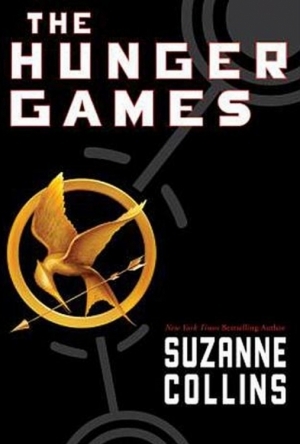

The Hunger Games is a trilogy of YA dystopian novels written by American author Suzanne Collins. The story is set in an unspecified future, in a dystopian, post-apocalyptic nation of Panem located in North America. The country consists of the Wealthy Capital surrounded by the twelve (Originally thirteen) poorer districts, each one in various states of poverty. The story follows Katniss Everdeen as she takes her sisters place in the annual Hunger Games. The games are a televised event created as punishment for a past rebellion. Over the course of the books Katniss and the rest of Panem are plunged into Civil War thanks to Katniss inadvertently fuelling a hidden rebel fraction led by President Alma Coin of (the previously thought to be destroyed) District 13. After going through hell, loosing friends and the sister she tried to protect Katniss is eventually tried for killing Coin at the execution of Ex-President Snow and sent back to District 12. Katniss eventually marries fellow tribute Peeta Mellark (whom she was tied to during the games as the pair of star-crossed lovers) and eventually have two children a boy and a girl. Author Suzanne Collins stated that the inspiration for the story came to her after channel surfing through TV channels, having seen a reality show on one channel then saw footage of the Iraq invasion. The two began to blur in an unsettling way and the idea started to form. The Greek myth of Theseus also served as a basis for the story, with Collins saying that Katniss could be called a future Theseus and The Hunger Games being an interpretation of the old gladiatorial games.
The Hunger Games the titular book was released on September 14th 2008 under the publishing house Scholastic Press. The book had an initial print run of 50,00 copies eventually being bumped up twice to 200,000 copies. By February 2010 the book had sold 800,000 copies and rights to the novel have been sold in 38 territories. In November 2008 The Hunger Games was placed on the New York Times best seller list where it would remain for 100 weeks (just over three months). By the time the books film adaption released in march 2012 the book had been on USA Today's best seller list for 135 weeks (Four months) and sold over 17.5 million copies. The book received several awards and honours such as Publishers Weekley's “Best book of the year 2008”, the New York Times “Notable children's book 2008” and was the 2009 young adult fiction category winner of the Golden Duck award. The book also received the California Young Reader medal in 2011.
Catching Fire, the second book was published on September 1st 2009 under Scholastic. As the sequel to the Hunger Games book it continues the story of Katniss Everdeen and the post-apocalyptic nation of Panem as rebellion begins. The book received mixed reviews but was placed on Time Magazines Top 100 fiction list of 2009. Catching fire had an initial print of 350,00 copies but was (Like its predecessor) had grown to 750,00 by February 2010. The book has sold over 10 million copies.
Mocking-jay the third and final book in the Hunger Games Trilogy and was published August 24th 2010 by Scholastic. The book had a 1.2 million copy print that was bumped up from 750,000 copies and in its first week sold over 450,00 copies. Reviews were favourable with the book and notes that it thoroughly explores the themes of the other books.
I really love the books and regularly read them. Whenever I do read them I tend to read all three of them in the space of a week. To be fair whilst I had heard of them before the first movie release I didn't start reading them until I'd seen the first movie. I did read Catching Fire and Mockingjay before their movie equivalents hit the screens. Whilst The Hunger Games was a brilliant opener and Mockingjay was a brilliant ender, I agree with a few reviewers that Catching fire had a delayed start and it took a bit of time to get into the action of the story at large.
Suzanne Collins was born in Hartford Connecticut on the 10th of August 1962 as the youngest fourth child to Jane Bradley Collins and Lt. Col. Michael Jon Collins a decorated U. S. Air Force officer. As a daughter of a military man she was constantly moving with her family and spent her childhood in the eastern united states. Collins went to the Alabama school of fine arts in Birmingham 1980 as a theatre arts Major. Collins went on to complete a Bachelor of arts from Indiana University in 1985 and telecommunications and in 1989 Collins earned her M. F. A. in dramatic writing from NYU Tisch school of arts. Collins began her career in 1991 as a writer for children's television shows and won a nomination in animation for co-writing the critically acclaimed Christmas special Santa, Baby!. Collins after meeting James Proimos whilst working on a children's show felt the urge to write children's books and spent the early 2000's writing five books of the Underland Chronicles; Gregor the Overlander, Gregor and the Prophecy of Bane, Gregor and the curse of the Warmbloods, Gregor and the Marks of Secret and Gregor and the Code of Claw. The influence for those books came from Alice in Wonderland. During the late 2000's she ends up writing the Hunger Games trilogy which went onto a famous movie trilogy. As the result of the hunger games trilogy popularity Collins was named one of Times Magazine's most Influential people of 2010. On June 17th 2019 Collins announced she was writing a prequel to the Hunger Games and is scheduled to be released on 19th May 2020, the book is to focus on the failed rebellion 64 years before the Hunger Games trilogy.
I highly respect the Author Suzanne Collins for both her work as a writer of Children's media and for her creativity in creating both the Hunger Games and the Underland Chronicles. Her creativity has been awarded with her books popularity and being announced amongst Time Magazine's 2010's most influential people and Amazons best selling Kindle author in 2012.
In March 2009 Lions Gate Entertainment entered into a co-production agreement with Nina Jacobson's Production company Color Force for the Hunger Games. Novel writer Suzanne Collins adapted the book in collaboration with screenwriter Billy Ray and Director Gary Ross. Actors Jennifer Lawrence, Josh Hutchinson and Liam Hemsworth were hired for the roles of Katniss, Peeta and Gale respectively. Lawrence was four years older than Katniss was in the books but Collins said she would rather the actress be older than the character since it demanded a certain maturity and power. Collins also liked Lawrence stating she was the “only one who truly captured the character I wrote in the book”. The Hunger Games Movie was released on march 23rd 2012. The Hunger Games: Catching Fire was released on November 22nd 2013 with Francis Lawrence being hired as Director and actors Phillip Seymour Hoffman, Jena Malone and Sam Claflin being hired as Plutarch Heavensbee, Johanna Mason and Finneck Odair respectively. The Hunger Games: Mockingjay was split into 2 and Part 1 was released on November 21st 2014 and part 2 on November 20th 2015 Francis Lawrence remained Director for the final movies with Actor Julianne Moore joining the cast as President Alma Coin.
I loved the movies point blank and whilst it has its flaws like most movies often do I think its redeeming quality has been it faithfulness in sticking to the books as closely as possible and the actors representation of Suzanne Collins characters such as Jennifer Lawrence as Katniss, Donald Sunderland and President Snow, Stanley Tucci as Ceaser Flickerman, Woody Harrelson as Haymich Abernathy and Elizabeth Banks as Effie Trinkett. Whilst all the actors were very good and were chosen well for their characters. These actors in particular I feel did exceptionally well in bringing their characters to life especially Elizabeth Banks, Stanley Tucci and Woody Harrelson but then I am a very big fan of theirs so I may be a little biased.
The Hunger Games the titular book was released on September 14th 2008 under the publishing house Scholastic Press. The book had an initial print run of 50,00 copies eventually being bumped up twice to 200,000 copies. By February 2010 the book had sold 800,000 copies and rights to the novel have been sold in 38 territories. In November 2008 The Hunger Games was placed on the New York Times best seller list where it would remain for 100 weeks (just over three months). By the time the books film adaption released in march 2012 the book had been on USA Today's best seller list for 135 weeks (Four months) and sold over 17.5 million copies. The book received several awards and honours such as Publishers Weekley's “Best book of the year 2008”, the New York Times “Notable children's book 2008” and was the 2009 young adult fiction category winner of the Golden Duck award. The book also received the California Young Reader medal in 2011.
Catching Fire, the second book was published on September 1st 2009 under Scholastic. As the sequel to the Hunger Games book it continues the story of Katniss Everdeen and the post-apocalyptic nation of Panem as rebellion begins. The book received mixed reviews but was placed on Time Magazines Top 100 fiction list of 2009. Catching fire had an initial print of 350,00 copies but was (Like its predecessor) had grown to 750,00 by February 2010. The book has sold over 10 million copies.
Mocking-jay the third and final book in the Hunger Games Trilogy and was published August 24th 2010 by Scholastic. The book had a 1.2 million copy print that was bumped up from 750,000 copies and in its first week sold over 450,00 copies. Reviews were favourable with the book and notes that it thoroughly explores the themes of the other books.
I really love the books and regularly read them. Whenever I do read them I tend to read all three of them in the space of a week. To be fair whilst I had heard of them before the first movie release I didn't start reading them until I'd seen the first movie. I did read Catching Fire and Mockingjay before their movie equivalents hit the screens. Whilst The Hunger Games was a brilliant opener and Mockingjay was a brilliant ender, I agree with a few reviewers that Catching fire had a delayed start and it took a bit of time to get into the action of the story at large.
Suzanne Collins was born in Hartford Connecticut on the 10th of August 1962 as the youngest fourth child to Jane Bradley Collins and Lt. Col. Michael Jon Collins a decorated U. S. Air Force officer. As a daughter of a military man she was constantly moving with her family and spent her childhood in the eastern united states. Collins went to the Alabama school of fine arts in Birmingham 1980 as a theatre arts Major. Collins went on to complete a Bachelor of arts from Indiana University in 1985 and telecommunications and in 1989 Collins earned her M. F. A. in dramatic writing from NYU Tisch school of arts. Collins began her career in 1991 as a writer for children's television shows and won a nomination in animation for co-writing the critically acclaimed Christmas special Santa, Baby!. Collins after meeting James Proimos whilst working on a children's show felt the urge to write children's books and spent the early 2000's writing five books of the Underland Chronicles; Gregor the Overlander, Gregor and the Prophecy of Bane, Gregor and the curse of the Warmbloods, Gregor and the Marks of Secret and Gregor and the Code of Claw. The influence for those books came from Alice in Wonderland. During the late 2000's she ends up writing the Hunger Games trilogy which went onto a famous movie trilogy. As the result of the hunger games trilogy popularity Collins was named one of Times Magazine's most Influential people of 2010. On June 17th 2019 Collins announced she was writing a prequel to the Hunger Games and is scheduled to be released on 19th May 2020, the book is to focus on the failed rebellion 64 years before the Hunger Games trilogy.
I highly respect the Author Suzanne Collins for both her work as a writer of Children's media and for her creativity in creating both the Hunger Games and the Underland Chronicles. Her creativity has been awarded with her books popularity and being announced amongst Time Magazine's 2010's most influential people and Amazons best selling Kindle author in 2012.
In March 2009 Lions Gate Entertainment entered into a co-production agreement with Nina Jacobson's Production company Color Force for the Hunger Games. Novel writer Suzanne Collins adapted the book in collaboration with screenwriter Billy Ray and Director Gary Ross. Actors Jennifer Lawrence, Josh Hutchinson and Liam Hemsworth were hired for the roles of Katniss, Peeta and Gale respectively. Lawrence was four years older than Katniss was in the books but Collins said she would rather the actress be older than the character since it demanded a certain maturity and power. Collins also liked Lawrence stating she was the “only one who truly captured the character I wrote in the book”. The Hunger Games Movie was released on march 23rd 2012. The Hunger Games: Catching Fire was released on November 22nd 2013 with Francis Lawrence being hired as Director and actors Phillip Seymour Hoffman, Jena Malone and Sam Claflin being hired as Plutarch Heavensbee, Johanna Mason and Finneck Odair respectively. The Hunger Games: Mockingjay was split into 2 and Part 1 was released on November 21st 2014 and part 2 on November 20th 2015 Francis Lawrence remained Director for the final movies with Actor Julianne Moore joining the cast as President Alma Coin.
I loved the movies point blank and whilst it has its flaws like most movies often do I think its redeeming quality has been it faithfulness in sticking to the books as closely as possible and the actors representation of Suzanne Collins characters such as Jennifer Lawrence as Katniss, Donald Sunderland and President Snow, Stanley Tucci as Ceaser Flickerman, Woody Harrelson as Haymich Abernathy and Elizabeth Banks as Effie Trinkett. Whilst all the actors were very good and were chosen well for their characters. These actors in particular I feel did exceptionally well in bringing their characters to life especially Elizabeth Banks, Stanley Tucci and Woody Harrelson but then I am a very big fan of theirs so I may be a little biased.

Heather Cranmer (2721 KP) rated The Exalted Gate in Books
Jun 7, 2018

(This review can be found on my blog <a href="http://themisadventuresofatwentysomething.blogspot.com/">The (Mis)Adventures of a Twenty-Something Year Old Girl</a>.
I absolutely love the cover of this book. It is gorgeous!! Anyway, this book has ten stories in it, so I will review and rate each one individually.
*
Boots
Judith (of an undisclosed age) is a girl that hates wearing shoes. However, she is in a play where she has to play a Polish tramp. She doesn't want to wear shoes, but the director says even tramps wear shoes. She finds some beat up looking boots in the prop room and puts them on. As soon as they are on her feet, it's like they have a mind of their own. They take Judith where they want to go. What ensues in an adventure that Judith won't soon forget.
I thought the story of Boots was a really cute and interesting read. I definitely think this will appeal to children of all ages. The only slight problem was with punctuation, but that's nothing that major. Judith is an interesting girl. I'd recommend this story.
I'd give Boots a 4.5 out of 5.
*
Five Gifts
Lonia is a thirteen year old girl whose parents are already nagging her to get married. (Yeah, it's a bit much, but it does say in the story that this was way back in the day). She'd rather spend her days in the children's glade talking to her elf friend, Pintak. One day, Pintak is kidnapped by a mean old wizard, and Lonia decides that she must go rescue him. She is given five gifts from different creatures of the forest to help her on her quest.
I was impressed with this story, and I found it quite interesting. There's also a lesson to be learned about experimenting on animals. Lonia was definitely a brave little girl and was willing to risk everything to save her friend. There are a few punctuation mistakes and a mispelt word, but other than that, this story was a good one.
I'd give Five Gifts a 5 out of 5.
*
Sintinko
Sintinko is a story set in Japan back when it was all emperors and generals. The emperor is jealous of Sintinko and wants to have him killed. It's only because of Ilyo, Sintinko's love interest, that the emperor spares his life. However, Sintinko is banished from Japan until he can find a maple tree that can sit in the hand of the emperor. Ilyo and Sintinko know that they will most likely never see each other. Unbeknownst to Sintinko and everyone else, Ilyo disguises herself as a geisha to help Sintinko on his journey. Love and loss are the themes of this story.
This was such a bittersweet love story. I felt sorry for both Sintinko and Ilyo. Sintinko thought he would never see his beloved again and swore off any type of relationship. Ilyo had her beloved right there in front of her, yet she couldn't do anything about it.
The names, being Japanese, were a bit hard to pronounce, but it's easy to get past that since the story is so strong. Speaking of names, this story even lets us know how the Bonsai tree got its name.
There's a few punctuation mistakes, but nothing that takes away from the story.
I think this story would be better suited for ages 11+. Personally, I found the story a bit slow, but not painfully slow.
I'd give Sintinko a 3.5 out of 5.
*
Tivurambhat
Tivurambhat is the story of a ghost by the same name of the title who helps people out in times of need in India. A mean man forces people to work for him by letting them borrow money, putting the interest up, and paying them such low wages they can never afford to pay him pack. One man decides to do something about it and goes to Tivurambhat for help.
I loved the message behind the story. Towards the ending, it even had me smiling. I couldn't pronounce the names since they were all Indian names, so I just shortened them so my American self could pronounce them. I loved the character of Tiv. He kind of reminded me of an American version of Casper for some reason. I really enjoyed the conversation between Pradesh and Tiv the most. This was such a happy story!
Again, there's some punctuation mistakes and a few grammar ones as well, but the story itself was excellent.
I'd give Tivurambhat a 5 out of 5.
*
St. Penalyn's Well
St Penalyn's Well tells the story of Rebecca (of an undisclosed age) who ventures into an overgrown garden with her dog. She stumbles across a well with an inscription. It is while reading this inscription that she becomes trapped in the well. Lucky for her, she meets an elf named Opickle who keeps her company and gives her the inspiration she needs to find her way out.
This was definitely an interesting story. I was hooked all the way through. It's a story about friendship amongst diversity and not giving up. I found Opickle to be just a tad bit of a snob but not enough to put me off the story.
A few punctuation mistakes throughout the story but not enough to be distracting.
St. Penalyn's Well gets a 5 out of 5 from me.
*
Quint and Trout's Mistake
Quint and Trout's Mistake is a story I didn't finish because of the name calling and making fun of someone who is overweight. It starts out innocently enough. A lake is being overrun by a white smelly substance. Two brothers, Quint and Trout, talk their friend Ned into investigating why this is happening. Ned swims down to the bottom of the lake and finds an overweight creature living in a cave who has been kicked out of his house. This is when the name calling starts, and I stopped reading.
I do not like stories aimed at children that condone name calling of any sort whether it be because of weight, disabilities, race, etc. Children do not need to read something like this and feel bad about themselves or view it as an excuse to tease others. I was very disappointed something like this was in a children's book.
Quint and Trout's Mistake gets a 0 out of 5 from me. What a vile story!
*
Densus
Densus is a boy who was born with blue fingernails and blue streaks in his hair. This is because he has a destiny to fulfill. When a crab named Arnold asks him if he'd go tell a giant that he has found a perfect wife for him, Densus agrees because it's his destiny even if there's a possibility the giant could kill him.
This is a story about destinies. It lets us know that we all have destinies if only we weren't too busy trying to find out what they are. This is a fun story which I think children would love! I loved Arnold the crab!! I think a majority of children would love him.
Again, there's a few punctuation and grammar mistakes but nothing major.
I'd give Densus a 5 out of 5.
*
Alice's Granddaughter
Alice's Granddaughter takes place years after Alice in Wonderland. Alice's granddaughter, Alicia, is recruited by a thief named Cheng to go down into a rabbit hole to get him a yellow dragon. Alicia discovers that things in Wonderland haven't changed much.
I thoroughly enjoyed this story! I'm a sucker for everything Alice in Wonderland-esque, and this was no exception! I loved how the author still managed to preserve the original Wonderland in his tale and how he even managed to keep the style of writing similar to that of Lewis Carroll. My favorite character was definitely the talking table. My only gripe is that I wish this story would've been longer!
As like with the previous story, there are some punctuation and grammar mistakes that can be overlooked.
Alice's Granddaughter gets a bit 5 out of 5.
*
The Dragon
The Dragon is a story about death. In this story, we follow a dragon in her very last moments as she dies of what I assume to be old age. We get to see her memories of when she was her prime and when she takes her last breath.
This is a sad story and probably one for the older children unless younger children can handle the topic of death. It's not written in a morbid way though. It's actually written quite beautifully especially when we get to see the memory of the dragon in her prime. I think this story can show that death is not always bad.
There are grammar and punctuation mistakes but nothing that deters from the story.
The Dragon gets a 3.75 out of 5.
*
The Wisdom of a Dog
The Wisdom of a Dog is about a man named Keith and his dog who go on an adventure and wind up in a crystal city. Keith must found out who is destroying the city and save it.
This story was a good read, and I think most children would enjoy it especially as it involves a talking dog. I enjoyed how the author even placed his own dialogue in the story. This is a good versus bad story that shows that bad people never win.
Again, there are grammar and punctuation mistakes, but it doesn't take away from the story.
The Wisdom of a Dog gets a 3.5 out of 5.
*
The Exalted Gate by Daniel Nanavati averages out to a 3.5 out of 5. I'd definitely recommend this book to old and young alike!
(I received a free physical copy of this title from the publisher in exchange for a fair and honest review).
I absolutely love the cover of this book. It is gorgeous!! Anyway, this book has ten stories in it, so I will review and rate each one individually.
*
Boots
Judith (of an undisclosed age) is a girl that hates wearing shoes. However, she is in a play where she has to play a Polish tramp. She doesn't want to wear shoes, but the director says even tramps wear shoes. She finds some beat up looking boots in the prop room and puts them on. As soon as they are on her feet, it's like they have a mind of their own. They take Judith where they want to go. What ensues in an adventure that Judith won't soon forget.
I thought the story of Boots was a really cute and interesting read. I definitely think this will appeal to children of all ages. The only slight problem was with punctuation, but that's nothing that major. Judith is an interesting girl. I'd recommend this story.
I'd give Boots a 4.5 out of 5.
*
Five Gifts
Lonia is a thirteen year old girl whose parents are already nagging her to get married. (Yeah, it's a bit much, but it does say in the story that this was way back in the day). She'd rather spend her days in the children's glade talking to her elf friend, Pintak. One day, Pintak is kidnapped by a mean old wizard, and Lonia decides that she must go rescue him. She is given five gifts from different creatures of the forest to help her on her quest.
I was impressed with this story, and I found it quite interesting. There's also a lesson to be learned about experimenting on animals. Lonia was definitely a brave little girl and was willing to risk everything to save her friend. There are a few punctuation mistakes and a mispelt word, but other than that, this story was a good one.
I'd give Five Gifts a 5 out of 5.
*
Sintinko
Sintinko is a story set in Japan back when it was all emperors and generals. The emperor is jealous of Sintinko and wants to have him killed. It's only because of Ilyo, Sintinko's love interest, that the emperor spares his life. However, Sintinko is banished from Japan until he can find a maple tree that can sit in the hand of the emperor. Ilyo and Sintinko know that they will most likely never see each other. Unbeknownst to Sintinko and everyone else, Ilyo disguises herself as a geisha to help Sintinko on his journey. Love and loss are the themes of this story.
This was such a bittersweet love story. I felt sorry for both Sintinko and Ilyo. Sintinko thought he would never see his beloved again and swore off any type of relationship. Ilyo had her beloved right there in front of her, yet she couldn't do anything about it.
The names, being Japanese, were a bit hard to pronounce, but it's easy to get past that since the story is so strong. Speaking of names, this story even lets us know how the Bonsai tree got its name.
There's a few punctuation mistakes, but nothing that takes away from the story.
I think this story would be better suited for ages 11+. Personally, I found the story a bit slow, but not painfully slow.
I'd give Sintinko a 3.5 out of 5.
*
Tivurambhat
Tivurambhat is the story of a ghost by the same name of the title who helps people out in times of need in India. A mean man forces people to work for him by letting them borrow money, putting the interest up, and paying them such low wages they can never afford to pay him pack. One man decides to do something about it and goes to Tivurambhat for help.
I loved the message behind the story. Towards the ending, it even had me smiling. I couldn't pronounce the names since they were all Indian names, so I just shortened them so my American self could pronounce them. I loved the character of Tiv. He kind of reminded me of an American version of Casper for some reason. I really enjoyed the conversation between Pradesh and Tiv the most. This was such a happy story!
Again, there's some punctuation mistakes and a few grammar ones as well, but the story itself was excellent.
I'd give Tivurambhat a 5 out of 5.
*
St. Penalyn's Well
St Penalyn's Well tells the story of Rebecca (of an undisclosed age) who ventures into an overgrown garden with her dog. She stumbles across a well with an inscription. It is while reading this inscription that she becomes trapped in the well. Lucky for her, she meets an elf named Opickle who keeps her company and gives her the inspiration she needs to find her way out.
This was definitely an interesting story. I was hooked all the way through. It's a story about friendship amongst diversity and not giving up. I found Opickle to be just a tad bit of a snob but not enough to put me off the story.
A few punctuation mistakes throughout the story but not enough to be distracting.
St. Penalyn's Well gets a 5 out of 5 from me.
*
Quint and Trout's Mistake
Quint and Trout's Mistake is a story I didn't finish because of the name calling and making fun of someone who is overweight. It starts out innocently enough. A lake is being overrun by a white smelly substance. Two brothers, Quint and Trout, talk their friend Ned into investigating why this is happening. Ned swims down to the bottom of the lake and finds an overweight creature living in a cave who has been kicked out of his house. This is when the name calling starts, and I stopped reading.
I do not like stories aimed at children that condone name calling of any sort whether it be because of weight, disabilities, race, etc. Children do not need to read something like this and feel bad about themselves or view it as an excuse to tease others. I was very disappointed something like this was in a children's book.
Quint and Trout's Mistake gets a 0 out of 5 from me. What a vile story!
*
Densus
Densus is a boy who was born with blue fingernails and blue streaks in his hair. This is because he has a destiny to fulfill. When a crab named Arnold asks him if he'd go tell a giant that he has found a perfect wife for him, Densus agrees because it's his destiny even if there's a possibility the giant could kill him.
This is a story about destinies. It lets us know that we all have destinies if only we weren't too busy trying to find out what they are. This is a fun story which I think children would love! I loved Arnold the crab!! I think a majority of children would love him.
Again, there's a few punctuation and grammar mistakes but nothing major.
I'd give Densus a 5 out of 5.
*
Alice's Granddaughter
Alice's Granddaughter takes place years after Alice in Wonderland. Alice's granddaughter, Alicia, is recruited by a thief named Cheng to go down into a rabbit hole to get him a yellow dragon. Alicia discovers that things in Wonderland haven't changed much.
I thoroughly enjoyed this story! I'm a sucker for everything Alice in Wonderland-esque, and this was no exception! I loved how the author still managed to preserve the original Wonderland in his tale and how he even managed to keep the style of writing similar to that of Lewis Carroll. My favorite character was definitely the talking table. My only gripe is that I wish this story would've been longer!
As like with the previous story, there are some punctuation and grammar mistakes that can be overlooked.
Alice's Granddaughter gets a bit 5 out of 5.
*
The Dragon
The Dragon is a story about death. In this story, we follow a dragon in her very last moments as she dies of what I assume to be old age. We get to see her memories of when she was her prime and when she takes her last breath.
This is a sad story and probably one for the older children unless younger children can handle the topic of death. It's not written in a morbid way though. It's actually written quite beautifully especially when we get to see the memory of the dragon in her prime. I think this story can show that death is not always bad.
There are grammar and punctuation mistakes but nothing that deters from the story.
The Dragon gets a 3.75 out of 5.
*
The Wisdom of a Dog
The Wisdom of a Dog is about a man named Keith and his dog who go on an adventure and wind up in a crystal city. Keith must found out who is destroying the city and save it.
This story was a good read, and I think most children would enjoy it especially as it involves a talking dog. I enjoyed how the author even placed his own dialogue in the story. This is a good versus bad story that shows that bad people never win.
Again, there are grammar and punctuation mistakes, but it doesn't take away from the story.
The Wisdom of a Dog gets a 3.5 out of 5.
*
The Exalted Gate by Daniel Nanavati averages out to a 3.5 out of 5. I'd definitely recommend this book to old and young alike!
(I received a free physical copy of this title from the publisher in exchange for a fair and honest review).
Purple Phoenix Games (2266 KP) rated VENOM Assault in Tabletop Games
Jan 25, 2021

What would you say if I told you I completely expected a game I received to fall completely flat for me but instead may actually unseat a revered similar game from my Top 10 list of games? That would be surprising, right? Well such is life, and such is this game. I do believe that VENOM Assault may knock off one of my favorite games: Legendary: A Marvel Deck-Building Game. That’s really saying something from me, so let me discuss a bit about why I state this.
VENOM Assault is a deck-building game very similar in style to Legendary: A Marvel Deck-Building Game (which, if I have to reference again will just call Legendary). Players take control of a team of (relative) wimps in order to help recruit the real elites and battle the evildoers plus their henchmen. Sound familiar? For this review I will be playing the Solo rules, which are the same as the multiplayer rules, but for one player. Novel, eh?
DISCLAIMER: We were provided a copy of this game for the purposes of this review. This is a retail copy of the game, so what you see in these photos is exactly what would be received in your box. I do not intend to cover every single rule included in the rulebook, but will describe the overall game flow and major rule set so that our readers may get a sense of how the game plays. For more in depth rules, you may purchase a copy online or from your FLGS. -T
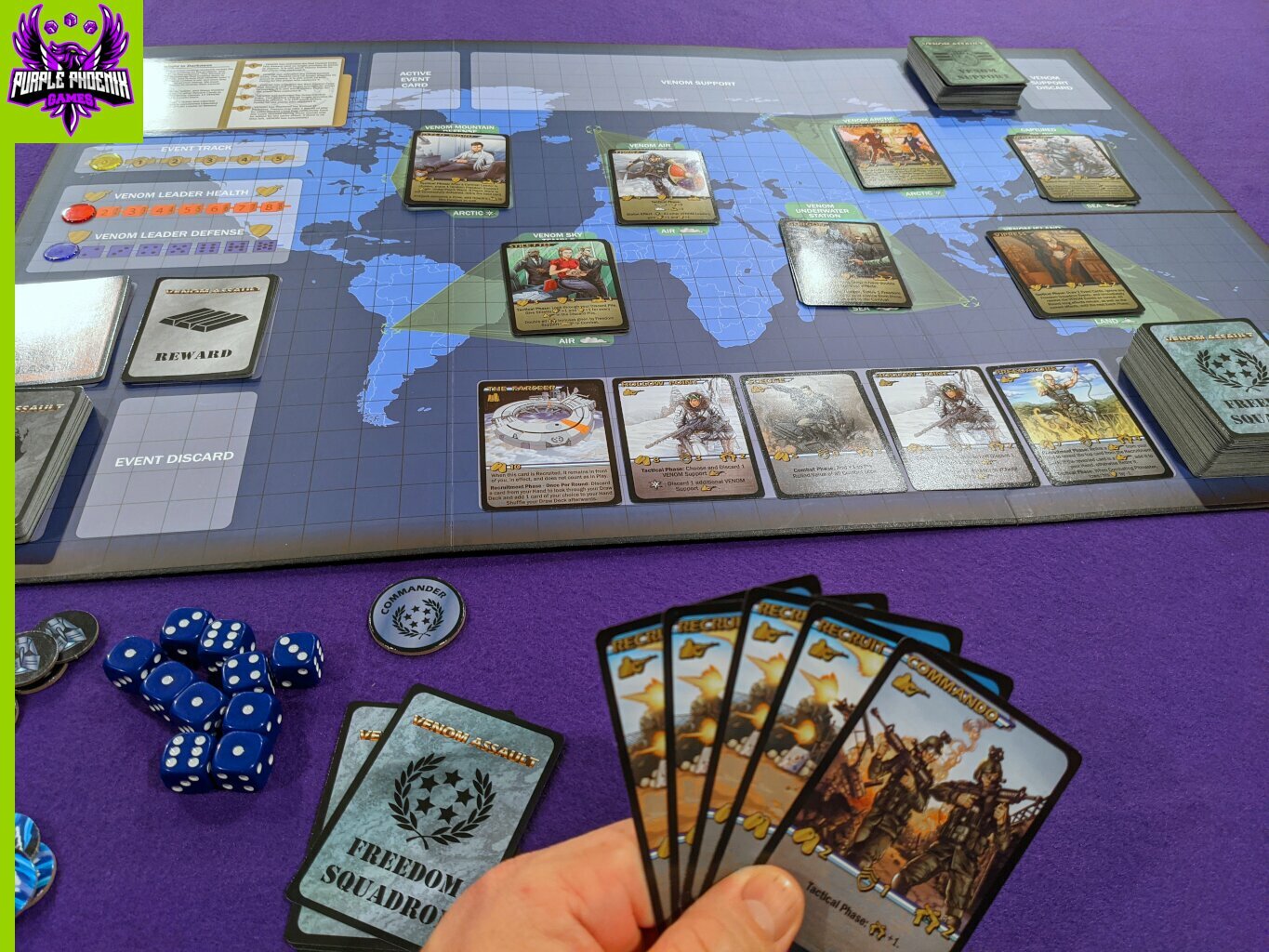
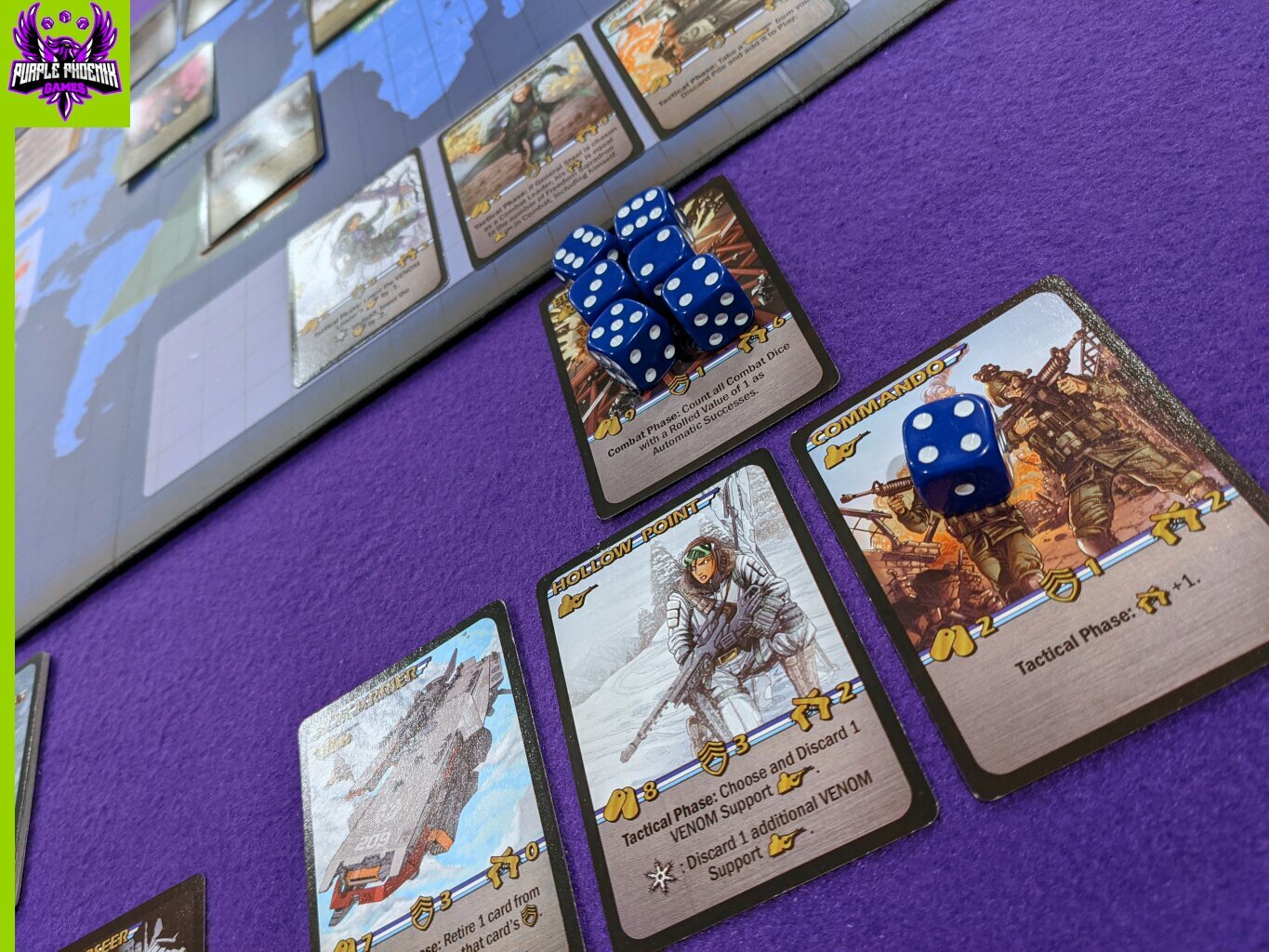
To setup a game, please follow the rulebook as there is way too much to cover here in complete detail. The setup should look similar to the following photo. Here is what you will see: a space for the Mission scenario in the upper left corner. To its right a space for the active Event card. Next to that is the area for the VENOM Support cards to be displayed. Then the VENOM Support deck and discard areas. Below the Mission area is the space to track threat level and the current VENOM Leader’s Health and Defense values. Beneath those trackers is an area for four decks: the VENOM Leader deck, Reward deck, Event deck, and Event discard. To the right of this area is the Training Ground (recruitment zone), the Recruitment deck, and the Retirement pile. In the middle of the board are seven spaces to be populated with Reward cards and VENOM Leaders on top of the Rewards. Each player is dealt six Recruits and four Commandos and will shuffle these to create their draw deck. The players then draw five cards to create their hand and the game may now begin! Go save the world!
I will not be covering every aspect of a turn but will highlight the goings on. The Commander (first player) will draw and read the Event for the round. Events can be helpful for the players, extremely hurtful by advancing the VENOM plot, or even uneventful altogether. Next, player(s) will enter the Recruitment Phase. During this phase players will be using their entire hand to total the recruitment points that can be spent on recruiting those elite soldier, vehicle, and location cards from the Training Ground right into their discard piles.
Once the Recruitment Phase is complete, the Tactical Phase begins, and this is a large part of the game that helps differentiate it from others of its like. The players will choose one of the seven revealed VENOM Leaders on the map to attack in combat (if they choose – this is optional). Using the stats on the VENOM Leader card the players will adjust the Health and Defense values on the trackers on the board. If the VENOM Leader has any abilities that would trigger during this phase, then they trigger now. These could include Global Abilities as well. Once the Leader is done with their abilities, the players will choose one of their cards played to become the Combat Leader. This character now may not use their printed ability but will use their Combat Value (crossed pistols) to place combat dice on their card. The other team members in the combat will add dice to the pool as well if their abilities direct them. Next, the VENOM Leader will call forth their VENOM Support armies to aid them in the combat round. Once displayed, any hero Tactical Phase abilities can be resolved. If VENOM Support armies still are active, their abilities may be resolved at this point.
As the Tactical Phase ends, the Combat Phase begins. The Combat Phase is where the players are able to roll their combat dice in the hopes of besting the VENOM Leader’s Health and Defense values. Defense values dictate the dice values that need to be hit or exceeded to equal a successful attack. The Health value is how many successes are needed to defeat the Leader. However, once rolled the VENOM Leader will trigger any Combat Phase abilities at this time. Once complete the hero team will be able to resolve their own Combat Phase abilities, if any. Finally, the VENOM Support will resolve their Combat Phase abilities. Now the dice may be completely resolved against the Leader, after all abilities have been resolved. If the Freedom Squadron (heroes) defeated the Leader, they take the Leader and Reward cards into their VP pile. Depending on the Mission, these Rewards may be necessary to win the game, and all will have VP values.
After a lengthy Tactical and Combat Phase, the players then enter the Retirement Phase. The players may retire a card from their hand, thus removing the card from the game entirely.
Once a card has been retired (or not), the End of Turn Phase will help clean up the mess of the current round. Any other End of Turn Phase abilities will trigger, and used cards will be discarded to the appropriate areas and refills of key points on the board and players’ hands will setup the next round of play.
Once the Mission card’s success or failure stipulations have been met the game is over and, with any luck, the Freedom Squadron has defeated VENOM once and for all!
Components. This game boasts a large game board, a metric ton of cards, some dice, and some cardboard tokens. All the components are of fine quality and I have no issues with them. The art style used in the game is pleasing and, thankfully, not over-the-top gory or bloody or anything.
You may have noticed or thought that perhaps this game is taking inspiration from a cartoon/toy line from the ’80s, and I would very much agree with you. Could it be called Legendary: G.I. Joe? Maybe, but this one stands on its own, though very similar to the Legendary system. What I do like about VENOM Assault is the fact that it already comes with a large amount of incredible cards to be recruited. I do not know if I will ever feel the need for extra heroes in this game, whereas with the Marvel Legendary one can really go overboard trying to collect all the mini expansions and big box expansions just to find their favorite Marvel entities. Since VENOM Assault isn’t tied to any specific IP and is more generic overall, each character provided is its own thing, not a specific hero that one has grown up loving their entire life.
You see, the problem with those mini expansions in Legendary, at least for me, is that each one brings with it a host of heroes AND a host of new keywords and rules that must be remembered or referenced until it becomes second nature. In VENOM Assault, the rules stay the same and play is altered by the Missions and which characters can be recruited. I like a more reliable and static ruleset when I’m playing an intense game. So point goes to VENOM Assault here too.
Now, I was never into G.I. Joe and I am not at all a war or guns kinda guy, but I am really attracted to this game. I don’t necessarily think of my heroes as going in and shooting the place up, but rather taking Navy Seals-style tactical maneuvers to eliminate the target. So the point is that if you were never into that IP before, you should not feel alienated by this one. It appeals to all, in my opinion.
I said previously in this review that VENOM Assault is knocking on the door of bumping Legendary from my Top 10 games. I continue thinking about it even when I am not playing, and that is a mark of an excellent game for me. If I never think of a game again after playing, there is no way it remains in my collection. This one, however, has me considering different strategies in my head even now as I’m typing.
If you are in the market for a great deck-builder with worldwide espionage at its heart, I urge you to grab a copy of VENOM Assault. If you like the Legendary system but are looking for something just a little different, check this one out. If you just enjoy owning games that are fun and make you think, but also include a bit of luck in the dice rolls, then you owe it to yourself to play this. I really think you’ll enjoy it, as I have. Okay, time to setup another game.
VENOM Assault is a deck-building game very similar in style to Legendary: A Marvel Deck-Building Game (which, if I have to reference again will just call Legendary). Players take control of a team of (relative) wimps in order to help recruit the real elites and battle the evildoers plus their henchmen. Sound familiar? For this review I will be playing the Solo rules, which are the same as the multiplayer rules, but for one player. Novel, eh?
DISCLAIMER: We were provided a copy of this game for the purposes of this review. This is a retail copy of the game, so what you see in these photos is exactly what would be received in your box. I do not intend to cover every single rule included in the rulebook, but will describe the overall game flow and major rule set so that our readers may get a sense of how the game plays. For more in depth rules, you may purchase a copy online or from your FLGS. -T
To setup a game, please follow the rulebook as there is way too much to cover here in complete detail. The setup should look similar to the following photo. Here is what you will see: a space for the Mission scenario in the upper left corner. To its right a space for the active Event card. Next to that is the area for the VENOM Support cards to be displayed. Then the VENOM Support deck and discard areas. Below the Mission area is the space to track threat level and the current VENOM Leader’s Health and Defense values. Beneath those trackers is an area for four decks: the VENOM Leader deck, Reward deck, Event deck, and Event discard. To the right of this area is the Training Ground (recruitment zone), the Recruitment deck, and the Retirement pile. In the middle of the board are seven spaces to be populated with Reward cards and VENOM Leaders on top of the Rewards. Each player is dealt six Recruits and four Commandos and will shuffle these to create their draw deck. The players then draw five cards to create their hand and the game may now begin! Go save the world!
I will not be covering every aspect of a turn but will highlight the goings on. The Commander (first player) will draw and read the Event for the round. Events can be helpful for the players, extremely hurtful by advancing the VENOM plot, or even uneventful altogether. Next, player(s) will enter the Recruitment Phase. During this phase players will be using their entire hand to total the recruitment points that can be spent on recruiting those elite soldier, vehicle, and location cards from the Training Ground right into their discard piles.
Once the Recruitment Phase is complete, the Tactical Phase begins, and this is a large part of the game that helps differentiate it from others of its like. The players will choose one of the seven revealed VENOM Leaders on the map to attack in combat (if they choose – this is optional). Using the stats on the VENOM Leader card the players will adjust the Health and Defense values on the trackers on the board. If the VENOM Leader has any abilities that would trigger during this phase, then they trigger now. These could include Global Abilities as well. Once the Leader is done with their abilities, the players will choose one of their cards played to become the Combat Leader. This character now may not use their printed ability but will use their Combat Value (crossed pistols) to place combat dice on their card. The other team members in the combat will add dice to the pool as well if their abilities direct them. Next, the VENOM Leader will call forth their VENOM Support armies to aid them in the combat round. Once displayed, any hero Tactical Phase abilities can be resolved. If VENOM Support armies still are active, their abilities may be resolved at this point.
As the Tactical Phase ends, the Combat Phase begins. The Combat Phase is where the players are able to roll their combat dice in the hopes of besting the VENOM Leader’s Health and Defense values. Defense values dictate the dice values that need to be hit or exceeded to equal a successful attack. The Health value is how many successes are needed to defeat the Leader. However, once rolled the VENOM Leader will trigger any Combat Phase abilities at this time. Once complete the hero team will be able to resolve their own Combat Phase abilities, if any. Finally, the VENOM Support will resolve their Combat Phase abilities. Now the dice may be completely resolved against the Leader, after all abilities have been resolved. If the Freedom Squadron (heroes) defeated the Leader, they take the Leader and Reward cards into their VP pile. Depending on the Mission, these Rewards may be necessary to win the game, and all will have VP values.
After a lengthy Tactical and Combat Phase, the players then enter the Retirement Phase. The players may retire a card from their hand, thus removing the card from the game entirely.
Once a card has been retired (or not), the End of Turn Phase will help clean up the mess of the current round. Any other End of Turn Phase abilities will trigger, and used cards will be discarded to the appropriate areas and refills of key points on the board and players’ hands will setup the next round of play.
Once the Mission card’s success or failure stipulations have been met the game is over and, with any luck, the Freedom Squadron has defeated VENOM once and for all!
Components. This game boasts a large game board, a metric ton of cards, some dice, and some cardboard tokens. All the components are of fine quality and I have no issues with them. The art style used in the game is pleasing and, thankfully, not over-the-top gory or bloody or anything.
You may have noticed or thought that perhaps this game is taking inspiration from a cartoon/toy line from the ’80s, and I would very much agree with you. Could it be called Legendary: G.I. Joe? Maybe, but this one stands on its own, though very similar to the Legendary system. What I do like about VENOM Assault is the fact that it already comes with a large amount of incredible cards to be recruited. I do not know if I will ever feel the need for extra heroes in this game, whereas with the Marvel Legendary one can really go overboard trying to collect all the mini expansions and big box expansions just to find their favorite Marvel entities. Since VENOM Assault isn’t tied to any specific IP and is more generic overall, each character provided is its own thing, not a specific hero that one has grown up loving their entire life.
You see, the problem with those mini expansions in Legendary, at least for me, is that each one brings with it a host of heroes AND a host of new keywords and rules that must be remembered or referenced until it becomes second nature. In VENOM Assault, the rules stay the same and play is altered by the Missions and which characters can be recruited. I like a more reliable and static ruleset when I’m playing an intense game. So point goes to VENOM Assault here too.
Now, I was never into G.I. Joe and I am not at all a war or guns kinda guy, but I am really attracted to this game. I don’t necessarily think of my heroes as going in and shooting the place up, but rather taking Navy Seals-style tactical maneuvers to eliminate the target. So the point is that if you were never into that IP before, you should not feel alienated by this one. It appeals to all, in my opinion.
I said previously in this review that VENOM Assault is knocking on the door of bumping Legendary from my Top 10 games. I continue thinking about it even when I am not playing, and that is a mark of an excellent game for me. If I never think of a game again after playing, there is no way it remains in my collection. This one, however, has me considering different strategies in my head even now as I’m typing.
If you are in the market for a great deck-builder with worldwide espionage at its heart, I urge you to grab a copy of VENOM Assault. If you like the Legendary system but are looking for something just a little different, check this one out. If you just enjoy owning games that are fun and make you think, but also include a bit of luck in the dice rolls, then you owe it to yourself to play this. I really think you’ll enjoy it, as I have. Okay, time to setup another game.


Cynthia Armistead (17 KP) rated Carniepunk in Books
Mar 1, 2018
As soon as I read about this collection on Kevin Hearne's Facebook, I knew I would be buying it. I don't care for carnivals at all, and every story will be related to one in some way - but there was just no way I was going to miss an Atticus and Oberon story! I even pre-ordered the book on Amazon, the first time I've ever done that. It was SO hard not to skip right ahead and read Hearne's contribution the moment the book was in my hot little hands, but I managed some discipline.
Rob Thurman's "Painted Love" opens the book. It is dark, but to be fair it isn't quite as dark as the only Thurman novel I've read, from the Cal Leandros series. I rather liked the twist. I adored the fiercely protective older sister, especially the way she is described. I'll rate this one at three.
I don't believe I've ever read anything by Delilah S. Dawson before, certainly not anything in the Blud universe, so I had no idea what to expect from "The Three Lives of Lydia." It was a far darker story than I would generally choose to read. I found the male love interest highly appealing. The portrayal of mental illness was horrific. I found it interesting that Dawson is an Atlantan as well as a fellow geeky mom, but I'm sure that I've never heard of her before. She does have a book coming out next year that looks promising, so I may give it a read. This one's a two.
Then there is the Iron Druid story! "The Demon Barker of Wheat Street" is set a few books back in the series' chronology (two weeks after "Two Ravens and One Crow"), so Granuaille isn't yet a full Druid. To make things even more interesting, Atticus accidentally offended the local elemental many years ago, so his magic doesn't work as well as usual in the area. The story isn't vital to the series, and knowledge of the series isn't necessary for enjoying it. Hearne's fans definitely won't want to miss it, though, and it could be used as a nice little taste of his style for new readers. Definitely a five.
I couldn't make it through "The Sweeter the Juice" by Mark Henry. Zombies are disgusting, but I was way squicked before the first walking dead even appeared on the scene. A one, just because there are no zeroes.
Jaye Wells is another new-to-me author, as far as I can remember at the moment. I didn't really like "The Werewife," to be honest. There was no joy anywhere in this story. There wasn't even a hint that perhaps the couple in the story had been happy together at one time. Both of them seemed pretty miserable, and I didn't like the way it ended. It didn't seem like there was any way to give them a happy ending, but that ending didn't feel "true." It gets a two, and that's only to set it apart from the previous story.
"The Cold Girl" by Rachel Caine is about an abusive teen relationship. Oh, and vampires. I'm not a Caine fan, but this story was better than some of her other work. Again, too dark for my tastes. If half stars were possible, it would have one. I'll be nice and round up to three.
The name Allison Pang sounds familiar, so maybe I've read something by her in the past. If I did, I'm certain that it wasn't set in the same world as "A Duet With Darkness," which says it is an Abby Sinclair story. I found the main character to be an annoying, immature twit, but I'm a sucker for fiction with musical influences. The music is well-done here. I don't know if I will read anything more by Ms. Pang or not - I suppose that depends on whether or not her other work has better characters and is also musical. This one gets a four.
I found "Recession of the Divine" by Hillary Jacques fascinating. The Greek inspiration was unusual. I didn't really buy the customers being quite so unquestioning of Ophelia's state, but it wasn't a major complaint overall. I was highly disappointed to find nothing but a credit in another anthology for her. But! Reading the author profiles at the end of the book pays off, because that's how I learned that she also writes as Regan Summers. Now her works published under that name are on my to-read shelf. Another five.
Jennifer Estep's "Parlor Tricks" was actually released free on Amazon a little while back to promote Carniepunk, so it was the first story I read. I enjoy the Elemental Assassin series in general, and this story is no exception. Again, knowledge of the series is not required to understand the story, and the story is not vital to the series. It is a nice little sample, though, and I enjoyed seeing Gin and Bria having a sisterly outing. I'm probably biased, but it gets a five.
I liked Kelly Meding's "Freak House" a lot, and her name sounded familiar, but the story was set in the "Strays" universe, which I was certain I had never heard of before. I actually stirred myself to look her up, and learned that I've had one of her books on my to-read list for ages, and Strays is a new series she's just starting. Djinn, werewolves, vampires, pixies, harpies, leprechauns, skinwalkers, and more, some "out" to humans, some living hidden - what's not to love? This one gets a four.
Nicole Peeler us yet another author who sounded vaguely familiar to me, and yep, there is one of her books on my to-read list (yes, it is massive, why do you ask?). It is, in fact, the first of the Jane True books, and "The Inside Man" is set in that world. Peeler's writing style dies not flow for me, but I liked Capitola Jones and her friends Shar and Moo. As clowns are indisputably evil, I had little to complain about in the story. It gets a three.
Succubus (former?) Jezzie is the main character in Jackie Kessler's story "A Chance in Hell." Obviously, the story is set her Hell on Earth series. I had to look that up, though, because while I know you're shocked, her name did not ring any bells for me. I don't actually have ALL the urban fantasy books on my to-read or read lists! The piece opens with a confusing remark about a demon eating Jezebel's face, when that definitely is not the anatomy in question. If that's a common euphemism, it is wholly new to me. Within the next couple of pages there are multiple references to the fact that she has fallen in love with a human since becoming mortal, but absolutely no explanation of how she would reconcile sex with an incubus with her human love. As much as I would prefer that it were not the case, the default assumption in our society is that people are monogamous. Therefore, when there is a deviation from that norm, the reader expects - something. Is it supposed to demonstrate that the fictional society is different? Is the character in an explicitly non-monogamous relationship? Is her love unrequited? Is the guy dead? Do demons not count? Is she just a skanky ho? Then this great love isn't mentioned again for the rest of the story, so none of the questions raised are answered. Oh. There is, in fact, a plot here, but I was so annoyed by that stuff that I almost failed to notice it. Demonic circus, yo. The whole demon thing reminds me too much of another series I've read in the past. I can't even remember the author's name, much less the title, right now, but Kessler's work feels derivative. She gets a two.
Next up is Kelly Gay - Hey look! Another author whose name I don't recognize! - with "Hell's Menagerie," a Charlie Madigan short story. Okay, this series is set in an alternate Atlanta. As an Atlanta girl, that certainly gets my attention. And Charlie is a single mother. I don't recall any other single mothers in the UF world right off. (Kate Daniels doesn't quite count, because she adopted her daughter as a teen. Although it is interesting to note that Kate is also Atlanta-based.) I was ready to like this one, based solely on what I knew of the series. Then there was a grammatical error on the second page of the story that set my teeth on edge, one which could not be chalked up to a character's voice. Add in the fact that we get a fast, "and also, Jim" style introduction to Charlie (who isn't even present in the story!), Rex, and Emma in less than two pages, and I am officially annoyed. It isn't an old matinee movie, so surely that information could have been worked in a little more naturally? Emma won me over. Mostly. There's some, "Not another super-gifted kid," reaction, but I guess if the mother is supposed to be all that it's to be expected that the daughter might be special, too. Hmm. A three.
The last piece is Seaman McGuire's "Daughter of the Midway, the Mermaid, and the Open, Lonely, Sea." Is that title a mouthful, or what? It has the feel of a Toby Daye story, although it isn't subtitled as such, and there are no fae so maybe it isn't in that universe at all. As there are other stories in the book that are set in the same world as their author's series, yet not marked in any way, lack of a subtitle can't be taken as a negative indicator, though. In any case, the story is poignant, which I've come to expect from McGuire. I didn't really like it, but I didn't dislike it, either. I couldn't "feel" Ada in any true sense. I have the same problem with Toby. A three at best.
Overall, the book was decent. The ratings only average out to 3.21, but I'm very glad to have read the stories by Hearne and Estep. Discovering Jacques/Summers was absolutely worthwhile. I really hate that I read as much of Henry's story as I did. If I could delete that from my memory, it would probably raise the rating for everything else.
Rob Thurman's "Painted Love" opens the book. It is dark, but to be fair it isn't quite as dark as the only Thurman novel I've read, from the Cal Leandros series. I rather liked the twist. I adored the fiercely protective older sister, especially the way she is described. I'll rate this one at three.
I don't believe I've ever read anything by Delilah S. Dawson before, certainly not anything in the Blud universe, so I had no idea what to expect from "The Three Lives of Lydia." It was a far darker story than I would generally choose to read. I found the male love interest highly appealing. The portrayal of mental illness was horrific. I found it interesting that Dawson is an Atlantan as well as a fellow geeky mom, but I'm sure that I've never heard of her before. She does have a book coming out next year that looks promising, so I may give it a read. This one's a two.
Then there is the Iron Druid story! "The Demon Barker of Wheat Street" is set a few books back in the series' chronology (two weeks after "Two Ravens and One Crow"), so Granuaille isn't yet a full Druid. To make things even more interesting, Atticus accidentally offended the local elemental many years ago, so his magic doesn't work as well as usual in the area. The story isn't vital to the series, and knowledge of the series isn't necessary for enjoying it. Hearne's fans definitely won't want to miss it, though, and it could be used as a nice little taste of his style for new readers. Definitely a five.
I couldn't make it through "The Sweeter the Juice" by Mark Henry. Zombies are disgusting, but I was way squicked before the first walking dead even appeared on the scene. A one, just because there are no zeroes.
Jaye Wells is another new-to-me author, as far as I can remember at the moment. I didn't really like "The Werewife," to be honest. There was no joy anywhere in this story. There wasn't even a hint that perhaps the couple in the story had been happy together at one time. Both of them seemed pretty miserable, and I didn't like the way it ended. It didn't seem like there was any way to give them a happy ending, but that ending didn't feel "true." It gets a two, and that's only to set it apart from the previous story.
"The Cold Girl" by Rachel Caine is about an abusive teen relationship. Oh, and vampires. I'm not a Caine fan, but this story was better than some of her other work. Again, too dark for my tastes. If half stars were possible, it would have one. I'll be nice and round up to three.
The name Allison Pang sounds familiar, so maybe I've read something by her in the past. If I did, I'm certain that it wasn't set in the same world as "A Duet With Darkness," which says it is an Abby Sinclair story. I found the main character to be an annoying, immature twit, but I'm a sucker for fiction with musical influences. The music is well-done here. I don't know if I will read anything more by Ms. Pang or not - I suppose that depends on whether or not her other work has better characters and is also musical. This one gets a four.
I found "Recession of the Divine" by Hillary Jacques fascinating. The Greek inspiration was unusual. I didn't really buy the customers being quite so unquestioning of Ophelia's state, but it wasn't a major complaint overall. I was highly disappointed to find nothing but a credit in another anthology for her. But! Reading the author profiles at the end of the book pays off, because that's how I learned that she also writes as Regan Summers. Now her works published under that name are on my to-read shelf. Another five.
Jennifer Estep's "Parlor Tricks" was actually released free on Amazon a little while back to promote Carniepunk, so it was the first story I read. I enjoy the Elemental Assassin series in general, and this story is no exception. Again, knowledge of the series is not required to understand the story, and the story is not vital to the series. It is a nice little sample, though, and I enjoyed seeing Gin and Bria having a sisterly outing. I'm probably biased, but it gets a five.
I liked Kelly Meding's "Freak House" a lot, and her name sounded familiar, but the story was set in the "Strays" universe, which I was certain I had never heard of before. I actually stirred myself to look her up, and learned that I've had one of her books on my to-read list for ages, and Strays is a new series she's just starting. Djinn, werewolves, vampires, pixies, harpies, leprechauns, skinwalkers, and more, some "out" to humans, some living hidden - what's not to love? This one gets a four.
Nicole Peeler us yet another author who sounded vaguely familiar to me, and yep, there is one of her books on my to-read list (yes, it is massive, why do you ask?). It is, in fact, the first of the Jane True books, and "The Inside Man" is set in that world. Peeler's writing style dies not flow for me, but I liked Capitola Jones and her friends Shar and Moo. As clowns are indisputably evil, I had little to complain about in the story. It gets a three.
Succubus (former?) Jezzie is the main character in Jackie Kessler's story "A Chance in Hell." Obviously, the story is set her Hell on Earth series. I had to look that up, though, because while I know you're shocked, her name did not ring any bells for me. I don't actually have ALL the urban fantasy books on my to-read or read lists! The piece opens with a confusing remark about a demon eating Jezebel's face, when that definitely is not the anatomy in question. If that's a common euphemism, it is wholly new to me. Within the next couple of pages there are multiple references to the fact that she has fallen in love with a human since becoming mortal, but absolutely no explanation of how she would reconcile sex with an incubus with her human love. As much as I would prefer that it were not the case, the default assumption in our society is that people are monogamous. Therefore, when there is a deviation from that norm, the reader expects - something. Is it supposed to demonstrate that the fictional society is different? Is the character in an explicitly non-monogamous relationship? Is her love unrequited? Is the guy dead? Do demons not count? Is she just a skanky ho? Then this great love isn't mentioned again for the rest of the story, so none of the questions raised are answered. Oh. There is, in fact, a plot here, but I was so annoyed by that stuff that I almost failed to notice it. Demonic circus, yo. The whole demon thing reminds me too much of another series I've read in the past. I can't even remember the author's name, much less the title, right now, but Kessler's work feels derivative. She gets a two.
Next up is Kelly Gay - Hey look! Another author whose name I don't recognize! - with "Hell's Menagerie," a Charlie Madigan short story. Okay, this series is set in an alternate Atlanta. As an Atlanta girl, that certainly gets my attention. And Charlie is a single mother. I don't recall any other single mothers in the UF world right off. (Kate Daniels doesn't quite count, because she adopted her daughter as a teen. Although it is interesting to note that Kate is also Atlanta-based.) I was ready to like this one, based solely on what I knew of the series. Then there was a grammatical error on the second page of the story that set my teeth on edge, one which could not be chalked up to a character's voice. Add in the fact that we get a fast, "and also, Jim" style introduction to Charlie (who isn't even present in the story!), Rex, and Emma in less than two pages, and I am officially annoyed. It isn't an old matinee movie, so surely that information could have been worked in a little more naturally? Emma won me over. Mostly. There's some, "Not another super-gifted kid," reaction, but I guess if the mother is supposed to be all that it's to be expected that the daughter might be special, too. Hmm. A three.
The last piece is Seaman McGuire's "Daughter of the Midway, the Mermaid, and the Open, Lonely, Sea." Is that title a mouthful, or what? It has the feel of a Toby Daye story, although it isn't subtitled as such, and there are no fae so maybe it isn't in that universe at all. As there are other stories in the book that are set in the same world as their author's series, yet not marked in any way, lack of a subtitle can't be taken as a negative indicator, though. In any case, the story is poignant, which I've come to expect from McGuire. I didn't really like it, but I didn't dislike it, either. I couldn't "feel" Ada in any true sense. I have the same problem with Toby. A three at best.
Overall, the book was decent. The ratings only average out to 3.21, but I'm very glad to have read the stories by Hearne and Estep. Discovering Jacques/Summers was absolutely worthwhile. I really hate that I read as much of Henry's story as I did. If I could delete that from my memory, it would probably raise the rating for everything else.

Rest by Charlotte Gainsbourg
7.0 Rate It
Album Watch
Sometimes it takes a personal tragedy to catalyse an artist’s practise, a crack in everything, to...
Pop