Kristy H (1252 KP) rated The Woman in Cabin 10 in Books
Feb 8, 2018
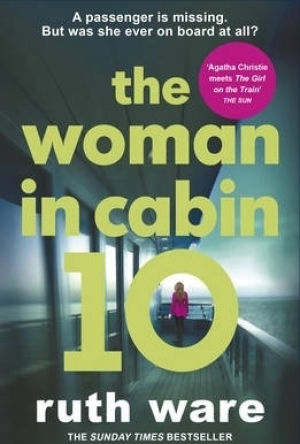


This was an interesting and suspenseful thriller. I agree with the comparisons to an Agatha Christie novel: with the setting of the novel being a ship, you have a limited cast of characters (and suspects), which heightens some of the intrigue. Ware does an excellent job of setting the scene, and you can practically feel yourself trapped in this opulent yet slightly claustrophobic, endlessly rocking luxury cruise-liner. Lo is set up rather quickly as unreliable narrator: she's clearly anxious after her break-in, prone to drinking, and reeling from a lack of sleep. Therefore, from the outset, we're not sure if we can trust what we're reading or what seems to be unfolding on this ship. One of my favorite things about this novel is that it certainly keeps you guessing -- I was constantly coming up with (and discarding) various theories as I read, placing blame on a new character every few chapters. And, of course, always harboring that seed of doubt that Lo just made the entire thing up. While we hear entirely from Lo, Ware places a few newspaper stories at the end of each chapter, which just add to your doubt and confusion.
As for Lo, she's not the most enjoyable of main characters and due to our limited set of characters, we don't have many others, so most of the tale hinges on her. She's a bit annoying and whiny and prone to overthinking and bad decisions. She can get frustrating at times, to say the least. The story itself isn't really creepy or spooky, but it's definitely interesting and, as I said, keeps you guessing until nearly the very end. A few of the plot points seem a bit haphazard, as if things were just jammed together randomly into the story, but I suppose they all work together at the end.
Overall, this is certainly an engaging and suspenseful thriller. If you enjoy a fast-paced whodunnit, this one is for you. 3.5 stars.
Kristy H (1252 KP) rated Best Intentions in Books
Feb 13, 2018
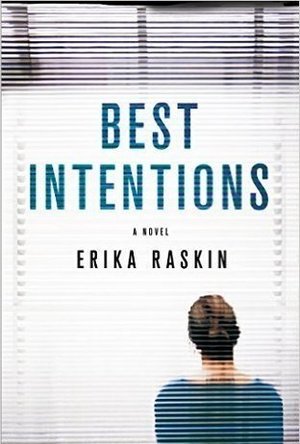

<i>This was an interesting novel, to say the least.</i> I was immediately drawn to it, as the author apparently lives in Charlottesville, my hometown. This book is set in Richmond, VA, and she certainly captures the area and the state quite well.
The book is told entirely from Marti's perspective and it takes a little while to fall into the pattern of reading, as present-tense and past-tense are presented together in the chapters without any break (at least they were in my ARC), leaving you a bit confused at first. The back and forth can be a little awkward and jarring in the beginning, though once you get used to it, it's a pretty compelling device. The novel isn't exactly exciting in a thriller-type way, but there's <i>a fascinating element to it that keeps you reading.</i>
There's a lot going on in this book--marital issues, a discussion on hospital policies, Marti juggling work and motherhood, investigative journalism, discussion into Richmond politics, etc. Sometimes it seems a little too much: did Marti really need to be the daughter of a Congressman, for instance?
Still, Raskin is a descriptive writer, and her prose is fairly easy to read, and again, as I mentioned, it's a hard-to-put down book. She had me from nearly the beginning, when she described one of the characters as "Tommy Lee Jones in his heyday cute." (She gets me, she really gets me, I thought!)
As the novel progresses, I found it almost Jodi Picoult-esque. There's a strong emphasis on character development, courtroom drama, and plot elements designed to make you think. Sure, the characters are drawn a bit black and white--Elliot bad, Marti good, but it works: Elliot is just so awful you cannot help but like Marti even more. Did I find the novel quite as persuasive and enjoyable as Picoult in her heyday? No. But that's pretty hard to do.
Overall, I enjoyed this one. It's descriptive, oddly compelling, and was a nice change of pace from the thrillers I've been reading lately. Definitely worth a read. I'd go with around 3.75 stars, rounded up to 4 here.
I received a copy of this novel from the publisher and Netgalley (thank you!); it is available everywhere as of 08/15/2017.
<center><a href="http://justacatandabookatherside.blogspot.com/">Blog</a>; ~ <a href="https://twitter.com/mwcmoto">Twitter</a>; ~ <a href="https://www.facebook.com/justacatandabook/">Facebook</a>; ~ <a href="https://plus.google.com/u/0/+KristyHamiltonbooks">Google+</a>; ~ <a href="https://www.instagram.com/justacatandabook/">Instagram</a>; </center>

Emma @ The Movies (1786 KP) rated A Private War (2018) in Movies
Jun 22, 2019 (Updated Sep 25, 2019)
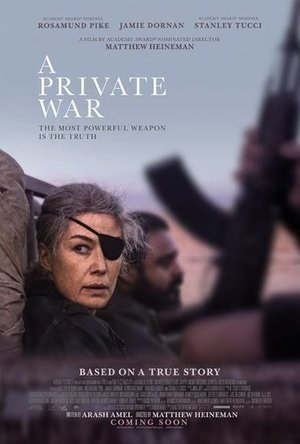

One thing I'd noted during the film was just how real the acting felt from the civilians. The reason for that (as discovered in the Q&A) was because they were actual civilians who had their lives changed by war. The moments they had on screen had an amazing impact before you even discovered that fact.
The acting talent in this does an amazing job. Tom Hollander and Corey Johnson bring us solid supporting roles, and there's a nice surprise of Stanley Tucci too. I'm only seen Jamie Dornan in last year's Robin Hood and he was reasonable in that, his appearance in A Private War is good but against all the other things happening it's not making it into my top ten things about the film.
Now... Rosamund Pike... there's no denying she's a wonderful actress and this role must have been so difficult to get right. Intensity and compassion when she's in the field and interviewing, to the sadness and emotion when she is home and struggling with her situation, Pike covers pretty much everything. There's only one moment where I didn't feel the connection to the character. Marie opens up to Paul in what feels like it should be an emotional scene but when it cuts out to the next one I was surprised that it didn't really hit as well as everything else did.
I loved the way they used subtitles in this, or rather didn't. When we see Marie talking her way through a roadblock the suspense is everywhere, there's no instant translation and that coupled with some great camera work gives you that feeling of mild panic along with the characters.
I wasn't entirely sure what I was getting myself into when I booked a ticket for this. I even had to pay for it as it was classified as an event rather than a film (which I thought was a little cheeky considering none of the other Q&A screenings I've been to have been) but it was £6 well spent.
We also get treated to hearing Annie Lennox's creation, Requiem For A Private War. Atmospheric and haunting, the song made me pause, her instantly recognisable voice hits the right tone for the film.
What you should do
When this comes out on February 15th you should definitely go and see it. It's an interesting creation and shows you a side of journalism that many have probably never even thought about.
Movie thing you wish you could take home
I've got a bathtub that Stanley Tucci is more than welcome to come and sit in... I know I've just brought the tone of this would review down with this but I don't care.

Writers' Forum Magazine
Book and Magazines & Newspapers
App
Writers’ Forum is the markets leading title for writers. Every issue features special interviews...
The Everybody Writes: Your Go-to Guide to Creating Ridiculously Good Content
Ann Handley and Vahe Habeshian
Book
Finally a go-to guide to creating and publishing the kind of content that will make your business...

Boxing Monthly Magazine - The boxing magazine for fight fans around the world
Sports and Magazines & Newspapers
App
Boxing Monthly is a magazine. THIS IS NOT A GAME if that's what you want go elsewhere. If you are a...


Lottie disney bookworm (1056 KP) rated The Magic of Terry Pratchett in Books
May 27, 2020
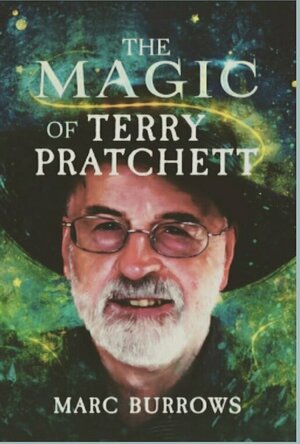
As a 32 year old female, mother and accountant you may be forgiven for expecting my book reviews to be based around chick-lit or classical novels and, although it is the case that I own several very well-read copies of Pride & Prejudice, I am wholly a child of the sci-fi/fantasy genre. Terry Pratchett novels sit alongside George RR Martin, Terry Brooks, David Eddings and Ursula Le Guin in my house; I owned and loved Discworld computer games and probably know every word to the film Labyrinth.
It could therefore be said that I would find Marc Burrow’s biography fascinating regardless: however, I am ashamed to say that, before reading this book, I knew very little about the life of the author whose books I admire so much.
Burrows structures his writing predictably enough, running through the life of Terry Pratchett chronologically, from his working-class upbringing; his career in journalism; the progression in popularity of his novels; his knighthood all the way up to his untimely death from Alzheimer’s. However, this is where an affiliation to any standard biography ends.
It is immediately apparent that Marc Burrows is an avid Terry Pratchett fan, even without reading his foreword, due to the inclusion of footnotes: a writing style which is synonymous with Pratchett. This allows Burrows, as it did with Pratchett, to provide little notes and details which cannot be in the main text without limiting the reading experience. It also allows both authors to inject a large amount of humour into their writing.
It should also be mentioned that no book has gripped me from the introduction in a long time, although I am fairly sure no other book would use the word “crotch” before we even reach Chapter One!
‘The Magic of Terry Pratchett’ is a clever, well-informed biography which perfectly encompasses the humour of the Discworld creator whilst educating the reader of his journey to becoming the icon that he is today. I have no doubt that this has been a labour of love for Marc Burrows: when the kindle says you have 20 minutes reading time left and you have reached the bibliography, you know that a whole lot of research has been done!
Sir Terry also had the tendency to embellish his stories and this is a factor Burrows does not try to hide; highlighting when facts don't quite add up and almost analysing the situation to try and discern the truth. This was such a refreshing approach to a biography: the wool is not pulled over the eyes of the reader, nor the subject blindly believed for convenience.
It is important to note that this book transgresses the existence of Discworld and “the business with the elephant” and encompasses all of Sir Terry’s work: from short stories in the local paper to his TV documentary on assisted death.
The reader will also learn of the involvement of Rhianna Pratchett in her father’s work and discover that the “man in the hat” was not always the easiest man to work with.
I am going to need at least 3 copies upon release- can we preorder?
Starting Up on Your Own: How to Succeed as an Independent Consultant or Freelance
Book
"I wish this book had been available when I began my independent career. There's only one word for...