
Search

Chris Sawin (602 KP) rated The Midnight Meat Train (2008) in Movies
Jun 19, 2019
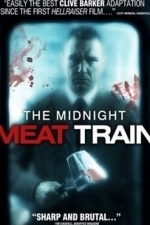


Step Away from the Meat
The Midnight Meat Train is a horror film based on the short story of the same name written by Clive Barker. The story was published in the first volume of Barker’s Books of Blood short story collection. The Books of Blood totaled six volumes with four to five stories in each volume and were published between 1984 and 1985. The first volume made Barker an overnight success with Stephen King hailing Barker as, “the future of horror.”
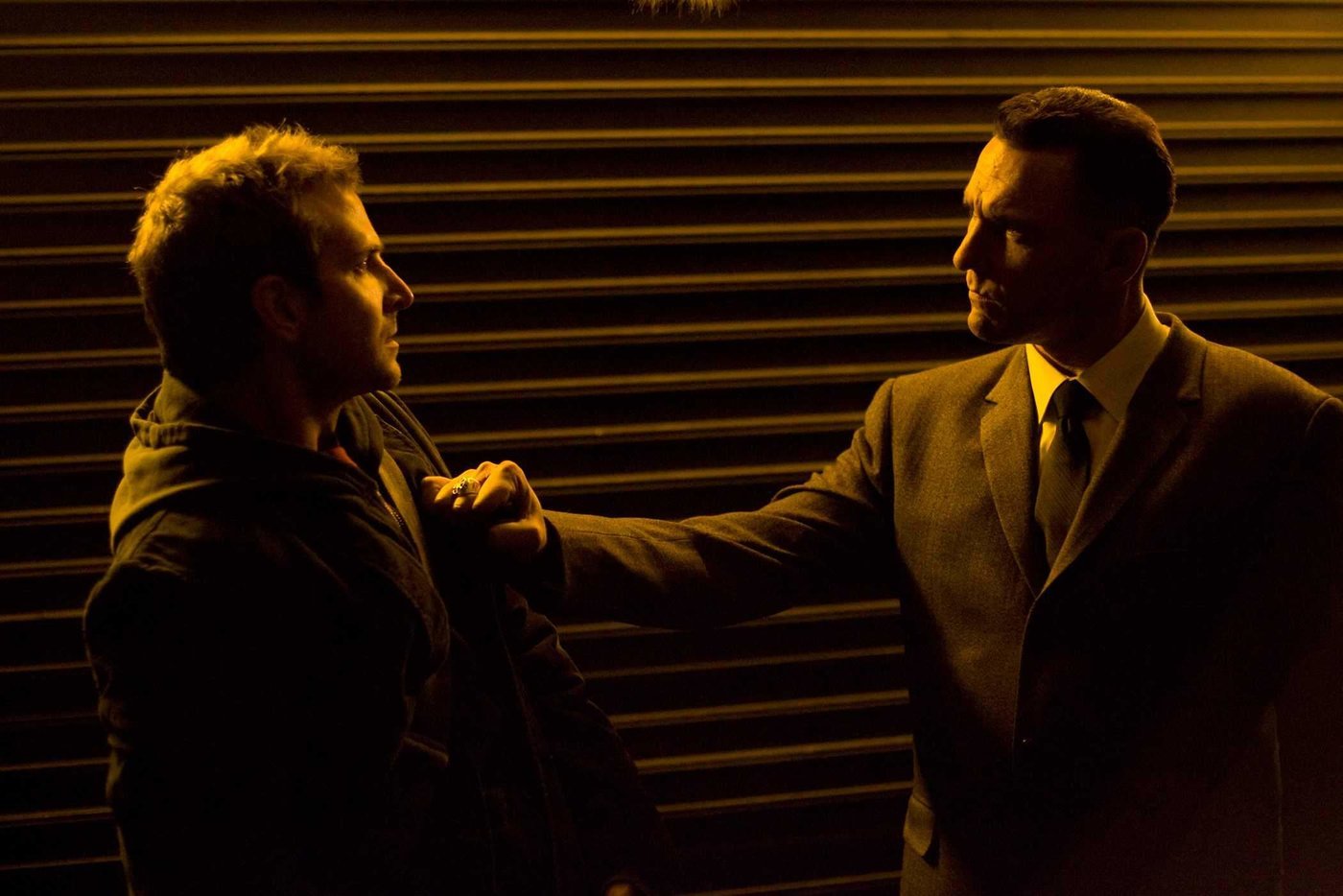
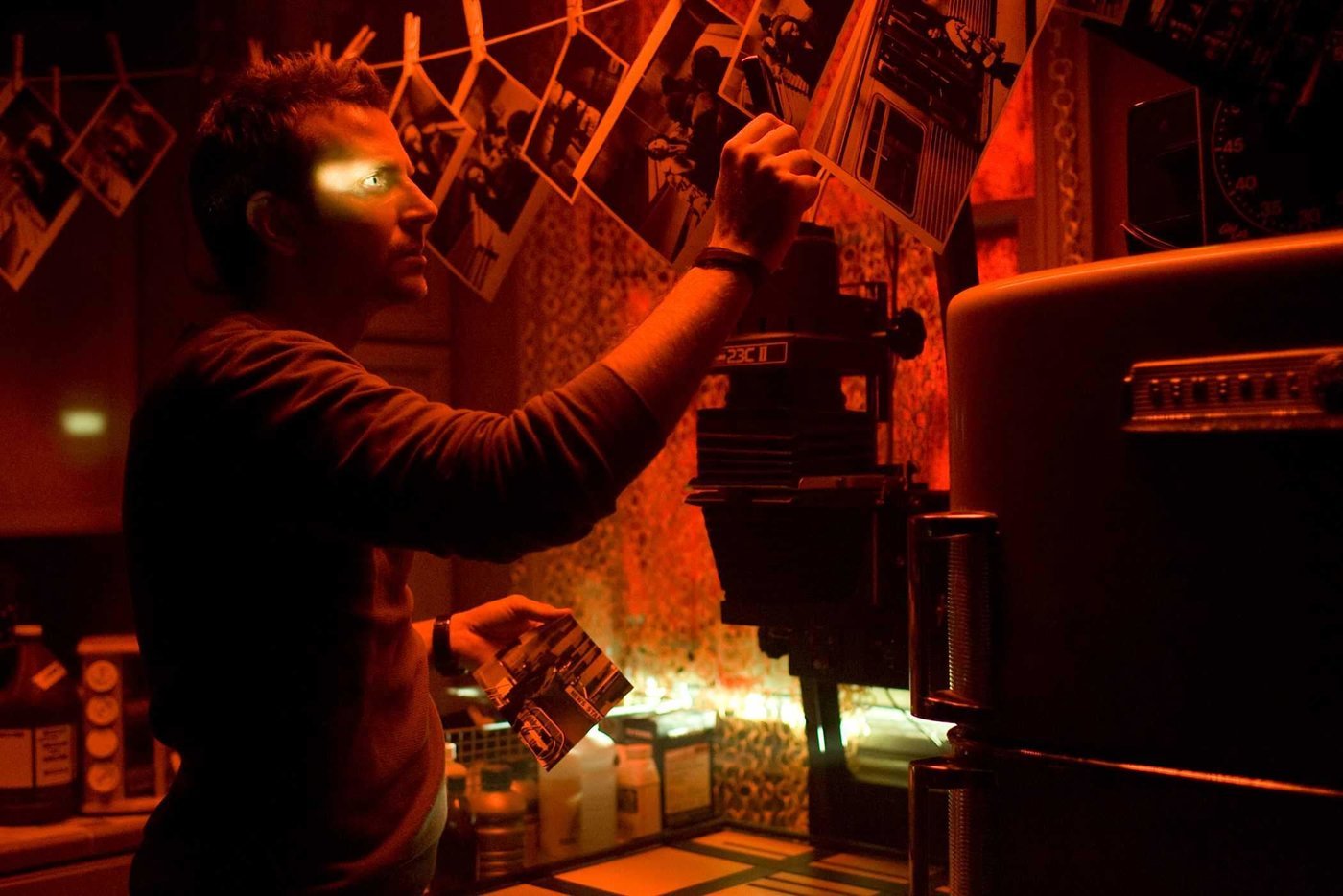
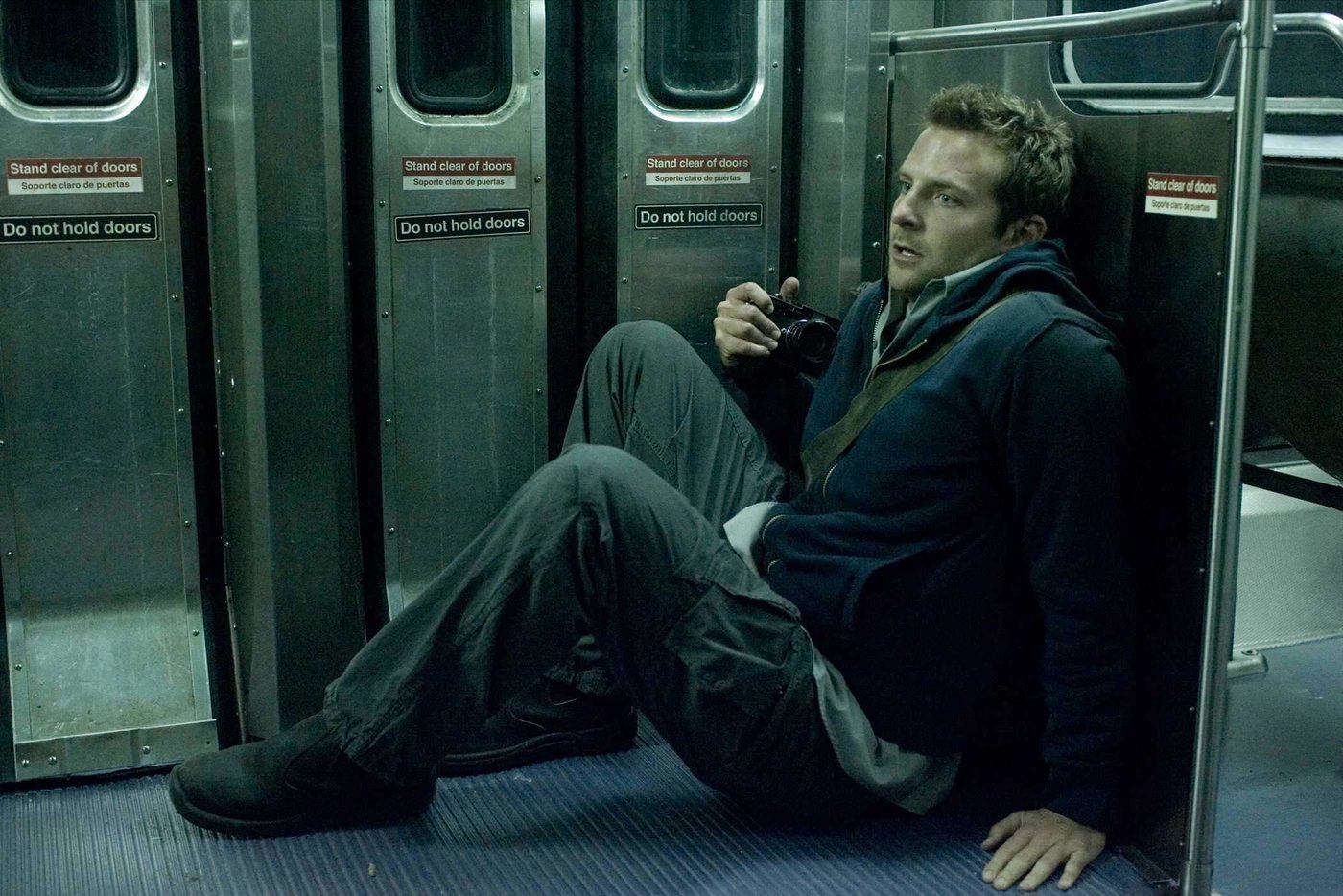
The screenplay for the 2008 film was written by Jeff Buhler (writer for the 2019 remakes of Jacob’s Ladder, Pet Sematary, and The Grudge) and directed by Ryuhei Kitamura (Versus, Godzilla: Final Wars). Bradley Cooper stars as a struggling photographer named Leon Kauffman. While he’s secured a job as a photographer, he hasn’t been recognized as a professional just yet. But Leon has a meeting with a professional artist named Susan Hoff (Brooke Shields) that could potentially change his career status. In Leon’s eyes, he doesn’t think that any other photographer has really captured the heart of the city and that’s what he aims to do with his work. However, Susan’s criticism is that Leon is failing at his dream and to only see her again once he finds what he’s looking for.
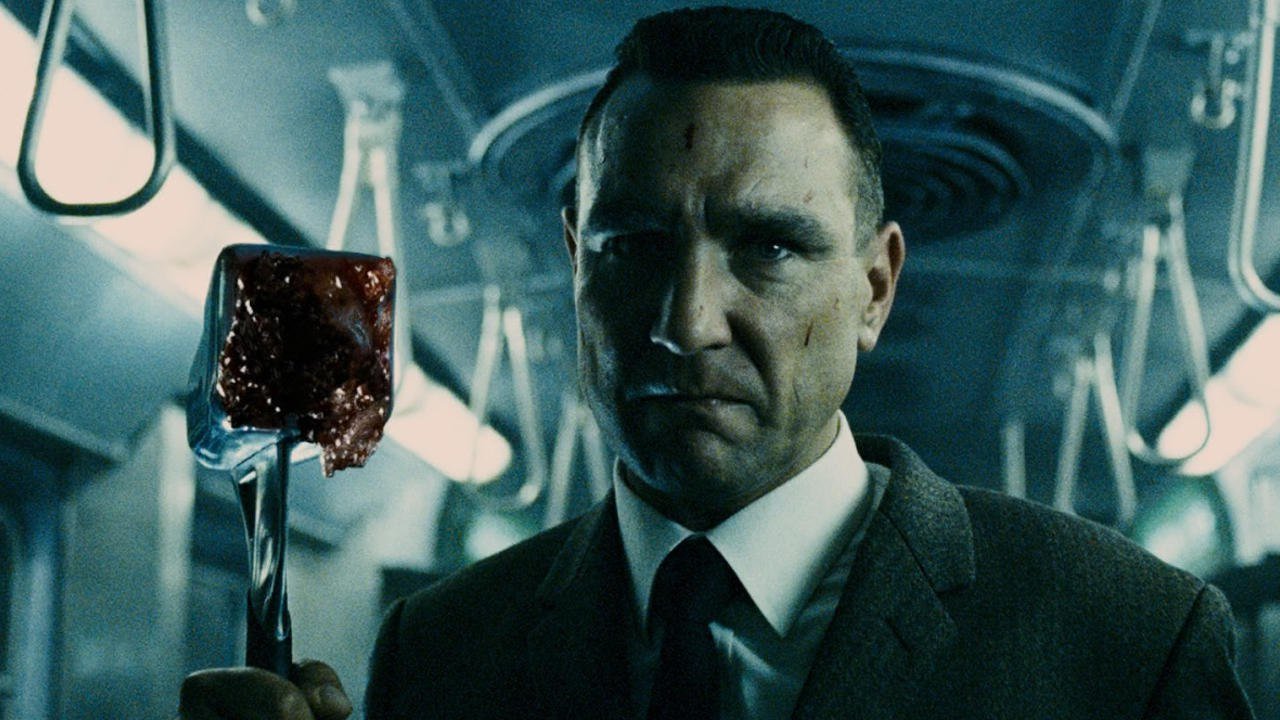
Leon confronts some thugs during a mugging and documents the ordeal with his camera. The pictures impress Susan and she tells Leon that he’ll be featured in her next show if he brings her two more shots like the newest ones. Leon encounters Mahogany (Vinnie Jones), a butcher that works at a meat packing plant. Leon develops an obsession over Mahogany and stalks him constantly while photographing him wherever he goes. Leon suspects that Mahogany and the train he takes so late at night are the cause for so many missing people over the past three years. Leon doesn’t know how these people disappear until he follows Mahogany onto the train one fateful evening. But this operation is much more complex and dangerous than Leon first realized and his life is forever altered because of it.
This is one of the few times where the short story that inspired the film was read before seeing it. This is coming from someone who is a sporadic reader at best, but Clive Barker has been a personal favorite author for as long as this cynically bonkers brain can remember. Most of the films based on Clive Barker’s works come from The Books of Blood; Book of Blood (Volume One), Dread (Volume Two), Rawhead Rex (Volume Three), Quicksilver Highway (Volume Four, “The Body Politik”), Candyman (Volume Five, “The Forbidden”), and Lord of Illusions (Volume Six, “The Last Illusion”). Barker has always been able to build these incredibly terrifying worlds in his writing with demented characters while maintaining this richly horrifying atmosphere. Thinking so highly of Barker and admiring his work so much made expectations a little high for this film. This is also Ryuhei Kitamura’s first American and English-speaking film. The Midnight Meat Train is one of the few times where the final product actually exceeded expectations.
The Midnight Meat Train pays more attention to blood, gore, and thrills than actually attempting to be scary. The kills in the film are exceptional and director of photography Jonathan Sela (John Wick, Atomic Blonde, Deadpool 2) delivers some incredibly captivating cinematography. There’s a scene where Mahogany knocks a woman’s head off her shoulders with his mallet that he’s always carrying around, but you see it all from her perspective; she puts her hands up as a last defense before the final blow, the room spins, the camera focuses on Mahogany and the headless corpse, he lowers his mallet as she blinks a few times, and the camera pans out from her eyeball to show her severed head.
Vinnie Jones has an overwhelming and powerful performance in The Midnight Meat Train. He doesn’t have much in the way of dialogue, but he makes a massive impact on screen because of his enormous presence. The English actor is 6’2”, so you’re already drawn to this big guy when he enters a room anyway, but give him a gigantic meat mallet and a desire to kill and he evolves into this unstoppable monster that many would consider frightening. Jones knows how to utilize his facial expressions and body language in a way that says more than any string of dialogue would.
The one issue with the film is that every person seemed to be able to sense when somebody else was behind them. While it made for some intriguing camera shots, the execution killed whatever attempts at suspense The Midnight Meat Train was going for. It would have been more satisfying to see at least one person get shanked or clocked in the temple without expecting it.
The Midnight Meat Train is a relentless gorefest that remains true to its source material. The horror film is worth a watch for any fan of Clive Barker’s work or horror films in general. There was this sinking gut feeling that the film wouldn’t keep the ending in tact since it seemed like it wouldn’t translate well on-screen. Without giving too much away, the ending is completely satisfying to those who are familiar with the short story. This is a remarkably excellent horror film that fails to get the recognition it deserves.
The Midnight Meat Train is currently streaming on Amazon Prime, YouTube, and Google Play for $1.99, on Vudu for $2.99, and iTunes for $3.99. The Multi-Format Blu-ray (which is the unrated director’s cut version of the film) is currently $6.50 with prime shipping on Amazon Prime and the DVD is running for $9.99 with prime shipping. On eBay, the pre-owned DVD is $4.58, the brand new DVD is $8.49, and the new Multi-Format Blu-ray is $10.98 and all three have free shipping.
The screenplay for the 2008 film was written by Jeff Buhler (writer for the 2019 remakes of Jacob’s Ladder, Pet Sematary, and The Grudge) and directed by Ryuhei Kitamura (Versus, Godzilla: Final Wars). Bradley Cooper stars as a struggling photographer named Leon Kauffman. While he’s secured a job as a photographer, he hasn’t been recognized as a professional just yet. But Leon has a meeting with a professional artist named Susan Hoff (Brooke Shields) that could potentially change his career status. In Leon’s eyes, he doesn’t think that any other photographer has really captured the heart of the city and that’s what he aims to do with his work. However, Susan’s criticism is that Leon is failing at his dream and to only see her again once he finds what he’s looking for.
Leon confronts some thugs during a mugging and documents the ordeal with his camera. The pictures impress Susan and she tells Leon that he’ll be featured in her next show if he brings her two more shots like the newest ones. Leon encounters Mahogany (Vinnie Jones), a butcher that works at a meat packing plant. Leon develops an obsession over Mahogany and stalks him constantly while photographing him wherever he goes. Leon suspects that Mahogany and the train he takes so late at night are the cause for so many missing people over the past three years. Leon doesn’t know how these people disappear until he follows Mahogany onto the train one fateful evening. But this operation is much more complex and dangerous than Leon first realized and his life is forever altered because of it.
This is one of the few times where the short story that inspired the film was read before seeing it. This is coming from someone who is a sporadic reader at best, but Clive Barker has been a personal favorite author for as long as this cynically bonkers brain can remember. Most of the films based on Clive Barker’s works come from The Books of Blood; Book of Blood (Volume One), Dread (Volume Two), Rawhead Rex (Volume Three), Quicksilver Highway (Volume Four, “The Body Politik”), Candyman (Volume Five, “The Forbidden”), and Lord of Illusions (Volume Six, “The Last Illusion”). Barker has always been able to build these incredibly terrifying worlds in his writing with demented characters while maintaining this richly horrifying atmosphere. Thinking so highly of Barker and admiring his work so much made expectations a little high for this film. This is also Ryuhei Kitamura’s first American and English-speaking film. The Midnight Meat Train is one of the few times where the final product actually exceeded expectations.
The Midnight Meat Train pays more attention to blood, gore, and thrills than actually attempting to be scary. The kills in the film are exceptional and director of photography Jonathan Sela (John Wick, Atomic Blonde, Deadpool 2) delivers some incredibly captivating cinematography. There’s a scene where Mahogany knocks a woman’s head off her shoulders with his mallet that he’s always carrying around, but you see it all from her perspective; she puts her hands up as a last defense before the final blow, the room spins, the camera focuses on Mahogany and the headless corpse, he lowers his mallet as she blinks a few times, and the camera pans out from her eyeball to show her severed head.
Vinnie Jones has an overwhelming and powerful performance in The Midnight Meat Train. He doesn’t have much in the way of dialogue, but he makes a massive impact on screen because of his enormous presence. The English actor is 6’2”, so you’re already drawn to this big guy when he enters a room anyway, but give him a gigantic meat mallet and a desire to kill and he evolves into this unstoppable monster that many would consider frightening. Jones knows how to utilize his facial expressions and body language in a way that says more than any string of dialogue would.
The one issue with the film is that every person seemed to be able to sense when somebody else was behind them. While it made for some intriguing camera shots, the execution killed whatever attempts at suspense The Midnight Meat Train was going for. It would have been more satisfying to see at least one person get shanked or clocked in the temple without expecting it.
The Midnight Meat Train is a relentless gorefest that remains true to its source material. The horror film is worth a watch for any fan of Clive Barker’s work or horror films in general. There was this sinking gut feeling that the film wouldn’t keep the ending in tact since it seemed like it wouldn’t translate well on-screen. Without giving too much away, the ending is completely satisfying to those who are familiar with the short story. This is a remarkably excellent horror film that fails to get the recognition it deserves.
The Midnight Meat Train is currently streaming on Amazon Prime, YouTube, and Google Play for $1.99, on Vudu for $2.99, and iTunes for $3.99. The Multi-Format Blu-ray (which is the unrated director’s cut version of the film) is currently $6.50 with prime shipping on Amazon Prime and the DVD is running for $9.99 with prime shipping. On eBay, the pre-owned DVD is $4.58, the brand new DVD is $8.49, and the new Multi-Format Blu-ray is $10.98 and all three have free shipping.

Purple Phoenix Games (2266 KP) rated Crazier Eights: Pantheon in Tabletop Games
Aug 25, 2020

DISCLAIMER: We have previously previewed Crazier Eights: Olympus, and this preview has much of the same verbiage as the two games share most things. Near the end of the preview are my thoughts about the differences in Pantheon vs Olympus. We will also be previewing Crazier Eights: Camelot, and that will also detail the differences between the other sets we have tried.
War. Old Maid. Go Fish. Crazy Eights. These are classic card games we probably all grew up playing. There have been many re-themes and new difficulty layers spread upon them to make them even more interesting. While UNO certainly has cornered the market on the Crazy Eights base, we have a new contender: Crazier Eights. Recoculous has published several versions of this card game with different themes: Camelot, Avalon, One Thousand & One Nights, Olympus, and Shahrzad. Today we are taking a preview of Crazier Eights: Pantheon.
You HAVE played Crazy Eights right? The card game where you attempt to be the first to exhaust your hand of cards, but you can only play down if you can match the suit or number on top of the discard pile? And if you can’t, you throw down an 8 as a wild and call the color to be played next? Well there you have the easy rules. Crazier Eights: Pantheon (which I will from here call C8P) holds basically the same rule-set with a few new mechanics and a theme. The win condition is still the same: be the first to exhaust your hand of cards, but to win you will need to play your hand strategically against your opponents.
DISCLAIMER: We were provided a copy of this game for the purposes of this review. This is a retail copy of the game, so what you see in these photos is exactly what would be received in your box. I do not intend to cover every single rule included in the rulebook, but will describe the overall game flow and major rule set so that our readers may get a sense of how the game plays. For more in depth rules, you may purchase a copy online or from your FLGS. -T
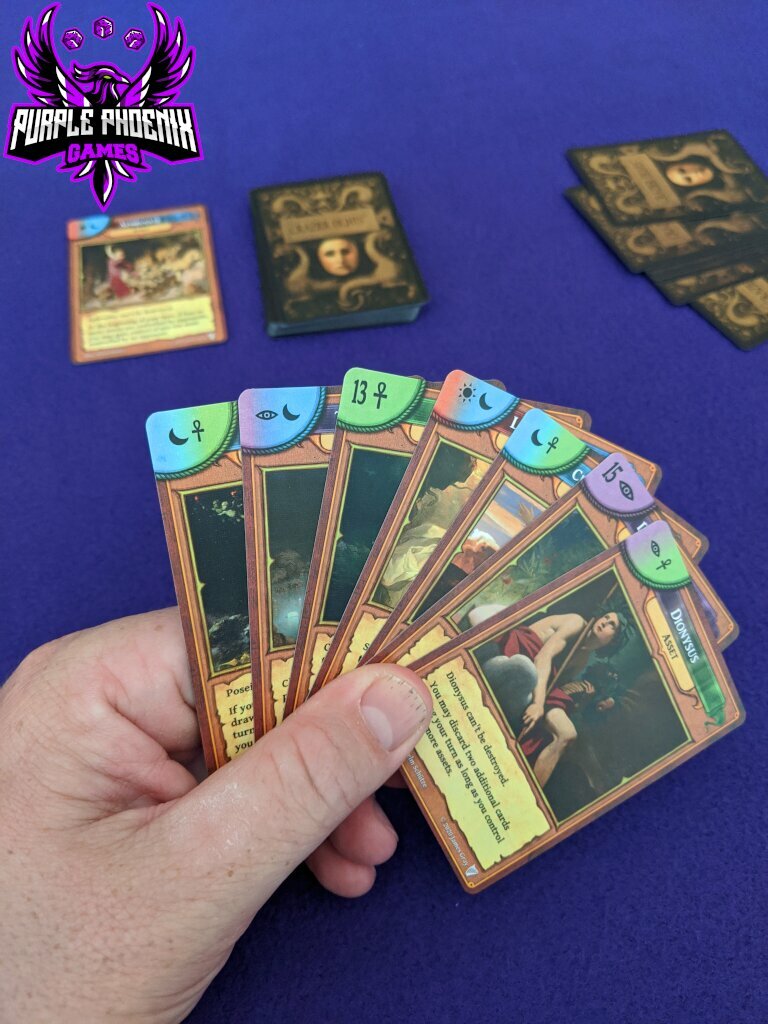
To setup, shuffle the large deck of cards and place the deck in the middle of the table. Flip the top card to begin the discard pile and dictate the first card play. Deal each player seven cards and you are ready to begin!
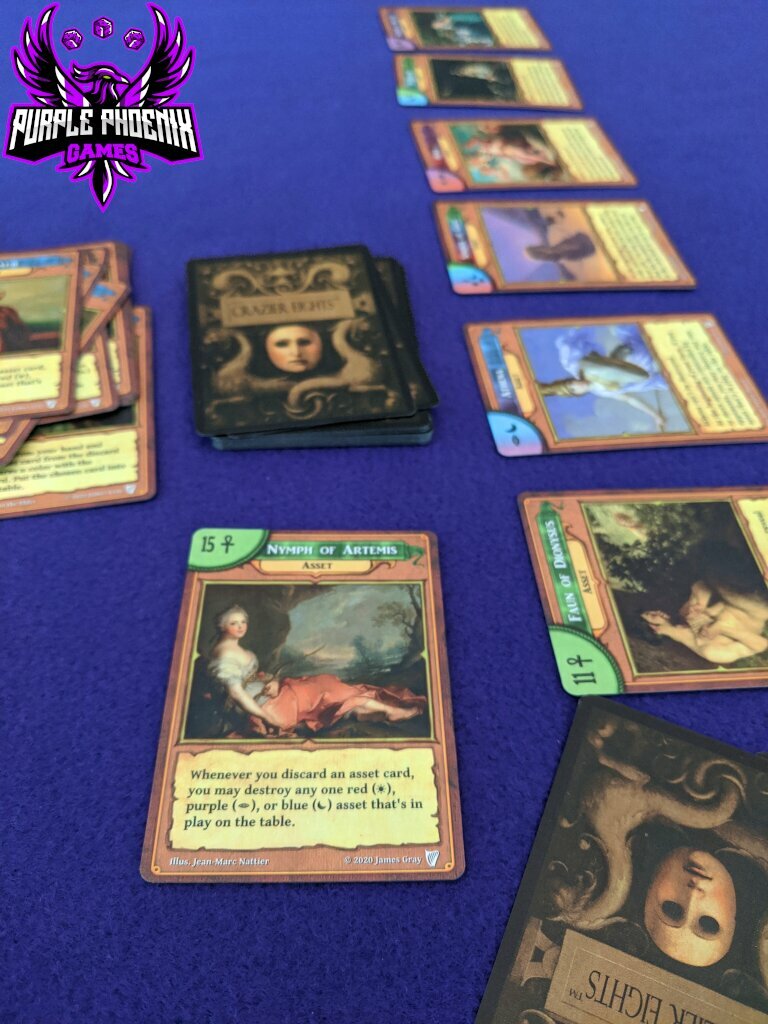
The turn structure is familiar: check for any “start of turn” effects and apply them, draw a card, play and/or discard a card, then resolve any “end of turn” effects. The deck is comprised of Events and Assets in different colors (suits) and numbers like in a typical deck of playing cards. After checking and resolving start of turn effects on Asset cards in your personal tableau, you must draw a card from the deck. This is where C8P strays from OG Crazy Eights a bit. You may play a card from your hand (Assets and Events) and discard a card to the discard pile (matching the suit/number/or an Eight), or simply play a card from your hand without discarding. Cards played from your hand can be Event cards that are played, resolved, and then discarded to the bottom of the discard pile, or an Asset card that is played to your tableau that cause chain reactions or other abilities on future turns. Next, resolve any end of turn effects from Assets in your tableau before the next player begins their turn.
Play continues in this fashion until one player has rid themselves of their hand and is crowned the Master of the Pantheon! Or at least, the winner of the game.
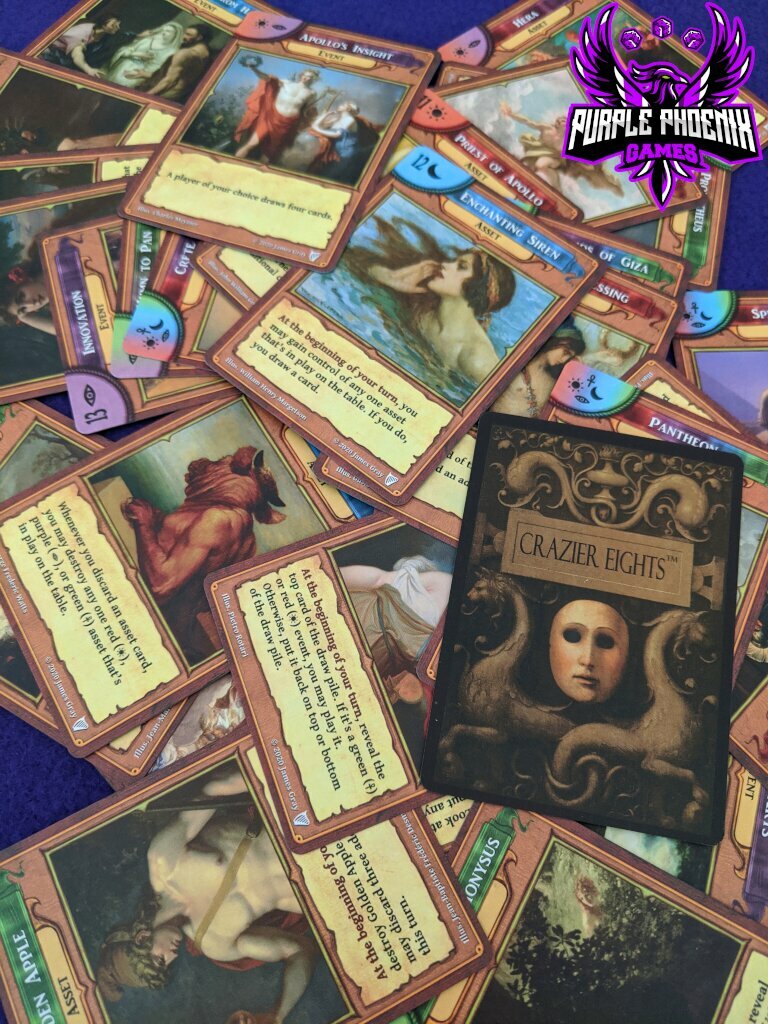
Components. This game is a box full of cards. The cards are good. The layout makes sense, and the art on the faces of the cards remind me of very classic art depicting ancient Grecian scenes. I am no art historian, so I do not know if they are existing art pieces or new ones crafted for this game, but either way, they are a joy to behold… if you can spend the time appreciating the art instead of tracking what cards you need to play and what effects you can chain together (that was me). Extra points to the Recoculous team for associating symbols with the different suit colors for our colorblind friends. This is something that unfortunately goes unaddressed far too often.
This implementation is the second Crazier Eights we have had the chance to try, and I can say that we really enjoyed our plays of it (we played Olympus first and will be playing Camelot soon). The game comes with many interesting and varied effects to craft an ingenious strategy, and the art is stellar. Beware of playing with AP-prone gamers, as there is a lot going on and it is more than just a skinned Crazy Eights.
The Pantheon set, specifically, seems to contain more cards that allow players to steal Assets from other players, and also cards that allow players to discard more than one card each turn. These are very interesting adjustments to our first experience of Crazier Eights, and from what we were told, Pantheon can be played as a standalone OR as an expansion to throw into any other set. There are less cards in Pantheon than in Olympus or Camelot (and the other base sets I assume), but the gameplay is the same, and is super quick.
Now having played this family of games several times, I can say that it is my favorite Crazy Eights derivative and certainly worthy of a look. If your game collection is sorely lacking in ancient Greek-themed card games, or if you want a hybrid game of old school rules with interesting twists, then do consider purchasing this or one of its predecessors.
PS – Don’t worry if, while you are playing, you have all your Assets stolen or destroyed. I have won the game with zero Assets in front of me while opponents have had eight, ironically. Assets are great, but you still need to shed your hand.
War. Old Maid. Go Fish. Crazy Eights. These are classic card games we probably all grew up playing. There have been many re-themes and new difficulty layers spread upon them to make them even more interesting. While UNO certainly has cornered the market on the Crazy Eights base, we have a new contender: Crazier Eights. Recoculous has published several versions of this card game with different themes: Camelot, Avalon, One Thousand & One Nights, Olympus, and Shahrzad. Today we are taking a preview of Crazier Eights: Pantheon.
You HAVE played Crazy Eights right? The card game where you attempt to be the first to exhaust your hand of cards, but you can only play down if you can match the suit or number on top of the discard pile? And if you can’t, you throw down an 8 as a wild and call the color to be played next? Well there you have the easy rules. Crazier Eights: Pantheon (which I will from here call C8P) holds basically the same rule-set with a few new mechanics and a theme. The win condition is still the same: be the first to exhaust your hand of cards, but to win you will need to play your hand strategically against your opponents.
DISCLAIMER: We were provided a copy of this game for the purposes of this review. This is a retail copy of the game, so what you see in these photos is exactly what would be received in your box. I do not intend to cover every single rule included in the rulebook, but will describe the overall game flow and major rule set so that our readers may get a sense of how the game plays. For more in depth rules, you may purchase a copy online or from your FLGS. -T
To setup, shuffle the large deck of cards and place the deck in the middle of the table. Flip the top card to begin the discard pile and dictate the first card play. Deal each player seven cards and you are ready to begin!
The turn structure is familiar: check for any “start of turn” effects and apply them, draw a card, play and/or discard a card, then resolve any “end of turn” effects. The deck is comprised of Events and Assets in different colors (suits) and numbers like in a typical deck of playing cards. After checking and resolving start of turn effects on Asset cards in your personal tableau, you must draw a card from the deck. This is where C8P strays from OG Crazy Eights a bit. You may play a card from your hand (Assets and Events) and discard a card to the discard pile (matching the suit/number/or an Eight), or simply play a card from your hand without discarding. Cards played from your hand can be Event cards that are played, resolved, and then discarded to the bottom of the discard pile, or an Asset card that is played to your tableau that cause chain reactions or other abilities on future turns. Next, resolve any end of turn effects from Assets in your tableau before the next player begins their turn.
Play continues in this fashion until one player has rid themselves of their hand and is crowned the Master of the Pantheon! Or at least, the winner of the game.
Components. This game is a box full of cards. The cards are good. The layout makes sense, and the art on the faces of the cards remind me of very classic art depicting ancient Grecian scenes. I am no art historian, so I do not know if they are existing art pieces or new ones crafted for this game, but either way, they are a joy to behold… if you can spend the time appreciating the art instead of tracking what cards you need to play and what effects you can chain together (that was me). Extra points to the Recoculous team for associating symbols with the different suit colors for our colorblind friends. This is something that unfortunately goes unaddressed far too often.
This implementation is the second Crazier Eights we have had the chance to try, and I can say that we really enjoyed our plays of it (we played Olympus first and will be playing Camelot soon). The game comes with many interesting and varied effects to craft an ingenious strategy, and the art is stellar. Beware of playing with AP-prone gamers, as there is a lot going on and it is more than just a skinned Crazy Eights.
The Pantheon set, specifically, seems to contain more cards that allow players to steal Assets from other players, and also cards that allow players to discard more than one card each turn. These are very interesting adjustments to our first experience of Crazier Eights, and from what we were told, Pantheon can be played as a standalone OR as an expansion to throw into any other set. There are less cards in Pantheon than in Olympus or Camelot (and the other base sets I assume), but the gameplay is the same, and is super quick.
Now having played this family of games several times, I can say that it is my favorite Crazy Eights derivative and certainly worthy of a look. If your game collection is sorely lacking in ancient Greek-themed card games, or if you want a hybrid game of old school rules with interesting twists, then do consider purchasing this or one of its predecessors.
PS – Don’t worry if, while you are playing, you have all your Assets stolen or destroyed. I have won the game with zero Assets in front of me while opponents have had eight, ironically. Assets are great, but you still need to shed your hand.

Hadley (567 KP) rated Frankenstein in Books
Apr 30, 2019
Great main character (1 more)
Beautiful writing
Over usage of some words (1 more)
Secondary characters have hardly a back story
In the horror genre, I have very few favorite female writers, but Mary Shelley is one of them. The way she weaves environments with character defining scenes is beautifully done in 'Frankenstein.' At the tender age of 18, Shelley was able to convey grief and loss through a single story. She created a relatable 'creature' that many readers will have pity for, but also an obsessive young man that can hardly be hated. Some people may be intimidated by the more diverse English language from the early 1800's, but, in my opinion, the story would not have had the same impact if it had been written today.
Not just horror readers will enjoy 'Frankenstein,' but also those who like to read philosophy. Shelley brings up life discerning questions that even society meddles with today. It's amazing to think that a two century old book discusses problems we still deal with.
The book begins with a sea captain that picks up a stranger that was stranded on a raft of ice, and this man has a fascinating story to tell. The entire book is a letter written by the sea captain to his sister, which he details every bit of Victor Frankenstein's several year tale. Readers get to follow Frankenstein's life from the moment his 'creature' is made to the end of his days, which traverses the globe. When Shelley begins to lull over her love of environments, she quickly picks up with character or story development that keeps our attention from wandering.
'Frankenstein' focuses on the need to be loved and accepted to live a happy existence,as well as reaching our dreams, but Shelley shows how achieving such things can cause a crushing defeat in the latter pursuit: "Night was far advanced when I came to the halfway resting-place, and seated myself beside the fountain. The stars shone at intervals, as the clouds passed from over them; the dark pines rose before me, and every here and there a broken tree lay on the ground: it was a scene of wonderful solemnity, and stirred strange thoughts within me. I wept bitterly; and clasping my hands in agony, I exclaimed, 'Oh! stars, and clouds, and winds, ye are all about to mock me: if ye really pity me, crush sensation and memory; let me become as nought; but if not, depart, depart, and leave me in darkness.' "
There are other characters we read of, including Frankenstein's best friend, Henry, and his long time love interest, Elizabeth (both of who grew up with Frankenstein). Henry comes from a well-to-do merchant family, while Elizabeth was orphaned from a wealthy family, then adopted by the Frankensteins as a future wife for Victor. Unfortunately, we learn little about them or Victor's family, that when any of them do die, it's not felt personally by the reader. There are other characters that had major events in the story, but as with the friends, they weren't developed enough to bring up any emotion at their passing.
After Frankenstein sets out after his creation,we meet the 'creature' at the top of a mountain. He is devastated that his creator hates him, and that the other humans he has met also hated him. "I expected this reception,' said the demon. 'All men hate the wretched; how, then, must I be hated, who am miserable beyond all living things! Yet you, my creator, detest and spurn me, thy creature, to whom thou art bound by ties only dissoluble by the annihilation of one of us. You purpose to kill me. How dare you sport thus with life? Do your duty towards me, and I will do mine towards you and the rest of mankind. If you will comply with my conditions, I will leave them and you at peace; but if you refuse, I will glut the maw of death, until it be satiated with the blood of your remaining friends.' "
The 'creature' gives Frankenstein an ultimatum: he either makes him a female companion or he will kill everyone Frankenstein loves and adores." 'What I ask of you is reasonable and moderate; I demand a creature of another sex, but as hideous as myself; the gratification is small, but it is all that I can receive,and it shall content me.' " Although, by this time, the 'creature' has already murdered Frankenstein's youngest brother, Victor agrees to make him a companion, but with serious regret soon after.
The majority of the story concerns Frankenstein trying fool-hardly to protect all those he loves while the 'creature' murders them one by one. The most surprising of the murders is Henry's. After Frankenstein changes his mind on making another creation, the 'creature' quickly finds Henry and kills him, but Frankenstein is accused of the murder and spends quite some time in prison for it. "But I was doomed to live; and, in two months, found myself as awaking from a dream, in a prison, stretched on a wretched bed, surrounded by gaolers, turnkeys, bolts, and all the miserable apparatus of a dungeon. "
Frankenstein is eventually released from prison when the evidence doesn't add up, and witnesses come forward, claiming to have seen Victor elsewhere at the time of the murder. Frankenstein is, at this time, in a drowning melancholy and madness, but this doesn't stop him from marrying Elizabeth. The 'creature' foretold Frankenstein that he would be with him on his wedding night, and Victor uses this to his advantage - arming himself with pistols and knives on the honeymoon. Yet, to no avail, Frankenstein is unable to outlive or outsmart the 'creature' at any turn.
'Frankenstein' is a must-read for all readers. Although many horror stories today pertain to a creature killing it's master, none of them can reach the grief stricken peaks as Shelley has. Every passage in this book reads like poetry. Every interaction between Frankenstein and his 'creature' is fascinating to the reader. And, before Frankenstein dies, he leaves the sea captain with words of wisdom that even readers could benefit from: "Seek happiness in tranquillity and avoid ambition, even if it be only the apparently innocent one of distinguishing yourself in science and discoveries."
Highly recommend!
Not just horror readers will enjoy 'Frankenstein,' but also those who like to read philosophy. Shelley brings up life discerning questions that even society meddles with today. It's amazing to think that a two century old book discusses problems we still deal with.
The book begins with a sea captain that picks up a stranger that was stranded on a raft of ice, and this man has a fascinating story to tell. The entire book is a letter written by the sea captain to his sister, which he details every bit of Victor Frankenstein's several year tale. Readers get to follow Frankenstein's life from the moment his 'creature' is made to the end of his days, which traverses the globe. When Shelley begins to lull over her love of environments, she quickly picks up with character or story development that keeps our attention from wandering.
'Frankenstein' focuses on the need to be loved and accepted to live a happy existence,as well as reaching our dreams, but Shelley shows how achieving such things can cause a crushing defeat in the latter pursuit: "Night was far advanced when I came to the halfway resting-place, and seated myself beside the fountain. The stars shone at intervals, as the clouds passed from over them; the dark pines rose before me, and every here and there a broken tree lay on the ground: it was a scene of wonderful solemnity, and stirred strange thoughts within me. I wept bitterly; and clasping my hands in agony, I exclaimed, 'Oh! stars, and clouds, and winds, ye are all about to mock me: if ye really pity me, crush sensation and memory; let me become as nought; but if not, depart, depart, and leave me in darkness.' "
There are other characters we read of, including Frankenstein's best friend, Henry, and his long time love interest, Elizabeth (both of who grew up with Frankenstein). Henry comes from a well-to-do merchant family, while Elizabeth was orphaned from a wealthy family, then adopted by the Frankensteins as a future wife for Victor. Unfortunately, we learn little about them or Victor's family, that when any of them do die, it's not felt personally by the reader. There are other characters that had major events in the story, but as with the friends, they weren't developed enough to bring up any emotion at their passing.
After Frankenstein sets out after his creation,we meet the 'creature' at the top of a mountain. He is devastated that his creator hates him, and that the other humans he has met also hated him. "I expected this reception,' said the demon. 'All men hate the wretched; how, then, must I be hated, who am miserable beyond all living things! Yet you, my creator, detest and spurn me, thy creature, to whom thou art bound by ties only dissoluble by the annihilation of one of us. You purpose to kill me. How dare you sport thus with life? Do your duty towards me, and I will do mine towards you and the rest of mankind. If you will comply with my conditions, I will leave them and you at peace; but if you refuse, I will glut the maw of death, until it be satiated with the blood of your remaining friends.' "
The 'creature' gives Frankenstein an ultimatum: he either makes him a female companion or he will kill everyone Frankenstein loves and adores." 'What I ask of you is reasonable and moderate; I demand a creature of another sex, but as hideous as myself; the gratification is small, but it is all that I can receive,and it shall content me.' " Although, by this time, the 'creature' has already murdered Frankenstein's youngest brother, Victor agrees to make him a companion, but with serious regret soon after.
The majority of the story concerns Frankenstein trying fool-hardly to protect all those he loves while the 'creature' murders them one by one. The most surprising of the murders is Henry's. After Frankenstein changes his mind on making another creation, the 'creature' quickly finds Henry and kills him, but Frankenstein is accused of the murder and spends quite some time in prison for it. "But I was doomed to live; and, in two months, found myself as awaking from a dream, in a prison, stretched on a wretched bed, surrounded by gaolers, turnkeys, bolts, and all the miserable apparatus of a dungeon. "
Frankenstein is eventually released from prison when the evidence doesn't add up, and witnesses come forward, claiming to have seen Victor elsewhere at the time of the murder. Frankenstein is, at this time, in a drowning melancholy and madness, but this doesn't stop him from marrying Elizabeth. The 'creature' foretold Frankenstein that he would be with him on his wedding night, and Victor uses this to his advantage - arming himself with pistols and knives on the honeymoon. Yet, to no avail, Frankenstein is unable to outlive or outsmart the 'creature' at any turn.
'Frankenstein' is a must-read for all readers. Although many horror stories today pertain to a creature killing it's master, none of them can reach the grief stricken peaks as Shelley has. Every passage in this book reads like poetry. Every interaction between Frankenstein and his 'creature' is fascinating to the reader. And, before Frankenstein dies, he leaves the sea captain with words of wisdom that even readers could benefit from: "Seek happiness in tranquillity and avoid ambition, even if it be only the apparently innocent one of distinguishing yourself in science and discoveries."
Highly recommend!
Purple Phoenix Games (2266 KP) rated Crazier Eights: Camelot in Tabletop Games
Dec 23, 2020

DISCLAIMER: We have previously reviewed Crazier Eights: Olympus and Crazier Eights: Pantheon, and this preview has much of the same verbiage as the family of games share most things. Near the end of the preview are my thoughts about the differences in Camelot vs Olympus and Pantheon.
War. Old Maid. Go Fish. Crazy Eights. These are classic card games we probably all grew up playing. There have been many re-themes and new difficulty layers spread upon them to make them even more interesting. While UNO certainly has cornered the market on the Crazy Eights base, we have a new contender: Crazier Eights. Recoculous has published several versions of this card game with different themes: Avalon, One Thousand & One Nights, Olympus, and Shahrzad. Today we are taking a preview of Crazier Eights: Camelot.
You HAVE played Crazy Eights right? The card game where you attempt to be the first to exhaust your hand of cards, but you can only play down if you can match the suit or number on top of the discard pile? And if you can’t, you throw down an 8 as a wild and call the color to be played next? Well there you have the easy rules. Crazier Eights: Camelot (which I will from here call C8C) holds basically the same rule-set with a few new mechanics and a theme. The win condition is still the same: be the first to exhaust your hand of cards, but to win you will need to play your hand strategically against your opponents.
DISCLAIMER: We were provided a copy of this game for the purposes of this review. This is a retail copy of the game, so what you see in these photos is exactly what would be received in your box. I do not intend to cover every single rule included in the rulebook, but will describe the overall game flow and major rule set so that our readers may get a sense of how the game plays. For more in depth rules, you may purchase a copy online or from your FLGS. -T
To setup, shuffle the large deck of cards and place the deck in the middle of the table. Flip the top card to begin the discard pile and dictate the first card play. Deal each player seven cards and you are ready to begin!
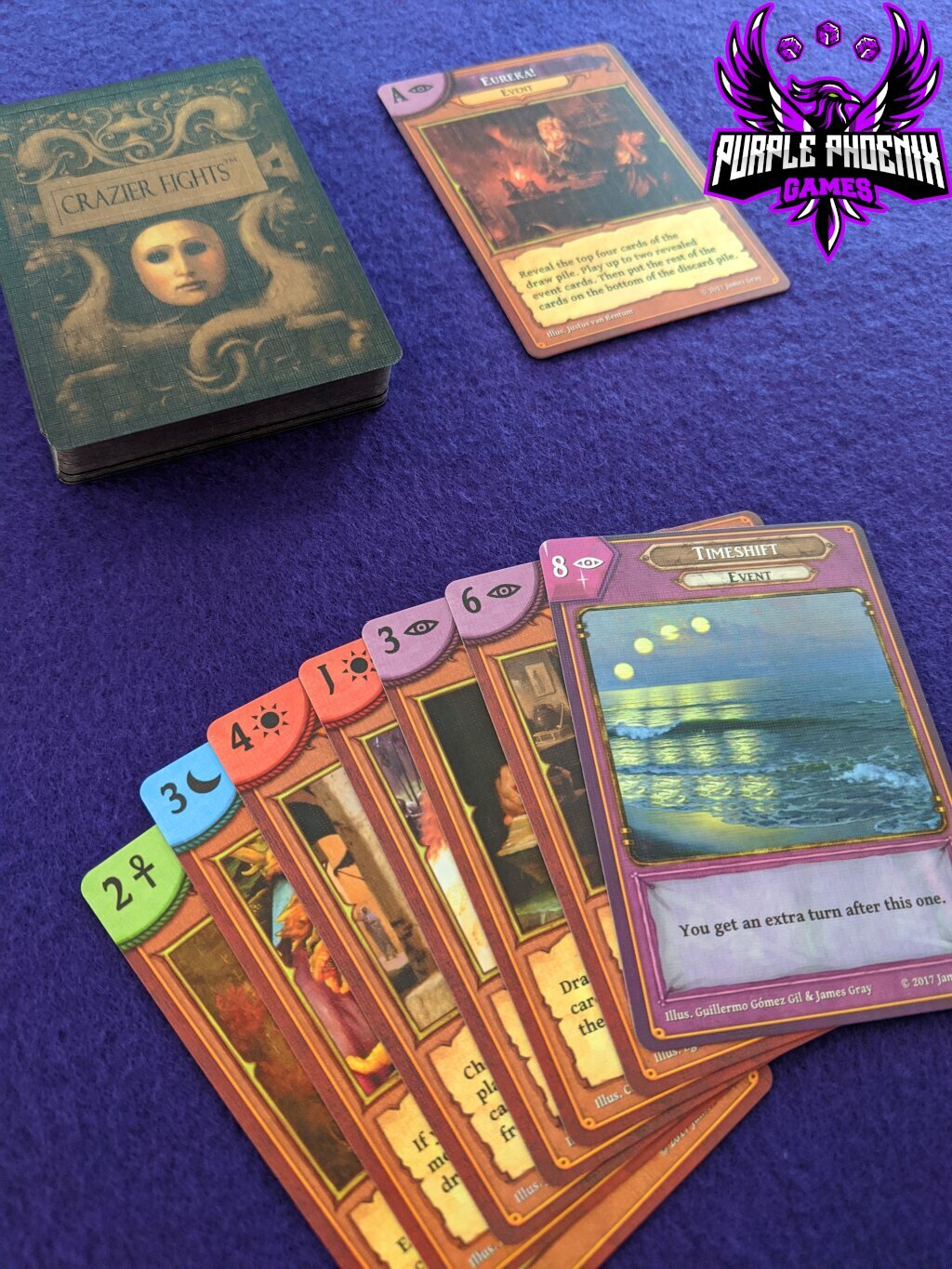
The turn structure is familiar: check for any “start of turn” effects and apply them, draw a card, play and/or discard a card, then resolve any “end of turn” effects. The deck is comprised of Events and Assets in different colors (suits) and numbers like in a typical deck of playing cards. After checking and resolving start of turn effects on Asset cards in your personal tableau, you must draw a card from the deck. This is where C8C strays from OG Crazy Eights a bit. You may play a card from your hand (Assets and Events) and discard a card to the discard pile (matching the suit/number/or an Eight), or simply play a card from your hand without discarding. Cards played from your hand can be Event cards that are played, resolved, and then discarded to the bottom of the discard pile, or an Asset card that is played to your tableau that cause chain reactions or other abilities on future turns. Next, resolve any end of turn effects from Assets in your tableau before the next player begins their turn.
Play continues in this fashion until one player has rid themselves of their hand and is crowned the Master of the Camelot! Or at least, the winner of the game.
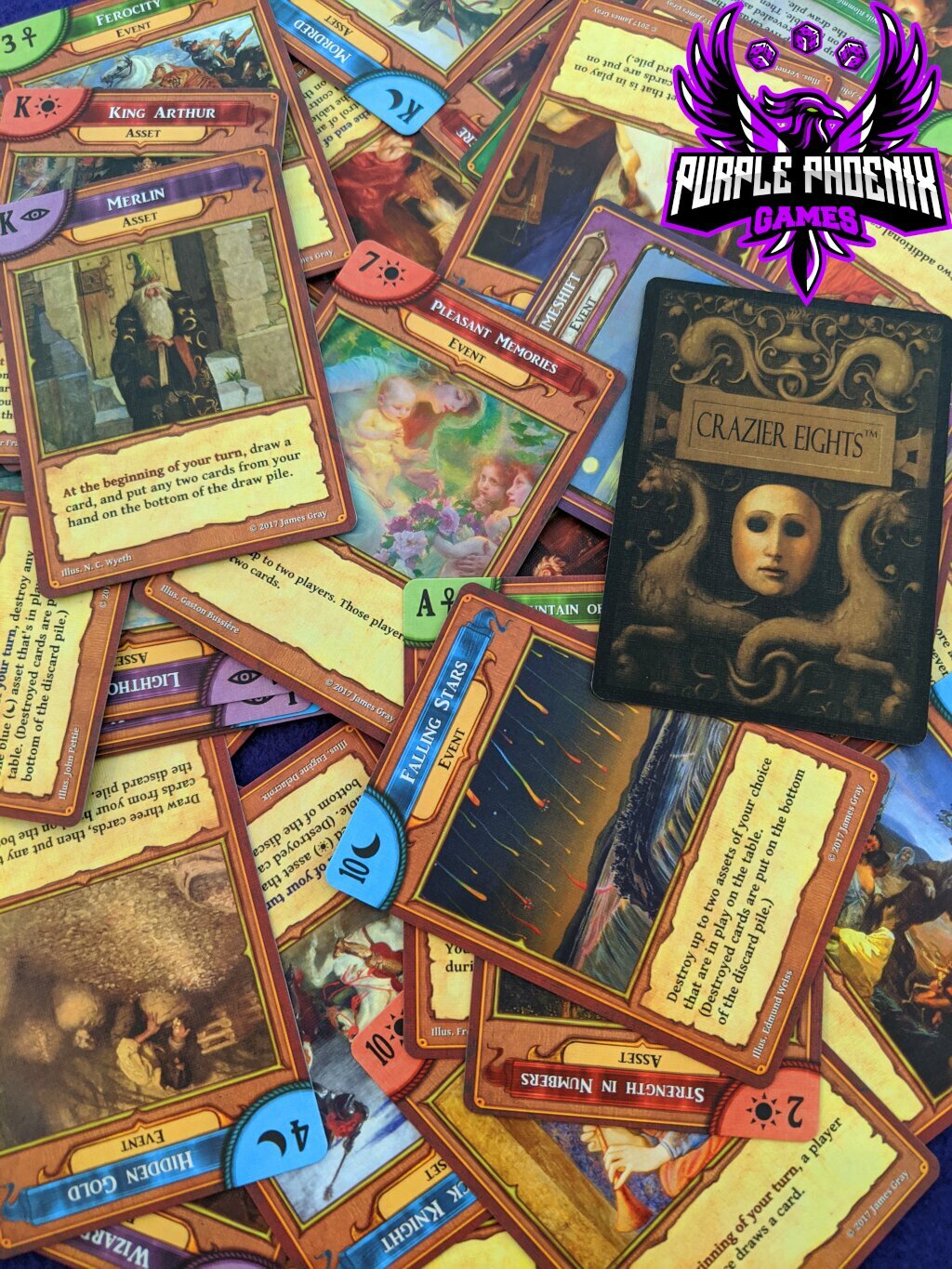
Components. This game is a box full of cards. The cards are good. The layout makes sense, and the art on the faces of the cards remind me of very classic art depicting ancient Arthurian scenes. I am no art historian, so I do not know if they are existing art pieces or new ones crafted for this game, but either way, they are a joy to behold… if you can spend the time appreciating the art instead of tracking what cards you need to play and what effects you can chain together (that was me). Extra points to the Recoculous team for associating symbols with the different suit colors for our colorblind friends. This is something that unfortunately goes unaddressed far too often.
This implementation is the third Crazier Eights we have had the chance to try, and I can say that we really enjoyed our plays of it (we played Olympus first and recently also reviewed Pantheon). The game comes with many interesting and varied effects to craft an ingenious strategy, and the art is stellar. Beware of playing with AP-prone gamers, as there is a lot going on and it is more than just a skinned Crazy Eights.
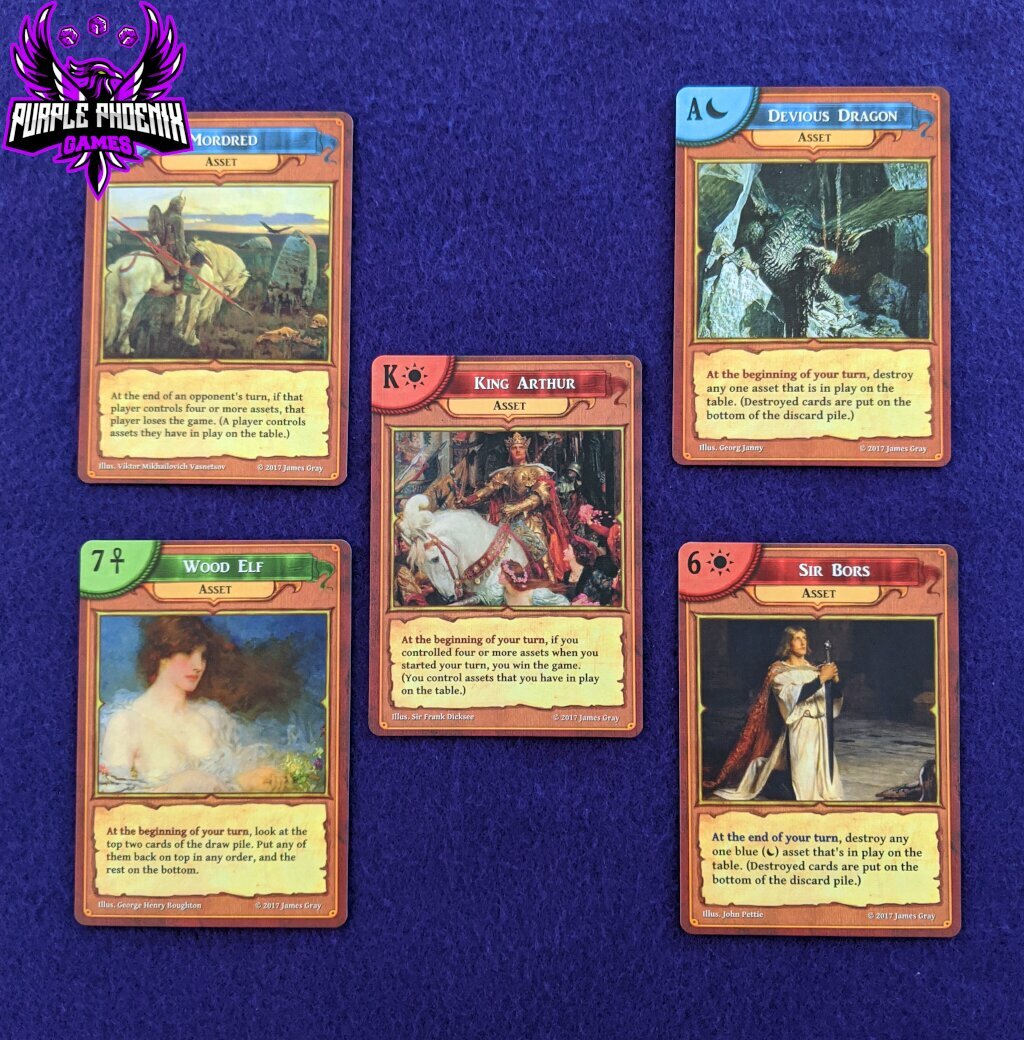
This Camelot set is slightly different than our previous experiences with both Olympus and Pantheon in a few ways. Firstly, it is more of a base game deck like Olympus instead of a standalone/expansion like Pantheon. Secondly, this set seems to use more cards that affect the assets of other players, specifically in destroying them. Additionally, I have noticed a few cards in the deck that specifically say if certain criteria are met one player automatically wins or loses the game. That’s it. Done-zo. Maybe I missed these cards in the other sets, but I do not remember them ever surfacing. Having each set focus on different aspects of the game and the manipulation of the rules ever so slightly to affect a player’s strategy from one set to the next is quite enchanting to me. Could you put all the sets together to make a massive meta-deck a la Munchkin with all the sets and expansions? Probably, but like Munchkin, I probably would rather keep them separate.
Now having played this family of games several times, I can say that it is my favorite Crazy Eights derivative and certainly worthy of a look. If your game collection is sorely lacking in Arthurian-themed card games, or if you want a hybrid game of old school rules with interesting twists, then do consider purchasing this or one of its predecessors.
PS – Don’t worry if, while you are playing, you have all your Assets stolen or destroyed. I have won the game with zero Assets in front of me while opponents have had eight, ironically. Assets are great, but you still need to shed your hand.
War. Old Maid. Go Fish. Crazy Eights. These are classic card games we probably all grew up playing. There have been many re-themes and new difficulty layers spread upon them to make them even more interesting. While UNO certainly has cornered the market on the Crazy Eights base, we have a new contender: Crazier Eights. Recoculous has published several versions of this card game with different themes: Avalon, One Thousand & One Nights, Olympus, and Shahrzad. Today we are taking a preview of Crazier Eights: Camelot.
You HAVE played Crazy Eights right? The card game where you attempt to be the first to exhaust your hand of cards, but you can only play down if you can match the suit or number on top of the discard pile? And if you can’t, you throw down an 8 as a wild and call the color to be played next? Well there you have the easy rules. Crazier Eights: Camelot (which I will from here call C8C) holds basically the same rule-set with a few new mechanics and a theme. The win condition is still the same: be the first to exhaust your hand of cards, but to win you will need to play your hand strategically against your opponents.
DISCLAIMER: We were provided a copy of this game for the purposes of this review. This is a retail copy of the game, so what you see in these photos is exactly what would be received in your box. I do not intend to cover every single rule included in the rulebook, but will describe the overall game flow and major rule set so that our readers may get a sense of how the game plays. For more in depth rules, you may purchase a copy online or from your FLGS. -T
To setup, shuffle the large deck of cards and place the deck in the middle of the table. Flip the top card to begin the discard pile and dictate the first card play. Deal each player seven cards and you are ready to begin!
The turn structure is familiar: check for any “start of turn” effects and apply them, draw a card, play and/or discard a card, then resolve any “end of turn” effects. The deck is comprised of Events and Assets in different colors (suits) and numbers like in a typical deck of playing cards. After checking and resolving start of turn effects on Asset cards in your personal tableau, you must draw a card from the deck. This is where C8C strays from OG Crazy Eights a bit. You may play a card from your hand (Assets and Events) and discard a card to the discard pile (matching the suit/number/or an Eight), or simply play a card from your hand without discarding. Cards played from your hand can be Event cards that are played, resolved, and then discarded to the bottom of the discard pile, or an Asset card that is played to your tableau that cause chain reactions or other abilities on future turns. Next, resolve any end of turn effects from Assets in your tableau before the next player begins their turn.
Play continues in this fashion until one player has rid themselves of their hand and is crowned the Master of the Camelot! Or at least, the winner of the game.
Components. This game is a box full of cards. The cards are good. The layout makes sense, and the art on the faces of the cards remind me of very classic art depicting ancient Arthurian scenes. I am no art historian, so I do not know if they are existing art pieces or new ones crafted for this game, but either way, they are a joy to behold… if you can spend the time appreciating the art instead of tracking what cards you need to play and what effects you can chain together (that was me). Extra points to the Recoculous team for associating symbols with the different suit colors for our colorblind friends. This is something that unfortunately goes unaddressed far too often.
This implementation is the third Crazier Eights we have had the chance to try, and I can say that we really enjoyed our plays of it (we played Olympus first and recently also reviewed Pantheon). The game comes with many interesting and varied effects to craft an ingenious strategy, and the art is stellar. Beware of playing with AP-prone gamers, as there is a lot going on and it is more than just a skinned Crazy Eights.
This Camelot set is slightly different than our previous experiences with both Olympus and Pantheon in a few ways. Firstly, it is more of a base game deck like Olympus instead of a standalone/expansion like Pantheon. Secondly, this set seems to use more cards that affect the assets of other players, specifically in destroying them. Additionally, I have noticed a few cards in the deck that specifically say if certain criteria are met one player automatically wins or loses the game. That’s it. Done-zo. Maybe I missed these cards in the other sets, but I do not remember them ever surfacing. Having each set focus on different aspects of the game and the manipulation of the rules ever so slightly to affect a player’s strategy from one set to the next is quite enchanting to me. Could you put all the sets together to make a massive meta-deck a la Munchkin with all the sets and expansions? Probably, but like Munchkin, I probably would rather keep them separate.
Now having played this family of games several times, I can say that it is my favorite Crazy Eights derivative and certainly worthy of a look. If your game collection is sorely lacking in Arthurian-themed card games, or if you want a hybrid game of old school rules with interesting twists, then do consider purchasing this or one of its predecessors.
PS – Don’t worry if, while you are playing, you have all your Assets stolen or destroyed. I have won the game with zero Assets in front of me while opponents have had eight, ironically. Assets are great, but you still need to shed your hand.

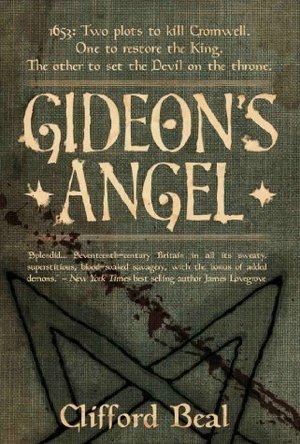
Jordan Binkerd (567 KP) rated Gideon's Angel in Books
Aug 15, 2019

Note: this review is transposted from my personal review blog, and so was originally written several years ago. I figured if I reposted it here, someone might actually read it….
I received my copy of Gideon’s Angel through the Goodreads FirstReads program. This in no way influences my review, except to ensure that I was able to get ahold of this book and thus review it. I have to say, I really enjoyed this one. I want to describe it as “steampunk,” but my understanding is that steampunk is usually set in the 1800s (or at least that level of tech and society) whereas this work is firmly set in 1653. If there’s already a term for pseudo-historical fiction with a fantasy touch set in that timeframe, I apologize for not knowing what it is and using it accordingly.
Things are not going well for Richard Treadwell. The English Civil War is over, the King’s Cavaliers lost to the forces of Parliament and Oliver Cromwell, and Charles I has been executed. Treadwell has managed to escape the destruction of his cause, and has spent the past eight years in exile in France, performing a delicate balancing act between loyalty to his exiled king* and his employer, Cardinal Mazarin. When Mazarin informs him that someone is using the forces of Hell to tip the balance in their favor and asks him to spy on the exile court to find out if it is one of the king’s supporters, Treadwell decides that it’s time to get out of Paris. He accepts a mission for one of the king’s more militant supporters that will take him back to his beloved England–to lead a Royalist uprising, one last try to oust Cromwell and his Puritan cronies. Treadwell has other business to tend to as well, including a wife who by now probably considers herself a widow. Unfortunately for Treadwell’s simple worldview, it soon becomes clear that Cromwell’s power is the only thing preventing the more radical Puritan elements from running roughshod over the whole country. Worse still, a demon from the pits of Hell has appeared to a radical Puritan sect masquerading as an angel of light and ordering the death of Cromwell so that the Kingdom of God may be fulfilled. Now instead of assassinating Cromwell Treadwell will be forced to save him–if he can find a way to fight the forces of Hell, gain some allies in his quest, and avoid d’Artagnan, a young Musketeer dispatched by the Cardinal to bear him back to Paris….
I really enjoyed this book. It’s not exactly “high literature,” but I think I’ve very well established that I care far more about a work’s entertainment value than whatever it is critics look for. The world Beal creates here feels very real, slipping in background historical information without making you feel like you’ve been lectured. Some readers will probably wish for more background on the English Civil War, and that’s fine. If they care that much, there are numerous good books on the subject. If they don’t, there’s a Wikipedia article that should give you a good rundown on what happened. Beal manages to evoke seventeenth-century London in all its grimy glory, much as it would have actually been aside from the fact that all the magic we dismiss as superstition is actually going on behind the scenes. Moreover, this magic very much resembles what you would find depicted in the folklore of the era without obvious modern embellishment. I’m not really all that well versed in the history of the Freemasons, so I can’t accurately speak to how they were portrayed here except to say that I very much doubt their claim to date back to the builders of the pyramids. Then again, I doubt they have the tools to summon demons too, so maybe I shouldn’t be too critical. Secondary characters generally proved to be interestingly complex, especially Billy Chard, but I am seeing criticism of how the female characters in the book act. They aren’t weak characters by any means, but they are constrained by their roles in society. Treadwell’s wife has pragmatically joined her fate to that of the officer who took over Treadwell’s land when he was banished and is pregnant with his child. Is she weak for this? Or is she a strong female doing what she has to in order to protect what is left of her family? Treadwell’s Parisian mistress follows him to England rather than stay in Paris and face the scandal of their liasion alone. Weak, for needing Treadwell by her side? Or strong, for following him into whatever dangers he may be facing? Finally, Isabelle decides to follow her father and the rest of Treadwell’s band into battle against the forces of Darkness, deciding that it would be better to fall by his side than live on without him. Possibly a sign of weakness, but look at her situation realistically. She and her father were driven from Spain for their Jewish heritage, her mother dying along the way. Jews do not fare well in the Christian world of the seventeenth century, not even in England. The lot of a young woman alone in the world is already hard enough in this time without adding the burden of religious and ethnic persecution. She would have no respectable means of supporting herself, and could conceivably find herself forced into prostitution–on her own if she was lucky, as no more than a slave if she was not. Is preferring death in battle to such a fate a sign of weakness or of strength? She certainly has no trouble speaking her mind, and in fact berates Treadwell severely for endangering her father when they first meet. I suppose I can understand where some people would find these characters and their portrayal to be weak and sexist, but I respectfully disagree. I submit that instead they are strong characters reacting realistically to a world where women are not treated equally–in fact, I would have more of a problem with them if they demonstrated anachronistic modern sensibilities.** The ending was a little deus ex machina, but on the whole I didn’t mind. I would say that I want to read a sequel, but I don’t think the author could come up with anything to top this in terms of personal impact on the characters–Treadwell’s internal conflict between hating Cromwell and having to save him is very well done, and I fear Beal would prove unable to find something equally interesting as a follow up. We never really got to find out what happened to Treadwell back during the Thirty Years War that introduced him to the world of angels and demons, so I could see maybe writing that up….I’d buy it, anyway.
CONTENT: R-rated language, occasionally harsh but I would argue not gratuitous. Moderately explicit sexual content, as you would expect from a work in this vein.*** A fair amount of violence, from both man and demon. Not usually too gory in its description. There is also a good deal of occult content, as the villains are summoning a demon they believe to be an angel. This demon’s lesser minions dog Treadwell and his friends, and there are multiple encounters with them. One is implied to be a golem, others appear as strange amalgamations of beast(s) and man. For me, this is adequately balanced by the recognition that, as powerful as the forces of Darkness are, God is far more powerful than they. Bottom line: if you’re mature enough to handle the other content, I don’t believe the occult elements should prove to be an issue.
*Charles I was executed, while his son Charles II went into exile. Just in case you were concerned with the historical accuracy of the book. So far as I can tell, this is pretty accurate. You know, aside from the demons and fictional characters roaming London…..
**Please understand, I’m neither defending nor endorsing the inequality of the seventeenth century. Neither is Clifford Beal, for that matter. I’m simply pointing out that it was how it was, and this was the world the characters would have come from. I’m all for equality, but to whitewash history and pretend it was different from it was….that way lies dangerous waters.
***This evokes more than anything a supernatural-tinged Alexandre Dumas novel for me….and you know how bawdry his musketeers could be when they wanted to be.
Original post: https://jordanbinkerd.wordpress.com/2013/10/24/review-gideons-angel-by-clifford-beal/
I received my copy of Gideon’s Angel through the Goodreads FirstReads program. This in no way influences my review, except to ensure that I was able to get ahold of this book and thus review it. I have to say, I really enjoyed this one. I want to describe it as “steampunk,” but my understanding is that steampunk is usually set in the 1800s (or at least that level of tech and society) whereas this work is firmly set in 1653. If there’s already a term for pseudo-historical fiction with a fantasy touch set in that timeframe, I apologize for not knowing what it is and using it accordingly.
Things are not going well for Richard Treadwell. The English Civil War is over, the King’s Cavaliers lost to the forces of Parliament and Oliver Cromwell, and Charles I has been executed. Treadwell has managed to escape the destruction of his cause, and has spent the past eight years in exile in France, performing a delicate balancing act between loyalty to his exiled king* and his employer, Cardinal Mazarin. When Mazarin informs him that someone is using the forces of Hell to tip the balance in their favor and asks him to spy on the exile court to find out if it is one of the king’s supporters, Treadwell decides that it’s time to get out of Paris. He accepts a mission for one of the king’s more militant supporters that will take him back to his beloved England–to lead a Royalist uprising, one last try to oust Cromwell and his Puritan cronies. Treadwell has other business to tend to as well, including a wife who by now probably considers herself a widow. Unfortunately for Treadwell’s simple worldview, it soon becomes clear that Cromwell’s power is the only thing preventing the more radical Puritan elements from running roughshod over the whole country. Worse still, a demon from the pits of Hell has appeared to a radical Puritan sect masquerading as an angel of light and ordering the death of Cromwell so that the Kingdom of God may be fulfilled. Now instead of assassinating Cromwell Treadwell will be forced to save him–if he can find a way to fight the forces of Hell, gain some allies in his quest, and avoid d’Artagnan, a young Musketeer dispatched by the Cardinal to bear him back to Paris….
I really enjoyed this book. It’s not exactly “high literature,” but I think I’ve very well established that I care far more about a work’s entertainment value than whatever it is critics look for. The world Beal creates here feels very real, slipping in background historical information without making you feel like you’ve been lectured. Some readers will probably wish for more background on the English Civil War, and that’s fine. If they care that much, there are numerous good books on the subject. If they don’t, there’s a Wikipedia article that should give you a good rundown on what happened. Beal manages to evoke seventeenth-century London in all its grimy glory, much as it would have actually been aside from the fact that all the magic we dismiss as superstition is actually going on behind the scenes. Moreover, this magic very much resembles what you would find depicted in the folklore of the era without obvious modern embellishment. I’m not really all that well versed in the history of the Freemasons, so I can’t accurately speak to how they were portrayed here except to say that I very much doubt their claim to date back to the builders of the pyramids. Then again, I doubt they have the tools to summon demons too, so maybe I shouldn’t be too critical. Secondary characters generally proved to be interestingly complex, especially Billy Chard, but I am seeing criticism of how the female characters in the book act. They aren’t weak characters by any means, but they are constrained by their roles in society. Treadwell’s wife has pragmatically joined her fate to that of the officer who took over Treadwell’s land when he was banished and is pregnant with his child. Is she weak for this? Or is she a strong female doing what she has to in order to protect what is left of her family? Treadwell’s Parisian mistress follows him to England rather than stay in Paris and face the scandal of their liasion alone. Weak, for needing Treadwell by her side? Or strong, for following him into whatever dangers he may be facing? Finally, Isabelle decides to follow her father and the rest of Treadwell’s band into battle against the forces of Darkness, deciding that it would be better to fall by his side than live on without him. Possibly a sign of weakness, but look at her situation realistically. She and her father were driven from Spain for their Jewish heritage, her mother dying along the way. Jews do not fare well in the Christian world of the seventeenth century, not even in England. The lot of a young woman alone in the world is already hard enough in this time without adding the burden of religious and ethnic persecution. She would have no respectable means of supporting herself, and could conceivably find herself forced into prostitution–on her own if she was lucky, as no more than a slave if she was not. Is preferring death in battle to such a fate a sign of weakness or of strength? She certainly has no trouble speaking her mind, and in fact berates Treadwell severely for endangering her father when they first meet. I suppose I can understand where some people would find these characters and their portrayal to be weak and sexist, but I respectfully disagree. I submit that instead they are strong characters reacting realistically to a world where women are not treated equally–in fact, I would have more of a problem with them if they demonstrated anachronistic modern sensibilities.** The ending was a little deus ex machina, but on the whole I didn’t mind. I would say that I want to read a sequel, but I don’t think the author could come up with anything to top this in terms of personal impact on the characters–Treadwell’s internal conflict between hating Cromwell and having to save him is very well done, and I fear Beal would prove unable to find something equally interesting as a follow up. We never really got to find out what happened to Treadwell back during the Thirty Years War that introduced him to the world of angels and demons, so I could see maybe writing that up….I’d buy it, anyway.
CONTENT: R-rated language, occasionally harsh but I would argue not gratuitous. Moderately explicit sexual content, as you would expect from a work in this vein.*** A fair amount of violence, from both man and demon. Not usually too gory in its description. There is also a good deal of occult content, as the villains are summoning a demon they believe to be an angel. This demon’s lesser minions dog Treadwell and his friends, and there are multiple encounters with them. One is implied to be a golem, others appear as strange amalgamations of beast(s) and man. For me, this is adequately balanced by the recognition that, as powerful as the forces of Darkness are, God is far more powerful than they. Bottom line: if you’re mature enough to handle the other content, I don’t believe the occult elements should prove to be an issue.
*Charles I was executed, while his son Charles II went into exile. Just in case you were concerned with the historical accuracy of the book. So far as I can tell, this is pretty accurate. You know, aside from the demons and fictional characters roaming London…..
**Please understand, I’m neither defending nor endorsing the inequality of the seventeenth century. Neither is Clifford Beal, for that matter. I’m simply pointing out that it was how it was, and this was the world the characters would have come from. I’m all for equality, but to whitewash history and pretend it was different from it was….that way lies dangerous waters.
***This evokes more than anything a supernatural-tinged Alexandre Dumas novel for me….and you know how bawdry his musketeers could be when they wanted to be.
Original post: https://jordanbinkerd.wordpress.com/2013/10/24/review-gideons-angel-by-clifford-beal/

Matthew Krueger (10051 KP) rated Horrified: Universal Monsters Strategy Board Game in Tabletop Games
Jul 31, 2020 (Updated Aug 1, 2020)
The Universal Monsters (3 more)
The Strategy
Replay Value
Think Ten Steps Ahead
The Excellent Universal Monsters Board Game
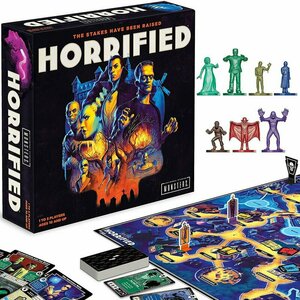
When I heard about Horrorified, i wanted to buy it right away. A board game that has the universal monsters and it revolves around them, i really wanted to buy it. Cause i love the universal monsters. My favorite being The Invisible Man and Dracula. So lets talk more about it.
The Gameplay:
Horrified is a cooperative game in which all the players win or lose together. The players win if they defeat all of the Monsters they are playing against. In order to defeat a Monster, you must first complete a task.
Each Monster's task and subsequent defeat is unique:
Creature from the Black Lagoon: Find the Creature's hidden lair, then drive the Creature away.
Dracula: Smash Dracula's four coffins, then overcome Dracula.
Frankenstein and the Bride: Teach Frankenstein and the Bride what it means to be human so they can live peacefully.
The Invisible Man: Supply evidence to the police of the Invisible Man's existence, then trap him.
The Mummy: Break the Mummy's curse, then return him to his tomb.
The Wolf Man: Discover the cure for lycanthropy, then administer it to the Wolf Man.
The players lose immediately if one of the following occurs:
Terror: Each time a Hero or Villager is defeated, the Terror Level will increase. If the Terror Level reaches its maximum, indicated by the skull, the Monsters have overrun the village and the players lose.
Out Of Time: Each turn, you will draw a card from the Monster deck. If you need to draw a Monster card but the deck is empty, you have taken too long to defeat the Monsters and the players lose.
Each turn has two phases, performed in this order:
Hero Phase: Take as many actions as indicated on your Badge. In addition, any player may play any number of Perk cards.
Monster Phase: Draw one Monster card from the top of the Monster deck and resolve all three parts of the card. After completing both phases, play proceeds clockwise, starting with the next player's Hero Phase.
Hero Phase: Actions: Take up to the number of actions indicated on your Badge. You may choose to take fewer. Actions may be taken multiple times and in any order. The possible actions are:
Move: Move your Hero along a lit path to an adjacent space. You cannot move to water spaces and can only cross the river using one of the two bridge spaces. In addition, you may take any number of Villagers in your Hero's space with you when you move.
Guide: Move one Villager from your Hero's space to an adjacent space, or move one Villager from an adjacent space to your Hero's space. Villagers also cannot move to water spaces, and Monsters do not affect their movement.
Special Action: Some Heroes have a special action, as indicated on their Badge. Just like other actions, special actions count as one of the total number of actions for your turn and can be taken multiple times.
Pick Up: Take any number of Items from your Hero's space. Keep all your Items in front of you, next to your Badge.
Share: All Heroes in the same space as your Hero may freely give or take any number of Items from each other.
Advance: At a specific location, use one of your Items to advance a Monster's task.
Defeat: In a Monster's space, use your Items to defeat that Monster.
Monster Phase:
Draw a card from the top of the Monster deck and resolve the three parts of the card, from top to bottom. After resolving the entire Monster card, put it in a discard pile face up.
1. Items: Draw the number of Items listed at the top of the card, if any, from the Item bag. Place each Item at the location indicated on the Item.
If you need to draw an Item when the Item bag is empty, place all the Items from the discard pile into the bag, mix them up, and continue drawing.
2. Event: Each Event either involves one of the Monsters or the Villagers.
The card's color, as well as the symbol above the Event's name, indicates who the Event is about. Gray cards are about the Villagers. Colored cards are about a specific Monster.
If the Event Monster is not in your game, completely ignore the Event and continue with the Monster Strike. Otherwise, read the Event out loud and do what it says.
3. Monster Strike: Certain Monsters move and attack, as indicated by the symbols at the bottom of the card. In order from left to right, move and attack with the first Monster before proceeding to the next Monster.
If an indicated Monster is not in your game, ignore that symbol. If the Frenzy symbol is shown, the Monster with the Frenzy Marker moves and attacks. This could result in the same Monster moving and attacking twice in one turn.
Move the Monster the number of spaces indicated on the card towards the closest person (Hero or Villager). As soon as the Monster is in a space with a person, they stop moving. If the Monster started in a space with a person, they don't move at all.
Attack one person in the Monster's space by rolling the number of attack dice indicated. If there are no people in the Monster's space, the Monster does not attack-do not roll dice. If there are multiple people in that space, the Monster will attack a Hero rather than a Villager.
If there are still multiple people the Monster could attack, the current player chooses one to attack before rolling.
Perk Cards: Each player starts the game with a Perk card, and more Perk cards can be earned by getting Villagers to their safe locations. Keep all your Perk cards face up in front of you. It's a good idea to discuss your Perk cards, and when to play them, with the other players.
Perks may be played on any player's turn, but only during the Hero Phase. When you play a Perk card, do what the card says, and then put it in a discard pile face up. Playing a Perk card does not take an action.
Items: Items are important for advancing tasks and defeating Monsters, as well as defending yourself from the Monsters' attacks. Each Item has a color, indicating its type, and a strength, which is the number at the top. Each Item also has a location, which indicates where the Item is placed when it is drawn from the Item bag.
Hit by a Monster:
Heroes: To ignore being hit by a Monster's attack, a Hero may discard one Item for each Hit symbol rolled. If the Hero does not have enough Items, or does not wish to discard any Items, they are defeated. One hit defeats a Hero.
When a Hero is defeated, increase the Terror Level by moving the Terror Marker one space and remove that Hero from the board.
At the start of that player's next turn, they place their Hero at the Hospital and take their turn as normal, including their full number of actions. A defeated Hero does not lose any Items or Perk cards.
Villagers: A Villager does not have any Items and is therefore defeated immediately when hit. When a Villager is defeated, increase the Terror Level by moving the Terror Marker one space and remove that Villager from the board.
End of the Game: The game can end in one of three ways:
Heroes Triumph: If you defeat all the Monsters, the game immediately ends and the players have won! You've saved the village from a horrific fate, and perhaps even the Monsters themselves.
Terror!: If the Terror Level reaches its maximum, indicated by the skull, the game immediately ends and the players have lost. Everyone, including the Heroes, are too horrified to continue. You abandon the village to the Monsters.
Out Of Time: If you need to draw a card when the Monster deck is empty, the game immediately ends and the players have lost. You've taken too long to save the village. The Villagers have fled and you aren't able to continue.
Solo Play: The Villagers are more fearful if there is only one Hero trying to save the village. Begin the game with the Terror Marker on the "3" of the Terror Level Track.
All the rules remain the same. However, do not play as the Courier-that Hero's Special Action cannot be taken in a solo game. Also the Perk cards "Special Delivery" and "Conduct An Investigation" cannot be used.
Either remove these cards before playing, or when drawn, immediately discard and draw a new Perk card to replace it.
Its a fantasic excellent strategy game based around the universal monsters. I love it so much its such a fun game. If you want to learn more go to BoardGameGeek, Dice Tower Review or One Stop Co-Op Shop.
The Gameplay:
Horrified is a cooperative game in which all the players win or lose together. The players win if they defeat all of the Monsters they are playing against. In order to defeat a Monster, you must first complete a task.
Each Monster's task and subsequent defeat is unique:
Creature from the Black Lagoon: Find the Creature's hidden lair, then drive the Creature away.
Dracula: Smash Dracula's four coffins, then overcome Dracula.
Frankenstein and the Bride: Teach Frankenstein and the Bride what it means to be human so they can live peacefully.
The Invisible Man: Supply evidence to the police of the Invisible Man's existence, then trap him.
The Mummy: Break the Mummy's curse, then return him to his tomb.
The Wolf Man: Discover the cure for lycanthropy, then administer it to the Wolf Man.
The players lose immediately if one of the following occurs:
Terror: Each time a Hero or Villager is defeated, the Terror Level will increase. If the Terror Level reaches its maximum, indicated by the skull, the Monsters have overrun the village and the players lose.
Out Of Time: Each turn, you will draw a card from the Monster deck. If you need to draw a Monster card but the deck is empty, you have taken too long to defeat the Monsters and the players lose.
Each turn has two phases, performed in this order:
Hero Phase: Take as many actions as indicated on your Badge. In addition, any player may play any number of Perk cards.
Monster Phase: Draw one Monster card from the top of the Monster deck and resolve all three parts of the card. After completing both phases, play proceeds clockwise, starting with the next player's Hero Phase.
Hero Phase: Actions: Take up to the number of actions indicated on your Badge. You may choose to take fewer. Actions may be taken multiple times and in any order. The possible actions are:
Move: Move your Hero along a lit path to an adjacent space. You cannot move to water spaces and can only cross the river using one of the two bridge spaces. In addition, you may take any number of Villagers in your Hero's space with you when you move.
Guide: Move one Villager from your Hero's space to an adjacent space, or move one Villager from an adjacent space to your Hero's space. Villagers also cannot move to water spaces, and Monsters do not affect their movement.
Special Action: Some Heroes have a special action, as indicated on their Badge. Just like other actions, special actions count as one of the total number of actions for your turn and can be taken multiple times.
Pick Up: Take any number of Items from your Hero's space. Keep all your Items in front of you, next to your Badge.
Share: All Heroes in the same space as your Hero may freely give or take any number of Items from each other.
Advance: At a specific location, use one of your Items to advance a Monster's task.
Defeat: In a Monster's space, use your Items to defeat that Monster.
Monster Phase:
Draw a card from the top of the Monster deck and resolve the three parts of the card, from top to bottom. After resolving the entire Monster card, put it in a discard pile face up.
1. Items: Draw the number of Items listed at the top of the card, if any, from the Item bag. Place each Item at the location indicated on the Item.
If you need to draw an Item when the Item bag is empty, place all the Items from the discard pile into the bag, mix them up, and continue drawing.
2. Event: Each Event either involves one of the Monsters or the Villagers.
The card's color, as well as the symbol above the Event's name, indicates who the Event is about. Gray cards are about the Villagers. Colored cards are about a specific Monster.
If the Event Monster is not in your game, completely ignore the Event and continue with the Monster Strike. Otherwise, read the Event out loud and do what it says.
3. Monster Strike: Certain Monsters move and attack, as indicated by the symbols at the bottom of the card. In order from left to right, move and attack with the first Monster before proceeding to the next Monster.
If an indicated Monster is not in your game, ignore that symbol. If the Frenzy symbol is shown, the Monster with the Frenzy Marker moves and attacks. This could result in the same Monster moving and attacking twice in one turn.
Move the Monster the number of spaces indicated on the card towards the closest person (Hero or Villager). As soon as the Monster is in a space with a person, they stop moving. If the Monster started in a space with a person, they don't move at all.
Attack one person in the Monster's space by rolling the number of attack dice indicated. If there are no people in the Monster's space, the Monster does not attack-do not roll dice. If there are multiple people in that space, the Monster will attack a Hero rather than a Villager.
If there are still multiple people the Monster could attack, the current player chooses one to attack before rolling.
Perk Cards: Each player starts the game with a Perk card, and more Perk cards can be earned by getting Villagers to their safe locations. Keep all your Perk cards face up in front of you. It's a good idea to discuss your Perk cards, and when to play them, with the other players.
Perks may be played on any player's turn, but only during the Hero Phase. When you play a Perk card, do what the card says, and then put it in a discard pile face up. Playing a Perk card does not take an action.
Items: Items are important for advancing tasks and defeating Monsters, as well as defending yourself from the Monsters' attacks. Each Item has a color, indicating its type, and a strength, which is the number at the top. Each Item also has a location, which indicates where the Item is placed when it is drawn from the Item bag.
Hit by a Monster:
Heroes: To ignore being hit by a Monster's attack, a Hero may discard one Item for each Hit symbol rolled. If the Hero does not have enough Items, or does not wish to discard any Items, they are defeated. One hit defeats a Hero.
When a Hero is defeated, increase the Terror Level by moving the Terror Marker one space and remove that Hero from the board.
At the start of that player's next turn, they place their Hero at the Hospital and take their turn as normal, including their full number of actions. A defeated Hero does not lose any Items or Perk cards.
Villagers: A Villager does not have any Items and is therefore defeated immediately when hit. When a Villager is defeated, increase the Terror Level by moving the Terror Marker one space and remove that Villager from the board.
End of the Game: The game can end in one of three ways:
Heroes Triumph: If you defeat all the Monsters, the game immediately ends and the players have won! You've saved the village from a horrific fate, and perhaps even the Monsters themselves.
Terror!: If the Terror Level reaches its maximum, indicated by the skull, the game immediately ends and the players have lost. Everyone, including the Heroes, are too horrified to continue. You abandon the village to the Monsters.
Out Of Time: If you need to draw a card when the Monster deck is empty, the game immediately ends and the players have lost. You've taken too long to save the village. The Villagers have fled and you aren't able to continue.
Solo Play: The Villagers are more fearful if there is only one Hero trying to save the village. Begin the game with the Terror Marker on the "3" of the Terror Level Track.
All the rules remain the same. However, do not play as the Courier-that Hero's Special Action cannot be taken in a solo game. Also the Perk cards "Special Delivery" and "Conduct An Investigation" cannot be used.
Either remove these cards before playing, or when drawn, immediately discard and draw a new Perk card to replace it.
Its a fantasic excellent strategy game based around the universal monsters. I love it so much its such a fun game. If you want to learn more go to BoardGameGeek, Dice Tower Review or One Stop Co-Op Shop.