
Search

Bob Mann (459 KP) rated Darkest Hour (2017) in Movies
Sep 29, 2021

Not buggering it up.
As Doctor Who repeatedly points out, time is most definitely a tricksy thing. As I think I’ve commented on before, the events of 1940-45 are not in my lifetime but were sufficiently fresh to my parents that they were still actively talked about… so they still appear “current” to me. But I find it astonishing to realize that to a teen viewer this film is equivalent in timeframe to the sinking of the Titanic! #ancienthistory! So I suspect your connection to this film will be strongly affected by your age, and that was definitely reflected in the average age at my showing which must have been at least 60.
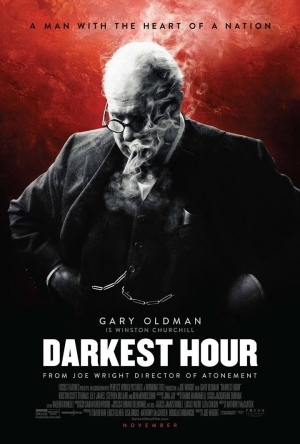
It’s 1940 and Western Europe is under siege. Neville Chamberlain (Ronald Pickup, “The Second Best Exotic Marigold Hotel“) is the Conservative Prime Minister but is voted out of office in an attempt to form a grand coalition government with Labour leader Clement Atlee (David Schofield). Despite appearing a shoe-in for the role, Viscount Halifax (Stephen Dillane) turns it down, thinking that his alternative (and bête noire) would drink from the poisoned chalice and be quickly be out of his (and Chamberlain’s) hair. For that alternative choice is the volatile and unpredictable Churchill (Gary Oldman), grudgingly invited into the job by King George VI (Ben Mendelsohn, “Rogue One“). With the Nazi’s bearing down on the 300,000 encircled troops at Dunkirk, and with calls from his war cabinet to capitulate and seek terms of settlement, this is indeed both Churchill’s, and the country’s, ‘darkest hour’.
Despite the woeful lack of historical knowledge among today’s youngsters, most will be at least aware of the story of Dunkirk, with many having absorbed Christopher Nolan’s film of last summer. This film is almost the matching bookend to that film, showing the terrifying behind-closed-door events that led up to that miracle. For it was terrifying seeing how close Britain came to the brink, and I’m not sure even I really appreciated that before. While this might have been a “thriller” if it had been a fictional story, we well know the outcome of the story: but even with this knowledge I still found the film to be extremely tense and claustrophobic as the net draws in around Churchill’s firmly-held beliefs.
Gary Oldman’s performance is extraordinary, and his award nominations are well-deserved. We have grown so used to some of his more over-the-top Russian portrayals in films like “Air Force One” and last year’s (pretty poor) “The Hitman’s Bodyguard” that it is easy to forget what a nuanced and flexible actor he is. Ever since that “No, surely not!” moment of that first glimpse of the film’s trailer, it has almost been impossible to ‘see’ Oldman behind the brilliant make-up of the character (Kazuhiro Tsuji gets a special credit for it). But his eyes are in there, and there are some extreme close-ups (for example, during a bizarre and tense phone call with Roosevelt (David Strathairn)) when you suddenly see “There you are!”.
The supportive wife – Clemmie (Kristin Scott Thomas) gives Winston (Gary Oldman) a hug.
While I have nothing against Brian Cox as an actor, I far prefer the portrayal of Churchill on show here compared to last year’s “Churchill“: true that that film was set three or four stressful years later, but Cox’s Churchill was portrayed as an incompetent fool, an embarrassment to the establishment that have to work around him. Oldman’s Churchill is irascible, unreasonable, but undeniably a leader and a great orator.
Mirroring “Churchill” though, the action is seen through the eyes of Churchill’s put-upon secretary, here played delightfully by Lily James (“Downton Abbey”, “Baby Driver“) who perfectly looks and sounds the part. The character is more successful than that of Ella Purnell’s Garrett in that she is given more room to develop her character and for the audience to warm to her. Oldman is getting all the kudos, but Lily James really deserves some for her touching and engaging performance here.
Perfectly cast: Lily James as Churchill’s secretary Elizabeth Layton.
Also in Oldman’s shadow is the always marvelous Kristin Scott Thomas (“Four Weddings and a Funeral”, “The English Patient”) as Clemmie Churchill, expressing all the love and frustration associated with being a long-suffering wife to an over-worked husband in the public service.
At the pen is “The Theory of Everything” writer Anthony McCarten, and I’d like to say its a great script but with most of the best lines (“a sheep in sheep’s clothing” – LoL) coming from Winston himself it’s difficult to tell. Some of the scenes can get a bit laborious and at 125 minutes – though not long by any means – the script could still perhaps have had a nip and tuck here and there.
Where some of this time is well spent though is in some sedate shots of London street life, across two separate scenes panning across everyday folk as the stresses of war start to become more evident. This is just one of the areas where director Joe Wright (“Atonement”, “Pride and Prejudice”) shows considerable panache, ably assisted by the cinematography of Bruno Delbonnel (“Inside Llewyn Davis“): a boy closes his telescope-fingers around Churchill’s plane; a bomb’s eye-view of the beleaguered Brigadier Nicholson in Calais; and – very impressively – the smoky imperiousness of the House of Commons set.
An atmospheric chamber: the recreation of the wartime House of Commons is spectacular (with production design by Sarah Greenwood (“Anna Karenina”, “Atonement”)).
And most-importantly Wright delivers what Christopher Nolan couldn’t deliver in “Dunkirk“: a properly CGI’d vista of hundred of small boats crossing the channel to Dunkirk. Now THAT is a scene that Kenneth Branagh could justly have looked in awe at!!!
There are a number of scenes that require disbelief to be suspended though: the biggest one being a tube train ride – very moving and effective I must say – but one that features the longest journey between any two stations on the District Line than has ever been experienced!
One stop on the District Line via Westminster…. via Harrow-on-the-Hill!
So this is a great film for really reliving a knife-edge moment in British history, and is highly recommended particularly for older viewers. If I’m honest though, between “Darkest Hour”, “Churchill” and John Lithgow’s excellent portrayal in “The Crown” I’m all over portrayals of the great man for a few years. Can we please move on now Hollywood?

The Bandersnatch (199 KP) rated Dracula in Books
Nov 7, 2019

Dracula was written by author Bram Stoker during the late 1890's and is set around the character of Dracula and his attempt to move from Transylvania to England so he can spread the curse of the undead (I.e. the creation of more vampires). English solicitor Jonathan Harker who'd originally gone to Transylvania to be legal aide for Dracula stops him with the help of Van Helsing and others which ends the life of one of them – Quincey-, the book ends with a note from Jonathan Harker that several people lived happily married and Jonathan has a son nicknamed for Quincey.
Dracula was published in London in May 1897 by Archibald Constable & Company and was later copyrighted in the U.S in 1899 and published by Doubleday & McClure of New York. Despite having decent praise form reviewers it wasn't an immediate bestseller. Although the English newspaper the Daily Mail ranked Stoker's writing prowess in Dracula above that of Mary Shelly, Edgar Allen Poe and Emily Bronte's Wuthering heights. Unfortunately it didn't make Stoker that much money and he'd had to petition for a compassionate grant from the royal literary fund. When he died his widow was forced to sell his notes and outlines of the book at an auction in 1913. It was the unauthorised adaption of Nosferatu by F. W. Murnau in 1922 and the resulting legal battle made when Stokers widow took affront that the novels popularity began to grow.
Before writing Dracula Bram Stoker had been researching European folklore and stories of vampires having been most influenced by Emily Gerard's “Transylvania Superstitions” 1885 essay...which included content about the vampire myth. Some historians insist that Vlad iii Dracula (More commonly known as Vlad the impaler) was the model for Stokers count but there's been no supporting evidence to make that true. According to one expert Stoker only borrowed the barest minimum of information of the Wallachian tyrant and he's not even mentioned in Stokers notes. Stoker was a member of the London library during the 1890's where books by Sabine Baring-Gould, Thomas Browne, AF Crosse and Charles Boner are attributed to Stokers research. Stoker would later claim he'd had a nightmare caused by over-eating crab meat about a “Vampire king” rising from his grave. Whitby on the Yorkshire coast contributed its landscape since Bram Stoker often holidayed there during the summer.
Dracula wasn't Stokers first choice as title for the story since he cycled through The Dead Un-Dead then simply the Un-Dead the count wasn't even supposed to be Count Dracula having had the name Count Wampyr for several drafts before Stoker became intrigued by the name Dracula. After reading “An account of the principles of Wallachia and Moldavia with political observations relative to them” written by author William Wilkinson (Published in 1820). the descendants of Vlad ii of Wallachia took the name Dracula or Dracul after being invested in the Order of the Dragon in 1431. In the old Romanian language the word Dracul mean “the Dragon” and Dracula meant “Son of the Dragon”. Nowadays however Dracul means “the Devil”
Whilst Dracula is known as THE Vampire novel its not the first. Johan Wolfgang Von Goethe had his book the Bride of Corinth published in 1797, 1871's Carmilla (a story about a lesbian vampire) was written by Sheridan Le Frau and James Malcolm Rymer's penny dreadful series Venny the Vampire was a product from the mid Victorian period. Even John Polidori created an image of a vampyric aristocrat in his 1819 story The Vampyre when he spent a summer with Merry Shelly (creator of Frankenstein) and her poet husband Percy Bysshe Shelly and Lord Bryon in 1816.
I really love Dracula. It showed the madness, the ethereal quality and the ultimate danger of what a vampire could do. Like many other goth inclined teenagers trying to find their feet in the world Dracula definitely added its two cents to my self worth and love of all things macabre. The fact it was written by a Victorian writer has added a unusual depth to the story as only a Victorian writer could. The culture of the Vampire has become deep rooted and wide spread in its acceptance and Dracula has definitely spearheaded such a phenomenon.
Abraham “Bram” Stoker was Born in Dublin, Ireland on the 8th of November 1847, He was the third of seven children born to Abraham and Charlotte Stoker and was bedridden with an unknown illness until he recovered at seven. He started schooling at a private school run by the Reverend William Woods and grew up without serious illness. Stoker excelled at sports at Trinity College Dublin having graduated in 1870 with a BA (Bachelor of Arts). He was an Auditor of the College Historical Society and the president of the University Philosophical Society where his first paper was on Sensationalism in fiction and society.
Thanks to his friend Dr. Maunsell, Stoker became interested in the theatre as a student and whilst working for the Irish civil service he became a theatre critic for the Dublin evening mail where he attracted notice for the quality of his reviews. Stoker gave a favourable review of Henry Irving's adaption of Hamlet in December 1876, this prompted Irving to invite him to dinner where they ended up becoming friends. Stoker wrote The Crystal Cup which was published by the London society in 1872 and The chain of Destiny which was released in four parts in the Shamrock. Stoker also wrote the non-fiction book the duties of clerks of petty sessions in Ireland which was published in 1879.
Bram stoker married Florence Balcombe the daughter of a lieutenent-colonel in 1978 and they moved to London. Where Stoker ended up the Business manager of the Lyceum theatre as well as manager for Henry Irving- a position he held for 27 years. Despite being a very busy man Stoker ended up writing several novels (as well as Dracula) Including The Snakes pass in 1890, the lady of the shroud in 1909 and the lair of the white worm in 1911. when Henry Irving died in 1906 he published his personal reminiscences of Henry Irving. Stoker also managed productions at the Prince of Wales theatre.
Bram stoker died after a series of strokes in London on April 20th 1912, the cause of death is split between the possibility of Tertiary Syphilis or overwork. He was cremated and was placed in a display urn at Golders Green Crematorium in North London, he was later joined by the ashes of his Son Irving Noel Stoker in 1961, his wife Florence was meant to join them but her ashes were scattered at the Gardens of rest.
Stoker was honoured with a Google Doogle (the banner on goggles homepage) on November 8th 2012 commemorating the 165th anniversary of his birth. An annual festival in honour of Bram Stoker happens in Dublin, its supported by the Bram stoker estate and was/is usually funded by Dublin City Council and Failte Ireland.
My opinion of Bran stoker is that of a decent hard working man who loved life. Stoker epitomises the phrases of “a man on a mission” and “a man who hussles”. Having worked extremely hard both creatively as a novelist and business wise as a theatre manager Stoker pretty much showed that if you work hard you could pretty much do anything you set your mind to.
And there you have it a book for all the ages, definitely under the banner of AWESOME!!!.