Search
Search results

Emma @ The Movies (1786 KP) rated VFW (2019) in Movies
Jun 8, 2020
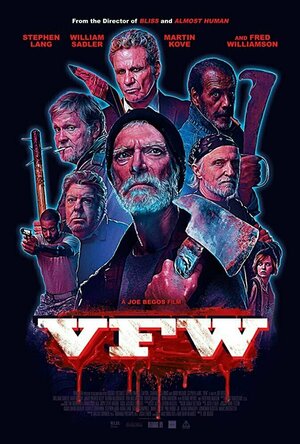


VFW had been an off the cuff pick for ones to watch, at the last minute it appeared in some listings and I was intrigued by the cast and the vibe I was getting from the poster.
When a young girl's plan for revenge goes awry she leads a drug fueled army to the doorstep of the local veterans club. The group must defend their home away from home and try to survive until the morning.
The opening scene paints a picture of a slightly dystopian present/future where drugs run rife and cities are shells of their former selves. There are addicts and revellers all in different states and they're either in lively party spirits or high and out of it. Right from the off I found the set up confusing because you're watching something that is difficult to assess, the darkness makes it almost impossible to gauge the surrounding and you're thrown for a loop when they cut to the bright afternoon scene that is pinpointed by captions to just three hours later.
VFW definitely has a heavy 80s vibe to it. The titles, the background hum of music and the style of the filming. The colours are great but it is incredibly difficult to see anything unless you're watching it in anything but darkness. On my first watch I found myself squinting and peering at the screen trying to decipher what was going on.
There's no logical consistency to things that happen even if you take into consideration that half the characters are supposed to be drugged up to the eyeballs. The event that starts off the whole caper gives you a fairly clear idea of how the addicts react to things, if that is translated to the rest of the hoard then there's no way this film is making it past 30 minutes. It would have been done and dusted.
Dialogue throughout isn't very inspiring, there's are some truly dubious moments and the rest is easily forgotten. The scenes themselves aren't believable, the main cast get lots of opportunities to have moments together inside the VFW club despite having moments before been under the threat of a siege. There was one point where I genuinely wondered if the baddies approached and went "No. It's rude to interrupt someone when they're talking."
What it's missing in those areas it makes up for in random violence. (Make sure to watch out for the plastic machete.) There's a vaguely amusing tooling up sequence and I kind of hope they got the cast drunk and let them improvise weapons all on their own for it. This is another thing that smacks of the 80s, a lot of that violence feels like it's been lifted out of retro horror movies and adapted to this film.
I haven't spoken about the cast, and it's something that left me a little frustrated. The names and faces on the list are epic, they're solid actors with a lot of good credits under their belts... but even though they get a couple of good points in the film it's not really what I'd want for them.
VFW has a lot of elements that could work but with the slightly b-moviesque action scenes and clear omissions for the sake of having a "moment" I think it misses the opportunity to be something more serious. It's not right for b-movie/spoof status and because it doesn't take itself seriously enough it's left in a no man's land and I just couldn't figure out what it was trying to do, especially as even they didn't seem to know if they were attempting to make zombie or an action film.
Originally posted on: https://emmaatthemovies.blogspot.com/2020/06/vfw-movie-review.html
When a young girl's plan for revenge goes awry she leads a drug fueled army to the doorstep of the local veterans club. The group must defend their home away from home and try to survive until the morning.
The opening scene paints a picture of a slightly dystopian present/future where drugs run rife and cities are shells of their former selves. There are addicts and revellers all in different states and they're either in lively party spirits or high and out of it. Right from the off I found the set up confusing because you're watching something that is difficult to assess, the darkness makes it almost impossible to gauge the surrounding and you're thrown for a loop when they cut to the bright afternoon scene that is pinpointed by captions to just three hours later.
VFW definitely has a heavy 80s vibe to it. The titles, the background hum of music and the style of the filming. The colours are great but it is incredibly difficult to see anything unless you're watching it in anything but darkness. On my first watch I found myself squinting and peering at the screen trying to decipher what was going on.
There's no logical consistency to things that happen even if you take into consideration that half the characters are supposed to be drugged up to the eyeballs. The event that starts off the whole caper gives you a fairly clear idea of how the addicts react to things, if that is translated to the rest of the hoard then there's no way this film is making it past 30 minutes. It would have been done and dusted.
Dialogue throughout isn't very inspiring, there's are some truly dubious moments and the rest is easily forgotten. The scenes themselves aren't believable, the main cast get lots of opportunities to have moments together inside the VFW club despite having moments before been under the threat of a siege. There was one point where I genuinely wondered if the baddies approached and went "No. It's rude to interrupt someone when they're talking."
What it's missing in those areas it makes up for in random violence. (Make sure to watch out for the plastic machete.) There's a vaguely amusing tooling up sequence and I kind of hope they got the cast drunk and let them improvise weapons all on their own for it. This is another thing that smacks of the 80s, a lot of that violence feels like it's been lifted out of retro horror movies and adapted to this film.
I haven't spoken about the cast, and it's something that left me a little frustrated. The names and faces on the list are epic, they're solid actors with a lot of good credits under their belts... but even though they get a couple of good points in the film it's not really what I'd want for them.
VFW has a lot of elements that could work but with the slightly b-moviesque action scenes and clear omissions for the sake of having a "moment" I think it misses the opportunity to be something more serious. It's not right for b-movie/spoof status and because it doesn't take itself seriously enough it's left in a no man's land and I just couldn't figure out what it was trying to do, especially as even they didn't seem to know if they were attempting to make zombie or an action film.
Originally posted on: https://emmaatthemovies.blogspot.com/2020/06/vfw-movie-review.html

Haley Mathiot (9 KP) rated You in Books
Apr 27, 2018

While reading—and after finishing—You, I really had no idea what to say about it. I let it sit in my brain for a while, and I think I’ve decided how I feel. It’s a funny book though, because honestly, you have to be the right kind of reader for it. I’m not yet sure what that kind of reader is.
First, as you can see above, I can’t really say what genre it was. It wasn’t really young adult, though I’m sure some young people will enjoy it. It’s not really adult either though, because it’s about a group of people who play videogames for a living. So I wasn’t sure what category to put it into for my brain.
There was some fantasy aspects, because the videogame they made was fantasy. The videogame characters would come to visit Russell, the main character, in his dreams or daydreams. Once he took one of them on a date. That was kind of weird.
Then there was the plot. They’re making this game, another game in the series, and there’s a bug that’s causing all sorts of problems. They have to play the game to get rid of the bug. Now I’m not a game designer but that doesn’t seem very probable to me personally. I’d do a control search for the line of problem code, and just take it the hell out. But like I said, I’m not a designer.
The subplot to the bug mystery had something to do with the past, the founder of the company, a mysterious death, and an “ultimate game.” It was all very vague, and not a lot of it was wrapped up.
Finally, I didn’t particularly like the conclusion. Suffice to say I thought the whole novel would take a different turn than it did, and it wasn’t what I wanted.
But the good parts were good! The writing was funny and descriptive, the characters were well developed—I loved Lisa so much!—and it was fast paced.
Personally, I liked it. I didn’t love it, I didn’t hate it, but I probably wouldn’t read (or listen to) it again.
Content/recommendation: some language, no sex. Ages 16+
First, as you can see above, I can’t really say what genre it was. It wasn’t really young adult, though I’m sure some young people will enjoy it. It’s not really adult either though, because it’s about a group of people who play videogames for a living. So I wasn’t sure what category to put it into for my brain.
There was some fantasy aspects, because the videogame they made was fantasy. The videogame characters would come to visit Russell, the main character, in his dreams or daydreams. Once he took one of them on a date. That was kind of weird.
Then there was the plot. They’re making this game, another game in the series, and there’s a bug that’s causing all sorts of problems. They have to play the game to get rid of the bug. Now I’m not a game designer but that doesn’t seem very probable to me personally. I’d do a control search for the line of problem code, and just take it the hell out. But like I said, I’m not a designer.
The subplot to the bug mystery had something to do with the past, the founder of the company, a mysterious death, and an “ultimate game.” It was all very vague, and not a lot of it was wrapped up.
Finally, I didn’t particularly like the conclusion. Suffice to say I thought the whole novel would take a different turn than it did, and it wasn’t what I wanted.
But the good parts were good! The writing was funny and descriptive, the characters were well developed—I loved Lisa so much!—and it was fast paced.
Personally, I liked it. I didn’t love it, I didn’t hate it, but I probably wouldn’t read (or listen to) it again.
Content/recommendation: some language, no sex. Ages 16+

Paul Chesworth (3 KP) created a post
Feb 20, 2018
Debbiereadsbook (1821 KP) rated Trusting a Warrior (Loving a Warrior #3) in Books
Nov 26, 2020
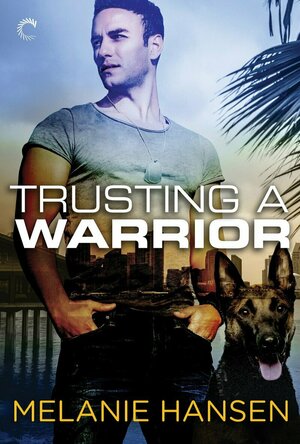

Hansen can grab you, by the heart strings, and drag you kicking and screaming through every single emotion known to man
Independent reviewer for Archaeolibrarian, I was gifted my copy of this book.
This is book 3 in the Loving A Warrior, and I STRONGLY suggest you read both books one, Loving A Warrior, and book 2, Keeping A Warrior, before you read this one. There is much referenced here that is not fully recapped. And you know, cos I said so! Both are 5 star reads.
As is this one!
Lani meets Geo on possibly the worst day of her life. Geo's ain't much better. Together they begin to navigate a relationship, while dealing with a huge amount of grief at the death of their loved ones.
Hansen has a knack of roping you in, pulling you close, and not letting you go. She can grab you, by the heart strings, and drag you kicking and screaming through every single emotion known to man, and then expect you to write a coherent review after!
I mean, I loved this book, I really did. It carries some difficult story lines, but again, Ms Hansen delivers them in a way that you cannot fault. Grief is a fickle thing, and everyone deals with that differently. I know, my sister and I dealt with my mother and father's death very different, but there is no right or wrong way. Here, Lani's grief is a decade old, but she still suffers. Geo's is much fresher, and it's HIS pain that hit me the most.
I have no personal experience of war, or those who serve. I can only imagine the horrors that are presented on a daily basis. It's to be expected that some will struggle with that, but put on a "brave face" The way Hansen describes Geo's grief and his own spiral downwards is heartbreaking, it really is. Only his relationship with Lani saves him.
I loved how the others in this series; Matt and Shane and Rhys and Devon, play a huge part here. I loved that Devon and Lani become such good friends, even if Lani is Rhys' ex.
What I want to know now, Ms Hansen, is this! Will we be privvy to want happened in Keeping A Warrior, and here, to Matt and Shane?? Cos let me tell ya, I does NEEEEEEEEEEEEEEED to know! We get an inkling of what Matt suffers here, but not enough. So, please, write a followup!
Love, love LOVED the epilogue! And I loved Bosch, Geo's military dog.
I can't, in any honesty, give this book any less than. . .
5 stars
**same worded review will appear elsewhere**
This is book 3 in the Loving A Warrior, and I STRONGLY suggest you read both books one, Loving A Warrior, and book 2, Keeping A Warrior, before you read this one. There is much referenced here that is not fully recapped. And you know, cos I said so! Both are 5 star reads.
As is this one!
Lani meets Geo on possibly the worst day of her life. Geo's ain't much better. Together they begin to navigate a relationship, while dealing with a huge amount of grief at the death of their loved ones.
Hansen has a knack of roping you in, pulling you close, and not letting you go. She can grab you, by the heart strings, and drag you kicking and screaming through every single emotion known to man, and then expect you to write a coherent review after!
I mean, I loved this book, I really did. It carries some difficult story lines, but again, Ms Hansen delivers them in a way that you cannot fault. Grief is a fickle thing, and everyone deals with that differently. I know, my sister and I dealt with my mother and father's death very different, but there is no right or wrong way. Here, Lani's grief is a decade old, but she still suffers. Geo's is much fresher, and it's HIS pain that hit me the most.
I have no personal experience of war, or those who serve. I can only imagine the horrors that are presented on a daily basis. It's to be expected that some will struggle with that, but put on a "brave face" The way Hansen describes Geo's grief and his own spiral downwards is heartbreaking, it really is. Only his relationship with Lani saves him.
I loved how the others in this series; Matt and Shane and Rhys and Devon, play a huge part here. I loved that Devon and Lani become such good friends, even if Lani is Rhys' ex.
What I want to know now, Ms Hansen, is this! Will we be privvy to want happened in Keeping A Warrior, and here, to Matt and Shane?? Cos let me tell ya, I does NEEEEEEEEEEEEEEED to know! We get an inkling of what Matt suffers here, but not enough. So, please, write a followup!
Love, love LOVED the epilogue! And I loved Bosch, Geo's military dog.
I can't, in any honesty, give this book any less than. . .
5 stars
**same worded review will appear elsewhere**

Annie Chanse (15 KP) rated Shadows & Dreams in Books
Dec 19, 2017


Review** spoiler alert ** *Warning: contains spoilers, bad words, and quite a long rant*
To be honest, I was very disappointed in this book. It had a great premise, which meant it had the potential to be a really good story, but the writing style of the author just completely ruined this book for me.
The basic idea behind the story is that Kate Kane, a paranormal PI, sets off on a case to find the brother of a woman she slept with once, and during this investigation, she runs into ALL MANNER OF TROUBLE. There are vampires and werewolves and ex-girlfriends around every corner, just lurking and waiting to pounce on Miss Kane. It's a very busy and involved story, and if it had been better written, I would have easily given it four stars at least, but there was just TOO much about this book -- style-wise -- that drove me insane.
For instance:
1. The plot, itself, is actually fairly well thought out and developed and is nowhere NEAR as cheesy as it sounds when you hear, "Vampires fighting werewolves," -- which, let's be honest, these days is so trite and overdone that it is scoffed at on a regular basis. However, there IS a good story in this novel. But the way Hall writes the not-cheesy story is so cheesy that it makes you THINK the story is cheesy. A lot of cheese, huh? A little confusing? Well then, let me give you an example.
Page 7-8: "Truth be told it was a little bit awkward, but my social weirdness threshold has gone way up since my girlfriend tried to murder my ex-girlfriend because her ex-girlfriend tried to murder her."
Okay... a bit ridiculous, especially seven/eight pages in, but I can roll with it. However, at the bottom of page eight:
Kane asks, "Who saw him last?"
Her assistant -- who is actually a statue brought to life and gifted to Kate by a group of rats who are apparently all seeing and all knowing God-types -- says, "I don't know. [...] Probably somebody at the hospital."
Kane asks, "Which one?"
And the assistant replies with this fantastic line: "The Whittington. He broke his leg changing a light bulb. Because he was standing on a swivel chair because he's an idiot."
Okay, I concede that maybe this line is supposed to sound ridiculous and funny, so I can even let that one slide. But then, three pages later, Hall completely turns me off to the book with this:
"Well, fuck. I was about to be hired by a woman I'd very nearly slept with to find her missing brother who was working for the woman who'd left me for a tech startup at the tech startup she left me for."
Wh-wh-what?! Are you kidding me? Could that sentence BE anymore convoluted or that plot-point any more ridiculously stereotypical?
And what is truly awful is that the story itself REALLY WASN'T THAT BAD. I mean, the writing was awful, which, overall, meant that the novel was -- in my opinion, of course -- bad, but the way the story progressed WAS interesting. It was nowhere near as bad as these 'recaps' by the main character make it sound, but the problem is that Hall throws in these inner-monologues for Kane ALL throughout the book, and they are terrible! Which, in turn, decreases the value of the entire story.
Another example falls right on the heels of the page 11 jewel.
Page 14: "I really really hoped this wasn't going to be another zombie plague. There'd been an outbreak when I'd taken Eve up to Lake Windermere for our third anniversary, and we'd spent the whole weekend under siege in the hotel, making molotovs from the minibar and clubbing re-animated tourists to death with souvenir walking sticks."
Really? Zombies now? On top of the vampires, witches, and werewolves? Can we POSSIBLY fit anymore para into this normal?
Enough with that.
Now on to point number 2. The girl on girl sex scenes in this book between sexy, snarky PI and her vampire girlfriend, the Prince (yes, Prince) of Cups, should be hot, right? No. They are forced, fake, and ridiculous. Halfway through the first one, I thought, "Jesus. This isn't lesbian sex. This is lesbian sex if it was written by a man who WISHES he could see some lesbian sex." That was the point at which I decided to look up more info on Alexis Hall, and I found out that he is, in fact, a man, which at least explains the sex scenes.
#3. Speaking of sex scenes, Hall also has this really irritating -- and distracting -- habit of throwing in random, explicitly sexual thoughts at TOTALLY inappropriate times. Right in the middle of the most stressful situations -- being locked up, about to be killed, thrown in prison/on trial -- Kate Kane begins inner-monologuing with herself about how much she'd like to fuck whatever female happens to be standing in front of her. RIDICULOUS! And annoying. Hated it.
4. One of the MOST annoying things about this book, however, was that it was in DESPERATE need of a SERIOUS case of editing. All throughout the book there were glaring errors that any first year college student should have caught while reading. I'm willing to discount SOME of these "errors" as simply being lost in translation, as the book is written with a British tone, and I am very much American. However, SOME of these errors simply CANNOT be due to anything other than careless editing.
For instance, page 113: "It's main distinguishing feature, right, was that was it was blue."
WAS that WAS it WAS blue? What does that even mean? Oh, yes, it means that no one bothered editing this beast before printing.
Page 141: "Piercing the heart will paralyse, but it won't kill, and anything will do, it doesn't have to wood."
Okay, so maybe the "paralyse" is simply British, but surely the "doesn't have to wood" bit needs a "be" in there somewhere, right?
Page 157: "Have we have achieved case closed, Miss Kane?"
Yes, yes have we have.
There are several -- SEVERAL -- more examples of these type errors, but I'm not about to point them all out. If you read the book, I'm sure you'll easily catch them on your own.
5. Another thing that drove me NUTS was the repetition. The awful thing is I'm fairly certain that Hall used these repetitious lines PURPOSELY to create some kind of effect -- humor, maybe? Whatever the desired result, it failed to do anything other than annoy me.
For instance, page 163: "'Hi. So. Look.' I tried to find a way to express the fact I had some good news and some bad news that wasn't I've got some good news and some bad news. 'I've got some good news and some bad news.'"
...blink... ...falls over...
Page 177: "All the more reason to tell them. [...] If they know that we know that she has returned, then they will not be tempted to conspire against us out of the false belief that we do not know. Of course, they may already know, but at present, we have no way to know what they know. If we tell them, we will know what they know, and all we will not know is how long they have known it."
Oh. Jumping. Jesus. On. A. Pogo. Stick. Please tell me you aren't serious.
And there was this one thing that repeated over and over again throughout the book. The first time, it was actually pretty clever. The second time, even, was okay. But by the time I'd read it nine times -- yes, NINE TIMES, no exaggeration whatsoever -- I was ready to never EVER read anything like it ever again.
This particular phrase was something Kate Kane internalized or muttered aloud to herself each time she decided to do something stupid OR she felt her life was in danger. The basic format went something like this:
"Here lies Kate Kane, died peacefully in her sleep aged 94. Beloved daughter."
The "Here lies Kate Kane" part remained constant, as did the "Beloved daughter." It was only the middle part that changed, for instance, "Here lies Kate Kate. Should have minded her own business. Beloved daughter." Or perhaps, "Here lies Kate Kane. She made a difference to dozens. Beloved daughter."
This continued NINE TIMES. It is not cute, funny, or clever after about the second time, definitely after the third. BUT NINE TIMES?! Come on!
And finally, my last complaint.
6. Several of the items, scenes, quotes, etc. in this book seemed waaaaaaaaaay too close to things from other books for my taste. Perhaps it is simply a coincidence and the author did not intentionally siphon plot points and details from other authors -- except, of course, when he obviously did in his quotations, such as his use of "Not all those who wander are lost" and "As old as my tongue, a little bit older than my teeth" which are DIRECTLY taken from other books, but I'm hoping those were intentional and not attempted-to-get-away-with-it plagiarism.
But there are several things in this novel that could have been taken from Jim Butcher's "Dresden Files", Lewis' "Narnia" chronicles, and Tolkien's "Lord of the Rings" series. I'm hoping, however, that they weren't, but they were very, very similar.
All in all, I'm disappointed to say that I was not a fan of this book at all, and I will most likely not be reading anymore Kate Kane books.
To be honest, I was very disappointed in this book. It had a great premise, which meant it had the potential to be a really good story, but the writing style of the author just completely ruined this book for me.
The basic idea behind the story is that Kate Kane, a paranormal PI, sets off on a case to find the brother of a woman she slept with once, and during this investigation, she runs into ALL MANNER OF TROUBLE. There are vampires and werewolves and ex-girlfriends around every corner, just lurking and waiting to pounce on Miss Kane. It's a very busy and involved story, and if it had been better written, I would have easily given it four stars at least, but there was just TOO much about this book -- style-wise -- that drove me insane.
For instance:
1. The plot, itself, is actually fairly well thought out and developed and is nowhere NEAR as cheesy as it sounds when you hear, "Vampires fighting werewolves," -- which, let's be honest, these days is so trite and overdone that it is scoffed at on a regular basis. However, there IS a good story in this novel. But the way Hall writes the not-cheesy story is so cheesy that it makes you THINK the story is cheesy. A lot of cheese, huh? A little confusing? Well then, let me give you an example.
Page 7-8: "Truth be told it was a little bit awkward, but my social weirdness threshold has gone way up since my girlfriend tried to murder my ex-girlfriend because her ex-girlfriend tried to murder her."
Okay... a bit ridiculous, especially seven/eight pages in, but I can roll with it. However, at the bottom of page eight:
Kane asks, "Who saw him last?"
Her assistant -- who is actually a statue brought to life and gifted to Kate by a group of rats who are apparently all seeing and all knowing God-types -- says, "I don't know. [...] Probably somebody at the hospital."
Kane asks, "Which one?"
And the assistant replies with this fantastic line: "The Whittington. He broke his leg changing a light bulb. Because he was standing on a swivel chair because he's an idiot."
Okay, I concede that maybe this line is supposed to sound ridiculous and funny, so I can even let that one slide. But then, three pages later, Hall completely turns me off to the book with this:
"Well, fuck. I was about to be hired by a woman I'd very nearly slept with to find her missing brother who was working for the woman who'd left me for a tech startup at the tech startup she left me for."
Wh-wh-what?! Are you kidding me? Could that sentence BE anymore convoluted or that plot-point any more ridiculously stereotypical?
And what is truly awful is that the story itself REALLY WASN'T THAT BAD. I mean, the writing was awful, which, overall, meant that the novel was -- in my opinion, of course -- bad, but the way the story progressed WAS interesting. It was nowhere near as bad as these 'recaps' by the main character make it sound, but the problem is that Hall throws in these inner-monologues for Kane ALL throughout the book, and they are terrible! Which, in turn, decreases the value of the entire story.
Another example falls right on the heels of the page 11 jewel.
Page 14: "I really really hoped this wasn't going to be another zombie plague. There'd been an outbreak when I'd taken Eve up to Lake Windermere for our third anniversary, and we'd spent the whole weekend under siege in the hotel, making molotovs from the minibar and clubbing re-animated tourists to death with souvenir walking sticks."
Really? Zombies now? On top of the vampires, witches, and werewolves? Can we POSSIBLY fit anymore para into this normal?
Enough with that.
Now on to point number 2. The girl on girl sex scenes in this book between sexy, snarky PI and her vampire girlfriend, the Prince (yes, Prince) of Cups, should be hot, right? No. They are forced, fake, and ridiculous. Halfway through the first one, I thought, "Jesus. This isn't lesbian sex. This is lesbian sex if it was written by a man who WISHES he could see some lesbian sex." That was the point at which I decided to look up more info on Alexis Hall, and I found out that he is, in fact, a man, which at least explains the sex scenes.
#3. Speaking of sex scenes, Hall also has this really irritating -- and distracting -- habit of throwing in random, explicitly sexual thoughts at TOTALLY inappropriate times. Right in the middle of the most stressful situations -- being locked up, about to be killed, thrown in prison/on trial -- Kate Kane begins inner-monologuing with herself about how much she'd like to fuck whatever female happens to be standing in front of her. RIDICULOUS! And annoying. Hated it.
4. One of the MOST annoying things about this book, however, was that it was in DESPERATE need of a SERIOUS case of editing. All throughout the book there were glaring errors that any first year college student should have caught while reading. I'm willing to discount SOME of these "errors" as simply being lost in translation, as the book is written with a British tone, and I am very much American. However, SOME of these errors simply CANNOT be due to anything other than careless editing.
For instance, page 113: "It's main distinguishing feature, right, was that was it was blue."
WAS that WAS it WAS blue? What does that even mean? Oh, yes, it means that no one bothered editing this beast before printing.
Page 141: "Piercing the heart will paralyse, but it won't kill, and anything will do, it doesn't have to wood."
Okay, so maybe the "paralyse" is simply British, but surely the "doesn't have to wood" bit needs a "be" in there somewhere, right?
Page 157: "Have we have achieved case closed, Miss Kane?"
Yes, yes have we have.
There are several -- SEVERAL -- more examples of these type errors, but I'm not about to point them all out. If you read the book, I'm sure you'll easily catch them on your own.
5. Another thing that drove me NUTS was the repetition. The awful thing is I'm fairly certain that Hall used these repetitious lines PURPOSELY to create some kind of effect -- humor, maybe? Whatever the desired result, it failed to do anything other than annoy me.
For instance, page 163: "'Hi. So. Look.' I tried to find a way to express the fact I had some good news and some bad news that wasn't I've got some good news and some bad news. 'I've got some good news and some bad news.'"
...blink... ...falls over...
Page 177: "All the more reason to tell them. [...] If they know that we know that she has returned, then they will not be tempted to conspire against us out of the false belief that we do not know. Of course, they may already know, but at present, we have no way to know what they know. If we tell them, we will know what they know, and all we will not know is how long they have known it."
Oh. Jumping. Jesus. On. A. Pogo. Stick. Please tell me you aren't serious.
And there was this one thing that repeated over and over again throughout the book. The first time, it was actually pretty clever. The second time, even, was okay. But by the time I'd read it nine times -- yes, NINE TIMES, no exaggeration whatsoever -- I was ready to never EVER read anything like it ever again.
This particular phrase was something Kate Kane internalized or muttered aloud to herself each time she decided to do something stupid OR she felt her life was in danger. The basic format went something like this:
"Here lies Kate Kane, died peacefully in her sleep aged 94. Beloved daughter."
The "Here lies Kate Kane" part remained constant, as did the "Beloved daughter." It was only the middle part that changed, for instance, "Here lies Kate Kate. Should have minded her own business. Beloved daughter." Or perhaps, "Here lies Kate Kane. She made a difference to dozens. Beloved daughter."
This continued NINE TIMES. It is not cute, funny, or clever after about the second time, definitely after the third. BUT NINE TIMES?! Come on!
And finally, my last complaint.
6. Several of the items, scenes, quotes, etc. in this book seemed waaaaaaaaaay too close to things from other books for my taste. Perhaps it is simply a coincidence and the author did not intentionally siphon plot points and details from other authors -- except, of course, when he obviously did in his quotations, such as his use of "Not all those who wander are lost" and "As old as my tongue, a little bit older than my teeth" which are DIRECTLY taken from other books, but I'm hoping those were intentional and not attempted-to-get-away-with-it plagiarism.
But there are several things in this novel that could have been taken from Jim Butcher's "Dresden Files", Lewis' "Narnia" chronicles, and Tolkien's "Lord of the Rings" series. I'm hoping, however, that they weren't, but they were very, very similar.
All in all, I'm disappointed to say that I was not a fan of this book at all, and I will most likely not be reading anymore Kate Kane books.
NF
Network Forensics
Book
Intensively hands-on training for real-world network forensics Network Forensics provides a uniquely...

Meet by Moonit - Chat & Share Photos
Social Networking and Lifestyle
App
Meet new people all over the world…chat and send photos! **As seen on ABCNews, BusinessInsider,...

Sheridan (209 KP) rated Mindhunter - Season 1 in TV
Apr 28, 2019

The Content (1 more)
The Concept
Slow Yet Twisted
I had a friend recommend this show to me and I thought, alright I'm constantly attempting to figure out why people's minds work the way they do, this could be interesting. Let me tell you right off the bat, push through that first episode, I promise you it gets more interesting. The first episode is a disaster, there's too much shoved in there (one second Ford is an active agent, then suddenly he's teaching, straight after he's at college, then he's working in the BSU) it was dull at best and dead confusing at worst. While the content is interesting, the characters and the relationships are odd and strained. Ford comes across like an actual serial killer (especially when he does that creepy wide-eyed stare *shivers*), he's socially awkward, his mannerisms feel stunted and strange and overall he is not a likeable character. I like to feel connected in some way to the characters I'm watching and at this stage Ed is more relatable than Ford (which is terrifying because - actual murderer there ?). The girlfriend is even worse, they both feel just - forced (and what's with the weirdly placed sex scenes?! They don't add anything to the story at all!) There's oddly placed scenes which are weird and don't make sense (Carr and the tuna/invisible cat - why - just why was that in there? It wasn't necessary and what was the point of that? Was it supposed to be creepy? Unsettling? Because for me it was just random and pointless). Tench is the only consistant, interesting character (who, bless him, smokes waaaay too much). Overall the show is slow, which admittedly can be a good thing, especially because at first they see so much resistance to the idea that people aren't always just 'born bad', but it never really picks up speed (like you're kind of expecting it to). The last episode is very odd, Ford becomes confusing and erratic, which is a complete 360 from his dead-eyed emotionally inept character in the first episodes. Is he having a breakdown? Is he realising he shares traits with the violent killers he's interviewing? The ending didn't make sense to me at all. I give the show an 8 for content because it is super fascinating, and appropriately disturbing but character wise it's definitely a 5, you just never really 'connect' with anyone. That being said, I will watch the next season, because it's still an interesting show, though it will be at the bottom of my 'to watch' list.
Emma @ The Movies (1786 KP) rated Playing with Fire (2019) in Movies
Jan 9, 2020
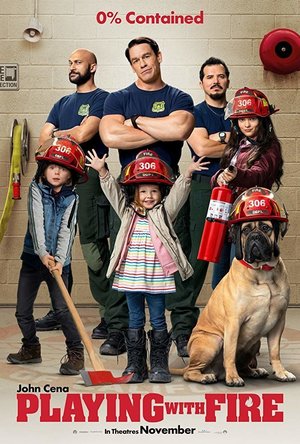


Seeing the trailer for this I was mildly excited, this sort of daft family humour holds a place in my heart and it looked like I was going to get another film to add to the "pick me up" watchlist. But oh my, everything about this experience rubbed me the wrong way.
Jake Carson runs a rugged group of smokejumpers that swoop into action and stop fires from taking hold. On their latest callout they find a cabin about to be engulfed by flames and trapped inside are three children in need of help.
Following the rules, Jake calls Child Protective Services, but being so remote they won't be able to get to them quickly. It's now their duty to keep the three of them safe until they arrive. Four grown men, three kids... what could possibly go wrong?
Where to start? How about that humour I was looking forward to? Or perhaps the severe lack of it. Over the whole runtime I laughed more at the end credits that I did at the whole film. Keegan-Michael Key is by far the funniest thing about the film, but it still isn't a perfect part. Key's way of sliding into scenes and just taking over was excellent, it made me smile, but when these moments started he was funny with just the right amount of over the top but the script would quite often throw him over that fine line and it became tiresome.
John Cena generally isn't bad when it comes to comedy offerings, but in Playing With Fire he's very stiff even for the by-the-books character he's playing. It felt like Jake had been made too straight-laced, he needs to make the transition from uptight to more relaxed but they could have brought it down just one step and it would have been something a lot easier to watch.
Brianna Hildebrand plays the oldest of the rescued children, Brynn. She gives a solid performance and probably has the best character overall, no frustrating quirks, nothing over the top. While she manages to make a good show of it being up against the over the top nature of everything else means it gets lost in the background.
While there might be a twist on the sort of story it doesn't feel new in any respects. I'm feeling rather let down with the whole thing but thankfully we're not short of other films that do this exact thing.
Originally posted on: https://emmaatthemovies.blogspot.com/2020/01/playing-with-fire-movie-review.html
Jake Carson runs a rugged group of smokejumpers that swoop into action and stop fires from taking hold. On their latest callout they find a cabin about to be engulfed by flames and trapped inside are three children in need of help.
Following the rules, Jake calls Child Protective Services, but being so remote they won't be able to get to them quickly. It's now their duty to keep the three of them safe until they arrive. Four grown men, three kids... what could possibly go wrong?
Where to start? How about that humour I was looking forward to? Or perhaps the severe lack of it. Over the whole runtime I laughed more at the end credits that I did at the whole film. Keegan-Michael Key is by far the funniest thing about the film, but it still isn't a perfect part. Key's way of sliding into scenes and just taking over was excellent, it made me smile, but when these moments started he was funny with just the right amount of over the top but the script would quite often throw him over that fine line and it became tiresome.
John Cena generally isn't bad when it comes to comedy offerings, but in Playing With Fire he's very stiff even for the by-the-books character he's playing. It felt like Jake had been made too straight-laced, he needs to make the transition from uptight to more relaxed but they could have brought it down just one step and it would have been something a lot easier to watch.
Brianna Hildebrand plays the oldest of the rescued children, Brynn. She gives a solid performance and probably has the best character overall, no frustrating quirks, nothing over the top. While she manages to make a good show of it being up against the over the top nature of everything else means it gets lost in the background.
While there might be a twist on the sort of story it doesn't feel new in any respects. I'm feeling rather let down with the whole thing but thankfully we're not short of other films that do this exact thing.
Originally posted on: https://emmaatthemovies.blogspot.com/2020/01/playing-with-fire-movie-review.html