
SOUTHERN LIVING Magazine
Lifestyle and Magazines & Newspapers
App
Discover the best of the South! SOUTHERN LIVING celebrates the legendary food, gracious homes, lush...

Drift Mania Championship Lite
Games and Sports
App
With MILLIONS of users, Drift Mania is a MUST-HAVE for any car enthusiasts! Join the revolution and...

Split Pic Pro - Photo Collage Maker
Photo & Video and Entertainment
App
The (new and improved) Original Cloning App with over 30 MILLION satisfied users! Split Pic Pro...

Atomic Clock (Gorgy Timing)
Utilities and Lifestyle
App
This tool shows you the ultimate precise time of day. To achieve this, it uses a special internet...
Splintered (Splintered, #1)
Book
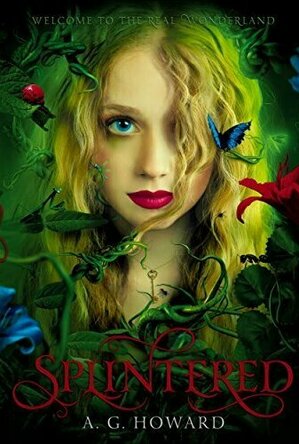
This stunning debut captures the grotesque madness of a mystical under-land, as well as a girl’s...
Heather Cranmer (2721 KP) rated You Won't Know Her Name in Books
Feb 17, 2022
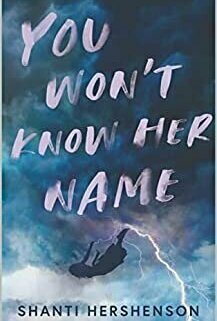
You Won't Know Her Name is certainly not for the faint of heart. With heavy themes such as bullying and sexual assault, I knew the plot would be a dark read. However, Hershenson writes like a pro, and the way she incorporates these themes into her story didn't put me off reading. The plot is solid and interesting if a little sad at what The Girl had to go through. I loved that there were no chapters, only poems and that each poem started with a title of what the short poem would be about. Each poem flows well into the next. It really made my heart hurt for all the injustices done to the girl (and her sister). What angered me the most was how the school failed this child. Unfortunately, many schools fail bullied children every day. (I speak from personal experience). I would say that there is a plot twist in this story, but there are no cliff hangers. It's just sad that there are so many people (children and adults alike) that have to go through such horrible bullying.
The characters in You Won't Know Her Name felt very realistic. We are told early on by the author that names aren't important so no names are ever mentioned in this story. We have "The Girl" who I felt so bad for. She didn't deserve any of the hate and the uncaringness she got. I just wanted to protect her so much throughout the story and tell "The Person" (The Girl's bully) to just back off. The Person acted in such a vile way toward The Girl and her sister. It made me wonder about The Person's background though. Was The Person being bullied at home to act out that way in school? I am, by no means, excusing The Person's behavior though.
Trigger warnings for You Won't Know Her Name include sexual assault (not graphic), profanity, talks of suicide, and violence. The author has included trigger warning notices at the start of each poem that could possibly trigger some readers though.
You Won't Know Her Name is a sad but a good read. There is some good to come out of it though. You Won't Know Her Name is a thought provoking read about a subject that, sadly, many children (and adults) have to deal with although they shouldn't.
Overall, You Won't Know Her Name is a well written piece of poetic literature that everyone should read. I would highly suggest that parents read it with their child and discuss it. If you are a librarian, buy this book for your library. It's not a long book either, so even the most hesitant reader could get a lot from it. I would definitely recommend You Won't Know Her Name by Shanti Hershenson to those aged 14+. Trust me, this is a book that needs to be read.

Goddess in the Stacks (553 KP) rated On Tyranny: Twenty Lessons From The Twentieth Century in Books
Jan 11, 2018
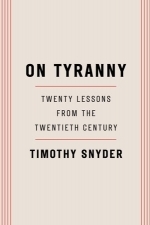
The format is simple: Twenty sections, each beginning with a lesson title and a short summary paragraph, then going into more detail in the next two to three pages. For example:
Do Not Obey In Advance.
Most of the power of authoritarianism is freely given. In times like these, individuals think ahead about what a more repressive government will want, and then offer themselves without being asked. A citizen who adapts in this way is teaching power what it can do.
The next few pages talk about Austrian Nazis rounded up Jews and used them as forced labor, before the German government told them to. When Jewish businesses were marked as such, people immediately started avoiding them. Anticipatory obedience. (Relate this to the suddenly overt racism and Nazi marches we're now facing in the US - where that used to be hidden.)
Another example:
Take Responsibility For The Face Of The World.
The symbols of today enable the reality of tomorrow. Notice the swastikas and the other signs of hate. Do not look away, and do not get used to them. Remove them yourself and set an example for others to do so.
The next pages talk about propaganda, and signs. If we tolerate swastikas, we imply that we accept them. That we support them. And if the oppressed groups that those swastikas are aimed at see everyone around them supporting them, who do they look to for help? All it takes is one person deciding to scrub off or paint over the swastika, for people around them to realize that's a thing that can be done. This plays into another section, which talked about Standing Out. Do the thing that makes you stand out - whether that's standing up for a minority, or scrubbing swastikas off walls, or attending a protest. If you don't stand out, you're too easily ignored as part of the problem.
This book had lots of holds at my local library - while I was sad to have to wait so long, I was pleased that so many people wanted to read it. I was 35th in line at one point! Just knowing that so many people want to read it is a little reassuring. The author has written several books on the Holocaust, WWII, and the rise of Hitler, so he knows what he's talking about, and it shows in his writing.
On Tyranny is a quick read and does an amazing job of boiling a lot of complicated concepts down into very succinct little points. I definitely recommend it as a jumping off point. Just don't let it be all you read.
You can find all my reviews at http://goddessinthestacks.wordpress.com
Eilidh G Clark (177 KP) rated Optograms in Books
May 13, 2017
I go to my room, wiping
the admirer’s lipstick clean
with tights beneath jeans
retrieved from a friend’s house,
and with the words
Big Girl’s Blouse
reverberating inside my head
This poem speaks volumes in so little words and the reader is forced to look inwardly at their own behaviour toward people who do not conform to the norm. Similarly, ‘Prayers to Aliens and Satellites’ is a raw and candid view of homelessness which digs deep into the readers conscience,
where bloodless, xylophonic fingers
sink into armpits –
petitioned hands closed to benefits
and the friendships of passersby.
Like the previous poem, ‘Prayers to Aliens and Satellites’ urges the reader to become more aware of the social problems in society. If these poems are not enough to capture the heart of the reader, Watt surprises us with his heart crushing honesty in poems such as ‘Clinics Lip’ – a grief stricken account of miscarriage,
A husband, once the acme of affection,
now lollygagging in the garden;
crossmaker in waiting
for the small plot earmarked for the hill’s crest.
My own personal favourite is ‘Trouble was Someone Else’s Kid’, a short account of childhood memories, like a fragment of memoir condensed into neatly arranged stanza’s. There is something funny yet tragic about this poem that brought to me both nostalgia and a desire to relive my own fading youth.
We moved in shadows, kept the lid
on, as if peanut butter sandwiches
had pasted our lips together.
Other neighbourhoods sizzled
with pyromaniacs and politics,
alcoholics who played tin whistles
when Di and Charles got hitched.
These are only a few of the delights that can be found in this little treasure of a pamphlet and I would urge poetry lovers as well as those who are new to poetry to seek out a copy of this work. With twenty-six wonderful poems Optograms, is undoubtedly one of the best collections of contemporary Scottish poetry that I have read.
To learn more about the Stephen Watt you can visit The Scottish Poetry Library, http://www.scottishpoetrylibrary.org.uk/poetry/poets/stephen-watt or like his Facebook page @StephenWattSpit. Optograms, can be purchased from stephenwattspit299@gmail.com or the publisher Marc Sherland marcsherland@me.com at Wild Word Press.
One of the things I noticed most was she details social rules in ways I never would have thought to do - she has a list of seven very specific rules for eye contact, for example. As an allistic person, most of those rules are things I do instinctively, without even really knowing the reason for them. Like, in conversation, looking up or to the side means you're thinking, looking down means you're done talking. I read that to my husband and he jumped in, surprised, with "so THAT'S why I get interrupted so much!" I never would have thought to codify that into words, but it's something I naturally do.
She talks about meltdowns vs shutdowns, which are things we've already learned the difference between with my husband, but we're both eager for strategies to avoid, mitigate, and recover from them. She gave some strategies as places to start, but that's hard to give general advice on as every autistic is so very different in that regard.
The chapter on alexithymia was really interesting. Alexithymia being an impairment in identifying and describing emotions. It leads to a lot of "Hey, are you okay?" "I don't know." "Well, how do you feel?" "I DON'T KNOW!" We'd already been introduced to this concept through her blog, but she expands on it in the book.
Another interesting (and applicable!) chapter was the one on executive dysfunction. (We joke that I am my husband's personal assistant - I keep his calendar and remind him of important dates/events/homework due dates, and sometimes nudge him to do things if it seems he's having trouble getting started.)
Kim uses the term Asperger's in her writing (as well as autism), but Asperger's has been rolled into the greater Autism Spectrum Disorder since 2013. Very recently there's been some debate about the Asperger name, as it's been revealed that Hans Asperger at least cooperated with the Nazis, and possibly was one himself. It's still used commonly, though, and there is a large community built around being Aspies. Personally, I think using the Asperger term is a little too divisive - it's basically the same as "high-functioning." But. I'm allistic and my opinion on the matter isn't the important one, so. We use autistic for my husband. (His choice, and when I asked his thoughts, he also thinks the Asperger term is divisive and not useful.) There's a number of Twitter threads and articles on the subject of using or not using the Asperger term, and what it means to the community.
Overall, this was a really great book for learning about how autism affects day-to-day life, and gave us lots of talking points and words for things we didn't have the vocabulary for. I'm looking forward to tackling the rest of my Autism Reading List.
You can find all my reviews at http://goddessinthestacks.wordpress.com
Goddess in the Stacks (553 KP) rated Bright Smoke, Cold Fire in Books
Apr 15, 2018
Hodge has written a few other books - Cruel Beauty, a retelling of Beauty and the Beast, and Crimson Bound, a retelling of Little Red Riding Hood. (She also has a novella that spins Cinderella.) You all know how much I like my redone Fairy Tales! Bright Smoke, Cold Fire, is a little different in that it's a Shakespeare play, instead of a fairy tale. I recently read and reviewed Miranda and Caliban, another Shakespeare reskin, but this, I think, is much better.
The Capulets have become the Catresou, and the Montagues the Mahyanai in this dark fantasy. The Ruining has killed every human outside the city of Viyara/Verona - only stopped by the mystical walls put up by a long-dead priestess and maintained by a mysterious cult of nuns.
My favorite characters in this book - and arguably the main characters - are Runajo (Rosaline) and Paris, rather than Romeo and the Juliet. (It's a title, not a name - her name was stripped from her as an infant when the magic was worked to make her "the Juliet.") The original play doesn't give either of them much time, and they are both fascinating characters in this novel - Runajo a little more than Paris, in my opinion. Runajo is a member of the Sisters of Thorns - the cult of nuns keeping the walls of Viyara up against The Ruining. When she accidentally brings the Juliet back from death, she becomes - or at least thinks she becomes - that which she and the city fear the most. A necromancer. Runajo and the Juliet both believe they will (and should) die for this crime, but still use the time they have left to try and save the city from the necromancers operating within.
Meanwhile, Paris and Romeo have found themselves bound by the magic that should have bound Romeo and Juliet, had it not gone terribly wrong. They can feel each other's emotions, see each other's memories, hear each other's thoughts. This is understandably awkward for Paris as he feels Romeo's grief for the Juliet's supposed death, and occasionally catches flashes of more intimate moments between the two. They decide to take on the city's necromancers in memory of the Juliet.
I liked how, similar to the play, Romeo and Juliet both operate for the entirety of the book under the assumption that the other one is dead. They both take risks and agree to things they would not have done if they didn't each welcome death in their own way.
I also very much enjoyed a side, non-binary character who I really want to see more of!
The book ended on an upsetting cliffhanger, which is really my only problem with it. The sequel is due out this summer (Endless Water, Starless Sky) and I will definitely be picking it up.
Great book, but you may want to wait a few months so you can immediately follow it with the sequel!
You can find all my reviews at http://goddessinthestacks.wordpress.com