Search

Lottie disney bookworm (1056 KP) rated What Once Was Mine in Books
Oct 25, 2021
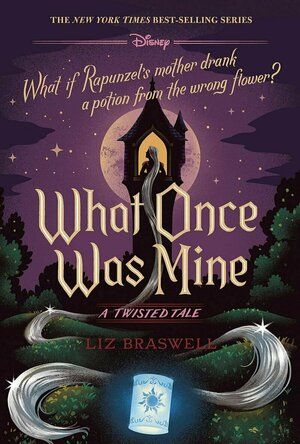

𝑾𝒉𝒂𝒕 𝒊𝒇 𝑹𝒂𝒑𝒖𝒏𝒛𝒆𝒍’𝒔 𝒎𝒐𝒕𝒉𝒆𝒓 𝒅𝒓𝒂𝒏𝒌 𝒂 𝒑𝒐𝒕𝒊𝒐𝒏 𝒇𝒓𝒐𝒎 𝒕𝒉𝒆 𝒘𝒓𝒐𝒏𝒈 𝒇𝒍𝒐𝒘𝒆𝒓?
As you will all know by now, I am in love with the Twisted Tales series and have to read each installment as they are released. What Once was Mine is the 12th Twisted Tale book and the 7th written by Liz Braswell so to say I was excited would be an understatement.
As always, TT books come with a tag line to lure you in and this one is “What if Rapunzel’s mother drank a potion from the wrong flower?” Yes, instead of the golden Sundrop flower, the ailing pregnant queen is mistakenly given a potion using the Moondrop flower, resulting in a silver-haired princess whose power kills rather than heals!
Of course, that casts the whole locking the princess in a tower concept into an entirely new light! However, many of the other elements remain the same as Disney’s ‘Tangled’ movie: Gothel is Rapunzel’s captor and “mother”, Flynn steals a crown and is on the run from the Stabbington brothers and Rapunzel is desperate to see the floating lights.
What Liz Braswell manages to do (very well, in my opinion) is to maintain all these similarities, keeping her readers rooted to the original story but also to bend the original fairytale into something a bit more mature, a bit darker and, in some cases, a bit more real.
“𝙏𝙝𝙚 𝙩𝙧𝙪𝙩𝙝 𝙖𝙗𝙤𝙪𝙩 𝙮𝙤𝙪 𝙞𝙨 𝙖𝙡𝙡 𝙩𝙖𝙣𝙜𝙡𝙚𝙙, 𝙡𝙞𝙠𝙚 𝙮𝙤𝙪𝙧 𝙗𝙧𝙖𝙞𝙙𝙨, 𝙍𝙖𝙥𝙪𝙣𝙯𝙚𝙡”
What Once was Mine is written from Rapunzel’s perspective. Now, this may be an obvious choice, but it also gives Braswell the opportunity to show her protagonist in a slightly more mature light than we are used to. Yes, Rapunzel is scatty, enthusiastic and teeth-grittingly cheerful about everything but she also believes she is dangerous and that she belongs in the tower for the safety of others.
Rapunzel has always been told that her hair killed her parents and that Gothel has been charged with her care and protection. However, what I really enjoyed about Braswell’s Rapunzel is that, although she begins with the same blind faith in Gothel as she has in the movie, she soon develops an inner turmoil of emotions with regards to her captor, questioning where she spends her days and recognising the little digs often made at the daughter’s expense.
As her journey continues, Rapunzel observes other mother-daughter relationships and her doubt and distrust of Gothel begins to build as a result. Lords, ladies and bandits alike are hunting for Rapunzel in order to claim her as their prize but this couldn’t be orchestrated by her mother, the only family she has ever known, could it?
“𝘽𝙚𝙜𝙞𝙣 𝙮𝙤𝙪𝙧 𝙣𝙞𝙣𝙚𝙩𝙚𝙚𝙣𝙩𝙝 𝙮𝙚𝙖𝙧 𝙗𝙮 𝙛𝙤𝙧𝙜𝙞𝙫𝙞𝙣𝙜 𝙮𝙤𝙪𝙧𝙨𝙚𝙡𝙛, 𝙍𝙖𝙥𝙪𝙣𝙯𝙚𝙡. 𝙏𝙝𝙖𝙩’𝙨 𝙖 𝙛𝙖𝙧 𝙗𝙚𝙩𝙩𝙚𝙧 𝙜𝙞𝙛𝙩 𝙩𝙝𝙖𝙣 𝙛𝙡𝙤𝙖𝙩𝙞𝙣𝙜 𝙡𝙖𝙣𝙩𝙚𝙧𝙣𝙨.”
I have conflicting feelings when it comes to the darker elements of What Once Was Mine. The inclusion of the very real Countess Bathory took me by surprise and was quite gruesome in places: not a problem for a grown-up Disney nerd but I’m not sure whether I will be passing this one along to the Mini Bookworm any time soon.
There is also the narrator of the story: a brother making up an alternative Rapunzel story for his sister while she is undergoing chemo. I understand this is an emotive topic for the author and I almost got it as a tool for the story-telling, enabling the use of quite modern, colloquial terms such as “murderhair” and enabling the creative inclusion of characters such as Maximus.
I really wanted this technique to be profound and make the story mean more, such as fairytales having an important place in the modern world for example. Unfortunately, it fell a little flat for me: it was an interesting tweak but it didn’t make me feel as much as I wanted it to.
It is not all doom and gloom though, Rapunzel’s perspective of the world provides comic moments: her (limited) knowledge of the world comes from the 37 books that she owns, leading to a moose that is definitely a squirrel and a cat which acts suspiciously like a fox. We are also not deprived of the regulars of The Snuggly Duckling, indeed all of your favourites from the film turn up for this novel.
Braswell’s characterisation when it came to Flynn was spot on in my opinion. The observation by Rapunzel that there is the “real” Flynn and then there is the charming, roguish mask he uses was perfect! Gina was also a great addition, desperately trying to be an adventurer/criminal and not being taken seriously just because she is a girl. The relationship between her and Flynn was adorable and, of course, Gina’s mother is just legendary.
“𝙎𝙝𝙚 𝙬𝙖𝙨𝙣’𝙩 𝙘𝙝𝙖𝙨𝙞𝙣𝙜 𝙙𝙞𝙨𝙩𝙖𝙣𝙩 𝙡𝙞𝙜𝙝𝙩𝙨; 𝙨𝙝𝙚 𝙬𝙖𝙨 𝙥𝙪𝙧𝙨𝙪𝙞𝙣𝙜 𝙖𝙣 𝙪𝙣𝙧𝙚𝙖𝙡𝙞𝙯𝙚𝙙 𝙙𝙧𝙚𝙖𝙢 𝙤𝙛 𝙣𝙤𝙧𝙢𝙖𝙡𝙘𝙮”
The writing style isn’t for everyone and, I must admit, this is the twisted tale which I have probably put down and walked away from the most. However, if you can stick it through the slow sections the story is really worth it and provides a much-admired evolution of the Disney Princess.
Don’t get me wrong - in the animated movie Rapunzel is great and all but by the end she is a princess with a haircut and a smouldering husband. Braswell’s Rapunzel has magic that she needs to study, understand and control, she is a future Queen in the making and simply has more of a purpose than her animated counterpart.
“𝙎𝙝𝙚 𝙝𝙖𝙙 𝙥𝙤𝙬𝙚𝙧 𝙖𝙣𝙙 𝙬𝙞𝙡𝙡 𝙖𝙣𝙙 𝙖 𝙨𝙩𝙪𝙗𝙗𝙤𝙧𝙣 𝙙𝙞𝙨𝙥𝙤𝙨𝙞𝙩𝙞𝙤𝙣”
What Once Was Mine brings a whole new depth to the characters of Disney’s Tangled. It gives us a new (frankly, disgusting) villain alongside all our favourite characters and definitely presents a creative twist on the traditional story. Don’t worry, Rapunzel still gets her Happily Ever After, but she fought a little harder for it this time around!

Purple Phoenix Games (2266 KP) rated Tsuro: Phoenix Rising in Tabletop Games
Oct 6, 2021
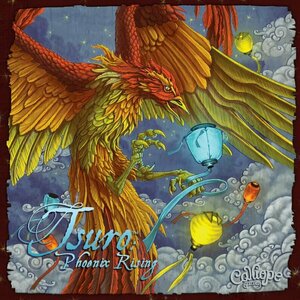


When we decided to start this board game review group, coming up with a name was definitely a challenge. We threw out so many ideas, my head was spinning with the possibilities! In our name search, someone suggested Purple Phoenix Games. It sounds cool, we all like the color purple, and it was a name upon which we could all finally agree! Ever since settling on our name, I have taken a keen interest in any game that has any mention of Phoenix, so when Travis backed Tsuro: Phoenix Rising on Kickstarter, I knew I’d have to play it. Does the game meet our expectations, or does this Phoenix struggle to rise from the ashes?
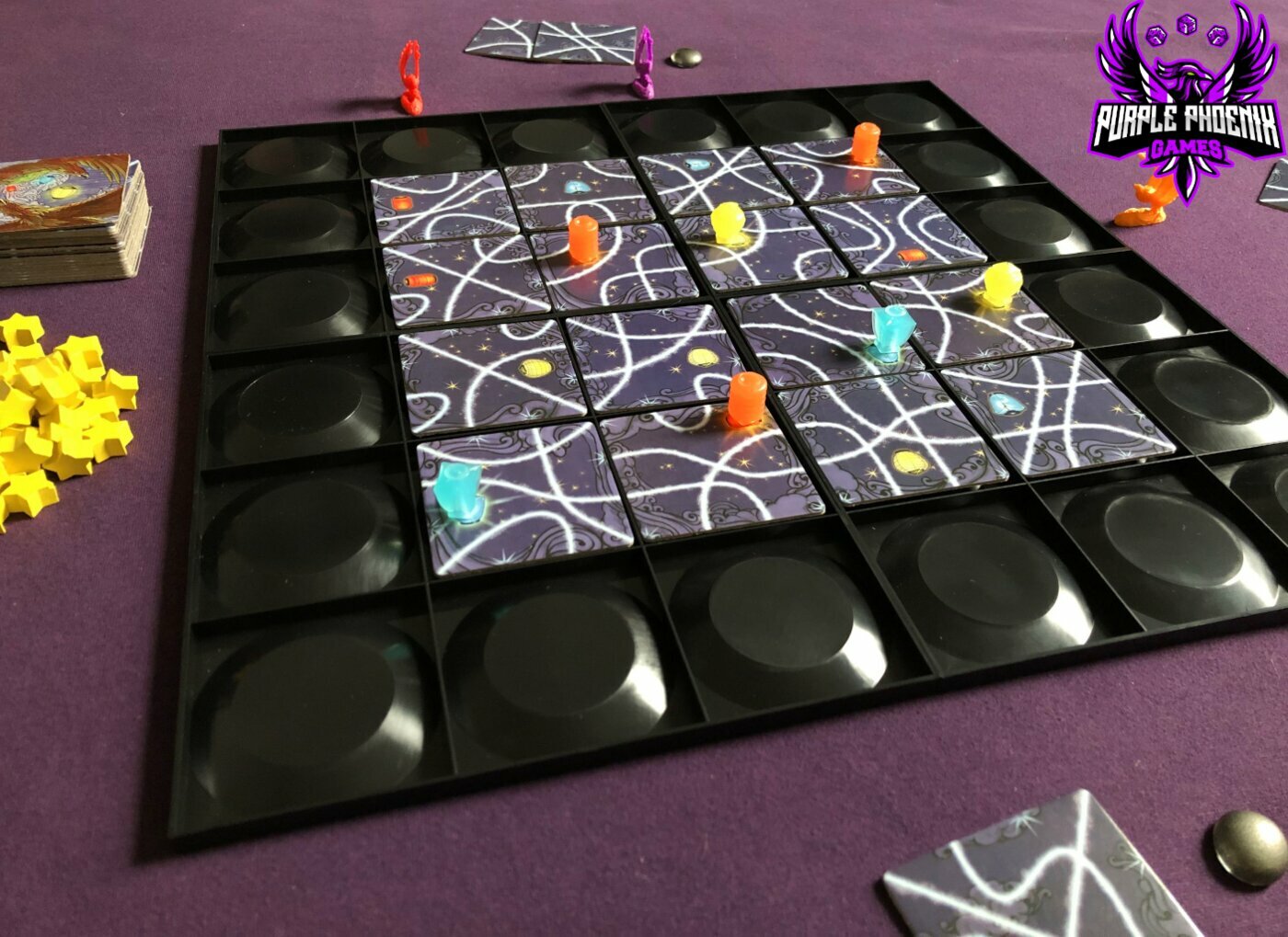
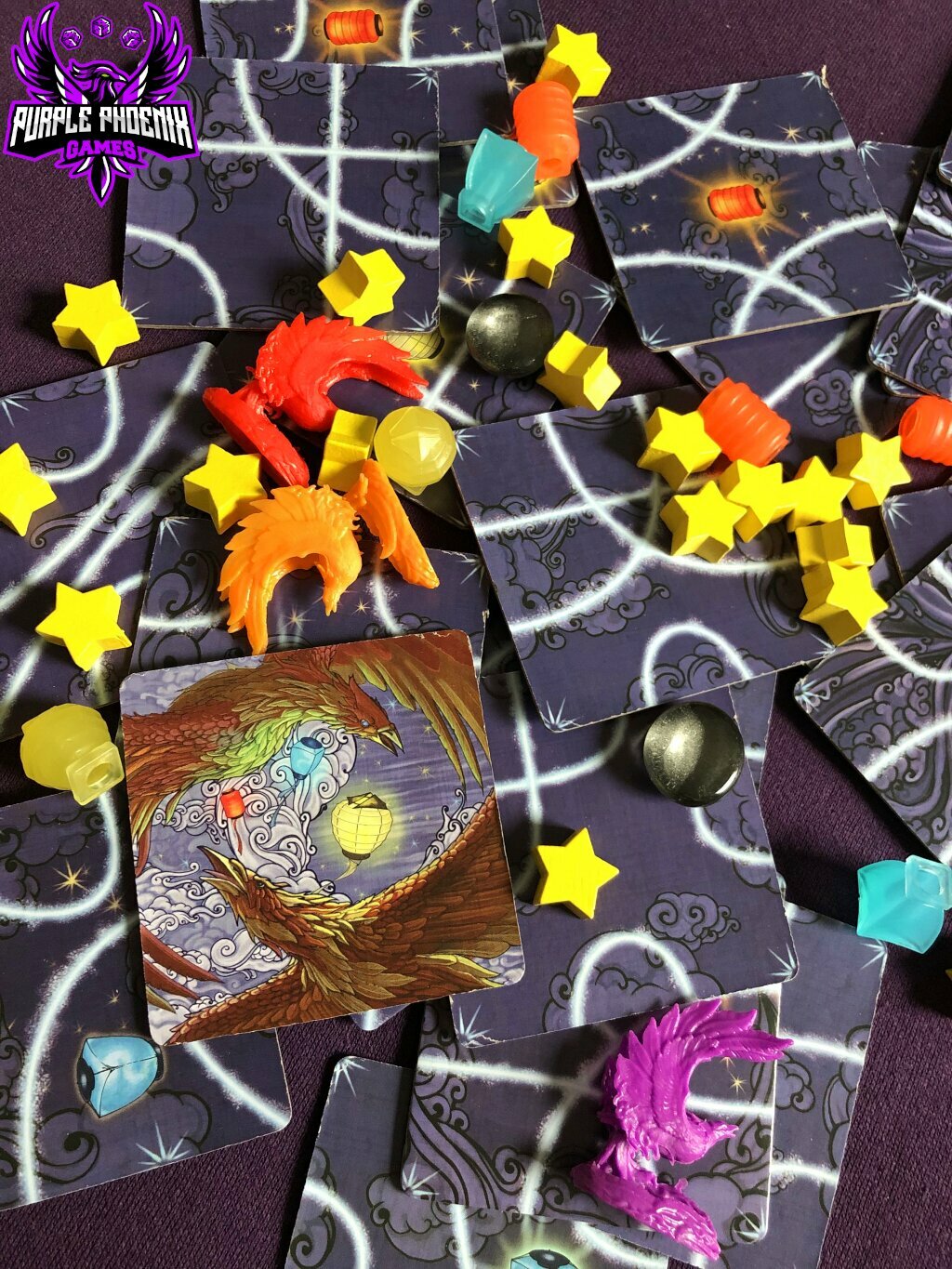
Tsuro: Phoenix Rising (referred to as just Tsuro for the remainder of this review) is a game of tile placement and network building in which players will each guide their Phoenix across the night sky to find Lanterns and collect Stars. To setup for a game, assemble the board and give each player a Life token and a Phoenix pawn in their chosen color. Each player will then place their Phoenix next to one of the empty Edge spaces of the board. Now shuffle and populate the Center tiles as described in the rules, place Lanterns on their specified tiles, deal each player 2 Edge tiles, and you are ready to begin.
Played over a series of rounds, players will take turns placing tiles and moving their Phoenix pawns along the paths that have been created. On your turn, you will perform the following actions: Create your path, Travel your path, and Prepare for your next turn. To Create your path, you will either play a tile from your hand, or you will flip/rotate a tile. To play a tile from your hand, the space in front of your Phoenix must be empty. Select one of the two tiles from your hand, add it to the board in an orientation that continues your current path, and discard the remaining tile. If the space in front of your Phoenix is already occupied by a tile, you will either flip or rotate that tile to extend your path.
Once your path has been Created, you will Follow it. Move your Phoenix along your new path until you either reach a dead end or are forced to leave the board – by following a path off of the board, colliding with another Phoenix, or entering an endless loop. During this step of your turn is when Stars will be created and earned. If during your movement your Phoenix enters and exits a tile with a Lantern on it, place a Star token onto that tile. Once your movement has ended, for each tile with a Star, you must move that Lantern to a different tile with its corresponding icon. Collect the Stars you created, and they are immediately scored. If, as a result of someone else’s turn, the path for your Phoenix has been extended, you will move your Phoenix along that new path after the active player has completed scoring any Stars. An important note – you can also earn Stars through this out-of-turn movement!
The last step of your turn is to Prepare for your next turn. Draw 2 new tiles from the draw stack if the space in front of your Phoenix is empty, otherwise draw no tiles. Play then continues on to the next player in turn order. If at any point in the game, your Phoenix has been forced off the board, you may spend your Life token on your next turn to Rise from the Ashes. This can only be performed if there is at least one empty space on the board with no tile on it. After a certain amount of time, the board will be completely filled and your opportunity to Rise from the Ashes will be gone! Rounds continue in the above fashion until one player has scored at least 7 Stars. Players will complete the current round, and then the game ends. OR if there comes a time during the game in which only 1 Phoenix pawn remains on the board, the game ends and that remaining player is declared the winner.
All in all, I really enjoy playing Tsuro, and not only because of our Phoenix connection. For such a seemingly simple game – create a path and move on it – the gameplay requires a good amount of strategy. The ability to rotate, and even flip, tiles adds so many strategic possibilities that really elevates the gameplay from that of the original. Also, with the addition of the Lanterns and Stars, the game offers another focus instead of simple player elimination. Strategies can, and will, vary between players, and that makes the game more engaging for all involved. Add in the fact that your Phoenix will move if another player has extended your path on their turn, and you’ve got all players playing on every turn of the game.
Another aspect of Tsuro that I really like is the addition of the Life token and the opportunity to Rise from the Ashes. Just because an opponent forces you off the board does not necessarily mean that you are out of the game for good. The chance to Rise is a unique second chance for players to stay involved in the game. I think it works well because of its limited timing. If there are no open spaces on the board, you are out of luck! It really ups the ante and keeps players on their toes.
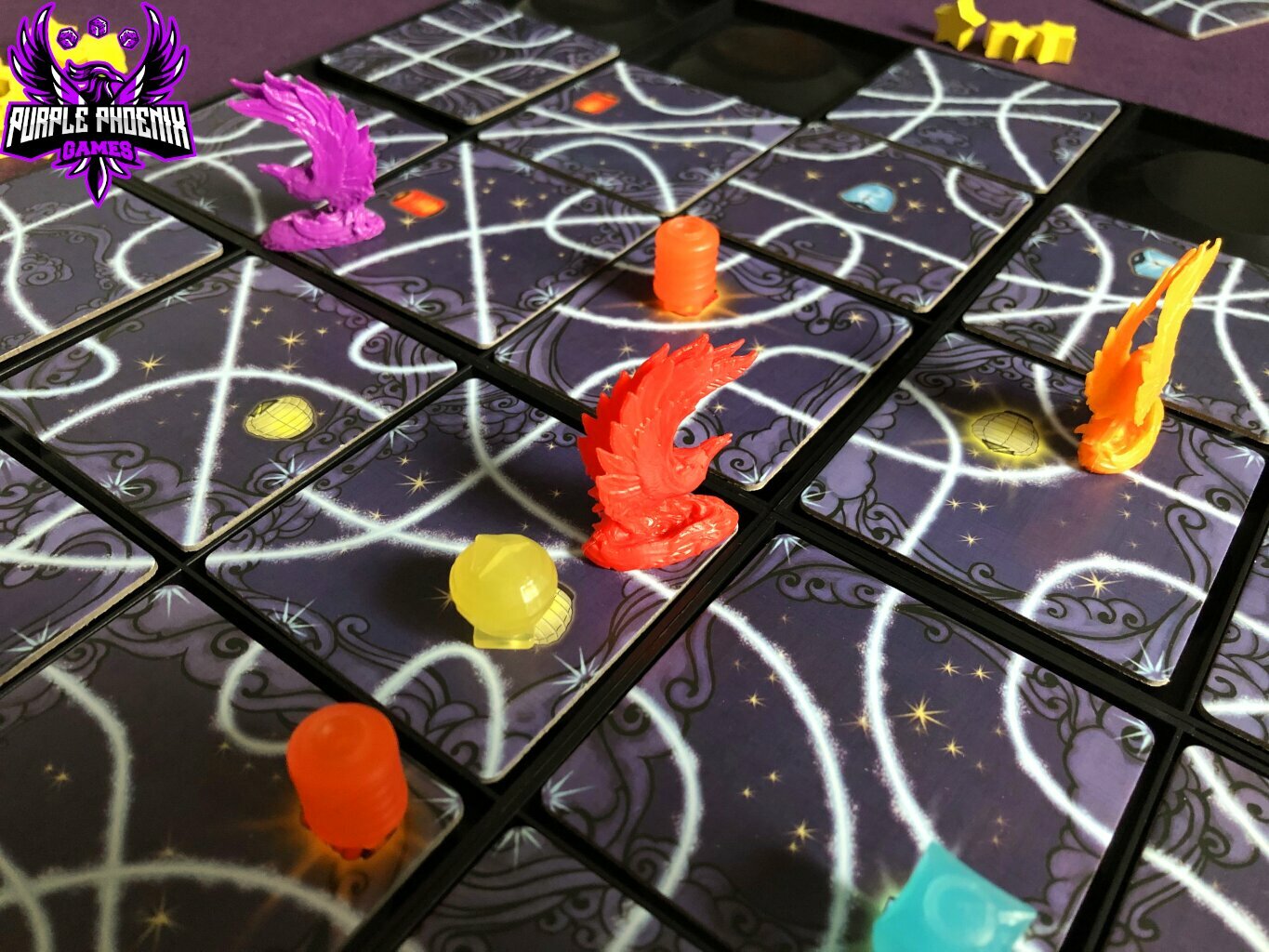
Let’s touch on components for a minute. They are pretty stellar in this game. The board is nice and sturdy, the cardboard tiles are thick, the Stars and Lanterns are of excellent quality, and the Phoenix pawns are nicely detailed and just plain fun to look at. No complaints about components from me in this game!
Compared to the original, I think that Tsuro: Phoenix Rising really lives up to its name. The gameplay is definitely elevated with new strategic options, and I believe that it does rise above the OG Tsuro. If you’ve never played either version, I highly recommend Phoenix Rising. It is entertaining, engaging, and has more to it than meets the eye. Purple Phoenix Games gives Tsuro: Phoenix Rising a mighty 11 / 18.

Purple Phoenix Games (2266 KP) rated Sheepy Time in Tabletop Games
May 27, 2021

Have you ever had trouble falling asleep? One method that supposedly helps lull you into a gentle slumber is counting sheep – imagine sheep prancing across a field and jumping over a fence. What seems like a simple and mundane task to us is actually a full-time job for these Dream Sheep! So put on your PJ’s, lace up your slippers (?), and clock in for a night of fence-jumping, all while avoiding the spooky Nightmares that will try to scare you awake!
Disclaimer: We were provided with a copy of Sheepy Time for the purposes of this preview. What you see pictured below are the retail components. -L
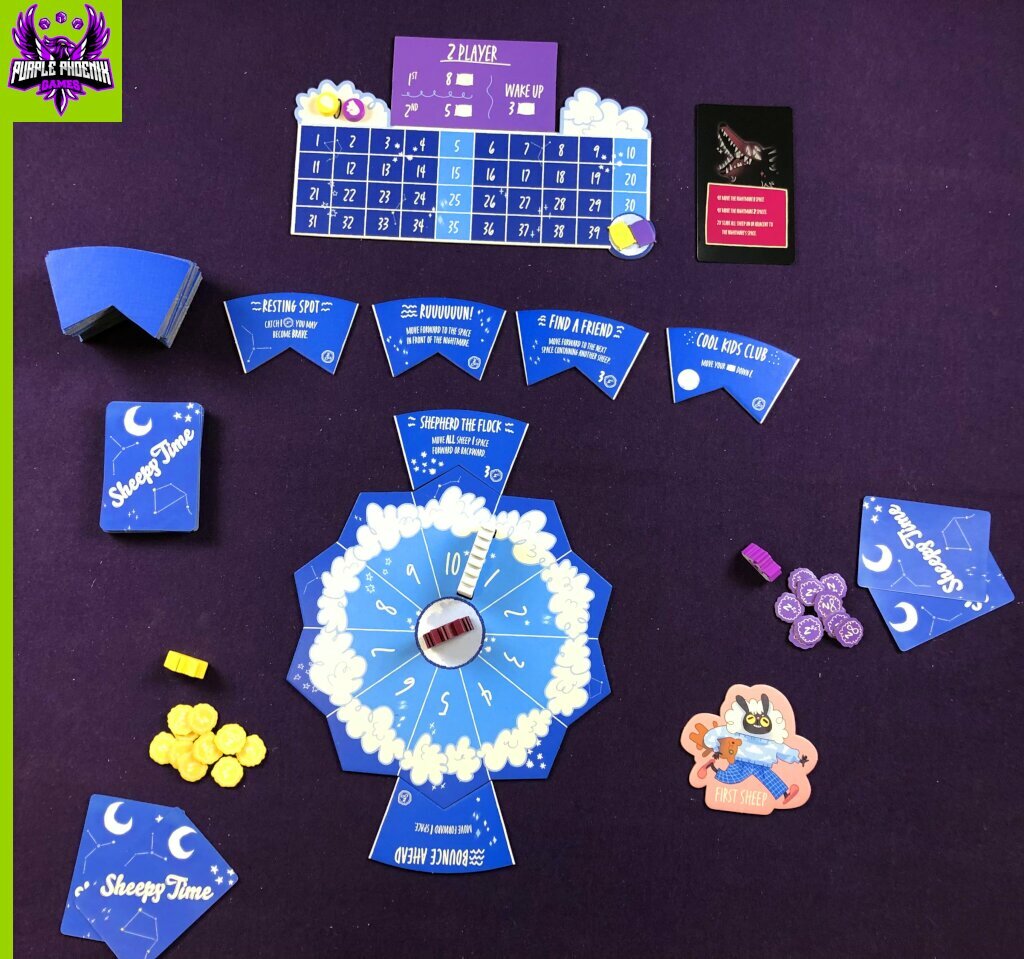
Sheepy Time is a push-your-luck game in which players take on the roles of Dream Sheep, tasked with helping humans fall asleep. Played over a series of rounds, players will take turns racing their Sheep around the board, using special Dream powers, and avoiding the Nightmare that lurks around the board. The player that earns the most points (as described in the rules) will be declared the dreamiest sheep of all! To setup for a game, place the board within reach of all players and attach the Fence between spaces 10 and 1. Place the scoreboard and Pillow Reference tile nearby, and give all players a Sheep, Wink, Pillow, and Zzz tokens in their chosen color. Select one of the three provided Nightmares to use this game, shuffle their cards into the deck of Sheep cards, and place the Nightmare meeple in the center of the board. Shuffle the Dream tiles, drawing and placing one randomly on spaces 1 and 5 of the board, and reveal four more tiles to create a market. Place all Pillow tokens on the 40 Winks space of the scoreboard, choose a starting player, and the game is ready to begin!
Each round of Sheepy Time is broken into two phases: the Racing phase, and the Resting phase. To begin the Racing phase, all players will draw 2 cards into their hand. A turn consists of 4 steps: Play a card, Use Dream tiles, Resolve Fence crossing, and Draw cards. The first action you will take on your turn is to play a card from your hand. Most cards will have you move your Sheep around the board a set number of spaces, or will give you the option to ‘Catch some Zzz’s’ (place one of your Zzz tokens on a Dream tile in play). The next step, if applicable, is to use Dream tiles. Dream tiles provide special/extra abilities that can be beneficial to you. In order to use a Dream tile, however, you must have a Zzz token on it – remove your Zzz token from the tile to use its power. So you’ve got to decide when to move your Sheep, or when it’s necessary to Catch some Zzz’s! The third step is to resolve Fence crossing, if applicable. If a cards movement causes your Sheep to cross the Fence, you immediately gain 5 Winks (on the Scoreboard), and decide whether to keep playing this round or ‘Call it a Night.’ If you decide to keep playing, you move to step 4, and draw a new card into your hand. If you Call it a Night, you will discard your hand, and sit out for the remainder of this Racing phase.
If at any point in the Racing phase, you draw a Nightmare card, it must immediately be revealed and resolved. The Nightmare moves around the board, much like the Sheep, but it will Scare any Sheep that it passes! Being Scared once is ok, but if you were to be Scared AGAIN, you get Woken Up, lose all Winks for this round, and are out of the Racing phase. If the Nightmare completes a lap of the board and crosses the Fence before all players have Called it a Night, the remaining players get Woken Up. How risky are you willing to be once the Nightmare comes into play? That’s for you to decide. Once all players have either Called it a Night or been Woken Up, the Racing phase ends. Check the scoreboard for a winner – when a player earns enough Winks in the Racing phase to surpass their Pillow token. If nobody has met that requirement, players will lower their Pillow tokens by the amount specified on the Pillow Reference tile. The lower you can get your Pillow token, the fewer Winks you need to get to win in future rounds! When all Pillow tokens have been adjusted, the game moves to the Resting phase. In this phase, each player will have the choice to either add a new Dream tile to the board, or to Catch 2 Zzz’s. In turn order, players can select one of the Dream tiles from the market to place on an open space of the board, or place 2 Zzz tokens on Dream tiles in play. When everyone has performed their action, the round ends and a new Racing phase begins. Play continues in this manner until one player has been declared the winner!
I’m not typically a fan of push-your-luck games, but Sheepy Time really surprised me! Yes, that mechanic is definitely present in the gameplay, but there is also quite a bit of strategic variability that makes turns feel a little more controlled. The Dream tiles in play will always be different, providing unique abilities to help give you a strategic boost during play. And you always have 2 cards to decide between to play – you are not limited to only one course of action each turn. So yes, there is a riskiness involved with how many laps you think you can get, can you avoid the Nightmare, etc. But there is also a light element of strategy that makes the game more exciting for me. The gameplay itself is also very smooth and intuitive. The turn order makes sense and the flow of the game is pretty seamless. It is fast to teach and learn, and even though the box says 30-45 minutes, it feels fast to play.
Let me touch on components for a minute. As I said earlier, this is a retail copy of the game, and the production quality is great. The cardboard components are nice and thick, the wooden meeples are large and cute, and the overall art style reflects the theme and lightness of the game well. I want to mention that the insert is nice as well – I know it doesn’t effect the gameplay, but it makes set-up/tear-down quick and efficient. AEG definitely knocked it over the fence (get it?) with the production of this game!
So where does Sheepy Time fit into my collection? I think it’s a great game to use to introduce newer gamers to the hobby. The rules and gameplay are not overwhelming, but they offer more of a modern gaming feel than some of the older classics. I would even say that this game can be used with younger gamers as well – take out the Dream tile powers, and just race to see who can earn the most Winks before the Nightmare gets them, or something like that! It is really accessible for everyone, and that earns a big thumbs up from me. So if you’re not quite sure what to think of this game based on the theme/art style, I can assure you that the gameplay is quite excellent. When Sheepy Time hits retail, make sure you jump at the chance to play this game. Definitely don’t sleep on it.
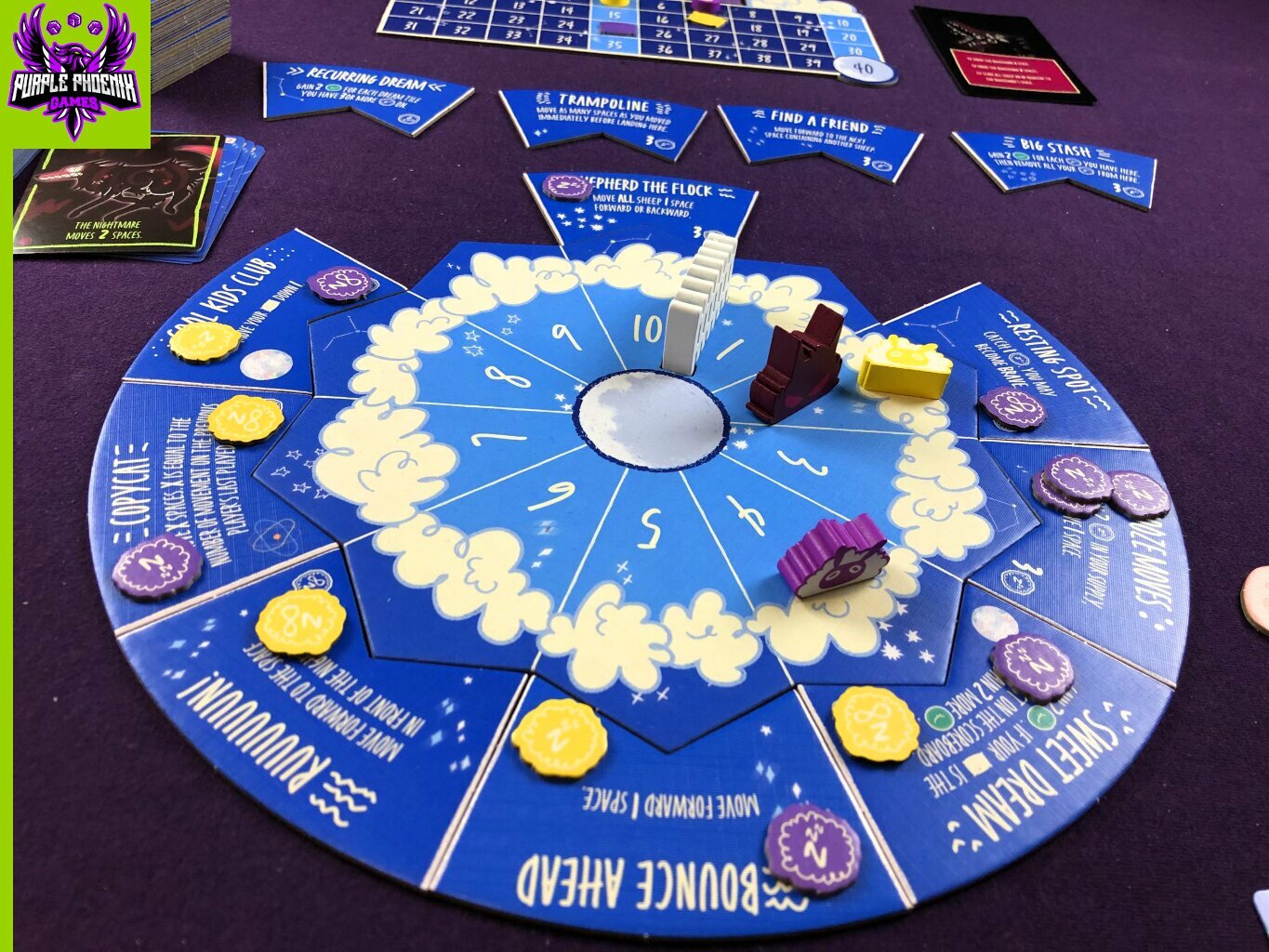
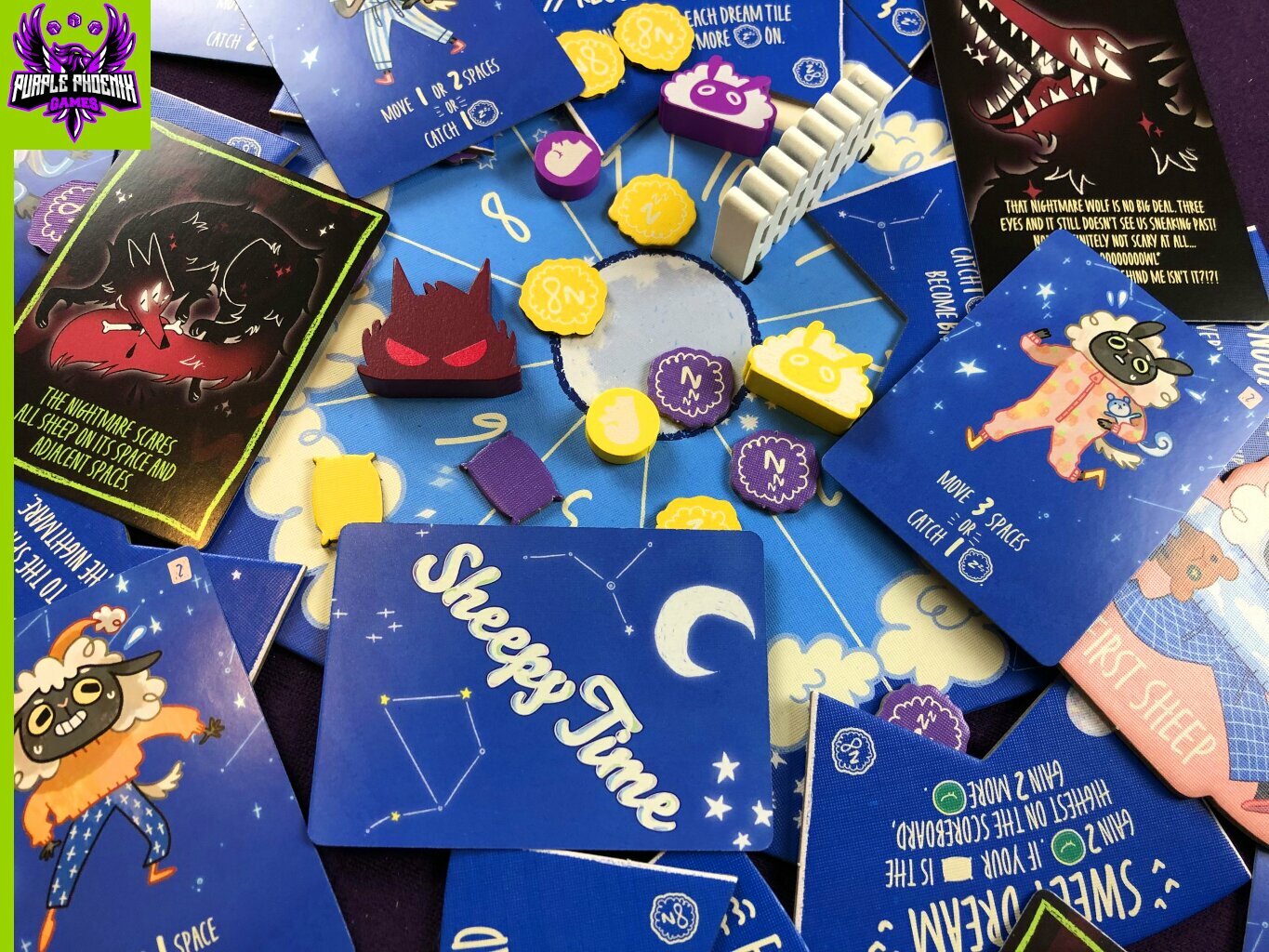

5 Minute Movie Guy (379 KP) rated A Million Ways to Die in the West (2014) in Movies
Jun 26, 2019

Neil Patrick Harris is delightfully devious. (1 more)
MacFarlane shows he has potential in his on-screen acting debut.
The humor is at times very vulgar and immature. (2 more)
The film is slow-paced and overly long.
"A Dozen Ways to Die in the West" would have been a more appropriate title.
A Million Ways to Die in the West is good for a few laughs but it feels like it goes on unreasonably long. Still, if you're a fan of MacFarlane's other works, you'll most likely enjoy his parody of the Old West.
Following the success of his directorial debut, Ted, Seth MacFarlane steps in front of the movie camera for the first time in his new film, A Million Ways to Die in the West. MacFarlane is best known as the creator of the popular animated television series, Family Guy, and he was also the host of the Oscars just two years ago. Now he’s taking the starring role in a film he wrote and directed himself. Here MacFarlane plays a cowardly sheep farmer named Albert who is miserably living in the dangerous Old West. Or rather, the not-so-dangerous Old West. Despite what the title suggests, there’s not a whole lot of dying going on in A Million Ways to Die in the West. You won’t find a whole lot of substance either, but there are a fair amount of laughs if you’re able to tolerate the crude toilet humor and dirty jokes. All in all, MacFarlane does a decent job in this comedy, but his jokes stick too close to his own conventions, and much like life on the frontier, the film can be kind of a drag.
If you’ve ever seen Family Guy, you should feel right at home with the humor in this film. It’s crass, edgy, violent, and full of pop culture references. Although, given that this is an R-rated movie, MacFarlane’s able to push the limits further than usual, and he makes sure to do that by including a lot of raunchy humor and toilet-gags. Oh, and in case you were wondering, yes, male genitals are still the hottest thing in comedy right now. As you’ve no doubt deduced, this is certainly not a film you’d want to take your kids to see. Nor is it for the easily-offended. Though in the film’s defense, it’s not entirely tasteless, and its use of vulgarity isn’t overly frequent. There’s plenty of great slapstick physical comedy and some pretty hilarious dialogue. I laughed more than I thought I would, and was never so disgusted that I wanted to walk out. It’s an entertaining film, it just happens to run a little long and lose momentum down the stretch. Plus the main premise of the film is never all that compelling to begin with.
In A Million Ways to Die in the West, MacFarlane’s character Albert is a man entirely self-aware of the time and place he’s living in, as well as the many dangers that come with it. He sheepishly lives his life, terrified by the threat of death that lurks around every corner. When his beloved girlfriend leaves him for a man with a mighty mustache, Albert has to cowboy up to prove his machismo and try to win her back. Luckily for him, he meets a gun-toting woman named Anna who’s happy to help him face his fears and show him the ropes of being a cowboy. Unfortunately however, this new friendship ends up putting Albert right into the crosshairs of Clinch Leatherwood, the deadliest outlaw around.
While MacFarlane does a respectable job in his first foray into acting, his character feels rather uninspired. I couldn’t help but see him as a hodgepodge of various Family Guy characters, having the clumsiness of Peter Griffin, the self-consciousness of Chris Griffin, and the intelligence and charm of Brian. Given that he created that show, perhaps that should be expected, but it just felt like Albert was lacking a unique and consistent identity. He’s a character who can be charming and funny, but he also comes off seeming like a jerk. All in all, the film has a good cast of actors, with Neil Patrick Harris being the stand-out of the bunch. He plays the pompous, mustached snob, Foy, who steals the heart of Albert’s girlfriend, Louise. Giovanni Ribisi and Sarah Silverman are likable as the flawed, clueless couple who serve as Albert’s close friends, Edward and Ruth. Although their characters stay pretty comfortably within the realm of what you would expect from their respective actors, with Edward being the naïve nice guy, while Silverman’s Ruth is the seemingly-sweet-and-innocent, foul-mouthed hussy. Charlize Theron does a fine job as Albert’s mentor, Anna. She has a strong presence in the film and is fun to watch, but despite her best efforts, the emotional element she brings to the story ends up feeling forced and unconvincing. Though that’s no fault of her own. It’s just hard to imagine her, or anyone, falling head over heels so easily and suddenly for a guy like Albert. Then, of course, there’s Liam Neeson, who is effective in his performance as the intimidating villain, Clinch, but would have benefitted from more screen-time.
A Million Ways to Die in the West proficiently parodies the western film genre, capturing the right atmosphere for the setting and time period. Visually it’s a pleasant film to look at, with good camera-work, well-created sets, and lots of beautiful scenery. This makes it all the more disappointing then that the filmmakers decided to place a visual filter over the entirety of the film to give it a more old-fashioned look. As a result, there is a constant flickering throughout the whole movie, and while not quite seizure-inducing, it certainly is distracting. At times you kind of get used to it and forget about it, but it really stands out in scenes with heavy lighting and most of the movie takes place in broad daylight. On the audio side of things, the music is appropriately fitting, but little of it is particularly noteworthy. There is a great song about mustaches, accompanied with a well-orchestrated dance number led by Neil Patrick Harris in what is undoubtedly one of the highlights of the film. Additionally the film’s theme song is appropriately fun. The visual effects in the movie, although limited, are done quite well and nicely add to the film’s comedic effect. Although I’m sure I speak for everyone when I say the movie could have done just fine without all of the animated urinating sheep.
I think the film’s greatest flaw is the fact that it’s doing too much as it tries to incorporate all of the main stereotypes of the western genre. It has duels, bar brawls, jailbreaks, horse chases, and even capture by Indians thrown in for good measure. In trying to cover all of the bases, the movie ends up running too long and becomes a little boring and tired. Rather than building up to a climax, the film diverges with some unnecessary scenes, and then concludes with a lackluster ending. It would have been cool to see Clinch and his group of bandits lay siege to the main town, which could have given the filmmakers an opportunity to create a wide variety of deaths, and allow Albert to exercise his newly developed skills before setting up to an ultimate final showdown. Maybe that would be adding to the long list of clichés, but at least it would have given this slow-paced film some much needed adrenaline and would have made it more true to its misleading title. There are also several cameo appearances in the film, and while a couple of them are great conceptually, I don’t think any of them are quite as satisfying as they should be. They end up feeling out of place, like last-second additions that have no purpose other than to acknowledge other films. I can appreciate the attempt but the cameos aren’t particularly funny and they just seems to emphasize how much better those other films are.
Seth MacFarlane’s A Million Ways to Die in the West is good for a few laughs, but just like his character Albert’s long-winded ramblings, it feels like it goes on unreasonably long. It’s still an entertaining film regardless, and if you’re a fan of MacFarlane’s other work, you’ll most likely enjoy his parody of the Old West. The movie has a talented cast, some truly great scenes such as a bar brawl and a memorable dance, as well as plenty of good old-fashioned slapstick, and witty dialogue. If you can handle the occasional gross-out gag, you’ll probably have a good time. Just don’t expect to actually see the many ways people can die In the Old West. The movie doesn’t show many deaths at all, and all the best ones you likely already saw in the trailer.
(This review was originally posted at 5mmg.com on 6.3.14.)
Purple Phoenix Games (2266 KP) rated The Grimm Forest in Tabletop Games
Apr 9, 2021
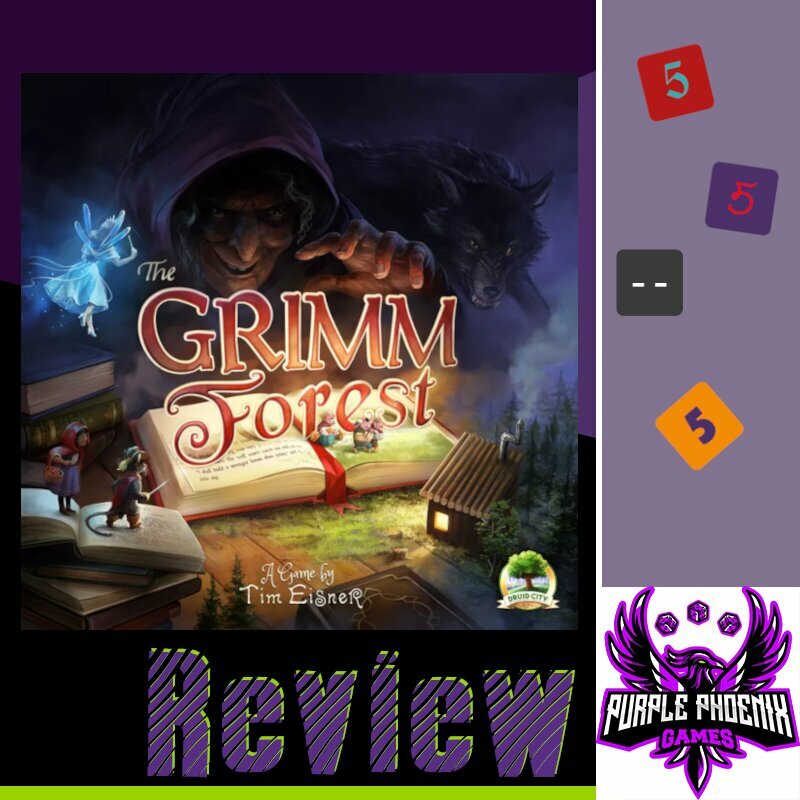
I am so psyched to be reviewing another board game based on fairytale lore. The Brothers Grimm material is such an enchanting (eh? eh?) theme and games can be taken in so many wonderful directions. Though I have never actually read any of the Grimm’s Fairy Tales (I know, I know), I have seen most of the movies based on the stories. I also know that the source material happens to be way darker than what Disney puts out, so when I heard we would be receiving The Grimm Forest to review, and not having really researched it much beforehand, I had a feeling it would be darker fare. But how dark does it go? Let’s find out.
The Grimm Forest is a simultaneous action selection, set collection, take that game for four family members of the infamous Three Little Pigs. As fantasy contractors players are tasked with constructing three houses as sturdy and quickly as they can. However, these contractors will have competition for limited resources, as well as the occasional interference from scary creatures and buddies of opponents. Like the baseball movie says, “If you build it, you will win the contract to build more stuff.” Or something like that.
DISCLAIMER: We were provided a copy of this game for the purposes of this review. This is a retail copy of the game, so what you see in these photos is exactly what would be received in your box. I do not intend to cover every single rule included in the rulebook, but will describe the overall game flow and major rule set so that our readers may get a sense of how the game plays. For more in depth rules, you may purchase a copy online or from your FLGS. -T
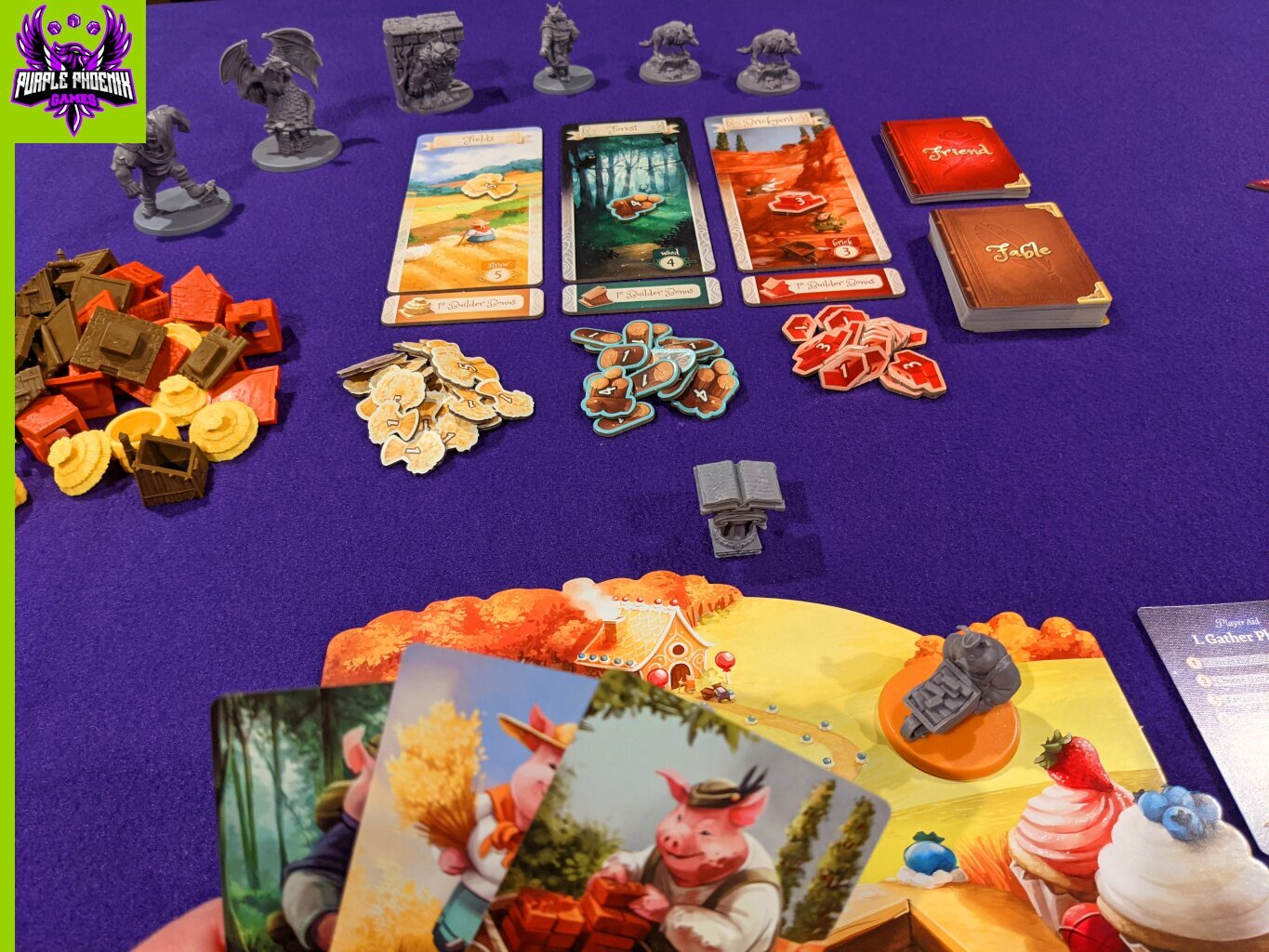
To setup, place the Location boards on the table for the Fields, Forest, and Brickyard (for a three-player game, as below). The First Builder Bonus tokens are placed below the matching Locations as well as the resources that can be harvested. One of each Mega Resource (5 Straw, 4 Wood, 3 Brick) are placed on the matching Location at the beginning of each round. The Friend and Fable decks are shuffled and placed nearby, as are the House sections (Floors, Walls, Roofs – Rooves?), and the Monster minis. Each player chooses a color and collects the Player board, Pig mini, and Gather cards matching that color. The first player is given the Starting Player tome token and the game may now begin!
The Grimm Forest is played over a series of rounds with each pig having a multi-step turn. Initially, however, the pigs will be deciding from which Location they would like to harvest resources by laying the corresponding Gather card from their hand to the table face-down. Once all pigs have laid their card, the Gather cards are flipped and revealed simultaneously. If any pig had chosen to also play one Fable card it would have been revealed and possibly resolved prior to this step. Players will place their Pig mini on the Location board they chose and then harvesting of resources may begin, unless a player has a Fable card that resolves at this point in the turn. If a Pig is alone in a Location they receive all resources currently found there. If Pigs share a Location then the shared minis will share the resources equally, keeping any remaining resources on the Location for the next round. If any player used a Fable card that activates at the end of the Gather phase, it is resolved now.
After the Gather phase, the Pigs will be able to take actions. On their turn, in turn order, each Pig may choose to perform two of the following actions in any order they wish (actions may be repeated except for Friend Special Actions): Draw a Fable card, Gain 1 Resource, Build, Special Actions. Drawing a Fable card is self-explanatory and players will keep their Fable cards secret from the other players. They may choose to play one of these Fable cards during the choosing of Gather cards portion of the beginning phase of a turn. A Pig may instead wish to gain one resource of their choosing and add it to their collection. As mentioned earlier, a Pig may also use their active Friend card’s (which is earned by building a Wall section) Special Action once per turn, should they have collected one earlier.
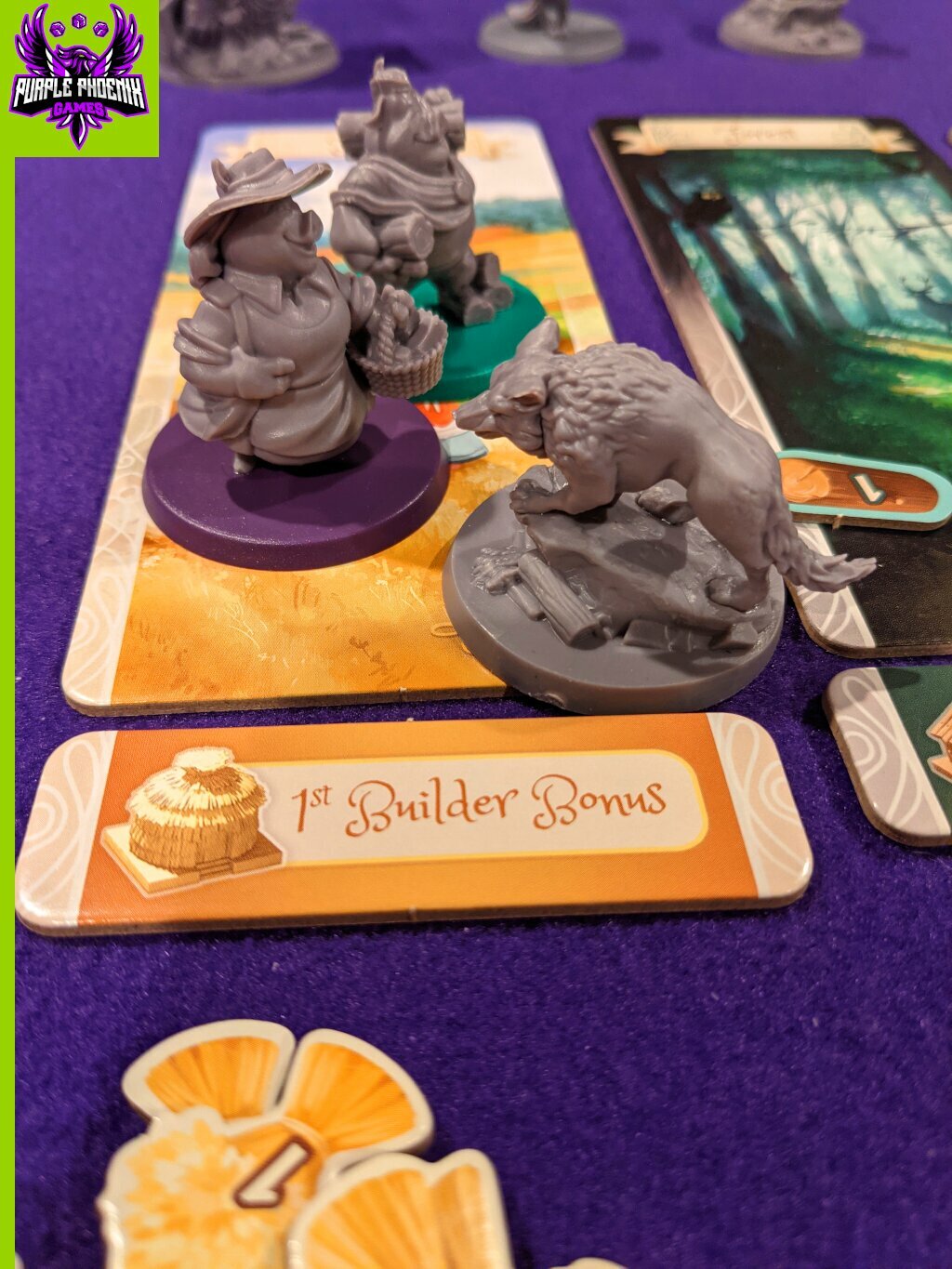
The true hero of The Grimm Forest is the Build action as this is what propels players to victory. Pigs may Build any house type they wish, as long as that type is not currently under construction elsewhere on their board. Also note that houses must be built from the ground up so Floors must be present before Walls can be built and Walls need to be constructed in order to hold up a Roof. Pigs may build these sections of houses by discarding the appropriate number and type of resources they have gathered previously: two resources for a Floor, four resources for Walls, and six resources for a Roof. Once a Pig completes construction of the first house of a type they will grab the matching First Builder Bonus token and reap its rewards.
The game continues in this fashion until one player has built three houses of any type, or multiple players have completed their three houses by the end of the round. Those tied players then check for sturdiness to break their tie: brick houses are sturdier than wood, which are sturdier than straw. The winner is the player with the sturdiest collection of houses, and then all players are invited to share a plate of bacon in celebration of the win (not in the rules, but I added that for… flavor).
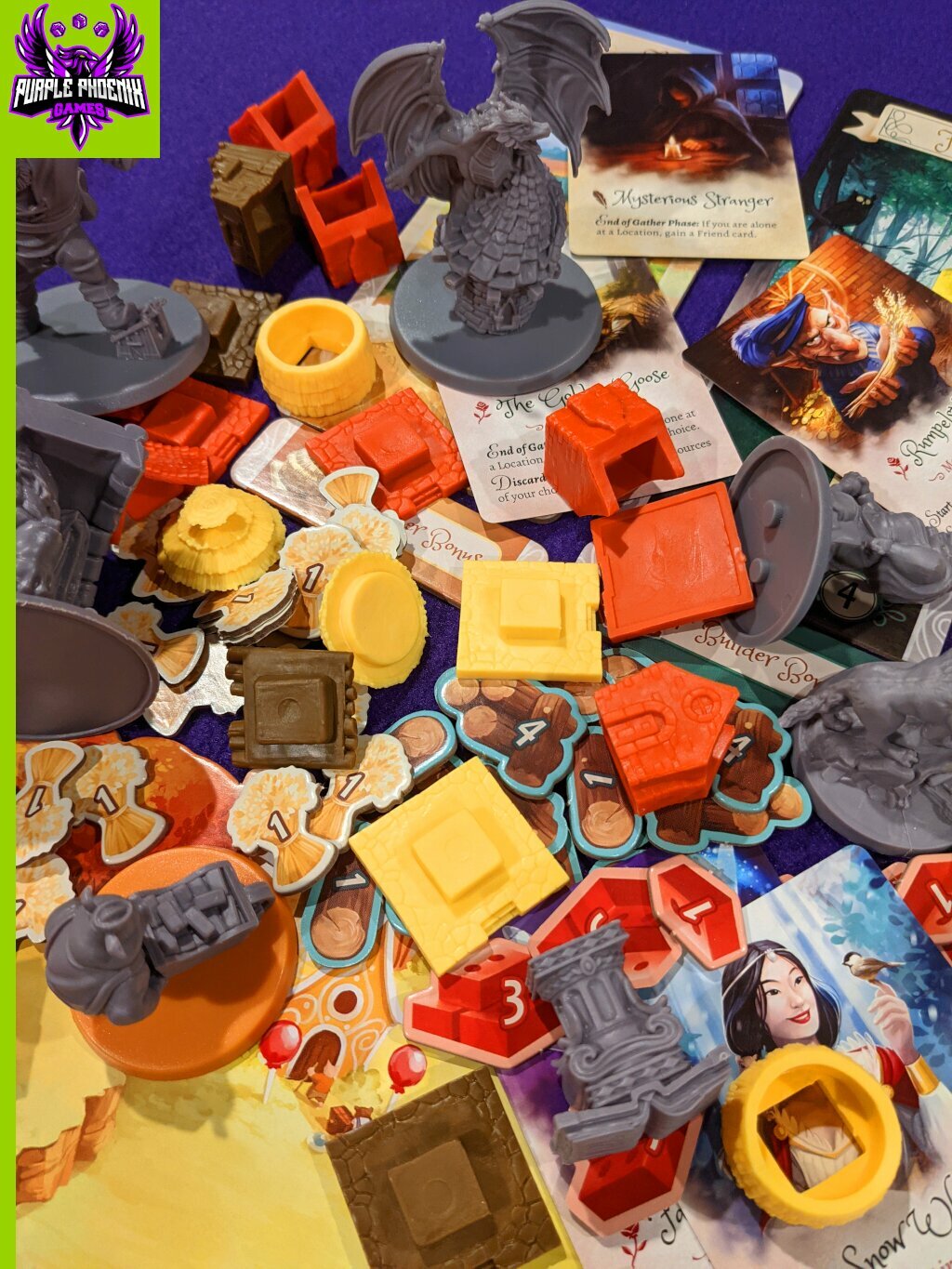
Components. This game is chocked full of killer components. I do not oftentimes compliment boxes and inserts, but when a game comes with GameTrayz already, you know that the publisher cared a ton about the game. Everything sets up and tears down so much nicer and quicker with a GameTrayz insert that I wish every game would come with them. Yeah, I know, $$$. Outside of the insert (or inside?) the other components in the game are simply stellar. Everything from the card backs resembling book covers, the incredible plastic house pieces, and amazing minis, just makes this one sing when on the table. The art is done by the incredible Mr. Cuddington, and they are quickly becoming some of my favorite board game artists.
Wait, there are monster minis? But I didn’t talk about that in my overview. Well, yes, that’s correct. These monsters come into play from certain Fable cards, and when they are played it instructs the player to introduce the appropriate monster mini on the playing area. This can be done with such dramatic flair that you truly get a sense of dread that little piggies may feel. If you have seen Stranger Things (not a sponsor) and remember the part when the Demogorgon mini hits the table, then you understand how I introduce my monster minis. These monsters wreak havoc on the players and sometimes deny them resources, and other chaos to mess with pigs.
Overall, I am so enamored with this game. It has nearly everything I love about games. It has amazing theme and art. That is always big with me. The components are super high quality, as all Druid City Games/Skybound Games usually are, and the game is so smooth once it is learned. All phases and turn components work together well, and there are plenty of choices each player makes every round. The game comes with advanced rules and components as well once all players are comfortable with the base game, and I love when games come with that added complexity and difficulty.
I have nothing bad to say about this game at all, which makes me sad, because I can usually find something to improve with every game I play. Okay wait, I just thought of one: I appreciate that the player colors include both orange and purple, but then the others are blue and green. I think the player colors could have come with some different choices as I feel blue, green, and purple are within similar color bands. Maybe pink and aqua would be better choices for my taste? I don’t know, and I am sure research was done to decide on the player colors, but like I said, I needed to find SOMETHING to complain about.
So it is certainly no surprise that I love this game and rated so highly. I doubt it will ever truly break into my Top 10, but I feel it ticks all of my boxes for a great game and a 6 from me. Purple Phoenix Games as a whole gives this one a porky 15 / 18. If you are looking for a great game that is admittedly lighter, but gives great gameplay throughout, features incredible art and components, and offers opportunities for role-play then you definitely need to grab a copy of The Grimm Forest. I will be recommending this to so many gamers in the future, and I will be pushing the floor of the age suggestion on the box once my son decides he wants to learn to read. I think I am going to go try out the Advanced rules now, and remember: don’t eat an apple that a scary person gave you at the door.