
Search
Search results

Purple Phoenix Games (2266 KP) rated Shadow Kingdoms of Valeria in Tabletop Games
Jan 5, 2022
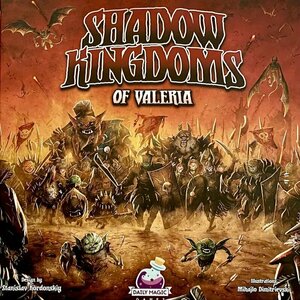

As you’ve read in our previous reviews, we are BIG fans of the Valeria-verse games. Whether we have to recruit adventurers for quests, build a thriving village, or traverse the lands to protect its people from various Monsters, we are all about this realm. For this newest installation in the series, the tables have been flipped on us – because doesn’t it get tiring always being the ‘good guys’? Shadow Kingdoms of Valeria allows players to embrace their inner dark side and fight back against these ‘heroes’ to reclaim dominance over the lands. Sometimes, it just feels good to be bad!
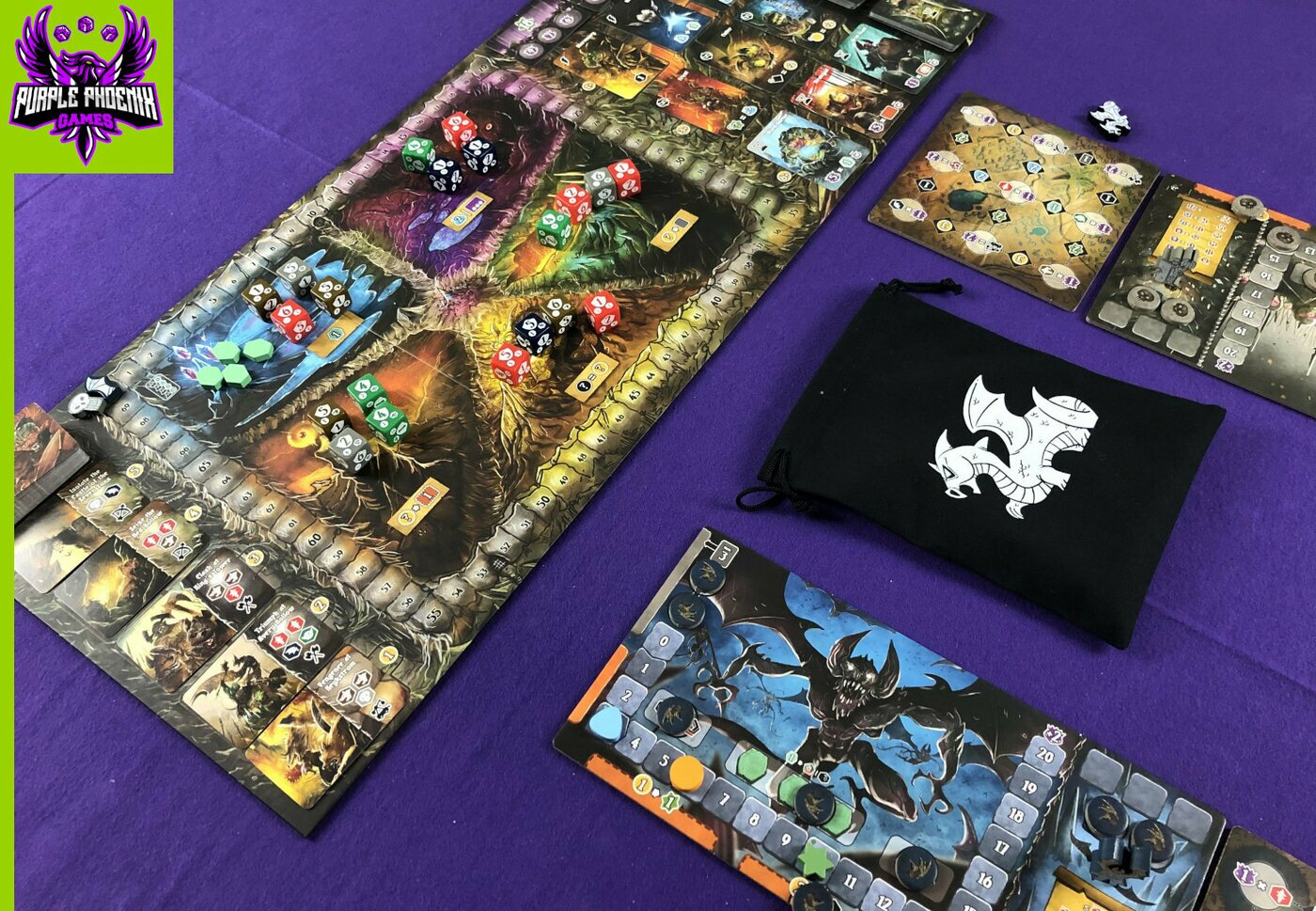
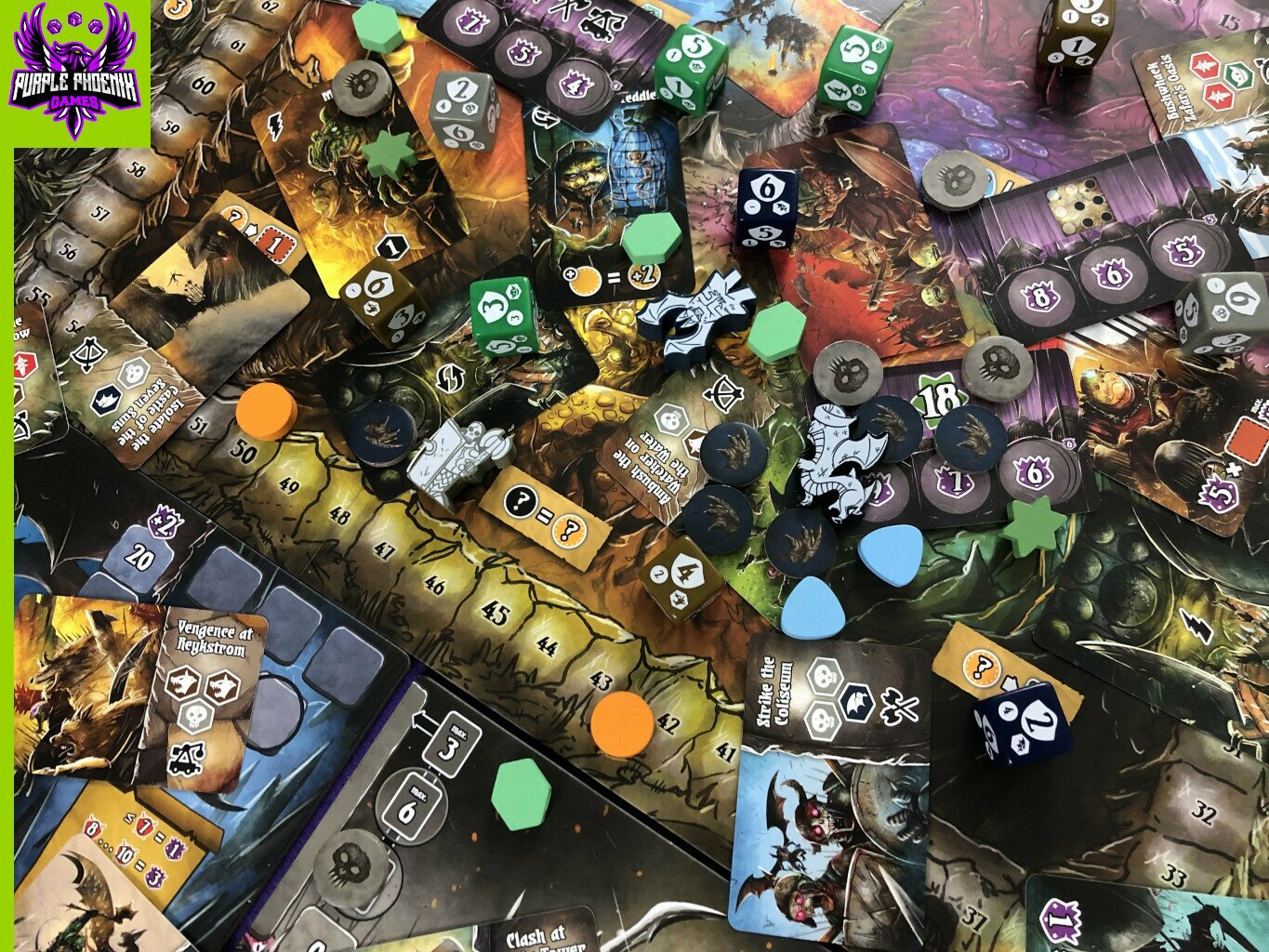
Shadow Kingdoms of Valeria is a game of worker placement and dice drafting/pool building in which players are trying to amass the most VP by the end of the game. Played over a series of rounds, players will take turns moving their Warden, drafting dice, and performing various actions. To setup, place the main board in the center of the play area. Shuffle and place the Battle Plan deck, Award cards, and Champion decks in their corresponding locations. Fill the dice bag with the requisite number of dice for your player count, and draw/roll/place the listed number of dice in each of the 5 Shrines (areas) of the main game board. A specified number of Gems are placed in the appropriate Shrine, and each player places their score marker on the 0 space of the score track. Each player receives a player board, random Campaign Map, Warden and Conquest Markers in their chosen color, as well as markers for Gold, Influence, and Magic. Choose a starting player, and the game is ready to begin! The setup for a 2-player game is pictured below.
On your turn, you will move your Warden from its current location to one of the other 5 locations on the board. Whichever location you choose dictates what actions you may take this turn, and are as follows: Gem Shrine, Magic Shrine, Champions Shrine, Gold Shrine, Tactics Shrine, or your own Camp. When placing your Warden at any location (with the exception of your own Camp), you will first select one of the dice found at that Shrine and place it on an open space of your player board. You may not move to a Shrine if it has no dice! After taking a die, you may perform the action associated with your chosen location. The Gem Shrine allows you to take 1 Gem, which can be used to manipulate dice in future turns. At the Magic Shrine, you may gain 2 Magic or claim 1 Award card. Magic can be spent in the game to manipulate dice or partially refresh the Champion/Battle Plan decks, and Award cards give you VP and can be claimed once you have met their requisite conditions. The Champions Shrine grants you the opportunity to buy a Champion card. Champions can provide either Immediate, Ongoing, or End-Game effects. The Gold Shrine allows you to gain Gold (used to purchase Champions and Battle Plans), and the Tactics Shrine allows you to buy a Battle Plan to be placed in your reserve on your player board.
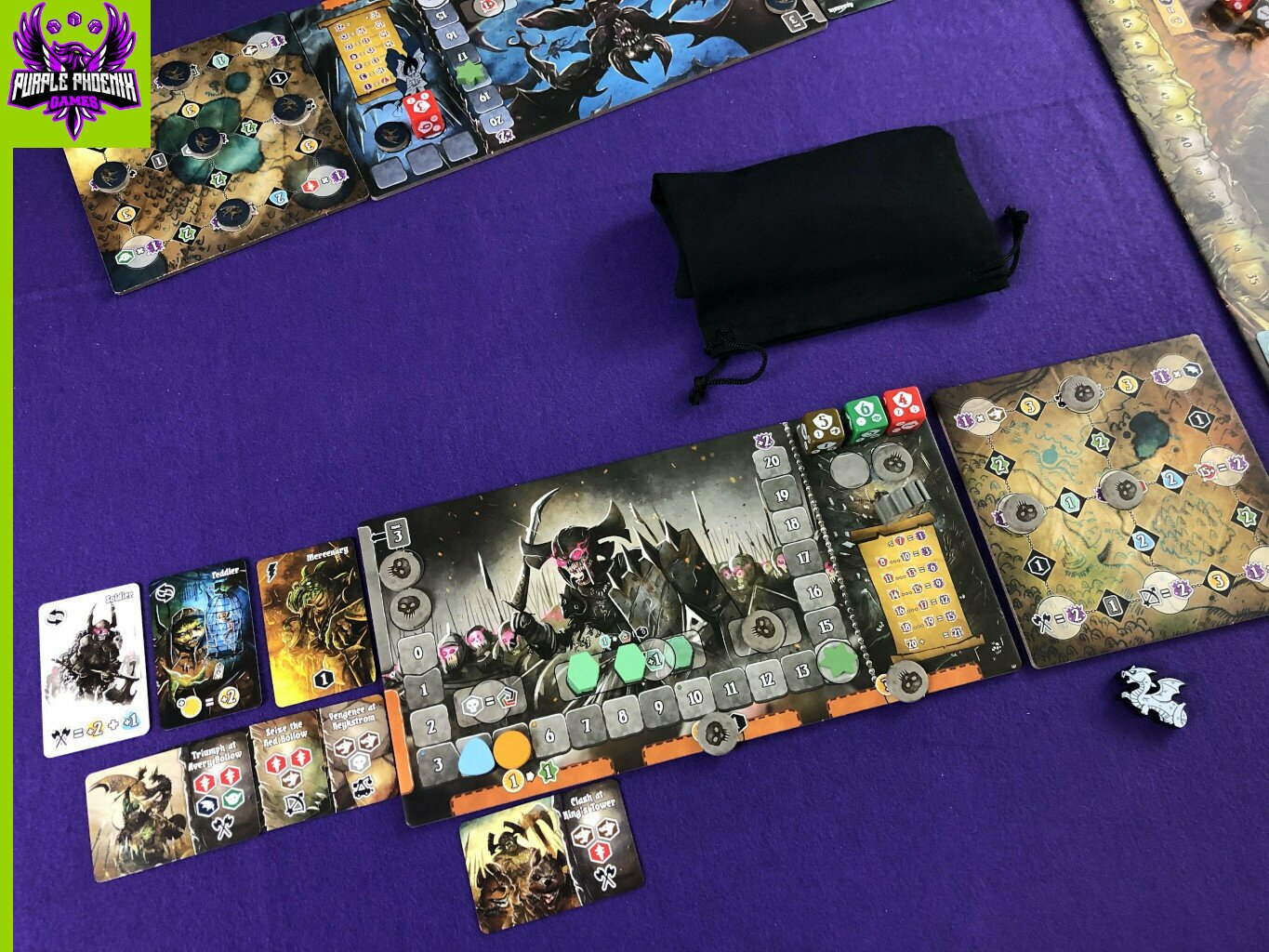
The final location, your own Camp, is on your player board. When you place your Warden here, you are committing to perform a Battle. To do so, select which Battle Plan you wish to complete (either from your reserve, or pay Gold to buy directly from the Battle Plan line), and place it on your player board. All Battle Plans have certain dice requirements that need to be met in order to be completed. Select and manipulate which dice you want to use for your chosen Battle Plan, and add up your total Strength. Compare your Strength to your Influence marker – the lower of the two will be your total strength for this battle. Check the chart on your player board to find the number of VP you earn for the total Strength level achieved in the Battle, and immediately move your score marker the appropriate number of spaces. After performing a Battle, you get to level up your player board. During the game setup, each player receives 10 Conquest Markers that are housed on their player board, blocking/locking certain bonuses, abilities, and dice slots. After a Battle, you may remove 1 Conquest Marker from your player board (granting you a new bonus/ability for future turns), and place it on your Campaign Map. Campaign Maps have nine different slots that will grant you differing rewards. Once you have moved your Conquest Marker, return all dice used in this Battle to the dice bag, and move your completed Battle Plan card to the side of your player board. Your turn then ends and the game moves to the next player.
The game continues in this fashion, with players moving their Wardens, collecting dice, and performing actions, until one player has completed their 7th Battle Plan. The round continues until all players have had an equal number of turns, and then players add up any remaining VP. The player who has accumulated the most VP is then declared the winner!
It really should come as no surprise to you that I love this game. Beyond just the Valeria-verse theme, though, the gameplay is more strategic than I originally thought. Yes, it’s a worker placement and dice drafting game, but the underlying strategy is really what makes it great. You see, the dice in the game have 3 different elements that affect your strategy. First is the color: each color matches a Faction, and different Factions are required to complete specific Battle Plans. Next, is the actual die value: you want higher numbers to get a higher Strength, which equates to more VP when completing Battle Plans. And lastly is the discount: depending on the face value of the die, you will receive a discount towards purchasing Champions, Battle Plans, or collecting gold. The lower the face value of the die, the higher the discount, and vice versa. So yeah, maybe taking a 1 value die won’t really help in the Battle Plan, but the amount of gold it allows you to collect might be worth it. You have those 3 things to consider for dice alone! And that doesn’t even take into account which Champions you might want to buy, or what Battle Plans would be beneficial to you.
Another neat strategic element are the Conquest Markers on your player board. Everyone starts with the same number/placement of Conquest Markers, but as the game progresses, players may resolve them in various ways. There is no ‘correct’ order in which to move Conquest Markers – it all comes down to your strategy. Maybe you want more dice right off the bat, so you remove those first. Or maybe you want to be able to reserve more than 1 Battle Plan at a time, so you go for that one. It’s going to be different for every player, and it’ll be different every game. It all depends on the layout of the main board, and which dice and actions are available to you at any given time. There are so many strategic considerations throughout the entire game, and it keeps all players actively engaged.
Components. No surprise here, but the component quality is great, which is to be expected of Daily Magic Games. The cardboard is all thick and chunky, the wooden tokens nice and sturdy, and the cards are easy to manipulate and clear to read. The artwork is, in my opinion, one of the greatest things about the Valeria games, and Shadow Kingdoms is no exception. When getting the game set up, sometimes I find myself just looking through the cards and really appreciating the artwork. So all in all, great production quality here.
Does Shadow Kingdoms of Valeria climb the ranks to my favorite Valeria game? Not quite, but I have to say honestly that it’s getting there. The gameplay is solid and straightforward, the strategic implications are vast, and the components make the game feel awesome. And to get the Monster perspective in this universe is a neat twist that I otherwise would not really have thought of. If you’re a fan of the Valeria games, definitely check this one out. Or if you’re just a fan of worker placement, with some unique elements of drafting, then I highly recommend this one as well. Purple Phoenix Games gives it a mighty 5 / 6. Check it out. I don’t think you’ll be disappointed.
Shadow Kingdoms of Valeria is a game of worker placement and dice drafting/pool building in which players are trying to amass the most VP by the end of the game. Played over a series of rounds, players will take turns moving their Warden, drafting dice, and performing various actions. To setup, place the main board in the center of the play area. Shuffle and place the Battle Plan deck, Award cards, and Champion decks in their corresponding locations. Fill the dice bag with the requisite number of dice for your player count, and draw/roll/place the listed number of dice in each of the 5 Shrines (areas) of the main game board. A specified number of Gems are placed in the appropriate Shrine, and each player places their score marker on the 0 space of the score track. Each player receives a player board, random Campaign Map, Warden and Conquest Markers in their chosen color, as well as markers for Gold, Influence, and Magic. Choose a starting player, and the game is ready to begin! The setup for a 2-player game is pictured below.
On your turn, you will move your Warden from its current location to one of the other 5 locations on the board. Whichever location you choose dictates what actions you may take this turn, and are as follows: Gem Shrine, Magic Shrine, Champions Shrine, Gold Shrine, Tactics Shrine, or your own Camp. When placing your Warden at any location (with the exception of your own Camp), you will first select one of the dice found at that Shrine and place it on an open space of your player board. You may not move to a Shrine if it has no dice! After taking a die, you may perform the action associated with your chosen location. The Gem Shrine allows you to take 1 Gem, which can be used to manipulate dice in future turns. At the Magic Shrine, you may gain 2 Magic or claim 1 Award card. Magic can be spent in the game to manipulate dice or partially refresh the Champion/Battle Plan decks, and Award cards give you VP and can be claimed once you have met their requisite conditions. The Champions Shrine grants you the opportunity to buy a Champion card. Champions can provide either Immediate, Ongoing, or End-Game effects. The Gold Shrine allows you to gain Gold (used to purchase Champions and Battle Plans), and the Tactics Shrine allows you to buy a Battle Plan to be placed in your reserve on your player board.
The final location, your own Camp, is on your player board. When you place your Warden here, you are committing to perform a Battle. To do so, select which Battle Plan you wish to complete (either from your reserve, or pay Gold to buy directly from the Battle Plan line), and place it on your player board. All Battle Plans have certain dice requirements that need to be met in order to be completed. Select and manipulate which dice you want to use for your chosen Battle Plan, and add up your total Strength. Compare your Strength to your Influence marker – the lower of the two will be your total strength for this battle. Check the chart on your player board to find the number of VP you earn for the total Strength level achieved in the Battle, and immediately move your score marker the appropriate number of spaces. After performing a Battle, you get to level up your player board. During the game setup, each player receives 10 Conquest Markers that are housed on their player board, blocking/locking certain bonuses, abilities, and dice slots. After a Battle, you may remove 1 Conquest Marker from your player board (granting you a new bonus/ability for future turns), and place it on your Campaign Map. Campaign Maps have nine different slots that will grant you differing rewards. Once you have moved your Conquest Marker, return all dice used in this Battle to the dice bag, and move your completed Battle Plan card to the side of your player board. Your turn then ends and the game moves to the next player.
The game continues in this fashion, with players moving their Wardens, collecting dice, and performing actions, until one player has completed their 7th Battle Plan. The round continues until all players have had an equal number of turns, and then players add up any remaining VP. The player who has accumulated the most VP is then declared the winner!
It really should come as no surprise to you that I love this game. Beyond just the Valeria-verse theme, though, the gameplay is more strategic than I originally thought. Yes, it’s a worker placement and dice drafting game, but the underlying strategy is really what makes it great. You see, the dice in the game have 3 different elements that affect your strategy. First is the color: each color matches a Faction, and different Factions are required to complete specific Battle Plans. Next, is the actual die value: you want higher numbers to get a higher Strength, which equates to more VP when completing Battle Plans. And lastly is the discount: depending on the face value of the die, you will receive a discount towards purchasing Champions, Battle Plans, or collecting gold. The lower the face value of the die, the higher the discount, and vice versa. So yeah, maybe taking a 1 value die won’t really help in the Battle Plan, but the amount of gold it allows you to collect might be worth it. You have those 3 things to consider for dice alone! And that doesn’t even take into account which Champions you might want to buy, or what Battle Plans would be beneficial to you.
Another neat strategic element are the Conquest Markers on your player board. Everyone starts with the same number/placement of Conquest Markers, but as the game progresses, players may resolve them in various ways. There is no ‘correct’ order in which to move Conquest Markers – it all comes down to your strategy. Maybe you want more dice right off the bat, so you remove those first. Or maybe you want to be able to reserve more than 1 Battle Plan at a time, so you go for that one. It’s going to be different for every player, and it’ll be different every game. It all depends on the layout of the main board, and which dice and actions are available to you at any given time. There are so many strategic considerations throughout the entire game, and it keeps all players actively engaged.
Components. No surprise here, but the component quality is great, which is to be expected of Daily Magic Games. The cardboard is all thick and chunky, the wooden tokens nice and sturdy, and the cards are easy to manipulate and clear to read. The artwork is, in my opinion, one of the greatest things about the Valeria games, and Shadow Kingdoms is no exception. When getting the game set up, sometimes I find myself just looking through the cards and really appreciating the artwork. So all in all, great production quality here.
Does Shadow Kingdoms of Valeria climb the ranks to my favorite Valeria game? Not quite, but I have to say honestly that it’s getting there. The gameplay is solid and straightforward, the strategic implications are vast, and the components make the game feel awesome. And to get the Monster perspective in this universe is a neat twist that I otherwise would not really have thought of. If you’re a fan of the Valeria games, definitely check this one out. Or if you’re just a fan of worker placement, with some unique elements of drafting, then I highly recommend this one as well. Purple Phoenix Games gives it a mighty 5 / 6. Check it out. I don’t think you’ll be disappointed.

Mothergamer (1655 KP) rated the PC version of The Witcher III: Wild Hunt in Video Games
Apr 3, 2019


I was excited to play Witcher 3 Complete Edition as I had never played it before, yet I had read all the books about the Witcher Geralt and liked them a lot. I have not played the first two games, but they are both on my to play list. Geralt's world is interesting filled with complex characters, fantastic monsters, and great storytelling. All I can say is that I have a ton of games to play and some things get backlogged. I still have a stack of PS3 games to play and of course, I'll be playing the remastered Skyrim for PS4 when it comes out and that's another game I haven't played yet, but for this moment let's discuss how much I loved Witcher 3.
Yes, I loved Witcher 3. I stayed up way too late many a night playing this game because I was having so much fun running around killing monsters and helping people in need. My vision of Geralt was someone who did his best to do the right thing and that sometimes that meant siding with the occasional monster because there were times when humans were the real monsters. The story drew me in right away and these were characters and lore I was familiar with so I was thrilled to explore the entire world in the game. Truly, I unlocked entire maps because I just had to know what everything was. The areas that were too high a level for me at the time I made a note of where they were and came back later. I think it's great when a game makes exploration fun and it definitely helped having Geralt's horse, Roach to help that exploration go a bit faster.
The environments in Witcher 3 are amazing. I would find myself stopping and just looking around at the scenery whether it was roaming through a forest or wandering the streets of a city. The attention to minute details was quite impressive. The gameplay is great. The gaming controls are fine tuned to make battles fun without feeling frustrating and the camera angles are spot on which made a terrific gaming experience for me. The music for Witcher 3 is beautiful. My favorite music was for the area of Skellige. Skellige was also my favorite place to explore because it was so pretty there with all the wild flowers and forests. I genuinely liked the people there too because many of them did not treat Geralt with complete suspicion or call him a freak the way they did in cities like Novigrad. They respected him and what he did; the fact that he was a Witcher and had cat eyes didn't really come up much. I felt that showed a lot of variety in the thinking of the people in the different areas.
There are mini games to play as well. I enjoyed the horse races because those were fun and worth the time and effort. They gave some great rewards such as saddle bags that increased my inventory space and saddles that increased my horse's stamina and speed. Then there's a card game called Gwent which you can play with various people ranging from innkeepers to some of Geralt's friends. I really tried with Gwent. It was a bit confusing for me and I found myself looking up videos on YouTube just to try and get the gist of it, and it helped a bit. However, a huge shout out to my friend Danny for giving a simple explanation of how it worked and the best strategy to winning because that helped more. I mainly just wanted to finish the Gwent side quests I had and I managed to do that. After that, I no longer bothered playing Gwent. It just wasn't my thing, but I will say graphics wise it was a well designed mini game and while it was a tad frustrating for me, I understood why many of my friends enjoyed it. There's also fist fights tournaments (think Fight Club) that Geralt can participate in. I aced the heck out of those and won all those prize coin purses. My favorite fight was the Rock Troll because it was interesting and I got to learn his name at the end; a reward for winning the fight.
Level grinding was not a chore for me in the game because there were so many quests and Witcher contracts which involves hunting specific monsters or investigating things that might involve monsters. These offer good experience and a lot of money for Geralt. There are times when the leveling feels a bit uneven because sometimes the main story quests give more experience than a few of the contracts and side quests. It's not a big deal, but it is noticeable. The skills menu for unlocking Geralt's Witcher abilities and upgrading them is easy to navigate and quite user friendly. My favorite skill was an upgrade of the Axii skill known as Puppet which could make enemies fight each other. The cutscenes and voice acting are superb; while the loading times are practically seamless which made me very happy.
First of all, I don't like anyone telling me what to do. Ask my parents. There was a time when I was told to eat my vegetables when I was a kid and instead of doing that, I stealthily put them under my chair and claimed my plate was clean because I wanted to go play with my friends. Hey, I was four. What the heck did I know about being a mastermind? My parents bought it for two minutes until they discovered it and yes, it was wrong of me to think that I didn't have to listen and tried to fool my parents but this gives you an idea about how long I've been like this. Don't get me wrong, if you just have a conversation with me and we have a healthy discussion I will listen to what you have to say. What I don't respond well to is comments like, "You should NOT be playing that game because of this, that, or the other thing." Ultimately I like to decide and think for myself and I think everyone should be able to decide for themselves whether or not they want to play a game, read a book, or see a movie.
While playing Witcher 3 two things came up about this which were I should not play the game because there are no people of color in it and that it was sexist to women. I honestly did not know there was a huge hullabaloo about these things when the game was first released because honestly I get busy with things going on in my life and I tend to just choose games that pique my interest. I thought the game looked interesting, so I bought it. That's really all there was to it.
As for the second aspect regarding the game being sexist towards women, I just find myself wondering where this comes from. There are several, I repeat, several strong female characters in the lore of Witcher and in the game. How is any of it sexist towards women? Look, I understand not liking all the boobies in the brothels and the sexual scenes in the game. It's not for everyone and some folks are just not down for it. It never bothered me and some of those sex scenes have some amusing humor in them. The argument that Geralt feels no emotions so it's sexist towards women is utter crap. If a person takes the time to actually read any of the books, read the lore, or actually tried to play the game they would know that Geralt can not express emotions on his face because of all the mutations that Witchers go through. Geralt actually feels very deeply especially when it comes to people like Yennefer who is his true love, Ciri who is like a daughter to him, and of course Vesemir who is a mentor/father figure to him. The fact that he can't physically express those emotions due to him essentially being a mutant shouldn't count against him.
The issues with things like Ciri being called a bitch by men or Yennefer being called a whore; those are things that happen in the real world and they sure as hell happened way too often throughout history. Part of the storytelling of many artistic things is that it finds a creative way to discuss real world issues and inform you hey, this kind of thing happens open your eyes. The part I loved is that these women did not need saving. They handled it themselves. The man who called Ciri a bitch? She broke his nose and she stuck up for herself. Yennefer handled the man who called her a whore and she held her own very well. These are not wilting flowers. These are strong, intelligent, and brave women in the story and I was thrilled that a fantasy game had them. Honestly, as soon as I heard the sentence, "Feminist Frequency said..." I felt my eyes rolling because this is such a stretch. I'm not saying that they're not entitled to their opinion because they are, but I did not see any evidence of that in the game at all and I disagree.
Games are meant to be fun and for me Witcher 3: The Wild Hunt was so much fun and one of the best games I've ever played. The story, the open exploration, and the diverse characters were amazing and I enjoyed it immensely. Now, I'm going to play through again on new game plus because the completionist in me wants to get all the different endings and the game is worth playing multiple times if one wishes.
Yes, I loved Witcher 3. I stayed up way too late many a night playing this game because I was having so much fun running around killing monsters and helping people in need. My vision of Geralt was someone who did his best to do the right thing and that sometimes that meant siding with the occasional monster because there were times when humans were the real monsters. The story drew me in right away and these were characters and lore I was familiar with so I was thrilled to explore the entire world in the game. Truly, I unlocked entire maps because I just had to know what everything was. The areas that were too high a level for me at the time I made a note of where they were and came back later. I think it's great when a game makes exploration fun and it definitely helped having Geralt's horse, Roach to help that exploration go a bit faster.
The environments in Witcher 3 are amazing. I would find myself stopping and just looking around at the scenery whether it was roaming through a forest or wandering the streets of a city. The attention to minute details was quite impressive. The gameplay is great. The gaming controls are fine tuned to make battles fun without feeling frustrating and the camera angles are spot on which made a terrific gaming experience for me. The music for Witcher 3 is beautiful. My favorite music was for the area of Skellige. Skellige was also my favorite place to explore because it was so pretty there with all the wild flowers and forests. I genuinely liked the people there too because many of them did not treat Geralt with complete suspicion or call him a freak the way they did in cities like Novigrad. They respected him and what he did; the fact that he was a Witcher and had cat eyes didn't really come up much. I felt that showed a lot of variety in the thinking of the people in the different areas.
There are mini games to play as well. I enjoyed the horse races because those were fun and worth the time and effort. They gave some great rewards such as saddle bags that increased my inventory space and saddles that increased my horse's stamina and speed. Then there's a card game called Gwent which you can play with various people ranging from innkeepers to some of Geralt's friends. I really tried with Gwent. It was a bit confusing for me and I found myself looking up videos on YouTube just to try and get the gist of it, and it helped a bit. However, a huge shout out to my friend Danny for giving a simple explanation of how it worked and the best strategy to winning because that helped more. I mainly just wanted to finish the Gwent side quests I had and I managed to do that. After that, I no longer bothered playing Gwent. It just wasn't my thing, but I will say graphics wise it was a well designed mini game and while it was a tad frustrating for me, I understood why many of my friends enjoyed it. There's also fist fights tournaments (think Fight Club) that Geralt can participate in. I aced the heck out of those and won all those prize coin purses. My favorite fight was the Rock Troll because it was interesting and I got to learn his name at the end; a reward for winning the fight.
Level grinding was not a chore for me in the game because there were so many quests and Witcher contracts which involves hunting specific monsters or investigating things that might involve monsters. These offer good experience and a lot of money for Geralt. There are times when the leveling feels a bit uneven because sometimes the main story quests give more experience than a few of the contracts and side quests. It's not a big deal, but it is noticeable. The skills menu for unlocking Geralt's Witcher abilities and upgrading them is easy to navigate and quite user friendly. My favorite skill was an upgrade of the Axii skill known as Puppet which could make enemies fight each other. The cutscenes and voice acting are superb; while the loading times are practically seamless which made me very happy.
First of all, I don't like anyone telling me what to do. Ask my parents. There was a time when I was told to eat my vegetables when I was a kid and instead of doing that, I stealthily put them under my chair and claimed my plate was clean because I wanted to go play with my friends. Hey, I was four. What the heck did I know about being a mastermind? My parents bought it for two minutes until they discovered it and yes, it was wrong of me to think that I didn't have to listen and tried to fool my parents but this gives you an idea about how long I've been like this. Don't get me wrong, if you just have a conversation with me and we have a healthy discussion I will listen to what you have to say. What I don't respond well to is comments like, "You should NOT be playing that game because of this, that, or the other thing." Ultimately I like to decide and think for myself and I think everyone should be able to decide for themselves whether or not they want to play a game, read a book, or see a movie.
While playing Witcher 3 two things came up about this which were I should not play the game because there are no people of color in it and that it was sexist to women. I honestly did not know there was a huge hullabaloo about these things when the game was first released because honestly I get busy with things going on in my life and I tend to just choose games that pique my interest. I thought the game looked interesting, so I bought it. That's really all there was to it.
As for the second aspect regarding the game being sexist towards women, I just find myself wondering where this comes from. There are several, I repeat, several strong female characters in the lore of Witcher and in the game. How is any of it sexist towards women? Look, I understand not liking all the boobies in the brothels and the sexual scenes in the game. It's not for everyone and some folks are just not down for it. It never bothered me and some of those sex scenes have some amusing humor in them. The argument that Geralt feels no emotions so it's sexist towards women is utter crap. If a person takes the time to actually read any of the books, read the lore, or actually tried to play the game they would know that Geralt can not express emotions on his face because of all the mutations that Witchers go through. Geralt actually feels very deeply especially when it comes to people like Yennefer who is his true love, Ciri who is like a daughter to him, and of course Vesemir who is a mentor/father figure to him. The fact that he can't physically express those emotions due to him essentially being a mutant shouldn't count against him.
The issues with things like Ciri being called a bitch by men or Yennefer being called a whore; those are things that happen in the real world and they sure as hell happened way too often throughout history. Part of the storytelling of many artistic things is that it finds a creative way to discuss real world issues and inform you hey, this kind of thing happens open your eyes. The part I loved is that these women did not need saving. They handled it themselves. The man who called Ciri a bitch? She broke his nose and she stuck up for herself. Yennefer handled the man who called her a whore and she held her own very well. These are not wilting flowers. These are strong, intelligent, and brave women in the story and I was thrilled that a fantasy game had them. Honestly, as soon as I heard the sentence, "Feminist Frequency said..." I felt my eyes rolling because this is such a stretch. I'm not saying that they're not entitled to their opinion because they are, but I did not see any evidence of that in the game at all and I disagree.
Games are meant to be fun and for me Witcher 3: The Wild Hunt was so much fun and one of the best games I've ever played. The story, the open exploration, and the diverse characters were amazing and I enjoyed it immensely. Now, I'm going to play through again on new game plus because the completionist in me wants to get all the different endings and the game is worth playing multiple times if one wishes.

Paul Kellett (118 KP) rated Descent: Journeys in the Dark (Second Edition) in Tabletop Games
May 4, 2019
Plenty of expansions (1 more)
Decent quality miniatures
App can be buggy (1 more)
One side can snowball after a couple of wins
Descent: Journeys In The Dark has been around a long time now, starting as a huge dungeon crawler and morphing into a tactical skirmish / objective-based campaign game. It is supposed to be played with 2-5 players with 1 player being the "Overlord", controlling all the monsters and playing nasty cards on the other players playing the group of heroes (at least 2 heroes required). The game is a fun dice-chucker with a decent amount of strategy and on the whole, well balanced.
With a couple of big-box and half a dozen small-box expansions, not to mention the various hero & monster packs, there is a ton of stuff available and if you own everything, you will be able to choose from 72 heroes with 22 different class decks; fight against 45 different monster types, and encounter around 15 lieutenants over a total of 182 different scenarios. That's plenty to keep you quiet for a while.
So many cards...
Descent: An Overview In The Dark
Descent is a scenario-based game where you work through a tree of different missions, choosing the next one based on whether the heroes or the Overlord worn the last. Each scenario will have specific objectives - anything from stealing an item and reaching the exit to interrogating prisoners and defeating a fearsome Lieutenant of the Overlord. Some of the monsters to be encountered are specified in the scenario text with other free groups able to be chosen from traits specific to that scenario. This gives some variety meaning you will never face exactly the same monsters if you replay the scenarios.
The good players choose a hero from the stack of basic skill types - Fighter, Healer, Scout or Mage and then choose from one of the many class decks for each type so the Fighter could be a Knight or a Berzerker, the Mage a Necromancer and the Healer a Bard, etc. These decks give each hero their skills and form their general strategy.
Meanwhile, the Overlord player chooses one of two Basic decks of cards that will form the base of his defence against the heroes. One deck is more about springing traps while the other has more things to enhance monster attacks. After choosing the basic deck, the Overlord can choose a specialist deck. These can be used to fine tune the Overlord's strategy and at first, only one card is available, the others will be purchased with experience points after each scenario. Finally, if the relevant expansion packs are available, the Overlord can choose a Lieutenant deck which adds further depth to his strategy and also offers the chance to bring a powerful figure into play later in the campaign.
Solo? How So? Redjak has the answer.
With all that going on, it sounds like a fairly daunting if not impossible task to play a solo game of Descent but a fan going by the name of Redjak created two card-driven AI decks - Redjak's Automated Monster Variant (RAMV) and Redjak's Automated Overlord Variant (RAOV). These decks both allow a player, or group of players to play the game as a fully co-operative experience with the cards replacing the Overlord player.
I will say that it is preferable if you have a grasp of the basic rules before jumping into these variants as there can be a lot going on if you are trying to learn the game and the solo rules at the same time. It's probably best to only choose two heroes at first as playing four heroes is more involved but ultimately more rewarding.
These variants are available to download and print out and are also available from the Printer Studio website if you search, although if you are not in the US, then shipping gets expensive.
RAMV
The Monster AI deck is the simpler of the two AI's, being just concerned with the monster actions and leaving out all the Overlord's cards. I haven't played much with this variant but the rules are fairly straightforward. You will set up 4 decks - an Event deck, a Dark Influence deck, a Conditions deck and a Monster deck.
After choosing a scenario to play, you draw cards from the Monster deck, finding ones with icons matching those of the current scenario. This keeps things random and you will always have different things to fight. The selected monster groups will then be placed in "Teams" underneath a row of team cards that will give them their activation order. Finally you will place the encounter objective card for the current scenario. This will give you specific things for each monster group to focus on in terms of stopping you from winning.
You will take your turn alternating hero and monster groups, drawing cards at various points when the monsters should react to attacks, certain scenario triggers ond other in-game events.
It is a fairly simple system but it works really well, giving a solid, straightforward dungeon crawl feel of exploring a map and fighting monsters while trying to complete your quest. Definitely a good starting point and good if you want a 'quick' dungeon crawl.
RAOV
This is the meat, the full experience. Although daunting at first, if you are familiar with the game rules (and have possibly played RAMV a bit), then it will make sense once you get stuck in.
RAOV differs over RAMV in only having one deck, but the rule book is more in depth describing how everything gets played.
You set up as normal, decide on what decks the Overlord will be playing with, draw his starting hand of cards placing them face up on the table. (This variant uses D10 dice anytime you have to make selections)
and take all your heroes actions. If at any point one of your actions would trigger an Overlord card, then that card is played and discarded. Having an open hand means that there are fewer surprises and the Overlord cant be as evil as a human player would be, but it is still tricky and knowing what cards might trigger forces you to think about your strategy in a different way.
Once the heroes have all activated, then the Overlord take its turn, playing any cards that would trigger at the start of the turn. Then, you flip over the top card of the AI deck and activate the first monster group. These cards have a primary target, shown by the corresponding hero symbol and several secondary targets. This gives the monster a focus for its actions. The main text of the card is a list of actions and essentially you work down the list doing whatever actions you are able. Each monster that activates will draw a new card and follow it's orders.
That in a nutshell is it. The Overlord's cards will trigger at the first available opportunity and the monsters will follow a list of options. Once you get used to it, it flows really well and doesn't feel too fiddly at all.
An Open Dungeon
As well as the two AI variants, Redjak also created Delven Deep - a deck of cards each displaying a different map tile that you can use to play a completely randomly generated dungeon crawl. I have yet to try this out, but it is another option if you don't fancy playing through a scripted scenario and just want to explore a random map, killing things.
For The Digital Generation
Fantasy Flight Games have also released an official, free companion app on Android, Steam and IOS that will take control of the Overlord player. This app comes with, I think 2 campaigns - a short training story and a larger, full campaign. Other campaigns a random dungeon generator are available to purchase in the app. None of the printed scenarios are playable using this app and it doesn't use any of the overlord cards, plot decks, event cards or encounter cards.
I will say that I am not a fan of apps for board games and it was actually this app in particular that soured me on the whole idea. Many people really enjoy this app and it has breathed a new lease of life into the game, but unfortunately on my first playthrough, it decided to crash near to the end of a campaign and I essentially lost 6 hours of gaming. I would have had to start all over again from the beginning. That was not a fun experience and put me off completely.
The app borrows heavily from Redjak's work, giving you a list of options to work through when activating the monsters, and various other triggers. Unlike the printed scenarios, all the maps in the digital stories are hidden until you explore them, so you never know what you will encounter. Also, there is a hidden timer in the program that means if you take too long exploring, fighting or whatever, then the game will start throwing nastier and nastier events at you. This makes the game much more of a race than its cardboard cousin and ramps up the difficulty at a fast pace making you feel like you never have enough time to do what you want.
In My opinion, RAOV is the best way to play Descent solo. It uses absolutely everything in the box and gives the most realistic feeling of playing the complete game.
With a couple of big-box and half a dozen small-box expansions, not to mention the various hero & monster packs, there is a ton of stuff available and if you own everything, you will be able to choose from 72 heroes with 22 different class decks; fight against 45 different monster types, and encounter around 15 lieutenants over a total of 182 different scenarios. That's plenty to keep you quiet for a while.
So many cards...
Descent: An Overview In The Dark
Descent is a scenario-based game where you work through a tree of different missions, choosing the next one based on whether the heroes or the Overlord worn the last. Each scenario will have specific objectives - anything from stealing an item and reaching the exit to interrogating prisoners and defeating a fearsome Lieutenant of the Overlord. Some of the monsters to be encountered are specified in the scenario text with other free groups able to be chosen from traits specific to that scenario. This gives some variety meaning you will never face exactly the same monsters if you replay the scenarios.
The good players choose a hero from the stack of basic skill types - Fighter, Healer, Scout or Mage and then choose from one of the many class decks for each type so the Fighter could be a Knight or a Berzerker, the Mage a Necromancer and the Healer a Bard, etc. These decks give each hero their skills and form their general strategy.
Meanwhile, the Overlord player chooses one of two Basic decks of cards that will form the base of his defence against the heroes. One deck is more about springing traps while the other has more things to enhance monster attacks. After choosing the basic deck, the Overlord can choose a specialist deck. These can be used to fine tune the Overlord's strategy and at first, only one card is available, the others will be purchased with experience points after each scenario. Finally, if the relevant expansion packs are available, the Overlord can choose a Lieutenant deck which adds further depth to his strategy and also offers the chance to bring a powerful figure into play later in the campaign.
Solo? How So? Redjak has the answer.
With all that going on, it sounds like a fairly daunting if not impossible task to play a solo game of Descent but a fan going by the name of Redjak created two card-driven AI decks - Redjak's Automated Monster Variant (RAMV) and Redjak's Automated Overlord Variant (RAOV). These decks both allow a player, or group of players to play the game as a fully co-operative experience with the cards replacing the Overlord player.
I will say that it is preferable if you have a grasp of the basic rules before jumping into these variants as there can be a lot going on if you are trying to learn the game and the solo rules at the same time. It's probably best to only choose two heroes at first as playing four heroes is more involved but ultimately more rewarding.
These variants are available to download and print out and are also available from the Printer Studio website if you search, although if you are not in the US, then shipping gets expensive.
RAMV
The Monster AI deck is the simpler of the two AI's, being just concerned with the monster actions and leaving out all the Overlord's cards. I haven't played much with this variant but the rules are fairly straightforward. You will set up 4 decks - an Event deck, a Dark Influence deck, a Conditions deck and a Monster deck.
After choosing a scenario to play, you draw cards from the Monster deck, finding ones with icons matching those of the current scenario. This keeps things random and you will always have different things to fight. The selected monster groups will then be placed in "Teams" underneath a row of team cards that will give them their activation order. Finally you will place the encounter objective card for the current scenario. This will give you specific things for each monster group to focus on in terms of stopping you from winning.
You will take your turn alternating hero and monster groups, drawing cards at various points when the monsters should react to attacks, certain scenario triggers ond other in-game events.
It is a fairly simple system but it works really well, giving a solid, straightforward dungeon crawl feel of exploring a map and fighting monsters while trying to complete your quest. Definitely a good starting point and good if you want a 'quick' dungeon crawl.
RAOV
This is the meat, the full experience. Although daunting at first, if you are familiar with the game rules (and have possibly played RAMV a bit), then it will make sense once you get stuck in.
RAOV differs over RAMV in only having one deck, but the rule book is more in depth describing how everything gets played.
You set up as normal, decide on what decks the Overlord will be playing with, draw his starting hand of cards placing them face up on the table. (This variant uses D10 dice anytime you have to make selections)
and take all your heroes actions. If at any point one of your actions would trigger an Overlord card, then that card is played and discarded. Having an open hand means that there are fewer surprises and the Overlord cant be as evil as a human player would be, but it is still tricky and knowing what cards might trigger forces you to think about your strategy in a different way.
Once the heroes have all activated, then the Overlord take its turn, playing any cards that would trigger at the start of the turn. Then, you flip over the top card of the AI deck and activate the first monster group. These cards have a primary target, shown by the corresponding hero symbol and several secondary targets. This gives the monster a focus for its actions. The main text of the card is a list of actions and essentially you work down the list doing whatever actions you are able. Each monster that activates will draw a new card and follow it's orders.
That in a nutshell is it. The Overlord's cards will trigger at the first available opportunity and the monsters will follow a list of options. Once you get used to it, it flows really well and doesn't feel too fiddly at all.
An Open Dungeon
As well as the two AI variants, Redjak also created Delven Deep - a deck of cards each displaying a different map tile that you can use to play a completely randomly generated dungeon crawl. I have yet to try this out, but it is another option if you don't fancy playing through a scripted scenario and just want to explore a random map, killing things.
For The Digital Generation
Fantasy Flight Games have also released an official, free companion app on Android, Steam and IOS that will take control of the Overlord player. This app comes with, I think 2 campaigns - a short training story and a larger, full campaign. Other campaigns a random dungeon generator are available to purchase in the app. None of the printed scenarios are playable using this app and it doesn't use any of the overlord cards, plot decks, event cards or encounter cards.
I will say that I am not a fan of apps for board games and it was actually this app in particular that soured me on the whole idea. Many people really enjoy this app and it has breathed a new lease of life into the game, but unfortunately on my first playthrough, it decided to crash near to the end of a campaign and I essentially lost 6 hours of gaming. I would have had to start all over again from the beginning. That was not a fun experience and put me off completely.
The app borrows heavily from Redjak's work, giving you a list of options to work through when activating the monsters, and various other triggers. Unlike the printed scenarios, all the maps in the digital stories are hidden until you explore them, so you never know what you will encounter. Also, there is a hidden timer in the program that means if you take too long exploring, fighting or whatever, then the game will start throwing nastier and nastier events at you. This makes the game much more of a race than its cardboard cousin and ramps up the difficulty at a fast pace making you feel like you never have enough time to do what you want.
In My opinion, RAOV is the best way to play Descent solo. It uses absolutely everything in the box and gives the most realistic feeling of playing the complete game.