Search

Search only in certain items:

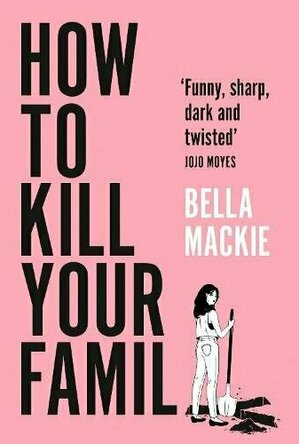
How to Kill Your Family
8
8.0 (2 Ratings)
Book Rating
Imagine the injustice of being sentenced to life imprisonment for a murder you didn’t commit. Not that Grace Bernard is actually innocent. I mean, she HAS murdered six (or is it five? I lose count) members of her own estranged family. Not that they didn’t deserve it.

This was a dark, funny book, and I found myself laughing at the most inappropriate moments. Grace plans her murders meticulously: she finds out what each family member likes to do, where they live and who their contacts are. She’s calm, collected and seriously scary. Grace is a prime example of a psychopath. She has no real attachments, she’s calm and collected during her murders, and her life otherwise appears to be normal.

But if anyone had found the memoir she starts to write whilst jailed for the murder she didn’t commit, she would have had a much longer sentence.

As you probably know by now, I always seem to end up with a soft spot for the more unpleasant, dare I say, naughty, characters. If you count six murders as a bit naughty, then yes, Grace has been added to my list of favourite characters. She really is something special!

Thanks to The Borough Press for my copy of this book to read through NetGalley.
  
The Princess Diarist
Carrie Fisher | 2017 | Biography
4
7.5 (22 Ratings)
Book Rating
Carrie Fisher's latest memoir details a behind the scenes look of the first <i>Star Wars</i> film. Motivated by the recent discovery of the journals she wrote while filming <i>Star Wars</i> in the late 1970s, Fisher discusses her naive nineteen-year-old self: not yet famous (though with famous parents) and unprepared for the juggernaut that would become the <i>Star Wars</i> franchise. She also covers her now famous co-star, Harrison Ford, and their relationship during the three months of filming. Fisher presents excerpts from her discovered journals and ponders on her life and the fame and notoriety that playing Princess Leia has brought her.

I am new to the <i>Star Wars</i> fandom, having only recently discovered the films myself in the past two years or so. My four-year-old daughters love them (and Leia), so I was intrigued by the idea of Fisher's memoir. While I like the films, I don't consider myself a fanatic by any stretch of the imagination. Still, I was interested in hearing some behind the scenes tidbits about filming. And Fisher starts out with such facts, explaining how an early scene was re-written due to the physical limitations of Peter Mayhew, who played Chewbacca. It's that sort of information that I find fascinating--and imagine other <i>Star Wars</i> fans would as well.

And, I won't lie, I was also fascinated by Fisher's reported relationship with Harrison Ford, who is about 15 years her senior (and was married while they were filming). Her portrayal of Harrison in the book seems spot on and is actually quite humorous at times. Unfortunately, her actual detail of the relationship is scant at best, and we really don't get much insight into their romance. What we do get is a lot of particulars about Fisher's own insecurities about herself, her body, her acting, etc.

She includes actual excerpts of the journals she found in the middle of the book, and I confess, I eventually started skimming them, because they were just agony to read. I can understand how they resonate from the perspective of a lovestruck teenager (because, truly, she was just that at the time), but so many years later, they just seem like a lot of bad poetry and ramblings that make no sense out of context. And beyond a few stories about Harrison, we really get nothing in the book that explains them, which is unfortunate, as Fisher seems witty and interesting (albeit insecure, but hey, so am I). I understand her angst from the journals, I really do, but I'm not honestly sure I wanted to read it in such form.

Plus, after that section of the book, we move on to Fisher discussing her fans and how "being Leia" has affected her life. And, again, I get it: we all forget how no one expected <i>Star Wars</i> to be so big. You wouldn't at nineteen realize what you were getting into, and I'm sure this character has absorbed much of her identity. And maybe it was reading this on the heel of Anna Kendrick's memoir, but I can only take so much of celebrities complaining about their fame and lives. The second half of Fisher's book, basically, is her capturing "conversations" with awestruck fans explaining how much Leia and <i>Star Wars</i> meant to them. But, really, it's mocking them and illustrating how tiresome the "lap dance" (her words) of signing autographs and appearing at various conventions can be. But, you know, as she states, it's worth it for the money. You can't help but feel a little offended on the part of these devoted, crazy fans, and a little less sorry for Fisher, even if she was not included on merchandising shares for <i>Star Wars</i>.

Sigh. Overall, I'm a bit conflicted on this one. Bits and pieces were very interesting. But I would have enjoyed hearing more about the actual set and her interactions with the other actors beyond Harrison Ford. While I also didn't mind hearing about Fisher's impressions of how Leia impacted her life, the fandom sections just rubbed me the wrong way. 2.5 stars.
  
40x40

Rachel King (13 KP) rated On Writing in Books

Feb 11, 2019  
On Writing
On Writing
Stephen King | 2012 | Biography
10
9.2 (23 Ratings)
Book Rating
I have not now nor ever been a fan of Stephen King's fiction, nor do I intend to change that pattern. His personal brand of fiction is simply not for me. But since this book is non-fiction, curiosity got the better of me. I am glad that I read this book very much, for both the memoir of his writing life, as well as the writing skills he attempts to impart.
The first half of the book is largely a memoir of King's life, with a focus on his writing career. The reader learns things such as what inspired him, what he liked in fiction, his initial forays into getting published, as well as his many rejections and criticisms. I found it both interesting and ironic that his first big book, Carrie, was accomplished largely thanks to his wife's encouragement, as he never really cared for the main character. He could take the simplest ideas, put two random thoughts together, and make them into these successful stories. All of this is woven into the more mundane aspects of his life, from schooling, to various jobs, to meeting his future wife.
The second part of the book is all about what King considers good writing practices, as well some of the advice that King has received over the years, such as when writing a second draft, subtract 10% from the original. He even goes into the details of good grammar and repeatedly refers to Strunk and White's The Elements of Style. He finishes off this section by showing a section of a first draft he wrote, and then the edited second draft of it to give the reader an idea of how to approach the editing process.
A final section in the book goes into the details of when King was hit and nearly killed by a "blue van" and the effect that it had on his life and his writing. The accident actually occurs before he begins the second part of this book, giving the manuscript the possibility of never being completed. This was probably the most intriguing part of the book for me, as he was able to remember in vivid detail what happened to him, and yet he seemed to be oddly emotionally-detached from its long-term consequences for his life. There is only one short paragraph in which I actually pick up on some emotion, when he discusses how quickly the driver of the blue van will likely be returning to the road. At one point he also made the observation that the driver could have stepped from the pages of one of his novels. What I do love is that his passion for writing helped him to overcome his injuries and regenerate that need to keep putting words to the page.