Search

Chris Sawin (602 KP) rated Carriers (2009) in Movies
Jun 20, 2019
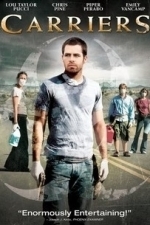


Brian and Danny grew up as two brothers who were relatively close to one another. They cherish the memories they have of Turtle Beach, a beach their family vacationed to every summer. The abandoned motel in Turtle Beach may be their best bet of surviving the highly contagious disease that now plagues the entire country and possibly the world. Not much is known about the virus other than the victims coughing up blood and bleeding from the ears as their condition worsens. Brian actually came up with a few rules that will hopefully get him, his girlfriend Bobby, his brother Danny, and Danny's friend Kate through this disease ridden world to Turtle Beach clean. The rules include avoiding the infected at all costs, disinfecting anything they've touched in the past 24 hours, and that the infected are already dead as there is no cure. You may survive if you stick to the rules, but actually abiding by them is an entirely different story.
Right off the bat, people are probably going to compare Carriers to Zombieland because of the rules. Carriers was released a full month before Zombieland, but Paramount Vantage folded upon its initial release causing its wide release to be an extremely limited one at the last minute (I think it wound up playing at only two theaters in the country). Expectations rise unintentionally in situations such as this. "This is that horror film that was practically shelved earlier this year and is finally being released." The result is a horror film that is well worth watching, but may not be entirely what you're expecting.
Carriers is more about establishing an atmosphere than anything else. Everything is abandoned and rightfully so as most people were picked off handfuls at a time by this pandemic. The entire film is more like the first half hour of 28 Days Later where Jim wakes up in an abandoned hospital and realizes how empty the streets of London are. There aren't masses of the infected running around lusting for brains or wanting to tear humans apart in Carriers. The story follows these four friends as they journey across the country to this supposed sanctuary where they hope to tough it out until this disease runs its course. Carriers is more of a slow burn as things turn from bad to worse very slowly and snowball as the film goes on.
Chris Pine is really the drawing factor of the film. His role as Brian is kind of like a more intense version of his role as Kirk in Star Trek from earlier this year. Brian comes off as an inconsiderate prick the first half of the film and seems to only do things that benefit himself. The second half is where his character gets interesting though. The speech he gives Danny about their parents and telling Danny that he only told him what he wanted to hear is the turning point for Brian. Chris Pine shines as things begin to roll downhill for Brian as his emotions take center stage and his true demeanor is revealed.
Everything else in the film pretty much feels like routine manuevers when it comes to films revolving around viral outbreaks as some main characters contract the disease, they resort to drastic measures to survive, and begin to question their humanity along the way. The most disappointing part of the film is the ending as things just seem to kind of stop without much of a resolution. It seems like films like this either end this way or have a really depressing ending and that's its biggest flaw. Movie buffs who have seen films concerning pandemics already have a rough idea of how the film is going to end and it's about time to mix that up a bit. There's got to be a decent way to end the film that offers something a bit different that could wrap everything up until that point, but also leave enough room open for a sequel if need be.
Carriers may be a bit slow at first and doesn't really offer anything you probably haven't seen before in a film like this, but is still worth seeing for Chris Pine's performance. It's kind of a more serious take on Zombieland without actual zombies running or stumbling around with an atmosphere similar to the one established in Danny Boyle's 28 Days Later. If you're a fan of films involving a virus that has wiped out most of the human population, then this is still worth a watch.
Right off the bat, people are probably going to compare Carriers to Zombieland because of the rules. Carriers was released a full month before Zombieland, but Paramount Vantage folded upon its initial release causing its wide release to be an extremely limited one at the last minute (I think it wound up playing at only two theaters in the country). Expectations rise unintentionally in situations such as this. "This is that horror film that was practically shelved earlier this year and is finally being released." The result is a horror film that is well worth watching, but may not be entirely what you're expecting.
Carriers is more about establishing an atmosphere than anything else. Everything is abandoned and rightfully so as most people were picked off handfuls at a time by this pandemic. The entire film is more like the first half hour of 28 Days Later where Jim wakes up in an abandoned hospital and realizes how empty the streets of London are. There aren't masses of the infected running around lusting for brains or wanting to tear humans apart in Carriers. The story follows these four friends as they journey across the country to this supposed sanctuary where they hope to tough it out until this disease runs its course. Carriers is more of a slow burn as things turn from bad to worse very slowly and snowball as the film goes on.
Chris Pine is really the drawing factor of the film. His role as Brian is kind of like a more intense version of his role as Kirk in Star Trek from earlier this year. Brian comes off as an inconsiderate prick the first half of the film and seems to only do things that benefit himself. The second half is where his character gets interesting though. The speech he gives Danny about their parents and telling Danny that he only told him what he wanted to hear is the turning point for Brian. Chris Pine shines as things begin to roll downhill for Brian as his emotions take center stage and his true demeanor is revealed.
Everything else in the film pretty much feels like routine manuevers when it comes to films revolving around viral outbreaks as some main characters contract the disease, they resort to drastic measures to survive, and begin to question their humanity along the way. The most disappointing part of the film is the ending as things just seem to kind of stop without much of a resolution. It seems like films like this either end this way or have a really depressing ending and that's its biggest flaw. Movie buffs who have seen films concerning pandemics already have a rough idea of how the film is going to end and it's about time to mix that up a bit. There's got to be a decent way to end the film that offers something a bit different that could wrap everything up until that point, but also leave enough room open for a sequel if need be.
Carriers may be a bit slow at first and doesn't really offer anything you probably haven't seen before in a film like this, but is still worth seeing for Chris Pine's performance. It's kind of a more serious take on Zombieland without actual zombies running or stumbling around with an atmosphere similar to the one established in Danny Boyle's 28 Days Later. If you're a fan of films involving a virus that has wiped out most of the human population, then this is still worth a watch.

Lee (2222 KP) rated The Founder (2017) in Movies
Jul 26, 2017
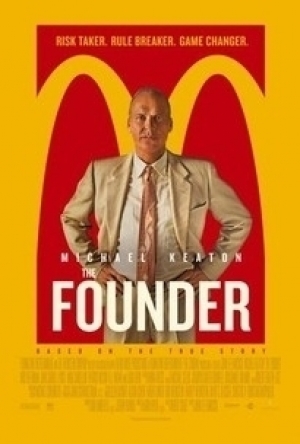
These days McDonalds is everywhere. You don’t have to travel too far before you see those familiar golden arches – in fact, there are three of them within a two mile radius of my home! I’m not personally a big fan of them, but that’s not to say I haven’t enjoyed the odd meal occasionally when in a hurry. It’s one of those things that’s just always been there in life, taken for granted without much of a thought as to how it all came to be so huge. Turns out there’s a pretty interesting story to be told involving a couple of pioneering brothers, and the guy who eventually completely screwed them over…
Michael Keaton is Ray Kroc, a hardworking salesman who always seems to be on the road while his bored wife (Laura Dern) is at home. Repeatedly getting the brush off from restaurant owners who don’t want to buy his amazing new five-spindled milkshake machine and frustrated by the slow, unreliable service from the drive-ins where he goes to get his lunch. For this part of the movie, we’re actually pretty sympathetic with Ray as he struggles in his lonely, boring, unfullfilling job, listening to motivational records in motel rooms as he drifts off to sleep. And then he gets a call from two brothers, Dick and Mac McDonald. They don’t just want to buy one of his milkshake machines, they want to buy at least six in order to cope with demand in their restaurant. Ray puts down the phone and his mind immediately goes into overdrive – what kind of restaurant have these guys got that’s producing this kind of demand? He pulls out a map and looks them up – they’re in San Bernadino California, so he heads off in his car to pay them a visit.
When he arrives, the place is packed with customers queuing for food. As Ray joins the queue a woman assures him that he won’t have to wait long and sure enough, after placing his 15 cent order for a burger, fries and soft drink (bargain!), he promptly gets his order within 30 seconds – served in a paper bag, no plates, no cutlery. He thinks there must be some mistake and it’s pretty amusing to see the bemused look on his face as he struggles to accept the concept that we now all take for granted. Fast, cheap food that you can eat absolutely anywhere you want – in your car, at the park, it’s up to you.
Ray offers to take the brothers out to dinner so that he can hear their story. It’s a wonderful, captivating story too, one that could so easily have been the entire movie. The brothers have such a good rapport as they passionately talk about what they’ve worked to achieve. Moving their restaurant to where it is now, developing their own machines for applying perfect amounts of ketchup and mustard into each bun and spending six hours sketching out potential restaurant layouts on a tennis court while their restaurant staff choreograph their optimised cooking routines. Everything has been tweaked to perfection, even down to the exact cooking time and temperature for their fries. After sleeping on all this information, Ray goes back to the brothers early the next morning and offers them the idea of franchising. But, it’s something they’ve dabbled in before and gave up on, having felt that they had no control over the quality and attention to detail that they pride themselves on in their own restaurant. Eventually Ray wins them over though and a contract is drawn up. The brothers get final say on everything and get half a percent of the profits but it’s up to Ray to setup the franchises and find the people to run them.
It’s a slow, hard process though and although Ray does setup a few successful restaurants, he soon becomes frustrated at the lack of money he seems to be making and the lack of control he has on the decision making process whenever he wants to save costs. The McDonald brothers just seem to keep saying ‘no’! But after he receives some business advice, telling him he should be concentrating on buying the land that the restaurants are on rather than the burgers being cooked, the tide begins to turn. He eventually becomes powerful enough to overpower the brothers, trademark their name, and generally take credit for everything the brothers worked for and built, eventually putting them out of business.
Kroc becomes ruthless, and a complete arsehole. The brothers did eventually make some decent money out of their final deal with Ray, but it certainly wasn’t the 100 million dollars a year they could have been making if they’d been treated right. You really feel for them, as they completely lose control of everything. But you can’t help wondering if things would have worked out that much different for them if they had never met Ray at all. Their restaurant will certainly have continued to do well for a while, but by focusing on just their one restaurant, how long before somebody else stole their idea and ran with it, somebody with the drive and vision to make real money like Ray, leaving them with no money settlement at all? After all, as the motivational LP that Ray listens to clearly pointed out at the start of the movie, “Nothing in the world can take the place of persistence, talent will not, nothing is more common than unsuccessful men with talent …”.
Michael Keaton is Ray Kroc, a hardworking salesman who always seems to be on the road while his bored wife (Laura Dern) is at home. Repeatedly getting the brush off from restaurant owners who don’t want to buy his amazing new five-spindled milkshake machine and frustrated by the slow, unreliable service from the drive-ins where he goes to get his lunch. For this part of the movie, we’re actually pretty sympathetic with Ray as he struggles in his lonely, boring, unfullfilling job, listening to motivational records in motel rooms as he drifts off to sleep. And then he gets a call from two brothers, Dick and Mac McDonald. They don’t just want to buy one of his milkshake machines, they want to buy at least six in order to cope with demand in their restaurant. Ray puts down the phone and his mind immediately goes into overdrive – what kind of restaurant have these guys got that’s producing this kind of demand? He pulls out a map and looks them up – they’re in San Bernadino California, so he heads off in his car to pay them a visit.
When he arrives, the place is packed with customers queuing for food. As Ray joins the queue a woman assures him that he won’t have to wait long and sure enough, after placing his 15 cent order for a burger, fries and soft drink (bargain!), he promptly gets his order within 30 seconds – served in a paper bag, no plates, no cutlery. He thinks there must be some mistake and it’s pretty amusing to see the bemused look on his face as he struggles to accept the concept that we now all take for granted. Fast, cheap food that you can eat absolutely anywhere you want – in your car, at the park, it’s up to you.
Ray offers to take the brothers out to dinner so that he can hear their story. It’s a wonderful, captivating story too, one that could so easily have been the entire movie. The brothers have such a good rapport as they passionately talk about what they’ve worked to achieve. Moving their restaurant to where it is now, developing their own machines for applying perfect amounts of ketchup and mustard into each bun and spending six hours sketching out potential restaurant layouts on a tennis court while their restaurant staff choreograph their optimised cooking routines. Everything has been tweaked to perfection, even down to the exact cooking time and temperature for their fries. After sleeping on all this information, Ray goes back to the brothers early the next morning and offers them the idea of franchising. But, it’s something they’ve dabbled in before and gave up on, having felt that they had no control over the quality and attention to detail that they pride themselves on in their own restaurant. Eventually Ray wins them over though and a contract is drawn up. The brothers get final say on everything and get half a percent of the profits but it’s up to Ray to setup the franchises and find the people to run them.
It’s a slow, hard process though and although Ray does setup a few successful restaurants, he soon becomes frustrated at the lack of money he seems to be making and the lack of control he has on the decision making process whenever he wants to save costs. The McDonald brothers just seem to keep saying ‘no’! But after he receives some business advice, telling him he should be concentrating on buying the land that the restaurants are on rather than the burgers being cooked, the tide begins to turn. He eventually becomes powerful enough to overpower the brothers, trademark their name, and generally take credit for everything the brothers worked for and built, eventually putting them out of business.
Kroc becomes ruthless, and a complete arsehole. The brothers did eventually make some decent money out of their final deal with Ray, but it certainly wasn’t the 100 million dollars a year they could have been making if they’d been treated right. You really feel for them, as they completely lose control of everything. But you can’t help wondering if things would have worked out that much different for them if they had never met Ray at all. Their restaurant will certainly have continued to do well for a while, but by focusing on just their one restaurant, how long before somebody else stole their idea and ran with it, somebody with the drive and vision to make real money like Ray, leaving them with no money settlement at all? After all, as the motivational LP that Ray listens to clearly pointed out at the start of the movie, “Nothing in the world can take the place of persistence, talent will not, nothing is more common than unsuccessful men with talent …”.

Purple Phoenix Games (2266 KP) rated The Bloody Inn in Tabletop Games
Feb 12, 2022
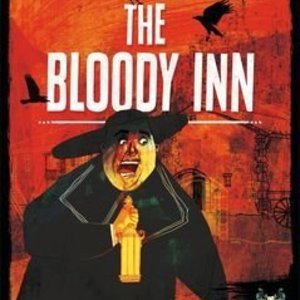

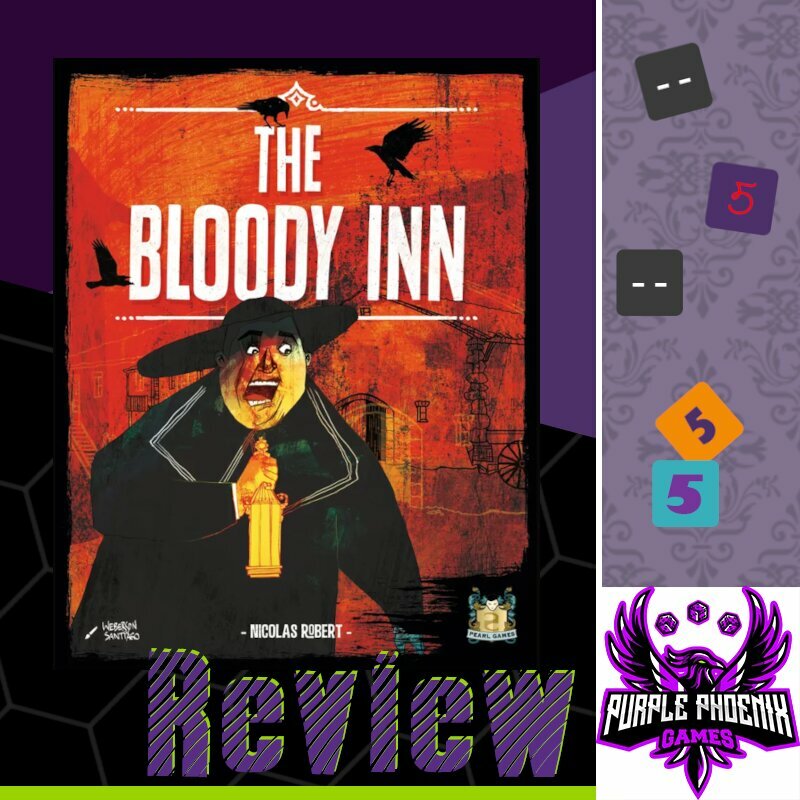
It’s cliche to post a game review like this so near to Halloween, so I will probably hold off on that. However, what a perfect game to go along with the macabre tone of the Halloween season! Get this: you and your family own a motel in a small town where many travelers stop to rest. You are strapped for cash, so what is a logical step in achieving wealth? Of course! Murdering and robbing your customers upon their stays! No? Not a typical business model? Unsustainable? Pfft. You just aren’t robbing the right customers…
The Bloody Inn is a card-drafting, hand management, horror game of recruiting accomplices and having them carry out dastardly deeds to secure the most money at the end of the game. In it, players take on the roles of one of the inn’s staff members and control pawns in their evil schemes in order to swindle and kill for mountains of francs (it’s set in France, pre-Euro).
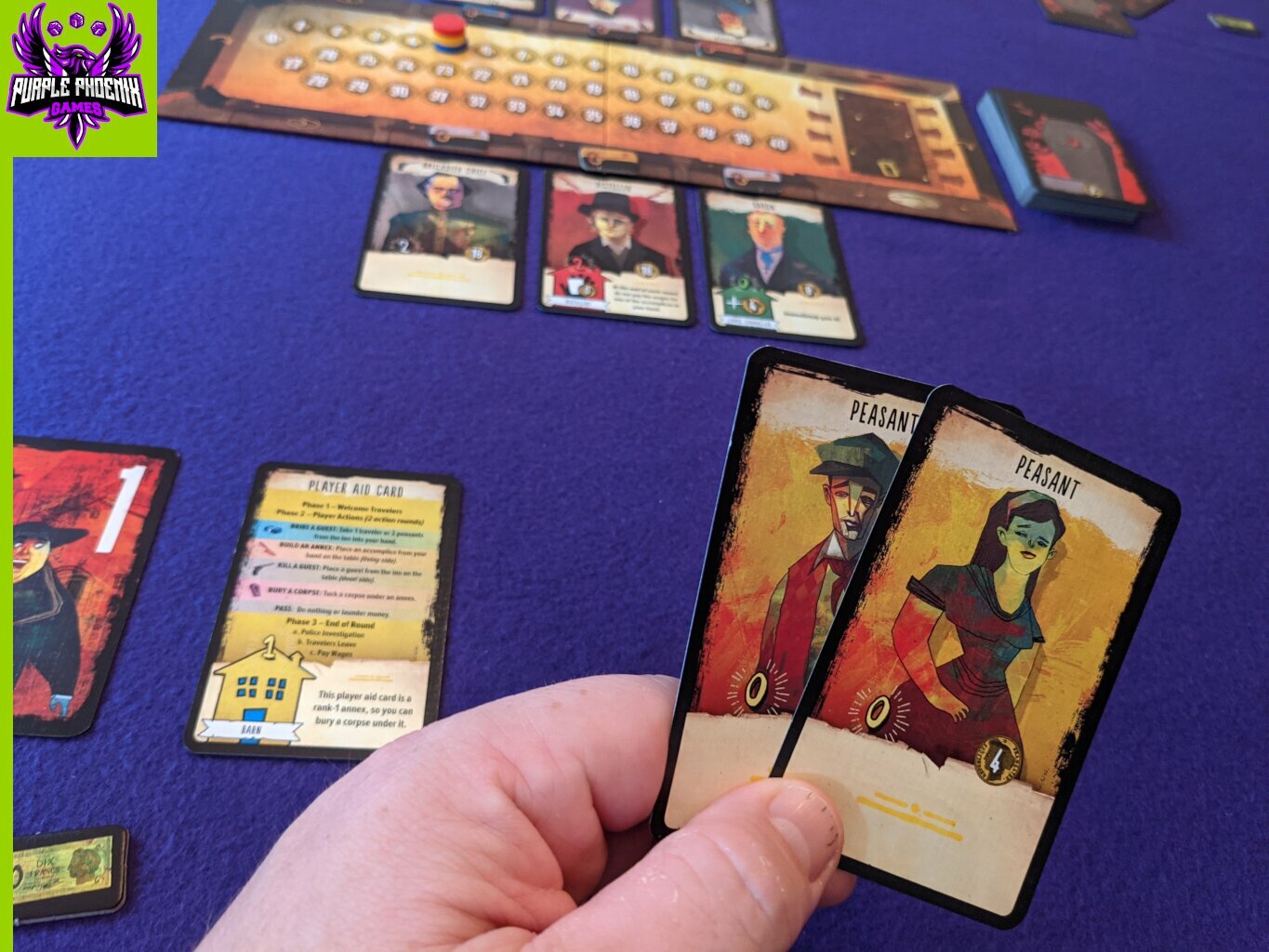
To setup, place the main board on the table, give each player the components of their color choice, two Peasant cards, a 10 franc (f) check, and a player aid card. The “traveler deck” is assembled and shuffled per the rules, and placed on the Entrance side of the board. Players choose one room to place a key token in their color, and several gray neutral key tokens are placed in other rooms. Unsuspecting travelers will be staying in these rooms each night. Per the rules, the greediest player is given the first player card and the mischief may begin!
The Bloody Inn is played over several rounds, and each round has players completing three phases: Welcome Travelers, Player Actions, and End of Round. Players will Welcome Travelers to signify the start of the round by the first player drawing one card from the deck at a time and choosing in which room they will be placed.
After Travelers have been welcomed and turn in for the evening, the second phase may begin: Player Actions. In turn order players will be able to perform two actions each round. Players may choose from five different actions, and actions can be repeated for the second action of the round. Players may Bribe a Guest by discarding cards from hand equal to the printed value on the target card’s front. Initially all players simply employ the two starter Peasants, so Bribing is only performed on cards that show a value of 0-2. When a player Bribes a guest, they essentially spend cards from hand to recruit the new guest to their employ. These new employees (accomplices) are then available to be used on future actions. One or two Peasants may also be Bribed from the bistro, adding to a player’s hand of usable human resources.
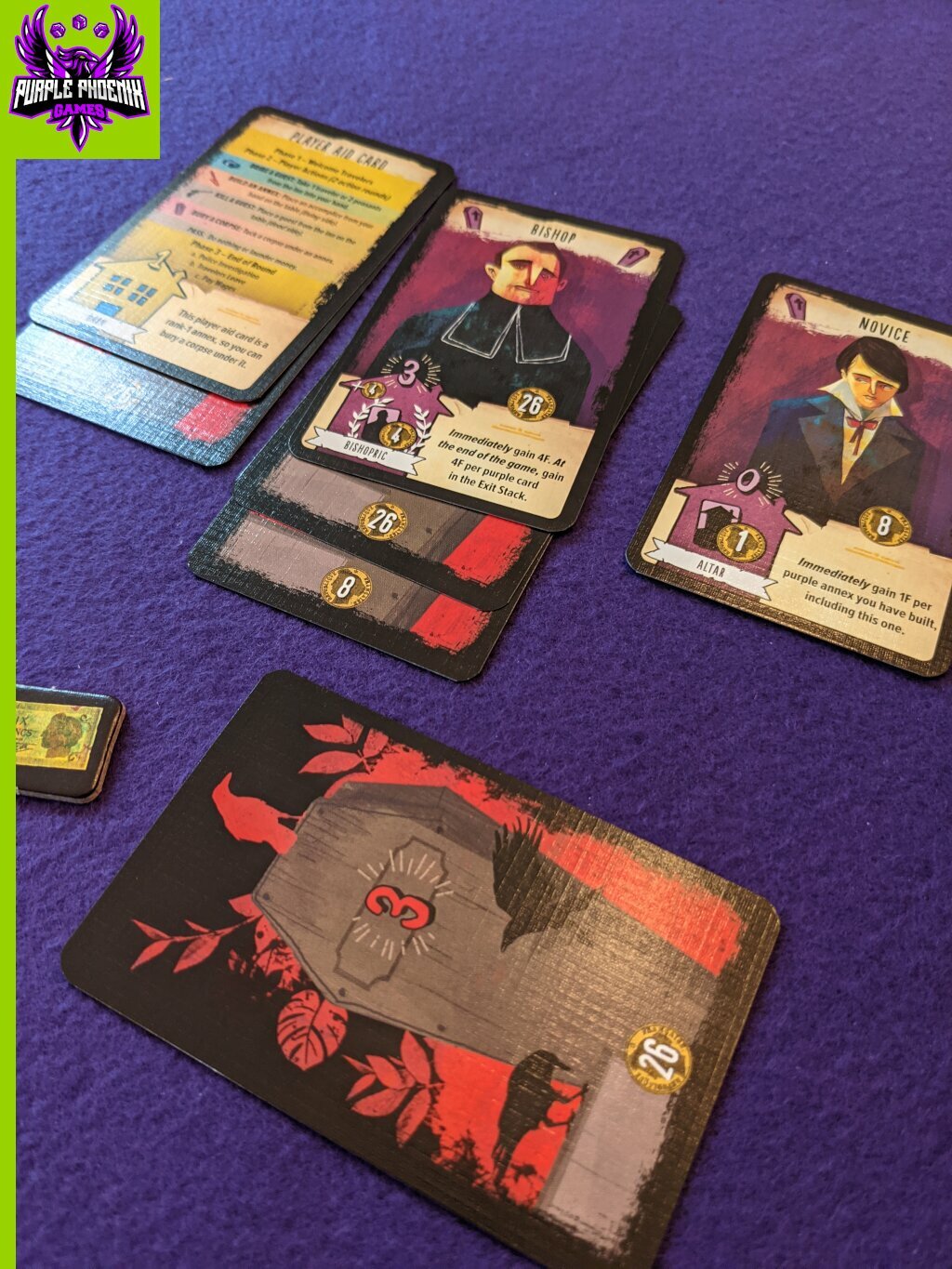
A player may instead choose to Kill a Guest by similarly discarding the appropriate number of accomplices and adding the freshly-slain guest to their tableau, face-down. The card backs feature a coffin with their “rank” (action number) printed on it. Corpses normally cause no issues, but they will need to be buried under an Annex in order to collect the money in their pockets. Players may use an action to Build an Annex by discarding the appropriate number of accomplices and using a card from hand to build and staff the Annex. Annexes can be used for the action printed on the card bottom, and/or as a housing for corpses, with the Corpses being sent to any player’s Annex via the Bury a Corpse action. Discard the requisite number of accomplices to bury a corpse, and avoid suspicion from the Law.
If none of these actions are attractive to the player, or if they simply wish, they may instead Pass and launder money from the village notary. To do this, either reduce the number of francs from the Wealth Track on the main board in order to gain a 10f check, or turn in a check for 10f on the Wealth Track.
Once all players have taken their two actions, the End of Round is performed. Firstly, if any Travelers remain belonging to the Police type (signified by pistol icons on the top of the card), they will conduct an investigation, finding any unburied corpses. Should a corpse be found in this way, the owning player will need to pay 10f for the local undertaker to dispose of the body respectfully. This not only costs the player 10f, but also the amount of money that could have been gained if they had only buried them or dealt with the Police traveler prior. Next, the Travelers who remain all wake up feeling refreshed and leave the inn by being placed in the discard pile. Once the board has been cleared of all Travelers, accomplices must be paid their wages for their help. For each accomplice in hand, the players must pay 1f from the Wealth Track.
Play continues in this fashion until the main Traveler deck has been depleted twice. Then, players add up their francs and the player with the most in francs and checks is the winner, and just the greatest little murderer/robber/briber in all the land!
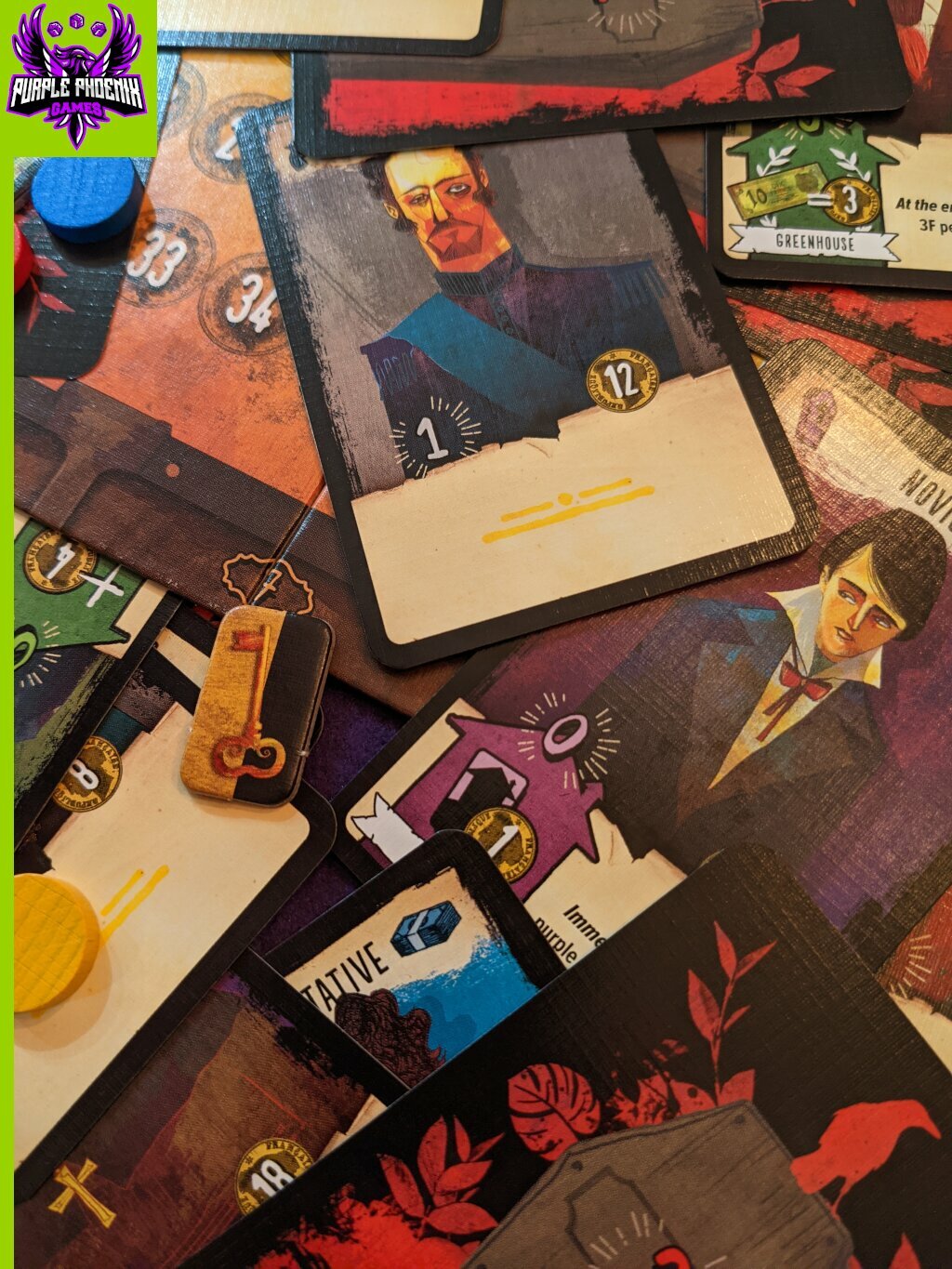
Components. This game really has a modest amount of components, but they are all similarly great quality. The main board acts as the inn’s room display, the Wealth Track, AND the bistro (where Peasants are discarded, as opposed to being placed in the normal discard pile). I love when components pull double or triple duty. That said, the player aids not only remind the players of the phases and actions from which they may choose, but it also provides the player with a starter Annex that can be used to bury their first corpse! HOW COOL IS THAT?! However, the greatest thing that stands out in regards to the components is the overall look and feel of the game. The character artist for this one is Weberson Santiago, and he has also illustrated games such as the new Quest (the new version of The Resistance: Avalon), Coup, and the new Whirling Witchcraft. I adore his art style, even though I shouldn’t. My typical preference of character art is semi-realism (like that of Kwanchai Moriya), but this style is really unique and perfectly applied to the theme. Great matchup of artist and game here. I do have one silly wish for this game: PLEASE change the player colors. I mean, I am so tired of having the choice between red, blue, green, and yellow. Take a Cue from my good friend Scott Brady and use one of the more interesting color choices. I mean, even to fit in with the theme here a more appropriate palette could include a brown, black, orange, and yellow or something. Be bold!!
I knew right away that this was a great game for me. Yes, the theme is super dark and macabre, which is rare for me to enjoy, but I would only play this with adults anyway so I am unbothered by it. However, the puzzle that lies within this box is one that I thoroughly enjoy solving every round. What I neglected to mention up top is the fact that when actions are taken (Bribing, Killing, Building Annexes, and Burying Corpses) if you happen to have certain card types in hand, then the cost of discards is reduced by the number of cards present. For example, if I were to Bribe a Police card from the rooms in my first action, they have an affinity for killing (messed up, I know) and will thus help me to perform a Kill action on the next turn by reducing the number of accomplices I would need to discard for that action. Side benefit: by taking the Police Travelers off the board, they then will not perform their investigations in the morning.
Another aspect I truly enjoy about The Bloody Inn is that many cards have that dual-purpose mechanic I appreciate. The player aid is also an Annex. Brilliant! Many of the Annex cards can also offer one-time or recurring powers. It’s just so satisfying to grab cards that can combo well with each other in order to fulfill your evil plans. Every card is important, and when they can offer more than one benefit, I am a happy gamer.
I cannot express how happy I am to have decided to purchase this one. I have seen the BGG ratings and rankings, but always thought I wouldn’t like it due to its very adult theme, but boy was I wrong! This is one of the best games I have played recently and I hope to even bling it out a bit, maybe even with new player colors like I suggested earlier. Laura and my wife were able to join me for this one and they agree with me – this one is excellent and definitely worth consideration into anyone’s collection. Purple Phoenix Games gives this one a dastardly 15 / 18. Yeah, it’s perfect for Halloweentime, but also for ANY time. If you are looking for something a little grim and grisly with lighter rules and lots of interesting choices, you need to check out The Bloody Inn. Grab lots of Police cards and go on a killing spree for me!
The Bloody Inn is a card-drafting, hand management, horror game of recruiting accomplices and having them carry out dastardly deeds to secure the most money at the end of the game. In it, players take on the roles of one of the inn’s staff members and control pawns in their evil schemes in order to swindle and kill for mountains of francs (it’s set in France, pre-Euro).
To setup, place the main board on the table, give each player the components of their color choice, two Peasant cards, a 10 franc (f) check, and a player aid card. The “traveler deck” is assembled and shuffled per the rules, and placed on the Entrance side of the board. Players choose one room to place a key token in their color, and several gray neutral key tokens are placed in other rooms. Unsuspecting travelers will be staying in these rooms each night. Per the rules, the greediest player is given the first player card and the mischief may begin!
The Bloody Inn is played over several rounds, and each round has players completing three phases: Welcome Travelers, Player Actions, and End of Round. Players will Welcome Travelers to signify the start of the round by the first player drawing one card from the deck at a time and choosing in which room they will be placed.
After Travelers have been welcomed and turn in for the evening, the second phase may begin: Player Actions. In turn order players will be able to perform two actions each round. Players may choose from five different actions, and actions can be repeated for the second action of the round. Players may Bribe a Guest by discarding cards from hand equal to the printed value on the target card’s front. Initially all players simply employ the two starter Peasants, so Bribing is only performed on cards that show a value of 0-2. When a player Bribes a guest, they essentially spend cards from hand to recruit the new guest to their employ. These new employees (accomplices) are then available to be used on future actions. One or two Peasants may also be Bribed from the bistro, adding to a player’s hand of usable human resources.
A player may instead choose to Kill a Guest by similarly discarding the appropriate number of accomplices and adding the freshly-slain guest to their tableau, face-down. The card backs feature a coffin with their “rank” (action number) printed on it. Corpses normally cause no issues, but they will need to be buried under an Annex in order to collect the money in their pockets. Players may use an action to Build an Annex by discarding the appropriate number of accomplices and using a card from hand to build and staff the Annex. Annexes can be used for the action printed on the card bottom, and/or as a housing for corpses, with the Corpses being sent to any player’s Annex via the Bury a Corpse action. Discard the requisite number of accomplices to bury a corpse, and avoid suspicion from the Law.
If none of these actions are attractive to the player, or if they simply wish, they may instead Pass and launder money from the village notary. To do this, either reduce the number of francs from the Wealth Track on the main board in order to gain a 10f check, or turn in a check for 10f on the Wealth Track.
Once all players have taken their two actions, the End of Round is performed. Firstly, if any Travelers remain belonging to the Police type (signified by pistol icons on the top of the card), they will conduct an investigation, finding any unburied corpses. Should a corpse be found in this way, the owning player will need to pay 10f for the local undertaker to dispose of the body respectfully. This not only costs the player 10f, but also the amount of money that could have been gained if they had only buried them or dealt with the Police traveler prior. Next, the Travelers who remain all wake up feeling refreshed and leave the inn by being placed in the discard pile. Once the board has been cleared of all Travelers, accomplices must be paid their wages for their help. For each accomplice in hand, the players must pay 1f from the Wealth Track.
Play continues in this fashion until the main Traveler deck has been depleted twice. Then, players add up their francs and the player with the most in francs and checks is the winner, and just the greatest little murderer/robber/briber in all the land!
Components. This game really has a modest amount of components, but they are all similarly great quality. The main board acts as the inn’s room display, the Wealth Track, AND the bistro (where Peasants are discarded, as opposed to being placed in the normal discard pile). I love when components pull double or triple duty. That said, the player aids not only remind the players of the phases and actions from which they may choose, but it also provides the player with a starter Annex that can be used to bury their first corpse! HOW COOL IS THAT?! However, the greatest thing that stands out in regards to the components is the overall look and feel of the game. The character artist for this one is Weberson Santiago, and he has also illustrated games such as the new Quest (the new version of The Resistance: Avalon), Coup, and the new Whirling Witchcraft. I adore his art style, even though I shouldn’t. My typical preference of character art is semi-realism (like that of Kwanchai Moriya), but this style is really unique and perfectly applied to the theme. Great matchup of artist and game here. I do have one silly wish for this game: PLEASE change the player colors. I mean, I am so tired of having the choice between red, blue, green, and yellow. Take a Cue from my good friend Scott Brady and use one of the more interesting color choices. I mean, even to fit in with the theme here a more appropriate palette could include a brown, black, orange, and yellow or something. Be bold!!
I knew right away that this was a great game for me. Yes, the theme is super dark and macabre, which is rare for me to enjoy, but I would only play this with adults anyway so I am unbothered by it. However, the puzzle that lies within this box is one that I thoroughly enjoy solving every round. What I neglected to mention up top is the fact that when actions are taken (Bribing, Killing, Building Annexes, and Burying Corpses) if you happen to have certain card types in hand, then the cost of discards is reduced by the number of cards present. For example, if I were to Bribe a Police card from the rooms in my first action, they have an affinity for killing (messed up, I know) and will thus help me to perform a Kill action on the next turn by reducing the number of accomplices I would need to discard for that action. Side benefit: by taking the Police Travelers off the board, they then will not perform their investigations in the morning.
Another aspect I truly enjoy about The Bloody Inn is that many cards have that dual-purpose mechanic I appreciate. The player aid is also an Annex. Brilliant! Many of the Annex cards can also offer one-time or recurring powers. It’s just so satisfying to grab cards that can combo well with each other in order to fulfill your evil plans. Every card is important, and when they can offer more than one benefit, I am a happy gamer.
I cannot express how happy I am to have decided to purchase this one. I have seen the BGG ratings and rankings, but always thought I wouldn’t like it due to its very adult theme, but boy was I wrong! This is one of the best games I have played recently and I hope to even bling it out a bit, maybe even with new player colors like I suggested earlier. Laura and my wife were able to join me for this one and they agree with me – this one is excellent and definitely worth consideration into anyone’s collection. Purple Phoenix Games gives this one a dastardly 15 / 18. Yeah, it’s perfect for Halloweentime, but also for ANY time. If you are looking for something a little grim and grisly with lighter rules and lots of interesting choices, you need to check out The Bloody Inn. Grab lots of Police cards and go on a killing spree for me!